
Isaiah 27:9

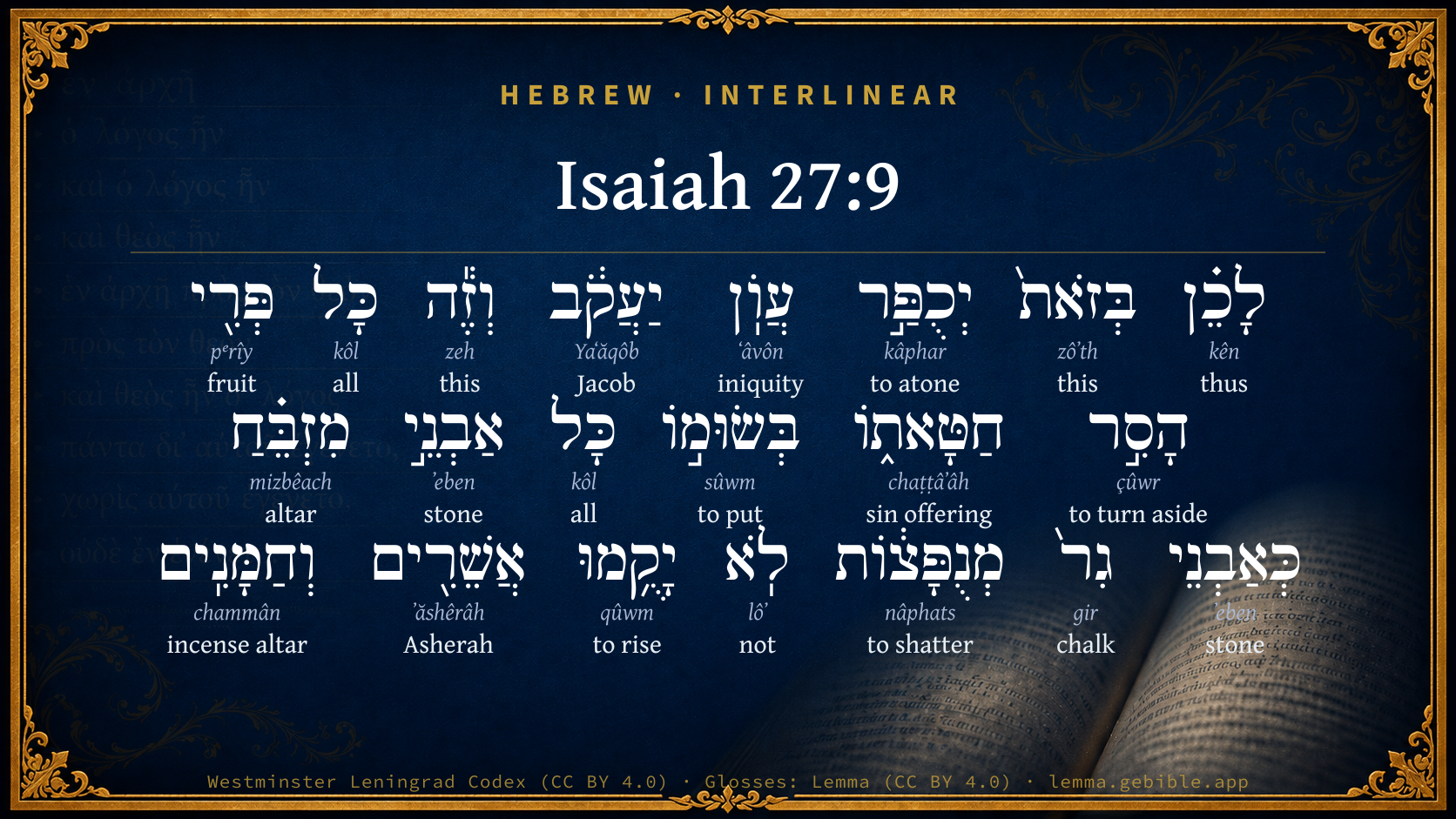
Hebrew (Westminster Leningrad Codex) Isaiah 27:9 appears in the Hebrew Old Testament. The text above is from the Westminster Leningrad Codex. Each word links to its Strong’s number, a concise gloss, and parsing drawn from the Open Scriptures Hebrew Bible morphology. Click any word for its full Brown-Driver-Briggs (BDB) entry.
Download image
Cite this verse

Isaiah 27:9 (World English Bible). Public Domain. Lemma interlinear Bible study tool, https://lemma.gebible.app/v/isaiah/27/9.

Show BibTeX & RIS
BibTeX
RIS
English Translation
Therefore by this shall the iniquity of Jacob be forgiven, and this is all the fruit of taking away his sin: that he makes all the stones of the altar as chalk stones that are beaten in sunder, [so that] the Asherim and the sun-images shall rise no more.
World English Bible · Public Domain
Highlights
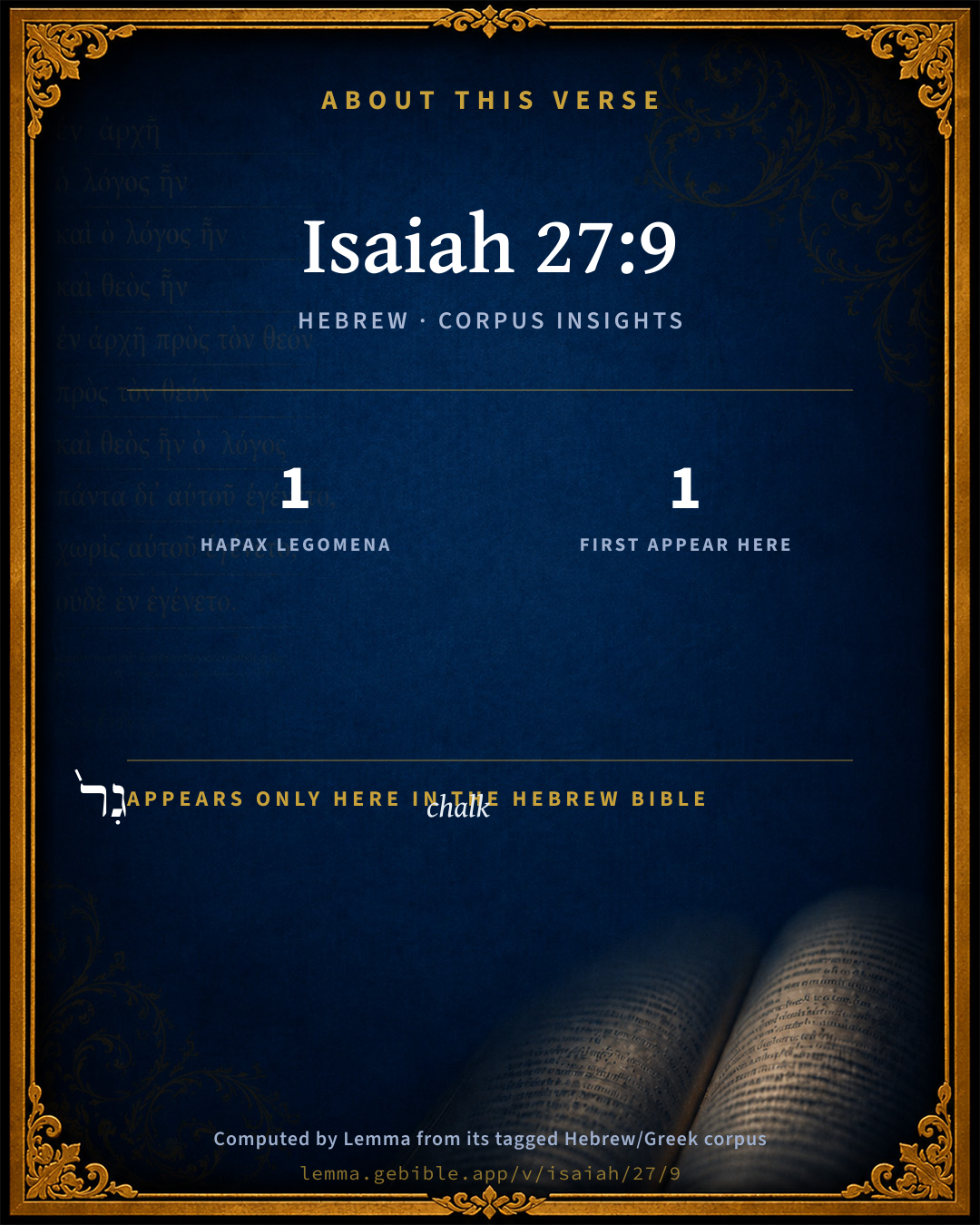
  • 1 hapax legomenon — only here in the Hebrew Bible
  • 1 first appearance in the Hebrew Bible
Full analysis ↓
Download a study sheet

One document with this verse’s original text, its word-by-word gloss line, the meaning frame, cross-references with their text, attributed commentary, and full source and license credits — printable, and it pastes into notes with its structure intact.

This verse Autodidact and up

Study sheet (.html) Plain text (.txt)

A passage Seminary Student

Up to 50 verses in one chapter. A passage sheet keeps up to 6 commentary sources and 12 cross-references per verse, in the order this page ranks them, and says so on the sheet whenever that leaves anything out. Ask for a single verse and you get the Autodidact verse sheet above.

Everything on this page stays free to read, with no account — the sheet is a download of what is already on screen, not access to it.

Want to remove ads? Support Godless Engineer
Compare translations 3

The same verse in 3 English versions, stacked beneath the original-language interlinear above. Click any original word for its lexicon entry.

Each is an independent rendering of the whole verse — the interlinear is not word-aligned to these translations.

Highlighted words mark where these versions differ — a whole-verse word diff, not a word-by-word alignment.

  • World English Bible Public Domain
    Therefore by this shall the iniquity of Jacob be forgiven, and this is all the fruit of taking away his sin: that he makes all the stones of the altar as chalk stones that are beaten in sunder, [so that] the Asherim and the sun-images shall rise no more.
  • King James Version Public Domain
    By this therefore shall the iniquity of Jacob be purged; and this is all the fruit to take away his sin; when he maketh all the stones of the altar as chalkstones that are beaten in sunder, the groves and images shall not stand up.
  • unfoldingWord Literal Text CC BY-SA 4.0
    Therefore, by this the iniquity of Jacob will be covered, and this all of the fruit of the removing of his sin: when he makes all of the stones of the altar like crushed stones of chalk; the Asherahs and sun images will not stand.

unfoldingWord Literal Text — © unfoldingWord, licensed CC BY-SA 4.0. Word-aligned USFM3 via Door43 (git.door43.org/unfoldingWord/en_ult).

Versions to compare (up to 4)

3 of 4 selected

Show all 18 translations

Every available English version of this verse, each an independent rendering of the whole verse.

  • World English Bible Public Domain
    Therefore by this shall the iniquity of Jacob be forgiven, and this is all the fruit of taking away his sin: that he makes all the stones of the altar as chalk stones that are beaten in sunder, [so that] the Asherim and the sun-images shall rise no more.
  • Berean Standard Bible Public Domain
    Therefore Jacob’s guilt will be atoned for, and the full fruit of the removal of his sin will be this: When he makes all the altar stones like crushed bits of chalk, no Asherah poles or incense altars will remain standing.
  • Majority Standard Bible Public Domain
    Therefore Jacob’s guilt will be atoned for, and the full fruit of the removal of his sin will be this: When he makes all the altar stones like crushed bits of chalk, no Asherah poles or incense altars will remain standing.
  • King James Version Public Domain
    By this therefore shall the iniquity of Jacob be purged; and this is all the fruit to take away his sin; when he maketh all the stones of the altar as chalkstones that are beaten in sunder, the groves and images shall not stand up.
  • American Standard Version (1901) Public Domain
    Therefore by this shall the iniquity of Jacob be forgiven, and this is all the fruit of taking away his sin: that he maketh all the stones of the altar as chalkstones that are beaten in sunder, `so that' the Asherim and the sun-images shall rise no more.
  • Revised Version (1885) Public Domain
    Therefore by this shall the iniquity of Jacob be purged, and this is all the fruit of taking away his sin; when he maketh all the stones of the altar as chalkstones that are beaten in sunder, so that the Asherim and the sun-images shall rise no more.
  • Geneva Bible (1599) Public Domain
    By this therefore shall the iniquitie of Iaakob be purged, and this is all the fruit, the taking away of his sinne: whe he shall make all the stones of the altars, as chalke stones broken in pieces, that the groues and images may not stand vp.
  • Douay-Rheims (1899) Public Domain
    Therefore upon this shall the iniquity of the house of Jacob be forgiven: and this is all the fruit, that the sin thereof should be taken away, when he shall have made all the stones of the altar, as burnt stones broken in pieces, the groves and temples shall not stand.
  • Young's Literal Translation Public Domain
    Therefore by this is the iniquity of Jacob covered, And this `is' all the fruit -- To take away his sin, in His setting all the stones of an altar, As chalkstones beaten in pieces, They rise not -- shrines and images.
  • Literal Standard Version CC BY-SA 4.0
    Therefore the iniquity of Jacob is covered by this, || And this [is] all the fruit—To take away his sin, || In his setting all the stones of an altar, || As chalkstones beaten in pieces, || They do not rise—Asherim and images.
  • Unlocked Literal Bible CC BY-SA 4.0
    So in this way, the iniquity of Jacob will be atoned for, for this will be the full fruit of the removal of his sin: when he will make all the altar stones as chalk and crushed to pieces, and no Asherah poles or incense altars will remain standing.
  • unfoldingWord Literal Text CC BY-SA 4.0
    Therefore, by this the iniquity of Jacob will be covered, and this all of the fruit of the removing of his sin: when he makes all of the stones of the altar like crushed stones of chalk; the Asherahs and sun images will not stand.
  • Darby Bible Public Domain
    By this, therefore, shall the iniquity of Jacob be purged; and this is all the fruit of the taking away of his sin: when he shall make all the stones of the altar as chalkstones that are crumbled in pieces, -- the Asherahs and the sun-images shall not stand.
  • World Messianic Bible Public Domain
    Therefore by this the iniquity of Jacob will be forgiven, and this is all the fruit of taking away his sin: that he makes all the stones of the altar as chalk stones that are beaten in pieces, so that the Asherah poles and the incense altars shall rise no more.
  • Webster's Bible Public Domain
    By this therefore shall the iniquity of Jacob be purged; and this is all the fruit to take away his sin; when he maketh all the stones of the altar as chalk-stones that are beaten asunder, the groves and images shall not stand up.
  • Free Bible Version CC BY-SA 4.0
    Through this experience Jacob's guilt will be forgiven. The removal of their sins will come to fruition when they take all the pagan altar stones and crush them to pieces like chalk—no Asherah poles or altars of incense will be left standing.
  • Bible in Basic English Public Domain
    So by this will the sin of Jacob be covered, and this is all the fruit of taking away his punishment; when all the stones of the altar are crushed together, so that the wood pillars and the sun-images will not be put up again.
  • JPS Tanakh (1917) Public Domain
    Therefore by this shall the iniquity of Jacob be expiated, and this is all the fruit of taking away his sin: when he maketh all the stones of the altar as chalkstones that are beaten in pieces, so that the Asherim and the sun-images shall rise no more.

Literal Standard Version (2020), Covenant Press — licensed CC BY-SA 4.0. Text via the HelloAO Bible API (eBible.org). Unlocked Literal Bible (unfoldingWord) — licensed CC BY-SA 4.0. Text via the HelloAO Bible API (eBible.org). unfoldingWord Literal Text — © unfoldingWord, licensed CC BY-SA 4.0. Word-aligned USFM3 via Door43 (git.door43.org/unfoldingWord/en_ult). Free Bible Version, Dr. Jonathan Gallagher — licensed CC BY-SA 4.0. Text via the HelloAO Bible API (eBible.org).

Word by word

More ways to search: Search by grammar → Find every occurrence → Compare this word →

Practice this passage: Drill this verse → Learn its vocabulary →

גִר֙
gir
H1615
“chalk”
Noun, Common, Masculine, Singular, Absolute
Part of Speech
Noun
Type
Common
Gender
Masculine
Number
Singular
State
Absolute
Full BDB Definition

Origin: perhaps from H3564

TWOT: 347a

chalk, lime
  1. לָכֵ֗ן kên H3651 “to/for · thus” Preposition + Adverb
  2. בְּזֹאת֙ zôʼth H2063 “in/at · this” Preposition + Pronoun, Demonstrative, Feminine, Singular
  3. יְכֻפַּ֣ר kâphar H3722 “to atone” Verb, Pual, Imperfect, 3rd Person, Masculine, Singular
  4. עֲוֺֽן ʻâvôn H5771 “iniquity of” Noun, Common, Both, Singular, Construct
  5. יַעֲקֹ֔ב Yaʻăqôb H3290 “Jacob” Noun, Proper
  6. וְזֶ֕ה zeh H2088 “and · this” Conjunction + Pronoun, Demonstrative, Masculine, Singular
  7. כָּל kôl H3605 “all of” Noun, Common, Masculine, Singular, Construct
  8. פְּרִ֖י pᵉrîy H6529 “fruit of” Noun, Common, Masculine, Singular, Construct
  9. הָסִ֣ר çûwr H5493 “to turn aside” Verb, Hiphil, Infinitive Construct
  10. חַטָּאת֑וֹ chaṭṭâʼâh H2403 “sin offering · his” Noun, Common, Feminine, Singular, Construct + Suffix, Personal, 3rd Person, Masculine, Singular
  11. בְּשׂוּמ֣וֹ sûwm H7760 “in/at · to put · him” Preposition + Verb, Qal, Infinitive Construct + Suffix, Personal, 3rd Person, Masculine, Singular
  12. כָּל kôl H3605 “all of” Noun, Common, Masculine, Singular, Construct
  13. אַבְנֵ֣י ʼeben H68 “stones of” Noun, Common, Feminine, Plural, Construct
  14. מִזְבֵּ֗חַ mizbêach H4196 “altar” Noun, Common, Masculine, Singular, Absolute
  15. כְּאַבְנֵי ʼeben H68 “like/as · stones of” Preposition + Noun, Common, Feminine, Plural, Construct
  16. מְנֻפָּצ֔וֹת nâphats H5310 “shattered” Verb, Pual, Participle Passive, Feminine, Plural, Absolute
  17. לֹֽא lôʼ H3808 “not” Particle, Negative
  18. יָקֻ֥מוּ qûwm H6965 “to rise” Verb, Qal, Imperfect, 3rd Person, Masculine, Plural
  19. אֲשֵׁרִ֖ים ʼăshêrâh H842 “Asherah” Noun, Proper
  20. וְחַמָּנִֽים chammân H2553 “and · incense altars” Conjunction + Noun, Common, Masculine, Plural, Absolute

About this verse

These counts appear in no published source. They are computed here, from the morphology-tagged text and Lemma’s own curated glosses. What Lemma adds →

21
words
19
distinct lemmas
Prophets
section

Notable vocabulary

1 hapax legomenon — a word that appears only here in the entire Hebrew Bible:

First appearance in Scripture

This word makes its first canonical appearance in the Hebrew Bible here:

Shared distinctive vocabulary

וְחַמָּנִֽים incense altar H2553 occurs in 8 verses of the Hebrew Bible. Also found in:

Grammatical profile

  • 5 verbs
  • 12 nouns
  • 2 pronouns
  • 1 adverb
  • 1 particle

Verb forms

  • יְכֻפַּ֣ר Pual · Imperfect
  • הָסִ֣ר Hiphil · Infinitive Construct
  • בְּשׂוּמ֣וֹ Qal · Infinitive Construct
  • מְנֻפָּצ֔וֹת Pual · Participle Passive
  • יָקֻ֥מוּ Qal · Imperfect

Repetition

Words recur within this verse — often emphatic in Hebrew:

  • כָּל all H3605 ×2
  • אַבְנֵ֣י stone H68 ×2

Hebrew & Septuagint length

In English translation the verse runs 49 words from the Hebrew and 56 from the Septuagint (LXX English) — closely comparable.

A rough comparison of the two English renderings, which tokenize alike — not a word-level alignment.

Word counts can differ between the Hebrew and the Greek without any difference in meaning — e.g. the Hebrew direct-object marker אֵת has no separate Greek word, and Greek often adds the article ὁ.

Cross-references

28

Topical passages linked to Isaiah 27:9 in the Treasury of Scripture Knowledge — connected by theme and wording, ordered by reader-vote popularity; previews shown in the World English Bible.

  • Isaiah 48:10 Behold, I have refined you, but not as silver; I have chosen you in the furnace of affliction.
  • Romans 11:27 This is my covenant to them, When I will take away their sins."
  • Isaiah 17:8 They shall not look to the altars, the work of their hands; neither shall they have respect to that which their fingers have made, either the Asherim, or the sun-images.
  • Daniel 11:35 Some of those who are wise shall fall, to refine them, and to purify, and to make them white, even to the time of the end; because it is yet for the time appointed.
  • Exodus 34:13 but you shall break down their altars, and dash in pieces their pillars, and you shall cut down their Asherim;
  • 2 Kings 25:9 He burnt the house of Yahweh, and the king's house; and all the houses of Jerusalem, even every great house, burnt he with fire.
  • 2 Kings 25:13–17 The pillars of brass that were in the house of Yahweh, and the bases and the brazen sea that were in the house of Yahweh, did the Chaldeans break in pieces, and carried the brass of them to Babylon.
  • 2 Chronicles 14:5 Also he took away out of all the cities of Judah the high places and the sun-images: and the kingdom was quiet before him.
  • 2 Chronicles 34:4 They broke down the altars of the Baals in his presence; and the sun-images that were on high above them he hewed down; and the Asherim, and the engraved images, and the molten images, he broke in pieces, and made dust of them, and strewed it on the graves [of those] who had sacrificed to them.
  • 2 Chronicles 36:19 They burnt the house of God, and broke down the wall of Jerusalem, and burnt all the palaces of it with fire, and destroyed all the goodly vessels of it.
  • Ezra 3:2–3 Then stood up Jeshua the son of Jozadak, and his brothers the priests, and Zerubbabel the son of Shealtiel, and his brothers, and built the altar of the God of Israel, to offer burnt offerings thereon, as it is written in the law of Moses the man of God.
  • Psalms 119:67 Before I was afflicted, I went astray; But now I observe your word.
  • Psalms 119:71 It is good for me that I have been afflicted, That I may learn your statutes.
  • Proverbs 20:30 Wounding blows cleanse away evil, And beatings purge the innermost parts.
  • Isaiah 1:24–25 Therefore the Lord, Yahweh of Hosts, The Mighty One of Israel, says: "Ah, I will get relief from my adversaries, And avenge myself of my enemies;
  • Isaiah 1:29 For they shall be ashamed of the oaks which you have desired, And you shall be confounded for the gardens that you have chosen.
  • Isaiah 2:12–21 For there will be a day of Yahweh of Hosts for all that is proud and haughty, And for all that is lifted up; And it shall be brought low:
  • Isaiah 4:4 when the Lord shall have washed away the filth of the daughters of Zion, and shall have purged the blood of Jerusalem from its midst, by the spirit of justice, and by the spirit of burning.
  • Ezekiel 11:18 They shall come there, and they shall take away all the detestable things of it and all the abominations of it from there.
  • Ezekiel 20:38 and I will purge out from among you the rebels, and those who disobey against me; I will bring them forth out of the land where they sojourn, but they shall not enter into the land of Israel: and you shall know that I am Yahweh.
  • Ezekiel 24:11–14 Then set it empty on the coals of it, that it may be hot, and the brass of it may burn, and that the filthiness of it may be molten in it, that the rust of it may be consumed.
  • Hosea 14:8 Ephraim, what have I to do any more with idols? I answer, and will take care of him. I am like a green fir tree; From me your fruit is found."
  • Micah 5:13–14 I will cut off your engraved images and your pillars out of your midst; And you shall no more worship the work of your hands.
  • Zechariah 13:2 It will come to pass in that day, says Yahweh of Hosts, that I will cut off the names of the idols out of the land, and they will no more be remembered; and also I will cause the prophets and the spirit of impurity to pass out of the land.
  • Malachi 3:2–3 "But who can endure the day of his coming? And who will stand when he appears? For he is like a refiner's fire, and like launderer's soap;
  • 1 Corinthians 11:32 But when we are judged, we are punished by the Lord, that we may not be condemned with the world.
  • Hebrews 12:6 For whom the Lord loves, he chastens, And scourges every son whom he receives."
  • Hebrews 12:9–11 Furthermore, we had the fathers of our flesh to chasten us, and we paid them respect. Shall we not much rather be in subjection to the Father of spirits, and live?

Cross-references courtesy of OpenBible.info (CC BY 4.0).

Hebrew and Greek witnesses Masoretic Hebrew ↔ Greek Septuagint

The same verse in the two great witnesses to the Old Testament, shown verse-for-verse.

These are two independent witnesses, not word-aligned to each other, and the Septuagint is shown in lemma (dictionary) form.

Hebrew Isaiah 27:9 Masoretic · Westminster Leningrad Codex

לָכֵ֗ן בְּזֹאת֙ יְכֻפַּ֣ר עֲוֺֽן יַעֲקֹ֔ב וְזֶ֕ה כָּל פְּרִ֖י הָסִ֣ר חַטָּאת֑וֹ בְּשׂוּמ֣וֹ כָּל אַבְנֵ֣י מִזְבֵּ֗חַ כְּאַבְנֵי גִר֙ מְנֻפָּצ֔וֹת לֹֽא יָקֻ֥מוּ אֲשֵׁרִ֖ים וְחַמָּנִֽים

Therefore by this shall the iniquity of Jacob be forgiven, and this is all the fruit of taking away his sin: that he makes all the stones of the altar as chalk stones that are beaten in sunder, [so that] the Asherim and the sun-images shall rise no more.

World English Bible · Public Domain

Greek LXX Isaiah 27:9 Septuagint · lemma form

διά οὗτος ἀποαἱρέω ὁ ἀνομία ἰακώβ καί οὗτος εἰμί ὁ εὐλογία αὐτός ὅταν ἀποαἱρέω αὐτός ὁ ἁμαρτία ὅταν τίθημι πᾶς ὁ λίθος ὁ βωμός κατακόπτω ὡς κονία λεπτός καί οὐ μή μένω ὁ δένδρον αὐτός καί ὁ εἴδωλον αὐτός ἐκκόπτω ὥσπερ δρυμός μακράν

Therefore shall the iniquity of Jacob be taken away; and this is his blessing, when I shall have taken away his sin; when they shall have broken to pieces all the stones of the altars as fine dust, and their trees shall not remain, and their idols shall be cut off, as a thicket afar off.

LXX2012 (modern English Septuagint) · Public Domain

On this verse, Adam Clarke's Commentary discusses the Septuagint’s reading. Read the note in Commentary ↓

Hebrew: Westminster Leningrad Codex (CC BY 4.0). Greek: Septuagint (public domain); English from LXX2012 (modern English Septuagint) (Public Domain). How the Septuagint differs from the Hebrew →

Targum (Aramaic paraphrase)

1

The Targum is the ancient Jewish Aramaic paraphrase of the Hebrew Scriptures — an interpretive translation, not the Hebrew text itself. Onkelos (literal) and Pseudo-Jonathan (expansive) render the Torah, and Jonathan the Prophets. Coverage is partial: where no permissively-licensed English translation exists for a verse, only the Aramaic is shown. This is verse-level text, not a word-by-word alignment to the Hebrew.

  1. Targum Jonathan Prophets (Joshua–Malachi)
    בְּכֵן בְּדָא יִשְׁתְּבֵיקוּן חוֹבַי בֵּית יַעֲקֹב וְדֵין כָּל עוֹבָדֵי אַסְטִיוּת חוֹבוֹהִי בְּשַׁוְיוּתֵהּ כָּל אַבְנֵי אֱגוֹרָא כְּאַבְנָא גִיר מְנַפְצָן לָא יִתְקַיְמוּן אֲשֵׁרַיָא וְחַנִסְנְסַיָא:

    By this, therefore, shall the sins of the house of Jacob be forgiven; and thus it shall be with all the works of the perverseness of their sins, namely, that they shall make all the stones of the (idolatrous) altar like chalk stones that are beaten asunder; the groves and the sun-images shall not; be raised up again.

    Targum Jonathan — Aramaic: “Mikraot Gedolot” (public domain). English: “Sefaria Community Translation” (CC0 1.0 (public-domain dedication)); “London "Chaldee Paraphrase," 1871” (public domain). Text via Sefaria.

Commentary

Notes on Isaiah 27:9 from classic Christian and Jewish commentators (each source and its license shown beneath its notes). The classic Christian expositions comment on the surrounding passage and are grouped to its opening verse, so a note may address several verses; the Jewish commentaries on the Tanakh (Rashi and others) are per-verse, so they appear only where the commentator wrote on this verse.

Lemma curates 59 commentaries, every one of them public domain or Creative Commons licensed, each selected and text-cleaned for this edition rather than reprinted as found. About our sources →

Trapp's Complete Commentary

John Trapp

Isa 27:9 By this therefore shall the iniquity of Jacob be purged; and this [is] all the fruit to take away his sin; when he maketh all the stones of the altar as chalkstones that are beaten in sunder, the groves and images shall not stand up.

Ver. 9. By this therefore shall the iniquity of Jacob be purged.] Hac re - i.e., deportations in Babyloniam, saith Piscator: "by this," that is, by their being carried captive into Babylon, as it was made a means to bring the elect to repentance. As one poison is antidotary to another, so is affliction to sin. Crosses are leeches to suck out the noxious blood, flails to thresh off our husks, files to brighten our graces, &c. Sanctified afflictions, said Mr Dod, are good promotions. "Corrections of instructions are the way of life," {Pro 16:23} For though "not joyous but grievous at present, yet afterwards they yield the peaceable fruit of righteousness unto them that are thereby exercised." {Heb 12:11} It fareth with God’s afflicted as it did once with those that had the sweating sickness in this land - if they slept, they died. To keep them waking, therefore, they were smitten with rosemary branches, whereat though they cried out, You kill me! you kill me! yet it proved a happy means to keep them alive. It was good for David that he was afflicted, {Psa 119:71} it rid him of those two evil humours, high mindedness and earthly mindedness. {Psa 131:1}

And this is all the fruit.] God’s rod, like Aaron’s, blossometh; and, like that of Jonathan, it hath honey at the end of it. A good use and a good issue of afflictions is ever to be prayed for. I read of a gracious man who, lying under great torments of the stone, would often cry out, The use, Lord, the use! And Mr Perkins, in like case, desired his friends to pray to God, not so much for ease of his pain, as for increase of his faith and patience. Perdidisti fructum afflictionum, said Augustine to some in his time, and it was a great loss doubtless.

To take away his sin.] The sin, not the man. See Psa 99:8. A leprous or ulcerous member a man loves as it is his own flesh, {Eph 5:29} though he loatheth the corruption and putrefaction that is in it; therefore he cuts it not off, but plastereth it; whereas a wart or wen {lump} he cutteth off as not his flesh: so here. {a}

When he maketh all the stones of the altar as chalk stones.] When he, that is, Jacob, in token of his true repentance, abandoneth all his mawmets (images) and monuments of idolatry, and them abolisheth and demolisheth so as never to be re-edified. The Jews, after the captivity, were so far from idolatry, that they would not admit a painter or carver into their city. And how zealous they were to keep their temple from such defilement, both in the time of Antiochus Epiphanes and of the Romans, histories show us.

{a} Dr Godwyn.

John Trapp, A Commentary or Exposition upon All the Books of the Old and New Testament (1647–1656) — public domain. Text from a community e-Sword module.

The Biblical Illustrator

Joseph S. Exell

Isa_27:9

By this therefore shall the iniquity of Jacob be purged

Gods end in sending calamities and afflictions on His people

Motives to enforce this duty of complying with the Lords end, in afflicting and bringing calamities upon us.

1. Otherwise our calamities are like to continue.

2. This may increase the affliction upon you, add more weight, and put more sting into it.

3. This may multiply your afflictions, and make them come in upon you as waves and billows in a storm.

4. This may bring more grievous evils upon you than any you have yet met with.

5. The Lord may give you over and refuse to correct any more.

6. He may leave you to spiritual judgments. Outward afflictions are His rods, but these are His swords; and when upon incorrigibleness under those, He takes up these, His wrath is raised to the height.

7. This is the way to be rejected of the Lord; for those that are not His to be rejected wholly, for those that are His to be in part rejected Jer_7:28-29).

8. This provokes the Lord to bring destruction. (D. Clarkson.)

Mortifying sin

If you would subdue your iniquity and mortify your sin--

1. Get mortifying apprehensions of it.

2. Get mortifying resolutions. Get your hearts resolved against sin; to prosecute it to the death; to engage all the strength you have, and can procure, in such a prosecution of it; resolve not to spare it; not to forbear it in the least; not to tolerate it, nor suffer it to have any quiet abode in any part of heart or life; not to enter into a parley or treaty with it; not to yield to any cessation, much less to make any peace with it, no more than the Israelites with those whom the Lord had devoted to destruction.

3. Get mortifying affections--affections which carry the heart from sin, or set it against it.

4. Get mortifying graces, three especially, love to God, faith in Him, and fear of Him.

5. Use mortifying means, those which the Lord has appointed for this end. (D. Clarkson.)

The Biblical Illustrator, edited by Joseph S. Exell (c. 1880s–1900s) — public domain. Text from a community e-Sword module.

Joseph Benson's Commentary

Isa 27:9. By this therefore — By this manner of God’s dealing with his people; shall the iniquity of Jacob be purged — Hebrew, יכפר, expiated, or forgiven: that is, by these chastisements Jacob shall be brought to true repentance, and in consequence thereof shall be pardoned. And this is all the fruit — The effect designed to be produced, by these severe corrections; to take away his sin — Not to destroy the sinner, as others are often destroyed by the calamities brought upon them, but only to take away the guilt and power of his sins; when he, &c. — Which sin of Jacob shall be taken away, and the punishment thereof removed, when he shall give such an evidence of the reality of his repentance as to destroy all the objects, instruments, means, and signs of idolatry out of the land; when he maketh the stones of the altar — Namely, the idolatrous altar, or altars, as chalk-stones — That is, broken into small pieces, and reduced to powder and dust. Possibly he may say, the altar, with respect to that particular altar which Ahaz had set up in the place of God’s altar; and this prophecy might be delivered in Ahaz’s time, while that altar stood and was used. He seems to allude to Moses’s showing his detestation of idolatry, by taking the golden calf, burning it, and grinding it to powder: and he intimates that when their repentance should be sincere, it would discover itself in a similar way. It must be observed, that of all sins, which are of a heinous nature, the Jews, till they were carried into captivity, were most inclined to idolatry, and for that sin especially, most of God’s judgments, which they had hitherto suffered, had been inflicted upon them. But of that most unreasonable and wicked inclination they were in a great measure cured by that severe punishment, the seventy years captivity in Babylon. The groves and images shall not stand up — Shall be thrown down with contempt and indignation.

Joseph Benson's Commentary on the Old and New Testaments (1811–1818) — public domain. Text from a community e-Sword module.

Tyndale Open Study Notes

Tyndale Open Resources

27:9 God’s justice requires him to punish sin. That punishment is designed to correct behavior and to purify. Being conquered and exiled wasThe Exile occurred so that to purge Israel’s wickedness and to take away all her sin (see Rom 11:27). • This was to be the end of all the pagan worship in Israel, including the incense altars and the poles that were used in worshiping the goddess Asherah.

Tyndale Open Study Notes — © Tyndale Open Resources, licensed CC BY-SA 4.0. Text via the HelloAO Bible API.

Geneva Bible (1599)

Geneva Bible translators

He showeth that there is no true repentance, nor full reconciliation to God, till the heart be purged from all idolatry, and the monuments thereof be destroyed.

Geneva Bible (1599) marginal notes — public domain. Text via Bolls.life.

Jamieson, Fausset & Brown

Robert Jamieson, A. R. Fausset & David Brown

By this--exile of Israel (the "sending away," Isa 27:8).

purged--expiated [HORSLEY].

all the fruit--This is the whole benefit designed to be brought about by the chastisement; namely, the removal of his (Israel's) sin (namely, object of idolatry; Deu 9:21; Hos 10:8).

when he--Jehovah; at the destruction of Jerusalem by Nebuchadnezzar, His instrument. The Jews ever since have abhorred idolatry (compare Isa 17:8).

not stand up--shall rise no more [HORSLEY].

Jamieson, Fausset & Brown — Commentary Critical and Explanatory on the Whole Bible (1871) — public domain (CC PDM 1.0). Text via the HelloAO Bible API.

Adam Clarke's Commentary

Verse 9. The groves - "And if the groves"] ולא velo. Four MSS., two ancient, of Kennicott's, and one ancient of my own, with the Septuagint; this makes a fuller sense.

Adam Clarke's Commentary on the Bible (1810–1826) — public domain. Text from a community e-Sword/MySword module.

Ellicott's Commentary for English Readers

(9) By this therefore shall the iniquity of Jacob be purged.—The pronoun may refer either to the chastisement of the previous verse as the instrument of purification (preferably), or to the destruction of idols which follows as the result and proof of that purification, the end contemplated by Jehovah in His chastisements.

This is all the fruit to take away his sin.—Better, of taking away his sin. The words repeat the thought of the previous clause. The fruit of repentance and forgiveness will be found in rooting out all vestiges of idol-worship. The LXX., “when I shall take away their sins,” is quoted by St. Paul in Rom_11:27.

The groves and images.—Literally, as elsewhere, the Asherahs, or the sun-images, the two leading features of the cultus which Israel had borrowed from the Phœnicians. In the action of Josiah (2Ch_34:3-4) we may, with little doubt, trace a conscious endeavour to fulfil the condition which Isaiah had thus proclaimed. He sought to “purge” Judah and Jerusalem from the “groves and the carved (sun) images, and molten images.”

A Bible Commentary for English Readers, edited by Charles John Ellicott (1878–1897) — public domain. Text from a community e-Sword module.

The Cambridge Bible for Schools and Colleges

gen. ed. J. J. S. Perowne

9. The condition of restoration and forgiveness. Therefore points back to the idea of Isa_27:7—the moderation of Israel’s punishment,—while By this, i.e. (“on this condition”) points forward to the end of the verse, the removal of idolatrous emblems.

be purged] be expiated (R.V. marg.).

and this is all … sin] Better: and this is the whole fruit of the taking away of his sin. “Fruit” seems here to mean contemplated or expected issue,—“the aim.”

when he maketh all the stones of the altar] Rather, that he should make all altar-stones, &c.

the groves and images, &c.] or, the Asherim and sun-pillars (see on Isa_17:8) shall not remain standing.

The Cambridge Bible for Schools and Colleges (gen. ed. J. J. S. Perowne; Cambridge University Press, 1878–1918) — public domain. Text from a community e-Sword module.

John Gill's Exposition

By this therefore shall the iniquity of Jacob be purged,.... Or "expiated", or "atoned" (a); not that afflictions are atonements for sin, or give satisfaction to divine justice for it; but they are the means of bringing the Lord's people to a sense of their sins, and to repentance and humiliation for them, and confession of them, and of leading them to the blood and sacrifice of Christ, by which they are expiated and atoned, and which the Spirit of God brings near, and applies unto them; whereby their sins, they are convicted of by means of afflictions, and which lay heavy upon their consciences, are purged away, and removed from them:

and this is all the fruit, to take away sin; this is the design and use of afflictions, the profit and advantage of them to the saints, that, being humbled for their sins, they depart from them, leave and forsake them; as well as the guilt of them is taken away from their consciences, through the application of pardoning grace, upon their repentance; see Job 36:8 this shows another difference between the afflictions of God's people and of others: namely, in the use and end of them. The sin of idolatry seems to be particularly designed by what follows; unless the sin of the present Jews, in their disbelief and rejection of the Messiah, should be rather intended; which, through their long affliction, they will be convinced of in the latter day, and it will be taken away from them, and be purged and expiated through the atoning sacrifice of Christ, the Saviour and Deliverer, they will embrace, Rom 11:25,

when he maketh all the stones of the altar as chalkstones that are beaten in sunder; that is, when Jacob, or the people of the Jews, being convinced of their idolatry by their afflictions, shall pull down all their idolatrous altars; perhaps particularly referring to that which Ahaz made, Kg2 16:10 and remove the stones thereof, and break them to pieces, as chalkstones for lime, which is easily done:

the groves and the images shall not stand up; erect, to be worshipped; but shall be thrown down, demolished, and broke to pieces; and, by thus abandoning their idols and idolatrous practices, they will show the sense they have of their sins, and the sincerity of their repentance; and it is to be observed, that the Jews, after their return from the Babylonish captivity, never practised idolatry more, not in the literal sense; perhaps some respect may be had here to the time when they shall look on him whom they have pierced, and mourn; and when they shall renounce all their legal sacrifices, traditions of the elders, and their own righteousness, their idols, and look alone to the sacrifice of Christ, and declare against all the idolatry of the church of Rome, and all antichristian worship.

(a) "propitiabitur", Pagninus, Montanus; "expiabitur", Piscator.

John Gill's Exposition of the Whole Bible (1746–1763) — public domain (CC PDM 1.0). Text via the HelloAO Bible API.

Albert Barnes' Notes on the Bible

By this - This verse states the whole design of the punishment of the Jews. They were taken away from their temple, their city, and their land; they were removed from the groves and altars of idolatry by which they had been so often led into sin; and the design was to preserve them henceforward from relapsing into their accustomed idolatry.

The iniquity of Jacob - The sin of the Jewish people, and particularly their tendency to idolatry, which was their easily besetting sin.

Be purged - (see the note at Isa 1:25).

And this is all the fruit - And this is all the “object” or “design” of their captivity and removal to Babylon.

When he maketh all the stones of the altar as chalk stones - That is, Yahweh shall make the stones of the altars reared in honor of idols like chalk stones; or shall throw them down, and scatter them abroad like stones that are easily beaten to pieces. The sense is, that Yahweh, during their captivity in Babylon, would overthrow the places where they had worshipped idols.

The groves and images shall not stand up - The groves consecrated to idols, and the images erected therein (see the note at Isa 17:8).

Albert Barnes' Notes on the Bible (1834–1885) — public domain. Text from a community e-Sword/MySword module.

Haydock's Catholic Bible Commentary

Jacob; viz., of such of them as shall be converted. (Challoner) --- Altar, dedicated to idols: then he shall obtain pardon. (Calmet)

George Leo Haydock (1774–1849), Haydock's Catholic Family Bible and Commentary, 1859 edition — public domain. Excludes Psalms (Douay-Rheims chapter numbering differs from Protestant) and Deuterocanonical books (Catholic canon only).

Matthew Poole's English Annotations

By this, by this manner of God’s dealing with his people, therefore, that the difference between Jacob and his enemies in their several sufferings may appear,

shall the iniquity of Jacob be purged, Heb. expiated or forgiven upon their true repentance, which shall be the happy effect of their chastisement.

This is all the fruit to take away his sin; the effect hereof shall not be to destroy the sinner, as it is in other men, but only to take away the guilt and power of their sins.

When he maketh; which sin of Jacob’s shall be purged and taken away, and the judgment removed, when he shall truly repent of all his sins, and especially of his idolatry, to which they were most inclined, and for which the most of God’s judgments which they had hitherto felt had been inflicted upon them.

The altar; which by a usual enallage may be put for the altars, to wit, their idolatrous altars, as is evident from the following words. Possibly he may say the altar with respect to that particular altar which Ahaz had set up in the place of God’s own altar; and this prophecy might be delivered either to the prophet, or by him to the people, in Ahaz’s time, while that altar stood and was used.

As chalk stones; when he shall break all those goodly altars in pieces, which God by his law had enjoined.

That are beaten in sunder; which kind of stones are of themselves apt to break into small pieces, and by the artificer are broken into smaller pieces for making mortar. He seems to allude to that fact of Moses, who, to show his detestation of idolatry, took the golden calf, and burnt it, and ground it to powder; and intimates, that when their repentance should be sincere, it would discover itself by their zeal in destroying the instruments of their idolatry. The groves; which were frequently erected to the honour of idols, of which we have many instances in Scripture, which God therefore commanded his people to destroy, Deu 7:5; 12:3.

Shall not stand up; shall be thrown down with contempt and indignation.

Matthew Poole's English Annotations on the Holy Bible (1683–1685) — public domain. Text from a community e-Sword/MySword module.

Whedon's Commentary on the Bible

Daniel D. Whedon

9. By this — By this sending away to Babylon.

Purged — Of idolatrous tendencies forever.

The fruit to take away his sin — The object or overruling purpose of the captivity.

As chalkstones — The old idolatrous altars in Judea are to crumble down as chalk crumbles in long weathering. The limestone of Judea is what, in geology, is called cretaceous, and easily crumbles or wears away. Likewise the old idolatrous groves, in which licentious rites were enacted, shall be cut down, and the sun images (Ashtoreth and Baal) destroyed.

Daniel D. Whedon (gen. ed.), Commentary on the Old and New Testaments (1874–1909) — public domain. Text from a community e-Sword module.

The Pulpit Commentary

By this; i.e. "by the punishment inflicted." God accepts punishment as an expiation of sin; and this punishment of Judah was especially intended to be expiatory, and to remove at once his guilt, and the evil temper which had led him into sin. Its fruit would be a revulsion from idolatry, which would show itself in a fierce determination to destroy all idolatrous emblems and implements, altars, groves, images, and the like. This spirit was strongly shown in the Maccabee period. (see RAPC 1Ma 5:44, 68 10:84 13:47, etc.) He maketh all the stones of the altar as chalkstones. A calcining of the stones into lime is probably intended. It was usual to subject the idolatrous objects to the action of fire, and then to stamp them into powder. (2Ki_23:4, 2Ki_23:6, 2Ki_23:11, 2Ki_23:12, 2Ki_23:15, etc.) The groves and images. (comp. 1Ki_15:13 1Ki_16:33 2Ki_17:10 2Ch_14:3; and see the comment on Isa_17:8)

Repentance proved in deeds.

The first clause may be translated thus: "On these terms shall the guilt of Jacob be purged." There must be the signs of reformation the actual destruction of idols and all idol-associations, as the proof and manifestation of the declared heart-surrender of idolatry. The child"s verse is correct theology and practical godliness"Repentance is to leave The sins we loved before; And show that we in earnest grieve, By doing so no more.

The very "stones of the altar" must be as "chalkstones that are beaten in sunder" if Jacob would make plain its repentance of its idolatries, and come to receive Divine forgiveness. Illustrations may be taken from the practical reformations on which Hezekiah and Josiah insisted as the outward signs of the national repentance. From this verse deal with the constant temptation to rest in mere sentiment, and impress the demand which God ever makes for proof in act of the repentance, or the faith, or the humility, or the zeal, that may be possessed. As our Savior expressed the same point in another of its connections, "If ye know these things, happy are ye if ye do them.

I GOOD SENTIMENTS ARE GOOD BEGINNINGS. Therefore in preachings and teachings appeal is properly made to feeling; effort is made to arouse emotions and to persuade. By the way of the heart access can often be gained to a man; and Scripture provides material for emotional appeals. "Knowing therefore the terror of the Lord, we persuade men." To move feeling, and to awaken good sentiment, is at least to make a breach in the walls. It is a beginning, and there is hope of what may be further accomplished when such a beginning is made. But we should be alive to the constant disposition of men to rest in sentiment. There is a subtle pleasure in feeling deeply. We easily get a kind of satisfaction in our good sentiments; and so Scripture roughly shakes down the satisfaction by calling such things "refuges of lies," or staffs that pierce the hand that leans on them.

II GOOD SENTIMENTS MAY SOON FADE. They always do when they remain as sentiments, and do not become motives to action. Our minds are constantly passing on to fresh things, and the older ones grow dim in the distance. If things are to keep up their interest, we must put continuous thought to them, and make them bear on daily conduct. We weep over a pathetic story-book, but in a little while all is forgotten as a dream when one awaketh. It would be a most humbling sight for us all if God were to show us the great heap of beautiful sentiments we once had and enjoyed.

III GOOD SENTIMENTS HAVE NO VOICE THAT GOD CAN HEED. If we offer such things to him, he will entirely withdraw and hide himself within a cloud, and wait and see how long the good sentiment will last. Penitence that is only a sensational sigh or tear he will not regard. It means nothing. It is but a passing ripple on a pool. Why should he turn aside to notice that? This thought will unfold into a practical dealing with the danger of forced emotions in revivalistic services; or the straining of religious feeling in children and young people. Mere emotion is too light a thing to ascend as prayer to the throne of God.

IV GOOD SENTIMENTS MUST SPEAK TO GOD THROUGH DEEDS. YOU say you repent. But the supreme question is What has your repentance made you do? You repent of that sin: then have you put it away? You repent of that wrong to your neighbor: then have you, as far as possible, put the wrong right? You repent of your idolatry: then have you broken up your idol-altars? Corresponding actions, "works meet for repentance, these are the terms of "purging;" this is the fruit to take away all the sin. R.T.

The Pulpit Commentary (1880–1919), ed. H.D.M. Spence-Jones & Joseph S. Exell — public domain. Text from a community e-Sword module.

John Wesley's Explanatory Notes

By this - By this manner of God's dealing with them. When - Which sin of Jacob's shall be purged, when he shall truly repent of all his sins, and especially of his idolatry. Altar - Their idolatrous altars. Possibly he may say the altar, with respect to that particular altar, which Ahaz had set upon the place of God's own altar; and this prophecy might be delivered in Ahaz's time, while that altar stood. Chalk-stones - When he shall break all those goodly altars in pieces. Not stand - Shall be thrown down with contempt.

John Wesley, Explanatory Notes Upon the Whole Bible (1754–1765) — public domain. Text via the GEBible commentary corpus.

Keil & Delitzsch

C. F. Keil & F. Delitzsch

He was angry, but not without love; He punished, but only to be able to pardon again. "Therefore will the guilt of Jacob be purged thus: and this is all the fruit of the removal of his son: when He maketh all altar-stones like chalk-stones that are broken in pieces, Astarte images and sun-pillars do not rise up again." With the word "therefore" (lâcēn) a conclusion is drawn from the expression "by measure." God punished Israel "by measure;" His punishment is a way to salvation: therefore it ceases as soon as its purpose is secured; and so would it cease now, if Israel would thoroughly renounce its sin, and, above all, the sin of all sins, namely idolatry. "Thus" (by this) refers to the בּשׂומו which follows; "by this," namely the breaking to pieces of the altars and images of the moon goddess; or possibly, to speak more correctly, the goddess of the morning-star, and those of the sun-god as well (see Isa 17:8). By the fact that Israel put away the fundamental cause of all mischief, viz., idolatry, the guilt for which it had yet to make atonement would be covered, made good, or wiped away (on cuppar, see at Isa 22:14). The parenthesis (cf., Isa 26:11) affirms that this very consequence would be all the fruit (cŏl-peri) desired by Jehovah of the removal of the sin of Israel, which the chastisement was intended to effect.

Keil & Delitzsch — Biblical Commentary on the Old Testament (1861–1891) — public domain (CC PDM 1.0). Text via the HelloAO Bible API. (Old Testament only.)

J. A. Alexander on Isaiah

Joseph Addison Alexander

“Therefore (because His chastisement was temporary and remedial in design) by this (affliction) shall Jacob’s iniquity be expiated (i.e., purged away), and this is all (its) fruit (or intended effect), to take away his sin, (as will appear) in his placing all the stones of the (idolatrous) altar like limestones dashed in pieces, (so that) groves and solar images (or images of Ashtoreth and Baal) shall arise no more.” The contrast between Israel and Babylon is still continued. Having said that the affliction of the former was but moderate and temporary, he now adds that it was meant to produce a most beneficent effect, to wit, the purgation of the people from the foul stain of idolatry. The sense required by the connection is, not that the breaking of the altars, as a spontaneous act, atoned for Israel’s previous idolatry, but that the exile cured them of that vice, and thereby led to the breaking of the altars.

Joseph Addison Alexander, The Prophecies of Isaiah (1846–1847; New York: Scribner, 1870–1878) — public domain. Text from a community e-Sword module.

unfoldingWord translationNotes

Door43 World Missions Community

So in this way

Possible meanings are 1) "this" refers to Yahweh sending the people into exile as Isaiah mentioned in the previous verse or 2) "this" refers to the actions that Isaiah will mention in the next part of verse 9.

the iniquity of Jacob will be atoned for

This can be stated in active form. AT: "Yahweh will purge the sin from the Israelites" or "Yahweh will forgive the sins of the Israelites" (See: Active or Passive)

iniquity of Jacob ... removal of his sin

Here "Jacob" represents the descendants of Jacob. AT: "iniquity of the Israelites ... removal of their sins" (See: Metonymy)

for this will be

Here "this" refers to the actions that Isaiah will describe in the next part of verse 9.

the full fruit

This speaks of the results of an action as if it were the fruit that grows as on a tree or vine. AT: "the result" (See: Metaphor)

he will make all the altar stones as chalk and crushed to pieces, and no Asherah poles or incense altars will remain standing

Here "he" refers to Jacob who represents his descendants. AT: "They will completely destroy all the altars on which they sacrifice to false gods, and they will remove all the Asherah idols and the altars on which they burn incense to false gods" (See: Metonymy)

translationWords

iniquity

Jacob

atonement

fruit

sin

altar

stone

Asherah

incense

unfoldingWord translationNotes — © Distant Shores Media and the Door43 World Missions Community, licensed CC BY-SA 4.0. Source: git.door43.org/Door43/en_tn.

Rashi

Rabbi Shlomo Yitzchaki (Rashi)

Therefore Now, too, with this, Jacob’s iniquity would be atoned for, to merit to be redeemed as then.

and this is all the fruit that is best for Me to remove his sin, if he makes all the altar stones of his high places, like crushed chalk-stones. מְנֻפָּצוֹת means crushed. Comp. (Ps. 137:9) “And crushes (וְנִפֵּץ) your babies.” Comp. (Jer. 13:14) “And I will crush them (וְנִפַּצְתִּים) one against the other.” גִּיר is a kind of dye.

asherim and sun images shall not rise So that they shall not retain their idolatry.

Rashi on the Tanakh — English translations: “The Judaica Press complete Tanach with Rashi, translated by A. J. Rosenberg” (CC BY 4.0); “Pentateuch with Rashi's commentary by M. Rosenbaum and A.M. Silbermann, 1929-1934” (public domain); “The Metsudah Tanach series, Lakewood, N.J” (CC BY 4.0); and “The Book of Joshua, Metsudah Publications, 1997” (CC BY 4.0). Text via Sefaria.

Ibn Ezra

Rabbi Abraham ibn Ezra

By this, therefore, shall the iniquity of Jacob be purged, etc. That is, no evil shall befall him—for the iniquity of Jacob (עון יעקב) is the source of all his evils —and the decree shall be rescinded, if they abolish idolatry.

הסר To take away. Infinitive.

The altar of Baal.

גיר Chalk.

מנפצות Beaten in sunder. Comp. תנפצם Thou shalt break them (Ps. 2:9).

לא יקמו Shall not stand. Shall not remain.

Ibn Ezra on the Tanakh — English translations: “Sefaria Community Translation” (CC0 1.0 (public-domain dedication)); “Yalkut, Sifsei Chachomim Chumash, Metsudah Publications, 2009” (CC BY 4.0); and “Commentary of Ibn Ezra on Isaiah - trans. by M. Friedlander, 1873” (public domain). Text via Sefaria.

Lesson kit

Teaching starters — assembled from the data on this page, not authored interpretation. Every prompt links to the verse data it draws on. Edit before teaching.

Isaiah, in the Prophets, opens this verse with 21 words (19 distinct Hebrew lemmas). Its most distinctive word is gir (“chalk”). A historical commentator’s framing appears above. Read the whole chapter for the surrounding context.

Discussion questions

  1. The word gir carries the sense “chalk.” How does it shape the verse?
  2. 1 word here appears nowhere else in the Hebrew Bible. Why might the author reach for such rare wording?
  3. This is the first place “chalk” appears in Scripture (first appears here). What does its debut here establish?
  4. How does Leviticus 26:30, which shares the word «incense altar», read alongside this verse?
  5. What does the repetition of “all” (2× in this one verse) do in this verse?
  6. These translations render this verse differently. What is at stake in choosing one wording over another?
  7. «יְכֻפַּ֣ר» is a Pual Imperfect verb. How does that grammatical form shape the action described?
  8. Compare how Trapp's Complete Commentary and The Biblical Illustrator read this verse. Where do they agree or differ?

Things to notice

  • 1 word in this verse appears nowhere else in the Hebrew Bible.
  • 1 word makes its first canonical appearance in Scripture here.
  • These translations choose different wording for 28 words in this verse.
  • “all” occurs 2× in this single verse.
  • 19 distinct Hebrew lemmas span 21 words in this verse.

Reading settings

Reading text

Shown beneath each verse's original-language words.

Old Testament
Old Testament edition

Read the OT as the Masoretic Hebrew (MT) or the Greek Septuagint (LXX).

English shown for the Greek Septuagint (in the Hebrew ↔ Greek comparison).

Comparing translations? Open the Compare panel on any verse page to stack up to four side by side.