
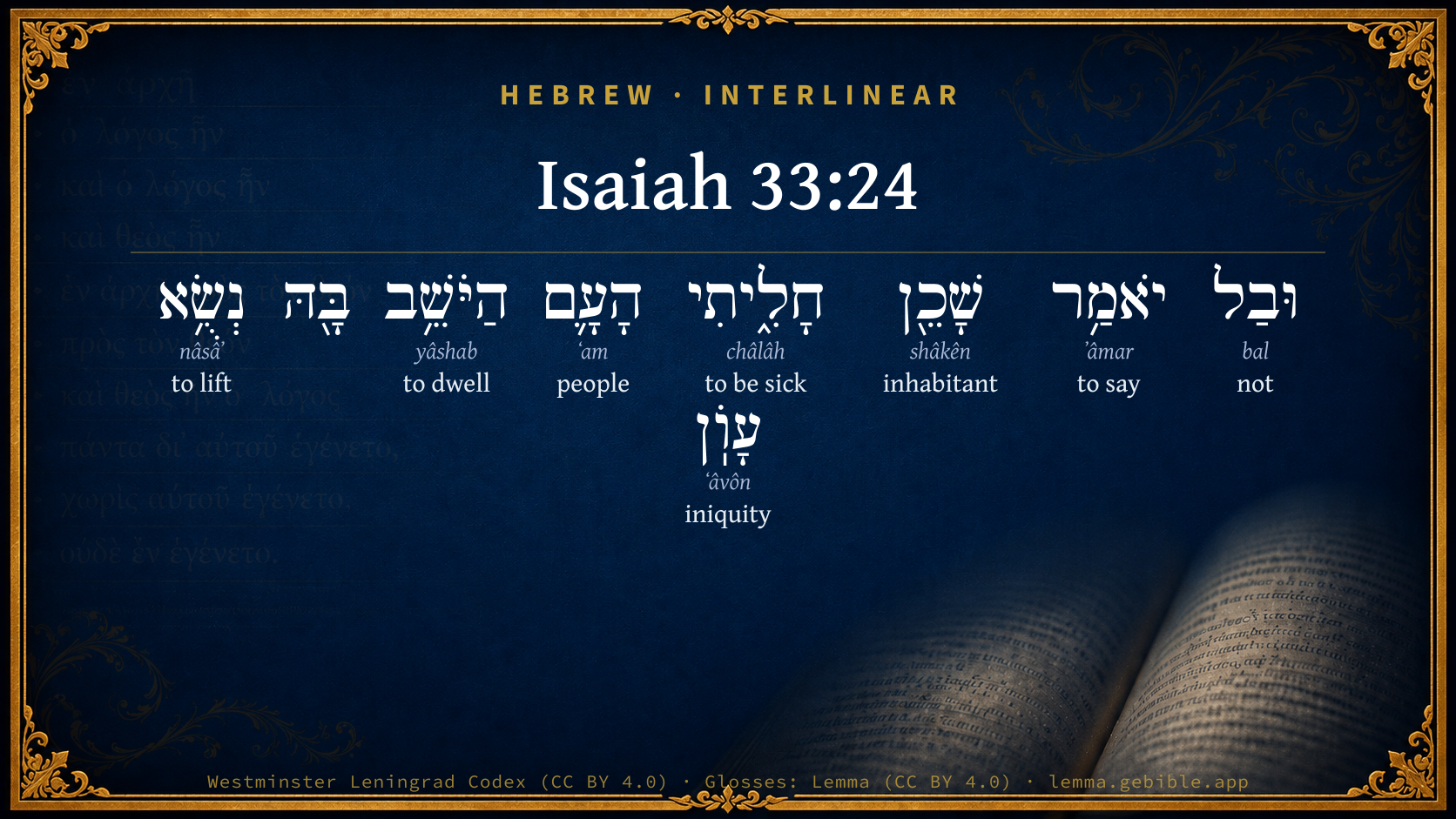
Isaiah 33:24

Hebrew (Westminster Leningrad Codex) Isaiah 33:24 appears in the Hebrew Old Testament. The text above is from the Westminster Leningrad Codex. Each word links to its Strong’s number, a concise gloss, and parsing drawn from the Open Scriptures Hebrew Bible morphology. Click any word for its full Brown-Driver-Briggs (BDB) entry.
Download image
Cite this verse

Isaiah 33:24 (World English Bible). Public Domain. Lemma interlinear Bible study tool, https://lemma.gebible.app/v/isaiah/33/24.

Show BibTeX & RIS
BibTeX
RIS
English Translation
The inhabitant shall not say, I am sick: the people who dwell therein shall be forgiven their iniquity.
World English Bible · Public Domain
Download a study sheet

One document with this verse’s original text, its word-by-word gloss line, the meaning frame, cross-references with their text, attributed commentary, and full source and license credits — printable, and it pastes into notes with its structure intact.

This verse Autodidact and up

Study sheet (.html) Plain text (.txt)

A passage Seminary Student

Up to 50 verses in one chapter. A passage sheet keeps up to 6 commentary sources and 12 cross-references per verse, in the order this page ranks them, and says so on the sheet whenever that leaves anything out. Ask for a single verse and you get the Autodidact verse sheet above.

Everything on this page stays free to read, with no account — the sheet is a download of what is already on screen, not access to it.

Want to remove ads? Support Godless Engineer
Compare translations 3

The same verse in 3 English versions, stacked beneath the original-language interlinear above. Click any original word for its lexicon entry.

Each is an independent rendering of the whole verse — the interlinear is not word-aligned to these translations.

Highlighted words mark where these versions differ — a whole-verse word diff, not a word-by-word alignment.

  • World English Bible Public Domain
    The inhabitant shall not say, I am sick: the people who dwell therein shall be forgiven their iniquity.
  • King James Version Public Domain
    And the inhabitant shall not say, I am sick: the people that dwell therein shall be forgiven their iniquity.
  • unfoldingWord Literal Text CC BY-SA 4.0
    And the inhabitant will not say, “I am sick”; the people dwelling in it forgiven of iniquity.

unfoldingWord Literal Text — © unfoldingWord, licensed CC BY-SA 4.0. Word-aligned USFM3 via Door43 (git.door43.org/unfoldingWord/en_ult).

Versions to compare (up to 4)

3 of 4 selected

Show all 18 translations

Every available English version of this verse, each an independent rendering of the whole verse.

  • World English Bible Public Domain
    The inhabitant shall not say, I am sick: the people who dwell therein shall be forgiven their iniquity.
  • Berean Standard Bible Public Domain
    And no resident of Zion will say, “I am sick.” The people who dwell there will be forgiven of iniquity.
  • Majority Standard Bible Public Domain
    And no resident of Zion will say, “I am sick.” The people who dwell there will be forgiven of iniquity.
  • King James Version Public Domain
    And the inhabitant shall not say, I am sick: the people that dwell therein shall be forgiven their iniquity.
  • American Standard Version (1901) Public Domain
    And the inhabitant shall not say, I am sick: the people that dwell therein shall be forgiven their iniquity.
  • Revised Version (1885) Public Domain
    And the inhabitant shall not say, I am sick: the people that dwell therein shall be forgiven their iniquity.
  • Geneva Bible (1599) Public Domain
    And none inhabitant shall say, I am sicke: the people that dwell therein, shall haue their iniquitie forgiuen.
  • Douay-Rheims (1899) Public Domain
    Neither shall he that is near, say: I am feeble. The people that dwell therein, shall have their iniquity taken away from them.
  • Young's Literal Translation Public Domain
    Nor doth an inhabitant say, `I was sick,' The people that is dwelling in it, is forgiven of iniquity!
  • Literal Standard Version CC BY-SA 4.0
    Nor does an inhabitant say, “I was sick”; The people dwelling in it [are] forgiven of [their] iniquity!
  • Unlocked Literal Bible CC BY-SA 4.0
    The inhabitants will not say, “I am sick;” the people who live there will be forgiven for their iniquity.
  • unfoldingWord Literal Text CC BY-SA 4.0
    And the inhabitant will not say, “I am sick”; the people dwelling in it forgiven of iniquity.
  • Darby Bible Public Domain
    And the inhabitant shall not say, I am sick: the people that dwell therein shall be forgiven [their] iniquity.
  • World Messianic Bible Public Domain
    The inhabitant won’t say, “I am sick.” The people who dwell therein will be forgiven their iniquity.
  • Webster's Bible Public Domain
    And the inhabitants shall not say, I am sick: the people that dwell therein shall be forgiven their iniquity.
  • Free Bible Version CC BY-SA 4.0
    Nobody in Israel will say, “I'm sick,” and those who live there will have their guilt removed.
  • Bible in Basic English Public Domain
    And the men of Zion will not say, I am ill: for its people will have forgiveness for their sin.
  • JPS Tanakh (1917) Public Domain
    And the inhabitant shall not say: 'I am sick'; the people that dwell therein shall be forgiven their iniquity.

Literal Standard Version (2020), Covenant Press — licensed CC BY-SA 4.0. Text via the HelloAO Bible API (eBible.org). Unlocked Literal Bible (unfoldingWord) — licensed CC BY-SA 4.0. Text via the HelloAO Bible API (eBible.org). unfoldingWord Literal Text — © unfoldingWord, licensed CC BY-SA 4.0. Word-aligned USFM3 via Door43 (git.door43.org/unfoldingWord/en_ult). Free Bible Version, Dr. Jonathan Gallagher — licensed CC BY-SA 4.0. Text via the HelloAO Bible API (eBible.org).

Word by word

More ways to search: Search by grammar → Find every occurrence → Compare this word →

Practice this passage: Drill this verse → Learn its vocabulary →

About this verse

These counts appear in no published source. They are computed here, from the morphology-tagged text and Lemma’s own curated glosses. What Lemma adds →

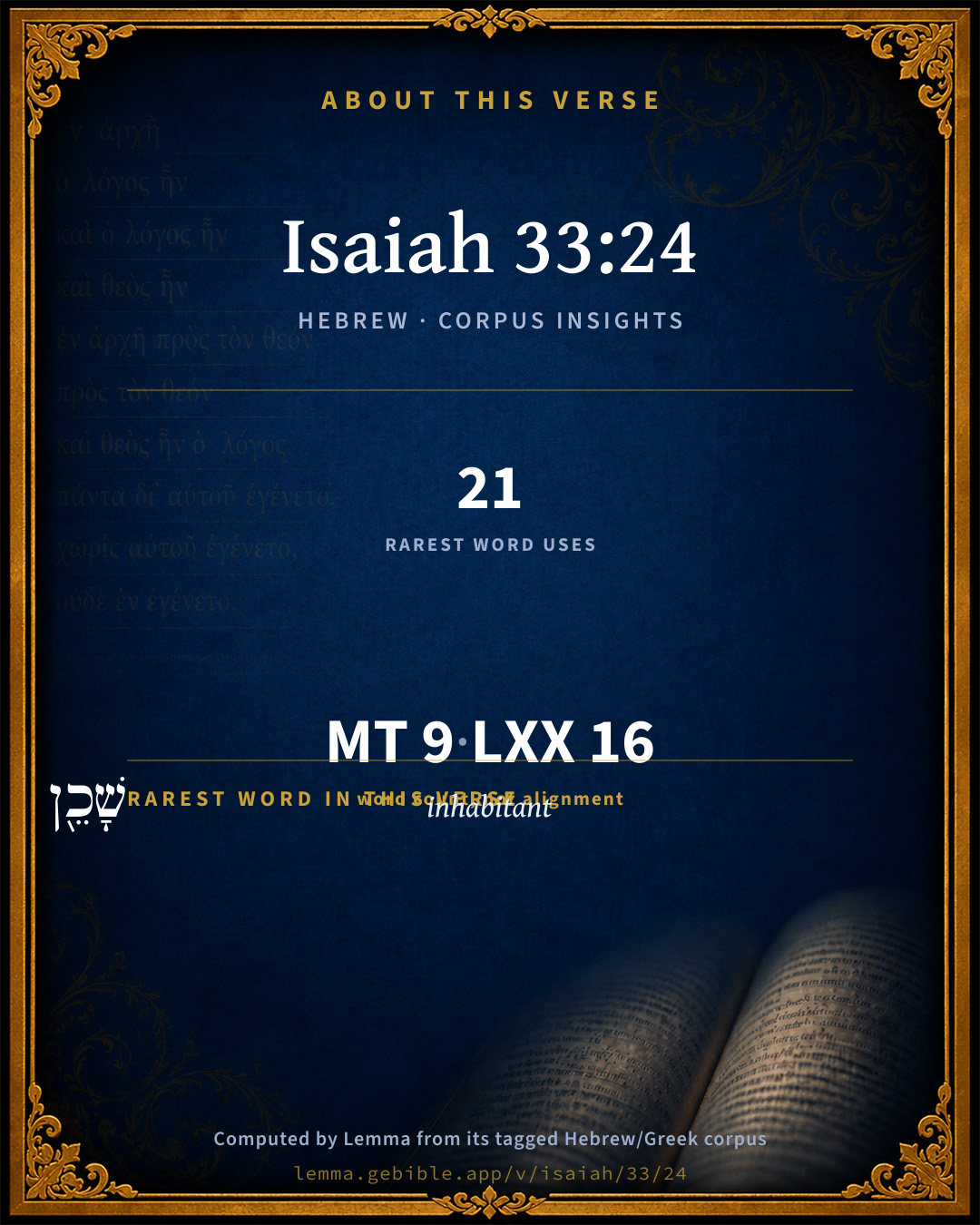
9
words
8
distinct lemmas
Prophets
section

Notable vocabulary

The rarest word here is שָׁכֵ֖ן inhabitant H7934 — appearing just 21 times in the whole Hebrew Bible.

Shared distinctive vocabulary

שָׁכֵ֖ן inhabitant H7934 occurs in 20 verses of the Hebrew Bible. Also found in:

Grammatical profile

  • 4 verbs
  • 2 nouns
  • 1 adjective
  • 1 preposition
  • 1 particle

Verb forms

  • יֹאמַ֥ר Qal · Imperfect
  • חָלִ֑יתִי Qal · Perfect
  • הַיֹּשֵׁ֥ב Qal · Participle Active
  • נְשֻׂ֥א Qal · Participle Passive

Hebrew & Septuagint length

In English translation the verse runs 18 words from the Hebrew and 22 from the Septuagint (LXX English) — closely comparable.

A rough comparison of the two English renderings, which tokenize alike — not a word-level alignment.

Word counts can differ between the Hebrew and the Greek without any difference in meaning — e.g. the Hebrew direct-object marker אֵת has no separate Greek word, and Greek often adds the article ὁ.

In the original languages it is 9 Hebrew tokens and 16 Greek tokens — but the two are counted differently (Hebrew bundles its prefixes and suffixes into one token; the Greek is in lemma form), so that isn’t a like-for-like length.

Cross-references

14

Topical passages linked to Isaiah 33:24 in the Treasury of Scripture Knowledge — connected by theme and wording, ordered by reader-vote popularity; previews shown in the World English Bible.

  • Jeremiah 50:20 In those days, and in that time, says Yahweh, the iniquity of Israel shall be sought for, and there shall be none; and the sins of Judah, and they shall not be found: for I will pardon them whom I leave as a remnant.
  • Revelation 21:4 He will wipe away from them every tear from their eyes. Death will be no more; neither will there be mourning, nor crying, nor pain, any more. The first things have passed away."
  • Exodus 15:26 and he said, "If you will diligently listen to the voice of Yahweh your God, and will do that which is right in his eyes, and will pay attention to his commandments, and keep all his statutes, I will put none of the diseases on you, which I have put on the Egyptians; for I am Yahweh who heals you."
  • 1 John 1:7–9 But if we walk in the light, as he is in the light, we have fellowship with one another, and the blood of Jesus Christ, his Son, cleanses us from all sin.
  • Isaiah 58:8 Then shall your light break forth as the morning, and your healing shall spring forth speedily; and your righteousness shall go before you; the glory of Yahweh shall by your rearward.
  • Jeremiah 33:6–8 Behold, I will bring it health and cure, and I will cure them; and I will reveal to them abundance of peace and truth.
  • James 5:14 Is any among you sick? Let him call for the elders of the assembly, and let them pray over him, anointing him with oil in the name of the Lord,
  • Isaiah 44:22 I have blotted out, as a thick cloud, your transgressions, and, as a cloud, your sins: return to me; for I have redeemed you.
  • Deuteronomy 7:15 Yahweh will take away from you all sickness; and none of the evil diseases of Egypt, which you know, will he put on you, but will lay them on all those who hate you.
  • Isaiah 30:26 Moreover the light of the moon shall be as the light of the sun, and the light of the sun shall be sevenfold, as the light of seven days, in the day that Yahweh binds up the hurt of his people, and heals the stroke of their wound.
  • 2 Chronicles 30:20 Yahweh listened to Hezekiah, and healed the people.
  • Micah 7:18–19 Who is a God like you, who pardons iniquity, And passes over the disobedience of the remnant of his heritage? He doesn't retain his anger forever, Because he delights in loving kindness.
  • Revelation 22:2 in the middle of its street. On this side of the river and on that was the tree of life, bearing twelve kinds of fruits, yielding its fruit every month. The leaves of the tree were for the healing of the nations.
  • Deuteronomy 28:27 Yahweh will strike you with the boil of Egypt, and with the tumors, and with the scurvy, and with the itch, of which you can not be healed.

Cross-references courtesy of OpenBible.info (CC BY 4.0).

Hebrew and Greek witnesses Masoretic Hebrew ↔ Greek Septuagint

The same verse in the two great witnesses to the Old Testament, shown verse-for-verse.

These are two independent witnesses, not word-aligned to each other, and the Septuagint is shown in lemma (dictionary) form.

Hebrew Isaiah 33:24 Masoretic · Westminster Leningrad Codex

וּבַל יֹאמַ֥ר שָׁכֵ֖ן חָלִ֑יתִי הָעָ֛ם הַיֹּשֵׁ֥ב בָּ֖הּ נְשֻׂ֥א עָוֺֽן

The inhabitant shall not say, I am sick: the people who dwell therein shall be forgiven their iniquity.

World English Bible · Public Domain

Greek LXX Isaiah 33:24 Septuagint · lemma form

καί οὐ μή εἶπον κοπιάω ὁ λαός ὁ ἐνοἰκέω ἐν αὐτός ἀποἵημι γάρ αὐτός ὁ ἁμαρτία

And the people dwelling among them shall by no means say, I am in pain: for their sin shall be forgiven them.

LXX2012 (modern English Septuagint) · Public Domain

Hebrew: Westminster Leningrad Codex (CC BY 4.0). Greek: Septuagint (public domain); English from LXX2012 (modern English Septuagint) (Public Domain). How the Septuagint differs from the Hebrew →

Targum (Aramaic paraphrase)

1

The Targum is the ancient Jewish Aramaic paraphrase of the Hebrew Scriptures — an interpretive translation, not the Hebrew text itself. Onkelos (literal) and Pseudo-Jonathan (expansive) render the Torah, and Jonathan the Prophets. Coverage is partial: where no permissively-licensed English translation exists for a verse, only the Aramaic is shown. This is verse-level text, not a word-by-word alignment to the Hebrew.

  1. Targum Jonathan Prophets (Joshua–Malachi)
    וְלָא יֵימְרוּן מִכְּעַן לְעַמָא דְשָׁרָן סְחוֹר סְחוֹר אֲתִיב לִשְׁכִינְתָּא מִלְוַתְכוֹן אֲתָת עַלָנָא מְחַת מְרַע עַמָא בֵּית יִשְׂרָאֵל יִתְכַּנְשׁוּן וִיתוּבוּן לְאַרְעֲהוֹן שְׁבִיק לְחוֹבֵיהוֹן:

    Henceforth they shall not say to the people which dwell round about them, I shall return to the Shekinah. (From you is come upon us the evil plague.) The people, the house of Israel, shall be gathered together, and they shall return to their land, their sins being forgiven.

    Targum Jonathan — Aramaic: “Mikraot Gedolot” (public domain). English: “Sefaria Community Translation” (CC0 1.0 (public-domain dedication)); “London "Chaldee Paraphrase," 1871” (public domain). Text via Sefaria.

Commentary

Notes on Isaiah 33:24 from classic Christian and Jewish commentators (each source and its license shown beneath its notes). The classic Christian expositions comment on the surrounding passage and are grouped to its opening verse, so a note may address several verses; the Jewish commentaries on the Tanakh (Rashi and others) are per-verse, so they appear only where the commentator wrote on this verse.

Lemma curates 59 commentaries, every one of them public domain or Creative Commons licensed, each selected and text-cleaned for this edition rather than reprinted as found. About our sources →

Trapp's Complete Commentary

John Trapp

Isa 33:24 And the inhabitant shall not say, I am sick: the people that dwell therein [shall be] forgiven [their] iniquity.

Ver. 24. And the inhabitant shall not say, I am sick.] sc., By reason of the long and strait siege. None shall be so lame, {Isa 33:23} or sick and in pain (as here), but that he shall be in case to pursue and prey upon the enemies.

The people that dwell therein shall be forgiven their iniquity.] Jehovah Rophe, or the physician, shall heal them on both sides, make them whole every whit. This is a most sweet promise, and highly to be prized by all that are heirs of the promises.

“ Optandum est ut sit mens sana in corpore sano. ”

John Trapp, A Commentary or Exposition upon All the Books of the Old and New Testament (1647–1656) — public domain. Text from a community e-Sword module.

The Biblical Illustrator

Joseph S. Exell

Isa_33:24

And the inhabitant shall not say, I am sick

The bliss of heaven

Two principal circumstances are dwelt upon, as constituting the bliss of heaven.

I. THERE IS NO SORROW IN HEAVEN. The inhabitant shall not say, I am sick. It is otherwise in this world, ruined as it has been by sin. Here the whole head is sick, and the whole heart faint. And what men universally feel, they with one consent complain of. In one way or other, every child of Adam is exclaiming, I am sick! With some--

1. The body is sick. But in heaven there is nothing of all this.

2. The heart is sick--sick of hope deferred, of rash and ill-judged wishes, of continual disappointments. In heaven, no heart saith, I am sick. No disappointment, there, of former hopes. Even hope finds no admission there. We hope for that we see not. But in heaven all is sight, and knowledge, and solid experience.

3. The soul is sick. In heaven no indwelling sin will remain, to suggest evil, when we would do good: no tempter, to recommend to us forbidden pleasures: no apostate, rebellious world, to revile, ensnare, or persecute the friends of God. Still--as there can be no doubt that memory will accompany the soul into its heavenly habitation--it may be imagined by some that the recollection of sins committed on earth must interfere with its entire felicity. But the apprehension is groundless. That a deep sense of unworthiness will exist, there is no doubt; even the sinless angels feel this. But the painful sense of guilt will be for ever excluded.

II. THERE IS NO CONDEMNATION IN HEAVEN. The people that dwell therein shall be forgiven their iniquity.

1. The forgiveness of sin will be more certain. Forgiveness is certain to the real believer; but who is certain of himself?

2. The forgiveness of sin will then be more complete,--not so much the forgiveness itself, as the consequences of it. (J. Jowett, M. A.)

Healing and pardon

This whole chapter was a gracious message from God to a people who were in extremis. When the worst had come to the worst, He laid bare His arm and brought deliverance for His people. Is not this a general rule with God? The peril of Jerusalem serves as a dark background to bring out the brightness of my text.

I. THERE IS SUCH A THING AS PRESENT FORGIVENESS. There must be a present, conscious, enjoyable pardon of sin--

1. Else there would be no joy in the world for thoughtful minds.

2. Else the main motive and fountain of love would be dried up. Forgiveness begets gratitude, gratitude creates love, and love brings forth holiness.

3. Else we should always be in bondage through fear of death.

4. Else the whole system of grace would be a dead letter, and its glorious privileges would be mere shells without a kernel. Let us bend our thoughts to a consideration of this great blessing as it is treated of in this chapter.

(1) It is plainly promised in the text.

(2) If we wish to obtain this free pardon it will be granted in answer to prayer. Read the second verse: O Lord, be gracious unto us.

(3) Pardon is given in connection with the exaltation of God. Read the fifth verse: The Lord is exalted. He does not grant this forgiveness until we begin to regognise that He is a great God and a Saviour. We must see that He is great in justice, and we must bow in penitence, and honour that justice.

(4) God grants pardon when men are humbled. See the seventh verse: Their valiant ones shall cry without: the ambassadors of peace shall weep bitterly.

(5) God grants this pardon also when the heart is searched. Read the fourteenth verse: The sinners in Zion are afraid; fearfulness hath surprised the hypocrites. Who among us shall dwell with the devouring fire? When we begin to examine ourselves, to fear because of sin, and to turn from all hypocrisy, then the Lord will accept us.

(6) God will also pardon us when He is acknowledged to be our Ruler and Lord. Look at the twenty-second verse: The Lord is our judge, &c.

(7) He will also forgive us when we put our trust in Him. Read the last clause of the twenty-second verse: He will save us. Faith must look for salvation from the Lord alone, and then salvation will come to it.

II. WHEN SIN IS PARDONED, THE CONSEQUENCES OF SIN ARE ALSO REMOVED. Sin had made these people sick, as Isaiah saith in his first chapter--The whole head is sick, and the whole heart faint. But when iniquity is forgiven, then the inhabitant shall not say, I am sick. Special chastisement is usually removed when any peculiar sin is forgiven. In the case of believers in the Lord Jesus Christ, if some of the temporal results of sin do not cease, yet it is only in appearance that they remain: or rather they remain for other purposes, benign and useful, and not as wrathful inflictions.

III. THIS MAKES A REMARKABLE CHANGE IN THE LANGUAGE OF THE FAVOURED PEOPLE. The inhabitant shall not say, I am sick.

1. They have no need to say it when the Lord comes and dwells with them; for the Sun of Righteousness hath risen upon them with healing in His wings.

2. They shall have no thought of saying, I am sick. He that feels the joy of pardoned sin forgets all his pains and griefs.

3. These people did not say they were sick, since they had a motive for not saying so. The three lepers who went out and divided the spoil did not say, We are lepers: that was forgotten, and they entered the tents as if they had been in health. They went into one pavilion and ate and drank, and then they went into another. Men free from leprosy could not have made themselves more at home. They took away gold and silver and hid it; though they were lepers. So when the Lord pardons our sin there is a prey to be taken: riches of grace are at our disposal.

4. Pardoned people shall not say they are sick, for by a little anticipation they shall declare the very contrary. In a little time we shall be where the inhabitant shall never be sick again. (C. H. Spurgeon.)

Sickness and sin

I. Let us speak of THOSE ILLS THAT FLESH IS HEIR TO. Wherever man exists in this world, the cry is heard, I a m sick. It is so because wherever man exists there is sin. Disease has been sent to reprove the sins of men, and to correct them with salutary pain. We are not competent to decide what specific connection there is between disease and sin in the case of our fellow-men. Endurance of sickness is more often a mark of Gods goodwill than of His severe displeasure.

1. Pain removes us out of the way of temptation, gives us time for reflection, when we were hastily running into danger.

2. How much a formidable sickness has helped a believer in drawing out his thoughts to the heavenly country and the passage into glory! But these considerations do not remove this original and humbling fact that sickness is a disorder in Gods world and that it is connected with that moral disorder which we call sin.

II. THE REMOVAL OF BOTH THESE. AS sickness and sin entered together, so shall they depart together. (D. Fraser, D. D.)

Pardon does not involve immediate deliverance from all evil

Upon one other point connected the forgiveness of sins we get instruction from the experience of Jerusalem. Pardon does not change the outside of life; it does not immediately modify the movements of history, or suspend the laws of nature. Although God has forgiven Jerusalem, Assyria comes back to besiege her. Although the penitent be truly reconciled to God, the constitutional results of his fall remain: the frequency of temptation, the power of habit, the bias and facility downwards, the physical and social consequences. Pardon changes none of these things. It does not keep off the Assyrians. But, if pardon means the return of God to the soul, then in this we have the secret of the return of the foe. Men could not try nor develop a sense of the former except by their experience of the latter, Had the Assyrians not returned, the Jews would have had no experimental proof of Gods restored presence, and the great miracle would never have happened that rang through human history for evermore--a trumpet-call to faith in the God of Israel And so, still the Lord scourgeth every son whom He receiveth, because He would put our penitence to the test; because He would discipline our disorganised affections, and give conscience and will a chance of wiping out defeat by victory; because He would baptize us with the most powerful baptism possible--the sense of being trusted once more to face the enemy upon the fields of our disgrace. (Prof. G. A. Smith, D. D.)

Nobody is quite well

A friend who met Lord Beaconsfield soon after that statesman had lost his helpful wife hoped that he was quite well. In a hollow voice Beaconsfield answered, Nobody is quite well. This is true. (Quiver.)

Forgiveness and healing

A brother had grievously offended, and had been put out from Church fellowship for his sin; and he so behaved that his pastor thought of him with pain, and was glad to avoid an interview with him, for it only produced a sad attempt at self-justification. At length the Lord brought him to a better mind. He sought his pastor, and said, with tears, Will you shake hands with me? The pastor replied, Right gladly. I rejoice to feel that the past is all forgiven. How are you? The repentant one made this reply, I am quite Well now that you restore me to your esteem. The poor man was extremely ill, but the joy of being once more in his old place in his friends thoughts made him refuse to say, I am sick. (C. H.Spurgeon.)

Forgiveness

Thy sins be forgiven thee. It is a beautiful figure. It is as if a boat was moored to a filthy mainland and could not get away. There comes a man who cuts the cable, and the boat floats away down stream.

That is the figure given. The Lord comes and cuts the cable that binds me to the filthy mainland of the past, and my boat goes free. (J. H.Jowett, M. A.)

.

The Biblical Illustrator, edited by Joseph S. Exell (c. 1880s–1900s) — public domain. Text from a community e-Sword module.

The Preacher's Complete Homiletical Commentary

Joseph S. Exell (gen. ed.)

NO SICKNESS THERE

Isa_33:24. And the inhabitant shall not say, I am sick.

In a besieged city, from watching, anxiety, and scarcity of food, there is usually considerable sickness. When an epidemic disease is prevalent, sickness becomes the general experience. There is in any large population always a considerable amount of sickness, more or less serious. Nor is it confined to the city. In the country it is much the same. At the best it is only somewhat less. Medical men are everywhere required. Sanitary arrangements, temperate habits, and medical skill may diminish the extent and alleviate the severity of sickness, but they cannot uproot it. When, therefore, we read of a city in which there shall be no sickness, our thoughts turn from earth to heaven. The text is a beautifully poetic representation of the termination of the conscious weakness that rested on Jerusalem while the Assyrian army lay before it. But there is a sense in which the words may be literally understood. We believe in “the holy city, the new Jerusalem.” Let us meditate on that new condition of our life.

I. Sickness is weakness. We give the name to all states of the body other than sound and perfect health. How numerous! Our condition here is one of constant liability to it. At every period of life we are exposed to it. It may be borne to us by the air we breathe; taken with the food we eat and the water we drink; received by contact with our fellows; lurk secretly in some part of our body unsuspected; develop itself from the slight cold, the result of carelessness, or in spite of the utmost thoughtfulness; it may attack the youth as well as the old man, those who boast the fulness of their strength as well as those who know themselves to be less firmly built. But it always supposes weakness. Under the name of weakness it holds its victim with a firm grasp. While he persuades himself that he has conquered, it secretly spreads through every vein, and eventually lays him prostrate. The strongest man becomes powerless when sickness holds him in its grasp. As he is too weak to throw off the weakness, he is too weak to perform the tasks which at other times he performs with perfect ease. The student, the mechanic, the merchant. Visit some sick-bed and your confidence of perpetual strength will depart. Sickness is humiliating because it is weakening. It is often attended with pain. Pain increases weakness. In the grasp of pain the sufferer may be held for days, with no power of resistance, no prospect of relief.

Have you not sometimes thought what a contrast it would be if you could be entirely free from sickness and from liability to it? We may indulge the thought. That will be the condition of the resurrection body in the celestial city. It will be fashioned like to the body of Christ’s glory (1Co_15:42-44). As Christ on the cross endured the last sickness and pain He was ever to know, so shall all His followers rise, as He did, to a life from which sickness and pain are for ever excluded. Are you one with Him? Then in pain, weariness, languor, sickness, let all impatience be subdued as you remember that it is only a little longer. “Neither shall there be any more pain.”

II. Sickness is sorrow. Sorrow because of lost time and business, fear that the end of life is near, the leaving behind not only all pleasant earthly things and persons, but especially those dependent on the patient’s life, to whom his loss may be ruin. Not to the patient only is it a time of sorrow. Enter the house. All is gloom. Rooms darkened. The family tread softly and speak under their breath, as if every sound would not only disturb the sufferer, but be out of harmony with their own feelings. It is the little one that has come home sick from school (2Ki_4:19). His mother takes him on her knee. Soon she perceives the signs of one of the sicknesses that are the terror of childhood. Medical aid is procured. The sickness deepens. Every one watches with aching heart, for the child is a universal favourite. And if he is taken, oh, what distress! Or it is the young man who has grown to maturity. He is active in business. His father, under the burden of advancing years, is gradually devolving responsibility on him, that he may himself enjoy a few years’ rest after a life of hard and anxious work. But sickness comes. It passes by those you would expect it to strike. It singles out the young and strong. Gradually that fine young man wastes away. Day and night the mother, whose advancing years and infirmities demand the attention, watches over him with a breaking heart. All is done that strong affection can inspire. It is vain. Oh! what sorrow through these months! And when the end comes, what tongue can describe the agony?

We wonder if it will ever cease to be true that “man was made to mourn.” Thank God we can entertain the prospect of the complete cessation of sorrow. “Neither sorrow.” “Sorrow and sighing shall flee away.” “God shall wipe away all tears from their eyes.” For “the inhabitant shall not say, I am sick.”

III. Sickness is the prelude to death. It usually precedes. Any sickness may end in it. Death changes everything: the body different; the soul different. But there shall be no more death. There will be the perpetuated life of paradise regained; for there will be the tree of life; there will be the resurrection body (1Co_15:53-54).

IV. Sickness, sorrow, and death are the fruit of sin. Does not Scripture thus trace them? There was no sickness before sin. Sin was the seed. The heavenly city is free from sin. There is perfect holiness. It is the completion of the redeeming work of Christ from sin, sorrow, death. The seed which bears sickness is taken out of the soil.

Shall we dwell in that city of immortal health? Are we travelling towards it? If not, we cannot reach it. Jesus is the way. Come to Him (Rev_21:27). It is a prepared place for a prepared people.—J. Rawlinson.

RECOVERY FROM SICKNESS

(Sermon to the Young.)

Isa_33:24. And the inhabitant shall not say, I am sick.

Our sun-dial is not that of Hezekiah: its shadow has no backward movement; the last enemy must soon challenge the traveller to pay the tax imposed on his pilgrimage. When all the pains and illnesses of the flesh are over, there remaineth a place purchased, prepared, and furnished for the children of God, and in which “the inhabitant shall not say, I am sick.” Where is this healthy spot? Not in any place in this country; not in the world of which our land is so favoured a portion. To be able always to say, “I am not sick,” is one of the privileges of heaven alone.

I. THE EVILS AND DISAGREEABLES OF SICKNESS.

Sickness is certainly not a pleasant thing—necessary, profitable, if you please, but not pleasant. It cannot be pleasant; for it is the punishment for sin. Angels are never sick, because they are of that world of which the inhabitant shall not say, “I am sick.” Sickness helps to crumble us into death; diseases are Death’s servants. Death sends them out in their different liveries as his couriers and forerunners; they apprise sinners that their Master is coming into their country, passing by that way, will perhaps “stand at their door and knock,” warning each to be ready to leave all and follow death, as Peter said he and his fellow-apostles had done for Christ (H. E. I. 1561).

1. Bodily pain often accompanies sickness. This is sometimes felt in so grievous and dreadful a degree that the sufferer wishes and prays for death to be relieved from his agonies. When David was tried in this way he said, “The pains of hell gat hold upon me”—a strong expression, meaning very excruciating pains. Who can tell but those who have felt them what sufferings belong to the burning fever, the tormenting headache, &c.? The curious machine is out of order; the wheels grind and grate against each other; “the harp with a thousand strings is out of tune and full of discords.” The very means taken for recovery often, for a time at least, increase pain and suffering. We admire the wisdom which God has given to man to discover the healing virtues concealed in Nature’s works. But most of these, excellent in their effects, are nauseous to the taste. It seems as if Providence had ordained this on purpose that everything should conspire in sickness to make it a suffering, uncomfortable time, in order the more deeply to impress on us the salutary lessons it is intended to teach us.

2. The interruption it causes to the active duties of life. Health is the one thing needful, not only to the enjoyment of life, but to the vigorous and successful discharge of its duties.

3. One might mention a third evil, viz., the trouble one gives in sickness to those around us, only you might be ready to cry out, “We cannot allow this to be either a trouble or an evil; what sister or affectionate brother would think this a trouble?” But often the sufferer feels it keenly.

II. THE PROFITS AND ADVANTAGES OF SICKNESS.

Begin by thanking Jesus Christ that sickness is not a punishment and nothing else—not a certainty and foretaste of hell. His sacrifice has taken away its sting; it bears the peaceable fruits of righteousness to them that are exercised thereby. It withdraws us from the world. We follow too hotly and incessantly the things of the world. Some years ago a satire was written upon us called “The World Without Souls,” and the author, without exaggerating, nearly proved that most of us live as if we thought this was really to be the case.

CONCLUSION.—So improve the sickness of earth as to make it the path to the health of heaven. In health often look back to the time of sickness: consider what were then your feelings, your fears, your good resolutions. Have you kept your word? Have you done your part? Is the Great Physician paid? He seeks not gold, but the coin of gratitude, love, and obedience. Every sickness should urge us to secure the country without pain; to win the new heavens and the new earth in which Christ’s redeemed people shall be crowned with unfading youth and unbroken health.—George Clark, M.A.: Sermons, pp. 59–68.

The Preacher's Complete Homiletical Commentary (gen. ed. Joseph S. Exell; Funk & Wagnalls, c. 1892) — public domain (pre-1929). A full-Bible homiletical/sermon-outline anthology covering 65 of 66 books (2 John is absent from the source module). Text from a community e-Sword module.

Tyndale Open Study Notes

Tyndale Open Resources

33:24 The people of Israel were the people of Zion (cp. 33:20). • sick . . . the Lord will forgive their sins: See 43:25.

Tyndale Open Study Notes — © Tyndale Open Resources, licensed CC BY-SA 4.0. Text via the HelloAO Bible API.

Jamieson, Fausset & Brown

Robert Jamieson, A. R. Fausset & David Brown

sick--SMITH thinks the allusion is to the beginning of the pestilence by which the Assyrians were destroyed, and which, while sparing the righteous, affected some within the city ("sinners in Zion"); it may have been the sickness that visited Hezekiah (Isa. 38:1-22). In the Jerusalem to come there shall be no "sickness," because there will be no "iniquity," it being forgiven (Psa 103:3). The latter clause of the verse contains the cause of the former (Mar 2:5-9).

The thirty-fourth and thirty-fifth chapters form one prophecy, the former part of which denounces God's judgment against His people's enemies, of whom Edom is the representative; the second part, of the flourishing state of the Church consequent on those judgments. This forms the termination of the prophecies of the first part of Isaiah (the thirty-sixth through thirty-ninth chapters being historical) and is a kind of summary of what went before, setting forth the one main truth, Israel shall be delivered from all its foes, and happier times shall succeed under Messiah.

Next: Isaiah Chapter 34

Jamieson, Fausset & Brown — Commentary Critical and Explanatory on the Whole Bible (1871) — public domain (CC PDM 1.0). Text via the HelloAO Bible API.

Adam Clarke's Commentary

Verse 24. And the inhabitant shall not say] This verse is somewhat obscure. The meaning of it seems to be, that the army of Sennacherib shall by the stroke of God be reduced to so shattered and so weak a condition, that the Jews shall fall upon the remains of them, and plunder them without resistance; that the most infirm and disabled of the people of Jerusalem shall come in for their share of the spoil; the lame shall seize the prey; even the sick and the diseased shall throw aside their infirmities, and recover strength enough to hasten to the general plunder. See above.

The last line of the verse is parallel to the first, and expresses the same sense in other words. Sickness being considered as a visitation from God, a punishment of sin; the forgiveness of sin is equivalent to the removal of a disease. Thus the psalmist: -

"Who forgiveth all thy sin;

And healeth all thine infirmities."

Ps 103:3.

Where the latter line only varies the expression of the former. And our blessed Saviour reasons with the Jews on the same principle: "Whether is it easier to say to the sick of the palsy, Thy sins are forgiven thee; or to say, Arise, and take up thy bed, and walk?" Mr 2:9. See also Mt 8:17; Isa 53:4. Qui locus Isaiae, 1Pe 2:24, refertur ad remissionem peccatorum: hic vero ad sanationem morborum, quia ejusdem potentiae et bonitatis est utrumque praestare; et, quia peccatis remissis, et morbi, qui fructus sunt peccatorum, pelluntur. "Which passage of Isaiah has reference, in Isa 33:1; Isa 2:24, to the remission of sins, and here to the healing of diseases, because both are effects of the same power and goodness; and because with the remission of sins was associated the removal of disorders, the fruits of sin." - Wetstein on Mt 8:17.

That this prophecy was exactly fulfilled, I think we may gather from the history of this great event given by the prophet himself. It is plain that Hezekiah, by his treaty with Sennacherib, by which he agreed to pay him three hundred talents of silver and thirty talents of gold, had stripped himself of his whole treasure. He not only gave him all the silver and gold that was in his own treasury and in that of the temple, but was even forced to cut off the gold from the doors of the temple and from the pillars, with which he had himself overlaid them, to satisfy the demands of the king of Assyria: but after the destruction of the Assyrian army, we find that he "had exceeding much riches, and that he made himself treasuries for silver, and for gold, and for precious stones," c. 2Ch 32:27. He was so rich, that out of pride and vanity he displayed his wealth to the ambassadors from Babylon. This cannot be otherwise accounted for, than by the prodigious spoil that was taken on the destruction of the Assyrian army. - L. And thus, in the providence of God, he had the wealth which was exacted from him restored.

Adam Clarke's Commentary on the Bible (1810–1826) — public domain. Text from a community e-Sword/MySword module.

Ellicott's Commentary for English Readers

(24) The inhabitant shall not say, I am sick . . .—The words seem to have had their starting- point in the pestilence which attacked the Assyrian army, and which had probably been felt, during the siege, in Jerusalem itself. The prophet, seeing in such a pestilence the punishment of iniquity, couples together the two blessings of health and pardon. Healthy, because holy, was his report as to the restored Jerusalem. (Comp. Mat_9:2.)

A Bible Commentary for English Readers, edited by Charles John Ellicott (1878–1897) — public domain. Text from a community e-Sword module.

The Cambridge Bible for Schools and Colleges

gen. ed. J. J. S. Perowne

24. The healing of disease and the forgiveness of sin are combined as in Psa_103:3; Mat_9:2 ff., &c. To the Old Testament saints sickness was the proof of God’s displeasure and of sin unforgiven. Hence in the conception of the Messianic community, the abolition of sickness, the chief evil of life, is the indispensable pledge that guilt is taken away. Cf. Exo_23:25.

The Cambridge Bible for Schools and Colleges (gen. ed. J. J. S. Perowne; Cambridge University Press, 1878–1918) — public domain. Text from a community e-Sword module.

John Gill's Exposition

And the inhabitant shall not say, I am sick,.... That is, the inhabitant of Zion, or Jerusalem, the church of Christ, Isa 33:20 and such are they that are born again in Zion, and brought up there; who are made free thereof by Christ; are brought to dwell here by the Lord himself; and, under the influence of divine grace, ask their way hither, and come willingly and cheerfully, and settle here: these, at this time the prophecy refers to, even the latter day, shall not be heard to say, not one of them, "I am sick"; either with the sickness of sin, so as to say there is no cure for them, or that they shall die of it, or even to complain of it; for all their sicknesses and diseases of this kind will be healed by the rising of the sun of righteousness upon them, with healing in his wings; or with the sickness of affliction, especially outward affliction of persecuting enemies, which will be at an end; and such joy will attend them, on account of their deliverance from them, that all their former sorrows and sufferings will be forgot; and in the New Jerusalem church state there will be neither one sickness nor another; no more sorrow, pain, or death; the leaves of the tree of life will be for the healing of the nations, Rev 21:4,

the people that dwell therein shall be forgiven their iniquity; this shows that sin is the sickness meant; the manner in which such a disease is cured, by forgiveness; and the perfect health and soundness, as well as joy, and peace, and comfort, which follows upon an application of pardoning grace and mercy. The Targum refers this to the time when the Israelites shall return to their own land; and Kimchi owns that some of their interpreters apply it to the times of the Messiah.

Next: Isaiah Chapter 34

John Gill's Exposition of the Whole Bible (1746–1763) — public domain (CC PDM 1.0). Text via the HelloAO Bible API.

Albert Barnes' Notes on the Bible

And the inhabitant - The inhabitant of Jerusalem.

Shall not say, I am sick - That is, probably, the spoil shall be so abundant, and the facility for taking it so great, that even the sick, the aged, and the infirm shall go forth nerved with new vigor to gather the spoil.

The people that dwell therein - In Jerusalem.

Shall be forgiven their iniquity - This is equivalent to saying that the calamities of the invasion would be entirely removed. This invasion is represented as coming upon them as a judgment for their sins. When the Assyrian should be overthrown, it would be a proof that the sin which had been the cause of the invasion had been forgiven, and that God was now disposed to show them favor and mercy. It is common in the Scriptures to represent any calamity as the consequence of sin, to identify the removal of the calamity and the forgiveness of the sin. Thus, the Saviour said Mar 2:5 to the man afflicted with the palsy, ‘Son, thy sins be forgiven thee.’ And when the scribes complained, he urged that the power of forgiving sins and of healing disease was the same, or that the forgiveness of sin was equivalent to the removal of disease Mar 2:9.

Albert Barnes' Notes on the Bible (1834–1885) — public domain. Text from a community e-Sword/MySword module.

Haydock's Catholic Bible Commentary

Feeble. All were obliged to collect the plunder, to be afterwards divided. None shall plead illness. The inhabitants of Jerusalem will not feel the effects of sin (Calmet) on this occasion. (Haydock)

George Leo Haydock (1774–1849), Haydock's Catholic Family Bible and Commentary, 1859 edition — public domain. Excludes Psalms (Douay-Rheims chapter numbering differs from Protestant) and Deuterocanonical books (Catholic canon only).

Matthew Poole's English Annotations

The inhabitant, to wit, of Jerusalem, God’s people,

shall not say, I am sick; shall have no cause to complain of any sickness or calamity; shall be fully delivered from all their enemies and evil occurrents; shall enjoy perfect tranquillity and prosperity. The people that dwell therein shall be forgiven their iniquity: this may be added, either,

1. As the reason of the foregoing privilege. Their sins, the main causes of all their distresses, shall be pardoned; and therefore their sufferings, the effects of sin, shall cease. Or,

2. As an additional favour. They shall not only receive from me a glorious temporal deliverance; but, which is infinitely better, the pardon of all their sins, and all those spiritual and everlasting blessings which attend upon that mercy.

Matthew Poole's English Annotations on the Holy Bible (1683–1685) — public domain. Text from a community e-Sword/MySword module.

The Pulpit Commentary

And the inhabitant shall not say, I am sick. There shall be no sickness in the restored Jerusalem at least, no "sickness unto death." The people that dwell therein shall be forgiven their iniquity. Once more the prophet floats off into Messianic anticipations.

No more sickness.

This is clearly a figure, designed to complete the picture of relief from the strain and pressure and anxiety of the time of invasion. Sickness is the constant attendant on prolonged siege. The point on which we may dwell is that sickness is the sign of the presence of evil, of sin; and so heaven is represented as the place where there is no more sickness, because there is no more sin. This connection between sickness and sin lies at the basis of some of the most important Mosaic regulations. It explains the importance ceremonially attached to the one disease of leprosy. Trench states this very skillfully: "The same principle which made all that had to do with death, a grave, a corpse, the occasions of a ceremonial uncleanness, inasmuch as all these were signs and consequences of sin, might in like manner, and with a perfect consistency, have made every sickness an occasion of uncleanness, each of these being also death beginning, partial death-echoes in the body of that terrible reality sin in the soul. But, instead of this, in a gracious sparing of man, and not pushing the principle to the uttermost, God took but one sickness, one of those visible out comings of a tainted nature, in which to testify that evil was not from him, could not dwell with him; he took but one, with which to link this teaching. Leprosy, which was indeed the sickness of sicknesses, was selected of God to the end that, bearing his testimony against it, he might bear his testimony against that out of which it and all other sicknesses grew against sin, as not from him, as grievous in his sight; and against the sickness itself also as grievous, inasmuch as it was a visible manifestation, a direct consequence, of the inner disharmony of man"s spirit, a commencement of the death, which through disobedience to God"s perfect will had found entrance into a nature made by God for immortality.

I ALL SICKNESS IS A LITTLE DEATH. It is a beginning of death. Strangely death lurks in the smallest things a pin-prick, a slip of the foot, a tiny clot of blood, the bite of a fly, etc.

II ALL DEATHS ARE THE SIGN OF SIN. "The sting of death is sin." Sickness and death keep ever before men the fact that they are sinners.

III SICKNESS AND DEATH WILL GO AWAY WHEN SIN GOES.

IV AS GOD IS GRACIOUSLY WORKING FOR THE REMOVAL OF SINS, WE KNOW HE IS WORKING ALSO FOR THE REMOVAL OF SUFFERING. The day cometh when he shall be able to "wipe all tears from our eyes. R.T.

The Pulpit Commentary (1880–1919), ed. H.D.M. Spence-Jones & Joseph S. Exell — public domain. Text from a community e-Sword module.

John Wesley's Explanatory Notes

The inhabitant - Of Jerusalem. Sick - Shall have no cause to complain of any sickness or calamity. Forgiven - They shall not only receive from me a glorious temporal deliverance; but, which is infinitely better, the pardon of all their sins, and all those spiritual and everlasting blessings, which attend upon that mercy.

John Wesley, Explanatory Notes Upon the Whole Bible (1754–1765) — public domain. Text via the GEBible commentary corpus.

J. A. Alexander on Isaiah

Joseph Addison Alexander

“And the inhabitant shall not say, I am sick (or have been sick).” This may either mean that none shall be sick, or that those who have been so shall be recovered. “The people dwelling in it (is) forgiven (its) iniquity.” Some suppose this to be an explanation of the sickness mentioned in the first clause, as a spiritual malady. Others understand it as explaining bodily disease to be the consequence and punishment of sin. The words may be taken in a wider sense than either of these, namely, that suffering shall cease with sin which is its cause. Thus understood, the words are strictly applicable only to a state of things still future, either upon earth or in heaven.

Joseph Addison Alexander, The Prophecies of Isaiah (1846–1847; New York: Scribner, 1870–1878) — public domain. Text from a community e-Sword module.

Rashi

Rabbi Shlomo Yitzchaki (Rashi)

And the neighbor shall not say (I.e., the neighbor of) Israel.

“I am sick” Because of this nation, this misfortune has befallen me, for The people Israel, who is called a people, that dwells in Jerusalem, shall be forgiven of sin.

Rashi on the Tanakh — English translations: “The Judaica Press complete Tanach with Rashi, translated by A. J. Rosenberg” (CC BY 4.0); “Pentateuch with Rashi's commentary by M. Rosenbaum and A.M. Silbermann, 1929-1934” (public domain); “The Metsudah Tanach series, Lakewood, N.J” (CC BY 4.0); and “The Book of Joshua, Metsudah Publications, 1997” (CC BY 4.0). Text via Sefaria.

Ibn Ezra

Rabbi Abraham ibn Ezra

And the inhabitant of Zion shall not say again, I am sick; for all the people shall be forgiven their iniquity.

Ibn Ezra on the Tanakh — English translations: “Sefaria Community Translation” (CC0 1.0 (public-domain dedication)); “Yalkut, Sifsei Chachomim Chumash, Metsudah Publications, 2009” (CC BY 4.0); and “Commentary of Ibn Ezra on Isaiah - trans. by M. Friedlander, 1873” (public domain). Text via Sefaria.

Lesson kit

Teaching starters — assembled from the data on this page, not authored interpretation. Every prompt links to the verse data it draws on. Edit before teaching.

Isaiah, in the Prophets, opens this verse with 9 words (8 distinct Hebrew lemmas). Its most distinctive word is shâkên (“inhabitant”). A historical commentator’s framing appears above. Read the whole chapter for the surrounding context.

Discussion questions

  1. What does “inhabitant” (shâkên) contribute to the verse as a whole?
  2. How does Exodus 3:22, which shares the word «inhabitant», read alongside this verse?
  3. These translations render this verse differently. What is at stake in choosing one wording over another?
  4. «יֹאמַ֥ר» is a Qal Imperfect verb. How does that grammatical form shape the action described?
  5. Compare how Trapp's Complete Commentary and The Biblical Illustrator read this verse. Where do they agree or differ?

Things to notice

Reading settings

Reading text

Shown beneath each verse's original-language words.

Old Testament
Old Testament edition

Read the OT as the Masoretic Hebrew (MT) or the Greek Septuagint (LXX).

English shown for the Greek Septuagint (in the Hebrew ↔ Greek comparison).

Comparing translations? Open the Compare panel on any verse page to stack up to four side by side.