

Jeremiah 3:13

Hebrew (Westminster Leningrad Codex) Jeremiah 3:13 appears in the Hebrew Old Testament. The text above is from the Westminster Leningrad Codex. Each word links to its Strong’s number, a concise gloss, and parsing drawn from the Open Scriptures Hebrew Bible morphology. Click any word for its full Brown-Driver-Briggs (BDB) entry.
Download image
Cite this verse

Jeremiah 3:13 (World English Bible). Public Domain. Lemma interlinear Bible study tool, https://lemma.gebible.app/v/jeremiah/3/13.

Show BibTeX & RIS
BibTeX
RIS
English Translation
Only acknowledge your iniquity, that you have transgressed against Yahweh your God, and have scattered your ways to the strangers under every green tree, and you have not obeyed my voice, says Yahweh.
World English Bible · Public Domain
Download a study sheet

One document with this verse’s original text, its word-by-word gloss line, the meaning frame, cross-references with their text, attributed commentary, and full source and license credits — printable, and it pastes into notes with its structure intact.

This verse Autodidact and up

Study sheet (.html) Plain text (.txt)

A passage Seminary Student

Up to 50 verses in one chapter. A passage sheet keeps up to 6 commentary sources and 12 cross-references per verse, in the order this page ranks them, and says so on the sheet whenever that leaves anything out. Ask for a single verse and you get the Autodidact verse sheet above.

Everything on this page stays free to read, with no account — the sheet is a download of what is already on screen, not access to it.

Want to remove ads? Support Godless Engineer
Compare translations 3

The same verse in 3 English versions, stacked beneath the original-language interlinear above. Click any original word for its lexicon entry.

Each is an independent rendering of the whole verse — the interlinear is not word-aligned to these translations.

Highlighted words mark where these versions differ — a whole-verse word diff, not a word-by-word alignment.

  • World English Bible Public Domain
    Only acknowledge your iniquity, that you have transgressed against Yahweh your God, and have scattered your ways to the strangers under every green tree, and you have not obeyed my voice, says Yahweh.
  • King James Version Public Domain
    Only acknowledge thine iniquity, that thou hast transgressed against the LORD thy God, and hast scattered thy ways to the strangers under every green tree, and ye have not obeyed my voice, saith the LORD.
  • unfoldingWord Literal Text CC BY-SA 4.0
    Only, know your iniquity, that you have transgressed against Yahweh your God, and you have spread your ways to strangers under every leafy tree, and to my voice you did not listen —the declaration of Yahweh.

unfoldingWord Literal Text — © unfoldingWord, licensed CC BY-SA 4.0. Word-aligned USFM3 via Door43 (git.door43.org/unfoldingWord/en_ult).

Versions to compare (up to 4)

3 of 4 selected

Show all 18 translations

Every available English version of this verse, each an independent rendering of the whole verse.

  • World English Bible Public Domain
    Only acknowledge your iniquity, that you have transgressed against Yahweh your God, and have scattered your ways to the strangers under every green tree, and you have not obeyed my voice, says Yahweh.
  • Berean Standard Bible Public Domain
    Only acknowledge your guilt, that you have rebelled against the LORD your God. You have scattered your favors to foreign gods under every green tree and have not obeyed My voice,’” declares the LORD.
  • Majority Standard Bible Public Domain
    Only acknowledge your guilt, that you have rebelled against the LORD your God. You have scattered your favors to foreign gods under every green tree and have not obeyed My voice,’” declares the LORD.
  • King James Version Public Domain
    Only acknowledge thine iniquity, that thou hast transgressed against the LORD thy God, and hast scattered thy ways to the strangers under every green tree, and ye have not obeyed my voice, saith the LORD.
  • American Standard Version (1901) Public Domain
    Only acknowledge thine iniquity, that thou hast transgressed against Jehovah thy God, and hast scattered thy ways to the strangers under every green tree, and ye have not obeyed my voice, saith Jehovah.
  • Revised Version (1885) Public Domain
    Only acknowledge thine iniquity, that thou hast transgressed against the LORD thy God, and hast scattered thy ways to the strangers under every green tree, and ye have not obeyed my voice, saith the LORD.
  • Geneva Bible (1599) Public Domain
    But knowe thine iniquitie: for thou hast rebelled against the Lord thy God, and hast scattered thy waies to the straunge gods vnder euery greene tree, but yee woulde not obey my voyce, sayeth the Lord.
  • Douay-Rheims (1899) Public Domain
    But yet acknowledge thy iniquity, that thou hast transgressed against the Lord thy God: and thou hast scattered thy ways to strangers under every green tree, and hast not heard my voice, saith the Lord.
  • Young's Literal Translation Public Domain
    Only, know thine iniquity, For against Jehovah thy God thou hast transgressed, And thou dost scatter thy ways to strangers, Under every green tree, And to My voice thou hast not hearkened, An affirmation of Jehovah.
  • Literal Standard Version CC BY-SA 4.0
    Only, know your iniquity, || For you have transgressed against your God YHWH, || And you scatter your ways to strangers, || Under every green tree, || And you have not listened to My voice,” || A declaration of YHWH.
  • Unlocked Literal Bible CC BY-SA 4.0
    Acknowledge your iniquity, for you have transgressed against Yahweh your God; you have shared your ways with strangers under every leafy tree! For you have not listened to my voice!—this is Yahweh's declaration.
  • unfoldingWord Literal Text CC BY-SA 4.0
    Only, know your iniquity, that you have transgressed against Yahweh your God, and you have spread your ways to strangers under every leafy tree, and to my voice you did not listen —the declaration of Yahweh.
  • Darby Bible Public Domain
    Only acknowledge thine iniquity, that thou hast transgressed against Jehovah thy God, and hast turned thy ways hither and thither to the strangers under every green tree; and ye have not hearkened to my voice, saith Jehovah.
  • World Messianic Bible Public Domain
    Only acknowledge your iniquity, that you have transgressed against the LORD your God, and have scattered your ways to the strangers under every green tree, and you have not obeyed my voice,’” says the LORD.
  • Webster's Bible Public Domain
    Only acknowledge thy iniquity, that thou hast transgressed against the LORD thy God, and hast scattered thy ways to the strangers under every green tree, and ye have not obeyed my voice, saith the LORD.
  • Free Bible Version CC BY-SA 4.0
    Just admit you did wrong, that you rebelled against the Lord your God. You spread yourself around, committing adultery by worshiping foreign gods under every green tree, refusing to do what I told you, declares the Lord.
  • Bible in Basic English Public Domain
    Only be conscious of your sin, the evil you have done against the Lord your God; you have gone with strange men under every branching tree, giving no attention to my voice, says the Lord.
  • JPS Tanakh (1917) Public Domain
    Only acknowledge thine iniquity, that thou hast transgressed against the LORD thy God, and hast scattered thy ways to the strangers under every leafy tree, and ye have not hearkened to My voice, saith the LORD.

Literal Standard Version (2020), Covenant Press — licensed CC BY-SA 4.0. Text via the HelloAO Bible API (eBible.org). Unlocked Literal Bible (unfoldingWord) — licensed CC BY-SA 4.0. Text via the HelloAO Bible API (eBible.org). unfoldingWord Literal Text — © unfoldingWord, licensed CC BY-SA 4.0. Word-aligned USFM3 via Door43 (git.door43.org/unfoldingWord/en_ult). Free Bible Version, Dr. Jonathan Gallagher — licensed CC BY-SA 4.0. Text via the HelloAO Bible API (eBible.org).

Word by word

More ways to search: Search by grammar → Find every occurrence → Compare this word →

Practice this passage: Drill this verse → Learn its vocabulary →

וַתְּפַזְּרִ֨י
pâzar
H6340
“and · to scatter”
Conjunction + Verb, Piel, Sequential Imperfect, 2nd Person, Feminine, Singular
Part of Speech
Conjunction + Verb
Stem
Piel
Form
Sequential Imperfect
Person
2nd Person
Gender
Feminine
Number
Singular
Full BDB Definition

Origin: a primitive root

TWOT: 1755

to scatter, disperse - (Qal) - to scatter - scattered (participle) - (Niphal) to be scattered - (Piel) to scatter - (Pual) to be scattered
  1. אַ֚ךְ ʼak H389 “surely” Particle, Accusative
  2. דְּעִ֣י yâdaʻ H3045 “know” Verb, Qal, Imperative, 2nd Person, Feminine, Singular
  3. עֲוֺנֵ֔ךְ ʻâvôn H5771 “iniquity · your” Noun, Common, Both, Singular, Construct + Suffix, Personal, 2nd Person, Feminine, Singular
  4. כִּ֛י kîy H3588 “that” Conjunction
  5. בַּיהוָ֥ה Yᵉhôvâh H3068 “in/at · LORD” Preposition + Noun, Proper
  6. אֱלֹהַ֖יִךְ ʼĕlôhîym H430 “God(s) · your” Noun, Common, Masculine, Plural, Construct + Suffix, Personal, 2nd Person, Feminine, Singular
  7. פָּשָׁ֑עַתְּ pâshaʻ H6586 “to rebel” Verb, Qal, Perfect, 2nd Person, Feminine, Singular
  8. אֶת ʼêth H853 “-” Particle, Direct Object
  9. דְּרָכַ֜יִךְ derek H1870 “ways · your” Noun, Common, Both, Plural, Construct + Suffix, Personal, 2nd Person, Feminine, Singular
  10. לַזָּרִ֗ים zûwr H2114 “to/for the · strange” Preposition, Determined + Adjective, Adjective, Masculine, Plural, Absolute
  11. תַּ֚חַת tachath H8478 “under” Preposition
  12. כָּל kôl H3605 “all of” Noun, Common, Masculine, Singular, Construct
  13. עֵ֣ץ ʻêts H6086 “tree” Noun, Common, Masculine, Singular, Absolute
  14. רַעֲנָ֔ן raʻănân H7488 “luxuriant” Adjective, Adjective, Masculine, Singular, Absolute
  15. וּבְקוֹלִ֥י qôwl H6963 “and · in/at · voice · my” Conjunction + Preposition + Noun, Common, Masculine, Singular, Construct + Suffix, Personal, 1st Person, Common, Singular
  16. לֹא lôʼ H3808 “not” Particle, Negative
  17. שְׁמַעְתֶּ֖ם shâmaʻ H8085 “to hear” Verb, Qal, Perfect, 2nd Person, Masculine, Plural
  18. נְאֻם nᵉʼum H5002 “utterance of” Noun, Common, Masculine, Singular, Construct
  19. יְהֹוָֽה Yᵉhôvâh H3068 “LORD” Noun, Proper

About this verse

These counts appear in no published source. They are computed here, from the morphology-tagged text and Lemma’s own curated glosses. What Lemma adds →

20
words
19
distinct lemmas
Prophets
section

Notable vocabulary

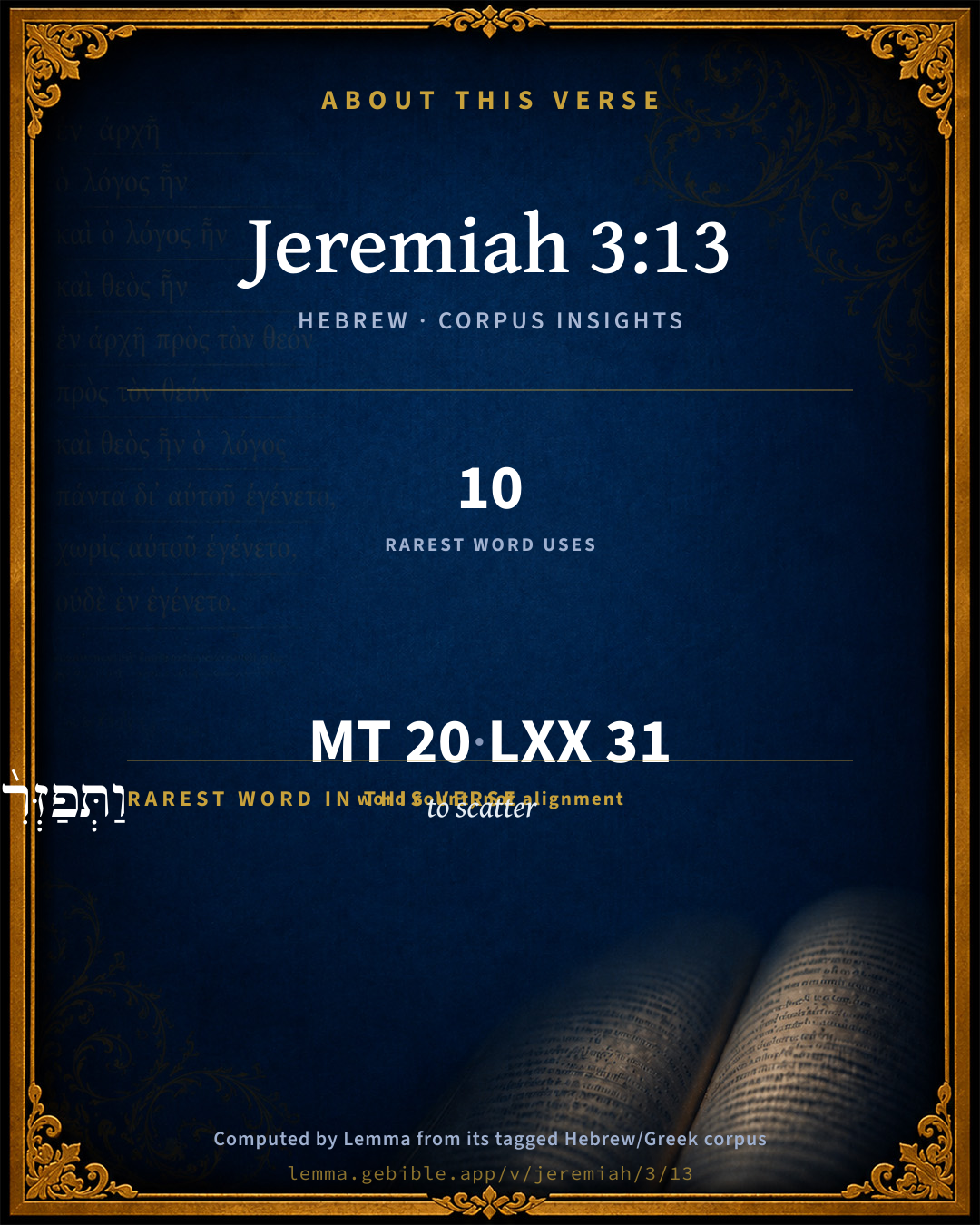
The rarest word here is וַתְּפַזְּרִ֨י to scatter H6340 — appearing just 10 times in the whole Hebrew Bible.

Shared distinctive vocabulary

וַתְּפַזְּרִ֨י to scatter H6340 occurs in 10 verses of the Hebrew Bible. Also found in:

Grammatical profile

  • 4 verbs
  • 9 nouns
  • 2 adjectives
  • 1 preposition
  • 1 conjunction
  • 3 particles

Verb forms

  • דְּעִ֣י Qal · Imperative
  • פָּשָׁ֑עַתְּ Qal · Perfect
  • וַתְּפַזְּרִ֨י Piel · Sequential Imperfect
  • שְׁמַעְתֶּ֖ם Qal · Perfect

Repetition

A word recurs within this verse — often emphatic in Hebrew:

  • בַּיהוָ֥ה LORD H3068 ×2

Hebrew & Septuagint length

In the original languages it is 20 Hebrew tokens and 31 Greek tokens — but the two are counted differently (Hebrew bundles its prefixes and suffixes into one token; the Greek is in lemma form), so that isn’t a like-for-like length.

Cross-references

16

Topical passages linked to Jeremiah 3:13 in the Treasury of Scripture Knowledge — connected by theme and wording, ordered by reader-vote popularity; previews shown in the World English Bible.

  • Deuteronomy 12:2 You shall surely destroy all the places in which the nations that you shall dispossess served their gods, on the high mountains, and on the hills, and under every green tree:
  • Deuteronomy 30:1–3 It shall happen, when all these things are come on you, the blessing and the curse, which I have set before you, and you shall call them to mind among all the nations, where Yahweh your God has driven you,
  • Jeremiah 2:25 Withhold your foot from being unshod, and your throat from thirst: but you said, It is in vain; no, for I have loved strangers, and after them will I go.
  • Jeremiah 3:6 Moreover Yahweh said to me in the days of Josiah the king, Have you seen that which backsliding Israel has done? she is gone up on every high mountain and under every green tree, and there has played the prostitute.
  • Jeremiah 3:25 Let us lie down in our shame, and let our confusion cover us; for we have sinned against Yahweh our God, we and our fathers, from our youth even to this day; and we have not obeyed the voice of Yahweh our God.
  • Jeremiah 2:20 For of old time I have broken your yoke, and burst your bonds; and you said, I will not serve; for on every high hill and under every green tree you did bow yourself, playing the prostitute.
  • Jeremiah 3:2 Lift up your eyes to the bare heights, and see; where have you not been lain with? By the ways have you sat for them, as an Arabian in the wilderness; and you have polluted the land with your prostitution and with your wickedness.
  • Jeremiah 14:20 We acknowledge, Yahweh, our wickedness, and the iniquity of our fathers; for we have sinned against you.
  • Luke 15:18–21 I will get up and go to my father, and will tell him, "Father, I have sinned against heaven, and in your sight.
  • 1 John 1:8–10 If we say that we have no sin, we deceive ourselves, and the truth is not in us.
  • Leviticus 26:40–42 "'If they confess their iniquity, and the iniquity of their fathers, in their trespass which they trespassed against me, and also that, because they walked contrary to me,
  • Job 33:27–28 He sings before men, and says, 'I have sinned, and perverted that which was right, And it didn't profit me.
  • Proverbs 28:13 He who conceals his sins doesn't prosper, But whoever confesses and renounces them finds mercy.
  • Jeremiah 31:18–20 I have surely heard Ephraim bemoaning himself [thus], You have chastised me, and I was chastised, as a calf unaccustomed [to the yoke]: turn you me, and I shall be turned; for you are Yahweh my God.
  • Ezekiel 16:15 But you did trust in your beauty, and played the prostitute because of your renown, and poured out your prostitution on everyone who passed by; his it was.
  • Ezekiel 16:24–25 that you have built to you a vaulted place, and have made you a lofty place in every street.

Cross-references courtesy of OpenBible.info (CC BY 4.0).

Hebrew and Greek witnesses Masoretic Hebrew ↔ Greek Septuagint

The same verse in the two great witnesses to the Old Testament, shown verse-for-verse.

These are two independent witnesses, not word-aligned to each other, and the Septuagint is shown in lemma (dictionary) form.

Hebrew Jeremiah 3:13 Masoretic · Westminster Leningrad Codex

אַ֚ךְ דְּעִ֣י עֲוֺנֵ֔ךְ כִּ֛י בַּיהוָ֥ה אֱלֹהַ֖יִךְ פָּשָׁ֑עַתְּ וַתְּפַזְּרִ֨י אֶת דְּרָכַ֜יִךְ לַזָּרִ֗ים תַּ֚חַת כָּל עֵ֣ץ רַעֲנָ֔ן וּבְקוֹלִ֥י לֹא שְׁמַעְתֶּ֖ם נְאֻם יְהֹוָֽה

Only acknowledge your iniquity, that you have transgressed against Yahweh your God, and have scattered your ways to the strangers under every green tree, and you have not obeyed my voice, says Yahweh.

World English Bible · Public Domain

Greek LXX Structure differs

In the Septuagint, Jeremiah is about an eighth shorter than the Hebrew and arranges its material differently — the Oracles Against the Nations (Hebrew chapters 46–51) appear in the middle of the Greek book, after 25:13. Because the chapter and verse boundaries do not line up, a verse-for-verse comparison with the Hebrew is not shown.

A verse-for-verse comparison isn’t shown here because the chapters and verses don’t line up. Switch to the LXX edition with the MT / LXX toggle above to read the Greek directly.

On this verse, Keil & Delitzsch discusses the Septuagint’s reading. Read the note in Commentary ↓

Hebrew: Westminster Leningrad Codex (CC BY 4.0). Greek: Septuagint (public domain); English from a public-domain English Septuagint. How the Septuagint differs from the Hebrew →

Targum (Aramaic paraphrase)

1

The Targum is the ancient Jewish Aramaic paraphrase of the Hebrew Scriptures — an interpretive translation, not the Hebrew text itself. Onkelos (literal) and Pseudo-Jonathan (expansive) render the Torah, and Jonathan the Prophets. Coverage is partial: where no permissively-licensed English translation exists for a verse, only the Aramaic is shown. This is verse-level text, not a word-by-word alignment to the Hebrew.

  1. Targum Jonathan Prophets (Joshua–Malachi)
    בְּרַם דְעִי חוֹבַיִךְ אֲרֵי בְמֵימְרָא דַייָ אֱלָהָךְ מְרֵידְתְּ וְקַלְקֵילְתְּ יַת אוֹרְחָתָךְ אִתְחַבַּרְתְּ לְעַמְמַיָא פַּלְחֵי כּוֹכְבַיָא תְּחוֹת כָּל אִילַן עַבּוּף וּלְמֵימְרִי לָא קַבֵּילְתּוּן אֲמַר יְיָ:

    (no public-domain English translation for this verse)

    Targum Jonathan — Aramaic: “Mikraot Gedolot” (public domain). English: “Sefaria Community Translation” (CC0 1.0 (public-domain dedication)); “London "Chaldee Paraphrase," 1871” (public domain). Text via Sefaria.

Commentary

Notes on Jeremiah 3:13 from classic Christian and Jewish commentators (each source and its license shown beneath its notes). The classic Christian expositions comment on the surrounding passage and are grouped to its opening verse, so a note may address several verses; the Jewish commentaries on the Tanakh (Rashi and others) are per-verse, so they appear only where the commentator wrote on this verse.

Lemma curates 59 commentaries, every one of them public domain or Creative Commons licensed, each selected and text-cleaned for this edition rather than reprinted as found. About our sources →

Trapp's Complete Commentary

John Trapp

Jer 3:13 Only acknowledge thine iniquity, that thou hast transgressed against the LORD thy God, and hast scattered thy ways to the strangers under every green tree, and ye have not obeyed my voice, saith the LORD.

Ver. 13. Only acknowledge thine iniquity.] Thus favour is promised to the ten captivated tribes, sed per modulum unius paenitentiae, but upon condition of their true repentance, one part whereof is confession of sin. {Pro 28:13 Psa 32:4} When thy sins and God’s wrath meeting in thy conscience, saith one, make thee deadly sick, then pour forth thy soul in confession; and as it will ease thee, as vomiting useth to do, so also it will move God to pity, and to give thee cordials and comforts to restore thee again. {a}

{a} Facit peccator confitendo propitium, quem non facit negando nescium. - August.

John Trapp, A Commentary or Exposition upon All the Books of the Old and New Testament (1647–1656) — public domain. Text from a community e-Sword module.

Tyndale Open Study Notes

Tyndale Open Resources

3:13 acknowledge your guilt . . . Admit that you rebelled . . . Confess that you refused to listen: Through these three elements of repentance, the people could demonstrate their willingness to receive the Lord’s salvation and restoration (Lev 26:40; Deut 30:1-5).

Tyndale Open Study Notes — © Tyndale Open Resources, licensed CC BY-SA 4.0. Text via the HelloAO Bible API.

Geneva Bible (1599)

Geneva Bible translators

There was no way, which thou didst not haunt to seek after the idols, and to trot a pilgrimage.

Geneva Bible (1599) marginal notes — public domain. Text via Bolls.life.

Jamieson, Fausset & Brown

Robert Jamieson, A. R. Fausset & David Brown

Only acknowledge-- (Deu 30:1, Deu 30:3; Pro 28:13).

scattered thy ways, &c.-- (Jer 2:25). Not merely the calves at Beth-el, but the idols in every direction, were the objects of their worship (Eze 16:15, Eze 16:24-25).

Jamieson, Fausset & Brown — Commentary Critical and Explanatory on the Whole Bible (1871) — public domain (CC PDM 1.0). Text via the HelloAO Bible API.

John Calvin's Commentaries

God lays down here a condition, lest hypocrites, relying on his goodness, should become more and more hardened, and yet think that he is bound as it were to them; for they usually reason thus, — “God is so kind that he recalls us to himself, and of his own free will invites even sinners; we may therefore easily settle matters with him.” Thus hypocrites by false thoughts’ delude themselves, thinking that they can elude God, since he seeks nothing else but to restore sinners to himself. Hence with the promise of favor there ought ever to be connected an exhortation to repentance. God then reminds here the Israelites, that they were greatly deceived, if they thought they could without any difficulty obtain pardon.

Hence he says, know thine iniquity The particle אך, ak, may be rendered only, or but, or yet. I prefer the second meaning, but; for an exception, as I have said, is here added, lest the Israelites slumbered in their vices, if they persuaded themselves that God was, as it, were, in their power and subject to their will. We hence see that the Prophet, modifying what he had said, introduces this sentence, “But in the meantime know thine iniquity, otherwise thou canst expect no peace with God.” Then these words follow, because thou hast acted wickedly against Jehovah thy God By these words the Prophet proves that the Israelites were guilty, lest they supposed that they could by evasions escape the wrath of God; for we know that often, even those who are conscious of their guilt, are not willing to confess their sins; and it is strange that men are so besotted as ever to contend with God. On this account the Prophets, when they exhorted the people to repent, at the same time brought to light their sins. Were there in men frankness and honesty, there would be no need thus to charge them; but as they either boldly deny their sins, or are so callous as to be moved by no fear, it is necessary to prick them sharply and even deeply to wound them. This is what the Prophet now does; Thou, he says, hast done wickedly against thy God; as though he had said, “I do not now in vain remind thee to own thy sins, for God himself condemns thee: think not thou that thou canst gain anything by thy subterfuges.”

He mentions also particulars, that he might come into closer quarters with them, Thou hast dispersed, he says, or scattered, thy ways to strangers, under every shady tree He again compares the Israelites to strumpets, who commonly so prostitute themselves, that they ramble from one place to another, invite and allure all they meet with. The Prophet then says, that the Israelites had thus dispersed themselves. He speaks delicately on an indelicate subject. But what he means is, that the Israelites were not content with one kind of superstition or with one idol, but blended together as many superstitions as they could, and borrowed false notions from all quarters: they were like a rambling strumpet, who prostitutes herself to all men indifferently. And strangers he calls all their fictitious gods; for as I have often said, they ought to have regarded him as their husband. When therefore the Israelites turned away to other gods, they became like a woman, who leaves her husband and prostitutes herself to any she can find. It is indeed a most common thing for those who forsake the true worship of God to seek for themselves various errors from all quarters, and to abandon themselves unreservedly to all kinds of superstitions.

He at length adds, And thou hast not hearkened to my voice By this fact the Prophet enhances their sin; for they had been instructed in the doctrine of the law, and understood the right way of salvation: how then was it that they thus polluted themselves with so many superstitions? It could not have been attributed to ignorance. It was then their manifest rebellion against God. The Prophet then shews that they had been disobedient and intractable, and that they had relapsed into idolatry and pernicious errors, because they had shaken off the yoke of God, and suffered not themselves to be ruled and guided by his word.

We now then perceive the meaning of this verse: God first requires a confession of sins from the Israelites; and thus he sets forth how available that return would be which he had previously mentioned; for until a sinner knows his sinfulness, he will never really and from the heart return to God, as the beginning of repentance is the confession of guilt. He then proves them to have been guilty, that he might cut off from them every pretense for evasion. He mentions in the third place specific sins, that he might hold them as it were fast bound, even that they had polluted themselves with superstitions, and that they had become, not only like an adulterous woman who follows another man, but also like filthy strumpets, who run here and there and make no difference between men known or unknown. He shews in the last place, that all this happened through mere obstinacy; for they had cast aside every regard for God, though he had given them his law, and sent the prophets as its faithful interpreters, so that they understood what God approved and what was just and right. The reason then why they went astray was, that they closed their ears to God’s word, and suffered not themselves to be ruled by it, but became wholly unteachable. Let us go on —

John Calvin's Commentaries (1540-1563) — public domain. Text from the Calvin Translation Society English edition (1840s-50s) via the Christian Classics Ethereal Library (ccel.org). Calvin's coverage is partial (roughly two-thirds of the Bible); uncommented books and verses are honest gaps, never fabricated. The 19th-century editor's footnotes and remarks are omitted so the notes are faithfully Calvin's own voice.

Ellicott's Commentary for English Readers

(13) Only acknowledge . . .—This was the one sufficient, indispensable condition of pardon—the confession that kept nothing back, and made no vain excuses.

Hast scattered thy ways.—The phrase is a strong one, thou hast left traces of thy way everywhere, i.e., hast gone this way and that in search of new and alien forms of worship. The “green tree” as before (Jer_2:20) was the familiar scene of the hateful worship.

A Bible Commentary for English Readers, edited by Charles John Ellicott (1878–1897) — public domain. Text from a community e-Sword module.

The Cambridge Bible for Schools and Colleges

gen. ed. J. J. S. Perowne

13. hast scattered thy ways] hast wandered hither and thither. Cp. Jer_2:23.

strangers] foreign gods. Cp. Jer_2:25.

The Cambridge Bible for Schools and Colleges (gen. ed. J. J. S. Perowne; Cambridge University Press, 1878–1918) — public domain. Text from a community e-Sword module.

John Gill's Exposition

Only acknowledge thine iniquity,.... Or, "know" (e) it; unless a man knows his sin, and is convicted of it, he will never repent of it, or turn from it; and when he is made sensible of it, and sorry for it, he ought to acknowledge and confess it before God, against whom he has sinned; this is what is insisted upon, and all that is insisted upon; and it is the least that can be done, and is what every sensible sinner will do, who upon it may expect the discovery of pardoning grace and mercy, Psa 32:5,

that thou hast transgressed against the Lord thy God; against his law, his declared mind and will, and notwithstanding he is the Lord thy God; against a God of love, grace, and mercy, who had loaded them with his benefits, and followed them with his goodness; all which aggravates the sin they had been guilty of:

and hast scattered thy ways to the strangers under every green tree; a phrase expressive of whoredom; it is an euphemism, the same with , as Jarchi observes, "the opening of the feet", to everyone that passes by, to be lain with, Eze 16:25 and is to be understood of the multiplied idolatries of Israel; and that as harlots run about here and there, and prostitute themselves to whomsoever they meet with, so they worshipped the strange gods of the Heathens everywhere, in all their cities, upon every mountain and hill, and under every green tree; see Jer 2:20 so the Targum,

"and thou hast corrupted thy way, thou hast joined thyself to the people that worship idols under every green tree:''

and ye have not obeyed my voice, saith the Lord: the voice of his command in the law, which forbids idolatry; and his voice by his prophets, which reproved them for it, and exhorted them to repentance; but they regarded neither.

(e) "scito", V. L. Pagninus, Montanus.

John Gill's Exposition of the Whole Bible (1746–1763) — public domain (CC PDM 1.0). Text via the HelloAO Bible API.

Albert Barnes' Notes on the Bible

Acknowledge - literally, “know thy iniquity;” know that thy doings are iniquitous.

Scattered thy ways - Wandered in search of those idolatries which foreign nations practice.

Albert Barnes' Notes on the Bible (1834–1885) — public domain. Text from a community e-Sword/MySword module.

Haydock's Catholic Bible Commentary

Ways, dividing thy love, and adoring idols with me.

George Leo Haydock (1774–1849), Haydock's Catholic Family Bible and Commentary, 1859 edition — public domain. Excludes Psalms (Douay-Rheims chapter numbering differs from Protestant) and Deuterocanonical books (Catholic canon only).

Matthew Poole's English Annotations

Only acknowledge thine iniquity; which will be the evidence of thy repentance, without which thou canst not lay claim to any pardon, Pro 28:13; Isa 55:7. This is spoken by way of limitation, lest the Israelites should fancy a too easy pardon from God’s merciful nature. Exhortations to repentance should always accompany the exhibition of promises.

Hast scattered thy ways to the strangers, viz. to other nations, or rather to other gods, or to idols, running here and there, up and down, like a light, impudent harlot. sometimes to one, sometimes to another, thus sucking in divers superstitions, called

scattering thy ways, Jer 3:6; 2Ki 17:4,9,10; Jer 2:23,25. Feet, whereby we go on in ways; a metaphorical metonymy. Ye have not obeyed my voice; so that your sin is not a sin of ignorance, but of obstinacy, shutting your ears against my counsels, which I sent you by my prophets for your reclaiming, 2Ki 17:13, &c.

Matthew Poole's English Annotations on the Holy Bible (1683–1685) — public domain. Text from a community e-Sword/MySword module.

Whedon's Commentary on the Bible

Daniel D. Whedon

13. Acknowledge — Literally, know; that is, see it in its true light. The most fundamental element in all genuine confession is confession to one’s self. One must admit his own vileness in his inmost soul before he is prepared for reformation.

Scattered thy ways — Hast run in all directions in search of false gods. Madly and irrationally has this quest been urged.

Daniel D. Whedon (gen. ed.), Commentary on the Old and New Testaments (1874–1909) — public domain. Text from a community e-Sword module.

The Pulpit Commentary

This condition of restoration to favor. Israel is to acknowledge, or perceive, notice, recognize, her guilt. And hast scattered thy ways; alluding to that "gadding about" in quest of foreign alliances, reproved in the preceding chapter. (Jer_2:36) Comp. "interlacing her ways," Jer_2:23.

The Pulpit Commentary (1880–1919), ed. H.D.M. Spence-Jones & Joseph S. Exell — public domain. Text from a community e-Sword module.

John Wesley's Explanatory Notes

Strangers - To other gods, or to idols, running here and there up and down.

John Wesley, Explanatory Notes Upon the Whole Bible (1754–1765) — public domain. Text via the GEBible commentary corpus.

Keil & Delitzsch

C. F. Keil & F. Delitzsch

An indispensable element of the return is: Acknowledge thy guilt, thine offence, for grievously hast thou offended; thou art fallen away (פּשׁע), and תּפזּרי את־דּרכיך, lit., hast scattered thy ways for strangers; i.e., hither and thither, on many a track, hast thou run after the strange gods: cf. Jer 2:23.

The repeated call שׁוּבוּ, Jer 3:14, is, like that in Jer 3:12, addressed to Israel in the narrower sense, not to the whole covenant people or to Judah. The "backsliding sons" are "the backsliding Israel" of Jer 3:7, Jer 3:8, Jer 3:11., and of Jer 3:22. In Jer 3:18 also Judah is mentioned only as it is in connection with Israel. בּעלתּי בכם, here and in Jer 31:32, is variously explained. There is no evidence for the meaning loathe, despise, which Ges. and Diet. in the Lex., following the example of Jos. Kimchi, Pococke, A Schultens, and others, attribute to the word בּעל; against this, cf. Hgstb. Christol. ii. p. 375; nor is the sig. "rule" certified (lxx διότι ἐγὼ κατακυριεύσω ὑμῶν); it cannot be proved from Isa 26:13. בּעל means only, own, possess; whence come the meanings, take to wife, have oneself married, which are to be maintained here and in Jer 31:32. In this view Jerome translates, quia ego vir vester; Luther, denn ich will euch mir vertrauen; Hgstb., denn ich traue euch mir an;-the reception anew of the people being given under the figure of a new marriage. This acceptation is, however, not suitable to the perf. בּעלתּי, for this, even if taken prophetically, cannot refer to a renewal of marriage which is to take place in the future. The perf. can be referred only to the marriage of Israel at the conclusion of the covenant on Sinai, and must be translated accordingly: I am your husband, or: I have wedded you to me. This is demanded by the grounding כּי; for the summons to repent cannot give as its motive some future act of God, but must point to that covenant relationship founded in the past, which, though suspended for a time, was not wholly broken up.

(Note: Calvin gives it rightly: "Dixerat enim, se dedisse libellum repudii h. e. quasi publicis tabulis se testatum fuisse, nihil amplius sibi esse conjunctionis cum populo illo. Nam exilium erat instar divortii. Jam dicit: Ego sum maritus vester. Nam etiamsi ego tam graviter laesus a vobis fuerim, quia fefellistis fidem mihi datam, tamen maneo in proposito, ut sim bovis maritus;...et perinde ac si mihi semper fidem praestitissetis, iterum assuman vos, inqiut.")

The promise of what God will do if Israel repents is given only from ולקחתּי (with ו consec.) onwards. The words, I take you, one out of a city, two out of a race, are not with Kimchi to be so turned: if even a single Israelite dwelt in a heathen city; but thus: if from amongst the inhabitants of a city there returns to me but one, and if out of a whole race there return but two, I will gather even these few and bring them to Zion. Quite aside from the point is Hitz.'s remark, that in Mic 5:1, too, a city is called אלף, and is equivalent to משׁפּחה. The numbers one and two themselves show us that משׁפּחה is a larger community than the inhabitants of one town, i.e., that it indicates the great subdivisions into which the tribes of Israel were distributed. The thought, then, is this: Though but so small a number obey the call to repent, yet the Lord will save even these; He will exclude from salvation no one who is willing to return, but will increase the small number of the saved to a great nation. This promise is not only not contradictory of those which declare the restoration of Israel as a whole; but it is rather a pledge that God will forget no one who is willing to be saved, and shows the greatness of the divine compassion.

As to the historical reference, it is manifest that the promise cannot be limited, as it is by Theodrt. and Grot., to the return from the Assyrian and Babylonian exile; and although the majority of commentators take it so, it can as little be solely referred to the Messianic times or to the time of the consummation of the kingdom of God. The fulfilment is accomplished gradually. It begins with the end of the Babylonian exile, in so far as at that time individual members of the ten tribes may have returned into the land of their fathers; it is continued in Messianic times during the lives of the apostles, by the reception, on the part of the Israelites, of the salvation that had appeared in Christ; it is carried on throughout the whole history of the Church, and attains its completion in the final conversion of Israel. This Messianic reference of the words is here the ruling one. This we may see from "bring you to Zion," which is intelligible only when we look on Zion as the seat of the kingdom of God; and yet more clearly is it seen from the further promise, Jer 3:15-17, I will give you shepherds according to my heart, etc. By shepherds we are not to understand prophets and priests, but the civil authorities, rulers, princes, kings (cf. Jer 2:8, Jer 2:26). This may not only be gathered from the parallel passage, Jer 23:4, but is found in the כּלבּי, which is an unmistakeable allusion to Sa1 13:14, where David is spoken of as a man whom Jahveh has sought out for Himself after His heart (כּלבבו), and has set to be prince over His people. They will feed you דּעה . Both these words are used adverbially. דּעה is a noun, and השׂכּיל an infin.: deal wisely, possess, and show wisdom; the latter is as noun generally השׂכּל , Dan 1:17; Pro 1:3; Pro 21:16, but is found also as infin. absol. Jer 9:23. A direct contrast to these shepherds is found in the earlier kings, whom Israel had itself appointed according to the desire of its heart, of whom the Lord said by Hosea, They have set up kings (to themselves), but not by me (Hos 8:4); kings who seduced the people of God to apostasy, and encouraged them in it. "In the whole of the long series of Israelitish rulers we find no Jehoshaphat, no Hezekiah, no Josiah; and quite as might have been expected, for the foundation of the throne of Israel was insurrection" (Hgstb.). But if Israel will return to the Lord, He will give it rulers according to His heart, like David (cf. Eze 34:23; Hos 3:5), who did wisely (משׂכּיל ) in all his ways, and with whom Jahveh was (Sa1 18:14.; cf. Kg1 2:3). The knowledge and wisdom consists in the keeping and doing of the law of God, Deu 4:6; Deu 29:8. As regards form, the promise attaches itself to the circumstances of the earlier times, and is not to be understood of particular historical rulers in the period after the exile; it means simply that the Lord will give to Israel, when it is converted to Him, good and faithful governors who will rule over it in the spirit of David. But the Davidic dynasty culminates in the kingship of the Messiah, who is indeed named David by the prophets; cf. Jer 22:4.

Keil & Delitzsch — Biblical Commentary on the Old Testament (1861–1891) — public domain (CC PDM 1.0). Text via the HelloAO Bible API. (Old Testament only.)

unfoldingWord translationNotes

Door43 World Missions Community

Acknowledge your iniquity

"Admit how you have sinned." God was speaking to Israel.

you have shared your ways with strangers under every leafy tree!

The word "strangers" refers to foreign gods. God speaks of Israel worshiping foreign gods as if Israel were a woman who was having sex with strangers. (See: Metaphor)

under every leafy tree

People would worship idols under trees. The word "every" is a generalization used to show that the people of Israel worshiped many gods under many different trees. (See: Hyperbole and Generalization)

you have not listened to my voice

Here "listened" represents obeying, and "my voice" represents what God has said. AT: "you have not obeyed what I have said" (See: Metonymy)

this is Yahweh's declaration

Yahweh speaks of himself by name to express the certainty of what he is declaring. See how you translated this in Jeremiah 1:8. AT: "this is what Yahweh has declared" or "this is what I, Yahweh, have declared" (See: First, Second, or Third Person)

I am your husband

God speaks of Israel belonging to him as if he were Israel's husband. AT: "you belong to me as a wife belongs to her husband" (See: Metaphor)

I will give you shepherds ... they will shepherd you

Here God speaks of leaders as if they were shepherds and the people they led were sheep. AT: "I will give you leaders ... they will lead you" (See: Metaphor)

shepherds after my heart

Here "heart" represents Yahweh's desire or will. The phrase "after my heart" is an idiom that describes people who do God's will. AT: "shepherds who do my will" or "shepherds who do what I want" (See: Metonymy and Idiom)

translationWords

acknowledge

iniquity

transgress

God

voice

people of God

Zion

shepherd

know

unfoldingWord translationNotes — © Distant Shores Media and the Door43 World Missions Community, licensed CC BY-SA 4.0. Source: git.door43.org/Door43/en_tn.

Rashi

Rabbi Shlomo Yitzchaki (Rashi)

you have rebelled Heb. פשעת.

and you have scattered your ways This is an expression of harlotry, spreading the legs to the woman’s private parts.

Rashi on the Tanakh — English translations: “The Judaica Press complete Tanach with Rashi, translated by A. J. Rosenberg” (CC BY 4.0); “Pentateuch with Rashi's commentary by M. Rosenbaum and A.M. Silbermann, 1929-1934” (public domain); “The Metsudah Tanach series, Lakewood, N.J” (CC BY 4.0); and “The Book of Joshua, Metsudah Publications, 1997” (CC BY 4.0). Text via Sefaria.

Lesson kit

Teaching starters — assembled from the data on this page, not authored interpretation. Every prompt links to the verse data it draws on. Edit before teaching.

Jeremiah, in the Prophets, opens this verse with 20 words (19 distinct Hebrew lemmas). Its most distinctive word is pâzar (“to scatter”). A historical commentator’s framing appears above. Read the whole chapter for the surrounding context.

Discussion questions

  1. What does “to scatter” (pâzar) contribute to the verse as a whole?
  2. Esther 3:8 shares the word «to scatter» with this verse. How do the two illuminate each other?
  3. “LORD” occurs 2× in this one verse. What is the effect of the repetition?
  4. These translations render this verse differently. What is at stake in choosing one wording over another?
  5. The verb «דְּעִ֣י» is Qal Imperative. How does its form color the action?
  6. Reading how Trapp's Complete Commentary and Tyndale Open Study Notes read this verse, where do the two commentators agree and where do they part?

Things to notice

Reading settings

Reading text

Shown beneath each verse's original-language words.

Old Testament
Old Testament edition

Read the OT as the Masoretic Hebrew (MT) or the Greek Septuagint (LXX).

English shown for the Greek Septuagint (in the Hebrew ↔ Greek comparison).

Comparing translations? Open the Compare panel on any verse page to stack up to four side by side.