
Joshua 22:20

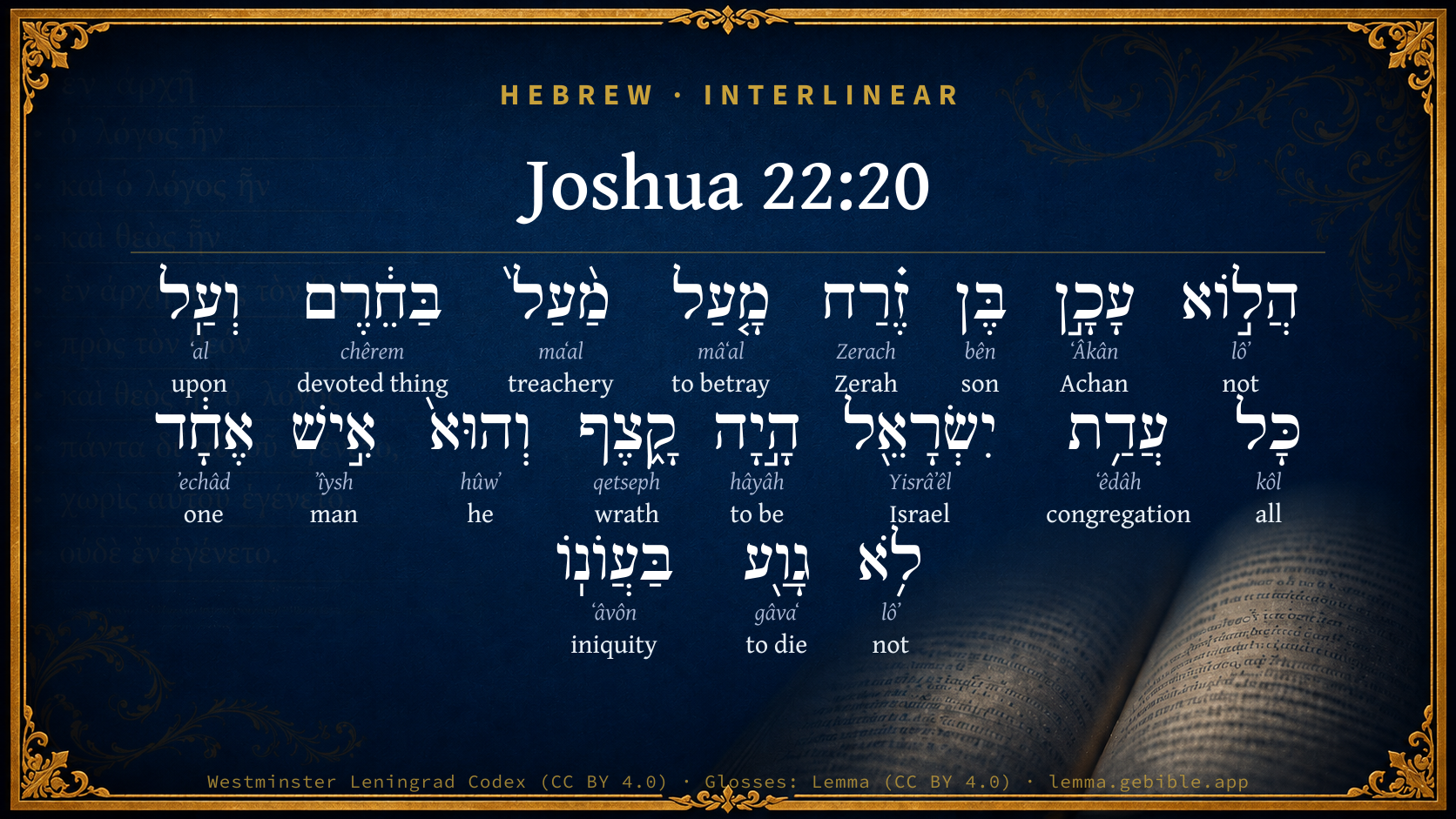
Hebrew (Westminster Leningrad Codex) Joshua 22:20 appears in the Hebrew Old Testament. The text above is from the Westminster Leningrad Codex. Each word links to its Strong’s number, a concise gloss, and parsing drawn from the Open Scriptures Hebrew Bible morphology. Click any word for its full Brown-Driver-Briggs (BDB) entry.
Download image
Cite this verse

Joshua 22:20 (World English Bible). Public Domain. Lemma interlinear Bible study tool, https://lemma.gebible.app/v/joshua/22/20.

Show BibTeX & RIS
BibTeX
RIS
English Translation
Didn't Achan the son of Zerah commit a trespass in the devoted thing, and wrath fell on all the congregation of Israel? and that man didn't perish alone in his iniquity.
World English Bible · Public Domain
Download a study sheet

One document with this verse’s original text, its word-by-word gloss line, the meaning frame, cross-references with their text, attributed commentary, and full source and license credits — printable, and it pastes into notes with its structure intact.

This verse Autodidact and up

Study sheet (.html) Plain text (.txt)

A passage Seminary Student

Up to 50 verses in one chapter. A passage sheet keeps up to 6 commentary sources and 12 cross-references per verse, in the order this page ranks them, and says so on the sheet whenever that leaves anything out. Ask for a single verse and you get the Autodidact verse sheet above.

Everything on this page stays free to read, with no account — the sheet is a download of what is already on screen, not access to it.

Want to remove ads? Support Godless Engineer
Compare translations 3

The same verse in 3 English versions, stacked beneath the original-language interlinear above. Click any original word for its lexicon entry.

Each is an independent rendering of the whole verse — the interlinear is not word-aligned to these translations.

Highlighted words mark where these versions differ — a whole-verse word diff, not a word-by-word alignment.

  • World English Bible Public Domain
    Didn't Achan the son of Zerah commit a trespass in the devoted thing, and wrath fell on all the congregation of Israel? and that man didn't perish alone in his iniquity.
  • King James Version Public Domain
    Did not Achan the son of Zerah commit a trespass in the accursed thing, and wrath fell on all the congregation of Israel? and that man perished not alone in his iniquity.
  • unfoldingWord Literal Text CC BY-SA 4.0
    not Achan, the son of Zerah, act unfaithfully in unfaithfulness with the devoted thing, and wrath was on all of the congregation of Israel? And he did not perish, one man, in his iniquity!’”

unfoldingWord Literal Text — © unfoldingWord, licensed CC BY-SA 4.0. Word-aligned USFM3 via Door43 (git.door43.org/unfoldingWord/en_ult).

Versions to compare (up to 4)

3 of 4 selected

Show all 18 translations

Every available English version of this verse, each an independent rendering of the whole verse.

  • World English Bible Public Domain
    Didn't Achan the son of Zerah commit a trespass in the devoted thing, and wrath fell on all the congregation of Israel? and that man didn't perish alone in his iniquity.
  • Berean Standard Bible Public Domain
    Was not Achan son of Zerah unfaithful regarding what was set apart for destruction, bringing wrath upon the whole congregation of Israel? Yet it was not only Achan who perished because of his sin!’”
  • Majority Standard Bible Public Domain
    Was not Achan son of Zerah unfaithful regarding what was set apart for destruction, bringing wrath upon the whole congregation of Israel? Yet it was not only Achan who perished because of his sin!’”
  • King James Version Public Domain
    Did not Achan the son of Zerah commit a trespass in the accursed thing, and wrath fell on all the congregation of Israel? and that man perished not alone in his iniquity.
  • American Standard Version (1901) Public Domain
    Did not Achan the son of Zerah commit a trespass in the devoted thing, and wrath fell upon all the congregation of Israel? and that man perished not alone in his iniquity.
  • Revised Version (1885) Public Domain
    Did not Achan the son of Zerah commit a trespass in the devoted thing, and wrath fell upon all the congregation of Israel? and that man perished not alone in his iniquity.
  • Geneva Bible (1599) Public Domain
    Did not Achan ye sonne of Zerah trespasse grieuously in the execrable thing, and wrath fell on all the Congregation of Israel? and this man alone perished not in his wickednesse.
  • Douay-Rheims (1899) Public Domain
    Did not Achan the son of Zare transgress the commandment of the Lord, and his wrath lay upon all the people of Israel? And he was but one man, and would to God he alone had perished in his wickedness.
  • Young's Literal Translation Public Domain
    Did not Achan son of Zerah commit a trespass in the devoted thing, and on all the company of Israel there was wrath? and he alone expired not in his iniquity.'
  • Literal Standard Version CC BY-SA 4.0
    Did Achan son of Zerah not commit a trespass in the devoted thing, and there was wrath on all the congregation of Israel? And he alone did not expire in his iniquity.”
  • Unlocked Literal Bible CC BY-SA 4.0
    Did not Achan son of Zerah break faith in the matter of those things that had been reserved for God? Did not wrath fall on all the people of Israel? That man did not perish alone for his iniquity.'”
  • unfoldingWord Literal Text CC BY-SA 4.0
    not Achan, the son of Zerah, act unfaithfully in unfaithfulness with the devoted thing, and wrath was on all of the congregation of Israel? And he did not perish, one man, in his iniquity!’”
  • Darby Bible Public Domain
    Did not Achan the son of Zerah commit a trespass in the accursed thing? and wrath fell on all the assembly of Israel, and he perished not alone in his iniquity.
  • World Messianic Bible Public Domain
    Didn’t Achan the son of Zerah commit a trespass in the devoted thing, and wrath fell on all the congregation of Israel? That man didn’t perish alone in his iniquity.’”
  • Webster's Bible Public Domain
    Did not Achan the son of Zerah commit a trespass in the accursed thing, and wrath fall on all the congregation of Israel? and that man perished not alone in his iniquity.
  • Free Bible Version CC BY-SA 4.0
    When Achan, son of Zerah, acted disloyally in taking consecrated things, didn't the whole of Israel suffer punishment? He wasn't the only one who died because of his sin!’”
  • Bible in Basic English Public Domain
    Did not Achan, the son of Zerah, do wrong about the cursed thing, causing wrath to come on all the people of Israel? And not on him only came the punishment of death.
  • JPS Tanakh (1917) Public Domain
    Did not Achan the son of Zerah commit a trespass concerning the devoted thing, and wrath fell upon all the congregation of Israel? and that man perished not alone in his iniquity.'

Literal Standard Version (2020), Covenant Press — licensed CC BY-SA 4.0. Text via the HelloAO Bible API (eBible.org). Unlocked Literal Bible (unfoldingWord) — licensed CC BY-SA 4.0. Text via the HelloAO Bible API (eBible.org). unfoldingWord Literal Text — © unfoldingWord, licensed CC BY-SA 4.0. Word-aligned USFM3 via Door43 (git.door43.org/unfoldingWord/en_ult). Free Bible Version, Dr. Jonathan Gallagher — licensed CC BY-SA 4.0. Text via the HelloAO Bible API (eBible.org).

Word by word

More ways to search: Search by grammar → Find every occurrence → Compare this word →

Practice this passage: Drill this verse → Learn its vocabulary →

עָכָ֣ן
ʻÂkân
H5912
“Achan”
Noun, Proper
Part of Speech
Noun
Type
Proper
Full BDB Definition

Origin: from an unused root meaning to trouble

TWOT: None

Achan = "troubler" - a Judaite who violated God's specific ban on taking any loot from the captured city of Jericho and was stoned to death along with his family for this violation
  1. הֲל֣וֹא lôʼ H3808 “not” Particle, Interrogative + Particle, Negative
  2. בֶּן bên H1121 “son of” Noun, Common, Masculine, Singular, Construct
  3. זֶ֗רַח Zerach H2226 “Zerah” Noun, Proper
  4. מָ֤עַל mâʻal H4603 “to betray” Verb, Qal, Perfect, 3rd Person, Masculine, Singular
  5. מַ֨עַל֙ maʻal H4604 “treachery” Noun, Common, Masculine, Singular, Absolute
  6. בַּחֵ֔רֶם chêrem H2764 “in/at the · devoted thing” Preposition, Determined + Noun, Common, Masculine, Singular, Absolute
  7. וְעַֽל ʻal H5921 “and · upon” Conjunction + Preposition
  8. כָּל kôl H3605 “all of” Noun, Common, Masculine, Singular, Construct
  9. עֲדַ֥ת ʻêdâh H5712 “congregation of” Noun, Common, Feminine, Singular, Construct
  10. יִשְׂרָאֵ֖ל Yisrâʼêl H3478 “Israel” Noun, Proper
  11. הָ֣יָה hâyâh H1961 “to be” Verb, Qal, Perfect, 3rd Person, Masculine, Singular
  12. קָ֑צֶף qetseph H7110 “wrath” Noun, Common, Masculine, Singular, Absolute
  13. וְהוּא֙ hûwʼ H1931 “and · he” Conjunction + Pronoun, Personal, 3rd Person, Masculine, Singular
  14. אִ֣ישׁ ʼîysh H376 “man” Noun, Common, Masculine, Singular, Absolute
  15. אֶחָ֔ד ʼechâd H259 “one” Adjective, Cardinal number, Masculine, Singular, Absolute
  16. לֹ֥א lôʼ H3808 “not” Particle, Negative
  17. גָוַ֖ע gâvaʻ H1478 “to die” Verb, Qal, Perfect, 3rd Person, Masculine, Singular
  18. בַּעֲוֺנֽוֹ ʻâvôn H5771 “in/at · iniquity · his” Preposition + Noun, Common, Both, Singular, Construct + Suffix, Personal, 3rd Person, Masculine, Singular

About this verse

These counts appear in no published source. They are computed here, from the morphology-tagged text and Lemma’s own curated glosses. What Lemma adds →

19
words
18
distinct lemmas
Historical
section

Notable vocabulary

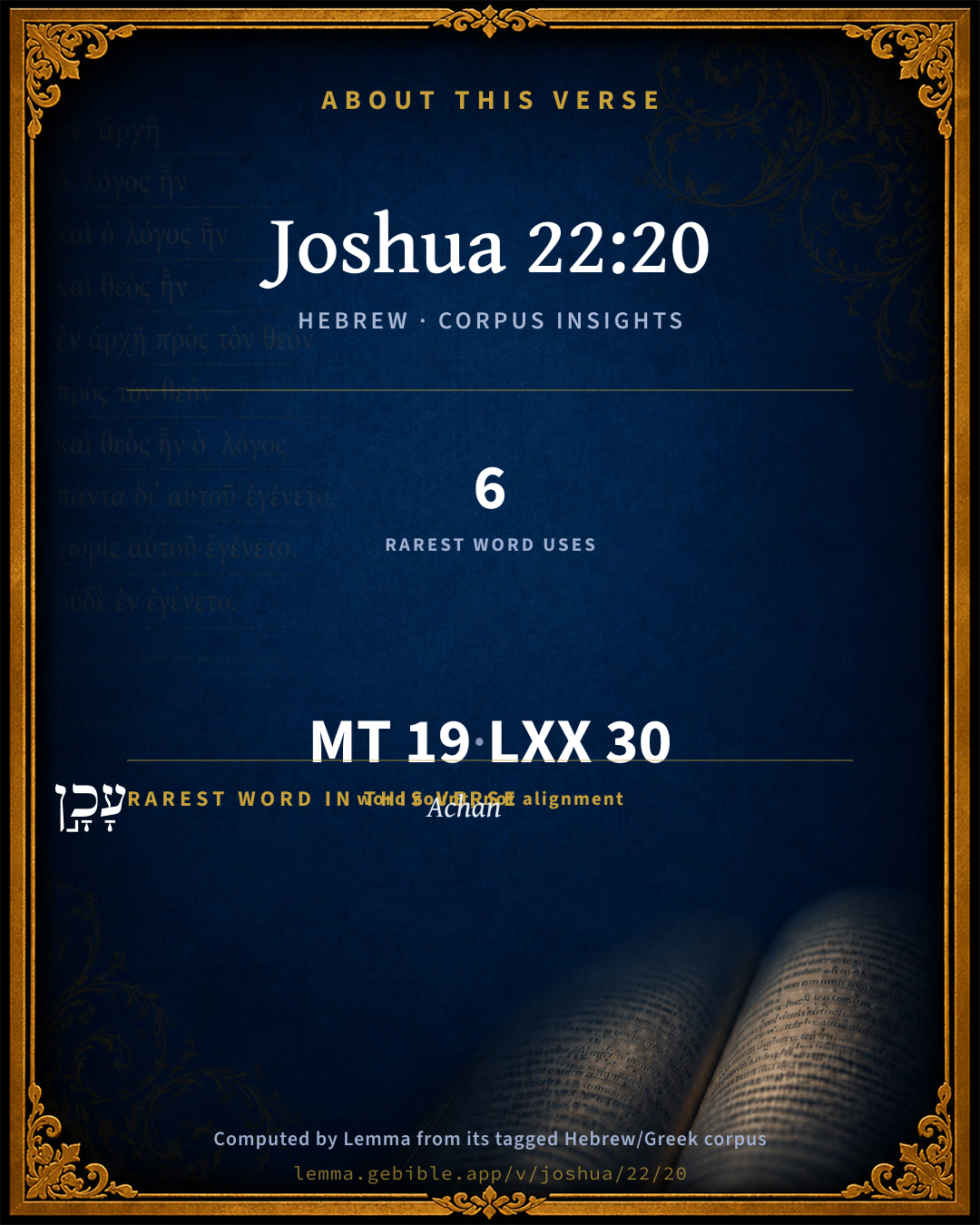
The rarest word here is עָכָ֣ן Achan H5912 — appearing just 6 times in the whole Hebrew Bible.

Shared distinctive vocabulary

עָכָ֣ן Achan H5912 occurs in 6 verses of the Hebrew Bible. Also found in:

Grammatical profile

  • 3 verbs
  • 11 nouns
  • 1 adjective
  • 1 pronoun
  • 1 preposition
  • 2 particles

Verb forms

  • מָ֤עַל Qal · Perfect
  • הָ֣יָה Qal · Perfect
  • גָוַ֖ע Qal · Perfect

Repetition

A word recurs within this verse — often emphatic in Hebrew:

  • הֲל֣וֹא not H3808 ×2

Hebrew & Septuagint length

In English translation the verse runs 31 words from the Hebrew and 35 from the Septuagint (LXX English) — closely comparable.

A rough comparison of the two English renderings, which tokenize alike — not a word-level alignment.

Word counts can differ between the Hebrew and the Greek without any difference in meaning — e.g. the Hebrew direct-object marker אֵת has no separate Greek word, and Greek often adds the article ὁ.

In the original languages it is 19 Hebrew tokens and 30 Greek tokens — but the two are counted differently (Hebrew bundles its prefixes and suffixes into one token; the Greek is in lemma form), so that isn’t a like-for-like length.

Cross-references

7

Topical passages linked to Joshua 22:20 in the Treasury of Scripture Knowledge — connected by theme and wording, ordered by reader-vote popularity; previews shown in the World English Bible.

  • Joshua 7:1 But the children of Israel committed a trespass in the devoted thing; for Achan, the son of Carmi, the son of Zabdi, the son of Zerah, of the tribe of Judah, took of the devoted thing: and the anger of Yahweh was kindled against the children of Israel.
  • Joshua 7:5 The men of Ai struck of them about thirty-six men; and they chased them [from] before the gate even to Shebarim, and struck them at the descent; and the hearts of the people melted, and became as water.
  • Joshua 7:18 and he brought near his household man by man; and Achan, the son of Carmi, the son of Zabdi, the son of Zerah, of the tribe of Judah, was taken.
  • Joshua 7:24 Joshua, and all Israel with him, took Achan the son of Zerah, and the silver, and the mantle, and the wedge of gold, and his sons, and his daughters, and his oxen, and his donkeys, and his sheep, and his tent, and all that he had: and they brought them up to the valley of Achor.
  • 1 Corinthians 10:6 Now these things were our examples, to the intent we should not lust after evil things, as they also lusted.
  • 2 Peter 2:6 and turning the cities of Sodom and Gomorrah into ashes, condemned them to destruction, having made them an example to those who would live ungodly;
  • Jude 1:5–6 Now I desire to remind you, though you already know this, that the Lord, having saved a people out of the land of Egypt, afterward destroyed those who didn't believe.

Cross-references courtesy of OpenBible.info (CC BY 4.0).

Hebrew and Greek witnesses Masoretic Hebrew ↔ Greek Septuagint

The same verse in the two great witnesses to the Old Testament, shown verse-for-verse.

These are two independent witnesses, not word-aligned to each other, and the Septuagint is shown in lemma (dictionary) form.

Hebrew Joshua 22:20 Masoretic · Westminster Leningrad Codex

הֲל֣וֹא עָכָ֣ן בֶּן זֶ֗רַח מָ֤עַל מַ֨עַל֙ בַּחֵ֔רֶם וְעַֽל כָּל עֲדַ֥ת יִשְׂרָאֵ֖ל הָ֣יָה קָ֑צֶף וְהוּא֙ אִ֣ישׁ אֶחָ֔ד לֹ֥א גָוַ֖ע בַּעֲוֺנֽוֹ

Didn't Achan the son of Zerah commit a trespass in the devoted thing, and wrath fell on all the congregation of Israel? and that man didn't perish alone in his iniquity.

World English Bible · Public Domain

Greek LXX Joshua 22:20 Septuagint · lemma form

οὐ ἰδού αχαρ ὁ ὁ ζαρα πλημμέλεια πλημμελέω ἀπό ὁ ἀνάθεμα καί ἐπί πᾶς συναγωγή ἰσραήλ γίγνομαι ὀργή καί οὗτος εἷς μόνος εἰμί μή μόνος οὗτος ἀποθνήσκω ὁ ἑαυτοῦ ἁμαρτία

Behold! did not Achar the son of Zara commit a trespass taking of the accursed thing, and there was wrath on the whole congregation of Israel? and he himself died alone in his own sin.

LXX2012 (modern English Septuagint) · Public Domain

On this verse, Haydock's Catholic Bible Commentary discusses the Septuagint’s reading. Read the note in Commentary ↓

Hebrew: Westminster Leningrad Codex (CC BY 4.0). Greek: Septuagint (public domain); English from LXX2012 (modern English Septuagint) (Public Domain). How the Septuagint differs from the Hebrew →

Targum (Aramaic paraphrase)

1

The Targum is the ancient Jewish Aramaic paraphrase of the Hebrew Scriptures — an interpretive translation, not the Hebrew text itself. Onkelos (literal) and Pseudo-Jonathan (expansive) render the Torah, and Jonathan the Prophets. Coverage is partial: where no permissively-licensed English translation exists for a verse, only the Aramaic is shown. This is verse-level text, not a word-by-word alignment to the Hebrew.

  1. Targum Jonathan Prophets (Joshua–Malachi)
    הֲלָא עָכָן בַּר זָרַח שְׁקַר שִׁקְרָא בְּחֶרְמָא וְעַל כָּל כְּנִשְׁתָּא דְיִשְׂרָאֵל הֲוָה רוּגְזָא וְהוּא גַבְרָא חָד לָא מִית בְּחוֹבֵיהּ:

    (no public-domain English translation for this verse)

    Targum Jonathan — Aramaic: “Mikraot Gedolot” (public domain). English: “Sefaria Community Translation” (CC0 1.0 (public-domain dedication)); “London "Chaldee Paraphrase," 1871” (public domain). Text via Sefaria.

Commentary

Notes on Joshua 22:20 from classic Christian and Jewish commentators (each source and its license shown beneath its notes). The classic Christian expositions comment on the surrounding passage and are grouped to its opening verse, so a note may address several verses; the Jewish commentaries on the Tanakh (Rashi and others) are per-verse, so they appear only where the commentator wrote on this verse.

Lemma curates 59 commentaries, every one of them public domain or Creative Commons licensed, each selected and text-cleaned for this edition rather than reprinted as found. About our sources →

Trapp's Complete Commentary

John Trapp

Jos 22:20 Did not Achan the son of Zerah commit a trespass in the accursed thing, and wrath fell on all the congregation of Israel? and that man perished not alone in his iniquity.

Ver. 20. Did not Achan, &c.] This is the true use of history, - to be warned by it: God therefore hangeth some malefactors up in gibbets as it were: Cavebis autem, si pavebis.

And wrath fell on all.] For that one: how much more for you many. One sinner destroyeth oft much good. {Ecc 9:18} Achan perished not alone, but his whole family with him; besides those thirty slain by the men of Ai.

John Trapp, A Commentary or Exposition upon All the Books of the Old and New Testament (1647–1656) — public domain. Text from a community e-Sword module.

The Biblical Illustrator

Joseph S. Exell

Jos_22:20

Achan . . . perished not alone in his iniquity.

Achan and his punishment

Where could I allege Scripture so wonderful to show the mystery of Gods justice, lest we speak unadvisedly with our lips: Why art Thou so wrath with the sheep of Thy pasture? Strike once upon this rock of justice, and I dare promise a fountain will issue out from thence of fear and reverence not to provoke the Lord by sins and trespasses; for if He threaten, shall He seem as one that mocks? First, We must put the cause foremost, the cause of all the wrath that follows, and that both general: it is iniquity, and with an instance his iniquity. The subject, Achan, but not alone; the affliction, that he perished. Now let not any man make it a fallacy to deceive his own soul. Doth not the cause deserve severe arraignment? Then blaspheme not as the wicked do: He seeketh an occasion to punish. Sin in its essence is confederate with death and punishment. Thus much for the cause in general. But what offence his iniquity did give, the sin of Achan will ask a peculiar and a larger trial. You are deceived if you think it was but larceny or greedy pilfering. But heinous was the fact of Achan, first in scandal, that an Israelite, preserved so long in the wilderness, one that fought the Lords battles, and came always home with victory, that he should be the first that trespassed among the Canaanites, the heathen that would blaspheme the living God. Secondly, In disobedience: that Joshua, his noble general, made the head of all the tribes by Gods appointment, and Moses good liking, and Eleazars unction, could not command to be obeyed. Thirdly, In faithless covetousness. That since manna did fall no more from heaven about their tents, the Lord did heed His people no longer, every man must catch what come to his hands, so Achan took the accursed, &c. Here is scandal to them that were without; within themselves contempt of the Lord and His servant Joshua, in his own heart an inordinate desire to grow rich and sumptuous. Now turn to the punishment of this man. Behold Achan, the son of Zerah, that man perished not alone in his iniquity. Achan that had outlived the corruption of his young years, and was grown in age able to go to warfare, to have many children, to know how to steal from God, and dissemble with Joshua, doth his hoary head go down with peace into the grave? Like the web of Penelope, all that hath been wrought in the year may be ravelled out in a night. Secondly, He that was spared among all the dangers of the wilderness is consumed in the city; he that could escape the pilgrimage of forty years is doomed to die in Canaan; he that was not devoured in the fire of Taberah is burnt in the valley of Achor. As Aristotle speaks of Homers poetry, when he set up walls for Troy in one book, and plucked them down in another. They that walk in the night preserve the flame of their torch or candle from winds and casualties abroad, which notwithstanding they put out when they return to their home. So Achan that walked over the sea, when the bridge was under water, and lived among scorpions, and was not consumed in the sedition of Dathan, nor slain in the battles of Moab, yet the vessel is not cast away in the ocean sea, but in the haven, and his light is put out at home in the long-expected Canaan. Note this, thirdly, in Achans person, mischief did light upon him, not in the hunger and thirst of the wilderness, not in his poverty, but having compiled much riches together, enough to purchase a good fee-simple in Canaan if the Lord had not given him his portion. Men think themselves nowadays past the law and penalties of death, when they have sinned so much that they are grown wealthy in iniquity; because, if need be, they can buy the favour of the judge. But this man, when he was furnished to live sumptuously, then he is cut off, that, as Solomon says, the remembrance of death may be bitter to that man, who thought it pleasant to live. This was St. Austins rule when he was old and had learnt the world: I fear no hurt from the world when it goes against me, and casts a froward look upon my fortunes, but my danger is near at hand, when it smiles and flatters me, as if all were happy. The sponges that swell with liquors are most likely to be pressed and emptied. Now recollect these three qualities of Achan, who was more likely to prosper than a soldier in the flower of his age, a joyful man at his journeys end in the land of his peace, a wealthy man in the plenty of his riches. Take it to thought, all you that have the world tied unto you with a threefold cord of health and peace and prosperity, which men dream as if it could not be broken; for it broke like tow among the sparks. I have many theorems to propound unto you, but all shall end in this doctrine, that excepting the first Adam, the root of our corrupt nature, and excepting the second Adam, who, being without spot or sin, gave Himself to the death of the Cross for the sins of all the world, these two excepted, every man dies for his own iniquity. First, I do presume that you will consent unto me that the heart of man is only evil continually, and that we may call it, as Theodorus did revile Tiberius, mud tempered with pollution. Then, it is confessed, that the wages of sin is death. Give me your credit but to one thing more. You are bound to answer to as painful and severe a death as Gods vengeance shall inflict upon you. Observe these points, then. First, If the disobedience of one sinner is enough to consume many persons, Lord whither will a multitude of iniquity send one man headlong? Sufficient are our evil days wherein we have walked too much before after the vanity of our mind. Secondly, As the greatest unity of the triumphant Church above doth consist in the glory which they enjoy together in the sight of God, so our unity of the militant Church below is to suffer and die together. It is that which must combine the souls of Christians. Thirdly, Shall not this make me as careful to prevent every mans sins as mine own? Shall I not offer myself to be my brothers keeper? Like watch men that compass the city in the night, not only for the safety of their own house, but lest any mansion take fire about them. Thus is the brief sum of the second part of my text, man perished in iniquity. Secondly, That man Achan, a branch of the olive tree, even Israel which God had planted. But an evil branch is evil though the stock were a cedar of Libanus. Is it any glory for the dead branches to boast they were vine branches, and not heythorn, since they are cut off and cast away? Lastly, He fell down like the tower of Siloam, and brained all that were about him. I have but one short part to dispatch, his execution, that man perished, &c. To search much into Achans punishment were not the way to be more learned, but more tormented. Briefly thus, Every man in the rank of a subject lives under the authority of three commanders--

1. Under the conscience of his own heart.

2. Under the laws of his king.

3. Under the commandments of God.

And if we displease either God or the king, or our own conscience, vengeance meets us on every side. Conscience hath a worm in store, nay, a cockatrice to sting us; the magistrate bears a sword to divide us; but especially it is a fearful thing to fall into the hands of the living God. In an evil conscience we die unto all joy and comfort; in our trespass against the laws of man we die unto men; in breaking the statutes of God we die unto heaven: surely he deserved not to die but one death that offended three. Some, perchance, will go a thought further, and pronounce a fearful sentence that this man was wiped for ever out of the book of the living. Nothing should make me mistrustful and doubt of his salvation but his too late repentance. Is this a time to leave off sin when we must leave off life and can sin no more? Do you then come to play the huxters for mercy, as if the market were cheapest at the latter end of the day? (Bp. Hacket.)

Achans sin, and Achans end

I. The perpetration of sin. Iniquity is the common characteristic of all mankind: The heart is deceitful above all things, and desperately wicked. But there is before us a reference to one particular act of sin, which, while proceeding from the depraved heart possessed by the perpetrator in common with others, appears to us in prominent and isolated distinction of enormity.

1. The iniquity of Achan was heinous, on account of its intrinsic nature. It was an act of covetousness. He was beguiled by a greedy and unprincipled desire after the attainment and preservation of wealth.

2. The iniquity of Achan was perpetrated against the Divine command, distinctly expressed and amply known.

3. The iniquity of Achan was heinous on account of its attendant dissimulation and attempted concealment.

II. The infliction of punishment. The punishment of the transgressor himself: That man perished in his iniquity. The terms of our text appear to justify the implication, that his iniquity was not repented of, and that therefore it was not cleansed or forgiven; he confessed, but he was not contrite; and the whole spirit of the narrative must be regarded as justifying the view which now is expressed. So that you perceive the death of his body was the sign of the ruin of his soul. And it is true with regard to every impenitent sinner, in every age of the world, who dies in iniquity, that thus he must perish. They shall utterly perish in their own corruption. They die the second death.

2. Observe the punishment of the transgressor, in relation to the interests of others. That man perished not alone in his iniquity. Men by their iniquity often associate themselves with the ruin of the souls of their fellow-men. It is probable that no person can long continue in a state of alienation from God without exerting (although he attempts it not) some baneful influence on the character and the interests of others; and there are, we have reason to fear, numerous instances in which men by bad example, or even by direct efforts for that purpose, make others partakers of their evil deeds and lead them down to hell. How horrible, how thrice horrible, to lead others into the prison I to lash around others the fetters! to administer to others the poison! to enwrap others in the flame! Deeds at which hell itself may wonder and fiend may point with amazement to his fellow fiend That man perished not alone in his iniquity; there is the seducer, and there are his victims--all victims now! Lessons--

1. There ought to be anxious application for the pardon of our transgressions perpetrated in past times.

2. There ought to be the determined repudiation and avoidance of sin for the time to come.

3. There ought to be diligent endeavour to bring our fellow-men to salvation. Some are not alone in their iniquity; it must be our ambition not to be alone in our salvation. (James Parsons.)

The history of Achan improved

I. The nature of the iniquity which he committed. He transgressed the plain command of God, and thus sinned against Him. He no doubt sinned also against his own soul, against his family, and against his people. But no notice is taken of this. What is dwelt upon is, that he sinned against the Lord. His iniquity was a transgression of the command and law and covenant of his God. It implied the basest ingratitude for the mercies he had received, as well as a secret disbelief of the Divine omniscience, power, holiness, righteousness, and truth. Was this sin peculiar to Achan? Are there not many others who are virtually guilty of the same thing? Are there not many who apply to their own use what has been dedicated to God? Are there not many who retain in their own possession gold and silver which they ought to consecrate to Him? Are there not many who rob Him of the time which He has set apart for His immediate worship and service? Are there not many who by no entreaty can be prevailed upon to glorify Him in their body, and in their spirit, which are His? What incited Achan to commit sacrilege, and thus to sin against God, was avarice--an inordinate desire of money, an eagerness of gain. And are there not many who, under the influence of the same sordid spirit, act like him, and thus sin against God and their own souls? Take heed, and beware of covetousness: for a mans life consisteth not in the abundance of things which he possesseth.

II. The way in which the iniquity of Achan was brought to light.

1. The Lord hates and abhors sin. It is an enemy within the camp which is sure to betray us into the hands of those that are without, and ultimately make us their prey.

2. The Lord sees our sins, however secretly they may be committed.

3. God is able to bring our sins to light even now, and that He frequently does bring them, to our utter confusion. By such visitations in time the Lord warns us of what we are to expect in eternity.

III. The confession which Achan made of his iniquity. Had Achan made this confession sooner, there would have been room to hope that he truly repented of his iniquity; but as he deferred his acknowledgment of his guilt till the lot actually pointed him out, there is reason to fear that it proceeded at last from no real change of heart; that, in fact, it was constrained and not voluntary.

1. How he was led to commit his iniquity. Mark here the way in which men are frequently led to sin against God. The temptation makes its insidious approach by means of the eyes, or one of the other senses; then there arises in the heart an evil desire for the thing seen; and desire, when it hath conceived, bringeth forth sin. It is necessary, therefore, that we should make a covenant with our eyes, that we should watch against temptation, that we should guard against the first approaches of iniquity, that we should stop every avenue by which sin can enter.

2. How full of fear and disquietude is the life of a sinner. Achan, having taken the accursed thing, hid it in the earth in the midst of his tent. Why? Because he was afraid some one would see it; and in this fear he must have lived day after day, until his iniquity was brought to light. Such always is sin, every sin, and especially the sin of theft or sacrilege. It deludes those who are under its dominion. It promises them much, but pays them little but wretchedness and misery. It fills them with fears and anxieties, and often causes them to flee when no man pursueth.

IV. The punishment which followed the iniquity of Achan.

1. As to Achan himself, condign punishment speedily overtook him: He perished in his iniquity. He suffered death as the due reward of his crime. And such is the wages which every sinner is sure to receive unless he obtains deliverance through the death of Christ, who died that we might live.

2. Others also suffered for the iniquity of Achan: That man perished not alone in his iniquity. Who, then, perished besides him? Many had perished before him, and perished too for his iniquity, namely, the thirty-and-six men who were smitten by the men of Ai. It is also probable that all his family were put to death with him for the same sin. Such were the dreadful consequences occasioned by the iniquity of this man. And is not sin, even in our own day, frequently followed by similar consequences? How often do we see children suffering for the sins of their parents and parents for the sins of their children? How often do we see thieves and murderers, adulterers, drunkards, and such like, involving their wives and families, and perhaps other relations also, in poverty and disgrace, in troubles and anxieties, in wretchedness and misery, if not in still more awful calamities? How often, also, has one order of society to bear the ill consequences arising from the misconduct of another?

Lessons:

1. How wonderful is the patience of God towards the world we live in. In the conduct of Achan we may see, as in a glass, what is the conduct of hundreds and thousands who are now living on the earth. How astonishing, then, is the patience of God! How wonderful that He should still bear with us, that He should still give us space for repentance, that He should still be unwilling theft we should perish! Oh, let us not despise the riches of His goodness and forbearance and long-suffering!

2. The patience of God, however great and wonderful, will not last for ever. (D. Rees.)

Fellowship in Achans fall

If indeed, says Dr. South, a man could be wicked and a villain to himself alone, the mischief would be so much the more tolerable. But the case, as he goes on to show, is much otherwise; the guilt of the crime lights upon one, but the example of it sways a multitude; especially if the criminal be of any note or eminence in the world. For the fall of such an one by any temptation (be it never so plausible) is like that of a principal stone or stately pillar, tumbling from a lofty edifice into the deep mire of the street; it does not only plunge and sink into the black dirt itself, but also dashes or bespatters all that are about it or near it when it falls. Well may the note of exclamation follow: how strange, yet how inevitable, the tie which may link our uneventful life with the stormy passions of numbers far away! More wonderful than even the Atlantic cable is declared to be that unknown fibre, along which, from other mens sins, responsibility may thrill even to our departed souls: a chain whose links are formed perhaps of idle words, of forgotten looks, of phrases of double meaning, of bad advice, of cynical sentiment hardly seriously meant; yet carried on through life after life, through soul after soul, till the little seed of evil sown by you has developed into some deed of guilt at which you shudder, but from participation in responsibility for which you cannot clear yourself. Every sin, we are in fine reminded, may waken its echo; every sin is reduplicated and reiterated in other souls and lives. A distinguished French preacher has a striking discourse on what he entitles the solidarity of evil; and lie, too, dilates upon the mysterious links which connect together persons and acts that appear to have nothing in common--suggesting melancholy examples of the contagion of guilt and its consequences, of the expansive power of corruption and its almost boundless results. Very forcibly Mr. Isaac Taylor warns us that in almost every event of life the remote consequences vastly outweigh the proximate in actual amount of importance; and he undertakes to show, on principles even of mathematical calculation, that each individual of the human family holds in his hand the centre lines of an interminable webwork, on which are sustained the fortunes of multitudes of his successors; the implicated consequences, if summed together, making up therefore a weight of human weal or woe that is reflected back with an incalculable momentum upon the lot of each. The practical conclusion is that every one is bound to remember that the personal sufferings or peculiar vicissitudes or toils through which he is called to pass are to be estimated and explained only in an immeasurably small proportion if his single welfare is regarded, while their full price and value are not to be computed unless the drops of the morning dew could be numbered. (F. Jacox, B. A.)

The Biblical Illustrator, edited by Joseph S. Exell (c. 1880s–1900s) — public domain. Text from a community e-Sword module.

Joseph Benson's Commentary

Jos 22:20. Achan the son of Zerah — That is, one of Zerah’s posterity. That man perished not alone — But brought destruction on his whole family, and on part of our forces sent against Ai.

Joseph Benson's Commentary on the Old and New Testaments (1811–1818) — public domain. Text from a community e-Sword module.

Tyndale Open Study Notes

Tyndale Open Resources

22:20 Achan: See ch 7. The delegation of western tribes feared that Achan’s sin and its consequences would be repeated.

Tyndale Open Study Notes — © Tyndale Open Resources, licensed CC BY-SA 4.0. Text via the HelloAO Bible API.

Geneva Bible (1599)

Geneva Bible translators

Signifying, that if many suffered for one man’s fault, for the fault of many, all should suffer.

Geneva Bible (1599) marginal notes — public domain. Text via Bolls.life.

Adam Clarke's Commentary

Verse 20. Did not Achan the son of Zerah] Your sin will not be merely against yourselves; your transgressions will bring down the wrath of God upon all the people; this was the case in the transgression of Achan; he alone sinned, and yet God on that account turned his face against the whole congregation, so that they fell before their enemies. We cannot therefore be unconcerned spectators of your transgression, we may all be implicated in its criminality; let this and the dishonour which we apprehend is done to our God plead our excuse, and vindicate the necessity of the present warlike appearance which we make before you. See the history of Achan referred to here, (Jos 7:11-26), and the notes there.

Adam Clarke's Commentary on the Bible (1810–1826) — public domain. Text from a community e-Sword/MySword module.

Ellicott's Commentary for English Readers

(20) That man perished not alone.—His whole household was exterminated. (See on Jos_7:24.)

A Bible Commentary for English Readers, edited by Charles John Ellicott (1878–1897) — public domain. Text from a community e-Sword module.

The Cambridge Bible for Schools and Colleges

gen. ed. J. J. S. Perowne

20. Did not Achan] Phinehas finally reminds the tribe of the recent crime of Achan (Jos_7:1 ff.) which had involved in its consequences not only the man himself, but his children, and the entire people (Jos_7:1-5).

The Cambridge Bible for Schools and Colleges (gen. ed. J. J. S. Perowne; Cambridge University Press, 1878–1918) — public domain. Text from a community e-Sword module.

John Gill's Exposition

Then the children of Reuben, and the children of Gad, and the half tribe of Manasseh, answered,.... By some person whom they appointed to deliver the answer in their name:

and said unto the heads of the thousands of Israel; who were over those that were rulers of the thousands of Israel, persons of greater authority than they, being princes of the respective tribes to which they belonged.

John Gill's Exposition of the Whole Bible (1746–1763) — public domain (CC PDM 1.0). Text via the HelloAO Bible API.

Haydock's Catholic Bible Commentary

Wickedness. Hebrew, "he did not expire in his sin," (Calmet) but repented; (Haydock) or, Did he not? &c. The Septuagint, "he did not alone die in his sin." Chaldean, "but this man alone did not die in his transgression." (Calmet) --- All Israel was in consternation, and 36 were slain. If this secret offence was so severely punished, what judgments will not the public apostacy of so many thousands draw upon our heads!

George Leo Haydock (1774–1849), Haydock's Catholic Family Bible and Commentary, 1859 edition — public domain. Excludes Psalms (Douay-Rheims chapter numbering differs from Protestant) and Deuterocanonical books (Catholic canon only).

Matthew Poole's English Annotations

The son of Zerah, i.e. one of his posterity, Jos 7:17,18.

Perished not alone, but brought destruction upon his whole family, and part of our forces sent against Ai.

In his iniquity, or, for his sin; of which see Jos 7:24.

Matthew Poole's English Annotations on the Holy Bible (1683–1685) — public domain. Text from a community e-Sword/MySword module.

Whedon's Commentary on the Bible

Daniel D. Whedon

20. Achan — Phinehas now argues that if the sin of an individual brought disasters upon the body politic, much more will that of the eastern tribes.

Perished not alone — But involved his family and all his possessions in the penal vengeance which came upon himself. See on Jos_7:24.

Daniel D. Whedon (gen. ed.), Commentary on the Old and New Testaments (1874–1909) — public domain. Text from a community e-Sword module.

The Pulpit Commentary

Did not Achan the son of Zerah. Here again the reference to the past history of Israel is suited to the speaker and the circumstances, and this appeal, therefore, strengthens our conviction that in the history of Achan we have fact and not fiction. The case of Achan is even more in point than that of Peer. In his case the Israelites had a clear proof that "one man"s sin," unless completely and absolutely put away, brought God"s dis. pleasure on "all the congregation". (Num_16:22) The repulse at Ai, fresh as it must have been in the memory of all, was sufficient evidence of this. How much more then would His displeasure fall upon Israel, if they condoned this act (as it seemed) of gross and open rebellion against the Lord who had brought them out of Egypt, and had put them in possession of the land He had promised them? Commit a trespass (see note on ver. 16). In the accursed thing. (see note on Jos_7:1) And that man perished not alone in his iniquity. Literally, and he, one man, did not expire in his iniquity. The Vulgate has, "and he was one man, and would that he had perished alone in his iniquity." The sense is the same as in our version. Achan did not perish alone, for not only did he involve his family in his ruin, but the loss of life at the first assault of Ai lay also at his door. (see Jos_7:5)

The Pulpit Commentary (1880–1919), ed. H.D.M. Spence-Jones & Joseph S. Exell — public domain. Text from a community e-Sword module.

John Wesley's Explanatory Notes

Of Zerah - That is, one of his posterity. Not alone - But brought destruction upon his whole family, and part of our forces sent against Ai.

John Wesley, Explanatory Notes Upon the Whole Bible (1754–1765) — public domain. Text via the GEBible commentary corpus.

Keil & Delitzsch

C. F. Keil & F. Delitzsch

He finally reminded them of the sin of Achan, how that had brought the wrath of God upon the whole congregation (Josh 7); and, moreover, Achan was not the only man who had perished on account of the sin, but thirty-six men had fallen on account of it at the first attack upon Ai (Jos 7:5). The allusion to this fact is to be understood as an argument a minori ad majus, as Masius has shown. "If Achan did not perish alone when he committed sacrilege, but God was angry with the whole congregation, what think ye will be the consequence if ye, so great a number, commit so grievous a sin against God?"

Keil & Delitzsch — Biblical Commentary on the Old Testament (1861–1891) — public domain (CC PDM 1.0). Text via the HelloAO Bible API. (Old Testament only.)

Lesson kit

Teaching starters — assembled from the data on this page, not authored interpretation. Every prompt links to the verse data it draws on. Edit before teaching.

Joshua, in the Historical, opens this verse with 19 words (18 distinct Hebrew lemmas). Its most distinctive word is ʻÂkân (“Achan”). A historical commentator’s framing appears above. Read the whole chapter for the surrounding context.

Discussion questions

  1. What does “Achan” (ʻÂkân) contribute to the verse as a whole?
  2. Joshua 7:1 shares the word «Achan» with this verse. How do the two illuminate each other?
  3. “not” occurs 2× in this one verse. What is the effect of the repetition?
  4. These translations render this verse differently. What is at stake in choosing one wording over another?
  5. The verb «מָ֤עַל» is Qal Perfect. How does its form color the action?
  6. Reading how Trapp's Complete Commentary and The Biblical Illustrator read this verse, where do the two commentators agree and where do they part?

Things to notice

Reading settings

Reading text

Shown beneath each verse's original-language words.

Old Testament
Old Testament edition

Read the OT as the Masoretic Hebrew (MT) or the Greek Septuagint (LXX).

English shown for the Greek Septuagint (in the Hebrew ↔ Greek comparison).

Comparing translations? Open the Compare panel on any verse page to stack up to four side by side.