

Job 14:17

Hebrew (Westminster Leningrad Codex) Job 14:17 appears in the Hebrew Old Testament. The text above is from the Westminster Leningrad Codex. Each word links to its Strong’s number, a concise gloss, and parsing drawn from the Open Scriptures Hebrew Bible morphology. Click any word for its full Brown-Driver-Briggs (BDB) entry.
Download image
Cite this verse

Job 14:17 (World English Bible). Public Domain. Lemma interlinear Bible study tool, https://lemma.gebible.app/v/job/14/17.

Show BibTeX & RIS
BibTeX
RIS
English Translation
My disobedience is sealed up in a bag. You fasten up my iniquity.
World English Bible · Public Domain
Download a study sheet

One document with this verse’s original text, its word-by-word gloss line, the meaning frame, cross-references with their text, attributed commentary, and full source and license credits — printable, and it pastes into notes with its structure intact.

This verse Autodidact and up

Study sheet (.html) Plain text (.txt)

A passage Seminary Student

Up to 50 verses in one chapter. A passage sheet keeps up to 6 commentary sources and 12 cross-references per verse, in the order this page ranks them, and says so on the sheet whenever that leaves anything out. Ask for a single verse and you get the Autodidact verse sheet above.

Everything on this page stays free to read, with no account — the sheet is a download of what is already on screen, not access to it.

Want to remove ads? Support Godless Engineer
Compare translations 3

The same verse in 3 English versions, stacked beneath the original-language interlinear above. Click any original word for its lexicon entry.

Each is an independent rendering of the whole verse — the interlinear is not word-aligned to these translations.

Highlighted words mark where these versions differ — a whole-verse word diff, not a word-by-word alignment.

  • World English Bible Public Domain
    My disobedience is sealed up in a bag. You fasten up my iniquity.
  • King James Version Public Domain
    My transgression is sealed up in a bag, and thou sewest up mine iniquity.
  • unfoldingWord Literal Text CC BY-SA 4.0
    My transgression sealed in a bag, and you would plaster over my iniquity.

unfoldingWord Literal Text — © unfoldingWord, licensed CC BY-SA 4.0. Word-aligned USFM3 via Door43 (git.door43.org/unfoldingWord/en_ult).

Versions to compare (up to 4)

3 of 4 selected

Show all 18 translations

Every available English version of this verse, each an independent rendering of the whole verse.

  • World English Bible Public Domain
    My disobedience is sealed up in a bag. You fasten up my iniquity.
  • Berean Standard Bible Public Domain
    My transgression would be sealed in a bag, and You would cover over my iniquity.
  • Majority Standard Bible Public Domain
    My transgression would be sealed in a bag, and You would cover over my iniquity.
  • King James Version Public Domain
    My transgression is sealed up in a bag, and thou sewest up mine iniquity.
  • American Standard Version (1901) Public Domain
    My transgression is sealed up in a bag, And thou fastenest up mine iniquity.
  • Revised Version (1885) Public Domain
    My transgression is sealed up in a bag, and thou fastenest up mine iniquity.
  • Geneva Bible (1599) Public Domain
    Mine iniquitie is sealed vp, as in a bagge, and thou addest vnto my wickednesse.
  • Douay-Rheims (1899) Public Domain
    Thou hast sealed up my offences as it were in a bag, but hast cured my iniquity.
  • Young's Literal Translation Public Domain
    Sealed up in a bag `is' my transgression, And Thou sewest up mine iniquity.
  • Literal Standard Version CC BY-SA 4.0
    My transgression [is] sealed up in a bag, and You sew up my iniquity.
  • Unlocked Literal Bible CC BY-SA 4.0
    My transgression would be sealed up in a bag; you would cover up my iniquity.
  • unfoldingWord Literal Text CC BY-SA 4.0
    My transgression sealed in a bag, and you would plaster over my iniquity.
  • Darby Bible Public Domain
    My transgression is sealed up in a bag, and thou heapest up mine iniquity.
  • World Messianic Bible Public Domain
    My disobedience is sealed up in a bag. You fasten up my iniquity.
  • Webster's Bible Public Domain
    My transgression is sealed up in a bag, and thou sewest up my iniquity.
  • Free Bible Version CC BY-SA 4.0
    My sins would be sealed up in a bag and you would cover my guilt.
  • Bible in Basic English Public Domain
    My wrongdoing is corded up in a bag, and my sin is shut up safe.
  • JPS Tanakh (1917) Public Domain
    My transgression is sealed up in a bag, and Thou heapest up mine iniquity.

Literal Standard Version (2020), Covenant Press — licensed CC BY-SA 4.0. Text via the HelloAO Bible API (eBible.org). Unlocked Literal Bible (unfoldingWord) — licensed CC BY-SA 4.0. Text via the HelloAO Bible API (eBible.org). unfoldingWord Literal Text — © unfoldingWord, licensed CC BY-SA 4.0. Word-aligned USFM3 via Door43 (git.door43.org/unfoldingWord/en_ult). Free Bible Version, Dr. Jonathan Gallagher — licensed CC BY-SA 4.0. Text via the HelloAO Bible API (eBible.org).

Word by word

More ways to search: Search by grammar → Find every occurrence → Compare this word →

Practice this passage: Drill this verse → Learn its vocabulary →

About this verse

These counts appear in no published source. They are computed here, from the morphology-tagged text and Lemma’s own curated glosses. What Lemma adds →

6
words
6
distinct lemmas
Wisdom
section

Notable vocabulary

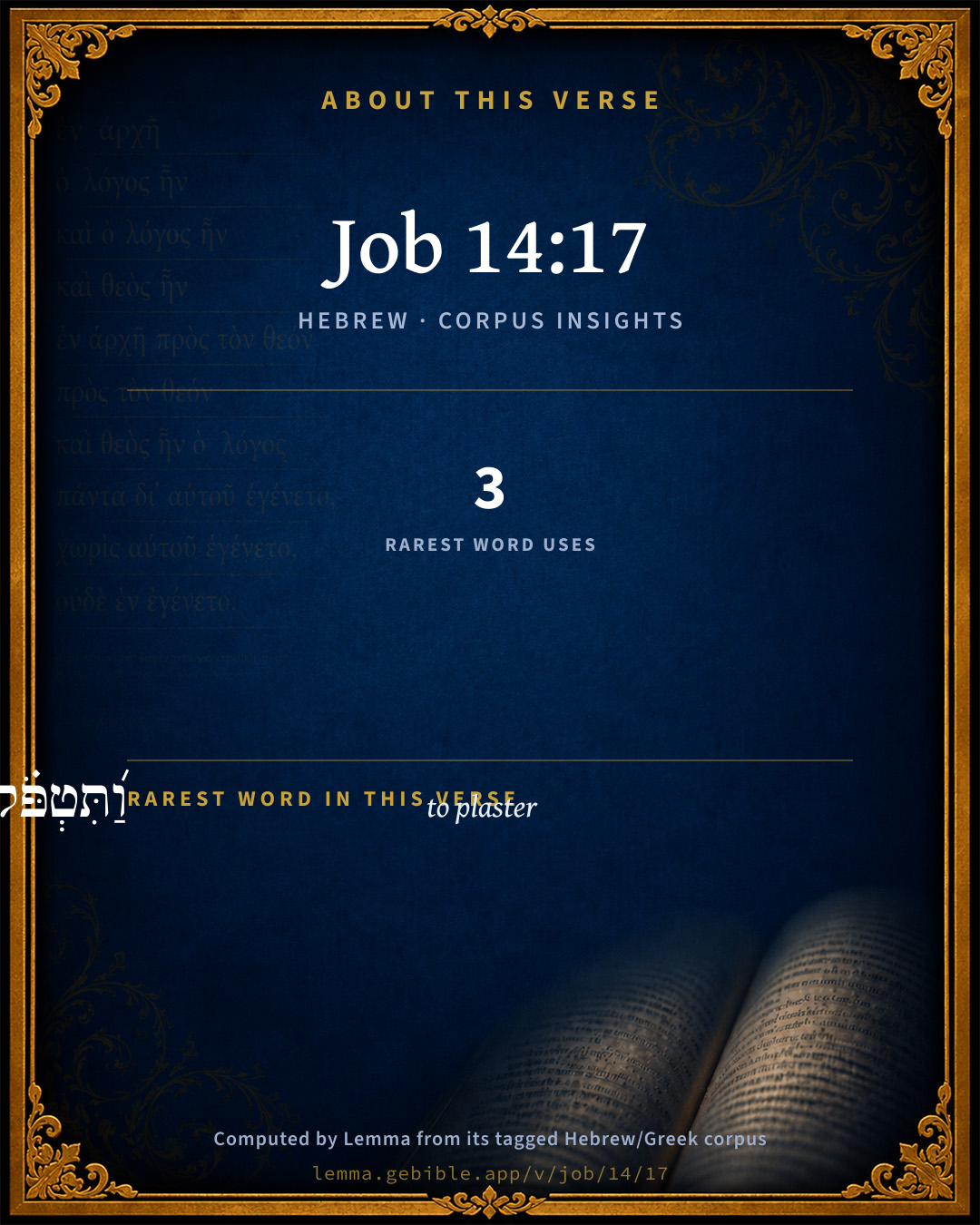
The rarest word here is וַ֝תִּטְפֹּ֗ל to plaster H2950 — appearing just 3 times in the whole Hebrew Bible.

Shared distinctive vocabulary

וַ֝תִּטְפֹּ֗ל to plaster H2950 occurs in 3 verses of the Hebrew Bible. Also found in:

Grammatical profile

  • 2 verbs
  • 3 nouns
  • 1 preposition

Verb forms

  • חָתֻ֣ם Qal · Participle Passive
  • וַ֝תִּטְפֹּ֗ל Qal · Sequential Imperfect

Hebrew & Septuagint length

In English translation the verse runs 13 words from the Hebrew and 21 from the Septuagint (LXX English) — the Septuagint runs noticeably longer here. See the side-by-side →

A rough comparison of the two English renderings, which tokenize alike — not a word-level alignment.

Word counts can differ between the Hebrew and the Greek without any difference in meaning — e.g. the Hebrew direct-object marker אֵת has no separate Greek word, and Greek often adds the article ὁ.

Cross-references

3

Topical passages linked to Job 14:17 in the Treasury of Scripture Knowledge — connected by theme and wording, ordered by reader-vote popularity; previews shown in the World English Bible.

  • Deuteronomy 32:34 Isn't this laid up in store with me, Sealed up among my treasures?
  • Hosea 13:12 The guilt of Ephraim is stored up. His sin is stored up.
  • Job 21:19 You say, 'God lays up his iniquity for his children.' Let him recompense it to himself, that he may know it.

Cross-references courtesy of OpenBible.info (CC BY 4.0).

Hebrew and Greek witnesses Masoretic Hebrew ↔ Greek Septuagint

The same verse in the two great witnesses to the Old Testament, shown verse-for-verse.

Here the Septuagint runs noticeably longer than the Hebrew — LXX2012 (modern English Septuagint) 21 words vs World English Bible 13. A rough length comparison of the two English translations, not a word-level alignment — read both below.

These are two independent witnesses, not word-aligned to each other, and the Septuagint is shown in lemma (dictionary) form.

Hebrew Job 14:17 Masoretic · Westminster Leningrad Codex

חָתֻ֣ם בִּצְר֣וֹר פִּשְׁעִ֑י וַ֝תִּטְפֹּ֗ל עַל עֲוֺנִֽי

My disobedience is sealed up in a bag. You fasten up my iniquity.

World English Bible · Public Domain

Greek LXX Job 14:17 Septuagint · lemma form

σφραγίζω δέ ἐγώ ὁ ἀνομία ἐν βαλλάντιον ἐπισημαίνω δέ εἰ τις ἄκων παραβαίνω

And you have sealed up my transgressions in a bag, and marked if I have been guilty of any transgression unawares.

LXX2012 (modern English Septuagint) · Public Domain

On this verse, Keil & Delitzsch discusses the Septuagint’s reading. Read the note in Commentary ↓

Hebrew: Westminster Leningrad Codex (CC BY 4.0). Greek: Septuagint (public domain); English from LXX2012 (modern English Septuagint) (Public Domain). How the Septuagint differs from the Hebrew →

Commentary

Notes on Job 14:17 from classic Christian and Jewish commentators (each source and its license shown beneath its notes). The classic Christian expositions comment on the surrounding passage and are grouped to its opening verse, so a note may address several verses; the Jewish commentaries on the Tanakh (Rashi and others) are per-verse, so they appear only where the commentator wrote on this verse.

Lemma curates 59 commentaries, every one of them public domain or Creative Commons licensed, each selected and text-cleaned for this edition rather than reprinted as found. About our sources →

Trapp's Complete Commentary

John Trapp

Job 14:17 My transgression [is] sealed up in a bag, and thou sewest up mine iniquity.

Ver. 17. My transgression is sealed up in a bag] As the writings or informations of a process which is ready to be sentenced, Deu 32:34 Hos 13:12. Thou hast, as it were, sealed up and made sure work with all my sins, saith Job, to have them forthcoming for the increase of my punishment. Look how the clerk of assizes (saith one) seals up the indictments of men, and at the assizes brings his bag, and takes them out to read the same against them; so God dealt with Job, in his conceit at least. The truth is, God had not sealed his transgressions in a bag, but had cast them behind his back. A bag God hath for men’s sins, and a bottle he hath for their tears, Psa 56:8. Now Job was one of those penitents that helped to fill God’s bottle, and therefore he saw at length (though now he was benighted) all his sins, bag and all, thrown in the sea, and sinking as a weighty millstone in those mighty waters of free grace and undeserved mercy.

And thou sewest up mine iniquity] Adsuesne aliquid iniquitati meae? so the Tigurines translate, i.e. Wilt thou sow or add anything to mine iniquity? wilt thou tie to it that tag (as a martyr phraseth it) of the law’s malediction, conjoining the punishment to the sin? Adsuere ad iniquitatem, est poenas poenis continenter adiungere (Merl.). Some make this an explication of the former; q.d. the bag is not only sealed, but, for more surety, sewed too, and that purposely for a purchase of punishment, as some sense it.

John Trapp, A Commentary or Exposition upon All the Books of the Old and New Testament (1647–1656) — public domain. Text from a community e-Sword module.

The Biblical Illustrator

Joseph S. Exell

Job_14:17

My transgression is sealed up in a bag.

Memory

The figure here employed to denote the certainty of a future investigation into all the secret transactions of a mans life is drawn from the peculiar manner in which payments, for convenience sake, were sometimes made by oriental merchants. A certain sum of money, or weight of gold, having been securely sown up in a bag, the seal of the banker was impressed upon it, and it passed current from hand to hand without being opened to be counted or weighed for the purpose of ascertaining the exact sum to be contained in it when it was first put into circulation. This custom is used to teach the doctrine of a day of account with every individual soul. The bag must at last be unsealed and unsewn, that the contents hidden from the eye may be made manifest. Look upon yourselves during the time of your trial upon earth, as though the secrets of your life, the life of your soul before God, all the busy multifarious emotions of your existence, were sealed up, and, as it were, sewn within yourself, as money in the bag; preserved there by the memory, and by the memory also to be produced, at a set time, for inspection and judgment. The memory is a wonderful faculty of the mind; where consciousness exists, there also the memory; it dies not with the body, but is active in the soul when emancipated from the flesh. Its instrument is the brain. The memory, which is the power of retaining what we have once grasped, and of recalling it at pleasure, makes the brain the seat of its operations, its busy workshop, its mechanical centre, where it sets all the wheels and intricate motions of the machinery of the intellect. Though our several faculties act upon the physical system, yet they reside essentially in the soul. If this be the relation between matter and spirit, between body and soul, we can understand their joint action, while we are able to distinguish the agent from the instrument, the cower from the machine, the soul from the body. Take an individual, and analyse the working of his memory upon his spiritual history. (G. Roberts.)

The waters wear the stones.

Silent action of rain

The most conspicuous agent employed (in the disintegration of rocks) is rain. Rain is not chemically pure, but always contains some proportion of oxygen and carbonic acid absorbed from the atmosphere; and after it reaches the ground organic acids are derived by it from the decaying vegetable and animal matter with which soils are more or less impregnated. Armed with such chemical agents, it attacks the various minerals of which rocks are composed, and thus, sooner or later, these minerals break up . . . In all regions where rain falls the result of this chemical action is conspicuous; soluble rocks are everywhere dissolving, while partially soluble rocks are becoming rotten and disintegrated. In limestone areas it can be shown that sometimes hundreds of feet of rock have thus been gradually and silently removed from the surface of the land. And the great depth now and again attained by rotted rock testifies likewise to the destructive action of rain water percolating from the surface. (Dr. Geikies Earth Sculpture.)

The Biblical Illustrator, edited by Joseph S. Exell (c. 1880s–1900s) — public domain. Text from a community e-Sword module.

Keil & Delitzsch

C. F. Keil & F. Delitzsch

17 My transgression is sealed up in a bag,

And Thou hast devised additions to my iniquity.

18 But a falling mountain moveth indeed,

And a rock falleth from its place.

19 Water holloweth out stone,

Its overflowings carry away the dust of the earth,

And the hope of man - Thou destroyest.

The meaning of Job 14:17 is, not that the judgment which pronounces him guilty lies in the sealed-up bag of the judge, so that it requires only to be handed over for execution (Hirz., Ew., Renan), for although פּשׁע (though not exactly the punishment of sin, which it does not signify even in Dan 9:24) can denote wickedness, as proved and recorded, and therefore metonomically the penal sentence, the figure is, however, taken not from the mode of preserving important documents, but from the mode of preserving collected articles of value in a sealed bag. The passage must be explained according to Hos 13:12; Deu 32:34; Rom 2:5, comp. Jer 17:1. The evil Job had formerly (Job 13:26) committed according to the sentence of God, God has gathered together as in a money bag, and carefully preserved, in order now to bring them home to him. And not this alone, however; He has devised still more against him than his actual misdeeds. Ewald translates: Thou hast sewed up my punishment; but טפל (vid., on Job 13:4) signifies, not to sew up, but: to sew on, patch on, and gen. to add (טפל, Rabb. accidens, a subordinate matter, opp. עקּר), after which the lxx translates ἐπεσημήνω (noted in addition), and Gecatilia Arab. ḥftṣt (added to in collecting). It is used here just as in the Aramaic phrase טפל שׁקרא (to patch on falsehood, to invent scandal).

The idea of the figures which follow is questionable. Hahn maintains that they do not describe destruction, but change, and that consequently the relation of Job 14:19 to what precedes is not similarity, but contrast: stones are not so hard, that they are not at length hollowed out, and the firm land is not so firm that it cannot be carried away by the flood; but man's prospect is for ever a hopeless one, and only for him is there no prospect of his lot ever being changed. Thus I thought formerly it should be explained: considering the waw, Job 14:19, as indicative not of comparison, but of contrast. But the assumption that the point of comparison is change, not destruction, cannot be maintained: the figures represent the slow but inevitable destruction wrought by the elements on the greatest mountains, on rocks, and on the solid earth. And if the poet had intended to contrast the slow but certain changes of nature with the hopelessness of man's lot, how many more appropriate illustrations, in which nature seems to come forth as with new life from the dead, were at his command! Raschi, who also considers the relation of the clauses to be antithetical, is guided by the right perception when he interprets: even a mountain that is cast down still brings forth fruit, and a rock removed from its place, even these are not without some signs of vitality in them, יבּול = (יבוּל) יעשׂהבוּל, which is indeed a linguistic impossibility. The majority of expositors are therefore right when they take the waw, Job 14:19, similarly to Job 5:7; Job 11:12; Job 12:11, as waw adaequationis. With this interpretation also, the connection of the clause with what precedes by ואוּלם (which is used exactly as in Job 1:11; Job 11:5; Job 12:7, where it signifies verum enim vero or attamen) is unconstrained. The course of thought is as follows: With unsparing severity, and even beyond the measure of my guilt, hast Thou caused me to suffer punishment for my sins, but (nevertheless) Thou shouldst rather be gentle and forbearing towards me, since even that which is firmest, strongest, and most durable cannot withstand ultimate destruction; and entirely in accordance with the same law, weak, frail man (אנושׁ) meets an early certain end, and at the same time Thou cuttest off from him every ground of hope of a continued existence. The waw, Job 14:19, is consequently, according to the sense, more quanto magis than sic, placing the things to be contrasted over against each other. הר־נופL is a falling, not a fallen (Ralbag) mountain; and having once received the impetus, it continues gradually to give way; Renan: s'effondre peu peu. Carey, better: "will decay," for נבל (cogn. נבל) signifies, decrease from external loses; specially of the falling off of leaves, Isa 34:4. The second figure, like Job 18:4, is to be explained according to Job 9:5 : a rock removes (not as Jerome translates, transfertur, which would be יעתק, and also not as lxx παλαιωθήσεται, Schlottm.: becomes old and crumbles away, although in itself admissible both as to language and fact; comp. on Job 21:7) from its place; it does not stand absolutely, immovably fast. In the third figure אבנים is a prominent object, as the accentuation with Mehupach legarmeh or (as it is found in correct Codd.) with Asla legarmeh rightly indicates שׁחק signifies exactly the same as Arab. sḥq, attere, conterere. In the fourth figure, ספיח must not be interpreted as meaning that which grows up spontaneously without re-sowing, although the Targum translates accordingly: it (the water) washes away its (i.e., the dust of the earth's) after-growth (כּתהא), which Symm. follows (τὰ παραλελειμνένα). It is also impossible according to the expression; for it must have been עפר הארץ. Jerome is essentially correct: et alluvione paullatim terra consumitur. It is true that ספח in Hebrew does not mean effundere in any other passage (on this point, vid., on Hab 2:15), but here the meaning effusio or alluvio may be supposed without much hesitation; and in a book whose language is so closely connected with the Arabic, we may even refer to ספח = Arab. sfḥ (kindred to Arab. sfk, שׁפך), although the word may also (as Ralbag suggests), by comparison with מטר סחף, Pro 28:3, and Arab. sḥı̂qt, a storm of rain, be regarded as transposed from חיפיה, from סחף in Arab. to tear off, sweep away, Targ. to thrust away (= רחף), Syr., Talm. to overthrow, subvertere (whence s'chifto, a cancer or cancerous ulcer). The suffix refers to מים, and תּשׁטף before a plural subject is quite according to rule, Ges. 146, 3. ספיחיה is mostly marked with Mercha, but according to our interpretation Dech, which is found here and there in the Codd., would be more correct.

The point of the four illustrations is not that not one of them is restored to its former condition (Oetinger, Hirz.), but that in spite of their stability they are overwhelmed by destruction, and that irrecoverably. Even the most durable things cannot defy decay, and now even as to mortal man - Thou hast brought his hope utterly to nought (האבדת with Pathach in pause as frequently; vid., Psalter ii. 468). The perf. is praegnans: all at once, suddenly - death, the germ of which he carries in him even from his birth, is to him an end without one ray of hope, - it is also the death of his hope.

Keil & Delitzsch — Biblical Commentary on the Old Testament (1861–1891) — public domain (CC PDM 1.0). Text via the HelloAO Bible API. (Old Testament only.)

Tyndale Open Study Notes

Tyndale Open Resources

14:17 If sins are sealed in a pouch they do not await a time of reckoning (Deut 32:34-35; Hos 13:12)—they are hidden forever. Job was requesting acquittal.

Tyndale Open Study Notes — © Tyndale Open Resources, licensed CC BY-SA 4.0. Text via the HelloAO Bible API.

Geneva Bible (1599)

Geneva Bible translators

Thou layest them all together, and sufferest none of my sins unpunished.

Geneva Bible (1599) marginal notes — public domain. Text via Bolls.life.

Jamieson, Fausset & Brown

Robert Jamieson, A. R. Fausset & David Brown

sealed up-- (Job 9:7). Is shut up in eternal oblivion, that is, God thenceforth will think no more of my former sins. To cover sins is to completely forgive them (Psa 32:1; Psa 85:2). Purses of money in the East are usually sealed.

sewest up--rather, "coverest"; akin to an Arabic word, "to color over," to forget wholly.

Jamieson, Fausset & Brown — Commentary Critical and Explanatory on the Whole Bible (1871) — public domain (CC PDM 1.0). Text via the HelloAO Bible API.

Adam Clarke's Commentary

Verse 17. My transgression is sealed up in a bag] An allusion to the custom of collecting evidence of state transgressions, sealing them up in a bag, and presenting them to the judges and officers of state to be examined, in order to trial and judgment. Just at this time (July, 1820) charges of state transgressions, sealed up in a GREEN BAG, and presented to the two houses of parliament, for the examination of a secret committee, are making a considerable noise in the land. Some suppose the allusion is to money sealed up in bags; which is common in the East. This includes two ideas:

1. Job's transgressions were all numbered; not one was passed by.

2. They were sealed up; so that none of them could be lost. These bags were indifferently sewed or sealed, the two words in the text.

Adam Clarke's Commentary on the Bible (1810–1826) — public domain. Text from a community e-Sword/MySword module.

The Cambridge Bible for Schools and Colleges

gen. ed. J. J. S. Perowne

17. Figures expressing the carefulness with which God treasures up a man’s sins lest any of them should be lost, in order to visit the full tale of them upon him.

The Cambridge Bible for Schools and Colleges (gen. ed. J. J. S. Perowne; Cambridge University Press, 1878–1918) — public domain. Text from a community e-Sword module.

John Gill's Exposition

My transgression is sealed up in a bag,.... Denoting either the concealment of it, as in Hos 13:12; not from God; nor in such sense sealed up as sin is by the sacrifice and satisfaction of Christ, who has thereby removed it out of the sight of divine justice; so that when it is sought for it shall not be found, nor any more seen, which is the sense of the phrase in Dan 9:24; where the words, "to make an end of sin", may be rendered, to "seal them up"; but this Job would not have complained of; he means it was hid as in a bag from himself, or he knew not what it was; the transgression was sealed up from him, he was entirely ignorant of and unacquainted with what it was for which he was severely afflicted: or else his sense is, that God had taken strict notice of his transgressions, and had, as it were, put them up in a bag, and set a seal upon it, that none might be lost, but might be ready to be produced against him another day; in allusion, as it is thought, to bills of indictment put up in bags sealed, to be brought into courts of judicature at a proper time, for which they are reserved:

and thou sewest up mine iniquity; in the bag in which it is sealed; not only did he seal up the bag, but sewed a cloth over it thus sealed, for greater security: or "thou sewest to mine iniquity" (m), or adds iniquity to iniquity, as in Psa 69:27; as arithmeticians do, who add one number to another until it becomes a great sum; thus God, according to Job, tacked and joined one sin to another, till it became one large heap and pile, reaching to the heavens, and calling for vengeance; or, as Sephorno interprets it, joined sins of ignorance to sins of presumption; or rather sewed or added the punishment of sin to sin, or punishment to punishment; the Targum is,

"my transgression is sealed up in a book of remembrances, and thou hast joined it to my iniquities.''

(m) "assuis iniquitati meae", Piscator; "et adjungis ad iniquitatem meam", Beza.

John Gill's Exposition of the Whole Bible (1746–1763) — public domain (CC PDM 1.0). Text via the HelloAO Bible API.

Albert Barnes' Notes on the Bible

My transgression is sealed up - The verb rendered sealed up (חתם châtham) means to seal, to close, to shut up; see the notes at Isa 8:16; compare the notes at Job 9:7. It was common with the ancients to use a seal where we use a lock. Money was counted and put into a bag, and a seal was attached to it. Hence, a seal might be put to a bag, as a sort of certificate of the amount, and to save the necessity of counting it again.

In a bag - - בצרור bı̂tserôr. So Jerome, “in sacculo.” So the Septuagint, ἐν βαλαντίῳ en balantiō. The word צרור tserôr means usually a “bundle” 1Sa 25:29; Son 1:13, or anything bound up (compare Job 26:8; Hos 13:12; Exo 12:34; Pro 26:8; Isa 8:16; Gen 42:35; Son 1:13; Pro 7:20); but here it is not improperly rendered a bag. The idea is, that they were counted and numbered like money, and then sealed up and carefully put away. God had made an accurate estimate of their number, and he seemed carefully to guard and observe them - as a man does bags of gold - so that none might be lost. His sins seemed to have become a sort of valuable treasure to the Almighty, none of which he allowed now to escape his notice.

And thou sewest up mine iniquity - Noyes renders this, “and thou addest unto mine iniquity.” Good, “thou tiest together mine iniquity.” The word used here טפל ṭâphal means properly to patch; to patch together; to sew to join together as carpenters do their work; and then to devise or forge - as a falsehood; - to join a malicious charge to a person. Thus, in Psa 119:69, “The proud have “forged a lie” (שׁקר טפלוּ ṭâphalô sheqer) against me,” that is, they have joined a lie to me, or devised this story about me. So in Job 13:4, “Ye are forgers of lies.” The word does not occur elsewhere. The Greeks have a similar expression in the phrase ῥάπτειν ἔπη raptein epē - from where the word ῥαψῳδὸς rapsōdos. The word here, it seems to me, is used in the sense of sewing up money in a bag, as well as sealing it. This is done when there are large sums, to avoid the inconvenience of counting it. The sum is marked on the bag, and a seal affixed to it to authenticate it, and it is thus passed from one to another without the trouble of counting. If a seal is placed on the bag, it will circulate for its assigned value, without being opened for examination. It is usual now in the East for a bag to contain five hundred piastres, and hence, such a sum is called “a purse,” and amounts are calculated by so many “purses;” see Harmer, ii. 285, Chardin, and Pict. Bible in loc. The sense here is, that God had carefully numbered his sins, and marked them, and meant that none of them should escape. He regarded them as very great. They could now be referred to in the gross, without the trouble of casting up the amount again. The sins of a man’s past life are summed up and marked with reference to the future judgment.

Albert Barnes' Notes on the Bible (1834–1885) — public domain. Text from a community e-Sword/MySword module.

Haydock's Catholic Bible Commentary

Cured. Hebrew, "sewed up." This method and sealing was in use to keep things of value, before locks were invented. (Calmet) --- Septuagint, "thou hast noted if I had transgressed unwillingly, Greek: akon." Yet God will not make us accountable for what we cannot help.

George Leo Haydock (1774–1849), Haydock's Catholic Family Bible and Commentary, 1859 edition — public domain. Excludes Psalms (Douay-Rheims chapter numbering differs from Protestant) and Deuterocanonical books (Catholic canon only).

Matthew Poole's English Annotations

Sealed up in a bag; as writings or other choice things, that they may be safely kept, and all of them brought forth upon occasion, and not one of them forgotten or lost. Compare Deu 32:44; Job 37:7; Hos 13:12.

Thou sewest up mine iniquity, i.e. thou keepest all my sins in thy memory, and fastenest the guilt of them upon my conscience. Or, thou addest to my sin, one sin to another; the follies of my youth, Job 13:26, to those of my riper years. Or, thou addest to my punishment, i.e. thou punishest me more than mine iniquities deserve, all things considered. For this sinful thought seems sometimes to have risen in Job’s mind, as may be gathered from divers parts of this book; which therefore Zophar decries and disproves, Job 11:6.

Matthew Poole's English Annotations on the Holy Bible (1683–1685) — public domain. Text from a community e-Sword/MySword module.

Whedon's Commentary on the Bible

Daniel D. Whedon

17. Sealed… in a bag — The money that is collected together in the treasuries of eastern princes is told up in certain equal sums, put into bags, and sealed. (Chardin.) The ancients used a seal where we use a lock. Even to the present day, in eastern countries, bags of money pass current without being counted, so long as the seal remains unbroken. Sins are treasured up for a day of final reckoning. They are thus declared to be of moment in the sight of God. All sins are against God, and involve not only his law, but his entire being. One by one, and silently, they enter into the divine remembrance, and none can be lost.

Sewest up — Literally, sewest on; the taphal of Job_13:4, which leads some to interpret it, “Thou addest iniquity to iniquity, one upon the other,” (Mercerus,) thus charging upon God that he makes the sins of his creature to be greater than they are. But such a sense is incongruous. Job means simply to say that God takes the greatest precaution lest any sins should be lost — even to the sewing them up against any possible rending of their receptacle.

Fifth strophe — Job’s final outcry to God feelingly urges man’s dismal fate, with nature, God, and sheol against him, Job_14:18-22.

Daniel D. Whedon (gen. ed.), Commentary on the Old and New Testaments (1874–1909) — public domain. Text from a community e-Sword module.

The Pulpit Commentary

My transgression is sealed up in a bag; (comp. Deu_32:34) i.e. God keeps account of all my transgressions. It is as if he put them all into a bag, (compare "Put my tears into thy bottle," Psa_56:8) whence they can be taken out and brought against me at any moment. They are "sealed up" in the bag for greater security. And thou sewest up mine iniquity. (So Ewald, Dillmaun, Canon Cook, and the Revised Version.) Others think the meaning to be, "Thou addest to my iniquity continually;" i.e. by placing fresh sins to my account. (So Schultens and Rosenmuller.)

Vers. 17-22. Self-defence before God: 4. Relapse into despondent imaginations.

I HE STILL ABOUNDS WITH VARIED FIGURES, THE VERY ELOQUENCE OF COMPLAINT. God has taken his sins and placed them as in a bag, sealed for safety of deposit, that they may be reproduced against him. He appears like an accuser who heaps up scandals and offences against the unhappy object of his wrath (ver. 17).

II IN THIS LIGHT OF PERSONAL EXPERIENCE HE FURTHER CONTEMPLATES THE CONDITION OF MANKIND.

1. The impossibility of resistance to their doom. (Vers. 18, 19) Mountains and rocks are dissolved, hard stones are gradually dislocated, by the continuous action of water; their fragments are carried away by the flood. Much more must the feeble body of man give way at last. And so his mind must surrender the kindled light of God, which God destroys!

2. The overmastering power of God. (Vers. 20-22) The mighty warrior overcomes the feeble resistance of his foe, and releases him only when he has set him before his face and given him a proof of his pre-walling three So God only releases man in death when all his beauty has passeth away, and there remains but the hideous corpse. In the lower world consciousness fails him; he knows nothing of the things of earth, joyous or sad; can render no help to the dear ones who survive him. In the lower world the dead man, without activity or energy, endures his bodily and mental pain in dreary solitude and stillness. So ends again this address with the gloomiest, most despondent outlook as to the other world, relieved only toe a moment by the fugitive hope of the life to come.

LESSONS.

1. The heart has an instinct for immortality, derived from its revolt from extreme pain. Something within us tells us that we were not made to be eternally, irrecoverably miserable.

2. The truth of a future life comes in flashes upon the mind; for its retention we need the support of positive revelation.

3. The natural weakness and frailty of man is complemented by his spiritual power and greatness as partaker of an endless life. J.

Sealed transgression.

Job seems to think that God has sealed his transgression up in a bag, keeping it in reserve to bring out against him at some future judgment.

I WE CANNOT TAKE BACK OUR SINS. They are ours before we have let them loose on the world. Then they pass out of our control. They may wander far in their mischievous effects, or they may be checked by the providence of God. But, in any case, they have passed away from us beyond all chance of recovery. The bag in which God puts our sins is sealed, and it is impossible for us to break the seals. We may well be on our guard against producing those evil things that we cannot hold in or suppress.

II OUR SINS ARE WITH GOD. He has them in his bag. We may not have thought that he noticed our conduct, and we may not have considered that our wickedness was an offence against God. Yet God could not be indifferent to our violation of his laws. Our first dealings with our sins was in the privacy of our own hearts. When we next meet them they will be in God"s possession, thoroughly examined by him, and ready to be used as he thinks fit in his judgment of us.

III OUR SINS ARE RESERVED FOR THE FUTURE. We do not now see them; they are sealed up in God"s bag. The judgment is not yet. Because it is delayed many men refuse to expect it, and grow indifferent to their guilt. But time will not alter it. We cannot expect future immunity because we enjoy present forbearance. How is the time for repentance. If the opportunities the present affords are neglected, can they be pleaded in extenuation of our guilt when at last we are called up for judgment?

IV IT IS OUR IMPENITENCE, NOT GOD"S WILL, THAT CAUSES OUR SINS TO BE SEALED UP IN GOD"S BAG. In the dreadful anguish and perplexity of his soul, Job seemed driven to the conclusion that God was carefully treasuring up his sins out of a spirit of opposition to him. Such an idea is quite impossible to one who knows God as he is revealed in Christ. God cannot delight himself in retaining our sins. They are no treasures for him. He would much rather be rid of them. The seal that holds them is our hard heart.

V THE GOSPEL OF CHRIST BREAKS THE SEAL OF SINS. Those sins that are still retained can yet be cast away, and the offer of forgiveness means that the bag may be opened. The past is not irreparable. Although it cannot be reversed, it may be forgiven and forgotten. Christ has taken the great bag of the world"s sins as a heavy burden upon his own shoulders. He has carried it with him to the grave. He has left it there, buried with the dark, bad past, and he has risen without it in a new life, triumphant and redemptive. Now, the preaching of his gospel is the declaration that for every sinner who repents and trusts Christ the bag of sins is gone; it will be remembered no more. Those who dread the reappearance of their sins as witnesses against them may have a sure hope of escaping them in the atoning work of Christ. W.F.A.

The Pulpit Commentary (1880–1919), ed. H.D.M. Spence-Jones & Joseph S. Exell — public domain. Text from a community e-Sword module.

John Wesley's Explanatory Notes

Sealed - As writings or other choice things, that they may all be brought forth upon occasion, and not one of them forgotten. Thou keepest all my sins in thy memory. But herein Job speaks rashly.

John Wesley, Explanatory Notes Upon the Whole Bible (1754–1765) — public domain. Text via the GEBible commentary corpus.

Rashi

Rabbi Shlomo Yitzchaki (Rashi)

sealed up in a bundle Sealed and preserved in a cloth bundle like silver and pearls, lest it be lost.

and You have attached Yourself to my iniquity Heb. ותטפל, You have attached Yourself to my iniquity.

Rashi on the Tanakh — English translations: “The Judaica Press complete Tanach with Rashi, translated by A. J. Rosenberg” (CC BY 4.0); “Pentateuch with Rashi's commentary by M. Rosenbaum and A.M. Silbermann, 1929-1934” (public domain); “The Metsudah Tanach series, Lakewood, N.J” (CC BY 4.0); and “The Book of Joshua, Metsudah Publications, 1997” (CC BY 4.0). Text via Sefaria.

Lesson kit

Teaching starters — assembled from the data on this page, not authored interpretation. Every prompt links to the verse data it draws on. Edit before teaching.

Job, in the Wisdom, opens this verse with 6 words (6 distinct Hebrew lemmas). Its most distinctive word is ṭâphal (“to plaster”). The Greek Septuagint runs longer here. A historical commentator’s framing appears above. Read the whole chapter for the surrounding context.

Discussion questions

  1. The word ṭâphal carries the sense “to plaster.” How does it shape the verse?
  2. Job 13:4 shares the word «to plaster» with this verse. How do the two illuminate each other?
  3. Compared with the Hebrew, the Septuagint runs longer here. What questions does that raise?
  4. These translations render this verse differently; the difference is in the English rendering, not the original. What questions does that raise?
  5. The verb «חָתֻ֣ם» is Qal Participle Passive. How does its form color the action?
  6. Reading how Trapp's Complete Commentary and The Biblical Illustrator read this verse, where do the two commentators agree and where do they part?

Things to notice

Reading settings

Reading text

Shown beneath each verse's original-language words.

Old Testament
Old Testament edition

Read the OT as the Masoretic Hebrew (MT) or the Greek Septuagint (LXX).

English shown for the Greek Septuagint (in the Hebrew ↔ Greek comparison).

Comparing translations? Open the Compare panel on any verse page to stack up to four side by side.