
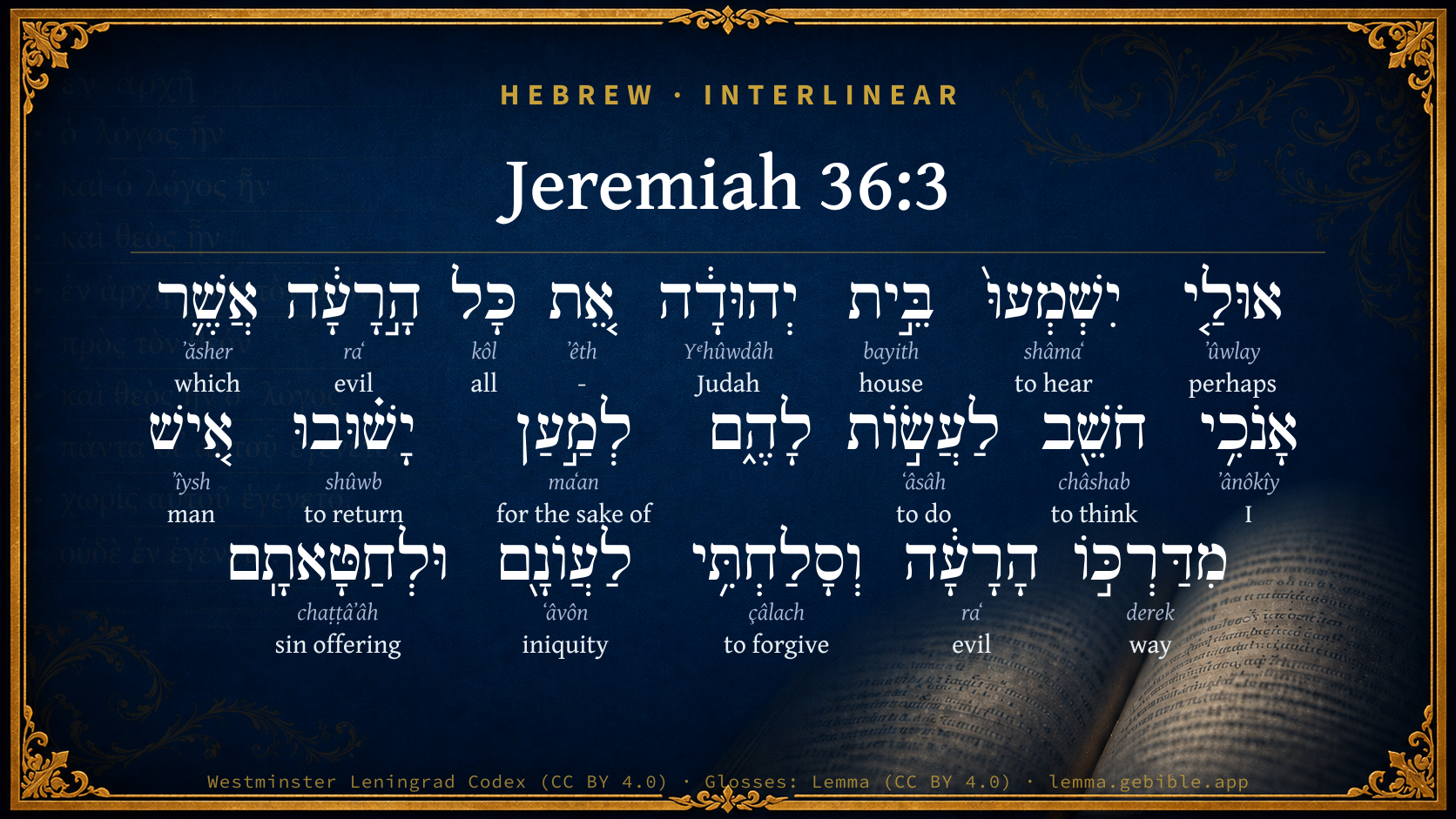
Jeremiah 36:3

Hebrew (Westminster Leningrad Codex) Jeremiah 36:3 appears in the Hebrew Old Testament. The text above is from the Westminster Leningrad Codex. Each word links to its Strong’s number, a concise gloss, and parsing drawn from the Open Scriptures Hebrew Bible morphology. Click any word for its full Brown-Driver-Briggs (BDB) entry.
Download image
Cite this verse

Jeremiah 36:3 (World English Bible). Public Domain. Lemma interlinear Bible study tool, https://lemma.gebible.app/v/jeremiah/36/3.

Show BibTeX & RIS
BibTeX
RIS
English Translation
It may be that the house of Judah will hear all the evil which I purpose to do to them; that they may return every man from his evil way; that I may forgive their iniquity and their sin.
World English Bible · Public Domain
Download a study sheet

One document with this verse’s original text, its word-by-word gloss line, the meaning frame, cross-references with their text, attributed commentary, and full source and license credits — printable, and it pastes into notes with its structure intact.

This verse Autodidact and up

Study sheet (.html) Plain text (.txt)

A passage Seminary Student

Up to 50 verses in one chapter. A passage sheet keeps up to 6 commentary sources and 12 cross-references per verse, in the order this page ranks them, and says so on the sheet whenever that leaves anything out. Ask for a single verse and you get the Autodidact verse sheet above.

Everything on this page stays free to read, with no account — the sheet is a download of what is already on screen, not access to it.

Want to remove ads? Support Godless Engineer
Compare translations 3

The same verse in 3 English versions, stacked beneath the original-language interlinear above. Click any original word for its lexicon entry.

Each is an independent rendering of the whole verse — the interlinear is not word-aligned to these translations.

Highlighted words mark where these versions differ — a whole-verse word diff, not a word-by-word alignment.

  • World English Bible Public Domain
    It may be that the house of Judah will hear all the evil which I purpose to do to them; that they may return every man from his evil way; that I may forgive their iniquity and their sin.
  • King James Version Public Domain
    It may be that the house of Judah will hear all the evil which I purpose to do unto them; that they may return every man from his evil way; that I may forgive their iniquity and their sin.
  • unfoldingWord Literal Text CC BY-SA 4.0
    Perhaps the people of Judah will listen to all the disasters that I intend to bring on them. Perhaps everyone will turn away from his wicked way, so I can forgive their iniquity and their sin.”

unfoldingWord Literal Text — © unfoldingWord, licensed CC BY-SA 4.0. Word-aligned USFM3 via Door43 (git.door43.org/unfoldingWord/en_ult).

Versions to compare (up to 4)

3 of 4 selected

Show all 18 translations

Every available English version of this verse, each an independent rendering of the whole verse.

  • World English Bible Public Domain
    It may be that the house of Judah will hear all the evil which I purpose to do to them; that they may return every man from his evil way; that I may forgive their iniquity and their sin.
  • Berean Standard Bible Public Domain
    Perhaps when the people of Judah hear about all the calamity I plan to bring upon them, each of them will turn from his wicked way. Then I will forgive their iniquity and their sin.”
  • Majority Standard Bible Public Domain
    Perhaps when the people of Judah hear about all the calamity I plan to bring upon them, each of them will turn from his wicked way. Then I will forgive their iniquity and their sin.”
  • King James Version Public Domain
    It may be that the house of Judah will hear all the evil which I purpose to do unto them; that they may return every man from his evil way; that I may forgive their iniquity and their sin.
  • American Standard Version (1901) Public Domain
    It may be that the house of Judah will hear all the evil which I purpose to do unto them; that they may return every man from his evil way; that I may forgive their iniquity and their sin.
  • Revised Version (1885) Public Domain
    It may be that the house of Judah will hear all the evil which I purpose to do unto them; that they may return every man from his evil way; that I may forgive their iniquity and their sin.
  • Geneva Bible (1599) Public Domain
    It may bee that the House of Iudah will heare of all the euill, which I determined to doe vnto them that they may returne euery man from his euil way, that I may forgiue their iniquitie and their sinnes.
  • Douay-Rheims (1899) Public Domain
    If so be, when the house of Juda shall hear all the evils that I purpose to do unto them, that they may return every man from his wicked way: and I will forgive their iniquity, and their sin.
  • Young's Literal Translation Public Domain
    if so be the house of Israel do hear all the evil that I am thinking of doing to them, so that they turn back each from is evil way, and I have been propitious to their iniquity, and to their sin.'
  • Literal Standard Version CC BY-SA 4.0
    perhaps the house of Israel so hears all the evil that I am thinking of doing to them, so that they each turn back from his evil way, and I have been propitious to their iniquity, and to their sin.”
  • Unlocked Literal Bible CC BY-SA 4.0
    Perhaps the people of Judah will listen to all the disasters that I intend to bring on them. Perhaps everyone will turn away from his wicked way, so I can forgive their iniquity and their sin.”
  • unfoldingWord Literal Text CC BY-SA 4.0
    Perhaps the people of Judah will listen to all the disasters that I intend to bring on them. Perhaps everyone will turn away from his wicked way, so I can forgive their iniquity and their sin.”
  • Darby Bible Public Domain
    It may be the house of Judah will hear all the evil that I purpose to do unto them, that they may return every man from his evil way, and that I may forgive their iniquity and their sin.
  • World Messianic Bible Public Domain
    It may be that the house of Judah will hear all the evil which I intend to do to them, that they may each return from his evil way; that I may forgive their iniquity and their sin.”
  • Webster's Bible Public Domain
    It may be that the house of Judah will hear all the evil which I purpose to do to them; that they may return every man from his evil way; that I may forgive their iniquity and their sin.
  • Free Bible Version CC BY-SA 4.0
    Maybe when the people of Judah hear about all the disasters I plan to bring down on them, everyone will stop their evil ways. Then I will forgive their guilt and sin.
  • Bible in Basic English Public Domain
    It may be that the people of Judah, hearing of all the evil which it is my purpose to do to them, will be turned, every man from his evil ways; so that they may have my forgiveness for their evil-doing and their sin.
  • JPS Tanakh (1917) Public Domain
    It may be that the house of Judah will hear all the evil which I purpose to do unto them; that they may return every man from his evil way, and I may forgive their iniquity and their sin.'

Literal Standard Version (2020), Covenant Press — licensed CC BY-SA 4.0. Text via the HelloAO Bible API (eBible.org). Unlocked Literal Bible (unfoldingWord) — licensed CC BY-SA 4.0. Text via the HelloAO Bible API (eBible.org). unfoldingWord Literal Text — © unfoldingWord, licensed CC BY-SA 4.0. Word-aligned USFM3 via Door43 (git.door43.org/unfoldingWord/en_ult). Free Bible Version, Dr. Jonathan Gallagher — licensed CC BY-SA 4.0. Text via the HelloAO Bible API (eBible.org).

Word by word

More ways to search: Search by grammar → Find every occurrence → Compare this word →

Practice this passage: Drill this verse → Learn its vocabulary →

אוּלַ֤י
ʼûwlay
H194
“perhaps”
Adverb
Part of Speech
Adverb
Full BDB Definition

Origin: from H176

TWOT: 46

perhaps, peradventure - if peradventure - unless - suppose
  1. יִשְׁמְעוּ֙ shâmaʻ H8085 “to hear” Verb, Qal, Imperfect, 3rd Person, Masculine, Plural
  2. בֵּ֣ית bayith H1004 “house of” Noun, Common, Masculine, Singular, Construct
  3. יְהוּדָ֔ה Yᵉhûwdâh H3063 “Judah” Noun, Proper
  4. אֵ֚ת ʼêth H853 “-” Particle, Direct Object
  5. כָּל kôl H3605 “all of” Noun, Common, Masculine, Singular, Construct
  6. הָ֣רָעָ֔ה raʻ H7451 “the · evil” Particle, Definite Article + Noun, Common, Feminine, Singular, Absolute
  7. אֲשֶׁ֛ר ʼăsher H834 “which” Particle, Relative
  8. אָנֹכִ֥י ʼânôkîy H595 “I” Pronoun, Personal, 1st Person, Common, Singular
  9. חֹשֵׁ֖ב châshab H2803 “thinking” Verb, Qal, Participle Active, Masculine, Singular, Absolute
  10. לַעֲשׂ֣וֹת ʻâsâh H6213 “to do” Preposition + Verb, Qal, Infinitive Construct
  11. לְמַ֣עַן maʻan H4616 “for the sake of” Preposition
  12. יָשׁ֗וּבוּ shûwb H7725 “to return” Verb, Qal, Imperfect, 3rd Person, Masculine, Plural
  13. אִ֚ישׁ ʼîysh H376 “man” Noun, Common, Masculine, Singular, Absolute
  14. מִדַּרְכּ֣וֹ derek H1870 “from · way · his” Preposition + Noun, Common, Both, Singular, Construct + Suffix, Personal, 3rd Person, Masculine, Singular
  15. הָרָעָ֔ה raʻ H7451 “the · evil” Particle, Definite Article + Adjective, Adjective, Feminine, Singular, Absolute
  16. וְסָלַחְתִּ֥י çâlach H5545 “and · to forgive” Conjunction + Verb, Qal, Sequential Perfect, 1st Person, Common, Singular
  17. לַעֲוֺנָ֖ם ʻâvôn H5771 “to/for · iniquity · their” Preposition + Noun, Common, Both, Singular, Construct + Suffix, Personal, 3rd Person, Masculine, Plural
  18. וּלְחַטָּאתָֽם chaṭṭâʼâh H2403 “and · to/for · sin offering · their” Conjunction + Preposition + Noun, Common, Feminine, Singular, Construct + Suffix, Personal, 3rd Person, Masculine, Plural

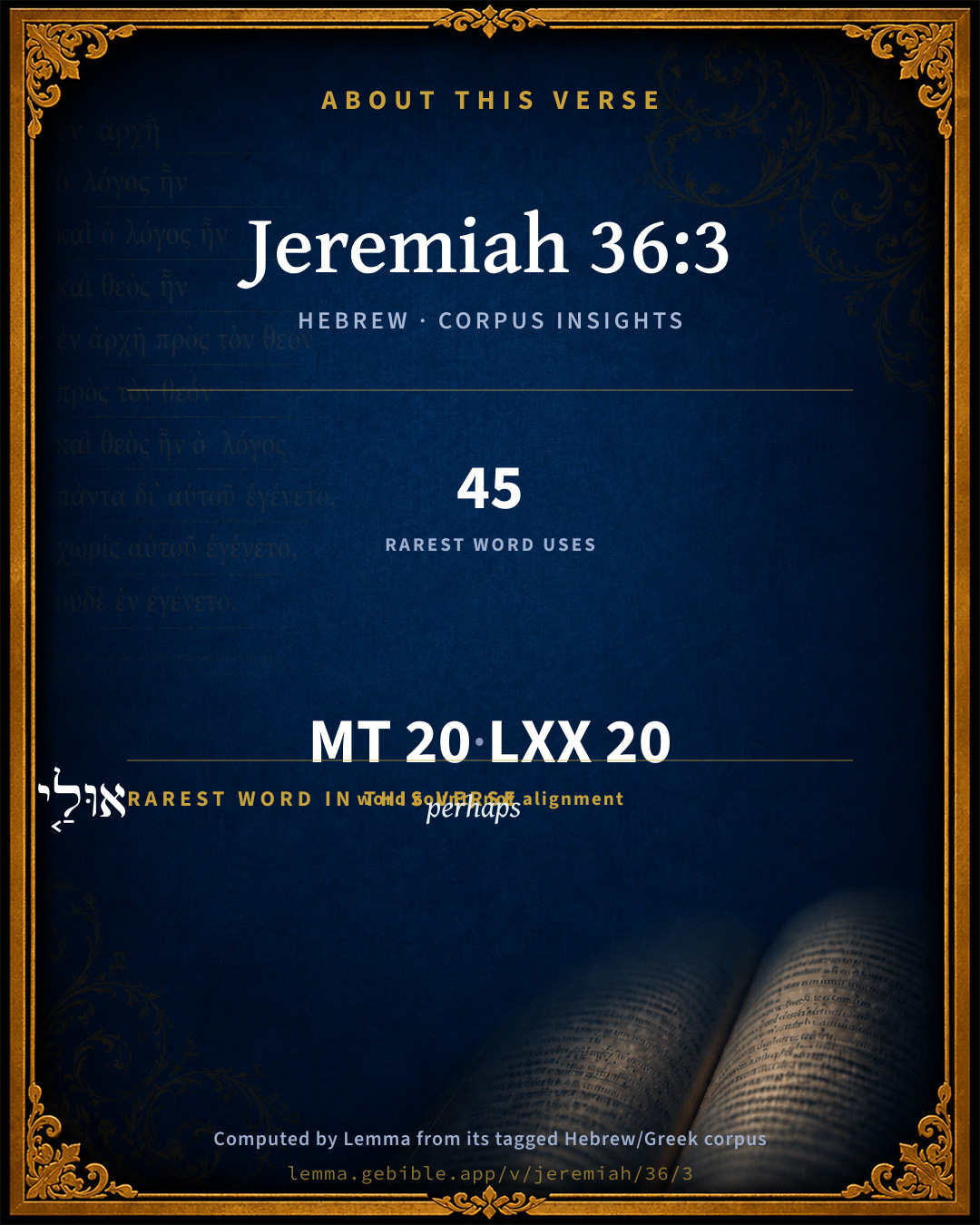
About this verse

These counts appear in no published source. They are computed here, from the morphology-tagged text and Lemma’s own curated glosses. What Lemma adds →

20
words
18
distinct lemmas
Prophets
section

Shared distinctive vocabulary

אוּלַ֤י perhaps H194 occurs in 44 verses of the Hebrew Bible. Also found in:

Grammatical profile

  • 5 verbs
  • 8 nouns
  • 1 adjective
  • 1 pronoun
  • 2 prepositions
  • 1 adverb
  • 2 particles

Verb forms

  • יִשְׁמְעוּ֙ Qal · Imperfect
  • חֹשֵׁ֖ב Qal · Participle Active
  • לַעֲשׂ֣וֹת Qal · Infinitive Construct
  • יָשׁ֗וּבוּ Qal · Imperfect
  • וְסָלַחְתִּ֥י Qal · Sequential Perfect

Repetition

A word recurs within this verse — often emphatic in Hebrew:

  • הָ֣רָעָ֔ה evil H7451 ×2

Hebrew & Septuagint length

In the original languages it is 20 Hebrew tokens and 20 Greek tokens — but the two are counted differently (Hebrew bundles its prefixes and suffixes into one token; the Greek is in lemma form), so that isn’t a like-for-like length.

Cross-references

34

Topical passages linked to Jeremiah 36:3 in the Treasury of Scripture Knowledge — connected by theme and wording, ordered by reader-vote popularity; previews shown in the World English Bible.

  • Jeremiah 18:8 if that nation, concerning which I have spoken, turn from their evil, I will repent of the evil that I thought to do to them.
  • Acts 3:19 "Repent therefore, and turn again, that your sins may be blotted out, so that there may come times of refreshing from the presence of the Lord,
  • Deuteronomy 30:2 and shall return to Yahweh your God, and shall obey his voice according to all that I command you this day, you and your children, with all your heart, and with all your soul;
  • Jeremiah 26:3 It may be they will listen, and turn every man from his evil way; that I may repent me of the evil which I purpose to do to them because of the evil of their doings.
  • Jeremiah 36:7 It may be they will present their supplication before Yahweh, and will return everyone from his evil way; for great is the anger and the wrath that Yahweh has pronounced against this people.
  • Ezekiel 12:3 Therefore, you son of man, prepare you stuff for removing, and remove by day in their sight; and you shall remove from your place to another place in their sight: it may be they will consider, though they are a rebellious house.
  • Deuteronomy 30:8 You shall return and obey the voice of Yahweh, and do all his commandments which I command you this day.
  • 1 Samuel 7:3 Samuel spoke to all the house of Israel, saying, If you do return to Yahweh with all your heart, then put away the foreign gods and the Ashtaroth from among you, and direct your hearts to Yahweh, and serve him only; and he will deliver you out of the hand of the Philistines.
  • Jeremiah 18:11 Now therefore, speak to the men of Judah, and to the inhabitants of Jerusalem, saying, Thus says Yahweh: Behold, I frame evil against you, and devise a device against you: return you now everyone from his evil way, and amend your ways and your doings.
  • Jeremiah 24:7 I will give them a heart to know me, that I am Yahweh: and they shall be my people, and I will be their God; for they shall return to me with their whole heart.
  • Jeremiah 35:15 I have sent also to you all my servants the prophets, rising up early and sending them, saying, Return you now every man from his evil way, and amend your doings, and don't go after other gods to serve them, and you shall dwell in the land which I have given to you and to your fathers: but you have not inclined your ear, nor listened to me.
  • Ezekiel 18:27–28 Again, when the wicked man turns away from his wickedness that he has committed, and does that which is lawful and right, he shall save his soul alive.
  • Mark 4:12 that 'seeing they may see, and not perceive; and hearing they may hear, and not understand; lest perhaps they should turn again, and their sins should be forgiven them.'"
  • Acts 26:18 to open their eyes, that they may turn from darkness to light and from the power of Satan to God, that they may receive remission of sins and an inheritance among those who are sanctified by faith in me.'
  • 2 Peter 3:9 The Lord is not slow concerning his promise, as some count slowness; but is patient with us, not wishing that any should perish, but that all should come to repentance.
  • Deuteronomy 5:29 Oh that there were such a heart in them, that they would fear me, and keep all my commandments always, that it might be well with them, and with their children forever!
  • 1 Kings 8:48–50 if they return to you with all their heart and with all their soul in the land of their enemies, who carried them captive, and pray to you toward their land, which you gave to their fathers, the city which you have chosen, and the house which I have built for your name:
  • 2 Chronicles 6:38–39 if they return to you with all their heart and with all their soul in the land of their captivity, where they have carried them captive, and pray toward their land, which you gave to their fathers, and the city which you have chosen, and toward the house which I have built for your name:
  • Nehemiah 1:9 but if you return to me, and keep my commandments and do them, though your outcasts were in the uttermost part of the heavens, yet will I gather them from there, and will bring them to the place that I have chosen, to cause my name to dwell there.
  • Isaiah 6:10 Make the heart of this people fat; Make their ears heavy, and shut their eyes; Lest they see with their eyes, And hear with their ears, And understand with their heart, And turn again, and be healed."
  • Isaiah 55:6–7 Seek you Yahweh while he may be found; call you on him while he is near:
  • Jeremiah 23:14 In the prophets of Jerusalem also I have seen a horrible thing: they commit adultery, and walk in lies; and they strengthen the hands of evil-doers, so that none does return from his wickedness: they are all of them become to me as Sodom, and the inhabitants of it as Gomorrah.
  • Ezekiel 18:23 Have I any pleasure in the death of the wicked? says the Lord Yahweh; and not rather that he should return from his way, and live?
  • Ezekiel 33:7–9 So you, son of man, I have set you a watchman to the house of Israel; therefore hear the word at my mouth, and give them warning from me.
  • Ezekiel 33:14–16 Again, when I say to the wicked, You shall surely die; if he turn from his sin, and do that which is lawful and right;
  • Jonah 3:8–10 but let them be covered with sackcloth, both man and animal, and let them cry mightily to God. Yes, let them turn everyone from his evil way, and from the violence that is in his hands.
  • Zephaniah 2:3 Seek Yahweh, all you humble of the land, who have kept his ordinances. Seek righteousness. Seek humility. It may be that you will be hidden in the day of Yahweh's anger.
  • Matthew 3:7–9 But when he saw many of the Pharisees and Sadducees coming for his baptism, he said to them, "You offspring of vipers, who warned you to flee from the wrath to come?
  • Matthew 13:15 For this people's heart has grown callous, Their ears are dull of hearing, They have closed their eyes; Or else perhaps they might perceive with their eyes, Hear with their ears, Understand with their heart, And should turn again; And I would heal them.'
  • Luke 3:7–9 He said therefore to the multitudes who went out to be baptized by him, "You offspring of vipers, who warned you to flee from the wrath to come?
  • Luke 20:13 The lord of the vineyard said, 'What shall I do? I will send my beloved son. It may be that seeing him, they will respect him.'
  • Acts 26:20 but declared first to them of Damascus, at Jerusalem, and throughout all the country of Judea, and also to the Gentiles, that they should repent and turn to God, doing works worthy of repentance.
  • Acts 28:27 For this people's heart has grown callous. Their ears are dull of hearing. Their eyes they have closed. Lest they should see with their eyes, Hear with their ears, Understand with their heart, And would turn again, And I would heal them.'
  • 2 Timothy 2:25–26 in gentleness correcting those who oppose him: perhaps God may give them repentance leading to a full knowledge of the truth,

Cross-references courtesy of OpenBible.info (CC BY 4.0).

Hebrew and Greek witnesses Masoretic Hebrew ↔ Greek Septuagint

The same verse in the two great witnesses to the Old Testament, shown verse-for-verse.

These are two independent witnesses, not word-aligned to each other, and the Septuagint is shown in lemma (dictionary) form.

Hebrew Jeremiah 36:3 Masoretic · Westminster Leningrad Codex

אוּלַ֤י יִשְׁמְעוּ֙ בֵּ֣ית יְהוּדָ֔ה אֵ֚ת כָּל הָ֣רָעָ֔ה אֲשֶׁ֛ר אָנֹכִ֥י חֹשֵׁ֖ב לַעֲשׂ֣וֹת לָהֶ֑ם לְמַ֣עַן יָשׁ֗וּבוּ אִ֚ישׁ מִדַּרְכּ֣וֹ הָרָעָ֔ה וְסָלַחְתִּ֥י לַעֲוֺנָ֖ם וּלְחַטָּאתָֽם

It may be that the house of Judah will hear all the evil which I purpose to do to them; that they may return every man from his evil way; that I may forgive their iniquity and their sin.

World English Bible · Public Domain

Greek LXX Structure differs

In the Septuagint, Jeremiah is about an eighth shorter than the Hebrew and arranges its material differently — the Oracles Against the Nations (Hebrew chapters 46–51) appear in the middle of the Greek book, after 25:13. Because the chapter and verse boundaries do not line up, a verse-for-verse comparison with the Hebrew is not shown.

A verse-for-verse comparison isn’t shown here because the chapters and verses don’t line up. Switch to the LXX edition with the MT / LXX toggle above to read the Greek directly.

Hebrew: Westminster Leningrad Codex (CC BY 4.0). Greek: Septuagint (public domain); English from a public-domain English Septuagint. How the Septuagint differs from the Hebrew →

Targum (Aramaic paraphrase)

1

The Targum is the ancient Jewish Aramaic paraphrase of the Hebrew Scriptures — an interpretive translation, not the Hebrew text itself. Onkelos (literal) and Pseudo-Jonathan (expansive) render the Torah, and Jonathan the Prophets. Coverage is partial: where no permissively-licensed English translation exists for a verse, only the Aramaic is shown. This is verse-level text, not a word-by-word alignment to the Hebrew.

  1. Targum Jonathan Prophets (Joshua–Malachi)
    מָאִים יִשְׁמְעוּן דְבֵית יְהוּדָה יַת כָּל בִּישְׁתָא דַאֲנָא מְחַשֵׁב לְמֶעְבַּד לְהוֹן בְּדִיל דִיתוּבוּן גְבַר מֵאוֹרְחֵיהּ בִּישְׁתָא וְאֶשְׁבּוֹק לְחוֹבֵיהוֹן וּלְחַטָאֵיהוֹן:

    (no public-domain English translation for this verse)

    Targum Jonathan — Aramaic: “Mikraot Gedolot” (public domain). English: “Sefaria Community Translation” (CC0 1.0 (public-domain dedication)); “London "Chaldee Paraphrase," 1871” (public domain). Text via Sefaria.

Commentary

Notes on Jeremiah 36:3 from classic Christian and Jewish commentators (each source and its license shown beneath its notes). The classic Christian expositions comment on the surrounding passage and are grouped to its opening verse, so a note may address several verses; the Jewish commentaries on the Tanakh (Rashi and others) are per-verse, so they appear only where the commentator wrote on this verse.

Lemma curates 59 commentaries, every one of them public domain or Creative Commons licensed, each selected and text-cleaned for this edition rather than reprinted as found. About our sources →

Trapp's Complete Commentary

John Trapp

Jer 36:3 It may be that the house of Judah will hear all the evil which I purpose to do unto them; that they may return every man from his evil way; that I may forgive their iniquity and their sin.

Ver. 3. It may be that the house of Judah will hear, &c.] See here the utility of the Holy Scriptures, and the excellent use that may be made of reading them. A man may be thereby doubtless converted where preaching is wanting, as various were in Queen Mary’s days, when the Word of God was precious; {a} as Augustine was by reading Rom 13:1-14., Fulgentius by the Frophet Jonah, Franciseus Junius by Joh 1:1-51., &c.; the eunuch, {Act 8:26-39} and those noble Bereans, {Act 17:11} were notably prepared for conversion by this ordinance.

That I may forgive their iniquity and their sin,] i.e., Their sins of all sorts, giving them a free and full discharge.

{a} Foxe’s Martyrol.

John Trapp, A Commentary or Exposition upon All the Books of the Old and New Testament (1647–1656) — public domain. Text from a community e-Sword module.

The Biblical Illustrator

Joseph S. Exell

Jer_36:3

It may be.

It may be

I. This word shows us the heart of God. Displeased because of sin, but longing to show mercy to the sinner. All His counsels and warnings, promises and threatenings, are for good (Deu_5:29-33; Deu_32:44-47; Isa_1:18-20; Jer_8:7-11; Eze_12:3; Eze_18:31; Hos_11:1-8; Joh_3:16-17; Luk_19:10; Luk_19:41-42).

II. This word reveals the grand possibilities of human life.

1. Earnest attention (Jer_36:3).

2. Penitential prayer (Jer_36:7).

3. Moral reconciliation. The hindrances to peace are not with God, but with us.

III. This word holds out encouragement to all true workers for Christ.

1. Prayer.

2. Holy endeavour.

3. Missionary enterprise. (W. Forsyth, M. A.)

The Biblical Illustrator, edited by Joseph S. Exell (c. 1880s–1900s) — public domain. Text from a community e-Sword module.

Joseph Benson's Commentary

Jer 36:3. It may be that the house of Judah will hear, &c. — That is, will hearken, and lay to heart, all the evil, &c., that they may return, &c. — Blaney translates the verse, “Peradventure the house of Judah may hear all the evil which I purpose to do unto them, so as to return every one from his evil way, and I may forgive their iniquity and their sin.” See the like expression, Jer 36:7; Jer 26:3; Eze 12:3; Amo 5:15; in which places God is introduced as speaking after the manner of men, and using such methods as, in human probability, might be most likely to prevail: compare Jer 8:6. These, and expressions of the like kind, sufficiently indicate that God’s foreknowledge of future events lays no restraint on the will of man, nor takes away the liberty of human actions. That I may forgive their iniquity and their sin — Forgiveness of sin in Scripture sometimes signifies the acquitting of a sinner from the obligation sin had laid him under to eternal death; sometimes the remission of a temporal punishment: it may here be understood as comprehending both, though it is probable the latter is principally intended.

Joseph Benson's Commentary on the Old and New Testaments (1811–1818) — public domain. Text from a community e-Sword module.

Tyndale Open Study Notes

Tyndale Open Resources

36:3 The Lord gave the people of Judah every opportunity to repent. God wanted the messages of judgment not just to alarm his people, but to awaken them to the judgment they would face if they did not turn from idol-worship. If they heeded the alarm, repented, and sincerely worshiped the one true God, he would forgive their sins and wrongdoings.

Tyndale Open Study Notes — © Tyndale Open Resources, licensed CC BY-SA 4.0. Text via the HelloAO Bible API.

Jamieson, Fausset & Brown

Robert Jamieson, A. R. Fausset & David Brown

hear--consider seriously.

return . . . from . . . evil way-- (Jon 3:8).

Jamieson, Fausset & Brown — Commentary Critical and Explanatory on the Whole Bible (1871) — public domain (CC PDM 1.0). Text via the HelloAO Bible API.

Adam Clarke's Commentary

Verse 3. It may be that the house of Judah will hear] It was yet possible to avert the judgments which had been so often denounced against them. But in order to this they must -

1. Hear what God has spoken.

2. Every man turn from his evil way.

3. If they do so, God graciously promises to forgive their iniquity and their sin.

Adam Clarke's Commentary on the Bible (1810–1826) — public domain. Text from a community e-Sword/MySword module.

John Calvin's Commentaries

Here God explains the object he had in view, even to make another trial whether the Jews were healable, so that the teaching of the Prophet might be conducive to their salvation. But he uses the particle אולי auli, “it may be,” which implies a doubt; because they had so often, and for so long a time, and in such various ways, shewed themselves to be so obstinate that hardly a hope could be entertained of their repentance. God, however, shews that he was not wearied, provided there remained in them still the smallest particle of religion. It may be then, he says, that the house of Judah will hear all the evil, etc.

We have seen how the Prophet labored, not only to terrify his own nation by threatenings, but also sweetly to allure them to the service of God; but God speaks here of them as of perverse men, who were almost intractable, according to what is said in Psalm 18:26, that God would be severe towards the perverse; for God deals with men according to their disposition. As the Jews then were unworthy that God should, according to his gentleness, teach them as children, this only remained for them, to repent under the influence of fear. It may be, he says, that they will bear all the evil, etc. We now see why God touches only on threatenings, for this alone remained for men so obstinate.

He says, The evil which I think to do, etc. God here transfers to himself what belongs to men; for he does not think or deliberate with himself; but as we cannot comprehend his incomprehensible counsel, he sometimes assumes the person of man; and this is what is common in Scripture. But he says, that he thinks of what he pronounces in his word; for as long as God exhorts men to repent, he holds, as it were, his hand suspended, and allows an opportunity to repent. He then says, that he is, as it were, in the midst of his deliberations: as when one wants to know whether an offender will submit, so God transforms himself, in a manner, into what man is, when he says, I think; that is, let them know that vengeance is not in vain denounced in my word; for I will perform whatever I now threaten, except they repent.

He says, That they may turn every one from his evil way This is to hear, previously mentioned, even when men become seriously touched, so as to be displeased with their vices, and to desire from the heart to surrender themselves to God. He joins a promise, for without the hope of pardon it cannot be, that men will repent, as it has been often said; but it must be repeated, because few understand that faith cannot be separated from repentance; and a sinner can never be induced to return truly to God, unless he entertains a hope of pardon, for this is a main truth, according to what is said in Psalm 130:4,

“With thee is mercy, that thou mayest be feared.”

Then, according to what is commonly done, the Prophet says, that if the Jews turned to God, he would be propitious to them, as though he had said, that men would not be disappointed, if they repent, because God would readily meet them, and be reconciled to them: for this one thing alone, as I have said, is what can encourage us to repent, that is, when we are convinced that God is ready to give us pardon. He mentions iniquity and sin. The Prophet, no doubt, referred to these two words, in order to shew that we ought by no means to despair, though sins be heaped on sins. It follows —

John Calvin's Commentaries (1540-1563) — public domain. Text from the Calvin Translation Society English edition (1840s-50s) via the Christian Classics Ethereal Library (ccel.org). Calvin's coverage is partial (roughly two-thirds of the Bible); uncommented books and verses are honest gaps, never fabricated. The 19th-century editor's footnotes and remarks are omitted so the notes are faithfully Calvin's own voice.

Ellicott's Commentary for English Readers

(3) It may be that the house of Judah will hear . . .—Better, hearken to, as implying more than the physical act of listening. Here again, in the expression of the hope that Israel would “return every man from his evil way,” we have a distinct echo from Jer_25:5.

A Bible Commentary for English Readers, edited by Charles John Ellicott (1878–1897) — public domain. Text from a community e-Sword module.

The Cambridge Bible for Schools and Colleges

gen. ed. J. J. S. Perowne

3. It may be that the house of Judah, etc.] Cp. ch. Jer_26:3.

The Cambridge Bible for Schools and Colleges (gen. ed. J. J. S. Perowne; Cambridge University Press, 1878–1918) — public domain. Text from a community e-Sword module.

John Gill's Exposition

It may be that the house of Judah will hear all the evil which I purpose to do unto them,.... Not that there was any uncertainty in God as to the knowledge of future events, any more than a change in his purposes: he had purposed to bring evil upon them, which purpose would not be disannulled; and he knew that the Jews would not hearken to the prediction of it, or be concerned about it, and repent of their sins, and reform; but this method he was pleased to take, as being, humanly speaking, a probable one to awaken their attention, and which would leave them inexcusable:

that they may return every man from his evil way; repent of it, and reform:

that I may forgive their iniquity and their sin; by not inflicting on them the punishment and ruin threatened: where repentance is, remission of sin is likewise, and both are the gifts of divine grace, when spiritual and evangelical.

John Gill's Exposition of the Whole Bible (1746–1763) — public domain (CC PDM 1.0). Text via the HelloAO Bible API.

Albert Barnes' Notes on the Bible

Compare Jer 26:3. In point of date Jer. 26: is immediately prior to the present.

Albert Barnes' Notes on the Bible (1834–1885) — public domain. Text from a community e-Sword/MySword module.

Haydock's Catholic Bible Commentary

If. This indicates free-will. (Haydock) --- God makes this last effort, that the hearing of so many separate prophecies together might make a deeper impression.

George Leo Haydock (1774–1849), Haydock's Catholic Family Bible and Commentary, 1859 edition — public domain. Excludes Psalms (Douay-Rheims chapter numbering differs from Protestant) and Deuterocanonical books (Catholic canon only).

Matthew Poole's English Annotations

What we translate it may be אולי others translate if perhaps, which better expresseth the sense. God knew what would be, but yet he would not be wanting in means by which they might be informed in his will, and so believe the thing, for believing and reforming are here meant by hearing, as the next words in part expound this term here. Forgiveness of sin in Scripture sometimes signifieth the acquitting of a sinner from the obligation sin layeth the sinner under to eternal death, sometimes the remission of a temporal punishment; it may here well be understood as comprehending both, though I think the latter to be what is here principally intended.

Matthew Poole's English Annotations on the Holy Bible (1683–1685) — public domain. Text from a community e-Sword/MySword module.

The Pulpit Commentary

"It may be.

We can understand the prophet thus speaking, but how can there be anything uncertain or contingent with God? And yet it is he who here speaks and says, "It may be." We are accustomed to say, "God knows all the past, and all the present, and all the future. (cf. Isa_46:9-11) Reason and Scripture alike seem to say that there can be nothing probable with God. But yet this is his word. Why does he thus speak? Perhaps

I BECAUSE THERE WAS NO LAW, NO DECREE, AGAINST THE PEOPLE"S REPENTANCE. He had made no such law, and man had not. There is no decree of reprobation.

II IT MAY BE CONSISTENT, AFTER ALL, WITH THE TRUTH OF THINGS FOR GOD THUS TO SPEAK, THOUGH WE CANNOT SEE HOW. We infer certain conclusions from what we read and learn about God, and these conclusions seem to deny the possibility of there being any "it may be" with him. But we may be wrong after all, and the fact that he does thus speak lends to the suspicion that we are.

III BECAUSE IT WOULD BE ILL FOR US WERE HE TO REVEAL THE CERTAINTIES OF THINGS. If they were to be such as we would desire, we should cease to labour for them. If otherwise, we should sit down in despair. But God desires us to labour and pray, and therefore hides the future from our eyes. Presumption and despair are both great evils; therefore to prevent them, God speaks after the manner of men, if not after the manner of God.

IV BECAUSE HE INTENDS HIS "MAY BE" TO BECOME "SHALL BE." He would have us fellow workers with him, and therefore he encourages our efforts, but hides from us be that which would lead us to think them unnecessary. And probably the "may be" will become "shall be," though not at the time nor in the manner we expect. Let us, therefore, be ever cheered forward when God says, "It may be. C.

HOMILIES BY D. YOUNG Ver. 3. God"s eye to every possibility.

I THE THING WHICH GOD GREATLY DESIRES. That man may repent, thus enabling him to forgive. He ever has his eyes on the ways of evil men, noticing the slightest sign of their weariness in them and disposition to leave them. This is always a thing to be suspected and prepared for. That any man should suddenly become uneasy and hesitating in the midst of evil courses is nothing wonderful when we consider that man was made for goodness and holiness. Thus what else should we look for than frequent expressions of desire on the part of God that man should again be found in the right way?

II GOD LEAVES NOTHING UNDONE TO BRING THIS ABOUT. There is something even touching about this word, "it may be." As if it were allowed that probabilities all pointed in one unfavourable direction, but still not one of them was such a certainty that the contrary possibility should be excluded. As the common proverb says, "While there"s life there"s hope." Every instance of a rejected appeal and an abused prophet lessens the probability, but it does not destroy the possibility. God goes on sending his prophets. Each man comes with his own personality, his own peculiar emphasis, and thus with evermore the same message there is variety both in the messenger and the form of his message. And at last, when the messenger gets shut up, his words are written down and transmitted by another. We cannot get rid of the Word of God. There are a thousand channels to the heart of man, and the violent stoppage of some may only result in the enlargement and efficacy of others.

III THERE IS AN EXAMPLE FOR US IN GOSPEL WORK. Scripture shows us God using many ways in trying to get at the human heart. Surely the great principle in this matter is that every way is right if it be not wrong in itself. We must not do evil that good may come; but we must be all things to all men that we may save some.

IV THERE MAY BE ADDED GUILT TO THOSE REJECTING THE GOSPEL. It was one of the worst elements in the guilt of Israel that it had been indifferent to so many appeals and such various ones. God did not send these people into exile upon one refusal or even upon a few. There was sufficient intimation of his demands and his designs. And we may take it that there always is sufficient intimation. With the constant extension of gospel effort and the wider diffusion of Bibles, tracts, and all sorts of printed agencies, we may say that each generation gets more of light than the one before it. Indeed, we may lay it down as a general principle that when all the opportunities of every human being are summed up, it will be found that he is without any excuse for pleading ignorance or doubt as to God"s demands. Y.

The Pulpit Commentary (1880–1919), ed. H.D.M. Spence-Jones & Joseph S. Exell — public domain. Text from a community e-Sword module.

Lesson kit

Teaching starters — assembled from the data on this page, not authored interpretation. Every prompt links to the verse data it draws on. Edit before teaching.

Jeremiah, in the Prophets, opens this verse with 20 words (18 distinct Hebrew lemmas). Its most distinctive word is ʼûwlay (“perhaps”). A historical commentator’s framing appears above. Read the whole chapter for the surrounding context.

Discussion questions

  1. What does “perhaps” (ʼûwlay) contribute to the verse as a whole?
  2. How does Genesis 16:2, which shares the word «perhaps», read alongside this verse?
  3. What does the repetition of “evil” (2× in this one verse) do in this verse?
  4. These translations render this verse differently; the difference is in the English rendering, not the original. What questions does that raise?
  5. «יִשְׁמְעוּ֙» is a Qal Imperfect verb. How does that grammatical form shape the action described?
  6. Compare how Trapp's Complete Commentary and The Biblical Illustrator read this verse. Where do they agree or differ?

Things to notice

Reading settings

Reading text

Shown beneath each verse's original-language words.

Old Testament
Old Testament edition

Read the OT as the Masoretic Hebrew (MT) or the Greek Septuagint (LXX).

English shown for the Greek Septuagint (in the Hebrew ↔ Greek comparison).

Comparing translations? Open the Compare panel on any verse page to stack up to four side by side.