
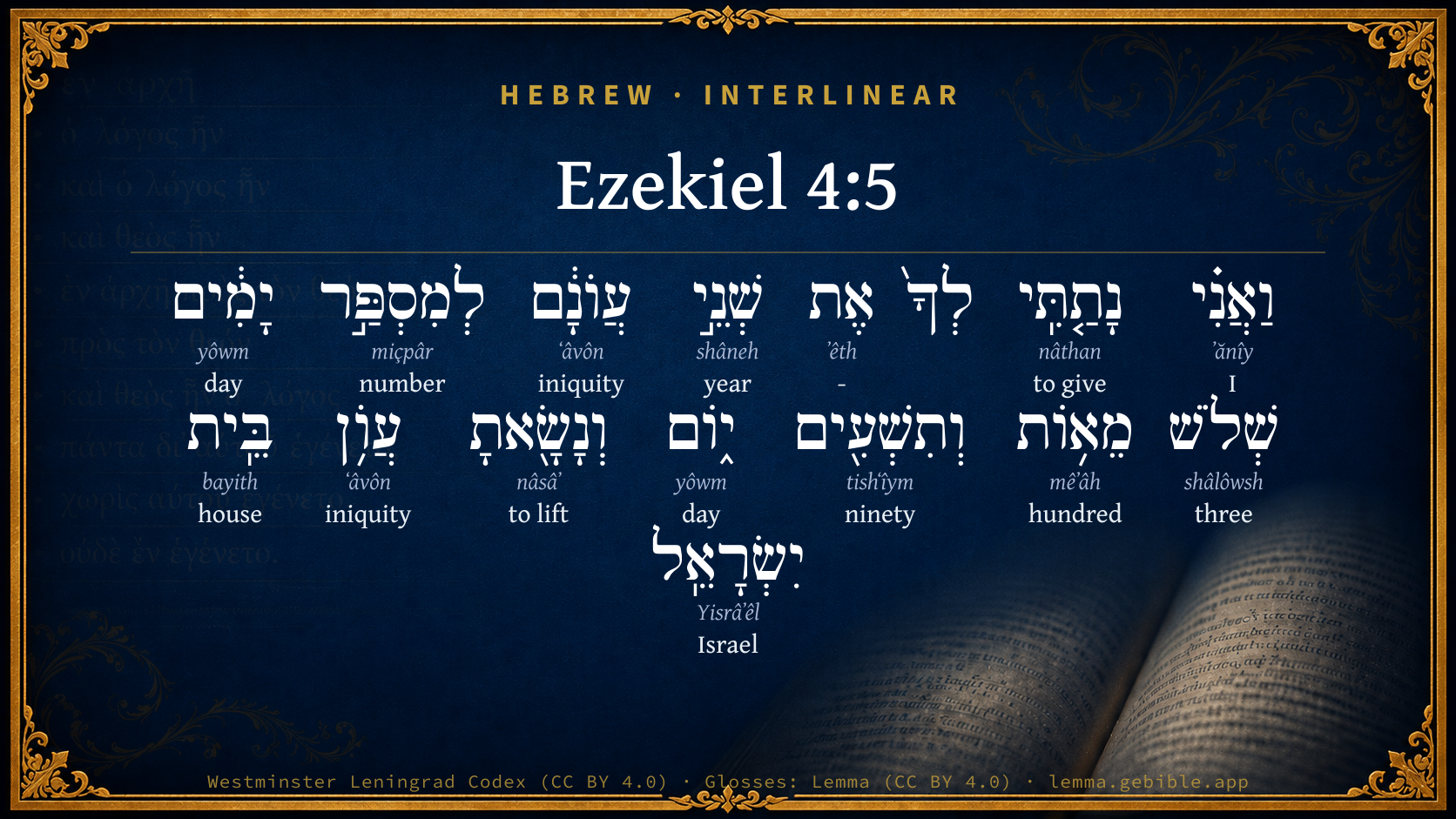
Ezekiel 4:5

Hebrew (Westminster Leningrad Codex) Ezekiel 4:5 appears in the Hebrew Old Testament. The text above is from the Westminster Leningrad Codex. Each word links to its Strong’s number, a concise gloss, and parsing drawn from the Open Scriptures Hebrew Bible morphology. Click any word for its full Brown-Driver-Briggs (BDB) entry.
Download image
Cite this verse

Ezekiel 4:5 (World English Bible). Public Domain. Lemma interlinear Bible study tool, https://lemma.gebible.app/v/ezekiel/4/5.

Show BibTeX & RIS
BibTeX
RIS
English Translation
For I have appointed the years of their iniquity to be to you a number of days, even three hundred ninety days: so shall you bear the iniquity of the house of Israel.
World English Bible · Public Domain
Download a study sheet

One document with this verse’s original text, its word-by-word gloss line, the meaning frame, cross-references with their text, attributed commentary, and full source and license credits — printable, and it pastes into notes with its structure intact.

This verse Autodidact and up

Study sheet (.html) Plain text (.txt)

A passage Seminary Student

Up to 50 verses in one chapter. A passage sheet keeps up to 6 commentary sources and 12 cross-references per verse, in the order this page ranks them, and says so on the sheet whenever that leaves anything out. Ask for a single verse and you get the Autodidact verse sheet above.

Everything on this page stays free to read, with no account — the sheet is a download of what is already on screen, not access to it.

Want to remove ads? Support Godless Engineer
Compare translations 3

The same verse in 3 English versions, stacked beneath the original-language interlinear above. Click any original word for its lexicon entry.

Each is an independent rendering of the whole verse — the interlinear is not word-aligned to these translations.

Highlighted words mark where these versions differ — a whole-verse word diff, not a word-by-word alignment.

  • World English Bible Public Domain
    For I have appointed the years of their iniquity to be to you a number of days, even three hundred ninety days: so shall you bear the iniquity of the house of Israel.
  • King James Version Public Domain
    For I have laid upon thee the years of their iniquity, according to the number of the days, three hundred and ninety days: so shalt thou bear the iniquity of the house of Israel.
  • unfoldingWord Literal Text CC BY-SA 4.0
    I myself am assigning to you one day to represent each year of their punishment: 390 days! In this way, you will carry the sin of the house of Israel.

unfoldingWord Literal Text — © unfoldingWord, licensed CC BY-SA 4.0. Word-aligned USFM3 via Door43 (git.door43.org/unfoldingWord/en_ult).

Versions to compare (up to 4)

3 of 4 selected

Show all 18 translations

Every available English version of this verse, each an independent rendering of the whole verse.

  • World English Bible Public Domain
    For I have appointed the years of their iniquity to be to you a number of days, even three hundred ninety days: so shall you bear the iniquity of the house of Israel.
  • Berean Standard Bible Public Domain
    For I have assigned to you 390 days, according to the number of years of their iniquity. So you shall bear the iniquity of the house of Israel.
  • Majority Standard Bible Public Domain
    For I have assigned to you 390 days, according to the number of years of their iniquity. So you shall bear the iniquity of the house of Israel.
  • King James Version Public Domain
    For I have laid upon thee the years of their iniquity, according to the number of the days, three hundred and ninety days: so shalt thou bear the iniquity of the house of Israel.
  • American Standard Version (1901) Public Domain
    For I have appointed the years of their iniquity to be unto thee a number of days, even three hundred and ninety days: so shalt thou bear the iniquity of the house of Israel.
  • Revised Version (1885) Public Domain
    For I have appointed the years of their iniquity to be unto thee a number of days, even three hundred and ninety days: so shalt thou bear the iniquity of the house of Israel.
  • Geneva Bible (1599) Public Domain
    For I haue layed vpon thee the yeeres of their iniquitie, according to the nomber of the dayes, euen three hundreth and ninetie dayes: so shalt thou beare the iniquitie of the house of Israel.
  • Douay-Rheims (1899) Public Domain
    And I have laid upon thee the years of their iniquity, according to the number of the days three hundred and ninety days: and thou shalt bear the iniquity of the house of Israel.
  • Young's Literal Translation Public Domain
    And I -- I have laid on thee the years of their iniquity, the number of days, three hundred and ninety days; and thou hast borne the iniquity of the house of Israel.
  • Literal Standard Version CC BY-SA 4.0
    And I have laid the years of their iniquity on you, the number of days, three hundred and ninety days; and you have borne the iniquity of the house of Israel.
  • Unlocked Literal Bible CC BY-SA 4.0
    I myself am assigning to you one day to represent each year of their punishment: 390 days! In this way, you will carry the sin of the house of Israel.
  • unfoldingWord Literal Text CC BY-SA 4.0
    I myself am assigning to you one day to represent each year of their punishment: 390 days! In this way, you will carry the sin of the house of Israel.
  • Darby Bible Public Domain
    And I have appointed thee the years of their iniquity, according to the number of the days, three hundred and ninety days; and thou shalt bear the iniquity of the house of Israel.
  • World Messianic Bible Public Domain
    For I have appointed the years of their iniquity to be to you a number of days, even three hundred ninety days. So you shall bear the iniquity of the house of Israel.
  • Webster's Bible Public Domain
    For I have laid upon thee the years of their iniquity, according to the number of the days, three hundred and ninety days: so shalt thou bear the iniquity of the house of Israel.
  • Free Bible Version CC BY-SA 4.0
    I will make you stay there for 390 days, representing the number of years of their sins. You will bear the sins of the Israelites.
  • Bible in Basic English Public Domain
    For I have had the years of their sin measured for you by a number of days, even three hundred and ninety days: and you will take on yourself the sin of the children of Israel.
  • JPS Tanakh (1917) Public Domain
    For I have appointed the years of their iniquity to be unto thee a number of days, even three hundred and ninety days; so shalt thou bear the iniquity of the house of Israel.

Literal Standard Version (2020), Covenant Press — licensed CC BY-SA 4.0. Text via the HelloAO Bible API (eBible.org). Unlocked Literal Bible (unfoldingWord) — licensed CC BY-SA 4.0. Text via the HelloAO Bible API (eBible.org). unfoldingWord Literal Text — © unfoldingWord, licensed CC BY-SA 4.0. Word-aligned USFM3 via Door43 (git.door43.org/unfoldingWord/en_ult). Free Bible Version, Dr. Jonathan Gallagher — licensed CC BY-SA 4.0. Text via the HelloAO Bible API (eBible.org).

Word by word

More ways to search: Search by grammar → Find every occurrence → Compare this word →

Practice this passage: Drill this verse → Learn its vocabulary →

וְתִשְׁעִ֖ים
tishʻîym
H8673
“and · ninety”
Conjunction + Adjective, Cardinal number, Both, Plural, Absolute
Part of Speech
Conjunction + Adjective
Type
Cardinal number
Gender
Both
Number
Plural
State
Absolute
Full BDB Definition

Origin: multiple from H8672

TWOT: 2552

ninety
  1. וַאֲנִ֗י ʼănîy H589 “and · I” Conjunction + Pronoun, Personal, 1st Person, Common, Singular
  2. נָתַ֤תִּֽי nâthan H5414 “to give” Verb, Qal, Perfect, 1st Person, Common, Singular
  3. אֶת ʼêth H853 “-” Particle, Direct Object
  4. שְׁנֵ֣י shâneh H8141 “year” Adjective, Cardinal number, Masculine, Dual, Construct
  5. עֲוֺנָ֔ם ʻâvôn H5771 “iniquity · their” Noun, Common, Both, Singular, Construct + Suffix, Personal, 3rd Person, Masculine, Plural
  6. לְמִסְפַּ֣ר miçpâr H4557 “to/for · number of” Preposition + Noun, Common, Masculine, Singular, Construct
  7. יָמִ֔ים yôwm H3117 “days” Noun, Common, Masculine, Plural, Absolute
  8. שְׁלֹשׁ shâlôwsh H7969 “three” Adjective, Cardinal number, Feminine, Singular, Absolute
  9. מֵא֥וֹת mêʼâh H3967 “hundred” Adjective, Cardinal number, Both, Plural, Absolute
  10. י֑וֹם yôwm H3117 “day” Noun, Common, Masculine, Singular, Absolute
  11. וְנָשָׂ֖אתָ nâsâʼ H5375 “and · to lift” Conjunction + Verb, Qal, Sequential Perfect, 2nd Person, Masculine, Singular
  12. עֲוֺ֥ן ʻâvôn H5771 “iniquity of” Noun, Common, Both, Singular, Construct
  13. בֵּֽית bayith H1004 “house of” Noun, Common, Masculine, Singular, Construct
  14. יִשְׂרָאֵֽל Yisrâʼêl H3478 “Israel” Noun, Proper

About this verse

These counts appear in no published source. They are computed here, from the morphology-tagged text and Lemma’s own curated glosses. What Lemma adds →

16
words
13
distinct lemmas
Prophets
section

Notable vocabulary

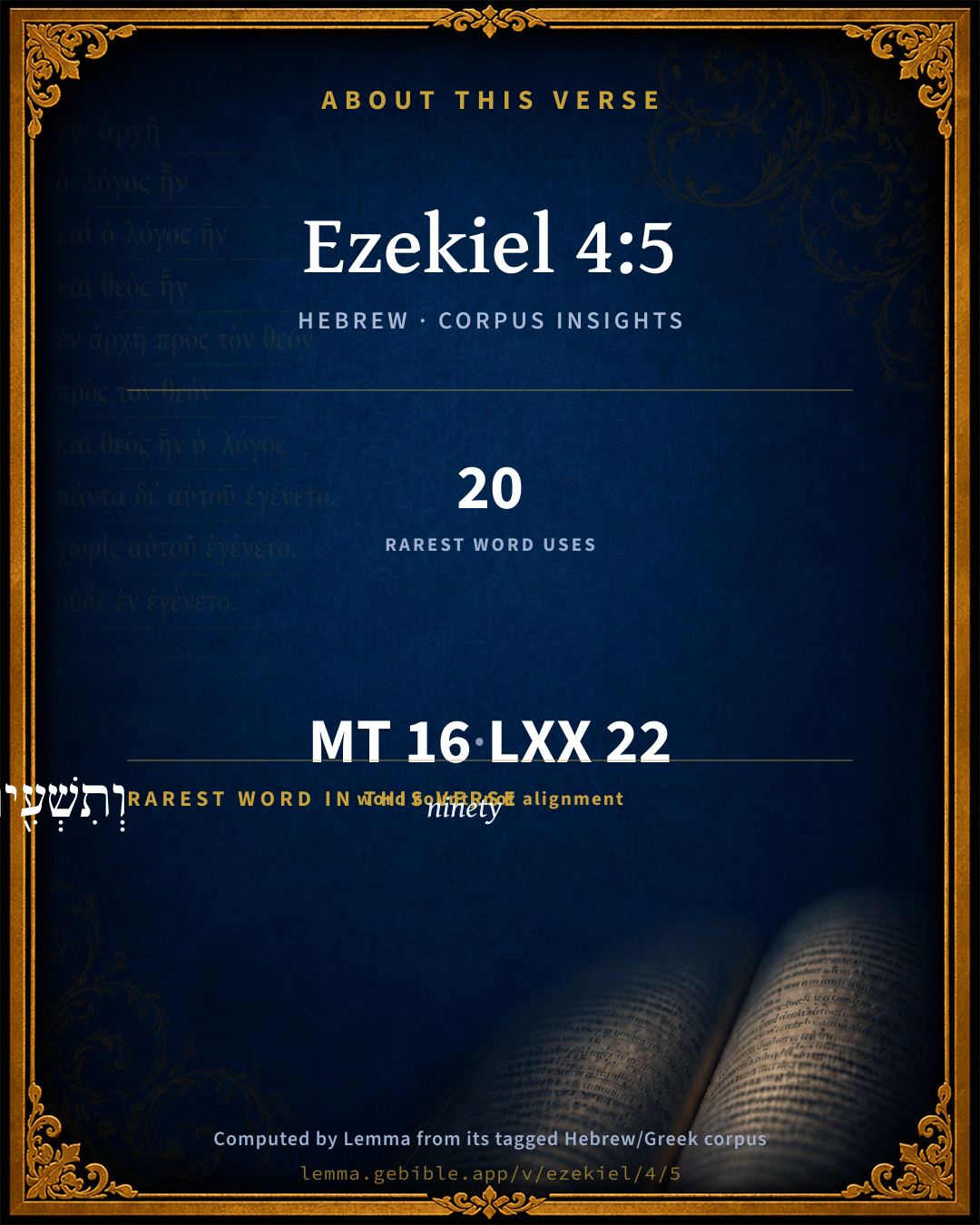
The rarest word here is וְתִשְׁעִ֖ים ninety H8673 — appearing just 20 times in the whole Hebrew Bible.

Shared distinctive vocabulary

וְתִשְׁעִ֖ים ninety H8673 occurs in 20 verses of the Hebrew Bible. Also found in:

Grammatical profile

  • 2 verbs
  • 7 nouns
  • 4 adjectives
  • 1 pronoun
  • 1 preposition
  • 1 particle

Verb forms

  • נָתַ֤תִּֽי Qal · Perfect
  • וְנָשָׂ֖אתָ Qal · Sequential Perfect

Repetition

Words recur within this verse — often emphatic in Hebrew:

  • עֲוֺנָ֔ם iniquity H5771 ×2
  • יָמִ֔ים day H3117 ×2

Hebrew & Septuagint length

In English translation the verse runs 33 words from the Hebrew and 29 from the Septuagint (LXX English) — closely comparable.

A rough comparison of the two English renderings, which tokenize alike — not a word-level alignment.

Word counts can differ between the Hebrew and the Greek without any difference in meaning — e.g. the Hebrew direct-object marker אֵת has no separate Greek word, and Greek often adds the article ὁ.

In the original languages it is 16 Hebrew tokens and 22 Greek tokens — but the two are counted differently (Hebrew bundles its prefixes and suffixes into one token; the Greek is in lemma form), so that isn’t a like-for-like length.

Cross-references

2

Topical passages linked to Ezekiel 4:5 in the Treasury of Scripture Knowledge — connected by theme and wording, ordered by reader-vote popularity; previews shown in the World English Bible.

  • Numbers 14:34 After the number of the days in which you spied out the land, even forty days, for every day a year, shall you bear your iniquities, even forty years, and you shall know my alienation.
  • Isaiah 53:6 All we like sheep have gone astray; everyone has turned to his own way; and Yahweh has laid on him the iniquity of us all.

Cross-references courtesy of OpenBible.info (CC BY 4.0).

Hebrew and Greek witnesses Masoretic Hebrew ↔ Greek Septuagint

The same verse in the two great witnesses to the Old Testament, shown verse-for-verse.

These are two independent witnesses, not word-aligned to each other, and the Septuagint is shown in lemma (dictionary) form.

Hebrew Ezekiel 4:5 Masoretic · Westminster Leningrad Codex

וַאֲנִ֗י נָתַ֤תִּֽי לְךָ֙ אֶת שְׁנֵ֣י עֲוֺנָ֔ם לְמִסְפַּ֣ר יָמִ֔ים שְׁלֹשׁ מֵא֥וֹת וְתִשְׁעִ֖ים י֑וֹם וְנָשָׂ֖אתָ עֲוֺ֥ן בֵּֽית יִשְׂרָאֵֽל

For I have appointed the years of their iniquity to be to you a number of days, even three hundred ninety days: so shall you bear the iniquity of the house of Israel.

World English Bible · Public Domain

Greek LXX Ezekiel 4:5 Septuagint · lemma form

καί ἐγώ δίδωμι σύ ὁ δύο ἀδικία αὐτός εἰς ἀριθμός ἡμέρα ἐνενήκοντα καί ἑκατόν ἡμέρα καί λαμβάνω ὁ ἀδικία ὁ οἶκος ἰσραήλ

For I have appointed you their iniquities for a number of days, for one hundred and ninety days: so you shall bear the iniquities of the house of Israel.

LXX2012 (modern English Septuagint) · Public Domain

On this verse, Haydock's Catholic Bible Commentary discusses the Septuagint’s reading. Read the note in Commentary ↓

Hebrew: Westminster Leningrad Codex (CC BY 4.0). Greek: Septuagint (public domain); English from LXX2012 (modern English Septuagint) (Public Domain). How the Septuagint differs from the Hebrew →

Targum (Aramaic paraphrase)

1

The Targum is the ancient Jewish Aramaic paraphrase of the Hebrew Scriptures — an interpretive translation, not the Hebrew text itself. Onkelos (literal) and Pseudo-Jonathan (expansive) render the Torah, and Jonathan the Prophets. Coverage is partial: where no permissively-licensed English translation exists for a verse, only the Aramaic is shown. This is verse-level text, not a word-by-word alignment to the Hebrew.

  1. Targum Jonathan Prophets (Joshua–Malachi)
    וַאֲנָא יְהָבִית לָךְ עַל חַד תְּרֵין בְּחוֹבֵיהוֹן לְמִנְיַן יוֹמַיָא תְּלַת מְאָה וְתִשְׁעִין יוֹמִין וּתְקַבֵּיל חוֹבֵי בֵית יִשְׂרָאֵל:

    (no public-domain English translation for this verse)

    Targum Jonathan — Aramaic: “Mikraot Gedolot” (public domain). English: “Sefaria Community Translation” (CC0 1.0 (public-domain dedication)); “London "Chaldee Paraphrase," 1871” (public domain). Text via Sefaria.

Commentary

Notes on Ezekiel 4:5 from classic Christian and Jewish commentators (each source and its license shown beneath its notes). The classic Christian expositions comment on the surrounding passage and are grouped to its opening verse, so a note may address several verses; the Jewish commentaries on the Tanakh (Rashi and others) are per-verse, so they appear only where the commentator wrote on this verse.

Lemma curates 59 commentaries, every one of them public domain or Creative Commons licensed, each selected and text-cleaned for this edition rather than reprinted as found. About our sources →

Ellicott's Commentary for English Readers

(5) The years of their iniquity, according to the number of the days.—Comp. Num_14:34. In regard to the number of the years, see Excursus II. at the end of this book.

(6) The iniquity of the house of Judah forty days.—This forty days is clearly subsequent and additional to the 390 days, making in all a period of 430 days. (On these numbers see Excursus II. at the end of this book.) The great disproportion between the two is in accordance with the difference in the two parts of the nation, and the consequent Divine dealings with them. Judah had remained faithful to its appointed rulers of the house of David, several of whose kings had been eminently devout men; through whatever mixture with idolatry it had yet always retained the worship of Jehovah, and had kept up the Aaronic priesthood, and preserved with more or less respect the law of Moses. It was now entering upon the period of the Babylonish captivity, from which, after seventy years, a remnant was to be again restored to keep up the people of the Messiah. Israel, on the other hand, had set up a succession of dynasties, and not one of all their kings had been a God-fearing man; they had made Baal their national god, and had made priests at their pleasure of the lowest of the people, and in consequence of their sins had been carried into a captivity from which they never returned.

EXCURSUS B: ON CHAPTER 4:5, 6.

The explanation of the periods of time here mentioned has occasioned great difficulty and difference of opinion among the commentators. The subject may be best approached by first observing what points are clearly determined in the text itself, and then excluding all interpretations which are inconsistent with these.

In the first place, it is expressly stated in each of these verses that these days represent years. No interpretation, therefore, can be admitted which requires them to be literal days. Secondly, it is plain that the period is one of “bearing their iniquity”; not a period in which they are becoming sinful, but one in which they are suffering the punishment of their sin. Thirdly, it is plain from the whole structure of the symbolism that this period is in some way intimately connected with the siege of Jerusalem. Finally, the two periods of 390 and of forty days are distinct. If the symbolism was carried out in act, they must have been consecutive, and it is still the natural inference that they were so, even if it was only in vision. The two periods together, then, constitute 430 days; yet this is not to be emphasised, since no express mention is made of the whole period.

These points of themselves exclude several of the explanations that have from time to time been put forward. Among these must be mentioned, first, one which has perhaps been more generally adopted than any other of its class, the supposition that the 390 years of Israel’s punishment are to be reckoned from some point in the reign of Jeroboam to the destruction of Jerusalem by Nebuchadnezzar. This, however, was far more a period of accumulation of Israel’s transgression than of suffering its punishment; neither in this case could the period be fairly considered as extending beyond the end of the kingdom of Israel (which lasted in all but 253 years) unless it was also extended indefinitely. Moreover, expositors who adopt this view are quite unable to give any satisfactory account of Judah’s forty years; for the proposal to reckon them from the reformation of Josiah is quite at variance with the character of the period described.

Every attempt to make these periods refer to a future time, stretching on far beyond the date of the prophecy, fails for want of any definite event at the end of either 390, 40, or 430 years.

The periods cannot be understood of events occurring in the course of the siege because, as already said, the numbers are expressly said to stand for years. Moreover, even if they could be taken of literal days, there would be nothing to correspond to them, since from the investment of the city to the flight of Zedekiah was 539 days, and to the destruction of the Temple twenty-eight days more (2Ki_25:1; 2Ki_25:3; 2Ki_25:8).

Of two other explanations, it is only necessary to say a word: that of Theodoret is based upon the Greek version, which, by a curious mistake, has 190 instead of 390 days, and of course falls to the ground when the true number is considered; the ancient Jews and some early Christians interpreted the passage of a period of 430 years, which they conceived was to be fulfilled from the destruction of Jerusalem and the Temple, in the second year of the Emperor Vespasian, to its expected restoration, which the event has shown to be groundless.

Another ancient interpretation makes of the period of 430 years, the time from the building to the destruction of Solomon’s Temple. This is open to the same objections already urged to others, and besides, it makes the total number the prominent thing, while there is no point of division for the 390 and the 40. St. Jerome reckoned the 390 years from the captivity of the northern kingdom to the deliverance of the Jews from danger in the time of Esther, and the 40 years from the destruction of the Temple by Nebuchadnezzar to the decree of Cyrus for the restoration of the Jews; but his chronology is at fault, and the former part of the explanation takes no notice of the main point of the siege of Jerusalem, while the events in the time of Esther cannot be looked upon as the termination of the punishment of the Israelites.

The later Jews make up the two periods by selecting throughout the period of the Judges and the monarchy the various times in which the sins of Israel and of Judah were especially marked, and adding these together; but this is utterly arbitrary and unsatisfactory.

So much space has been given to these different interpretations in order to show that there is no definite term of years, either before or after the date of the prophecy, which the ingenuity of the commentators has been able to discover, satisfying the conditions of the prophecy itself. We are, therefore, left free to accept the interpretation now generally given by the best modern expositors.

This takes for its starting-point the evident allusion of Ezekiel to Num_14:14, “After the number of the days in which ye searched the land, even forty days, each day for a year shall ye bear your iniquities;” and the earlier prophecies declaring that the people in punishment for their sins should be brought again into Egypt, which yet should not be Egypt (Deu_28:68; Hos_8:13; Hos_9:3; Hos_11:5), but Assyria or Babylonia, as is expressly defined in some of these prophecies. The meaning is plainly that they should endure sufferings corresponding to the Egyptian bondage, but in another locality. Ezekiel himself elsewhere (Eze_20:35) speaks of God’s dealings with the captives as a pleading with them “in the wilderness.” Now if this be once recognised as the basis of Ezekiel’s language—the representation of the future in terms of the historic past, which is so common in all prophecy—there need be no difficulty in the mention of the precise numbers. They become mere catch-words to carry the mind to the period he would indicate. The wanderings in the wilderness were always reckoned at 40 years, and the sojourn in Egypt (see Exo_12:40) at 430 years. Ezekiel merely follows here his habit of putting everything into vivid and concrete form. Are his people to suffer for their sins as they suffered of old? Judah is to endure the 40 years of wilderness sufferings, and Israel those of the Egyptian bondage; only, if he spoke of the latter as 430 years, it might seem that Israel was to endure the punishment belonging to both Israel and Judah, and therefore he takes from it the period already assigned to Judah, leaving for Israel 390 years. This accounts for his not mentioning the 430 years at all, and could be done the more easily because the actual bondage in Egypt was far less than either number. No precise period whatever is intended by the mention of these numbers, but only a vivid comparison of the future woes to the past. Again, whatever might be their present sufferings, they still had hope, and even indulged in defiance, while Jerusalem and the Temple stood. This hope was vain. The holy city and the Temple itself should be destroyed, and then they would know that the hand of the Lord was heavy upon them indeed for the punishment of their sins. The siege of Jerusalem is, therefore, the prominent feature of the prophecy; and there is foretold, as the consequence of this, the eating of “defiled bread among the Gentiles” (Eze_4:13) as in Egypt of old, together with the various forms of want and suffering set forth in the striking symbolism of this chapter.

A Bible Commentary for English Readers, edited by Charles John Ellicott (1878–1897) — public domain. Text from a community e-Sword module.

Trapp's Complete Commentary

John Trapp

Eze 4:5 For I have laid upon thee the years of their iniquity, according to the number of the days, three hundred and ninety days: so shalt thou bear the iniquity of the house of Israel.

Ver. 5. Three hundred and ninety days.] That is, say some, the siege of Jerusalem shall continue so many days - via, thirteen months, or thereabouts. But they do better, who, taking a day for a year in both the accounts, {as Eze 4:6} and making the forty of Judah to run along with the last year of Israel’s 390, end both at Nabuzaradan’s carrying away to Babylon the last relics of Israel and Judah: and begin Israel’s years at Jeroboam’s apostasy, and Judah’s at Huldah’s prophecy in the eighteenth of Josiah’s reign, when the law was found but not observed by that idolatrous people, as appeareth by the complaints made of them by Zephaniah and Jeremiah; neither were they warned by their brethren’s miseries, the ten tribes being now carried into captivity. Compare Eze 1:1-2; Eze 3:15; Eze 3:24-27; Eze 8:1.

John Trapp, A Commentary or Exposition upon All the Books of the Old and New Testament (1647–1656) — public domain. Text from a community e-Sword module.

Albert Barnes' Notes on the Bible

According to the number of the days - Or, “to be to thee as a number of days (even as)” etc. Compare the margin reference. Some conceive that these “days” were the years during which Israel and Judah sinned, and date in the case of Israel from Jeroboam’s rebellion to the time at which Ezekiel wrote (circa 390 years); and in the case of Judah from Josiah’s reformation. But it seems more in accordance with the other “signs,” to suppose that they represent not that which had been, but that which shall be. The whole number of years is 430 Eze 4:5-6, the number assigned of old for the affliction of the descendants of Abraham Gen 15:13; Exo 12:40. The “forty years” apportioned to Judah Eze 4:6, bring to mind the 40 years passed in the wilderness; and these were years not only of punishment, but also of discipline and preparatory to restoration, so Ezekiel would intimate the difference between the punishments of Israel and of Judah to be this, that the one would be of much longer duration with no definite hope of recovery, but the other would be imposed with the express purpose of the renewal of mercy.

Albert Barnes' Notes on the Bible (1834–1885) — public domain. Text from a community e-Sword/MySword module.

Jamieson, Fausset & Brown

Robert Jamieson, A. R. Fausset & David Brown

three hundred and ninety days--The three hundred ninety years of punishment appointed for Israel, and forty for Judah, cannot refer to the siege of Jerusalem. That siege is referred to in Eze 4:1-3, and in a sense restricted to the literal siege, but comprehending the whole train of punishment to be inflicted for their sin; therefore we read here merely of its sore pressure, not of its result. The sum of three hundred ninety and forty years is four hundred thirty, a period famous in the history of the covenant-people, being that of their sojourn in Egypt (Exo 12:40-41; Gal 3:17). The forty alludes to the forty years in the wilderness. Elsewhere (Deu 28:68; Hos 9:3), God threatened to bring them back to Egypt, which must mean, not Egypt literally, but a bondage as bad as that one in Egypt. So now God will reduce them to a kind of new Egyptian bondage to the world: Israel, the greater transgressor, for a longer period than Judah (compare Eze 20:35-38). Not the whole of the four hundred thirty years of the Egypt state is appointed to Israel; but this shortened by the forty years of the wilderness sojourn, to imply, that a way is open to their return to life by their having the Egypt state merged into that of the wilderness; that is, by ceasing from idolatry and seeking in their sifting and sore troubles, through God's covenant, a restoration to righteousness and peace [FAIRBAIRN]. The three hundred ninety, in reference to the sin of Israel, was also literally true, being the years from the setting up of the calves by Jeroboam (Kg1 12:20-33), that is, from 975 to 583 B.C.: about the year of the Babylonians captivity; and perhaps the forty of Judah refers to that part of Manasseh's fifty-five year's reign in which he had not repented, and which, we are expressly told, was the cause of God's removal of Judah, notwithstanding Josiah's reformation (Kg1 21:10-16; Kg2 23:26-27).

Jamieson, Fausset & Brown — Commentary Critical and Explanatory on the Whole Bible (1871) — public domain (CC PDM 1.0). Text via the HelloAO Bible API.

The Cambridge Bible for Schools and Colleges

gen. ed. J. J. S. Perowne

5. Read with R.V., for I have appointed the years of their iniquity to be unto thee a number of days, even 390 days. The number of years during which the people shall bear their iniquity is symbolized by the number of days during which Ezekiel lies on his side, as is said explicitly in Eze_4:6 “a day for a year.”

The Cambridge Bible for Schools and Colleges (gen. ed. J. J. S. Perowne; Cambridge University Press, 1878–1918) — public domain. Text from a community e-Sword module.

John Gill's Exposition

For I have laid upon thee the years of their iniquity,.... Or the iniquity which for so many years they have been guilty of; that is, the punishment of it:

according to the number of the days; a day for a year;

three hundred and ninety days; which signify three hundred and ninety years; and so many years there were from the revolt of the ten tribes from Rehoboam, and the setting up the calves at Dan and Bethel, to the destruction of Jerusalem; which may be reckoned thus: the apostasy was in the fourth year of Rehoboam, so that there remained thirteen years of his reign, for he reigned seventeen years; Abijah his successor reigned three years; Asa, forty one; Jehoshaphat, twenty five; Joram, eight; Ahaziah, one; Athaliah, seven; Joash, forty; Amaziah, twenty nine: Uzziah, fifty two; Jotham, sixteen; Ahaz, sixteen; Hezekiah, twenty nine; Manasseh, fifty five; Amos, two; Josiah, thirty one; Jehoahaz, three months; Jehoiakim, eleven years; Jeconiah, three months and ten days; and Zedekiah, eleven years; in all three hundred and ninety years. Though Grotius reckons them from the fall of Solomon to the carrying captive of the ten tribes by Shalmaneser. According to Jerom, both the three hundred and ninety days, and the forty days, were figurative of the captivities of Israel and Judah. The captivity of Israel, or the ten tribes, began under Pekah king of Israel, Kg1 15:29; when many places in the kingdom were wasted; from whence, to the fortieth year of Ahasuerus, when the Jews were entirely set at liberty, were three hundred and ninety years (e); and the captivity of Judah began in the first year of Jeconiah, which, to the first of Cyrus, were forty years. The Jewish writers make these years to be the time of the idolatry of these people in their chronicle (f) they say, from hence we learn that Israel provoked the Lord to anger, from the time they entered into the land until they went out of it, three hundred and ninety years. Which, according to Jarchi and Kimchi, are, to be reckoned partly in the times of the judges, and partly in the times of the kings of Israel; in the times of the former, a hundred and eleven years: from Micah, till the ark was carried captive in the days of Eli, forty years; and from the time of Jeroboam to Hoshea, two hundred and forty; which make three hundred and ninety one: but the last of Hoshea is not of the number, since it was in the ninth year of his reign the city of Samaria was taken. So Jarchi. Kimchi's reckoning is different. Abarbinel is of opinion that these years describe the four hundred and thirty years of Israel's bondage in Egypt; though, he says, they may be understood of the time of the division of the kingdom under Rehoboam, from whence, to the destruction of Jerusalem, were three hundred and ninety years; which sense is best, and is what is first given;

so shalt thou bear the iniquity of the house of Israel; as many days as answer to these years; by the house of Israel is meant not merely the ten tribes, who had been carried captive long before this time, but such of them also as were mixed with the tribes of Judah and Benjamin.

(e) Vid. Lyra in loc. (f) Seder Olam Rabba, c. 26. p. 73.

John Gill's Exposition of the Whole Bible (1746–1763) — public domain (CC PDM 1.0). Text via the HelloAO Bible API.

Haydock's Catholic Bible Commentary

Three, &c. St. Jerome says some "Vulgate," (Haydock) Latin, (Calmet) or rather incorrect Greek (Haydock) copies read 100, others 150. See Origen, &c. (Calmet) --- The Alexandrian copy has the former, (Haydock) the Roman edition the latter number; and is followed by Theodoret and Maldonat. (Calmet) --- But the more accurate Septuagint agree with the Hebrew, &c. The captivity of Israel must be dated from Phacee, (4 Kings xv. 29.) to the end of the reign of Darius Memnon, who espoused Esther, and granted liberty "to all the Jews;" or rather from Manathem, (4 Kings xv. 19.) to the 28th of the same king Assuerus. Thus God’s "grace, we think, and we may so speak without arrogance, has enabled us to explain this difficulty, which no other has done." (St. Jerome) --- Many confound the duration of the iniquity of Israel with that of Juda, forming 430 years; and they explain it of the time during which the nation had prevaricated. But this seems unnatural. We may rather conclude, that the prophet speaks of a separate judgment, and dates from the destruction of Samaria and of Jerusalem. The former city was taken the year of the world 3283. If we add 390 years, we shall find the year 3673 the very year when Alexander [the Great] overcame Darius, and soon after granted the Jews full liberty to return, or live according to their own laws. This he granted to those in Babylon, and to the Israelites (Calmet) in Media. (Josephus, Antiquities xii. 2.) as Osee (xi. 11.) had foretold. The chastisement of Juda must be dated from the destruction of Jerusalem under Sedecias, till Darius, the Mede, favoured the Jews about forty years afterwards. (Calmet) --- St. Jerome only allows forty years to have elapsed from the first of Jechonias till the first of Cyrus. The want of an exact chronology gives rise to many such difficulties. (Haydock) --- It is very hard to explain how the ten tribes were 390 and the two tribes 40 years in captivity, as it is certain that the latter were seventy year banished from their own country. (Worthington) --- Perhaps during the last thirty their condition was greatly ameliorated, after the decree of Cyrus, though the liberation was only perfect under Hystaspes and Esther. (Haydock) --- The iniquity of Israel, from Solomon to Salmanasar, lasted 390 years; and that of Juda, under the reign of Manasses, was most abominable for the space of forty years; (Tournemine) or it continued so long from the 18th of Josias till the 4th, after the city was destroyed, and the land became a desert. (Usher, the year of the world 3380 to 3420.) --- But how shall the reign of the virtuous Josias be included in this period? (Haydock) --- The action of the prophet lying 430 days, denoted the length of the siege of Jerusalem, during which extreme scarcity should be felt, and also the captivity of the people. Some have thought that he could not remain 390 days on one side, and that all passed in spirit. But what impression would that make upon the people? He was chained down, (Calmet) to represent their miserable condition. (Haydock) --- Prædo saw a fool who lay tied in one posture for above fifteen years. (Calmet) --- The remaining so long in one posture must have been painful to the prophet. (Tirinus)

George Leo Haydock (1774–1849), Haydock's Catholic Family Bible and Commentary, 1859 edition — public domain. Excludes Psalms (Douay-Rheims chapter numbering differs from Protestant) and Deuterocanonical books (Catholic canon only).

Matthew Poole's English Annotations

This verse explains the former. I have pointed out the number of years wherein apostate Israel sinned against me, and I did bear with them according to the number of days, wherein thou must lie on thy left side. Three hundred and ninety days. See Eze 4:4. There is some difference, though of no great moment, in fixing the periods of beginning and ending these prophetic days. These years some begin at Solomon’s falling to idolatry, in the twenty-seventh year of his reign, and end them in the fifth of Zedekiah’s captivity. Others begin at the fourth year of Rehoboam, and end them in the twenty-first year of the captivity. Others begin them in the first of Rehoboam and Jeroboam, when the kingdom was divided, and then they must end about the seventeenth year of the captivity. The first supputation to me is much the likeliest, and agrees nearest with the year wherein this prophet begins his prophecy. It is not altogether unlikely that the prophet may intimate, though obscurely, the continuance of the siege of Jerusalem, which the Chaldeans began on the tenth day of the tenth month of the ninth year of Zedekiah, and lasted the remaining two months of the ninth year, and the whole tenth year except some five months, wherein the Babylonians retired to fight the Egyptians, beat them, spoiled them, and returned to the siege of Jerusalem, which lasted to the ninth day of the fourth month of Zedekiah’s eleventh year. So that one whole year, and three weeks, and four days, or thirteen months, at thirty days in each month, taking up three hundred and ninety days, and discounting the five months and odd days in the Egyptian expedition, you come to the continuance of three hundred and ninety days in the threatened siege, and possibly this may be the intent of the prophecy.

Matthew Poole's English Annotations on the Holy Bible (1683–1685) — public domain. Text from a community e-Sword/MySword module.

The Pulpit Commentary

Three hundred and ninety days, etc. The days, as stated in ver. 6, stand for years according to the symbolism (with which Ezekiel was probably acquainted) of Num_14:34. How we are to explain the precise number chosen is a problem winch has much exercised the minds of interpreters. I will begin by stating what seems to me the most tenable solution. In doing this I follow Smend and Cornill in taking the LXX as giving the original reading, and the Hebrew as a later correction, made with a purpose.

(1) Jerome and Origen bear witness to the fact that most copies of the former gave 190 years, some 150 and others, agreeing with the Hebrew, 390. The first of these numbers fits in with the thought that Ezekiel"s act was to represent the period of the punishment of the northern kingdom. That punishment starts from the first captivity under Pekah about B.C. 734. Reckoning from that date, the 190 years bring us to about B.C. 544. The punishment of Judah, in like manner, dates from the destruction of Jerusalem in B.C. 586, and the forty years bring us to B.C. 546, a date so near the other, that, in the round numbers which Ezekiel uses, they may be taken as practically coinciding. It was to that date that the prophet, perhaps, unacquainted with Jeremiah"s seventy years, (Jer_25:12) with a different starting point (B.C. 600) and terminus (B.C. 536), looked forward as the starting point of the restoration of Israel. It is obvious that Ezekiel contemplated the contemporaneous restoration of Israel and Judah, (Eze_16:53-55 Eze_37:19-22 Eze_47:13) as indeed Isaiah also seems to do (11:13, 14), and Jeremiah (31:6, 12, 27). The teaching of Ezekiel"s acts, then, had two distinct purposes.

(a) It taught the certainty of the punishment. No plots, or rebellions, or alliances with Egypt, could avert the doom of exile from these who should survive the siege of Jerusalem.

(b) It taught the exiles to accept their punishment with patience, but with hope. There was a limit, and that not very far off, which some of them might live to see, and beyond which there lay the hope of a restoration for both Israel and Judah. If that hope was not realized to the extent which Ezekiel"s language impiles, the same may be, said of the language of Isaiah 40-66., whether we refer those chapters to Isaiah himself or to the "great unknown" who followed Ezekiel, and may have listened to his teaching.

(2) Still keeping to the idea of the years of punishment, but taking the Hebrew text, the combination of 390 and 40 gives 430, and this, it is urged, was the number assigned in Exo_12:40 for the years of the sojourning in Egypt. Then the nation had been one, now it is divided. And the punishment of its two divisions is apportioned according to their respective guilt. For Israel, whose sins had been of a deeper dye, there was to be, as it were, another Egyptian bondage Hos_8:13 and Hos_9:3 seem to predict a literal return to Egypt, but Hos_11:5 shows it to have been figurative only) For Judah there was to be another quasi-wandering in the wilderness for forty years a period of punishment, but also of preparation lot a re-entry into the land of promise (Currey, Gardiner).

(3) A somewhat fanciful variation on the preceding view connects the 390 days with the forty stripes of Deu_25:3, reduced by Jewish preachers to "forty stripes save one". (2Co_11:24) Thus thirty-nine were assigned to each of the ten tribes, leaving forty for Judah standing by itself. With this addition (3) merges into (2).

(4) The traditional Jewish interpretation, on the other hand (Kimchi), sees in the number of the years the measure, not of the punishment, but of the guilt of Israel and Judah respectively. That of the former is measured (as in the margin of the Authorized Version) from the revolt of the ten tribes (B.C. 975) to the time at which Ezekiel received the commands with whichwe are now dealing (B.C. 595). This computation gives, it is true, only 380 years; but the prophet may be thought of as dealing with round numbers, the 390 being, perhaps, chosen for the reason indicated in (3), or as reckoning with a different chronology. The forty years of the guilt of Judah are, on this view, reckoned from Josiah"s reformation (B.C. 624), which would bring us to B.C. 585-4. And the sin of Judah is thought of as consisting specially in its resistance to that reformation and its rapid relapse into an apostasy like that of Ahaz or Manasseh. It can hardly be said that this is a satisfactory explanation.

(5) Yet another view has been suggested, sc. that the siege of Jerusalem lasted, in round numbers, for 430 days a day for each year of the national guilt as measured in the last hypothesis. Against this there is the fact that, according to the statements in 2Ki_25:1-3, the siege lasted for much more than the 430 days, sc. for nearly a year and a half. The conclusion to which I am led, after examining the several hypotheses, is, as I have sail, in favour of (1). The text of the Hebrew, as we find it, may have risen out of the tinct that the ten tribes had not returned as a body, and that there was no sign of their return, when Judah returned in B.C. 536, and therefore a larger number was inserted to allow time for a more adequate interval.

The Pulpit Commentary (1880–1919), ed. H.D.M. Spence-Jones & Joseph S. Exell — public domain. Text from a community e-Sword module.

John Wesley's Explanatory Notes

I have laid - I have pointed out the number of years wherein apostate Israel sinned against me, and I did bear with them. Years - These years probably began at Solomon's falling to idolatry, in the twenty-seventh year of his reign, and ended in the fifth of Zedekiah's captivity.

John Wesley, Explanatory Notes Upon the Whole Bible (1754–1765) — public domain. Text via the GEBible commentary corpus.

Rashi

Rabbi Shlomo Yitzchaki (Rashi)

I have given you the years of their iniquity, etc. I have made it easier for you to tolerate the pain that I Myself suffered for the number of the years that they sinned before Me: for you I converted it to that number in days. [Another explanation: שְּׁנֵי is like שְׁנַיִם, two, and so did Jonathan render: Now I have given you twice as much as their iniquity. This does not appear in other editions].

three hundred and ninety days We learned in Seder Olam (ch. 26): This teaches us that Israel sinned for three hundred and ninety years from the time they entered the Land until the ten tribes were exiled therefrom. You find [the events of] two hundred and forty-three of them delineated: From the time Jeroboam assumed the throne until Hoshea son of Elah was exiled and in “the days that the judges judged” are one hundred and eleven years. The rest, however, are not delineated. (These are [the calculations of] the three hundred and ninety years—that I found in a responsum from Rabbi Joseph, the head of the yeshivah—that the ten tribes sinned from the days of Joshua until Sannecherib exiled them from Samaria. Calculate: in the days of the Judges there were 8 years under the rule of Cushan, 18 under the rule of Eglon, 20 under the rule of Sisera, 7 under the rule of Midian, 18 under the rule of the children of Ammon, and 40 under the rule of the Philistines. This totals 111. From Micah until the Ark was captured were 40 years, totaling 151. Calculate for Jeroboam son of Nebat 22, Nadab his son 2, Baasa 24, Elah his son 2, Omri 12, Ahab 22, Ahaziah his son 2, Jehoram his brother 12, Jehu 28, Jehoahaz 17, Jehoash his son 16, Jeroboam his son 41the total is 350 (sic.). And [with] Menachem son of Gadi 10, Pekahiah his son 2, Pekah son of Remaliah 20, and Hoshea son of Elah 9 years, the total is 391, but Hoshea’s last year is not counted because in Hoshea’s ninth year, Samaria was captured and Hoshea was counted as having reigned 8 years, leaving a total of 390. The forty years that the kings of Judah sinned after the exile of Sannecherib until [the prophecy of] this chapter was said to Ezekiel are delineated below, and I did not find it necessary to explain them. This is not found in other editions.)

Rashi on the Tanakh — English translations: “The Judaica Press complete Tanach with Rashi, translated by A. J. Rosenberg” (CC BY 4.0); “Pentateuch with Rashi's commentary by M. Rosenbaum and A.M. Silbermann, 1929-1934” (public domain); “The Metsudah Tanach series, Lakewood, N.J” (CC BY 4.0); and “The Book of Joshua, Metsudah Publications, 1997” (CC BY 4.0). Text via Sefaria.

Lesson kit

Teaching starters — assembled from the data on this page, not authored interpretation. Every prompt links to the verse data it draws on. Edit before teaching.

Ezekiel, in the Prophets, opens this verse with 16 words (13 distinct Hebrew lemmas). Its most distinctive word is tishʻîym (“ninety”). A historical commentator’s framing appears above. Read the whole chapter for the surrounding context.

Discussion questions

  1. How does “ninety” (tishʻîym) shape what this verse is saying?
  2. Genesis 5:9 shares the word «ninety» with this verse. How do the two illuminate each other?
  3. “iniquity” occurs 2× in this one verse. What is the effect of the repetition?
  4. These translations render this verse differently. What is at stake in choosing one wording over another?
  5. The verb «נָתַ֤תִּֽי» is Qal Perfect. How does its form color the action?
  6. Reading how Ellicott's Commentary for English Readers and Trapp's Complete Commentary read this verse, where do the two commentators agree and where do they part?

Things to notice

Reading settings

Reading text

Shown beneath each verse's original-language words.

Old Testament
Old Testament edition

Read the OT as the Masoretic Hebrew (MT) or the Greek Septuagint (LXX).

English shown for the Greek Septuagint (in the Hebrew ↔ Greek comparison).

Comparing translations? Open the Compare panel on any verse page to stack up to four side by side.