Nehemiah 9:2

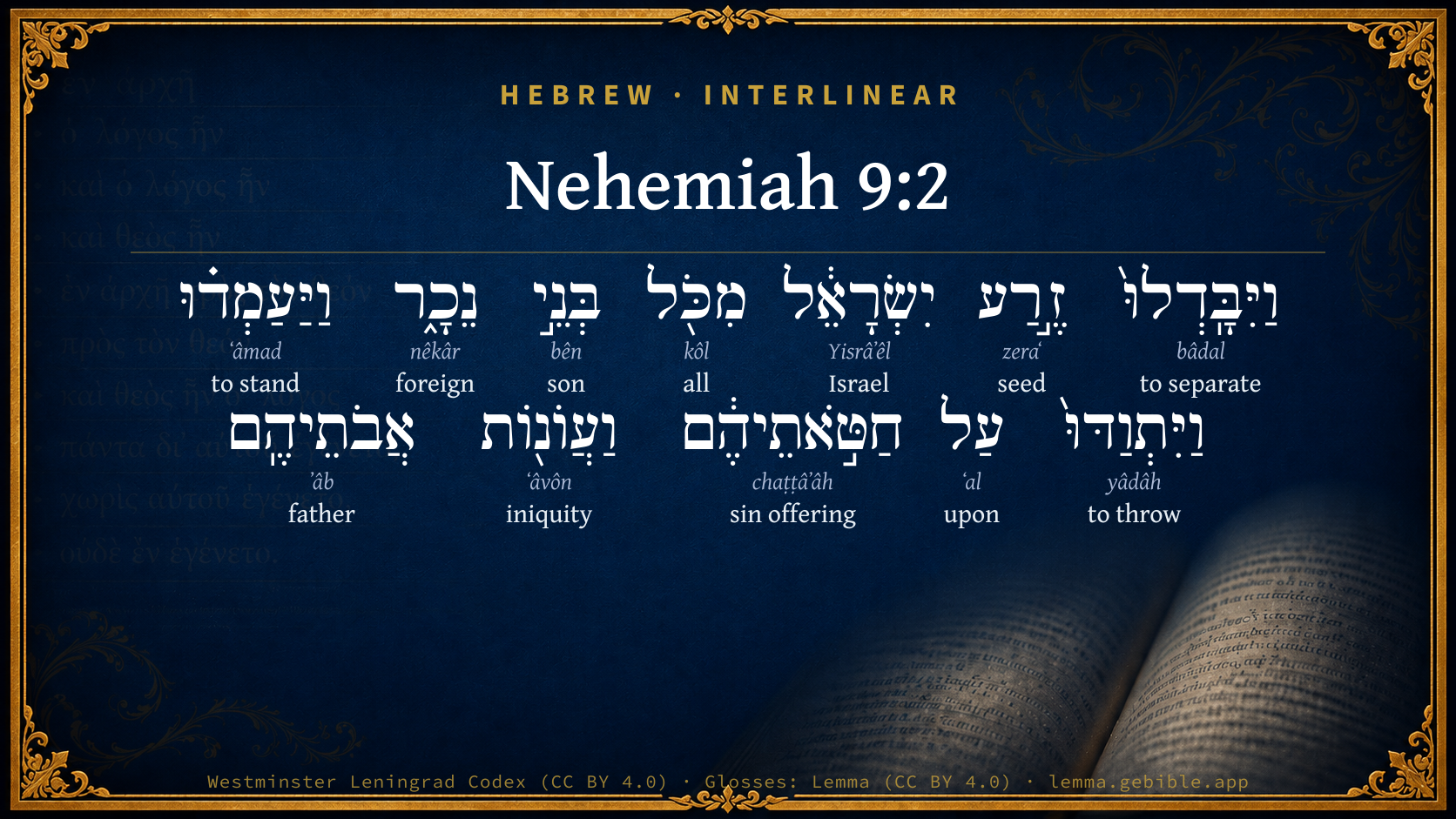
Hebrew (Westminster Leningrad Codex) Nehemiah 9:2 appears in the Hebrew Old Testament. The text above is from the Westminster Leningrad Codex. Each word links to its Strong’s number, a concise gloss, and parsing drawn from the Open Scriptures Hebrew Bible morphology. Click any word for its full Brown-Driver-Briggs (BDB) entry.
Download image
Cite this verse

Nehemiah 9:2 (World English Bible). Public Domain. Lemma interlinear Bible study tool, https://lemma.gebible.app/v/nehemiah/9/2.

Show BibTeX & RIS
BibTeX
RIS
English Translation
The seed of Israel separated themselves from all foreigners, and stood and confessed their sins, and the iniquities of their fathers.
World English Bible · Public Domain
Download a study sheet

One document with this verse’s original text, its word-by-word gloss line, the meaning frame, cross-references with their text, attributed commentary, and full source and license credits — printable, and it pastes into notes with its structure intact.

This verse Autodidact and up

Study sheet (.html) Plain text (.txt)

A passage Seminary Student

Up to 50 verses in one chapter. A passage sheet keeps up to 6 commentary sources and 12 cross-references per verse, in the order this page ranks them, and says so on the sheet whenever that leaves anything out. Ask for a single verse and you get the Autodidact verse sheet above.

Everything on this page stays free to read, with no account — the sheet is a download of what is already on screen, not access to it.

Want to remove ads? Support Godless Engineer
Compare translations 3

The same verse in 3 English versions, stacked beneath the original-language interlinear above. Click any original word for its lexicon entry.

Each is an independent rendering of the whole verse — the interlinear is not word-aligned to these translations.

Highlighted words mark where these versions differ — a whole-verse word diff, not a word-by-word alignment.

  • World English Bible Public Domain
    The seed of Israel separated themselves from all foreigners, and stood and confessed their sins, and the iniquities of their fathers.
  • King James Version Public Domain
    And the seed of Israel separated themselves from all strangers, and stood and confessed their sins, and the iniquities of their fathers.
  • unfoldingWord Literal Text CC BY-SA 4.0
    And the seed of Israel separated themselves from all the sons of a foreigner. And they stood, and they confessed concerning their sins and the iniquities of their fathers.

unfoldingWord Literal Text — © unfoldingWord, licensed CC BY-SA 4.0. Word-aligned USFM3 via Door43 (git.door43.org/unfoldingWord/en_ult).

Versions to compare (up to 4)

3 of 4 selected

Show all 18 translations

Every available English version of this verse, each an independent rendering of the whole verse.

  • World English Bible Public Domain
    The seed of Israel separated themselves from all foreigners, and stood and confessed their sins, and the iniquities of their fathers.
  • Berean Standard Bible Public Domain
    Those of Israelite descent separated themselves from all the foreigners, and they stood and confessed their sins and the iniquities of their fathers.
  • Majority Standard Bible Public Domain
    Those of Israelite descent separated themselves from all the foreigners, and they stood and confessed their sins and the iniquities of their fathers.
  • King James Version Public Domain
    And the seed of Israel separated themselves from all strangers, and stood and confessed their sins, and the iniquities of their fathers.
  • American Standard Version (1901) Public Domain
    And the seed of Israel separated themselves from all foreigners, and stood and confessed their sins, and the iniquities of their fathers.
  • Revised Version (1885) Public Domain
    And the seed of Israel separated themselves from all strangers, and stood and confessed their sins, and the iniquities of their fathers.
  • Geneva Bible (1599) Public Domain
    (And they that were of the seede of Israel were separated from all the strangers) and they stoode and confessed their sinnes and the iniquities of their fathers.
  • Douay-Rheims (1899) Public Domain
    And the seed of the children of Israel separated themselves from every stranger: and they stood, and confessed their sins, and the iniquities of their fathers.
  • Young's Literal Translation Public Domain
    and the seed of Israel are separated from all sons of a stranger, and stand and confess concerning their sins, and the iniquities of their fathers,
  • Literal Standard Version CC BY-SA 4.0
    and the seed of Israel are separated from all sons of a stranger, and stand and confess concerning their sins, and the iniquities of their fathers,
  • Unlocked Literal Bible CC BY-SA 4.0
    The descendants of Israel separated themselves from all the foreigners. They stood and confessed their own sins and the evil actions of their ancestors.
  • unfoldingWord Literal Text CC BY-SA 4.0
    And the seed of Israel separated themselves from all the sons of a foreigner. And they stood, and they confessed concerning their sins and the iniquities of their fathers.
  • Darby Bible Public Domain
    And the seed of Israel separated themselves from all foreigners, and stood and confessed their sins, and the iniquities of their fathers.
  • World Messianic Bible Public Domain
    The offspring of Israel separated themselves from all foreigners and stood and confessed their sins and the iniquities of their fathers.
  • Webster's Bible Public Domain
    And the seed of Israel separated themselves from all strangers, and stood and confessed their sins, and the iniquities of their fathers.
  • Free Bible Version CC BY-SA 4.0
    Those of Israelite ancestry separated themselves from the foreigners, and stood to confess their sins and those of their forefathers.
  • Bible in Basic English Public Domain
    And the seed of Israel made themselves separate from all the men of other nations, publicly requesting forgiveness for their sins and the wrongdoing of their fathers.
  • JPS Tanakh (1917) Public Domain
    And the seed of Israel separated themselves from all foreigners, and stood and confessed their sins, and the iniquities of their fathers.

Literal Standard Version (2020), Covenant Press — licensed CC BY-SA 4.0. Text via the HelloAO Bible API (eBible.org). Unlocked Literal Bible (unfoldingWord) — licensed CC BY-SA 4.0. Text via the HelloAO Bible API (eBible.org). unfoldingWord Literal Text — © unfoldingWord, licensed CC BY-SA 4.0. Word-aligned USFM3 via Door43 (git.door43.org/unfoldingWord/en_ult). Free Bible Version, Dr. Jonathan Gallagher — licensed CC BY-SA 4.0. Text via the HelloAO Bible API (eBible.org).

Word by word

More ways to search: Search by grammar → Find every occurrence → Compare this word →

Practice this passage: Drill this verse → Learn its vocabulary →

נֵכָ֑ר
nêkâr
H5236
“foreign”
Noun, Common, Masculine, Singular, Absolute
Part of Speech
Noun
Type
Common
Gender
Masculine
Number
Singular
State
Absolute
Full BDB Definition

Origin: from H5234

TWOT: 1368b

foreign, alien, foreignness, that which is foreign - foreignness, foreign gods - alien, foreigner - foreign (vanities)
  1. וַיִּבָּֽדְלוּ֙ bâdal H914 “and · to separate” Conjunction + Verb, Niphal, Sequential Imperfect, 3rd Person, Masculine, Plural
  2. זֶ֣רַע zeraʻ H2233 “seed of” Noun, Common, Masculine, Singular, Construct
  3. יִשְׂרָאֵ֔ל Yisrâʼêl H3478 “Israel” Noun, Proper
  4. מִכֹּ֖ל kôl H3605 “from · all of” Preposition + Noun, Common, Masculine, Singular, Construct
  5. בְּנֵ֣י bên H1121 “sons of” Noun, Common, Masculine, Plural, Construct
  6. וַיַּעַמְד֗וּ ʻâmad H5975 “and · to stand” Conjunction + Verb, Qal, Sequential Imperfect, 3rd Person, Masculine, Plural
  7. וַיִּתְוַדּוּ֙ yâdâh H3034 “and · to throw” Conjunction + Verb, Hithpael, Sequential Imperfect, 3rd Person, Masculine, Plural
  8. עַל ʻal H5921 “upon” Preposition
  9. חַטֹּ֣אתֵיהֶ֔ם chaṭṭâʼâh H2403 “sin offerings · their” Noun, Common, Feminine, Plural, Construct + Suffix, Personal, 3rd Person, Masculine, Plural
  10. וַעֲוֺנ֖וֹת ʻâvôn H5771 “and · iniquities of” Conjunction + Noun, Common, Both, Plural, Construct
  11. אֲבֹתֵיהֶֽם ʼâb H1 “fathers · their” Noun, Common, Masculine, Plural, Construct + Suffix, Personal, 3rd Person, Masculine, Plural

About this verse

These counts appear in no published source. They are computed here, from the morphology-tagged text and Lemma’s own curated glosses. What Lemma adds →

12
words
12
distinct lemmas
Historical
section

Shared distinctive vocabulary

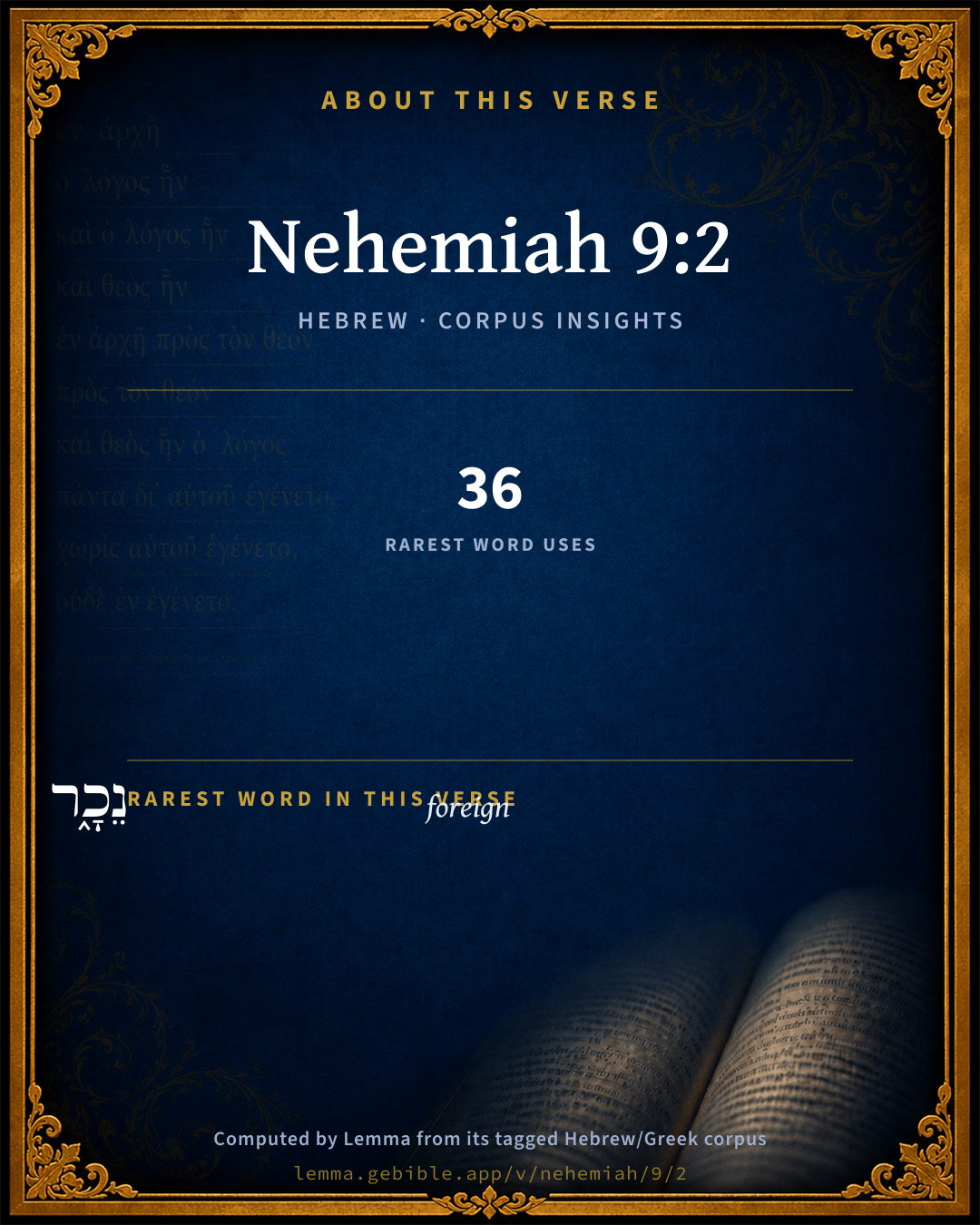
נֵכָ֑ר foreign H5236 occurs in 35 verses of the Hebrew Bible. Also found in:

Grammatical profile

  • 3 verbs
  • 8 nouns
  • 1 preposition

Verb forms

  • וַיִּבָּֽדְלוּ֙ Niphal · Sequential Imperfect
  • וַיַּעַמְד֗וּ Qal · Sequential Imperfect
  • וַיִּתְוַדּוּ֙ Hithpael · Sequential Imperfect

Cross-references

16

Topical passages linked to Nehemiah 9:2 in the Treasury of Scripture Knowledge — connected by theme and wording, ordered by reader-vote popularity; previews shown in the World English Bible.

  • Nehemiah 13:3 It came to pass, when they had heard the law, that they separated from Israel all the mixed multitude.
  • Daniel 9:3–10 I set my face to the Lord God, to seek by prayer and petitions, with fasting and sackcloth and ashes.
  • Ezra 10:11 Now therefore make confession to Yahweh, the God of your fathers, and do his pleasure; and separate yourselves from the peoples of the land, and from the foreign women.
  • Nehemiah 13:30 Thus cleansed I them from all foreigners, and appointed charges for the priests and for the Levites, everyone in his work;
  • Daniel 9:20 While I was speaking, and praying, and confessing my sin and the sin of my people Israel, and presenting my supplication before Yahweh my God for the holy mountain of my God;
  • Hosea 5:7 They are unfaithful to Yahweh; For they have borne illegitimate children. Now the new moon will devour them with their fields.
  • Ezra 9:2 For they have taken of their daughters for themselves and for their sons, so that the holy seed have mixed themselves with the peoples of the lands: yes, the hand of the princes and rulers has been chief in this trespass.
  • Psalms 144:11 Rescue me, and deliver me out of the hands of foreigners, Whose mouths speak deceit, Whose right hand is a right hand of falsehood.
  • 1 John 1:7–9 But if we walk in the light, as he is in the light, we have fellowship with one another, and the blood of Jesus Christ, his Son, cleanses us from all sin.
  • Leviticus 26:39–40 Those of you who are left will pine away in their iniquity in your enemies' lands; and also in the iniquities of their fathers shall they pine away with them.
  • Ezra 9:6–7 and I said, my God, I am ashamed and blush to lift up my face to you, my God; for our iniquities are increased over our head, and our guiltiness is grown up to the heavens.
  • Nehemiah 1:6 Let your ear now be attentive, and your eyes open, that you may listen to the prayer of your servant, which I pray before you at this time, day and night, for the children of Israel your servants while I confess the sins of the children of Israel, which we have sinned against you. Yes, I and my father's house have sinned:
  • Psalms 144:7 Stretch out your hand from above, Rescue me, and deliver me out of great waters, Out of the hands of foreigners;
  • Isaiah 2:6 For you have forsaken your people, the house of Jacob, Because they are filled from the east, With those who practice divination like the Philistines, And they clasp hands with the children of foreigners.
  • Ezra 9:15 Yahweh, the God of Israel, you are righteous; for we are left a remnant that is escaped, as it is this day: behold, we are before you in our guiltiness; for none can stand before you because of this.
  • Psalms 106:6–7 We have sinned with our fathers. We have committed iniquity. We have done wickedly.

Cross-references courtesy of OpenBible.info (CC BY 4.0).

Hebrew and Greek witnesses Masoretic Hebrew ↔ Greek Septuagint

The same verse in the two great witnesses to the Old Testament, shown verse-for-verse.

These are two independent witnesses, not word-aligned to each other, and the Septuagint is shown in lemma (dictionary) form.

Hebrew Nehemiah 9:2 Masoretic · Westminster Leningrad Codex

וַיִּבָּֽדְלוּ֙ זֶ֣רַע יִשְׂרָאֵ֔ל מִכֹּ֖ל בְּנֵ֣י נֵכָ֑ר וַיַּעַמְד֗וּ וַיִּתְוַדּוּ֙ עַל חַטֹּ֣אתֵיהֶ֔ם וַעֲוֺנ֖וֹת אֲבֹתֵיהֶֽם

The seed of Israel separated themselves from all foreigners, and stood and confessed their sins, and the iniquities of their fathers.

World English Bible · Public Domain

Greek LXX Structure differs

The Septuagint has no separate book of Nehemiah. Its Greek text is the second half of Esdras B (2 Esdras), chapters 11–23; Ezra is the first half (1–10).

A verse-for-verse comparison isn’t shown here because the chapters and verses don’t line up. Switch to the LXX edition with the MT / LXX toggle above to read the Greek directly.

On this verse, The Cambridge Bible for Schools and Colleges discusses the Septuagint’s reading. Read the note in Commentary ↓

Hebrew: Westminster Leningrad Codex (CC BY 4.0). Greek: Septuagint (public domain); English from a public-domain English Septuagint. How the Septuagint differs from the Hebrew →

Commentary

Notes on Nehemiah 9:2 from classic Christian and Jewish commentators (each source and its license shown beneath its notes). The classic Christian expositions comment on the surrounding passage and are grouped to its opening verse, so a note may address several verses; the Jewish commentaries on the Tanakh (Rashi and others) are per-verse, so they appear only where the commentator wrote on this verse.

Lemma curates 59 commentaries, every one of them public domain or Creative Commons licensed, each selected and text-cleaned for this edition rather than reprinted as found. About our sources →

The Cambridge Bible for Schools and Colleges

gen. ed. J. J. S. Perowne

2. the seed of Israel] A more formal and poetical expression than ‘the children of Israel.’ It does not occur again in these books; but we find it in 2Ki_17:20; 1Ch_16:13; Psa_22:23, and in Is. Jer. The phrase to be compared with it is ‘the holy seed’ in Ezr_9:2 (Est_10:3).

separated themselves] See on Neh_10:28; Ezr_9:2-3. No stranger was to take part in this national act of humiliation and confession. The ‘strangers,’ i.e. the heathen who had not joined themselves to the ‘holy seed,’ and yet resided in Jerusalem, were not permitted to take part in the ceremony about to be described. Some commentators regard the words as describing in anticipation the result of the action taken by the Israelites on this day, as if by their penitence and confession they finally severed themselves from ‘the strangers.’ But from the position of the verse it is more natural to understand it of a solemn act of separation preliminary to the ratification of the Covenant.

from all strangers] ‘b’ ney nêkar,’ i.e. ‘children of the foreigner,’ LXX. ἀπὸ παντὸς υἱοῦ ἀλλοτρίου. Vulg. ‘ab omni filio alienigena,’ as in Psa_18:45; Psa_144:7; Psa_144:11; Isa_60:10; Isa_61:5; Isa_62:8; Eze_44:7.

confessed their sins] So in chap. Neh_1:6; and compare a possibly parallel instance of national ‘confession,’ 2Ch_30:22, where however there is some doubt whether ‘confession’ or ‘thanksgiving’ is intended: cf. Ezr_10:11.

sins, and the iniquities] ‘Sin’ (ḥattâth) denoting ‘failure’ generally from the right way; ‘iniquity’ (‘âvôn), carrying also the sense of ‘guilt,’ but denoting especially ‘crookedness’ and ‘perverseness’ (2Sa_7:14). Both words occur with the verb ‘confess;’ ‘sins,’ Lev_5:5; Num_5:7; Dan_9:20; ‘iniquities,’ Lev_16:21; Lev_26:40.

The Cambridge Bible for Schools and Colleges (gen. ed. J. J. S. Perowne; Cambridge University Press, 1878–1918) — public domain. Text from a community e-Sword module.

Trapp's Complete Commentary

John Trapp

Neh 9:2 And the seed of Israel separated themselves from all strangers, and stood and confessed their sins, and the iniquities of their fathers.

Ver. 2. And the seed of Israel] Called Israelites (not Abrahamites) from their wrestling with God by prayer and tears, and prevailing. Called also Jews from Judah, which signifieth the confessor. Here it is said of them that,

They stood and confessed their sins] All their sins, either actually committed, or habitually comprised in their body of sin. This whoso doth in due manner shall have mercy, Pro 28:13. Yea, he shall have heaven. Israel had power with God as a prince. Judah, the confessor, got the kingdom from Reuben. Confession is the way to the kingdom; walk in it; only it must be joined with confusion of sin, as here. They separated themselves from all strangers, they abandoned their peccatum in deliciis, their darling sin, they kept themselves from their iniquity. Psa 18:23. Hoc non sit verbis, Marce: ut ameris, ama Let this not be by words so that you may be loved and love. (Martial).

And the iniquities of their fathers] i.e. Of their progenitors; which are owned, if not bewailed, disclaimed.

John Trapp, A Commentary or Exposition upon All the Books of the Old and New Testament (1647–1656) — public domain. Text from a community e-Sword module.

Joseph Benson's Commentary

Neh 9:2. The seed of Israel separated themselves — From all unnecessary society with the heathen, and particularly from those strange women whom some of them had married. For although Ezra had effected this separation formerly, as far as he had knowledge of the faulty persons, and power to reform them; yet it seems there were some criminals who either had escaped his knowledge, or were beyond the reach of his power; or there were some new delinquents that since that time had fallen into the same error, and now showed the truth of their repentance by forsaking their beloved sins and dearest relations. And the iniquities of their fathers — Which they confess, partly as one cause of their present sufferings; and partly because they, by their practices, had justified their father’s sins, and made them their own.

Joseph Benson's Commentary on the Old and New Testaments (1811–1818) — public domain. Text from a community e-Sword module.

Tyndale Open Study Notes

Tyndale Open Resources

9:2 Those of Israelite descent separated themselves from all foreigners as they confessed their own sins: This sentence might allude to the problem of intermarriage with foreigners, as narrated in Ezra 9–10.

Tyndale Open Study Notes — © Tyndale Open Resources, licensed CC BY-SA 4.0. Text via the HelloAO Bible API.

Geneva Bible (1599)

Geneva Bible translators

Hebrew, strange children.

Geneva Bible (1599) marginal notes — public domain. Text via Bolls.life.

Jamieson, Fausset & Brown

Robert Jamieson, A. R. Fausset & David Brown

confessed their sins, and the iniquities of their fathers--Not only did they read in their recent sufferings a punishment of the national apostasy and guilt, but they had made themselves partakers of their fathers' sins by following the same evil ways.

Jamieson, Fausset & Brown — Commentary Critical and Explanatory on the Whole Bible (1871) — public domain (CC PDM 1.0). Text via the HelloAO Bible API.

Adam Clarke's Commentary

Verse 2. The seed of Israel separated themselves] A reformation of this kind was begun by Ezra, Ezr 10:3; but it appears that either more were found out who had taken strange wives, or else those who had separated from them had taken them again.

And stood and confessed their sins, and the iniquities of their fathers.] They acknowledged that they had been sinners against God throughout all their generations; that their fathers had sinned and were punished; and that they, with this example before their eyes, had copied their fathers' offences.

Adam Clarke's Commentary on the Bible (1810–1826) — public domain. Text from a community e-Sword/MySword module.

Ellicott's Commentary for English Readers

(2) The seed of Israel separated themselves from all strangers.—The change to “seed” has here a deep propriety. They carefully avoided the many aliens among them throughout this fast.

And stood and confessed.—It must be remembered that these verses give the programme of what is afterwards filled up: the very praise for which they “stood” was filled with confession.

A Bible Commentary for English Readers, edited by Charles John Ellicott (1878–1897) — public domain. Text from a community e-Sword module.

John Gill's Exposition

And the seed of Israel separated themselves from all strangers,.... Such as were genuine Israelites, of the seed of Abraham, who had married wives of the Gentiles, strangers to the commonwealth of Israel, either before the reformation by Ezra, not being then discovered, or had fallen into this evil since; but now, on the reading of the law, were convinced of it, and so separated themselves from such wives, which was a proof of the truth of their repentance:

and stood and confessed their sins, and the iniquities of their fathers: particularly their taking of strange wives, which their fathers had also done, and set them a bad example, which they had followed; of standing and confessing, see Luk 18:13.

John Gill's Exposition of the Whole Bible (1746–1763) — public domain (CC PDM 1.0). Text via the HelloAO Bible API.

Haydock's Catholic Bible Commentary

Stranger; idolatrous women. (Haydock) --- True repentance requires the works of mortification, and particularly the removal of all occasions of sin and disorderly pleasures. (Worthington) --- The reformation had been commenced under Esdras, but some had relapsed, 1 Esdras x. 3. (Calmet) --- The true born Israelites would have no society with the sons of infidels. (Tirinus) --- Fathers, that they might not be punished for them, Exodus xx. 5. (Calmet)

George Leo Haydock (1774–1849), Haydock's Catholic Family Bible and Commentary, 1859 edition — public domain. Excludes Psalms (Douay-Rheims chapter numbering differs from Protestant) and Deuterocanonical books (Catholic canon only).

Matthew Poole's English Annotations

From all strangers; from all familiar and unnecessary society with the heathens, and particularly from those strange women whom some of them had married. For though Ezra had done this formerly, Ezr 10, as far as he had knowledge of the persons faulty, and power to redress their faults, yet, it seems, there were some criminals, who were either without his knowledge, or out of his power; or these were some new delinquents, that since that time had fallen into the same error, and showed the truth of their repentance by the forsaking of their beloved sins and dearest relations. See again Neh 13:3.

The iniquities of their fathers; which they confess partly as one cause of their present sufferings; and partly because they by their practices had justified their fathers’ sins, and made them their own.

Matthew Poole's English Annotations on the Holy Bible (1683–1685) — public domain. Text from a community e-Sword/MySword module.

Whedon's Commentary on the Bible

Daniel D. Whedon

2. Seed of Israel — The pure descendants of Israel, as distinguished from the offspring of unlawful mixed marriages.

Separated themselves from all strangers — Renounced all fellowship with the heathen, and dissolved all their marriages with strange women. Marriages of this character had been one of the great sins of the people which Ezra had corrected some time before, (Ezra 9, 10,) but even up to this time they were not all pure, and at a still later day Nehemiah had to contend again with the same evil.

Neh_13:23-30.

Stood and confessed — As is more fully shown in the penitential prayer that follows after Neh_9:5.

Daniel D. Whedon (gen. ed.), Commentary on the Old and New Testaments (1874–1909) — public domain. Text from a community e-Sword module.

The Pulpit Commentary

The seed of Israel separated themselves from all strangers. Compare Neh_10:28, by which it appears that the "strangers" are "the people of the lands," or neighbouring heathen, of whom there were at all times considerable numbers in Jerusalem. (comp. Neh_13:16) It was not fitting that these aliens should take part in a ceremony of which the main object was that the special people of God should renew their covenant with him. Stood and confessed. Attitude is perhaps scarcely intended here, since the Jews confessed their sins kneeling, (Ezr_9:5) or prostrate. (Ezr_10:1) Hence we hear in the next verse that they "stood up," or "rose up" (consurrexerunt, Vulg.).

HOMILIES BY W. CLARKSON Vers. 2, 31-33, 36-38. Appeal

It has been remarked that there is no prayer in this lengthy address to God. And the absence of direct supplication is certainly very noticeable. But it must be remembered that we may make our appeal to God in more ways than by directly asking him for the blessings we desire at his hand. The comparative and almost complete absence of formal petition from this address suggests to us that we may go far towards winning our cause by

I PRESENTING THE SOUL BEFORE GOD IN A RECEPTIVE SPIRITUAL STATE. It is only in some spiritual conditions that we can expect to be recipients of his bounty. Not to be in the right state is to lock the door at which we stand. By such an address as this the Jews either showed themselves to be in, or brought themselves into, an acceptable recipient condition. There were

1. The solemn recognition of God"s excellency; of his greatness God, the great, the mighty, and the terrible God" (ver. 32); of his goodness great mercies" sake;"... "thou art a gracious and merciful God"(ver. 31); of his faithfulness keepest covenant and mercy" (ver. 32); of his justice art just in all that is brought upon us" (ver. 33).

2. Sense of their own ill-desert. "Thou hast done right, but we have done wickedly.

3. Readiness to separate from sin. "The seed of Israel separated themselves from all strangers" (ver. 2). "If we regard iniquity in our hearts, the Lord will not hear us". (Psa_66:18 Isa_1:15)

4. Preparedness to pledge themselves to his service. The Jews were prepared to "make a sure covenant, and write it and seal it" (ver. 38). Thus, on this occasion, the children of Israel presented themselves before God, and not only showed, as they began to speak reverently and humbly to him, but gained more as they proceeded, a fitting spiritual condition for receiving his Divine communications. It is not by" loud speaking," nor by "much speaking", (Mat_6:7) but rather by asking in a right temper and mode, that we make a forcible and prevailing appeal to the Divine Helper; presenting ourselves before him as suppliants in the spirit of

a. profound reverence,

b. deep humility,

c. genuine consecration.

II REQUEST IN WORDS (vers. 32, 36, 37). "Now therefore, our God,... let not all the trouble seem little before thee, that hath come upon us, on our kings, and on our princes, and on our priests, and on our prophets, and on our fathers, and on all thy people, since the time of the kings of Assyria unto this day" (ver. 32). "Behold," continues this appeal, "we are servants, and the land thou gavest unto our fathers,... we are servants in it: and it yieldeth much increase unto the kings whom thou hast set over us:... they have dominion over our bodies, and over our cattle, at their pleasure, and we are in great distress" (vers. 36, 37). This is

(1) a direct appeal to the pitifulness of Jehovah that he would have compassion on them who were slaves in their own land their persons and their property being at the mercy of a foreign prince; it was also

(2) an indirect appeal to his faithfulness and justice. For had not God chastened them very long and very sore? he who had promised to forgive them their iniquities when they returned unto him; he who would not make his punishment to be out of proportion to their offence. They desired to "see the beauty of the Lord" (his righteousness, his equity), that they might be "made glad according to the days wherein he had afflicted them, and the years wherein they had seen evil". (Psa_90:15, Psa_90:17) In making our appeal to God there are two things which will ever be the substance and burden of our plea:

(3) the soreness of our necessity: our weakness, our want, our trouble, our humiliation, our darkness and ignorance, our repeated failure, our distance from the goal and the prize;

(4) the greatness of his goodness: his pitifulness, his patience, his considerateness, his promised mercy, his faithfulness. We may come hopefully to his throne because he is "a gracious and merciful God," pleading his "great mercies" sake" (ver. 31). But more than that, we may come "boldly" to the throne of his grace, because he is One that "keeps covenant" (ver. 32) as well as "mercy," because he has pledged his word to us in Christ Jesus, and he will be "faithful and just to forgive us our sins, and to cleanse us from all unrighteousness. C.

The Pulpit Commentary (1880–1919), ed. H.D.M. Spence-Jones & Joseph S. Exell — public domain. Text from a community e-Sword module.

John Wesley's Explanatory Notes

Separated - From all unnecessary society with the Heathens, and particularly from those strange women whom some of them had married. For though Ezra had done this formerly, yet, it seems, there were some criminals, without his knowledge, or, these were some new delinquents, that since that time had fallen into the same error, and shewed the truth of their repentance by forsaking their beloved sins, and dearest relations.

John Wesley, Explanatory Notes Upon the Whole Bible (1754–1765) — public domain. Text via the GEBible commentary corpus.

Rashi

Rabbi Shlomo Yitzchaki (Rashi)

from all the foreigners and from their wives of the heathen nations, as is stated above (Ezra 10).

Rashi on the Tanakh — English translations: “The Judaica Press complete Tanach with Rashi, translated by A. J. Rosenberg” (CC BY 4.0); “Pentateuch with Rashi's commentary by M. Rosenbaum and A.M. Silbermann, 1929-1934” (public domain); “The Metsudah Tanach series, Lakewood, N.J” (CC BY 4.0); and “The Book of Joshua, Metsudah Publications, 1997” (CC BY 4.0). Text via Sefaria.

Lesson kit

Teaching starters — assembled from the data on this page, not authored interpretation. Every prompt links to the verse data it draws on. Edit before teaching.

Nehemiah, in the Historical, opens this verse with 12 words (12 distinct Hebrew lemmas). Its most distinctive word is nêkâr (“foreign”). A historical commentator’s framing appears above. Read the whole chapter for the surrounding context.

Discussion questions

  1. What does “foreign” (nêkâr) contribute to the verse as a whole?
  2. Genesis 17:12 shares the word «foreign» with this verse. How do the two illuminate each other?
  3. These translations render this verse differently. What is at stake in choosing one wording over another?
  4. The verb «וַיִּבָּֽדְלוּ֙» is Niphal Sequential Imperfect. How does its form color the action?
  5. Reading how The Cambridge Bible for Schools and Colleges and Trapp's Complete Commentary read this verse, where do the two commentators agree and where do they part?

Things to notice

Reading settings

Reading text

Shown beneath each verse's original-language words.

Old Testament
Old Testament edition

Read the OT as the Masoretic Hebrew (MT) or the Greek Septuagint (LXX).

English shown for the Greek Septuagint (in the Hebrew ↔ Greek comparison).

Comparing translations? Open the Compare panel on any verse page to stack up to four side by side.