
Isaiah 65:7

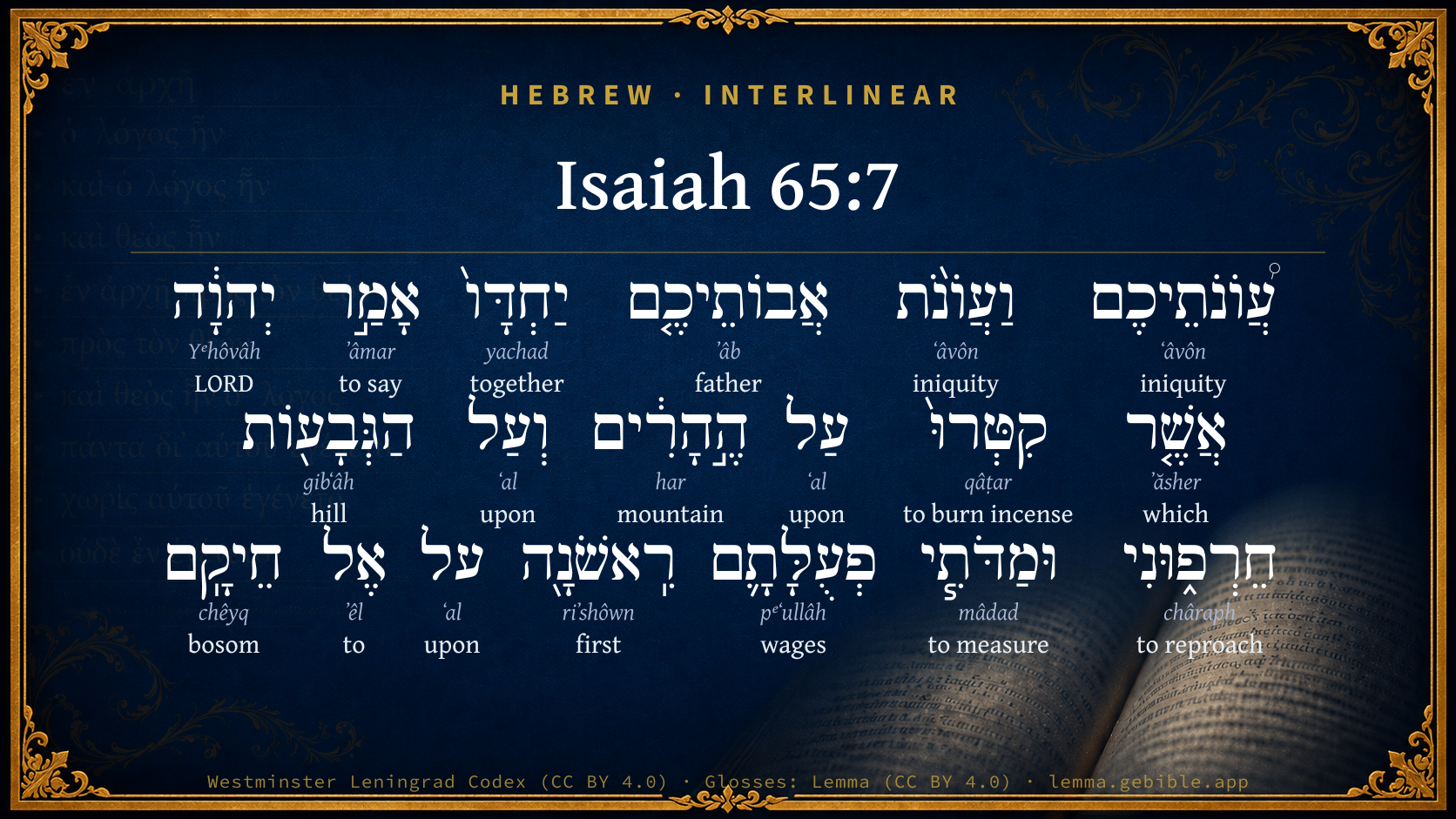
Hebrew (Westminster Leningrad Codex) Isaiah 65:7 appears in the Hebrew Old Testament. The text above is from the Westminster Leningrad Codex. Each word links to its Strong’s number, a concise gloss, and parsing drawn from the Open Scriptures Hebrew Bible morphology. Click any word for its full Brown-Driver-Briggs (BDB) entry.
Download image
Cite this verse

Isaiah 65:7 (World English Bible). Public Domain. Lemma interlinear Bible study tool, https://lemma.gebible.app/v/isaiah/65/7.

Show BibTeX & RIS
BibTeX
RIS
English Translation
your own iniquities, and the iniquities of your fathers together, says Yahweh, who have burned incense on the mountains, and blasphemed me on the hills; therefore will I first measure their work into their bosom.
World English Bible · Public Domain
Download a study sheet

One document with this verse’s original text, its word-by-word gloss line, the meaning frame, cross-references with their text, attributed commentary, and full source and license credits — printable, and it pastes into notes with its structure intact.

This verse Autodidact and up

Study sheet (.html) Plain text (.txt)

A passage Seminary Student

Up to 50 verses in one chapter. A passage sheet keeps up to 6 commentary sources and 12 cross-references per verse, in the order this page ranks them, and says so on the sheet whenever that leaves anything out. Ask for a single verse and you get the Autodidact verse sheet above.

Everything on this page stays free to read, with no account — the sheet is a download of what is already on screen, not access to it.

Want to remove ads? Support Godless Engineer
Compare translations 3

The same verse in 3 English versions, stacked beneath the original-language interlinear above. Click any original word for its lexicon entry.

Each is an independent rendering of the whole verse — the interlinear is not word-aligned to these translations.

Highlighted words mark where these versions differ — a whole-verse word diff, not a word-by-word alignment.

  • World English Bible Public Domain
    your own iniquities, and the iniquities of your fathers together, says Yahweh, who have burned incense on the mountains, and blasphemed me on the hills; therefore will I first measure their work into their bosom.
  • King James Version Public Domain
    Your iniquities, and the iniquities of your fathers together, saith the LORD, which have burned incense upon the mountains, and blasphemed me upon the hills: therefore will I measure their former work into their bosom.
  • unfoldingWord Literal Text CC BY-SA 4.0
    your iniquities and the iniquities of your fathers together,” says Yahweh, “because they have burned incense on the mountains and have taunted me on the hills. And I will measure their former deed into their lap.” q1

unfoldingWord Literal Text — © unfoldingWord, licensed CC BY-SA 4.0. Word-aligned USFM3 via Door43 (git.door43.org/unfoldingWord/en_ult).

Versions to compare (up to 4)

3 of 4 selected

Show all 18 translations

Every available English version of this verse, each an independent rendering of the whole verse.

  • World English Bible Public Domain
    your own iniquities, and the iniquities of your fathers together, says Yahweh, who have burned incense on the mountains, and blasphemed me on the hills; therefore will I first measure their work into their bosom.
  • Berean Standard Bible Public Domain
    both for your iniquities and for those of your fathers,” says the LORD. “Because they burned incense on the mountains and scorned Me on the hills, I will measure into their laps full payment for their former deeds.”
  • Majority Standard Bible Public Domain
    both for your iniquities and for those of your fathers,” says the LORD. “Because they burned incense on the mountains and scorned Me on the hills, I will measure into their laps full payment for their former deeds.”
  • King James Version Public Domain
    Your iniquities, and the iniquities of your fathers together, saith the LORD, which have burned incense upon the mountains, and blasphemed me upon the hills: therefore will I measure their former work into their bosom.
  • American Standard Version (1901) Public Domain
    your own iniquities, and the iniquities of your fathers together, saith Jehovah, that have burned incense upon the mountains, and blasphemed me upon the hills; therefore will I first measure their work into their bosom.
  • Revised Version (1885) Public Domain
    your own iniquities, and the iniquities of your fathers together, saith the LORD, which have burned incense upon the mountains, and blasphemed me upon the hills: therefore will I first measure their work into their bosom.
  • Geneva Bible (1599) Public Domain
    Your iniquities and the iniquities of your fathers shalbe together (sayth the Lord) which haue burnt incense vpon the mountaines, and blasphemed me vpon the hilles: therefore wil I measure their olde worke into their bosome.
  • Douay-Rheims (1899) Public Domain
    Your iniquities, and the iniquities of your fathers together, saith the Lord, who have sacrificed upon the mountains, and have reproached me upon the hills; and I will measure back their first work in their bosom.
  • Young's Literal Translation Public Domain
    Your iniquities, and the iniquities of your fathers together, said Jehovah, Who have made perfume on the mountains, And on the heights have reproached Me, And I have measured their former work into their bosom.'
  • Literal Standard Version CC BY-SA 4.0
    Your iniquities, and the iniquities of your fathers together,” said YHWH, “Who have made incense on the mountains, || And have reproached Me on the heights, || And I have measured their former work into their bosom.”
  • Unlocked Literal Bible CC BY-SA 4.0
    for their sins and the sins of their fathers together,” says Yahweh. “I will repay them for burning incense on the mountains and for mocking me on the hills. I will therefore measure out their past deeds into their laps.”
  • unfoldingWord Literal Text CC BY-SA 4.0
    your iniquities and the iniquities of your fathers together,” says Yahweh, “because they have burned incense on the mountains and have taunted me on the hills. And I will measure their former deed into their lap.” q1
  • Darby Bible Public Domain
    your iniquities, and the iniquities of your fathers together, saith Jehovah, who have burned incense upon the mountains, and outraged me upon the hills; and I will measure their former work into their bosom.
  • World Messianic Bible Public Domain
    your own iniquities and the iniquities of your fathers together”, says the LORD, “who have burned incense on the mountains, and blasphemed me on the hills. Therefore I will first measure their work into their bosom.”
  • Webster's Bible Public Domain
    Your iniquities, and the iniquities of your fathers together, saith the LORD, who have burned incense upon the mountains, and blasphemed me upon the hills: therefore will I measure their former work into their bosom.
  • Free Bible Version CC BY-SA 4.0
    I'm going to pay you back for both your own sins and the sins of your forefathers, says the Lord, because they burned incense on the mountains and ridiculed me on the hills. I'm going to measure into their laps full payment for what they've done.
  • Bible in Basic English Public Domain
    For their sins and the sins of their fathers, who were burning perfumes on the mountains, and saying evil things against me on the hills: so I will take the measure of their sins, and will send the punishment for them into their breast.
  • JPS Tanakh (1917) Public Domain
    Your own iniquities, and the iniquities of your fathers together, saith the LORD, that have offered upon the mountains, and blasphemed Me upon the hills; therefore will I first measure their wage into their bosom.

Literal Standard Version (2020), Covenant Press — licensed CC BY-SA 4.0. Text via the HelloAO Bible API (eBible.org). Unlocked Literal Bible (unfoldingWord) — licensed CC BY-SA 4.0. Text via the HelloAO Bible API (eBible.org). unfoldingWord Literal Text — © unfoldingWord, licensed CC BY-SA 4.0. Word-aligned USFM3 via Door43 (git.door43.org/unfoldingWord/en_ult). Free Bible Version, Dr. Jonathan Gallagher — licensed CC BY-SA 4.0. Text via the HelloAO Bible API (eBible.org).

Word by word

More ways to search: Search by grammar → Find every occurrence → Compare this word →

Practice this passage: Drill this verse → Learn its vocabulary →

פְעֻלָּתָ֛ם
pᵉʻullâh
H6468
“wages · their”
Noun, Common, Feminine, Singular, Construct + Suffix, Personal, 3rd Person, Masculine, Plural
Part of Speech
Noun
Type
Common
Gender
Feminine
Number
Singular
State
Construct
Full BDB Definition

Origin: pass part of H6466

TWOT: 1792b

work, recompense, reward - work - wages
  1. עֲ֠וֺנֹתֵיכֶם ʻâvôn H5771 “iniquities · your” Noun, Common, Both, Plural, Construct + Suffix, Personal, 2nd Person, Masculine, Plural
  2. וַעֲוֺנֹ֨ת ʻâvôn H5771 “and · iniquities of” Conjunction + Noun, Common, Both, Plural, Construct
  3. אֲבוֹתֵיכֶ֤ם ʼâb H1 “fathers · your” Noun, Common, Masculine, Plural, Construct + Suffix, Personal, 2nd Person, Masculine, Plural
  4. יַחְדָּו֙ yachad H3162 “together” Adverb
  5. אָמַ֣ר ʼâmar H559 “to say” Verb, Qal, Perfect, 3rd Person, Masculine, Singular
  6. יְהוָ֔ה Yᵉhôvâh H3068 “LORD” Noun, Proper
  7. אֲשֶׁ֤ר ʼăsher H834 “which” Particle, Relative
  8. קִטְּרוּ֙ qâṭar H6999 “to burn incense” Verb, Piel, Perfect, 3rd Person, Common, Plural
  9. עַל ʻal H5921 “upon” Preposition
  10. הֶ֣הָרִ֔ים har H2022 “the · mountains” Particle, Definite Article + Noun, Common, Masculine, Plural, Absolute
  11. וְעַל ʻal H5921 “and · upon” Conjunction + Preposition
  12. הַגְּבָע֖וֹת gibʻâh H1389 “the · hills” Particle, Definite Article + Noun, Common, Feminine, Plural, Absolute
  13. חֵרְפ֑וּנִי châraph H2778 “to reproach · me” Verb, Piel, Perfect, 3rd Person, Common, Plural + Suffix, Personal, 1st Person, Common, Singular
  14. וּמַדֹּתִ֧י mâdad H4058 “and · to measure” Conjunction + Verb, Qal, Sequential Perfect, 1st Person, Common, Singular
  15. רִֽאשֹׁנָ֖ה riʼshôwn H7223 “first” Adjective, Adjective, Feminine, Singular, Absolute
  16. על ʻal H5921 “upon” Preposition
  17. אֶל ʼêl H413 “to” Preposition
  18. חֵיקָֽם chêyq H2436 “bosom · their” Noun, Common, Masculine, Singular, Construct + Suffix, Personal, 3rd Person, Masculine, Plural

About this verse

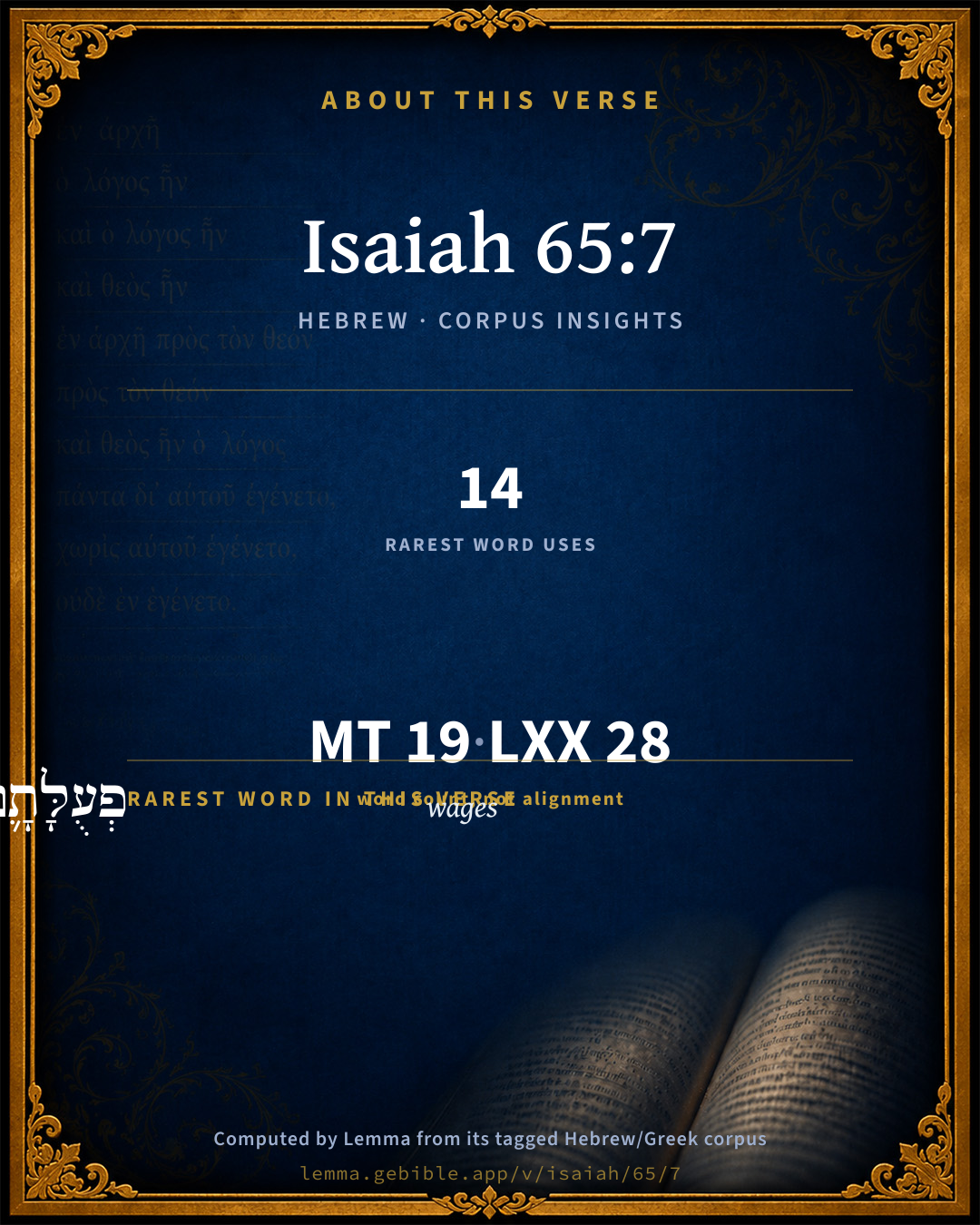
These counts appear in no published source. They are computed here, from the morphology-tagged text and Lemma’s own curated glosses. What Lemma adds →

19
words
16
distinct lemmas
Prophets
section

Notable vocabulary

The rarest word here is פְעֻלָּתָ֛ם wages H6468 — appearing just 14 times in the whole Hebrew Bible.

Shared distinctive vocabulary

פְעֻלָּתָ֛ם wages H6468 occurs in 14 verses of the Hebrew Bible. Also found in:

Grammatical profile

  • 4 verbs
  • 8 nouns
  • 1 adjective
  • 4 prepositions
  • 1 adverb
  • 1 particle

Verb forms

  • אָמַ֣ר Qal · Perfect
  • קִטְּרוּ֙ Piel · Perfect
  • חֵרְפ֑וּנִי Piel · Perfect
  • וּמַדֹּתִ֧י Qal · Sequential Perfect

Repetition

Words recur within this verse — often emphatic in Hebrew:

  • עַל upon H5921 ×3
  • עֲ֠וֺנֹתֵיכֶם iniquity H5771 ×2

Hebrew & Septuagint length

In English translation the verse runs 35 words from the Hebrew and 32 from the Septuagint (LXX English) — closely comparable.

A rough comparison of the two English renderings, which tokenize alike — not a word-level alignment.

Word counts can differ between the Hebrew and the Greek without any difference in meaning — e.g. the Hebrew direct-object marker אֵת has no separate Greek word, and Greek often adds the article ὁ.

In the original languages it is 19 Hebrew tokens and 28 Greek tokens — but the two are counted differently (Hebrew bundles its prefixes and suffixes into one token; the Greek is in lemma form), so that isn’t a like-for-like length.

Cross-references

21

Topical passages linked to Isaiah 65:7 in the Treasury of Scripture Knowledge — connected by theme and wording, ordered by reader-vote popularity; previews shown in the World English Bible.

  • Isaiah 57:7 On a high and lofty mountain have you set your bed; there also you went up to offer sacrifice.
  • Ezekiel 20:27–28 Therefore, son of man, speak to the house of Israel, and tell them, Thus says the Lord Yahweh: In this moreover have your fathers blasphemed me, in that they have committed a trespass against me.
  • Exodus 20:5 you shall not bow yourself down to them, nor serve them, for I, Yahweh your God, am a jealous God, visiting the iniquity of the fathers on the children, on the third and on the fourth generation of those who hate me,
  • Isaiah 22:14 Yahweh of Hosts revealed himself in my ears, Surely this iniquity shall not be forgiven you until you die, says the Lord, Yahweh of Hosts.
  • Isaiah 65:6 Behold, it is written before me: I will not keep silence, but will recompense, yes, I will recompense into their bosom,
  • Jeremiah 13:25 This is your lot, the portion measured to you from me, says Yahweh; because you have forgotten me, and trusted in falsehood.
  • Leviticus 26:39 Those of you who are left will pine away in their iniquity in your enemies' lands; and also in the iniquities of their fathers shall they pine away with them.
  • Psalms 106:6–7 We have sinned with our fathers. We have committed iniquity. We have done wickedly.
  • Jeremiah 5:9 Shall I not visit for these things? says Yahweh; and shall not my soul be avenged on such a nation as this?
  • Jeremiah 5:29 Shall I not visit for these things? says Yahweh; shall not my soul be avenged on such a nation as this?
  • Jeremiah 7:19–20 Do they provoke me to anger? says Yahweh; [do they] not [provoke] themselves, to the confusion of their own faces?
  • Numbers 32:14 Behold, you are risen up in your fathers' place, an increase of sinful men, to augment yet the fierce anger of Yahweh toward Israel.
  • 1 Kings 22:43 He walked in all the way of Asa his father; He didn't turn aside from it, doing that which was right in the eyes of Yahweh: however the high places were not taken away; the people still sacrificed and burnt incense in the high places.
  • 2 Kings 12:3 However the high places were not taken away; the people still sacrificed and burnt incense in the high places.
  • 2 Kings 14:4 However the high places were not taken away: the people still sacrificed and burnt incense in the high places.
  • 2 Kings 15:35 However the high places were not taken away: the people still sacrificed and burned incense in the high places. He built the upper gate of the house of Yahweh.
  • 2 Kings 16:4 He sacrificed and burnt incense in the high places, and on the hills, and under every green tree.
  • Ezekiel 18:6 and has not eaten on the mountains, neither has lifted up his eyes to the idols of the house of Israel, neither has defiled his neighbor's wife, neither has come near to a woman in her impurity,
  • Daniel 9:8 Lord, to us belongs confusion of face, to our kings, to our princes, and to our fathers, because we have sinned against you.
  • Matthew 23:31–36 Therefore you testify to yourselves that you are children of those who killed the prophets.
  • 1 Thessalonians 2:16 forbidding us to speak to the Gentiles that they may be saved; to fill up their sins always. But wrath has come on them to the uttermost.

Cross-references courtesy of OpenBible.info (CC BY 4.0).

Hebrew and Greek witnesses Masoretic Hebrew ↔ Greek Septuagint

The same verse in the two great witnesses to the Old Testament, shown verse-for-verse.

These are two independent witnesses, not word-aligned to each other, and the Septuagint is shown in lemma (dictionary) form.

Hebrew Isaiah 65:7 Masoretic · Westminster Leningrad Codex

עֲ֠וֺנֹתֵיכֶם וַעֲוֺנֹ֨ת אֲבוֹתֵיכֶ֤ם יַחְדָּו֙ אָמַ֣ר יְהוָ֔ה אֲשֶׁ֤ר קִטְּרוּ֙ עַל הֶ֣הָרִ֔ים וְעַל הַגְּבָע֖וֹת חֵרְפ֑וּנִי וּמַדֹּתִ֧י פְעֻלָּתָ֛ם רִֽאשֹׁנָ֖ה על אֶל חֵיקָֽם

your own iniquities, and the iniquities of your fathers together, says Yahweh, who have burned incense on the mountains, and blasphemed me on the hills; therefore will I first measure their work into their bosom.

World English Bible · Public Domain

Greek LXX Isaiah 65:7 Septuagint · lemma form

ὁ ἁμαρτία αὐτός καί ὁ πατήρ αὐτός λέγω κύριος ὅς θυμιάω ἐπί ὁ ὄρος καί ἐπί ὁ βουνός ὀνειδίζω ἐγώ ἀποδίδωμι ὁ ἔργον αὐτός εἰς ὁ κόλπος αὐτός

their sins and the sins of their fathers, says the Lord, who have burnt incense on the mountains, and reproached me on the hills: I will recompense their works into their bosom.

LXX2012 (modern English Septuagint) · Public Domain

On this verse, Adam Clarke's Commentary discusses the Septuagint’s reading. Read the note in Commentary ↓

Hebrew: Westminster Leningrad Codex (CC BY 4.0). Greek: Septuagint (public domain); English from LXX2012 (modern English Septuagint) (Public Domain). How the Septuagint differs from the Hebrew →

Targum (Aramaic paraphrase)

1

The Targum is the ancient Jewish Aramaic paraphrase of the Hebrew Scriptures — an interpretive translation, not the Hebrew text itself. Onkelos (literal) and Pseudo-Jonathan (expansive) render the Torah, and Jonathan the Prophets. Coverage is partial: where no permissively-licensed English translation exists for a verse, only the Aramaic is shown. This is verse-level text, not a word-by-word alignment to the Hebrew.

  1. Targum Jonathan Prophets (Joshua–Malachi)
    חוֹבֵיכוֹן וְחוֹבֵי אֲבָהַתְכוֹן גְלָן קֳדָמַי כַּחֲדָא אֲמַר יְיָ דַאֲסִיקוּ בוּסְמִין עַל טוּרַיָא וְעַל רְמָתָא חֲסִידוּ קֳדָמַי וְאֶתֵּן אֲגַר עוֹבָדֵיהוֹן בְּקַדְמֵיתָא עַל חֵיקְהוֹן:

    Your sins and the sins of your fathers together are revealed before me, saith the Lord, which have offered incense upon the mountains, and blasphemed me upon the hills: therefore will I give the reward of their former works into their bosom.

    Targum Jonathan — Aramaic: “Mikraot Gedolot” (public domain). English: “Sefaria Community Translation” (CC0 1.0 (public-domain dedication)); “London "Chaldee Paraphrase," 1871” (public domain). Text via Sefaria.

Commentary

Notes on Isaiah 65:7 from classic Christian and Jewish commentators (each source and its license shown beneath its notes). The classic Christian expositions comment on the surrounding passage and are grouped to its opening verse, so a note may address several verses; the Jewish commentaries on the Tanakh (Rashi and others) are per-verse, so they appear only where the commentator wrote on this verse.

Lemma curates 59 commentaries, every one of them public domain or Creative Commons licensed, each selected and text-cleaned for this edition rather than reprinted as found. About our sources →

Trapp's Complete Commentary

John Trapp

Isa 65:7 Your iniquities, and the iniquities of your fathers together, saith the LORD, which have burned incense upon the mountains, and blasphemed me upon the hills: therefore will I measure their former work into their bosom.

Ver. 7. Your iniquities, and the iniquities of your fathers together.] Your "vain conversation received by tradition from your fathers," {1Pe 1:18} whom you have striven to out sin. {Gen 15:16 Mat 23:32; Mat 23:35-36; Mat 27:25 1Th 2:15-16}

And blasphemed me upon the hills.] Or, Reproached or dishonoured me. Displeasing service is double dishonour, because men dishonour God in that wherein they pretend (or presume at least) to please him. Such are all Popish will-worshippers; neither will it help them to plead the example of their forefathers, for here that of the prophet Ezekiel {Eze 20:18} should take place, "Walk ye not in the ways of your fathers."

Therefore will I measure into their bosom.] Or, Lap; very largely. See Psa 79:12 Luk 6:38. I will pay them home, for the new and the old together.

John Trapp, A Commentary or Exposition upon All the Books of the Old and New Testament (1647–1656) — public domain. Text from a community e-Sword module.

Joseph Benson's Commentary

Isa 65:7. Your iniquities, and the iniquities of your fathers together — Yea, and when I reckon with them, I will punish them, not only for their personal sins, but for the sins of their parents, which they have made their own, by imitation. Which have burned incense upon the mountains — There performing to idols that homage which I commanded them to pay unto me; or, if any of them pretend it was to me they performed that service, though before an image, yet it was in a way and place in which I expressly forbid them to worship me, having appointed the place where, and the manner how, I would be worshipped. And blasphemed me upon the hills — Dishonoured instead of glorifying me, by worshipping me in a way which I had not appointed, and which they learned only from idolaters. Therefore will I measure their former work, &c. — I will not only punish the late sins that they have committed, but the former sins of this kind, which those that went before did practise, and they have continued in.

Joseph Benson's Commentary on the Old and New Testaments (1811–1818) — public domain. Text from a community e-Sword module.

Tyndale Open Study Notes

Tyndale Open Resources

65:7 The people of Israel practiced their pagan religion at sacred shrines on mountains and hills (see 1 Kgs 14:23; Hos 4:13).

Tyndale Open Study Notes — © Tyndale Open Resources, licensed CC BY-SA 4.0. Text via the HelloAO Bible API.

Geneva Bible (1599)

Geneva Bible translators

Shall be both punished together: and this declareth how the children are punished for their fathers’ faults, to wit, when the same faults or like are found in them.

Geneva Bible (1599) marginal notes — public domain. Text via Bolls.life.

Jamieson, Fausset & Brown

Robert Jamieson, A. R. Fausset & David Brown

Their sin had been accumulating from age to age until God at last repaid it in full.

mountains-- (Isa 57:7; Eze 18:6; Eze 20:27-28; Hos 4:13).

their--"Your" had preceded. From speaking to, He speaks of them; this implies growing alienation from them and greater distance.

work--the full recompense of their work (so Isa 49:4).

Jamieson, Fausset & Brown — Commentary Critical and Explanatory on the Whole Bible (1871) — public domain (CC PDM 1.0). Text via the HelloAO Bible API.

Adam Clarke's Commentary

Verse 7. Your iniquities, and the iniquities of your fathers - "Their iniquities, and the iniquities of their fathers"] For the pronoun affixed of the second person חם chem, your, twice, read הם hem, their, in the third person; with the Septuagint and Houbigant. - L.

Adam Clarke's Commentary on the Bible (1810–1826) — public domain. Text from a community e-Sword/MySword module.

Ellicott's Commentary for English Readers

(7) Which have burned incense upon the mountains . . .—The old inveterate sin of the worship of high places (comp. Isa_57:7; Hos_4:13; Eze_6:13; 2Ki_15:4; 2Ki_15:35). The worship paid there to other gods, or nominally to Jehovah in a way which He had forbidden, was practically a “blasphemy” or “reproach” against Him.

Their former work.—Better, I will measure their work first into their bosoms. That was, as it were, the primary duty of the Supreme Ruler.

A Bible Commentary for English Readers, edited by Charles John Ellicott (1878–1897) — public domain. Text from a community e-Sword module.

The Cambridge Bible for Schools and Colleges

gen. ed. J. J. S. Perowne

7. Your iniquities … your fathers] The change from 3rd to 2nd pers. is extremely awkward, unless the verse could be detached from the preceding and regarded (down to “hills”) as an exclamation. This is far from natural; the better construction is that of the E.V. which makes “iniquities” the obj. to “recompense.” It is probably necessary (with the LXX.) to read “their” in both cases. The iniquities of the fathers are indicated in the following words.

which have burnt incense (have sacrificed,—see on Isa_1:13) upon the mountains] The reference is obviously to the illegal worship of the “high places” or local sanctuaries, which is denounced in similar terms in Hos_4:13; Eze_6:13; cf. Eze_18:6 (if the text be right,—see Davidson on the passage in Camb. Bible for Schools). That this form of idolatry was also practised by those here spoken of is in every way probable (see ch. Isa_57:7); on the other hand their ancestors, the pre-exilic Israelites, could not be charged with the more heinous offences described in Isa_65:3-5. These last, however, were the outcome of the same idolatrous tendency which formerly shewed itself in the worship at the high places, and the judgement now about to descend on the children is called forth both by their own guilt and by that of their fathers.

therefore will I measure their former work] Rather: and I will first measure their reward. The word for “former” (rí’shônâh) if an adj., ought to have the art., and moreover the thought expressed by this translation would be unsuitable, since it passes by in silence the recompense due to the sins of the children themselves. It must therefore be rendered as an adverb, as in Jer_16:18 (“and first I will recompense their iniquity” &c.). So R.V.

into their bosom] as Isa_65:6.

The Cambridge Bible for Schools and Colleges (gen. ed. J. J. S. Perowne; Cambridge University Press, 1878–1918) — public domain. Text from a community e-Sword module.

John Gill's Exposition

Your iniquities, and the iniquities of your fathers together (saith the Lord),.... That is, the punishment both of the one and of the other; these being alike, and continued from father to son, and approved of, and committed by one generation after another, till the measure was filled up; and then the recompence of reward is given for all of them together at once: which have burnt incense upon the mountains, and blasphemed me upon the hills; where they offered incense and other sacrifices to idols, which was interpreted by the Lord as a blaspheming and reproaching of him; see Isa 57:7,

therefore will I measure their former work into their bosom; punish them for their former sins as well as their latter ones, and both together.

John Gill's Exposition of the Whole Bible (1746–1763) — public domain (CC PDM 1.0). Text via the HelloAO Bible API.

Albert Barnes' Notes on the Bible

Your iniquities - Their idolatry and their forsaking God, and their arts of necromancy.

And the iniquities of your fathers together - The consequences of your own sins, and of the long defection of the nation from virtue and pure religion, shall come rushing upon you like accumulated floods. This is in accordance with the Scripture doctrine everywhere, that the consequences of the sins of ancestors pass over and visit their posterity (see Exo 20:5; Exo 34:7; Num 14:18; Job 21:19; Luk 11:50-51; the notes at Rom 5:19). The case here was, that the nation had been characteristically prone to wander from God, and to fall into idolatry. Crime had thus been accumulating, like pent-up waters, for ages, and now it swept away every barrier. So crime often accumulates in a nation. Age after age rolls on, and it is unpunished, until it breaks over every obstacle, and all that is valuable and happy is swept suddenly away.

Which have burnt incense upon the mountains - (See the notes at Isa 65:3).

And blasphemed me upon the hills - That is, they have dishonored me by worshipping idols, and by denying me in that public manner. Idols were usually worshipped on high places.

Will I measure their former work - I will recompense them; I will pour the reward of their work or of their doings into their bosom.

Albert Barnes' Notes on the Bible (1834–1885) — public domain. Text from a community e-Sword/MySword module.

Haydock's Catholic Bible Commentary

Hills. Some offered sacrifices to God, others to idols; both unlawfully. (Calmet)

George Leo Haydock (1774–1849), Haydock's Catholic Family Bible and Commentary, 1859 edition — public domain. Excludes Psalms (Douay-Rheims chapter numbering differs from Protestant) and Deuterocanonical books (Catholic canon only).

Matthew Poole's English Annotations

Yea, and when I reckon with them, I will punish them, not only for their personal sins, but for the sins of their parents, which they have testified their approbation of by continuing in them, and so made them their own, by an apish, sinful imitation.

Which have burnt incense upon the mountains: their fathers burnt incense upon the mountains, there performing to idols that homage which I obliged them to pay unto me; or if any of them pretend it was to me, though before an image, yet it was in a way which I directed them not, who had appointed them the place where I would be worshipped.

And blasphemed me upon the hills; so as that, instead of blessing, they indeed blasphemed me upon the hills; instead of speaking well, they spake ill of my name, worshipping me in a way which I had not appointed, and for which they only took their copy from idolaters.

Therefore will I measure their former work into their bosom; therefore I will punish them, and that justly, as he that rendereth another his due by

measure, giving measure for measure, and weight for weight; only they must expect that I should not only punish the late sins that have committed of this nature, but the former sins of this kind which those in this nation, that went before this present generation, did commit, and the present age hath continued in the guilt of.

Matthew Poole's English Annotations on the Holy Bible (1683–1685) — public domain. Text from a community e-Sword/MySword module.

The Pulpit Commentary

Your iniquities. This is a new sentence, not a continuation of ver. 6, which should be closed by a full stop. It is an incomplete sentence, needing for its completion the repetition of the verb shillamti, "I will recompense." Which have burned incense upon the mountains. (see 2Ki_17:11 Hos_4:13 Eze_6:13; and comp. Isa_57:7) And blasphemed me; rather, reproached me. (see Isa_37:4, Isa_37:17, Isa_37:23, Isa_37:24) Therefore will I measure their former work; rather, therefore will r, first of all, measure their work into their bosom. The expression, "first of all," prepares the way for the encouraging promises of vers. 8-10.

The Pulpit Commentary (1880–1919), ed. H.D.M. Spence-Jones & Joseph S. Exell — public domain. Text from a community e-Sword module.

John Wesley's Explanatory Notes

Together - Yea, and when I reckon with them, I will punish them, not only for their personal sins, but for the sins of their parents, which they have made their own, by imitation. Their former - I will not only punish the late sins that they have committed, but the former sins of this kind, which those that went before did commit, and they have continued in.

John Wesley, Explanatory Notes Upon the Whole Bible (1754–1765) — public domain. Text via the GEBible commentary corpus.

Rashi

Rabbi Shlomo Yitzchaki (Rashi)

Your iniquities Yours and your forefathers’ together I will recompense you.

Rashi on the Tanakh — English translations: “The Judaica Press complete Tanach with Rashi, translated by A. J. Rosenberg” (CC BY 4.0); “Pentateuch with Rashi's commentary by M. Rosenbaum and A.M. Silbermann, 1929-1934” (public domain); “The Metsudah Tanach series, Lakewood, N.J” (CC BY 4.0); and “The Book of Joshua, Metsudah Publications, 1997” (CC BY 4.0). Text via Sefaria.

Ibn Ezra

Rabbi Abraham ibn Ezra

Your iniquities, etc. You have added sins to the sins of your forefathers. I measured their former work into their bosom. Your fathers went into exile for their idolatry.

Ibn Ezra on the Tanakh — English translations: “Sefaria Community Translation” (CC0 1.0 (public-domain dedication)); “Yalkut, Sifsei Chachomim Chumash, Metsudah Publications, 2009” (CC BY 4.0); and “Commentary of Ibn Ezra on Isaiah - trans. by M. Friedlander, 1873” (public domain). Text via Sefaria.

Lesson kit

Teaching starters — assembled from the data on this page, not authored interpretation. Every prompt links to the verse data it draws on. Edit before teaching.

Isaiah, in the Prophets, opens this verse with 19 words (16 distinct Hebrew lemmas). Its most distinctive word is pᵉʻullâh (“wages”). A historical commentator’s framing appears above. Read the whole chapter for the surrounding context.

Discussion questions

  1. What does “wages” (pᵉʻullâh) contribute to the verse as a whole?
  2. How does Leviticus 19:13, which shares the word «wages», read alongside this verse?
  3. What does the repetition of “upon” (3× in this one verse) do in this verse?
  4. These translations render this verse differently; the difference is in the English rendering, not the original. What questions does that raise?
  5. «אָמַ֣ר» is a Qal Perfect verb. How does that grammatical form shape the action described?
  6. Compare how Trapp's Complete Commentary and Joseph Benson's Commentary read this verse. Where do they agree or differ?

Things to notice

Reading settings

Reading text

Shown beneath each verse's original-language words.

Old Testament
Old Testament edition

Read the OT as the Masoretic Hebrew (MT) or the Greek Septuagint (LXX).

English shown for the Greek Septuagint (in the Hebrew ↔ Greek comparison).

Comparing translations? Open the Compare panel on any verse page to stack up to four side by side.