Job 11:6

Hebrew (Westminster Leningrad Codex) Job 11:6 appears in the Hebrew Old Testament. The text above is from the Westminster Leningrad Codex. Each word links to its Strong’s number, a concise gloss, and parsing drawn from the Open Scriptures Hebrew Bible morphology. Click any word for its full Brown-Driver-Briggs (BDB) entry.
Download image
Cite this verse

Job 11:6 (World English Bible). Public Domain. Lemma interlinear Bible study tool, https://lemma.gebible.app/v/job/11/6.

Show BibTeX & RIS
BibTeX
RIS
English Translation
That he would show you the secrets of wisdom! For true wisdom has two sides. Know therefore that God exacts of you less than your iniquity deserves.
World English Bible · Public Domain
Highlights Full analysis ↓
Download a study sheet

One document with this verse’s original text, its word-by-word gloss line, the meaning frame, cross-references with their text, attributed commentary, and full source and license credits — printable, and it pastes into notes with its structure intact.

This verse Autodidact and up

Study sheet (.html) Plain text (.txt)

A passage Seminary Student

Up to 50 verses in one chapter. A passage sheet keeps up to 6 commentary sources and 12 cross-references per verse, in the order this page ranks them, and says so on the sheet whenever that leaves anything out. Ask for a single verse and you get the Autodidact verse sheet above.

Everything on this page stays free to read, with no account — the sheet is a download of what is already on screen, not access to it.

Want to remove ads? Support Godless Engineer
Compare translations 3

The same verse in 3 English versions, stacked beneath the original-language interlinear above. Click any original word for its lexicon entry.

Each is an independent rendering of the whole verse — the interlinear is not word-aligned to these translations.

Highlighted words mark where these versions differ — a whole-verse word diff, not a word-by-word alignment.

  • World English Bible Public Domain
    That he would show you the secrets of wisdom! For true wisdom has two sides. Know therefore that God exacts of you less than your iniquity deserves.
  • King James Version Public Domain
    And that he would shew thee the secrets of wisdom, that they are double to that which is! Know therefore that God exacteth of thee less than thine iniquity deserveth.
  • unfoldingWord Literal Text CC BY-SA 4.0
    and declare to you the secrets of wisdom? For double to understanding. And know that God is forgetting for you of your iniquity.

unfoldingWord Literal Text — © unfoldingWord, licensed CC BY-SA 4.0. Word-aligned USFM3 via Door43 (git.door43.org/unfoldingWord/en_ult).

Versions to compare (up to 4)

3 of 4 selected

Show all 18 translations

Every available English version of this verse, each an independent rendering of the whole verse.

  • World English Bible Public Domain
    That he would show you the secrets of wisdom! For true wisdom has two sides. Know therefore that God exacts of you less than your iniquity deserves.
  • Berean Standard Bible Public Domain
    and disclose to you the secrets of wisdom, for true wisdom has two sides. Know then that God exacts from you less than your iniquity deserves.
  • Majority Standard Bible Public Domain
    and disclose to you the secrets of wisdom, for true wisdom has two sides. Know then that God exacts from you less than your iniquity deserves.
  • King James Version Public Domain
    And that he would shew thee the secrets of wisdom, that they are double to that which is! Know therefore that God exacteth of thee less than thine iniquity deserveth.
  • American Standard Version (1901) Public Domain
    And that he would show thee the secrets of wisdom! For he is manifold in understanding. Know therefore that God exacteth of thee less than thine iniquity deserveth.
  • Revised Version (1885) Public Domain
    And that he would shew thee the secrets of wisdom, that is manifold in effectual working! Know therefore that God exacteth of thee less than thine iniquity deserveth.
  • Geneva Bible (1599) Public Domain
    That he might shewe thee the secretes of wisedome, howe thou hast deserued double, according to right: know therefore that God hath forgotten thee for thine iniquitie.
  • Douay-Rheims (1899) Public Domain
    That he might shew thee the secrets of wisdom, and that his law is manifold, and thou mightest understand that he exacteth much less of thee, than thy iniquity deserveth.
  • Young's Literal Translation Public Domain
    And declare to thee secrets of wisdom, For counsel hath foldings. And know thou that God forgetteth for thee, `Some' of thine iniquity.
  • Literal Standard Version CC BY-SA 4.0
    And declares to you secrets of wisdom, for counsel has foldings. And know that God forgets of your iniquity for you.
  • Unlocked Literal Bible CC BY-SA 4.0
    that he would show you the secrets of wisdom! For he is great in understanding. Know then that God demands from you less than your iniquity deserves.
  • unfoldingWord Literal Text CC BY-SA 4.0
    and declare to you the secrets of wisdom? For double to understanding. And know that God is forgetting for you of your iniquity.
  • Darby Bible Public Domain
    And that he would shew thee the secrets of wisdom, how that they are the double of what is realised; and know that +God passeth by [much] of thine iniquity!
  • World Messianic Bible Public Domain
    that he would show you the secrets of wisdom! For true wisdom has two sides. Know therefore that God exacts of you less than your iniquity deserves.
  • Webster's Bible Public Domain
    And that he would show thee the secrets of wisdom, that they are double to that which is! Know therefore that God exacteth of thee less than thy iniquity deserveth.
  • Free Bible Version CC BY-SA 4.0
    because then he would explain to you the secrets of wisdom. True wisdom has many sides to it. God's treatment of you is far better than your guilt deserves.
  • Bible in Basic English Public Domain
    And would make clear to you the secrets of wisdom, and the wonders of his purpose!
  • JPS Tanakh (1917) Public Domain
    And that He would tell thee the secrets of wisdom, that sound wisdom is manifold! Know therefore that God exacteth of thee less than thine iniquity deserveth.

Literal Standard Version (2020), Covenant Press — licensed CC BY-SA 4.0. Text via the HelloAO Bible API (eBible.org). Unlocked Literal Bible (unfoldingWord) — licensed CC BY-SA 4.0. Text via the HelloAO Bible API (eBible.org). unfoldingWord Literal Text — © unfoldingWord, licensed CC BY-SA 4.0. Word-aligned USFM3 via Door43 (git.door43.org/unfoldingWord/en_ult). Free Bible Version, Dr. Jonathan Gallagher — licensed CC BY-SA 4.0. Text via the HelloAO Bible API (eBible.org).

Word by word

More ways to search: Search by grammar → Find every occurrence → Compare this word →

Practice this passage: Drill this verse → Learn its vocabulary →

תַּֽעֲלֻמ֣וֹת
taʻălummâh
H8587
“secrets of”
Noun, Common, Feminine, Plural, Construct
Part of Speech
Noun
Type
Common
Gender
Feminine
Number
Plural
State
Construct
Full BDB Definition

Origin: from H5956

TWOT: 1629a

hidden thing, secret, that which is hidden
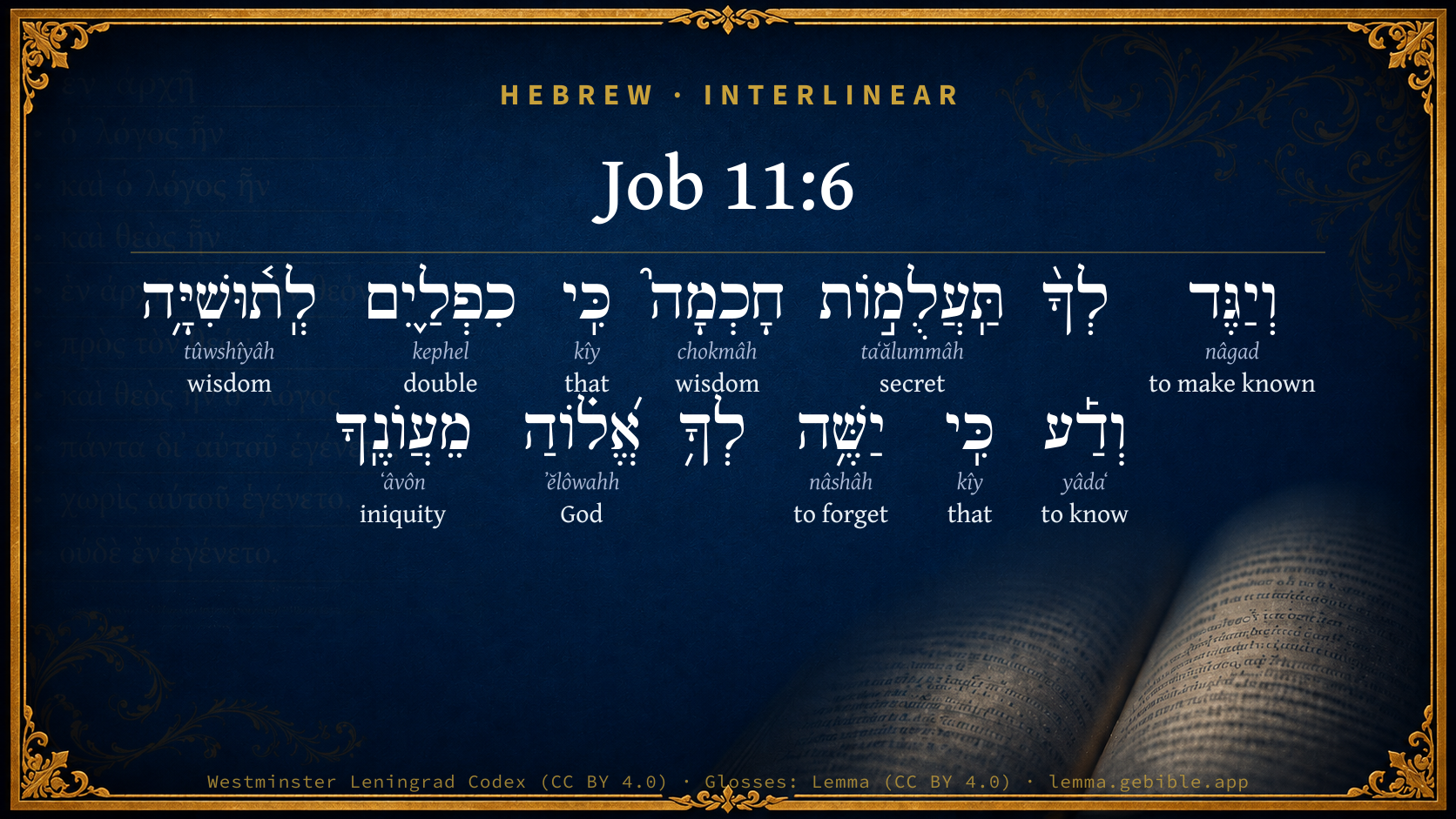
  1. וְיַגֶּד nâgad H5046 “and · to make known” Conjunction + Verb, Hiphil, Imperfect, 3rd Person, Masculine, Singular
  2. חָכְמָה֮ chokmâh H2451 “wisdom” Noun, Common, Feminine, Singular, Absolute
  3. כִּֽי kîy H3588 “that” Conjunction
  4. כִפְלַ֪יִם kephel H3718 “double” Noun, Common, Masculine, Dual, Absolute
  5. לְֽת֫וּשִׁיָּ֥ה tûwshîyâh H8454 “to/for · wisdom” Preposition + Noun, Common, Feminine, Singular, Absolute
  6. וְדַ֡ע yâdaʻ H3045 “and · know” Conjunction + Verb, Qal, Imperative, 2nd Person, Masculine, Singular
  7. כִּֽי kîy H3588 “that” Conjunction
  8. יַשֶּׁ֥ה nâshâh H5382 “to forget” Verb, Hiphil, Imperfect, 3rd Person, Masculine, Singular
  9. אֱ֝ל֗וֹהַ ʼĕlôwahh H433 “God” Noun, Common, Masculine, Singular, Absolute
  10. מֵעֲוֺנֶֽךָ ʻâvôn H5771 “from · iniquity · your” Preposition + Noun, Common, Both, Singular, Construct + Suffix, Personal, 2nd Person, Masculine, Singular

About this verse

These counts appear in no published source. They are computed here, from the morphology-tagged text and Lemma’s own curated glosses. What Lemma adds →

13
words
10
distinct lemmas
Wisdom
section

Notable vocabulary

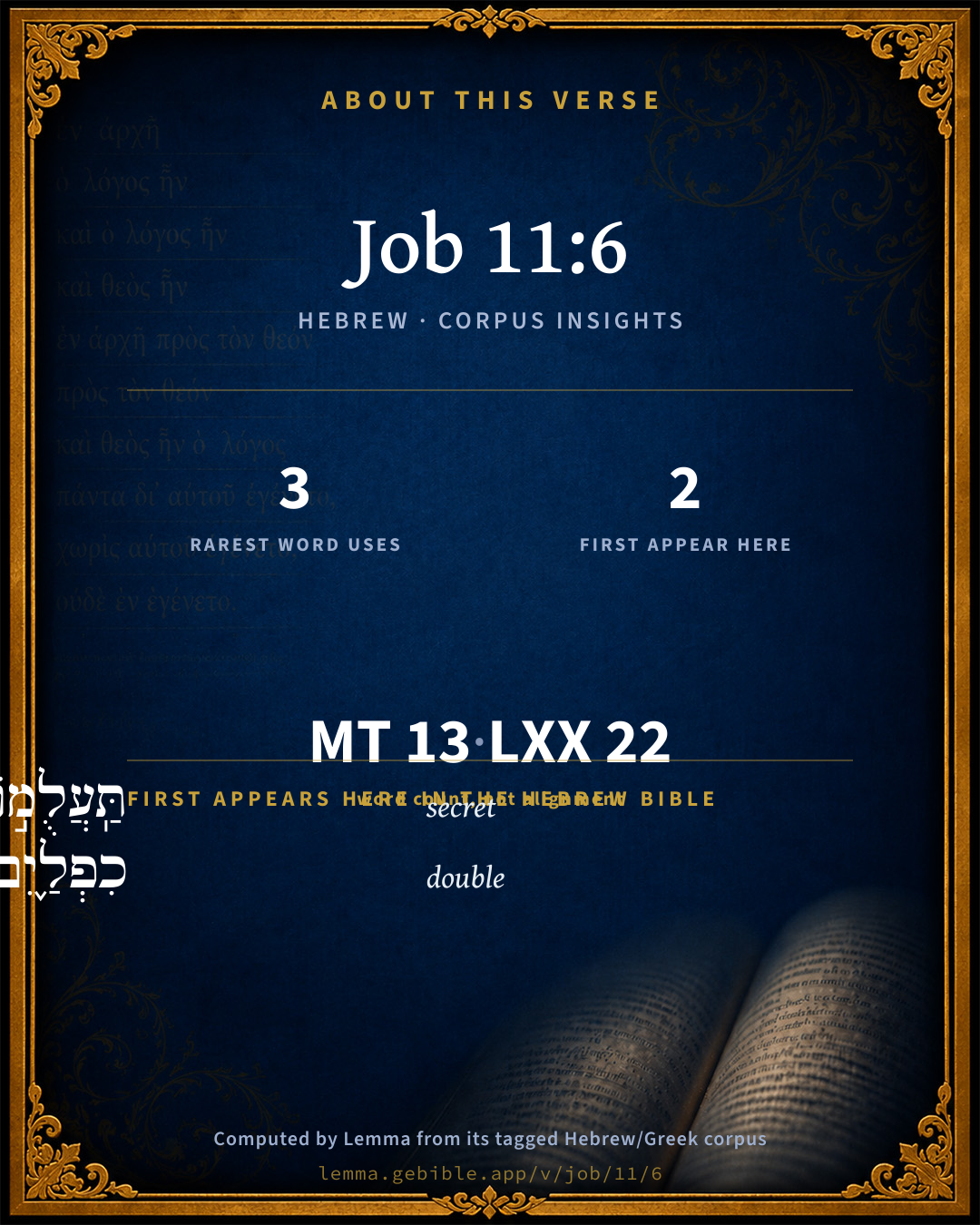
The rarest word here is תַּֽעֲלֻמ֣וֹת secret H8587 — appearing just 3 times in the whole Hebrew Bible.

First appearance in Scripture

These words make their first canonical appearance in the Hebrew Bible here:

  • תַּֽעֲלֻמ֣וֹת secret H8587
  • כִפְלַ֪יִם double H3718

Shared distinctive vocabulary

תַּֽעֲלֻמ֣וֹת secret H8587 occurs in 3 verses of the Hebrew Bible. Also found in:

Grammatical profile

  • 3 verbs
  • 6 nouns
  • 2 prepositions
  • 2 conjunctions

Verb forms

  • וְיַגֶּד Hiphil · Imperfect
  • וְדַ֡ע Qal · Imperative
  • יַשֶּׁ֥ה Hiphil · Imperfect

Repetition

A word recurs within this verse — often emphatic in Hebrew:

  • כִּֽי that H3588 ×2

Hebrew & Septuagint length

In English translation the verse runs 27 words from the Hebrew and 40 from the Septuagint (LXX English) — the Septuagint runs noticeably longer here. See the side-by-side →

A rough comparison of the two English renderings, which tokenize alike — not a word-level alignment.

Word counts can differ between the Hebrew and the Greek without any difference in meaning — e.g. the Hebrew direct-object marker אֵת has no separate Greek word, and Greek often adds the article ὁ.

In the original languages it is 13 Hebrew tokens and 22 Greek tokens — but the two are counted differently (Hebrew bundles its prefixes and suffixes into one token; the Greek is in lemma form), so that isn’t a like-for-like length.

Cross-references

17

Topical passages linked to Job 11:6 in the Treasury of Scripture Knowledge — connected by theme and wording, ordered by reader-vote popularity; previews shown in the World English Bible.

  • Ezra 9:13 After all that is come on us for our evil deeds, and for our great guilt, seeing that you our God have punished us less than our iniquities deserve, and have given us such a remnant,
  • Lamentations 3:22 [It is of] Yahweh's loving kindnesses that we are not consumed, because his compassion doesn't fail.
  • Daniel 2:28 but there is a God in heaven who reveals secrets, and he has made known to the king Nebuchadnezzar what shall be in the latter days. Your dream, and the visions of your head on your bed, are these:
  • Matthew 13:35 that it might be fulfilled which was spoken through the prophet, saying, "I will open my mouth in parables; I will utter things hidden from the foundation of the world."
  • Ephesians 3:5 which in other generations was not made known to the children of men, as it has now been revealed to his holy apostles and prophets in the Spirit;
  • Job 15:8 Have you heard the secret counsel of God? Do you limit wisdom to yourself?
  • Deuteronomy 29:29 The secret things belong to Yahweh our God; but the things that are revealed belong to us and to our children forever, that we may do all the words of this law.
  • Job 9:4 God who is wise in heart, and mighty in strength: Who has hardened himself against him, and prospered?
  • Job 15:5 For your iniquity teaches your mouth, And you choose the language of the crafty.
  • Job 15:11 Are the consolations of God too small for you, Even the word that is gentle toward you?
  • Psalms 25:14 The friendship of Yahweh is with those who fear him. He will show them his covenant.
  • Daniel 2:47 The king answered to Daniel, and said, Of a truth your God is the God of gods, and the Lord of kings, and a revealer of secrets, seeing you have been able to reveal this secret.
  • Romans 16:25–26
  • Psalms 103:10 He has not dealt with us according to our sins, Nor repaid us for our iniquities.
  • Psalms 106:43–46 Many times he delivered them, But they were rebellious in their counsel, And were brought low in their iniquity.
  • 1 Corinthians 2:9–11 But as it is written, "Things which an eye didn't see, and an ear didn't hear, Which didn't enter into the heart of man, These God has prepared for those who love him."
  • Job 28:28 To man he said, 'Behold, the fear of the Lord, that is wisdom. To depart from evil is understanding.'"

Cross-references courtesy of OpenBible.info (CC BY 4.0).

Hebrew and Greek witnesses Masoretic Hebrew ↔ Greek Septuagint

The same verse in the two great witnesses to the Old Testament, shown verse-for-verse.

Here the Septuagint runs noticeably longer than the Hebrew — LXX2012 (modern English Septuagint) 40 words vs World English Bible 27. A rough length comparison of the two English translations, not a word-level alignment — read both below.

These are two independent witnesses, not word-aligned to each other, and the Septuagint is shown in lemma (dictionary) form.

Hebrew Job 11:6 Masoretic · Westminster Leningrad Codex

וְיַגֶּד לְךָ֨ תַּֽעֲלֻמ֣וֹת חָכְמָה֮ כִּֽי כִפְלַ֪יִם לְֽת֫וּשִׁיָּ֥ה וְדַ֡ע כִּֽי יַשֶּׁ֥ה לְךָ֥ אֱ֝ל֗וֹהַ מֵעֲוֺנֶֽךָ

That he would show you the secrets of wisdom! For true wisdom has two sides. Know therefore that God exacts of you less than your iniquity deserves.

World English Bible · Public Domain

Greek LXX Job 11:6 Septuagint · lemma form

εἶτα ἀναἀγγέλλω σύ δύναμις σοφία ὅτι διπλοῦς εἰμί ὁ κατά σύ καί τότε γιγνώσκω ὅτι ἄξιος σύ ἀποβαίνω ἀπό κύριος ὅς ἁμαρτάνω

Then shall he declare to you the power of wisdom; for it shall be double of that which is with you: and then shall you know, that a just recompence of your sins has come to you from the Lord.

LXX2012 (modern English Septuagint) · Public Domain

On this verse, Adam Clarke's Commentary discusses the Septuagint’s reading. Read the note in Commentary ↓

Hebrew: Westminster Leningrad Codex (CC BY 4.0). Greek: Septuagint (public domain); English from LXX2012 (modern English Septuagint) (Public Domain). How the Septuagint differs from the Hebrew →

Commentary

Notes on Job 11:6 from classic Christian and Jewish commentators (each source and its license shown beneath its notes). The classic Christian expositions comment on the surrounding passage and are grouped to its opening verse, so a note may address several verses; the Jewish commentaries on the Tanakh (Rashi and others) are per-verse, so they appear only where the commentator wrote on this verse.

Lemma curates 59 commentaries, every one of them public domain or Creative Commons licensed, each selected and text-cleaned for this edition rather than reprinted as found. About our sources →

Trapp's Complete Commentary

John Trapp

Job 11:6 And that he would shew thee the secrets of wisdom, that [they are] double to that which is! Know therefore that God exacteth of thee [less] than thine iniquity [deserveth].

Ver. 6. And that he would show thee the secrets of wisdom] This may be understood as God’s law (saith Diodati), or as the hidden ways of his providence; which if God would show Job, he should at once see that he mistook much, and knew little of those many mysteries that are both in the word and works of God, in all divine dispensations, which are such as none can unriddle but God himself; neither can we see them till he show them. It is well observed, that the word here rendered show signifieth to interpret and expound that which is dark, mysterious, and enigmatical; and till God show us in this sort we remain ignorant both in the book of the creatures and in the book of the Scriptures. Oh, pray that ye may be all taught of God, that he would show you great and mighty things which you know not, Jer 33:3, that he would so open your eyes, that ye may behold wondrous things out of his law, Psa 119:18.

That they are double to that which is] Sunt enim Deo iudiciorum duo genera, so the Tigurines translate the words, for God hath judgments of two several sorts, viz. open and secret, such as thou with all thy skill canst not dive into. The Hebrew is, doubles to the being; that is, saith one, manifold more than is by thee apprehended; and although God hath afflicted thee according to what he hath revealed, yet he might afflict thee more if he should proceed according to the height of his secret wisdom; thy plagues should be double to that which is, if God should deal rigorously with thee; there is reason therefore thou shouldest be patient, since thy sins are far more than thy sufferings.

Know, then, that God exacteth of thee less than thine iniquity deserveth] This is a meditation that may be of special use, as to humble us, so to stanch murmuring, and to strengthen patience under present pressures. See Ezr 9:13, with the note. Junius rendereth it, acknowledge at least that God exacteth somewhat of thee for thine iniquity; somewhat it is, and but somewhat, since hell is the just hire of the least sin, and it is the Lord’s mercy that we are not consumed, Lam 3:22.

John Trapp, A Commentary or Exposition upon All the Books of the Old and New Testament (1647–1656) — public domain. Text from a community e-Sword module.

Joseph Benson's Commentary

Job 11:6. That he would show thee the secrets of wisdom — The unsearchable depths of his wisdom in dealing with his creatures. That they are double to that which is — That they are far greater (the word double being used indefinitely for manifold, or plentiful) than that which is manifested. The secret wisdom of God is infinitely greater than that which is revealed to us by his word or works: the greatest part of what is known of God is the least part of those perfections that are in him. And therefore thou art rash in judging so harshly of his proceedings with thee, because thou dost not comprehend the reasons of them, and in judging thyself innocent, because thou dost not see thy sins: whereas, the all-knowing God sees innumerable sins in thee, for which he may utterly destroy thee. God exacteth of thee less than thine iniquity deserveth — Or, as the Hebrew, ישׁה מעונךְ, jashe magnavoneka, may be rendered, gives, or forgives thee part of thine iniquity; doth not deal with thee according to the full demerit of it, but remits thee a part of the punishment due to thee: which he affirms, on an ungrounded persuasion that Job was an ungodly hypocrite. “Strange presumption, says Dr. Dodd, “thus to pronounce positively upon a point of which he could not possibly be a judge. But it happened here, as usual, that this speaker, who sets out with the greatest heat, is the first whose arguments are spent. For, after this vehement speech, he makes but one reply, and it is over with him.” We may however, so far agree with Zophar, as to allow that when, and so far as the debt of duty is not paid, it belongs to justice to insist on the debt of punishment; and that whatever punishment is inflicted upon us in this world, it is less than our iniquities deserve, and that, therefore, instead of complaining of our troubles, we ought to be thankful that we are out of hell.

Joseph Benson's Commentary on the Old and New Testaments (1811–1818) — public domain. Text from a community e-Sword module.

Geneva Bible (1599)

Geneva Bible translators

Which is not to stand in justifying of thyself: he signifieth that man will never be overcome, while he reasoneth with another, and therefore God must break off the controversy, and stop man’s mouth.

Geneva Bible (1599) marginal notes — public domain. Text via Bolls.life.

Jamieson, Fausset & Brown

Robert Jamieson, A. R. Fausset & David Brown

to that which is!--Rather, "they are double to [man's] wisdom" [MICHAELIS]. So the Hebrew is rendered (Pro 2:7). God's ways, which you arraign, if you were shown their secret wisdom, would be seen vastly to exceed that of men, including yours (Co1 1:25).

exacteth--Rather, "God consigns to oblivion in thy favor much of thy guilt."

Jamieson, Fausset & Brown — Commentary Critical and Explanatory on the Whole Bible (1871) — public domain (CC PDM 1.0). Text via the HelloAO Bible API.

Adam Clarke's Commentary

Verse 6. The secrets of wisdom] All the depths of his own counsels; the heights, lengths, and breadths, of holiness. That they are double to that which is, תושיה tushiyah, which we translate that which is, is a word frequent in Job and in the Book of Proverbs, and is one of the evidences brought in favour of Solomon as the author of this book. It signifies substance or essence, and is translated by a great variety of terms; enterprise, completeness, substance, the whole constitution, wisdom, law, sound wisdom, solid complete happiness, solidity of reason and truth, the complete total sum, c., c. See Taylor's Hebrew and English Concord., under ישה. In this place the versions are various. Coverdale, following the Vulgate, translates: That he might shewe the (out of his secrite wissdome) how manyfolde his lawe is. The Septuagint, ὁτι διπλους εσται των κατα σε, that it is double to what it is with thee. Mr. Good translates, "For they are intricacies to INIQUITY." This is a meaning never before given to תושיה tushiyah, and a meaning which even his own learned note will not make generally prevalent. Perhaps Zophar is here, in mind, comparing the wisdom which has been revealed with the wisdom not revealed. The perfection and excellence of the Divine nature and the purity of his law, are, in substance and essence, double or manifold to the revelation already made.

Less than thine iniquity deserveth.] Mr. Good translates, And the knowledge hath withdrawn from thee because of thy sins and represents Zophar as praying that God would reveal to him the secrets of wisdom, and the knowledge which he had withdrawn from him because of his transgressions. That Zophar intends to insinuate that God afflicted Job because of his iniquities, is evident and that he thought that God had inflicted less chastisement upon him than his sins deserved, is not less so; and that, therefore, Job's complaining of harsh treatment was not at all well founded.

Adam Clarke's Commentary on the Bible (1810–1826) — public domain. Text from a community e-Sword/MySword module.

Ellicott's Commentary for English Readers

(6) They are double to that which is!—This translation conveys no sense, and is not a translation; see the last Note.

A Bible Commentary for English Readers, edited by Charles John Ellicott (1878–1897) — public domain. Text from a community e-Sword module.

The Cambridge Bible for Schools and Colleges

gen. ed. J. J. S. Perowne

6. shew thee the secrets of wisdom] Wisdom here is God’s omniscience. Its secrets are not the things known to it, such, for example, as Job’s sins, but its own profound depths and insight.

that they are double to that which is] Or, that it (wisdom) is double in (true) understanding. By double or twofold in regard to true understanding is not meant, double of man’s wisdom or that of the creature in general, but rather, twofold what Job conceived of it, in other words, that, in regard to its true insight, it far exceeded all conception. This translation presents the smallest deviation from the A. V. and is simple. It is an objection to it that it makes “understanding” a quality of “wisdom,” while the former word (on which see note on ch. Job_5:12) would more naturally be but another name for the “wisdom,” as it is in Job’s reply to all this, ch. Job_12:16, cf. Job_11:13. Hence others assume that the word twofold means “many folds,” translating: that folds, complications, belong to (true) understanding,—that is, that (God’s) understanding is manifold.

Know therefore] i. e. then shouldst thou know. The imperative is a more vivid way of expressing the future, see on ch. Job_5:1.

exacteth of thee less, &c.] This gives the general sense, though the translation seems to rest both on a false etymology and a false idea of construction. Literally the words mean: God bringeth into forgetfulness for thee some of thy guilt, that is, remembereth not against thee all thy guilt. Others (e.g. Hitz.): God causeth thee to forget thy guilt. The general meaning is, that if God would appear and speak and reveal His knowledge of Job’s sins, Job would be brought to know that he was guilty—perhaps even that his afflictions were far below his guilt. This is a harder word than has yet been uttered against Job.

The Cambridge Bible for Schools and Colleges (gen. ed. J. J. S. Perowne; Cambridge University Press, 1878–1918) — public domain. Text from a community e-Sword module.

John Gill's Exposition

And that he would show thee the secrets of wisdom,.... Either of sound doctrine, in opposition to his own doctrine he had such a vain opinion of; and then he would see, as he thought, that it was not so pure as he imagined it to be: the Gospel, and the doctrines of it, are the wisdom of God, the produce of it, and in which it is displayed; as in the doctrines of election to grace and glory, of redemption by Christ, of justification by his righteousness, and pardon by his blood; by which all the divine perfections are glorified, the justice and holiness of God, as well as his grace and mercy: and there are "secrets" or mysteries in this wisdom of God, Co1 2:6; of mysterious doctrines, which, though revealed, yet the "modus", or manner of them, is not to be searched out and understood; such is the trinity of Persons in the Godhead, the union of the two natures in Christ, the saint's union to God and communion with him, the resurrection of the dead, &c. and these and such like them are only shown by the Lord; men cannot come at them of themselves, by their own natural reason and understanding; it is God that reveals them, in his word, and by his spirit, and gives his people an increasing knowledge of them, Co1 2:9; or it may be rather the secrets of the wisdom of Divine Providence, in the government of the world, and the ordering of all things in it according to the counsel of God, may be here meant; there is a great display of the wisdom of God in Providence, and there are secrets in it undiscoverable by creatures; his ways are past finding out, they are in the deep waters, and his footsteps are not known, nor to be traced; though sometimes he makes his judgments manifest, and his mind in them; and what he does now, which men know not, he shows them hereafter; especially his own people, and particularly when in the sanctuary of the Lord, and in the way of their duty, when everything appears right and beautiful they before were ready to complain of; see Rom 11:33; and then it is seen:

that they are double to that which is! or to "wisdom" (b); as the word is rendered in Pro 2:7; that is, to human wisdom; and then the sense is, that the secrets of divine wisdom displayed, whether in the doctrines of grace or in the methods of Providence, being shown and made manifest, would appear to be "double"; that is, vastly, yea, infinitely to exceed the wisdom of men; and that these, which men are apt to arraign as weak and wrong, are the effects of the highest wisdom, or they then appear so "to a man of wisdom" (c); so the supply may be made, as is in Mic 6:9; or else the sense is, were Job let in to the secret wisdom of God more, and into the purity and holiness of his law, which some understand by "that which is", or "wisdom", and render it "according to the law" (d) and see what that requires, and how much short he comes of it, and what and how many were his transgressions and violations of it; it then would be plain to him, that the punishment that God, in wisdom, and according to his righteous law, might inflict upon him, would be double; or, greatly, yea, infinitely exceed those afflictions he was now exercised with, and therefore he had no reason to complain; to which agrees what follows:

know therefore that God exacteth of thee less than thine iniquities deserve; or punishes, afflicts, or chastises, less than the deserts of sin; see Ezr 9:13; some render it, "God exacteth of thee something of thine iniquity"; so Junius and Tremellius; according to which version the sense is, that sins are debts, and these many; and that payment of part of the debt of punishment for them is only required, which is not truth; for, though there is a debt of punishment due to justice for sin, yet it is not part of it only that is required of the sinner, but the whole, if any; for indeed no part of it is exacted of God's people, since the whole has been exacted of Christ, and he has answered and paid the whole debt, and blotted out the handwriting against them; wherefore the word used has rather the signification of forgetfulness, and may be rendered, either "God hath caused", or "suffered thee to forget part of thine iniquity" (e); or thou couldest never say that thou wert clean in his eye, and free from sin; or, "God himself has forgot part of thine iniquity" (f); in that he has afflicted thee so mildly, and with so much lenity; or, "hath forgotten thee for thine iniquity" (g); forsook him, hid his face from him, laid his hand on him, and sorely chastised him, so that he seemed to be forgotten by him, or he to forget to be gracious to him; all which were owing to his sins, these were the causes of it; or, "will condemn thee for thine iniquity" (h).

(b) "sapientiae", de Dieu, Schmidt, Michaelis; so the Targum. (c) "Viro sapientiae", Drusius. (d) "Secundum legem vel ordinationem", Vatablus. (e) "oblivisci facit te Deus, aliquid de iniquitate tua", some in Mercer so Gersom & Ben Melech, & Gussetius, p. 510. (f) "Quod obliviscatur tibi Deus ab iniquitate tua", Piscator; Vid. Gusset ib. (g) "Quod oblitus tui est propter iniquitatem tuam", Pagninus, Mercerus. (h) So some in Ben Melech.

John Gill's Exposition of the Whole Bible (1746–1763) — public domain (CC PDM 1.0). Text via the HelloAO Bible API.

Albert Barnes' Notes on the Bible

And that he would show thee the secrets of wisdom - The hidden things that pertain to wisdom. The reference here is to the wisdom of God himself. The sense is this, “you now think yourself pure and holy. You have confidence in your own wisdom and integrity. But this apprehension is based on a short-sighted view of God, and on ignorance of him. If he would speak and show you his wisdom; if he would express his sense of what purity is, you would at once see how far you have come from perfection, and would be overwhelmed with a sense of your comparative vileness and sin.”

That they are double to that which is - Noyes renders this,” his wisdom which is unsearchable.” Dr. Good, strangely enough, “for they are intricacies to iniquity.” The expression, as it stands in our common version, is not very intelligible; and indeed it is difficult, to attach any idea to it. Of the words used in the Hebrew, the sense is not difficult. The word כפלים kı̂playı̂m, “double,” is from כפל kâphal “to fold,”” to double;” and means a doubling Job 41:5; and then two folds, or double folds, and the sense here is, that the wisdom of God is “double-fold;” that is, complicated, inexplicable, or manifold. It is not spread out and plain, but is infolded, so that it requires to be unrolled to be understood. The word rendered “that which is” (תשׁיה tûshı̂yâh), means properly a setting upright, uprightness - from ישׁע yâsha‛. Hence, it means help, deliverance, Job 6:13; purpose, undertaking, see the notes at Job 5:12; and then counsel, wisdom, understanding, Job 12:16; Isa 28:29. It means here, I suppose, “understanding;” and the idea is, that the wisdom of God is “double of understanding;” that is, it is so infolded, so complex, that it greatly surpasses our comprehension. What we see is a small part of it; and the “secrets” of his wisdom - the parts of his wisdom which are not unfolded, are far above our grasp. His wisdom is like a vast roll or volume, only the first and a very small part of which is unrolled so that we can read it. But who can look into that that remains unopened, and penetrate between the involutions, so as to perceive and read it all? It is but little that is now unrolled of the mighty volume - the remainder will be unfolded as years and ages shall pass on, and the entire unfolding of the book will be reserved for eternity.

Know, therefore, that God exacteth of thee less than thine iniquity deserveth - The word here rendered “exacteth” (ישׁה yasheh) more properly means “to forget” - from נשׁה nâshâh. It also means to loan on usury, or to borrow; but the sense here is rather that of forgetting. It is not used in the sense of exacting. The true meaning is, “know, therefore, that for thee God hath caused to be forgotten a part of thy iniquity.” That is, he has treated you as if he had caused a part of your sins to be out of mind, or as if they were not remembered. Instead of treating you, as you complain, with severity, he has by no means inflicted on you the calamities which you deserve. The ground of this unfeeling assertion is the abstract proposition that God is infinitely wiser than human beings; that he has a deeper insight into human guilt than people can have; and that if he should disclose to us all that he sees of the heart, we should be amazed at the revelations of our own sins. This sentiment is undoubtedly true, and accords almost cxactly with what Job had himself said Job 9:19-22, but there is something very harsh and severe in the manner in which Zophar applies it.

Albert Barnes' Notes on the Bible (1834–1885) — public domain. Text from a community e-Sword/MySword module.

Haydock's Catholic Bible Commentary

Law. Hebrew Thushiya, (Haydock) "the essence" of any thing. Hence it is explained, "law, strength, comfort," &c. We might translate, "and that the reality of thy crimes deserved double punishment," &c. The obligations of the natural, and also of the written law of Moses, with which Job was (Calmet) perhaps (Haydock) acquainted, (chap. xxii. 22.) are very numerous and difficult. The ways of Providence are not easily understood, though some are obvious enough. He rewards and punishes. (Calmet) --- Septuagint, "for it is double of what has come against thee, and then thou wouldst know that thy sins are justly requited." Protestants, "that they are double to that which is: Know, therefore, that God exacteth of thee less than thine iniquity deserveth," 1 Esdras ix. 13. (Haydock)

George Leo Haydock (1774–1849), Haydock's Catholic Family Bible and Commentary, 1859 edition — public domain. Excludes Psalms (Douay-Rheims chapter numbering differs from Protestant) and Deuterocanonical books (Catholic canon only).

Matthew Poole's English Annotations

The secrets of wisdom, i.e. the unknown and unsearchable depths of God’s wisdom and counsels in dealing with his creatures.

That they are double to that which is, i.e. that they are far more and greater (the word double being used indefinitely for manifold, or plentiful, as Isa 40:2; 61:7; Jer 17:18; Zec 9:12) than that which hath a being or existence, i.e. the secret wisdom of God is infinitely greater than that which is revealed to us by his word or works. The greatest part of what is known of God, is the least part of those perfections that are in him. And therefore thou dost rashly and foolishly in passing such a bold censure upon God’s ways, and judging so harshly of his proceedings with thee, because thou dost not comprehend the reasons of them, and in judging thyself innocent, because thou dost not see thy sins; whereas the all-knowing God sees innumerable sins in thee, for which he may utterly destroy thee, though thou discernest them not. But the words are and must be rendered, either thus, that he hath double, i.e. abundant, wisdom, for so this Hebrew word signifies, Job 6:13; 12:16; Pro 2:7; 3:21; or,

that they are double to, or in, that being or essence, to wit, to God, of whom he is here speaking; or, to the being, i.e. to God, who calls himself by the name I am, Exo 3:14, which signifies being; and who appropriates being to himself, Isa 45:18, I am, and there is none else besides me; as elsewhere he is said to be the only wise, and only Potentate, and only immortal being, 1Ti 1:17; 6:15,16. God exacteth of thee less than thine iniquity deserveth, Heb. God lends, or gives, or forgives, thee part of thine iniquity, or of thy punishment; so far is he from dealing worse than thou deservest, as thou dost most falsely and wickedly accuse him.

Matthew Poole's English Annotations on the Holy Bible (1683–1685) — public domain. Text from a community e-Sword/MySword module.

Whedon's Commentary on the Bible

Daniel D. Whedon

b. Would that God might appear, even as Job desired, for then the divine insight would disclose Job’s deep guilt, and the many transgressions which still remained unpunished. The danger to Job lies not in God’s almightiness, as he claims, but in the deeps of God’s manifold knowledge, Job_11:5-6.

6. The secrets of wisdom — Prof. Lee devotes several pages to showing that the wisdom referred to is Christ, who is called the wisdom of God. This is one of the many instances which commentators upon this book furnish of forced spiritual interpretations.

Double to that which is — Michaelis and Dillmann render it, “double to (man’s) wisdom,” that is, God’s wisdom vastly exceeds ours: (Gesenius, p. 704:) others, “because there are complications of his wisdom;” that is, it is complicated, occult, inexplicable, and at the same time varied and infinite. Zockler’s reading is preferable “that it (wisdom) is twofold in true knowledge.” כפליםis dual in form, but used absolutely for manifold — fold upon fold! Compared with God’s, all human wisdom is vain, because one-sided. For the rendering of the difficult word toushiyyah, true knowledge, see Job_5:12; Job_12:16. God exacteth of thee, etc. — Literally, God brings into forgetfulness to thee a part of thy fault; (Furst, Dillmann;) God remits to thee of thy guilt. This is evident from the smallness of Job’s sufferings compared with his deserts. God is as infinite in mercy as he is in knowledge. “He forgives more than he punishes.” (Comp. Psa_103:10.) The truth is a precious one, but as applied to Job it was offensive.

Daniel D. Whedon (gen. ed.), Commentary on the Old and New Testaments (1874–1909) — public domain. Text from a community e-Sword module.

The Pulpit Commentary

And that he would show thee the secrets of wisdom! In God are "all the treasures of wisdom and knowledge hid away". (apokrufoi Col_2:3) Zophar wishes that he would reveal to Job this wisdom, or a portion of it, as, in that case, all his pride and self-confidence would be confounded and fall away. That they are double to that which is! This phrase is very obscure. Some translate, "For he (i.e. God) is twice as wise as thou;" others, "That it (i.e. wisdom) is manifold in effectual working;" others, again, "That they (i.e. the treasures of wisdom) are double (or manifold) in substance." Perhaps this last rendering is to be preferred. The treasures of wisdom that are hid away in God have many depths, secret and unexplored; they "lie, as it were, fold over fold, in unexpected complexities, defying the shallow and unscrutinizing gaze" (Professor Stanley Leathes). If they were revealed to Job, they would astonish, confound, silence, him. Know therefore that God exacteth of thee less than thine iniquity deserveth. "Be sure," i.e. , "that God, so far from inflicting on thee a more severe punishment than thou deservest, in reality excuses much of thy guilt, and punishes thee less than is thy due." This is Zophar"s conclusion from his general knowledge of God"s dealings with man. (comp. Ezr_9:13)

A sermon on the Divine forbearance.

I THE DESERT OF SIN.

1. The nature of it. The punishment of death temporal, spiritual, and eternal.

2. The severity of it. Were this penalty exacted from each transgressor to the full, it would mean the extinction of every spark of terrestrial happiness, the withdrawal from the sinful soul of every gracious influence, the absolute cessation of hope of eternal felicity beyond the grave, with all the misery which such a melancholy state of being would entail.

3. The certainty of it. That is, unless the execution of this awful penalty can be delayed. That it can, constitutes the glad tidings of the gospel. But where the gospel of the grace of God is not permitted to interpose for the sinner"s rescue, the infliction of this appalling retribution is inevitable.

4. The justness of it. To some minds it seems scarcely consistent with absolute equity to inflict so tremendous a chastisement upon feeble men for the trifling defalcations of a short lifetime. But this objection springs from imperfect notions of the heinousness of sin as committed against an infinite God and a holy Law. Besides, the penalty is that of the Divine Law, and we know that the Law is holy. (Rom_7:12)

II THE FORBEARANCE OF GOD.

1. The proof of it.

(1) Our own lives attest this.

(2) God"s Word affirms this.

(3) God"s providential dealings with men in general discover this.

2. The reason of it.

(1) In mercy to man, because he willeth not that any should perish.

(2) In justice to Christ, from whom the full penalty hath already been exacted.

(3) For the honour of himself, the glory of his grace being the highest motive by which God can be actuated.

III THE INSTRUCTION OF MAN. "Know thou;" meaning that precious lessons should be derived from the study of so grand a truth.

1. Submission. It should silence all murmurings against afflictive dispensations.

2. Repentance. It ought to fill the human spirit with devout contrition.

3. Hope. It should teach man to "account the long-suffering of our God salvation."

The Pulpit Commentary (1880–1919), ed. H.D.M. Spence-Jones & Joseph S. Exell — public domain. Text from a community e-Sword module.

John Wesley's Explanatory Notes

Secrets - The unsearchable depths of God's wisdom in dealing with his creatures. Double - That they are far greater (the word double being used indefinitely for manifold, or plentiful) than that which is manifested. The secret wisdom of God is infinitely greater than that which is revealed to us by his word or works: the greatest part of what is known of God, is the least part of those perfections that are in him. And therefore thou dost rashly in judging so harshly of his proceedings with thee, because thou dost not comprehend the reasons of them, and in judging thyself innocent, because thou dost not see thy sins; whereas the all- knowing God sees innumerable sins in thee, for which he may utterly destroy thee.

John Wesley, Explanatory Notes Upon the Whole Bible (1754–1765) — public domain. Text via the GEBible commentary corpus.

Rashi

Rabbi Shlomo Yitzchaki (Rashi)

mysteries of wisdom and you would know that the wisdom is double, i.e., the Torah that you did not fulfill.

that [God] lends Heb. ישה, like (Deut.24: 10), “If you lend (תשה) your friend.” He has yet a large debt over you in the matters of your iniquity.

Rashi on the Tanakh — English translations: “The Judaica Press complete Tanach with Rashi, translated by A. J. Rosenberg” (CC BY 4.0); “Pentateuch with Rashi's commentary by M. Rosenbaum and A.M. Silbermann, 1929-1934” (public domain); “The Metsudah Tanach series, Lakewood, N.J” (CC BY 4.0); and “The Book of Joshua, Metsudah Publications, 1997” (CC BY 4.0). Text via Sefaria.

Lesson kit

Teaching starters — assembled from the data on this page, not authored interpretation. Every prompt links to the verse data it draws on. Edit before teaching.

Job, in the Wisdom, opens this verse with 13 words (10 distinct Hebrew lemmas). Its most distinctive word is taʻălummâh (“secret”). The Greek Septuagint runs longer here. A historical commentator’s framing appears above. Read the whole chapter for the surrounding context.

Discussion questions

  1. The word taʻălummâh carries the sense “secret.” How does it shape the verse?
  2. 2 words make their first appearance in Scripture here. What does this debut establish?
  3. How does Job 28:11, which shares the word «secret», read alongside this verse?
  4. What does the repetition of “that” (2× in this one verse) do in this verse?
  5. The Septuagint runs longer here than the Hebrew. What might account for the difference?
  6. These translations render this verse differently. What is at stake in choosing one wording over another?
  7. «וְיַגֶּד» is a Hiphil Imperfect verb. How does that grammatical form shape the action described?
  8. Compare how Trapp's Complete Commentary and Joseph Benson's Commentary read this verse. Where do they agree or differ?

Things to notice

Reading settings

Reading text

Shown beneath each verse's original-language words.

Old Testament
Old Testament edition

Read the OT as the Masoretic Hebrew (MT) or the Greek Septuagint (LXX).

English shown for the Greek Septuagint (in the Hebrew ↔ Greek comparison).

Comparing translations? Open the Compare panel on any verse page to stack up to four side by side.