
2 Samuel 14:32

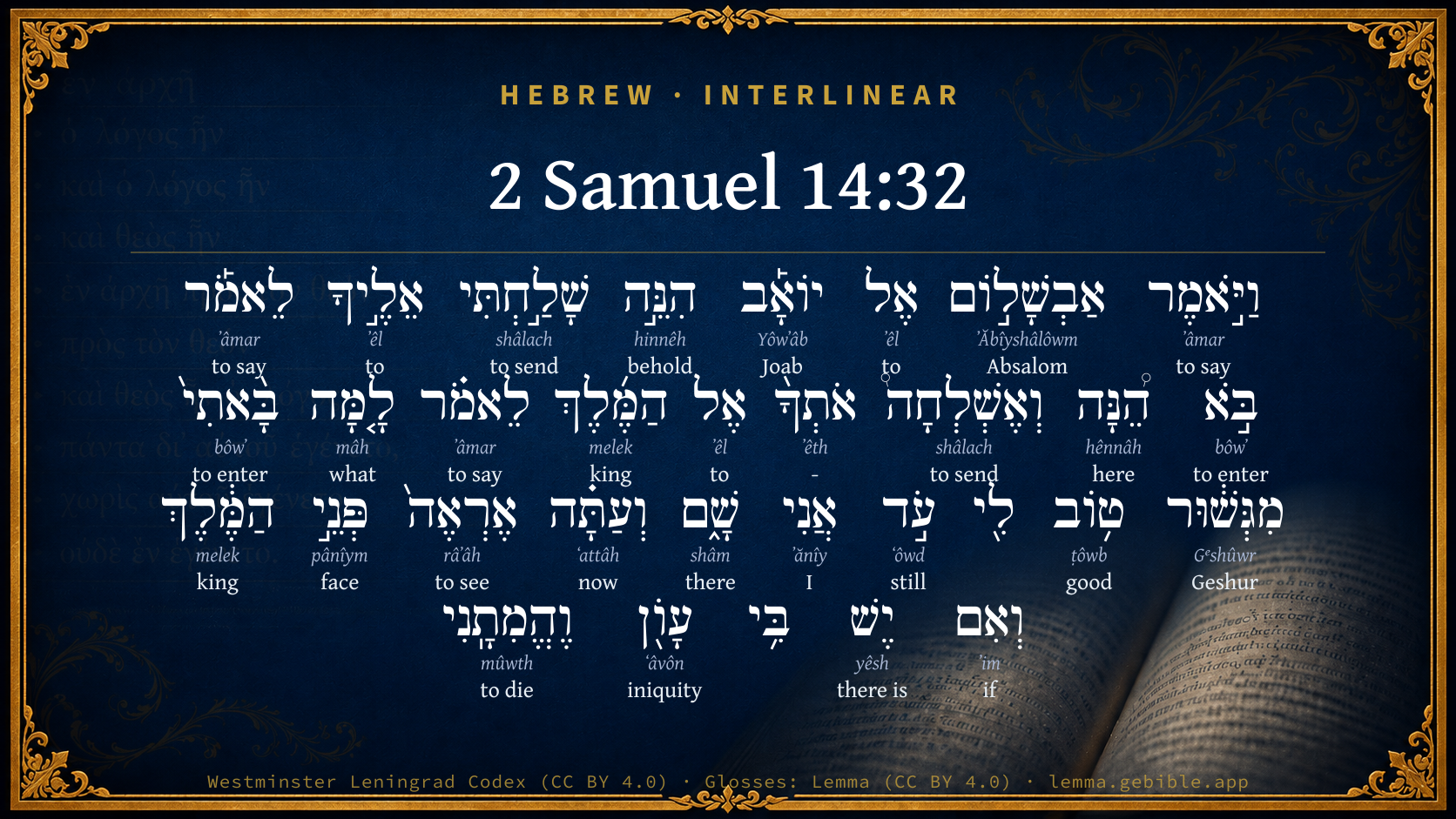
Hebrew (Westminster Leningrad Codex) 2 Samuel 14:32 appears in the Hebrew Old Testament. The text above is from the Westminster Leningrad Codex. Each word links to its Strong’s number, a concise gloss, and parsing drawn from the Open Scriptures Hebrew Bible morphology. Click any word for its full Brown-Driver-Briggs (BDB) entry.
Download image
Cite this verse

2 Samuel 14:32 (World English Bible). Public Domain. Lemma interlinear Bible study tool, https://lemma.gebible.app/v/2-samuel/14/32.

Show BibTeX & RIS
BibTeX
RIS
English Translation
Absalom answered Joab, Behold, I sent to you, saying, Come here, that I may send you to the king, to say, Why am I come from Geshur? it were better for me to be there still. Now therefore let me see the king's face; and if there be iniquity in me, let him kill me.
World English Bible · Public Domain
Download a study sheet

One document with this verse’s original text, its word-by-word gloss line, the meaning frame, cross-references with their text, attributed commentary, and full source and license credits — printable, and it pastes into notes with its structure intact.

This verse Autodidact and up

Study sheet (.html) Plain text (.txt)

A passage Seminary Student

Up to 50 verses in one chapter. A passage sheet keeps up to 6 commentary sources and 12 cross-references per verse, in the order this page ranks them, and says so on the sheet whenever that leaves anything out. Ask for a single verse and you get the Autodidact verse sheet above.

Everything on this page stays free to read, with no account — the sheet is a download of what is already on screen, not access to it.

Want to remove ads? Support Godless Engineer
Compare translations 3

The same verse in 3 English versions, stacked beneath the original-language interlinear above. Click any original word for its lexicon entry.

Each is an independent rendering of the whole verse — the interlinear is not word-aligned to these translations.

Highlighted words mark where these versions differ — a whole-verse word diff, not a word-by-word alignment.

  • World English Bible Public Domain
    Absalom answered Joab, Behold, I sent to you, saying, Come here, that I may send you to the king, to say, Why am I come from Geshur? it were better for me to be there still. Now therefore let me see the king's face; and if there be iniquity in me, let him kill me.
  • King James Version Public Domain
    And Absalom answered Joab, Behold, I sent unto thee, saying, Come hither, that I may send thee to the king, to say, Wherefore am I come from Geshur? it had been good for me to have been there still: now therefore let me see the king's face; and if there be any iniquity in me, let him kill me.
  • unfoldingWord Literal Text CC BY-SA 4.0
    And Absalom said to Joab, “Behold, I sent to you, saying, ‘Come here, that I may send you to the king, saying, “Why have I come from Geshur? better for me I still there.”’ And now, let me see the face of the king, but if iniquity is in me, then let him kill me.”

unfoldingWord Literal Text — © unfoldingWord, licensed CC BY-SA 4.0. Word-aligned USFM3 via Door43 (git.door43.org/unfoldingWord/en_ult).

Versions to compare (up to 4)

3 of 4 selected

Show all 18 translations

Every available English version of this verse, each an independent rendering of the whole verse.

  • World English Bible Public Domain
    Absalom answered Joab, Behold, I sent to you, saying, Come here, that I may send you to the king, to say, Why am I come from Geshur? it were better for me to be there still. Now therefore let me see the king's face; and if there be iniquity in me, let him kill me.
  • Berean Standard Bible Public Domain
    “Look,” said Absalom, “I sent for you and said, ‘Come here. I want to send you to the king to ask: Why have I come back from Geshur? It would be better for me if I were still there.’ So now, let me see the king’s face, and if there is iniquity in me, let him kill me.”
  • Majority Standard Bible Public Domain
    “Look,” said Absalom, “I sent for you and said, ‘Come here. I want to send you to the king to ask: Why have I come back from Geshur? It would be better for me if I were still there.’ So now, let me see the king’s face, and if there is iniquity in me, let him kill me.”
  • King James Version Public Domain
    And Absalom answered Joab, Behold, I sent unto thee, saying, Come hither, that I may send thee to the king, to say, Wherefore am I come from Geshur? it had been good for me to have been there still: now therefore let me see the king's face; and if there be any iniquity in me, let him kill me.
  • American Standard Version (1901) Public Domain
    And Absalom answered Joab, Behold, I sent unto thee, saying, Come hither, that I may send thee to the king, to say, Wherefore am I come from Geshur? it were better for me to be there still. Now therefore let me see the king's face; and if there be iniquity in me, let him kill me.
  • Revised Version (1885) Public Domain
    And Absalom answered Joab, Behold, I sent unto thee, saying, Come hither, that I may send thee to the king, to say, Wherefore am I come from Geshur? it were better for me to be there still: now therefore let me see the king’s face; and if there be iniquity in me, let him kill me.
  • Geneva Bible (1599) Public Domain
    And Absalom answered Ioab, Beholde, I sent for thee, saying, Come thou hither, and I wil send thee to the King for to say, Wherefore am I come from Geshur? It had bene better for me to haue bene there still: nowe therefore let mee see the Kings face: and if there be any trespasse in me, let him kill me.
  • Douay-Rheims (1899) Public Domain
    And Absalom answered Joab: I sent to thee beseeching thee to come to me, that I might send thee to the king, to say to him: Wherefore am I come from Gessur? it had been better for me to be there: I beseech thee therefore that I may see the face of the king: and if he be mindful of my iniquity, let him kill me.
  • Young's Literal Translation Public Domain
    And Absalom saith unto Joab, `Lo, I sent unto thee, saying, Come hither, and I send thee unto the king to say, Why have I come in from Geshur? -- good for me while I `am' there -- and now, let me see the king's face, and if there is in me iniquity then thou hast put me to death.'
  • Literal Standard Version CC BY-SA 4.0
    And Absalom says to Joab, “Behold, I sent to you, saying, Come here, and I send you to the king to say, Why have I come in from Geshur? [It was] good for me while I [was] there—and now, let me see the king’s face, and if there is iniquity in me then you have put me to death.”
  • Unlocked Literal Bible CC BY-SA 4.0
    Absalom answered Joab, “Look, I sent word to you saying, 'Come here so I may send you to the king to say, “Why did I come from Geshur? It would be better for me to still be there. Now therefore let me see the king's face, and if I am guilty, let him kill me.”'”
  • unfoldingWord Literal Text CC BY-SA 4.0
    And Absalom said to Joab, “Behold, I sent to you, saying, ‘Come here, that I may send you to the king, saying, “Why have I come from Geshur? better for me I still there.”’ And now, let me see the face of the king, but if iniquity is in me, then let him kill me.”
  • Darby Bible Public Domain
    And Absalom said to Joab, Behold, I sent to thee, saying, Come hither, that I may send thee to the king, to say, Why am I come from Geshur? it would have been better for me to be there still. And now let me see the king's face; and if there be iniquity in me, let him slay me.
  • World Messianic Bible Public Domain
    Absalom answered Joab, “Behold, I sent to you, saying, ‘Come here, that I may send you to the king, to say, “Why have I come from Geshur? It would be better for me to be there still. Now therefore, let me see the king’s face; and if there is iniquity in me, let him kill me.”’”
  • Webster's Bible Public Domain
    And Absalom answered Joab, Behold, I sent to thee, saying, Come hither, that I may send thee to the king, to say, Why am I come from Geshur? it had been good for me had I been there still: now therefore let me see the king's face; and if there is any iniquity in me, let him kill me.
  • Free Bible Version CC BY-SA 4.0
    “Look here,” said Absalom, “I sent for you, saying, ‘Come here. I want you to go to the king and ask: Why did I bother coming back from Geshur? It would have been better for me to stay there.’ So go and arrange for me to see the king, and if I'm guilty of anything, he can kill me.”
  • Bible in Basic English Public Domain
    And Absalom's answer was, See, I sent to you saying, Come here, so that I may send you to the king to say, Why have I come back from Geshur? it would be better for me to be there still: let me now see the king's face, and if there is any sin in me, let him put me to death.
  • JPS Tanakh (1917) Public Domain
    And Absalom answered Joab: 'Behold, I sent unto thee, saying: Come hither, that I may send thee to the king, to say: Wherefore am I come from Geshur? it were better for me to be there still; now therefore let me see the king's face; and if there be iniquity in me, let him kill me.'

Literal Standard Version (2020), Covenant Press — licensed CC BY-SA 4.0. Text via the HelloAO Bible API (eBible.org). Unlocked Literal Bible (unfoldingWord) — licensed CC BY-SA 4.0. Text via the HelloAO Bible API (eBible.org). unfoldingWord Literal Text — © unfoldingWord, licensed CC BY-SA 4.0. Word-aligned USFM3 via Door43 (git.door43.org/unfoldingWord/en_ult). Free Bible Version, Dr. Jonathan Gallagher — licensed CC BY-SA 4.0. Text via the HelloAO Bible API (eBible.org).

Word by word

More ways to search: Search by grammar → Find every occurrence → Compare this word →

Practice this passage: Drill this verse → Learn its vocabulary →

מִגְּשׁ֔וּר
Gᵉshûwr
H1650
“from · Geshur”
Preposition + Noun, Proper
Part of Speech
Preposition + Noun
Type
Proper
Full BDB Definition

Origin: from an unused root (meaning to join)

TWOT: None

Geshur or Geshurites = "proud beholder" - a people - a land in north Transjordania
  1. וַיֹּ֣אמֶר ʼâmar H559 “and · to say” Conjunction + Verb, Qal, Sequential Imperfect, 3rd Person, Masculine, Singular
  2. אַבְשָׁל֣וֹם ʼĂbîyshâlôwm H53 “Absalom” Noun, Proper
  3. אֶל ʼêl H413 “to” Preposition
  4. יוֹאָ֡ב Yôwʼâb H3097 “Joab” Noun, Proper
  5. הִנֵּ֣ה hinnêh H2009 “behold” Particle, Demonstrative
  6. שָׁלַ֣חְתִּי shâlach H7971 “to send” Verb, Qal, Perfect, 1st Person, Common, Singular
  7. אֵלֶ֣יךָ ʼêl H413 “to · you” Preposition + Suffix, Personal, 2nd Person, Masculine, Singular
  8. לֵאמֹ֡ר ʼâmar H559 “to say” Preposition + Verb, Qal, Infinitive Construct
  9. בֹּ֣א bôwʼ H935 “enter” Verb, Qal, Imperative, 2nd Person, Masculine, Singular
  10. הֵ֠נָּה hênnâh H2008 “here” Adverb
  11. וְאֶשְׁלְחָה֩ shâlach H7971 “and · to send” Conjunction + Verb, Qal, Cohortative, 1st Person, Common, Singular
  12. אֹתְךָ֨ ʼêth H853 “- · you” Particle, Direct Object + Suffix, Personal, 2nd Person, Masculine, Singular
  13. אֶל ʼêl H413 “to” Preposition
  14. הַמֶּ֜לֶךְ melek H4428 “the · king” Particle, Definite Article + Noun, Common, Masculine, Singular, Absolute
  15. לֵאמֹ֗ר ʼâmar H559 “to say” Preposition + Verb, Qal, Infinitive Construct
  16. לָ֤מָּה mâh H4100 “to/for · what” Preposition + Particle, Interrogative
  17. בָּ֨אתִי֙ bôwʼ H935 “to enter” Verb, Qal, Perfect, 1st Person, Common, Singular
  18. ט֥וֹב ṭôwb H2896 “good” Adjective, Adjective, Masculine, Singular, Absolute
  19. עֹ֣ד ʻôwd H5750 “still” Adverb
  20. אֲנִי ʼănîy H589 “I” Pronoun, Personal, 1st Person, Common, Singular
  21. שָׁ֑ם shâm H8033 “there” Adverb
  22. וְעַתָּ֗ה ʻattâh H6258 “and · now” Conjunction + Adverb
  23. אֶרְאֶה֙ râʼâh H7200 “to see” Verb, Qal, Cohortative, 1st Person, Common, Singular
  24. פְּנֵ֣י pânîym H6440 “face(s) of” Noun, Common, Both, Plural, Construct
  25. הַמֶּ֔לֶךְ melek H4428 “the · king” Particle, Definite Article + Noun, Common, Masculine, Singular, Absolute
  26. וְאִם ʼim H518 “and · if” Conjunction + Conjunction
  27. יֶשׁ yêsh H3426 “there is” Particle, Demonstrative
  28. עָוֺ֖ן ʻâvôn H5771 “iniquity” Noun, Common, Both, Singular, Absolute
  29. וֶהֱמִתָֽנִי mûwth H4191 “and · to die · me” Conjunction + Verb, Hiphil, Sequential Perfect, 3rd Person, Masculine, Singular + Suffix, Personal, 1st Person, Common, Singular

About this verse

These counts appear in no published source. They are computed here, from the morphology-tagged text and Lemma’s own curated glosses. What Lemma adds →

32
words
23
distinct lemmas
Historical
section

Notable vocabulary

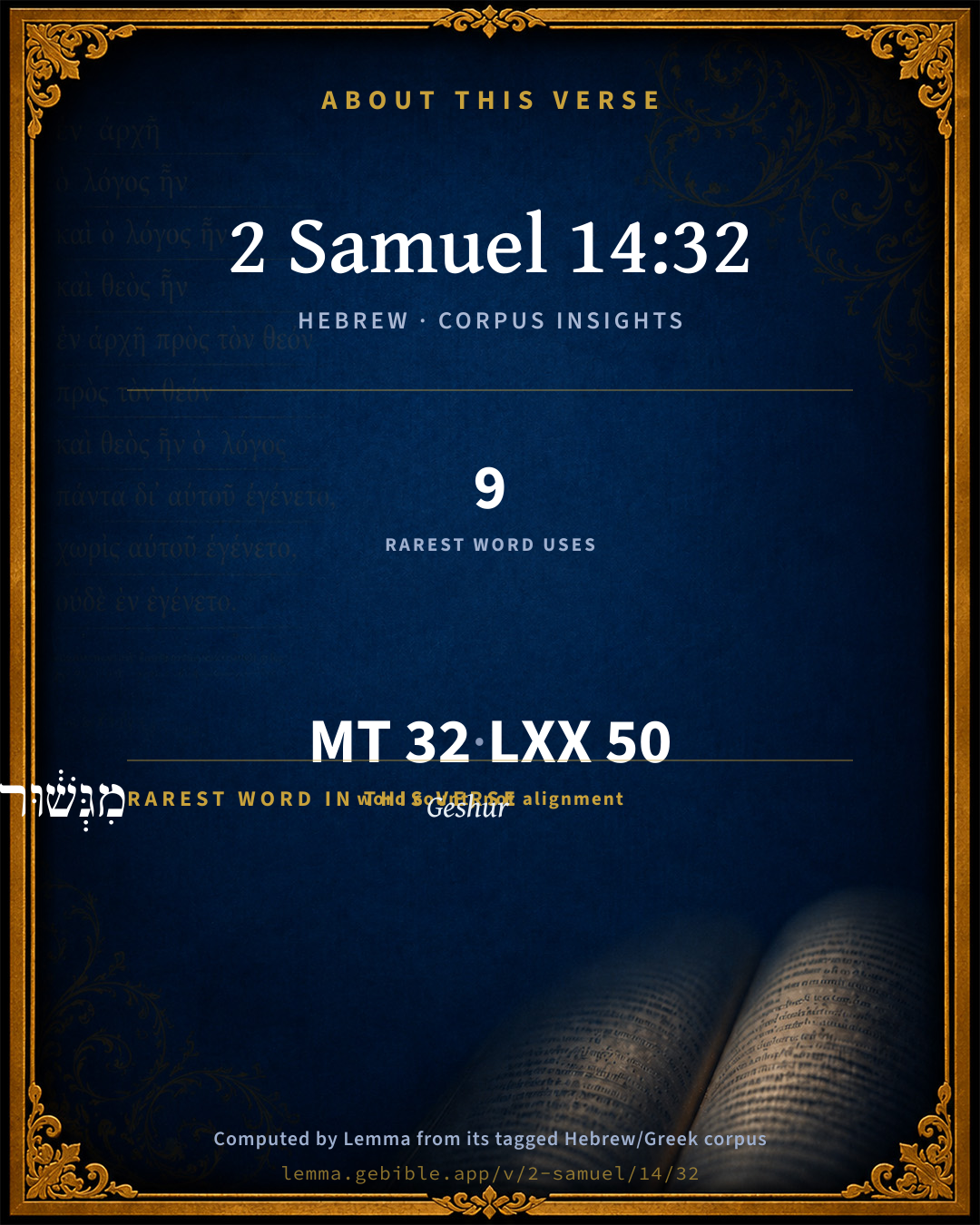
The rarest word here is מִגְּשׁ֔וּר Geshur H1650 — appearing just 9 times in the whole Hebrew Bible.

Shared distinctive vocabulary

מִגְּשׁ֔וּר Geshur H1650 occurs in 9 verses of the Hebrew Bible. Also found in:

Grammatical profile

  • 9 verbs
  • 7 nouns
  • 1 adjective
  • 1 pronoun
  • 5 prepositions
  • 1 conjunction
  • 4 adverbs
  • 4 particles

Verb forms

  • וַיֹּ֣אמֶר Qal · Sequential Imperfect
  • שָׁלַ֣חְתִּי Qal · Perfect
  • לֵאמֹ֡ר Qal · Infinitive Construct
  • בֹּ֣א Qal · Imperative
  • וְאֶשְׁלְחָה֩ Qal · Cohortative
  • לֵאמֹ֗ר Qal · Infinitive Construct
  • בָּ֨אתִי֙ Qal · Perfect
  • אֶרְאֶה֙ Qal · Cohortative
  • וֶהֱמִתָֽנִי Hiphil · Sequential Perfect

Repetition

Words recur within this verse — often emphatic in Hebrew:

  • וַיֹּ֣אמֶר to say H559 ×3
  • שָׁלַ֣חְתִּי to send H7971 ×2
  • בֹּ֣א to enter H935 ×2
  • הַמֶּ֜לֶךְ king H4428 ×2
  • אֶל to H413 ×3

Hebrew & Septuagint length

In English translation the verse runs 55 words from the Hebrew and 64 from the Septuagint (LXX English) — closely comparable.

A rough comparison of the two English renderings, which tokenize alike — not a word-level alignment.

Word counts can differ between the Hebrew and the Greek without any difference in meaning — e.g. the Hebrew direct-object marker אֵת has no separate Greek word, and Greek often adds the article ὁ.

In the original languages it is 32 Hebrew tokens and 50 Greek tokens — but the two are counted differently (Hebrew bundles its prefixes and suffixes into one token; the Greek is in lemma form), so that isn’t a like-for-like length.

Cross-references

12

Topical passages linked to 2 Samuel 14:32 in the Treasury of Scripture Knowledge — connected by theme and wording, ordered by reader-vote popularity; previews shown in the World English Bible.

  • Exodus 14:12 Isn't this the word that we spoke to you in Egypt, saying, 'Leave us alone, that we may serve the Egyptians?' For it were better for us to serve the Egyptians, than that we should die in the wilderness."
  • 1 Samuel 20:8 Therefore deal kindly with your servant; for you have brought your servant into a covenant of Yahweh with you: but if there be in me iniquity, kill me yourself; for why should you bring me to your father?
  • Proverbs 28:13 He who conceals his sins doesn't prosper, But whoever confesses and renounces them finds mercy.
  • Genesis 3:12 The man said, "The woman whom you gave to be with me, she gave me of the tree, and I ate."
  • Exodus 16:3 and the children of Israel said to them, "We wish that we had died by the hand of Yahweh in the land of Egypt, when we sat by the flesh-pots, when we ate our fill of bread, for you have brought us out into this wilderness, to kill this whole assembly with hunger."
  • Exodus 17:3 The people were thirsty for water there; and the people murmured against Moses, and said, "Why have you brought us up out of Egypt, to kill us, our children, and our livestock with thirst?"
  • 1 Samuel 15:13 Samuel came to Saul; and Saul said to him, Blessed are you by Yahweh: I have performed the commandment of Yahweh.
  • Psalms 36:2 For he flatters himself in his own eyes, Too much to detect and hate his sin.
  • Jeremiah 2:22–23 For though you wash yourself with lye, and use much soap, yet your iniquity is marked before me, says the Lord Yahweh.
  • Jeremiah 8:12 Were they ashamed when they had committed abomination? nay, they were not at all ashamed, neither could they blush: therefore shall they fall among those who fall; in the time of their visitation they shall be cast down, says Yahweh.
  • Matthew 25:44 "Then they will also answer, saying, 'Lord, when did we see you hungry, or thirsty, or a stranger, or naked, or sick, or in prison, and didn't help you?'
  • Romans 3:19 Now we know that whatever things the law says, it speaks to those who are under the law, that every mouth may be closed, and all the world may be brought under the judgment of God.

Cross-references courtesy of OpenBible.info (CC BY 4.0).

Hebrew and Greek witnesses Masoretic Hebrew ↔ Greek Septuagint

The same verse in the two great witnesses to the Old Testament, shown verse-for-verse.

These are two independent witnesses, not word-aligned to each other, and the Septuagint is shown in lemma (dictionary) form.

Hebrew 2 Samuel 14:32 Masoretic · Westminster Leningrad Codex

וַיֹּ֣אמֶר אַבְשָׁל֣וֹם אֶל יוֹאָ֡ב הִנֵּ֣ה שָׁלַ֣חְתִּי אֵלֶ֣יךָ לֵאמֹ֡ר בֹּ֣א הֵ֠נָּה וְאֶשְׁלְחָה֩ אֹתְךָ֨ אֶל הַמֶּ֜לֶךְ לֵאמֹ֗ר לָ֤מָּה בָּ֨אתִי֙ מִגְּשׁ֔וּר ט֥וֹב לִ֖י עֹ֣ד אֲנִי שָׁ֑ם וְעַתָּ֗ה אֶרְאֶה֙ פְּנֵ֣י הַמֶּ֔לֶךְ וְאִם יֶשׁ בִּ֥י עָוֺ֖ן וֶהֱמִתָֽנִי

Absalom answered Joab, Behold, I sent to you, saying, Come here, that I may send you to the king, to say, Why am I come from Geshur? it were better for me to be there still. Now therefore let me see the king's face; and if there be iniquity in me, let him kill me.

World English Bible · Public Domain

Greek LXX 2 Samuel 14:32 Septuagint · lemma form

καί εἶπον αβεσσαλωμ πρός ιωαβ ἰδού ἀποστέλλω πρός σύ λέγω ἵημι ὧδε καί ἀποστέλλω σύ πρός ὁ βασιλεύς λέγω ἵνα τίς ἔρχομαι ἐκ γεδσουρ ἀγαθός ἐγώ εἰμί ὁ ἔτι εἰμί ἐγώ ἐκεῖ καί νῦν ὁράω ὁ πρόσωπον ὁ βασιλεύς οὐ ὁράω εἰ δέ εἰμί ἐν ἐγώ ἀδικία καί θανατόω ἐγώ

And Abessalom said to Joab, Behold, I sent to you, saying, Come hither, and I will send you to the king, saying, Why did I come out of Gedsur? it would have been better for me to have remained there: and now, behold, I have not seen the face of the king; but if there is iniquity in me, then put me to death.

LXX2012 (modern English Septuagint) · Public Domain

Hebrew: Westminster Leningrad Codex (CC BY 4.0). Greek: Septuagint (public domain); English from LXX2012 (modern English Septuagint) (Public Domain). How the Septuagint differs from the Hebrew →

Targum (Aramaic paraphrase)

1

The Targum is the ancient Jewish Aramaic paraphrase of the Hebrew Scriptures — an interpretive translation, not the Hebrew text itself. Onkelos (literal) and Pseudo-Jonathan (expansive) render the Torah, and Jonathan the Prophets. Coverage is partial: where no permissively-licensed English translation exists for a verse, only the Aramaic is shown. This is verse-level text, not a word-by-word alignment to the Hebrew.

  1. Targum Jonathan Prophets (Joshua–Malachi)
    וַאֲמַר אַבְשָׁלוֹם לְיוֹאָב הָא שְׁלָחִית לְוָתָךְ לְמֵימָר אִיתָא הַלְכָא וְאִשְׁלְחִינָךְ לְוַת מַלְכָּא לְמֵימַר לְמָה אָתֵיתִי מִגְשׁוּר טַב לִי עוֹד דַאֲנָא תַמָן וּכְעַן אֶחֱזֵי אַפֵּי מַלְכָּא וְאִם אִית בִּי חוֹבָא וְיִקְטְלִינַנִי:

    (no public-domain English translation for this verse)

    Targum Jonathan — Aramaic: “Mikraot Gedolot” (public domain). English: “Sefaria Community Translation” (CC0 1.0 (public-domain dedication)); “London "Chaldee Paraphrase," 1871” (public domain). Text via Sefaria.

Commentary

Notes on 2 Samuel 14:32 from classic Christian and Jewish commentators (each source and its license shown beneath its notes). The classic Christian expositions comment on the surrounding passage and are grouped to its opening verse, so a note may address several verses; the Jewish commentaries on the Tanakh (Rashi and others) are per-verse, so they appear only where the commentator wrote on this verse.

Lemma curates 59 commentaries, every one of them public domain or Creative Commons licensed, each selected and text-cleaned for this edition rather than reprinted as found. About our sources →

Trapp's Complete Commentary

John Trapp

2Sa 14:32 And Absalom answered Joab, Behold, I sent unto thee, saying, Come hither, that I may send thee to the king, to say, Wherefore am I come from Geshur? [it had been] good for me [to have been] there still: now therefore let me see the king’s face; and if there be [any] iniquity in me, let him kill me.

Ver. 32. It had been good for me to have been there still.] Since there I lived at liberty, and in all manner of courtly jollity; as for the use of God’s ordinances, he made no reckoning of that.

Now therefore let me see the king’s face.] Oh, deep dissimulation! he was even now hatching treason in his heart against his father, and yet maketh as if he could not live out of his favour.

And if there be any iniquity in me.] This he speaketh as one confident either of his father’s lenity and indulgence, or of his own conceited innocency in killing Amnon for forcing his sister. We know what Jacob’s two sons said in defence of that horrid act of theirs in slaughtering the Shechemites. "Should he deal with our sister as a harlot?" {Gen 34:31} The word harlot is written with a great letter in the original æ, to show with what a courage they spake it. {Hebrew Text Note} We know also how Collatinus, the husband of Lucretia, is cried up in the Roman history for killing Tarquin, who had ravished her: and likewise Virginius for murdering his own daughter, that she might not be deflowered. {a}

Let him kill me.] Ubi non sis qui fueris, non est cur vivas. {b}

{a} Liv. Val. Max., lib. vi. cap. 1. το ζην μη καλως, μεγας εστι πονος. - Euripid.

{b} Cicero.

John Trapp, A Commentary or Exposition upon All the Books of the Old and New Testament (1647–1656) — public domain. Text from a community e-Sword module.

Joseph Benson's Commentary

2Sa 14:32. If there be iniquity in me — He could not but know that there was iniquity in him, heinous iniquity: but he pretends if the king would not pardon it, and admit him into his presence, he had rather die. Let him kill me — For it is better for me to die than be deprived of the sight and favour of my dear father. Thus he insinuates himself into his father’s affections, by pretending such respect and love to him. See how easily even wise parents may be imposed upon by their children, when they are blindly fond of them!

Joseph Benson's Commentary on the Old and New Testaments (1811–1818) — public domain. Text from a community e-Sword module.

Geneva Bible (1599)

Geneva Bible translators

If I have offended by revenging my sister’s dishonor: thus the wicked justify themselves in their evil.

Geneva Bible (1599) marginal notes — public domain. Text via Bolls.life.

Ellicott's Commentary for English Readers

(32) If there be any iniquity.—Absalom makes no acknowledgment of having done wrong, but simply says that this state of half-reconciliation is intolerable. He must either be punished or fully pardoned. Joab’s intercession accomplishes its purpose; the king receives Absalom, and kisses him in token of complete reconciliation. In this David showed great weakness, for which he afterwards suffered severely.

A Bible Commentary for English Readers, edited by Charles John Ellicott (1878–1897) — public domain. Text from a community e-Sword module.

The Cambridge Bible for Schools and Colleges

gen. ed. J. J. S. Perowne

32. if there be any iniquity in me] Let the king treat me either as guilty or as innocent. This half-forgiveness is worse than death. Absalom means to protest that he is innocent, and had been fully justified in taking revenge on Amnon, as the king had left his offence unpunished.

The Cambridge Bible for Schools and Colleges (gen. ed. J. J. S. Perowne; Cambridge University Press, 1878–1918) — public domain. Text from a community e-Sword module.

John Gill's Exposition

And Absalom answered Joab,.... Neither denying the fact, nor being ashamed of it, nor asking pardon for it; but endeavouring to vindicate it, by giving a reason as he thought sufficient for it:

behold, I sent unto thee, saying, come hither, that I may send thee to the king; which was assuming great authority over a person in such an high office as Joab was; had he been king, he could not have used more, to send for him, and command his attendance, and send him on what errand he thought fit, as here:

to say, wherefore am I come from Geshur? why did the king send for me? why did not he let me alone where I was? to what purpose am I brought hither, since I am not admitted to court?

it had been good for me to have been there still; and better, where he lived in a king's court, and had honour and respect shown him, suitable to his rank; and where he had his liberty, and could go where he pleased; and where this mark of his father's displeasure, not suffering him to see his face, would not be so manifest as here, and so less disgraceful to him:

now therefore let me see the king's face; that is, speak to the king, and intercede for me, that I may see his face; which he was so importunate for, not from affection to the king; but that being at court, he might be able to ingratiate himself among the courtiers and others, and carry the point which his ambition prompted him to, supplant the king, and seize the crown:

and if there be any iniquity in me, let him kill me; signifying he chose to die, rather than to live such a life he did: but of being put to death he was not much afraid; presuming partly upon his innocence, thinking that the killing of his brother was no crime, because he was the aggressor, had ravished his sister, and for it ought to die; and since justice was delayed, and not done him, he had committed no iniquity in putting him to death; and partly on his father's affection to him, which he was sensible of; at least he had reason to believe he would not now put him to death; for had he designed that, he would have ordered it before now, since he had had him so long in his hands.

John Gill's Exposition of the Whole Bible (1746–1763) — public domain (CC PDM 1.0). Text via the HelloAO Bible API.

Matthew Poole's English Annotations

It had been good for me to have been there still, rather than here, because my estrangement from him now when I am so near to him is both moro grievous and more shameful to me. But the truth of the business was this, Absalom saw that his father had accomplished his design in bringing him thither, having satisfied both his own natural affection, and his people’s desire of Absalom’s return from banishment; but that he could not without restitution into the king’s presence and favour compass his design, i.e. confirm and improve that interest which he saw he had in the people’s hearts.

Let him kill me; for it is better for me to die, than to want the sight and favour of my dear father. Thus he insinuates himself into his father’s affections, by pretending such respect and love to him. It seems that by this time Absalom having so far recovered his father’s favour as to be recalled, he began to grow upon him, and take so much confidence as to stand upon his own justification, as if what he had done had been no iniquity, at least not such as to deserve death; for so much this speech intimates.

Matthew Poole's English Annotations on the Holy Bible (1683–1685) — public domain. Text from a community e-Sword/MySword module.

Whedon's Commentary on the Bible

Daniel D. Whedon

32. If there be… iniquity in me, let him kill me — Absalom pretends to be very innocent, but had justice been meted out to him he could not have stood for a day. But he knew his father’s tender and sensitive nature; he knew his weakness, too, and was doubtless well satisfied that a bold and defiant challenge would soon lead David to make a reconciliation.

Daniel D. Whedon (gen. ed.), Commentary on the Old and New Testaments (1874–1909) — public domain. Text from a community e-Sword module.

The Pulpit Commentary

If there be (any) iniquity in me, let him kill me. The word "any," wrongly inserted in the Authorized Version, as omitted in the Revised Version. It would have been monstrous for Absalom to profess innocence, with the murder of Amnon fresh in his memory; but the phrase, "if there be iniquity in me," means, "if my offence is still unpardoned." If year after year he was to be treated as a criminal, then he would rather be put to death at once. And Absalom"s plea succeeds. Joab, who had been unwilling to visit the prisoner, now consents to act as mediator, reports to David his son"s vexation at such long continued coldness, and obtains full pardon.

The Pulpit Commentary (1880–1919), ed. H.D.M. Spence-Jones & Joseph S. Exell — public domain. Text from a community e-Sword module.

John Wesley's Explanatory Notes

Kill me - For it is better for me to die, than to want the sight and favour of my dear father. Thus he insinuates himself into his father's affections, by pretending such respect and love to him It seems that by this time Absalom having so far recovered his father's favour, began to grow upon him, and take so much confidence as to stand upon his own justification, as if what he had done, had been no iniquity, at least not such as to deserve death. See how easily wise parents may be imposed on by their children, when they are blindly fond of them.

John Wesley, Explanatory Notes Upon the Whole Bible (1754–1765) — public domain. Text via the GEBible commentary corpus.

unfoldingWord translationNotes

Door43 World Missions Community

Look

"Pay attention, because what I am about to say is both true and important"

I sent word

Here "word" is a metonym for "a message." This means that he sent a messenger. AT: "I sent a messenger" (See: Metonymy)

to the king to say

The message here for the king is written as if Absalom were the speaker. Absalom was asking Joab to speak the message on his behalf. The full meaning of this statement can be made clear. AT: "to say to the king on my behalf" or "to ask the king for me" (See: Assumed Knowledge and Implicit Information)

the king's face

Here "king's face" refers to the king himself. AT: "the king" (See: Synecdoche)

bowed low to the ground before the king

Absalom is showing respect to the king. AT: "bowed low to the ground to honor the king" (See: Symbolic Action)

the king kissed Absalom

This implies that the king forgave and restored Absalom. The full meaning of this can be made clear. (See: Assumed Knowledge and Implicit Information and Symbolic Action)

translationWords

Geshur

guilt

bow

kiss

unfoldingWord translationNotes — © Distant Shores Media and the Door43 World Missions Community, licensed CC BY-SA 4.0. Source: git.door43.org/Door43/en_tn.

Rashi

Rabbi Shlomo Yitzchaki (Rashi)

[Then] kill me. The king should kill me.

Rashi on the Tanakh — English translations: “The Judaica Press complete Tanach with Rashi, translated by A. J. Rosenberg” (CC BY 4.0); “Pentateuch with Rashi's commentary by M. Rosenbaum and A.M. Silbermann, 1929-1934” (public domain); “The Metsudah Tanach series, Lakewood, N.J” (CC BY 4.0); and “The Book of Joshua, Metsudah Publications, 1997” (CC BY 4.0). Text via Sefaria.

Lesson kit

Teaching starters — assembled from the data on this page, not authored interpretation. Every prompt links to the verse data it draws on. Edit before teaching.

2 Samuel, in the Historical, opens this verse with 32 words (23 distinct Hebrew lemmas). Its most distinctive word is Gᵉshûwr (“Geshur”). A historical commentator’s framing appears above. Read the whole chapter for the surrounding context.

Discussion questions

  1. What does “Geshur” (Gᵉshûwr) contribute to the verse as a whole?
  2. How does Joshua 13:13, which shares the word «Geshur», read alongside this verse?
  3. What does the repetition of “to say” (3× in this one verse) do in this verse?
  4. These translations render this verse differently. What is at stake in choosing one wording over another?
  5. «וַיֹּ֣אמֶר» is a Qal Sequential Imperfect verb. How does that grammatical form shape the action described?
  6. Compare how Trapp's Complete Commentary and Joseph Benson's Commentary read this verse. Where do they agree or differ?

Things to notice

Reading settings

Reading text

Shown beneath each verse's original-language words.

Old Testament
Old Testament edition

Read the OT as the Masoretic Hebrew (MT) or the Greek Septuagint (LXX).

English shown for the Greek Septuagint (in the Hebrew ↔ Greek comparison).

Comparing translations? Open the Compare panel on any verse page to stack up to four side by side.