
Psalms 69:27

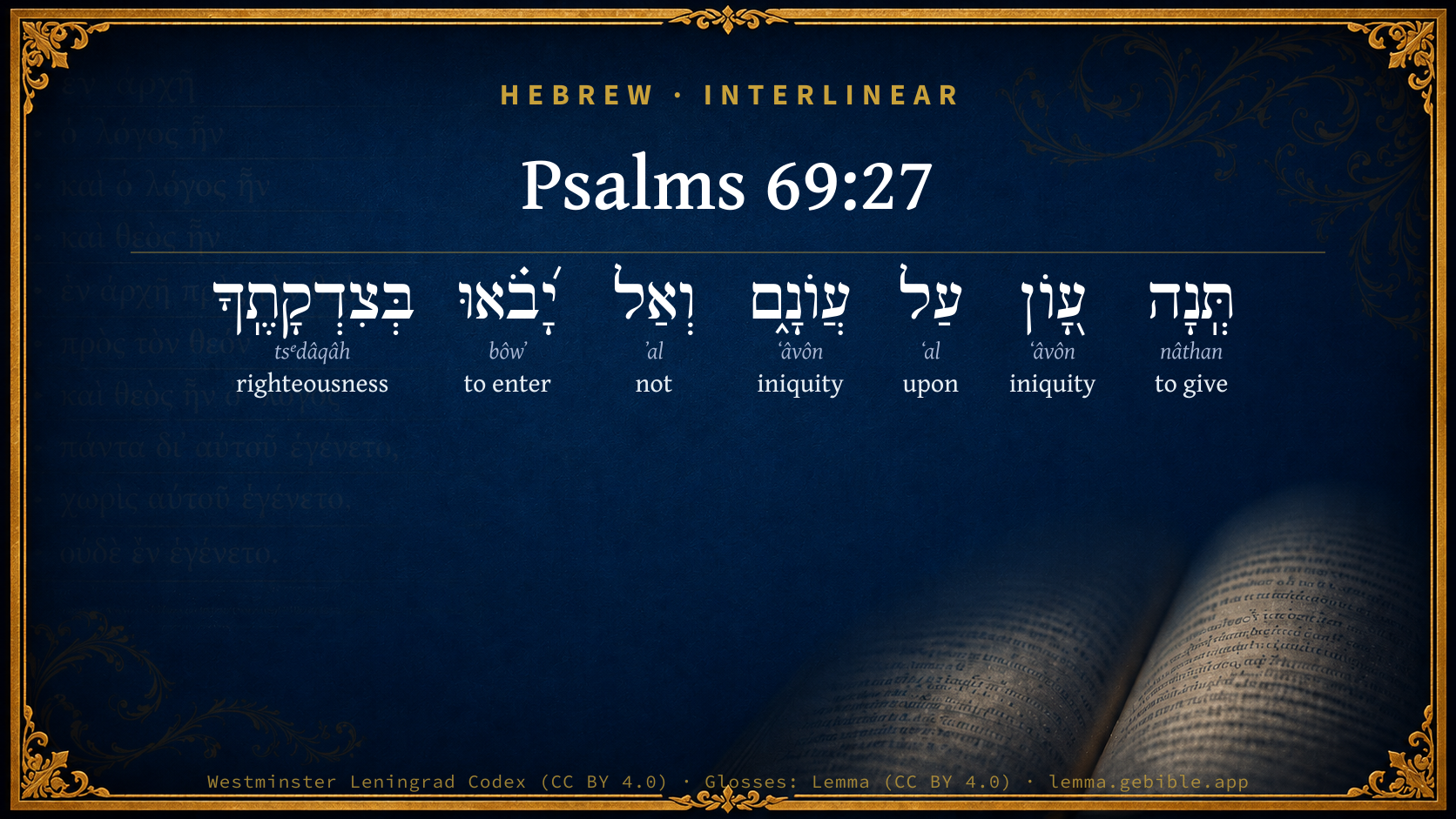
Hebrew (Westminster Leningrad Codex) Psalms 69:27 appears in the Hebrew Old Testament. The text above is from the Westminster Leningrad Codex. Each word links to its Strong’s number, a concise gloss, and parsing drawn from the Open Scriptures Hebrew Bible morphology. Click any word for its full Brown-Driver-Briggs (BDB) entry.
Download image
Cite this verse

Psalms 69:27 (World English Bible). Public Domain. Lemma interlinear Bible study tool, https://lemma.gebible.app/v/psalms/69/27.

Show BibTeX & RIS
BibTeX
RIS
English Translation
Charge them with crime upon crime. Don't let them come into your righteousness.
World English Bible · Public Domain
Download a study sheet

One document with this verse’s original text, its word-by-word gloss line, the meaning frame, cross-references with their text, attributed commentary, and full source and license credits — printable, and it pastes into notes with its structure intact.

This verse Autodidact and up

Study sheet (.html) Plain text (.txt)

A passage Seminary Student

Up to 50 verses in one chapter. A passage sheet keeps up to 6 commentary sources and 12 cross-references per verse, in the order this page ranks them, and says so on the sheet whenever that leaves anything out. Ask for a single verse and you get the Autodidact verse sheet above.

Everything on this page stays free to read, with no account — the sheet is a download of what is already on screen, not access to it.

Want to remove ads? Support Godless Engineer
Compare translations 3

The same verse in 3 English versions, stacked beneath the original-language interlinear above. Click any original word for its lexicon entry.

Each is an independent rendering of the whole verse — the interlinear is not word-aligned to these translations.

Highlighted words mark where these versions differ — a whole-verse word diff, not a word-by-word alignment.

  • World English Bible Public Domain
    Charge them with crime upon crime. Don't let them come into your righteousness.
  • King James Version Public Domain
    Add iniquity unto their iniquity: and let them not come into thy righteousness.
  • unfoldingWord Literal Text CC BY-SA 4.0
    Add iniquity to their iniquity, and let them not come into your righteousness.

unfoldingWord Literal Text — © unfoldingWord, licensed CC BY-SA 4.0. Word-aligned USFM3 via Door43 (git.door43.org/unfoldingWord/en_ult).

Versions to compare (up to 4)

3 of 4 selected

Show all 18 translations

Every available English version of this verse, each an independent rendering of the whole verse.

  • World English Bible Public Domain
    Charge them with crime upon crime. Don't let them come into your righteousness.
  • Berean Standard Bible Public Domain
    Add iniquity to their iniquity; let them not share in Your righteousness.
  • Majority Standard Bible Public Domain
    Add iniquity to their iniquity; let them not share in Your righteousness.
  • King James Version Public Domain
    Add iniquity unto their iniquity: and let them not come into thy righteousness.
  • American Standard Version (1901) Public Domain
    Add iniquity unto their iniquity; And let them not come into thy righteousness.
  • Revised Version (1885) Public Domain
    Add iniquity unto their iniquity: and let them not come into thy righteousness.
  • Geneva Bible (1599) Public Domain
    Laie iniquitie vpon their iniquitie, and let them not come into thy righteousnesse.
  • Douay-Rheims (1899) Public Domain
    Because they have persecuted him whom thou hast smitten; and they have added to the grief of my wounds.
  • Young's Literal Translation Public Domain
    Give punishment for their iniquity, And they enter not into Thy righteousness.
  • Literal Standard Version CC BY-SA 4.0
    Give punishment for their iniquity, || And they do not enter into Your righteousness.
  • Unlocked Literal Bible CC BY-SA 4.0
    Accuse them of having committed iniquity after iniquity; do not let them come into your righteous victory.
  • unfoldingWord Literal Text CC BY-SA 4.0
    Add iniquity to their iniquity, and let them not come into your righteousness.
  • Darby Bible Public Domain
    Add iniquity unto their iniquity, and let them not come into thy righteousness.
  • World Messianic Bible Public Domain
    Charge them with crime upon crime. Don’t let them come into your righteousness.
  • Webster's Bible Public Domain
    \\69:26\\For they persecute him whom thou hast smitten; and they talk to the grief of those whom thou hast wounded.
  • Free Bible Version CC BY-SA 4.0
    Punish them for the evil they have done. Don't acquit them.
  • Bible in Basic English Public Domain
    Let their punishment be increased; let them not come into your righteousness.
  • JPS Tanakh (1917) Public Domain
    (69-28) Add iniquity unto their iniquity; and let them not come into Thy righteousness.

Literal Standard Version (2020), Covenant Press — licensed CC BY-SA 4.0. Text via the HelloAO Bible API (eBible.org). Unlocked Literal Bible (unfoldingWord) — licensed CC BY-SA 4.0. Text via the HelloAO Bible API (eBible.org). unfoldingWord Literal Text — © unfoldingWord, licensed CC BY-SA 4.0. Word-aligned USFM3 via Door43 (git.door43.org/unfoldingWord/en_ult). Free Bible Version, Dr. Jonathan Gallagher — licensed CC BY-SA 4.0. Text via the HelloAO Bible API (eBible.org).

Word by word

More ways to search: Search by grammar → Find every occurrence → Compare this word →

Practice this passage: Drill this verse → Learn its vocabulary →

בְּצִדְקָתֶֽךָ
tsᵉdâqâh
H6666
“in/at · righteousness · your”
Preposition + Noun, Common, Feminine, Singular, Construct + Suffix, Personal, 2nd Person, Masculine, Singular
Part of Speech
Preposition + Noun
Type
Common
Gender
Feminine
Number
Singular
State
Construct
Full BDB Definition

Origin: from H6663

TWOT: 1879b

justice, righteousness - righteousness (in government) - of judge, ruler, king - of law - of Davidic king Messiah - righteousness (of God's attribute) - righteousness (in a case or cause) - righteousness, truthfulness - righteousness (as ethically right) - righteousness (as vindicated), justification, salvation - of God - prosperity (of people) - righteous acts
  1. תְּֽנָה nâthan H5414 “give” Verb, Qal, Imperative, 2nd Person, Masculine, Singular + Suffix, h
  2. עָ֭וֺן ʻâvôn H5771 “iniquity” Noun, Common, Both, Singular, Absolute
  3. עַל ʻal H5921 “upon” Preposition
  4. עֲוֺנָ֑ם ʻâvôn H5771 “iniquity · their” Noun, Common, Both, Singular, Construct + Suffix, Personal, 3rd Person, Masculine, Plural
  5. וְאַל ʼal H408 “and · not” Conjunction + Particle, Negative
  6. יָ֝בֹ֗אוּ bôwʼ H935 “to enter” Verb, Qal, Jussive, 3rd Person, Masculine, Plural

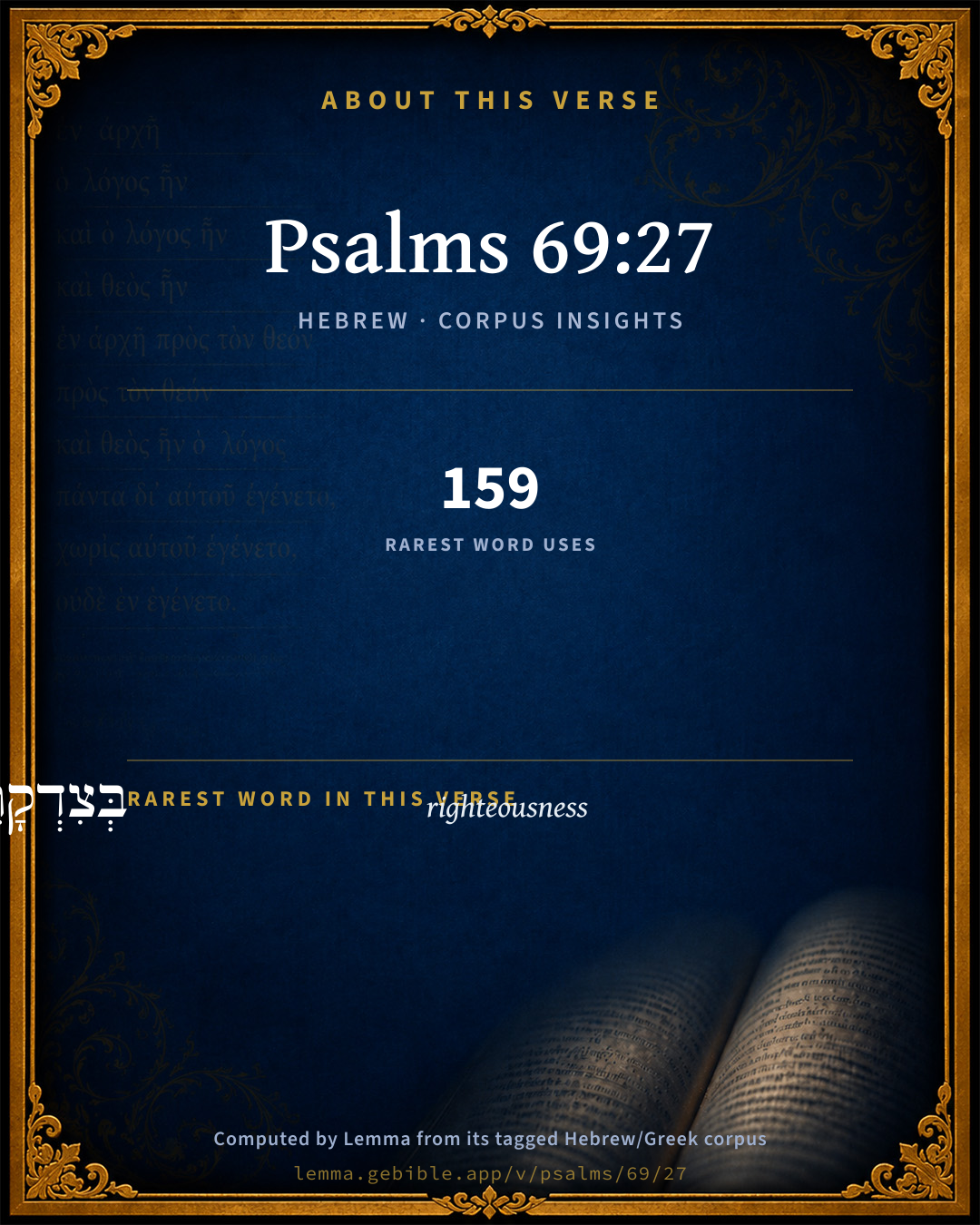
About this verse

These counts appear in no published source. They are computed here, from the morphology-tagged text and Lemma’s own curated glosses. What Lemma adds →

7
words
6
distinct lemmas
Wisdom
section

Grammatical profile

  • 2 verbs
  • 3 nouns
  • 1 preposition
  • 1 particle

Verb forms

  • תְּֽנָה Qal · Imperative
  • יָ֝בֹ֗אוּ Qal · Jussive

Repetition

A word recurs within this verse — often emphatic in Hebrew:

  • עָ֭וֺן iniquity H5771 ×2

Hebrew & Septuagint length

In English translation the verse runs 13 words from the Hebrew and 13 from the Septuagint (LXX English) — the same length.

A rough comparison of the two English renderings, which tokenize alike — not a word-level alignment.

Word counts can differ between the Hebrew and the Greek without any difference in meaning — e.g. the Hebrew direct-object marker אֵת has no separate Greek word, and Greek often adds the article ὁ.

Cross-references

21

Topical passages linked to Psalms 69:27 in the Treasury of Scripture Knowledge — connected by theme and wording, ordered by reader-vote popularity; previews shown in the World English Bible.

  • Nehemiah 4:5 and don't cover their iniquity, and don't let their sin be blotted out from before you; for they have provoked [you] to anger before the builders.
  • Isaiah 26:10 Let favor be shown to the wicked, yet will he not learn righteousness; in the land of uprightness will he deal wrongfully, and will not see the majesty of Yahweh.
  • Romans 1:28 Even as they refused to have God in their knowledge, God gave them up to a reprobate mind, to do those things which are not fitting;
  • Revelation 22:10–11 He said to me, "Don't seal up the words of the prophecy of this book, for the time is at hand.
  • 2 Thessalonians 2:11–12 Because of this, God sends them a working of error, that they should believe a lie;
  • Romans 10:2–3 For I testify about them that they have a zeal for God, but not according to knowledge.
  • 2 Timothy 4:14 Alexander, the coppersmith, did much evil to me. The Lord will repay him according to his works,
  • Exodus 8:15 But when Pharaoh saw that there was a respite, he hardened his heart, and didn't listen to them, as Yahweh had spoken.
  • Exodus 8:32 Pharaoh hardened his heart this time also, and he didn't let the people go.
  • Exodus 9:12 Yahweh hardened the heart of Pharaoh, and he didn't listen to them, as Yahweh had spoken to Moses.
  • Leviticus 26:39 Those of you who are left will pine away in their iniquity in your enemies' lands; and also in the iniquities of their fathers shall they pine away with them.
  • Psalms 81:12 So I let them go after the stubbornness of their hearts, That they might walk in their own counsels.
  • Psalms 109:14 Let the iniquity of his fathers be remembered by Yahweh. Don't let the sin of his mother be blotted out.
  • Matthew 23:31–32 Therefore you testify to yourselves that you are children of those who killed the prophets.
  • Matthew 27:4–5 saying, "I have sinned in that I betrayed innocent blood." But they said, "What is that to us? You see to it."
  • Romans 9:18 So then, he has mercy on whom he desires, and he hardens whom he desires.
  • Romans 9:31 but Israel, following after a law of righteousness, didn't arrive at the law of righteousness.
  • Psalms 24:5 He shall receive a blessing from Yahweh, Righteousness from the God of his salvation.
  • Psalms 109:17–19 Yes, he loved cursing, and it came to him. He didn't delight in blessing, and it was far from him.
  • Isaiah 5:6 I will lay it a wasteland. It won't be pruned nor hoed, But it will grow briers and thorns. I will also command the clouds that they rain no rain on it."
  • Matthew 21:19 Seeing a fig tree by the road, he came to it, and found nothing on it but leaves. He said to it, "Let there be no fruit from you forever!" Immediately the fig tree withered away.

Cross-references courtesy of OpenBible.info (CC BY 4.0).

Hebrew and Greek witnesses Masoretic Hebrew ↔ Greek Septuagint

The same verse in the two great witnesses to the Old Testament, shown verse-for-verse.

You’re reading Greek Psalm 68 (Hebrew Psalm 69). The Septuagint counts the superscription, so verse numbers can differ from the Hebrew — chapter-level alignment, not verse-by-verse. Numbering follows Rahlfs.

These are two independent witnesses, not word-aligned to each other, and the Septuagint is shown in lemma (dictionary) form.

Hebrew Psalms 69:27 Masoretic · Westminster Leningrad Codex

תְּֽנָה עָ֭וֺן עַל עֲוֺנָ֑ם וְאַל יָ֝בֹ֗אוּ בְּצִדְקָתֶֽךָ

Charge them with crime upon crime. Don't let them come into your righteousness.

World English Bible · Public Domain

Greek LXX Greek Psalm 68:27 Septuagint · lemma form

ὅτι ὅς σύ πατάσσω αὐτός καταδιώκω καί ἐπί ὁ ἄλγος ὁ τραυματίας σύ προςτίθημι

Add iniquity to their iniquity; and let them not come into your righteousness.

LXX2012 (modern English Septuagint) · Public Domain

Hebrew: Westminster Leningrad Codex (CC BY 4.0). Greek: Septuagint (public domain); English from LXX2012 (modern English Septuagint) (Public Domain). How the Septuagint differs from the Hebrew →

Commentary

Notes on Psalms 69:27 from classic Christian and Jewish commentators (each source and its license shown beneath its notes). The classic Christian expositions comment on the surrounding passage and are grouped to its opening verse, so a note may address several verses; the Jewish commentaries on the Tanakh (Rashi and others) are per-verse, so they appear only where the commentator wrote on this verse.

Lemma curates 59 commentaries, every one of them public domain or Creative Commons licensed, each selected and text-cleaned for this edition rather than reprinted as found. About our sources →

The Cambridge Bible for Schools and Colleges

gen. ed. J. J. S. Perowne

27. Some commentators, retaining the A.V. rendering of Psa_69:26, regard Psa_69:27-28 as the words of the Psalmist’s enemies, directed against him and his fellow sufferers. This interpretation has been advocated, as removing from the mouth of the Psalmist at any rate the most terrible anathemas. But perplexing as it may be, it is far more natural to see in these verses the climax of his imprecations.

Add iniquity &c.] Instead of taking away their iniquities by forgiveness, let one iniquity accumulate upon another till they are crushed by the load. Cp. Psa_38:4; Jer_18:23.

let them not come into thy righteousness] Let them have no share in the manifestation of that righteousness or faithfulness to His covenant in virtue of which Jehovah pardons sin and delivers from danger. Cp. Psa_5:8; Psa_71:2; Psa_71:15; Psa_71:19; Psa_71:24.

The Cambridge Bible for Schools and Colleges (gen. ed. J. J. S. Perowne; Cambridge University Press, 1878–1918) — public domain. Text from a community e-Sword module.

Trapp's Complete Commentary

John Trapp

Psa 69:27 Add iniquity unto their iniquity: and let them not come into thy righteousness.

Ver. 27. Add iniquity unto their iniquity] Punish one sin with another (by giving them up to a reprobate sense, to an incurable hardness), and plague them soundly for their sin. The same Hebrew word signifieth both sin and punishment; these two are tied together with chains of adamant.

And let them not come into thy righteousness] i.e. Hold them not righteous, nor bestow upon them thy crown of righteousness.

John Trapp, A Commentary or Exposition upon All the Books of the Old and New Testament (1647–1656) — public domain. Text from a community e-Sword module.

The Biblical Illustrator

Joseph S. Exell

Psa_69:27-28

Add iniquity unto their iniquity: and let them not come into Thy righteousness.

Imprecations in the Psalms

There are tones in the Psalter which seem to jar upon our feelings, which do not naturally or readily adapt themselves to our Christian sentiment. There is an outburst of vindictive joy and exultation in the punishment of the wicked; there is an almost savage delight in the destruction of oppressors, as in Psa_137:9. There are withering imprecations, so fierce and so elaborately wrought, that it makes ones blood run cold to see them. How are we to account for these, and to take them on our lips and read them in our services? There are some who would persuade us that they are capable of an application to our spiritual struggles, that the enemies which we have to face are not persecutors and tyrants such as the oppressors of Israel of old, that we wrestle net with flesh and blood, etc. Accordingly, the language of the Psalms may be turned, they say, from its original sense into a spiritual channel. But how is it possible to carry out such a principle of interpretation consistently? How in our spiritual warfare may we adopt with definite meaning such words as these: Set Thou an ungodly man to be ruler over him, and let Satan stand at his right hand: Let him be blotted out of the book of the living? The unnatural strain which must be put upon the words to make them fit into such a system of interpretation ought to have compelled expositors long ago to abandon it. But let us try to look more carefully at the exact position of the psalmists of old, and then, I think, we may arrive at a more natural and truer explanation. The truth is, these words are a striking proof of that intense reality of which I have been speaking. The Jewish psalmists, remember, are the mouthpiece of injured innocence. These are the natural accents of the martyr Church; the afflicted people of God are, almost in every psalm, crushed, borne down because of the oppression of the enemy. Whether the enemies be foreign oppressors or ungodly men who have risen to high office, in any case they have power, and exercise it unscrupulously against those who love God, and it is this which rouses the indignation of the psalmist, and it is an intolerable thing to see high-handed wickedness triumph. It does seem like an arraignment of the very justice of the Most High when the ungodly ravish the poor, and say, as in defiance of the Eternal Majesty, There is no God, or He hideth His face. The true heart rises up against this: the true heart on the side of God longs to see His righteousness vindicated, and so, even in the calmest moments of their lives, when their hearts are full of Gods goodness, or when they are lost in the contemplation of nature, they still recur to the same theme, and the 104th psalm, which has won the admiration of so many high intellects for its matchless description of the beauty and splendour of creation, ends with the devout and ardent conviction that sinners will be consumed out of the earth, and the ungodly shall come to an end. Still, we must ask ourselves, Are we justified in taking these burning anathemas on our lips? Is such language in harmony with our Christian consciousness? Is there no difference in this respect between the Old Testament and the New? I believe there is. Our Lord Himself tells us there is, and warns us against the excess of a fiery zeal. The spirit of Elijah is not the spirit of Christ. Even the spirits of David and of St. Paul are not the same. And this must be so, because the revelations of God in the Old Testament and in the New are not the same. The law given on Sinai was stern and inexorable in its punishment, and the soldiers of God were sent to execute His judgments with a two-edged sword in their hands, and the prayers and praises of God in their mouths. It was their mission to exterminate all ungodliness and idolatry; but Jesus Christ, the incarnate revelation of God, came in lowliness and meekness, teaching and practising forbearance and forgiveness, enduring contradiction of sinners against Himself, giving His back to the smiter, and His cheek to them that plucked off the hair, not hiding His face from shame and spitting, and as He dies on the cross, interceding for His murderers--Father, forgive them, for they know not what they do. Unquestionably there is a progress in Divine revelation, and we ought to bear it in mind. What is it that we really learn in the New Testament from passages like those of which I have been speaking? Is it indifference? Is it calm acquiescence in injustice? Is it tolerance of iniquity? Is it coldness towards God and His truth? Most certainly not. It is stern repression, not of our natural sense of justice, but of hatred of individuals; it is to forego personal revenge; it is to bear with personal injuries and wrongs. That is the temper which the Gospel cultivates. I am sure we cannot love God with all our heart unless we hate sin with all our heart; but it is sin we are to hate, not the sinner. Hero we are to draw the distinction which the psalmists of old did not draw and could not draw. But it is wickedness that is to arouse our indignation, not differences of religious opinion. It is the grossest perversion of the psalms when these burning words are turned into a justification of theological hatred and strife. Oh, how sad it is to think that Christian men, knowing that there is all this awful wickedness seething in their midst and around them, can turn aside from the real battle, can so far misunderstand and mistake who their real foes are, that they can give their time and thoughts to angry quarrellings about matters of the most trivial and insignificant importance, about petty questions of ritual and ceremonial and forms of worship, instead of girding up all their energies to go forth into that great battle which is going on in this world between God Himself and all the powers of evil that are arrayed against Him, God give us more of the charity of Jesus Christ our Lord, more of His love in our hearts, a more yearning desire to go forth into the world in order that we may win the world to its true Lord and Master. That is the true charity; that is the true love; that is the true hatred of evil. (Bp. Perowne.)

Davids imprecations

A renowned professor who, as Germany thinks, has done more for New England theology than any man since Jonathan Edwards, was once walking with a clergyman of a radical faith, who objected to the doctrine that the Bible is inspired, and did so on the ground of the imprecatory psalms. The replies of the usual kind were made, and it was presumed that David expressed the Divine purpose in praying that his enemies might be destroyed, and that he gave utterance only to the natural righteous indignation of conscience against unspeakable iniquity. But the doubter would not be satisfied. The two came at last to a newspaper bulletin, on which the words were written: Baltimore to be shelled at twelve oclock. I am glad of it, said the Radical preacher. I am glad of it. And so am I, said his companion; but I hardly dare say so, for fear you should say that I am uttering an imprecatory psalm. (Joseph Cook.)

The Biblical Illustrator, edited by Joseph S. Exell (c. 1880s–1900s) — public domain. Text from a community e-Sword module.

Joseph Benson's Commentary

Psa 69:27. Add iniquity to their iniquity — Or, give or permit, as תנה, tenah, may be properly rendered. The old version expresses the psalmist’s meaning accurately, Let, or permit, them to fall from one wickedness to another. It is not unusual with God, as a punishment of some great sin or sins, though not to infuse into men any evil, yet, by withdrawing his grace, and leaving them to themselves, to suffer them to commit more sins, and to be so far from being reformed, as daily to grow worse and worse, and at last to become quite obdurate and irreclaimable. The words, however, may be rendered, Add punishment to their punishment, (for the word עוןis often put for the punishment of iniquity.) Send one judgment upon them after another, without ceasing. And let them not come into thy righteousness — Into that way of obedience which thou requirest, and which thou wilt accept, the obedience of faith in the Messiah and his gospel, producing love, and universal holiness and righteousness; or, to thy mercy, thy pardoning mercy, as the original word frequently signifies, so as to be made partakers of it. Let them not obtain an interest in the everlasting righteousness which the Messiah shall bring into the world, Dan 9:24; the righteousness of God by faith, revealed in the gospel, and witnessed by the law and the prophets, Php 3:9; Rom 1:17; and Rom 3:9, &c., according to which God justifies the ungodly, and accepts them as righteous in his sight. For this was the righteousness which the Jews rejected, Rom 10:3, according to this prediction. Thus, as the first branch of this verse foretels their being guilty of many sins, and adding iniquity to iniquity, so this predicts their rejection of, and therefore their exclusion from, an interest in the only remedy, the remission of sins through faith in the Mediator, and the holiness and happiness consequent thereon.

Joseph Benson's Commentary on the Old and New Testaments (1811–1818) — public domain. Text from a community e-Sword module.

J. A. Alexander on Psalms

Joseph Addison Alexander

28. (Psa 69:27). Give (or place) iniquity upon iniquity, and let them not come into thy righteousness. Luther and others understand the first clause as a prayer that sin may be made the punishment of sin (Rom 1:28). But there seems to be rather an allusion to the double sense of the equivocal term, which properly denotes sin as such or in itself considered, but sometimes seems to mean sin considered in its consequences or effects. Thus understood, it is a prayer that sin may be followed by the natural effects of sin. The righteousness of God is that which he bestows by the judicial act of justification, including pardon. To come into it is to come into possession or enjoyment of it, to become a sharer in it.

Joseph Addison Alexander, The Psalms Translated and Explained (1850) — public domain. Text from a community e-Sword module.

Geneva Bible (1599)

Geneva Bible translators

By their continuance and increasing in their sins, let it be known that they be of the reprobate.

Geneva Bible (1599) marginal notes — public domain. Text via Bolls.life.

Jamieson, Fausset & Brown

Robert Jamieson, A. R. Fausset & David Brown

iniquity--or, "punishment of iniquity" (Psa 40:12).

come . . . righteousness--partake of its benefits.

Jamieson, Fausset & Brown — Commentary Critical and Explanatory on the Whole Bible (1871) — public domain (CC PDM 1.0). Text via the HelloAO Bible API.

Adam Clarke's Commentary

Verse 27. Add iniquity unto their iniquity] תנה עון על עונם tenah avon al avonam; give iniquity, that is, the reward of it, upon or for their iniquity. Or, as the original signifies perverseness, treat their perverseness with perverseness: act, in thy judgments, as crookedly towards them as they dealt crookedly towards thee. They shall get, in the way of punishment, what they have dealt out in the way of oppression.

Adam Clarke's Commentary on the Bible (1810–1826) — public domain. Text from a community e-Sword/MySword module.

John Calvin's Commentaries

27. Add iniquity to their iniquity. As the Hebrew word און, avon, signifies at times guilt as well as iniquity, some translate the verse thus, Add thou, that is, thou, O God! punishment to their punishment Others extend it yet further, regarding it as a prayer that wicked men might punish them for their wickedness. But it is abundantly evident, from the second clause, that what David prays for rather is, as is almost universally admitted, that God, taking his Spirit altogether from the wicked, would give them over to a reprobate mind, that they might never seek or have any desire to be brought to genuine repentance and amendment. Some interpret the phrase to come into righteousness as meaning to be absolved or acquitted; but it seems to want the spirit of the language here used, by which David intends to express much more. Accordingly, the words ought to be expounded thus: Let their wickedness increase more and more, and let them turn away with abhorrence from all thought of amendment, to make it manifest that they are utterly alienated from God. As this form of expression is familiar to the Sacred Writings, and every where to be met with, we ought not to think it harsh; and to wrest it, as some do, for the sake of avoiding what may have the appearance of absurdity, is ridiculous. The explanation they give of it is, That God adds sins to sins by permitting them; and they defend such an exposition by asserting that this is an idiom of the Hebrew language, an assertion, the accuracy of which no Hebrew scholar will admit. Nor is it necessary to bring forward any such quibbles to excuse God; for, when he blinds the reprobate, it is sufficient for us to know that he has good and just causes for doing so; and it is in vain for men to murmur and to dispute with him, as if they sinned only by his impulse. Although the causes why they are blinded sometimes lie hidden in the secret purpose of Deity, there is not a man who is not reproved by his own conscience; and it is our duty to adore and admire the high mysteries of God, which surpass our understanding. It is justly said that “God’s judgments are a great deep,” (Psalm 36:6.) It would certainly be highly perverse to involve God in a part of the guilt of the wicked, whenever he executes his judgments upon them; as, for example, when he executes the judgment threatened in the passage before us. The amount is, that the wicked are plunged into a deep gulf of wickedness by the just vengeance of Heaven, that they may never return to a sound understanding, and that he who is filthy may become still more filthy, (Revelation 22:11.) Let it further be observed, that I do not explain the righteousness of God as denoting the righteousness which he bestows upon his chosen ones in regenerating them by his Holy Spirit, but the holiness manifested in the life which is so well-pleasing to him.

John Calvin's Commentaries (1540-1563) — public domain. Text from the Calvin Translation Society English edition (1840s-50s) via the Christian Classics Ethereal Library (ccel.org). Calvin's coverage is partial (roughly two-thirds of the Bible); uncommented books and verses are honest gaps, never fabricated. The 19th-century editor's footnotes and remarks are omitted so the notes are faithfully Calvin's own voice.

Ellicott's Commentary for English Readers

(27) Add iniquity—This may be understood in two different senses: (1) Let sin be added to sin in thy account, till the tale be full. (2) Add guilt for guilt, i.e., for each wrong committed write down a punishment.

And let them not . . .—i.e., let them not be justified in thy sight; not gain their cause at thy tribunal.

(27, 28) It is doubtful whether these verses give the talk of the enemies just mentioned, or whether the psalmist himself, after a pause, resumes his imprecations. The former supposition certainly adds a fresh force to the prayer of Psa_69:29; and it is more natural to suppose that the string of curses, once ended, should not be taken up again. On the other hand, would the apostates, against whom the psalm is directed, have put their animosity into the shape of a wish to have names blotted out of God’s book? If so, it must be in irony.

A Bible Commentary for English Readers, edited by Charles John Ellicott (1878–1897) — public domain. Text from a community e-Sword module.

John Gill's Exposition

Add iniquity to their iniquity,.... Let them alone in sin; suffer them to go on in it; lay no restraints upon them; put no stop in providence in their way; let them proceed from one evil to another, till they fall into ruin: to their natural and acquired hardness of heart, give them up to a judicial hardness; that they may do things that are not convenient, and be damned. Suffer them not to stop at the crucifixion of the Messiah; let them go on to persecute his apostles and followers; to show the utmost spite and malice against the Christian religion; to embrace false Christs, and blaspheme the true one; to believe the greatest lies and absurdities, and commit the foulest of actions; as seditions, rapines, murders, &c. as they did while Jerusalem was besieged; that they may fill up the measure of their sins, and wrath may come upon them to the uttermost, Th1 2:15. The word rendered "iniquity", sometimes signifies "punishment", as in Gen 4:13; and, according to this sense of it, the words may be differently rendered, and admit a different meaning; either, "give punishment for their iniquity" (m); so Kimchi; that is, punish them according to their deserts, as their sins and iniquities require: or, "add punishment to their punishment" (n); to their present temporal punishment before imprecated, relating to their table mercies, their persons, and their habitations, add future and everlasting punishment; let them be punished with everlasting destruction, soul and body, in hell;

and let them not come into thy righteousness; meaning, not his strict justice or righteous judgment; into that they would certainly come; nor was it the will of the Messiah they should escape it: but either the goodness, grace, and mercy of God, which is sometimes desired by righteousness, as in Psa 31:1; and the sense is, let them have no share in pardoning grace now, nor obtain mercy in the last day; but be condemned when they are judged, Psa 109:7. Or rather, the righteousness of Christ, which is called the righteousness of God, that is, the Father; because he approves and accepts of it, and imputes it to his people without works: and seeing the Jews sought for justification by their own works, and went about to establish their own righteousness, and submitted not to Christ's, but despised and rejected it; it was but just that they should be excluded from all benefit and advantage by it, as is here imprecated. The Targum is,

"and let them not be worthy to come into the congregation of shy righteous ones;''

neither here, nor at the last judgment; see Psa 1:5.

(m) "da punitionem iniquitatis", Pagninus; "appone illis poenam pro iniquitate", Muis. (n) So Junius & Tremellius.

John Gill's Exposition of the Whole Bible (1746–1763) — public domain (CC PDM 1.0). Text via the HelloAO Bible API.

Albert Barnes' Notes on the Bible

Add iniquity unto their iniquity - Margin, “punishment of iniquity.” The literal rendering is, “Give iniquity upon their iniquity.” Luther understands this as a prayer that “sin may be made a punishment for sin;” that is, that they may, as a punishment for their former sins, be left to commit still more aggravated crimes, and thus draw on themselves severer punishment. So Rosenmuller renders it, “Suffer them to accumulate sins by rushing from one sin to another, until their crimes are matured, and their destined punishment comes upon them.” An idea similar to this occurs in Rom 1:28, where God is represented as having “given the pagan over to a reprobate mind, to do those things which are not convenient” fit, or proper - “because they did not like to retain him in their knowledge.” Perhaps this is the most natural interpretation here, though another has been suggested which the original will bear. According to that, there is an allusion here to the double sense of the equivocal term rendered “iniquity” - עון ‛âvôn - which properly denotes sin as such, or in itself considered, but which sometimes seems to denote sin in its consequences or effects. This latter is the interpretation adopted by Prof. Alexander. Thus understood, it is a prayer that God would add, or give, to their sin that which sin deserved; or, in other words, that he would punish it “as” it deserved.

And let them not come into thy righteousness - Let them not be treated “as” righteous; as those who are regarded by “thee” as righteous. Let them be treated as they deserve. This is the same as praying that a murderer may not be treated as an innocent man; a burglar, as if he were a man of peace; or a dishonest man, as if he were honest. Let people be regarded and treated as they “are in fact;” or, as they deserve to be treated. It seems difficult to see why this prayer may not be offered with propriety, and with a benevolent heart - for to bring this about is what all officers of justice are endeavoring to accomplish.

Albert Barnes' Notes on the Bible (1834–1885) — public domain. Text from a community e-Sword/MySword module.

Matthew Poole's English Annotations

Add iniquity to their iniquity; give them up to their own vain minds and vile lusts, and to a reprobate sense, and take off all the restraints of thy grace and providence, and expose them to the temptations of the world and of the devil, that so they may grow worse and worse, and at last may fill up the measure of their sins; as is said, Mat 12:32; compare Rom 1:28,29. Or, Add punishment to their punishment; as this word is oft taken. Send one judgment upon them after another, without ceasing. Let them not

come into thy righteousness; let them never partake of thy righteousness, i.e. either,

1. Of thy faithfulness, in making good thy promises to them. Or,

2. Of thy mercy and goodness. Or rather,

3. Of thy righteousness, properly so called, of that everlasting righteousness which the Messiah shall bring into the world, Dan 9:24, which is called the righteousness of God, Rom 1:17; Phi 3:9, &c., which is said to be witnessed by the law and the prophets, Rom 3:21, by and for which God doth justify or pardon sinners, and accept them in Christ as righteous persons. For this was the righteousness which the Jews rejected to their own ruin, Rom 10:3, according to this prediction. Thus as the first branch of the verse maketh or supposeth them guilty of many sins, so this excludes them from the only remedy, the remission of their sins. And that justifying rather than sanctifying righteousness is here meant seems most probable from the phrase, which seems to be a judicial phrase, as we read of coming or entering into judgment, Job 22:4; 34:23, and into condemnation, Joh 5:24, opposite unto which is this phrase, of coming into justification; or, which is all one, into thy righteousness.

Matthew Poole's English Annotations on the Holy Bible (1683–1685) — public domain. Text from a community e-Sword/MySword module.

The Treasury of David

Charles H. Spurgeon

Ver. 27. Add iniquity unto their iniquity. Unbelievers will add sin to sin, and so, punishment to punishment. This is the severest imprecation, or prophecy, of all. For men to be let alone to fill up the measure of their iniquity, is most equitable, but yet most awful.

And let them not come into thy righteousness. If they refuse it, and resist thy gospel, let them shut themselves out of it.

"He that will not when he may,

When he would he shall have nay."

Those who choose evil shall have their choice. Men who hate divine mercy shall not have it forced upon them, but (unless sovereign grace interpose) shall be left to themselves to aggravate their guilt, and ensure their doom.

Ver. 27. Add iniquity unto their iniquity. This is that retaliation of sin which God returns into their bosoms that foster it; that since "they loved cursing, it shall be unto them." Ps 109:17. So David here (though it was not in him precantis votum, but prophetantis vaticinium, he did not desire it to be so, but he knew it would be so), Add iniquity unto their iniquity. Neither doth God this by infusion of wickedness, but by subtraction of his Spirit. He is causa deficiens, non efficiens: as the recalling of the sun from us causeth darkness; so the privations of grace creates the prevalence of ungodliness. It is in him not peccatum sed judicum, --not sin, but judgment. When he leaves us to ourselves, it is no wonder if we fall into horrid and prodigious sins. Peccatum est malum in se: effectum prioris mali, et causa subsequentis: est et supplicium, et causa supplicii: Sin is evil in itself, the effects of former evil, the cause of future: it is both punishment itself, and the cause of punishment. In all the storehouse of God's plagues there is not a greater vengeance. With other punishments the body smarts; the soul groaneth under this. Hence, sins multiply without limits, that the plagues may be without end. Every affliction is sore that offends us; but that is direful which offends God. Such do at once act and suffer: it is both an active and a passive sin. The punishment they suffer is (in them) sin; the sin they do is (from God) a punishment. Thomas Adams.

Ver. 27. Add iniquity unto their iniquity. Or, as the original signifies, perverseness, treat their perverseness with perverseness: act, in thy judgments, as crookedly towards them as they dealt crookedly towards thee. They shall get, in the way of punishment, what they have dealt out in the way of oppression. Adam Clarke.

Ver. 27. Add iniquity unto their iniquity. Sin, carried far enough, becomes its own punishment. Let but a voracious glutton be bound to sit at a well furnished table but two hours after he had filled his stomach, he would account it an intolerable penance. Let but the drunkard be forced to drink on with those that can drink him down, how is he a burden to himself, and a scorn to his fellow drunkards! Let but a lazy sluggard be confined three days to his bed, and how weary will he be of his bed of down! How is the idle person more weary of his idleness than another is of work! Samuel Annesley (1620-1696), in "Morning Exercises."

None.

Psalms 69:28*

Charles H. Spurgeon's The Treasury of David (1869–1885) — public domain. Psalms only. Text from a community e-Sword/MySword module.

Whedon's Commentary on the Bible

Daniel D. Whedon

27. Add iniquity unto… iniquity—That is, “Let it all stand against them in thy book; one sin after another, as committed, not being blotted out, but only swelling the fearful reckoning.”—Perowne. Hold them accountable for every act, omitting nothing. See Jer_18:23; Ecc_12:14. The terribleness of such a condition can be realized only by comparing such passages as Job_9:3, Psa_130:3; Psa_143:2.

Let them not come into thy righteousness—That is, as wicked men let them not avail themselves of the benefits or immunities of righteousness, as if they were righteous persons. The case is now supposed to have gone to judgment, and the offenders stand by their works alone. This corresponds with the first member of the verse. As they have despised mercy and stand upon justice, so add up their sins without omitting one, and withhold the benefits of law which would accrue to a righteous man. However harsh this may seem, it is simply the course of justice. An irregular and inexact accountability, with an undiscriminating award of justice, belong only to the worst of human governments. But such expressions as these always assume the case to be one of obstinate and contemptuous impenitence, like Mat_23:33-36. Only upon the contingency of their remaining in this state do the maledictions, or rather, the forewarning predictions, apply, for they are to be construed as warnings to arrest their course. See on Psa_109:6. A righteous God could not treat them otherwise. With such as despise both justice and mercy, human obligation and divine authority, the law must take its course. Penalty, in such a case, is the last resource of government for the protection of the innocent, the support of law, and the vindication of the character of God. The whole current of the imprecatory psalms carries along with it this view, and is herein coincident with the whole scheme both of moral government and redemption, whether under the Old Testament or New. God has no law, either in respect to its precept or penalty, concerning which it is not proper for us to pray that it may be applied or enforced according to his mind and published purpose. See Mat_6:15; Mat_7:2; Mat_18:35; Jas_2:13; Rev_6:10

Daniel D. Whedon (gen. ed.), Commentary on the Old and New Testaments (1874–1909) — public domain. Text from a community e-Sword module.

The Pulpit Commentary

Add iniquity unto their iniquity. Either "let them fall from one wickedness to another," as the clause is rendered in the Prayer book Version; or "add to the record of their sin in thy book, a further record of other sins, as they commit them." And let them not come into thy righteousness; i.e. let them not receive the gift of thy justifying grace, and so be counted among thy righteous ones.

The Pulpit Commentary (1880–1919), ed. H.D.M. Spence-Jones & Joseph S. Exell — public domain. Text from a community e-Sword module.

John Wesley's Explanatory Notes

Wilt add - Give them up to their own lusts. Not let them - Partake of thy righteousness, or of thy mercy and goodness.

John Wesley, Explanatory Notes Upon the Whole Bible (1754–1765) — public domain. Text via the GEBible commentary corpus.

Rashi

Rabbi Shlomo Yitzchaki (Rashi)

For this nation, which You smote.

they pursued For You were a little angry, and they helped cause harm.

and about the pain of those whom You wounded they tell their words, to plot: “Let us destroy them while they are in pain.”

Rashi on the Tanakh — English translations: “The Judaica Press complete Tanach with Rashi, translated by A. J. Rosenberg” (CC BY 4.0); “Pentateuch with Rashi's commentary by M. Rosenbaum and A.M. Silbermann, 1929-1934” (public domain); “The Metsudah Tanach series, Lakewood, N.J” (CC BY 4.0); and “The Book of Joshua, Metsudah Publications, 1997” (CC BY 4.0). Text via Sefaria.

Lesson kit

Teaching starters — assembled from the data on this page, not authored interpretation. Every prompt links to the verse data it draws on. Edit before teaching.

Psalms, in the Wisdom, opens this verse with 7 words (6 distinct Hebrew lemmas). Its most distinctive word is tsᵉdâqâh (“righteousness”). A historical commentator’s framing appears above. Read the whole chapter for the surrounding context.

Discussion questions

  1. How does “righteousness” (tsᵉdâqâh) shape what this verse is saying?
  2. Nehemiah 4:5 shares this passage’s theme. How do the two illuminate each other?
  3. “iniquity” occurs 2× in this one verse. What is the effect of the repetition?
  4. These translations render this verse differently; the difference is in the English rendering, not the original. What questions does that raise?
  5. The verb «תְּֽנָה» is Qal Imperative. How does its form color the action?
  6. Reading how The Cambridge Bible for Schools and Colleges and Trapp's Complete Commentary read this verse, where do the two commentators agree and where do they part?

Things to notice

  • These translations choose different wording for 6 words in this verse.
  • “iniquity” occurs 2× in this single verse.
  • 6 distinct Hebrew lemmas span 7 words in this verse.

Reading settings

Reading text

Shown beneath each verse's original-language words.

Old Testament
Old Testament edition

Read the OT as the Masoretic Hebrew (MT) or the Greek Septuagint (LXX).

English shown for the Greek Septuagint (in the Hebrew ↔ Greek comparison).

Comparing translations? Open the Compare panel on any verse page to stack up to four side by side.