Isaiah 30:13

Hebrew (Westminster Leningrad Codex) Isaiah 30:13 appears in the Hebrew Old Testament. The text above is from the Westminster Leningrad Codex. Each word links to its Strong’s number, a concise gloss, and parsing drawn from the Open Scriptures Hebrew Bible morphology. Click any word for its full Brown-Driver-Briggs (BDB) entry.
Download image
Cite this verse

Isaiah 30:13 (World English Bible). Public Domain. Lemma interlinear Bible study tool, https://lemma.gebible.app/v/isaiah/30/13.

Show BibTeX & RIS
BibTeX
RIS
English Translation
therefore this iniquity shall be to you as a breach ready to fall, swelling out in a high wall, whose breaking comes suddenly in an instant.
World English Bible · Public Domain
Download a study sheet

One document with this verse’s original text, its word-by-word gloss line, the meaning frame, cross-references with their text, attributed commentary, and full source and license credits — printable, and it pastes into notes with its structure intact.

This verse Autodidact and up

Study sheet (.html) Plain text (.txt)

A passage Seminary Student

Up to 50 verses in one chapter. A passage sheet keeps up to 6 commentary sources and 12 cross-references per verse, in the order this page ranks them, and says so on the sheet whenever that leaves anything out. Ask for a single verse and you get the Autodidact verse sheet above.

Everything on this page stays free to read, with no account — the sheet is a download of what is already on screen, not access to it.

Want to remove ads? Support Godless Engineer
Compare translations 3

The same verse in 3 English versions, stacked beneath the original-language interlinear above. Click any original word for its lexicon entry.

Each is an independent rendering of the whole verse — the interlinear is not word-aligned to these translations.

Highlighted words mark where these versions differ — a whole-verse word diff, not a word-by-word alignment.

  • World English Bible Public Domain
    therefore this iniquity shall be to you as a breach ready to fall, swelling out in a high wall, whose breaking comes suddenly in an instant.
  • King James Version Public Domain
    Therefore this iniquity shall be to you as a breach ready to fall, swelling out in a high wall, whose breaking cometh suddenly at an instant.
  • unfoldingWord Literal Text CC BY-SA 4.0
    therefore this iniquity will be to you like a breach falling, a bulge in a high wall, whose breaking comes suddenly, in an instant.

unfoldingWord Literal Text — © unfoldingWord, licensed CC BY-SA 4.0. Word-aligned USFM3 via Door43 (git.door43.org/unfoldingWord/en_ult).

Versions to compare (up to 4)

3 of 4 selected

Show all 18 translations

Every available English version of this verse, each an independent rendering of the whole verse.

  • World English Bible Public Domain
    therefore this iniquity shall be to you as a breach ready to fall, swelling out in a high wall, whose breaking comes suddenly in an instant.
  • Berean Standard Bible Public Domain
    this iniquity of yours is like a breach about to fail, a bulge in a high wall, whose collapse will come suddenly—in an instant!
  • Majority Standard Bible Public Domain
    this iniquity of yours is like a breach about to fail, a bulge in a high wall, whose collapse will come suddenly—in an instant!
  • King James Version Public Domain
    Therefore this iniquity shall be to you as a breach ready to fall, swelling out in a high wall, whose breaking cometh suddenly at an instant.
  • American Standard Version (1901) Public Domain
    therefore this iniquity shall be to you as a breach ready to fall, swelling out in a high wall, whose breaking cometh suddenly in an instant.
  • Revised Version (1885) Public Domain
    therefore this iniquity shall be to you as a breach ready to fall, swelling out in a high wall, whose breaking cometh suddenly at an instant.
  • Geneva Bible (1599) Public Domain
    Therefore this iniquitie shalbe vnto you as a breach that falleth, or a swelling in an hie wall, whose breaking commeth suddenly in a moment.
  • Douay-Rheims (1899) Public Domain
    Therefore shall this iniquity be to you as a breach that falleth, and is found wanting in a high wall, for the destruction thereof shall come on a sudden, when it is not looked for.
  • Young's Literal Translation Public Domain
    Therefore is this iniquity to you as a breach falling, Swelled out in a wall set on high, Whose destruction suddenly, at an instant cometh.
  • Literal Standard Version CC BY-SA 4.0
    Therefore this iniquity is to you as a breach falling, || Swelled out in a wall set on high, || Whose destruction comes suddenly, in an instant.
  • Unlocked Literal Bible CC BY-SA 4.0
    so this sin will be to you like a broken part ready to fall, like a bulge in a high wall whose fall will happen suddenly, in an instant.”
  • unfoldingWord Literal Text CC BY-SA 4.0
    therefore this iniquity will be to you like a breach falling, a bulge in a high wall, whose breaking comes suddenly, in an instant.
  • Darby Bible Public Domain
    therefore this iniquity shall be to you as a breach ready to fall, swelling out in a towering wall, whose breaking shall come suddenly in an instant.
  • World Messianic Bible Public Domain
    therefore this iniquity shall be to you like a breach ready to fall, swelling out in a high wall, whose breaking comes suddenly in an instant.
  • Webster's Bible Public Domain
    Therefore this iniquity shall be to you as a breach ready to fall, swelling out in a high wall, whose breaking cometh suddenly at an instant.
  • Free Bible Version CC BY-SA 4.0
    your punishment will suddenly fall on you, like a high wall that bulges out and collapses in an instant.
  • Bible in Basic English Public Domain
    This sin will be to you like a crack in a high wall, causing its fall suddenly and in a minute.
  • JPS Tanakh (1917) Public Domain
    Therefore this iniquity shall be to you as a breach ready to fall, swelling out in a high wall, whose breaking cometh suddenly at an instant.

Literal Standard Version (2020), Covenant Press — licensed CC BY-SA 4.0. Text via the HelloAO Bible API (eBible.org). Unlocked Literal Bible (unfoldingWord) — licensed CC BY-SA 4.0. Text via the HelloAO Bible API (eBible.org). unfoldingWord Literal Text — © unfoldingWord, licensed CC BY-SA 4.0. Word-aligned USFM3 via Door43 (git.door43.org/unfoldingWord/en_ult). Free Bible Version, Dr. Jonathan Gallagher — licensed CC BY-SA 4.0. Text via the HelloAO Bible API (eBible.org).

Word by word

More ways to search: Search by grammar → Find every occurrence → Compare this word →

Practice this passage: Drill this verse → Learn its vocabulary →

נִבְעֶ֖ה
bâʻâh
H1158
“seeking”
Verb, Niphal, Participle Active, Masculine, Singular, Absolute
Part of Speech
Verb
Stem
Niphal
Form
Participle Active
Gender
Masculine
Number
Singular
State
Absolute
Full BDB Definition

Origin: a primitive root

TWOT: 259

to seek out, swell, cause to swell, boil up, enquire - (Qal) - to seek, enquire - to cause to boil up - (Niphal) - to be searched out - to be swelling, bulging, swelling out
  1. לָכֵ֗ן kên H3651 “to/for · thus” Preposition + Adverb
  2. יִֽהְיֶ֤ה hâyâh H1961 “to be” Verb, Qal, Imperfect, 3rd Person, Masculine, Singular
  3. הֶעָוֺ֣ן ʻâvôn H5771 “the · iniquity” Particle, Definite Article + Noun, Common, Both, Singular, Absolute
  4. הַזֶּ֔ה zeh H2088 “the · this” Particle, Definite Article + Pronoun, Demonstrative, Masculine, Singular
  5. כְּפֶ֣רֶץ perets H6556 “like/as · breach” Preposition + Noun, Common, Masculine, Singular, Absolute
  6. נֹפֵ֔ל nâphal H5307 “falling” Verb, Qal, Participle Active, Masculine, Singular, Absolute
  7. בְּחוֹמָ֣ה chôwmâh H2346 “in/at · wall” Preposition + Noun, Common, Feminine, Singular, Absolute
  8. נִשְׂגָּבָ֑ה sâgab H7682 “being high” Verb, Niphal, Participle Active, Feminine, Singular, Absolute
  9. אֲשֶׁר ʼăsher H834 “which” Particle, Relative
  10. פִּתְאֹ֥ם pithʼôwm H6597 “suddenly” Adverb
  11. לְפֶ֖תַע pethaʻ H6621 “to/for · suddenness” Preposition + Noun, Common, Masculine, Singular, Absolute
  12. יָב֥וֹא bôwʼ H935 “to enter” Verb, Qal, Imperfect, 3rd Person, Masculine, Singular
  13. שִׁבְרָֽהּ sheber H7667 “breaking · her” Noun, Common, Masculine, Singular, Construct + Suffix, Personal, 3rd Person, Feminine, Singular

About this verse

These counts appear in no published source. They are computed here, from the morphology-tagged text and Lemma’s own curated glosses. What Lemma adds →

15
words
14
distinct lemmas
Prophets
section

Notable vocabulary

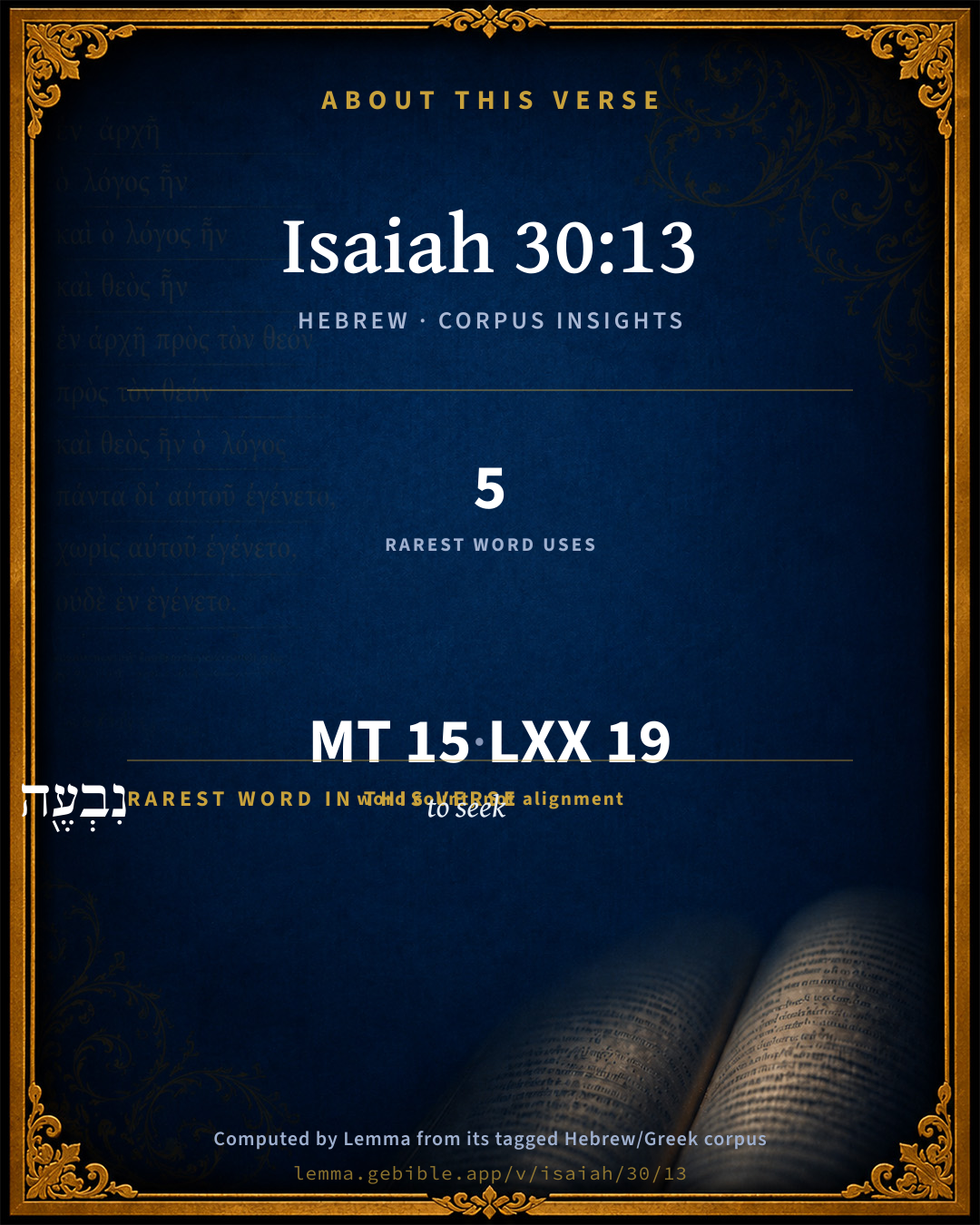
The rarest word here is נִבְעֶ֖ה to seek H1158 — appearing just 5 times in the whole Hebrew Bible.

Shared distinctive vocabulary

נִבְעֶ֖ה to seek H1158 occurs in 4 verses of the Hebrew Bible. Also found in:

Grammatical profile

  • 5 verbs
  • 5 nouns
  • 1 pronoun
  • 1 preposition
  • 2 adverbs
  • 1 particle

Verb forms

  • יִֽהְיֶ֤ה Qal · Imperfect
  • נֹפֵ֔ל Qal · Participle Active
  • נִבְעֶ֖ה Niphal · Participle Active
  • נִשְׂגָּבָ֑ה Niphal · Participle Active
  • יָב֥וֹא Qal · Imperfect

Hebrew & Septuagint length

In English translation the verse runs 26 words from the Hebrew and 28 from the Septuagint (LXX English) — closely comparable.

A rough comparison of the two English renderings, which tokenize alike — not a word-level alignment.

Word counts can differ between the Hebrew and the Greek without any difference in meaning — e.g. the Hebrew direct-object marker אֵת has no separate Greek word, and Greek often adds the article ὁ.

In the original languages it is 15 Hebrew tokens and 19 Greek tokens — but the two are counted differently (Hebrew bundles its prefixes and suffixes into one token; the Greek is in lemma form), so that isn’t a like-for-like length.

Cross-references

10

Topical passages linked to Isaiah 30:13 in the Treasury of Scripture Knowledge — connected by theme and wording, ordered by reader-vote popularity; previews shown in the World English Bible.

  • Isaiah 29:5 But the multitude of your foes shall be like small dust, and the multitude of the awesome ones as chaff that passes away: yes, it shall be in an instant suddenly.
  • Ezekiel 13:10–15 Because, even because they have seduced my people, saying, Peace; and there is no peace; and when one builds up a wall, behold, they daub it with whitewash:
  • 1 Kings 20:30 But the rest fled to Aphek, into the city; and the wall fell on twenty-seven thousand men who were left. Ben Hadad fled, and came into the city, into an inner chamber.
  • Psalms 62:3 How long will you assault a man, Would all of you throw him down, Like a leaning wall, like a tottering fence?
  • Proverbs 29:1 He who is often rebuked and stiffens his neck Will be destroyed suddenly, with no remedy.
  • 1 Thessalonians 5:1–3 But concerning the times and the seasons, brothers, you have no need that anything be written to you.
  • Job 36:18 Don't let riches entice you to wrath, Neither let the great size of a bribe turn you aside.
  • Psalms 73:19–20 How they are suddenly destroyed! They are completely swept away with terrors.
  • Matthew 7:27 The rain came down, the floods came, and the winds blew, and beat on that house; and it fell--and great was its fall."
  • Luke 6:49 But he who hears, and doesn't do, is like a man who built a house on the earth without a foundation, against which the stream broke, and immediately it fell, and the ruin of that house was great."

Cross-references courtesy of OpenBible.info (CC BY 4.0).

Hebrew and Greek witnesses Masoretic Hebrew ↔ Greek Septuagint

The same verse in the two great witnesses to the Old Testament, shown verse-for-verse.

These are two independent witnesses, not word-aligned to each other, and the Septuagint is shown in lemma (dictionary) form.

Hebrew Isaiah 30:13 Masoretic · Westminster Leningrad Codex

לָכֵ֗ן יִֽהְיֶ֤ה לָכֶם֙ הֶעָוֺ֣ן הַזֶּ֔ה כְּפֶ֣רֶץ נֹפֵ֔ל נִבְעֶ֖ה בְּחוֹמָ֣ה נִשְׂגָּבָ֑ה אֲשֶׁר פִּתְאֹ֥ם לְפֶ֖תַע יָב֥וֹא שִׁבְרָֽהּ

therefore this iniquity shall be to you as a breach ready to fall, swelling out in a high wall, whose breaking comes suddenly in an instant.

World English Bible · Public Domain

Greek LXX Isaiah 30:13 Septuagint · lemma form

διά οὗτος εἰμί σύ ὁ ἁμαρτία οὗτος ὡς τεῖχος πίπτω παραχρῆμα πόλις ὀχυρός ἁλίσκω ὅς παραχρῆμα παραεἰμί ὁ πτῶμα

therefore shall this sin be to you as a wall suddenly falling when a strong city has been taken, of which the fall is very near at hand.

LXX2012 (modern English Septuagint) · Public Domain

Hebrew: Westminster Leningrad Codex (CC BY 4.0). Greek: Septuagint (public domain); English from LXX2012 (modern English Septuagint) (Public Domain). How the Septuagint differs from the Hebrew →

Targum (Aramaic paraphrase)

1

The Targum is the ancient Jewish Aramaic paraphrase of the Hebrew Scriptures — an interpretive translation, not the Hebrew text itself. Onkelos (literal) and Pseudo-Jonathan (expansive) render the Torah, and Jonathan the Prophets. Coverage is partial: where no permissively-licensed English translation exists for a verse, only the Aramaic is shown. This is verse-level text, not a word-by-word alignment to the Hebrew.

  1. Targum Jonathan Prophets (Joshua–Malachi)
    בְּכֵן יְהֵי לְכוֹן חוֹבָא הָדֵין כִּכְרַךְ דַחֲרוֹב וְאִתְחַמַר כְּשׁוּר מַתְקַף דְבִתְכֵּיף שָׁלוּ יֵיתֵי תַּבְרֵיהּ:

    Therefore this sin shall be unto you as a city laid waste, and made a ruinous heap, as a bending: wall, whose breaking cometh very suddenly.

    Targum Jonathan — Aramaic: “Mikraot Gedolot” (public domain). English: “Sefaria Community Translation” (CC0 1.0 (public-domain dedication)); “London "Chaldee Paraphrase," 1871” (public domain). Text via Sefaria.

Commentary

Notes on Isaiah 30:13 from classic Christian and Jewish commentators (each source and its license shown beneath its notes). The classic Christian expositions comment on the surrounding passage and are grouped to its opening verse, so a note may address several verses; the Jewish commentaries on the Tanakh (Rashi and others) are per-verse, so they appear only where the commentator wrote on this verse.

Lemma curates 59 commentaries, every one of them public domain or Creative Commons licensed, each selected and text-cleaned for this edition rather than reprinted as found. About our sources →

Trapp's Complete Commentary

John Trapp

Isa 30:13 Therefore this iniquity shall be to you as a breach ready to fall, swelling out in a high wall, whose breaking cometh suddenly at an instant.

Ver. 13. Therefore this iniquity shall be unto you,] q.d., Your commonwealth is tumbling down apace, and ye are hastening the utter ruin of it, as if ye were ambitious of your own destruction, which will be, as sudden, so total. {Isa 30:14}

John Trapp, A Commentary or Exposition upon All the Books of the Old and New Testament (1647–1656) — public domain. Text from a community e-Sword module.

The Biblical Illustrator

Joseph S. Exell

Isa_30:13

As a breach ready to fall.

-

A retributive crash

The best translation seems to be: Therefore this guilt shall be to you as a rent descending (literally, falling) (and) bulging out in a high wall, whose crash comes, etc. The slight beginnings of transgression, its inevitable tendency to gravitate more and more from the moral perpendicular, till a critical point is reached, then the suddenness of the final catastrophe,--are vividly expressed by this magnificent simile. Psa_62:3. (Prof. J. Skinner, D. D.)

Nemesis

1. The people, on account of the eminence and grandeur to which they were elevated, are compared to a high wall.

2. The sin whereby they despised the Word of the Lord, the instructions of His servants, and even the name of the Holy One of Israel, and sought assistance from Egypt, was to prove ruinous to them, as the swelling out in a high wall. The breach, or bulge, which is supposed to have been in the lower part of the wall, as often happens in old buildings, might signify the insolence and pride whereby the posterity of Israel were puffed up in the confidence of being aided by the Egyptians. (R. Macculloch.)

Nemesis

I. WHO IT IS THAT GIVES JUDGMENT UPON THEM. The Holy One of Israel (Isa_30:12). See Isa_30:11. Faithful ministers will not be driven from using such expressions as are proper to awaken sinners, though they be displeasing.

II. WHAT THE GROUND OF THE JUDGEMENT IS. Because ye despise, etc., (Isa_30:12).

III. WHAT THE JUDGMENT IS THAT IS PASSED UPON THEM. The ruin they should bring upon themselves should be--

1. A surprising ruin, coming suddenly.

2. An utter ruin, universal and irreparable (Isa_30:14). (M. Henry.)

The Biblical Illustrator, edited by Joseph S. Exell (c. 1880s–1900s) — public domain. Text from a community e-Sword module.

Jamieson, Fausset & Brown

Robert Jamieson, A. R. Fausset & David Brown

Image from a curve swelling out in a wall (Psa 62:3); when the former gives way, it causes the downfall of the whole wall; so their policy as to Egypt.

Jamieson, Fausset & Brown — Commentary Critical and Explanatory on the Whole Bible (1871) — public domain (CC PDM 1.0). Text via the HelloAO Bible API.

Adam Clarke's Commentary

Verse 13. Swelling out to a high wall - "A swelling in a high wall"] It has been observed before, that the buildings of Asia generally consist of little better than what we call mud walls. "All the houses at Ispahan," says Thevenot, Vol. II., p. 159, "are built of bricks made of clay and straw, and dried in the sun; and covered with a plaster made of a fine white stone. In other places in Persia the houses are built with nothing else but such bricks, made with tempered clay and chopped straw, well mingled together, and dried in the sun, and then used: but the least rain dissolves them." Sir John Chardin's MS. remark on this place of Isaiah is very apposite: Murs en Asie etant faits de terre se fendent ainsi par milieu et de haut en bas. "The walls in Asia being made of earth often cleave from top to bottom." This shouts clearly how obvious and expressive the image is. The psalmist has in the same manner made use of it, to express sudden and utter destruction: -

"Ye shall be slain all of you;

Ye shall be like an inclining wall, like a shattered fence."

Ps 62:4.

Adam Clarke's Commentary on the Bible (1810–1826) — public domain. Text from a community e-Sword/MySword module.

Ellicott's Commentary for English Readers

(13) As a breach ready to fall.—The ill-built, half-decayed houses of Jerusalem may have furnished the outward imagery of the parable. First comes the threatening bulge, then the crack, and then the crash. That was to be the outcome of the plans they were building up on the unsound foundation of corrupt intrigue. In Eze_13:10 we have the additional feature of the “untempered mortar” with which such a wall is built.

A Bible Commentary for English Readers, edited by Charles John Ellicott (1878–1897) — public domain. Text from a community e-Sword module.

The Cambridge Bible for Schools and Colleges

gen. ed. J. J. S. Perowne

13. Disaster will follow their policy with the necessity of a natural law. The best translation seems to be: Therefore this guilt shall be to you as a rent descending (lit. “falling”) (and) bulging out in a high wall, whose crash comes, &c. The slight beginnings of transgression, its inevitable tendency to gravitate more and more from the moral perpendicular, till a critical point is reached, then the suddenness of the final catastrophe,—are vividly expressed by this magnificent simile. Comp. Psa_62:3.

suddenly at an instant] Cf. ch. Isa_29:5.

The Cambridge Bible for Schools and Colleges (gen. ed. J. J. S. Perowne; Cambridge University Press, 1878–1918) — public domain. Text from a community e-Sword module.

John Gill's Exposition

Therefore this iniquity shall be to you as a breach ready to fall,.... Or, "as a falling breach" (m); contempt of the word of God, and trusting in wickedness, rejecting the counsel of God, and placing confidence in the creature, these would be the cause of ruin; which ruin is signified by the breach of a falling wall, or by a breach in a wall, by reason of which it is in danger of falling, and is just ready to fall:

swelling out in a high wall; like a wall that bellies out and bulges, and which, when it once begins to do, suddenly falls; and the higher it is, it comes with more force, and the greater is the fall:

whose breaking cometh suddenly, at an instant; and so it is suggested, should be the ruin of this people; the high towering confidence they had in Egypt would fall with its own weight, and they with it, and be broken to pieces in a moment; and which is further illustrated by another simile.

(m) "sicut ruptura cadens", Montanus, Cocceius, De Dieu. Ben Melech observes, that a breach is after the building is fallen; for the breach does not fall, but it is said on account of the end of it, or what it is at last, as in Isa. xlvii. 2. "grind meal" or "flour".

John Gill's Exposition of the Whole Bible (1746–1763) — public domain (CC PDM 1.0). Text via the HelloAO Bible API.

Albert Barnes' Notes on the Bible

Therefore this iniquity - That is, this refusing to trust in Yahweh, and this intention to seek the alliance of Egypt. The general sense of the figure here is, that their depending on Egypt would involve them ultimately in complete and awful ruin - ruin that should come upon them as suddenly as when a wall that had been long swelling out gives way.

As a breach ready to fall - Like a breaking forth, or a bursting in a wall.

Swelling out in a high wall - That is, where the foundation is not firm, and where one part of the wall sinks, and it inclines to one side until it suddenly bursts forth. A similar figure is used by the Psalmist Psa 62:3 :

Ye shall be slain all of you

As a bowing wall shall ye be, and as a tottering fence.

Whose breaking cometh suddenly - Though it has been long leaning and swelling, yet the actual bursting forth would be in an instant. So would it be with the destruction that would come upon the Jews. Though by their sins they had been long preparing for it, yet it would come upon them by a sudden and tremendous crash. So it will be with all sinners. Destruction may seem to be long delayed - as a wall may be long inclining, and may seem to prepare imperceptibly to fall; but in due time it will come suddenly upon them, when too late to obtain relief.

Albert Barnes' Notes on the Bible (1834–1885) — public domain. Text from a community e-Sword/MySword module.

Haydock's Catholic Bible Commentary

For. Psalm lxi. 3. If God had not miraculously cut off the army of Sennacherib, what would have become of the kingdom of Juda?

George Leo Haydock (1774–1849), Haydock's Catholic Family Bible and Commentary, 1859 edition — public domain. Excludes Psalms (Douay-Rheims chapter numbering differs from Protestant) and Deuterocanonical books (Catholic canon only).

Matthew Poole's English Annotations

This iniquity, of sending and trusting to Egypt for succour.

Whose breaking cometh suddenly at an instant; like a wall which is high, and seems to be strong, but swelling forth in some parts, which upon the least accident falleth down suddenly to the ground. Such shall be the issue of your high and towering confidence in Egypt.

Matthew Poole's English Annotations on the Holy Bible (1683–1685) — public domain. Text from a community e-Sword/MySword module.

The Pulpit Commentary

This iniquity shall be to you as a breach ready to fall. Your sin in rebelling against God, rejecting the warnings of his prophets, and trusting in your own devices shall bring you into the condition of a wall in which there is a "breach," or rather, a "bulge," which therefore totters to its fall, and is liable to dissolve in ruins at any moment. Swelling out in a high wall. The higher the wail, the greater the danger, and the more complete the destruction.

The Pulpit Commentary (1880–1919), ed. H.D.M. Spence-Jones & Joseph S. Exell — public domain. Text from a community e-Sword module.

John Wesley's Explanatory Notes

This iniquity - Of trusting to Egypt, shall be like a wall which is high, but swelling forth in some parts, which, upon the least accident, falls down suddenly.

John Wesley, Explanatory Notes Upon the Whole Bible (1754–1765) — public domain. Text via the GEBible commentary corpus.

J. A. Alexander on Isaiah

Joseph Addison Alexander

“Therefore shall this iniquity be to you like a breach falling (or ready to fall) swelling out in a high wall, whose breaking may come suddenly, at (any) instant. The image is that of a wall which is rent or cracked and bulges out.” This interpretation conveys the idea of a gradual yet sudden catastrophe, which is admirably suited to the context. It is also true that the idea of a downfall springing from internal causes is more appropriate in this connection than that of mere external violence however overwhelming.

Joseph Addison Alexander, The Prophecies of Isaiah (1846–1847; New York: Scribner, 1870–1878) — public domain. Text from a community e-Sword module.

Rashi

Rabbi Shlomo Yitzchaki (Rashi)

as a breach of a fallen wall.

revealed in a fortified wall Revealed to enter thereby the walls of your fortification. נִבְעֶה is an expression of revealing, as in Obadiah (1:6): “His hidden things were revealed (נִבְעוּ).” Dunash, however, interprets נִבְעֶה as a protrusion, since the wall develops blisters (אֲבַעְבּוּעוֹת) because of the rains and the deterioration of the weak mortar.

Rashi on the Tanakh — English translations: “The Judaica Press complete Tanach with Rashi, translated by A. J. Rosenberg” (CC BY 4.0); “Pentateuch with Rashi's commentary by M. Rosenbaum and A.M. Silbermann, 1929-1934” (public domain); “The Metsudah Tanach series, Lakewood, N.J” (CC BY 4.0); and “The Book of Joshua, Metsudah Publications, 1997” (CC BY 4.0). Text via Sefaria.

Ibn Ezra

Rabbi Abraham ibn Ezra

Therefore, because you trust in the money, which you send to the King of Assyria, that he shall not come. This iniquity shall be to you, etc., that is, it will destroy you.

כפרץ מגדל נופל ═ נופל כפרץ As a breach of a falling tower. דבר נבעה ═ נבעה A swelling thing. Of the same root is אבעבועות blains (Exod. 9:9). נבעה can also be joined with פרץ: a swelling breach.

לפתע פתאם Suddenly at an instant. The two words have nearly the same meaning; comp. אדמת עפר the dust of the earth (Dan. 12:12). קדש הקדשים the most holy; so also לפתע פתאם most suddenly.

Ibn Ezra on the Tanakh — English translations: “Sefaria Community Translation” (CC0 1.0 (public-domain dedication)); “Yalkut, Sifsei Chachomim Chumash, Metsudah Publications, 2009” (CC BY 4.0); and “Commentary of Ibn Ezra on Isaiah - trans. by M. Friedlander, 1873” (public domain). Text via Sefaria.

Lesson kit

Teaching starters — assembled from the data on this page, not authored interpretation. Every prompt links to the verse data it draws on. Edit before teaching.

Isaiah, in the Prophets, opens this verse with 15 words (14 distinct Hebrew lemmas). Its most distinctive word is bâʻâh (“to seek”). A historical commentator’s framing appears above. Read the whole chapter for the surrounding context.

Discussion questions

  1. How does “to seek” (bâʻâh) shape what this verse is saying?
  2. Isaiah 21:12 shares the word «to seek» with this verse. How do the two illuminate each other?
  3. These translations render this verse differently; the difference is in the English rendering, not the original. What questions does that raise?
  4. The verb «יִֽהְיֶ֤ה» is Qal Imperfect. How does its form color the action?
  5. Reading how Trapp's Complete Commentary and The Biblical Illustrator read this verse, where do the two commentators agree and where do they part?

Things to notice

Reading settings

Reading text

Shown beneath each verse's original-language words.

Old Testament
Old Testament edition

Read the OT as the Masoretic Hebrew (MT) or the Greek Septuagint (LXX).

English shown for the Greek Septuagint (in the Hebrew ↔ Greek comparison).

Comparing translations? Open the Compare panel on any verse page to stack up to four side by side.