Joshua 22:17

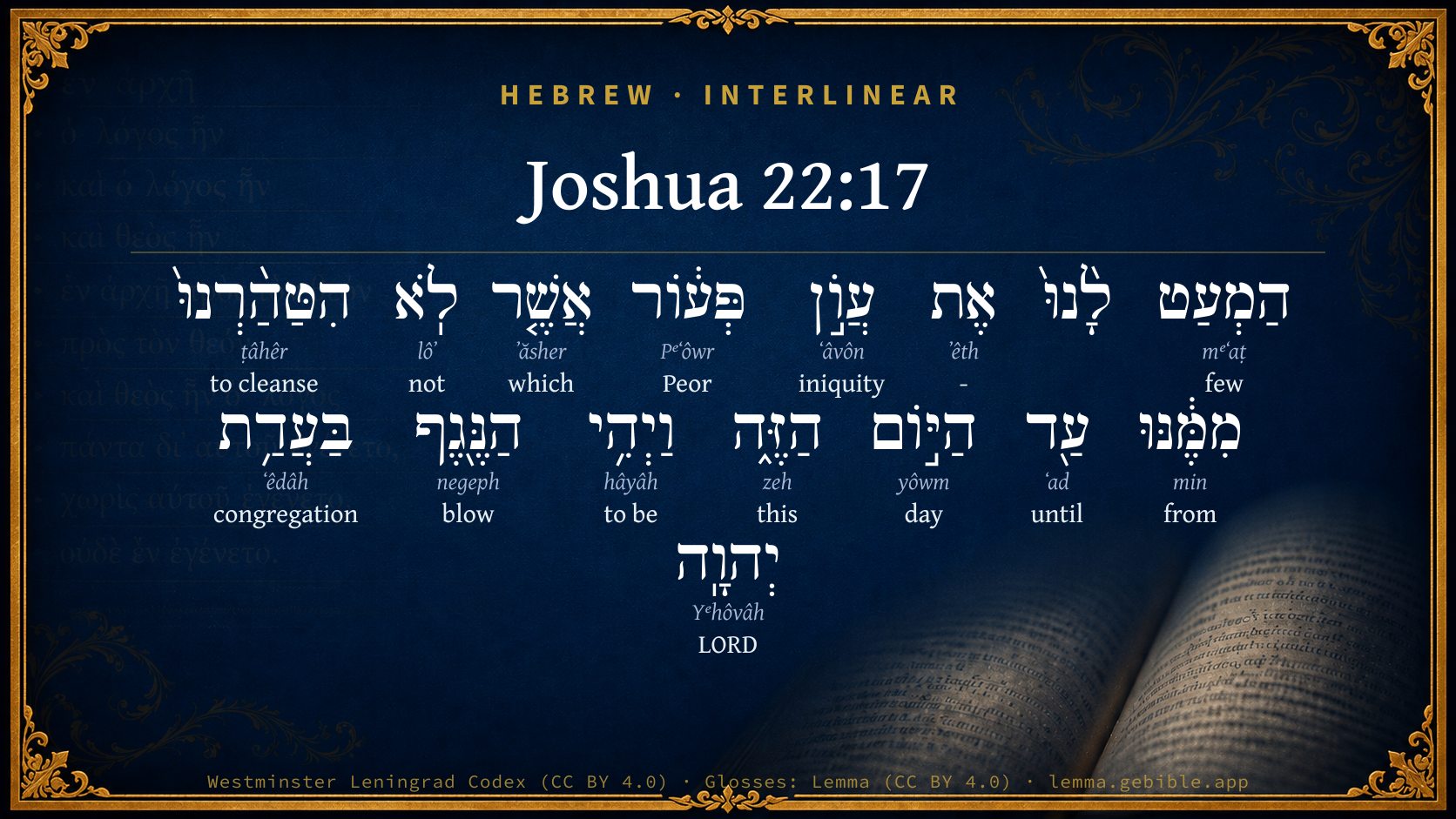
Hebrew (Westminster Leningrad Codex) Joshua 22:17 appears in the Hebrew Old Testament. The text above is from the Westminster Leningrad Codex. Each word links to its Strong’s number, a concise gloss, and parsing drawn from the Open Scriptures Hebrew Bible morphology. Click any word for its full Brown-Driver-Briggs (BDB) entry.
Download image
Cite this verse

Joshua 22:17 (World English Bible). Public Domain. Lemma interlinear Bible study tool, https://lemma.gebible.app/v/joshua/22/17.

Show BibTeX & RIS
BibTeX
RIS
English Translation
Is the iniquity of Peor too little for us, from which we have not cleansed ourselves to this day, although there came a plague on the congregation of Yahweh,
World English Bible · Public Domain
Download a study sheet

One document with this verse’s original text, its word-by-word gloss line, the meaning frame, cross-references with their text, attributed commentary, and full source and license credits — printable, and it pastes into notes with its structure intact.

This verse Autodidact and up

Study sheet (.html) Plain text (.txt)

A passage Seminary Student

Up to 50 verses in one chapter. A passage sheet keeps up to 6 commentary sources and 12 cross-references per verse, in the order this page ranks them, and says so on the sheet whenever that leaves anything out. Ask for a single verse and you get the Autodidact verse sheet above.

Everything on this page stays free to read, with no account — the sheet is a download of what is already on screen, not access to it.

Want to remove ads? Support Godless Engineer
Compare translations 3

The same verse in 3 English versions, stacked beneath the original-language interlinear above. Click any original word for its lexicon entry.

Each is an independent rendering of the whole verse — the interlinear is not word-aligned to these translations.

Highlighted words mark where these versions differ — a whole-verse word diff, not a word-by-word alignment.

  • World English Bible Public Domain
    Is the iniquity of Peor too little for us, from which we have not cleansed ourselves to this day, although there came a plague on the congregation of Yahweh,
  • King James Version Public Domain
    Is the iniquity of Peor too little for us, from which we are not cleansed until this day, although there was a plague in the congregation of the LORD,
  • unfoldingWord Literal Text CC BY-SA 4.0
    the iniquity of Peor little for us, from which we have not purified ourselves to this day? And a plague was among the congregation of Yahweh.

unfoldingWord Literal Text — © unfoldingWord, licensed CC BY-SA 4.0. Word-aligned USFM3 via Door43 (git.door43.org/unfoldingWord/en_ult).

Versions to compare (up to 4)

3 of 4 selected

Show all 18 translations

Every available English version of this verse, each an independent rendering of the whole verse.

  • World English Bible Public Domain
    Is the iniquity of Peor too little for us, from which we have not cleansed ourselves to this day, although there came a plague on the congregation of Yahweh,
  • Berean Standard Bible Public Domain
    Was not the sin of Peor enough for us, from which we have not cleansed ourselves to this day? It even brought a plague upon the congregation of the LORD.
  • Majority Standard Bible Public Domain
    Was not the sin of Peor enough for us, from which we have not cleansed ourselves to this day? It even brought a plague upon the congregation of the LORD.
  • King James Version Public Domain
    Is the iniquity of Peor too little for us, from which we are not cleansed until this day, although there was a plague in the congregation of the LORD,
  • American Standard Version (1901) Public Domain
    Is the iniquity of Peor too little for us, from which we have not cleansed ourselves unto this day, although there came a plague upon the congregation of Jehovah,
  • Revised Version (1885) Public Domain
    Is the iniquity of Peor too little for us, from which we have not cleansed ourselves unto this day, although there came a plague upon the congregation of the LORD,
  • Geneva Bible (1599) Public Domain
    Haue we too litle for the wickednesse of Peor, whereof we are not clensed vnto this day, though a plague came vpon the Congregation of the Lord?
  • Douay-Rheims (1899) Public Domain
    Is it a small thing to you that you sinned with Beelphegor, and the stain of that crime remaineth in us to this day? and many of the people perished.
  • Young's Literal Translation Public Domain
    Is the iniquity of Peor little to us, from which we have not been cleansed till this day -- and the plague is in the company of Jehovah,
  • Literal Standard Version CC BY-SA 4.0
    Is the iniquity of Peor little to us, from which we have not been cleansed until this day—and the plague is in the congregation of YHWH,
  • Unlocked Literal Bible CC BY-SA 4.0
    Was our sin at Peor not enough for us? Yet we have not even now cleansed ourselves from it. For that sin there came a plague on the assembly of Yahweh.
  • unfoldingWord Literal Text CC BY-SA 4.0
    the iniquity of Peor little for us, from which we have not purified ourselves to this day? And a plague was among the congregation of Yahweh.
  • Darby Bible Public Domain
    Is the iniquity of Peor too little for us? from which we are not cleansed until this day, although there was a plague in the assembly of Jehovah.
  • World Messianic Bible Public Domain
    Is the iniquity of Peor too little for us, from which we have not cleansed ourselves to this day, although there came a plague on the congregation of the LORD,
  • Webster's Bible Public Domain
    Is the iniquity of Peor too little for us, from which we are not cleansed until this day, although there was a plague in the congregation of the LORD,
  • Free Bible Version CC BY-SA 4.0
    Wasn't our sin at Peor enough? Even now we're still not clean from the plague that attacked the Lord's people.
  • Bible in Basic English Public Domain
    Was not the sin of Baal-peor great enough, from which we are not clear even to this day, though punishment came on the people of the Lord,
  • JPS Tanakh (1917) Public Domain
    Is the iniquity of Peor too little for us, from which we have not cleansed ourselves unto this day, although there came a plague upon the congregation of the LORD,

Literal Standard Version (2020), Covenant Press — licensed CC BY-SA 4.0. Text via the HelloAO Bible API (eBible.org). Unlocked Literal Bible (unfoldingWord) — licensed CC BY-SA 4.0. Text via the HelloAO Bible API (eBible.org). unfoldingWord Literal Text — © unfoldingWord, licensed CC BY-SA 4.0. Word-aligned USFM3 via Door43 (git.door43.org/unfoldingWord/en_ult). Free Bible Version, Dr. Jonathan Gallagher — licensed CC BY-SA 4.0. Text via the HelloAO Bible API (eBible.org).

Word by word

More ways to search: Search by grammar → Find every occurrence → Compare this word →

Practice this passage: Drill this verse → Learn its vocabulary →

פְּע֔וֹר
Pᵉʻôwr
H6465
“Peor”
Noun, Proper
Part of Speech
Noun
Type
Proper
Full BDB Definition

Origin: from H6473

TWOT: None

Peor = "cleft" - a mountain peak in Moab belonging to the Abarim range and near Pisgah (noun proper locative) - a false god worshipped in Moab; corresponds to Baal (noun proper deity)
  1. הַמְעַט mᵉʻaṭ H4592 “few” Particle, Interrogative + Adjective, Adjective, Masculine, Singular, Absolute
  2. אֶת ʼêth H853 “-” Particle, Direct Object
  3. עֲוֺ֣ן ʻâvôn H5771 “iniquity of” Noun, Common, Both, Singular, Construct
  4. אֲשֶׁ֤ר ʼăsher H834 “which” Particle, Relative
  5. לֹֽא lôʼ H3808 “not” Particle, Negative
  6. הִטַּהַ֨רְנוּ֙ ṭâhêr H2891 “to cleanse” Verb, Hithpael, Perfect, 1st Person, Common, Plural
  7. מִמֶּ֔נּוּ min H4480 “from · us” Preposition + Suffix, Personal, 1st Person, Common, Plural
  8. עַ֖ד ʻad H5704 “until” Preposition
  9. הַיּ֣וֹם yôwm H3117 “the · day” Particle, Definite Article + Noun, Common, Masculine, Singular, Absolute
  10. הַזֶּ֑ה zeh H2088 “the · this” Particle, Definite Article + Pronoun, Demonstrative, Masculine, Singular
  11. וַיְהִ֥י hâyâh H1961 “and · to be” Conjunction + Verb, Qal, Sequential Imperfect, 3rd Person, Masculine, Singular
  12. הַנֶּ֖גֶף negeph H5063 “the · blow” Particle, Definite Article + Noun, Common, Masculine, Singular, Absolute
  13. בַּעֲדַ֥ת ʻêdâh H5712 “in/at · congregation of” Preposition + Noun, Common, Feminine, Singular, Construct
  14. יְהוָֽה Yᵉhôvâh H3068 “LORD” Noun, Proper

About this verse

These counts appear in no published source. They are computed here, from the morphology-tagged text and Lemma’s own curated glosses. What Lemma adds →

16
words
15
distinct lemmas
Historical
section

Notable vocabulary

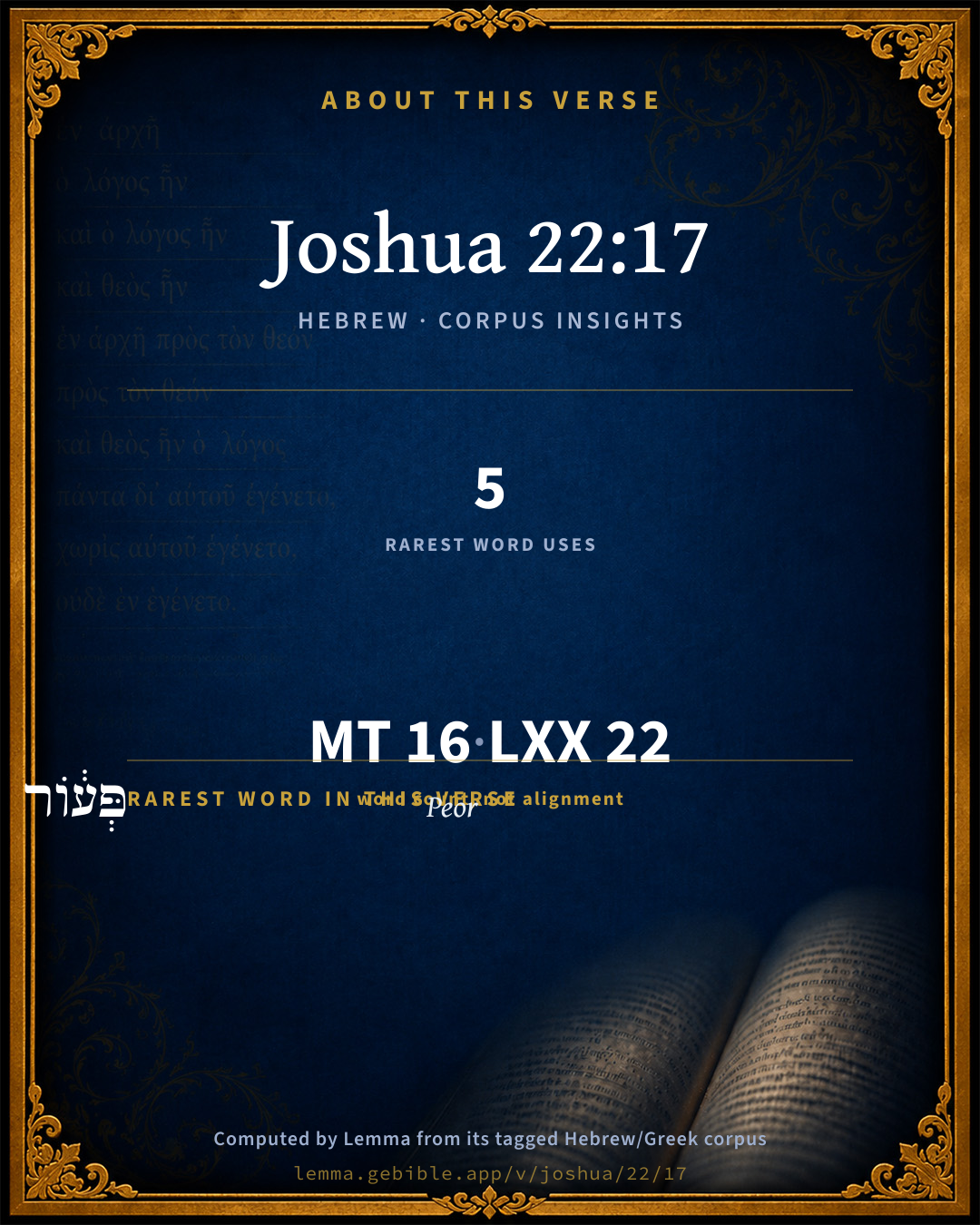
The rarest word here is פְּע֔וֹר Peor H6465 — appearing just 5 times in the whole Hebrew Bible.

Shared distinctive vocabulary

פְּע֔וֹר Peor H6465 occurs in 4 verses of the Hebrew Bible. Also found in:

Grammatical profile

  • 2 verbs
  • 6 nouns
  • 1 adjective
  • 1 pronoun
  • 3 prepositions
  • 3 particles

Verb forms

  • הִטַּהַ֨רְנוּ֙ Hithpael · Perfect
  • וַיְהִ֥י Qal · Sequential Imperfect

Hebrew & Septuagint length

In English translation the verse runs 29 words from the Hebrew and 31 from the Septuagint (LXX English) — closely comparable.

A rough comparison of the two English renderings, which tokenize alike — not a word-level alignment.

Word counts can differ between the Hebrew and the Greek without any difference in meaning — e.g. the Hebrew direct-object marker אֵת has no separate Greek word, and Greek often adds the article ὁ.

In the original languages it is 16 Hebrew tokens and 22 Greek tokens — but the two are counted differently (Hebrew bundles its prefixes and suffixes into one token; the Greek is in lemma form), so that isn’t a like-for-like length.

Cross-references

6

Topical passages linked to Joshua 22:17 in the Treasury of Scripture Knowledge — connected by theme and wording, ordered by reader-vote popularity; previews shown in the World English Bible.

  • Numbers 25:1–18 Israel abode in Shittim; and the people began to play the prostitute with the daughters of Moab:
  • Psalms 106:28–29 They joined themselves also to Baal Peor, And ate the sacrifices of the dead.
  • Deuteronomy 4:3–4 Your eyes have seen what Yahweh did because of Baal Peor; for all the men who followed Baal Peor, Yahweh your God has destroyed them from the midst of you.
  • Ezra 9:13–14 After all that is come on us for our evil deeds, and for our great guilt, seeing that you our God have punished us less than our iniquities deserve, and have given us such a remnant,
  • 1 Corinthians 10:8 Neither let us commit sexual immorality, as some of them committed, and in one day twenty-three thousand fell.
  • 1 Corinthians 10:11 Now all these things happened to them by way of example, and they were written for our admonition, on whom the ends of the ages have come.

Cross-references courtesy of OpenBible.info (CC BY 4.0).

Hebrew and Greek witnesses Masoretic Hebrew ↔ Greek Septuagint

The same verse in the two great witnesses to the Old Testament, shown verse-for-verse.

These are two independent witnesses, not word-aligned to each other, and the Septuagint is shown in lemma (dictionary) form.

Hebrew Joshua 22:17 Masoretic · Westminster Leningrad Codex

הַמְעַט לָ֨נוּ֙ אֶת עֲוֺ֣ן פְּע֔וֹר אֲשֶׁ֤ר לֹֽא הִטַּהַ֨רְנוּ֙ מִמֶּ֔נּוּ עַ֖ד הַיּ֣וֹם הַזֶּ֑ה וַיְהִ֥י הַנֶּ֖גֶף בַּעֲדַ֥ת יְהוָֽה

Is the iniquity of Peor too little for us, from which we have not cleansed ourselves to this day, although there came a plague on the congregation of Yahweh,

World English Bible · Public Domain

Greek LXX Joshua 22:17 Septuagint · lemma form

μή μικρός ἐγώ ὁ ἁμάρτημα φογωρ ὅτι οὐ καθαρίζω ἀπό αὐτός ἕως ὁ ἡμέρα οὗτος καί γίγνομαι πληγή ἐν ὁ συναγωγή κύριος

Is the sin of Phogor too little for you, whereas we have not been cleansed from it until this day, though there was a plague among the congregation of the Lord?

LXX2012 (modern English Septuagint) · Public Domain

Hebrew: Westminster Leningrad Codex (CC BY 4.0). Greek: Septuagint (public domain); English from LXX2012 (modern English Septuagint) (Public Domain). How the Septuagint differs from the Hebrew →

Targum (Aramaic paraphrase)

1

The Targum is the ancient Jewish Aramaic paraphrase of the Hebrew Scriptures — an interpretive translation, not the Hebrew text itself. Onkelos (literal) and Pseudo-Jonathan (expansive) render the Torah, and Jonathan the Prophets. Coverage is partial: where no permissively-licensed English translation exists for a verse, only the Aramaic is shown. This is verse-level text, not a word-by-word alignment to the Hebrew.

  1. Targum Jonathan Prophets (Joshua–Malachi)
    הַזְעֵיר לָנָא יַת חוֹבָא דִפְעוֹר דְלָא אִדַכִּינָא מִנֵיהּ עַד יוֹמָא הָדֵין וַהֲוַת מְחָתָא בִּכְנִשְׁתָּא דַיָי:

    (no public-domain English translation for this verse)

    Targum Jonathan — Aramaic: “Mikraot Gedolot” (public domain). English: “Sefaria Community Translation” (CC0 1.0 (public-domain dedication)); “London "Chaldee Paraphrase," 1871” (public domain). Text via Sefaria.

Commentary

Notes on Joshua 22:17 from classic Christian and Jewish commentators (each source and its license shown beneath its notes). The classic Christian expositions comment on the surrounding passage and are grouped to its opening verse, so a note may address several verses; the Jewish commentaries on the Tanakh (Rashi and others) are per-verse, so they appear only where the commentator wrote on this verse.

Lemma curates 59 commentaries, every one of them public domain or Creative Commons licensed, each selected and text-cleaned for this edition rather than reprinted as found. About our sources →

Trapp's Complete Commentary

John Trapp

Jos 22:17 [Is] the iniquity of Peor too little for us, from which we are not cleansed until this day, although there was a plague in the congregation of the LORD,

Ver. 17. Is the iniqity of Peor too little for us?] But that by heaping up sin to sin, we must needs heap up more wrath, and not rather redeem our own sorrows? should we be thus ambitious of our own ruin? and have we not yet sufficiently smarted Oh, what bloody wails left God upon our backs at that time! and is all forgotten? Cur turbatis κοινωφελες? Why bring ye the heavy hand of God upon us all by this your revolt? that he should now pay us home for the new and the old?

John Trapp, A Commentary or Exposition upon All the Books of the Old and New Testament (1647–1656) — public domain. Text from a community e-Sword module.

Joseph Benson's Commentary

Jos 22:17. Is the iniquity of Peor — That is, of worshipping Baal-peor; too little for us? — Is it not enough that we provoked God to wrath then, but we must provoke him again now? Probably this is mentioned the rather, because Phinehas, the first commissioner in this treaty, had signalized himself in that matter; and because they were now at, or near, the very place where that iniquity was committed. From which we are not cleansed to this day — For though God had pardoned it, as to the national punishment of it, (Num 25:11,) yet they were not yet thoroughly purged from it; partly because the shame and blot of that odious practice were not yet wiped off, and partly because some of that corrupt leaven still remained among them; and though smothered for a time, yet was ready to break forth upon all occasions: see Jos 24:33. And God also took notice of these idolatrous inclinations in particular persons, and found out ways to punish them.

Joseph Benson's Commentary on the Old and New Testaments (1811–1818) — public domain. Text from a community e-Sword module.

Tyndale Open Study Notes

Tyndale Open Resources

22:17 The sin at Peor was Israel’s idolatrous rebellion in Moab, just at the point of entering the Promised Land (Num 25). Phinehas, now the leader of this delegation, had acted to save Israel from complete destruction at that time. He did not want to see any part of Israel turn away from God again.

Tyndale Open Study Notes — © Tyndale Open Resources, licensed CC BY-SA 4.0. Text via the HelloAO Bible API.

Geneva Bible (1599)

Geneva Bible translators

Meaning, God is not fully pacified, forasmuch as no punishment can be sufficient for such wickedness and idolatry.

Geneva Bible (1599) marginal notes — public domain. Text via Bolls.life.

Adam Clarke's Commentary

Verse 17. Is the iniquity of Peor too little] See this history, Nu 25:3, c., and the notes there. Phinehas takes it for granted that this altar was built in opposition to the altar of God erected by Moses, and that they intended to have a separate service, priesthood, &c., which would be rebellion against God, and bring down his curse on them and their posterity and, in order to show that God is jealous of his glory, he refers to the business of Baal Peor, which took place in that very country they were now about to possess, the destructive consequences of which he, through his zeal for the glory of God, was the means of preventing.

Adam Clarke's Commentary on the Bible (1810–1826) — public domain. Text from a community e-Sword/MySword module.

John Calvin's Commentaries

17. Is the iniquity of Peor too little for us? etc They represent the crime as more heinous, from their perverse obstinacy in not ceasing ever and anon to provoke the Lord by their abominations. They bring forward one signal example of recent occurrence. While they were encircling the sanctuary of God from the four cardinal points, like good watchmen of God, and when they had received the form of due worship, and were habituated to it by constant exercise, they had allowed themselves, through the seductive allurements of harlots, to be polluted by foul superstitions, and had worshipped Baal-Peor. As the whole people were implicated in this crime, the ten ambassadors do not hesitate to admit, that they were partners in the guilt. They therefore ask, Is not the iniquity which we contracted in the matter of Baal-Peor sufficient? They add, that they were not yet purified from it, just as if they had said, that the remembrance of it was not yet entirely buried, or that the vengeance of God was not yet extinguished; and hence they infer, that the two tribes and the half tribe, while with impious contumacy they turn aside from God, and shake off his yoke, not only consult ill for themselves, but are calling down similar destruction on the whole people, because God will avenge the insult offered him to a wider extent. This they confirm by the example of Achan, who, though he was alone when he secretly stole of the accursed thing, did not alone undergo the punishment of his sacrilege, but also dragged others along with him, as it was seen that some fell in the line of battle, while all were shamefully put to flight, because pollution attached to the people.

They reason from the less to the greater. If the anger of God burnt against many for the clandestine misdeed of one man, much less would he allow the people to escape if they connived at manifest idolatry. A middle view, however, is inserted, that if the two tribes and half tribe built up an altar, and if their condition was worse from not dwelling in the land of Canaan, let them rather come and obtain a settlement also in the land of Canaan, but let them not provoke God by a wicked rivalship. Hence we infer, that they were not urged by some turgid impetus, since, even at their own loss and expense, they are willing kindly to offer partnership to those who had demanded a settlement and domicile for themselves elsewhere.

John Calvin's Commentaries (1540-1563) — public domain. Text from the Calvin Translation Society English edition (1840s-50s) via the Christian Classics Ethereal Library (ccel.org). Calvin's coverage is partial (roughly two-thirds of the Bible); uncommented books and verses are honest gaps, never fabricated. The 19th-century editor's footnotes and remarks are omitted so the notes are faithfully Calvin's own voice.

Ellicott's Commentary for English Readers

(17) The iniquity of Peor.—A very natural subject for reference on the part of Phinehas, who had distinguished himself by his zealous opposition to it.

A Bible Commentary for English Readers, edited by Charles John Ellicott (1878–1897) — public domain. Text from a community e-Sword module.

The Cambridge Bible for Schools and Colleges

gen. ed. J. J. S. Perowne

17. the iniquity of Peor] i. e. of Baal Peor. In four passages Peor occurs as a contraction for Baal Peor, (a) Num_25:18, twice; (b) Num_31:16; and (c) in this place. He makes allusion to the apostasy in the staying of which he himself had borne so memorable a part, and many have suspected that there were still some amongst them who were hankering after the licentious orgies of Baal worship. We shall find Joshua himself alluding to the same propensity (Jos_24:14-23).

although there was a plague] Of which upwards of 24,000 of the people died.

The Cambridge Bible for Schools and Colleges (gen. ed. J. J. S. Perowne; Cambridge University Press, 1878–1918) — public domain. Text from a community e-Sword module.

John Gill's Exposition

But that you must turn away this day from following the Lord?.... From the worship of the Lord, as the Targum, and so on Jos 22:16; not content with the former transgression, but must add this revolt unto it, and at a time which sadly aggravates it:

and it will be, that seeing ye rebel to, day against the Lord; against the Word of the Lord, as the Targum, and so on Jos 22:16,

that tomorrow he will be wroth with the whole congregation of Israel; or, in a little time, if a stop is not put to this revolt, the whole body of the people will suffer for it: here they express a concern for the whole nation of Israel, as well as for the glory of God; for sometimes the whole congregation has been charged with the sins of individuals, and punished for it, as a case after mentioned shows; see Jos 7:1.

John Gill's Exposition of the Whole Bible (1746–1763) — public domain (CC PDM 1.0). Text via the HelloAO Bible API.

Albert Barnes' Notes on the Bible

From which we are not cleansed until this day - Phinehas, who had borne a conspicuous part in vindicating the cause of God against those who fell away to Baal-peor, means that terrible as the punishment had been, there were still those among them who hankered after Baal worship, and even practiced it in secret. (Compare Joshua’s words, Jos 24:14-23.)

Albert Barnes' Notes on the Bible (1834–1885) — public domain. Text from a community e-Sword/MySword module.

Haydock's Catholic Bible Commentary

Beelphegor. As they lived in the country, where this idol had been adored, Phinees was afraid lest they might have built the altar in his honour. He reminds them what destruction that worship had brought upon all Israel. He had been particularly zealous in appeasing the wrath of God, and therefore speaks with more authority. Hebrew, "is not the crime of Phegor enough for us, that we should not wish to expiate it until this day?" (Calmet) or Protestants, "is the iniquity of Peor too little for us, from which we are not cleansed until this day? (although there was a plague in the congregation of the Lord)." The stain of this impiety still remained upon Israel. They ought, therefore, to endeavour by sincere repentance, to obliterate it entirely, and not, by fresh provocations, enkindle the dreadful wrath of God. (Haydock) --- There was reason to fear lest the Lord should punish this sin still more, as he is accustomed to do, when people relapse. (Calmet) --- All must therefore shew their zeal to prevent such crimes, as the multitude sometimes suffers for the offence of one, when they do not take all possible care to prevent it, ver. 20. (Haydock)

George Leo Haydock (1774–1849), Haydock's Catholic Family Bible and Commentary, 1859 edition — public domain. Excludes Psalms (Douay-Rheims chapter numbering differs from Protestant) and Deuterocanonical books (Catholic canon only).

Matthew Poole's English Annotations

The iniquity of Peor, i.e. of our worshipping of BaalPeer, Num 25.

From which we are not cleansed until this day; for though God had pardoned it, as to the national punishment of it, Num 25:11, yet they were not yet thoroughly purged from it; partly because the shame and blot of that filthy and odious practice was not yet wiped of; and partly because some of that corrupt leaven still remained among them, and though it smothered for a time, yet was ready to break forth upon all occasions. See Jos 24:23. And God also took notice of these idolatrous inclinations in particular persons, and found out ways to punish them one time or other.

Matthew Poole's English Annotations on the Holy Bible (1683–1685) — public domain. Text from a community e-Sword/MySword module.

Whedon's Commentary on the Bible

Daniel D. Whedon

17. Is the iniquity of Peor too little — Phinehas had a vivid remembrance of that dreadful outbreak of crime whose curse his active zeal had turned away from the congregation by a bold thrust of his javelin. Num_25:1-13. Hence the naturalness of this historical allusion.

Not cleansed until this day — Though the divine wrath was turned away, the sad consequences of that crime were still visible.

Although there was a plague — Rather, and the plague was in the congregation.

Daniel D. Whedon (gen. ed.), Commentary on the Old and New Testaments (1874–1909) — public domain. Text from a community e-Sword module.

The Pulpit Commentary

Is the iniquity of Peer too little for us? How natural the illustration in the mouth of the speaker! It was Phinehas who had avenged the iniquity of Peer, and arrested the judgment for that offence as it was about to fall. How natural that the occurrence should be, as it were, branded upon his memory with a hot iron, and that the mention of it should spring at once to his lips when he saw his brethren, as he thought, upon the verge of a similar offence! Peor is, of course, a contraction for Baal-Peor. (Num_25:3) This god derives his name probably from Mount Peer, or "the cloven mountain". (Num_23:28) From which we are not cleansed until this day . Here we have the expression of the feeling which was never removed until Christ came. It was not possible that the blood of bulls and of goats could take away sin. No ceremonial lustrations could "cleanse us from its guilt and power." No destruction of the prime mover of the offence, though it may avert the wrath of God, can remove the moral reproach which lies upon the sinner. Not even the destruction of twenty-four thousand persons (Num_25:9) can purify Israel from the taint of pollution. In the eyes of a sincere servant like Phinehas, the stigma rests upon Israel still, nor could anything avail to take it away. Truly, the law was, indeed, "our schoolmaster, to bring us to Christ." What Keil says of Calvin"s explanation, that "the remembrance was not yet quite buried, nor the anger of God extinct," is unsatisfactory. His own explanation, that "the heart of Israel still delighted in their sin," is even more so, since we have no evidence whatever that this was the case at the time of which we are speaking. We have here again to remark that the history in Numbers is here presupposed, and an allusion to an incident in Numbers is here placed in the mouth of one of the chief actors in it. How natural, if the history be a veracious one! How marvellously ingenious, if it he not! The circumstance is mentioned again in Hosea, in the time of Jotham or Hezekiah, and again in Psalm 106., which would appear to have been written during the captivity. Thus we have a chain of testimony concerning it which makes it difficult to assign a time for the invention of the story, if it be invented, since all references to it in Scripture are perfectly consistent with each other, and display none of the signs of gradual growth which we invariably find in the case of legends. A plague. The original is noticeable, the plague; a natural mode of speech for one who well remembered it.

The Pulpit Commentary (1880–1919), ed. H.D.M. Spence-Jones & Joseph S. Exell — public domain. Text from a community e-Sword module.

John Wesley's Explanatory Notes

Of Peor - That is, of our worshipping of Baal-peor, Num. xxv, 3. Probably this is mentioned the rather, because Phinehas, the first commissioner in this treaty, had signalized himself in that matter: and because they were now at or near the very place, where that iniquity was committed. Are not cleansed - For though God had pardoned it, as to the national punishment of it, Num. xxv, 11, yet they were not yet throughly purged from it; partly because the shame and blot of that odious practice was not yet wiped off: and partly, because some of that corrupt leaven still remained among them, and though smothered for a time, yet was ready to break forth upon all occasions, See chap. xxiv, 33. And God also took notice of these idolatrous inclinations in particular persons, and found out ways to punish them.

John Wesley, Explanatory Notes Upon the Whole Bible (1754–1765) — public domain. Text via the GEBible commentary corpus.

Keil & Delitzsch

C. F. Keil & F. Delitzsch

To show the greatness of the sin through apostasy from the Lord, the speaker reminds them of two previous acts of sin on the part of the nation, which had brought severe judgments upon the congregation. "Is there too little for us in the iniquity of Peor (i.e., with Peor, or through the worship of Peor, Num 25:3), from which we have not cleansed ourselves till this day, and there came the plague upon the congregation of Jehovah?" את־עון is an accusative: see Ges. 117, 2; Ewald, 277, d. That plague, of which 24,000 Israelites died, was stayed through the zeal of Phinehas for the honour of the Lord (Num 25:4-9, Num 25:11). The guilt connected with the worship of Peor had thereby been avenged upon the congregation, and the congregation itself had been saved from any further punishment in consequence of the sin. When Phinehas, therefore, affirmed that the congregation had not yet been cleansed from the crime, he did not mean that they were still bearing or suffering from the punishment of that crime, but that they were not yet cleansed from that sin, inasmuch as many of them were still attached to idolatry in their hearts, even if they had hitherto desisted from it outwardly from fear of the infliction of fresh judgment.

Keil & Delitzsch — Biblical Commentary on the Old Testament (1861–1891) — public domain (CC PDM 1.0). Text via the HelloAO Bible API. (Old Testament only.)

unfoldingWord translationNotes

Door43 World Missions Community

Was our sin at Peor not enough for us?

This question emphasizes how serious their previous sin was. This can be written as a statement. AT: "We had already sinned terribly at Peor!" (See: Rhetorical Question)

Peor

This is name of a place. Translate the same way as in Joshua 13:20. (See: How to Translate Names)

we have not even now cleansed ourselves from it

This can be stated in positive form. AT: "we are still dealing with the guilt of that sin" (See: Litotes)

Must you also turn away from following Yahweh at this present day?

This question is used to rebuke the people for their sin. This can be written as a statement. AT: "You must not turn away from following Yahweh today!" (See: Rhetorical Question)

translationWords

sin

Yahweh

anger

Israel

unfoldingWord translationNotes — © Distant Shores Media and the Door43 World Missions Community, licensed CC BY-SA 4.0. Source: git.door43.org/Door43/en_tn.

Lesson kit

Teaching starters — assembled from the data on this page, not authored interpretation. Every prompt links to the verse data it draws on. Edit before teaching.

Joshua, in the Historical, opens this verse with 16 words (15 distinct Hebrew lemmas). Its most distinctive word is Pᵉʻôwr (“Peor”). A historical commentator’s framing appears above. Read the whole chapter for the surrounding context.

Discussion questions

  1. How does “Peor” (Pᵉʻôwr) shape what this verse is saying?
  2. Numbers 23:28 shares the word «Peor» with this verse. How do the two illuminate each other?
  3. These translations render this verse differently; the difference is in the English rendering, not the original. What questions does that raise?
  4. The verb «הִטַּהַ֨רְנוּ֙» is Hithpael Perfect. How does its form color the action?
  5. Reading how Trapp's Complete Commentary and Joseph Benson's Commentary read this verse, where do the two commentators agree and where do they part?

Things to notice

Reading settings

Reading text

Shown beneath each verse's original-language words.

Old Testament
Old Testament edition

Read the OT as the Masoretic Hebrew (MT) or the Greek Septuagint (LXX).

English shown for the Greek Septuagint (in the Hebrew ↔ Greek comparison).

Comparing translations? Open the Compare panel on any verse page to stack up to four side by side.