

1 Samuel 18:9

Hebrew (Westminster Leningrad Codex) 1 Samuel 18:9 appears in the Hebrew Old Testament. The text above is from the Westminster Leningrad Codex. Each word links to its Strong’s number, a concise gloss, and parsing drawn from the Open Scriptures Hebrew Bible morphology. Click any word for its full Brown-Driver-Briggs (BDB) entry.
Download image
Cite this verse

1 Samuel 18:9 (World English Bible). Public Domain. Lemma interlinear Bible study tool, https://lemma.gebible.app/v/1-samuel/18/9.

Show BibTeX & RIS
BibTeX
RIS
English Translation
Saul eyed David from that day and forward.
World English Bible · Public Domain
Highlights
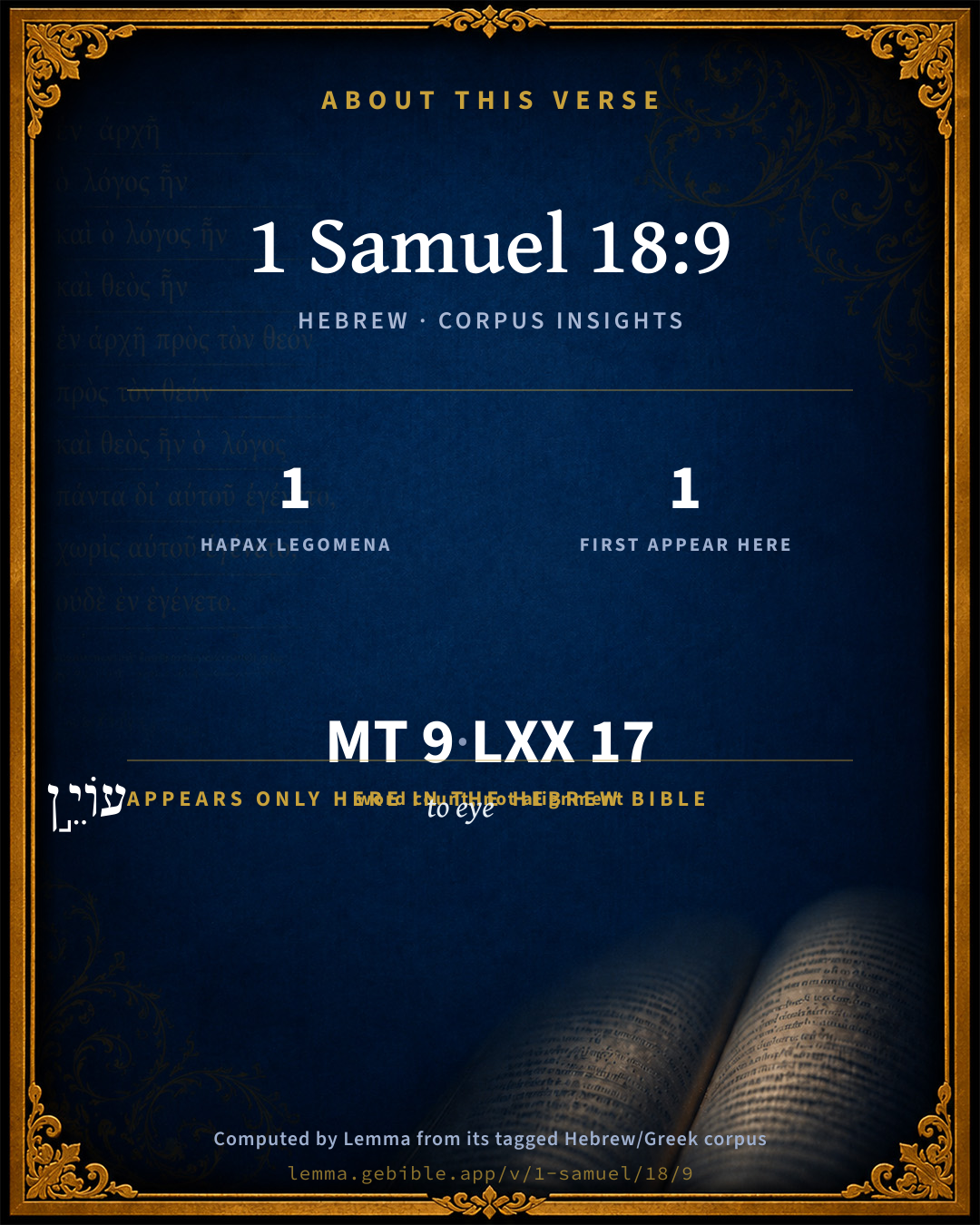
  • 1 hapax legomenon — only here in the Hebrew Bible
  • 1 first appearance in the Hebrew Bible
Full analysis ↓
Download a study sheet

One document with this verse’s original text, its word-by-word gloss line, the meaning frame, cross-references with their text, attributed commentary, and full source and license credits — printable, and it pastes into notes with its structure intact.

This verse Autodidact and up

Study sheet (.html) Plain text (.txt)

A passage Seminary Student

Up to 50 verses in one chapter. A passage sheet keeps up to 6 commentary sources and 12 cross-references per verse, in the order this page ranks them, and says so on the sheet whenever that leaves anything out. Ask for a single verse and you get the Autodidact verse sheet above.

Everything on this page stays free to read, with no account — the sheet is a download of what is already on screen, not access to it.

Want to remove ads? Support Godless Engineer
Compare translations 3

The same verse in 3 English versions, stacked beneath the original-language interlinear above. Click any original word for its lexicon entry.

Each is an independent rendering of the whole verse — the interlinear is not word-aligned to these translations.

Highlighted words mark where these versions differ — a whole-verse word diff, not a word-by-word alignment.

  • World English Bible Public Domain
    Saul eyed David from that day and forward.
  • King James Version Public Domain
    And Saul eyed David from that day and forward.
  • unfoldingWord Literal Text CC BY-SA 4.0
    And it happened that Saul was eyeing David from that day and beyond.

unfoldingWord Literal Text — © unfoldingWord, licensed CC BY-SA 4.0. Word-aligned USFM3 via Door43 (git.door43.org/unfoldingWord/en_ult).

Versions to compare (up to 4)

3 of 4 selected

Show all 18 translations

Every available English version of this verse, each an independent rendering of the whole verse.

  • World English Bible Public Domain
    Saul eyed David from that day and forward.
  • Berean Standard Bible Public Domain
    And from that day forward Saul kept a jealous eye on David.
  • Majority Standard Bible Public Domain
    And from that day forward Saul kept a jealous eye on David.
  • King James Version Public Domain
    And Saul eyed David from that day and forward.
  • American Standard Version (1901) Public Domain
    And Saul eyed David from that day and forward.
  • Revised Version (1885) Public Domain
    And Saul eyed David from that day and forward.
  • Geneva Bible (1599) Public Domain
    Wherefore Saul had an eye on Dauid from that day forward.
  • Douay-Rheims (1899) Public Domain
    And Saul did not look on David with a good eye from that day and forward.
  • Young's Literal Translation Public Domain
    and Saul is eyeing David from that day and thenceforth.
  • Literal Standard Version CC BY-SA 4.0
    And Saul is eyeing David from that day and from then on.
  • Unlocked Literal Bible CC BY-SA 4.0
    Saul looked at David with suspicion from that day on.
  • unfoldingWord Literal Text CC BY-SA 4.0
    And it happened that Saul was eyeing David from that day and beyond.
  • Darby Bible Public Domain
    And Saul eyed David from that day and forward.
  • World Messianic Bible Public Domain
    Saul watched David from that day and forward.
  • Webster's Bible Public Domain
    And Saul eyed David from that day and forward.
  • Free Bible Version CC BY-SA 4.0
    From that time on Saul viewed David with suspicion.
  • Bible in Basic English Public Domain
    And from that day Saul was looking with envy on David.
  • JPS Tanakh (1917) Public Domain
    And Saul eyed David from that day and forward.

Literal Standard Version (2020), Covenant Press — licensed CC BY-SA 4.0. Text via the HelloAO Bible API (eBible.org). Unlocked Literal Bible (unfoldingWord) — licensed CC BY-SA 4.0. Text via the HelloAO Bible API (eBible.org). unfoldingWord Literal Text — © unfoldingWord, licensed CC BY-SA 4.0. Word-aligned USFM3 via Door43 (git.door43.org/unfoldingWord/en_ult). Free Bible Version, Dr. Jonathan Gallagher — licensed CC BY-SA 4.0. Text via the HelloAO Bible API (eBible.org).

Word by word

More ways to search: Search by grammar → Find every occurrence → Compare this word →

Practice this passage: Drill this verse → Learn its vocabulary →

About this verse

These counts appear in no published source. They are computed here, from the morphology-tagged text and Lemma’s own curated glosses. What Lemma adds →

9
words
9
distinct lemmas
Historical
section

Notable vocabulary

1 hapax legomenon — a word that appears only here in the entire Hebrew Bible:

  • עוֹיֵ֣ן to eye H5770

First appearance in Scripture

This word makes its first canonical appearance in the Hebrew Bible here:

  • עוֹיֵ֣ן to eye H5770

Shared distinctive vocabulary

וָהָֽלְאָה yonder H1973 occurs in 16 verses of the Hebrew Bible. Also found in:

Grammatical profile

  • 2 verbs
  • 4 nouns
  • 1 pronoun
  • 1 adverb
  • 1 particle

Verb forms

  • וַיְהִ֥י Qal · Sequential Imperfect
  • עוֹיֵ֣ן Qal · Participle Active

Hebrew & Septuagint length

In English translation the verse runs 8 words from the Hebrew and 9 from the Septuagint (LXX English) — closely comparable.

A rough comparison of the two English renderings, which tokenize alike — not a word-level alignment.

Word counts can differ between the Hebrew and the Greek without any difference in meaning — e.g. the Hebrew direct-object marker אֵת has no separate Greek word, and Greek often adds the article ὁ.

In the original languages it is 9 Hebrew tokens and 17 Greek tokens — but the two are counted differently (Hebrew bundles its prefixes and suffixes into one token; the Greek is in lemma form), so that isn’t a like-for-like length.

Cross-references

6

Topical passages linked to 1 Samuel 18:9 in the Treasury of Scripture Knowledge — connected by theme and wording, ordered by reader-vote popularity; previews shown in the World English Bible.

  • Genesis 4:5–6 but he didn't respect Cain and his offering. Cain was very angry, and the expression on his face fell.
  • Genesis 31:2 Jacob saw the expression on Laban's face, and, behold, it was not toward him as before.
  • Matthew 20:15 Isn't it lawful for me to do what I want to with what I own? Or is your eye evil, because I am good?'
  • Mark 7:22 covetings, wickedness, deceit, lustful desires, an evil eye, blasphemy, pride, and foolishness.
  • Ephesians 4:27 neither give place to the devil.
  • James 5:9 Don't grumble, brothers, against one another, so that you won't be judged. Behold, the judge stands at the door.

Cross-references courtesy of OpenBible.info (CC BY 4.0).

Hebrew and Greek witnesses Masoretic Hebrew ↔ Greek Septuagint

The same verse in the two great witnesses to the Old Testament, shown verse-for-verse.

These are two independent witnesses, not word-aligned to each other, and the Septuagint is shown in lemma (dictionary) form.

Hebrew 1 Samuel 18:9 Masoretic · Westminster Leningrad Codex

וַיְהִ֥י שָׁא֖וּל עון עוֹיֵ֣ן אֶת דָּוִ֑ד מֵהַיּ֥וֹם הַה֖וּא וָהָֽלְאָה

Saul eyed David from that day and forward.

World English Bible · Public Domain

Greek LXX 1 Samuel 18:9 Septuagint · lemma form

καί πᾶς ἰσραήλ καί ἰούδας ἀγαπάω ὁ δαυίδ ὅτι αὐτός ἐκπορεύομαι καί εἰςπορεύομαι πρό πρόσωπον ὁ λαός

And Saul eyed David from that day and onward.

LXX2012 (modern English Septuagint) · Public Domain

On this verse, Haydock's Catholic Bible Commentary discusses the Septuagint’s reading. Read the note in Commentary ↓

Hebrew: Westminster Leningrad Codex (CC BY 4.0). Greek: Septuagint (public domain); English from LXX2012 (modern English Septuagint) (Public Domain). How the Septuagint differs from the Hebrew →

Targum (Aramaic paraphrase)

1

The Targum is the ancient Jewish Aramaic paraphrase of the Hebrew Scriptures — an interpretive translation, not the Hebrew text itself. Onkelos (literal) and Pseudo-Jonathan (expansive) render the Torah, and Jonathan the Prophets. Coverage is partial: where no permissively-licensed English translation exists for a verse, only the Aramaic is shown. This is verse-level text, not a word-by-word alignment to the Hebrew.

  1. Targum Jonathan Prophets (Joshua–Malachi)
    וַהֲוָה שָׁאוּל כָּמִין לְדָוִד מִיוֹמָא הַהוּא וּלְהַלָא:

    (no public-domain English translation for this verse)

    Targum Jonathan — Aramaic: “Mikraot Gedolot” (public domain). English: “Sefaria Community Translation” (CC0 1.0 (public-domain dedication)); “London "Chaldee Paraphrase," 1871” (public domain). Text via Sefaria.

Commentary

Notes on 1 Samuel 18:9 from classic Christian and Jewish commentators (each source and its license shown beneath its notes). The classic Christian expositions comment on the surrounding passage and are grouped to its opening verse, so a note may address several verses; the Jewish commentaries on the Tanakh (Rashi and others) are per-verse, so they appear only where the commentator wrote on this verse.

Lemma curates 59 commentaries, every one of them public domain or Creative Commons licensed, each selected and text-cleaned for this edition rather than reprinted as found. About our sources →

Trapp's Complete Commentary

John Trapp

1Sa 18:9 And Saul eyed David from that day and forward.

Ver. 9. And Saul eyed David.] Limis intuebatur, he looked upon him with an evil eye: prying into all his actions, and making the worst of everything.

From that day and forward.] Discovering that lernam vitiorum, world of wickedness, that was in his own heart. Sooner or later a hypocrite will show himself; how else should his name rot?

John Trapp, A Commentary or Exposition upon All the Books of the Old and New Testament (1647–1656) — public domain. Text from a community e-Sword module.

The Biblical Illustrator

Joseph S. Exell

1Sa_18:9-30

And Saul eyed David from that day and forward.

Davids enemy-Saul

It is the enmity of Saul which we are to consider--its beginning, its rapid growth, its deadly purpose. The excitement of the war being over, the king has time to think of himself, and he is filled with thoughts of his dethronement; and the envy of David eats into his heart so greedily that his old frenzy is brought on again. On the very next day his heart grew malicious toward David; the evil spirit seized him once more. Whether this was a diabolical possession or a mere mental malady the learned are not agreed. It seems to have partaken of both. There is too much of apparent nature in it to permit us to believe it was all spiritual, and there was too much of apparent spiritual in it to suffer us to believe it was all natural. This we know from the plain record: The Spirit of the Lord had departed from Saul, and an evil spirit from the Lord troubled him. So that, negatively and positively, the hand of the Lord was in it. And yet he was eating the fruit of his own doings--given over, as Paul says, to a reprobate mind. But Sauls hate has not abated with the passage of the frenzy. The direct assault has failed, but there are surer methods in reserve. Men are cheap now to the king, who sees his crown in danger, and ten thousand slain or captured will not be missed if David but goes down with them. Yet again he fails. David can wield a thousand men as skilfully as he can swing his sling, and the king grows bitterer still. Saul learns that his other daughter loves this brilliant young captain, and it is surmised that her passion was returned, else the spirited soldier had not submitted so tamely to his twice winning and twice losing Merab. Not to gratify the heart of either does Saul give his consent now; he hopes that Michal may be a snare to him and the hand of the Philistine may be against him. He slyly mentions a dower--not directly, but through his courtiers--such as a poor man, skilled in fight, might give to a king, the procuring of which he surely thought would bring him his death. And his heart must have been filled with malignant joy as he heard that he and his men (his two or three attendants, not his ten hundred) bad sallied forth to slay one hundred men. But before the days were expired back be comes, bringing the designated trophies in double tale. But why pursue the disgraceful story further? Each defeat but fans the flame to greater fury, and Saul soon throws off the thin disguise with which he has marked his deadly purpose, and openly spake to Jonathan, his sons and to all his servants that they should kill David (1Sa_19:1.) At length the sad end came. The life that bad begun in such brilliant promise was closed by self-destruction. His enmity was fruitless, except in bitterness to himself and trouble to Israel. It could not set aside the plans of the Almighty: His counsel shall stand, and He will do all His pleasure. These are the practical lessons which the unrelenting enmity of Saul suggests.

(1) Beware of jealousy. Let the misery Saul brought upon himself remind us what a magazine of self-torture every human spirit contains; and no single disposition of the soul is more likely to touch off the magazine, and make of the heart a hell of wildest disorder and ever-dripping woe, than the disposition of envy, jealousy, and revenge. Jealousy may lead any man who listens to its suggestions into hatred as fierce, and opposition as malignant, and thoughts as deadly, and at last defiance of God as blasphemous, as Saul manifested.

(2) We are reminded by Sauls conduct how natural it is for a man to throw over on some other the blame of his own hurtful blunders or wilful misdeeds. Rarely, very rarely, do men go down by blunders all their own or wickedness springing from their own hearts. But for some other or others they bad been standing yet.

(3) Sauls case may warn us of the great danger of becoming embittered and revengeful when going down in prosperity and losing influence and honour. Men rarely stay long at the top. There is an established system of rotation in the universe as regards the tenure of its high places. Men may come down when at the height of their powers and opportunity, or they may stay up till waning powers tell them another must take the place. A blunder may give the start, or the scheming of others may do the work. But whatever causes it, let the declining man crucify his selfishness, curb his tongue from bitter words, and go down gracefully, sweetly, clothed in the kingly garments of dignified self-respect.

(4) As Saul warns of what may take men down, David teaches how to rise in the face of opposition that it would seem should stop our progress. He who fears God will have the favour of the Lord.

(5) We may see in Sauls fall and Davids rise that God cannot be thwarted in His purposes. In spite of Sauls javelin, in spite of Sauls wily scheming, in spite of his pursuing warriors, in spite of the fierceness of the Philistines, he was chosen of the Lord and must take the crown. Now, therefore, kings, be wise; be taught, ye judges of the earth; The Lord reigneth; He puts down one, and sets another up. (T. H. Hanna, D. D.)

The wicked jealous of the good

The incident teaches three things respecting good and bad men.

I. The wicked are often jealous of a good mans popularity. And Saul was very wroth, and the saying displeased him. Sauls behaviour to David reveals the progress of jealousy in four stages.

1. There is anger. He was wroth.

2. There is envy. And Saul eyed him from that day.

3. There is madness. The evil spirit from God came upon him.

4. There is murder. And Saul east the javelin: for he said, I will smite David even to the wall.

It is a sure sign that the Spirit of God has left a man when he is jealous of his benefactor. Jealousy is a foolish passion, and inflicts self-injury. Jealousy is a wicked passion, and displeasing to God. Jealousy is a dangerous passion, and leads to the most fatal issues. Wrath is cruel, and anger is outrageous; but who is able to stand against envy?

II. The wicked are often terrified by a good mans security. And Saul was afraid of David, because the Lord was with him, and was departed from Saul. Sin makes a man a coward. Tis doing wrong creates such fears as these, renders us jealous, and destroys our peace. Sauls fear led to the adoption of the most desperate measures to ruin David.

1. Saul resolves to dismiss David. Therefore Saul removed David from him, and made him his captain over a thousand. Saul wished to prevent David from gaining the affections of the courtiers, and also to excite against him the envy of his subordinates. In both intentions he was disappointed; for all Israel loved David.

2. Saul endeavours to provoke David. Sauls change of purpose in giving his daughter to Adriel was designed to wound Davids honour, and excite his resentment. David had just cause of complaint, but he did not utter a word of reproach against the glaring injustice.

3. Saul determines to kill David. Jealousy extorts the most costly sacrifices--gratitude, honour, affection. A bad man will barter away his own child to accomplish his ends. Under the promise of preferment there may lurk the most deadly designs. Fair words may proceed from a foul heart. The face may beam with the light of heaven, while the heart is inflamed with the passions of hell.

III. The wicked are often defeated by a good mans valour.

1. In this encounter David fulfils the kings stipulation.

2. In this encounter David thwarts the kings purpose.

3. In this encounter David wins the kings daughter. God can make the impediments that are thrown in the way of His children aids to their progress. The subtle and deadly designs of our enemies are among the ordained purposes of God. (J. T. Woodhouse.)

Sauls evil eye

I. Sauls envy. Selfishness, that root of bitterness filled him. And from it there sprang the baleful poison-breathing blossom, envy. What a sin is this! Men enjoy the pleasures of sin for a season, but no pleasure in this--of all sins the most hateful. It is vexed at anothers good. It sickens to hear another praised. Base, it

Withers at anothers joy,

And hates the excellence it cannot reach.

Envy hath no holidays. Where it enters it poisons life. It is a very hell above ground. Let us beware. Let us not in this thing give place to the devil, but resist him. This Book has solemn warnings enough against this abominable sin. The first death in our world was brought about by it, when Cain, the devils patriarch, as an old wrier calls him, laid his cruel club on the innocent head of his brother Abel. It was the sin of Josephs brethren. The patriarchs, says St. Stephen, moved with envy, sold Joseph into Egypt. It was the sin of Korah, who envied Moses, and of Ahab, who envied Naboth. And the crowning crime of history is put to its account, for the Pharisees for envy delivered our Lord to death.

II. Michaels deception. There was no need for the deception. It showed her distrust of God. It was wrong, and it led to a lie against the very man she loved. Better to die than to lie. You might as well steal from the rich to help the poor, as to seek by lies to help another. Trust in God and do the right and speak the right. Men may extenuate their falsehoods and call them white lies and grey fibs. But God frowns away the epithets. He will not acknowledge them. He bids us speak truth one to another. He declares that lying lips are an abomination to Him; that a lying tongue is but for a moment; that all liars will be excluded from the Heavenly and Eternal City of Truth and Glory.

III. Davids preservation.

1. From bodily peril he was preserved. As captain of a thousand guarding the frontier--a dangerous service; as proving his worthiness, by deeds of valour, of the hand of Merab. As escaping again and again and again, the hurled javelin that sought to pin him in death to the wall. As watched for by Sauls assassins; how imperilled, how preserved was David! Not by miracle. Human friendship helped him. Beautiful, magnanimous the pleading of Jonathan with Saul on his behalf. There was a true friend who worked for him with the patience and meekness of wisdom. And who, with word in season, shamed the king from his murderous purpose. So far did Jonathans oratory and Davids innocency together triumph in Sauls conscience. Thus, for a little while, a debtor to friendship and its successful plea, David had peace. Wifely love helped him. Michal refused to be, as Saul had hoped, a snare to her husband. She warned him of the men of blood that lay in wait for him. She let him down through a window, and he escaped.

4. His own valour helped him. Great had been his victory over Goliath. But more than this was needed. His alert and constant watchfulness helped him. When he struck his harp he was never so absorbed in the song as to be heedless of the king. On that javelin sceptre his eye indeed needed to be fixed!

6. Yet the Lord preserved him. For these were but the means by which worked for him the Almighty Preserver of men; the God who had set His love upon him.

7. He was preserved from spiritual peril. He was unharmed by prosperity. With much to flatter him into forgetfulness of his lowly origin, to tempt him into the airs and assumptions of pride, he walked humbly because he walked with God. (G. T. Coster.)

The discipline of an anointed man

Keep in mind the undoubted anointing of David, and then see what untoward and heartbreaking experiences may befall men whom God has sealed as the special objects of His favour and the high ministers of His empire. Given, a man called of God to a great work, and qualified for its execution, to find the providences which will distinguish his course. A child might answer the easy problem: His career will be brilliant--his path will be lined with choice flowers--he will be courted, blessed, honoured on every hand. Look at the history of David for a contradiction of this answer. We shall find persecution, hatred, difficulty, hunger, cold, loneliness, danger upon danger; yet he who endures them all is an anointed man--a favourite of heaven. The history, so far as we shall be able to trace it, shows four things respecting the discipline of an anointed man:--

I. That great honours are often followed by great trials. These trials not to be looked at in themselves, but in their relation to the honours which went before. Imagine a garden discussing the year as if it were all winter. Look at the temptation assailing David, in the fact that he alone had slain the enemy of Israel. Something was needed on the other side to chasten his feeling. Men must be taught their weakness as well as their power.

II. That great trials generally bring unexpected alleviations. The soul of Jonathan was knit with the soul of David, and Jonathan loved him as his own soul. The love of one true soul may keep us from despair. Love is fertile and energetic in device, See what Jonathan did. Love is more than a match for mere power. Love is most valued under such circumstances as Davids. There is a friend that sticketh closer than a brother.

III. That no outward trials can compare in severity with the self-torment of wicked men. We are apt to think that Saul did all the mischief, and David suffered it. That is an incomplete view of the case, Saul was himself the victim of the cruellest torment.

IV. That great trials, though calling for self-scrutiny, may not call for self-accusation. This is a point which should be put with great delicacy, because we are too apt to exempt ourselves from self-reproach. The question which the tried man generally asks himself is, What have I done? Days of misery have been spent in brooding ever that inquiry. The question is only good so far as it goes. It should be succeeded by another--What is God doing? Imagine the silver in the refining fire asking, What have I done?--not knowing that it is being prepared to adorn the table of a king! Imagine the field asking, What have I done, that the plough should cut me up? We are strong only so far as we see a Divine purpose in the discipline of our life. Whom the Lord loveth He chasteneth and scourgeth every son whom He receiveth. Let patience have her perfect work. We are polished by sharp friction. We are refined by Divine fire. Sorrow gives the deepest, and sweetest tone to our sympathy. We should be driven mad by uninterrupted, ever-augmenting prosperity. Over every jealous soul the hand of the Lord is omnipotent. Look at Saul, and the case of David is hopeless: look beyond him, and see how by a way that he knew not the shepherd was being trained to be mighty among kings, and chief of all who sing the praises of God. (J. Parker, D. D.)

The great persecution

The king of Israel has fairly entered on a course of stern hostility to David. With the history of this ruling purpose his whole subsequent career is darkened.

1. The deadly nature of Sauls enmity. A less thorough tyrant would at the most have deemed confinement retribution stern enough for the crimes of personal bravery, prudent conduct, a happy successfulness given by God, and a high popularity with the people. But Sauls enmity, once kindled, could be quenched only by blood. Jealousy is cruel as the grave. With Saul, as with all tyrants in whom conscience is not quite dead, and fear is keenly alive, it was felt as a desperate necessity that he should proceed to extremities. And so he sought the life of David. Nothing lower would content him. And from that inner hall where the jealous monarch nursed his wrath, the password went that David be destroyed. The persevering obstinacy of it. The proofs of this are mournfully abundant. It may be measured by the plans it contrived, the time during which it lasted, and the obstacles which it overcame.

2. The plans which it contrived. A device to make him fall by the sword of the Philistines. But how sad is the picture of an unnatural father sacrificing the domestic affections at the shrine of his kingly jealousy! Making a daughters love the vehicle of vengeance on its object! A state alliance for mere political purposes is bad enough; but to make holiest feelings the slaves, not of public interest, but of private resentment, is immeasurably worse. He assails him again with his own hand, and sends secret agents to his house to slay him. He escaped to Samuel. Two companies of messengers were despatched in pursuit. Yes, from the very horns of the altar the relentless king would drag his victim. But a mighty interposition came from the invisible to shield the innocent.

3. The time during which it lasted. The usual calculations make it eight or nine years. This surely is too brief a period to admit of occurrences so important, numerous, and varied as the history contains. But assuming the accuracy of the estimate, how tenacious must have been the life of a resentment which reigned so long! Time, the great soother of strife, lost here its mellowing charm. The dark passion seems to have wrapped his soul in perpetual gloom, and to have become to him a second nature.

4. The obstacles it surmounted. The monitions of his own conscience; the high character and deserved popularity of David; the immense and ceaseless trouble, and the neglect of grave public duties, involved in pursuing the fugitive. How stern and settled that resentment which so quickly quenched all soft emotion, and craved still for the blood of the brave, forbearing, and generous youth. We shudder at a passion, so fierce, sullen, and enduring. We cannot help discerning in it the malevolent working of hellish inspiration. Sauls forfeiture of the kingdom was absolute and irreparable. It was emphatically pronounced, more than once, by Him who cannot lie. And yet this poor worm of the dust dares to plant himself in the way, dares to conceive deliberately the design of arresting that series of events, thereby to defeat the purpose of Him who is great in counsel and mighty in work, and throw upon the majesty of heaven the ignominy of a conspicuous failure. Amazing fact! Language cannot express the enormity. By what name shall we call it? Infatuation? Madness? Impiety? It is all three in one. To attempt plucking the stars from their seats, or stopping the tidal flow, were not greater madness than to strike at him who is shielded by omnipotence. To blaspheme in words the sacred name of God. Were not more daring impiety than to offer proud and obstinate resistance to His will. To profane and prostitute thus the time, faculties, and privileges He has given is to make life one great oath. (P. Richardson. B. A.)

Looking for the black side

And Saul eyed David--that is to say, cast an askance vision at him; thought mean things of him; was sure there was a black side in him, and steadily looked for it. Saul allowed this looking for the black side in David to become a settled habit of his life. How sad the habit! And the seat of it was a mean, miserable envy. Remember those wise words which the wise Lord Bacon said of envy: Envy is the worst of all passions, and feedeth upon the spirits, and they again upon the body; and so much more because it is perpetual, and, as it is said, keepeth no holidays. And this looking upon the black side is not an altogether ancient failing. Some people steadily look for the black side in other people. This, as we have just been saying, became Sauls way. Saul therefore perpetually misinterpreted David. One is pretty apt to see what one is bound to see. I have been in India for many a year, and I never saw a native Christian the whole time. So spoke a colonel on board a steamer going to Bombay. Some days afterward the same colonel was telling of his bunting experience, and said that thirty tigers had fallen to his rifle. Did I understand you to say thirty, colonel? asked a missionary at the table. Yes, sir, thirty, replied the officer. Because, pursued the missionary, I thought perhaps you meant three. No, sir, thirty. Well, now, that is strange; I have been in India twenty-five years and I never saw a wild live tiger all the while. Very likely not, sir, said the colonel, but that is because you did not look for them. Perhaps it is so, admitted the missionary; but was not that the reason you never saw a native convert? So it is, one sees pretty generally what one is bound to see, tigers or Christians; and if one is bound to see a tiger, even though there may be no tigers in his country, he can imagine one easily enough, and that, so far as be is concerned, amounts to the same thing. (W. Hoyt, D. D.)

Pride of rivalry

Ciceros natural place was at Caesars side; but to Caesar alone of his contemporaries be was conscious of an inferiority which was intolerable to him. In his own eyes he was always the first person. He had been made unhappy by the thought that posterity might rate Pompey above himself. Closer acquaintance had reassured him about Pompey, but in Caesar he was conscious of a higher presence, and he rebelled against the humiliating acknowledgment. (Froudes Caesar.)

Jealousy denies justice to others

Napoleon the First absolutely detracted from the merits of his bravest marshals, and was as jealous of fame as a woman or a poet; whilst Oliver Goldsmith used to fume and fret, nay, would ridiculously interrupt the company when he found the praises and attention lavished on his friend, Dr. Johnson, were too strong for his jealous heart. (H. O. Mackay.)

Cruelty of envy

Dionysius the tyrant, out, of envy, punished Philoxinius the musician because he could sing, and Plato, the philosopher, because he could dispute better than himself. (Plutarch.)

Tyranny of self

The friendly biographer of the artist Gustave Dore says of him: He never heard of any other artists success without brooding over it jealously and unhappily. He was ever on the qui vive of envious excitement, and lived with the constant fear gnawing his vitals that any day someone might come to the front and eclipse him. So the sin of selfishness always in the end punishes the soul that indulges it. It comes like Herodias, a dazzling creature, yet intent on blood. There is no cruelty like the cruelty of sin even to the sinner himself. (H. O. Mackay.)

Envy the parent of crime

Cambyses, king of Persia, slew his brother because the latter could draw a stronger bow than himself; and Caligula, the Roman emperor, put his brother to death because he was specially handsome.

The Biblical Illustrator, edited by Joseph S. Exell (c. 1880s–1900s) — public domain. Text from a community e-Sword module.

Geneva Bible (1599)

Geneva Bible translators

Because he bare him envy and hatred.

Geneva Bible (1599) marginal notes — public domain. Text via Bolls.life.

Jamieson, Fausset & Brown

Robert Jamieson, A. R. Fausset & David Brown

Saul eyed David--that is, invidiously, with secret and malignant hatred.

Jamieson, Fausset & Brown — Commentary Critical and Explanatory on the Whole Bible (1871) — public domain (CC PDM 1.0). Text via the HelloAO Bible API.

Ellicott's Commentary for English Readers

(9) And Saul eyed David.—From the hour on which the king listened to the people’s lilt in honour of the young hero, in Saul’s distempered mind hate alternated with love. He still in his heart longed for the presence of the only human being who could charm away his ever-increasing melancholia, but he dreaded with a fierce jealousy the growing influence of the winning and gifted man whom he had taken from the sheep-folds; and now through the rest of the records of this book we shall see how the hate gradually obscured the old love. All our memories of Saul seem bound up with his life-long murderous pursuit of David.

A Bible Commentary for English Readers, edited by Charles John Ellicott (1878–1897) — public domain. Text from a community e-Sword module.

The Cambridge Bible for Schools and Colleges

gen. ed. J. J. S. Perowne

9. Saul eyed David] With a suspicious jealousy which soon ripened into a deadly hatred. There is no need to suppose that David’s anointing by Samuel had been reported to him. “The prophet had distinctly told him in the day of his sin, that the Lord had rent the kingdom from him, and had given it to a neighbour that was better than he. And in David he could read the marks of such a man.” Wilberforce’s Heroes of Heb. Hist. p. 245.

The Cambridge Bible for Schools and Colleges (gen. ed. J. J. S. Perowne; Cambridge University Press, 1878–1918) — public domain. Text from a community e-Sword module.

John Gill's Exposition

And Saul eyed David from that day and forward. Instead of looking pleasantly, and with a smile, upon him, as a courtier and favourite, he was justly entitled to by his gallant behaviour, he looked at him with a sour, ill natured look; he looked at him with an evil, spiteful, malicious, and envious eye; or he diligently watched and observed all his motions and actions, whether they tended to disloyalty and treason, to dethrone him, and take the kingdom to himself, which he was suspicious of; he laid wait for him, as the Targum, and laid snares too, as the following history shows.

And Saul eyed David from that day and forward. Instead of looking pleasantly, and with a smile, upon him, as a courtier and favourite, he was justly entitled to by his gallant behaviour, he looked at him with a sour, ill natured look; he looked at him with an evil, spiteful, malicious, and envious eye; or he diligently watched and observed all his motions and actions, whether they tended to disloyalty and treason, to dethrone him, and take the kingdom to himself, which he was suspicious of; he laid wait for him, as the Targum, and laid snares too, as the following history shows.

1 Samuel 18:10

sa1 18:10

sa1 18:10

sa1 18:10And it came to pass on the morrow,.... After the women had met him with their music and dancing, and when returned home:

that the evil spirit from God came upon Saul; thinking on the above things that had passed, he became melancholy:

and he prophesied in the midst of the house; either really, delivering out divine songs, as the prophets did; according to Abarbinel, he foretold that David would be king, and the kingdom would be taken from him, and given to him; or he feigned himself a prophet, mimicking their motions and gestures; or, as the Targum, acted like a mad man, or a fool, uttering foolish words, and using ridiculous gestures, which seems most agreeable to the evil spirit in him:

and David played with his hand as at other times; upon his harp, to remove the evil spirit, or melancholy disposition from Saul; for though he was now advanced at court, and an officer in the army, and high in the affections and applause of the people: yet he did not think it below him to act as a musician, to do service to his prince; of such an humble, kind, and ingenuous disposition was he:

and there was a javelin in Saul's hand; a kind of spear, or half pike, which he had taken into his hand on purpose to kill David while playing; for persons in such circumstances as his, as they are very mischievous, so very subtle at contriving.

John Gill's Exposition of the Whole Bible (1746–1763) — public domain (CC PDM 1.0). Text via the HelloAO Bible API.

Haydock's Catholic Bible Commentary

Eye. Septuagint, "and Saul suspected." (Haydock) --- Chaldean, "laid snares for David." (Calmet)

George Leo Haydock (1774–1849), Haydock's Catholic Family Bible and Commentary, 1859 edition — public domain. Excludes Psalms (Douay-Rheims chapter numbering differs from Protestant) and Deuterocanonical books (Catholic canon only).

Matthew Poole's English Annotations

i.e. Narrowly observed all his counsels and actions, that he might understand whether he had any design upon the kingdom or no, and that he might find some colourable pretence of putting him to death.

Matthew Poole's English Annotations on the Holy Bible (1683–1685) — public domain. Text from a community e-Sword/MySword module.

Whedon's Commentary on the Bible

Daniel D. Whedon

9. Eyed David from that day — Watched all his movements with suspicion and jealousy. And this fact may well account for the king’s failure to reward David and his father’s house according to all that he had promised the one who would succeed in slaying the insolent Goliath. 1Sa_17:25.

Daniel D. Whedon (gen. ed.), Commentary on the Old and New Testaments (1874–1909) — public domain. Text from a community e-Sword module.

Rashi

Rabbi Shlomo Yitzchaki (Rashi)

Viewed suspiciously. With an envious glance.

Rashi on the Tanakh — English translations: “The Judaica Press complete Tanach with Rashi, translated by A. J. Rosenberg” (CC BY 4.0); “Pentateuch with Rashi's commentary by M. Rosenbaum and A.M. Silbermann, 1929-1934” (public domain); “The Metsudah Tanach series, Lakewood, N.J” (CC BY 4.0); and “The Book of Joshua, Metsudah Publications, 1997” (CC BY 4.0). Text via Sefaria.

Lesson kit

Teaching starters — assembled from the data on this page, not authored interpretation. Every prompt links to the verse data it draws on. Edit before teaching.

1 Samuel, in the Historical, opens this verse with 9 words (9 distinct Hebrew lemmas). Its most distinctive word is ʻâvan (“to eye”). A historical commentator’s framing appears above. Read the whole chapter for the surrounding context.

Discussion questions

  1. The word ʻâvan carries the sense “to eye.” How does it shape the verse?
  2. This verse holds 1 word here found nowhere else in the Hebrew Bible. What might the rare word draw attention to?
  3. The word “to eye” first appears here in Scripture. What is being introduced at this debut?
  4. Genesis 19:9 shares the word «yonder» with this verse. How do the two illuminate each other?
  5. These translations render this verse differently; the difference is in the English rendering, not the original. What questions does that raise?
  6. The verb «וַיְהִ֥י» is Qal Sequential Imperfect. How does its form color the action?
  7. Reading how Trapp's Complete Commentary and The Biblical Illustrator read this verse, where do the two commentators agree and where do they part?

Things to notice

Reading settings

Reading text

Shown beneath each verse's original-language words.

Old Testament
Old Testament edition

Read the OT as the Masoretic Hebrew (MT) or the Greek Septuagint (LXX).

English shown for the Greek Septuagint (in the Hebrew ↔ Greek comparison).

Comparing translations? Open the Compare panel on any verse page to stack up to four side by side.