Isaiah 6:7

Hebrew (Westminster Leningrad Codex) Isaiah 6:7 appears in the Hebrew Old Testament. The text above is from the Westminster Leningrad Codex. Each word links to its Strong’s number, a concise gloss, and parsing drawn from the Open Scriptures Hebrew Bible morphology. Click any word for its full Brown-Driver-Briggs (BDB) entry.
Download image
Cite this verse

Isaiah 6:7 (World English Bible). Public Domain. Lemma interlinear Bible study tool, https://lemma.gebible.app/v/isaiah/6/7.

Show BibTeX & RIS
BibTeX
RIS
English Translation
He touched my mouth with it, and said, "Behold, this has touched your lips; and your iniquity is taken away, and your sin forgiven."
World English Bible · Public Domain
Download a study sheet

One document with this verse’s original text, its word-by-word gloss line, the meaning frame, cross-references with their text, attributed commentary, and full source and license credits — printable, and it pastes into notes with its structure intact.

This verse Autodidact and up

Study sheet (.html) Plain text (.txt)

A passage Seminary Student

Up to 50 verses in one chapter. A passage sheet keeps up to 6 commentary sources and 12 cross-references per verse, in the order this page ranks them, and says so on the sheet whenever that leaves anything out. Ask for a single verse and you get the Autodidact verse sheet above.

Everything on this page stays free to read, with no account — the sheet is a download of what is already on screen, not access to it.

Want to remove ads? Support Godless Engineer
Compare translations 3

The same verse in 3 English versions, stacked beneath the original-language interlinear above. Click any original word for its lexicon entry.

Each is an independent rendering of the whole verse — the interlinear is not word-aligned to these translations.

Highlighted words mark where these versions differ — a whole-verse word diff, not a word-by-word alignment.

  • World English Bible Public Domain
    He touched my mouth with it, and said, "Behold, this has touched your lips; and your iniquity is taken away, and your sin forgiven."
  • King James Version Public Domain
    And he laid it upon my mouth, and said, Lo, this hath touched thy lips; and thine iniquity is taken away, and thy sin purged.
  • unfoldingWord Literal Text CC BY-SA 4.0
    And he made touch on my mouth, and he said, “Behold, this has touched on your lips, and your iniquity has departed, and your sin has been covered.”

unfoldingWord Literal Text — © unfoldingWord, licensed CC BY-SA 4.0. Word-aligned USFM3 via Door43 (git.door43.org/unfoldingWord/en_ult).

Versions to compare (up to 4)

3 of 4 selected

Show all 18 translations

Every available English version of this verse, each an independent rendering of the whole verse.

  • World English Bible Public Domain
    He touched my mouth with it, and said, "Behold, this has touched your lips; and your iniquity is taken away, and your sin forgiven."
  • Berean Standard Bible Public Domain
    And with it he touched my mouth and said: “Now that this has touched your lips, your iniquity is removed and your sin is atoned for.”
  • Majority Standard Bible Public Domain
    And with it he touched my mouth and said: “Now that this has touched your lips, your iniquity is removed and your sin is atoned for.”
  • King James Version Public Domain
    And he laid it upon my mouth, and said, Lo, this hath touched thy lips; and thine iniquity is taken away, and thy sin purged.
  • American Standard Version (1901) Public Domain
    and he touched my mouth with it, and said, Lo, this hath touched thy lips; and thine iniquity is taken away, and thy sin forgiven.
  • Revised Version (1885) Public Domain
    and he touched my mouth with it, and said, Lo, this hath touched thy lips; and thine iniquity is taken away, and thy sin purged.
  • Geneva Bible (1599) Public Domain
    And he touched my mouth, and sayd, Loe, this hath touched thy lips, and thine iniquitie shall be taken away, and thy sinne shalbe purged.
  • Douay-Rheims (1899) Public Domain
    And he touched my mouth, and said: Behold this hath touched thy lips, and thy iniquities shall be taken away, and thy sin shall be cleansed.
  • Young's Literal Translation Public Domain
    and he striketh against my mouth, and saith: `Lo, this hath stricken against thy lips, And turned aside is thine iniquity, And thy sin is covered.'
  • Literal Standard Version CC BY-SA 4.0
    and he strikes against my mouth and says: “Behold, this has struck against your lips, || And your iniquity is turned aside, || And your sin is covered.”
  • Unlocked Literal Bible CC BY-SA 4.0
    He touched my mouth with it and said, “See, this has touched your lips; your guilt has been taken away, and your sin atoned for.”
  • unfoldingWord Literal Text CC BY-SA 4.0
    And he made touch on my mouth, and he said, “Behold, this has touched on your lips, and your iniquity has departed, and your sin has been covered.”
  • Darby Bible Public Domain
    and he made it touch my mouth, and said, Behold, this hath touched thy lips; and thine iniquity is taken away, and thy sin expiated.
  • World Messianic Bible Public Domain
    He touched my mouth with it, and said, “Behold, this has touched your lips; and your iniquity is taken away, and your sin forgiven.”
  • Webster's Bible Public Domain
    And he laid it upon my mouth, and said, Lo, this hath touched thy lips; and thy iniquity is taken away, and thy sin purged.
  • Free Bible Version CC BY-SA 4.0
    He touched me on my mouth with it and told me, “Look! This has touched your lips, so now your guilt is taken away and your sin is forgiven.”
  • Bible in Basic English Public Domain
    And after touching my mouth with it, he said, See, your lips have been touched with this; and your evil is taken away, and you are made clean from sin.
  • JPS Tanakh (1917) Public Domain
    and he touched my mouth with it, and said: Lo, this hath touched thy lips; and thine iniquity is taken away, and thy sin expiated.

Literal Standard Version (2020), Covenant Press — licensed CC BY-SA 4.0. Text via the HelloAO Bible API (eBible.org). Unlocked Literal Bible (unfoldingWord) — licensed CC BY-SA 4.0. Text via the HelloAO Bible API (eBible.org). unfoldingWord Literal Text — © unfoldingWord, licensed CC BY-SA 4.0. Word-aligned USFM3 via Door43 (git.door43.org/unfoldingWord/en_ult). Free Bible Version, Dr. Jonathan Gallagher — licensed CC BY-SA 4.0. Text via the HelloAO Bible API (eBible.org).

Word by word

More ways to search: Search by grammar → Find every occurrence → Compare this word →

Practice this passage: Drill this verse → Learn its vocabulary →

תְּכֻפָּֽר
kâphar
H3722
“to atone”
Verb, Pual, Imperfect, 3rd Person, Feminine, Singular
Part of Speech
Verb
Stem
Pual
Form
Imperfect
Person
3rd Person
Gender
Feminine
Number
Singular
Full BDB Definition

Origin: a primitive root

TWOT: 1023 , 1024 , 1025 , 1026

to cover, purge, make an atonement, make reconciliation, cover over with pitch - (Qal) to coat or cover with pitch - (Piel) - to cover over, pacify, propitiate - to cover over, atone for sin, make atonement for - to cover over, atone for sin and persons by legal rites - (Pual) - to be covered over - to make atonement for - (Hithpael) to be covered
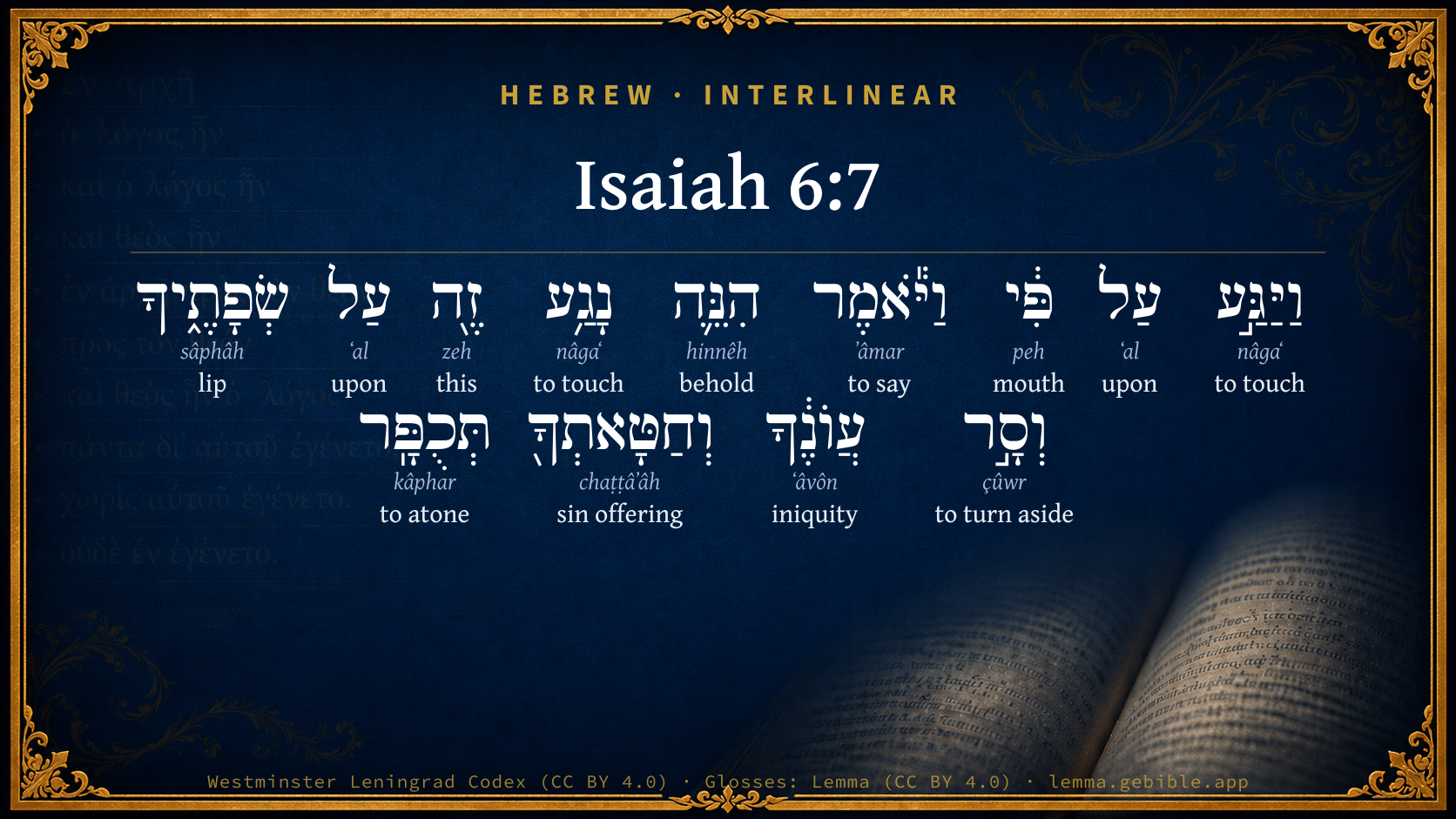
  1. וַיַּגַּ֣ע nâgaʻ H5060 “and · to touch” Conjunction + Verb, Hiphil, Sequential Imperfect, 3rd Person, Masculine, Singular
  2. עַל ʻal H5921 “upon” Preposition
  3. פִּ֔י peh H6310 “mouth · my” Noun, Common, Masculine, Singular, Construct + Suffix, Personal, 1st Person, Common, Singular
  4. וַיֹּ֕אמֶר ʼâmar H559 “and · to say” Conjunction + Verb, Qal, Sequential Imperfect, 3rd Person, Masculine, Singular
  5. הִנֵּ֛ה hinnêh H2009 “behold” Particle, Demonstrative
  6. נָגַ֥ע nâgaʻ H5060 “to touch” Verb, Qal, Perfect, 3rd Person, Masculine, Singular
  7. זֶ֖ה zeh H2088 “this” Pronoun, Demonstrative, Masculine, Singular
  8. עַל ʻal H5921 “upon” Preposition
  9. שְׂפָתֶ֑יךָ sâphâh H8193 “lips · your” Noun, Common, Feminine, Dual, Construct + Suffix, Personal, 2nd Person, Masculine, Singular
  10. וְסָ֣ר çûwr H5493 “and · to turn aside” Conjunction + Verb, Qal, Sequential Perfect, 3rd Person, Masculine, Singular
  11. עֲוֺנֶ֔ךָ ʻâvôn H5771 “iniquity · your” Noun, Common, Both, Singular, Construct + Suffix, Personal, 2nd Person, Masculine, Singular
  12. וְחַטָּאתְךָ֖ chaṭṭâʼâh H2403 “and · sin offering · your” Conjunction + Noun, Common, Feminine, Singular, Construct + Suffix, Personal, 2nd Person, Masculine, Singular

About this verse

These counts appear in no published source. They are computed here, from the morphology-tagged text and Lemma’s own curated glosses. What Lemma adds →

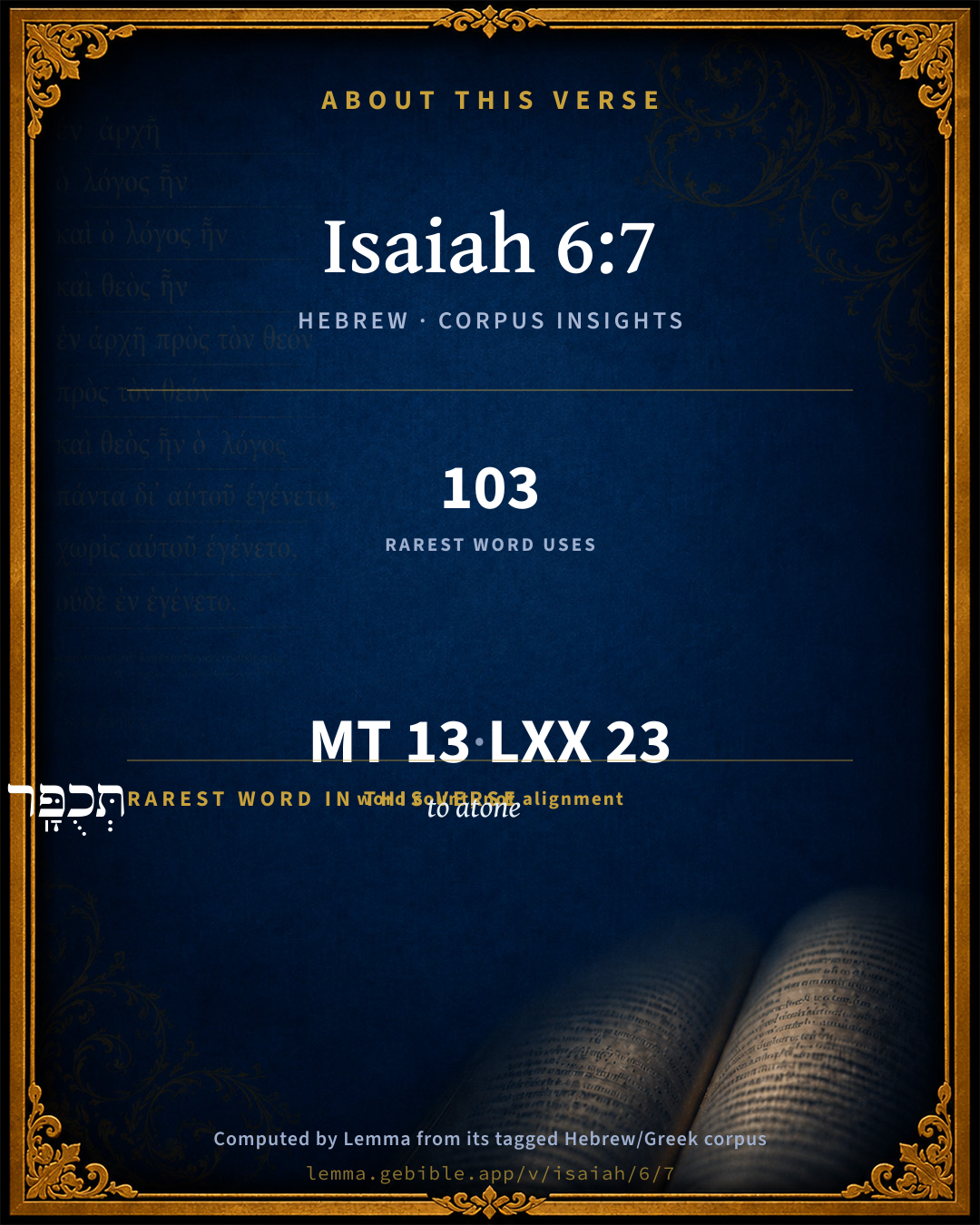
13
words
11
distinct lemmas
Prophets
section

Grammatical profile

  • 5 verbs
  • 4 nouns
  • 1 pronoun
  • 2 prepositions
  • 1 particle

Verb forms

  • וַיַּגַּ֣ע Hiphil · Sequential Imperfect
  • וַיֹּ֕אמֶר Qal · Sequential Imperfect
  • נָגַ֥ע Qal · Perfect
  • וְסָ֣ר Qal · Sequential Perfect
  • תְּכֻפָּֽר Pual · Imperfect

Repetition

Words recur within this verse — often emphatic in Hebrew:

  • וַיַּגַּ֣ע to touch H5060 ×2
  • עַל upon H5921 ×2

Hebrew & Septuagint length

In English translation the verse runs 24 words from the Hebrew and 25 from the Septuagint (LXX English) — closely comparable.

A rough comparison of the two English renderings, which tokenize alike — not a word-level alignment.

Word counts can differ between the Hebrew and the Greek without any difference in meaning — e.g. the Hebrew direct-object marker אֵת has no separate Greek word, and Greek often adds the article ὁ.

In the original languages it is 13 Hebrew tokens and 23 Greek tokens — but the two are counted differently (Hebrew bundles its prefixes and suffixes into one token; the Greek is in lemma form), so that isn’t a like-for-like length.

Cross-references

9

Topical passages linked to Isaiah 6:7 in the Treasury of Scripture Knowledge — connected by theme and wording, ordered by reader-vote popularity; previews shown in the World English Bible.

  • Jeremiah 1:9 Then Yahweh put forth his hand, and touched my mouth; and Yahweh said to me, Behold, I have put my words in your mouth:
  • 1 John 1:7 But if we walk in the light, as he is in the light, we have fellowship with one another, and the blood of Jesus Christ, his Son, cleanses us from all sin.
  • Isaiah 43:25 I, even I, am he who blots out your transgressions for my own sake; and I will not remember your sins.
  • Daniel 10:16 Behold, one in the likeness of the sons of men touched my lips: then I opened my mouth, and spoke and said to him who stood before me, my lord, by reason of the vision my sorrows are turned on me, and I retain no strength.
  • Isaiah 53:5 But he was pierced for our transgressions, he was crushed for our iniquities; the punishment that brought our peace was on him; and by his wounds we are healed.
  • Isaiah 53:10 Yet it pleased Yahweh to bruise him; he has put him to grief: when you shall make his soul an offering for sin, he shall see [his] seed, he shall prolong his days, and the pleasure of Yahweh shall prosper in his hand.
  • Matthew 9:2 Behold, they brought to him a man who was paralyzed, lying on a bed. Jesus, seeing their faith, said to the paralytic, "Son, cheer up! Your sins are forgiven you."
  • Hebrews 9:13–14 For if the blood of goats and bulls, and the ashes of a heifer sprinkling those who have been defiled, sanctify to the cleanness of the flesh:
  • 1 John 2:1–2 My little children, I write these things to you so that you may not sin. If anyone sins, we have a Counselor with the Father, Jesus Christ, the righteous.

Cross-references courtesy of OpenBible.info (CC BY 4.0).

Hebrew and Greek witnesses Masoretic Hebrew ↔ Greek Septuagint

The same verse in the two great witnesses to the Old Testament, shown verse-for-verse.

These are two independent witnesses, not word-aligned to each other, and the Septuagint is shown in lemma (dictionary) form.

Hebrew Isaiah 6:7 Masoretic · Westminster Leningrad Codex

וַיַּגַּ֣ע עַל פִּ֔י וַיֹּ֕אמֶר הִנֵּ֛ה נָגַ֥ע זֶ֖ה עַל שְׂפָתֶ֑יךָ וְסָ֣ר עֲוֺנֶ֔ךָ וְחַטָּאתְךָ֖ תְּכֻפָּֽר

He touched my mouth with it, and said, "Behold, this has touched your lips; and your iniquity is taken away, and your sin forgiven."

World English Bible · Public Domain

Greek LXX Isaiah 6:7 Septuagint · lemma form

καί ἅπτομαι ὁ στόμα ἐγώ καί εἶπον ἰδού ἅπτομαι οὗτος ὁ χεῖλος σύ καί ἀποαἱρέω ὁ ἀνομία σύ καί ὁ ἁμαρτία σύ περικαθαρίζω

and he touched my mouth, and said, Behold, this has touched your lips, and will take away your iniquities, and will purge off your sins.

LXX2012 (modern English Septuagint) · Public Domain

Hebrew: Westminster Leningrad Codex (CC BY 4.0). Greek: Septuagint (public domain); English from LXX2012 (modern English Septuagint) (Public Domain). How the Septuagint differs from the Hebrew →

Targum (Aramaic paraphrase)

1

The Targum is the ancient Jewish Aramaic paraphrase of the Hebrew Scriptures — an interpretive translation, not the Hebrew text itself. Onkelos (literal) and Pseudo-Jonathan (expansive) render the Torah, and Jonathan the Prophets. Coverage is partial: where no permissively-licensed English translation exists for a verse, only the Aramaic is shown. This is verse-level text, not a word-by-word alignment to the Hebrew.

  1. Targum Jonathan Prophets (Joshua–Malachi)
    וְסַדַר בְּפוּמִי וַאֲמַר הָא שַׁוִיתִי פִּתְגַמֵי נְבוּאָתִי בְּפוּמָךְ וְיַעְדוּן חוֹבָךְ וְחֶטְאָךְ יִתְכַּפְּרוּן:

    And he placed it in my mouth, and said, Behold, I have put the words of my prophecies in thy mouth, and thy iniquities are put away, and thy sins are expiated.

    Targum Jonathan — Aramaic: “Mikraot Gedolot” (public domain). English: “Sefaria Community Translation” (CC0 1.0 (public-domain dedication)); “London "Chaldee Paraphrase," 1871” (public domain). Text via Sefaria.

Commentary

Notes on Isaiah 6:7 from classic Christian and Jewish commentators (each source and its license shown beneath its notes). The classic Christian expositions comment on the surrounding passage and are grouped to its opening verse, so a note may address several verses; the Jewish commentaries on the Tanakh (Rashi and others) are per-verse, so they appear only where the commentator wrote on this verse.

Lemma curates 59 commentaries, every one of them public domain or Creative Commons licensed, each selected and text-cleaned for this edition rather than reprinted as found. About our sources →

Trapp's Complete Commentary

John Trapp

Isa 6:7 And he laid [it] upon my mouth, and said, Lo, this hath touched thy lips; and thine iniquity is taken away, and thy sin purged.

Ver. 7. And he laid it upon my mouth.] Not to burn him, for all this was visional, but to expiate and purify his lips by the "spirit of judgment and of burning"; {Isa 4:4} to fire him up to a holy contention in godliness, and to fit him yet further for his office, as the apostles were for theirs by cloven tongues of fire {Act 2:3-4}

And said, Lo, this hath touched thy lips.] To the sign words are used to make a perfect sacrament. And here the cautiousness of the angel is to be noted. He saith not, I have touched, but, lo, this coal hath touched thy lips. So Paul, "Yet not I, but the grace of God in me." {1Co 15:10} So the good and faithful servant, Not I, but "Thy talent hath gained ten talents." {Luk 19:16} The seraph was himself a burning creature, as his very name importeth; howbeit it was not the seraph but the retheph or burning coal that did the deed, that God might have all the glory.

Thine iniquity is taken away.] Sacraments take not away sin, but only testify that iniquity is purged by Christ alone, who hath merited justification and sanctification.

John Trapp, A Commentary or Exposition upon All the Books of the Old and New Testament (1647–1656) — public domain. Text from a community e-Sword module.

Tyndale Open Study Notes

Tyndale Open Resources

6:7 your guilt is removed, and your sins are forgiven: The prophet’s experience of forgiveness anticipated Israel’s national need for forgiveness and cleansing (43:25; 44:22; see study note on 39:6-7).

Tyndale Open Study Notes — © Tyndale Open Resources, licensed CC BY-SA 4.0. Text via the HelloAO Bible API.

Geneva Bible (1599)

Geneva Bible translators

This declareth that man cannot render due obedience to God, till he have purged us.

Geneva Bible (1599) marginal notes — public domain. Text via Bolls.life.

Jamieson, Fausset & Brown

Robert Jamieson, A. R. Fausset & David Brown

mouth . . . lips--(See on Isa 6:5). The mouth was touched because it was the part to be used by the prophet when inaugurated. So "tongues of fire" rested on the disciples (Act 2:3-4) when they were being set apart to speak in various languages of Jesus.

iniquity--conscious unworthiness of acting as God's messenger.

purged--literally, "covered," that is, expiated, not by any physical effect of fire to cleanse from sin, but in relation to the altar sacrifices, of which Messiah, who here commissions Isaiah, was in His death to be the antitype: it is implied hereby that it is only by sacrifice sin can be pardoned.

Jamieson, Fausset & Brown — Commentary Critical and Explanatory on the Whole Bible (1871) — public domain (CC PDM 1.0). Text via the HelloAO Bible API.

Ellicott's Commentary for English Readers

(7) And he laid it upon my mouth.—So Jehovah “touched the mouth” of Isaiah’s great successor (Jer_1:9); but not in that case with a “coal from the altar.” That prophet, like Moses (Exo_4:10), had felt only or chiefly the want of power (“Alas! I cannot speak), and power was given him. Isaiah desired purity, and his prayer also was answered.

Thine iniquity is taken away, and thy sin purged.—The clauses express the two elements of the great change which men, according to their varying systems, have called Conversion, the New Birth, Regeneration; but which is at all times a necessary stage in the perfecting of the saints of God. Pardon and purity are the conditions alike of the prophet’s work and of the completeness of his own spiritual life.

A Bible Commentary for English Readers, edited by Charles John Ellicott (1878–1897) — public domain. Text from a community e-Sword module.

The Cambridge Bible for Schools and Colleges

gen. ed. J. J. S. Perowne

7. and thine iniquity … purged] and thy guilt passes away and thy sin is atoned for. The last word is the technical term for the expiatory effect of the sacrificial ritual.

The Cambridge Bible for Schools and Colleges (gen. ed. J. J. S. Perowne; Cambridge University Press, 1878–1918) — public domain. Text from a community e-Sword module.

John Gill's Exposition

And he laid it upon my mouth,.... Because he had complained of the impurity of his lips, and that his mouth might take in by faith this comfortable doctrine of pardon, and it might be filled with praise and thankfulness; it denotes the ministration of the Gospel, as a means of the application of pardoning grace:

and said, lo, this hath touched thy lips; this coal, as a symbol of the word; the particle "lo", or "behold", is prefixed to this declaration, as requiring attention to a matter of importance, and as expressing something wonderful, and declaring something sure and certain; all which the pardon of sin is, and which is spoken of without a figure in the next words:

and thine iniquity is taken away: which was abominable in his sight; a burden to him, and the cause of his distress; even all his iniquity, and particularly the iniquity of his lips he had been mourning over, and confessing; this was taken away, as by the sacrifice of Christ, from the sight of God, so from his own conscience, by the application of pardon:

and thy sin purged; or "atoned for", or "covered" (q); which is done meritoriously, only by the blood and sacrifice of Christ; and in a way of application by the Spirit of God, through a promise, and by the ministry of the word; which latter is here meant. The Targum is,

"and he disposed "it" in my mouth; and said, lo, I have put the words of my prophecy in thy mouth, and thine iniquities are removed, and thy sins are expiated, or forgiven.''

(q) "expiatur", Junius & Tremellius, Cocceius; "expiabitur", Montanus, Piscator; "proprie tegere". Forerius.

John Gill's Exposition of the Whole Bible (1746–1763) — public domain (CC PDM 1.0). Text via the HelloAO Bible API.

Albert Barnes' Notes on the Bible

And he laid it upon my mouth - Margin, ‘And he caused it to touch my mouth.’ This is the more correct rendering. It was a slight, momentary touch, sufficient merely to be a “sign or token” that he was cleansed.

Thine iniquity is taken away - That is, whatever obstacle there existed to your communicating the message of God to this people, arising from your own consciousness of unworthiness, is taken away. You are commissioned to bear that message, and your own consciousness of guilt should not be a hinderance. To understand this, it should be remembered that “fire,” among the orientals, has been always regarded as an emblem of “purifying.” Thus the Sabeans, the followers or Zoroaster in Persia, worshipped “fire,” as the emblem of a pure divinity; see Mal 3:2-3; compare Mat 3:2. Every minister of the gospel, though conscious of personal unworthiness and unfitness, should yet go freely and cheerfully to his work, if he has evidence that he is called and commissioned by God. “Is purged.” Is purified, is removed - תכפר tekupâr from כפר kâphar, “to cover, to overlay;” then to make an atonement for, to expiate, to cover sin, to pardon it, to affect or to procure forgiveness; and then to purify in general, to make whole; compare the note at Isa 43:3. This does not mean, that the fire from the altar had any physical effect to purify him from sin, but that it was “emblematic” of such a purifying; and probably, also, the fact that it was taken from the altar of sacrifice, was to him an indication that he was pardoned through the “atonement,” or expiation there made. The Jews expected pardon in no other mode than by sacrifice; and the offering on their altar pointed to the great sacrifice which was to be made on the cross for the sins of human beings. There is here a beautiful “union” of the truths respecting sacrifice. The great doctrine is presented that it is only by sacrifice that sin can be pardoned; and the Messiah, the sacrifice himself, is exhibited as issuing the commission to Isaiah to go and declare his message to people.

Albert Barnes' Notes on the Bible (1834–1885) — public domain. Text from a community e-Sword/MySword module.

Haydock's Catholic Bible Commentary

Sin. Impediment in speech. All defects were attributed to some sin, (John ix. 2.) as Job’s friends maintained.

George Leo Haydock (1774–1849), Haydock's Catholic Family Bible and Commentary, 1859 edition — public domain. Excludes Psalms (Douay-Rheims chapter numbering differs from Protestant) and Deuterocanonical books (Catholic canon only).

Matthew Poole's English Annotations

He laid it upon my mouth slightly, so as only to touch my lips, and not to burn them; which God could easily effect.

Thy sin purged; this is a sign that I have pardoned and purged the uncleanness of thy lips, and do own and accept time as a fit minister for my service.

Matthew Poole's English Annotations on the Holy Bible (1683–1685) — public domain. Text from a community e-Sword/MySword module.

Whedon's Commentary on the Bible

Daniel D. Whedon

7. Touched thy lips — Yet, though “mouth” alone was touched by the coal, the purifying power burned through the whole nature. The “lips” were touched because they were the organ through which the purified nature would express itself.

Daniel D. Whedon (gen. ed.), Commentary on the Old and New Testaments (1874–1909) — public domain. Text from a community e-Sword module.

The Pulpit Commentary

He laid it upon my mouth; literally, he caused it to touch my mouth; i.e. "he touched my mouth with it." He brought it into contact with that part of him which the prophet had recognized (ver. 5) as the seat of impurity. Thine iniquity is taken away. By the contact the prophet"s impurity is purged, and he is freed from it. The symbolical net showed

(1) that sin could be purged;

(2) that the highest angelic nature could not, alone and of its own force, purge it; and

(3) that the purging could come only from that fire which consumes the incense that is laid upon the altar of God. Dr. Kay suggests that this fire is "the Divine love."

The Pulpit Commentary (1880–1919), ed. H.D.M. Spence-Jones & Joseph S. Exell — public domain. Text from a community e-Sword module.

John Wesley's Explanatory Notes

Laid it - So as only to touch my lips, and not to burn them; which God could easily effect. Lo - This is a sign that I have pardoned and purged the uncleanness of thy lips.

John Wesley, Explanatory Notes Upon the Whole Bible (1754–1765) — public domain. Text via the GEBible commentary corpus.

J. A. Alexander on Isaiah

Joseph Addison Alexander

“And he caused it to touch (i.e., laid it on) my mouth, and said, Lo, this hath touched thy lips, and thy iniquity is gone, and thy sin shall be atoned for (or forgiven).” The mention of the altar and the assurance of forgiveness, or rather of atonement, makes it natural to take the application of fire as a symbol of expiation by sacrifice. The fire is applied lo the lips for a twofold reason: first, to show that the particular impediment of which the Prophet had complained was done away; and secondly, to show that the gift of inspiration is included, though it does not constitute the sole or chief meaning of the symbol. The gift of prophecy could scarcely be described as having taken away sin, although it might naturally accompany the work of expiation. The preterit and future forms are here combined, perhaps to intimate, first, that the pardon was already granted, and then that it should still continue. This, at least, seems better than arbitrarily to confound the two as presents.

Joseph Addison Alexander, The Prophecies of Isaiah (1846–1847; New York: Scribner, 1870–1878) — public domain. Text from a community e-Sword module.

Rashi

Rabbi Shlomo Yitzchaki (Rashi)

And he caused it to touch my mouth... “...and your iniquity shall be removed” This is to cause pain, to atone for your iniquity that you degraded Israel. And his strength was great, for the angel was afraid to take it without tongs, yet he caused it to touch the prophet’s lip, and he [the prophet] was not injured. [This is found] in Tanhuma (ibid.) This is [the meaning] of what Scripture states (Joel 2: 11): “For His camp is very great,” these are the angels; “and stronger” than they “are those who fulfill His word”these are the prophets (Tanhuma ibid.). Jonathan renders: “And in his hand was a glowing coal,” to mean, “And in his mouth was speech.” The expression רִצְפָּה: [means a thing refined in the mouth and with the tongue] (רָצוּף בְּפֶּה). “From upon the altar,” he received the speech from the mouth of the Holy One, blessed be he, from His throne in Heaven, which was directed opposite the altar that was in the Temple.

Rashi on the Tanakh — English translations: “The Judaica Press complete Tanach with Rashi, translated by A. J. Rosenberg” (CC BY 4.0); “Pentateuch with Rashi's commentary by M. Rosenbaum and A.M. Silbermann, 1929-1934” (public domain); “The Metsudah Tanach series, Lakewood, N.J” (CC BY 4.0); and “The Book of Joshua, Metsudah Publications, 1997” (CC BY 4.0). Text via Sefaria.

Ibn Ezra

Rabbi Abraham ibn Ezra

זה This, namely, הׇאֵשׁ the fire; אֵשׁ is used also as a masculine noun.

Thy sin. The sinning by words; for he spoke frivolously, like his fellow-men.

Ibn Ezra on the Tanakh — English translations: “Sefaria Community Translation” (CC0 1.0 (public-domain dedication)); “Yalkut, Sifsei Chachomim Chumash, Metsudah Publications, 2009” (CC BY 4.0); and “Commentary of Ibn Ezra on Isaiah - trans. by M. Friedlander, 1873” (public domain). Text via Sefaria.

Lesson kit

Teaching starters — assembled from the data on this page, not authored interpretation. Every prompt links to the verse data it draws on. Edit before teaching.

Isaiah, in the Prophets, opens this verse with 13 words (11 distinct Hebrew lemmas). Its most distinctive word is kâphar (“to atone”). A historical commentator’s framing appears above. Read the whole chapter for the surrounding context.

Discussion questions

  1. How does “to atone” (kâphar) shape what this verse is saying?
  2. Jeremiah 1:9 shares this passage’s theme. How do the two illuminate each other?
  3. “to touch” occurs 2× in this one verse. What is the effect of the repetition?
  4. These translations render this verse differently. What is at stake in choosing one wording over another?
  5. The verb «וַיַּגַּ֣ע» is Hiphil Sequential Imperfect. How does its form color the action?
  6. Reading how Trapp's Complete Commentary and Tyndale Open Study Notes read this verse, where do the two commentators agree and where do they part?

Things to notice

Reading settings

Reading text

Shown beneath each verse's original-language words.

Old Testament
Old Testament edition

Read the OT as the Masoretic Hebrew (MT) or the Greek Septuagint (LXX).

English shown for the Greek Septuagint (in the Hebrew ↔ Greek comparison).

Comparing translations? Open the Compare panel on any verse page to stack up to four side by side.