Jeremiah 13:22

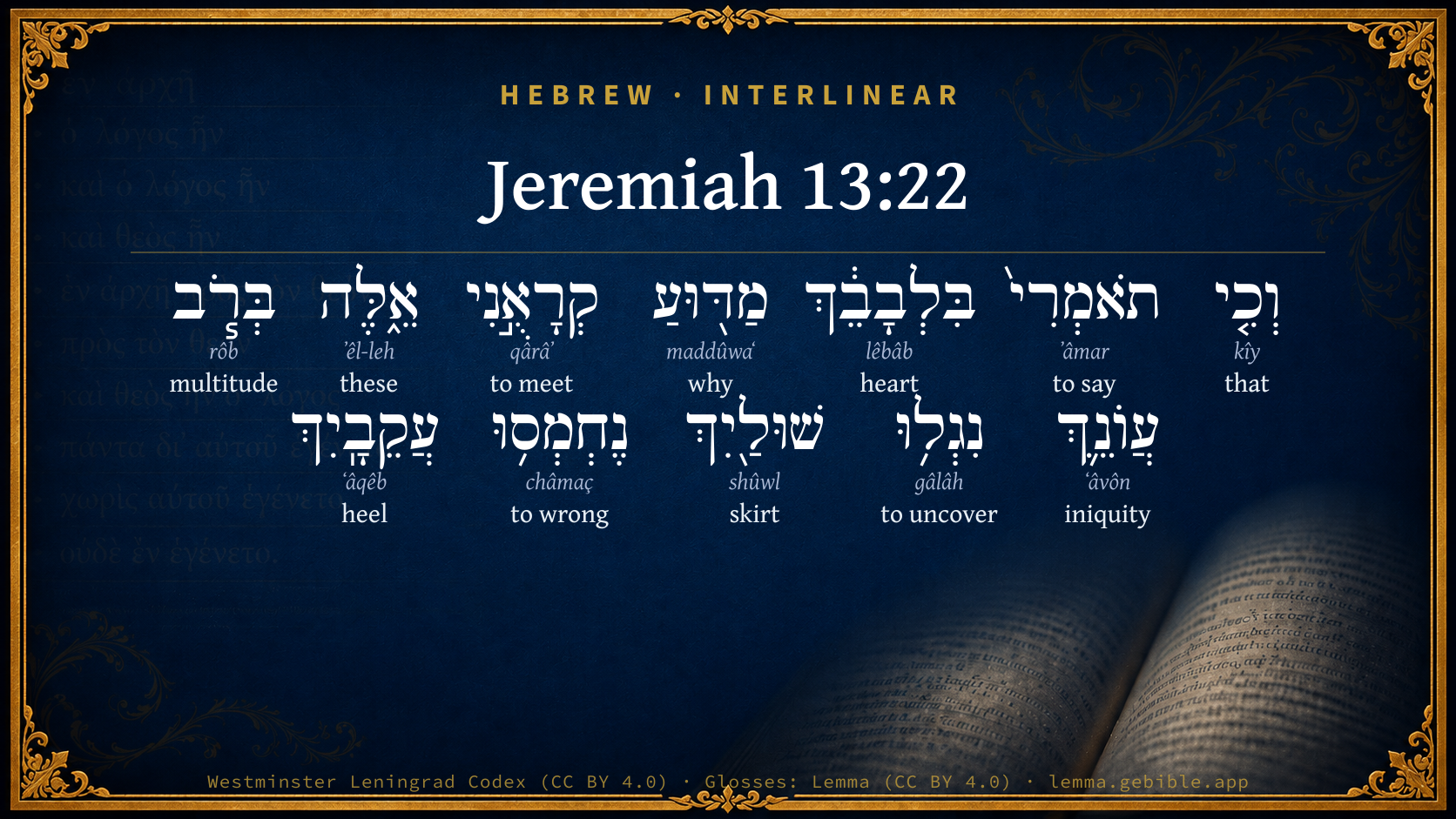
Hebrew (Westminster Leningrad Codex) Jeremiah 13:22 appears in the Hebrew Old Testament. The text above is from the Westminster Leningrad Codex. Each word links to its Strong’s number, a concise gloss, and parsing drawn from the Open Scriptures Hebrew Bible morphology. Click any word for its full Brown-Driver-Briggs (BDB) entry.
Download image
Cite this verse

Jeremiah 13:22 (World English Bible). Public Domain. Lemma interlinear Bible study tool, https://lemma.gebible.app/v/jeremiah/13/22.

Show BibTeX & RIS
BibTeX
RIS
English Translation
If you say in your heart, Why are these things come on me? for the greatness of your iniquity are your skirts uncovered, and your heels suffer violence.
World English Bible · Public Domain
Download a study sheet

One document with this verse’s original text, its word-by-word gloss line, the meaning frame, cross-references with their text, attributed commentary, and full source and license credits — printable, and it pastes into notes with its structure intact.

This verse Autodidact and up

Study sheet (.html) Plain text (.txt)

A passage Seminary Student

Up to 50 verses in one chapter. A passage sheet keeps up to 6 commentary sources and 12 cross-references per verse, in the order this page ranks them, and says so on the sheet whenever that leaves anything out. Ask for a single verse and you get the Autodidact verse sheet above.

Everything on this page stays free to read, with no account — the sheet is a download of what is already on screen, not access to it.

Want to remove ads? Support Godless Engineer
Compare translations 3

The same verse in 3 English versions, stacked beneath the original-language interlinear above. Click any original word for its lexicon entry.

Each is an independent rendering of the whole verse — the interlinear is not word-aligned to these translations.

Highlighted words mark where these versions differ — a whole-verse word diff, not a word-by-word alignment.

  • World English Bible Public Domain
    If you say in your heart, Why are these things come on me? for the greatness of your iniquity are your skirts uncovered, and your heels suffer violence.
  • King James Version Public Domain
    And if thou say in thine heart, Wherefore come these things upon me? For the greatness of thine iniquity are thy skirts discovered, and thy heels made bare.
  • unfoldingWord Literal Text CC BY-SA 4.0
    And if you say in your heart, “Why have these things come upon me?” For the multitude of your iniquity your skirts have been uncovered your heels been exposed.

unfoldingWord Literal Text — © unfoldingWord, licensed CC BY-SA 4.0. Word-aligned USFM3 via Door43 (git.door43.org/unfoldingWord/en_ult).

Versions to compare (up to 4)

3 of 4 selected

Show all 18 translations

Every available English version of this verse, each an independent rendering of the whole verse.

  • World English Bible Public Domain
    If you say in your heart, Why are these things come on me? for the greatness of your iniquity are your skirts uncovered, and your heels suffer violence.
  • Berean Standard Bible Public Domain
    And if you ask yourself, “Why has this happened to me?” It is because of the magnitude of your iniquity that your skirts have been stripped off and your body has been exposed.
  • Majority Standard Bible Public Domain
    And if you ask yourself, “Why has this happened to me?” It is because of the magnitude of your iniquity that your skirts have been stripped off and your body has been exposed.
  • King James Version Public Domain
    And if thou say in thine heart, Wherefore come these things upon me? For the greatness of thine iniquity are thy skirts discovered, and thy heels made bare.
  • American Standard Version (1901) Public Domain
    And if thou say in thy heart, Wherefore are these things come upon me? for the greatness of thine iniquity are thy skirts uncovered, and thy heels suffer violence.
  • Revised Version (1885) Public Domain
    And if thou say in thine heart, Wherefore are these things come upon me? for the greatness of thine iniquity are thy skirts discovered, and thy heels suffer violence.
  • Geneva Bible (1599) Public Domain
    And if thou say in thine heart, Wherefore come these things vpon me? For the multitude of thine iniquities are thy skirts discouered and thy heeles made bare.
  • Douay-Rheims (1899) Public Domain
    And if thou shalt say in thy heart: Why are these things come upon me? For the greatness of thy iniquity, thy nakedness is discovered, the soles of thy feet are defiled.
  • Young's Literal Translation Public Domain
    And when thou dost say in thy heart, `Wherefore have these met me?' For the abundance of thine iniquity Have thy skirts been uncovered, Have thy heels suffered violence.
  • Literal Standard Version CC BY-SA 4.0
    And when you say in your heart, “Why have these met me?” For the abundance of your iniquity || Have your skirts been uncovered, || Have your heels suffered violence.
  • Unlocked Literal Bible CC BY-SA 4.0
    Then you might say in your heart, 'Why are these things happening to me?' It will be for the multitude of your iniquities that your skirts are raised up and you have been violated.
  • unfoldingWord Literal Text CC BY-SA 4.0
    And if you say in your heart, “Why have these things come upon me?” For the multitude of your iniquity your skirts have been uncovered your heels been exposed.
  • Darby Bible Public Domain
    And if thou say in thy heart, Wherefore come these things upon me? For the greatness of thine iniquity are thy skirts uncovered, [and] thy heels have suffered violence.
  • World Messianic Bible Public Domain
    If you say in your heart, “Why have these things come on me?” Your skirts are uncovered because of the greatness of your iniquity, and your heels suffer violence.
  • Webster's Bible Public Domain
    And if thou shalt say in thy heart, Why come these things upon me? For the greatness of thy iniquity are thy skirts uncovered, and thy heels made bare.
  • Free Bible Version CC BY-SA 4.0
    If you say to yourself, Why has this happened to me? it's because you have been so wicked. That's why your skirts were stripped off and you were raped.
  • Bible in Basic English Public Domain
    And if you say in your heart, Why have these things come on me? because of the number of your sins, your skirts have been uncovered and violent punishment overtakes you.
  • JPS Tanakh (1917) Public Domain
    And if thou say in thy heart: 'Wherefore are these things befallen me?' — for the greatness of thine iniquity are thy skirts uncovered, and thy heels suffer violence.

Literal Standard Version (2020), Covenant Press — licensed CC BY-SA 4.0. Text via the HelloAO Bible API (eBible.org). Unlocked Literal Bible (unfoldingWord) — licensed CC BY-SA 4.0. Text via the HelloAO Bible API (eBible.org). unfoldingWord Literal Text — © unfoldingWord, licensed CC BY-SA 4.0. Word-aligned USFM3 via Door43 (git.door43.org/unfoldingWord/en_ult). Free Bible Version, Dr. Jonathan Gallagher — licensed CC BY-SA 4.0. Text via the HelloAO Bible API (eBible.org).

Word by word

More ways to search: Search by grammar → Find every occurrence → Compare this word →

Practice this passage: Drill this verse → Learn its vocabulary →

נֶחְמְס֥וּ
châmaç
H2554
“to wrong”
Verb, Niphal, Perfect, 3rd Person, Common, Plural
Part of Speech
Verb
Stem
Niphal
Form
Perfect
Person
3rd Person
Gender
Common
Number
Plural
Full BDB Definition

Origin: a primitive root

TWOT: TWOT- 678

to wrong, do violence to, treat violently, do wrongly - (Qal) to treat violently, do wrong - of physical wrong - of ethical wrong - of physical and ethical wrong - (Niphal) to be treated violently
  1. וְכִ֤י kîy H3588 “and · that” Conjunction + Conjunction
  2. תֹאמְרִי֙ ʼâmar H559 “to say” Verb, Qal, Imperfect, 2nd Person, Feminine, Singular
  3. בִּלְבָבֵ֔ךְ lêbâb H3824 “in/at · heart · your” Preposition + Noun, Common, Masculine, Singular, Construct + Suffix, Personal, 2nd Person, Feminine, Singular
  4. מַדּ֖וּעַ maddûwaʻ H4069 “why” Particle, Interrogative
  5. קְרָאֻ֣נִי qârâʼ H7122 “to meet · me” Verb, Qal, Perfect, 3rd Person, Common, Plural + Suffix, Personal, 1st Person, Common, Singular
  6. אֵ֑לֶּה ʼêl-leh H428 “these” Pronoun, Demonstrative, Common, Plural
  7. בְּרֹ֧ב rôb H7230 “in/at · multitude of” Preposition + Noun, Common, Both, Singular, Construct
  8. עֲוֺנֵ֛ךְ ʻâvôn H5771 “iniquity · your” Noun, Common, Both, Singular, Construct + Suffix, Personal, 2nd Person, Feminine, Singular
  9. נִגְל֥וּ gâlâh H1540 “to uncover” Verb, Niphal, Perfect, 3rd Person, Common, Plural
  10. שׁוּלַ֖יִךְ shûwl H7757 “skirts · your” Noun, Common, Masculine, Plural, Construct + Suffix, Personal, 2nd Person, Feminine, Singular
  11. עֲקֵבָֽיִךְ ʻâqêb H6119 “heels · your” Noun, Common, Masculine, Plural, Construct + Suffix, Personal, 2nd Person, Feminine, Singular

About this verse

These counts appear in no published source. They are computed here, from the morphology-tagged text and Lemma’s own curated glosses. What Lemma adds →

12
words
12
distinct lemmas
Prophets
section

Notable vocabulary

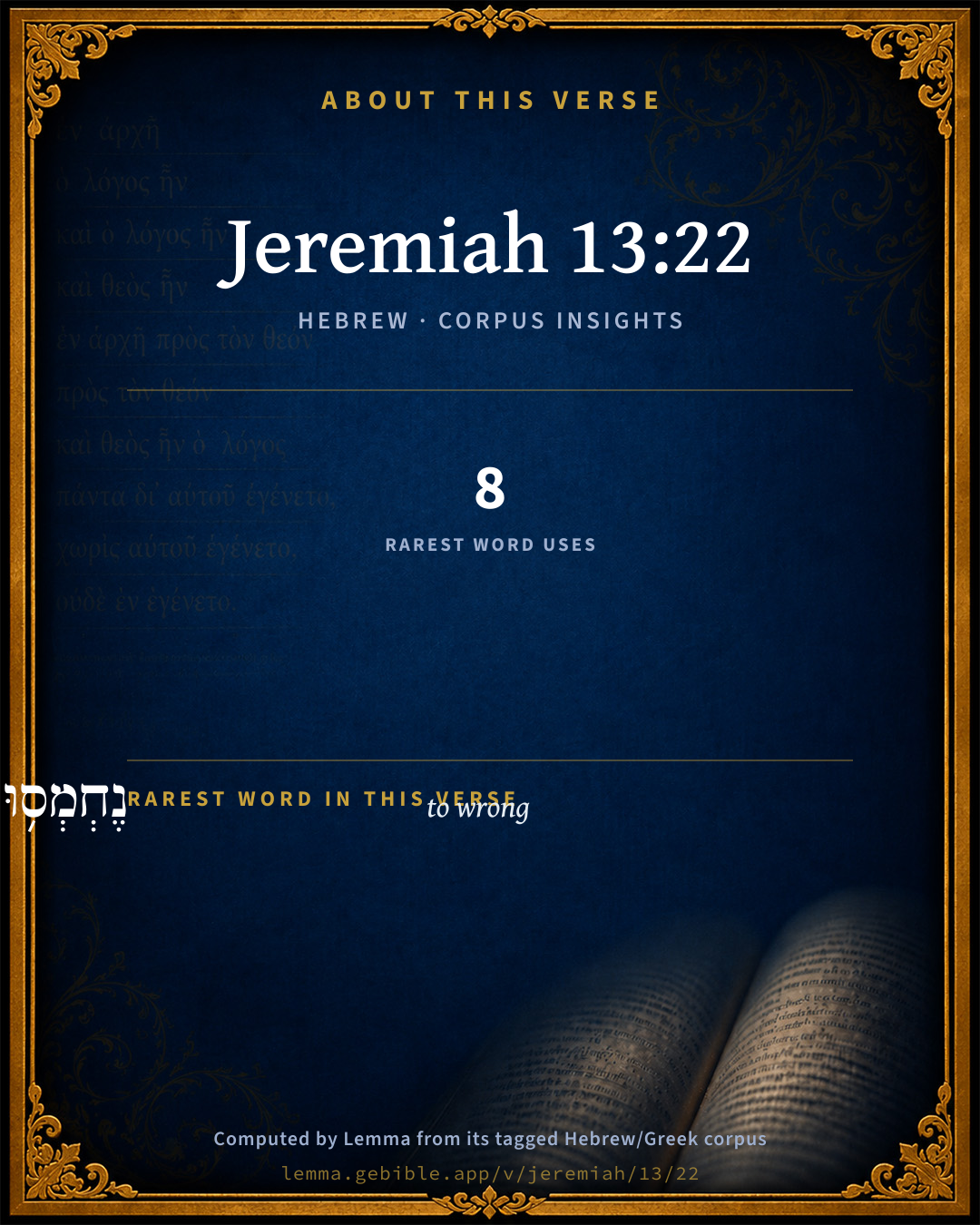
The rarest word here is נֶחְמְס֥וּ to wrong H2554 — appearing just 8 times in the whole Hebrew Bible.

Shared distinctive vocabulary

נֶחְמְס֥וּ to wrong H2554 occurs in 8 verses of the Hebrew Bible. Also found in:

Grammatical profile

  • 4 verbs
  • 5 nouns
  • 1 pronoun
  • 1 conjunction
  • 1 particle

Verb forms

  • תֹאמְרִי֙ Qal · Imperfect
  • קְרָאֻ֣נִי Qal · Perfect
  • נִגְל֥וּ Niphal · Perfect
  • נֶחְמְס֥וּ Niphal · Perfect

Cross-references

21

Topical passages linked to Jeremiah 13:22 in the Treasury of Scripture Knowledge — connected by theme and wording, ordered by reader-vote popularity; previews shown in the World English Bible.

  • Nahum 3:5 "Behold, I am against you," says Yahweh of Hosts, "and I will lift your skirts over your face. I will show the nations your nakedness, and the kingdoms your shame.
  • Jeremiah 16:10–11 It shall happen, when you shall show this people all these words, and they shall tell you, Why has Yahweh pronounced all this great evil against us? or what is our iniquity? or what is our sin that we have committed against Yahweh our God?
  • Jeremiah 5:19 It shall happen, when you shall say, Why has Yahweh our God done all these things to us? then shall you say to them, Like as you have forsaken me, and served foreign gods in your land, so shall you serve strangers in a land that is not yours.
  • Deuteronomy 7:17 If you shall say in your heart, These nations are more than I; how can I dispossess them?
  • Jeremiah 9:2–9 Oh that I had in the wilderness a lodging-place of wayfaring men; that I might leave my people, and go from them! for they are all adulterers, an assembly of treacherous men.
  • Jeremiah 13:26 Therefore will I also uncover your skirts on your face, and your shame shall appear.
  • Lamentations 1:8 Jerusalem has grievously sinned; therefore she is become as an unclean thing; All who honored her despise her, because they have seen her nakedness: Yes, she sighs, and turns backward.
  • Hosea 2:10 Now I will uncover her lewdness in the sight of her lovers, And no one will deliver her out of my hand.
  • Isaiah 3:17 Therefore the Lord brings sores on the crown of the head of the women of Zion, And Yahweh will make their scalps bald."
  • Jeremiah 2:17–19 Haven't you procured this to yourself, in that you have forsaken Yahweh your God, when he led you by the way?
  • Ezekiel 16:37–39 therefore see, I will gather all your lovers, with whom you have taken pleasure, and all those who you have loved, with all those who you have hated; I will even gather them against you on every side, and will uncover your nakedness to them, that they may see all your nakedness.
  • Deuteronomy 8:17 and [lest] you say in your heart, My power and the might of my hand has gotten me this wealth.
  • Deuteronomy 18:21 If you say in your heart, How shall we know the word which Yahweh has not spoken?
  • Isaiah 20:4 so shall the king of Assyria lead away the captives of Egypt, and the exiles of Ethiopia, young and old, naked and barefoot, and with buttocks uncovered, to the shame of Egypt.
  • Isaiah 47:2–3 Take the millstones, and grind meal; remove your veil, strip off the train, uncover the leg, pass through the rivers.
  • Isaiah 47:8 Now therefore hear this, you who are given to pleasures, who sit securely, who say in your heart, I am, and there is none else besides me; I shall not sit as a widow, neither shall I know the loss of children:
  • Ezekiel 23:27–29 Thus will I make your lewdness to cease from you, and your prostitution [brought] from the land of Egypt; so that you shall not lift up your eyes to them, nor remember Egypt any more.
  • Hosea 2:3 Lest I strip her naked, And make her bare as in the day that she was born, And make her like a wilderness, And set her like a dry land, And kill her with thirst.
  • Hosea 12:8 Ephraim said, "Surely I have become rich, I have found myself wealth. In all my wealth they won't find in me any iniquity that is sin."
  • Zephaniah 1:12 It will happen at that time, that I will search Jerusalem with lamps, and I will punish the men who are settled on their dregs, who say in their heart, "Yahweh will not do good, neither will he do evil."
  • Luke 5:21–22 The scribes and the Pharisees began to reason, saying, "Who is this that speaks blasphemies? Who can forgive sins, but God alone?"

Cross-references courtesy of OpenBible.info (CC BY 4.0).

Hebrew and Greek witnesses Masoretic Hebrew ↔ Greek Septuagint

The same verse in the two great witnesses to the Old Testament, shown verse-for-verse.

These are two independent witnesses, not word-aligned to each other, and the Septuagint is shown in lemma (dictionary) form.

Hebrew Jeremiah 13:22 Masoretic · Westminster Leningrad Codex

וְכִ֤י תֹאמְרִי֙ בִּלְבָבֵ֔ךְ מַדּ֖וּעַ קְרָאֻ֣נִי אֵ֑לֶּה בְּרֹ֧ב עֲוֺנֵ֛ךְ נִגְל֥וּ שׁוּלַ֖יִךְ נֶחְמְס֥וּ עֲקֵבָֽיִךְ

If you say in your heart, Why are these things come on me? for the greatness of your iniquity are your skirts uncovered, and your heels suffer violence.

World English Bible · Public Domain

Greek LXX Structure differs

In the Septuagint, Jeremiah is about an eighth shorter than the Hebrew and arranges its material differently — the Oracles Against the Nations (Hebrew chapters 46–51) appear in the middle of the Greek book, after 25:13. Because the chapter and verse boundaries do not line up, a verse-for-verse comparison with the Hebrew is not shown.

A verse-for-verse comparison isn’t shown here because the chapters and verses don’t line up. Switch to the LXX edition with the MT / LXX toggle above to read the Greek directly.

Hebrew: Westminster Leningrad Codex (CC BY 4.0). Greek: Septuagint (public domain); English from a public-domain English Septuagint. How the Septuagint differs from the Hebrew →

Targum (Aramaic paraphrase)

1

The Targum is the ancient Jewish Aramaic paraphrase of the Hebrew Scriptures — an interpretive translation, not the Hebrew text itself. Onkelos (literal) and Pseudo-Jonathan (expansive) render the Torah, and Jonathan the Prophets. Coverage is partial: where no permissively-licensed English translation exists for a verse, only the Aramaic is shown. This is verse-level text, not a word-by-word alignment to the Hebrew.

  1. Targum Jonathan Prophets (Joshua–Malachi)
    וַאֲרֵי תֵימְרִין בְּלִבִּיךְ מָא דֵין עַרְעוּנִי כָּל אִלֵין עַל דְסַגִיאוּ חוֹבָךְ אִתְגְלִיאַת בַּהֲתָתִיךְ אִתְחֲזֵי קְלָנִיךְ:

    (no public-domain English translation for this verse)

    Targum Jonathan — Aramaic: “Mikraot Gedolot” (public domain). English: “Sefaria Community Translation” (CC0 1.0 (public-domain dedication)); “London "Chaldee Paraphrase," 1871” (public domain). Text via Sefaria.

Commentary

Notes on Jeremiah 13:22 from classic Christian and Jewish commentators (each source and its license shown beneath its notes). The classic Christian expositions comment on the surrounding passage and are grouped to its opening verse, so a note may address several verses; the Jewish commentaries on the Tanakh (Rashi and others) are per-verse, so they appear only where the commentator wrote on this verse.

Lemma curates 59 commentaries, every one of them public domain or Creative Commons licensed, each selected and text-cleaned for this edition rather than reprinted as found. About our sources →

Matthew Henry's Commentary

Here is, I. Ruin threatened as before, that the Jews shall go into captivity, and fall under all the miseries of beggary and bondage, shall be stripped of their clothes, their skirts discovered for want of upper garments to cover them, and their heels made bare for want of shoes, Jer 13:22. Thus they used to deal with prisoners taken in war, when they drove them into captivity, naked and barefoot, Isa 20:4. Being thus carried off into a strange country, they shall be scattered there, as the stubble that is blown away by the wind of the wilderness, and nobody is concerned to bring it together again, Jer 13:24. If the stubble escape the fire, it shall be carried away by the wind. If one judgment do not do the work, another shall, with those that by sin have made themselves as stubble. They shall be stripped of all their ornaments and exposed to shame, as harlots that are carted, Jer 13:26. They made their pride appear, but God will make their shame appear; so that those who have doted on them shall be ashamed of them.

II. An enquiry made by the people into the cause of this ruin, Jer 13:22. Thou wilt say in thy heart (and God knows how to give a proper answer to what men say in their hearts, though they do not speak it out; Jesus, knowing their thoughts, replied to them, Mat 9:4), Wherefore came these things upon me? The question is supposed to come into the heart, 1. Of a sinner quarrelling with God and refusing to receive correction. They could not see that they had done any thing which might justly provoke God to be thus angry with them. They durst not speak it out; but in their hearts they thus charged God with unrighteousness, if he had laid upon them more than was meet. They seek for the cause of their calamities, when, if they had not been willfully blind, they might easily have seen it. Or, 2. Of a sinner returning to God. If there come but a penitent thought into the heart at any time (saying, What have I done? Jer 8:6, wherefore am I in affliction? why doth God contend with me?) God takes notice of it, and is ready by his Spirit to impress the conviction, that, sin being discovered, it may be repented of.

III. An answer to this enquiry. God will be justified when he speaks and will oblige us to justify him, and therefore will set the sin of sinners in order before them. Do they ask, Wherefore come these things upon us? Let them know it is all owing to themselves.

1. It is for the greatness of their iniquities, Jer 13:22. God does not take advantage against them for small faults; no, the sins for which he now punishes them are of the first rate, very heinous in their own nature and highly aggravated - for the multitude of thy iniquity (so it may be read), sins of every kind and often repeated and relapsed into. Some think we are more in danger from the multitude of our smaller sins than from the heinousness of our greater sins; of both we may say, Who can understand his errors?

2. It is for their obstinacy in sin, their being so long accustomed to it that there was little hope left of their being reclaimed from it (Jer 13:23): Can the Ethiopian change his skin, that is by nature black, or the leopard his spots, that are even woven into the skin? Dirt contracted may be washed off, but we cannot alter the natural colour of a hair (Mat 5:36), much less of the skin; and so impossible is it, morally impossible, to reclaim and reform these people. (1.) They had been long accustomed to do evil. They were taught to do evil; they had been educated and brought up in sin; they had served an apprenticeship to it, and had all their days made a trade of it. It was so much their constant practice that it had become a second nature to them. (2.) Their prophets therefore despaired of ever bring them to do good. This was what they aimed at; they persuaded them to cease to do evil and learn to do well, but could not prevail. They had so long been used to do evil that it was next to impossible for them to repent, and amend, and begin to do good. Note, Custom in sin is a very great hindrance to conversion from sin. The disease that is inveterate is generally thought incurable. Those that have been long accustomed to sin have shaken off the restraint of fear and shame; their consciences are seared; the habits of sin are confirmed; it pleads prescription; and it is just with God to give those up to their own hearts' lusts that have long refused to give themselves up to his grace. Sin is the blackness of the soul, the deformity of it; it is its spot, the discolouring of it; it is natural to us, we were shapen in it, so that we cannot get clear of it by any power of our own. But there is an almighty grace that is able to change the Ethiopian's skin, and that grace shall not be wanting to those who in a sense of their need of it seek it earnestly and improve it faithfully.

3. It is for their treacherous departures from the God of truth and dependence on lying vanities (Jer 13:25): "This is thy lot, to be scattered and driven away; this is the portion of thy measures from me, the punishment assigned thee as by line and measure; this shall be thy share of the miseries of this world; expect it, and think not to escape it: it is because thou hast forgotten me, the favours I have bestowed upon thee and the obligations thou art under to me; thou hast no sense, no remembrance, of these." Forgetfulness of God is at the bottom of all sin, as the remembrance of our Creator betimes is the happy and hopeful beginning of a holy life. "Having forgotten me, thou hast trusted in falsehood, in idols, in an arm of flesh in Egypt and Assyria, in the self-flatteries of a deceitful heart." Whatever those trust to that forsake God, they will find it a broken reed, a broken cistern.

4. It is for their idolatry, their spiritual whoredom, that sin which is of all sins most provoking to the jealous God. They are exposed to a shameful calamity (Jer 13:26) because they have been guilty of a shameful iniquity and yet are shameless in it (Jer 13:27): "I have seen thy adulteries (thy inordinate fancy for strange gods, which thou hast been impatient for the gratification of, and hast even neighed after it), even the lewdness of thy whoredoms, thy impudence and insatiableness in them, thy eager worshipping of idols on the hills in the fields, upon the high places. This is that for which a woe is denounced against thee, O Jerusalem! nay, and many woes."

IV. Here is an affectionate expostulation with them, in the close, upon the whole matter. Though it was adjudged next to impossible for them to be brought to do good (Jer 13:23), yet while there is life there is hope, and therefore still he reasons with them to bring them to repentance, Jer 13:27. 1. He reasons with them concerning the thing itself: Wilt thou not be made clean? Note, It is the great concern of those who are polluted by sin to be made clean by repentance, and faith, and a universal reformation. The reason why sinners are not made clean is because they will not be made clean; and herein they act most unreasonably: "Wilt thou not be made clean? Surely thou will at length be persuaded to wash thee, and make thee clean, and so be wise for thyself." 2. Concerning the time of it: When shall it once be? Note, It is an instance of the wonderful grace of God that he desires the repentance and conversion of sinners, and thinks the time long till they are brought to relent; but it is an instance of the wonderful folly of sinners that they put that off from time to time which is of such absolute necessity that, if it be not done some time, they are certainly undone for ever. They do not say that they will never be cleansed, but not yet; they will defer it to a more convenient season, but cannot tell us when it shall once be.

Matthew Henry's Commentary on the Whole Bible (1708–1710) — public domain (CC PDM 1.0). Text via the HelloAO Bible API.

Trapp's Complete Commentary

John Trapp

Jer 13:22 And if thou say in thine heart, Wherefore come these things upon me? For the greatness of thine iniquity are thy skirts discovered, [and] thy heels made bare.

Ver. 22. Are thy skirts discovered.] Thou art brought to most miserable shame and servitude, having scarce a rag to thy back, or a shoe for thy foot.

John Trapp, A Commentary or Exposition upon All the Books of the Old and New Testament (1647–1656) — public domain. Text from a community e-Sword module.

Joseph Benson's Commentary

Jer 13:22. If thou say, Wherefore come these things upon me? — Hypocrites will rarely confess their own shame and God’s righteousness, but are ready to expostulate with him, and to inquire why he hath dealt so with them, as if he had treated them unjustly. But, saith God, For the greatness of thine iniquity are thy skirts discovered, &c. — That is, thou art carried into captivity, stripped and bare, without covering to thy nakedness; it being the barbarous custom of conquerors, in ancient times, to treat their captives with such indignities in conducting them to the place of their intended residence: see note on Isa 3:17; and Nah 3:5. Lowth thinks the words may also allude to the punishment that used to be inflicted upon common harlots and adulteresses, which was to strip them naked, and expose them to the eyes of the world: and thus God threatened he would deal with Jerusalem, upon account of her spiritual fornication.

Joseph Benson's Commentary on the Old and New Testaments (1811–1818) — public domain. Text from a community e-Sword module.

Geneva Bible (1599)

Geneva Bible translators

The cloak of hypocrisy shall be pulled off, and thy shame seen.

Geneva Bible (1599) marginal notes — public domain. Text via Bolls.life.

Jamieson, Fausset & Brown

Robert Jamieson, A. R. Fausset & David Brown

if thou say--connecting this verse with "What wilt thou say" (Jer 13:21)?

skirts discovered--that is, are thrown up so as to expose the person (Jer 13:26; Isa 3:17; Nah 3:5).

heels made bare--The sandal was fastened by a thong above the heel to the instep. The Hebrew, is, "are violently handled," or "torn off"; that is, thou art exposed to ignominy. Image from an adulteress.

Jamieson, Fausset & Brown — Commentary Critical and Explanatory on the Whole Bible (1871) — public domain (CC PDM 1.0). Text via the HelloAO Bible API.

Adam Clarke's Commentary

Verse 22. Are thy skirts discovered] Thy defenceless state is every where known; thou art not only weak, but ignominiously so. It is thy scandal to be in so depressed a condition; thou art lower than the basest of thy adversaries, and thou art so because of thy sin.

Adam Clarke's Commentary on the Bible (1810–1826) — public domain. Text from a community e-Sword/MySword module.

John Calvin's Commentaries

The Prophet again declares that God’s judgment would be just, which he had previously foretold; for hypocrites, we know, do not cease to quarrel with God, except they are often proved guilty; and it is always their object, where they cannot wholly excuse themselves, to extenuate in some measure their fault. The Prophet therefore here removes every pretense for evasion, and declares that they were wholly worthy of such a reward.

But his manner of speaking ought to be noticed, If thou wilt say in thine heart, etc. Hypocrites do not only claim for themselves righteousness before the world, but they also deceive themselves, and the devil so dementates them with a false persuasion, that they seek to be counted just before God. This then is what the Prophet sets forth when he says, If thou wilt say in thine heart, Why have these evils happened to me? that is, if thou seekest by secret murmuring to contend with God, the answer is ready, — Because of the multitude of thine iniquity, discovered are thy skirts, and thy heels are denuded.” The multitude of iniquity he calls that perverse wickedness which prevailed among the Jews; for they had not ceased for a long time to provoke the wrath of God. Had they only once sinned, or had been guilty of one kind of sin, there would have been some hope of pardon, at least God would not have executed a punishment so severe; but as there had been an uninterrupted course of sinning, the Prophet shews that it would not be right to spare them any longer.

As to the simile, it is a form of speaking often used by the prophets, that is, to denude the soles of the feet, and to discover the skirts. We know that; men clothe themselves, not only to preserve them from cold. but that they also cover the body for the sake of modesty: there is therefore a twofold use of garments, the one occasioned by necessity, and the other by decency. As then clothes are partly made for this end — to cover what could not be decently shewn or left bare without shame, the prophets use this mode of speaking when they have in view to shew that one is exposed to public reproaJeremiah It afterwards follows —

John Calvin's Commentaries (1540-1563) — public domain. Text from the Calvin Translation Society English edition (1840s-50s) via the Christian Classics Ethereal Library (ccel.org). Calvin's coverage is partial (roughly two-thirds of the Bible); uncommented books and verses are honest gaps, never fabricated. The 19th-century editor's footnotes and remarks are omitted so the notes are faithfully Calvin's own voice.

Ellicott's Commentary for English Readers

(22) Are thy skirts discovered.—The “skirts,” or flowing train, worn by women of rank, the removal of which was the sign of extremest degradation (Isa_20:4; Isa_47:2; Eze_23:29; Hos_2:3; Nah_3:5).

Thy heels made bare.—Better, outraged, or disgraced, made to walk barefoot, like menial slaves; possibly, like the outcast harlot. Compare Isaiah’s walking “naked and barefoot” as the symbol of the coming degradation of his people (Isa_20:2-4).

A Bible Commentary for English Readers, edited by Charles John Ellicott (1878–1897) — public domain. Text from a community e-Sword module.

John Gill's Exposition

Therefore will I scatter them as the stubble that passeth away,.... Because of their many sins, and continuance in them, their habits and custom of sinning, they are threatened with being carried captive into other nations, where they should be dispersed and separated one from another, which would make their state and condition very uncomfortable; and this would be as easily and as swiftly done as the light stubble which is blown away by every puff of wind; nor would they be able any more to resist the enemy, and help themselves, than the stubble is to stand before the wind; as follows:

by the wind of the wilderness; which blows freely and strongly; so the Chaldean army is compared to a dry wind of the high places in the wilderness, even a full wind that should scatter and destroy, Jer 4:11; or, "to the wind of the wilderness" (u); and so may denote the wilderness of the people, or the land of Babylon, whither they should be carried captive, and from whence the wind should come that should bring them thither. Kimchi and Ben Melech make mention sea wilderness between Jerusalem and Babylon, as what may be intended.

(u) "ad ventum deserti", Pagninus, Montanus, Vatablus, Junius & Tremellius, Piscator, Cocceius.

John Gill's Exposition of the Whole Bible (1746–1763) — public domain (CC PDM 1.0). Text via the HelloAO Bible API.

Albert Barnes' Notes on the Bible

Made bare - Rather, “ill-used, treated with violence.” The long flowing robes worn by ladies of rank, are to be laid aside, that they might do menial work, bare-legged, like slaves. The ill-usage to the heels is the having to tramp barefoot, a thing very painful to women accustomed to the seclusion of the female apartments.

Albert Barnes' Notes on the Bible (1834–1885) — public domain. Text from a community e-Sword/MySword module.

Haydock's Catholic Bible Commentary

Defiled. Thou art exposed to the brutality of the soldiers.

George Leo Haydock (1774–1849), Haydock's Catholic Family Bible and Commentary, 1859 edition — public domain. Excludes Psalms (Douay-Rheims chapter numbering differs from Protestant) and Deuterocanonical books (Catholic canon only).

Matthew Poole's English Annotations

Hypocrites will rarely confess their own shame and God’s righteousness, but are ready to expostulate and dispute with God, and to call him to account why he hath dealt so with them, as if God had dealt unjustly. But (saith God) if thou shouldst have any such thoughts in thine heart, do but remember thine iniquities, how many and how great they have been, thy nakedness is discovered because of these, and for these thou art exposed to contempt and shame. Probably these phrases are fetched from the usual practice of soldiers, when they have conquered a place and taken prisoners, to strip them, and leave those of either sex, either no clothes to cover their nakedness, or nothing but their own rags, not sufficient to cover their nakedness. By skirts is meant the lower part of their bodies covered with the lower part of their garments.

Matthew Poole's English Annotations on the Holy Bible (1683–1685) — public domain. Text from a community e-Sword/MySword module.

Whedon's Commentary on the Bible

Daniel D. Whedon

22. Skirts discovered — Lifted so as to expose the person, expressive of ignominy and shame.

Heels made bare — Driven into exile as captives and slaves, barefoot and with violence.

Daniel D. Whedon (gen. ed.), Commentary on the Old and New Testaments (1874–1909) — public domain. Text from a community e-Sword module.

The Pulpit Commentary

Thy heels made bare; rather, treated with violence. The fate held out to the daughter of Zion (trained to walk about with "tinkling ornaments," Isa_2:18) is to plod wearily along with bare feet. (comp. Isa_47:1)

The Pulpit Commentary (1880–1919), ed. H.D.M. Spence-Jones & Joseph S. Exell — public domain. Text from a community e-Sword module.

John Wesley's Explanatory Notes

Thy skirts - Probably these phrases are fetched from the usual practice of soldiers when they have conquered a place and taken prisoners, to strip them. By skirts is meant the lower part of their bodies covered with the lower part of their garments.

John Wesley, Explanatory Notes Upon the Whole Bible (1754–1765) — public domain. Text via the GEBible commentary corpus.

Keil & Delitzsch

C. F. Keil & F. Delitzsch

This will befall the daughter of Zion for her sore transgressions. Therefore will she be covered with scorn and shame. The manner of her dishonour, discovery of the skirts (here and esp. in Jer 13:26), recalls Nah 3:5, cf. Isa 47:3; Hos 2:5. Chr. B. Mich. and others understand the violent treatment of the heels to be the loading of the feet with chains; but the mention of heels is not in keeping with this. Still less can the exposure of the heels by the upturning of the skirts be called maltreatment of the heels; nor can it be that, as Hitz. holds, the affront is simply specialized by the mention of the heels instead of the person. The thing can only mean, that the person will be driven forth into exile barefoot and with violence, perhaps under the rod; cf. Psa 89:52.

Keil & Delitzsch — Biblical Commentary on the Old Testament (1861–1891) — public domain (CC PDM 1.0). Text via the HelloAO Bible API. (Old Testament only.)

unfoldingWord translationNotes

Door43 World Missions Community

General Information:

Yahweh continues to talk to Jeremiah. He is telling Jeremiah what to say to the king of Judah and the king's mother.

that your skirts are raised up and you have been violated

This means that the enemy soldiers will rape the Judean women. This can be stated in active form. AT: "that the enemy soldiers will lift up the skirts of your women and rape them" (See: Euphemism and Active or Passive)

Can the people of Cush change their skin color, or a leopard change its spots?

This rhetorical question is used to state an example of something that is impossible. This question can be written as a statement. Also, the understood verb "can" maybe be supplied in the second phrase. AT: "The people of Cush cannot change their skin color and a leopard cannot change its spots." (See: Rhetorical Question and Ellipsis)

If so, then you yourself, although accustomed to wickedness, would be able to do good

This statement is ironic because the examples about the Cushite and the leopard are impossible situations. This states that if those impossible things could happen then they could do good. AT: "Just like these things are impossible, so it is also impossible for you who always do evil to do good" (See: Irony)

I will scatter them like chaff that perishes in the desert wind

"I will scatter them like chaff that is blown away by the wind." Yahweh is saying He will scatter His people throughout the world just as chaff is scattered by the wind. (See: Simile)

translationWords

heart

iniquity

raise

Cush

chaff

perish

desert

unfoldingWord translationNotes — © Distant Shores Media and the Door43 World Missions Community, licensed CC BY-SA 4.0. Source: git.door43.org/Door43/en_tn.

Rashi

Rabbi Shlomo Yitzchaki (Rashi)

your skirts The skirts of the garments (tes ourlets in French), your hems. When a woman is stripped in a humiliating way, they turn her chemise upside down.

your steps cut off Your ways are cut off. נחמסו is like (Lam. 2:6) “And He cut off (ויחמֹס) like a garden His dwelling.”

your steps (traces in O.F.) Travelers have stopped.

Rashi on the Tanakh — English translations: “The Judaica Press complete Tanach with Rashi, translated by A. J. Rosenberg” (CC BY 4.0); “Pentateuch with Rashi's commentary by M. Rosenbaum and A.M. Silbermann, 1929-1934” (public domain); “The Metsudah Tanach series, Lakewood, N.J” (CC BY 4.0); and “The Book of Joshua, Metsudah Publications, 1997” (CC BY 4.0). Text via Sefaria.

Lesson kit

Teaching starters — assembled from the data on this page, not authored interpretation. Every prompt links to the verse data it draws on. Edit before teaching.

Jeremiah, in the Prophets, opens this verse with 12 words (12 distinct Hebrew lemmas). Its most distinctive word is châmaç (“to wrong”). A historical commentator’s framing appears above. Read the whole chapter for the surrounding context.

Discussion questions

  1. How does “to wrong” (châmaç) shape what this verse is saying?
  2. How does Job 15:33, which shares the word «to wrong», read alongside this verse?
  3. These translations render this verse differently; the difference is in the English rendering, not the original. What questions does that raise?
  4. «תֹאמְרִי֙» is a Qal Imperfect verb. How does that grammatical form shape the action described?
  5. Compare how Matthew Henry's Commentary and Trapp's Complete Commentary read this verse. Where do they agree or differ?

Things to notice

Reading settings

Reading text

Shown beneath each verse's original-language words.

Old Testament
Old Testament edition

Read the OT as the Masoretic Hebrew (MT) or the Greek Septuagint (LXX).

English shown for the Greek Septuagint (in the Hebrew ↔ Greek comparison).

Comparing translations? Open the Compare panel on any verse page to stack up to four side by side.