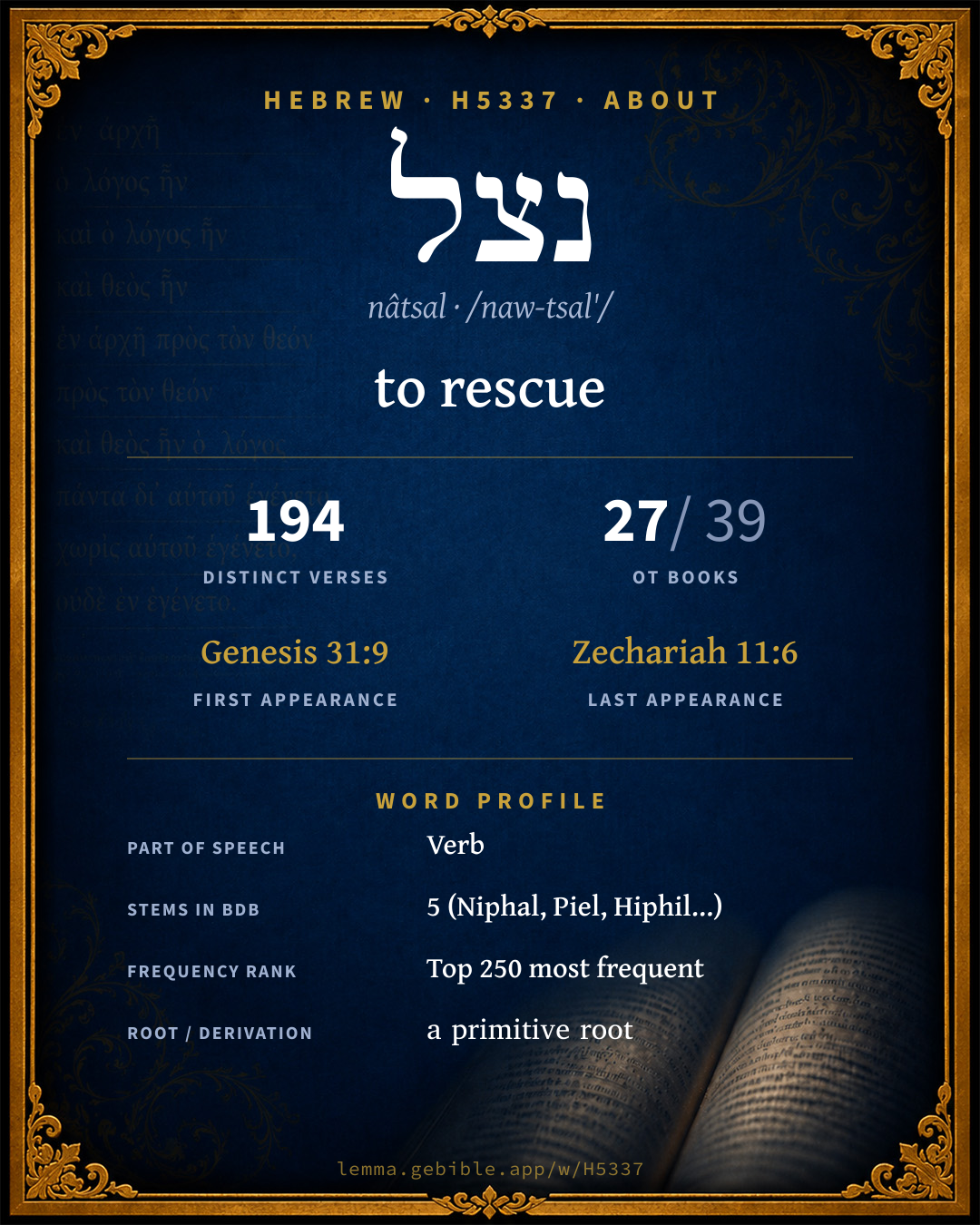
נָצַל
to rescue
‘to rescue’ is one of 3 main senses fuller range ↓
Full lexicon entry — Brown-Driver-Briggs (BDB)
From Brown-Driver-Briggs (BDB)
Where this word appears
See every Hiphil verb in the Hebrew Bible →
Grammar key — what these labels mean
Part of speech
- Verb
- An action or state-of-being word.
Stem
- Hiphil
- The causative active stem (“he caused / brought about”). Here: ‘take away’
- Niphal
- Usually the simple passive or reflexive of the Qal (“he was written”). Here: ‘reflex. tear oneself away’
- Piel
- An intensive or resultative active stem. Here: ‘strip off’
- Hophal
- The passive counterpart of the Hiphil (“he was caused to…”).
- Hithpael
- The reflexive or reciprocal stem (the subject acts on itself).
Form
- Participle Active
- A verbal adjective expressing ongoing or characteristic action (“writing / one who writes”).
- Imperative
- A direct command (“write!”).
- Infinitive Construct
- A bound verbal noun, frequently with prepositions (“to write / in writing”).
- Perfect
- A completed action or state — Hebrew marks aspect (completeness) more than strict tense (“he wrote”).
- Sequential Perfect
- A perfect with prefixed waw continuing a preceding imperfect or command (waw-consecutive perfect).
- Imperfect
- An incomplete, ongoing, or future action (“he will / would write”).
- Sequential Imperfect
- An imperfect with prefixed waw — the standard past-narrative form (waw-consecutive imperfect).
- Infinitive Absolute
- An unbound verbal noun, often intensifying or standing in for a finite verb.
- Participle Passive
- A verbal adjective expressing action received (“written”).
- Cohortative
- A first-person volitional form expressing wish or resolve (“let me / let us write”).
- Jussive
- A third- or second-person volitional form expressing wish or command (“let him write”).
State
- Absolute
- The independent form of a noun, not bound to a following word.
Person
- 2nd Person
- The one addressed (“you”).
- 3rd Person
- The one spoken about (“he / she / it / they”).
- 1st Person
- The speaker (“I / we”).
Gender
- Masculine
- Grammatically masculine.
- Common
- Either gender — not distinguished for this form.
- Feminine
- Grammatically feminine.
Number
- Singular
- One.
- Plural
- More than one (in Hebrew, generally three or more).
Grammatical forms 38 distinct
- Verb, Hiphil, Imperfect, 3rd Person, Masculine, Singular 27 times (13%)
- Verb, Hiphil, Imperative, 2nd Person, Masculine, Singular 24 times (11%)
- Verb, Hiphil, Infinitive Construct 24 times (11%)
- Verb, Hiphil, Participle Active, Masculine, Singular, Absolute 18 times (8%)
- Verb, Hiphil, Perfect, 3rd Person, Masculine, Singular 16 times (8%)
- Verb, Hiphil, Sequential Imperfect, 3rd Person, Masculine, Singular 11 times (5%)
- Verb, Hiphil, Sequential Perfect, 1st Person, Common, Singular 10 times (5%)
- Verb, Hiphil, Perfect, 3rd Person, Common, Plural 10 times (5%)
+30 more forms (73 occurrences)
Parsed forms decoded from the imported morphology (morphhb / Westminster Leningrad Codex — WLC text public domain, morphhb tagging CC BY 4.0), counted across 213 parsed occurrences — not distinct verses.
Every verse where H5337 appears — 194 distinct verses across 27 books. Click any verse to open its interlinear word-by-word view. Verse text shown in the World English Bible for context — . Each verse’s Hebrew form is shown with its reference; the English is not keyword-highlighted, since the data carries no word-level English alignment. Use “Compare translations” on any verse to read it across multiple English versions. This concordance covers the Hebrew Bible; Septuagint (Greek Old Testament) occurrences are not indexed here.
Genesis 6 verses
- Genesis 31:9 וַ/יַּצֵּ֧ל conj + Hiphil wimpf 3ms Thus God has taken away the cattle of your father, and given them to me.
- Genesis 31:16 הִצִּ֤יל Hiphil pf 3ms For all the riches which God has taken away from our father, that is ours and our children's. Now then, whatever God has said to you, do."
- Genesis 32:11 הַצִּילֵ֥/נִי Hiphil impv 2ms + sfx pers 1cs Please deliver me from the hand of my brother, from the hand of Esau: for I fear him, lest he come and strike me, and the mothers with the children.
- Genesis 32:30 וַ/תִּנָּצֵ֖ל conj + Niphal wimpf 3fs Jacob called the name of the place Peniel: for, he said, "I have seen God face to face, and my life is preserved."
- Genesis 37:21 וַ/יַּצִּלֵ֖/הוּ conj + Hiphil wimpf 3ms + sfx pers 3ms Reuben heard it, and delivered him out of their hand, and said, "Let's not take his life."
- Genesis 37:22 הַצִּ֤יל Hiphil inf.cs Reuben said to them, "Shed no blood. Throw him into this pit that is in the wilderness, but lay no hand on him"-- that he might deliver him out of their hand, to restore him to his father.
Exodus 12 verses
- Exodus 2:19 הִצִּילָ֖/נוּ Hiphil pf 3ms + sfx pers 1cp They said, "An Egyptian delivered us out of the hand of the shepherds, and moreover he drew water for us, and watered the flock."
- Exodus 3:8 לְ/הַצִּיל֣/וֹ prep + Hiphil inf.cs + sfx pers 3ms I have come down to deliver them out of the hand of the Egyptians, and to bring them up out of that land to a good and large land, to a land flowing with milk and honey; to the place of the Canaanite, the Hittite, the Amorite, the Perizzite, the Hivite, and the Jebusite.
- Exodus 3:22 וְ/נִצַּלְתֶּ֖ם conj + Piel wpf 2mp But every woman shall ask of her neighbor, and of her who visits her house, jewels of silver, jewels of gold, and clothing; and you shall put them on your sons, and on your daughters. You shall despoil the Egyptians.
- Exodus 5:23 וְ/הַצֵּ֥ל הִצַּ֖לְתָּ conj + Hiphil inf.abs Hiphil pf 2ms For since I came to Pharaoh to speak in your name, he has brought trouble on this people; neither have you delivered your people at all."
- Exodus 6:6 וְ/הִצַּלְתִּ֥י conj + Hiphil wpf 1cs Therefore tell the children of Israel, 'I am Yahweh, and I will bring you out from under the burdens of the Egyptians, and I will rid you out of their bondage, and I will redeem you with an outstretched arm, and with great judgments:
- Exodus 12:27 הִצִּ֑יל Hiphil pf 3ms that you shall say, 'It is the sacrifice of Yahweh's Passover, who passed over the houses of the children of Israel in Egypt, when he struck the Egyptians, and spared our houses.'" The people bowed their heads and worshiped.
- Exodus 12:36 וַֽ/יְנַצְּל֖וּ conj + Piel wimpf 3mp Yahweh gave the people favor in the sight of the Egyptians, so that they let them have what they asked. They despoiled the Egyptians.
- Exodus 18:4 וַ/יַּצִּלֵ֖/נִי conj + Hiphil wimpf 3ms + sfx pers 1cs The name of the other was Eliezer, for he said, "My father's God was my help and delivered me from Pharaoh's sword."
- Exodus 18:8 וַ/יַּצִּלֵ֖/ם conj + Hiphil wimpf 3ms + sfx pers 3mp Moses told his father-in-law all that Yahweh had done to Pharaoh and to the Egyptians for Israel's sake, all the hardships that had come on them on the way, and how Yahweh delivered them.
- Exodus 18:9 הִצִּיל֖/וֹ Hiphil pf 3ms + sfx pers 3ms Jethro rejoiced for all the goodness which Yahweh had done to Israel, in that he had delivered them out of the hand of the Egyptians.
- Exodus 18:10 הִצִּ֥יל הִצִּיל֙ Hiphil pf 3ms Hiphil pf 3ms Jethro said, "Blessed be Yahweh, who has delivered you out of the hand of the Egyptians, and out of the hand of Pharaoh; who has delivered the people from under the hand of the Egyptians.
- Exodus 33:6 וַ/יִּֽתְנַצְּל֧וּ conj + Hithpael wimpf 3mp The children of Israel stripped themselves of their jewelry from Mount Horeb onward.
Numbers 1 verse
Deuteronomy 4 verses
- Deuteronomy 23:14 לְ/הַצִּֽילְ/ךָ֙ prep + Hiphil inf.cs + sfx pers 2ms for Yahweh your God walks in the midst of your camp, to deliver you, and to give up your enemies before you; therefore shall your camp be holy, that he may not see an unclean thing in you, and turn away from you.
- Deuteronomy 23:15 יִנָּצֵ֥ל Niphal impf 3ms You shall not deliver to his master a servant who is escaped from his master to you:
- Deuteronomy 25:11 לְ/הַצִּ֥יל prep + Hiphil inf.cs When men strive together one with another, and the wife of the one draws near to deliver her husband out of the hand of him who strikes him, and puts forth her hand, and takes him by the secrets;
- Deuteronomy 32:39 מַצִּֽיל Hiphil ptcp.act ms See now that I, even I, am he, There is no god with me: I kill, and I make alive; I wound, and I heal; There is none who can deliver out of my hand.
Joshua 4 verses
- Joshua 2:13 וְ/הִצַּלְתֶּ֥ם conj + Hiphil wpf 2mp and that you will save alive my father, and my mother, and my brothers, and my sisters, and all that they have, and will deliver our lives from death.
- Joshua 9:26 וַ/יַּצֵּ֥ל conj + Hiphil wimpf 3ms So did he to them, and delivered them out of the hand of the children of Israel, that they didn't kill them.
- Joshua 22:31 הִצַּלְתֶּ֛ם Hiphil pf 2mp Phinehas the son of Eleazar the priest said to the children of Reuben, and to the children of Gad, and to the children of Manasseh, This day we know that Yahweh is in the midst of us, because you have not committed this trespass against Yahweh: now have you delivered the children of Israel out of the hand of Yahweh.
- Joshua 24:10 וָ/אַצִּ֥ל conj + Hiphil wimpf 1cs but I would not listen to Balaam; therefore he blessed you still: so I delivered you out of his hand.
Judges 6 verses
- Judges 6:9 וָ/אַצִּ֤ל conj + Hiphil wimpf 1cs and I delivered you out of the hand of the Egyptians, and out of the hand of all who oppressed you, and drove them out from before you, and gave you their land;
- Judges 8:34 הַ/מַּצִּ֥יל ptcl def.art + Hiphil ptcp.act ms The children of Israel didn't remember Yahweh their God, who had delivered them out of the hand of all their enemies on every side;
- Judges 9:17 וַ/יַּצֵּ֥ל conj + Hiphil wimpf 3ms (for my father fought for you, and adventured his life, and delivered you out of the hand of Midian:
- Judges 10:15 הַצִּילֵ֥/נוּ Hiphil impv 2ms + sfx pers 1cp The children of Israel said to Yahweh, We have sinned: do you to us whatever seems good to you; only deliver us, we pray you, this day.
- Judges 11:26 הִצַּלְתֶּ֖ם Hiphil pf 2mp While Israel lived in Heshbon and its towns, and in Aroer and its towns, and in all the cities that are along by the side of the Arnon, three hundred years; why didn't you recover them within that time?
- Judges 18:28 מַצִּ֜יל Hiphil ptcp.act ms There was no deliverer, because it was far from Sidon, and they had no dealings with any man; and it was in the valley that lies by Beth Rehob. They built the city, and lived therein.
1 Samuel 14 verses
- 1 Samuel 4:8 יַצִּילֵ֔/נוּ Hiphil impf 3ms + sfx pers 1cp Woe to us! who shall deliver us out of the hand of these mighty gods? these are the gods that struck the Egyptians with all manner of plagues in the wilderness.
- 1 Samuel 7:3 וְ/יַצֵּ֥ל conj + Hiphil impf 3ms Samuel spoke to all the house of Israel, saying, If you do return to Yahweh with all your heart, then put away the foreign gods and the Ashtaroth from among you, and direct your hearts to Yahweh, and serve him only; and he will deliver you out of the hand of the Philistines.
- 1 Samuel 7:14 הִצִּ֥יל Hiphil pf 3ms The cities which the Philistines had taken from Israel were restored to Israel, from Ekron even to Gath; and the border of it did Israel deliver out of the hand of the Philistines. There was peace between Israel and the Amorites.
- 1 Samuel 10:18 וָ/אַצִּ֤יל conj + Hiphil wimpf 1cs and he said to the children of Israel, Thus says Yahweh, the God of Israel, I brought up Israel out of Egypt, and I delivered you out of the hand of the Egyptians, and out of the hand of all the kingdoms that oppressed you:
- 1 Samuel 12:10 הַצִּילֵ֛/נוּ Hiphil impv 2ms + sfx pers 1cp They cried to Yahweh, and said, We have sinned, because we have forsaken Yahweh, and have served the Baals and the Ashtaroth: but now deliver us out of the hand of our enemies, and we will serve you.
- 1 Samuel 12:11 וַ/יַּצֵּ֨ל conj + Hiphil wimpf 3ms Yahweh sent Jerubbaal, and Bedan, and Jephthah, and Samuel, and delivered you out of the hand of your enemies on every side; and you lived in safety.
- 1 Samuel 12:21 יַצִּ֖ילוּ Hiphil impf 3mp and don't turn aside; for [then would you go] after vain things which can't profit nor deliver, for they are vain.
- 1 Samuel 14:48 וַ/יַּצֵּ֥ל conj + Hiphil wimpf 3ms He did valiantly, and struck the Amalekites, and delivered Israel out of the hands of those who despoiled them.
- 1 Samuel 17:35 וְ/הִצַּ֣לְתִּי conj + Hiphil wpf 1cs I went out after him, and struck him, and delivered it out of his mouth; and when he arose against me, I caught him by his beard, and struck him, and killed him.
- 1 Samuel 17:37 הִצִּלַ֜/נִי יַצִּילֵ֔/נִי Hiphil pf 3ms + sfx pers 1cs Hiphil impf 3ms + sfx pers 1cs David said, Yahweh who delivered me out of the paw of the lion, and out of the paw of the bear, he will deliver me out of the hand of this Philistine. Saul said to David, Go, and Yahweh shall be with you.
- 1 Samuel 26:24 וְ/יַצִּלֵ֖/נִי conj + Hiphil impf 3ms + sfx pers 1cs Behold, as your life was much set by this day in my eyes, so let my life be much set by in the eyes of Yahweh, and let him deliver me out of all oppression.
- 1 Samuel 30:8 וְ/הַצֵּ֥ל תַּצִּֽיל conj + Hiphil inf.abs Hiphil impf 2ms David inquired of Yahweh, saying, If I pursue after this troop, shall I overtake them? He answered him, Pursue; for you shall surely overtake [them], and shall without fail recover [all].
- 1 Samuel 30:18 וַ/יַּצֵּ֣ל הִצִּ֥יל conj + Hiphil wimpf 3ms Hiphil pf 3ms David recovered all that the Amalekites had taken; and David rescued his two wives.
- 1 Samuel 30:22 הִצַּ֑לְנוּ Hiphil pf 1cp Then answered all the wicked men and base fellows, of those who went with David, and said, Because they didn't go with us, we will not give them anything of the spoil that we have recovered, except to every man his wife and his children, that he may lead them away, and depart.
2 Samuel 9 verses
- 2 Samuel 12:7 הִצַּלְתִּ֖י/ךָ Hiphil pf 1cs + sfx pers 2ms Nathan said to David, "You are the man. This is what Yahweh, the God of Israel, says: 'I anointed you king over Israel, and I delivered you out of the hand of Saul.
- 2 Samuel 14:6 מַצִּ֖יל Hiphil ptcp.act ms Your handmaid had two sons, and they two strove together in the field, and there was none to part them, but the one struck the other, and killed him.
- 2 Samuel 14:16 לְ/הַצִּ֥יל prep + Hiphil inf.cs For the king will hear, to deliver his servant out of the hand of the man who would destroy me and my son together out of the inheritance of God.
- 2 Samuel 19:9 הִצִּילָ֣/נוּ Hiphil pf 3ms + sfx pers 1cp All the people were at strife throughout all the tribes of Israel, saying, The king delivered us out of the hand of our enemies, and he saved us out of the hand of the Philistines; and now he is fled out of the land from Absalom.
- 2 Samuel 20:6 וְ/הִצִּ֥יל conj + Hiphil wpf 3ms David said to Abishai, Now will Sheba the son of Bichri do us more harm than did Absalom: take your lord's servants, and pursue after him, lest he get him fortified cities, and escape out of our sight.
- 2 Samuel 22:1 הִצִּ֨יל Hiphil pf 3ms David spoke to Yahweh the words of this song in the day that Yahweh delivered him out of the hand of all his enemies, and out of the hand of Saul:
- 2 Samuel 22:18 יַצִּילֵ֕/נִי Hiphil impf 3ms + sfx pers 1cs He delivered me from my strong enemy, From those who hated me; for they were too mighty for me.
- 2 Samuel 22:49 תַּצִּילֵֽ/נִי Hiphil impf 2ms + sfx pers 1cs Who brings me forth from my enemies: Yes, you lift me up above those who rise up against me; You deliver me from the violent man.
- 2 Samuel 23:12 וַ/יַּצִּילֶ֔/הָ conj + Hiphil wimpf 3ms + sfx pers 3fs But he stood in the midst of the plot, and defended it, and killed the Philistines; and Yahweh worked a great victory.
2 Kings 10 verses
- 2 Kings 17:39 יַצִּ֣יל Hiphil impf 3ms but Yahweh your God shall you fear; and he will deliver you out of the hand of all your enemies.
- 2 Kings 18:29 לְ/הַצִּ֥יל prep + Hiphil inf.cs Thus says the king, Don't let Hezekiah deceive you; for he will not be able to deliver you out of his hand:
- 2 Kings 18:30 הַצֵּ֥ל יַצִּילֵ֖/נוּ Hiphil inf.abs Hiphil impf 3ms + sfx pers 1cp neither let Hezekiah make you trust in Yahweh, saying, Yahweh will surely deliver us, and this city shall not be given into the hand of the king of Assyria.
- 2 Kings 18:32 יַצִּילֵֽ/נוּ Hiphil impf 3ms + sfx pers 1cp Until I come and take you away to a land like your own land, a land of grain and new wine, a land of bread and vineyards, a land of olive trees and of honey, that you may live, and not die: and don't listen to Hezekiah, when he persuades you, saying, Yahweh will deliver us.
- 2 Kings 18:33 הַ/הַצֵּ֥ל הִצִּ֛ילוּ ptcl inter + Hiphil inf.abs Hiphil pf 3cp Has any of the gods of the nations ever delivered his land out of the hand of the king of Assyria?
- 2 Kings 18:34 הִצִּ֥ילוּ Hiphil pf 3cp Where are the gods of Hamath, and of Arpad? where are the gods of Sepharvaim, of Hena, and Ivvah? have they delivered Samaria out of my hand?
- 2 Kings 18:35 הִצִּ֥ילוּ יַצִּ֧יל Hiphil pf 3cp Hiphil impf 3ms Who are they among all the gods of the countries, that have delivered their country out of my hand, that Yahweh should deliver Jerusalem out of my hand?
- 2 Kings 19:11 תִּנָּצֵֽל Niphal impf 2ms Behold, you have heard what the kings of Assyria have done to all lands, by destroying them utterly: and shall you be delivered?
- 2 Kings 19:12 הַ/הִצִּ֨ילוּ ptcl inter + Hiphil pf 3cp Have the gods of the nations delivered them, which my fathers have destroyed, Gozan, and Haran, and Rezeph, and the children of Eden that were in Telassar?
- 2 Kings 20:6 אַצִּ֣ילְ/ךָ֔ Hiphil impf 1cs + sfx pers 2ms I will add to your days fifteen years; and I will deliver you and this city out of the hand of the king of Assyria; and I will defend this city for my own sake, and for my servant David's sake.
1 Chronicles 2 verses
- 1 Chronicles 11:14 וַ/יַּצִּיל֔וּ/הָ conj + Hiphil wimpf 3mp + sfx pers 3fs They stood in the midst of the plot, and defended it, and killed the Philistines; and Yahweh saved them by a great victory.
- 1 Chronicles 16:35 וְ/הַצִּילֵ֖/נוּ conj + Hiphil impv 2ms + sfx pers 1cp Say you, Save us, God of our salvation, Gather us together and deliver us from the nations, To give thanks to your holy name, To triumph in your praise.
2 Chronicles 7 verses
- 2 Chronicles 20:25 וַ/יְנַצְּל֥וּ conj + Piel wimpf 3mp When Jehoshaphat and his people came to take the spoil of them, they found among them in abundance both riches and dead bodies, and precious jewels, which they stripped off for themselves, more than they could carry away: and they were three days in taking the spoil, it was so much.
- 2 Chronicles 25:15 הִצִּ֥ילוּ Hiphil pf 3cp Therefore the anger of Yahweh was kindled against Amaziah, and he sent to him a prophet, who said to him, Why have you sought after the gods of the people, which have not delivered their own people out of your hand?
- 2 Chronicles 32:11 יַצִּילֵ֕/נוּ Hiphil impf 3ms + sfx pers 1cp Does not Hezekiah persuade you, to give you over to die by famine and by thirst, saying, Yahweh our God will deliver us out of the hand of the king of Assyria?
- 2 Chronicles 32:13 לְ/הַצִּ֥יל prep + Hiphil inf.cs Don't you know what I and my fathers have done to all the peoples of the lands? Were the gods of the nations of the lands in any wise able to deliver their land out of my hand?
- 2 Chronicles 32:14 לְ/הַצִּ֥יל לְ/הַצִּ֥יל prep + Hiphil inf.cs prep + Hiphil inf.cs Who was there among all the gods of those nations which my fathers utterly destroyed, that could deliver his people out of my hand, that your God should be able to deliver you out of my hand?
- 2 Chronicles 32:15 לְ/הַצִּ֥יל יַצִּ֥ילוּ prep + Hiphil inf.cs Hiphil impf 3mp Now therefore don't let Hezekiah deceive you, nor persuade you after this manner, neither believe you him; for no god of any nation or kingdom was able to deliver his people out of my hand, and out of the hand of my fathers: how much less shall your God deliver you out of my hand?
- 2 Chronicles 32:17 הִצִּ֤ילוּ יַצִּ֞יל Hiphil pf 3cp Hiphil impf 3ms He wrote also letters, to rail on Yahweh, the God of Israel, and to speak against him, saying, As the gods of the nations of the lands, which have not delivered their people out of my hand, so shall the God of Hezekiah not deliver his people out of my hand.
Ezra 1 verse
Nehemiah 1 verse
Job 3 verses
- Job 5:4 מַצִּֽיל Hiphil ptcp.act ms His children are far from safety, They are crushed in the gate. Neither is there any to deliver them,
- Job 5:19 יַצִּילֶ֑/ךָּ Hiphil impf 3ms + sfx pers 2ms He will deliver you in six troubles; Yes, in seven there shall no evil touch you.
- Job 10:7 מַצִּֽיל Hiphil ptcp.act ms Although you know that I am not wicked, There is no one who can deliver out of your hand.
Psalms 44 verses
- Psalms 7:1 וְ/הַצִּילֵֽ/נִי conj + Hiphil impv 2ms + sfx pers 1cs Yahweh, my God, I take refuge in you. Save me from all those who pursue me, and deliver me,
- Psalms 7:2 מַצִּֽיל Hiphil ptcp.act ms Lest they tear apart my soul like a lion, Ripping it in pieces, while there is none to deliver.
- Psalms 18:1 הִֽצִּיל Hiphil pf 3ms I love you, Yahweh, my strength.
- Psalms 18:17 יַצִּילֵ֗/נִי Hiphil impf 3ms + sfx pers 1cs He delivered me from my strong enemy, From those who hated me; for they were too mighty for me.
- Psalms 18:48 תַּצִּילֵֽ/נִי Hiphil impf 2ms + sfx pers 1cs He rescues me from my enemies. Yes, you lift me up above those who rise up against me. You deliver me from the violent man.
- Psalms 22:8 יַ֝צִּילֵ֗/הוּ Hiphil impf 3ms + sfx pers 3ms "He trusts in Yahweh; Let him deliver him; Let him rescue him, since he delights in him."
- Psalms 22:20 הַצִּ֣ילָ/ה Hiphil impv 2ms + sfx h Deliver my soul from the sword, My precious life from the power of the dog.
- Psalms 25:20 וְ/הַצִּילֵ֑/נִי conj + Hiphil impv 2ms + sfx pers 1cs Oh keep my soul, and deliver me. Let me not be disappointed, for I take refuge in you.
- Psalms 31:2 הַצִּ֫ילֵ֥/נִי Hiphil impv 2ms + sfx pers 1cs Bow down your ear to me. Deliver me speedily. Be to me a strong rock, A house of defense to save me.
- Psalms 31:15 הַצִּ֘ילֵ֤/נִי Hiphil impv 2ms + sfx pers 1cs My times are in your hand. Deliver me from the hand of my enemies, and from those who persecute me.
- Psalms 33:16 יִנָּצֵ֥ל Niphal impf 3ms There is no king saved by the multitude of a host. A mighty man is not delivered by great strength.
- Psalms 33:19 לְ/הַצִּ֣יל prep + Hiphil inf.cs To deliver their soul from death, To keep them alive in famine.
- Psalms 34:4 הִצִּילָֽ/נִי Hiphil pf 3ms + sfx pers 1cs I sought Yahweh, and he answered me, And delivered me from all my fears.
- Psalms 34:17 הִצִּילָֽ/ם Hiphil pf 3ms + sfx pers 3mp The righteous cry, and Yahweh hears, And delivers them out of all their troubles.
- Psalms 34:19 יַצִּילֶ֥/נּוּ Hiphil impf 3ms + sfx pers 3ms Many are the afflictions of the righteous, But Yahweh delivers him out of them all.
- Psalms 35:10 מַצִּ֣יל Hiphil ptcp.act ms All my bones shall say, "Yahweh, who is like you, Who delivers the poor from him who is too strong for him, Yes, the poor and the needy from him who robs him?"
- Psalms 39:8 הַצִּילֵ֑/נִי Hiphil impv 2ms + sfx pers 1cs Deliver me from all my transgressions. Don't make me the reproach of the foolish.
- Psalms 40:13 לְ/הַצִּילֵ֑/נִי prep + Hiphil inf.cs + sfx pers 1cs Be pleased, Yahweh, to deliver me. Hurry to help me, Yahweh.
- Psalms 50:22 מַצִּֽיל Hiphil ptcp.act ms "Now consider this, you who forget God, Lest I tear you into pieces, and there be none to deliver.
- Psalms 51:14 הַצִּ֘ילֵ֤/נִי Hiphil impv 2ms + sfx pers 1cs Deliver me from bloodguiltiness, O God, the God of my salvation. My tongue shall sing aloud of your righteousness.
- Psalms 54:7 הִצִּילָ֑/נִי Hiphil pf 3ms + sfx pers 1cs For he has delivered me out of all trouble. My eye has seen triumph over my enemies.
- Psalms 56:13 הִצַּ֪לְתָּ Hiphil pf 2ms For you have delivered my soul from death, And prevented my feet from falling, That I may walk before God in the light of the living.
- Psalms 59:1 הַצִּילֵ֖/נִי Hiphil impv 2ms + sfx pers 1cs Deliver me from my enemies, my God. Set me on high from those who rise up against me.
- Psalms 59:2 הַ֭צִּילֵ/נִי Hiphil impv 2ms + sfx pers 1cs Deliver me from the workers of iniquity. Save me from the bloodthirsty men.
- Psalms 69:14 הַצִּילֵ֣/נִי אִנָּצְלָ֥ה Hiphil impv 2ms + sfx pers 1cs Niphal coh 1cs Deliver me out of the mire, and don't let me sink. Let me be delivered from those who hate me, and out of the deep waters.
- Psalms 70:1 לְ/הַצִּילֵ֑/נִי prep + Hiphil inf.cs + sfx pers 1cs Hurry, God, to deliver me. Come quickly to help me, Yahweh.
- Psalms 71:2 תַּצִּילֵ֥/נִי Hiphil impf 2ms + sfx pers 1cs Deliver me in your righteousness, and rescue me. Turn your ear to me, and save me.
- Psalms 71:11 מַצִּֽיל Hiphil ptcp.act ms Saying, "God has forsaken him. Pursue and take him, for no one will rescue him."
- Psalms 72:12 יַ֭צִּיל Hiphil impf 3ms For he will deliver the needy when he cries; The poor, who has no helper.
- Psalms 79:9 וְ/הַצִּילֵ֥/נוּ conj + Hiphil impv 2ms + sfx pers 1cp Help us, God of our salvation, for the glory of your name. Deliver us, and forgive our sins, for your name's sake.
- Psalms 82:4 הַצִּֽילוּ Hiphil impv 2mp Rescue the weak and needy. Deliver them out of the hand of the wicked."
- Psalms 86:13 וְ/הִצַּ֥לְתָּ conj + Hiphil pf 2ms For your loving kindness is great toward me. You have delivered my soul from the lowest Sheol.
- Psalms 91:3 יַ֭צִּֽילְ/ךָ Hiphil impf 3ms + sfx pers 2ms For he will deliver you from the snare of the fowler, And from the deadly pestilence.
- Psalms 97:10 יַצִּילֵֽ/ם Hiphil impf 3ms + sfx pers 3mp You who love Yahweh, hate evil. He preserves the souls of his saints. He delivers them out of the hand of the wicked.
- Psalms 106:43 יַצִּ֫ילֵ֥/ם Hiphil impf 3ms + sfx pers 3mp Many times he delivered them, But they were rebellious in their counsel, And were brought low in their iniquity.
- Psalms 107:6 יַצִּילֵֽ/ם Hiphil impf 3ms + sfx pers 3mp Then they cried to Yahweh in their trouble, And he delivered them out of their distresses,
- Psalms 109:21 הַצִּילֵֽ/נִי Hiphil impv 2ms + sfx pers 1cs But deal with me, Yahweh the Lord, for your name's sake, Because your loving kindness is good, deliver me;
- Psalms 119:43 תַּצֵּ֬ל Hiphil juss 2ms Don't snatch the word of truth out of my mouth, For I put my hope in your ordinances.
- Psalms 119:170 הַצִּילֵֽ/נִי Hiphil impv 2ms + sfx pers 1cs Let my supplication come before you. Deliver me according to your word.
- Psalms 120:2 הַצִּ֣ילָ/ה Hiphil impv 2ms + sfx h Deliver my soul, Yahweh, from lying lips, From a deceitful tongue.
- Psalms 142:6 הַצִּילֵ֥/נִי Hiphil impv 2ms + sfx pers 1cs Listen to my cry, For I am in desperate need. Deliver me from my persecutors, For they are stronger than me.
- Psalms 143:9 הַצִּילֵ֖/נִי Hiphil impv 2ms + sfx pers 1cs Deliver me, Yahweh, from my enemies. I flee to you to hide me.
- Psalms 144:7 וְ֭/הַצִּילֵ/נִי conj + Hiphil impv 2ms + sfx pers 1cs Stretch out your hand from above, Rescue me, and deliver me out of great waters, Out of the hands of foreigners;
- Psalms 144:11 וְ/הַצִּילֵ/נִי֮ conj + Hiphil impv 2ms + sfx pers 1cs Rescue me, and deliver me out of the hands of foreigners, Whose mouths speak deceit, Whose right hand is a right hand of falsehood.
Proverbs 12 verses
- Proverbs 2:12 לְ֭/הַצִּ֣ילְ/ךָ prep + Hiphil inf.cs + sfx pers 2ms To deliver you from the way of evil, From the men who speak perverse things;
- Proverbs 2:16 לְ֭/הַצִּ֣ילְ/ךָ prep + Hiphil inf.cs + sfx pers 2ms To deliver you from the strange woman, Even from the foreigner who flatters with her words;
- Proverbs 6:3 וְֽ/הִנָּצֵ֗ל conj + Niphal impv 2ms Do this now, my son, and deliver yourself, Seeing you have come into the hand of your neighbor. Go, humble yourself. Press your plea with your neighbor.
- Proverbs 6:5 הִ֭נָּצֵל Niphal impv 2ms Free yourself, like a gazelle from the hand of the hunter, Like a bird from the snare of the fowler.
- Proverbs 10:2 תַּצִּ֥יל Hiphil impf 3fs Treasures of wickedness profit nothing, But righteousness delivers from death.
- Proverbs 11:4 תַּצִּ֥יל Hiphil impf 3fs Riches don't profit in the day of wrath, But righteousness delivers from death.
- Proverbs 11:6 תַּצִּילֵ֑/ם Hiphil impf 3fs + sfx pers 3mp The righteousness of the upright shall deliver them, But the unfaithful will be trapped by evil desires.
- Proverbs 12:6 יַצִּילֵֽ/ם Hiphil impf 3ms + sfx pers 3mp The words of the wicked are about lying in wait for blood, But the speech of the upright rescues them.
- Proverbs 14:25 מַצִּ֣יל Hiphil ptcp.act ms A truthful witness saves souls, But a false witness is deceitful.
- Proverbs 19:19 תַּ֝צִּ֗יל Hiphil impf 2ms A hot-tempered man must pay the penalty, For if you rescue him, you must do it again.
- Proverbs 23:14 תַּצִּֽיל Hiphil impf 2ms Punish him with the rod, And save his soul from Sheol.
- Proverbs 24:11 הַ֭צֵּל Hiphil impv 2ms Rescue those who are being led away to death! Indeed, hold back those who are staggering to the slaughter!
Isaiah 19 verses
- Isaiah 5:29 מַצִּֽיל Hiphil ptcp.act ms Their roaring will be like a lioness. They will roar like young lions. Yes, they shall roar, And seize their prey and carry it off, And there will be no one to deliver.
- Isaiah 19:20 וְ/הִצִּילָֽ/ם conj + Hiphil wpf 3ms + sfx pers 3mp It shall be for a sign and for a witness to Yahweh of Hosts in the land of Egypt; for they shall cry to Yahweh because of oppressors, and he will send them a savior, and a defender, and he will deliver them.
- Isaiah 20:6 לְ/הִ֨נָּצֵ֔ל prep + Niphal inf.cs The inhabitant of this coast-land shall say in that day, Behold, such is our expectation, where we fled for help to be delivered from the king of Assyria: and we, how shall we escape?
- Isaiah 31:5 וְ/הִצִּ֖יל conj + Hiphil wpf 3ms As birds hovering, so will Yahweh of Hosts protect Jerusalem; he will protect and deliver [it], he will pass over and preserve [it].
- Isaiah 36:14 לְ/הַצִּ֥יל prep + Hiphil inf.cs Thus says the king, Don't let Hezekiah deceive you; for he will not be able to deliver you:
- Isaiah 36:15 הַצֵּ֥ל יַצִּילֵ֖/נוּ Hiphil inf.abs Hiphil impf 3ms + sfx pers 1cp neither let Hezekiah make you trust in Yahweh, saying, Yahweh will surely deliver us; this city shall not be given into the hand of the king of Assyria.
- Isaiah 36:18 יַצִּילֵ֑/נוּ הַ/הִצִּ֜ילוּ Hiphil impf 3ms + sfx pers 1cp ptcl inter + Hiphil pf 3cp Beware lest Hezekiah persuade you, saying, Yahweh will deliver us. Has any of the gods of the nations delivered his land out of the hand of the king of Assyria?
- Isaiah 36:19 הִצִּ֥ילוּ Hiphil pf 3cp Where are the gods of Hamath and Arpad? where are the gods of Sepharvaim? and have they delivered Samaria out of my hand?
- Isaiah 36:20 הִצִּ֥ילוּ יַצִּ֧יל Hiphil pf 3cp Hiphil impf 3ms Who are they among all the gods of these countries, that have delivered their country out of my hand, that Yahweh should deliver Jerusalem out of my hand?
- Isaiah 37:11 תִּנָּצֵֽל Niphal impf 2ms Behold, you have heard what the kings of Assyria have done to all lands, by destroying them utterly: and shall you be delivered?
- Isaiah 37:12 הַ/הִצִּ֨ילוּ ptcl inter + Hiphil pf 3cp Have the gods of the nations delivered them, which my fathers have destroyed, Gozan, and Haran, and Rezeph, and the children of Eden who were in Telassar?
- Isaiah 38:6 אַצִּ֣ילְ/ךָ֔ Hiphil impf 1cs + sfx pers 2ms I will deliver you and this city out of the hand of the king of Assyria; and I will defend this city.
- Isaiah 42:22 מַצִּ֔יל Hiphil ptcp.act ms But this is a people robbed and plundered; they are all of them snared in holes, and they are hid in prison-houses: they are for a prey, and none delivers; for a spoil, and none says, Restore.
- Isaiah 43:13 מַצִּ֑יל Hiphil ptcp.act ms Yes, since the day was I am he; and there is none who can deliver out of my hand: I will work, and who can hinder it?
- Isaiah 44:17 הַצִּילֵ֔/נִי Hiphil impv 2ms + sfx pers 1cs The residue of it he makes a god, even his engraved image; he falls down to it and worships, and prays to it, and says, Deliver me; for you are my god.
- Isaiah 44:20 יַצִּ֤יל Hiphil impf 3ms He feeds on ashes; a deceived heart has turned him aside; and he can't deliver his soul, nor say, Is there not a lie in my right hand?
- Isaiah 47:14 יַצִּ֥ילוּ Hiphil impf 3mp Behold, they shall be as stubble; the fire shall burn them; they shall not deliver themselves from the power of the flame: it shall not be a coal to warm at, nor a fire to sit before.
- Isaiah 50:2 לְ/הַצִּ֑יל prep + Hiphil inf.cs Why, when I came, was there no man? when I called, was there none to answer? Is my hand shortened at all, that it can't redeem? or have I no power to deliver? Behold, at my rebuke I dry up the sea, I make the rivers a wilderness: their fish stink, because there is no water, and die for thirst.
- Isaiah 57:13 יַצִּילֻ֣/ךְ Hiphil impf 3mp + sfx pers 2fs When you cry, let those who you have gathered deliver you; but the wind shall take them, a breath shall carry them all away: but he who takes refuge in me shall possess the land, and shall inherit my holy mountain.
Jeremiah 10 verses
- Jeremiah 1:8 לְ/הַצִּלֶ֖/ךָ prep + Hiphil inf.cs + sfx pers 2ms Don't be afraid because of them; for I am with you to deliver you, says Yahweh.
- Jeremiah 1:19 לְ/הַצִּילֶֽ/ךָ prep + Hiphil inf.cs + sfx pers 2ms They shall fight against you; but they shall not prevail against you: for I am with you, says Yahweh, to deliver you.
- Jeremiah 7:10 נִצַּ֑לְנוּ Niphal pf 1cp and come and stand before me in this house, which is called by my name, and say, We are delivered; that you may do all these abominations?
- Jeremiah 15:20 וּ/לְ/הַצִּילֶ֖/ךָ conj + prep + Hiphil inf.cs + sfx pers 2ms I will make you to this people a fortified brazen wall; and they shall fight against you, but they shall not prevail against you; for I am with you to save you and to deliver you, says Yahweh.
- Jeremiah 15:21 וְ/הִצַּלְתִּ֖י/ךָ conj + Hiphil wpf 1cs + sfx pers 2ms I will deliver you out of the hand of the wicked, and I will redeem you out of the hand of the terrible.
- Jeremiah 20:13 הִצִּ֛יל Hiphil pf 3ms Sing to Yahweh, praise you Yahweh; for he has delivered the soul of the needy from the hand of evil-doers.
- Jeremiah 21:12 וְ/הַצִּ֥ילוּ conj + Hiphil impv 2mp House of David, thus says Yahweh, Execute justice in the morning, and deliver him who is robbed out of the hand of the oppressor, lest my wrath go forth like fire, and burn so that none can quench it, because of the evil of your doings.
- Jeremiah 22:3 וְ/הַצִּ֥ילוּ conj + Hiphil impv 2mp Thus says Yahweh: Execute you justice and righteousness, and deliver him who is robbed out of the hand of the oppressor: and do no wrong, do no violence, to the foreigner, the fatherless, nor the widow; neither shed innocent blood in this place.
- Jeremiah 39:17 וְ/הִצַּלְתִּ֥י/ךָ conj + Hiphil wpf 1cs + sfx pers 2ms But I will deliver you in that day, says Yahweh; and you shall not be given into the hand of the men of whom you are afraid.
- Jeremiah 42:11 וּ/לְ/הַצִּ֥יל conj + prep + Hiphil inf.cs Don't be afraid of the king of Babylon, of whom you are afraid; don't be afraid of him, says Yahweh: for I am with you to save you, and to deliver you from his hand.
Ezekiel 14 verses
- Ezekiel 3:19 הִצַּֽלְתָּ Hiphil pf 2ms Yet if you warn the wicked, and he doesn't turn from his wickedness, nor from his wicked way, he shall die in his iniquity; but you have delivered your soul.
- Ezekiel 3:21 הִצַּֽלְתָּ Hiphil pf 2ms Nevertheless if you warn the righteous man, that the righteous not sin, and he does not sin, he shall surely live, because he took warning; and you have delivered your soul.
- Ezekiel 7:19 לְ/הַצִּילָ֗/ם prep + Hiphil inf.cs + sfx pers 3mp They shall cast their silver in the streets, and their gold shall be as an unclean thing; their silver and their gold shall not be able to deliver them in the day of the wrath of Yahweh: they shall not satisfy their souls, neither fill their bowels; because it has been the stumbling block of their iniquity.
- Ezekiel 13:21 וְ/הִצַּלְתִּ֤י conj + Hiphil wpf 1cs Your kerchiefs also will I tear, and deliver my people out of your hand, and they shall be no more in your hand to be hunted; and you shall know that I am Yahweh.
- Ezekiel 13:23 וְ/הִצַּלְתִּ֤י conj + Hiphil wpf 1cs Therefore you shall no more see false visions, nor practice divination. I will deliver my people out of your hand; and you shall know that I am Yahweh.
- Ezekiel 14:14 יְנַצְּל֣וּ Piel impf 3mp though these three men, Noah, Daniel, and Job, were in it, they should deliver but their own souls by their righteousness, says the Lord Yahweh.
- Ezekiel 14:16 יַצִּ֑ילוּ יִנָּצֵ֔לוּ Hiphil impf 3mp Niphal impf 3mp though these three men were in it, as I live, says the Lord Yahweh, they should deliver neither sons nor daughters; they only should be delivered, but the land should be desolate.
- Ezekiel 14:18 יַצִּ֖ילוּ יִנָּצֵֽלוּ Hiphil impf 3mp Niphal impf 3mp though these three men were in it, as I live, says the Lord Yahweh, they should deliver neither sons nor daughters, but they only should be delivered themselves.
- Ezekiel 14:20 יַצִּ֑ילוּ יַצִּ֥ילוּ Hiphil impf 3mp Hiphil impf 3mp though Noah, Daniel, and Job, were in it, as I live, says the Lord Yahweh, they should deliver neither son nor daughter; they should but deliver their own souls by their righteousness.
- Ezekiel 33:9 הִצַּֽלְתָּ Hiphil pf 2ms Nevertheless, if you warn the wicked of his way to turn from it, and he doesn't turn from his way; he shall die in his iniquity, but you have delivered your soul.
- Ezekiel 33:12 תַצִּילֶ֨/נּוּ֙ Hiphil impf 3fs + sfx pers 3ms You, son of man, tell the children of your people, The righteousness of the righteous shall not deliver him in the day of his disobedience; and as for the wickedness of the wicked, he shall not fall thereby in the day that he turns from his wickedness; neither shall he who is righteous be able to live thereby in the day that he sins.
- Ezekiel 34:10 וְ/הִצַּלְתִּ֤י conj + Hiphil wpf 1cs Thus says the Lord Yahweh: Behold, I am against the shepherds; and I will require my sheep at their hand, and cause them to cease from feeding the sheep; neither shall the shepherds feed themselves any more; and I will deliver my sheep from their mouth, that they may not be food for them.
- Ezekiel 34:12 וְ/הִצַּלְתִּ֣י conj + Hiphil wpf 1cs As a shepherd seeks out his flock in the day that he is among his sheep that are scattered abroad, so will I seek out my sheep; and I will deliver them out of all places where they have been scattered in the cloudy and dark day.
- Ezekiel 34:27 וְ/הִ֨צַּלְתִּ֔י/ם conj + Hiphil wpf 1cs + sfx pers 3mp The tree of the field shall yield its fruit, and the earth shall yield its increase, and they shall be secure in their land; and they shall know that I am Yahweh, when I have broken the bars of their yoke, and have delivered them out of the hand of those who made slaves of them.
Daniel 2 verses
- Daniel 8:4 מַצִּ֖יל Hiphil ptcp.act ms I saw the ram pushing westward, and northward, and southward; and no animals could stand before him, neither was there any who could deliver out of his hand; but he did according to his will, and magnified himself.
- Daniel 8:7 מַצִּ֛יל Hiphil ptcp.act ms I saw him come close to the ram, and he was moved with anger against him, and struck the ram, and broke his two horns; and there was no power in the ram to stand before him; but he cast him down to the ground, and trampled on him; and there was none who could deliver the ram out of his hand.
Hosea 3 verses
- Hosea 2:9 וְ/הִצַּלְתִּי֙ conj + Hiphil wpf 1cs Therefore I will take back my grain in its time, And my new wine in its season, And will pluck away my wool and my flax which should have covered her nakedness.
- Hosea 2:10 יַצִּילֶ֥/נָּה Hiphil impf 3ms + sfx pers 3fs Now I will uncover her lewdness in the sight of her lovers, And no one will deliver her out of my hand.
- Hosea 5:14 מַצִּֽיל Hiphil ptcp.act ms For I will be to Ephraim like a lion, And like a young lion to the house of Judah. I myself will tear in pieces and go away. I will carry off, and there will be no one to deliver.
Amos 2 verses
- Amos 3:12 יַצִּ֨יל יִנָּצְל֞וּ Hiphil impf 3ms Niphal impf 3mp Thus says Yahweh: "As the shepherd rescues out of the mouth of the lion two legs, Or a piece of an ear, So shall the children of Israel be rescued who sit in Samaria on the corner of a couch, And on the silken cushions of a bed."
- Amos 4:11 מֻצָּ֣ל Hophal ptcp.pass ms "I have overthrown some of you, As when God overthrew Sodom and Gomorrah, And you were like a burning stick plucked out of the fire; Yet you haven't returned to me," says Yahweh.
Jonah 1 verse
Micah 3 verses
- Micah 4:10 תִּנָּצֵ֔לִי Niphal impf 2fs Be in pain, and labor to bring forth, daughter of Zion, Like a woman in travail; For now you will go forth out of the city, And will dwell in the field, And will come even to Babylon. There you will be rescued. There Yahweh will redeem you from the hand of your enemies.
- Micah 5:6 וְ/הִצִּיל֙ conj + Hiphil wpf 3ms They will rule the land of Assyria with the sword, And the land of Nimrod in its gates. He will deliver us from the Assyrian, When he invades our land, And when he marches within our border.
- Micah 5:8 מַצִּֽיל Hiphil ptcp.act ms The remnant of Jacob will be among the nations, In the midst of many peoples, Like a lion among the animals of the forest, Like a young lion among the flocks of sheep; Who, if he goes through, treads down and tears in pieces, And there is no one to deliver.
Habakkuk 1 verse
Zephaniah 1 verse
Zechariah 2 verses
- Zechariah 3:2 מֻצָּ֥ל Hophal ptcp.pass ms Yahweh said to Satan, "Yahweh rebuke you, Satan! Yes, Yahweh who has chosen Jerusalem rebuke you! Isn't this a burning stick plucked out of the fire?"
- Zechariah 11:6 אַצִּ֖יל Hiphil impf 1cs For I will no more pity the inhabitants of the land," says Yahweh; "but, behold, I will deliver the men everyone into his neighbor's hand, and into the hand of his king. They will strike the land, and out of their hand I will not deliver them."
About this entry
At a glance — auto-summarized from this page’s data, not written by a person. Every figure links to its source below. This summary describes the numbers; it doesn’t interpret them.
“to rescue” is the headline sense of the Hebrew verb נצל (nâtsal). The verb spans 5 stems, from Niphal to Piel. With 194 verses in 27 books, it is a common word in the Hebrew Bible. First canonically at Genesis 31:9, it enters the text early. It clusters with הצלה and נצל under a shared root. The sections below give every sense, occurrence, and version rendering.
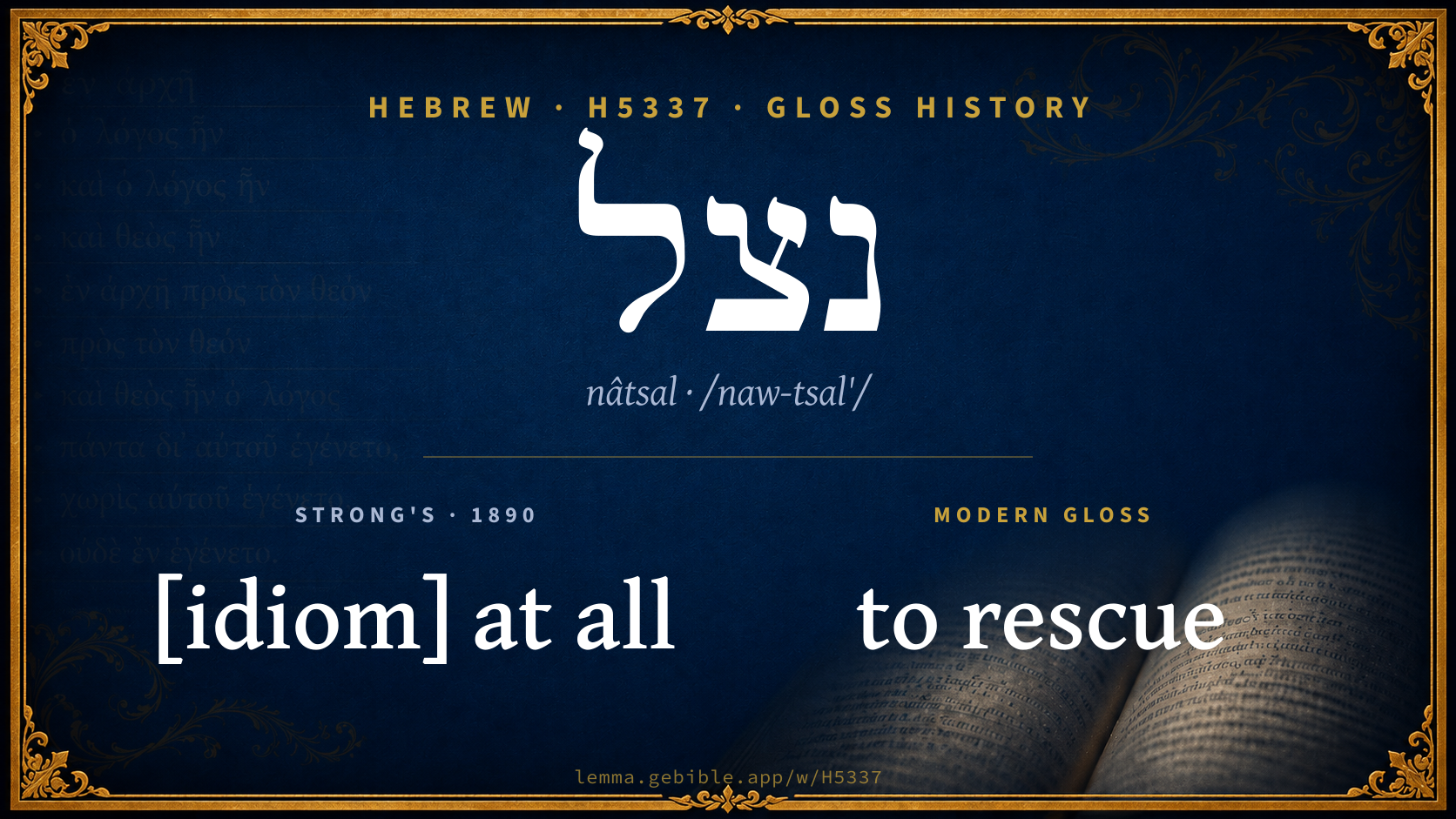
Gloss history
Strong's 1890 vs modern scholarship
About this word
Strong's H5337 catalogs a Hebrew word from the Hebrew Old Testament.
These counts are not copied from any lexicon or concordance. They are computed here, from the morphology-tagged Hebrew Old Testament. What Lemma adds →
- 194
- distinct verses
- The word appears in 194 distinct verses.
- 27 / 39
- OT books
- The word appears in 27 of 39 Old Testament books.
- #225
- by frequency
- Top 250 most frequent Hebrew words (rank 225 of 8,640 Hebrew words by occurrence).
View all 194 occurrences in the concordance →
By section of the Old Testament
By traditional corpus
Conventional, traditional groupings — biblical authorship is debated, so this is a traditional corpus grouping, not an authorship claim. Each share is this word’s portion of its verses in that division of the Hebrew canon. Each figure is a share of the word’s 194 distinct verses.
- Prophets (Nevi'im) 99 verses · 51%
- Writings (Ketuvim) 72 verses · 37%
- Torah (Pentateuch) 23 verses · 12%
How translations render this word
Counts come from each version’s own published word-to-Strong’s tagging or interlinear alignment — an approximate guide to how each version renders this word, not a word-level alignment the data otherwise carries. Because each total is that version’s own tagged count, the per-version totals vary from one another and need not match the appearance or distinct-verse counts above. These counts may also differ from a printed concordance because Lemma counts each distinctly tagged rendering and does not collapse phrase taggings into a single head-word total. This is a fixed set of word-tagged versions (KJV, ASV, BSB, ULT) and does not change with the reading translation you choose elsewhere. Each version’s license is shown beside its name below (and on Sources).
- King James Version: Deliver 53×, Delivered 18×, Shall deliver 6×
- American Standard Version: Deliver 44×, Delivered 14×, I will deliver 6×
- Berean Standard Bible: Deliver 25×, Deliver me 13×, Rescue 8×
- unfoldingWord Literal Text: Deliver 24×, Deliver me 12×, Rescue 9×
King James Version Public Domain
Renders H5337 across 213 tagged occurrences — most commonly:
Plus other, less common renderings. Plus 74 renderings that appear only once — usually multi-word phrases or single function words the recovered tagging swept in, not distinct renderings.
American Standard Version Public Domain
Renders H5337 across 211 tagged occurrences — most commonly:
Plus other, less common renderings. Plus 78 renderings that appear only once — usually multi-word phrases or single function words the recovered tagging swept in, not distinct renderings.
Berean Standard Bible Public Domain
Renders H5337 across 207 tagged occurrences — most commonly:
Plus other, less common renderings. Plus 62 renderings that appear only once — usually multi-word phrases or single function words the recovered tagging swept in, not distinct renderings. Not rendered by a distinct English word in 6 further occurrences.
unfoldingWord Literal Text CC BY-SA 4.0
Renders H5337 across 236 tagged occurrences — most commonly:
Plus other, less common renderings. Plus 82 renderings that appear only once — usually multi-word phrases or single function words the recovered tagging swept in, not distinct renderings.
15 senses and sub-senses in the full BDB
Hebrew verbs can shift meaning by stem (binyan): Qal is the basic action, Niphal is often passive or reflexive, Piel often intensifies or makes it factitive, and Hiphil is typically causative. The senses below are grouped under the stem BDB assigns to each. This entry also uses Hophal (the passive of Hiphil) and Hithpael (reflexive or reciprocal).
What do BDB’s symbols mean?
BDB uses these scholarly abbreviations:
| Symbol | Meaning |
|---|---|
| 𝔊 | the Septuagint (the ancient Greek translation, LXX) |
| 𝔙 | the Vulgate (the Latin translation) |
| 𝔖 | the Syriac version (the Peshitta) |
| 𝔗 | the Targum (the Aramaic translation) |
| ψ | the Psalms |
| √ | root (the underlying root or stem) |
| ‖ | parallel passage (a synonymous or contrasted parallel) |
| † | the dagger: every passage where the word occurs is cited |
The 15 senses and sub-senses the full Brown-Driver-Briggs lexicon distinguishes for this word, in lexicon order (not ranked by frequency), with BDB’s own verbatim wording and sub-sense lettering. Shown in Hebrew script with BDB’s own scholarly abbreviations. The condensed entry is in the Lexicon Entry tab. See also the Forms in the corpus table below.
Niphal
- Pf. 1 pl. נִצַּלְנוּ Je 7:10; Impf. יִנָּצֵל Dt 23:16, + 1 s. אִנָּֽצְלָה ψ 69:15, + 8 times Impf.; Inf. הִנָּצֵל Is 20:6 + 3 times— e.g. Jeremiah 7:10
- 1. reflex. tear oneself away, deliver oneself: abs. Pr 6:3; Ez 14:16, 18; 2 K 19:11 = Is 37:11; c. מִיַּד Pr 6:5; מֵעִם … אֶל escape from—unto Dt 23:16. e.g. Proverbs 6:3
- 2. passive, be torn out or away מִפִּי הָאֲרִי Am 3:12; be delivered, abs. Gn 32:31 Je 7:10 ψ 33:16 Mi 4:10; מִפְּנֵי Is 20:6; מִכַּף Hb 2:9; מִן ψ 69:15. e.g. Amos 3:12
Piel
- Pf. 2 mpl. נִצַּלְתֶּם Ex 3:22; Impf. יְנַצֵּל Ez 14:14 + 2 times;— e.g. Exodus 3:22
- 1. strip off, spoil, abs. 2 Ch 20:25; c. acc. pers. Ex 3:22; 12:36 (J). e.g. 2 Chronicles 20:25
- 2. deliver, c. acc. נַפְשָׁם Ez 14:14. e.g. Ezekiel 14:14
Hiphil
- Pf. הִצִּיל Ex 12:27; 2 ms. הִצַּ֫לֳתָּ Ex 5:23 + 50 times Pf.; Impf. יַצִּיל 2 K 17:39; יַצֵּל Gn 31:9; + 63 times Impf.; Imv. הַצֵּל Pr 24:11; הַצִּ֫ילָה ψ 22:21; sf. הַצִּילֵנִי Gn 32:12 + 24 times Imv.; Inf. abs. הַצֵּל 2 K 18:30 + 4 times; cstr. הַצִּיל Gn 37:22 + 23 times Inf.; Pt. מַצִּיל Dt 32:39 + 16 times Pt.— e.g. Exodus 12:27
- 1. take away, snatch away, e.g. property Gn 31:9, 16 (E) Ho 2:11, prey from the mouth of animals 1 S 17:35; Am 3:12; Ez 34:10; words of י׳ from the mouth ψ 119:43; וְאֵין מַצִּיל בֵּינֵיהֶם 2 S 14:6 and there was none to tear them apart (two fighting); וְהִצִּיל עֵינֵנוּ 2 S 20:6 and take away our eye (elude our sight, Ges; Ew We after 𝔊 cast shadow over our eye, denom. from צֵל; Bö Th after 𝔖 tear away our eye, harm us irretrievably, v. Dr 1 S 26:2; HPS escape from us [מִמֶּנּוּ, as 𝔊L], cf. Bu [וְנִצַּל]). e.g. Genesis 31:9
- 2. rescue, recover, e.g. cities Ju 11:26; wives and property 1 S 30:8, 18, 22. e.g. Judges 11:26
- 3. deliver from:
- a. enemies and troubles, abs. 1 S 12:21; Pr 19:19; Is 50:2; Je 39:17; †אֵין מַצִּיל Ju 18:28; Jb 5:4; 10:7 ψ 7:3; 50:22; 71:11; Is 5:29; 42:22; 43:13; Dn 8:4, 7 Ho 5:14; Mi 5:7; c. acc. Ex 18:8 (E) 5:23; 12:27 (J), Dt 23:15 + 39 times; †הַצִּיל נַפְשוֹ Is 44:20; 47:14; Ez 3:19, 21; 14:20; 33:19; c. מִן from Mi 5:6 + 25 times; מִיַּד from the hand or power of Gn 32:12; Ex 2:19 (J) + 57 times; מִתַּחַת יַד Ex 18:10 (E); †מִכַּף 2 S 14:16; 19:10; 22:1 = ψ 18:1, 2 K 20:6 = Is 38:6, 2 Ch 32:11 Ezr 8:31. e.g. 1 Samuel 12:21
- b. from death Pr 11:6; 12:6; מִמּוֹת Jos 2:13 (J), ψ 33:19; 56:14; Pr 10:2 = 11:4; מִשְּׁאוֹל ψ 86:13 Pr 23:14. e.g. Proverbs 11:6
- 4. deliver from sin and guilt (in late writings), מִכָּל־פְּשָׁעַי ψ 39:9 from all my transgressions; מִדָּמִים ψ 51:16 from bloodguiltiness; הַצִּילֵנוּ וְכַפֵּר עַל־חַטֹּאתֵינוּ ψ 79:9 deliver us and cover over all our sins; prob. also כְּאִמְרָֽתְךָ הַצִּילֵנִי ψ 119:170. e.g. Psalms 39:9
Hophal
- Pt. מֻצָּל;—כְּאוּד מֻצָּל מִשְּׂרֵפָה Am 4:11 as a brand plucked out of the burning; מֵאֵשׁ Zc 3:2 from the fire. e.g. Amos 4:11
Hithpael
- וַיִּתְנַצְּלוּ אֶת־עֶדְיָם Ex 33:6 (E) and they stripped themselves of their ornaments. e.g. Exodus 33:6
Senses from the full Brown-Driver-Briggs lexicon (Brown, Driver, Briggs; Oxford 1906 — public domain), digitized via Sefaria, supplemented by the OpenScriptures HebrewLexicon (CC BY 4.0). Full attribution on Sources.
Word origin
vb. not in Qal; Pi. strip, plunder; Niph. deliver oneself, be delivered; Hiph. snatch away, deliver (Ecclus Hiph. Pt. מצלת delivering 40:24b (Levi conj. יציל 40:24a); NH Hiph. = BH; Biblical Aramaic Haph. id.; Syriac ܢܨܰܠ pour out; Arabic نَصَلَ intrans. tincturam exuit emisitque barba, ex cuspide excidit sagitta, etc., Kam. Frey; Ethiopic iii. ተነጽለ evulsum vel abruptum excidere e suo loco, Di698);—
— Brown-Driver-Briggs (Oxford 1906, public domain), digitized via Sefaria, supplemented by the OpenScriptures HebrewLexicon (CC BY 4.0). See Sources.
Origin: a primitive root
Jastrow Dictionary
A second Hebrew/Aramaic lexicon for comparison, covering Aramaic and post-biblical (Talmudic, Targumic, Midrashic) usage that the biblical-Hebrew BDB does not. Matched by lemma rather than by Strong’s number, so a lemma may carry more than one Jastrow headword (shown separately below), and the entries cover usage well beyond the Bible.
נָצַל
- to remove, set aside.
- to empty, ransack. Esth. R. to III, 9 עד שנִצְּלוּ את מצרים so that they ransacked Egypt.
- , נִיצּוֹל
- *1. to be fit for throwing away (as נֵצֶל), to be decayed. Y. Naz. VII, 56ᵇ bot. בשר המת שנִצַּל Ar. (Ar. ed. Rome שנצול; ed. שנתוק), v. נֵצֶל.
- 2. (b. h.) to be rescued, saved. Midr. Till. to Ps. I לא נִצַּלְתִּי מידו I did not escape his power; Yalk. Num. 750 נוצלתי (read: נִיצַּ׳; ed. Liv. נִצּוֹלְתִּי). Yoma 86ᵇ כגון שבאת … ונ׳ הימנה when an opportunity to sin offered itself to him once and again, and he escaped it; Kidd. 39ᵇ. Esth. R. to II, 7 עתידין לִינָּצֵל וכ׳ are destined to be saved through me; עתידין להִנָּצֵל על ידיה be saved through her. B. Bath. 164ᵇ שלש … אין אדם ניצול מהן וכ׳ there are three sins which man cannot escape &c.; a. fr.
- to save, rescue. Num. R. s. 18 אשתו הִצִּילָתוֹ his wife saved him. Ib. משה … הַצִּילֵנוּ O Moses …, save us! Sabb. XVI, 1 מַצִּילִין אותן וכ׳ we must save them from fire (on the Sabbath). Snh. VIII, 7 שמצילין אותן בנפשן whom we must save (prevent from committing a crime) even at the risk of their lives. Ib. 73ᵃ ניתן להַצִּילָהּ בנפשו it is a duty to save her (from rape) at the expense of the assailant’s life; a. fr.—Trnsf. (in ritual and levitical law) to protect. Ḥull. 55ᵇ כל … מַצִּיל בגלודה every part of the skin (which has remained unaffected) protects a flayed animal from being declared ṭ’refah. Ib. מהו שיַצִּיל וכ׳ does it form a protection from &c.? Ohol. V, 3 מַצֶּלֶת על הכל protects everything in it from uncleanness; a. v. fr.
- to be saved. Esth. R. to V, 3 כבר הוּצְּלוּ חנניה וכ׳ Hananiah and his colleagues have long ere this been delivered from the furnace; a. e.
נְצַל
- , to save. Taan. 9ᵇ רחמנא לִיצְּלַן, v. כִּיסּוּפָא; a. e.
- same. Snh. 72ᵇ דלא מצי אַצּוּלֵיה when he cannot save him. Sabb. 115ᵃ השתא אַצּוּלֵי מַצִּילִינָן וכ׳ since we are bound to save them (on the Sabbath), is it necessary to say that they require burying (when defective)?; a. fr.
- to be saved. Ab. Zar. 18ᵃ bot. ומִתַּצְּלַת and thou shalt be saved.
נֵצֶל
- (preced. wds.) [that which is thrown away,] decayed matter, esp. (in levitical law) liquid and coagulated portions of a corpse. Ohol. II, 1; Naz. VII, 2. Y. ib. VII, 56ᵇ bot. איזהו נ׳ בשר המת שנתוק ומוהל וכ׳ (Ar. שנצל) what is netsel (in levitical law)? A corpse which is dissolving &c., v. מוֹהַל; Bab. ib. 50ᵃ איזהו נ׳ בשר המת שקרש ומוהל שהרתיח a secretion from a corpse which became coagulated, and a liquid secretion exposed to heat. Tosef. Ohol. III, 6; a. e.
צָלַל
- 1. to move, shake, hang over; denom. צֵל.
- 2. to turn, circle, roll (v. Jud. VII, 13); to eddy, sink. Koh. R. to XII, 7; Y. Ber. IV, 7ᵇ bot., a. e. (ref. to צולה, Is. XLIV, 27) why is Babylonia called tsulah, ששם צָלְלוּ מיתי וכ׳ because there sank the corpses of the generation of the flood; Lam. R. introd. (R. Josh. 2) צללו מי מבול (corr. acc.); v. infra.—3) (cmp. שָׁקַע) to settle, be clear; to clarify. Tosef. Nidd. III, 11 צָלְלוּ לא יחזור וכ׳ if the mixture has settled (become clear), he must not stir it up again; Nidd. 20ᵃ, v. עָכַר. Y. Keth. I, 25ᵇ bot. וחוזרת וצוֹלֶלֶת, v. צָכַר. Gen. R. s. 80, end וצָלַלְנוּ, v. צָכַר; a. e.—Part. pass. צָלוּל; f. צְלוּלָה; pl. צְלוּלִים, צְלוּלִין; צְלוּלוֹת. Ib. צ׳ היתה, v. צָכַר. Y. Ter. V, end, 43ᵈ יין צ׳ clarified wine. Sabb. 109ᵃ; 139ᵇ; a. fr.—Pesik. Haʿomer, p. 71ᵃ (play on צלול, K’ri צליל, Jud. VII, 13) על שצלול היה אותו הדור וכ׳ (not על שצלל עליהם, v. Rashi to Jud. l. c.) because that generation was cleared (bared) of righteous men; Pesik. R. s. 18 שצליל עליהם corr. acc.); Yalk. Jud. 62, Yalk. Lev. 643 (corr. acc.).—[ e.g. Judges 7:13
- 4. to glisten, be bright; (of sound) to vibrate, ring; v. מְצִילָּה, צִלְצֵל &c.]
- to be cleared. Y. Nidd. II, end, 50ᵇ יִצָּלְלוּ ולא יעכרו, v. עָכַר. Sabb. XX, 2 (139ᵇ) שיִצַּלּוּ (Bab. ed. שיִצּוֹלּוּ; v. Rabb. D. S. a. l. note 20) that they (the dregs) may settle.
- 1. to become clear, settle. Par. VIII, 11 עד שתָּצֵל until it is settled.
- 2. (denom. of צֵל) to shade. Pes. 50ᵃ (ref. to מצלות, Zech. XIV, 20) there will be an addition to the sacred precincts of Jerusalem עד שהסוס רץ ומֵיצֵל Ms. M. (ed. ומֵצֵיל; Rashi: עד שעה שהסרס וכ׳) as far as a horse can run (from sunrise) until it gives shade (casts its shadow under itself, i.e. till noon-time; Y. ib. III, end, 30ᵇ עד מקום שהסוס רץ ואינו עושה צל); Bab. l. c. כל ביזה … עד שהסוס רץ ומיצל וכ׳ whatever booty Israel will make (from morning) to the time &c., will be sacred &c. e.g. Zechariah 14:20
- to be sunk, dumped. Zeb. 113ᵇ שכל מתי מבול נִצְטַלְּלוּ לשם Ms. R. a. K. (ed. נִצְתַּלְּלוּ שם) because all the corpses of the flood were dumped there (in Babylonia); Sabb. 113ᵇ; v. supra.
A Dictionary of the Targumim, the Talmud Babli and Yerushalmi, and the Midrashic Literature (Marcus Jastrow; London, Luzac, 1903) — Public Domain. Digitized via Sefaria. Digitized via Sefaria. Full attribution on Sources.
Forms in the corpus
The 157 distinct written forms H5337 takes in the Hebrew Bible, most frequent first — each parse links to that stem’s occurrences in the concordance. Hebrew forms include their vowel points and cantillation, so a single lemma takes many written forms.
The 60 most common forms are shown; 97 rarer forms follow in the full concordance.
Same root — word family
Other BDB entries built from the same root as H5337, grouped by Strong’s listed origin. These share a root / origin per the lexicon — not necessarily a shared meaning. Each links to that word’s own entry.
Derived from this word
Compare all same-root words → They share a root, not necessarily a meaning.
Septuagint verse parallels
This word appears in 175 verses that also exist in the Greek Old Testament (Septuagint), out of the 194 Hebrew verses it occurs in. You can read those verses in Greek by switching the Old Testament edition to the Septuagint.
Read these verses in the Septuagint
- Genesis 31:9
- Exodus 2:19
- Numbers 35:25
- Deuteronomy 23:14
- Joshua 2:13
- Judges 6:9
- 1 Samuel 4:8
- 2 Samuel 12:7
- 2 Kings 17:39
- 1 Chronicles 11:14
- 2 Chronicles 20:25
- Ezra 8:31
This is a verse-level parallel only — the same verses exist in both the Hebrew and Greek Old Testaments. No word-level Hebrew↔Greek correspondence is claimed: the data carries no such alignment, so no Greek word is shown as this Hebrew word’s translation. Coverage is not total — the Septuagint omits the deuterocanon and renumbers the Psalms, so some Hebrew verses have no direct Greek parallel.