
Jeremiah 1:8

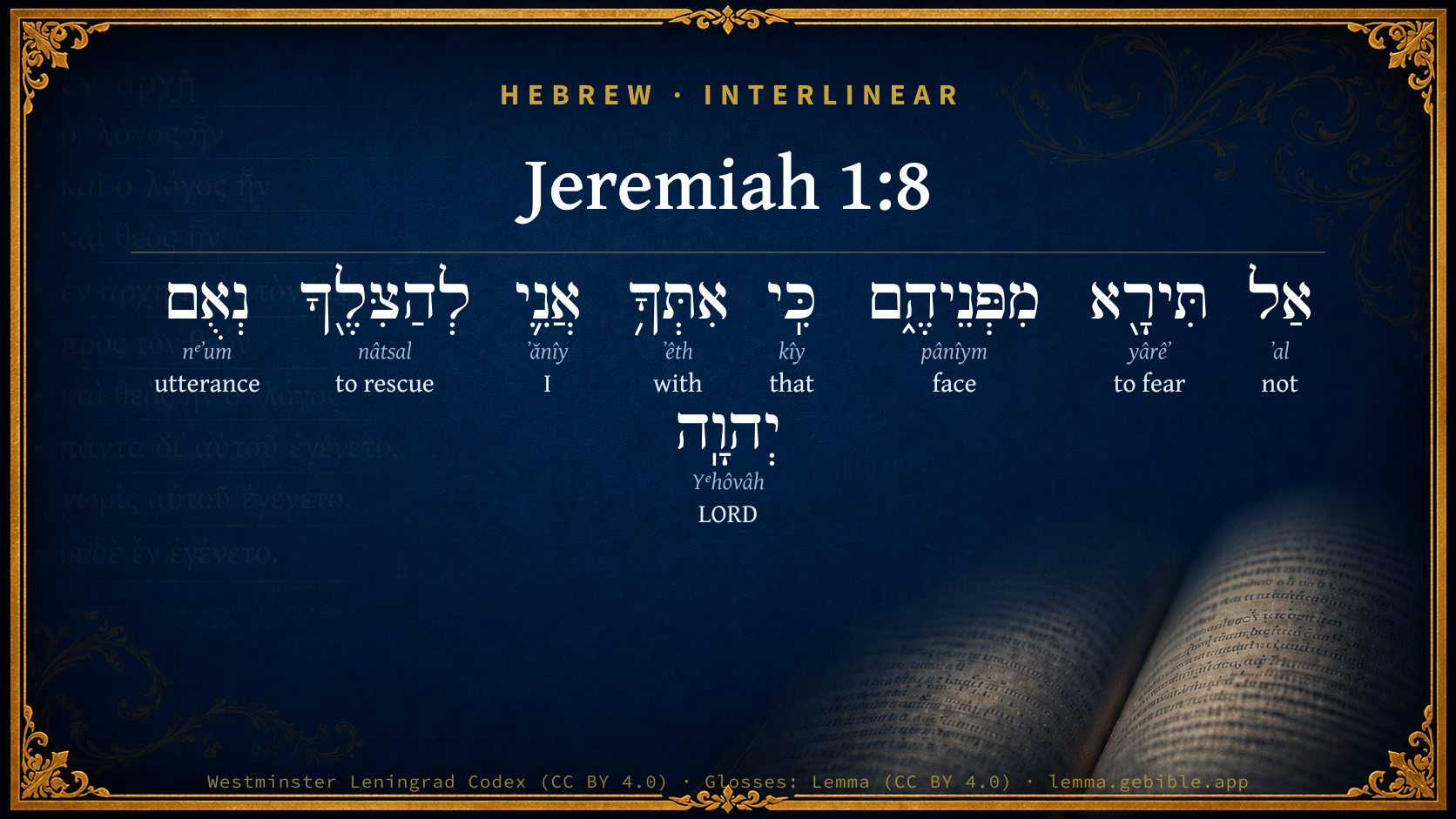
Hebrew (Westminster Leningrad Codex) Jeremiah 1:8 appears in the Hebrew Old Testament. The text above is from the Westminster Leningrad Codex. Each word links to its Strong’s number, a concise gloss, and parsing drawn from the Open Scriptures Hebrew Bible morphology. Click any word for its full Brown-Driver-Briggs (BDB) entry.
Download image
Cite this verse

Jeremiah 1:8 (World English Bible). Public Domain. Lemma interlinear Bible study tool, https://lemma.gebible.app/v/jeremiah/1/8.

Show BibTeX & RIS
BibTeX
RIS
English Translation
Don't be afraid because of them; for I am with you to deliver you, says Yahweh.
World English Bible · Public Domain
Download a study sheet

One document with this verse’s original text, its word-by-word gloss line, the meaning frame, cross-references with their text, attributed commentary, and full source and license credits — printable, and it pastes into notes with its structure intact.

This verse Autodidact and up

Study sheet (.html) Plain text (.txt)

A passage Seminary Student

Up to 50 verses in one chapter. A passage sheet keeps up to 6 commentary sources and 12 cross-references per verse, in the order this page ranks them, and says so on the sheet whenever that leaves anything out. Ask for a single verse and you get the Autodidact verse sheet above.

Everything on this page stays free to read, with no account — the sheet is a download of what is already on screen, not access to it.

Want to remove ads? Support Godless Engineer
Compare translations 3

The same verse in 3 English versions, stacked beneath the original-language interlinear above. Click any original word for its lexicon entry.

Each is an independent rendering of the whole verse — the interlinear is not word-aligned to these translations.

Highlighted words mark where these versions differ — a whole-verse word diff, not a word-by-word alignment.

  • World English Bible Public Domain
    Don't be afraid because of them; for I am with you to deliver you, says Yahweh.
  • King James Version Public Domain
    Be not afraid of their faces: for I am with thee to deliver thee, saith the LORD.
  • unfoldingWord Literal Text CC BY-SA 4.0
    Do not be afraid of their faces, for I with you to rescue you”—the declaration of Yahweh.

unfoldingWord Literal Text — © unfoldingWord, licensed CC BY-SA 4.0. Word-aligned USFM3 via Door43 (git.door43.org/unfoldingWord/en_ult).

Versions to compare (up to 4)

3 of 4 selected

Show all 18 translations

Every available English version of this verse, each an independent rendering of the whole verse.

  • World English Bible Public Domain
    Don't be afraid because of them; for I am with you to deliver you, says Yahweh.
  • Berean Standard Bible Public Domain
    Do not be afraid of them, for I am with you to deliver you,” declares the LORD.
  • Majority Standard Bible Public Domain
    Do not be afraid of them, for I am with you to deliver you,” declares the LORD.
  • King James Version Public Domain
    Be not afraid of their faces: for I am with thee to deliver thee, saith the LORD.
  • American Standard Version (1901) Public Domain
    Be not afraid because of them; for I am with thee to deliver thee, saith Jehovah.
  • Revised Version (1885) Public Domain
    Be not afraid because of them: for I am with thee to deliver thee, saith the LORD.
  • Geneva Bible (1599) Public Domain
    Be not afraide of their faces: for I am with thee to deliuer thee, saith the Lord.
  • Douay-Rheims (1899) Public Domain
    Be not afraid at their presence: for I am with thee to deliver thee, saith the Lord.
  • Young's Literal Translation Public Domain
    Be not afraid of their faces, for with thee `am' I to deliver thee, -- an affirmation of Jehovah.'
  • Literal Standard Version CC BY-SA 4.0
    Do not be afraid of their faces, for I [am] with you to deliver you,” a declaration of YHWH.
  • Unlocked Literal Bible CC BY-SA 4.0
    Do not be afraid of them, for I am with you to rescue you—this is Yahweh's declaration.”
  • unfoldingWord Literal Text CC BY-SA 4.0
    Do not be afraid of their faces, for I with you to rescue you”—the declaration of Yahweh.
  • Darby Bible Public Domain
    Be not afraid of them; for I am with thee to deliver thee, saith Jehovah.
  • World Messianic Bible Public Domain
    Don’t be afraid because of them, for I am with you to rescue you,” says the LORD.
  • Webster's Bible Public Domain
    Be not afraid of their faces: for I am with thee to deliver thee, saith the LORD.
  • Free Bible Version CC BY-SA 4.0
    Don't be afraid of them because I'll go with you and I'll look after you. This is the Lord's promise.”
  • Bible in Basic English Public Domain
    Have no fear because of them: for I am with you, to keep you safe, says the Lord.
  • JPS Tanakh (1917) Public Domain
    Be not afraid of them; for I am with thee to deliver thee, saith the LORD.

Literal Standard Version (2020), Covenant Press — licensed CC BY-SA 4.0. Text via the HelloAO Bible API (eBible.org). Unlocked Literal Bible (unfoldingWord) — licensed CC BY-SA 4.0. Text via the HelloAO Bible API (eBible.org). unfoldingWord Literal Text — © unfoldingWord, licensed CC BY-SA 4.0. Word-aligned USFM3 via Door43 (git.door43.org/unfoldingWord/en_ult). Free Bible Version, Dr. Jonathan Gallagher — licensed CC BY-SA 4.0. Text via the HelloAO Bible API (eBible.org).

Word by word

More ways to search: Search by grammar → Find every occurrence → Compare this word →

Practice this passage: Drill this verse → Learn its vocabulary →

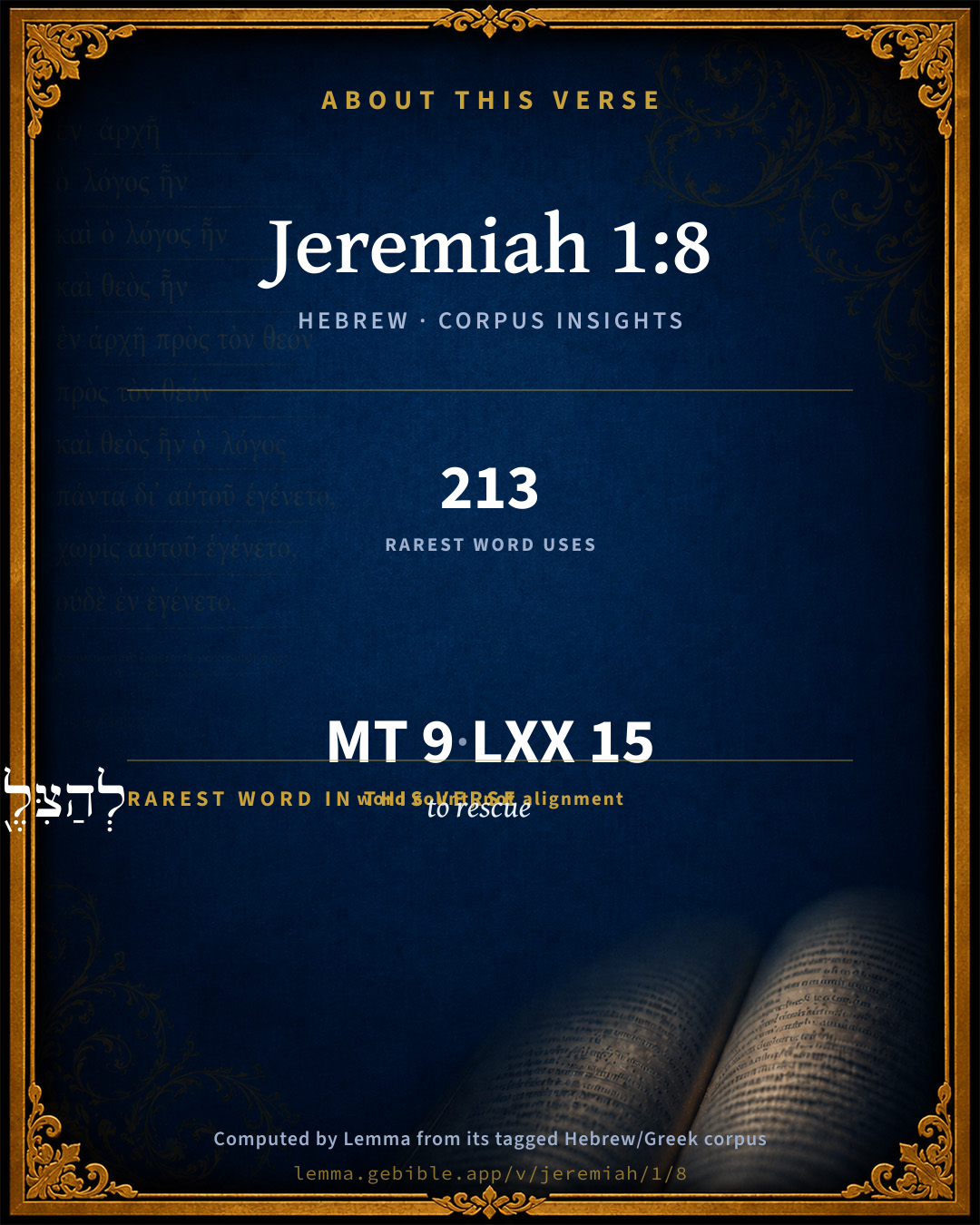
לְהַצִּלֶ֖ךָ
nâtsal
H5337
“to rescue · you”
Preposition + Verb, Hiphil, Infinitive Construct + Suffix, Personal, 2nd Person, Masculine, Singular
Part of Speech
Preposition + Verb
Stem
Hiphil
Form
Infinitive Construct
Full BDB Definition

Origin: a primitive root

TWOT: 1404

to snatch away, deliver, rescue, save, strip, plunder - (Niphal) - to tear oneself away, deliver oneself - to be torn out or away, be delivered - (Piel) - to strip off, spoil - to deliver - (Hiphil) - to take away, snatch away - to rescue, recover - to deliver (from enemies or troubles or death) - to deliver from sin and guilt - (Hophal) to be plucked out - (Hithpael) to strip oneself
  1. אַל ʼal H408 “not” Particle, Negative
  2. תִּירָ֖א yârêʼ H3372 “to fear” Verb, Qal, Jussive, 2nd Person, Masculine, Singular
  3. מִפְּנֵיהֶ֑ם pânîym H6440 “from · face(s) · their” Preposition + Noun, Common, Both, Plural, Construct + Suffix, Personal, 3rd Person, Masculine, Plural
  4. כִּֽי kîy H3588 “that” Conjunction
  5. אִתְּךָ֥ ʼêth H854 “with · you” Preposition + Suffix, Personal, 2nd Person, Masculine, Singular
  6. אֲנִ֛י ʼănîy H589 “I” Pronoun, Personal, 1st Person, Common, Singular
  7. נְאֻם nᵉʼum H5002 “utterance of” Noun, Common, Masculine, Singular, Construct
  8. יְהוָֽה Yᵉhôvâh H3068 “LORD” Noun, Proper

About this verse

These counts appear in no published source. They are computed here, from the morphology-tagged text and Lemma’s own curated glosses. What Lemma adds →

9
words
9
distinct lemmas
Prophets
section

Grammatical profile

  • 2 verbs
  • 3 nouns
  • 1 pronoun
  • 1 preposition
  • 1 conjunction
  • 1 particle

Verb forms

  • תִּירָ֖א Qal · Jussive
  • לְהַצִּלֶ֖ךָ Hiphil · Infinitive Construct

Hebrew & Septuagint length

In the original languages it is 9 Hebrew tokens and 15 Greek tokens — but the two are counted differently (Hebrew bundles its prefixes and suffixes into one token; the Greek is in lemma form), so that isn’t a like-for-like length.

Cross-references

25

Topical passages linked to Jeremiah 1:8 in the Treasury of Scripture Knowledge — connected by theme and wording, ordered by reader-vote popularity; previews shown in the World English Bible.

  • Joshua 1:5 There shall not any man be able to stand before you all the days of your life. As I was with Moses, so I will be with you; I will not fail you, nor forsake you.
  • Joshua 1:9 Haven't I commanded you? Be strong and of good courage; don't be afraid, neither be dismayed: for Yahweh your God is with you wherever you go.
  • Isaiah 51:7 Listen to me, you who know righteousness, the people in whose heart is my law; don't you fear the reproach of men, neither be you dismayed at their insults.
  • Deuteronomy 31:6 Be strong and of good courage, don't be afraid, nor be scared of them: for Yahweh your God, he it is who does go with you; he will not fail you, nor forsake you.
  • Luke 12:4–5 "I tell you, my friends, don't be afraid of those who kill the body, and after that have no more that they can do.
  • Jeremiah 15:20–21 I will make you to this people a fortified brazen wall; and they shall fight against you, but they shall not prevail against you; for I am with you to save you and to deliver you, says Yahweh.
  • Hebrews 13:5–6 Be free from the love of money, content with such things as you have, for he has said, "I will in no way leave you, neither will I in any way forsake you."
  • Deuteronomy 31:8 Yahweh, he it is who does go before you; he will be with you, he will not fail you, neither forsake you: don't be afraid, neither be dismayed.
  • Ezekiel 2:6–7 You, son of man, don't be afraid of them, neither be afraid of their words, though briers and thorns are with you, and you do dwell among scorpions: don't be afraid of their words, nor be dismayed at their looks, though they are a rebellious house.
  • Exodus 3:12 He said, "Certainly I will be with you. This will be the token to you, that I have sent you: when you have brought forth the people out of Egypt, you shall serve God on this mountain."
  • Isaiah 43:2 When you pass through the waters, I will be with you; and through the rivers, they shall not overflow you: when you walk through the fire, you shall not be burned, neither shall the flame kindle on you.
  • Ezekiel 3:8–9 Behold, I have made your face hard against their faces, and your forehead hard against their foreheads.
  • Acts 4:13 Now when they saw the boldness of Peter and John, and had perceived that they were unlearned and ignorant men, they marveled. They recognized that they had been with Jesus.
  • 2 Timothy 4:17–18 But the Lord stood by me, and strengthened me, that through me the message might be fully proclaimed, and that all the Gentiles might hear; and I was delivered out of the mouth of the lion.
  • Matthew 10:26 Therefore don't be afraid of them, for there is nothing covered that will not be revealed; and hidden that will not be known.
  • Acts 18:10 for I am with you, and no one will attack you to harm you, for I have many people in this city."
  • Isaiah 51:12 I, even I, am he who comforts you: who are you, that you are afraid of man who shall die, and of the son of man who shall be made as grass;
  • Jeremiah 1:17 You therefore gird up your loins, and arise, and speak to them all that I command you: don't be dismayed at them, lest I dismay you before them.
  • Jeremiah 20:11 But Yahweh is with me as an awesome mighty one: therefore my persecutors shall stumble, and they shall not prevail; they shall be utterly disappointed, because they have not dealt wisely, even with an everlasting dishonor which shall never be forgotten.
  • Matthew 28:20 teaching them to observe all things that I commanded you. Behold, I am with you always, even to the end of the age." Amen.
  • Acts 4:29 Now, Lord, look at their threats, and grant to your servants to speak your word with all boldness,
  • Acts 26:17 delivering you from the people, and from the Gentiles, to whom I send you,
  • 2 Corinthians 1:8–10 For we don't desire to have you uninformed, brothers, concerning our affliction which happened to us in Asia, that we were weighed down exceedingly, beyond our power, so much that we despaired even of life.
  • Acts 7:9–10 "The patriarchs, moved with jealousy against Joseph, sold him into Egypt. God was with him,
  • Ephesians 6:20 for which I am an ambassador in chains; that in it I may speak boldly, as I ought to speak.

Cross-references courtesy of OpenBible.info (CC BY 4.0).

Hebrew and Greek witnesses Masoretic Hebrew ↔ Greek Septuagint

The same verse in the two great witnesses to the Old Testament, shown verse-for-verse.

These are two independent witnesses, not word-aligned to each other, and the Septuagint is shown in lemma (dictionary) form.

Hebrew Jeremiah 1:8 Masoretic · Westminster Leningrad Codex

אַל תִּירָ֖א מִפְּנֵיהֶ֑ם כִּֽי אִתְּךָ֥ אֲנִ֛י לְהַצִּלֶ֖ךָ נְאֻם יְהוָֽה

Don't be afraid because of them; for I am with you to deliver you, says Yahweh.

World English Bible · Public Domain

Greek LXX Structure differs

In the Septuagint, Jeremiah is about an eighth shorter than the Hebrew and arranges its material differently — the Oracles Against the Nations (Hebrew chapters 46–51) appear in the middle of the Greek book, after 25:13. Because the chapter and verse boundaries do not line up, a verse-for-verse comparison with the Hebrew is not shown.

A verse-for-verse comparison isn’t shown here because the chapters and verses don’t line up. Switch to the LXX edition with the MT / LXX toggle above to read the Greek directly.

Hebrew: Westminster Leningrad Codex (CC BY 4.0). Greek: Septuagint (public domain); English from a public-domain English Septuagint. How the Septuagint differs from the Hebrew →

Targum (Aramaic paraphrase)

1

The Targum is the ancient Jewish Aramaic paraphrase of the Hebrew Scriptures — an interpretive translation, not the Hebrew text itself. Onkelos (literal) and Pseudo-Jonathan (expansive) render the Torah, and Jonathan the Prophets. Coverage is partial: where no permissively-licensed English translation exists for a verse, only the Aramaic is shown. This is verse-level text, not a word-by-word alignment to the Hebrew.

  1. Targum Jonathan Prophets (Joshua–Malachi)
    לָא תִדְחַל מִן קָדָמֵיהוֹן אֲרֵי בְסִעְדָךְ מֵימְרִי לְשֵׁיזְבוּתָךְ אֲמַר יְיָ:

    (no public-domain English translation for this verse)

    Targum Jonathan — Aramaic: “Mikraot Gedolot” (public domain). English: “Sefaria Community Translation” (CC0 1.0 (public-domain dedication)); “London "Chaldee Paraphrase," 1871” (public domain). Text via Sefaria.

Commentary

Notes on Jeremiah 1:8 from classic Christian and Jewish commentators (each source and its license shown beneath its notes). The classic Christian expositions comment on the surrounding passage and are grouped to its opening verse, so a note may address several verses; the Jewish commentaries on the Tanakh (Rashi and others) are per-verse, so they appear only where the commentator wrote on this verse.

Lemma curates 59 commentaries, every one of them public domain or Creative Commons licensed, each selected and text-cleaned for this edition rather than reprinted as found. About our sources →

Trapp's Complete Commentary

John Trapp

Jer 1:8 Be not afraid of their faces: for I [am] with thee to deliver thee, saith the LORD.

Ver. 8. Be not afraid of their faces.] Look they never so big, as did Henry VIII upon Latimer and upon Lambert, who yet told him his own; as did Stephen Gardiner upon Dr Taylor, martyr, but had as good as he brought. {a} The majesty of a man, as also his wrath, showeth itself in his countenance; and young men especially are apt to be baffled and dashed with fierce looks.

For I am with thee to deliver thee.] On one sort or another; thy crown, be sure, no man shall take from thee; thy perpetual triumph thou shalt not lose.

{a} Acts and Mon.

John Trapp, A Commentary or Exposition upon All the Books of the Old and New Testament (1647–1656) — public domain. Text from a community e-Sword module.

Jamieson, Fausset & Brown

Robert Jamieson, A. R. Fausset & David Brown

(Eze 2:6; Eze 3:9).

I am with thee-- (Exo 3:12; Jos 1:5).

Jamieson, Fausset & Brown — Commentary Critical and Explanatory on the Whole Bible (1871) — public domain (CC PDM 1.0). Text via the HelloAO Bible API.

Adam Clarke's Commentary

Verse 8. Be not afraid of their faces] That is, the Jews, whom he knew would persecute him because of the message which he brought. To be fore-warned is to be half armed. He knew what he was to expect from the disobedient and the rebellious, and must now be prepared to meet it.

Adam Clarke's Commentary on the Bible (1810–1826) — public domain. Text from a community e-Sword/MySword module.

John Calvin's Commentaries

We may learn from this verse that Jeremiah, when he observed the heavy and hard conflicts he had to undertake, was greatly disturbed; for he had not courage enough firmly and boldly to assail enemies so many and so violent. He indeed saw, that he had to do with a degenerated people, who had almost all departed from the law of God: and since they had for many years shaken off the yoke, and were petulantly exulting in their freedom, it was difficult to bring them back to obedience, and to a right course of life. It hence appears that the Prophet was restrained by this difficulty, so as not to venture to undertake the prophetic office. But God applied a suitable remedy to his fear; for what does he say? Fear not their face It appears, then, that when Jeremiah said that he was a child, he had in view, as I have already hinted, the difficulty of the undertaking; he could hardly bear to carry on contests so severe with that rebellious people, who had now become hardened in their wickedness. We hence see how he refused, in an indirect manner, the burden laid on him, for he ventured, not openly and ingenuously, and in plain words, to confess how the matter was; but God, who penetrates into the hearts of men, and knows all their hidden feelings and motives, heals his timidity by saying, Fear not their face.

Now this passage shews that corruptions had so prevailed among the chosen people, that no servant of God could peaceably perform his office. When prophets and teachers have to do with a teachable people, they have no need to fight: but when there is no fear of God, and no regard for him, yea, when men are led away by the violence of their lusts, no godly teacher can exercise his duty without being prepared for war. This, then, is what God intimates, when he bids his Prophet to be courageous; for he saw that there would be as many enemies as professed themselves to be the children of Abraham.

The reason, also, for boldness and confidence, that is added, ought to be noticed, For I am with thee to deliver thee By these words God reminds the Prophet, that there would be sufficient protection in his power, so that he had no need to dread the fury of his own nation. It was, indeed, at first, a formidable undertaking, when Jeremiah saw that he had to carry on war, not with a few men, but with the whole people; but God sets himself in opposition to all men, and says, I am with thee, fear not. We hence see that due honor is then conceded to God, when being content with his defense we disregard the fury of men, and hesitate not to contend with all the ungodly, yea, though they may rise up in a mass against us: and were their forces and power the strongest, we ought yet to feel assured that the defense of God alone is sufficient to protect us. This is the full meaning of the passage. It now follows-

John Calvin's Commentaries (1540-1563) — public domain. Text from the Calvin Translation Society English edition (1840s-50s) via the Christian Classics Ethereal Library (ccel.org). Calvin's coverage is partial (roughly two-thirds of the Bible); uncommented books and verses are honest gaps, never fabricated. The 19th-century editor's footnotes and remarks are omitted so the notes are faithfully Calvin's own voice.

Ellicott's Commentary for English Readers

(8) Be not afraid.—The words imply, as in those spoken to Ezekiel (Eze_2:6), to St. Peter (Luk_5:10), and St. Paul (Act_18:9), the fear that sprang from the sense of personal weakness and unfitness to cope with the dangers to which his work exposed him. The “faces” of his adversaries would be a source of terror to him. The consciousness that Jehovah was with him was to raise him from that timidity.

A Bible Commentary for English Readers, edited by Charles John Ellicott (1878–1897) — public domain. Text from a community e-Sword module.

The Cambridge Bible for Schools and Colleges

gen. ed. J. J. S. Perowne

8. Be not afraid] Jeremiah had pleaded his youth, but, as the Lord saw, another cause for his shrinking from the task was his natural timidity.

The Cambridge Bible for Schools and Colleges (gen. ed. J. J. S. Perowne; Cambridge University Press, 1878–1918) — public domain. Text from a community e-Sword module.

John Gill's Exposition

Be not afraid of their faces,.... Their stern looks, their frowning brows, and angry countenances, which would threaten him with destruction and death:

for I am with thee, to deliver thee, saith the Lord; out of their hands, when in the most imminent danger. The Targum paraphrases the words thus,

"my Word shall be thine help to deliver thee:''

which is true of Christ, the essential Word of God.

John Gill's Exposition of the Whole Bible (1746–1763) — public domain (CC PDM 1.0). Text via the HelloAO Bible API.

Matthew Poole's English Annotations

Be not afraid of their faces; their fierce looks, Eze 3:9, the indication of their enraged minds, Dan 3:19; neither when thou deliverest my message to them, nor when thou mayst be cited before them, Mat 10:18,19. This is God’s answer to Jeremiah’s fears in respect of the persons he was to deal with, as the other was in respect of his own consciousness of insufficiency; and he mentions their faces, because the majestic countenance of princes and magistrates is apt to strike a great awe and terror upon children.

I am with thee; I will not only send thee as other kings do their ambassadors, but I will go with thee. This God promises to Moses, Exo 3:12; Deu 31:6,8.

To deliver thee: here God promises his protection for encouragement.

Matthew Poole's English Annotations on the Holy Bible (1683–1685) — public domain. Text from a community e-Sword/MySword module.

Keil & Delitzsch

C. F. Keil & F. Delitzsch

Just as little needs youthful bashfulness or shy unwillingness to speak before high and mighty personages stand as a hindrance in the way of his accepting God's call. The Lord will be with him, so that he needs have no fear for any man. The suffix in מפניהם refers to all to whom God sends him (Jer 1:7). These, enraged by the threatenings of punishment which he must proclaim to them, will seek to persecute him and put him to death (cf. Jer 1:19); but God promises to rescue him from every distress and danger which the fulfilment of his duties can bring upon him. Yet God does not let the matter cease with this pledge; but, further, He consecrates him to his calling.

Keil & Delitzsch — Biblical Commentary on the Old Testament (1861–1891) — public domain (CC PDM 1.0). Text via the HelloAO Bible API. (Old Testament only.)

Lesson kit

Teaching starters — assembled from the data on this page, not authored interpretation. Every prompt links to the verse data it draws on. Edit before teaching.

Jeremiah, in the Prophets, opens this verse with 9 words (9 distinct Hebrew lemmas). Its most distinctive word is nâtsal (“to rescue”). A historical commentator’s framing appears above. Read the whole chapter for the surrounding context.

Discussion questions

  1. The word nâtsal carries the sense “to rescue.” How does it shape the verse?
  2. Joshua 1:5 shares this passage’s theme. How do the two illuminate each other?
  3. These translations render this verse differently; the difference is in the English rendering, not the original. What questions does that raise?
  4. The verb «תִּירָ֖א» is Qal Jussive. How does its form color the action?
  5. Reading how Trapp's Complete Commentary and Jamieson, Fausset & Brown read this verse, where do the two commentators agree and where do they part?

Things to notice

Reading settings

Reading text

Shown beneath each verse's original-language words.

Old Testament
Old Testament edition

Read the OT as the Masoretic Hebrew (MT) or the Greek Septuagint (LXX).

English shown for the Greek Septuagint (in the Hebrew ↔ Greek comparison).

Comparing translations? Open the Compare panel on any verse page to stack up to four side by side.