Isaiah 37:11

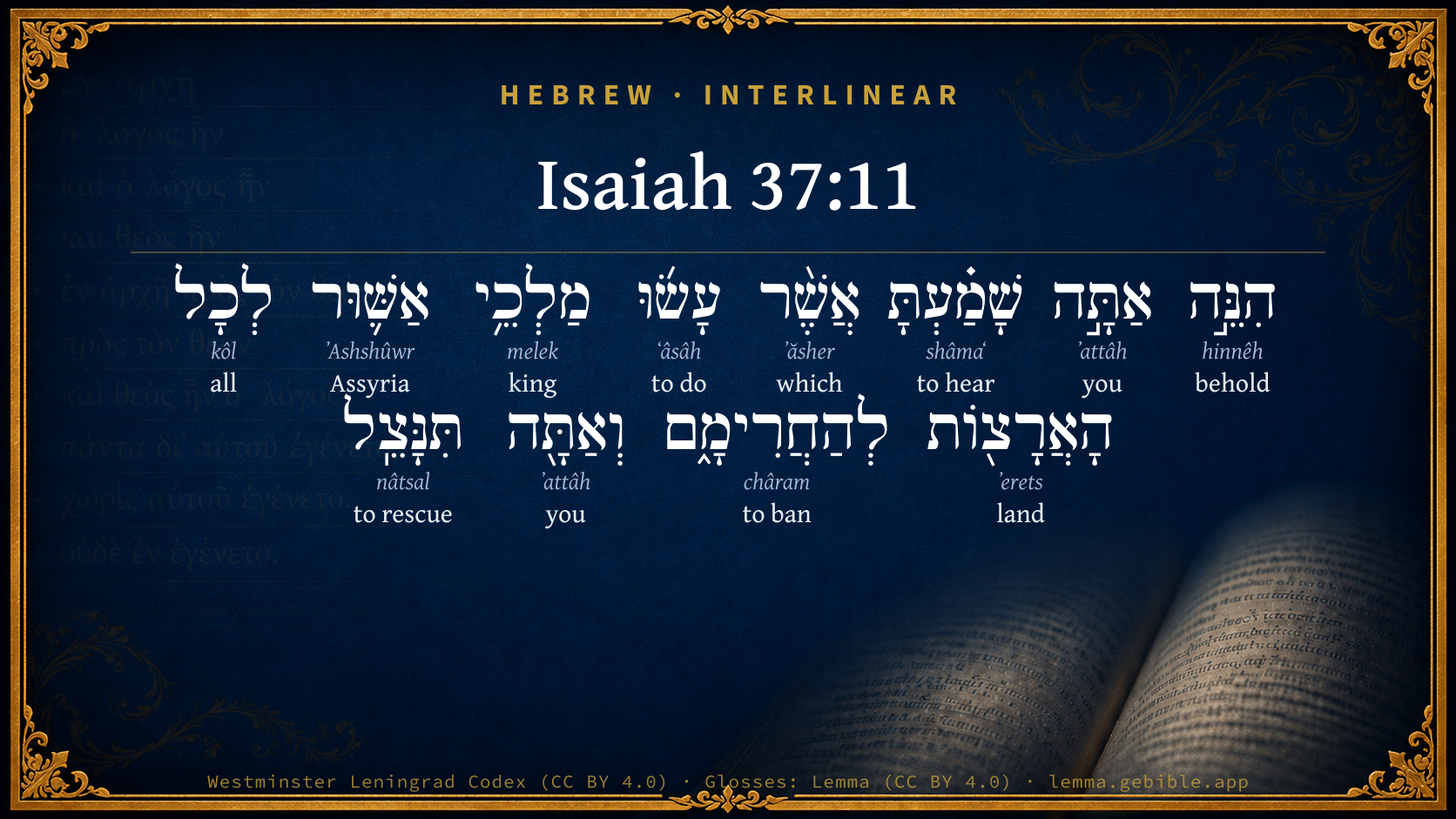
Hebrew (Westminster Leningrad Codex) Isaiah 37:11 appears in the Hebrew Old Testament. The text above is from the Westminster Leningrad Codex. Each word links to its Strong’s number, a concise gloss, and parsing drawn from the Open Scriptures Hebrew Bible morphology. Click any word for its full Brown-Driver-Briggs (BDB) entry.
Download image
Cite this verse

Isaiah 37:11 (World English Bible). Public Domain. Lemma interlinear Bible study tool, https://lemma.gebible.app/v/isaiah/37/11.

Show BibTeX & RIS
BibTeX
RIS
English Translation
Behold, you have heard what the kings of Assyria have done to all lands, by destroying them utterly: and shall you be delivered?
World English Bible · Public Domain
Download a study sheet

One document with this verse’s original text, its word-by-word gloss line, the meaning frame, cross-references with their text, attributed commentary, and full source and license credits — printable, and it pastes into notes with its structure intact.

This verse Autodidact and up

Study sheet (.html) Plain text (.txt)

A passage Seminary Student

Up to 50 verses in one chapter. A passage sheet keeps up to 6 commentary sources and 12 cross-references per verse, in the order this page ranks them, and says so on the sheet whenever that leaves anything out. Ask for a single verse and you get the Autodidact verse sheet above.

Everything on this page stays free to read, with no account — the sheet is a download of what is already on screen, not access to it.

Want to remove ads? Support Godless Engineer
Compare translations 3

The same verse in 3 English versions, stacked beneath the original-language interlinear above. Click any original word for its lexicon entry.

Each is an independent rendering of the whole verse — the interlinear is not word-aligned to these translations.

Highlighted words mark where these versions differ — a whole-verse word diff, not a word-by-word alignment.

  • World English Bible Public Domain
    Behold, you have heard what the kings of Assyria have done to all lands, by destroying them utterly: and shall you be delivered?
  • King James Version Public Domain
    Behold, thou hast heard what the kings of Assyria have done to all lands by destroying them utterly; and shalt thou be delivered?
  • unfoldingWord Literal Text CC BY-SA 4.0
    Behold, you, you have heard what the kings of Assyria have done to all of the lands by destroying them. So you, will you be delivered?

unfoldingWord Literal Text — © unfoldingWord, licensed CC BY-SA 4.0. Word-aligned USFM3 via Door43 (git.door43.org/unfoldingWord/en_ult).

Versions to compare (up to 4)

3 of 4 selected

Show all 18 translations

Every available English version of this verse, each an independent rendering of the whole verse.

  • World English Bible Public Domain
    Behold, you have heard what the kings of Assyria have done to all lands, by destroying them utterly: and shall you be delivered?
  • Berean Standard Bible Public Domain
    Surely you have heard what the kings of Assyria have done to all the other countries, devoting them to destruction. Will you then be spared?
  • Majority Standard Bible Public Domain
    Surely you have heard what the kings of Assyria have done to all the other countries, devoting them to destruction. Will you then be spared?
  • King James Version Public Domain
    Behold, thou hast heard what the kings of Assyria have done to all lands by destroying them utterly; and shalt thou be delivered?
  • American Standard Version (1901) Public Domain
    Behold, thou hast heard what the kings of Assyria have done to all lands, by destroying them utterly: and shalt thou be delivered?
  • Revised Version (1885) Public Domain
    Behold, thou hast heard what the kings of Assyria have done to all lands, by destroying them utterly: and shalt thou be delivered?
  • Geneva Bible (1599) Public Domain
    Beholde, thou hast heard what the Kings of Asshur haue done to all lands in destroying them, and shalt thou be deliuered?
  • Douay-Rheims (1899) Public Domain
    Behold thou hast heard all that the kings of the Assyrians hare done to all countries which they have destroyed, and canst thou be delivered?
  • Young's Literal Translation Public Domain
    Lo, thou hast heard that which the kings of Asshur have done to all the lands -- to devote them -- and thou art delivered!
  • Literal Standard Version CC BY-SA 4.0
    Behold, you have heard that which the kings of Asshur have done to all the lands—to devote them—and you are delivered!
  • Unlocked Literal Bible CC BY-SA 4.0
    See, you have heard what the kings of Assyria have done to all lands by destroying them completely. So will you be rescued?
  • unfoldingWord Literal Text CC BY-SA 4.0
    Behold, you, you have heard what the kings of Assyria have done to all of the lands by destroying them. So you, will you be delivered?
  • Darby Bible Public Domain
    Behold, thou hast heard what the kings of Assyria have done to all countries, destroying them utterly; and shalt thou be delivered?
  • World Messianic Bible Public Domain
    Behold, you have heard what the kings of Assyria have done to all lands, by destroying them utterly. Shall you be delivered?
  • Webster's Bible Public Domain
    Behold, thou hast heard what the kings of Assyria have done to all lands by destroying them utterly; and shalt thou be delivered?
  • Free Bible Version CC BY-SA 4.0
    Look! You've heard what the kings of Assyria have done to all the countries they've invaded — they destroyed them completely! Do you really think you'll be saved?
  • Bible in Basic English Public Domain
    No doubt the story has come to your ears of what the kings of Assyria have done to all lands, putting them to the curse: and will you be kept safe from their fate?
  • JPS Tanakh (1917) Public Domain
    Behold, thou hast heard what the kings of Assyria have done to all lands, by destroying them utterly; and shalt thou be delivered?

Literal Standard Version (2020), Covenant Press — licensed CC BY-SA 4.0. Text via the HelloAO Bible API (eBible.org). Unlocked Literal Bible (unfoldingWord) — licensed CC BY-SA 4.0. Text via the HelloAO Bible API (eBible.org). unfoldingWord Literal Text — © unfoldingWord, licensed CC BY-SA 4.0. Word-aligned USFM3 via Door43 (git.door43.org/unfoldingWord/en_ult). Free Bible Version, Dr. Jonathan Gallagher — licensed CC BY-SA 4.0. Text via the HelloAO Bible API (eBible.org).

Word by word

More ways to search: Search by grammar → Find every occurrence → Compare this word →

Practice this passage: Drill this verse → Learn its vocabulary →

לְהַחֲרִימָ֑ם
châram
H2763
“to ban · them”
Preposition + Verb, Hiphil, Infinitive Construct + Suffix, Personal, 3rd Person, Masculine, Plural
Part of Speech
Preposition + Verb
Stem
Hiphil
Form
Infinitive Construct
Full BDB Definition

Origin: a primitive root

TWOT: 744 , 745

to ban, devote, destroy utterly, completely destroy, dedicate for destruction, exterminate - (Hiphil) - to prohibit (for common use), ban - to consecrate, devote, dedicate for destruction - to exterminate, completely destroy - (Hophal) - to be put under the ban, be devoted to destruction - to be devoted, be forfeited - to be completely destroyed - to split, slit, mutilate (a part of the body) - (Qal) to mutilate - (Hiphil) to divide
  1. הִנֵּ֣ה hinnêh H2009 “behold” Particle, Demonstrative
  2. אַתָּ֣ה ʼattâh H859 “you” Pronoun, Personal, 2nd Person, Masculine, Singular
  3. שָׁמַ֗עְתָּ shâmaʻ H8085 “to hear” Verb, Qal, Perfect, 2nd Person, Masculine, Singular
  4. אֲשֶׁ֨ר ʼăsher H834 “which” Particle, Relative
  5. עָשׂ֜וּ ʻâsâh H6213 “to do” Verb, Qal, Perfect, 3rd Person, Common, Plural
  6. מַלְכֵ֥י melek H4428 “kings of” Noun, Common, Masculine, Plural, Construct
  7. אַשּׁ֛וּר ʼAshshûwr H804 “Assyria” Noun, Proper
  8. לְכָל kôl H3605 “to/for · all of” Preposition + Noun, Common, Masculine, Singular, Construct
  9. הָאֲרָצ֖וֹת ʼerets H776 “the · lands” Particle, Definite Article + Noun, Common, Both, Plural, Absolute
  10. וְאַתָּ֖ה ʼattâh H859 “and · you” Conjunction + Pronoun, Personal, 2nd Person, Masculine, Singular
  11. תִּנָּצֵֽל nâtsal H5337 “to rescue” Verb, Niphal, Imperfect, 2nd Person, Masculine, Singular

About this verse

These counts appear in no published source. They are computed here, from the morphology-tagged text and Lemma’s own curated glosses. What Lemma adds →

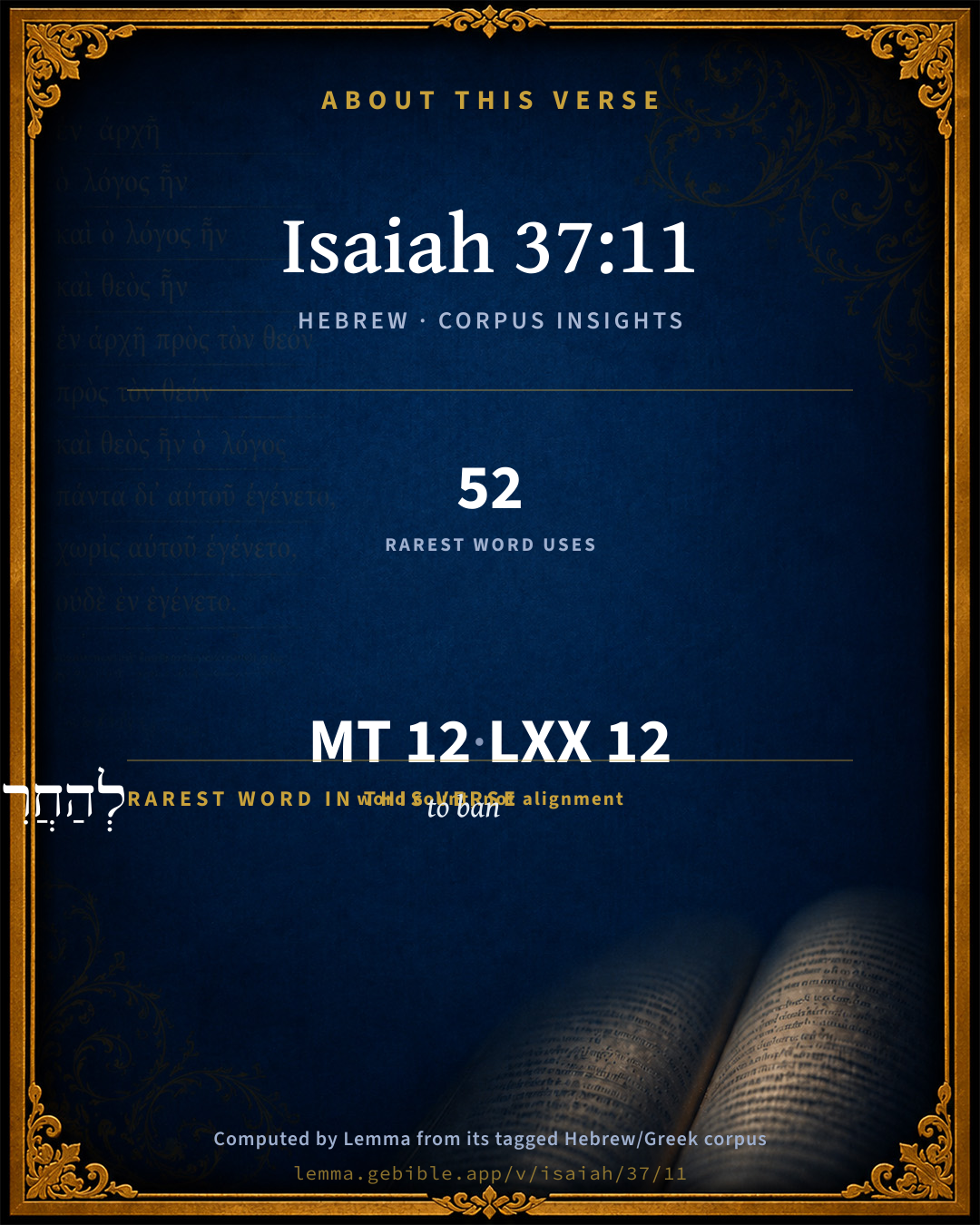
12
words
11
distinct lemmas
Prophets
section

Shared distinctive vocabulary

לְהַחֲרִימָ֑ם to ban H2763 occurs in 48 verses of the Hebrew Bible. Also found in:

Grammatical profile

  • 4 verbs
  • 4 nouns
  • 2 pronouns
  • 2 particles

Verb forms

  • שָׁמַ֗עְתָּ Qal · Perfect
  • עָשׂ֜וּ Qal · Perfect
  • לְהַחֲרִימָ֑ם Hiphil · Infinitive Construct
  • תִּנָּצֵֽל Niphal · Imperfect

Repetition

A word recurs within this verse — often emphatic in Hebrew:

  • אַתָּ֣ה you H859 ×2

Hebrew & Septuagint length

In English translation the verse runs 23 words from the Hebrew and 24 from the Septuagint (LXX English) — closely comparable.

A rough comparison of the two English renderings, which tokenize alike — not a word-level alignment.

Word counts can differ between the Hebrew and the Greek without any difference in meaning — e.g. the Hebrew direct-object marker אֵת has no separate Greek word, and Greek often adds the article ὁ.

In the original languages it is 12 Hebrew tokens and 12 Greek tokens — but the two are counted differently (Hebrew bundles its prefixes and suffixes into one token; the Greek is in lemma form), so that isn’t a like-for-like length.

Cross-references

6

Topical passages linked to Isaiah 37:11 in the Treasury of Scripture Knowledge — connected by theme and wording, ordered by reader-vote popularity; previews shown in the World English Bible.

  • Isaiah 36:18–20 Beware lest Hezekiah persuade you, saying, Yahweh will deliver us. Has any of the gods of the nations delivered his land out of the hand of the king of Assyria?
  • 2 Kings 17:4–6 The king of Assyria found conspiracy in Hoshea; for he had sent messengers to So king of Egypt, and offered no tribute to the king of Assyria, as he had done year by year: therefore the king of Assyria shut him up, and bound him in prison.
  • 2 Kings 18:33–35 Has any of the gods of the nations ever delivered his land out of the hand of the king of Assyria?
  • Isaiah 10:7–14 However he doesn't mean so, neither does his heart think so; but it is in his heart to destroy, and to cut off not a few nations.
  • Isaiah 14:17 who made the world as a wilderness, and overthrew the cities of it; who didn't let loose his prisoners to their home?"
  • Isaiah 37:18–19 Of a truth, Yahweh, the kings of Assyria have laid waste all the countries, and their land,

Cross-references courtesy of OpenBible.info (CC BY 4.0).

Hebrew and Greek witnesses Masoretic Hebrew ↔ Greek Septuagint

The same verse in the two great witnesses to the Old Testament, shown verse-for-verse.

These are two independent witnesses, not word-aligned to each other, and the Septuagint is shown in lemma (dictionary) form.

Hebrew Isaiah 37:11 Masoretic · Westminster Leningrad Codex

הִנֵּ֣ה אַתָּ֣ה שָׁמַ֗עְתָּ אֲשֶׁ֨ר עָשׂ֜וּ מַלְכֵ֥י אַשּׁ֛וּר לְכָל הָאֲרָצ֖וֹת לְהַחֲרִימָ֑ם וְאַתָּ֖ה תִּנָּצֵֽל

Behold, you have heard what the kings of Assyria have done to all lands, by destroying them utterly: and shall you be delivered?

World English Bible · Public Domain

Greek LXX Isaiah 37:11 Septuagint · lemma form

ἤ οὐ ἀκούω ὅς ποιέω βασιλεύς ἀσσύριος πᾶς ὁ γῆ ὡς ἀποὀλλύω

Have you not heard what the kings of the Assyrians have done, how they have destroyed the whole earth? and shall you be delivered?

LXX2012 (modern English Septuagint) · Public Domain

Hebrew: Westminster Leningrad Codex (CC BY 4.0). Greek: Septuagint (public domain); English from LXX2012 (modern English Septuagint) (Public Domain). How the Septuagint differs from the Hebrew →

Targum (Aramaic paraphrase)

1

The Targum is the ancient Jewish Aramaic paraphrase of the Hebrew Scriptures — an interpretive translation, not the Hebrew text itself. Onkelos (literal) and Pseudo-Jonathan (expansive) render the Torah, and Jonathan the Prophets. Coverage is partial: where no permissively-licensed English translation exists for a verse, only the Aramaic is shown. This is verse-level text, not a word-by-word alignment to the Hebrew.

  1. Targum Jonathan Prophets (Joshua–Malachi)
    הָא אַתְּ שְׁמַעְתָּא דַעֲבָדוּ מַלְכֵי אַתּוּר לְכָל מְדִינָתָא לְגַמָרוּתְהוֹן וְאַתְּ מְדַמֵי לְאִשְׁתֵּיזָבָא:

    Behold, thou hast heard what the kings of Assyria have done to all lands by destroying them utterly; and dost thou imagine that thou wilt be delivered?

    Targum Jonathan — Aramaic: “Mikraot Gedolot” (public domain). English: “Sefaria Community Translation” (CC0 1.0 (public-domain dedication)); “London "Chaldee Paraphrase," 1871” (public domain). Text via Sefaria.

Commentary

Notes on Isaiah 37:11 from classic Christian and Jewish commentators (each source and its license shown beneath its notes). The classic Christian expositions comment on the surrounding passage and are grouped to its opening verse, so a note may address several verses; the Jewish commentaries on the Tanakh (Rashi and others) are per-verse, so they appear only where the commentator wrote on this verse.

Lemma curates 59 commentaries, every one of them public domain or Creative Commons licensed, each selected and text-cleaned for this edition rather than reprinted as found. About our sources →

Jamieson, Fausset & Brown

Robert Jamieson, A. R. Fausset & David Brown

all lands-- (Isa 14:17). He does not dare to enumerate Egypt in the list.

Jamieson, Fausset & Brown — Commentary Critical and Explanatory on the Whole Bible (1871) — public domain (CC PDM 1.0). Text via the HelloAO Bible API.

The Cambridge Bible for Schools and Colleges

gen. ed. J. J. S. Perowne

11. by destroying them utterly] Lit. putting them to the ban, see on ch. Isa_34:2.

The Cambridge Bible for Schools and Colleges (gen. ed. J. J. S. Perowne; Cambridge University Press, 1878–1918) — public domain. Text from a community e-Sword module.

John Gill's Exposition

Have the gods of the nations delivered them which my fathers have destroyed,.... They have not. But what then? is the God of Israel to be put upon a level with such dunghill gods? so Sennacherib reckoned him, as Rabshakeh before, in his name, Isa 36:18,

as Gozan, and Haran, and Rezeph, and the children of Eden, which were in Telassar. Gozan was the same, it may be, with the Gausanitis of Ptolemy (z) which he makes mention of in his description of Mesopotamia; and the rather, since Haran or Chapman was a city of Mesopotamia, Gen 11:31 called by Ptolemy by the name of Carrae (a); and who also, in the same place, makes mention of Rezeph, under the name of Rhescipha; though he likewise speaks of another place in Palmyrene in Syria, called Rhaesapha (b), which some think to be the place here intended. Eden was also in Mesopotamia, in the eastern part of which was the garden of Eden; and this Telassar, inhabited by the children of Eden, was a city in that country, which is by Ptolemy (c) called Thelda; though Hillerus (d) is of opinion that the city Thalatha is meant, which is placed (e) near the river Tigris, a river of paradise. A very learned (f) men is of opinion, that the Eden, Isaiah here speaks of, belongs either to Syria of Damascus, and to the Lebanon and Paneas from whence Jordan arose; or to Syro-Phoenicia, and the Mediterranean sea, which the name Thalassar shows, as if it was the Syrians being used to derive not a few of their words from the Greeks: and certain it is, that there is now a village called Eden on Mount Lebanon, which Thevenot (g) mentions; and another, near Damascus, Mr. Maundrell (h) speaks of; see Amo 1:5 and Tyre in Phoenicia is called Eden, Eze 28:13.

(z) Geograph, l. 5. c. 18. (a) Ibid. (b) Ibid. c. 15. (c) lbid. c. 18. (d) Onomast. Sacr. p. 945. (e) Geograph. l. 5. c. 20. (f) Nichol. Abrami Pharus Vet. Test. l. 2. c. 16. p. 57. (g) Travels, part 1. B. 2. ch. 60. p. 221. (h) Journey from Aleppo, p. 119, 120. Ed. 7th.

John Gill's Exposition of the Whole Bible (1746–1763) — public domain (CC PDM 1.0). Text via the HelloAO Bible API.

Albert Barnes' Notes on the Bible

And shalt thou be delivered? - How will it be possible for you to stand out against the conquerors of the world?

Albert Barnes' Notes on the Bible (1834–1885) — public domain. Text from a community e-Sword/MySword module.

The Pulpit Commentary

Thou hast heard what the kings of Assyria have done to all lands (compare the Assyrian inscriptions, passim). Tiglath-Pileser I calls himself "the conquering hero, the terror of whose name has overwhelmed all regions " ("Records of the Past," vol. 5. p. 8); Asshur-izir-pal, "the king who subdued all the races of men" (ibid., ch. 7. p. 11); Shalmaneser II, "the marcher over the whole world" (ibid., vol. 5. p. 29); Shamas-Vul, "the trampler on the world" (ibid., vol. 1:12). Sargon says that "the gods had granted him the exercise of his sovereignty over all kings" (ibid., ch. 9. p. 4), and that he reigned from the two beginnings to the two ends of the four celestial points" (ibid., ch. 11. p. 33), i.e. from the furthest north to the furthest south, and from the extreme cast to the extreme west. Sennacherib himself says, Aashur, father of the gods, among all kings firmly has raised me, and over all that dwell in the countries he caused to increase my weapons" (ibid., ch. 11. p. 49). From first to last, in their inscriptions, the monarchs claim a universal dominion.

The Pulpit Commentary (1880–1919), ed. H.D.M. Spence-Jones & Joseph S. Exell — public domain. Text from a community e-Sword module.

J. A. Alexander on Isaiah

Joseph Addison Alexander

“Behold thou hast heard what the kings of Assyria have done to all the lands, by utterly destroying them, and thou shalt be delivered!” The interjection behold appeals to these events as something perfectly notorious; as if he had said, ‘see what has happened to others, and then judge whether thou art likely to escape’. The pronoun thou, in the first clause, not being necessary to the sense, is, according to analogy, distinctive and emphatic, and may be explained to mean, thou at least hast heard, if not the common people. In the last clause, the same pronoun stands in opposition to the other kings or kingdoms who had been destroyed. This clause is, in most versions, rendered as an interrogation, but is properly an exclamation of contemptuous incredulity. All the lands may be either an elliptical expression for all the lands subdued by them, or, which is more in keeping with the character of the discourse, a hyperbolical expression of the speaker’s arrogance.

Joseph Addison Alexander, The Prophecies of Isaiah (1846–1847; New York: Scribner, 1870–1878) — public domain. Text from a community e-Sword module.

unfoldingWord translationNotes

Door43 World Missions Community

General Information:

This continues the king of Assyria's message to Hezekiah.

See, you have heard

The word "see" here is used to add emphasis to what is said next. AT: "You have certainly heard"

So will you be rescued?

The king of Assyria uses this question to ridicule Hezekiah and his army. This may be written as a statement. AT: "So you too will not be saved." or "So of course no one will rescue you either!" (See: Rhetorical Question)

Have the gods of the nations rescued them ... Tel Assar?

The king of Assyria uses this question to ridicule Hezekiah and his army. This may be written as a statement. AT: "The nations' god did not rescue the nations that my fathers destroyed ... Tel Assar!" (See: Rhetorical Question)

that my fathers destroyed

These men destroyed the cities listed by conquering them with their armies. Here the word "fathers" refers to his father and his other ancestors who were kings. AT: "that my fathers destroyed with their armies" (See: Synecdoche)

Gozan ... Haran ... Rezeph ... Eden ... Tel Assar ... Hena ... Ivvah

These are places that the Assyrians had conquered. (See: How to Translate Names)

Where is the king ... Ivvah?

The king of Assyria uses this question to ridicule Hezekiah and his army. This may be written as a statement. AT: "We also conquered the king ... Ivvah!" (See: Rhetorical Question)

Hamath ... Arpad ... Sepharvaim

Translate the names of these cities the same as you did in Isaiah 36:19. (See: How to Translate Names)

translationWords

king

Assyria

false god

nation

unfoldingWord translationNotes — © Distant Shores Media and the Door43 World Missions Community, licensed CC BY-SA 4.0. Source: git.door43.org/Door43/en_tn.

Lesson kit

Teaching starters — assembled from the data on this page, not authored interpretation. Every prompt links to the verse data it draws on. Edit before teaching.

Isaiah, in the Prophets, opens this verse with 12 words (11 distinct Hebrew lemmas). Its most distinctive word is châram (“to ban”). A historical commentator’s framing appears above. Read the whole chapter for the surrounding context.

Discussion questions

  1. How does “to ban” (châram) shape what this verse is saying?
  2. How does Exodus 22:20, which shares the word «to ban», read alongside this verse?
  3. What does the repetition of “you” (2× in this one verse) do in this verse?
  4. These translations render this verse differently; the difference is in the English rendering, not the original. What questions does that raise?
  5. «שָׁמַ֗עְתָּ» is a Qal Perfect verb. How does that grammatical form shape the action described?
  6. Compare how Jamieson, Fausset & Brown and The Cambridge Bible for Schools and Colleges read this verse. Where do they agree or differ?

Things to notice

Reading settings

Reading text

Shown beneath each verse's original-language words.

Old Testament
Old Testament edition

Read the OT as the Masoretic Hebrew (MT) or the Greek Septuagint (LXX).

English shown for the Greek Septuagint (in the Hebrew ↔ Greek comparison).

Comparing translations? Open the Compare panel on any verse page to stack up to four side by side.