
Ezekiel 13:21

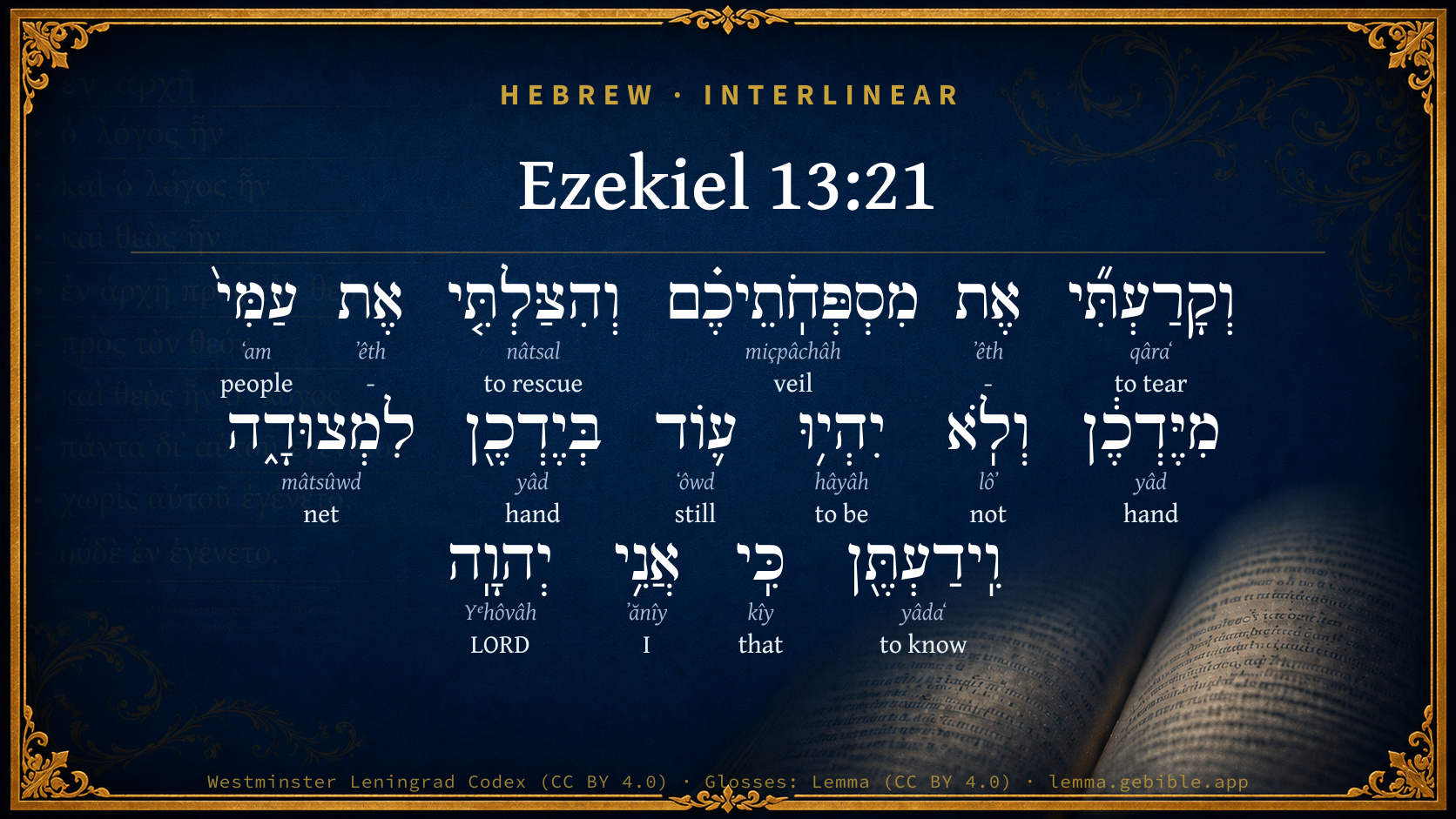
Hebrew (Westminster Leningrad Codex) Ezekiel 13:21 appears in the Hebrew Old Testament. The text above is from the Westminster Leningrad Codex. Each word links to its Strong’s number, a concise gloss, and parsing drawn from the Open Scriptures Hebrew Bible morphology. Click any word for its full Brown-Driver-Briggs (BDB) entry.
Download image
Cite this verse

Ezekiel 13:21 (World English Bible). Public Domain. Lemma interlinear Bible study tool, https://lemma.gebible.app/v/ezekiel/13/21.

Show BibTeX & RIS
BibTeX
RIS
English Translation
Your kerchiefs also will I tear, and deliver my people out of your hand, and they shall be no more in your hand to be hunted; and you shall know that I am Yahweh.
World English Bible · Public Domain
Download a study sheet

One document with this verse’s original text, its word-by-word gloss line, the meaning frame, cross-references with their text, attributed commentary, and full source and license credits — printable, and it pastes into notes with its structure intact.

This verse Autodidact and up

Study sheet (.html) Plain text (.txt)

A passage Seminary Student

Up to 50 verses in one chapter. A passage sheet keeps up to 6 commentary sources and 12 cross-references per verse, in the order this page ranks them, and says so on the sheet whenever that leaves anything out. Ask for a single verse and you get the Autodidact verse sheet above.

Everything on this page stays free to read, with no account — the sheet is a download of what is already on screen, not access to it.

Want to remove ads? Support Godless Engineer
Compare translations 3

The same verse in 3 English versions, stacked beneath the original-language interlinear above. Click any original word for its lexicon entry.

Each is an independent rendering of the whole verse — the interlinear is not word-aligned to these translations.

Highlighted words mark where these versions differ — a whole-verse word diff, not a word-by-word alignment.

  • World English Bible Public Domain
    Your kerchiefs also will I tear, and deliver my people out of your hand, and they shall be no more in your hand to be hunted; and you shall know that I am Yahweh.
  • King James Version Public Domain
    Your kerchiefs also will I tear, and deliver my people out of your hand, and they shall be no more in your hand to be hunted; and ye shall know that I am the LORD.
  • unfoldingWord Literal Text CC BY-SA 4.0
    I will tear away your veils and rescue my people from your hand, so they will no longer be trapped in your hands. You will know that I am Yahweh.

unfoldingWord Literal Text — © unfoldingWord, licensed CC BY-SA 4.0. Word-aligned USFM3 via Door43 (git.door43.org/unfoldingWord/en_ult).

Versions to compare (up to 4)

3 of 4 selected

Show all 18 translations

Every available English version of this verse, each an independent rendering of the whole verse.

  • World English Bible Public Domain
    Your kerchiefs also will I tear, and deliver my people out of your hand, and they shall be no more in your hand to be hunted; and you shall know that I am Yahweh.
  • Berean Standard Bible Public Domain
    I will also tear off your veils and deliver My people from your hands, so that they will no longer be prey in your hands. Then you will know that I am the LORD.
  • Majority Standard Bible Public Domain
    I will also tear off your veils and deliver My people from your hands, so that they will no longer be prey in your hands. Then you will know that I am the LORD.
  • King James Version Public Domain
    Your kerchiefs also will I tear, and deliver my people out of your hand, and they shall be no more in your hand to be hunted; and ye shall know that I am the LORD.
  • American Standard Version (1901) Public Domain
    Your kerchiefs also will I tear, and deliver my people out of your hand, and they shall be no more in your hand to be hunted; and ye shall know that I am Jehovah.
  • Revised Version (1885) Public Domain
    Your kerchiefs also will I tear, and deliver my people out of your hand, and they shall be no more in your hand to be hunted; and ye shall know that I am the LORD.
  • Geneva Bible (1599) Public Domain
    Your vailes also will I teare, and deliuer my people out of your hande, and they shalbe no more in your hands to be hunted, and ye shall knowe that I am the Lord.
  • Douay-Rheims (1899) Public Domain
    And I will tear your pillows, and will deliver my people out of your hand, neither shall they be any more in your hands to be a prey: and you shall know that I am the Lord.
  • Young's Literal Translation Public Domain
    And I have torn your kerchiefs, And delivered My people out of your hand, And they are no more in your hand for a prey, And ye have known that I `am' Jehovah.
  • Literal Standard Version CC BY-SA 4.0
    And I have torn your veils, || And delivered My people out of your hand, || And they are no longer for a prey in your hand, || And you have known that I [am] YHWH.
  • Unlocked Literal Bible CC BY-SA 4.0
    I will tear away your veils and rescue my people from your hand, so they will no longer be trapped in your hands. You will know that I am Yahweh.
  • unfoldingWord Literal Text CC BY-SA 4.0
    I will tear away your veils and rescue my people from your hand, so they will no longer be trapped in your hands. You will know that I am Yahweh.
  • Darby Bible Public Domain
    And I will tear your veils and deliver my people out of your hand, and they shall be no more in your hand to be hunted; and ye shall know that I [am] Jehovah.
  • World Messianic Bible Public Domain
    I will also tear your veils and deliver my people out of your hand; and they will no longer be in your hand to be ensnared. Then you will know that I am the LORD.
  • Webster's Bible Public Domain
    Your kerchiefs also will I tear, and deliver my people out of your hand, and they shall no more be in your hand to be hunted; and ye shall know that I am the LORD.
  • Free Bible Version CC BY-SA 4.0
    I will also rip off your veils and rescue my people from your power, so that they will no longer be your victims. Then you will know that I am the Lord.
  • Bible in Basic English Public Domain
    And I will have your veils violently parted in two, and will make my people free from your hands, and they will no longer be in your power for you to go after them; and you will be certain that I am the Lord.
  • JPS Tanakh (1917) Public Domain
    Your pads also will I tear, and deliver My people out of your hand, and they shall be no more in your hand to be hunted; and ye shall know that I am the LORD.

Literal Standard Version (2020), Covenant Press — licensed CC BY-SA 4.0. Text via the HelloAO Bible API (eBible.org). Unlocked Literal Bible (unfoldingWord) — licensed CC BY-SA 4.0. Text via the HelloAO Bible API (eBible.org). unfoldingWord Literal Text — © unfoldingWord, licensed CC BY-SA 4.0. Word-aligned USFM3 via Door43 (git.door43.org/unfoldingWord/en_ult). Free Bible Version, Dr. Jonathan Gallagher — licensed CC BY-SA 4.0. Text via the HelloAO Bible API (eBible.org).

Word by word

More ways to search: Search by grammar → Find every occurrence → Compare this word →

Practice this passage: Drill this verse → Learn its vocabulary →

מִסְפְּחֹֽתֵיכֶ֗ם
miçpâchâh
H4555
“veils · your”
Noun, Common, Feminine, Plural, Construct + Suffix, Personal, 2nd Person, Masculine, Plural
Part of Speech
Noun
Type
Common
Gender
Feminine
Number
Plural
State
Construct
Full BDB Definition

Origin: from H5596

TWOT: 1534c

long veil, veil (as spread out)
  1. וְקָרַעְתִּ֞י qâraʻ H7167 “and · to tear” Conjunction + Verb, Qal, Sequential Perfect, 1st Person, Common, Singular
  2. אֶת ʼêth H853 “-” Particle, Direct Object
  3. וְהִצַּלְתִּ֤י nâtsal H5337 “and · to rescue” Conjunction + Verb, Hiphil, Sequential Perfect, 1st Person, Common, Singular
  4. אֶת ʼêth H853 “-” Particle, Direct Object
  5. עַמִּי֙ ʻam H5971 “people · my” Noun, Common, Masculine, Singular, Construct + Suffix, Personal, 1st Person, Common, Singular
  6. מִיֶּדְכֶ֔ן yâd H3027 “from · hand · your” Preposition + Noun, Common, Both, Singular, Construct + Suffix, Personal, 2nd Person, Feminine, Plural
  7. וְלֹֽא lôʼ H3808 “and · not” Conjunction + Particle, Negative
  8. יִהְי֥וּ hâyâh H1961 “to be” Verb, Qal, Imperfect, 3rd Person, Masculine, Plural
  9. ע֛וֹד ʻôwd H5750 “still” Adverb
  10. בְּיֶדְכֶ֖ן yâd H3027 “in/at · hand · your” Preposition + Noun, Common, Both, Singular, Construct + Suffix, Personal, 2nd Person, Feminine, Plural
  11. לִמְצוּדָ֑ה mâtsûwd H4686 “to/for · net” Preposition + Noun, Common, Feminine, Singular, Absolute
  12. וִֽידַעְתֶּ֖ן yâdaʻ H3045 “and · to know” Conjunction + Verb, Qal, Sequential Perfect, 2nd Person, Feminine, Plural
  13. כִּֽי kîy H3588 “that” Conjunction
  14. אֲנִ֥י ʼănîy H589 “I” Pronoun, Personal, 1st Person, Common, Singular
  15. יְהוָֽה Yᵉhôvâh H3068 “LORD” Noun, Proper

About this verse

These counts appear in no published source. They are computed here, from the morphology-tagged text and Lemma’s own curated glosses. What Lemma adds →

16
words
14
distinct lemmas
Prophets
section

Notable vocabulary

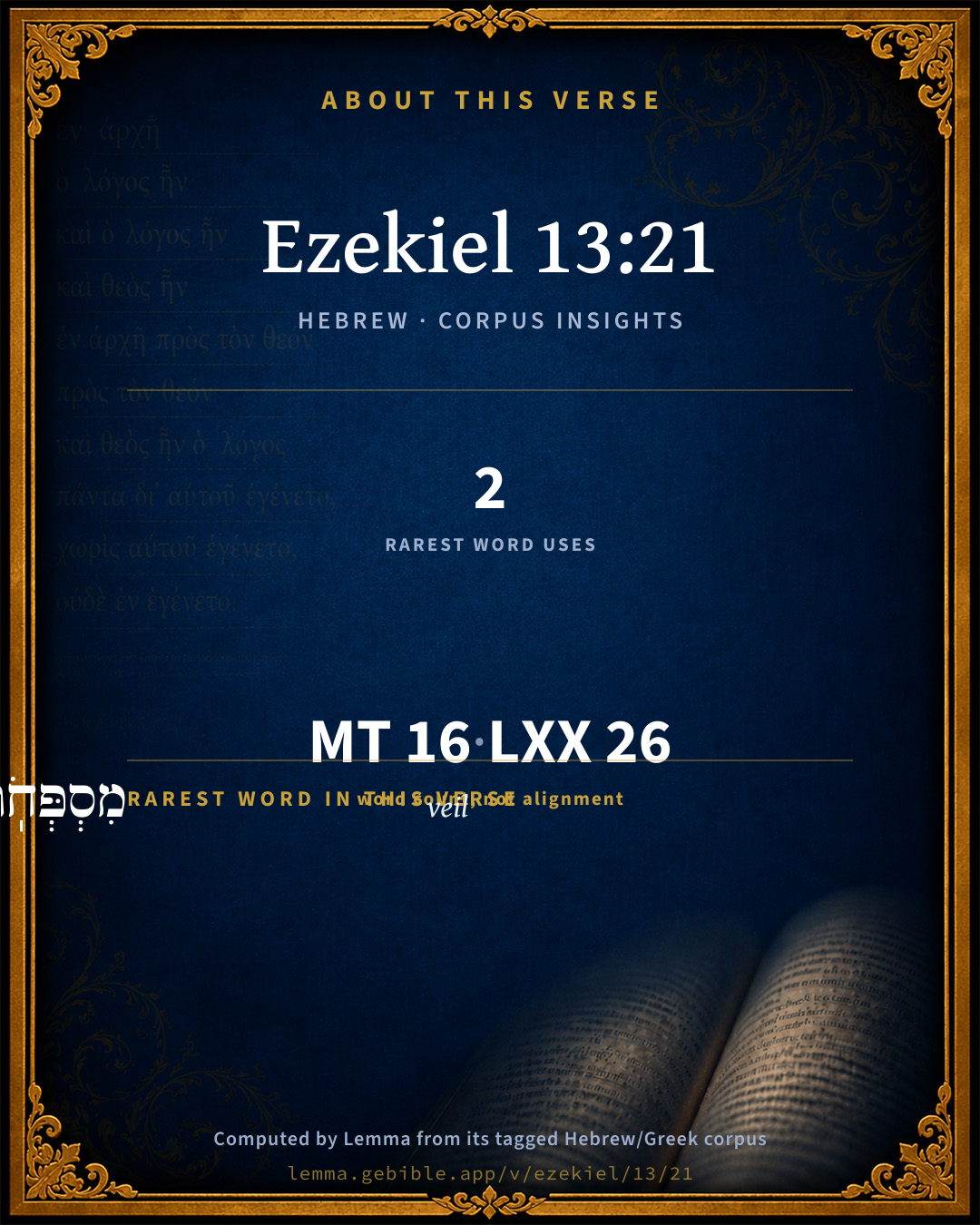
The rarest word here is מִסְפְּחֹֽתֵיכֶ֗ם veil H4555 — appearing just 2 times in the whole Hebrew Bible.

Shared distinctive vocabulary

מִסְפְּחֹֽתֵיכֶ֗ם veil H4555 occurs in 2 verses of the Hebrew Bible. Also found in:

Grammatical profile

  • 4 verbs
  • 6 nouns
  • 1 pronoun
  • 1 conjunction
  • 1 adverb
  • 3 particles

Verb forms

  • וְקָרַעְתִּ֞י Qal · Sequential Perfect
  • וְהִצַּלְתִּ֤י Hiphil · Sequential Perfect
  • יִהְי֥וּ Qal · Imperfect
  • וִֽידַעְתֶּ֖ן Qal · Sequential Perfect

Repetition

A word recurs within this verse — often emphatic in Hebrew:

  • מִיֶּדְכֶ֔ן hand H3027 ×2

Hebrew & Septuagint length

In English translation the verse runs 34 words from the Hebrew and 36 from the Septuagint (LXX English) — closely comparable.

A rough comparison of the two English renderings, which tokenize alike — not a word-level alignment.

Word counts can differ between the Hebrew and the Greek without any difference in meaning — e.g. the Hebrew direct-object marker אֵת has no separate Greek word, and Greek often adds the article ὁ.

In the original languages it is 16 Hebrew tokens and 26 Greek tokens — but the two are counted differently (Hebrew bundles its prefixes and suffixes into one token; the Greek is in lemma form), so that isn’t a like-for-like length.

Cross-references

1

Topical passages linked to Ezekiel 13:21 in the Treasury of Scripture Knowledge — connected by theme and wording, ordered by reader-vote popularity; previews shown in the World English Bible.

  • Psalms 91:3 For he will deliver you from the snare of the fowler, And from the deadly pestilence.

Cross-references courtesy of OpenBible.info (CC BY 4.0).

Hebrew and Greek witnesses Masoretic Hebrew ↔ Greek Septuagint

The same verse in the two great witnesses to the Old Testament, shown verse-for-verse.

These are two independent witnesses, not word-aligned to each other, and the Septuagint is shown in lemma (dictionary) form.

Hebrew Ezekiel 13:21 Masoretic · Westminster Leningrad Codex

וְקָרַעְתִּ֞י אֶת מִסְפְּחֹֽתֵיכֶ֗ם וְהִצַּלְתִּ֤י אֶת עַמִּי֙ מִיֶּדְכֶ֔ן וְלֹֽא יִהְי֥וּ ע֛וֹד בְּיֶדְכֶ֖ן לִמְצוּדָ֑ה וִֽידַעְתֶּ֖ן כִּֽי אֲנִ֥י יְהוָֽה

Your kerchiefs also will I tear, and deliver my people out of your hand, and they shall be no more in your hand to be hunted; and you shall know that I am Yahweh.

World English Bible · Public Domain

Greek LXX Ezekiel 13:21 Septuagint · lemma form

καί διαῥήγνυμι ὁ ἐπιβόλαιον σύ καί ῥύομαι ὁ λαός ἐγώ ἐκ χείρ σύ καί οὐκέτι εἰμί ἐν χείρ σύ εἰς συστροφή καί ἐπιγιγνώσκω διότι ἐγώ κύριος

And I will tear your kerchiefs, and will rescue my people out of your hands, and they shall no longer be in your hands to be confounded; and you⌃ shall know that I am the Lord.

LXX2012 (modern English Septuagint) · Public Domain

Hebrew: Westminster Leningrad Codex (CC BY 4.0). Greek: Septuagint (public domain); English from LXX2012 (modern English Septuagint) (Public Domain). How the Septuagint differs from the Hebrew →

Targum (Aramaic paraphrase)

1

The Targum is the ancient Jewish Aramaic paraphrase of the Hebrew Scriptures — an interpretive translation, not the Hebrew text itself. Onkelos (literal) and Pseudo-Jonathan (expansive) render the Torah, and Jonathan the Prophets. Coverage is partial: where no permissively-licensed English translation exists for a verse, only the Aramaic is shown. This is verse-level text, not a word-by-word alignment to the Hebrew.

  1. Targum Jonathan Prophets (Joshua–Malachi)
    וְאַפְסֵיק יַת פַּת כּוּמָרֵיכוֹן וַאֲשֵׁיזֵיב יַת עַמִי מִיֶדְכוֹן וְלָא יִתְמַסְרוּן עוֹד בְּיֶדְכוֹן לְאִשְׁתֵּיצָאָה וְתִידְעוּן אֲרֵי אֲנָא יְיָ:

    (no public-domain English translation for this verse)

    Targum Jonathan — Aramaic: “Mikraot Gedolot” (public domain). English: “Sefaria Community Translation” (CC0 1.0 (public-domain dedication)); “London "Chaldee Paraphrase," 1871” (public domain). Text via Sefaria.

Commentary

Notes on Ezekiel 13:21 from classic Christian and Jewish commentators (each source and its license shown beneath its notes). The classic Christian expositions comment on the surrounding passage and are grouped to its opening verse, so a note may address several verses; the Jewish commentaries on the Tanakh (Rashi and others) are per-verse, so they appear only where the commentator wrote on this verse.

Lemma curates 59 commentaries, every one of them public domain or Creative Commons licensed, each selected and text-cleaned for this edition rather than reprinted as found. About our sources →

John Gill's Exposition

Therefore ye shall see no more vanity, nor divine divinations,.... They should not be suffered any longer to impose upon the people; and they should be so sufficiently exposed, that the people would not give heed to their vain visions and lying divinations any more; and no gain coming to them hereby, they would not be disposed to make pretensions to them, as they had done: or the sense is, that they should perish in the siege and destruction of Jerusalem; and so they and their false prophecies would cease together:

for I will deliver my people out of your hand, and ye shall know that I am the Lord; see Eze 13:21.

Next: Ezekiel Chapter 14

John Gill's Exposition of the Whole Bible (1746–1763) — public domain (CC PDM 1.0). Text via the HelloAO Bible API.

Trapp's Complete Commentary

John Trapp

Eze 13:21 Your kerchiefs also will I tear, and deliver my people out of your hand, and they shall be no more in your hand to be hunted; and ye shall know that I [am] the LORD.

Ver. 21. And they shall be no more in your hand.] God’s own people may be, for a time, in the hand of seducers, and taken in their nets, carried away by their false opinions; but God will at length deliver his people out of their hand.

John Trapp, A Commentary or Exposition upon All the Books of the Old and New Testament (1647–1656) — public domain. Text from a community e-Sword module.

Jamieson, Fausset & Brown

Robert Jamieson, A. R. Fausset & David Brown

in your hand--in your power. "My people" are the elect remnant of Israel to be saved.

ye shall know--by the judgments which ye shall suffer.

Jamieson, Fausset & Brown — Commentary Critical and Explanatory on the Whole Bible (1871) — public domain (CC PDM 1.0). Text via the HelloAO Bible API.

Adam Clarke's Commentary

Verse 21. Your kerchiefs] Nets, or amulets, as some think.

Adam Clarke's Commentary on the Bible (1810–1826) — public domain. Text from a community e-Sword/MySword module.

John Calvin's Commentaries

What the Prophet had said concerning the pillows he now pronounces of the veils, by which they were accustomed to cover either their own heads, or those of the persons who consulted them. The conclusion is, that God would put an end to such follies. For the people were so fascinated by these silly things, that it became necessary to strip away these masks, since these women were always ready to deceive. He adds also, that he would do that for the benefit of his own people. We have said that this ought not to be extended generally to all the sons of Abraham according to the flesh. For God suffered almost all to perish, as he had said by Isaiah:

“Even if thy people had been as the sand of the sea-shore, a remnant only shall be saved,” (Isaiah 10:22.)

When, therefore, God speaks here concerning his own people, this sentence ought to be restricted to the elect: as when it is said in the psalm, How soft and kind is God to his people Israel; and then he adds by way of correction, to those who are upright in heart, (Psalm 73:1,) Since many boasted themselves to be Israelites who are very unlike their father, and through being degenerate deprived themselves of that honor: hence the Prophet restricts God’s goodness peculiarly to the elect who are upright in heart, after he had spoken of the whole people. Although Ezekiel did not distinctly express what we have cited from the psalm, yet the sense is the same; and this is easily gathered from the eleventh chapter of the Epistle to the Romans (Romans 11:5, 6), where God sets before us the remnant preserved according to God’s gratuitous election. For the same sense it is added, that they should no longer be for a prey. We have said how these women hunted these wretched souls, not only for purposes of gain, but also because Satan abused their fallacies. So, therefore, it happened that these souls were enticed to their destruction. For this reason God pronounces that they should no longer be their prey. And he repeats what he had already said, ye shall know that I am Jehovah. Here God brings before us his power, because we know how safely hypocrites allude his sacred name; and this easily appears in the boldness and licentiousness of these women. Hence God here threatens them: he says that they should feel at length who had spoken, since they ridiculed Ezekiel and his other servants. There is, then, a silent antithesis between God and the prophets; not that God separates himself from his servants; for the truth, of which they are ministers and heralds, is an indissoluble bond of union between them; but the language is adapted to the senses of those with whom the Prophet treats. Now, since these women were so wanton, he says that he was not despised by them, but God himself. It follows —

John Calvin's Commentaries (1540-1563) — public domain. Text from the Calvin Translation Society English edition (1840s-50s) via the Christian Classics Ethereal Library (ccel.org). Calvin's coverage is partial (roughly two-thirds of the Bible); uncommented books and verses are honest gaps, never fabricated. The 19th-century editor's footnotes and remarks are omitted so the notes are faithfully Calvin's own voice.

Matthew Poole's English Annotations

Kerchiefs: see Eze 13:18.

My people; God owns them, at least some among them; though all were not his, yet he had a people among them.

Your hand; power of their seductions.

Matthew Poole's English Annotations on the Holy Bible (1683–1685) — public domain. Text from a community e-Sword/MySword module.

Whedon's Commentary on the Bible

Daniel D. Whedon

21. Your kerchiefs also will I tear — These victims should be delivered from the snare of the fowler (Psa_91:3) and the charm of the net should be destroyed. It is suggestive that after the Babylonish captivity we find very little of these divinations in Jerusalem. (See Eze_12:24.)

Daniel D. Whedon (gen. ed.), Commentary on the Old and New Testaments (1874–1909) — public domain. Text from a community e-Sword module.

Lesson kit

Teaching starters — assembled from the data on this page, not authored interpretation. Every prompt links to the verse data it draws on. Edit before teaching.

Ezekiel, in the Prophets, opens this verse with 16 words (14 distinct Hebrew lemmas). Its most distinctive word is miçpâchâh (“veil”). A historical commentator’s framing appears above. Read the whole chapter for the surrounding context.

Discussion questions

  1. How does “veil” (miçpâchâh) shape what this verse is saying?
  2. Ezekiel 13:18 shares the word «veil» with this verse. How do the two illuminate each other?
  3. “hand” occurs 2× in this one verse. What is the effect of the repetition?
  4. The translations on this page render this verse differently — a whole-verse word diff, not a word-by-word alignment. What might account for the different wordings?
  5. The verb «וְקָרַעְתִּ֞י» is Qal Sequential Perfect. How does its form color the action?
  6. Reading how John Gill's Exposition and Trapp's Complete Commentary read this verse, where do the two commentators agree and where do they part?

Things to notice

Reading settings

Reading text

Shown beneath each verse's original-language words.

Old Testament
Old Testament edition

Read the OT as the Masoretic Hebrew (MT) or the Greek Septuagint (LXX).

English shown for the Greek Septuagint (in the Hebrew ↔ Greek comparison).

Comparing translations? Open the Compare panel on any verse page to stack up to four side by side.