Isaiah 36:19

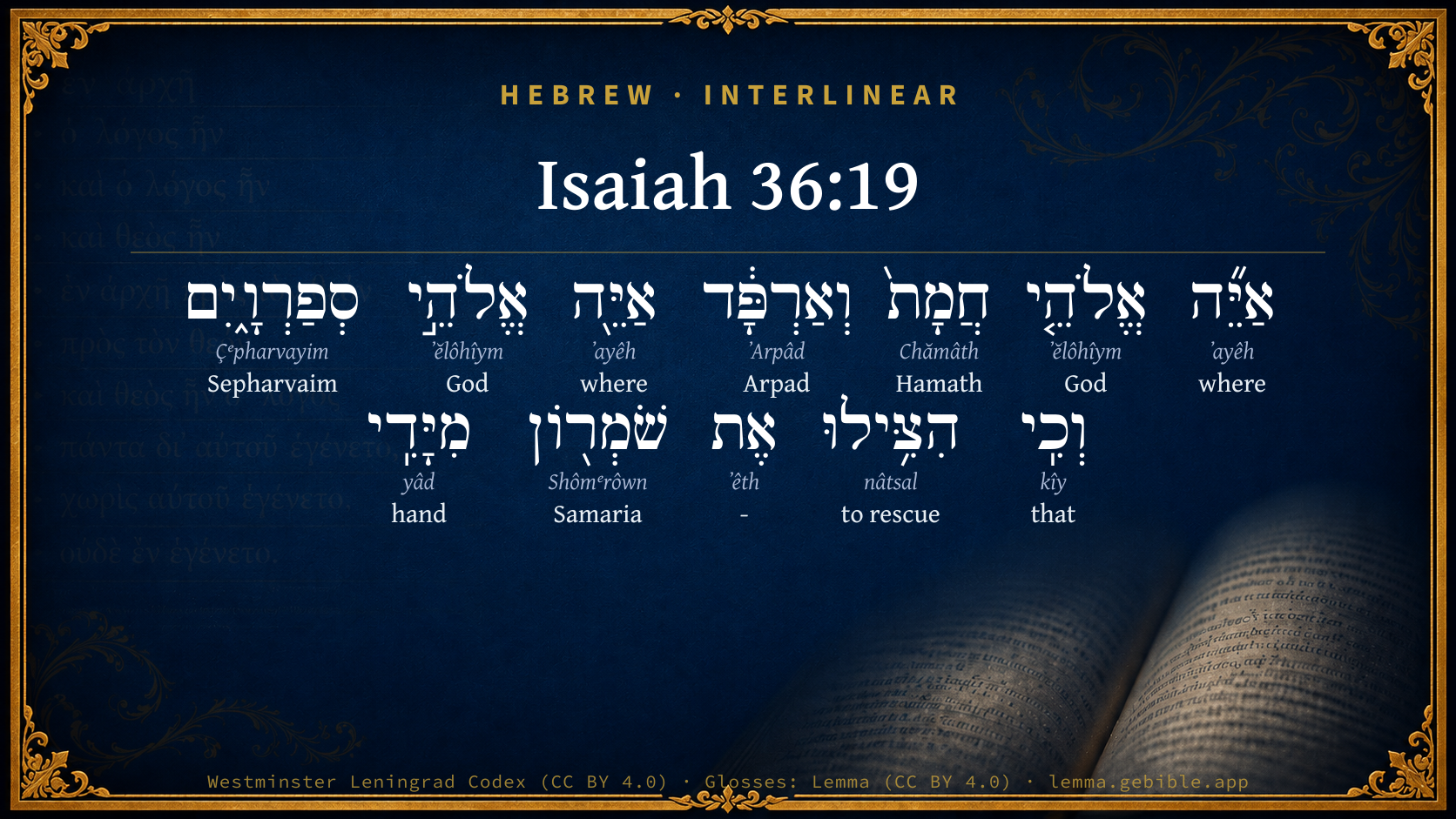
Hebrew (Westminster Leningrad Codex) Isaiah 36:19 appears in the Hebrew Old Testament. The text above is from the Westminster Leningrad Codex. Each word links to its Strong’s number, a concise gloss, and parsing drawn from the Open Scriptures Hebrew Bible morphology. Click any word for its full Brown-Driver-Briggs (BDB) entry.
Download image
Cite this verse

Isaiah 36:19 (World English Bible). Public Domain. Lemma interlinear Bible study tool, https://lemma.gebible.app/v/isaiah/36/19.

Show BibTeX & RIS
BibTeX
RIS
English Translation
Where are the gods of Hamath and Arpad? where are the gods of Sepharvaim? and have they delivered Samaria out of my hand?
World English Bible · Public Domain
Download a study sheet

One document with this verse’s original text, its word-by-word gloss line, the meaning frame, cross-references with their text, attributed commentary, and full source and license credits — printable, and it pastes into notes with its structure intact.

This verse Autodidact and up

Study sheet (.html) Plain text (.txt)

A passage Seminary Student

Up to 50 verses in one chapter. A passage sheet keeps up to 6 commentary sources and 12 cross-references per verse, in the order this page ranks them, and says so on the sheet whenever that leaves anything out. Ask for a single verse and you get the Autodidact verse sheet above.

Everything on this page stays free to read, with no account — the sheet is a download of what is already on screen, not access to it.

Want to remove ads? Support Godless Engineer
Compare translations 3

The same verse in 3 English versions, stacked beneath the original-language interlinear above. Click any original word for its lexicon entry.

Each is an independent rendering of the whole verse — the interlinear is not word-aligned to these translations.

Highlighted words mark where these versions differ — a whole-verse word diff, not a word-by-word alignment.

  • World English Bible Public Domain
    Where are the gods of Hamath and Arpad? where are the gods of Sepharvaim? and have they delivered Samaria out of my hand?
  • King James Version Public Domain
    Where are the gods of Hamath and Arphad? where are the gods of Sepharvaim? and have they delivered Samaria out of my hand?
  • unfoldingWord Literal Text CC BY-SA 4.0
    Where the gods of Hamath and Arpad? Where the gods of Sepharvaim? And indeed, did they deliver Samaria from my hand?

unfoldingWord Literal Text — © unfoldingWord, licensed CC BY-SA 4.0. Word-aligned USFM3 via Door43 (git.door43.org/unfoldingWord/en_ult).

Versions to compare (up to 4)

3 of 4 selected

Show all 18 translations

Every available English version of this verse, each an independent rendering of the whole verse.

  • World English Bible Public Domain
    Where are the gods of Hamath and Arpad? where are the gods of Sepharvaim? and have they delivered Samaria out of my hand?
  • Berean Standard Bible Public Domain
    Where are the gods of Hamath and Arpad? Where are the gods of Sepharvaim? Have they delivered Samaria from my hand?
  • Majority Standard Bible Public Domain
    Where are the gods of Hamath and Arpad? Where are the gods of Sepharvaim? Have they delivered Samaria from my hand?
  • King James Version Public Domain
    Where are the gods of Hamath and Arphad? where are the gods of Sepharvaim? and have they delivered Samaria out of my hand?
  • American Standard Version (1901) Public Domain
    Where are the gods of Hamath and Arpad? where are the gods of Sepharvaim? and have they delivered Samaria out of my hand?
  • Revised Version (1885) Public Domain
    Where are the gods of Hamath and Arpad? where are the gods of Sepharvaim? and have they delivered Samaria out of my hand?
  • Geneva Bible (1599) Public Domain
    Where is the god of Hamath, and of Arpad? where is the god of Sepharuaim? or howe haue they deliuered Samaria out of mine hand?
  • Douay-Rheims (1899) Public Domain
    Where is the god of Emath and of Arphad? where is the god of Sepharvaim? have they delivered Samaria out of my hand?
  • Young's Literal Translation Public Domain
    Where `are' the gods of Hamath and Arpad? Where the gods of Sepharvaim, that they have delivered Samaria out of my hand?
  • Literal Standard Version CC BY-SA 4.0
    Where [are] the gods of Hamath and Arpad? Where [are] the gods of Sepharvaim, that they have delivered Samaria out of my hand?
  • Unlocked Literal Bible CC BY-SA 4.0
    Where are the gods of Hamath and Arpad? Where are the gods of Sepharvaim? Have they rescued Samaria from my power?
  • unfoldingWord Literal Text CC BY-SA 4.0
    Where the gods of Hamath and Arpad? Where the gods of Sepharvaim? And indeed, did they deliver Samaria from my hand?
  • Darby Bible Public Domain
    Where are the gods of Hamath and of Arpad? where are the gods of Sepharvaim? and have they delivered Samaria out of my hand?
  • World Messianic Bible Public Domain
    Where are the gods of Hamath and Arpad? Where are the gods of Sepharvaim? Have they delivered Samaria from my hand?
  • Webster's Bible Public Domain
    Where are the gods of Hamath and Arpad? where are the gods of Sepharvaim? and have they delivered Samaria out of my hand?
  • Free Bible Version CC BY-SA 4.0
    Where were the gods of Hamath and Arpad? Where were the gods of Sepharvaim? Were they able to save Samaria from me?
  • Bible in Basic English Public Domain
    Where are the gods of Hamath and of Arpad? where are the gods of Sepharvaim? where are the gods of Samaria? and have they kept Samaria out of my hand?
  • JPS Tanakh (1917) Public Domain
    Where are the gods of Hamath and Arpad? where are the gods of Sepharvaim? and have they delivered Samaria out of my hand?

Literal Standard Version (2020), Covenant Press — licensed CC BY-SA 4.0. Text via the HelloAO Bible API (eBible.org). Unlocked Literal Bible (unfoldingWord) — licensed CC BY-SA 4.0. Text via the HelloAO Bible API (eBible.org). unfoldingWord Literal Text — © unfoldingWord, licensed CC BY-SA 4.0. Word-aligned USFM3 via Door43 (git.door43.org/unfoldingWord/en_ult). Free Bible Version, Dr. Jonathan Gallagher — licensed CC BY-SA 4.0. Text via the HelloAO Bible API (eBible.org).

Word by word

More ways to search: Search by grammar → Find every occurrence → Compare this word →

Practice this passage: Drill this verse → Learn its vocabulary →

וְאַרְפָּ֔ד
ʼArpâd
H774
“and · Arpad”
Conjunction + Noun, Proper
Part of Speech
Conjunction + Noun
Type
Proper
Full BDB Definition

Origin: from H7502

TWOT: None

Arpad or Arphad = "I shall be spread out (or supported)" - a city in northern Syria cited as an example of the Assyrian conquest
  1. אַיֵּ֞ה ʼayêh H346 “where” Particle, Interrogative
  2. אֱלֹהֵ֤י ʼĕlôhîym H430 “God(s) of” Noun, Common, Masculine, Plural, Construct
  3. חֲמָת֙ Chămâth H2574 “Hamath” Noun, Proper
  4. אַיֵּ֖ה ʼayêh H346 “where” Particle, Interrogative
  5. אֱלֹהֵ֣י ʼĕlôhîym H430 “God(s) of” Noun, Common, Masculine, Plural, Construct
  6. סְפַרְוָ֑יִם Çᵉpharvayim H5617 “Sepharvaim” Noun, Proper
  7. וְכִֽי kîy H3588 “and · that” Conjunction + Conjunction
  8. הִצִּ֥ילוּ nâtsal H5337 “to rescue” Verb, Hiphil, Perfect, 3rd Person, Common, Plural
  9. אֶת ʼêth H853 “-” Particle, Direct Object
  10. שֹׁמְר֖וֹן Shômᵉrôwn H8111 “Samaria” Noun, Proper
  11. מִיָּדִֽי yâd H3027 “from · hand · my” Preposition + Noun, Common, Both, Singular, Construct + Suffix, Personal, 1st Person, Common, Singular

About this verse

These counts appear in no published source. They are computed here, from the morphology-tagged text and Lemma’s own curated glosses. What Lemma adds →

12
words
10
distinct lemmas
Prophets
section

Notable vocabulary

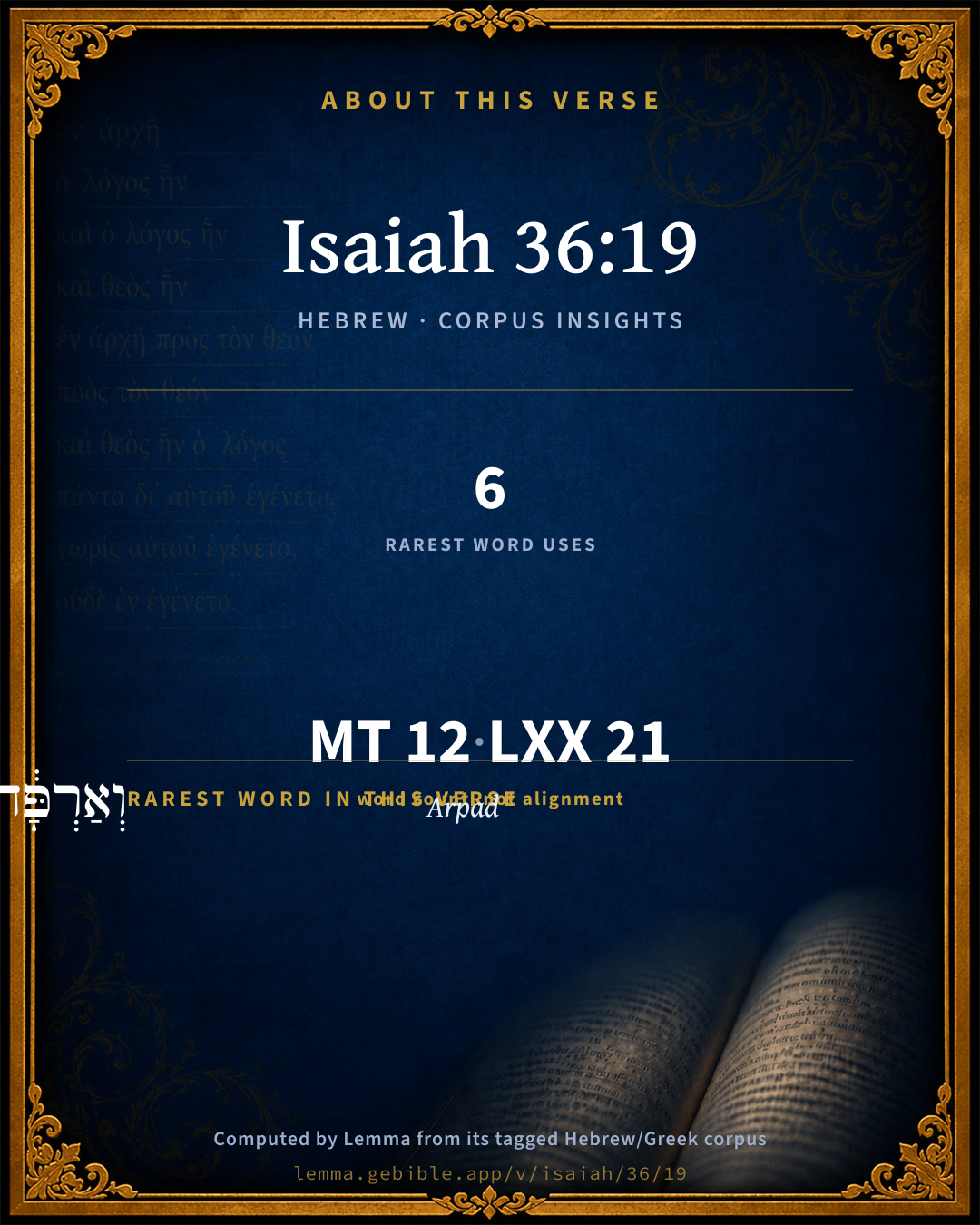
The rarest word here is וְאַרְפָּ֔ד Arpad H774 — appearing just 6 times in the whole Hebrew Bible.

Shared distinctive vocabulary

וְאַרְפָּ֔ד Arpad H774 occurs in 6 verses of the Hebrew Bible. Also found in:

Grammatical profile

  • 1 verb
  • 7 nouns
  • 1 conjunction
  • 3 particles

Verb forms

  • הִצִּ֥ילוּ Hiphil · Perfect

Repetition

Words recur within this verse — often emphatic in Hebrew:

  • אַיֵּ֞ה where H346 ×2
  • אֱלֹהֵ֤י God H430 ×2

Hebrew & Septuagint length

In English translation the verse runs 23 words from the Hebrew and 26 from the Septuagint (LXX English) — closely comparable.

A rough comparison of the two English renderings, which tokenize alike — not a word-level alignment.

Word counts can differ between the Hebrew and the Greek without any difference in meaning — e.g. the Hebrew direct-object marker אֵת has no separate Greek word, and Greek often adds the article ὁ.

In the original languages it is 12 Hebrew tokens and 21 Greek tokens — but the two are counted differently (Hebrew bundles its prefixes and suffixes into one token; the Greek is in lemma form), so that isn’t a like-for-like length.

Cross-references

8

Topical passages linked to Isaiah 36:19 in the Treasury of Scripture Knowledge — connected by theme and wording, ordered by reader-vote popularity; previews shown in the World English Bible.

  • Isaiah 10:9–11 Isn't Calno as Carchemish? Isn't Hamath as Arpad? Isn't Samaria as Damascus?
  • Jeremiah 49:23 Of Damascus. Hamath is confounded, and Arpad; for they have heard evil news, they are melted away: there is sorrow on the sea; it can't be quiet.
  • Numbers 34:8 from Mount Hor you shall mark out to the entrance of Hamath; and the goings out of the border shall be at Zedad;
  • 2 Samuel 8:9 When Toi king of Hamath heard that David had struck all the host of Hadadezer,
  • 2 Kings 17:5–7 Then the king of Assyria came up throughout all the land, and went up to Samaria, and besieged it three years.
  • 2 Kings 17:24 The king of Assyria brought men from Babylon, and from Cuthah, and from Avva, and from Hamath and Sepharvaim, and placed them in the cities of Samaria instead of the children of Israel; and they possessed Samaria, and lived in the cities of it.
  • Isaiah 37:11–13 Behold, you have heard what the kings of Assyria have done to all lands, by destroying them utterly: and shall you be delivered?
  • 2 Kings 18:10–12 At the end of three years they took it: in the sixth year of Hezekiah, which was the ninth year of Hoshea king of Israel, Samaria was taken.

Cross-references courtesy of OpenBible.info (CC BY 4.0).

Hebrew and Greek witnesses Masoretic Hebrew ↔ Greek Septuagint

The same verse in the two great witnesses to the Old Testament, shown verse-for-verse.

These are two independent witnesses, not word-aligned to each other, and the Septuagint is shown in lemma (dictionary) form.

Hebrew Isaiah 36:19 Masoretic · Westminster Leningrad Codex

אַיֵּ֞ה אֱלֹהֵ֤י חֲמָת֙ וְאַרְפָּ֔ד אַיֵּ֖ה אֱלֹהֵ֣י סְפַרְוָ֑יִם וְכִֽי הִצִּ֥ילוּ אֶת שֹׁמְר֖וֹן מִיָּדִֽי

Where are the gods of Hamath and Arpad? where are the gods of Sepharvaim? and have they delivered Samaria out of my hand?

World English Bible · Public Domain

Greek LXX Isaiah 36:19 Septuagint · lemma form

ποῦ εἰμί ὁ θεός αιμαθ καί αρφαθ καί ποῦ ὁ θεός ὁ πόλις σεπφαριμ μή δύναμαι ῥύομαι σαμαρεία ἐκ χείρ ἐγώ

Where is the god of Emath, and Arphath? and where is the god of Eppharuaim? have they been able to deliver Samaria out of my hand?

LXX2012 (modern English Septuagint) · Public Domain

On this verse, Adam Clarke's Commentary discusses the Septuagint’s reading. Read the note in Commentary ↓

Hebrew: Westminster Leningrad Codex (CC BY 4.0). Greek: Septuagint (public domain); English from LXX2012 (modern English Septuagint) (Public Domain). How the Septuagint differs from the Hebrew →

Targum (Aramaic paraphrase)

1

The Targum is the ancient Jewish Aramaic paraphrase of the Hebrew Scriptures — an interpretive translation, not the Hebrew text itself. Onkelos (literal) and Pseudo-Jonathan (expansive) render the Torah, and Jonathan the Prophets. Coverage is partial: where no permissively-licensed English translation exists for a verse, only the Aramaic is shown. This is verse-level text, not a word-by-word alignment to the Hebrew.

  1. Targum Jonathan Prophets (Joshua–Malachi)
    אָן דַחֲלַת חֲמָת וְאַרְפָּד אָן דַחֲלַת סְפַרְוָיִם וַאֲרֵי שֵׁיזָבוּ יַת שֹׁמְרוֹן מִן יְדִי:

    Where are the gods of Hamath and Arphad? where are the gods of Sepharvaim? what have they delivered Samaria out of my hand?

    Targum Jonathan — Aramaic: “Mikraot Gedolot” (public domain). English: “Sefaria Community Translation” (CC0 1.0 (public-domain dedication)); “London "Chaldee Paraphrase," 1871” (public domain). Text via Sefaria.

Commentary

Notes on Isaiah 36:19 from classic Christian and Jewish commentators (each source and its license shown beneath its notes). The classic Christian expositions comment on the surrounding passage and are grouped to its opening verse, so a note may address several verses; the Jewish commentaries on the Tanakh (Rashi and others) are per-verse, so they appear only where the commentator wrote on this verse.

Lemma curates 59 commentaries, every one of them public domain or Creative Commons licensed, each selected and text-cleaned for this edition rather than reprinted as found. About our sources →

The Biblical Illustrator

Joseph S. Exell

Isa_36:19

Where are the gods?

--

Hamath

Hamath at the north border of the Holy Land, a large town on the Orontes, depopulated by the Assyrian in 720. Arpad, Aradus, a town on the coast, now a heap of ruins. Sepharvaim, or Sipar, a town to the north of Babylon, built on both sides of the Euphrates. (B. Blake, B.D.)

Inquiry for gods:

These inquiries may, by a slight accommodation, be used as showing some characteristics of false gods, and showing, by implication, the glory and worship which are due to the one living Lord. Men have a distinct right to inquire for their gods. Almighty God Himself does not shrink from this test of personality and nearness. He will be inquired of. He has proclaimed Himself accessible. Come now, let us reason together. God is within reach of the heart of man; and religion, as well as bringing with it a Divine fear, brings with it also a Divine companionship. Men cannot live on mere sublimity. Man cannot get hold of infinitude. He must have something that he can lay the hands of his heart upon. God must give miniatures of Himself, which little children even can put away in the hiding-places of their love as their chief jewels. (J. Parker, D.D.)

What is a mans god?

A mans god is whatever is the supreme object of his admiration and trust. It may be beauty, it may be strength, it may be money, it may be fame, it may be self-righteousness, it may be self-confidence. Now there are times in life when a man instinctively or by force inquires for his god; and he who cannot, in such critical hours, find his god, has made the profoundest and saddest spiritual mistake in the bestowment of his affections and the gift of his trust. There are times when you are dissatisfied with yourself; when you feel your utter nothingness. Take a season of utter prostration, when the strong man is withered. At such a time we look out for something greater than ourselves. Is there no one who can meet us in this extremity of feebleness, who can come down to us, not in the thunder of His great power, but in the condescension of His almightiness? Look at a time of commercial panic, business distress, when no man knows whom to trust. Man cannot be satisfied then without the supernatural; he may even drift into superstition. Atheists pray when they are in extreme pain or peril. There are times when all men either come quietly, with reverence and tenderness, to seek God who has withdrawn for a moment, or when they are startled, are frightened into momentary devotion. (J. Parker, D.D.)

Man-made gods

1. Some people have made money their god, and there is not a more helpless god in all the temples of idolatry. He will never come to you in the crisis of your life. He will make little compromises with you, help you over divers stiles, solve certain little problems for you. But when your soul is in agony, when your life has wrought itself down to the one last spasm, he will be a dumb god. We brought nothing into this world, and it is certain we can carry nothing out. If you could take a five-pound note with you across the grave into yonder invisible mysterious world, nobody would know what it was. You would have to explain it, and nobody would believe you. You might hold it up, and show the watermark, and lecture upon it, and turn it round and round, and nobody could change it.

2. There is another god that some men are making. Its name is Luck! Some men say, Things will not turn out so badly after all. I have always been able to get upon the sunny side of the road, and something will occur to get me upon that side again. I have trusted the chapter of accidents. My chances have always turned out right, and they will turn out right again. There never was so mocking an idol as luck. The young man who throws in a game of that kind and is lucky, will have another game to play. He has another competitor who will force him, and say, Now you must have the dice out again. The name of that last competitor is Death, and he will play you. The young man says, I do not want to play. Death grasps him by the throat, and says, You shall play! Now he gets hold of his dice-box, and Death always wins.

3. Some mens god is a well-favoured countenance. They trust to their shape, figure, bearing, expression. They say, My face is an introduction, a certificate, a guarantee: wherever I go a space is cleared for me. A very superficial god! I can imagine such persons brought into circumstances which will try their god severely. Yonder is a man lofty in stature, portly in bearing, commanding in all the attributes of external person. He says that he feels a pain piercing him. He is taken home, and betakes himself to his bed. His physician comes to his room and says, This is a case of small-pox. That god of his will be dug in the face till the mans own mother will not know him, and the sister who loved him best will pray to escape from his presence. God can blotch your skin! God can send poison into your blood! And you, who sneered at ungainly virtue, at unfavoured honesty, may be a corrupt, worm-eaten, pestilent thing in the dirt! What, then, if any man should say to you, Where is thy God? (J. Parker, D.D.)

The revelation of the true God in times of human need

This part of the subject is not free from difficulty. Many a man has felt the most intense pain on observing what he supposed was Gods absence from the scene of human affairs. This difficulty must be grappled with if we would be honest to all sides of our great subject. In reply to this difficulty I suggest three things.

1. As a mere matter of fact, attested by a thousand histories known in our own experience, God has appeared in vindication of His name and honour.

2. As a first principle in sound theology, it must be admitted that God Himself is the only true judge as to the best manner and time of interposition. By so much as He is God this point at least must be conceded. Let us be fair to the Almighty, as we would be fair to man. Stephen was taken by the mob, dragged out and stoned. Where was his God then? was once the mocking inquiry of a well-known freethinker. Go to Stephen himself for an answer; and when he, outraged and dishonoured, said with his dying breath, Lord, lay not this sin to their charge,--to have wrought in the human soul, under circumstances so tragic and terrible, a desire like that, was to do more for Stephen than if he had been lifted up by myriads of angels out of the hands of his murderers and set in the sun! Do not let us forget Gods spiritual gifts to us. Though the stones were falling upon him and he was in the last agonies, he said in a whisper, the sound of which shall survive the voices of all thunders and floods, I see heaven opened, and Jesus standing at the right hand of God. It is only in crises, in extremities such as these, that the highest reach of faith is realised, and that faith itself becomes victory.

3. Then the very absence of God, being dictated by wisdom and controlled by love, must be intended to have a happy effect upon human faith. When God is absent, what if His absence is intended to excite inquiry in our hearts? It is in having to grope for God we learn lessons of our own blindness and weakness and spiritual incapacity. (J. Parker, D.D.)

.

The Biblical Illustrator, edited by Joseph S. Exell (c. 1880s–1900s) — public domain. Text from a community e-Sword module.

Tyndale Open Study Notes

Tyndale Open Resources

36:19 The populations of Hamath and Arpad had been relocated to Samaria, where the new local deities were the gods of Sepharvaim (2 Kgs 17:24). The logic of the argument made sense to an Assyrian. If the Assyrian gods defeated all the gods of the other nations and the God of the Israelite nation of Samaria, would they not also defeat the God of Judah?

Tyndale Open Study Notes — © Tyndale Open Resources, licensed CC BY-SA 4.0. Text via the HelloAO Bible API.

Geneva Bible (1599)

Geneva Bible translators

That is, of Antioch in Syria, of the which these two other cities also were: whereby we see how every town had his peculiar idol, and how the wicked make God an idol because they do not understand that God maketh them his scourge, and punisheth cities for sin.

Geneva Bible (1599) marginal notes — public domain. Text via Bolls.life.

Jamieson, Fausset & Brown

Robert Jamieson, A. R. Fausset & David Brown

Hamath . . . Arphad--(See on Isa 10:9).

Sepharvaim--literally, "the two scribes"; now Sipphara, on the east of Euphrates, above Babylon. It was a just retribution (Pro 1:31; Jer 2:19). Israel worshipped the gods of Sepharvaim, and so colonists of Sepharvaim were planted in the land of Israel (thenceforth called Samaria) by the Assyrian conqueror (Kg2 17:24; compare Kg2 18:34).

Samaria--Shalmaneser began the siege against Hoshea, because of his conspiring with So of Egypt (Kg2 17:4). Sargon finished it; and, in his palace at Khorsabad, he has mentioned the number of Israelites carried captive--27,280 [G. V. SMITH].

Jamieson, Fausset & Brown — Commentary Critical and Explanatory on the Whole Bible (1871) — public domain (CC PDM 1.0). Text via the HelloAO Bible API.

Adam Clarke's Commentary

Verse 19. Where are the gods] Many MSS. add the conjunction here also: And, or But, where are the gods, c.

For other matters relative to this chapter, 2Kg 18:13, c.

Of Sepharvaim] The other copy, 2Kg 18:34, adds, of "Henah and Ivah."

Have they delivered] וכי vechi. The copulative is not expressed here by the Septuagint, Syriac, Vulgate, and three MSS. nor is it in any other copy. Ib. Houbigant reads הכי hachi, with the interrogative particle; a probable conjecture, which the ancient Versions above quoted seem to favour.

Adam Clarke's Commentary on the Bible (1810–1826) — public domain. Text from a community e-Sword/MySword module.

Ellicott's Commentary for English Readers

(19) Hamath and Arphad . . .—See Note on Isa_10:9. Looking to the practice of the Assyrians, the question would have had for its answer, not the echoing “Where?” which it suggests to modern ears, but “They are to be seen in the Temples of Assyria, as trophies of its victories.”

Sepharvaim.—The southernmost city of Mesopotamia, on the left bank of the Euphrates, probably the same as the “sun-city” Sippara, in which Xisuthros, the Noah of Chaldæan mythology, was said to have concealed the sacred books before the great flood (Records of the Past, vii. 143).

A Bible Commentary for English Readers, edited by Charles John Ellicott (1878–1897) — public domain. Text from a community e-Sword module.

The Cambridge Bible for Schools and Colleges

gen. ed. J. J. S. Perowne

19. On Hamath and Arphad, see ch. Isa_10:9. Sepharvaim has usually been identified with Sippar to the north of Babylon. Since, however, it is always mentioned along with Hamath and Arpad, it is more probable that a city in northern Syria is meant. Some consider it to be the same as Sibraim in Eze_47:16 (between Damascus and Hamath). 2Ki_18:34 adds Hena and Ivvah as in ch. Isa_37:13.

and have they delivered] Others translate “how much less have they (the gods of Samaria) delivered.” The Hebrew is peculiar.

The Cambridge Bible for Schools and Colleges (gen. ed. J. J. S. Perowne; Cambridge University Press, 1878–1918) — public domain. Text from a community e-Sword module.

John Gill's Exposition

Where are the gods of Hamath and Arphad?.... What is become of them? where are they to be found? where's their power to protect and defend the people they presided over? thus they might be justly derided, but not so the God at Israel; these places are mentioned in Isa 10:9. Hamath was a city in Syria, thought by some to be the same afterwards called Antiochia and Epiphania, from Antiochus Epiphanes: Arphad is joined with it in Jer 49:23 as a city of Syria; perhaps originally founded and inhabited by the Arvadite, mentioned with the Hamathite, in Gen 10:18,

where are the gods of Sepharvaim? another place in Syria, the city Sipphore; not the Sipphara of Ptolemy (n), in Mesopotamia, or that, near Babylon, Abydenus (o) makes mention of, but a city in Syro-Phoenicia, Kg2 17:24,

and have they delivered Samaria out of my hand? the gods of the above places, which were worshipped in Samaria, or the gods peculiar to that place; though Samaria was not taken by the present king of Assyria, Sennacherib, but by a predecessor of his, Shalmaneser,

2Ki 17:3,6, which yet is here boasted of as a conquest of the present king.

(n) Geograph. l. 5. c. 18. (o) Apud Euseb. Praepar. Evangel. l. 9. c. 41. p. 457.

John Gill's Exposition of the Whole Bible (1746–1763) — public domain (CC PDM 1.0). Text via the HelloAO Bible API.

Albert Barnes' Notes on the Bible

Where are the gods of Hamath ... - In regard to these places, see the notes at Isa 10:9-11.

Where are the gods of Sepharvaim? - Sepharvaim was probably in Mesopotamia. Ptolemy mentions a city there of the name of Sipphara, as the most southern city of Mesopotamia, which is probably the same. It is evident that it was in the vicinity of Hamath and Arphad, and these are known to have been in Mesopotamia. When Shalmaneser carried Israel away captive from Samaria, he sent colonies of people into Palestine in their stead, among whom were the Sepharvaim 2Ki 17:24, 2Ki 17:31.

And have they delivered Samaria - (See the note at Isa 10:11). The author of the Books of Chronicles expresses this in a more summary manner, and says, that Rabshakeh joined Yahweh with the gods of the nations in the same language of reproach: ‘And he spake against the God of Jerusalem, as against the gods of the people of the earth, which were the work of the hands of man,’ 2Ch 32:19.

Albert Barnes' Notes on the Bible (1834–1885) — public domain. Text from a community e-Sword/MySword module.

Whedon's Commentary on the Bible

Daniel D. Whedon

19. Where are the gods — Rabshakeh had, in the previous verse, appealed to his success as to the petty northern nations. Their gods failed them, so will Jehovah, the Jews’ deity, fail them. For Hamath, Arphad, and Sepharvaim, see notes in Isa_10:9. The defeat of Samaria is another argument.

Daniel D. Whedon (gen. ed.), Commentary on the Old and New Testaments (1874–1909) — public domain. Text from a community e-Sword module.

The Pulpit Commentary

Where are the gods of Hamath?. (comp. Isa_10:9) Sargon had reduced Hamath in his third year, B.C. 720. He had "swept the whole land of Hamath to its extreme limit," taken the king prisoner, and carried him away captive to Assyria, where he flayed and burned him; removed most of the inhabitants, and replaced them by Assyrians; plundered the city of its chief treasures, and placed an Assyrian governor over it (see "Eponym Canon," pp. 126-128). Among the treasures taken were, no doubt, the images of the Hamathite gods, which were uniformly carried off by the Assyrians from a conquered city. And Arphad. Arphad, or Arpad, (Isa_10:9) had joined with Hamath in the war against Assyria, and was taken by Sargon in the same year ("Eponym Canon," p. 127). Of Sepharvaim. Scpharvaim, or Sippara, was besieged and captured by Sargon in his twelfth year, B.C. 710. A severe example was made of the inhabitants (G. Smith, "History of Babylonia," p. 122). A discovery made by Mr. Hormuzd Rassam, in 1881, is thought to prove that Sippara was situated at Abu-Habbah, between Baghdad and the site of Babylon, about sixteen miles from the former city (see the "Transactions of the Society of Bibl. Archaeology," vol. 8. pp. 164, 173). "Hena" and "Ivah," joined with Sepharvaim by the author of Kings, (2Ki_18:31) seem to be omitted by Isaiah as unimportant. They are thought to have been towns upon the Euphrates, not very distant from Babylon, and have been identified respectively with Anah and Hit. But the identification is in both cases uncertain. Have they delivered Samaria? Delitzsch and Mr. Cheyne translate, How much less have they delivered Samaria?" Kay, Verily have they delivered," regarding the sentence as ironical. Sennacherib can see no distinction between the cities where Jehovah was worshipped, and those which acknowledged any other tutelary god. As Samaria fell, why should not Jerusalem fall?

The Pulpit Commentary (1880–1919), ed. H.D.M. Spence-Jones & Joseph S. Exell — public domain. Text from a community e-Sword module.

J. A. Alexander on Isaiah

Joseph Addison Alexander

“Where (are) the gods of Hamath and Arpad? where the gods of Sepharvaim? and (when or where was it) that they delivered Samaria out of my hand?” In the rapidity of his triumphant interrogation, he expresses himself darkly and imperfectly. The last clause must of course refer to the gods of Samaria, though not expressly mentioned. For the situation of Hamath and Arpad, see the note on Isa 10:9. Sepharvaim is probably the Sipphara of Ptolemy, a town and province in the south of Mesopotamia, already subject to Assyria in the days of Shalmaneser. The parallel passage (2Ki 18:34) adds Hena and Hevah, which are also named with Sepharvaim in 2Ki 19:13 and Isa 37:13. The question (where are they?) seems to imply, not only that they had not saved their worshippers, but that they had ceased to be.

Joseph Addison Alexander, The Prophecies of Isaiah (1846–1847; New York: Scribner, 1870–1878) — public domain. Text from a community e-Sword module.

Rashi

Rabbi Shlomo Yitzchaki (Rashi)

Now did they save Samaria from my hand? and the inhabitants of Samaria worshipped the Gods of the Arameans, who were their neighbors, and Hamath is from Aram.

Rashi on the Tanakh — English translations: “The Judaica Press complete Tanach with Rashi, translated by A. J. Rosenberg” (CC BY 4.0); “Pentateuch with Rashi's commentary by M. Rosenbaum and A.M. Silbermann, 1929-1934” (public domain); “The Metsudah Tanach series, Lakewood, N.J” (CC BY 4.0); and “The Book of Joshua, Metsudah Publications, 1997” (CC BY 4.0). Text via Sefaria.

Lesson kit

Teaching starters — assembled from the data on this page, not authored interpretation. Every prompt links to the verse data it draws on. Edit before teaching.

Isaiah, in the Prophets, opens this verse with 12 words (10 distinct Hebrew lemmas). Its most distinctive word is ʼArpâd (“Arpad”). A historical commentator’s framing appears above. Read the whole chapter for the surrounding context.

Discussion questions

  1. What does “Arpad” (ʼArpâd) contribute to the verse as a whole?
  2. 2 Kings 18:34 shares the word «Arpad» with this verse. How do the two illuminate each other?
  3. “where” occurs 2× in this one verse. What is the effect of the repetition?
  4. These translations render this verse differently; the difference is in the English rendering, not the original. What questions does that raise?
  5. The verb «הִצִּ֥ילוּ» is Hiphil Perfect. How does its form color the action?
  6. Reading how The Biblical Illustrator and Tyndale Open Study Notes read this verse, where do the two commentators agree and where do they part?

Things to notice

Reading settings

Reading text

Shown beneath each verse's original-language words.

Old Testament
Old Testament edition

Read the OT as the Masoretic Hebrew (MT) or the Greek Septuagint (LXX).

English shown for the Greek Septuagint (in the Hebrew ↔ Greek comparison).

Comparing translations? Open the Compare panel on any verse page to stack up to four side by side.