
Isaiah 44:17

Hebrew (Westminster Leningrad Codex) Isaiah 44:17 appears in the Hebrew Old Testament. The text above is from the Westminster Leningrad Codex. Each word links to its Strong’s number, a concise gloss, and parsing drawn from the Open Scriptures Hebrew Bible morphology. Click any word for its full Brown-Driver-Briggs (BDB) entry.
Download image
Cite this verse

Isaiah 44:17 (World English Bible). Public Domain. Lemma interlinear Bible study tool, https://lemma.gebible.app/v/isaiah/44/17.

Show BibTeX & RIS
BibTeX
RIS
English Translation
The residue of it he makes a god, even his engraved image; he falls down to it and worships, and prays to it, and says, Deliver me; for you are my god.
World English Bible · Public Domain
Download a study sheet

One document with this verse’s original text, its word-by-word gloss line, the meaning frame, cross-references with their text, attributed commentary, and full source and license credits — printable, and it pastes into notes with its structure intact.

This verse Autodidact and up

Study sheet (.html) Plain text (.txt)

A passage Seminary Student

Up to 50 verses in one chapter. A passage sheet keeps up to 6 commentary sources and 12 cross-references per verse, in the order this page ranks them, and says so on the sheet whenever that leaves anything out. Ask for a single verse and you get the Autodidact verse sheet above.

Everything on this page stays free to read, with no account — the sheet is a download of what is already on screen, not access to it.

Want to remove ads? Support Godless Engineer
Compare translations 3

The same verse in 3 English versions, stacked beneath the original-language interlinear above. Click any original word for its lexicon entry.

Each is an independent rendering of the whole verse — the interlinear is not word-aligned to these translations.

Highlighted words mark where these versions differ — a whole-verse word diff, not a word-by-word alignment.

  • World English Bible Public Domain
    The residue of it he makes a god, even his engraved image; he falls down to it and worships, and prays to it, and says, Deliver me; for you are my god.
  • King James Version Public Domain
    And the residue thereof he maketh a god, even his graven image: he falleth down unto it, and worshippeth it, and prayeth unto it, and saith, Deliver me; for thou art my god.
  • unfoldingWord Literal Text CC BY-SA 4.0
    And its remnant, he makes into a god, into his idol; he prostrates to it and bows down, and he prays to it and says, “Deliver me, for you my god.”

unfoldingWord Literal Text — © unfoldingWord, licensed CC BY-SA 4.0. Word-aligned USFM3 via Door43 (git.door43.org/unfoldingWord/en_ult).

Versions to compare (up to 4)

3 of 4 selected

Show all 18 translations

Every available English version of this verse, each an independent rendering of the whole verse.

  • World English Bible Public Domain
    The residue of it he makes a god, even his engraved image; he falls down to it and worships, and prays to it, and says, Deliver me; for you are my god.
  • Berean Standard Bible Public Domain
    From the rest he makes a god, his graven image. He bows down to it and worships; he prays to it and says, “Save me, for you are my god.”
  • Majority Standard Bible Public Domain
    From the rest he makes a god, his graven image. He bows down to it and worships; he prays to it and says, “Save me, for you are my god.”
  • King James Version Public Domain
    And the residue thereof he maketh a god, even his graven image: he falleth down unto it, and worshippeth it, and prayeth unto it, and saith, Deliver me; for thou art my god.
  • American Standard Version (1901) Public Domain
    And the residue thereof he maketh a god, even his graven image; he falleth down unto it and worshippeth, and prayeth unto it, and saith, Deliver me; for thou art my god.
  • Revised Version (1885) Public Domain
    And the residue thereof he maketh a god, even his graven image: he falleth down unto it and worshippeth, and prayeth unto it, and saith, Deliver me; for thou art my god.
  • Geneva Bible (1599) Public Domain
    And the residue thereof he maketh a god, euen his idole: he boweth vnto it, and worshippeth and prayeth vnto it, and sayeth, Deliuer me: for thou art my god.
  • Douay-Rheims (1899) Public Domain
    But the residue thereof he made a god, and a graven thing for himself: he boweth down before it, and adoreth it, and prayeth unto it, saying: Deliver me, for thou art my God.
  • Young's Literal Translation Public Domain
    And its remnant for a god he hath made -- For his graven image, He falleth down to it, and worshippeth, And prayeth unto it, and he saith, `Deliver me, for my god thou `art'.'
  • Literal Standard Version CC BY-SA 4.0
    And he has made its remnant for a god—For his carved image, || He falls down to it, and worships, || And prays to it, and he says, “Deliver me, for you [are] my god.”
  • Unlocked Literal Bible CC BY-SA 4.0
    With the rest of the wood he makes a god, his carved image; he bows down to it and reverences it, and prays to it saying, “Rescue me, for you are my god.”
  • unfoldingWord Literal Text CC BY-SA 4.0
    And its remnant, he makes into a god, into his idol; he prostrates to it and bows down, and he prays to it and says, “Deliver me, for you my god.”
  • Darby Bible Public Domain
    And with the remainder thereof he maketh a ùgod, his graven image; he falleth down unto it, and worshippeth it, and prayeth unto it, and saith, Deliver me, for thou art my ùgod.
  • World Messianic Bible Public Domain
    The rest of it he makes into a god, even his engraved image. He bows down to it and worships, and prays to it, and says, “Deliver me, for you are my god!”
  • Webster's Bible Public Domain
    And the residue of it he maketh a god, even his graven image: he falleth down to it, and worshipeth it, and prayeth to it, and saith, Deliver me; for thou art my god.
  • Free Bible Version CC BY-SA 4.0
    Then he uses the rest of the wood to make himself a god, an idol he bows down to in worship and prays to, saying, “Save me, for you are my god!”
  • Bible in Basic English Public Domain
    And the rest of it he makes into a god, even his pictured image: he goes down on his face before it, giving worship to it, and making prayer to it, saying, Be my saviour; for you are my god.
  • JPS Tanakh (1917) Public Domain
    And the residue thereof he maketh a god, even his graven image; he falleth down unto it and worshippeth, and prayeth unto it, and saith: 'Deliver me, for thou art my god.'

Literal Standard Version (2020), Covenant Press — licensed CC BY-SA 4.0. Text via the HelloAO Bible API (eBible.org). Unlocked Literal Bible (unfoldingWord) — licensed CC BY-SA 4.0. Text via the HelloAO Bible API (eBible.org). unfoldingWord Literal Text — © unfoldingWord, licensed CC BY-SA 4.0. Word-aligned USFM3 via Door43 (git.door43.org/unfoldingWord/en_ult). Free Bible Version, Dr. Jonathan Gallagher — licensed CC BY-SA 4.0. Text via the HelloAO Bible API (eBible.org).

Word by word

More ways to search: Search by grammar → Find every occurrence → Compare this word →

Practice this passage: Drill this verse → Learn its vocabulary →

יסגוד
çâgad
H5456
“to prostrate”
Verb, Qal, Imperfect, 3rd Person, Masculine, Singular
Part of Speech
Verb
Stem
Qal
Form
Imperfect
Person
3rd Person
Gender
Masculine
Number
Singular
Full BDB Definition

Origin: a primitive root

TWOT: 1459

(Qal) to prostrate oneself (in worship)
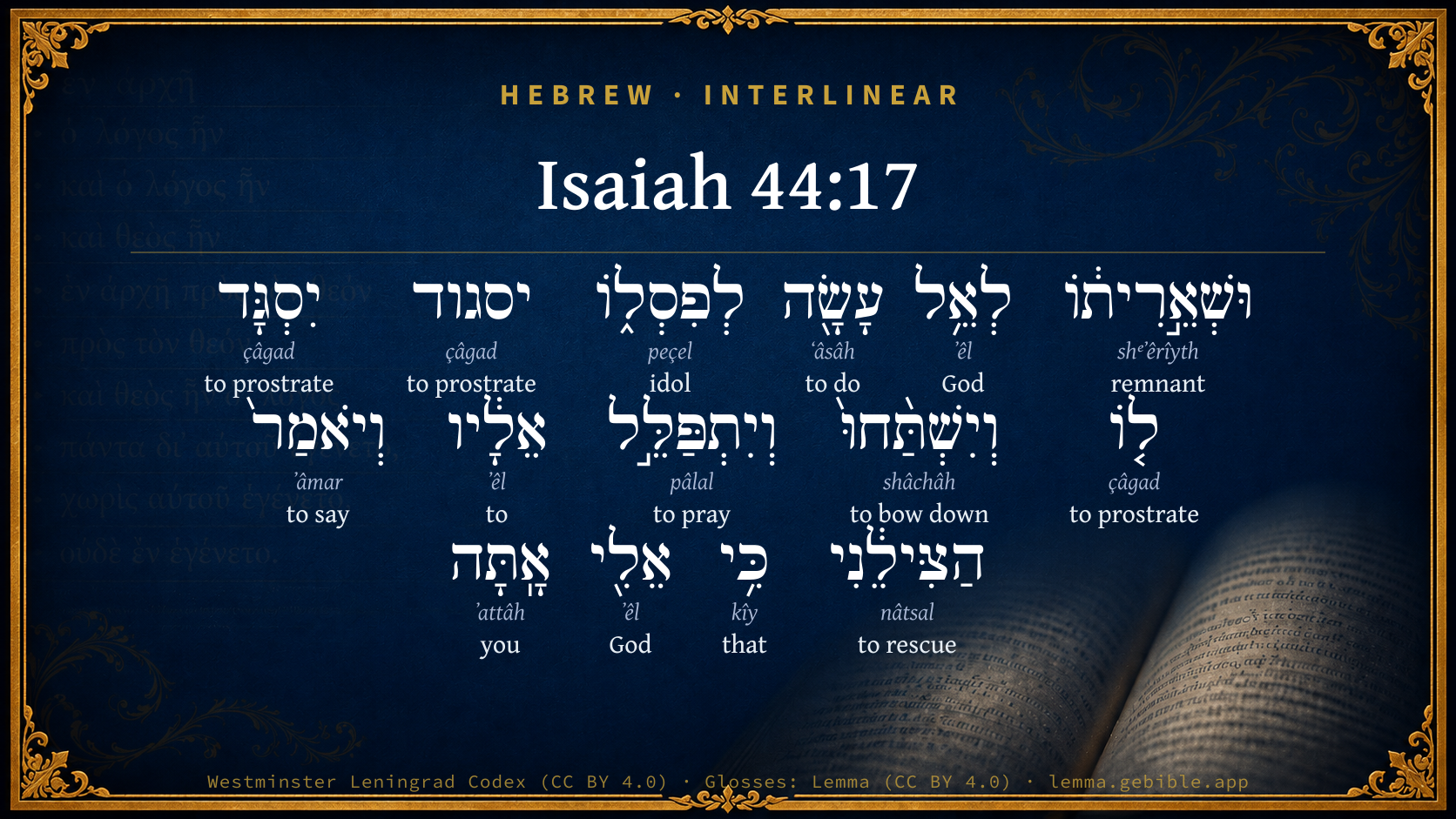
  1. וּשְׁאֵ֣רִית֔וֹ shᵉʼêrîyth H7611 “and · remnant · his” Conjunction + Noun, Common, Feminine, Singular, Construct + Suffix, Personal, 3rd Person, Masculine, Singular
  2. לְאֵ֥ל ʼêl H410 “to/for · God” Preposition + Noun, Common, Masculine, Singular, Absolute
  3. עָשָׂ֖ה ʻâsâh H6213 “to do” Verb, Qal, Perfect, 3rd Person, Masculine, Singular
  4. לְפִסְל֑וֹ peçel H6459 “to/for · idol · his” Preposition + Noun, Common, Masculine, Singular, Construct + Suffix, Personal, 3rd Person, Masculine, Singular
  5. יִסְגָּד çâgad H5456 “to prostrate” Verb, Qal, Imperfect, 3rd Person, Masculine, Singular
  6. ל֤וֹ çâgad H5456 “to/for · him” Preposition + Suffix, Personal, 3rd Person, Masculine, Singular
  7. וְיִשְׁתַּ֨חוּ֙ shâchâh H7812 “and · to bow down” Conjunction + Verb, Hishtaphel, Imperfect, 3rd Person, Masculine, Singular
  8. וְיִתְפַּלֵּ֣ל pâlal H6419 “and · to pray” Conjunction + Verb, Hithpael, Imperfect, 3rd Person, Masculine, Singular
  9. אֵלָ֔יו ʼêl H413 “to · him” Preposition + Suffix, Personal, 3rd Person, Masculine, Singular
  10. וְיֹאמַר֙ ʼâmar H559 “and · to say” Conjunction + Verb, Qal, Imperfect, 3rd Person, Masculine, Singular
  11. הַצִּילֵ֔נִי nâtsal H5337 “rescue · me” Verb, Hiphil, Imperative, 2nd Person, Masculine, Singular + Suffix, Personal, 1st Person, Common, Singular
  12. כִּ֥י kîy H3588 “that” Conjunction
  13. אֵלִ֖י ʼêl H410 “God · my” Noun, Common, Masculine, Singular, Construct + Suffix, Personal, 1st Person, Common, Singular
  14. אָֽתָּה ʼattâh H859 “you” Pronoun, Personal, 2nd Person, Masculine, Singular

About this verse

These counts appear in no published source. They are computed here, from the morphology-tagged text and Lemma’s own curated glosses. What Lemma adds →

15
words
12
distinct lemmas
Prophets
section

Notable vocabulary

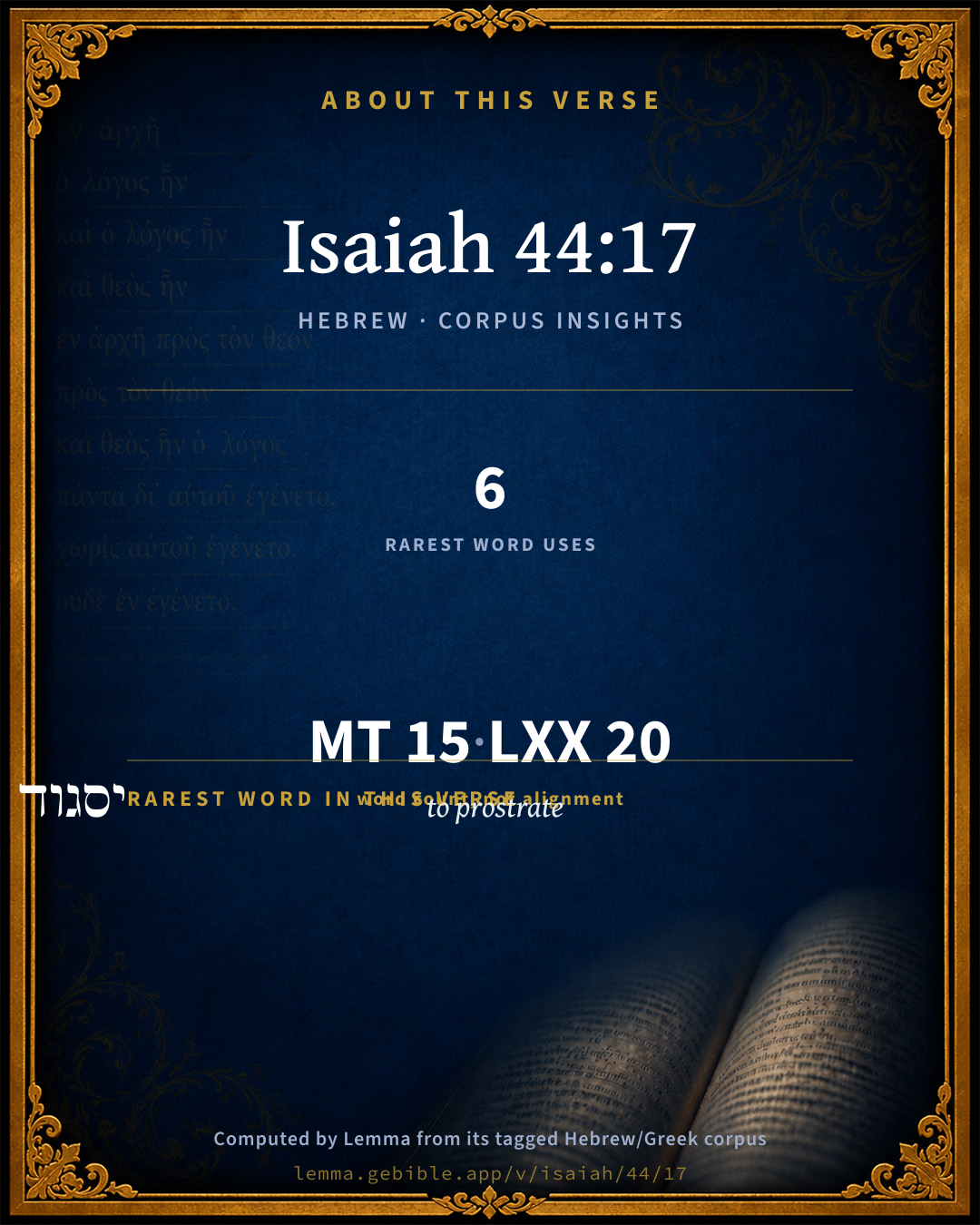
The rarest word here is יסגוד to prostrate H5456 — appearing just 6 times in the whole Hebrew Bible.

Shared distinctive vocabulary

יסגוד to prostrate H5456 occurs in 4 verses of the Hebrew Bible. Also found in:

Grammatical profile

  • 7 verbs
  • 4 nouns
  • 1 pronoun
  • 2 prepositions
  • 1 conjunction

Verb forms

  • עָשָׂ֖ה Qal · Perfect
  • יסגוד Qal · Imperfect
  • יִסְגָּד Qal · Imperfect
  • וְיִשְׁתַּ֨חוּ֙ Hishtaphel · Imperfect
  • וְיִתְפַּלֵּ֣ל Hithpael · Imperfect
  • וְיֹאמַר֙ Qal · Imperfect
  • הַצִּילֵ֔נִי Hiphil · Imperative

Repetition

Words recur within this verse — often emphatic in Hebrew:

  • יסגוד to prostrate H5456 ×3
  • לְאֵ֥ל God H410 ×2

Hebrew & Septuagint length

In English translation the verse runs 32 words from the Hebrew and 20 from the Septuagint (LXX English) — the Septuagint runs noticeably shorter here. See the side-by-side →

A rough comparison of the two English renderings, which tokenize alike — not a word-level alignment.

Word counts can differ between the Hebrew and the Greek without any difference in meaning — e.g. the Hebrew direct-object marker אֵת has no separate Greek word, and Greek often adds the article ὁ.

In the original languages it is 15 Hebrew tokens and 20 Greek tokens — but the two are counted differently (Hebrew bundles its prefixes and suffixes into one token; the Greek is in lemma form), so that isn’t a like-for-like length.

Cross-references

9

Topical passages linked to Isaiah 44:17 in the Treasury of Scripture Knowledge — connected by theme and wording, ordered by reader-vote popularity; previews shown in the World English Bible.

  • Isaiah 45:20 Assemble yourselves and come; draw near together, you who have escaped from the nations: they have no knowledge who carry the wood of their engraved image, and pray to a god that can't save.
  • 1 Kings 18:26 They took the bull which was given them, and they dressed it, and called on the name of Baal from morning even until noon, saying, Baal, hear us. But there was no voice, nor any who answered. They leaped about the altar which was made.
  • Isaiah 36:19–20 Where are the gods of Hamath and Arpad? where are the gods of Sepharvaim? and have they delivered Samaria out of my hand?
  • Isaiah 37:38 It happened, as he was worshipping in the house of Nisroch his god, that Adrammelech and Sharezer his sons struck him with the sword; and they escaped into the land of Ararat. Esar Haddon his son reigned in his place.
  • Daniel 3:17 If it be [so], our God whom we serve is able to deliver us from the burning fiery furnace; and he will deliver us out of your hand, O king.
  • Daniel 3:29 Therefore I make a decree, that every people, nation, and language, which speak anything evil against the God of Shadrach, Meshach, and Abednego, shall be cut in pieces, and their houses shall be made a dunghill; because there is no other god who is able to deliver after this sort.
  • Daniel 6:16 Then the king commanded, and they brought Daniel, and cast him into the den of lions. [Now] the king spoke and said to Daniel, Your God whom you serve continually, he will deliver you.
  • Daniel 6:20–22 When he came near to the den to Daniel, he cried with a lamentable voice; the king spoke and said to Daniel, Daniel, servant of the living God, is your God, whom you serve continually, able to deliver you from the lions?
  • Daniel 6:27 He delivers and rescues, and he works signs and wonders in heaven and in earth, who has delivered Daniel from the power of the lions.

Cross-references courtesy of OpenBible.info (CC BY 4.0).

Hebrew and Greek witnesses Masoretic Hebrew ↔ Greek Septuagint

The same verse in the two great witnesses to the Old Testament, shown verse-for-verse.

Here the Septuagint runs noticeably shorter than the Hebrew — LXX2012 (modern English Septuagint) 20 words vs World English Bible 32. A rough length comparison of the two English translations, not a word-level alignment — read both below.

These are two independent witnesses, not word-aligned to each other, and the Septuagint is shown in lemma (dictionary) form.

Hebrew Isaiah 44:17 Masoretic · Westminster Leningrad Codex

וּשְׁאֵ֣רִית֔וֹ לְאֵ֥ל עָשָׂ֖ה לְפִסְל֑וֹ יסגוד יִסְגָּד ל֤וֹ וְיִשְׁתַּ֨חוּ֙ וְיִתְפַּלֵּ֣ל אֵלָ֔יו וְיֹאמַר֙ הַצִּילֵ֔נִי כִּ֥י אֵלִ֖י אָֽתָּה

The residue of it he makes a god, even his engraved image; he falls down to it and worships, and prays to it, and says, Deliver me; for you are my god.

World English Bible · Public Domain

Greek LXX Isaiah 44:17 Septuagint · lemma form

ὁ δέ λοιπός ποιέω εἰς θεός γλυπτός καί προςκυνέω αὐτός καί προςεὔχομαι λέγω ἐκαἱρέω ἐγώ ὅτι θεός ἐγώ εἰμί σύ

And the rest he makes a graven god, and worships, and prays, saying, Deliver me; for you are my God.

LXX2012 (modern English Septuagint) · Public Domain

Hebrew: Westminster Leningrad Codex (CC BY 4.0). Greek: Septuagint (public domain); English from LXX2012 (modern English Septuagint) (Public Domain). How the Septuagint differs from the Hebrew →

Targum (Aramaic paraphrase)

1

The Targum is the ancient Jewish Aramaic paraphrase of the Hebrew Scriptures — an interpretive translation, not the Hebrew text itself. Onkelos (literal) and Pseudo-Jonathan (expansive) render the Torah, and Jonathan the Prophets. Coverage is partial: where no permissively-licensed English translation exists for a verse, only the Aramaic is shown. This is verse-level text, not a word-by-word alignment to the Hebrew.

  1. Targum Jonathan Prophets (Joshua–Malachi)
    וּשְׁאָרֵהּ לְדַחֲלָא עָבַד לְצַלְמָא סְגִיד לֵיהּ וְאֶשְׁתַּעְבֵּד לֵיהּ וּבְעָא מִנֵהּ וַאֲמַר שֵׁיזְבָנִי אֲרֵי דְחַלְתִּי אָתְּ:

    And the remainder thereof he maketh a god; to the image he boweth down; he becometh servile to it, and prayeth to it, and saith, Deliver me; for thou art my god.

    Targum Jonathan — Aramaic: “Mikraot Gedolot” (public domain). English: “Sefaria Community Translation” (CC0 1.0 (public-domain dedication)); “London "Chaldee Paraphrase," 1871” (public domain). Text via Sefaria.

Commentary

Notes on Isaiah 44:17 from classic Christian and Jewish commentators (each source and its license shown beneath its notes). The classic Christian expositions comment on the surrounding passage and are grouped to its opening verse, so a note may address several verses; the Jewish commentaries on the Tanakh (Rashi and others) are per-verse, so they appear only where the commentator wrote on this verse.

Lemma curates 59 commentaries, every one of them public domain or Creative Commons licensed, each selected and text-cleaned for this edition rather than reprinted as found. About our sources →

Trapp's Complete Commentary

John Trapp

Isa 44:17 And the residue thereof he maketh a god, [even] his graven image: he falleth down unto it, and worshippeth [it], and prayeth unto it, and saith, Deliver me; for thou [art] my god.

Ver. 17. He falleth down unto it, and worshippeth it.] Do not Papists even the same, whatever they pretend in defence of their idolatry? See Rev 9:20. {See Trapp on "Rev 9:20"} So loath they are to have their asses’ ears to be seen.

John Trapp, A Commentary or Exposition upon All the Books of the Old and New Testament (1647–1656) — public domain. Text from a community e-Sword module.

The Biblical Illustrator

Joseph S. Exell

Isa_44:17

And the residue thereof he maketh a god

Residual religion

The scene is one which we may describe as very childish indeed.

It belongs to the very earliest stage one might imagine of the thought of worship, The man who evidently lives under conditions by no means of the highest civilisation feels himself exposed to the natural inclemency of the weather, and to the pangs of hunger. He selects a tree, and because he needs food he breaks up the tree and kindles a fire and prepares his food. He then rejoices in the warmth of the fire that he has kindled, and he has satisfied two of the simple wants of nature. He has been hungry, and he has provided himself food. He is cold, and he has provided himself with warmth. But there is yet another instinct in his nature which demands satisfaction. He is conscious that he is a weak creature in the midst of a strange and wonderful world. Mysterious powers that he cannot fathom seem to float about his life, and to interpose their forces often to the derangement of his plans. And therefore, when he has satisfied those two simple physical wants, he takes the residue of the tree that he has cut down, and he makes it into a god. Thus it is that he satisfies three imperious desires and needs of his nature. Is it wholly untrue to say that there are many men who live after this fashion, that when they have supplied their own wants, when their body has been amply fed, when the conditions of their life have been cared for so that they are well provided with the warming comforts of life, then, out of the residue of their time, out of the residue of their money, out of the residue of their thought, they will, perchance, consecrate something to God? (Bp. W. B. Carpenter, D. D.)

Materials and principles of life:

There is one very common delusion which, if we will watch ourselves, we shall find that we are all of us more or less liable to. We confuse the materials of life with the principles which ought to govern life. The materials of life in this poor mans case were very simple indeed. He is a man who can cut down a tree of the forest to make himself a habitation, and from the wood all round about him gathers what may be called the material of life, whether for the house or for the cooking of food, and these materials of life are such that you and I, looking back upon them from our refined and elevated position, say that they are very simple and very crude indeed; but he manipulates these materials after a certain principle. Given that we have different materials to deal with, and that ours is not the life of the forest and the dependence upon the forest, but that ours is the life of modern civilisation, with our railways and our telegraphs and our newspapers daily, with our opportunities of enjoyment in abundance, and with means of information in the multiplied books which are issued daily from the press. With all these things which constitute the material of our life, and with our occupations governed and guided by the principles of modern civilisation, it is possible that we may say--and we shall say truly--that the materials of life which we possess are far superior to the rude materials which belonged to that poor mans life. But is the difference between one man and another to be judged by the materials which a man uses, or by the principles which he applies in the use of those materials? (Bp. W. B. Carpenter, D. D.)

Religion the all-comprising principle of life:

Is religion to be looked upon as a thing that you can separate? Or are you going to regard religion as a principle which is applicable to life, and applicable at every hour and in every place, and all through life? Was that old rhyme right that told us that the twenty-four hours of the day should be divided into eight hours for work, and eight for rest, and eight which are given to God; or was not that correction right of the man who said, eight for toil, and eight for rest, and all for God? Gounod had painted on his piano the head of the Christ, as if he would say, Wherever I look before I compose, I look upon the head of the crucified Lord, and I know that the spirit of that Lord passes into me; and when I begin to compose my melodies, the music of His life penetrates my soul, and gives me the respiration. We should look into the face of God, understand the character of God, understand that He claims every human being as His son, and understand, therefore, that there is no bondage here, but that there is the freedom of the son, and the love of the sons heart, and the desire of the sons heart to advance the kingdom and the family of God. (Bp. B. W. Carpenter, D. D.)

The Biblical Illustrator, edited by Joseph S. Exell (c. 1880s–1900s) — public domain. Text from a community e-Sword module.

Adam Clarke's Commentary

Verse 17. He falleth down unto it] There were four forms of adoration used among the Hebrews:

1. השתחוה HISHTACHAVAH, The prostration of the whole body.

2. קדד KADAD, The bowing of the head.

3. כרע CARA, The bending of the upper part of the body down to the knees.

4. ברך BARACH, Bowing the knee, or kneeling. See on Isa 49:23.

Adam Clarke's Commentary on the Bible (1810–1826) — public domain. Text from a community e-Sword/MySword module.

John Gill's Exposition

And the residue thereof he maketh a god, even his graven image,.... What remains of the tree, that is not consumed by making a fire to warm with, by heating the oven to bake bread with, and by using it in the kitchen to roast meat with, this is made an image of, and being graved and carved, is called a god, and worshipped; though it is of the same matter, and of the same nature, with that which was used for warming, baking, and roasting:

he falleth down unto it, and worshippeth it, and prayeth unto it, and saith, deliver me, for thou art my god; he bows unto it, falls down on his knees, and spreads out his hands, and lifts them up, and uses all the gestures of adoration; yea, makes a formal address in prayer and supplication, and particularly requests that he would deliver him from present danger and distresses, of whatsoever kind he was attended with; declaring at the same time he was his god, in whom he trusted, and from whom he expected relief and help. Monstrous stupidity!

John Gill's Exposition of the Whole Bible (1746–1763) — public domain (CC PDM 1.0). Text via the HelloAO Bible API.

The Pulpit Commentary

The residue thereof; i.e. the other half.

The Pulpit Commentary (1880–1919), ed. H.D.M. Spence-Jones & Joseph S. Exell — public domain. Text from a community e-Sword module.

John Wesley's Explanatory Notes

He eateth - He dresses flesh for his eating. Seen - I have felt the warmth of it.

John Wesley, Explanatory Notes Upon the Whole Bible (1754–1765) — public domain. Text via the GEBible commentary corpus.

J. A. Alexander on Isaiah

Joseph Addison Alexander

“And the rest of it (i.e., the other half) he has made into a god, into his graven image; he will bow down to it, and will worship, and will pray to it, and say, Deliver me, for thee, (art) my god.” The consecution of the tenses is the same as in the preceding verse, and has the same effect of fixing the point of observation in the midst of the process. He has kindled his fire, and will use it to prepare his food. He has made his idol, and will fall down and pray to it. The pronoun at the end may be regarded as emphatic and as meaning thou and thou alone.

Joseph Addison Alexander, The Prophecies of Isaiah (1846–1847; New York: Scribner, 1870–1878) — public domain. Text from a community e-Sword module.

unfoldingWord translationNotes

Door43 World Missions Community

translationWords

false god

image

bow

revere

pray

unfoldingWord translationNotes — © Distant Shores Media and the Door43 World Missions Community, licensed CC BY-SA 4.0. Source: git.door43.org/Door43/en_tn.

Ibn Ezra

Rabbi Abraham ibn Ezra

A god according to his idea.

His image. This is the explanation of the expression a god which precedes.

Ibn Ezra on the Tanakh — English translations: “Sefaria Community Translation” (CC0 1.0 (public-domain dedication)); “Yalkut, Sifsei Chachomim Chumash, Metsudah Publications, 2009” (CC BY 4.0); and “Commentary of Ibn Ezra on Isaiah - trans. by M. Friedlander, 1873” (public domain). Text via Sefaria.

Lesson kit

Teaching starters — assembled from the data on this page, not authored interpretation. Every prompt links to the verse data it draws on. Edit before teaching.

Isaiah, in the Prophets, opens this verse with 15 words (12 distinct Hebrew lemmas). Its most distinctive word is çâgad (“to prostrate”). The Greek Septuagint runs shorter here. A historical commentator’s framing appears above. Read the whole chapter for the surrounding context.

Discussion questions

  1. How does “to prostrate” (çâgad) shape what this verse is saying?
  2. How does Isaiah 44:15, which shares the word «to prostrate», read alongside this verse?
  3. What does the repetition of “to prostrate” (3× in this one verse) do in this verse?
  4. The Septuagint runs shorter here than the Hebrew. What might account for the difference?
  5. These translations render this verse differently. What is at stake in choosing one wording over another?
  6. «עָשָׂ֖ה» is a Qal Perfect verb. How does that grammatical form shape the action described?
  7. Compare how Trapp's Complete Commentary and The Biblical Illustrator read this verse. Where do they agree or differ?

Things to notice

Reading settings

Reading text

Shown beneath each verse's original-language words.

Old Testament
Old Testament edition

Read the OT as the Masoretic Hebrew (MT) or the Greek Septuagint (LXX).

English shown for the Greek Septuagint (in the Hebrew ↔ Greek comparison).

Comparing translations? Open the Compare panel on any verse page to stack up to four side by side.