
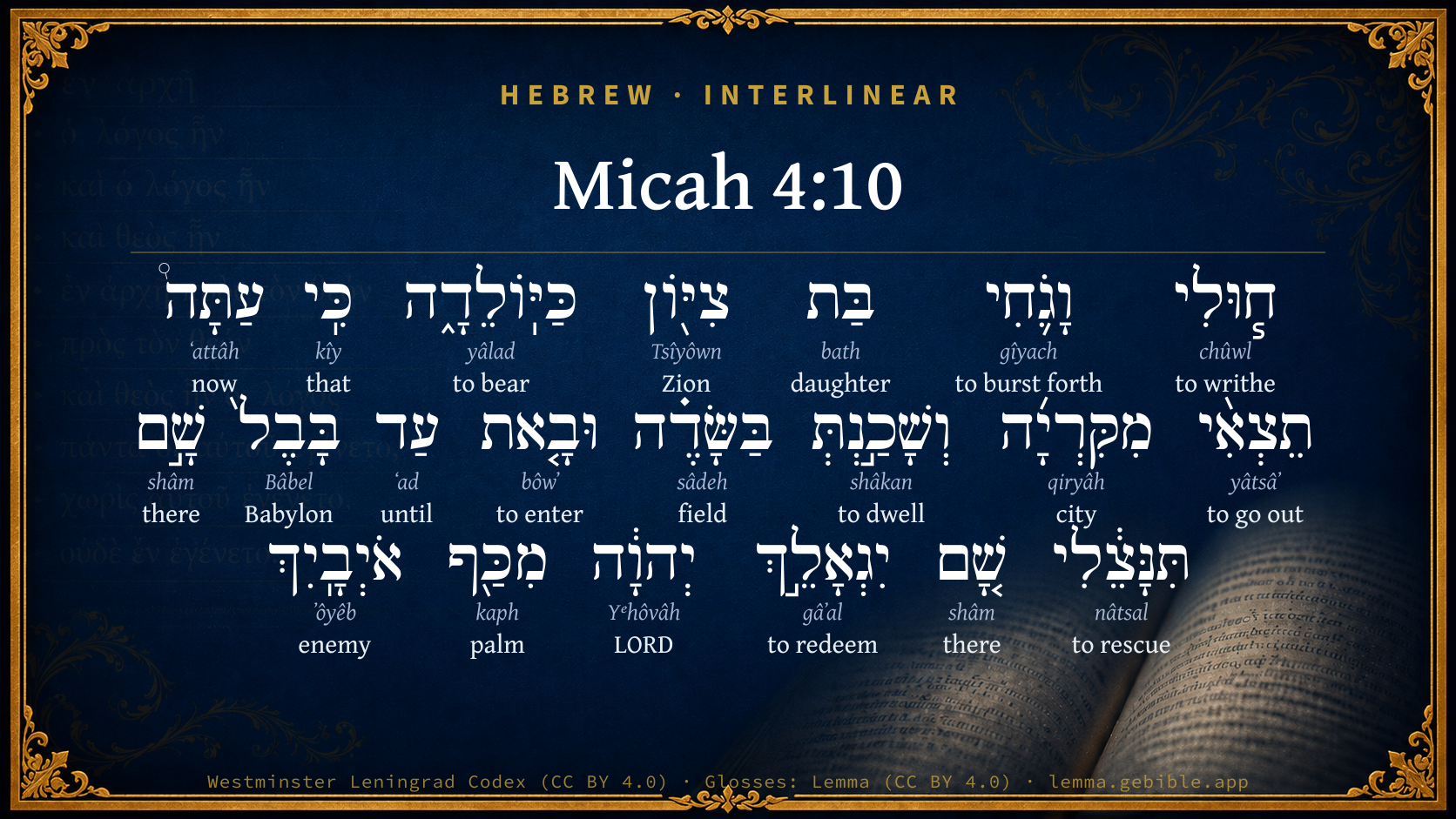
Micah 4:10

Hebrew (Westminster Leningrad Codex) Micah 4:10 appears in the Hebrew Old Testament. The text above is from the Westminster Leningrad Codex. Each word links to its Strong’s number, a concise gloss, and parsing drawn from the Open Scriptures Hebrew Bible morphology. Click any word for its full Brown-Driver-Briggs (BDB) entry.
Download image
Cite this verse

Micah 4:10 (World English Bible). Public Domain. Lemma interlinear Bible study tool, https://lemma.gebible.app/v/micah/4/10.

Show BibTeX & RIS
BibTeX
RIS
English Translation
Be in pain, and labor to bring forth, daughter of Zion, Like a woman in travail; For now you will go forth out of the city, And will dwell in the field, And will come even to Babylon. There you will be rescued. There Yahweh will redeem you from the hand of your enemies.
World English Bible · Public Domain
Download a study sheet

One document with this verse’s original text, its word-by-word gloss line, the meaning frame, cross-references with their text, attributed commentary, and full source and license credits — printable, and it pastes into notes with its structure intact.

This verse Autodidact and up

Study sheet (.html) Plain text (.txt)

A passage Seminary Student

Up to 50 verses in one chapter. A passage sheet keeps up to 6 commentary sources and 12 cross-references per verse, in the order this page ranks them, and says so on the sheet whenever that leaves anything out. Ask for a single verse and you get the Autodidact verse sheet above.

Everything on this page stays free to read, with no account — the sheet is a download of what is already on screen, not access to it.

Want to remove ads? Support Godless Engineer
Compare translations 3

The same verse in 3 English versions, stacked beneath the original-language interlinear above. Click any original word for its lexicon entry.

Each is an independent rendering of the whole verse — the interlinear is not word-aligned to these translations.

Highlighted words mark where these versions differ — a whole-verse word diff, not a word-by-word alignment.

  • World English Bible Public Domain
    Be in pain, and labor to bring forth, daughter of Zion, Like a woman in travail; For now you will go forth out of the city, And will dwell in the field, And will come even to Babylon. There you will be rescued. There Yahweh will redeem you from the hand of your enemies.
  • King James Version Public Domain
    Be in pain, and labour to bring forth, O daughter of Zion, like a woman in travail: for now shalt thou go forth out of the city, and thou shalt dwell in the field, and thou shalt go even to Babylon; there shalt thou be delivered; there the LORD shall redeem thee from the hand of thine enemies.
  • unfoldingWord Literal Text CC BY-SA 4.0
    Writhe in pain and burst forth, daughter Zion, like a woman giving birth. For now you will you go out of the city, and live in the field, and go to Babylon. There you will be rescued. There Yahweh will redeem you from the hand of your enemies.

unfoldingWord Literal Text — © unfoldingWord, licensed CC BY-SA 4.0. Word-aligned USFM3 via Door43 (git.door43.org/unfoldingWord/en_ult).

Versions to compare (up to 4)

3 of 4 selected

Show all 18 translations

Every available English version of this verse, each an independent rendering of the whole verse.

  • World English Bible Public Domain
    Be in pain, and labor to bring forth, daughter of Zion, Like a woman in travail; For now you will go forth out of the city, And will dwell in the field, And will come even to Babylon. There you will be rescued. There Yahweh will redeem you from the hand of your enemies.
  • Berean Standard Bible Public Domain
    Writhe in agony, O Daughter of Zion, like a woman in labor. For now you will leave the city and camp in the open fields. You will go to Babylon; there you will be rescued; there the LORD will redeem you from the hand of your enemies!
  • Majority Standard Bible Public Domain
    Writhe in agony, O Daughter of Zion, like a woman in labor. For now you will leave the city and camp in the open fields. You will go to Babylon; there you will be rescued; there the LORD will redeem you from the hand of your enemies!
  • King James Version Public Domain
    Be in pain, and labour to bring forth, O daughter of Zion, like a woman in travail: for now shalt thou go forth out of the city, and thou shalt dwell in the field, and thou shalt go even to Babylon; there shalt thou be delivered; there the LORD shall redeem thee from the hand of thine enemies.
  • American Standard Version (1901) Public Domain
    Be in pain, and labor to bring forth, O daughter of Zion, like a woman in travail; for now shalt thou go forth out of the city, and shalt dwell in the field, and shalt come even unto Babylon: there shalt thou be rescued; there will Jehovah redeem thee from the hand of thine enemies.
  • Revised Version (1885) Public Domain
    Be in pain, and labour to bring forth, O daughter of Zion, like a woman in travail: for now shalt thou go forth out of the city, and shalt dwell in the field, and shalt come even unto Babylon; there shalt thou be rescued; there shall the LORD redeem thee from the hand of thine enemies.
  • Geneva Bible (1599) Public Domain
    Sorow and mourne, O daughter Zion, like a woman in trauaile: for nowe shalt thou goe foorth of the citie, and dwel in the field, and shalt goe into Babel, but there shalt thou be deliuered: there the Lord shall redeeme thee from the hand of thine enemies.
  • Douay-Rheims (1899) Public Domain
    Be in pain and labour, O daughter of Sion, as a woman that bringeth forth: for now shalt thou go out of the city, and shalt dwell in the country, and shalt come even to Babylon, there thou shalt be delivered: there the Lord will redeem thee out of the hand of thy enemies.
  • Young's Literal Translation Public Domain
    Be pained, and bring forth, O daughter of Zion, As a travailing woman, For now, thou goest forth from the city, And thou hast dwelt in the field, And thou hast gone unto Babylon, There thou art delivered, There redeem thee doth Jehovah from the hand of thine enemies.
  • Literal Standard Version CC BY-SA 4.0
    Be pained, and bring forth, O daughter of Zion, || As a travailing woman, || For now you go forth from the city, || And you have dwelt in the field, || And you have gone to Babylon, || There you are delivered, || There YHWH redeems you from the hand of your enemies.
  • Unlocked Literal Bible CC BY-SA 4.0
    Be in pain and labor to give birth, daughter of Zion, like a woman in labor. For now you will you go out of the city, live in the field, and go to Babylon. There you will be rescued. There Yahweh will rescue you from the hand of your enemies.
  • unfoldingWord Literal Text CC BY-SA 4.0
    Writhe in pain and burst forth, daughter Zion, like a woman giving birth. For now you will you go out of the city, and live in the field, and go to Babylon. There you will be rescued. There Yahweh will redeem you from the hand of your enemies.
  • Darby Bible Public Domain
    Be in pain, and labour to bring forth, O daughter of Zion, like a woman in travail; for now shalt thou go forth out of the city, and thou shalt dwell in the field, and thou shalt go even to Babylon: there shalt thou be delivered; there Jehovah will redeem thee from the hand of thine enemies.
  • World Messianic Bible Public Domain
    Be in pain, and labor to give birth, daughter of Zion, like a woman in travail; for now you will go out of the city, and will dwell in the field, and will come even to Babylon. There you will be rescued. There the LORD will redeem you from the hand of your enemies.
  • Webster's Bible Public Domain
    Be in pain, and labor to bring forth, O daughter of Zion, like a woman in travail: for now shalt thou go forth from the city, and thou shalt dwell in the field, and thou shalt go even to Babylon; there shalt thou be delivered; there the LORD shall redeem thee from the hand of thy enemies.
  • Free Bible Version CC BY-SA 4.0
    Thrash around in agony like a woman giving birth, people of Zion—for you will be expelled from the city, forced to camp out in the open, and exiled to Babylon. But the Lord will bring you back, and rescue you from the power of your enemies.
  • Bible in Basic English Public Domain
    Be in pain, make sounds of grief, O daughter of Zion, like a woman in childbirth: for now you will go out of the town, living in the open country, and will come even to Babylon; there you will have salvation; there the Lord will make you free from the hands of your haters.
  • JPS Tanakh (1917) Public Domain
    Be in pain, and labour to bring forth, O daughter of Zion, like a woman in travail; for now shalt thou go forth out of the city, and shalt dwell in the field, and shalt come even unto Babylon; there shalt thou be rescued; there shall the LORD redeem thee from the hand of thine enemies.

Literal Standard Version (2020), Covenant Press — licensed CC BY-SA 4.0. Text via the HelloAO Bible API (eBible.org). Unlocked Literal Bible (unfoldingWord) — licensed CC BY-SA 4.0. Text via the HelloAO Bible API (eBible.org). unfoldingWord Literal Text — © unfoldingWord, licensed CC BY-SA 4.0. Word-aligned USFM3 via Door43 (git.door43.org/unfoldingWord/en_ult). Free Bible Version, Dr. Jonathan Gallagher — licensed CC BY-SA 4.0. Text via the HelloAO Bible API (eBible.org).

Word by word

More ways to search: Search by grammar → Find every occurrence → Compare this word →

Practice this passage: Drill this verse → Learn its vocabulary →

וָגֹ֛חִי
gîyach
H1518
“and · burst forth”
Conjunction + Verb, Qal, Imperative, 2nd Person, Feminine, Singular
Part of Speech
Conjunction + Verb
Stem
Qal
Form
Imperative
Person
2nd Person
Gender
Feminine
Number
Singular
Full BDB Definition

Origin: a primitive root

TWOT: 345

to burst forth - (Qal) - to burst forth - to draw forth - to bring forth - (Hiphil) to break forth
  1. ח֧וּלִי chûwl H2342 “writhe” Verb, Qal, Imperative, 2nd Person, Feminine, Singular
  2. בַּת bath H1323 “daughter of” Noun, Common, Feminine, Singular, Construct
  3. צִיּ֖וֹן Tsîyôwn H6726 “Zion” Noun, Proper
  4. כַּיּֽוֹלֵדָ֑ה yâlad H3205 “like/as the · bearing” Preposition, Determined + Verb, Qal, Participle Active, Feminine, Singular, Absolute
  5. כִּֽי kîy H3588 “that” Conjunction
  6. עַתָּה֩ ʻattâh H6258 “now” Adverb
  7. תֵצְאִ֨י yâtsâʼ H3318 “to go out” Verb, Qal, Imperfect, 2nd Person, Feminine, Singular
  8. מִקִּרְיָ֜ה qiryâh H7151 “from · city” Preposition + Noun, Common, Feminine, Singular, Absolute
  9. וְשָׁכַ֣נְתְּ shâkan H7931 “and · to dwell” Conjunction + Verb, Qal, Sequential Perfect, 2nd Person, Feminine, Singular
  10. בַּשָּׂדֶ֗ה sâdeh H7704 “in/at the · field” Preposition, Determined + Noun, Common, Masculine, Singular, Absolute
  11. וּבָ֤את bôwʼ H935 “and · to enter” Conjunction + Verb, Qal, Sequential Perfect, 2nd Person, Feminine, Singular
  12. עַד ʻad H5704 “until” Preposition
  13. בָּבֶל֙ Bâbel H894 “Babylon” Noun, Proper
  14. שָׁ֣ם shâm H8033 “there” Adverb
  15. תִּנָּצֵ֔לִי nâtsal H5337 “to rescue” Verb, Niphal, Imperfect, 2nd Person, Feminine, Singular
  16. שָׁ֚ם shâm H8033 “there” Adverb
  17. יִגְאָלֵ֣ךְ gâʼal H1350 “to redeem · you” Verb, Qal, Imperfect, 3rd Person, Masculine, Singular + Suffix, Personal, 2nd Person, Feminine, Singular
  18. יְהוָ֔ה Yᵉhôvâh H3068 “LORD” Noun, Proper
  19. מִכַּ֖ף kaph H3709 “from · palm of” Preposition + Noun, Common, Feminine, Singular, Construct
  20. אֹיְבָֽיִךְ ʼôyêb H341 “enemy · you” Verb, Qal, Participle Active, Masculine, Plural, Construct + Suffix, Personal, 2nd Person, Feminine, Singular

About this verse

These counts appear in no published source. They are computed here, from the morphology-tagged text and Lemma’s own curated glosses. What Lemma adds →

21
words
20
distinct lemmas
Prophets
section

Notable vocabulary

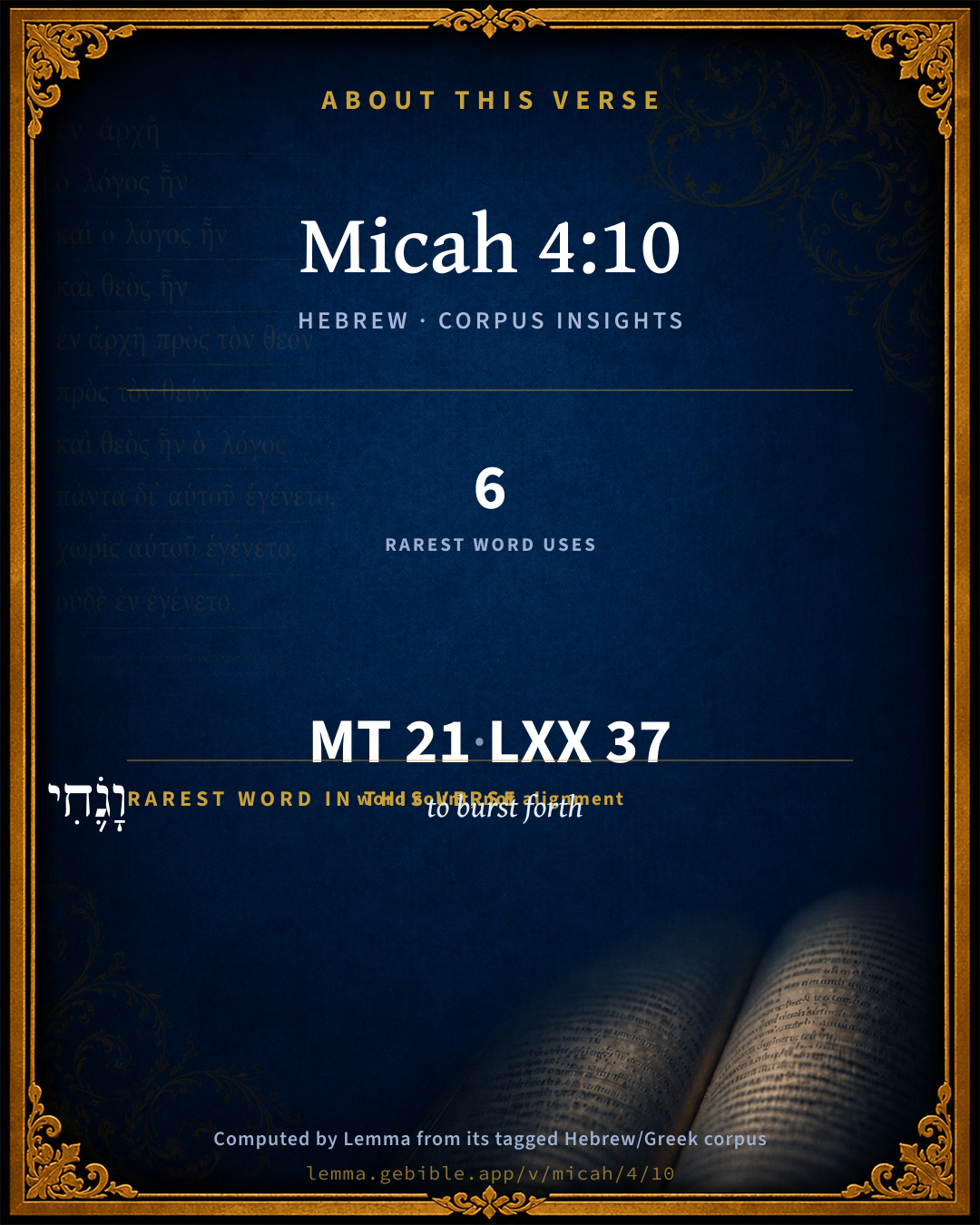
The rarest word here is וָגֹ֛חִי to burst forth H1518 — appearing just 6 times in the whole Hebrew Bible.

Shared distinctive vocabulary

וָגֹ֛חִי to burst forth H1518 occurs in 6 verses of the Hebrew Bible. Also found in:

Grammatical profile

  • 9 verbs
  • 7 nouns
  • 1 preposition
  • 1 conjunction
  • 3 adverbs

Verb forms

  • ח֧וּלִי Qal · Imperative
  • וָגֹ֛חִי Qal · Imperative
  • כַּיּֽוֹלֵדָ֑ה Qal · Participle Active
  • תֵצְאִ֨י Qal · Imperfect
  • וְשָׁכַ֣נְתְּ Qal · Sequential Perfect
  • וּבָ֤את Qal · Sequential Perfect
  • תִּנָּצֵ֔לִי Niphal · Imperfect
  • יִגְאָלֵ֣ךְ Qal · Imperfect
  • אֹיְבָֽיִךְ Qal · Participle Active

Repetition

A word recurs within this verse — often emphatic in Hebrew:

  • שָׁ֣ם there H8033 ×2

Hebrew & Septuagint length

In English translation the verse runs 54 words from the Hebrew and 61 from the Septuagint (LXX English) — closely comparable.

A rough comparison of the two English renderings, which tokenize alike — not a word-level alignment.

Word counts can differ between the Hebrew and the Greek without any difference in meaning — e.g. the Hebrew direct-object marker אֵת has no separate Greek word, and Greek often adds the article ὁ.

In the original languages it is 21 Hebrew tokens and 37 Greek tokens — but the two are counted differently (Hebrew bundles its prefixes and suffixes into one token; the Greek is in lemma form), so that isn’t a like-for-like length.

Cross-references

19

Topical passages linked to Micah 4:10 in the Treasury of Scripture Knowledge — connected by theme and wording, ordered by reader-vote popularity; previews shown in the World English Bible.

  • Isaiah 48:20 Go you forth from Babylon, flee you from the Chaldeans; with a voice of singing declare you, tell this, utter it even to the end of the earth: say you, Yahweh has redeemed his servant Jacob.
  • 2 Kings 20:18 Of your sons who shall issue from you, whom you shall father, shall they take away; and they shall be eunuchs in the palace of the king of Babylon.
  • Isaiah 43:14 Thus says Yahweh, your Redeemer, the Holy One of Israel: For your sake I have sent to Babylon, and I will bring down all of them as fugitives, even the Chaldeans, in the ships of their rejoicing.
  • Isaiah 45:13 I have raised him up in righteousness, and I will make straight all his ways: he shall build my city, and he shall let my exiles go free, not for price nor reward, says Yahweh of Hosts.
  • Isaiah 52:9–12 Break forth into joy, sing together, you waste places of Jerusalem; for Yahweh has comforted his people, he has redeemed Jerusalem.
  • Hosea 2:14 "Therefore, behold, I will allure her, And bring her into the wilderness, And speak tenderly to her.
  • Hosea 13:13 The sorrows of a travailing woman will come on him. He is an unwise son; For when it is time, he doesn't come to the opening of the womb.
  • 2 Chronicles 36:20 Those who had escaped from the sword carried he away to Babylon; and they were servants to him and his sons until the reign of the kingdom of Persia:
  • Psalms 106:10 He saved them from the hand of him who hated them, And redeemed them from the hand of the enemy.
  • Isaiah 66:7–9 Before she travailed, she brought forth; before her pain came, she was delivered of a man-child.
  • Jeremiah 15:21 I will deliver you out of the hand of the wicked, and I will redeem you out of the hand of the terrible.
  • Hosea 1:10 Yet the number of the children of Israel will be as the sand of the sea, which can't be measured nor numbered; and it will come to pass that, in the place where it was said to them, 'You are not my people,' they will be called 'sons of the living God.'
  • Micah 7:8–13 Don't rejoice against me, my enemy. When I fall, I will arise. When I sit in darkness, Yahweh will be a light to me.
  • Zechariah 2:7–9 'Come, Zion! Escape, you who dwell with the daughter of Babylon.'
  • Revelation 12:14 Two wings of the great eagle were given to the woman, that she might fly into the wilderness to her place, so that she might be nourished for a time, and times, and half a time, from the face of the serpent.
  • 2 Chronicles 33:11 Therefore Yahweh brought on them the captains of the host of the king of Assyria, who took Manasseh in chains, and bound him with fetters, and carried him to Babylon.
  • Ezra 1:1–2 Now in the first year of Cyrus king of Persia, that the word of Yahweh by the mouth of Jeremiah might be accomplished, Yahweh stirred up the spirit of Cyrus king of Persia, so that he made a proclamation throughout all his kingdom, and [put it] also in writing, saying,
  • John 16:20–22 Most assuredly I tell you, that you will weep and lament, but the world will rejoice. You will be sorrowful, but your sorrow will be turned into joy.
  • 2 Kings 25:4 Then a breach was made in the city, and all the men of war [fled] by night by the way of the gate between the two walls, which was by the king's garden (now the Chaldeans were against the city round about); and [the king] went by the way of the Arabah.

Cross-references courtesy of OpenBible.info (CC BY 4.0).

Hebrew and Greek witnesses Masoretic Hebrew ↔ Greek Septuagint

The same verse in the two great witnesses to the Old Testament, shown verse-for-verse.

These are two independent witnesses, not word-aligned to each other, and the Septuagint is shown in lemma (dictionary) form.

Hebrew Micah 4:10 Masoretic · Westminster Leningrad Codex

ח֧וּלִי וָגֹ֛חִי בַּת צִיּ֖וֹן כַּיּֽוֹלֵדָ֑ה כִּֽי עַתָּה֩ תֵצְאִ֨י מִקִּרְיָ֜ה וְשָׁכַ֣נְתְּ בַּשָּׂדֶ֗ה וּבָ֤את עַד בָּבֶל֙ שָׁ֣ם תִּנָּצֵ֔לִי שָׁ֚ם יִגְאָלֵ֣ךְ יְהוָ֔ה מִכַּ֖ף אֹיְבָֽיִךְ

Be in pain, and labor to bring forth, daughter of Zion, Like a woman in travail; For now you will go forth out of the city, And will dwell in the field, And will come even to Babylon. There you will be rescued. There Yahweh will redeem you from the hand of your enemies.

World English Bible · Public Domain

Greek LXX Micah 4:10 Septuagint · lemma form

ὠδίνω καί ἀνδρίζομαι καί ἐγγίζω θυγάτηρ σιων ὡς τίκτω διότι νῦν ἐκἔρχομαι ἐκ πόλις καί κατασκηνόω ἐν πεδίον καί ἥκω ἕως βαβυλών ἐκεῖθεν ῥύομαι σύ καί ἐκεῖθεν λυτρόω σύ κύριος ὁ θεός σύ ἐκ χείρ ἐχθρός σύ

Be in pain, and strengthen yourself, and draw near, O daughter of Sion, as a woman in travail: for now you shall go forth out of the city, and shall lodge in the plain, and shall reach even to Babylon: thence shall the Lord your God deliver you, and thence shall he redeem you out of the hand of your enemies.

LXX2012 (modern English Septuagint) · Public Domain

On this verse, The Cambridge Bible for Schools and Colleges discusses the Septuagint’s reading. Read the note in Commentary ↓

Hebrew: Westminster Leningrad Codex (CC BY 4.0). Greek: Septuagint (public domain); English from LXX2012 (modern English Septuagint) (Public Domain). How the Septuagint differs from the Hebrew →

Targum (Aramaic paraphrase)

1

The Targum is the ancient Jewish Aramaic paraphrase of the Hebrew Scriptures — an interpretive translation, not the Hebrew text itself. Onkelos (literal) and Pseudo-Jonathan (expansive) render the Torah, and Jonathan the Prophets. Coverage is partial: where no permissively-licensed English translation exists for a verse, only the Aramaic is shown. This is verse-level text, not a word-by-word alignment to the Hebrew.

  1. Targum Jonathan Prophets (Joshua–Malachi)
    מְרָעִי וְזוּעִי כְּנִשְׁתָּא דְצִיוֹן כַּיוֹלֶדְתָּא אֲרֵי כְעַן תִּפְקִין מִקַרְתָּא וְתִשְׁרִין בְּחַקְלָא וְתָהֲכִין עַד בָּבֶל תַּמָן תִּישְׁתֵּיזְבִין תַּמָן יִפְרְקִינָךְ יְיָ מִיַד בַּעֲלֵי דְבָבָךְ:

    (no public-domain English translation for this verse)

    Targum Jonathan — Aramaic: “Mikraot Gedolot” (public domain). English: “Sefaria Community Translation” (CC0 1.0 (public-domain dedication)); “London "Chaldee Paraphrase," 1871” (public domain). Text via Sefaria.

Commentary

Notes on Micah 4:10 from classic Christian and Jewish commentators (each source and its license shown beneath its notes). The classic Christian expositions comment on the surrounding passage and are grouped to its opening verse, so a note may address several verses; the Jewish commentaries on the Tanakh (Rashi and others) are per-verse, so they appear only where the commentator wrote on this verse.

Lemma curates 59 commentaries, every one of them public domain or Creative Commons licensed, each selected and text-cleaned for this edition rather than reprinted as found. About our sources →

Trapp's Complete Commentary

John Trapp

Mic 4:10 Be in pain, and labour to bring forth, O daughter of Zion, like a woman in travail: for now shalt thou go forth out of the city, and thou shalt dwell in the field, and thou shalt go [even] to Babylon; there shalt thou be delivered; there the LORD shall redeem thee from the hand of thine enemies.

Ver. 10. Be in pain and labour to briny forth, &c.] Be sensible of thine ensuing captivity, and take on; but yet with hope of a gracious deliverance in due time. {See Trapp on "Mic 4:9"} It is no less a fault to despise the chastening of the Lord than to faint when thou art rebuked, Heb 12:5. The hypocrite in heart heapeth up wrath, saith Elihu, and why? he crieth not when God bindeth him, Job 36:13. The wicked, saith Hannah, are silent in darkness, and shall therefore lie down in sorrow, 1Sa 2:9 Isa 50:10. This is not patience, but pertinace, the strength of stones and flesh of brass, Job 6:12. It is not valour, but apathy, stupidity, and indolence, much complained of in Scripture, and threatened with a succession of sorrows, Lev 26:18; Lev 26:28, seven more, and seven more, and seven to that. Three times in that chapter God raiseth his note of threatening, and he raiseth it by sevens, and those are discords in music. Such sayings will be heavy, songs, and their execution heavy pangs; worse than those of a woman in travail.

For now shalt thou go forth out of the city] This now occured not out of a hundred years after. Foul weather seldom rotteth in the air. Time weareth not out God’s threatenings, Nullum tempus occurrit Regi, nedum Deo: Time can be no prejudice to the Ancient of days; sooner or later his word shall be accomplished. When the sins of the Amorites are full they shall be sure of their payment. The bottle of wickedness, when once filled with those bitter waters, will sink to the bottom.

And thou shalt dwell in the field] Sub dio, under daylight, having no canopy over thee but the azured sky; so little account is made of poor captives: if they may have the open air to breathe in, though they lie without doors, it is better than a stinking dungeon, or to be shut up close under hatches among the excrements of nature, as Barbarossa’s Christian prisoners taken in Greece were; so that all the way as he went home with them to Constantinople, every hour almost some of them were cast dead overboard.

And thou shalt go even to Babylon] There to dwell among plants and hedges, making flowerpots for a foreign prince. "There they dwelt with the king for his work," 1Ch 4:23.

There shalt thou be delivered, there the Lord shall redeem thee] This "there" is as emphatic as that "yet" so often repeated Zec 1:17. {See Trapp on "Zec 1:17"} It seemed improbable to many, and to some impossible, that ever they should return out of Babylon. But God effected it, to the great astonishment of his poor people, who were like them that dream, Psa 126:1 and could scarcely believe their own eyes. God loves to deliver those that are forsaken of their hopes. Ad nos ergo transferamus promissionem istam, saith Gualther upon the text. Let us apply this promise to ourselves; and as often as we are pinched with poverty, or tormented with diseases, or cast out into banishment, or are in any great danger by water or land, or under terrors of conscience, let us think we hear God thus speaking to us, "There shalt thou be delivered: there will I redeem thee."

John Trapp, A Commentary or Exposition upon All the Books of the Old and New Testament (1647–1656) — public domain. Text from a community e-Sword module.

Tyndale Open Study Notes

Tyndale Open Resources

4:10 Distant Babylon lay about 1,000 miles (1,700 kilometers) from Jerusalem; it could not be reached by cutting across the barren eastern desert. • The Lord’s rescue of his people from sure death in Babylon would surpass his bringing them out of Egypt. They were formed in the womb of suffering and awaited a promising rebirth (Isa 43:1-5; cp. Ezek 37). • For Micah, Babylon represented the concept of exile. In Micah’s time (the late 700s and early 600s BC), there was not even the whisper of a Babylonian empire replacing the Assyrians. But Micah was speaking for God, who knows the future.

Tyndale Open Study Notes — © Tyndale Open Resources, licensed CC BY-SA 4.0. Text via the HelloAO Bible API.

Jamieson, Fausset & Brown

Robert Jamieson, A. R. Fausset & David Brown

Be in pain, and labour--carrying on the metaphor of a pregnant woman. Thou shalt be affected with bitter sorrows before thy deliverance shall come. I do not forbid thy grieving, but I bring thee consolation. Though God cares for His children, yet they must not expect to be exempt from trouble, but must prepare for it.

go forth out of the city--on its capture. So "come out" is used Kg2 24:12; Isa 36:16.

dwell in the field--namely, in the open country, defenseless, instead of their fortified city. Beside the Chebar (Psa 137:1; Eze 3:15).

Babylon--Like Isaiah, Micah looks beyond the existing Assyrian dynasty to the Babylonian, and to Judah's captivity under it, and restoration (Isa 39:7; Isa 43:14; Isa 48:20). Had they been, as rationalists represent, merely sagacious politicians, they would have restricted their prophecies to the sphere of the existing Assyrian dynasty. But their seeing into the far-off future of Babylon's subsequent supremacy, and Judah's connection with her, proves them to be inspired prophets.

there . . . there--emphatic repetition. The very scene of thy calamities is to be the scene of thy deliverance. In the midst of enemies, where all hope seems cut off, there shall Cyrus, the deliverer, appear (compare Jdg 14:14). Cyrus again being the type of the greater Deliverer, who shall finally restore Israel.

Jamieson, Fausset & Brown — Commentary Critical and Explanatory on the Whole Bible (1871) — public domain (CC PDM 1.0). Text via the HelloAO Bible API.

Adam Clarke's Commentary

Verse 10. There shalt thou be delivered] There God shall meet thee; and by redeeming thee from thy captivity, bringing thee back to thine own land, and finally converting thee unto himself, shall deliver thee from the burden of grief and wo which thou now bearest, and under which thou dost groan.

Adam Clarke's Commentary on the Bible (1810–1826) — public domain. Text from a community e-Sword/MySword module.

John Calvin's Commentaries

Why then has pain laid hold on thee as on one in travail? Be in pain, he says, and groan; that is, I will not prevent thee to grieve and to mourn; as though he said, “Certainly even the strongest cannot look on calamities so dreadful, without suffering the heaviest sorrow; but though God may for a time subject his children to the greatest tortures, and expose them to the most grievous evils, he will yet restore them at length from their exile.” Thou shalt depart, he says, from the city, and dwell in the field: thou shalt come even to Babylon; but there thou shalt be delivered; there shall Jehovah redeem thee from the hand of thy enemies The import of the whole is, that though God would have a care for his people, as he had promised, there was yet no cause for the faithful to flatter themselves, as though they were to be exempt from troubles; but the Prophet, on the contrary, exhorts them to prepare themselves to undergo calamities, as they were not only to be ejected from their country, and to wander in strange lands like vagrants, but were to be led away into Babylon as to their grave.

But to strengthen the minds of the faithful to bear the cross, he gives them a hope of deliverance, and says, that God would there deliver them, and there redeem them from the hand of their enemies. He repeats the adverb, שם, shem, there, twice, and not without cause: for the faithful might have excluded every hope of deliverance, as though the gate of God’s power had been closed. And this is the reason why the Prophet repeats twice, there, there; even from the grave he will deliver and redeem thee: “Extend then your hope, not only to a small measure of favor, as though God could deliver you only from a state of some small danger, but even to death itself. Though then ye lay, as it were, in your graves, yet doubt not but that God will stretch forth his hand to you, for he will be your deliverer. God then in whose power is victory, can overcome many and innumerable deaths.”

John Calvin's Commentaries (1540-1563) — public domain. Text from the Calvin Translation Society English edition (1840s-50s) via the Christian Classics Ethereal Library (ccel.org). Calvin's coverage is partial (roughly two-thirds of the Bible); uncommented books and verses are honest gaps, never fabricated. The 19th-century editor's footnotes and remarks are omitted so the notes are faithfully Calvin's own voice.

Ellicott's Commentary for English Readers

(10) Thou shalt go even to Babylon.—This prediction has naturally caused difficulty to those who doubt the power of prophets to prophesy: for Babylon was not at all considered in the days of Micah, when Assyria was in the ascendant. It was a century after Micah’s time before Babylon recovered its ancient dignity. The fact, however, remains that Micah wrote, “Thou shalt go to Babel;” and there is the other fact, that the people of Judah (not Israel) did go. Micah also declared, “THERE shalt thou be delivered:” and in the time of Cyrus the Jews were delivered there. The repetition, “There . . . there,” is emphatic.

A Bible Commentary for English Readers, edited by Charles John Ellicott (1878–1897) — public domain. Text from a community e-Sword module.

The Cambridge Bible for Schools and Colleges

gen. ed. J. J. S. Perowne

10. Be in pain, &c.] There is no remedy for Zion’s distress. Having sinned, she must bear her punishment. Having lost her first purity, she must be refined.

for now shalt thou go forth] ‘Now,’ because the future is realized by the prophet as if present. To heighten the effect of his announcement, he describes one by one the stages of the calamity,—the going out of the city, the dwelling in the open country, houseless and unprotected, and lastly the coming to Babylon, the scene of captivity. To ‘go forth’=to surrender, as Isa_36:16, 2Ki_24:12.

and thou shalt go even to Babylon] These words are very difficult, when viewed in relation to the context. For 1, the enemy, whose destruction the prophet anticipates, is the contemporary kingdom of Assyria (see Mic_5:6), not that of Babylon, which had in fact been conquered by Tiglath-Pileser, and only succeeded to the place and power of Assyria a century later; and 2, we read in Mic_4:12 that Jehovah has brought the hostile nations to Jerusalem that they may be destroyed there, which seems not to allow space for a transportation of the Judæans to Babylon. Thus the difficulty in admitting that Micah really foretold the Babylonian captivity is based on purely exegetical grounds. It has indeed been replied 1, that Babylon is here mentioned only as a province of the Assyrian empire, and 2, that it appears from 2Ki_17:24 (confirmed by the Annals of Sargon, Records of the Past, vii. 29), that Sargon transported a part of the rebellious population of Babylonia to N. Israel, which we may presume that, according to the custom of the Assyrians, he replaced by captive Israelites. It is therefore quite conceivable that in foretelling an invasion of Judah by Sargon, the prophet might represent the captives of Judah as following their Israelitish brethren to Babylonia. This reply is perhaps adequate as against the first-mentioned difficulty, but it leaves the second in its full force. It is necessary therefore to assume either that these words, ‘and thou shalt go to Babylon,’ are the interpolation of a later editor of the prophetic writings, who overlooked or misunderstood the context, or that they represent a subsequent revelation made by the Spirit of prophecy to Micah himself. The former view is perhaps at first sight objectionable, because it assumes that Divine Providence has not watched over the text of the Scriptures so as to prevent alterations from being made in their original form. But we must remember that the permanent function of the Old Testament for Christians is simply to point to Jesus Christ, as the Saviour both of Jew and of Gentile, and that no superficial changes of the text are of any religious importance which leave the performance of this function unimparied. The hypothesis of interpolation is confirmed (to mention the principal evidence only) by the occurrence of closely analogous words, undoubtedly interpolated, in the Septuagint version of Mic_4:8, the second part of which runs thus, καὶ εἰσεύσεται ἡ ἀρχὴ ἡ πρώτη, βασιλεία ἐκ Βαβυλῶνος τῇ θυγατρὶ Ἱερουσαλήμ. These words seem to give us the point of view from which the students (translators or editors) of the Scriptures approached the prophecies after the exile. The great deliverance from Babylon swallowed up all others, and they discovered references to it which are not warranted by the context of the passages. In a certain sense, it is true, the Babylonian captivity was the fulfilment of the prophecy before us; for neither the actual punishment nor the actual deliverance of Jerusalem in Micah’s time corresponded exactly to the prophet’s statements. Whether it be for the repentance of Hezekiah, or for any other reason known only to God, Jerusalem was not suffered to come to such extremities as the prophet describes, and consequently the Divine interposition was not so striking and unique. If however we prefer the second of the alternatives mentioned above, analogies for this view are also forthcoming. Isaiah repeatedly intermixes the matter of later discourses with that of earlier ones—an inevitable consequence of the mode in which the prophetic discourses were brought into their present form on the basis of notes and recollections (see the present annotator’s edition of Isaiah).

there shalt thou be delivered] If we accept the former of the alternatives proposed in the foregoing note, so that ‘and thou shalt go even to Babylon’ becomes an interpolation, we must suppose the promised deliverance to take place ‘in the field’ (or open country) where the people of Jerusalem have assembled. They are in fact on the point of surrendering to the Assyrians, their king (see Mic_5:1) has suffered the grossest indignity, when Jehovah suddenly interposes for their relief. Otherwise the deliverance will be that from the Babylonian exile, a view however which is difficult to reconcile with Mic_4:12.

The Cambridge Bible for Schools and Colleges (gen. ed. J. J. S. Perowne; Cambridge University Press, 1878–1918) — public domain. Text from a community e-Sword module.

John Gill's Exposition

Be in pain, and labour to bring forth, O daughter of Zion,

like a woman in travail,.... Bear thy troubles and calamities, sufferings and sorrows, patiently, and expect deliverance from them, as a woman in such circumstances does: or, as some render it in the future, "thou shalt be in pain", &c. (y); and so is a prediction of their distress and captivity, which is expressed in plainer terms in the following clauses:

for now shalt thou go forth out of the city; the city of Jerusalem; either by flight, in a private and secret manner, as Zedekiah and his princes, and part of his army did; or by force, being taken and led out by the enemy:

and thou shalt dwell in the field; being turned out of their houses, they were obliged to lodge in the fields, while they were collected together, and in a body marched as captives to Babylon; and while on the road lay in the open fields, and not in houses, who had been used to dwell in a city, and in their panelled houses; but now even their city itself was ploughed like a field, as before predicted:

and thou shalt go even to Babylon; to the city of Babylon, as their king did, and many of them also; and others of them into various parts of that kingdom: this is a clear prophecy of the Babylonish captivity, which came to pass upwards of a hundred years after this:

there shalt thou be delivered; after seventy years captivity, by the hand of Cyrus; who taking the city of Babylon, and making himself master of the whole empire, delivered the Jews from their bondage, and gave them liberty to return to their own land:

there the Lord shall redeem thee from the hand of thine enemies; the Chaldeans: and this was typical of the deliverance and redemption of all the Lord's people from the hand of all their spiritual enemies; from Satan and the world, law, death, and hell; by the blood of the great Redeemer, and near kinsman of his people, the Lord Jesus Christ.

(y) "dolebis ac suspirabis", so some in Vatablus.

John Gill's Exposition of the Whole Bible (1746–1763) — public domain (CC PDM 1.0). Text via the HelloAO Bible API.

Albert Barnes' Notes on the Bible

Be in pain, and labor to bring forth - (Literally, Writhe and burst forth,) as if to say, “thou must suffer, but thy suffering and thy joy shall be one. Thou canst not have the joy without the suffering. As surely as thou sufferest, thou shalt have joy. In all sorrow, lose not faith and hope, and “thou shalt be sorrowful, but thy sorrow shall be turned into joy” Joh 16:20. Cyril: “Good daughter, be very patient in the pangs, bear up against your sorrows,” so shall the birth be nigh. Yet for the time she must “go forth out of the city” into captivity. “And thou shalt dwell in the field,” houseless, under tents, as captives were accustomed to be kept, until all were gathered together to be led away; a sore exchange for her former luxury, and in requital of their oppression Amo 6:1-14; Mic 2:8-9.

And thou shalt go even to Babylon - Not Babylon, but Assyria was the scourge of God in Micah’s time. Babylon was scarcely known, a far country 2Ki 20:14. Yet Micah is taught of God to declare that thither shall the two tribes be carried captive, although the ten were carried captive by Assyria. “There (see the note at Hos 2:15) shalt thou be delivered, there the Lord shall redeem thee from the hand of thine enemies.” God’s judgments, or purifying trials, or visitation of His saints, hold their way, until their end be reached. They who suffer them cannot turn them aside; they who inflict them cannot add to them or detain them. The prison house is the place of deliverance to Joseph and Peter; the Red Sea to Israel; the judges were raised up, when Israel was mightily oppressed; Jabesh-Gilead was delivered when the seventh day was come 1Sa 11:3, 1Sa 11:10-11; the walls of Jerusalem were the end of Sennacherib; Judah should have long been in the very hand and grasp of Babylon, yet must its clenched hand be opened.

Albert Barnes' Notes on the Bible (1834–1885) — public domain. Text from a community e-Sword/MySword module.

Matthew Poole's English Annotations

Be in pain, and labour to bring forth; it may be read, Thou shalt be in pain, and thou shalt labour, &c.; so it will be a prediction of the troubles, sorrows, and dangers that they shall meet with in the wars against the Babylonians, and in their captivity under them.

O daughter of Zion; all the house of Judah, particularly you that dwell in Jerusalem and near Mount Zion. Like a woman in travail; whose sorrows are very sharp, but somewhat mitigated by expectation of a good delivery, and the birth of a living child: let your hopes so mitigate your sorrows too.

For now; ere long, within a few years, you will see or hear that Israel is carried captive (which Micah lived to see): this may be an admonition, it is certainly a token that you shall be captives too; and this came upon them one hundred and thirty years after, when in Zedekiah’s time the daughter of Zion was deplorably wasted, conquered, and captivated by Nebuchadnezzar.

Thou shalt go forth out of the city; forced thereto by the prevailing power of the Babylonians, who took Zedekiah and those that accompanied him when they stole out of the city: these did go out when they could keep in it no longer.

Thou shalt dwell in the field; as conquered, made prisoners, and held so in the fields under a strong guard, until all the conquered were brought together, that they might in one body be led away. In their journey to Babylon they were forced to lodge in the fields, also exposed to all the inconveniencies of heat in the day and of cold in the night, weary, hungry, thirsty, and faint near to death.

Thou shalt go even to Babylon; O daughter of Zion, thou shalt certainly be carried captive to Babylon, where thy dwelling shall be little bettered, thou shalt dwell by the river, without the city.

There shalt thou be delivered; by Cyrus first, and by Darius Hystaspes next, and by Artaxerxes in Nehemiah’s time; all this as type of a greater deliverance.

The Lord; the everlasting God, thy God, whose servants the Persian kings that favoured the Jews were, and by whose motion they did incline to release them. Shall redeem; the Hebrew word points out a redemption by the next kinsman, and so fairly minds us of the Messiah, the great Redeemer of the church. And to him, and the redemption of the church by him, do these deliverances ultimately and principally point.

From the hand of thine enemies; who would have detained the people of God longer in slavery, or who would have hindered the rebuilding of the temple, and the re-establishment of the worship of God. Proportionably to this type doth the antitype answer, Luk 1:74,75.

Matthew Poole's English Annotations on the Holy Bible (1683–1685) — public domain. Text from a community e-Sword/MySword module.

The Pulpit Commentary

Be in pain. The anguish is not to be resisted, but shall end, like birth pains, in deliverance. Septuagint, Wdine kai andrizou kai eggize , "Be in pain, and do bravely, and draw near," which is like Aeneas"s encouragement to his friends (Virgil, "AEneid," 1:207)"Durate, et vosmet rebus servate secundis.

For now shalt thou go forth. The prophet leaves his metaphor, and announces that the people shall "go forth" into captivity. He says "now," as having the scene before his eyes. They must leave their city, live shelterless in the open country, be carried to a distant land, even to Babylon. Shall dwell in the field; i.e. while they are making their way to the place of their captivity. Thou shall go even to Babylon. This is simple prophecy, and could have been known to Micah only by inspiration. In his day Assyria was the enemy whom Israel had to dread, (as Mic_5:5, Mic_5:6) Babylon being at this time in the position of a conquered country, and not becoming again powerful and independent for another century, So Isaiah prophesied of the captivity to Babylon, (Isa_39:3-8) if modern critics have not shaken our faith in the genuineness of that chapter. Micah does not define the time of the Captivity, or the agents; he notes merely the place whither the Jews were at last to be deported. Even in this case "Babylon" may have its typical import, and be taken to represent the great world power arrayed against the chosen race; and the prophecy may look forward to other fulfilments in succeeding ages. Some commentators think that Babylon is here mentioned as the most distant country known, or as a portion of the Assyrian empire. Others suppose that Sargon transported some Israelitish captives to Babylon to replace the rebellious Babylonians whom he exiled to Palestine, ("Records of the Past," 7:29 2Ki_17:24; comp. 2Ch_33:11) and that thus Micah was naturally led to represent the Judaeans as following their brethren. Whichever explanation we take, there is no reason to consider that the reference to Babylon is the interpolation of a late editor of the prophetic writings. There shall thou be delivered. In Babylon deliverance shall arise. This prophecy was first literally fulfilled in the return from captivity under Cyrus; it is further fulfilled, under Christ, in the rescue of the true Israelites from the bondage of sin and the world.

The Pulpit Commentary (1880–1919), ed. H.D.M. Spence-Jones & Joseph S. Exell — public domain. Text from a community e-Sword module.

John Wesley's Explanatory Notes

In pain - Thou shalt have troubles, sorrows, and dangers in the wars against the Babylonians, and in the captivity under them. Now - Shortly. In the field - In their journey to Babylon they were forced to lodge in the fields. Delivered - By Cyrus, by Darius, and by Artaxerxes; and this was a type of a greater deliverance. Redeem - The Hebrew word points out a redemption by the next kinsman, and so minds us of the Messiah, the great redeemer of the church.

John Wesley, Explanatory Notes Upon the Whole Bible (1754–1765) — public domain. Text via the GEBible commentary corpus.

Scofield Reference Notes

C. I. Scofield

redeem

Heb. "goel," Redemp. (Kinsman type). (See Scofield "Isa 59:20").

The Scofield Reference Bible (1917 edition), notes by C. I. Scofield — public domain. Text from a community e-Sword module.

Rashi

Rabbi Shlomo Yitzchaki (Rashi)

Be in pain Heb. חוּלִי, an expression of pain, as in (verse 9) “that pangs (חִיל) have seized you.” This expression is appropriate for a woman in confinement.

and kneel Heb. וָגֹחִי, kneel and bend down on your belly (גָחוֹן). So it is in the language of the Mishnah (Moed Katan 7a): “A wall that bends over (הַגוֹחֶה) into a public domain.”

you shall go forth from the city—From Jerusalem, to go into exile.

and you shall dwell in the field—Your dwelling shall be plowed up like a field.

Rashi on the Tanakh — English translations: “The Judaica Press complete Tanach with Rashi, translated by A. J. Rosenberg” (CC BY 4.0); “Pentateuch with Rashi's commentary by M. Rosenbaum and A.M. Silbermann, 1929-1934” (public domain); “The Metsudah Tanach series, Lakewood, N.J” (CC BY 4.0); and “The Book of Joshua, Metsudah Publications, 1997” (CC BY 4.0). Text via Sefaria.

Lesson kit

Teaching starters — assembled from the data on this page, not authored interpretation. Every prompt links to the verse data it draws on. Edit before teaching.

Micah, in the Prophets, opens this verse with 21 words (20 distinct Hebrew lemmas). Its most distinctive word is gîyach (“to burst forth”). A historical commentator’s framing appears above. Read the whole chapter for the surrounding context.

Discussion questions

  1. What does “to burst forth” (gîyach) contribute to the verse as a whole?
  2. How does Judges 20:33, which shares the word «to burst forth», read alongside this verse?
  3. What does the repetition of “there” (2× in this one verse) do in this verse?
  4. These translations render this verse differently; the difference is in the English rendering, not the original. What questions does that raise?
  5. «ח֧וּלִי» is a Qal Imperative verb. How does that grammatical form shape the action described?
  6. Compare how Trapp's Complete Commentary and Tyndale Open Study Notes read this verse. Where do they agree or differ?

Things to notice

Reading settings

Reading text

Shown beneath each verse's original-language words.

Old Testament
Old Testament edition

Read the OT as the Masoretic Hebrew (MT) or the Greek Septuagint (LXX).

English shown for the Greek Septuagint (in the Hebrew ↔ Greek comparison).

Comparing translations? Open the Compare panel on any verse page to stack up to four side by side.