Zechariah 14:20

Hebrew (Westminster Leningrad Codex) Zechariah 14:20 appears in the Hebrew Old Testament. The text above is from the Westminster Leningrad Codex. Each word links to its Strong’s number, a concise gloss, and parsing drawn from the Open Scriptures Hebrew Bible morphology. Click any word for its full Brown-Driver-Briggs (BDB) entry.
Download image
Cite this verse

Zechariah 14:20 (World English Bible). Public Domain. Lemma interlinear Bible study tool, https://lemma.gebible.app/v/zechariah/14/20.

Show BibTeX & RIS
BibTeX
RIS
English Translation
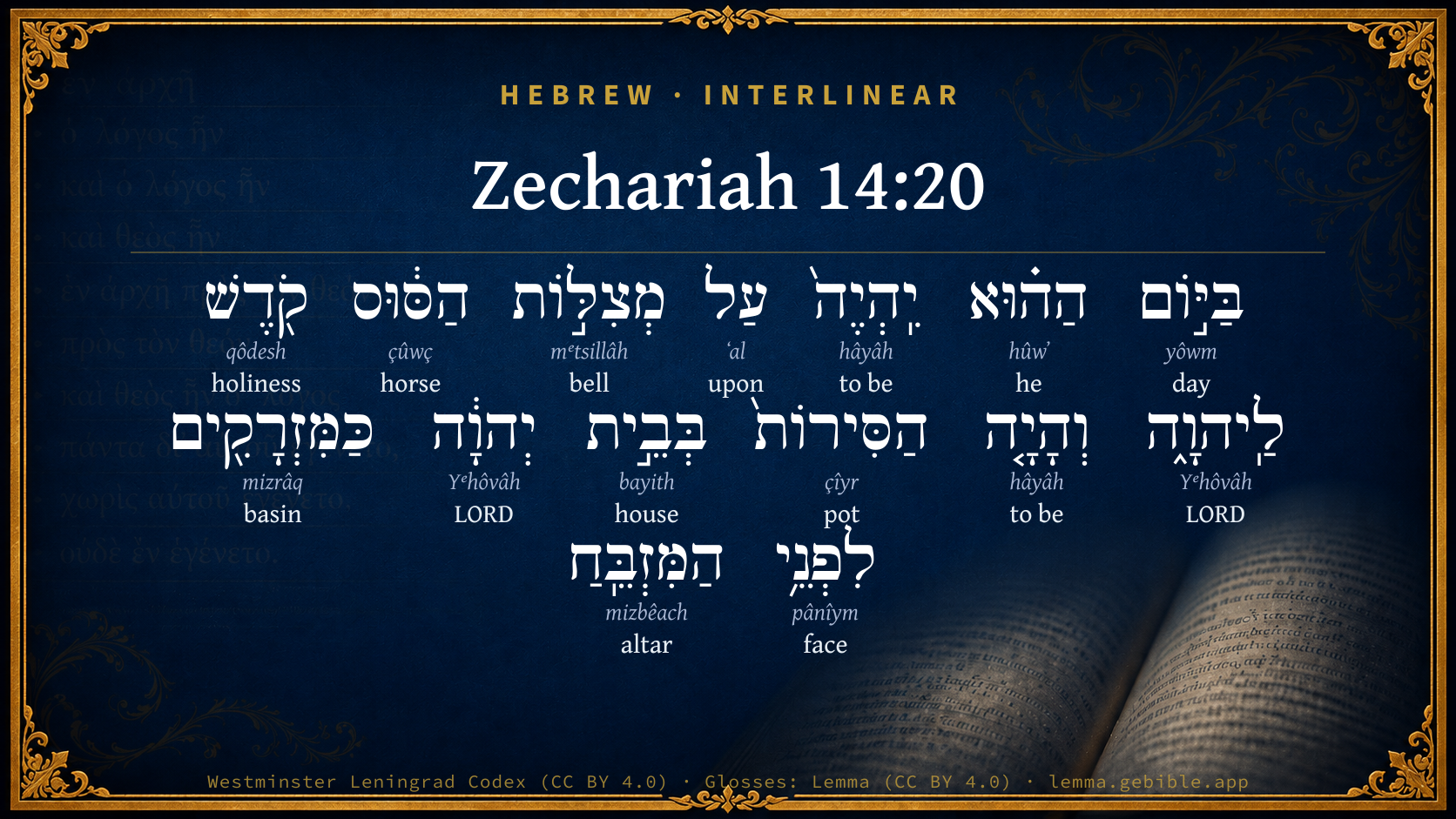
In that day there will be on the bells of the horses, "HOLY TO YAHWEH;" and the pots in Yahweh's house will be like the bowls before the altar.
World English Bible · Public Domain
Highlights
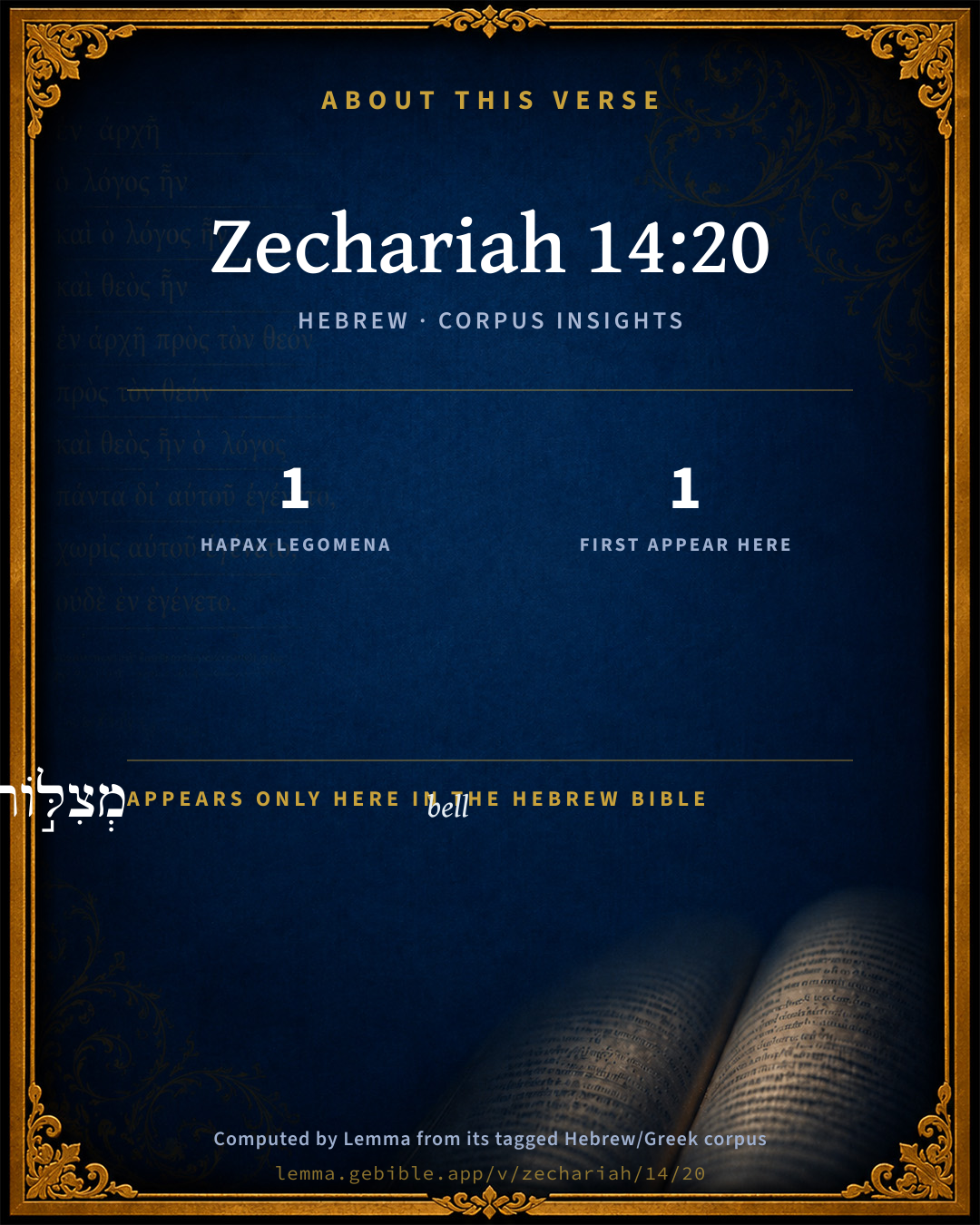
  • 1 hapax legomenon — only here in the Hebrew Bible
  • 1 first appearance in the Hebrew Bible
Full analysis ↓
Download a study sheet

One document with this verse’s original text, its word-by-word gloss line, the meaning frame, cross-references with their text, attributed commentary, and full source and license credits — printable, and it pastes into notes with its structure intact.

This verse Autodidact and up

Study sheet (.html) Plain text (.txt)

A passage Seminary Student

Up to 50 verses in one chapter. A passage sheet keeps up to 6 commentary sources and 12 cross-references per verse, in the order this page ranks them, and says so on the sheet whenever that leaves anything out. Ask for a single verse and you get the Autodidact verse sheet above.

Everything on this page stays free to read, with no account — the sheet is a download of what is already on screen, not access to it.

Want to remove ads? Support Godless Engineer
Compare translations 3

The same verse in 3 English versions, stacked beneath the original-language interlinear above. Click any original word for its lexicon entry.

Each is an independent rendering of the whole verse — the interlinear is not word-aligned to these translations.

Highlighted words mark where these versions differ — a whole-verse word diff, not a word-by-word alignment.

  • World English Bible Public Domain
    In that day there will be on the bells of the horses, "HOLY TO YAHWEH;" and the pots in Yahweh's house will be like the bowls before the altar.
  • King James Version Public Domain
    In that day shall there be upon the bells of the horses, HOLINESS UNTO THE LORD; and the pots in the LORD's house shall be like the bowls before the altar.
  • unfoldingWord Literal Text CC BY-SA 4.0
    But on that day, the bells of the horses “Set apart to Yahweh,” and the basins in Yahweh’s house will be like the bowls before the altar.

unfoldingWord Literal Text — © unfoldingWord, licensed CC BY-SA 4.0. Word-aligned USFM3 via Door43 (git.door43.org/unfoldingWord/en_ult).

Versions to compare (up to 4)

3 of 4 selected

Show all 18 translations

Every available English version of this verse, each an independent rendering of the whole verse.

  • World English Bible Public Domain
    In that day there will be on the bells of the horses, "HOLY TO YAHWEH;" and the pots in Yahweh's house will be like the bowls before the altar.
  • Berean Standard Bible Public Domain
    On that day, HOLY TO THE LORD will be inscribed on the bells of the horses, and the cooking pots in the house of the LORD will be like the sprinkling bowls before the altar.
  • Majority Standard Bible Public Domain
    On that day, HOLY TO THE LORD will be inscribed on the bells of the horses, and the cooking pots in the house of the LORD will be like the sprinkling bowls before the altar.
  • King James Version Public Domain
    In that day shall there be upon the bells of the horses, HOLINESS UNTO THE LORD; and the pots in the LORD's house shall be like the bowls before the altar.
  • American Standard Version (1901) Public Domain
    In that day shall there be upon the bells of the horses, HOLY UNTO JEHOVAH; and the pots in Jehovah's house shall be like the bowls before the altar.
  • Revised Version (1885) Public Domain
    In that day shall there be upon the bells of the horses, HOLY UNTO THE LORD; and the pots in the LORD’S house shall be like the bowls before the altar.
  • Geneva Bible (1599) Public Domain
    In that day shall there be written vpon the bridles of the horses, The holinesse vnto the Lord, and the pottes in the Lords house shall be like the bowles before the altar.
  • Douay-Rheims (1899) Public Domain
    In that day that which is upon the bridle of the horse shall be holy to the Lord: and the caldrons in the house of the Lord shall be as the phials before the altar.
  • Young's Literal Translation Public Domain
    In that day there is on bells of the horse, `Holy to Jehovah,' And the pots in the house of Jehovah Have been as bowls before the altar.
  • Literal Standard Version CC BY-SA 4.0
    In that day “Holy to YHWH” is [engraved] on bells of the horse, || And the pots in the house of YHWH || Have been as bowls before the altar.
  • Unlocked Literal Bible CC BY-SA 4.0
    But on that day, the bells of the horses will say, “Set apart to Yahweh,” and the basins in Yahweh's house will be like the bowls before the altar.
  • unfoldingWord Literal Text CC BY-SA 4.0
    But on that day, the bells of the horses “Set apart to Yahweh,” and the basins in Yahweh’s house will be like the bowls before the altar.
  • Darby Bible Public Domain
    In that day shall there be upon the bells of the horses, HOLINESS UNTO JEHOVAH; and the pots in Jehovah's house shall be like the bowls before the altar.
  • World Messianic Bible Public Domain
    In that day there will be inscribed on the bells of the horses, “HOLY TO THE LORD”; and the pots in the LORD’s house will be like the bowls before the altar.
  • Webster's Bible Public Domain
    In that day there shall be upon the bells of the horses, HOLINESS TO THE LORD; and the pots in the LORD'S house shall be like the bowls before the altar.
  • Free Bible Version CC BY-SA 4.0
    On that day the bells worn by horses will be engraved with the words “Holy to the Lord.” The household cooking pots used in the Lord's Temple will be as holy as the bowls used on the altar in the presence of the Lord.
  • Bible in Basic English Public Domain
    On that day all the bells of the horses will be holy to the Lord, and the pots in the Lord's house will be like the basins before the altar.
  • JPS Tanakh (1917) Public Domain
    In that day shall there be upon the bells of the horses: HOLY UNTO THE LORD; and the pots in the LORD'S house shall be like the basins before the altar.

Literal Standard Version (2020), Covenant Press — licensed CC BY-SA 4.0. Text via the HelloAO Bible API (eBible.org). Unlocked Literal Bible (unfoldingWord) — licensed CC BY-SA 4.0. Text via the HelloAO Bible API (eBible.org). unfoldingWord Literal Text — © unfoldingWord, licensed CC BY-SA 4.0. Word-aligned USFM3 via Door43 (git.door43.org/unfoldingWord/en_ult). Free Bible Version, Dr. Jonathan Gallagher — licensed CC BY-SA 4.0. Text via the HelloAO Bible API (eBible.org).

Word by word

More ways to search: Search by grammar → Find every occurrence → Compare this word →

Practice this passage: Drill this verse → Learn its vocabulary →

מְצִלּ֣וֹת
mᵉtsillâh
H4698
“bells of”
Noun, Common, Feminine, Plural, Construct
Part of Speech
Noun
Type
Common
Gender
Feminine
Number
Plural
State
Construct
Full BDB Definition

Origin: from H6750

TWOT: 1919e

bell
  1. בַּיּ֣וֹם yôwm H3117 “in/at the · day” Preposition, Determined + Noun, Common, Masculine, Singular, Absolute
  2. הַה֗וּא hûwʼ H1931 “the · he” Particle, Definite Article + Pronoun, Personal, 3rd Person, Masculine, Singular
  3. יִֽהְיֶה֙ hâyâh H1961 “to be” Verb, Qal, Imperfect, 3rd Person, Masculine, Singular
  4. עַל ʻal H5921 “upon” Preposition
  5. הַסּ֔וּס çûwç H5483 “the · horse” Particle, Definite Article + Noun, Common, Masculine, Singular, Absolute
  6. קֹ֖דֶשׁ qôdesh H6944 “holiness” Noun, Common, Masculine, Singular, Absolute
  7. לַֽיהוָ֑ה Yᵉhôvâh H3068 “to/for · LORD” Preposition + Noun, Proper
  8. וְהָיָ֤ה hâyâh H1961 “and · to be” Conjunction + Verb, Qal, Sequential Perfect, 3rd Person, Masculine, Singular
  9. הַסִּירוֹת֙ çîyr H5518 “the · pots” Particle, Definite Article + Noun, Common, Both, Plural, Absolute
  10. בְּבֵ֣ית bayith H1004 “in/at · house of” Preposition + Noun, Common, Masculine, Singular, Construct
  11. יְהוָ֔ה Yᵉhôvâh H3068 “LORD” Noun, Proper
  12. כַּמִּזְרָקִ֖ים mizrâq H4219 “like/as the · basins” Preposition, Determined + Noun, Common, Masculine, Plural, Absolute
  13. לִפְנֵ֥י pânîym H6440 “to/for · face(s) of” Preposition + Noun, Common, Both, Plural, Construct
  14. הַמִּזְבֵּֽחַ mizbêach H4196 “the · altar” Particle, Definite Article + Noun, Common, Masculine, Singular, Absolute

About this verse

These counts appear in no published source. They are computed here, from the morphology-tagged text and Lemma’s own curated glosses. What Lemma adds →

15
words
13
distinct lemmas
Prophets
section

Notable vocabulary

1 hapax legomenon — a word that appears only here in the entire Hebrew Bible:

  • מְצִלּ֣וֹת bell H4698

First appearance in Scripture

This word makes its first canonical appearance in the Hebrew Bible here:

  • מְצִלּ֣וֹת bell H4698

Shared distinctive vocabulary

כַּמִּזְרָקִ֖ים basin H4219 occurs in 32 verses of the Hebrew Bible. Also found in:

Grammatical profile

  • 2 verbs
  • 11 nouns
  • 1 pronoun
  • 1 preposition

Verb forms

  • יִֽהְיֶה֙ Qal · Imperfect
  • וְהָיָ֤ה Qal · Sequential Perfect

Repetition

Words recur within this verse — often emphatic in Hebrew:

  • יִֽהְיֶה֙ to be H1961 ×2
  • לַֽיהוָ֑ה LORD H3068 ×2

Hebrew & Septuagint length

In English translation the verse runs 29 words from the Hebrew and 33 from the Septuagint (LXX English) — closely comparable.

A rough comparison of the two English renderings, which tokenize alike — not a word-level alignment.

Word counts can differ between the Hebrew and the Greek without any difference in meaning — e.g. the Hebrew direct-object marker אֵת has no separate Greek word, and Greek often adds the article ὁ.

Cross-references

37

Topical passages linked to Zechariah 14:20 in the Treasury of Scripture Knowledge — connected by theme and wording, ordered by reader-vote popularity; previews shown in the World English Bible.

  • 1 Corinthians 3:16–17 Don't you know that you are a temple of God, and that God's Spirit lives in you?
  • Exodus 39:30 They made the plate of the holy crown of pure gold, and wrote on it a writing, like the engravings of a signet: "HOLY TO YAHWEH."
  • Isaiah 23:18 Her merchandise and her hire shall be holiness to Yahweh: it shall not be treasured nor laid up; for her merchandise shall be for those who dwell before Yahweh, to eat sufficiently, and for durable clothing.
  • 1 Peter 2:5 You also, as living stones, are built up as a spiritual house, to be a holy priesthood, to offer up spiritual sacrifices, acceptable to God through Jesus Christ.
  • Leviticus 8:9 He set the turban on his head; and on the turban, in front, he set the golden plate, the holy crown; as Yahweh commanded Moses.
  • Exodus 28:33–36 On its hem you shall make pomegranates of blue, and of purple, and of scarlet, around its hem; and bells of gold between them round about:
  • Exodus 37:16 He made the vessels which were on the table, its dishes, its spoons, its bowls, and its pitchers with which to pour out, of pure gold.
  • Leviticus 6:28 But the earthen vessel in which it is boiled shall be broken; and if it is boiled in a brazen vessel, it shall be scoured, and rinsed in water.
  • Numbers 4:7 On the table of show bread they shall spread a blue cloth, and put on it the dishes, the spoons, the bowls, and the cups with which to pour out; and the continual bread shall be on it.
  • Numbers 4:14 They shall put on it all its vessels, with which they minister about it, the fire pans, the flesh hooks, the shovels, and the basins; all the vessels of the altar; and they shall spread on it a covering of sealskin, and put in its poles.
  • Numbers 7:13 and his offering was: one silver platter, the weight of which was one hundred thirty shekels, one silver bowl of seventy shekels, after the shekel of the sanctuary; both of them full of fine flour mixed with oil for a meal offering;
  • Numbers 7:19 He offered for his offering: one silver platter, the weight of which was one hundred thirty shekels, one silver bowl of seventy shekels, after the shekel of the sanctuary; both of them full of fine flour mixed with oil for a meal offering;
  • Numbers 7:84–85 This was the dedication of the altar, on the day when it was anointed, by the princes of Israel: twelve silver platters, twelve silver bowls, twelve golden ladles;
  • Zechariah 9:15 Yahweh of Hosts will defend them; And they will destroy and overcome with sling-stones; And they will drink, and roar as through wine; And they will be filled like bowls, Like the corners of the altar.
  • Exodus 25:29 You shall make its dishes, its spoons, its ladles, and its bowls to pour out offerings with. Of pure gold shall you make them.
  • 1 Samuel 2:14 and he struck it into the pan, or kettle, or caldron, or pot; all that the flesh-hook brought up the priest took therewith. So they did in Shiloh to all the Israelites who came there.
  • 2 Chronicles 4:8 He made also ten tables, and placed them in the temple, five on the right side, and five on the left. He made one hundred basins of gold.
  • Psalms 110:3 Your people offer themselves willingly in the day of your power, in holy array. Out of the womb of the morning, you have the dew of your youth.
  • Proverbs 21:3–4 To do righteousness and justice Is more acceptable to Yahweh than sacrifice.
  • Ezekiel 46:20–24 He said to me, This is the place where the priests shall boil the trespass-offering and the sin-offering, [and] where they shall bake the meal-offering; that they not bring them forth into the outer court, to sanctify the people.
  • Obadiah 1:17 But in Mount Zion, there will be those who escape, and it will be holy. The house of Jacob will possess their possessions.
  • Zephaniah 2:11 Yahweh will be awesome to them, for he will famish all the gods of the land. Men will worship him, everyone from his place, even all the shores of the nations.
  • Malachi 1:11 For from the rising of the sun even to the going down of the same, my name is great among the nations, and in every place incense will be offered to my name, and a pure offering: for my name is great among the nations," says Yahweh of Hosts.
  • Luke 11:41 But give for gifts to the needy those things which are within, and behold, all things will be clean to you.
  • Acts 10:15 A voice came to him again the second time, "What God has cleansed, you must not call unclean."
  • Acts 10:28 He said to them, "You yourselves know how it is an unlawful thing for a man who is a Jew to join himself or come to one of another nation, but God has shown me that I shouldn't call any man unholy or unclean.
  • Acts 11:9 But a voice answered me the second time out of heaven, 'What God has cleansed, don't you call unclean.'
  • Acts 15:9 He made no distinction between us and them, cleansing their hearts by faith.
  • Romans 14:17–18 for the Kingdom of God is not eating and drinking, but righteousness, peace, and joy in the Holy Spirit.
  • Colossians 3:17 Whatever you do, in word or in deed, do all in the name of the Lord Jesus, giving thanks to God the Father, through him.
  • Colossians 3:22–24 Servants, obey in all things those who are your masters according to the flesh, not just when they are looking, as men-pleasers, but in singleness of heart, fearing God.
  • Titus 1:15–16 To the pure, all things are pure; but to those who are defiled and unbelieving, nothing is pure; but both their mind and their conscience are defiled.
  • 1 Peter 2:9 But you are a chosen race, a royal priesthood, a holy nation, a people for God's own possession, that you may show forth the excellencies of him who called you out of darkness into his marvelous light:
  • 1 Peter 4:11 If any man speaks, let it be as it were oracles of God. If any man serves, let it be as of the strength which God supplies, that in all things God may be glorified through Jesus Christ, to whom belong the glory and the dominion forever and ever. Amen.
  • Revelation 1:6 and he made us to be a Kingdom, priests to his God and Father; to him be the glory and the dominion forever and ever. Amen.
  • Revelation 5:10 And made them kings and priests to our God, And they reign on earth."
  • Revelation 20:6 Blessed and holy is he who has part in the first resurrection. Over these, the second death has no power, but they will be priests of God and of Christ, and will reign with him one thousand years.

Cross-references courtesy of OpenBible.info (CC BY 4.0).

Hebrew and Greek witnesses Masoretic Hebrew ↔ Greek Septuagint

The same verse in the two great witnesses to the Old Testament, shown verse-for-verse.

These are two independent witnesses, not word-aligned to each other, and the Septuagint is shown in lemma (dictionary) form.

Hebrew Zechariah 14:20 Masoretic · Westminster Leningrad Codex

בַּיּ֣וֹם הַה֗וּא יִֽהְיֶה֙ עַל מְצִלּ֣וֹת הַסּ֔וּס קֹ֖דֶשׁ לַֽיהוָ֑ה וְהָיָ֤ה הַסִּירוֹת֙ בְּבֵ֣ית יְהוָ֔ה כַּמִּזְרָקִ֖ים לִפְנֵ֥י הַמִּזְבֵּֽחַ

In that day there will be on the bells of the horses, "HOLY TO YAHWEH;" and the pots in Yahweh's house will be like the bowls before the altar.

World English Bible · Public Domain

Greek LXX Zechariah 14:20 Septuagint · lemma form

ἐν ὁ ἡμέρα ἐκεῖνος εἰμί ὁ ἐπί ὁ χαλινός ὁ ἵππος ἅγιος ὁ κύριος παντοκράτωρ καί εἰμί ὁ λέβης ὁ ἐν ὁ οἶκος κύριος ὡς φιάλη πρό πρόσωπον ὁ θυσιαστήριον

In that day there shall be upon the bridle of every horse Holiness to the Lord Almighty; and the caldrons in the house of the Lord shall be as bowls before the altar.

LXX2012 (modern English Septuagint) · Public Domain

On this verse, John Gill's Exposition discusses the Septuagint’s reading. Read the note in Commentary ↓

Hebrew: Westminster Leningrad Codex (CC BY 4.0). Greek: Septuagint (public domain); English from LXX2012 (modern English Septuagint) (Public Domain). How the Septuagint differs from the Hebrew →

Targum (Aramaic paraphrase)

1

The Targum is the ancient Jewish Aramaic paraphrase of the Hebrew Scriptures — an interpretive translation, not the Hebrew text itself. Onkelos (literal) and Pseudo-Jonathan (expansive) render the Torah, and Jonathan the Prophets. Coverage is partial: where no permissively-licensed English translation exists for a verse, only the Aramaic is shown. This is verse-level text, not a word-by-word alignment to the Hebrew.

  1. Targum Jonathan Prophets (Joshua–Malachi)
    בְּעִדָנָא הַהִיא יְהֵא עַל כְּרוּבַת סוּסַיָא קוּדְשָׁא קֳדָם יְיָ וִיהוֹן דוּדַיָא בְּבֵית מַקְדְשָׁא דַייָ סַגִיאִין כְּמִזְרְקַיָא קֳדָם מַדְבְּחָא:

    (no public-domain English translation for this verse)

    Targum Jonathan — Aramaic: “Mikraot Gedolot” (public domain). English: “Sefaria Community Translation” (CC0 1.0 (public-domain dedication)); “London "Chaldee Paraphrase," 1871” (public domain). Text via Sefaria.

Commentary

Notes on Zechariah 14:20 from classic Christian and Jewish commentators (each source and its license shown beneath its notes). The classic Christian expositions comment on the surrounding passage and are grouped to its opening verse, so a note may address several verses; the Jewish commentaries on the Tanakh (Rashi and others) are per-verse, so they appear only where the commentator wrote on this verse.

Lemma curates 59 commentaries, every one of them public domain or Creative Commons licensed, each selected and text-cleaned for this edition rather than reprinted as found. About our sources →

The Cambridge Bible for Schools and Colleges

gen. ed. J. J. S. Perowne

20. Holiness unto the Lord] Holy unto the Lord, R. V., and so in Zec_14:21; Exo_28:36.

pots in the Lord’s house] 1Sa_2:14; 2Ch_35:13.

bowls before the altar] chap. Zec_9:15, note.

20, 21. The perfect and crowning holiness of Jerusalem and Judah

The ornaments of worldly pomp and warlike power shall be as truly consecrated as the very mitre of the High Priest, and every vessel used in the meanest service of the Temple as holy as the vessels of the altar itself, Zec_14:20. Nay every common vessel throughout the city and the whole land shall be so holy as to be meet for the service of the sanctuary, and every profane person shall be for ever banished from the house of the Lord, Zec_14:21.

The Cambridge Bible for Schools and Colleges (gen. ed. J. J. S. Perowne; Cambridge University Press, 1878–1918) — public domain. Text from a community e-Sword module.

Trapp's Complete Commentary

John Trapp

Zec 14:20 In that day shall there be upon the bells of the horses, HOLINESS UNTO THE LORD; and the pots in the LORD’S house shall be like the bowls before the altar.

Ver. 20. In that day shall there be upon the bells of the horses] Hanged upon their heads, or about their necks, as Jdg 8:26 : the Midianitish camels had rich collars and chains about their necks, for ornament’ sake. It was a witty conceit of a modern divine (Dr Stoughton) that many deal with their ministers as carriers do with their horses, lay heavy burdens upon them, and then hang bells about their necks: they shall have hard work and great commendations, but easy commons; good words, but slight wages. This was better than that bald conceit of Theodoret and others, that this prophecy was then fulfilled, when as Constantine the Great (or his mother, Helen, for him) caused the bits of his horse bridle to be made of the nails of the cross of Christ. I confess the word is by some rendered bridles, by others trappings, frontals, collars. It is απαξ λεγομενον, read only here; and hence this variety of interpretations. Calvin renders it stables of horses; which, although they are but contemptible places, and usually stink; yet the prophet saith, they shall be holy to the Lord. Hereby the prophet teacheth, saith he, that God shall so be King of the world, as that all things shall be applied to his worship neither shall anything be of so common and ordinary use that shall not change its nature, and be sanctified to God’s service. The comparison here is made between things profane and the inscription on the high priest’s mitre, which was holiness to the Lord. This is a manifest testimony of a godly mind, when godliness runs through a man’s whole life, as the woof doth through the web; when ordinary actions are done from a right principle and to a right purpose; according to that old and good rule, Quicquid agas, propter Deum agas, "Whether ye eat, or drink, or whatsoever ye do, do all to the glory of God," 1Co 10:31. Receive every creature with thanksgiving, 1Ti 4:14; in serving men, serve the Lord Christ; exercise your general calling in your particular; do earthly business with heavenly minds; content not yourself with a natural use of the creature, as brute beasts do, but taste the sweetness of God in all; and in all thy ways acknowledge him, depending upon him for direction and success, consulting with him, and approving thine heart and life unto him. Holiness must be written upon our bridles when we war, upon our caps when we drink (Dr Harris). This is to go the upper way, Pro 15:24, which indeed is both cleaner, shorter, and safer. This is to be of that royal priesthood, that hath for its posy, Holiness to the Lord. This is to be harmless and blameless, the sons of God; known by their holiness, as David’s children were by their garments of various colours: for as he that hath called them is holy, so are they also holy, and that in all manner of conversation and communion too, even when they deal with carnal men and in common matters.

And the pots in the Lord’s house shall be like the bowls before the altar] All this must be understood as the spiritual service, which should be in the Christian Church; described by the ancient ceremonial service, as Isa 60:7; Isa 66:23 Mal 1:11. And it is to show that the efficacy, force, and operation of the Holy Ghost shall be far more plentiful, through Christ, in the Church of the gospel, than it was in times past, under the law. See Heb 8:6 Eph 3:5 Isa 44:3-4.

John Trapp, A Commentary or Exposition upon All the Books of the Old and New Testament (1647–1656) — public domain. Text from a community e-Sword module.

The Biblical Illustrator

Joseph S. Exell

Zec_14:20-21

In that day there shall be upon the bells of the horses, Holiness unto the Lord

Universal holiness

This text may be a prediction of the latter-day glory, when the knowledge of Christ shall cover the whole earth.

But at all times, and in all places, holiness becometh the house of the Lord. It is His royal will and pleasure that all who name His name should depart from all iniquity. This holiness, which we call universal holiness, because it extends to the whole man, and to his whole conduct, is described in the text in a remarkable manner. The prophet foretells that holiness to the Lord shall be written on the bells and bridles of the horses. It was originally engraved on a plate of gold, and fixed on the mitre or turban of the high priest. In wearing this, he was a type of Christ, our great High Priest. The meaning of writing this on the trappings of the horses is, that religion shall not be confined to sacred persons, times, and places, as this inscription originally was to the high priest; but that all real Christians, being a holy priesthood, shall be religious at all times and in all things; that true holiness shall extend itself to the ordinary concerns of life. The proposition we enforce is, that universal holiness becomes the profession of the Gospel. To be holy signifies, in Scripture, to be set apart from a common or profane use, to God and His service. Holiness is the renovation of our nature by the Spirit of God. The holiness required by the Gospel is something far superior to what is called morality. Holiness supposes the renewal of the heart. There is a universal change made in a real Christian, which is far superior to mere morality. God Himself is the author of holiness; there is nothing in our fallen nature to produce it. The principal instrument employed by the Spirit of grace in effecting this holy change, is the Word of the Gospel. Sanctify them through Thy truth. The holiness of the Gospel has for its grand objects, God and our neighbour. Religion is to influence the common concerns of life. Holiness is not to be confined to sacred things, but mingled with our ordinary affairs. We see little practical religion among many nominal Christians and unstable professors. Even the most exemplary have cause to lament their deficiencies.

I. What should be the Christians temper and views with regard to himself? Let the Christian remember that he is the temple of the Holy Ghost, and that the temple of the Lord must be holy.

II. Holiness to the Lord is to be exmplified in the relative duties of social life. In general, the Christian has two things to regard,--to do no harm, and to do much good. Active benevolence is a necessary fruit of holiness. There are certain situations in life wherein persons, being mutually related to each other, are expected more particularly to manifest the holiness of the Gospel The conjugal state. The relation of parents and children. Of masters and servants. Then are we holy? A soul unsanctified can never gain admittance into heaven, the residence of a holy God, holy angels, and holy men. (G. Burder.)

Holiness

1. The holiness here predicted is evangelical.

2. The holiness here predicted is conspicuous and attractive.

3. The holiness here predicted is exemplified in the lives of the ministers of the Gospel.

4. The holiness here predicted embraces the transactions of ordinary business.

5. The holiness here predicted reaches to the social enjoyments of Christian professors.

6. The holiness here predicted pervades religious worship.

7. The holiness here predicted purifies the communion of the Christian Church. (G. Brooks.)

Holiness unto the Lord

The prevalence of sin in the world is a subject which the Christian daily reflects upon with unfeigned sorrow and humiliation. In every place iniquity abounds. Divine things are continually treated with presumptuous irreverence and disregard. The mind, however, is relieved from its depression, occasioned by the present gloomy state of things, while it contemplates the prospects of a brighter day, which in Gods good time will arise. The sure word of prophecy unfolds to our view the most glorious representation of the Church prospering in the latter times. Zechariah foretells the general sanctification of men, and the consequent establishment of true religion in the world.

I. What is implied in these encouraging words--In that day there shall be upon the bells of the horses, Holiness unto the Lord? This appears to be a prediction of the general prevalence of pure and undefiled religion. It teaches us that holiness shall become universal in its extent, entire in its influence, and unveiled by shame or fear.

1. Holiness shall hereafter become universal in its extent. It shall be written upon the bells or bridles of the horses. It shall not be limited to persons of any particular order or profession; it shall extend to all who are engaged in secular occupations and pursuits. Men shall then become, as it were, priests unto God. In Gods good time, the things of God will be exalted to their just preeminence; and as they deserve, will occupy the attention and influence the hearts of men. Religion will be everywhere regarded as the one thing needful.

2. Holiness shall then become entire in its influence. It shall not be partial and defective; but perfect and complete. It shall govern the whole man, and regulate all that pertains to Him. As all men will make a profession of religion, so all who profess it will become truly and completely religious. Their piety will not be limited to particular occasions. They will walk in the fear of the Lord all the day long. They shall be influenced by a continual sense of His presence, and actuated by an habitual reverence for His laws. But not only shall the personal holiness of men be entire, their possessions, and everything pertaining to them shall, as it were, be holy too. The pots in the Lords house shall be like the bowls before the altar. At present we have to lament that sacred things are most shamefully abused and profaned, but hereafter the case will be reversed; things of a worldly nature shall be sanctified to the purposes of religion.

3. Holiness shall be open and unreserved in man, free from any false feeling of shame, or fear of reproach.

II. What instruction may be deduced from these words. The prophet says, In that day. The period has certainly not yet arrived; nor can it be expected till the mystery of iniquity has ceased to work. It is, however, even now in its progress towards fulfilment; for it has a reference to the whole period of the Gospel dispensation. Then what manner of persons ought they to be who make a profession of that Gospel? Surely holiness becomes the house of God. Everyone that nameth the name of Christ should depart from iniquity. All who are privileged to bear the Christian name are required to cultivate extraordinary purity and holiness.

1. You are required to be holy by the very relation which you bear to God.

2. This is according to the express command of heaven: for this is the will of God, even your sanctification.

3. This is the very end for which the Redeemer died.

4. The Scriptures represent this aa an indispensable qualification for heaven. Without holiness no man shall see the Lord. Are you then living as persons truly devoted to God, and letting your conversation be in all things as becometh the Gospel of Christ? These questions are of supreme importance to us all; they are, as it were, the turning point on which life and death, heaven and hell, depend. (E. Whieldon, M. A.)

Universal holiness the object of Christian hope

The words Holiness to the Lord, were written on the mitre placed on the head of the Jewish high priest. They were intended to point out the sacredness of the office, and the peculiar sanctity of the priestly character; but they referred to a greater than he, even the High Priest of our profession, Christ Jesus.

I. Earthly employments sanctified.

1. This is not the ease at present. Even the people of God find themselves in much danger of being careful and troubled about many things. There is not now on the bells of the horses, Holiness to the Lord.

2. There is a time when it shall be so. It will be evident, by the way in which common duties shall be discharged, that holiness to the Lord is the governing principle. All the intercourse of society shall be under the influence of Christian principle. In conducting the concerns of business, there will be no fraud or deceit--no taking advantage of the ignorance, the necessities, or the liberality of another--no tempting others to sin, in order to make gain by their iniquity. Many are the temptations necessarily arising from being associated with those who fear not God.

II. Spiritual services beautified. This embraces religion in the Church and in the family.

1. The services of the sanctuary. Things which have been deemed of small importance shall be attended to with a spirit of elevated piety. There is a prevalent error in undervaluing the devotional part of the service. The day is coming, may God hasten it on, when the pots in the Lords house shall be like the bowls before the altar.

2. The religion of the family. In private dwellings a spirit of devotion shall run through all the engagements of the family. Look how much this is neglected. How many who wait on God in His house, do not serve Him in their own.

III. The professing Church shall be purified.

1. Charity in circumstantial matters shall be exercised. There are now often more disputes about the way of worship than endeavours to attain the right spirit of worship. Love of party destroys the love of Christ.

2. Agreement in fundamental truth. There shall be none to broach heresy, or to lessen the glory of the Lord Jesus Christ; but dependence on His righteousness shall be universal. Applying this subject to ourselves we see--

(1) Ground for serious inquiry. Can we say, as respects business, public ordinances, Sabbath and home duties, etc., that everywhere is written, Holiness to the Lord?

2. A source of important instruction. See here a standard for your daily conduct. Pray, and try to attain to it. No Christian man is so happy as he who sees and enjoys Christ in everything.

3. A subject for fervent prayer. Pray that you may exhibit in your lives the power of grace in the soul. We see the principles on which we ought to act, in order so to pass through things temporal, as not to lose the things which are eternal. We may have the world, and we may use the world, but let us not forget that if any man love the world, the love of the Father is not in him. Let it be our constant prayer that God may be our guard and our guide in our religious intercourse with our families, with His Church and people, and with our own hearts in our prayer chambers. And may the Lord Jesus Christ fulfil in us all the good pleasure of His will, and the work of faith with power. (J. G. Breeny, B. A.)

Religion and business

How to retain the spirit of serious piety in the busy activities of life, is a question vital to Christian character. The practical divorce of religion and piety in our daily affairs is fraught with peril. Too many regard religion as out of place in the thoroughfares of trade, as a fabric of too fine a texture, or as an exotic transplanted from a tropical to a polar clime. The easy quietude of the sanctuary or closet befits it: Holiness to the Lord may be lint on the Bible, but not on the ledger; on the mitre of priest, but not on the bells of horses. How can religion and business be properly blended?

1. By having all actions constrained by holy motives. We do not, indeed, have God as a distinct object before us every moment, but we do the work which He has appointed us, in our special sphere, as a service to Him: Not slothful in business, fervent in spirit, serving the Lord. The blood circulates silently in our veins, and so religion is a silent, but vital, force in our hearts.

2. We are to remember that religion is being good and doing good. It is not quietism or asceticism, but a dominant principle that guides our thought and speech and action. It is a reflection of Christs life in the flesh. It shows itself in minutest details--the soft step, the gentle voice, the courteous demeanour; in honest speech, in nobility of dealing and truthfulness of disposition. True religion, someone says, puts no sand in sugar, alum in bread, water into milk, or otter into butter; it keeps the wife from ill-temper when her husbands dirty boots soil the floor, and keeps him from having dirty boots; it prevents him from fretting at a late dinner, and keeps her from having late dinners.

3. Religion is doing secular acts from sacred motives oftener than it is doing merely sacred acts, so called. When piety stamps our life, all our acts are religious. It is wrong to separate toil and worship, and to forget that motive gives character to deeds. An automaton may do many of our acts, but it, has no moral character. The heart makes the work of the workman holy. An anvil may be consecrated and a pulpit desecrated. A religion that is not fitted to week day work never had a Sabbath day origin. (C. H. Buck.)

The true Christian holiness

These words indicate that the great design, and ultimate result, of the diffusion of the Gospel is to promote holiness. In the view of many, salvation is simply deliverance from punishment. But salvation is a character as well as a condition, and the two can never he really divorced. Christianity is a life as well as a creed. The bestowment of forgiveness is not the great end of the Gospel, but only a means to the higher end of lifting men from their degradation and making them in heart and in conduct, as well as in name, the sons of God. To rest in pardon is a mean and contemptible thing, displaying a disposition of the grossest selfishness. When salvation is really possessed, it is a living character, produced by the grace of the Holy Spirit, and rooted in the simple faith which the soul is exercising in Jesus Christ.

I. What holiness is. What precisely do we mean when we say of a man that he is holy? We imply not simply that he is virtuous, but rather that his virtue has a special and peculiar quality. In our common speech there is a recognition of the distinction between virtue and holiness. The virtuous man regulates his conduct by moral principles alone, while the holy man maintains a close and constant fellowship with the living God. The one gives you a lofty idea of his own excellence, the other makes you feel the greatness and purity of God. The scriptural significance of the term is consecrated to Jehovah. Holiness, so far as it is an inward principle, is the maintenance of close communion with God: and so far as it is an outward manifestation, it is the consecration of the life to God. Holiness is a disposition lying back behind all virtues, and giving to each of them its own distinctive peculiarity. Holiness is an inward, all-regulating principle.

II. How this holiness is to be attained. Clearly, it is not possessed by every man. No man has it naturally, and as a thing of course. Indeed, the very reverse is true. Men do not like to retain God in their knowledge. How is all this to be changed? Not by the individual himself. From an unholy soul nothing but that which is unholy can proceed. By no mere process of development, or natural selection, can the unholy man train himself into holiness. Neither can this change be accomplished by means of external rites. The Scriptures state with the utmost explicitness that we are regenerated by the power of the Holy Ghost. If we inquire into the mode of His operations, we get no reply. If we ask how He can work in and upon a man, while not infringing on his free agency, we are not told. Though silent as to the mode, Scripture repeatedly asserts the fact. The other element of holiness is consecration to God. But the essence of sin is self-will, and so it is impossible that a man can dedicate himself to God until sin within him has been crushed. In order to holiness, the sinner needs to be reconciled to God, and to he made like to God. But these are the very things which are to he accomplished through his belief on the Lord Jesus Christ, by the power of the Holy Ghost. As to consecration to Him, the sight of the means by which his guilt and depravity have been removed, produces in the believers soul a deep feeling of personal indebtedness to God. He cannot lay claim to himself after God has redeemed him to Himself by the precious blood of Christ. His gratitude takes the form of self-dedication. It follows, also, that we must seek to have faith, strong and abiding, in the Lord Jesus Christ as our Redeemer, and in His death as the propitiation for our sins. This is a view of the Cross which is too seldom before our eyes.

III. Where this holiness is to be manifested. It is to characterise the believers life in all occupations and under all circumstances. Under the New Testament we have no holy places, or holy persons. To the Christian there should be nothing purely secular. Wherever piety is genuine, and our consecration unreserved, we shall seek in all things to glorify God. (W. M. Taylor, D. D.)

Holiness on the bells of the horses

The period to which these verses refer is still future. Piety is to be almost universal, extending generally to all persons and acts. Gather from the text what real piety is. Use the text as a standard.

1. On the bells of the horses, Holiness to the Lord, not on the priests mitre only. Common occupations are to be performed with an eye to God. We are to serve God indirectly in our callings, as well as directly in our ordinances; secular things are to be conducted on the same holy principles of faith and obedience as our sacred services. Horses are used for state occasions, for recreation, for journeying, for merchandise. And bells on the horses give notice of their approach And wherever a Christian comes, holiness to the Lord should attend him.

2. And the pots in the Lords house shall be like the bowls before the altar. Lesser things in the service of God should be attended to, as well as the more important; earthen pots, as well as golden bowls, should be held sacred. Where there is real holiness people are not nice and particular about ceremonial holiness. The true worshipper seeks to worship in spirit. This is the main thing. At the same time, he does not disparage sacred persons, places, days, and things, because he can make ordinary persons, places, days, and things, conducive and helpful to his spiritual growth. You should carry your religion into your ordinary affairs, but you should not carry your ordinary affairs into your religious worship, except for the sake of guidance and blessing, and that you may go forth to conduct them in a right manner and with a proper spirit. (H. C. Mitchinson, M. A.)

Holiness to the Lord

Jerusalem and Judah are referred to in a literal sense, but, as is common, they are ultimately referred to as a type of the universal Church of the latter day. In its real scope the prediction extends to the whole world. Everything in prophecy and providence unites, to prove that the entire fulfilment is at the door. The term holy signifies set apart, devoted. To be holy to the Lord is to be consecrated to Him. But holiness to the Lord is a still more forcible expression, and denotes consecration in the abstract. Men will write holiness to the Lord on all that they are and have. This implies that they will go through and reexamine all their habits, and bring all to the touchstone of Scripture. They will consecrate to Him all their powers of body and mind, all their time, influence, and possessions. You have come upon the stage at a time when Christendom is teeming with projects and institutions to meliorate the condition of man, and to advance the kingdom of Christ. See that you give these institutions firm and unwearied support. Fall in with the spirit of your age. You ought to be wholly for God, because He made you what you are, and built the world you inhabit, and furnished it for your use, and placed you in it, and commanded you to serve Him with all your heart and soul. You are not your own. You ought to be wholly for Christ, because He died to redeem you from eternal fire and raise you to immortal happiness. You must devote your lives to the interests of His kingdom if you would most promote the happiness of men. You must be wholly devoted if you would wish for a life of comfort. A divided mind is an uneasy mind. Many people have just enough religion to make them wretched. A heart and life consecrated without reserve to Christ, would bring peace of conscience, the strong exercise of benevolent affection, the satisfaction of a delightful employment, and crown all with ecstatic communion with God, and an assured hope of immortality. (E. Dorr Griffin, D. D.)

Holiness to the Lord

The prophets and apostles often speak of a glorious day, which is to dawn upon the Church in the latter ages of the world. Respecting this glorious day two things are predicted in the chapter before us. The true religion shall then universally prevail. Christians shall make much greater attainments in religion, and its sanctifying influence shall pervade all the common concerns and employments of life.

1. These expressions of the text imply that, when the day here predicted arrives, all the common business, employments, and actions of men shall be performed with as much seriousness and devoutness, as the most pious Christians now feel when engaged in the most solemn duties of religion. The meaning of the prediction evidently is that, while persons are engaged in all the common business and concerns of life, whether at home or abroad, whether in the house or by the way, they shall feel as serious, as devout, as much engaged in the service of God, as did the Jewish high priest, when he wore that sacred inscription upon his forehead.

2. In that day, every house, every shop, and the whole world itself, will be a house of God, a temple consecrated to His praise. A temple is a place consecrated and devoted to God for religious purposes. But in that day every house will be such a place.

3. Every day will then be like a Sabbath.

4. Every common meal will be what the Lords Supper is now.

5. When this day arrives, there will be no insincere worshippers found in Gods house, no hypocritical professors in His Church.

Application. Learn--

1. Our great and innumerable deficiencies.

2. Whether we have any religion or not.

3. What pleasures, pursuits, and employments are really lawful and pleasing to God. (E. Payson, D. D.)

Holiness to the Lord

Zechariah describes, in the last chapters of his book, great troubles coming on the world. All the world gathered round about Jerusalem to destroy it. The Lord Himself coming down from heaven to deliver the sacred city. There was no thought more pressed upon the mind of the Jew than that of holiness. It was the motto of the national life. The same conception of universal sanctity was carried forward from Judaism to Christianity.

I. The highest state of man, the most blessed condition of the world, is here set before us. The first meaning of holiness is separation. Separation looks two ways, to the past and to the future. There is something from which we are separated, and something to which we are separated. When we think of holiness practically, in respect to our present life, we are apt to regard it as representing an unattainable height. Holiness is absolute purity. Sanctification is ever represented in Scripture as though it were equivalent with a positive perfection already attained in this life. Holiness describes, not a realised height of nature or life, but a law or condition of life,--a process, a growth, springing out of faith, going on with us to our eternal future. Holiness is consecration.

II. This Divine idea of holiness is universally applicable. There is nothing which cannot be consecrated. The first thing in true consecration is the act of the inner self. We have none of us altogether conquered our old selfishness: we battle with it still. But holiness is the renunciation of all for Christ. And we have all an outside life to bring under this law of entire surrender. Holiness is not the condition of human nature, left to itself, it is the gift of God. There is a spurious holiness into which we are invited. Outside sanctities will never quicken the soul into new life. (R. A. Redford, LL. B. , M. A.)

The holiness of the gospel church

These words describe the purity and holiness of the gospel church in such terms and notions as are proper to the Old Testament dispensation. Notice the inscription, or impress,--Holiness to the Lord. The things inscribed are particularly enumerated, the horse bells; the bowls, the pots. What was used in the kitchens of the temple; and the utensils of every ordinary house and family. Notice the time. In that day. The whole state of things under the Gospel, which is as it were but one day. But where is this universal holiness to be found? Prophecies of things belonging to our obedience are to be often understood of our duty, rather than of the event. As to the event, it is to be understood comparatively, not absolutely. And the Gospel state hath its ebbs and flows in several ages. Doctrine--God in and by the Gospel will effect an eminent and notable sanctification both of things and persons.

I. That degree of holiness which is here prophesied of.

1. All such things as were before employed against God should be then employed and converted to His service, for the horse bells shall be inscribed.

2. Upon all the utensils of the temple there shall be Holiness to the Lord, whether pots or bowls.

3. The expressions imply a proficiency and growth in holiness; for the pots of the kitchen of the temple shall become as the bowls of the altar for purity and holiness.

4. As it is a progressive holiness, so it is also a diffusive holiness, which spreadeth itself through all actions, civil and sacred; in things which belong to peace and war.

II. Of holiness in the general. Consider it--

1. Relatively. Four things are in it. An inclination towards God. From this tendency towards God ariseth a dedication of ourselves, and all that we have to the Lords use and service. From this dedication there results a relation of the persons so dedicated to God, so that from that time forth they are not their own, but the Lords. There is another thing, and that is the actual using of ourselves for God. We are vessels set apart for the masters use.

2. Positive holiness may be considered either with respect to our persons or actions. Our persons, when we are renewed by the Spirit, or there is an inward principle of sanctification wrought in our hearts. As a person is holy by his principle, so an action is holy by the rule, when it agreeth with it as to manner and matter and end.

III. Reasons why this eminent holiness, both of persons and actions, should take place in the Gospel, above the times of the law.

1. Because of our principle, the new nature wrought in us by the Spirit of God, which is suited to the whole will of God.

2. Because of the exactness of our rule, which teacheth us how to walk in our several businesses and employments.

3. Because of our pattern and example, Jesus Christ, who was exact in all His actions.

4. Because of our obligations to Christ; partly because of His dominion as the Lord and Redeemer by right of purchase. In all conditions and states of life He hath a right in us, therefore in every state of life we should glorify Him. Partly from our gratitude to Christ as Saviour as well as Lord. Use--To persuade us to this universal obedience. None enter upon Gods service but with a consecration. Sundry directions.

(1) Undertake nothing but what will bear this inscription upon it.

(2) Be sure to exercise your general calling, as a Christian, in your particular. Your particular calling is that way of life to which God hath designed you by your abilities and education.

(3) Turn all second-table duties into first-table duties,

(4) Go about your earthly business with a heavenly mind.

(5) Content not yourselves with the natural use of the creature, as brute beasts do, but see God in all.

(6) In all your ways acknowledge God, depending upon Him for direction and success, and consulting with Him, and approving thy heart and life unto Him.

(7) God should be worshipped by every faithful person in His own house in as God-like a manner as He was worshipped by the Jews in the temple. A Christian must be alike everywhere, at home and abroad. (T. Manton.)

The bright future of the world, the reign of holiness

Holiness will be the salient feature in the future of the world. The holiness will be universal.

I. It will embrace the affairs of common life. Upon the bells of the horses. It was common amongst ancient nations to have bells on horses for use or ornament, or perhaps for both. It is said that in Alexanders funeral procession the horses had gold bells attached to their cheek straps.

II. It will embrace all domestic concerns. Every pot in Jerusalem and in Judah shall be holiness unto the Lord of hosts. The idea is that holiness will extend even to the minutest concerns of domestic life, the members of families will be religious. The very pots in which the priests cooked their food should be as sacred as the bowls that caught the victims blood. Observe--

(1) That the distinction between the sacred and secular is to be abolished, but,--

(2) not by separation from the world, nor by making all things secular, but by making all things holy, by carrying into all occupations the spirit and delight of Gods presence. Holiness to the Lord is not to be obliterated from the High Priests mitre so that he might feel as little solemnised when putting on his mitre and entering the Holiest of all, as if he were going into his stable to put the collar on his horse; when he puts the collar on his horse and goes to his day work or recreation, he is to be as truly and lovingly at one with God as when with incense and priestly garments he enters the Holy of Holies.--Dr. Dods.

III. It will embrace all religious characters. In that day there shall be no more the Canaanite in the house of the Lord of hosts. By Canaanite, says Dr. Henderson, is meant merchant. The Phoenicians who inhabited the northern part of Canaan were the most celebrated merchants of antiquity. The word may fairly be regarded as standing for mercenary men, men animated by the mercenary spirit. Such men are ever to be found in connection with religion. The old prophets bewailed this spirit. It was found in the earlier ages of the Christian Church. Men who considered gain as godliness, the Canaanite or the merchant do not necessarily belong to mercantile life but to other avocations as well and even to the priestly life. Perhaps the mercenary spirit is as rife in priests and ministers now as ever. But in the coming age there will be no more the Canaanite--the mercenary man--in the house of the Lord, all will be holy. (Homilist.)

Holiness has to do with every part of our life

Religion is one of the colours of life which mingles most intimately with all the other colours of the palette. It is that which lends them their appearance of depth, and the best of their brilliance. If by a subtle process it is taken away, all become tarnished and discoloured. (W. Mallock.)

Holiness applies to common things

I pray my friends not to be so spiritual that they cannot do a good days work, or give full measure, or sell honest wares. To my disgust, I have known persons professing to have reached perfect purity who have done very dirty things. I have been suspicious of superfine spirituality since I knew one who took no interest in the affairs of this world, and yet speculated till he lost thousands of other peoples money. Do not get to be so heavenly minded that you cannot put up with the little vexations of the family; for we have heard of people of whom it was said that the sooner they went to heaven the better, for they were too disagreeable to live with below. (C. H. Spurgeon.)

Holiness in the common things of life

There is a legend of an artist who sought a piece of sandalwood out of which to carve a Madonna. At last he was about to give up in despair, leaving the vision of his life unrealised, when in a dream he was bidden to shape the figure from a block of oak, which was destined for the fire. Obeying the command, he produced from the log of common firewood a masterpiece. In like manner many people wait for great and brilliant opportunities for doing the good things, the beautiful things, of which they dream, while, through all the plain, common days, the very opportunities they require for such deeds lie close to them, in the simplest and most familiar passing events, and in the homeliest circumstances. They wait to find sandalwood out of which to carve Madonnas, while far more lovely Madonnas than they dream of are hidden in the common logs of oak they burn in their open fireplace, or spurn with their feet in the wood yard.

Holiness unto the Lord

Holiness stands for three things--first, and in its deepest conception, separation from sin or common use, as the one day in the week, the one mountain of Zion amid the hills, and the child Samuel in his mothers home, dedicated to the service of God. Secondly, holiness stands for consecration or devotion to God; that which is not used for sin is set apart for His holy service; that which is not used for ordinary purposes is dedicated, like the communion plate, to one most holy and sacred purpose. Just as you would not use the chalice or paten of the communion for any common meal, however urgently you were pressed to it, so the holy thing is set apart for God. Thirdly, holiness implies growing capacity for the likeness of God. The nature which is yielded to God receives more of God, and, by receiving God, becomes changed into the likeness of God. So Holiness unto the Lord was engraven as a sacred motto upon the golden plate, on Aarons forehead, and everyone that saw the high priest so arrayed felt that there was a rightness, a holy fitness, that a man who was set apart for the service of Gods house should wear such a tablet. Probably, if you were told that you should dally wear a similar badge, you would exclaim, No, not so. I am quite willing to be a Christian. I believe in Jesus Christ as my Saviour. I am looking one day to stand before Him, rid of all imperfections and impurity, in the Temple of God, but I dare not assume that title now. I am not holy. I know it myself, and those that know me best would confess it too. That inscription and that golden plate are not for me. Then you are missing the point of Zechariahs conception of this dispensation. Anticipating the time in which we live, he said, The Holy Spirit will be so brought within the reach of ordinary people that the sacred inscription which had been reserved for the high priest will be inscribed upon the very bells of their horses gear, while the utensils and vessels which are devoted to common use will become, as it were, dignified and sanctified, as much so as altar vessels; while those which the priests employ for common purposes will be as bowls in which the blood of the victim is received, and into which the priest dips his hand to sprinkle the blood on the Day of Atonement. Three words will indicate our line of thought, namely,--Abolition, Inclusion, Elevation.

I. Abolition. There is an abolition in our present dispensation of the old distinction between sacred and secular. Many people live in two houses--of their sacred and of their secular duty; and though they pass from one to the other yet there is a distinct demarcation between what they are at sacred hours and at other times. People seem to suppose that religion can be put on and off as a dress; that it is separate from their real life; that it resembles undigested food, which is taken into the body but does not become part of their nature, and is therefore a burden and inconvenience. Now, this cannot be right. If you consider the genius of our religion the idea of such a partition cannot be admitted for a moment. What is the Christian religion? A creed? A performance? A donning of a certain outward behaviour or habit? It is a life; and surely life must express itself by speech and act, and in all the various outgoings of doing and suffering. The life of a flower must always exhale sweet fragrance; the life of a bird must always pour itself forth in carol and song; the life of a fish must always show itself, whether it flashes up from the surface of the water or buries itself in the depth. So the life of God always expresses itself; it is not located in certain acts, but it pervades a man as the spirit of selfishness might do. A students knowledge will affect his life at every turn. An artist cannot find enjoyment at one time in that which jars on his well balanced tastes at another. So when we receive the new life of God it must pour out through the channels of our whole being; or, ii ever we are inconsistent with it, it will rebuke and call us back, through confession and prayer, to the old standard. You cannot be religious there and irreligious here; if you have life it will show itself as much on Monday as Sunday. Religion is also a recognition of Christs kingship, the presenting Him with the keys of ones whole being. But if you are only going to serve Christ on certain occasions, and on Sundays, there are six-sevenths of your time taken out from His holy government. How can you call yourself a slave of Jesus Christ if you are only serving Him in certain specified duties and acts, whilst the residue of your life is spent according to your whim? Is not that the way in which the wandering tribes of Siberia acknowledge the Tsar of Russia, whilst they assert a good deal of autonomy of their own? Is not that detrimental to all consistency, all true devotion and consecration? Does the planet ever leave the sphere of the suns influence? Religion is a testimony to the world. The world does not come to our places of worship or see us at our best; the world does not intrude upon our domestic privacy, and overhear our prayers. The world can only judge us when we cross its track, when we are engaged in the same duties as it is familiar with, or undergoing privations and discipline it can appreciate.

II. Inclusion. The Jews were forbidden to buy or own horses. Horses were identified with war, with proud display and show. But here we note that instead of the horses being kept outside the national life, they are permitted, and, instead of their being under a ban, Holiness unto the Lord is written upon their bells--Calvin says upon their blinkers. In the old times men said that religion consisted in their attitude towards God, and that therefore everything which could not be directly used for His service must be viewed with suspicion, Hence the relationships of family life were carefully abjured by monk and nun; and through the Middle Ages especially, when the ascetic idea dominated men, we have hardly any reference to natural beauty. The Christian idea is infinitely preferable. You may have your horses, but they must be consecrated. You may have the horse bells to make sweet music, but see to it that they are inscribed with Holiness unto the Lord. You may have the vessels and implements of daily service, but mind that every one of them is handled as the bowls of the altar. Of course, if you feel that certain things, which are innocent in themselves, are getting too great a hold upon you, or are influencing other people wrongly, then you are bound to put them away. Whatever you may do rightly you may do for Him, and whatever you may do for Him you are right in doing.

III. Elevation. Zechariah says that there is to be no distinction between sacred and secular, but he does not say we are to level down the sacred to the secular. He does not say that the holy bowls in which the victims blood was caught are to be levelled down to that of the other vessels of the Temple; but that the ordinary vessels are to be levelled up to these. He does not say that the priest is to take off his plate, and have no more reverence for the worship of God than he felt when he went to saddle his horse for an afternoons excursion, but that he is to saddle his horses for his pleasure ride with the same reverence and devotion to God as when he entered the temple at the call of sacred duty. The whole tendency of the present day is to make everything equally secular, but we must take care to make everything equally sacred. You must have your church, that your workshop may become imbued with the spirit of your church; you must have your Bible reading, that all books may be read under the light that shines from your Bible; you must have the Lords Supper, that you may eat and drink always to the glory of God. (F. B. Meyer, B. A.)

The Biblical Illustrator, edited by Joseph S. Exell (c. 1880s–1900s) — public domain. Text from a community e-Sword module.

Joseph Benson's Commentary

Zec 14:20-21. In that day — When the nations are converted to God, as is foretold Zec 14:16; shall there be upon the bells of the horses — Written, as it were, on every common thing; HOLINESS UNTO THE LORD — This was the inscription on the mitre of the Jewish high-priest, denoting the great holiness of his office, and how he ought to conduct himself in a holy manner in all things, especially in those relating to divine worship. Now in these days of the gospel, when the Jews shall be converted to Christ, and the fulness of the Gentiles brought in, and made a holy nation, a royal priesthood, the grace of God shall be so abundant and efficacious, that common ordinary things in the hands of Christians, much more their persons, shall bear the dedicating inscription of HOLINESS TO THE LORD, and by their study and practice of holiness they shall make good their motto; they shall honour and glorify God in all circumstances and situations, times and places, and use every thing in a holy manner. And the pots in the Lord’s house — The meanest utensil employed in his service; shall be like the bowls before the altar — Shall be as the vessels of silver and gold used in the solemn sacrifices. Yea, every pot in Jerusalem shall be holiness unto the Lord — The utensils of private houses shall all be dedicated to God’s service, and employed in his fear and to his glory; with such sobriety and temperance, such devotedness to God, and such a mixture of pious thoughts and expressions, that even their meals shall look like sacrifices; they shall not eat and drink to themselves, but to Him that spreads their tables and fills their cups. And all they that sacrifice — In allusion to sacrifices, the prophet expresses all religious affections, practice, and worship, which shall be as pleasing to God as were the sacrifices of his people, offered up with divine warrant and approbation. Shall come and take of them — Of those pots and vessels, freely and without scruple; and seethe therein — The ceremonial distinction between holy and unholy places and things shall cease with the ritual law on which it was founded. One place shall be as acceptable to God as another, and one vessel or instrument of divine service as holy as another. For the true worshippers shall worship the Father in spirit and in truth, and men shall pray and give thanks everywhere, lifting up holy hands without wrath and doubting. Little regard shall be had to the circumstance, provided there be nothing indecent or disorderly, while the life, and soul, and substance of divine worship and service are religiously preserved and adhered to. And there shall be no more the Canaanite in the house of the Lord — There shall be no more a profane or impious person in the societies of the faithful. For though persons that were Canaanites, strangers, and foreigners, should be brought into the house of the Lord, yet they should cease to be Canaanites; they should have nothing of the spirit or disposition of Canaanites, or heathen, in them. And though in gospel times people should be indifferent as to holy vessels and holy places, yet they should be very strict with respect to church discipline, and careful not to admit the profane to sacred ordinances, or to Christian fellowship with them, but should separate between the precious and the vile, between Israelites and Canaanites. Yet this will not have its perfect accomplishment short of the heavenly Jerusalem, that house of the Lord of hosts into which no unclean thing shall enter. For at the end of time, and not before, Christ shall gather out of his kingdom every thing that offends; and the tares and wheat shall be perfectly and eternally separated.

Joseph Benson's Commentary on the Old and New Testaments (1811–1818) — public domain. Text from a community e-Sword module.

Keil & Delitzsch

C. F. Keil & F. Delitzsch

Zac 14:20. "In that day there will stand upon the bells of the horses, Holy to Jehovah; and the pots in the house of Jehovah will be like the sacrificial bowls before the altar. Zac 14:21. And every pot in Jerusalem and Judah will be holy to Jehovah of hosts, and all who sacrifice will come and take of them, and boil therein; and there will be no Canaanite any more in the house of Jehovah of hosts in that day." The meaning of Zac 14:20 is not exhausted by the explanation given by Michaelis, Ewald, and others, that even the horses will then be consecrated to the Lord. The words קדשׁ ליהוה were engraven upon the gold plate on the tiara of the high priest, in the characters used in engravings upon a seal (Exo 28:36). If, then, these words are (i.e., are to stand) upon the bells of the horses, the meaning is, that the bells of the horses will resemble the head-dress of the high priest in holiness.

(Note: It follows from this passage, that it was an Israelitish custom to hang bells upon the horses and mules as ornaments, and probably also for other purposes, as with us. This custom was a very common one in antiquity (see the proofs which have been so diligently collected in Dougtaei Analecta sacr. p. 296ff.).)

This does not merely express the fact that the whole of the ceremonial law will be abolished, but also that the distinction between holy and profane will cease, inasmuch as even the most outward things, and things having no connection whatever with worship, will be as holy as those objects formerly were, which were dedicated to the service of Jehovah by a special consecration. In Zac 14:20 and Zac 14:21, the graduated distinction between the things which were more or less holy is brought prominently out. The pots in the sanctuary, which were used for boiling the sacrificial flesh, were regarded as much less holy than the sacrificial bowls in which the blood of the sacrificial animals was received, and out of which it was sprinkled or poured upon the altar. In the future these pots will be just as holy as the sacrificial bowls; and indeed not merely the boiling pots in the temple, but all the boiling pots in Jerusalem and Judah, which have hitherto been only clean and not holy, so that men will use them at pleasure for boiling the sacrificial flesh. In this priestly-levitical drapery the thought is expressed, that in the perfected kingdom of God not only will everything without exception be holy, but all will be equally holy. The distinction between holy and profane can only cease, however, when the sin and moral defilement which first evoked this distinction, and made it necessary that the things intended for the service of God should be set apart, and receive a special consecration, have been entirely removed and wiped away. To remove this distinction, to prepare the way for the cleansing away of sin, and to sanctify once more that which sin had desecrated, was the object of the sacred institutions appointed by God. To this end Israel was separated from the nations of the earth; and in order to train it up as a holy nation, and to secure the object described, a law was given to it, in which the distinction between holy and profane ran through all the relations of life. And this goal will be eventually reached by the people of God; and sin with all its consequences be cleansed away by the judgment. In the perfected kingdom of God there will be no more sinners, but only such as are righteous and holy. This is affirmed in the last clause: there will be no Canaanite any more in the house of Jehovah. The Canaanites are mentioned here, not as merchants, as in Zep 1:11; Hos 12:8 (as Jonathan, Aquila, and others suppose), but as a people laden with sin, and under the curse (Gen 9:25; Lev 18:24.; Deu 7:2; Deu 9:4, etc.), which has been exterminated by the judgment. In this sense, as the expression לא עוד implies, the term Canaanite is used to denote the godless members of the covenant nation, who came to the temple with sacrifices, in outward self-righteousness. As עוד presupposes that there were Canaanites in the temple of Jehovah in the time of the prophet, the reference cannot be to actual Canaanites, because they were prohibited by the law from entering the temple, but only to Israelites, who were Canaanites in heart. Compare Isa 1:10, where the princes of Judah are called princes of Sodom (Eze 16:3; Eze 44:9). The "house of Jehovah" is the temple, as in the preceding verse, and not the church of Jehovah, as in Zac 9:8, although at the time of the completion of the kingdom of God the distinction between Jerusalem and the temple will have ceased, and the whole of the holy city, yea, the whole of the kingdom of God, will be transformed by the Lord into a holy of holies (see Rev 21:22, Rev 21:27).

Thus does our prophecy close with a prospect of the completion of the kingdom of God in glory. All believing commentators are agreed that the final fulfilment of Zac 14:20 and Zac 14:21 lies before us in Rev 21:27 and Rev 22:15, and that even Zac 12:1-14 neither refers to the Chaldaean catastrophe nor to the Maccabaean wars, but to the Messianic times, however they may differ from one another in relation to the historical events which the prophecy foretels. Hofmann and Koehler, as well as Ebrard and Kliefoth, start with the assumption, that the prophecy in ch. 12-14 strikes in where the preceding one in ch. 9-11 terminates; that is to say, that it commences with the time when Israel was given up to the power of the fourth empire, on account of its rejection of the good shepherd, who appeared in Christ. Now since Hofmann and Koehler understand by Israel only the chosen people of the old covenant, or the Jewish nation, and by Jerusalem the capital of this nation in Palestine, they find this prophecy in Zac 12:1-14, that when Jehovah shall eventually bring to pass the punishment of the bad shepherd, i.e., of the imperial power, with its hostility to God, it will assemble together again in its members the nations of the earth, to make war upon the material Jerusalem and Israel, which has returned again from its dispersion in all the world into the possession of the holy land (Palestine), and will besiege the holy city; but it will there be smitten by Jehovah, and lose its power over Israel. At that time will Jehovah also bring the previous hardening of Israel to an end, open its eyes to its sin against the Saviour it has put to death, and effect its conversion. But they differ in opinion as to ch. 14. According to Koehler, this chapter refers to a future which is still in the distance - to a siege and conquest of Jerusalem which are to take place after Israel's conversion, through which the immediate personal appearance of Jehovah will be brought to pass, and all the effects by which that appearance is necessarily accompanied. According to Hofmann (Schriftbeweis, ii. p. 610ff.), Zac 14:1. refers to the same occurrence as Zac 12:2., with this simple difference, that in Zac 12:1-14 the prophet states what that day, in which the whole of the world of nations attacks Jerusalem, will do with the people of God, and in ch. 14 to what extremity it will be brought. Ebrard and Kliefoth, on the other hand, understand by Israel, with its capital Jerusalem, and the house of David (in Zechariah 12:1-13:6), rebellious Judaism after the rejection of the Messiah; and by Judah with its princes, Christendom. Hence the prophecy in this section announces what calamities will happen to Israel according to the flesh - that has become rebellious through rejecting the Messiah - from the first coming of Christ onwards, until its ultimate conversion after the fulness of the Gentiles has come in.

(Note: Kliefoth accordingly finds the siege of Jerusalem, predicted in Zac 12:2, fulfilled in the siege of that city by Titus. The besieging nations then drank the reeling-cup; for the subjection of Judah was the last act in the victory of the Roman empire over the Macedonian. Rome was then at the summit of its imperial greatness; and from that time forth it became reeling and weak. This weakening was indeed prepared and effected through the Christina church; but it was just the siege of Jerusalem which transferred the centre of the Christian church from Jerusalem to the Roman empire. The fulfilment of Zac 12:3 is to be found in the Crusades, the Oriental question, the Haute Finance, and the Emancipation of the Jews. Jerusalem has thus become a burden-stone for all nations, etc.)

The section Zac 13:7-9 (the smiting of the shepherd) does not refer to the crucifixion of Christ, because this did not lead to the consequences indicated in Zac 13:8, so far as the whole earth was concerned, but to the "cutting off of the Messiah" predicted in Dan 9:26, the great apostasy which forms the beginning of the end, according to Luk 17:25; Th2 2:3; Ti1 4:1, and Ti1 4:2 Time. Zac 3:1, and through which Christ in His church is, according to the description in Rev 13:17, so cut off from historical life, that it cannot be anything on earth. Lastly, ch. 14 treats of the end of the world and the general judgment.

Of these two views, we cannot look upon either as well founded. For, in the first place, the assumption common to the two, and with which they set out, is erroneous and untenable, - namely, that the prophecy in ch. 12ff. strikes in where the previous one in ch. 9-11 terminated, and therefore that ch. 12-14 is a direct continuation of ch. 9-11. This assumption is at variance not only with the relation in which the two prophecies stand to one another, as indicated by the correspondence in their headings, and as unfolded in Zac 12:1, Zac 12:2, but also with the essence of the prophecy, inasmuch as it is not a historical prediction of the future according to its successive development, but simply a spiritual intuition effected by inspiration, in which only the leading features of the form which the kingdom of God would hereafter assume are set forth, and that in figures drawn from the circumstances of the present and the past. Again, the two views can only be carried out by forcing the text. If the prophecy in Zac 12:1-14 started with the period when Israel came into power of the Roman empire after the rejection of the Messiah, it could not leap so abruptly to the last days, as Hofmann and Koehler assume, and commence with the description of a victorious conflict on the part of Israel against the nations of the world that were besieging Jerusalem, but would certainly first of all predict, if not the destruction of the Jewish nation by the Romans (which is merely indicated in ch. 11), at all events the gathering together of the Jews, who had been scattered by the Romans over all the world, into Palestine and Jerusalem, before an attack of the nations of the world upon Israel could possibly be spoken of. Moreover, even the difference between Hofmann and Koehler with regard to the relation between Zac 12:1-9 and Zac 14:1-5 shows that the transference of the whole to the last times cannot be reconciled with the words of these sections. The hypothesis of Koehler, that after the gathering together of Israel out of its dispersion, the nations of the world would make an attack upon Jerusalem in which they would be defeated, and that this conflict would for the first time bring Israel to the recognition of its guilt in putting Christ to death, is at variance with the whole of the prophecy and teaching of both the Old and New Testaments. For, according to these, Israel is not to be gathered together from its dispersion among the nations till it shall return with penitence to Jehovah, whom it has rejected. But Hofmann's statement as to the relation between the two sections is so brief and obscure, that it is more like a concealment than a clearing up of the difficulties which it contains. Lastly, when Hofmann correctly observes, that "by the Israel of the heading in Zac 12:1 we can only understand the people of God, in contradistinction to the world of nations, which is estranged from God," this cannot apply to the unbelieving Jews, who have been given into the power of the last empire on account of their rejection of Christ, or Israel according to the flesh, for that Israel is rejected by God. The people of God exists, since the rejection of Christ, only in Christendom, which has been formed out of believing Jews and believing Gentiles, or the church of the New Testament, the stem and kernel of which were that portion of Israel which believingly accepted the Messiah when He appeared, and into whose bosom the believing Gentile peoples were received. Ebrard and Kliefoth are therefore perfectly right in their rejection of the Jewish chiliasm of Hofmann and Koehler; but when they understand by the Israel of the heading belonging to ch. 12-14, which we find in Zac 12:1-9, only the unbelieving carnal Israel, and by that in ch. 14 the believing Israel which has been converted to Christ, and also introduce into Zac 12:1-9 an antithesis between Israel and Judah, and then understand by Jerusalem and the house of David in Zac 12:1-14 the hardened Jews, and by Judah, Christendom; and, on the other hand, by Jerusalem and Judah in ch. 14 the Christendom formed of believing Jews and believing Gentiles, - we have already shown at Zac 12:10 that these distinctions are arbitrarily forced upon the text.

Our prophecy treats in both parts - Zechariah 12:1-13:6 and ch. 13:7-14:21 - of Israel, the people of God, and indeed the people of the new covenant, which has grown out of the Israel that believed in Christ, and believers of the heathen nations incorporated into it, and refers not merely to the church of the new covenant in the last times, when all the old Israel will be liberated by the grace of God from the hardening inflicted upon it, and will be received again into the kingdom of God, and form a central point thereof (Vitringa, C. B. Mich., etc.), but to the whole development of the church of Christ from its first beginning till its completion at the second coming of the Lord, as Hengstenberg has in the main discovered and observed. As the Israel of the heading (Zac 12:1) denotes the people of God in contradistinction to the peoples of the world, the inhabitants of Jerusalem with the house of David, and Judah with its princes, as the representatives of Israel, are typical epithets applied to the representatives and members of the new covenant people, viz., the Christian church; and Jerusalem and Judah, as the inheritance of Israel, are types of the seats and territories of Christendom. The development of the new covenant nation, however, in conflict with the heathen world, and through the help of the Lord and His Spirit, until its glorious completion, is predicted in our oracle, not according to its successive historical course, but in such a manner that the first half announces how the church of the Lord victoriously defeats the attacks of the heathen world through the miraculous help of the Lord, and how in consequence of this victory it is increased by the fact that the hardened Israel comes more and more to the acknowledgment of its sin and to belief in the Messiah, whom it has put to death, and is incorporated into the church; whilst the second half, on the other hand, announces how, in consequence of the slaying of the Messiah, there falls upon the covenant nation a judgment through which two-thirds are exterminated, and the remainder is tested and refined by the Lord, so that, although many do indeed fall and perish in the conflicts with the nations of the world, the remnant is preserved, and in the last conflict will be miraculously delivered through the coming of the Lord, who will come with His saints to complete His kingdom in glory by the destruction of the enemies of His kingdom, and by the transformation and renewal of the earth. As the believing penitential look at the pierced One (Zac 12:10) will not take place for the first time at the ultimate conversion of Israel at the end of the days, but began on the day of Golgotha, and continues through all the centuries of the Christian church, so did the siege of Jerusalem by all nations (Zac 12:1-9), i.e., the attack of the heathen nations upon the church of God, commence even in the days of the apostles (cf. Act 4:25.), and continues through the whole history of the Christina church to the last great conflict which will immediately precede the return of our Lord to judgment. And again, just as the dispersion of the flock after the slaying of the shepherd commenced at the arrest and death of Christ, and the bringing back of the hand of the Lord upon the small ones at the resurrection of Christ, so have they both been repeated in every age of the Christian church, inasmuch as with every fresh and powerful exaltation of antichristian heathenism above the church of Christ, those who are weak in faith flee and are scattered; but as soon as the Lord shows Himself alive in His church again, they let Him gather them together once more. And this will continue, according to the word of the Lord in Mat 24:10., till the end of the days, when Satan will go out to deceive the nations in the four quarters of the earth, and to gather together Gog and Magog to battle against the camp of the saints and the holy city; whereupon the Lord from heaven will destroy the enemy, and perfect His kingdom in the heavenly Jerusalem (Rev).

So far as the relation between Zac 12:2-9 and Zac 14:1-5 is concerned, it is evident from the text of both these passages that they do not treat of two different attacks upon the church of God by the imperial power, occurring at different times; but that, whilst Zac 12:1-14 depicts the constantly repeated attack in the light of its successful overthrow, ch. 14 describes the hostile attack according to its partial success and final issue in the destruction of the powers that are hostile to God. This issue takes place, no doubt, only at the end of the course of this world, with the return of Christ to the last judgment; but the fact that Jerusalem is conquered and plundered, and the half of its population led away into captivity, proves indisputably that the siege of Jerusalem predicted in ch. 14 must not be restricted to the last attack of Antichrist upon the church of the Lord, but that all the hostile attacks of the heathen world upon the city of God are embraced in the one picture of a siege of Jerusalem. In the attack made upon Jerusalem by Gog and Magog, the city is not conquered and plundered, either according to Ezekiel 38 and 39, or according to Rev 20:7-9; but the enemy is destroyed by the immediate interposition of the Lord, without having got possession of the holy city. But to this ideal summary of the conflicts and victories of the nations of the world there is appended directly the picture of the final destruction of the ungodly power of the world, and the glorification of the kingdom of God; so that in Zechariah 14 (from vv. 6-21) there is predicted in Old Testament form the completion of the kingdom of God, which the Apostle John saw and described in Revelation in New Testament mode under the figure of the heavenly Jerusalem.

Keil & Delitzsch — Biblical Commentary on the Old Testament (1861–1891) — public domain (CC PDM 1.0). Text via the HelloAO Bible API. (Old Testament only.)

MacLaren's Expositions of Holy Scripture

Alexander MacLaren

Exodus

THREE INSCRIPTIONS WITH ONE MEANING

HOLINESS TO THE LORD.’ - Exo 28:36.

HOLINESS UNTO THE LORD.’ - Zec 14:20.

‘His name shall be in their foreheads.’ - Rev 22:4.

You will have perceived my purpose in putting these three widely separated texts together. They all speak of inscriptions, and they are all obviously connected with each other. The first of them comes from the ancient times of the institution of the ceremonial ritual, and describes a part of the high priest’s official dress. In his mitre was a thin plate of gold on which was written, ‘Holiness to the Lord.’ The second of them comes from almost the last portion recorded of the history of Israel in the Old Testament, and is from the words of the great Prophet of the Restoration-his ideal presentation of the Messianic period, in which he recognises as one feature, that the inscription on the mitre of the high priest shall be written on ‘the bells of the horses.’ And the last of them is from the closing vision of the celestial kingdom, the heavenly and perfected form of the Christian Church. John, probably remembering the high priest and his mitre, with its inscription upon the forehead, says: ‘His servants shall do Him priestly service’-for that is the meaning of the word inadequately translated ‘serve Him’-’and see His face, and His name shall be in their foreheads.’

These three things, then-the high priest’s mitre, the horses’ bells, the foreheads of the perfected saints-present three aspects of the Christian thought of holiness. Take them one by one.

I. The high priest’s mitre.

The high priest was the official representative of the nation. He stood before God as the embodied and personified Israel. For the purposes of worship Israel was the high priest, and the high priest was Israel. And so, on his forehead, not to distinguish him from the rest of the people, but to include all the people in his consecration, shone a golden plate with the motto, ‘Holiness to the Lord.’ So, at the very beginning of Jewish ritual there stands a protest against all notions that make ‘saint’ the designation of any abnormal or exceptional sanctity, and confine the name to the members of any selected aristocracy of devoutness and goodness. All Christian men, ex officio, by the very fact of their Christianity, are saints, in the true sense of the word. And the representative of the whole of Israel stood there before God, with this inscription blazing on his forehead, as a witness that, whatsoever holiness may be, it belongs to every member of the true Israel.

And what is it? It is a very unfortunate thing-indicating superficiality of thought-that the modern popular notion of ‘holiness’ identifies it with purity, righteousness, moral perfection. Now that idea is in it, but is not the whole of it. For, not to spend time upon mere remarks on words, the meaning of the word thus rendered is in Hebrew, as well as in Greek and in our own English, one and the same. The root-meaning is ‘separated,’ ‘set apart,’ and the word expresses primarily, not moral character, but relation to God. That makes all the difference; and it incalculably deepens the conception, as well as puts us on the right track for understanding the only possible means by which there can ever be realised that moral perfection and excellence which has unfortunately monopolised the meaning of the word in most people’s minds. The first thought is ‘set apart to God.’ That is holiness, in its root and germ.

And how can we be set apart for God? You may devote a dead thing for certain uses easily enough. How can a man be separated and laid aside?

Well, there is only one way, brethren, and that is by self-surrender. ‘Yield yourselves to God’ is but the other side, or, rather, the practical shape, of the Old and the New Testament doctrine of holiness. A man becomes God’s when he says, ‘Lord, take me and mould me, and fill me and cleanse me, and do with me what Thou wilt.’ In that self-surrender, which is the tap-root of all holiness, the first and foremost thing to be offered is that most obstinate of all, the will that is in us. And when we yield our wills in submission both to commandments and providences, both to gifts and to withdrawals, both to gains and to losses, both to joys and to sorrows, then we begin to write upon our foreheads ‘Holiness to the Lord.’ And when we go on to yield our hearts to Him, by enshrining Him sole and sovereign in their innermost chamber, and turning to Him the whole current of our lives and desires, and hopes and confidences, which we are so apt to allow to run to waste and be sucked up in the desert sands of the world, then we write more of that inscription. And when we fill our minds with joyful submission to His truth, and occupy our thoughts with His mighty Name and His great revelation, and carry Him with us in the hidden corners of our consciousness, even whilst we are busy about daily work, then we add further letters to it. And when the submissive will, and the devoted heart, and the occupied thoughts are fully expressed in daily life and its various external duties, then the writing is complete. ‘Holiness to the Lord’ is self-surrender of will and heart and mind and everything. And that surrender is of the very essence of Christianity.

What is a saint? Some man or woman that has practised unheard-of austerities? Somebody that has lived an isolated and self-regarding life in convent or monastery or desert? No! a man or woman in the world who, moved by the mercies of God, yields self to God as ‘a living sacrifice.’

So the New Testament writers never hesitate to speak even of such very imperfect Christians as were found in abundance in churches like Corinth and Galatia as being all ‘saints,’ every man of them. That is not because the writers were minimising their defects, or idealising their persons, but because, if they are Christians at all, they are saints; seeing that no man is a Christian who has not been drawn by Christ’s great sacrifice for him to yield himself a sacrifice for Christ.

Of course that intrusive idea which has, in popular apprehension, so swallowed up the notion of holiness-viz. that of perfection of moral character or conduct-is included in this other, or rather is developed from it. For the true way to conquer self is to surrender self; and the more entire our giving up of ourselves, the more certainly shall we receive ourselves back again from His hands. ‘By the mercies of God, I beseech you, yield yourselves living sacrifices.’

II. I come to my next text-the horses’ bells.

Zechariah has a vision of the ideal Messianic times, and, of course, as must necessarily be the case, his picture is painted with colours laid upon his palette by his experience, and he depicts that distant future in the guise suggested to him by what he saw around him. So we have to disentangle from his words the sentiment which he expresses, and to recognise the symbolic way in which he puts it. His thought is this,-the inscription on the high priest’s mitre will be written on the bells which ornament the harness of the horses, which in Israel were never used as with us, but only either for war or for pomp and display, and the use of which was always regarded with a certain kind of doubt and suspicion. Even these shall be consecrated in that far-off day.

And then he goes on with variations on the same air, ‘In that day there shall be upon the bells of the horses, "Holiness unto the Lord,"‘ and adds that ‘the pots in the Lord’s house’-the humble vessels that were used for the most ordinary parts of the Temple services-’shall be like the bowls before the altar,’ into which the sacred blood of the offerings was poured. The most external and secular thing bearing upon religion shall be as sacred as the sacredest. But that is not all. ‘Yea! every pot in Jerusalem and in Judah shall be holiness unto the Lord of hosts, and all they that sacrifice shall come and take of them,’ and put their offerings therein. That is to say, the coarse pottery vessels that were in every poverty-stricken house in the city shall be elevated to the rank of the sacred vessels of the Temple. Domestic life with all its secularities shall be hallowed. The kitchens of Jerusalem shall be as truly places of worship as is the inner shrine of the Most High.

On the whole, the prophet’s teaching is that, in the ideal state of man upon earth, there will be an entire abolition of the distinction between ‘sacred’ and ‘secular’; a distinction that has wrought infinite mischief in the world, and in the lives of Christian people.

Let me translate these words of our prophet into English equivalents. Every cup and tumbler in a poor man’s kitchen may be as sacred as the communion chalice that passes from lip to lip with the ‘blood of Jesus Christ’ in it. Every common piece of service that we do, down among the vulgarities and the secularities and the meannesses of daily life, may be lifted up to stand upon precisely the same level as the sacredest office that we undertake. The bells of the horses may jingle to the same tune as the trumpets of the priests sounded within the shrine, and on all, great and small, may be written, ‘Holiness to the Lord.’

But let us remember that that universally diffused sanctity will need to have a centre of diffusion, else there will be no diffusion, and that all life will become sacred when the man that lives it has ‘Holiness to the Lord’ written on his forehead, and not else. If that be the inscription on the driver’s heart, the horses that he drives will have it written on their bells, but they will not have it unless it be. Holy men make all things holy. ‘To the pure all things are pure,’ but unto them that are unclean and disobedient there is nothing pure. Hallow thyself, and all things are clean unto thee.

III. And so I come to my third text-the perfected saints’ foreheads.

The connection between the first and the last of these texts is as plain and close as between the first and the second. For John in his closing vision gives emphasis to the priestly idea as designating in its deepest relations the redeemed and perfected Christian Church. Therefore he says, as I have already explained, ‘His servants shall do Him priestly service, and His name shall be in their foreheads.’ The old official dress of the high priest comes into his mind, and he paints the future, just as Zechariah did, under the forms of the past, and sees before the throne the perfected saints, each man of them with that inscription clear and conspicuous.

But there is an advance in his words which I think it is not fanciful to note. It is only the name that is written in the perfected saint’s forehead. Not the ‘Holiness unto the Lord,’ but just the bare name. What does that mean? Well, it means the same as your writing your name in one of your books does, or as when a man puts his initials on the back of his oxen, or as the old practice of branding the master’s mark upon the slave did. It means absolute ownership.

But it means something more. The name is the manifested personality, the revealed God, or, as we say in an abstract way, the character of God. That Name is to be in the foreheads of His perfected people. How does it come to be there? Read also the clause before the text-’His servants shall see His face, and His name shall be in their foreheads.’ That is to say, the perfected condition is not reached by surrender only, but by assimilation; and that assimilation comes by contemplation. The faces that are turned to Him, and behold Him, are smitten with the light and shine, and those that look upon them see ‘as it had been the face of an angel,’ as the Sanhedrim saw that of Stephen, when he beheld the Son of Man ‘standing at the right hand of God.’

My last text is but a picturesque way of saying what the writer of it says in plain words when he declares, ‘We shall be like Him, for we shall see Him as He is.’ The name is to be ‘in their foreheads,’ where every eye can see it. Alas! alas! it is so hard for us to live out our best selves, and to show to the world what is in us. Cowardice, sheepishness, and a hundred other reasons prevent it. In this poor imperfect state no emotion ever takes shape and visibility without losing more or less of its beauty. But yonder the obstructions to self-manifestation will be done away; and ‘when He shall be manifested, we also shall be manifested with Him in glory.’

‘Then shall the righteous blaze forth like the sun in My heavenly Father’s Kingdom.’ But the beginning of it all is ‘Holiness to the Lord’ written on our hearts; and the end of that is the vision which is impossible without holiness, and which leads on to the beholder’s perfect likeness to his Lord.

Alexander MacLaren, Expositions of Holy Scripture (1904–1910) — public domain. Text from a community e-Sword module.

Tyndale Open Study Notes

Tyndale Open Resources

14:20 Holy to the Lord: See study note on 3:5. The priesthood was set apart for the Lord, as was the nation of Israel (Exod 19:6; Lev 11:44-45). That identity will be fulfilled in the messianic kingdom (Rom 11:16-17; Eph 1:4; 5:27; 1 Pet 1:15-16). The inscription on the harness bells and the cooking pots shows how pervasive holiness will be in that day.

Tyndale Open Study Notes — © Tyndale Open Resources, licensed CC BY-SA 4.0. Text via the HelloAO Bible API.

Geneva Bible (1599)

Geneva Bible translators

Signifying, that to what service they were put now (whether to labor, or to serve in war) they were now holy, because the Lord had sanctified them.

As precious the one as the other, because they shall be sanctified.

Geneva Bible (1599) marginal notes — public domain. Text via Bolls.life.

Jamieson, Fausset & Brown

Robert Jamieson, A. R. Fausset & David Brown

shall there be upon the bells--namely, this inscription, "Holiness to the Lord," the same as was on the miter of the high priest (Exo 28:36). This implies that all things, even the most common, shall be sacred to Jehovah, and not merely the things which under the law had peculiar sanctity attached to them. The "bells" were metal plates hanging from the necks of horses and camels as ornaments, which tinkled (as the Hebrew root means) by striking against each other. Bells attached to horses are found represented on the walls of Sennacherib's palace at Koyunjik.

pots . . . like . . . bowls--the vessels used for boiling, for receiving ashes, &c., shall be as holy as the bowls used for catching the blood of the sacrificial victims (see on Zac 9:15; Sa1 2:14). The priesthood of Christ will be explained more fully both by the Mosaic types and by the New Testament in that temple of which Ezekiel speaks. Then the Song of Solomon, now obscure, will be understood, for the marriage feast of the Lamb will be celebrated in heaven (Rev. 19:1-21), and on earth it will be a Solomonic period, peaceful, glorious, and nuptial. There will be no king but a prince; the sabbatic period of the judges will return, but not with the Old Testament, but New Testament glory (Isa 1:26; Eze. 45:1-25) [ROOS].

Jamieson, Fausset & Brown — Commentary Critical and Explanatory on the Whole Bible (1871) — public domain (CC PDM 1.0). Text via the HelloAO Bible API.

Adam Clarke's Commentary

Verse 20. Upon the bells of the horses] They appear, formerly, to have had bells on horses, camels, c., as we have now, to amuse the animals, and encourage them in their work. In some very fine Asiatic paintings now before me, I see bells both on horses, mules, and camels little bells tied to their legs, and larger ones about their necks, particularly in the representation of a caravan passing through the valley of serpents, in the island of Serendib, now Ceylon. The margin reads bridles.

HOLINESS UNTO THE LORD] As the Gospel is a holy system, preaching holiness and producing holiness in those who believe, so all without, as well as within, shall bear this impress; and even a man's labour shall be begun and continued, and ended in the Lord; yea, and the animals he uses, and the instruments he works with, shall be all consecrated to God through Christ.

The pots] "The meanest utensil in the house of God, Ne 10:29, shall be as the vessels of silver, and gold used in solemn sacrifice; they shall be like the bowls before the altar." - See Newcome.

Adam Clarke's Commentary on the Bible (1810–1826) — public domain. Text from a community e-Sword/MySword module.

John Calvin's Commentaries

Zechariah teaches us in this verse, that God would become the king of the world, so that all things would be applied to his service, and that nothing would be so profane as not to change its nature, so as to be sanctified for the service of God. This is the import of the whole. There is some obscurity in the words; but interpreters for the most part have been led astray, because they have not sufficiently attended to the design of the Prophet; and thus they have wrested the words to their own views, while they did not understand the subject.

There will be, he says, an inscription on the shades or head coverings of horses, Holiness to Jehovah. No interpreters have perceived that there is here an implied comparison between the mitre of the high priest and all profane things; for since the high priest was a type of Christ, there was inscribed on his tiara, Holiness to Jehovah, קדש ליהוה, kodash la-Ieve, and as the holiness of the temple, and of everything belonging to the service under the law, depended on the priesthood, this inscription must be viewed as extending to everything in the temple, to the altar, to the sanctuary, to the sacrifices, to the offerings, to the candlestick, to the incense, and in short, to all sacred things.

What now does the Prophet mean? There shall be, he says, that inscription which the high priest bears on his head, Holiness to Jehovah; there shall be, he says, this inscription on the stables of the horses

As to the word מצלות, metsalut, it is only found here. Some derive it from צול, tsul, and others from צלע, tsale; but the more received opinion is that it comes from צלל, tsalal, in which the ל, lamed, is doubled. And some render it trappings; others, reins; others, bells; and all only conjecture, for there is no certainty. Some also render it the deep; and this sense may be also suitable. But what I have already stated seems to me more probable — that the shades or blinkers of horses are meant, and are here metaphorically called stables. Though then the stable of a horse is a mean and sordid place, and often filthy, yet the Prophet says that it would become holy to the Lord.

The meaning then is, that no place was so profane which would not be made holy when God reigned through the whole world. But if any one prefers trappings, or warlike harness, I do not object; for this view also is not unsuitable. Nothing is less holy than to shed human blood; and hence the Scripture says, that their hands are polluted who justly slay an enemy in war; not because slaughter is of itself sinful, but because the Lord intended to strike men with terror, that they might not rashly commit slaughter. It would not then ill suit this place to say, that the Lord would make holy the trappings of horses, so that nothing disorderly would hereafter be done in war, but that every one putting on arms would acknowledge God to be a judge in heaven, and would not dare, without a just cause, to engage with his enemy.

Ridiculous and puerile is what Theodore says in the first book of his Ecclesiastical history. He quotes this passage, and says that it was fulfilled when Helena, the mother of Constantine, adorned the trappings of a horse with a nail of the cross; for her purpose was to give this to her son as a sort of charm. One of those nails by which she thought Christ was crucified, she put in the royal diadem; of the other she caused the bit of a bridle to be made, or according to Eusebius, to be partly made; but Theodore says that the whole was made of it. These are indeed rank trifles; but yet I thought proper to refer to them, that you might know how foolish that age was. Jerome indeed rejects the fable; but as it was believed by many, we see how shamefully deluded at that time were many of those who were accounted the luminaries of the Church. I now return to the words of the Prophet.

He says, that upon the stables, or upon the trappings of the horses, there would be this inscription — Holiness to Jehovah — קדש ליהוה, kodash la-Ieve: then he adds, All the pots in the house of Jehovah shall be as the vessels before the altar; that is, whatever was before only applied to profane uses, would be invested with holiness. I then give this interpretation — that pots or kettles would be like the vessels of the altar, as the whole apparatus for cooking would be converted to the service of God; as though he had said that there would be no profane luxuries, as before, but that common food would be made holy, inasmuch as men themselves would become holy to the Lord, and would be holy in their whole life and in all their actions.

But most go astray in supposing that the trappings would be made into pots; for the Prophet meant another things that holiness would exist among men in peace as well as in war, so that whether they carried on war, or rested at home, whether they ate or drank, they would still offer a pure sacrifice to God, both in eating and drinking, and even in warfare. Such then is the view we ought to take of the Prophet’s words — that all the pots in the house of Jehovah shall be like the vessels before the altar; that is, “whatever has hitherto been profaned by the intemperance and luxuries of men, shall hereafter become holy, and be like the vessels of the temple itself.”

Jerome philosophises here with great acuteness, as the Prophet intimated that the sacrifices offered under the law would be of no account, because God would no longer require the fat of beasts, nor any of the ritual observations, but would desire only prayers, which are the sacrifices approved by him; and hence he renders מזרקים, mesarekim, bowls, and not vessels, a word of wider meaning; but it signifies the latter.

We now see that what Zechariah meant was this — that God would so claim the whole world as his own, as to consecrate men and all their possessions wholly to his own service, so that there would be no longer any uncleanness, that whether they ate or drank, or engaged in war, or undertook any other work, all things would be pure and holy, for God would always be before their eyes. Let us proceed -

John Calvin's Commentaries (1540-1563) — public domain. Text from the Calvin Translation Society English edition (1840s-50s) via the Christian Classics Ethereal Library (ccel.org). Calvin's coverage is partial (roughly two-thirds of the Bible); uncommented books and verses are honest gaps, never fabricated. The 19th-century editor's footnotes and remarks are omitted so the notes are faithfully Calvin's own voice.

Ellicott's Commentary for English Readers

(20) Canaanite, in reference to the early days of Israel’s existence, denotes alien, unbeliever. The word implies just what “Jew,” would in the present day to an illiberal German or Russian, or Cáfir, or Frangi (Frank) to an orthodox Moslem.

A Bible Commentary for English Readers, edited by Charles John Ellicott (1878–1897) — public domain. Text from a community e-Sword module.

John Gill's Exposition

In that day,.... After the destruction of antichrist and all the antichristian party, and a new state of things will take place, either the spiritual or personal reign of Christ:

shall there be upon the bells of the horses, HOLINESS TO THE LORD; as was upon the mitre of the high priest, Exo 28:36 to which there seems to be an allusion here: or, "upon the trappings of the horses" (e), as the Targum renders it; and this intends either the horses slain in war, whose bells or trappings should be devoted and applied to holy uses; or the horses that carried the people up to Jerusalem to worship there, or horses in common. The Septuagint and Vulgate Latin versions render it, "on the bridle of the horse shall be Holiness to the Lord"; that is, they should be devoted to his service, which sometimes were very richly adorned; yea, were of gold; as those described by Virgil (f); nay, they were adorned with precious stones, with pearls, emeralds, and jacinths, insomuch that the Romans were obliged to restrain this luxury by a law (g). The conceit of some of the fathers, that this refers to one of the nails in the cross of Christ, which Constantine put into his horse's bridle, is justly ridiculed and exploded by most commentators. It seems best to render the word as we do, "bells", as Kimchi and Jarchi interpret it; since it is used of cymbals made of brass, which were to make a sound to be heard, Ch1 15:19 and of the same metal were the horses' bells made; though those which the mules at the funeral of Alexander had at each jaw were made of gold (h); as were those Aaron had at the hem of his robe. The use of these bells on horses, according to Gussetius (i), in the eastern countries, where they travelled through deserts, and had no beaten track, was to keep them together, and that they might be known where they were when parted; and of like use are they now to horses of burden or packhorses with us; though in common use they seem to serve to give horses a pleasure, and quicken them in their work: but the original of them seems to be for the training of horses for war, and therefore they hung bells to their bridles, to use them to a noise, and to try if they could bear a noise, and the tumult of war, so as not to throw their riders, or expose them to danger (k); hence one that has not been tried or trained up to anything is called by the Greeks one not used to the noise of a bell, by a metaphor taken from horses, that have never been tried by the sound of bells, whether they can bear the noise of war without fear (l): and so it may signify, that these, and all the apparatus of war, all kind of armour, should no more be made use of for such purposes, there being now universal peace in the kingdom of Christ; wherefore these, and the like, should be converted to sacred uses, just as swords, at the same time, shall be beaten into ploughshares, and spears into pruning hooks, for civil uses, Isa 2:4 or, since Holiness to the Lord is said to be upon them, the sense may be, that holiness will be very general among all men; all professing people will be righteous; it will appear in all their actions, civil as well as religious; it will be as visible as the bells upon the horses, by their frequent going to the house of God; their constant attendance on public worship; their walking in the ways of the Lord, and their love to one another.

And the pots in the Lord's house shall be like the bowls before the altar; the "pots" in which they boiled the sacrifices shall be like "the bowls before the altar", which held the blood of the sacrifices to be sprinkled; either like them for number; they shall be many, like them, as the Targum paraphrases it; or for goodness, being made of the same metal: and the whole denotes the number, holiness, and excellency of the saints in the latter day, who will direct all their actions to the glory of God, whether in eating or drinking, or in whatever they do.

(e) "in phaleris", Tigurine version. (f) "Aurea pectoribus demissa monilia pendent, Tecti auro, fulvum mandunt sub dentibus aurum." Virgil. Aeneid. l. 7. "Fraenaque bina meus, quae nunc habet aurea Pallas." Aeneid. l. 3. (g) Vid. Salmuth in Pancirol. Rer. Memorab. par. 1. tit. 48. p. 231. (h) See Calmet's Dictionary, in the word "Bella". (i) Ebr. Comment. p. 715. (k) Scholiast. Aristophan. in Ranis, Act. 1. Sc. 2. p. 214. Salmuth in Pancirol. par. 2. tit. 9. De Campanis, p. 161. Hospinian. de Templis, l. 2. c. 26. p. 333. (l) Vid. Scapulae Lexic. in voce "et alios lexicograph".

John Gill's Exposition of the Whole Bible (1746–1763) — public domain (CC PDM 1.0). Text via the HelloAO Bible API.

Albert Barnes' Notes on the Bible

In that day there shall be upon the bells of the horses, Holiness unto the Lord - He does not say only, that they should be consecrated to God, as Isaiah says of Tyre, “Her merchandise and her hire shall be holiness to the Lord” Isa 23:18; he says that, “the bells of the horses,” things simply secular, should bear the same inscription as the plate on the high priest’s forehead. Perhaps the comparison was suggested by the bells on the high priest’s dress ; not the lamina only on his forehead, but bells (not as his, which were part of his sacred dress), bells, altogether secular, should be inscribed with the self-same title, whereby he himself was dedicated to God.

Holiness to the Lord - He does not bring down what is sacred to a level with common things, but he uplifts ordinary things, that they too, should be sacred, as Paul says, “whether ye eat or drink or whatsoever ye do, do all to the glory of God” 1Co 10:31.

And the pots of the Lord’s house shall be like bowls before the altar - The pots are mentioned, together with other vessels of the Lord’s house Eze 38:3; 1Ki 7:45; 2Ki 25:14; 2Ch 4:11, 2Ch 4:16; Jer 52:18-19, but not in regard to any sacred use. They were used, with other vessels, for dressing the victims 2Ch 35:13 for the partakers of the sacrifices. These were to be sacred, like those made for the most sacred use of all, “the bowls for sprinkling,” whence, that sacrificial blood was taken, which was to make the typical atonement.

Albert Barnes' Notes on the Bible (1834–1885) — public domain. Text from a community e-Sword/MySword module.

Haydock's Catholic Bible Commentary

Bridle. The golden ornaments of the bridle, &c., shall be turned into offerings in the house of God. And there shall be an abundance of cauldrons and phials for the sacrifices of the temple; by which is meant, under a figure, the great resort there shall be to the temple, that is, to the Church of Christ, and her sacrifice. (Challoner) --- It is of a different nature, being the body and blood of Christ. But it shall not be confined to one place, nor the priesthood to one family, ver. 21. Hebrew, "they shall inscribe on the stables, Holy," &c. The most filthy places shall be purified and changed into temples; or, "what is upon the little bells for horses shall be sanctified;" or, on these "bells shall be inscribed, sacred to the Lord." (Calmet) --- Metsilloth may signify a bell or bridle, &c. (Haydock) --- The bits were often of gold. (Virgil, Æneid vii., and viii.) (Calmet) --- St. Jerome’s master said the word should be motsiluth, "trappings" and armour. (Haydock)

George Leo Haydock (1774–1849), Haydock's Catholic Family Bible and Commentary, 1859 edition — public domain. Excludes Psalms (Douay-Rheims chapter numbering differs from Protestant) and Deuterocanonical books (Catholic canon only).

Matthew Poole's English Annotations

In that day; when the nations are converted to God, as it is Zec 14:16.

Shall there be upon the bells of the horses; written as it were on every common thing; such as the bells, bridles. or collars, or stables of horses; in these very things, i.e. the use of them, they should make it appear they were for God and for his worship, wheresoever these things may serve or promote it.

Holiness unto the Lord: this was the inscription on the rich mitre of the Jewish high priest, denoting the great holiness of his office, and how lie was dedicated to God, and that he ought to keep himself holy in all things, especially in things of Divine worship. Now in these days of the gospel, when Gentiles are converted to Christ, made priests unto God, are made holy nations, a royal priesthood, the grace of God shall so abound and prevail, that common, ordinary things in the hands of Christians, much more their persons, shall hear the dedicating inscription of

Holiness to the Lord, and by their study of holiness they shall make good their motto.

The pots; which were used in the kitchens of the temple, for the use of the priest, and were not accounted so sacred as the utensils nearer to the sacrifices and altar.

Shall be like the bowls; which received the blood of the sacrifices, and retained it, until the ministering priest had finished his service, and sprinkled it as commanded: now these, as appropriated to be used nearer to the altar, were more esteemed as more holy; so should holiness in these days spoken of exceed the holiness of those former days.

Matthew Poole's English Annotations on the Holy Bible (1683–1685) — public domain. Text from a community e-Sword/MySword module.

The Pulpit Commentary

Vers. 20, 21. Then everything alike shall be holy, and the ungodly shall be altogether excluded from the house of the Lord.

Upon the bells of the horses. The prophet, describing the holiness of the theocracy, uses imagery drawn from the ritual customs of the Law. "The bells," says Henderson, "were small metallic plates, suspended from the necks or heads of horses and camels, for the sake of ornament, and making a tinkling noise by striking against each other like cymbals." Probably these plates had the names of the owners engraven on them. The Septuagint gives "bridle," which possibly the unusual word metzilloth may mean. HOLINESS (holy) UNTO THE LORD; Sanctum Domino (Vulgate); Agion tw Kuriw pantokratori (Septuagint). This was the inscription upon the golden plate on the mitre of the high priest. (Exo_28:36) The affixing of this inscription on the trappings of horses signifies that the commonest things shall become holy, all things that men use for work, profit, or ornament shall be consecrated to God"s service. The pots in the Lord"s house. The "pots" are vessels of inferior sanctity used for boiling the meat of the sacrifice. (1Sa_2:14 2Ch_35:13) The bowls before the altar. These held the blood of the victims for sprinkling on the altar, and the sacred libations, and were considered of superior sanctity. The prophet announces that now all shall be holy, the lower equal to the highest.

Vers. 20, 21. The bright future of the world the reign of holiness.

"In that day shall there be upon the bells of the horses," etc. Looking at the passage as a portraiture of the future of the world, we are reminded that holiness will be its grand characteristic. There may be, and no doubt there will be, other things great material and mental prosperity but holiness will be its salient feature. The holiness will be universal.

I IT WILL EMBRACE THE AFFAIRS OF COMMON LIFE. "In that day shall there be upon the bells of the horses." It was common amongst ancient nations to have bells on horses for use or ornament, or perhaps for both. It is said that in Alexander"s funeral procession the horses had gold bells attached to their cheek straps. "Holiness unto the Lord," under the Law of Moses had been inscribed on the frontlet of the high priest, and nowhere else; now it was to be even on the bells of the horses, the commonest things of secular life. In this age no horses will be employed in wars and races, they will only be employed for right purposes and in a right way. The men who ride and drive them in state will be holy men, the men who use them in agriculture will be holy men. Horses, which for ages have been unrighteously treated and unrighteously used, in that day will be properly treated and properly employed.

II IT WILL EMBRACE ALL DOMESTIC CONCERNS. "Every pot in Jerusalem and in Judah shall be holiness unto the Lord of hosts." The idea is that holiness will extend even to the minutest concerns of domestic life, the members of families will be religious. The very pots in which the priests cooked their food should be as sacred as the bowls that caught the victim"s blood. Observe

(1) that the distinction between the sacred and secular is to be abolished; but

(2) not by separation from the world, nor by making all things secular, but by making all things holy, by carrying into all occupations the spirit and delight of God"s presence. to the Lord" is not to he obliterated from the high priest"s mitre, so that he might feel as little solemnized when putting on his mitre and entering the holiest of all, as if he were going into his stable to put the collar on his horse; but when he puts the collar on his horse and goes to his day"s work or recreation, he is to be as truly and lovingly as one with God as when with incense and priestly garments he enters the holy of holies" (Dr. Dods).

III IT WILL EMBRACE ALL RELIGIOUS CHARACTERS. "In that day there shall be no more the Canaanite in the house of the Lord of hosts." "By "Canaanite, says Dr. Henderson, "is meant "merchant." The Phoenicians who inhabited the northern part of Canaan were the most celebrated merchants of antiquity. The word may fairly be regarded as standing for mercenary men men animated by the mercenary spirit." Such men are ever to be found in connection with religion. The old prophets bewailed this spirit. It was found in the earlier ages of the Christian Church. Men who considered "gain as godliness," the Canaanite or the merchant, do not necessarily belong to mercantile life, but to other avocations as well, and even to the priestly life. Perhaps the mercenary spirit is as rife in priests and ministers now as ever. But in the coming age there will be no more the Canaanite the mercenary man in the house of the Lord; all will be holy.

CONCLUSION. Hail, blessed age! May the chariot of time quicken its speed, and bring this blessed age to this world of depravity and sin!

Note: This closes our sketches on the prophecy of Zechariah. We confess that going through it seriatim we have found in various passages, expressions and allusions to which we were utterly unable to put any clear and intelligible interpretation. There is a haze more or less over the whole book, and our endeavour has been, wherever we have caught a glimpse of a great, practical truth, to bring it out and work it into the service of soul culture. Though we may have failed to give the true meaning to many passages, we know that we have not intentionally misinterpreted any utterance, or turned a phrase or a word to any theological or ecclesiastical predilection, if indeed any such we have. D.T.

The Pulpit Commentary (1880–1919), ed. H.D.M. Spence-Jones & Joseph S. Exell — public domain. Text from a community e-Sword module.

John Wesley's Explanatory Notes

Shall there be - Written as it were on every common thing. Holiness unto the Lord - Their persons shall bear the dedicating inscription of holiness to the Lord, and by their study of holiness they shall make good their motto. The pots - Which were used in the kitchens of the temple, and were not accounted so sacred as the utensils near the sacrifices, and altar. The bowls - Which received the blood of the sacrifices, were esteemed more holy; so shall thy holiness in these days exceed the holiness of those former days.

John Wesley, Explanatory Notes Upon the Whole Bible (1754–1765) — public domain. Text via the GEBible commentary corpus.

unfoldingWord translationNotes

Door43 World Missions Community

General Information:

These verses continue the description of the final war for the city of Jerusalem and of how God will save her.

the bells of the horses will say

"the inscription on the bells of the horses will say"

the basins in Yahweh's house

These basins were used for boiling meat in the courtyard of the temple. AT: "the cooking pots in the courtyard of the temple" (See: Assumed Knowledge and Implicit Information)

will be like the bowls before the altar

It is implied that the basins will be sacred like the bowls used for catching the blood of the sacrifices. AT: "will be as sacred as the bowls used at the altar" (See: Assumed Knowledge and Implicit Information)

every pot in Jerusalem and Judah will be set apart to Yahweh of hosts

Various types of pots and utensils were made especially to be used in the temple for the worship of Yahweh and for the sacrifices. These were considered special, not to be used for anything else.

traders will no longer be in the house of Yahweh

It was the custom for traders to sell the people things they needed in order to make proper sacrifices to Yahweh in the temple. AT: "people will no longer buy or sell things in the courtyard of the temple of Yahweh" (See: Assumed Knowledge and Implicit Information)

traders

Some versions of the Bible translate "traders" as "Canaanites."

translationWords

horse

set apart

Yahweh

house of God

altar

Jerusalem

Judah

sacrifice

Yahweh of hosts

unfoldingWord translationNotes — © Distant Shores Media and the Door43 World Missions Community, licensed CC BY-SA 4.0. Source: git.door43.org/Door43/en_tn.

Rashi

Rabbi Shlomo Yitzchaki (Rashi)

there will be upon the bells of the horses On the bells that are hung on the horse for beauty between its eyes (Pesachim 50a). Those, too, will be consecrated to make service vessels: sprinkling basins for the blood and pots to cook the flesh of the many sacrifices.

Yea, every pot...will be All those that are used to remove the ashes, they too will be of gold and of silver, like the sprinkling basins that are before the altar.

the bells of the horses tentinonc in Old French.

Rashi on the Tanakh — English translations: “The Judaica Press complete Tanach with Rashi, translated by A. J. Rosenberg” (CC BY 4.0); “Pentateuch with Rashi's commentary by M. Rosenbaum and A.M. Silbermann, 1929-1934” (public domain); “The Metsudah Tanach series, Lakewood, N.J” (CC BY 4.0); and “The Book of Joshua, Metsudah Publications, 1997” (CC BY 4.0). Text via Sefaria.

Lesson kit

Teaching starters — assembled from the data on this page, not authored interpretation. Every prompt links to the verse data it draws on. Edit before teaching.

Zechariah, in the Prophets, opens this verse with 15 words (13 distinct Hebrew lemmas). Its most distinctive word is mᵉtsillâh (“bell”). A historical commentator’s framing appears above. Read the whole chapter for the surrounding context.

Discussion questions

  1. What does “bell” (mᵉtsillâh) contribute to the verse as a whole?
  2. This verse holds 1 word here found nowhere else in the Hebrew Bible. What might the rare word draw attention to?
  3. The word “bell” first appears here in Scripture. What is being introduced at this debut?
  4. Exodus 27:3 shares the word «basin» with this verse. How do the two illuminate each other?
  5. “to be” occurs 2× in this one verse. What is the effect of the repetition?
  6. The translations on this page render this verse differently — a whole-verse word diff, not a word-by-word alignment. What might account for the different wordings?
  7. The verb «יִֽהְיֶה֙» is Qal Imperfect. How does its form color the action?
  8. Reading how The Cambridge Bible for Schools and Colleges and Trapp's Complete Commentary read this verse, where do the two commentators agree and where do they part?

Things to notice

  • 1 word in this verse appears nowhere else in the Hebrew Bible.
  • 1 word makes its first canonical appearance in Scripture here.
  • These translations choose different wording for 15 words in this verse.
  • “to be” occurs 2× in this single verse.
  • 13 distinct Hebrew lemmas span 15 words in this verse.

Reading settings

Reading text

Shown beneath each verse's original-language words.

Old Testament
Old Testament edition

Read the OT as the Masoretic Hebrew (MT) or the Greek Septuagint (LXX).

English shown for the Greek Septuagint (in the Hebrew ↔ Greek comparison).

Comparing translations? Open the Compare panel on any verse page to stack up to four side by side.