
Ezekiel 14:20

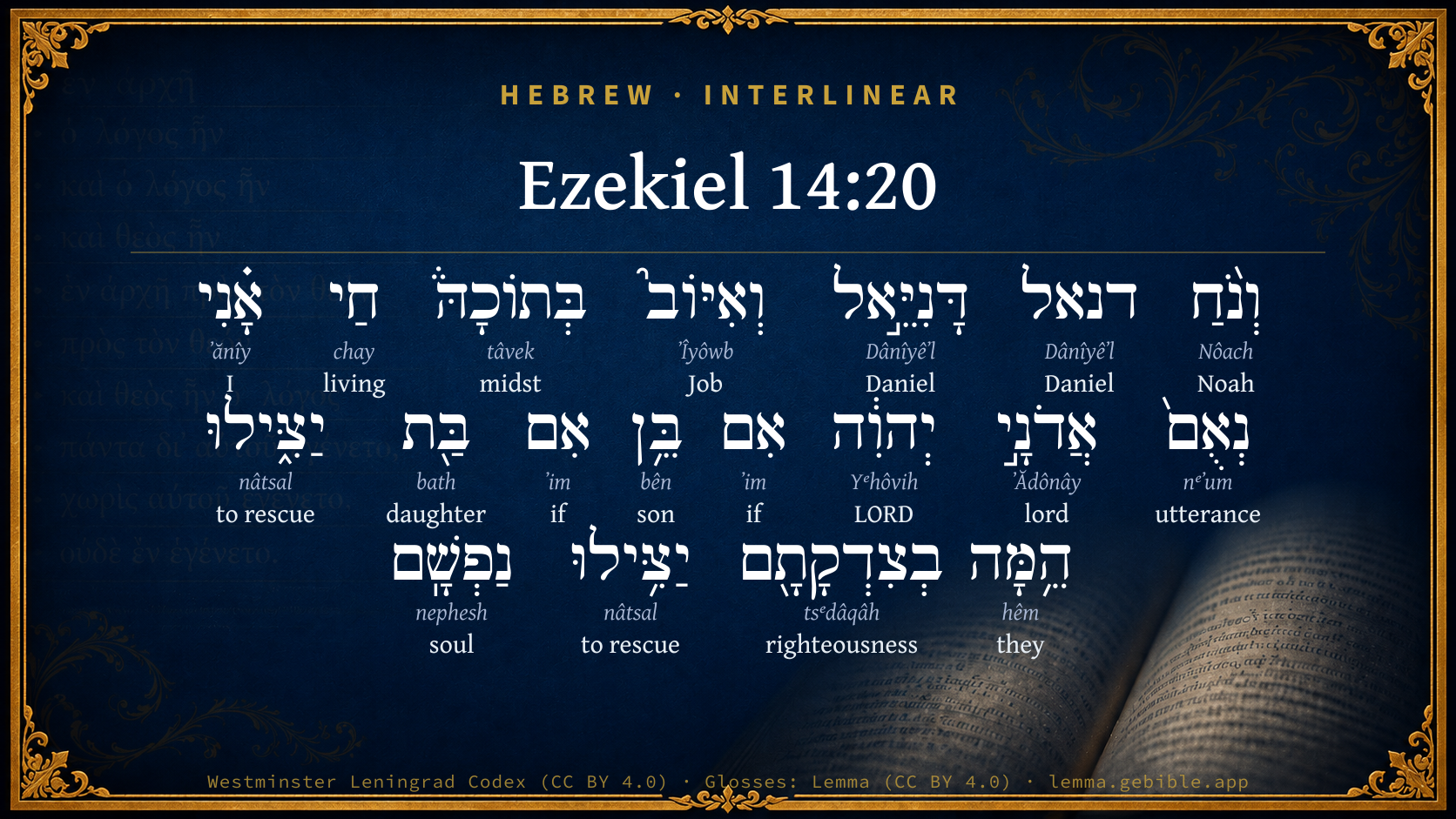
Hebrew (Westminster Leningrad Codex) Ezekiel 14:20 appears in the Hebrew Old Testament. The text above is from the Westminster Leningrad Codex. Each word links to its Strong’s number, a concise gloss, and parsing drawn from the Open Scriptures Hebrew Bible morphology. Click any word for its full Brown-Driver-Briggs (BDB) entry.
Download image
Cite this verse

Ezekiel 14:20 (World English Bible). Public Domain. Lemma interlinear Bible study tool, https://lemma.gebible.app/v/ezekiel/14/20.

Show BibTeX & RIS
BibTeX
RIS
English Translation
though Noah, Daniel, and Job, were in it, as I live, says the Lord Yahweh, they should deliver neither son nor daughter; they should but deliver their own souls by their righteousness.
World English Bible · Public Domain
Download a study sheet

One document with this verse’s original text, its word-by-word gloss line, the meaning frame, cross-references with their text, attributed commentary, and full source and license credits — printable, and it pastes into notes with its structure intact.

This verse Autodidact and up

Study sheet (.html) Plain text (.txt)

A passage Seminary Student

Up to 50 verses in one chapter. A passage sheet keeps up to 6 commentary sources and 12 cross-references per verse, in the order this page ranks them, and says so on the sheet whenever that leaves anything out. Ask for a single verse and you get the Autodidact verse sheet above.

Everything on this page stays free to read, with no account — the sheet is a download of what is already on screen, not access to it.

Want to remove ads? Support Godless Engineer
Compare translations 3

The same verse in 3 English versions, stacked beneath the original-language interlinear above. Click any original word for its lexicon entry.

Each is an independent rendering of the whole verse — the interlinear is not word-aligned to these translations.

Highlighted words mark where these versions differ — a whole-verse word diff, not a word-by-word alignment.

  • World English Bible Public Domain
    though Noah, Daniel, and Job, were in it, as I live, says the Lord Yahweh, they should deliver neither son nor daughter; they should but deliver their own souls by their righteousness.
  • King James Version Public Domain
    Though Noah, Daniel, and Job were in it, as I live, saith the Lord GOD, they shall deliver neither son nor daughter; they shall but deliver their own souls by their righteousness.
  • unfoldingWord Literal Text CC BY-SA 4.0
    then even if Noah, Daniel, and Job were in that land—as I live, declares the Lord Yahweh—they would not be able to rescue even their own sons or daughters; only their own lives would be rescued by their righteousness.

unfoldingWord Literal Text — © unfoldingWord, licensed CC BY-SA 4.0. Word-aligned USFM3 via Door43 (git.door43.org/unfoldingWord/en_ult).

Versions to compare (up to 4)

3 of 4 selected

Show all 18 translations

Every available English version of this verse, each an independent rendering of the whole verse.

  • World English Bible Public Domain
    though Noah, Daniel, and Job, were in it, as I live, says the Lord Yahweh, they should deliver neither son nor daughter; they should but deliver their own souls by their righteousness.
  • Berean Standard Bible Public Domain
    then as surely as I live, declares the Lord GOD, even if Noah, Daniel, and Job were in it, they could not deliver their own sons or daughters. Their righteousness could deliver only themselves.
  • Majority Standard Bible Public Domain
    then as surely as I live, declares the Lord GOD, even if Noah, Daniel, and Job were in it, they could not deliver their own sons or daughters. Their righteousness could deliver only themselves.
  • King James Version Public Domain
    Though Noah, Daniel, and Job were in it, as I live, saith the Lord GOD, they shall deliver neither son nor daughter; they shall but deliver their own souls by their righteousness.
  • American Standard Version (1901) Public Domain
    though Noah, Daniel, and Job, were in it, as I live, saith the Lord Jehovah, they should deliver neither son nor daughter; they should but deliver their own souls by their righteousness.
  • Revised Version (1885) Public Domain
    though Noah, Daniel, and Job, were in it, as I live, saith the Lord GOD, they shall deliver neither son nor daughter; they shall but deliver their own souls by their righteousness.
  • Geneva Bible (1599) Public Domain
    And though Noah, Daniel and Iob were in the middes of it, As I liue, sayth the Lord God, they shall deliuer neither sonne nor daughter: they shall but deliuer their owne soules by their righteousnes.
  • Douay-Rheims (1899) Public Domain
    And Noe, and Daniel, and Job be in the midst thereof: as I live, saith the Lord God, they shall deliver neither son nor daughter: but they shall only deliver their own souls by their justice.
  • Young's Literal Translation Public Domain
    and Noah, Daniel, and Job, in its midst: I live -- an affirmation of the Lord Jehovah -- neither son nor daughter do they deliver; they, by their righteousness, deliver their own soul.
  • Literal Standard Version CC BY-SA 4.0
    and [despite] Noah, Daniel, and Job, in its midst—[as] I live,” a declaration of Lord YHWH, “they deliver neither son nor daughter; they, by their righteousness, [only] deliver their own soul.”
  • Unlocked Literal Bible CC BY-SA 4.0
    then even if Noah, Daniel, and Job were in that land—as I live, declares the Lord Yahweh—they would not be able to rescue even their own sons or daughters; only their own lives would be rescued by their righteousness.
  • unfoldingWord Literal Text CC BY-SA 4.0
    then even if Noah, Daniel, and Job were in that land—as I live, declares the Lord Yahweh—they would not be able to rescue even their own sons or daughters; only their own lives would be rescued by their righteousness.
  • Darby Bible Public Domain
    and Noah, Daniel, and Job should be in it, [as] I live, saith the Lord Jehovah, they should deliver neither son nor daughter: they should [but] deliver their own souls by their righteousness.
  • World Messianic Bible Public Domain
    though Noah, Daniel, and Job, were in it, as I live,” says the Lord GOD, “they would deliver neither son nor daughter; they would deliver only their own souls by their righteousness.”
  • Webster's Bible Public Domain
    Though Noah, Daniel, and Job, were in it, as I live, saith the Lord GOD, they shall deliver neither son nor daughter; they shall deliver their own souls only by their righteousness.
  • Free Bible Version CC BY-SA 4.0
    As I live, declares the Lord God, even if Noah, Daniel, and Job were present, they couldn't save their sons or daughters. Their good lives would only save themselves.
  • Bible in Basic English Public Domain
    Even if Noah, Daniel, and Job were in it, by my life, says the Lord, they would not keep son or daughter safe; only themselves would they keep safe through their righteousness.
  • JPS Tanakh (1917) Public Domain
    though Noah, Daniel, and Job, were in it, as I live, saith the Lord GOD, they shall deliver neither son nor daughter; they shall but deliver their own souls by their righteousness.

Literal Standard Version (2020), Covenant Press — licensed CC BY-SA 4.0. Text via the HelloAO Bible API (eBible.org). Unlocked Literal Bible (unfoldingWord) — licensed CC BY-SA 4.0. Text via the HelloAO Bible API (eBible.org). unfoldingWord Literal Text — © unfoldingWord, licensed CC BY-SA 4.0. Word-aligned USFM3 via Door43 (git.door43.org/unfoldingWord/en_ult). Free Bible Version, Dr. Jonathan Gallagher — licensed CC BY-SA 4.0. Text via the HelloAO Bible API (eBible.org).

Word by word

More ways to search: Search by grammar → Find every occurrence → Compare this word →

Practice this passage: Drill this verse → Learn its vocabulary →

דנאל
Dânîyêʼl
H1840
“Daniel”
Noun, Proper
Part of Speech
Noun
Type
Proper
Full BDB Definition

Origin: from H1835 and H410

TWOT: None

Daniel = "God is my judge" - the 2nd son of David, by Abigail the Carmelitess - the 4th of the greater prophets, taken as hostage in the first deportation to Babylon, because of the gift of God of the interpretation of dreams, he became the 2nd in command of the Babylon empire and lasted through the end of the Babylonian empire and into the Persian empire. His prophecies are the key to the understanding of end time events. Noted for his purity and holiness by contemporary prophet, Ezekiel - a priest of the line of Ithamar who sealed the covenant with Nehemiah
  1. וְנֹ֨חַ Nôach H5146 “and · Noah” Conjunction + Noun, Proper
  2. דָּנִיֵּ֣אל Dânîyêʼl H1840 “Daniel” Noun, Proper
  3. וְאִיּוֹב֮ ʼÎyôwb H347 “and · Job” Conjunction + Noun, Proper
  4. בְּתוֹכָהּ֒ tâvek H8432 “in/at · midst · her” Preposition + Noun, Common, Masculine, Singular, Construct + Suffix, Personal, 3rd Person, Feminine, Singular
  5. חַי chay H2416 “living” Adjective, Adjective, Masculine, Singular, Absolute
  6. אָ֗נִי ʼănîy H589 “I” Pronoun, Personal, 1st Person, Common, Singular
  7. נְאֻם֙ nᵉʼum H5002 “utterance of” Noun, Common, Masculine, Singular, Construct
  8. אֲדֹנָ֣י ʼĂdônây H136 “Lord · my” Noun, Common, Masculine, Plural, Construct + Suffix, Personal, 1st Person, Common, Singular
  9. יְהוִ֔ה Yᵉhôvih H3069 “LORD” Noun, Proper
  10. אִם ʼim H518 “if” Conjunction
  11. בֵּ֥ן bên H1121 “son” Noun, Common, Masculine, Singular, Absolute
  12. אִם ʼim H518 “if” Conjunction
  13. בַּ֖ת bath H1323 “daughter” Noun, Common, Feminine, Singular, Absolute
  14. יַצִּ֑ילוּ nâtsal H5337 “to rescue” Verb, Hiphil, Imperfect, 3rd Person, Masculine, Plural
  15. הֵ֥מָּה hêm H1992 “they” Pronoun, Personal, 3rd Person, Masculine, Plural
  16. בְצִדְקָתָ֖ם tsᵉdâqâh H6666 “in/at · righteousness · their” Preposition + Noun, Common, Feminine, Singular, Construct + Suffix, Personal, 3rd Person, Masculine, Plural
  17. יַצִּ֥ילוּ nâtsal H5337 “to rescue” Verb, Hiphil, Imperfect, 3rd Person, Masculine, Plural
  18. נַפְשָֽׁם nephesh H5315 “soul · their” Noun, Common, Both, Singular, Construct + Suffix, Personal, 3rd Person, Masculine, Plural

About this verse

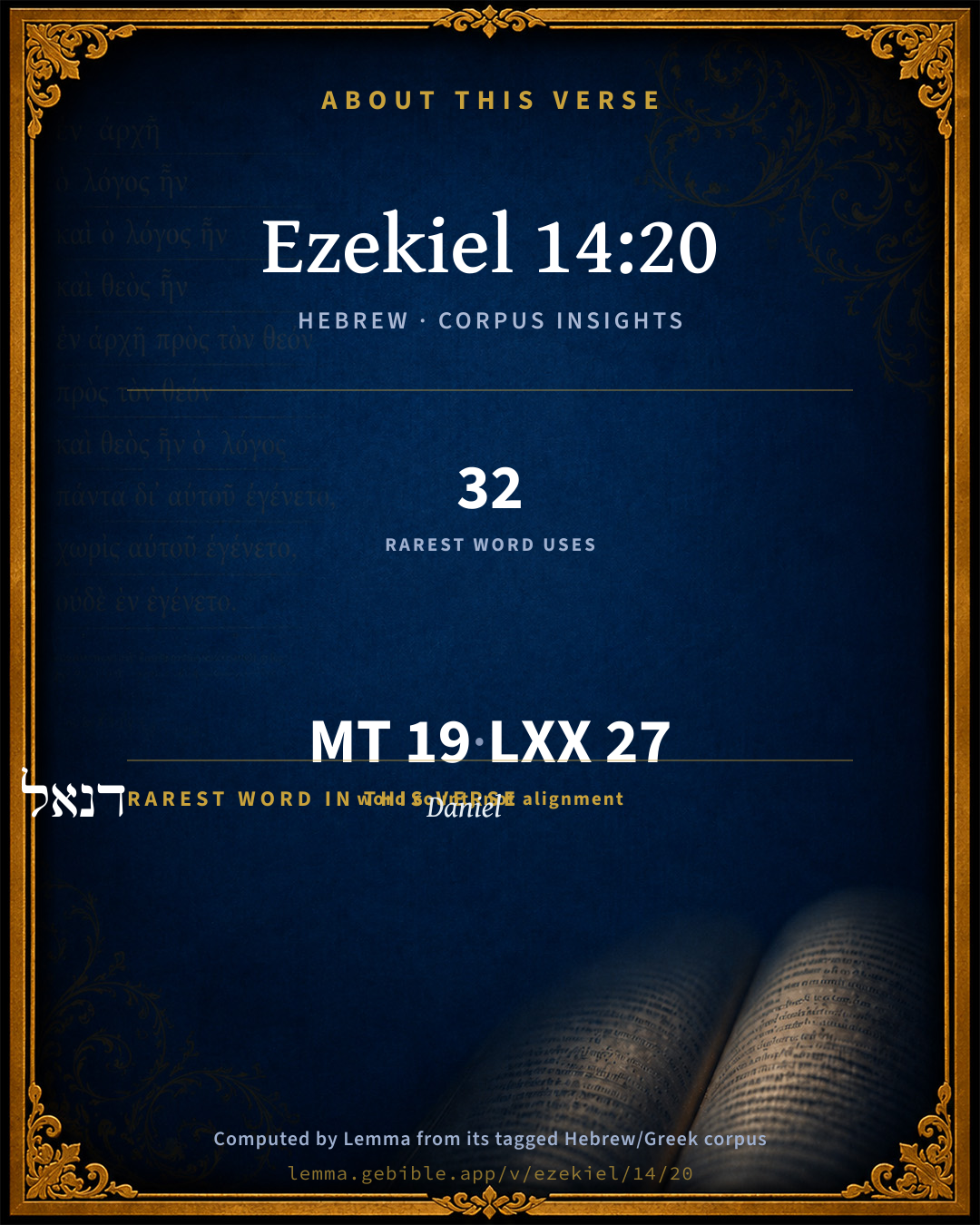
These counts appear in no published source. They are computed here, from the morphology-tagged text and Lemma’s own curated glosses. What Lemma adds →

19
words
16
distinct lemmas
Prophets
section

Shared distinctive vocabulary

דנאל Daniel H1840 occurs in 28 verses of the Hebrew Bible. Also found in:

Grammatical profile

  • 2 verbs
  • 12 nouns
  • 1 adjective
  • 2 pronouns
  • 2 conjunctions

Verb forms

  • יַצִּ֑ילוּ Hiphil · Imperfect
  • יַצִּ֥ילוּ Hiphil · Imperfect

Repetition

Words recur within this verse — often emphatic in Hebrew:

  • דנאל Daniel H1840 ×2
  • יַצִּ֑ילוּ to rescue H5337 ×2
  • אִם if H518 ×2

Hebrew & Septuagint length

In English translation the verse runs 32 words from the Hebrew and 37 from the Septuagint (LXX English) — closely comparable.

A rough comparison of the two English renderings, which tokenize alike — not a word-level alignment.

Word counts can differ between the Hebrew and the Greek without any difference in meaning — e.g. the Hebrew direct-object marker אֵת has no separate Greek word, and Greek often adds the article ὁ.

In the original languages it is 19 Hebrew tokens and 27 Greek tokens — but the two are counted differently (Hebrew bundles its prefixes and suffixes into one token; the Greek is in lemma form), so that isn’t a like-for-like length.

Cross-references

13

Topical passages linked to Ezekiel 14:20 in the Treasury of Scripture Knowledge — connected by theme and wording, ordered by reader-vote popularity; previews shown in the World English Bible.

  • Ezekiel 14:14 though these three men, Noah, Daniel, and Job, were in it, they should deliver but their own souls by their righteousness, says the Lord Yahweh.
  • 1 John 3:10 In this the children of God are revealed, and the children of the devil. Whoever doesn't do righteousness is not of God, neither is he who doesn't love his brother.
  • Job 5:19–24 He will deliver you in six troubles; Yes, in seven there shall no evil touch you.
  • Psalms 33:18–19 Behold, Yahweh's eye is on those who fear him, On those who hope in his loving kindness;
  • Isaiah 3:10 Tell the righteous "Good!" For they shall eat the fruit of their deeds.
  • Ezekiel 14:16 though these three men were in it, as I live, says the Lord Yahweh, they should deliver neither sons nor daughters; they only should be delivered, but the land should be desolate.
  • Ezekiel 18:22 None of his transgressions that he has committed shall be remembered against him: in his righteousness that he has done he shall live.
  • Hosea 10:12 Sow to yourselves in righteousness, Reap according to kindness. Break up your fallow ground; For it is time to seek Yahweh, Until he comes and rains righteousness on you.
  • Zephaniah 2:3 Seek Yahweh, all you humble of the land, who have kept his ordinances. Seek righteousness. Seek humility. It may be that you will be hidden in the day of Yahweh's anger.
  • Acts 10:35 but in every nation he who fears him and works righteousness is acceptable to him.
  • 1 John 2:29 If you know that he is righteous, you know that everyone who practices righteousness is born of him.
  • 1 John 3:7 Little children, let no one lead you astray. He who does righteousness is righteous, even as he is righteous.
  • Ezekiel 18:20 The soul who sins, he shall die: the son shall not bear the iniquity of the father, neither shall the father bear the iniquity of the son; the righteousness of the righteous shall be on him, and the wickedness of the wicked shall be on him.

Cross-references courtesy of OpenBible.info (CC BY 4.0).

Hebrew and Greek witnesses Masoretic Hebrew ↔ Greek Septuagint

The same verse in the two great witnesses to the Old Testament, shown verse-for-verse.

These are two independent witnesses, not word-aligned to each other, and the Septuagint is shown in lemma (dictionary) form.

Hebrew Ezekiel 14:20 Masoretic · Westminster Leningrad Codex

וְנֹ֨חַ דנאל דָּנִיֵּ֣אל וְאִיּוֹב֮ בְּתוֹכָהּ֒ חַי אָ֗נִי נְאֻם֙ אֲדֹנָ֣י יְהוִ֔ה אִם בֵּ֥ן אִם בַּ֖ת יַצִּ֑ילוּ הֵ֥מָּה בְצִדְקָתָ֖ם יַצִּ֥ילוּ נַפְשָֽׁם

though Noah, Daniel, and Job, were in it, as I live, says the Lord Yahweh, they should deliver neither son nor daughter; they should but deliver their own souls by their righteousness.

World English Bible · Public Domain

Greek LXX Ezekiel 14:20 Septuagint · lemma form

καί νωε καί δανιηλ καί ιωβ ἐν μέσος αὐτός ζάω ἐγώ λέγω κύριος ἐάν υἱός ἤ θυγάτηρ ὑπολείπω αὐτός ἐν ὁ δικαιοσύνη αὐτός ῥύομαι ὁ ψυχή αὐτός

and should Noe, and Daniel, and Job, be in the midst of it, as I live, says the Lord, there shall be left them neither sons nor daughters; only they by their righteousness shall deliver their souls.

LXX2012 (modern English Septuagint) · Public Domain

Hebrew: Westminster Leningrad Codex (CC BY 4.0). Greek: Septuagint (public domain); English from LXX2012 (modern English Septuagint) (Public Domain). How the Septuagint differs from the Hebrew →

Targum (Aramaic paraphrase)

1

The Targum is the ancient Jewish Aramaic paraphrase of the Hebrew Scriptures — an interpretive translation, not the Hebrew text itself. Onkelos (literal) and Pseudo-Jonathan (expansive) render the Torah, and Jonathan the Prophets. Coverage is partial: where no permissively-licensed English translation exists for a verse, only the Aramaic is shown. This is verse-level text, not a word-by-word alignment to the Hebrew.

  1. Targum Jonathan Prophets (Joshua–Malachi)
    וְנֹחַ דָנִיאֵל וְאִיוֹב בְּגַוָהּ וְקַיָם אֲנָא אֲמַר יְיָ אֱלֹהִים אִם בַּר אִם בְּרַתָּא יְשֵׁיזְבוּן אִינוּן בִּזְכוּתְהוֹן יְשֵׁיזְבוּן נַפְשְׁהוֹן:

    (no public-domain English translation for this verse)

    Targum Jonathan — Aramaic: “Mikraot Gedolot” (public domain). English: “Sefaria Community Translation” (CC0 1.0 (public-domain dedication)); “London "Chaldee Paraphrase," 1871” (public domain). Text via Sefaria.

Commentary

Notes on Ezekiel 14:20 from classic Christian and Jewish commentators (each source and its license shown beneath its notes). The classic Christian expositions comment on the surrounding passage and are grouped to its opening verse, so a note may address several verses; the Jewish commentaries on the Tanakh (Rashi and others) are per-verse, so they appear only where the commentator wrote on this verse.

Lemma curates 59 commentaries, every one of them public domain or Creative Commons licensed, each selected and text-cleaned for this edition rather than reprinted as found. About our sources →

Trapp's Complete Commentary

John Trapp

Eze 14:20 Though Noah, Daniel, and Job, [were] in it, [as] I live, saith the Lord GOD, they shall deliver neither son nor daughter; they shall [but] deliver their own souls by their righteousness.

Ver. 20. Neither son nor daughter.] Though it were an only one, and so more dear to them.

They shall but deliver.] Howbeit a good man also may die of the plague, as did Oecolampadius, Greenham, &c.

John Trapp, A Commentary or Exposition upon All the Books of the Old and New Testament (1647–1656) — public domain. Text from a community e-Sword module.

John Gill's Exposition

For thus saith the Lord God, how much more,.... If the Lord would not be entreated by such good men as those mentioned, for a land that had sinned against him, to whom he only sends some one of the above judgments, either famine, or noisome beasts, or the sword, or the pestilence, how much more inexorable and deaf to all entreaties must he be; or if anyone of those judgments makes so great a desolation in the land, then how much greater must that detraction be,

when I send my four sore judgments on Jerusalem: or "evil" (a) ones; as they are to men, though righteously inflicted by the Lord; when all these four are sent together, what a devastation must they make! namely,

the sword, and the famine, and the, noisome beast, and the pestilence,

to cut off from it man and beast; three of them, it is evident, were sent upon Jerusalem at the time of its siege by Nebuchadnezzar, the sword, famine, and pestilence; and no doubt the other, even the noisome beasts; and if not literally, yet figuratively, for Nebuchadnezzar himself is compared to a lion, Jer 4:7.

(a) "mala", Pagninus, Montanus, Cocceius, Starckius; "pessima", Junius & Tremellius, Vatablus.

John Gill's Exposition of the Whole Bible (1746–1763) — public domain (CC PDM 1.0). Text via the HelloAO Bible API.

Matthew Poole's English Annotations

Their own souls; their person, their life.

By their righteousness; not meriting the deliverance, but yet the justice and mercy of God shall surely keep them from falling in the punishment who were kept from the sin.

Matthew Poole's English Annotations on the Holy Bible (1683–1685) — public domain. Text from a community e-Sword/MySword module.

Whedon's Commentary on the Bible

Daniel D. Whedon

20. By their righteousness — This is the strength of all intercessory prayer; but no prayer, however fervent, coming from any heart, however righteous, can put away this punishment so justly due to willful and persistent transgression and guilt. (See chap. 33.)

Daniel D. Whedon (gen. ed.), Commentary on the Old and New Testaments (1874–1909) — public domain. Text from a community e-Sword module.

The Pulpit Commentary

The privilege and power of the godly, their nature and limitation.

Noah, Daniel, and Job were in it, as I live, saith the Lord God," etc. Three very distinguished men are here mentioned, two of whom had long passed away from this world and all its scenes, the other was yet amongst men upon earth. Yet Noah and Job are spoken of as still in being.

Absent from this world, they were yet living and present in the great universe of God. These undesigned testimonies to man"s immortality, to be met with frequently in the Scriptures, afford the basin for a strong argument in support of that fact.

The dead are like the stars by day, Withdrawn from mortal eye; But not extinct, they hold their way In glory through the sky.

Spirits from bondage thus set free Vanish amidst immensity, Where human thought, like human sight, Fails to pursue their trackless flight.

Daniel at this time, like Ezekiel, was an exile in Babylon, and was eminent both for his piety and his position. Noah, Daniel, and Job were all good men and great men; they are enrolled amongst the most illustrious of our race. The prophet in this paragraph predicts "four sore judgments upon Jerusalem, the sword, and the famine, and the noisome beast, and the pestilence," by reason of their idolatry and other sins. And in the text he declares that, when the hour of judgment arrives, even the presence of such men as Noah, Daniel, and Job in the doomed city would not avail to save any but their own souls.

I THE PRIVILEGES OF GOOD MEN. Our text announces the safety of good men even in the extremest dangers and the most irresistible judgments. "They shall deliver their own souls by their righteousness." History affords remarkable examples of the deliverance of the good in times of sore peril. (cf. Gen_7:23 Gen_18:32 Gen_19:15-25) But it is not often that the godly are exempted from the calamities and judgments which befall the wicked. Thus Daniel, Ezekiel, and other holy men were carried into Chaldea with those to whom the exile was the punishment of idolatry, and were now suffering that exile with them. But invariably "they deliver their own souls by their righteousness." "If their bodies be not delivered, yet their souls are." Amid the overthrow of cities, the ruin of countries, or even the wreck of the world, their spiritual interests are secure. Moreover, though they are not exempt from general calamities, yet to them the calamities wear a different aspect from that which they present to the wicked. They are sustained under them, and enabled to hear them with heroic patience. The suffering which comes to the wicked as the judgment of a stern Ruler comes to the righteous as the chastisement of a loving Father. And, by his grace, out of the scars of suffering, God will evolve the beauties of holiness. The darkness and anguish which embitter and harden the heart of the wicked will increase the trust and tenderness and refine the graces of the righteous.

II THE POWER OF GOOD MEN. Our text implies that Noah, Daniel, and Job had power to do much for their fellow men; that they could do much in averting destruction and saving man. The warning that these three saints would not be able to screen them from this judgment implies the belief on the part of the people of Jerusalem that the good men amongst them, by their lives and prayers, would turn aside the threatening storm. If any can turn away the judgments of Heaven from a nation of evil doers, good men can do it. God may spare the wicked because of the righteous. The power of good men to avert Divine wrath from a people has at least two branches.

1. The power of moral influence with men. They are "the salt of the earth." Were it not for their influence society would become hopelessly corrupt, and the storm of God"s judgment would sweep the guilty race from the earth.

2. The power of intercession with God. We have illustrious examples of this. (cf. Gen_18:23-32; Exo_32:11-14, Exo_32:30-34; Num_11:1-3 Num_14:13-20 Num_16:44-50) Who can estimate the power of the intercession of good men?

III THE LIMITATION OF THE POWER OF GOOD MEN. "Though Noah, Daniel, and Job were in it as I live, saith the Lord God, they shall deliver neither son nor daughter." "When the sin of a people has come to its height, and the decree has gone forth for their ruin, the piety and prayers of the best men shall not prevail to finish the controversy. This is here asserted again and again, that, though these three men were in Jerusalem at this time, yet they should deliver neither son nor daughter, not so much as the little ones should be spared for their sakes." This shows how dark and terrible the guilt of the inhabitants of Jerusalem must have been. (cf. Jer_15:1 Jer_7:16 Jer_11:14) When the forbearance of God is exhausted, any number of the holiest of men cannot ward off the stroke of doom. Character may become so utterly depraved that reformation is impossible, and then nothing but judgment remains. Moral disease may become so deeply rooted and strong that no influence can overcome it, no power eradicate it, and then destruction is inevitable. When the Divine means of reformation have all been tiled, and all have failed, what remains but utter ruin? "Abused patience will turn at last into inexorable wrath.

CONCLUSION.

1. Our subject speaks earnestly to parents concerning the salvation of their children. If you would save your children you must begin to work early and wisely. While the chains of evil habits are unforged, and the heart is susceptible of sacred impressions, and the conscience sensitive, and the sympathies tender, we must seek the salvation of our children if we would secure it. Oh, the time may come when the holiest of men "shall deliver neither son nor daughter" from the storms of God"s judgment!

2. Our text reminds us all that salvation is a personal concern. Our kinsfolk and friends may be pious in life and powerful in prayer; but their piety will not avail for them and for us. No man possesses superfluous grace. Continuance in sin may lead, nay, must lead, to a moral condition in which the prayers of the most loving and sainted parents may avail nothing for their own son or daughter. You must believe on Jesus Christ for yourself, repent of your sins yourself. You must "work out your own salvation." There is no working by proxy here. "Each man shall bear his own burden." "Each one of us shall give account of himself to God." Therefore "strive to enter in by the narrow door," etc. "Give the more diligence to make your calling and election sure. W.J.

The Pulpit Commentary (1880–1919), ed. H.D.M. Spence-Jones & Joseph S. Exell — public domain. Text from a community e-Sword module.

Lesson kit

Teaching starters — assembled from the data on this page, not authored interpretation. Every prompt links to the verse data it draws on. Edit before teaching.

Ezekiel, in the Prophets, opens this verse with 19 words (16 distinct Hebrew lemmas). Its most distinctive word is Dânîyêʼl (“Daniel”). A historical commentator’s framing appears above. Read the whole chapter for the surrounding context.

Discussion questions

  1. How does “Daniel” (Dânîyêʼl) shape what this verse is saying?
  2. 1 Chronicles 3:1 shares the word «Daniel» with this verse. How do the two illuminate each other?
  3. “Daniel” occurs 2× in this one verse. What is the effect of the repetition?
  4. These translations render this verse differently. What is at stake in choosing one wording over another?
  5. The verb «יַצִּ֑ילוּ» is Hiphil Imperfect. How does its form color the action?
  6. Reading how Trapp's Complete Commentary and John Gill's Exposition read this verse, where do the two commentators agree and where do they part?

Things to notice

Reading settings

Reading text

Shown beneath each verse's original-language words.

Old Testament
Old Testament edition

Read the OT as the Masoretic Hebrew (MT) or the Greek Septuagint (LXX).

English shown for the Greek Septuagint (in the Hebrew ↔ Greek comparison).

Comparing translations? Open the Compare panel on any verse page to stack up to four side by side.