2 Samuel 14:16

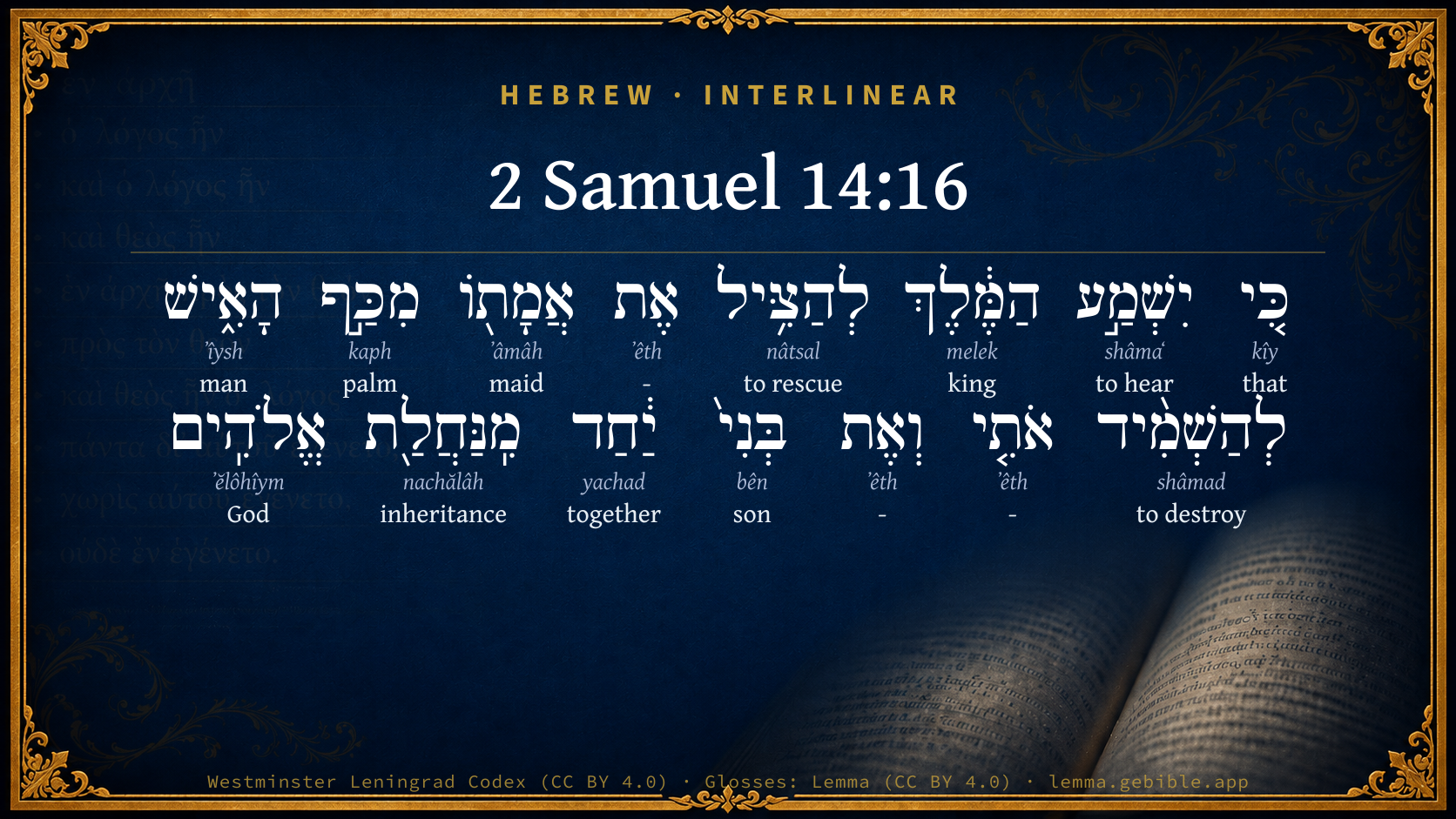
Hebrew (Westminster Leningrad Codex) 2 Samuel 14:16 appears in the Hebrew Old Testament. The text above is from the Westminster Leningrad Codex. Each word links to its Strong’s number, a concise gloss, and parsing drawn from the Open Scriptures Hebrew Bible morphology. Click any word for its full Brown-Driver-Briggs (BDB) entry.
Download image
Cite this verse

2 Samuel 14:16 (World English Bible). Public Domain. Lemma interlinear Bible study tool, https://lemma.gebible.app/v/2-samuel/14/16.

Show BibTeX & RIS
BibTeX
RIS
English Translation
For the king will hear, to deliver his servant out of the hand of the man who would destroy me and my son together out of the inheritance of God.
World English Bible · Public Domain
Download a study sheet

One document with this verse’s original text, its word-by-word gloss line, the meaning frame, cross-references with their text, attributed commentary, and full source and license credits — printable, and it pastes into notes with its structure intact.

This verse Autodidact and up

Study sheet (.html) Plain text (.txt)

A passage Seminary Student

Up to 50 verses in one chapter. A passage sheet keeps up to 6 commentary sources and 12 cross-references per verse, in the order this page ranks them, and says so on the sheet whenever that leaves anything out. Ask for a single verse and you get the Autodidact verse sheet above.

Everything on this page stays free to read, with no account — the sheet is a download of what is already on screen, not access to it.

Want to remove ads? Support Godless Engineer
Compare translations 3

The same verse in 3 English versions, stacked beneath the original-language interlinear above. Click any original word for its lexicon entry.

Each is an independent rendering of the whole verse — the interlinear is not word-aligned to these translations.

Highlighted words mark where these versions differ — a whole-verse word diff, not a word-by-word alignment.

  • World English Bible Public Domain
    For the king will hear, to deliver his servant out of the hand of the man who would destroy me and my son together out of the inheritance of God.
  • King James Version Public Domain
    For the king will hear, to deliver his handmaid out of the hand of the man that would destroy me and my son together out of the inheritance of God.
  • unfoldingWord Literal Text CC BY-SA 4.0
    For the king will listen to deliver his female servant from the palm of the man to destroy me and my son together from the inheritance of God.’

unfoldingWord Literal Text — © unfoldingWord, licensed CC BY-SA 4.0. Word-aligned USFM3 via Door43 (git.door43.org/unfoldingWord/en_ult).

Versions to compare (up to 4)

3 of 4 selected

Show all 18 translations

Every available English version of this verse, each an independent rendering of the whole verse.

  • World English Bible Public Domain
    For the king will hear, to deliver his servant out of the hand of the man who would destroy me and my son together out of the inheritance of God.
  • Berean Standard Bible Public Domain
    For the king will hear and deliver his maidservant from the hand of the man who would cut off both me and my son from God’s inheritance.’
  • Majority Standard Bible Public Domain
    For the king will hear and deliver his maidservant from the hand of the man who would cut off both me and my son from God’s inheritance.’
  • King James Version Public Domain
    For the king will hear, to deliver his handmaid out of the hand of the man that would destroy me and my son together out of the inheritance of God.
  • American Standard Version (1901) Public Domain
    For the king will hear, to deliver his servant out of the hand of the man that would destroy me and my son together out of the inheritance of God.
  • Revised Version (1885) Public Domain
    For the king will hear to deliver his servant out of the hand of the man that would destroy me and my son together out of the inheritance of God.
  • Geneva Bible (1599) Public Domain
    For the King wil heare, to deliuer his handmayde out of the hande of the man that woulde destroy mee, and also my sonne from the inheritance of God.
  • Douay-Rheims (1899) Public Domain
    And the king hath hearkened to me to deliver his handmaid out of the hand of all that would destroy me and my son together out of the inheritance of God.
  • Young's Literal Translation Public Domain
    for the king doth hearken to deliver his handmaid out of the paw of the man `seeking' to destroy me and my son together out of the inheritance of God,
  • Literal Standard Version CC BY-SA 4.0
    for the king listens to deliver his handmaid out of the paw of the man [seeking] to destroy me and my son together out of the inheritance of God,
  • Unlocked Literal Bible CC BY-SA 4.0
    Perhaps the king will listen to me and deliver his servant from the hand of the man who would destroy me and my son together, out of the inheritance God gave us.'
  • unfoldingWord Literal Text CC BY-SA 4.0
    For the king will listen to deliver his female servant from the palm of the man to destroy me and my son together from the inheritance of God.’
  • Darby Bible Public Domain
    For the king will hear, to deliver his handmaid out of the hand of the man that would destroy me and my son together out of the inheritance of God.
  • World Messianic Bible Public Domain
    For the king will hear, to deliver his servant out of the hand of the man who would destroy me and my son together out of the inheritance of God.
  • Webster's Bible Public Domain
    For the king will hear, to deliver his handmaid from the hand of the man that would destroy me and my son together out of the inheritance of God.
  • Free Bible Version CC BY-SA 4.0
    Perhaps the king will listen and save me from the man who would cut off both me and my son from God's chosen people.
  • Bible in Basic English Public Domain
    For the king will give ear, and take his servant out of the power of the man whose purpose is the destruction of me and my son together from the heritage of God.
  • JPS Tanakh (1917) Public Domain
    For the king will hear, to deliver his servant out of the hand of the man that would destroy me and my son together out of the inheritance of God.

Literal Standard Version (2020), Covenant Press — licensed CC BY-SA 4.0. Text via the HelloAO Bible API (eBible.org). Unlocked Literal Bible (unfoldingWord) — licensed CC BY-SA 4.0. Text via the HelloAO Bible API (eBible.org). unfoldingWord Literal Text — © unfoldingWord, licensed CC BY-SA 4.0. Word-aligned USFM3 via Door43 (git.door43.org/unfoldingWord/en_ult). Free Bible Version, Dr. Jonathan Gallagher — licensed CC BY-SA 4.0. Text via the HelloAO Bible API (eBible.org).

Word by word

More ways to search: Search by grammar → Find every occurrence → Compare this word →

Practice this passage: Drill this verse → Learn its vocabulary →

אֲמָת֖וֹ
ʼâmâh
H519
“maid · his”
Noun, Common, Feminine, Singular, Construct + Suffix, Personal, 3rd Person, Masculine, Singular
Part of Speech
Noun
Type
Common
Gender
Feminine
Number
Singular
State
Construct
Full BDB Definition

Origin: apparently a primitive word

TWOT: 112

maid-servant, female slave, maid, handmaid, concubine - of humility (figuratively)
  1. כִּ֚י kîy H3588 “that” Conjunction
  2. יִשְׁמַ֣ע shâmaʻ H8085 “to hear” Verb, Qal, Imperfect, 3rd Person, Masculine, Singular
  3. הַמֶּ֔לֶךְ melek H4428 “the · king” Particle, Definite Article + Noun, Common, Masculine, Singular, Absolute
  4. לְהַצִּ֥יל nâtsal H5337 “to rescue” Preposition + Verb, Hiphil, Infinitive Construct
  5. אֶת ʼêth H853 “-” Particle, Direct Object
  6. מִכַּ֣ף kaph H3709 “from · palm of” Preposition + Noun, Common, Feminine, Singular, Construct
  7. הָאִ֑ישׁ ʼîysh H376 “the · man” Particle, Definite Article + Noun, Common, Masculine, Singular, Absolute
  8. לְהַשְׁמִ֨יד shâmad H8045 “to destroy” Preposition + Verb, Hiphil, Infinitive Construct
  9. אֹתִ֤י ʼêth H853 “- · me” Particle, Direct Object + Suffix, Personal, 1st Person, Common, Singular
  10. וְאֶת ʼêth H853 “and · -” Conjunction + Particle, Direct Object
  11. בְּנִי֙ bên H1121 “son · my” Noun, Common, Masculine, Singular, Construct + Suffix, Personal, 1st Person, Common, Singular
  12. יַ֔חַד yachad H3162 “together” Adverb
  13. מִֽנַּחֲלַ֖ת nachălâh H5159 “from · inheritance of” Preposition + Noun, Common, Feminine, Singular, Construct
  14. אֱלֹהִֽים ʼĕlôhîym H430 “God(s)” Noun, Common, Masculine, Plural, Absolute

About this verse

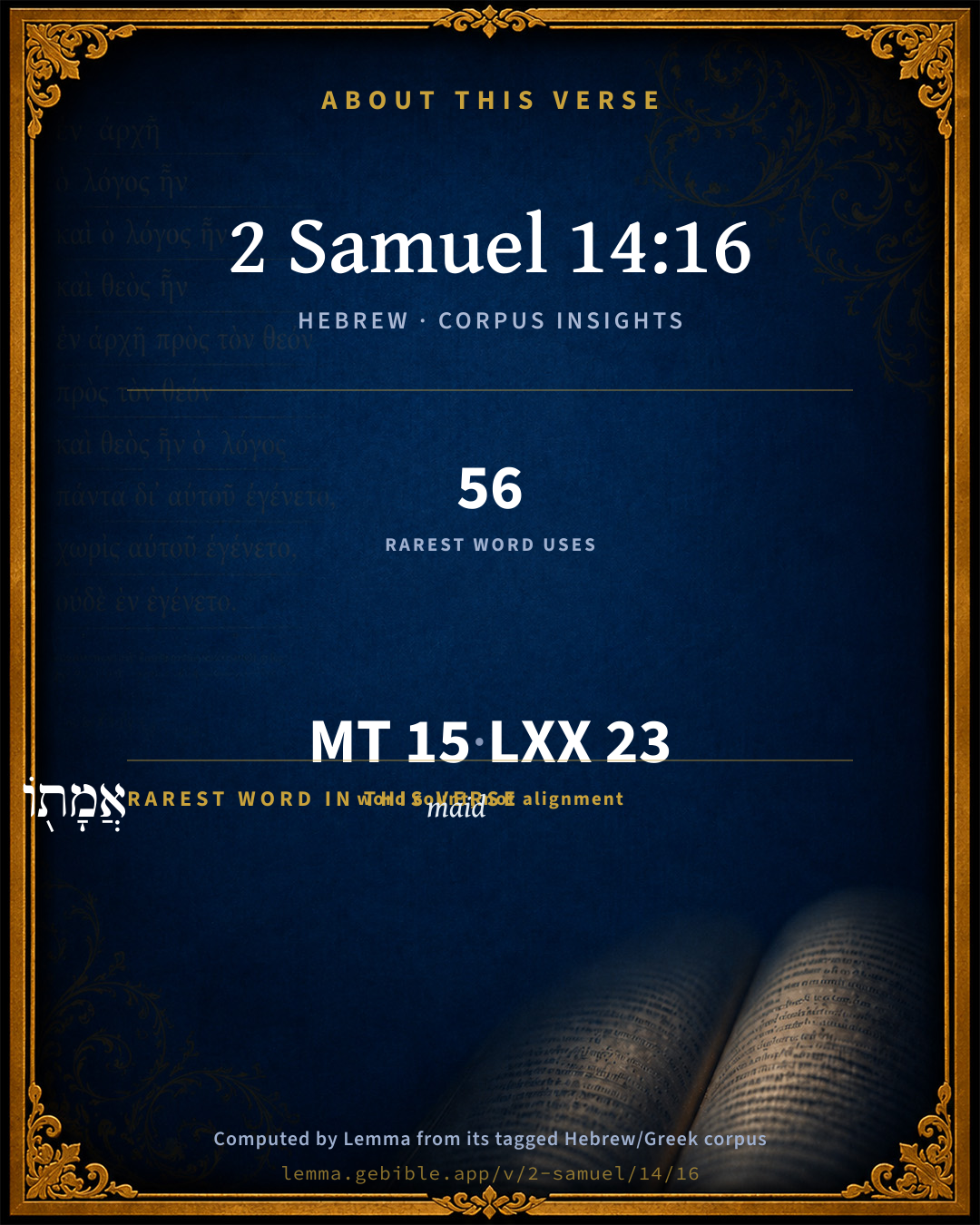
These counts appear in no published source. They are computed here, from the morphology-tagged text and Lemma’s own curated glosses. What Lemma adds →

15
words
13
distinct lemmas
Historical
section

Shared distinctive vocabulary

אֲמָת֖וֹ maid H519 occurs in 49 verses of the Hebrew Bible. Also found in:

Grammatical profile

  • 3 verbs
  • 7 nouns
  • 1 conjunction
  • 1 adverb
  • 3 particles

Verb forms

  • יִשְׁמַ֣ע Qal · Imperfect
  • לְהַצִּ֥יל Hiphil · Infinitive Construct
  • לְהַשְׁמִ֨יד Hiphil · Infinitive Construct

Hebrew & Septuagint length

In English translation the verse runs 30 words from the Hebrew and 31 from the Septuagint (LXX English) — closely comparable.

A rough comparison of the two English renderings, which tokenize alike — not a word-level alignment.

Word counts can differ between the Hebrew and the Greek without any difference in meaning — e.g. the Hebrew direct-object marker אֵת has no separate Greek word, and Greek often adds the article ὁ.

In the original languages it is 15 Hebrew tokens and 23 Greek tokens — but the two are counted differently (Hebrew bundles its prefixes and suffixes into one token; the Greek is in lemma form), so that isn’t a like-for-like length.

Cross-references

1

Topical passages linked to 2 Samuel 14:16 in the Treasury of Scripture Knowledge — connected by theme and wording, ordered by reader-vote popularity; previews shown in the World English Bible.

  • 1 Samuel 26:19 Now therefore, please let my lord the king hear the words of his servant. If it be Yahweh that has stirred you up against me, let him accept an offering: but if it be the children of men, cursed be they before Yahweh: for they have driven me out this day that I shouldn't cling to Yahweh's inheritance, saying, Go, serve other gods.

Cross-references courtesy of OpenBible.info (CC BY 4.0).

Hebrew and Greek witnesses Masoretic Hebrew ↔ Greek Septuagint

The same verse in the two great witnesses to the Old Testament, shown verse-for-verse.

These are two independent witnesses, not word-aligned to each other, and the Septuagint is shown in lemma (dictionary) form.

Hebrew 2 Samuel 14:16 Masoretic · Westminster Leningrad Codex

כִּ֚י יִשְׁמַ֣ע הַמֶּ֔לֶךְ לְהַצִּ֥יל אֶת אֲמָת֖וֹ מִכַּ֣ף הָאִ֑ישׁ לְהַשְׁמִ֨יד אֹתִ֤י וְאֶת בְּנִי֙ יַ֔חַד מִֽנַּחֲלַ֖ת אֱלֹהִֽים

For the king will hear, to deliver his servant out of the hand of the man who would destroy me and my son together out of the inheritance of God.

World English Bible · Public Domain

Greek LXX 2 Samuel 14:16 Septuagint · lemma form

ὅτι ἀκούω ὁ βασιλεύς ῥύομαι ὁ δούλη αὐτός ἐκ χείρ ὁ ἀνήρ ὁ ζητέω ἐκαἴρω ἐγώ καί ὁ υἱός ἐγώ ἀπό κληρονομία θεός

for the king will hear. Let him rescue his handmaid out of the hand of the man that seeks to cast out me and my son from the inheritance of God.

LXX2012 (modern English Septuagint) · Public Domain

Hebrew: Westminster Leningrad Codex (CC BY 4.0). Greek: Septuagint (public domain); English from LXX2012 (modern English Septuagint) (Public Domain). How the Septuagint differs from the Hebrew →

Targum (Aramaic paraphrase)

1

The Targum is the ancient Jewish Aramaic paraphrase of the Hebrew Scriptures — an interpretive translation, not the Hebrew text itself. Onkelos (literal) and Pseudo-Jonathan (expansive) render the Torah, and Jonathan the Prophets. Coverage is partial: where no permissively-licensed English translation exists for a verse, only the Aramaic is shown. This is verse-level text, not a word-by-word alignment to the Hebrew.

  1. Targum Jonathan Prophets (Joshua–Malachi)
    אֲרֵי יִשְׁמַע מַלְכָּא לְשֵׁיזָבָא יַת אַמְתֵיהּ מִיַד גַבְרָא לְשֵׁיצָאָה יָתִי וְיַת בְּרִי כַּחֲדָא מֵאַחֲסָנַת עַמָא דַיָי:

    (no public-domain English translation for this verse)

    Targum Jonathan — Aramaic: “Mikraot Gedolot” (public domain). English: “Sefaria Community Translation” (CC0 1.0 (public-domain dedication)); “London "Chaldee Paraphrase," 1871” (public domain). Text via Sefaria.

Commentary

Notes on 2 Samuel 14:16 from classic Christian and Jewish commentators (each source and its license shown beneath its notes). The classic Christian expositions comment on the surrounding passage and are grouped to its opening verse, so a note may address several verses; the Jewish commentaries on the Tanakh (Rashi and others) are per-verse, so they appear only where the commentator wrote on this verse.

Lemma curates 59 commentaries, every one of them public domain or Creative Commons licensed, each selected and text-cleaned for this edition rather than reprinted as found. About our sources →

Trapp's Complete Commentary

John Trapp

2Sa 14:16 For the king will hear, to deliver his handmaid out of the hand of the man [that would] destroy me and my son together out of the inheritance of God.

Ver. 16. For the king will hear.] Or else he hath lost his old wont. And if he yield to me for the rescuing of my son, will he not do the like for his own at the suit of the whole people? will he in similibus causis dissimilem ferre sententiam? This was her argument; but not so sound a one; for the king’s case and hers were different. But orators are permitted non ad veritatem solum, sed etiam ad opiniones eorum qui audiunt, orationem accommodare, saith a great master in rhetoric: {a} that is to tune and turn their tongues somewhat to the humours of their hearers.

{a} Cicer., Partit.

John Trapp, A Commentary or Exposition upon All the Books of the Old and New Testament (1647–1656) — public domain. Text from a community e-Sword module.

Joseph Benson's Commentary

2Sa 14:16. For the king will hear — Clemency and kindness are the properties of a good king, and such a king, she insinuates, she knew David to be, who, she was persuaded, would grant her audience and acceptance. To deliver his handmaid, &c. — By granting her request concerning her son, in whose life, she intimates, her own was bound up, so that she could not outlive his death; supposing that David’s case might be similar, and therefore that this might touch him in a tender part, though it was not proper to say so expressly; and thereby suggesting, that the safety and comfort of the people of Israel depended on Absalom’s restoration. Out of the inheritance of God — That is, out of that land which God gave to his people, to be their inheritance, and in which alone he hath fixed the place of his presence and worship. Thus she artfully reminds the king how dangerous it was to let Absalom (unto whom she had ventured to apply her case) continue among idolaters, in a state of separation from God, his house, and people.

Joseph Benson's Commentary on the Old and New Testaments (1811–1818) — public domain. Text from a community e-Sword module.

Tyndale Open Study Notes

Tyndale Open Resources

14:16 The woman again addressed her specific situation. The king’s concern for Absalom (see 13:39 and corresponding note) was keeping him from attending to matters of justice among his people. • cut us off: If her only remaining son were killed, the woman’s family would lose ownership of its ancestral property (cp. Num 27:1-11).

Tyndale Open Study Notes — © Tyndale Open Resources, licensed CC BY-SA 4.0. Text via the HelloAO Bible API.

The Cambridge Bible for Schools and Colleges

gen. ed. J. J. S. Perowne

16. the inheritance of God] The nation of Israel. Cp. 1Sa_26:19; Deu_32:9.

The Cambridge Bible for Schools and Colleges (gen. ed. J. J. S. Perowne; Cambridge University Press, 1878–1918) — public domain. Text from a community e-Sword module.

John Gill's Exposition

For the king will hear,.... She was fully persuaded of it, as now he had heard her:

to deliver his handmaid out of the hand of the man that would destroy me and my son together out of the inheritance of God; he had given his word and his oath that he would deliver her son from the avenger of blood, that neither he nor any other should destroy him; which would have been the destruction of her and her whole family out of the land of Israel, the land which God had chosen for his inheritance, and had given to the of Israel to be theirs; and since the king had heard her, and granted her this favour, she doubted not but that he would deliver his own son from death, and restore him to the inheritance of the land, where he might worship the Lord God of his fathers, of which he was now deprived.

John Gill's Exposition of the Whole Bible (1746–1763) — public domain (CC PDM 1.0). Text via the HelloAO Bible API.

Haydock's Catholic Bible Commentary

Me. She identifies her cause with that of her son, as if she could not survive his death; or, at least, could not retain the inheritance, if he should perish. (Haydock)

George Leo Haydock (1774–1849), Haydock's Catholic Family Bible and Commentary, 1859 edition — public domain. Excludes Psalms (Douay-Rheims chapter numbering differs from Protestant) and Deuterocanonical books (Catholic canon only).

Matthew Poole's English Annotations

For I know the king is so wise and just, that I assure myself of audience and acceptation; which expectation of hers is cunningly insinuated here, that the king might conceive himself obliged to answer it, and not to disappoint her hope, nor to forfeit that good opinion which his subjects now had of him.

To deliver his handmaid out of the hand of the man; to grant my request concerning my son, and consequently the people’s petition concerning Absalom.

Me and my son; implying that her life was bound up in the life of her son, and that she could not outlive his death; (and supposing, it is like, that it might be David’s case also, and would therefore touch him in a tender part, though it were not proper to say it expressly;) and thereby suggesting that the tranquillity, safety, and comfort of the people of Israel depended upon Absalom’s restitution, and the settlement of the succession in him.

Out of the inheritance of God, i.e. out of that inheritance which God hath given to me and mine; or out of that land which God gave to his people to be their inheritance and possession, and in which alone God hath settled the place of his presence and worship; whereby she intimates the danger of Absalom’s living in a state of separation from God and his house, and amongst idolaters.

Matthew Poole's English Annotations on the Holy Bible (1683–1685) — public domain. Text from a community e-Sword/MySword module.

John Wesley's Explanatory Notes

Hear - For I know the king is so wise and just, that I assure myself of audience and acceptation. Deliver - To grant my request concerning my son, and consequently the peoples petition concerning Absalom. My son - Implying that her life was bound up in the life of her son, and that she could not outlive his death; (and supposing that it might be David's case also, and would therefore touch him in a tender part, though it were not proper to say it expressly:) and thereby suggesting, that the safety and comfort of the people of Israel, depended upon Absalom's restitution. Inheritance - That is, out of that land which God gave to his people to be their inheritance, and in which alone God hath settled the place of his presence and worship: whereby she intimates the danger of Absalom's living in a state of separation from God, and his house, amongst idolaters.

John Wesley, Explanatory Notes Upon the Whole Bible (1754–1765) — public domain. Text via the GEBible commentary corpus.

Rashi

Rabbi Shlomo Yitzchaki (Rashi)

When the king hears [and agrees] to save his handmaiden from the [avenger] man's hand. who is coming to kill my son and to remove us both from the inheritance [given by] God.

Rashi on the Tanakh — English translations: “The Judaica Press complete Tanach with Rashi, translated by A. J. Rosenberg” (CC BY 4.0); “Pentateuch with Rashi's commentary by M. Rosenbaum and A.M. Silbermann, 1929-1934” (public domain); “The Metsudah Tanach series, Lakewood, N.J” (CC BY 4.0); and “The Book of Joshua, Metsudah Publications, 1997” (CC BY 4.0). Text via Sefaria.

Lesson kit

Teaching starters — assembled from the data on this page, not authored interpretation. Every prompt links to the verse data it draws on. Edit before teaching.

2 Samuel, in the Historical, opens this verse with 15 words (13 distinct Hebrew lemmas). Its most distinctive word is ʼâmâh (“maid”). A historical commentator’s framing appears above. Read the whole chapter for the surrounding context.

Discussion questions

  1. How does “maid” (ʼâmâh) shape what this verse is saying?
  2. How does Genesis 20:17, which shares the word «maid», read alongside this verse?
  3. These translations render this verse differently. What is at stake in choosing one wording over another?
  4. «יִשְׁמַ֣ע» is a Qal Imperfect verb. How does that grammatical form shape the action described?
  5. Compare how Trapp's Complete Commentary and Joseph Benson's Commentary read this verse. Where do they agree or differ?

Things to notice

Reading settings

Reading text

Shown beneath each verse's original-language words.

Old Testament
Old Testament edition

Read the OT as the Masoretic Hebrew (MT) or the Greek Septuagint (LXX).

English shown for the Greek Septuagint (in the Hebrew ↔ Greek comparison).

Comparing translations? Open the Compare panel on any verse page to stack up to four side by side.