Isaiah 43:13

Hebrew (Westminster Leningrad Codex) Isaiah 43:13 appears in the Hebrew Old Testament. The text above is from the Westminster Leningrad Codex. Each word links to its Strong’s number, a concise gloss, and parsing drawn from the Open Scriptures Hebrew Bible morphology. Click any word for its full Brown-Driver-Briggs (BDB) entry.
Download image
Cite this verse

Isaiah 43:13 (World English Bible). Public Domain. Lemma interlinear Bible study tool, https://lemma.gebible.app/v/isaiah/43/13.

Show BibTeX & RIS
BibTeX
RIS
English Translation
Yes, since the day was I am he; and there is none who can deliver out of my hand: I will work, and who can hinder it?
World English Bible · Public Domain
Download a study sheet

One document with this verse’s original text, its word-by-word gloss line, the meaning frame, cross-references with their text, attributed commentary, and full source and license credits — printable, and it pastes into notes with its structure intact.

This verse Autodidact and up

Study sheet (.html) Plain text (.txt)

A passage Seminary Student

Up to 50 verses in one chapter. A passage sheet keeps up to 6 commentary sources and 12 cross-references per verse, in the order this page ranks them, and says so on the sheet whenever that leaves anything out. Ask for a single verse and you get the Autodidact verse sheet above.

Everything on this page stays free to read, with no account — the sheet is a download of what is already on screen, not access to it.

Want to remove ads? Support Godless Engineer
Compare translations 3

The same verse in 3 English versions, stacked beneath the original-language interlinear above. Click any original word for its lexicon entry.

Each is an independent rendering of the whole verse — the interlinear is not word-aligned to these translations.

Highlighted words mark where these versions differ — a whole-verse word diff, not a word-by-word alignment.

  • World English Bible Public Domain
    Yes, since the day was I am he; and there is none who can deliver out of my hand: I will work, and who can hinder it?
  • King James Version Public Domain
    Yea, before the day was I am he; and there is none that can deliver out of my hand: I will work, and who shall let it?
  • unfoldingWord Literal Text CC BY-SA 4.0
    Even from the day, I he, and there is none delivering from my hand. I act, and who turns it back?” q1

unfoldingWord Literal Text — © unfoldingWord, licensed CC BY-SA 4.0. Word-aligned USFM3 via Door43 (git.door43.org/unfoldingWord/en_ult).

Versions to compare (up to 4)

3 of 4 selected

Show all 18 translations

Every available English version of this verse, each an independent rendering of the whole verse.

  • World English Bible Public Domain
    Yes, since the day was I am he; and there is none who can deliver out of my hand: I will work, and who can hinder it?
  • Berean Standard Bible Public Domain
    Even from eternity I am He, and none can deliver out of My hand. When I act, who can reverse it?”
  • Majority Standard Bible Public Domain
    Even from eternity I am He, and none can deliver out of My hand. When I act, who can reverse it?”
  • King James Version Public Domain
    Yea, before the day was I am he; and there is none that can deliver out of my hand: I will work, and who shall let it?
  • American Standard Version (1901) Public Domain
    Yea, since the day was I am he; and there is none that can deliver out of my hand: I will work, and who can hinder it?
  • Revised Version (1885) Public Domain
    Yea, since the day was I am he; and there is none that can deliver out of my hand: I will work, and who shall let it?
  • Geneva Bible (1599) Public Domain
    Yea, before the day was, I am, and there is none that can deliuer out of mine hand: I will doe it, and who shall let it?
  • Douay-Rheims (1899) Public Domain
    And from the beginning I am the same, and there is none that can deliver out of my hand: I will work, and who shall turn it away?
  • Young's Literal Translation Public Domain
    Even from the day I `am' He, And there is no deliverer from My hand, I work, and who doth turn it back?
  • Literal Standard Version CC BY-SA 4.0
    Even from the day I [am] He, || And there is no deliverer from My hand, || I work, and who turns it back?
  • Unlocked Literal Bible CC BY-SA 4.0
    From this day on I am he, and no one can rescue anyone from my hand. I act, and who can turn it back?”
  • unfoldingWord Literal Text CC BY-SA 4.0
    Even from the day, I he, and there is none delivering from my hand. I act, and who turns it back?” q1
  • Darby Bible Public Domain
    Yea, since the day was, I [am] HE, and there is none that delivereth out of my hand: I will work, and who shall hinder it?
  • World Messianic Bible Public Domain
    Yes, since the day was, I am he. There is no one who can deliver out of my hand. I will work, and who can hinder it?”
  • Webster's Bible Public Domain
    Yes, before the day was, I am he; and there is none that can deliver out of my hand: I will work, and who shall hinder it?
  • Free Bible Version CC BY-SA 4.0
    I am God from the beginning. No one can snatch anybody from my hand. No one can reverse what I do.
  • Bible in Basic English Public Domain
    From time long past I am God, and from this day I am he: there is no one who is able to take you out of my hand: when I undertake a thing, by whom will my purpose be changed?
  • JPS Tanakh (1917) Public Domain
    Yea, since the day was I am He, and there is none that can deliver out of My hand; I will work, and who can reverse it?

Literal Standard Version (2020), Covenant Press — licensed CC BY-SA 4.0. Text via the HelloAO Bible API (eBible.org). Unlocked Literal Bible (unfoldingWord) — licensed CC BY-SA 4.0. Text via the HelloAO Bible API (eBible.org). unfoldingWord Literal Text — © unfoldingWord, licensed CC BY-SA 4.0. Word-aligned USFM3 via Door43 (git.door43.org/unfoldingWord/en_ult). Free Bible Version, Dr. Jonathan Gallagher — licensed CC BY-SA 4.0. Text via the HelloAO Bible API (eBible.org).

Word by word

More ways to search: Search by grammar → Find every occurrence → Compare this word →

Practice this passage: Drill this verse → Learn its vocabulary →

אֶפְעַ֖ל
pâʻal
H6466
“to do”
Verb, Qal, Imperfect, 1st Person, Common, Singular
Part of Speech
Verb
Stem
Qal
Form
Imperfect
Person
1st Person
Gender
Common
Number
Singular
Full BDB Definition

Origin: a primitive root

TWOT: 1792

to do, make - (Qal) - to do - to make
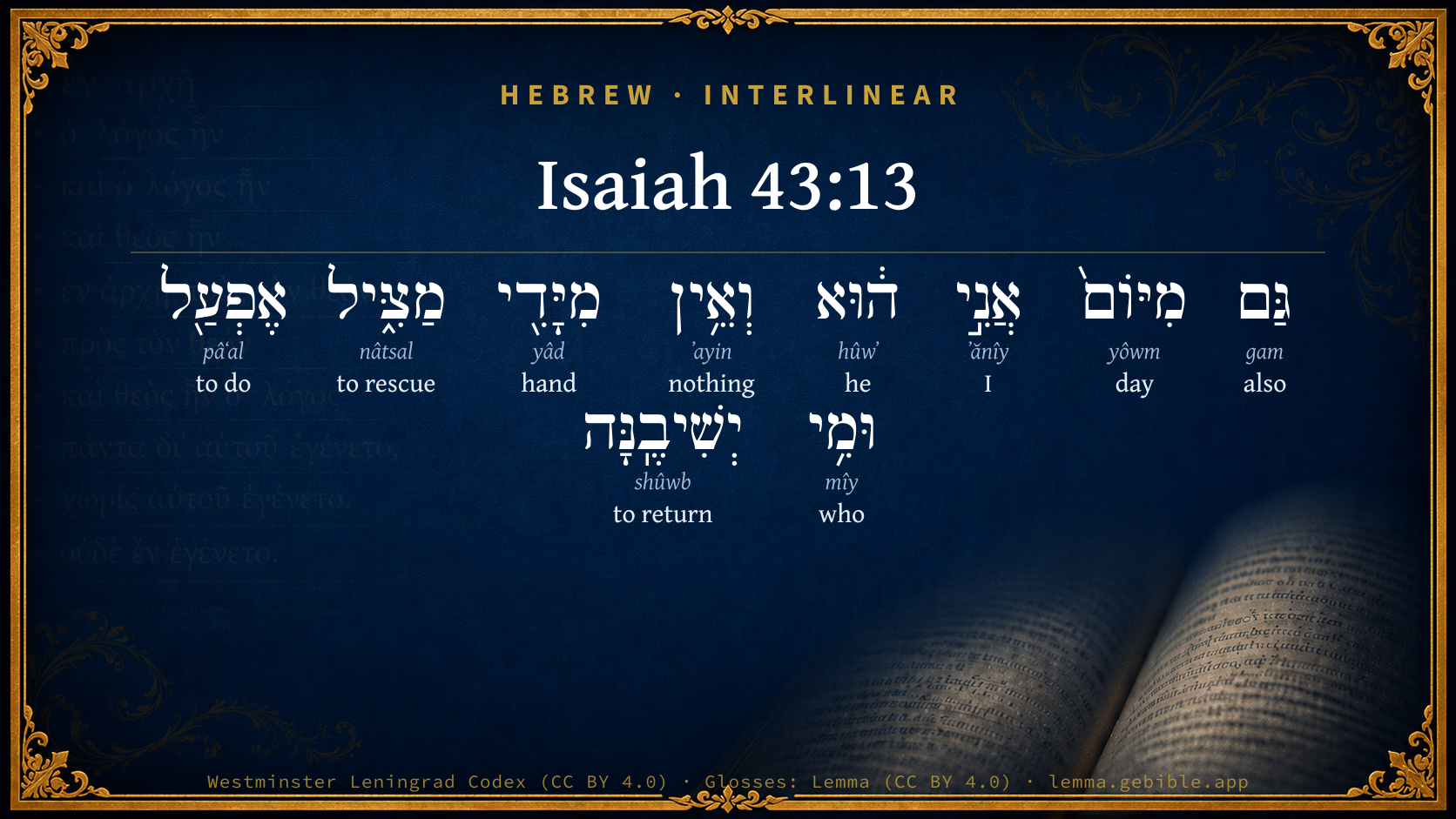
  1. גַּם gam H1571 “also” Particle, Accusative
  2. מִיּוֹם֙ yôwm H3117 “from · day” Preposition + Noun, Common, Masculine, Singular, Absolute
  3. אֲנִ֣י ʼănîy H589 “I” Pronoun, Personal, 1st Person, Common, Singular
  4. ה֔וּא hûwʼ H1931 “he” Pronoun, Personal, 3rd Person, Masculine, Singular
  5. וְאֵ֥ין ʼayin H369 “and · nothing” Conjunction + Particle, Negative
  6. מִיָּדִ֖י yâd H3027 “from · hand · my” Preposition + Noun, Common, Both, Singular, Construct + Suffix, Personal, 1st Person, Common, Singular
  7. מַצִּ֑יל nâtsal H5337 “rescuing” Verb, Hiphil, Participle Active, Masculine, Singular, Absolute
  8. וּמִ֥י mîy H4310 “and · who” Conjunction + Particle, Interrogative
  9. יְשִׁיבֶֽנָּה shûwb H7725 “to return · her” Verb, Hiphil, Imperfect, 3rd Person, Masculine, Singular + Suffix, Personal, 3rd Person, Feminine, Singular

About this verse

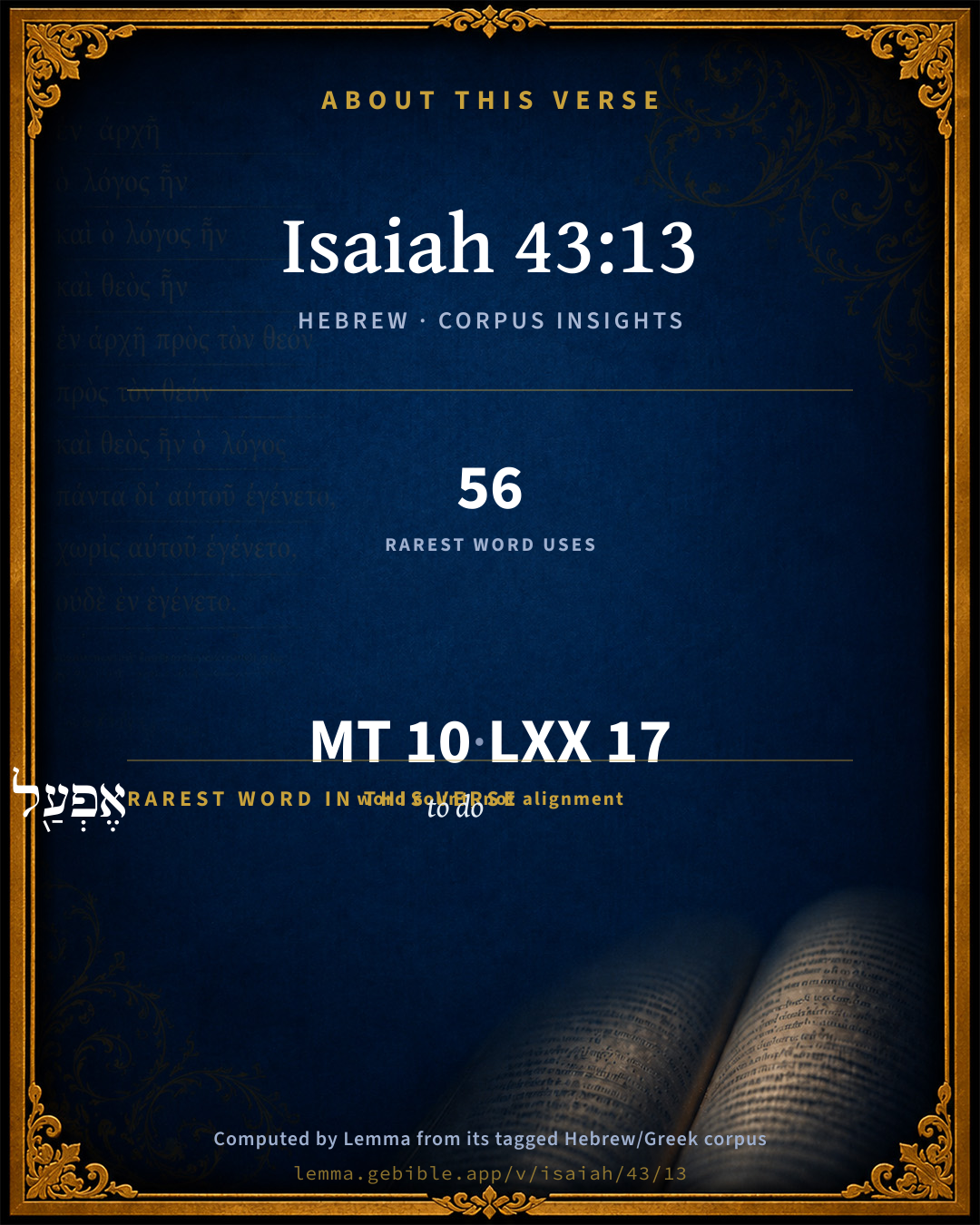
These counts appear in no published source. They are computed here, from the morphology-tagged text and Lemma’s own curated glosses. What Lemma adds →

10
words
10
distinct lemmas
Prophets
section

Shared distinctive vocabulary

אֶפְעַ֖ל to do H6466 occurs in 55 verses of the Hebrew Bible. Also found in:

Grammatical profile

  • 3 verbs
  • 2 nouns
  • 2 pronouns
  • 3 particles

Verb forms

  • מַצִּ֑יל Hiphil · Participle Active
  • אֶפְעַ֖ל Qal · Imperfect
  • יְשִׁיבֶֽנָּה Hiphil · Imperfect

Hebrew & Septuagint length

In English translation the verse runs 27 words from the Hebrew and 24 from the Septuagint (LXX English) — closely comparable.

A rough comparison of the two English renderings, which tokenize alike — not a word-level alignment.

Word counts can differ between the Hebrew and the Greek without any difference in meaning — e.g. the Hebrew direct-object marker אֵת has no separate Greek word, and Greek often adds the article ὁ.

In the original languages it is 10 Hebrew tokens and 17 Greek tokens — but the two are counted differently (Hebrew bundles its prefixes and suffixes into one token; the Greek is in lemma form), so that isn’t a like-for-like length.

Cross-references

26

Topical passages linked to Isaiah 43:13 in the Treasury of Scripture Knowledge — connected by theme and wording, ordered by reader-vote popularity; previews shown in the World English Bible.

  • Isaiah 14:27 For Yahweh of Hosts has purposed, and who shall annul it? and his hand is stretched out, and who shall turn it back?
  • Isaiah 46:10 declaring the end from the beginning, and from ancient times things that are not [yet] done; saying, My counsel shall stand, and I will do all my pleasure;
  • Psalms 90:2 Before the mountains were brought forth, Or ever you had formed the earth and the world, Even from everlasting to everlasting, you are God.
  • Hebrews 13:8 Jesus Christ is the same yesterday, today, and forever.
  • John 8:58 Jesus said to them, "Most assuredly, I tell you, before Abraham came into existence, I AM."
  • Deuteronomy 32:39 See now that I, even I, am he, There is no god with me: I kill, and I make alive; I wound, and I heal; There is none who can deliver out of my hand.
  • Job 9:12 Behold, he snatches away; who can hinder him? Who will ask him, 'What are you doing?'
  • 1 Timothy 1:17 Now to the King eternal, immortal, invisible, to God who alone is wise, be honor and glory forever and ever. Amen.
  • Revelation 1:8 "I am the Alpha and the Omega," says the Lord God, "who is and who was and who is to come, the Almighty."
  • Psalms 93:2 Your throne is established from long ago. You are from everlasting.
  • Isaiah 41:4 Who has worked and done it, calling the generations from the beginning? I, Yahweh, the first, and with the last, I am he.
  • Isaiah 57:15 For thus says the high and lofty One who inhabits eternity, whose name is Holy: I dwell in the high and holy place, with him also who is of a contrite and humble spirit, to revive the spirit of the humble, and to revive the heart of the contrite.
  • Job 34:29 When he gives quietness, who then can condemn? When he hides his face, who then can see him? Alike whether to a nation, or to a man:
  • Psalms 50:22 "Now consider this, you who forget God, Lest I tear you into pieces, and there be none to deliver.
  • Proverbs 8:23 I was set up from everlasting, from the beginning, Before the earth existed.
  • Micah 5:2 But you, Bethlehem Ephrathah, Being small among the clans of Judah, Out of you one will come forth to me that is to be ruler in Israel; Whose goings forth are from of old, from everlasting.
  • Habakkuk 1:12 Aren't you from everlasting, Yahweh my God, my Holy One? We will not die. Yahweh, you have appointed him for judgment. You, Rock, have established him to punish.
  • Ephesians 1:11 in whom also we were assigned an inheritance, having been foreordained according to the purpose of him who works all things after the counsel of his will;
  • Deuteronomy 28:31 Your ox shall be slain before your eyes, and you shall not eat of it: your donkey shall be violently taken away from before your face, and shall not be restored to you: your sheep shall be given to your enemies, and you shall have none to save you.
  • Job 34:14–15 If he set his heart on himself, If he gathered to himself his spirit and his breath;
  • Proverbs 21:30 There is no wisdom nor understanding Nor counsel against Yahweh.
  • Daniel 4:35 All the inhabitants of the earth are reputed as nothing; and he does according to his will in the army of heaven, and among the inhabitants of the earth; and none can stay his hand, or tell him, What do you?
  • John 1:1–2 In the beginning was the Word, and the Word was with God, and the Word was God.
  • Romans 9:18–19 So then, he has mercy on whom he desires, and he hardens whom he desires.
  • Hosea 2:10 Now I will uncover her lewdness in the sight of her lovers, And no one will deliver her out of my hand.
  • Hosea 5:14 For I will be to Ephraim like a lion, And like a young lion to the house of Judah. I myself will tear in pieces and go away. I will carry off, and there will be no one to deliver.

Cross-references courtesy of OpenBible.info (CC BY 4.0).

Hebrew and Greek witnesses Masoretic Hebrew ↔ Greek Septuagint

The same verse in the two great witnesses to the Old Testament, shown verse-for-verse.

These are two independent witnesses, not word-aligned to each other, and the Septuagint is shown in lemma (dictionary) form.

Hebrew Isaiah 43:13 Masoretic · Westminster Leningrad Codex

גַּם מִיּוֹם֙ אֲנִ֣י ה֔וּא וְאֵ֥ין מִיָּדִ֖י מַצִּ֑יל אֶפְעַ֖ל וּמִ֥י יְשִׁיבֶֽנָּה

Yes, since the day was I am he; and there is none who can deliver out of my hand: I will work, and who can hinder it?

World English Bible · Public Domain

Greek LXX Isaiah 43:13 Septuagint · lemma form

ἔτι ἀπό ἀρχή καί οὐ εἰμί ὁ ἐκ ὁ χείρ ἐγώ ἐκαἱρέω ποιέω καί τίς ἀποστρέφω αὐτός

even from the beginning; and there is none that can deliver out of my hands: I will work, and who shall turn it back?

LXX2012 (modern English Septuagint) · Public Domain

On this verse, John Gill's Exposition discusses the Septuagint’s reading. Read the note in Commentary ↓

Hebrew: Westminster Leningrad Codex (CC BY 4.0). Greek: Septuagint (public domain); English from LXX2012 (modern English Septuagint) (Public Domain). How the Septuagint differs from the Hebrew →

Targum (Aramaic paraphrase)

1

The Targum is the ancient Jewish Aramaic paraphrase of the Hebrew Scriptures — an interpretive translation, not the Hebrew text itself. Onkelos (literal) and Pseudo-Jonathan (expansive) render the Torah, and Jonathan the Prophets. Coverage is partial: where no permissively-licensed English translation exists for a verse, only the Aramaic is shown. This is verse-level text, not a word-by-word alignment to the Hebrew.

  1. Targum Jonathan Prophets (Joshua–Malachi)
    אַף מַעַלְמָא אֲנָא הוּא וְלֵית דְמִן יְדִי מְשֵׁיזֵיב אַעַבְדִינָהּ וְלָא אֲתֵיבִינָהּ:

    Yea, from eternity I am He; and there is none that can deliver out of my hand: I will do it, and who shall turn it back?

    Targum Jonathan — Aramaic: “Mikraot Gedolot” (public domain). English: “Sefaria Community Translation” (CC0 1.0 (public-domain dedication)); “London "Chaldee Paraphrase," 1871” (public domain). Text via Sefaria.

Commentary

Notes on Isaiah 43:13 from classic Christian and Jewish commentators (each source and its license shown beneath its notes). The classic Christian expositions comment on the surrounding passage and are grouped to its opening verse, so a note may address several verses; the Jewish commentaries on the Tanakh (Rashi and others) are per-verse, so they appear only where the commentator wrote on this verse.

Lemma curates 59 commentaries, every one of them public domain or Creative Commons licensed, each selected and text-cleaned for this edition rather than reprinted as found. About our sources →

Trapp's Complete Commentary

John Trapp

Isa 43:13 Yea, before the day [was] I [am] he; and [there is] none that can deliver out of my hand: I will work, and who shall let it?

Ver. 13. Yea, before the day was I am he.] The "Ancient of days," yea, the eternal The God of Israel was long before Israel was in being.

And there is none that can deliver out of my hand.] So Nebuchadnezzar vainly vaunted, but was soon confuted. {Dan 3:15; Dan 3:17; Dan 3:29}

I will work, and who shall let it?] Angels may be hindered. God can come between their essence and their executive power, and so keep them from doing what they would. In fire there is the substance and the quality of heat; between these God can separate, as he did in the Babylonish fire. {Dan 3:22-25} But who shall hinder the Most High?

John Trapp, A Commentary or Exposition upon All the Books of the Old and New Testament (1647–1656) — public domain. Text from a community e-Sword module.

The Biblical Illustrator

Joseph S. Exell

Isa_43:13

I will work, and who shall let it?

--

Salvation through judgment

The words (Isa_43:13) intimate that the salvation foretold comes in the way of judgment. Jehovah will effectually intervene; and when He does this, who can turn it back, so that it shall not be done? (F. Delitzsch, D. D.)

A great work

I. THE WORKER AND THE WORK TO BE DONE. The worker is God Himself. He worketh all things after the counsel of His own will. And the work which He hath purposed with regard to the salvation of His people is to gather together in one the children of God which are scattered abroad. There are, however, subordinate workers whom God employs for this purpose--ministers of the Gospel, whose chief work lies in the endeavour to win souls to Christ, who are called labourers together with God--workers together with Him; and it is theirs to preach the Word, the substance of which Word is Christ--to invite sinners to Christ by showing His excellency and dignity as the Son of God, His tenderness and sympathy as the Son of man--by showing to sinners the perfection of His redeeming work. But as ministers are fellow-workers together with God by virtue of their office, so may private Christians be.

II. THE FIELD OF WORK. Gods field of labour is everywhere. His object is to gather His people together who are still lying in darkness and sin. For this glorious end He employs various means. His means are directed particularly to individuals.

III. THE CENTRE IN WHOM THE WORK IS COMPLETE. This, in one word, is Christ. It is the simple knowledge of a dependence upon Christs person by which God works out His purpose of salvation. But I should not be preaching to you the whole counsel of God if I omitted to put before you also the side of your responsibility. (J. W. Reeve, M. A.)

The Biblical Illustrator, edited by Joseph S. Exell (c. 1880s–1900s) — public domain. Text from a community e-Sword module.

The Preacher's Complete Homiletical Commentary

Joseph S. Exell (gen. ed.)

THE ETERNITY AND OMNIPOTENCE OF GOD

Isa_43:13. Yea, before the day was, &c.

The doctrine taught here is—

1. That God is from everlasting—for if He was before time, He must have been eternal (H. E. I. 2253; P. O. 1493).

2. That He is unchangeably the same—a doctrine which is, as it is here designed to be used, the only sure foundation for the security of His people—for who can trust a being who is fickle? (H. E. I. 2254–2256, 2324, 2341).

3. That He can deliver His people always, no matter what are their circumstances.

4. That He will accomplish all His plans; no matter whether to save His people, or to destroy His foes.

5. That no one, man or devil, can hinder Him.

6. That opposition to Him is as fruitless as it is wild. If men wish for happiness, they must fall in with His plans, and aid in the furtherance of His designs.—A. Barnes.

The Preacher's Complete Homiletical Commentary (gen. ed. Joseph S. Exell; Funk & Wagnalls, c. 1892) — public domain (pre-1929). A full-Bible homiletical/sermon-outline anthology covering 65 of 66 books (2 John is absent from the source module). Text from a community e-Sword module.

Jamieson, Fausset & Brown

Robert Jamieson, A. R. Fausset & David Brown

before--literally, from the time of the first existence of day.

let--Old English for "hinder" (Isa 14:27). Rather, translate, "undo it" [HORSLEY].

Jamieson, Fausset & Brown — Commentary Critical and Explanatory on the Whole Bible (1871) — public domain (CC PDM 1.0). Text via the HelloAO Bible API.

Ellicott's Commentary for English Readers

(13) Who shall let it?—Literally, who shall turn it back? One of the numerous echoes from Job (Isa_9:12; Isa_11:10).

A Bible Commentary for English Readers, edited by Charles John Ellicott (1878–1897) — public domain. Text from a community e-Sword module.

The Cambridge Bible for Schools and Colleges

gen. ed. J. J. S. Perowne

13. Yea, before the day was] The correct translation is that of R.V. marg.: Yea, from this day forth (for all the future) I am the same (Isa_41:4); the deliverance marking a new era in Jehovah’s manifestation of Himself as God, the only God who is a Saviour (Isa_43:11).

I will work … let it?] Better: I work, and who shall reverse it?

The Cambridge Bible for Schools and Colleges (gen. ed. J. J. S. Perowne; Cambridge University Press, 1878–1918) — public domain. Text from a community e-Sword module.

John Gill's Exposition

Thus saith the Lord, your Redeemer,.... That redeemed Israel out of Egypt, and would redeem the Jews from Babylon in a short time, and be the author of a greater redemption to his people than either of these, even a spiritual and eternal one:

the Holy One of Israel; see Isa 43:3, holy in himself, holiness to Israel, and faithful to his promises:

for your sake I have sent to Babylon: Cyrus and his army to take it, in order to deliver the Jews from their captivity in it. The Targum wrongly paraphrases it to the sense quite contrary,

"for your sins have I carried you captive unto Babylon:''

and have brought down all their nobles; from their seats of honour and glory, stripped them of all their grandeur and dignity, and reduced them to a low and mean estate. This is to be understood of the princes and nobles of Babylon, who fell with the city, as their king did: or, "their bars" (l); for what bars are to houses and cities, that princes should be to the people, the defence and protection of them. Though some think this refers to the gates of Babylon, and the strong bars of them now broken; see Isa 45:2. The Septuagint, Syriac, and Arabic versions render it "fugitives"; and which some understand of the Jews, who were as such in Babylon, but now should be brought out of it; which sense is countenanced by the above versions, which render it, I will raise up, bring, or bring back, "all the fugitives" (m); others of the Chaldeans, who should be forced to fly upon the taking of their city; but the first sense seems best, which distinguishes them from the common people in the next clause:

and the Chaldeans, whose cry is in their ships; who used to glory in their shipping they had in the river Euphrates, as the Vulgate Latin and Syriac versions render it; and so the Targum calls their ships, "ships of their praise"; where, and of which, they used to make their ovations and triumphs; and the word (n) used has the signification of shouting for joy: or rather, "whose cry is to the ships" (o); as it might be, when they found Cyrus and his army had got into the city, then their cry was, to the ships, to the ships, that lay in the river hard by, in order to make their escape; or their cry was, when they were "in" the ships, even in a way of lamentation and distress, because they could not get them off, Cyrus having drained the river; or it refers to their cry, when put aboard the ships that belonged to the Medes and Persians, in order to the transporting them into other countries. Such a howling there will be when mystical Babylon is destroyed, Rev 18:17.

(l) "vectes omnes", Julius & Tremellius; "vectes universos", Piscator. (m) "Fugitivos universos", Vatablus, Paginus, Montanus; "fugientes omnes", Vitringa (n) "in navibus ovatio eorum", Forerius; "cumu avibus ob quas jubilant", Piscator; "in naves ovationis ipsorum", Vitringa. (o) "Ad naves clamor eorum", Grotius, Gataker.

John Gill's Exposition of the Whole Bible (1746–1763) — public domain (CC PDM 1.0). Text via the HelloAO Bible API.

Albert Barnes' Notes on the Bible

Yea, before the day was - Before the first day, or before the beginning of time; from eternity. The Septuagint renders it correctly, Ἀπ ̓ ἀρχης Ap' archēs, and the Vulgate (Ab initio), ‘From the beginning.’

I am he - I am the same Isa 43:10.

I will work - I will accomplish my designs.

And who shall let it? - Margin, as Hebrew, ‘Turn it back.’ The meaning is, ‘Who can hinder it?’ And the doctrine taught here is:

1. That God is from everlasting, for if he was before time, he must have been eternal.

2. That he is unchangeably the same - a doctrine which is, as it is here designed to be used, the only sure foundation for the security of his people - for who can trust a being who is fickle, changing, vacillating?

3. That he can deliver his people always, no matter what are their circumstances.

4. That he will accomplish all his plans; no matter whether to save his people, or to destroy his foes.

5. That no one - man or devil - can hinder him. How can the feeble arm of a creature resist God?

6. That opposition to him is as fruitless as it is wicked. If people wish for happiness, they must fall in with his plans, and aid in the furtherance of his designs.

Albert Barnes' Notes on the Bible (1834–1885) — public domain. Text from a community e-Sword/MySword module.

Matthew Poole's English Annotations

Before the day was; before all time; or, which is all one, from all eternity: or, since the day was; since the beginning of time and things, in all ages since the creation of the world.

I am he; I am God, and I have proved myself to be so.

There is none, none of those which are called gods, that can deliver out of my hand; that can save them whom I will destroy. Therefore they are impotent, and consequently no gods.

I will work, and who shall let it? nor can they hinder me in any other work which I resolve to do.

Matthew Poole's English Annotations on the Holy Bible (1683–1685) — public domain. Text from a community e-Sword/MySword module.

The Pulpit Commentary

Yea, before the day was I am he. So the LXX, Jerome, and Stier; but most moderns translate, "Yea, from this time forth I am he". (setup. Eze_48:35) Kay, however, thinks that the translation of the Authorized Version may stand. Who shall let it? literally, as in Isa_14:27, who shall turn it back? i.e. "reverse it, undo it." Surely no one.

The Pulpit Commentary (1880–1919), ed. H.D.M. Spence-Jones & Joseph S. Exell — public domain. Text from a community e-Sword module.

John Wesley's Explanatory Notes

Yea - Before all time; from all eternity, I am God.

John Wesley, Explanatory Notes Upon the Whole Bible (1754–1765) — public domain. Text via the GEBible commentary corpus.

J. A. Alexander on Isaiah

Joseph Addison Alexander

“Also (or even) from the day I am He, and there is no one freeing from my hand; I will do, and who will undo it?” The assonance in the last clause is not in the original, which literally means, I will act (or make), and who will cause it to return, (i.e., reverse or nullify it)? The interrogative form implies negation. A similar expression of the same idea is found in Isa 14:27. What is said specifically in the first clause of delivering from Jehovah’s power, is extended in the last to all counteraction or reversal of His acts. From the day is understood by some as referring to a specific terminus a quo, such as the origin of Israel as a nation, the exodus, etc. Others make it indefinite, ‘of old’ or ‘long since’. But the best interpreters explain it as meaning ‘since the first day’, or ‘since time began’. The words are then universal, both in the extent of power claimed, and in relation to the time of its exercise. Over every object and in every age the power of Jehovah had been clearly proved to be supreme and absolute.

Joseph Addison Alexander, The Prophecies of Isaiah (1846–1847; New York: Scribner, 1870–1878) — public domain. Text from a community e-Sword module.

Rashi

Rabbi Shlomo Yitzchaki (Rashi)

Even before the day I am He Not only that day was I alone, but even before it became day I am He alone.

I do If I came to do, no one can retract.

Rashi on the Tanakh — English translations: “The Judaica Press complete Tanach with Rashi, translated by A. J. Rosenberg” (CC BY 4.0); “Pentateuch with Rashi's commentary by M. Rosenbaum and A.M. Silbermann, 1929-1934” (public domain); “The Metsudah Tanach series, Lakewood, N.J” (CC BY 4.0); and “The Book of Joshua, Metsudah Publications, 1997” (CC BY 4.0). Text via Sefaria.

Ibn Ezra

Rabbi Abraham ibn Ezra

Before the day was, etc. I was God before the existence of day. Therefore, the word גם yea is added.

מהיות יום:═מיום When day was not yet.

I am he; and since I am God, who can be delivered out of my hand;

I do my desire and will, and none can frustrate my doing.

Ibn Ezra on the Tanakh — English translations: “Sefaria Community Translation” (CC0 1.0 (public-domain dedication)); “Yalkut, Sifsei Chachomim Chumash, Metsudah Publications, 2009” (CC BY 4.0); and “Commentary of Ibn Ezra on Isaiah - trans. by M. Friedlander, 1873” (public domain). Text via Sefaria.

Lesson kit

Teaching starters — assembled from the data on this page, not authored interpretation. Every prompt links to the verse data it draws on. Edit before teaching.

Isaiah, in the Prophets, opens this verse with 10 words (10 distinct Hebrew lemmas). Its most distinctive word is pâʻal (“to do”). A historical commentator’s framing appears above. Read the whole chapter for the surrounding context.

Discussion questions

  1. What does “to do” (pâʻal) contribute to the verse as a whole?
  2. Exodus 15:17 shares the word «to do» with this verse. How do the two illuminate each other?
  3. These translations render this verse differently. What is at stake in choosing one wording over another?
  4. The verb «מַצִּ֑יל» is Hiphil Participle Active. How does its form color the action?
  5. Reading how Trapp's Complete Commentary and The Biblical Illustrator read this verse, where do the two commentators agree and where do they part?

Things to notice

Reading settings

Reading text

Shown beneath each verse's original-language words.

Old Testament
Old Testament edition

Read the OT as the Masoretic Hebrew (MT) or the Greek Septuagint (LXX).

English shown for the Greek Septuagint (in the Hebrew ↔ Greek comparison).

Comparing translations? Open the Compare panel on any verse page to stack up to four side by side.