

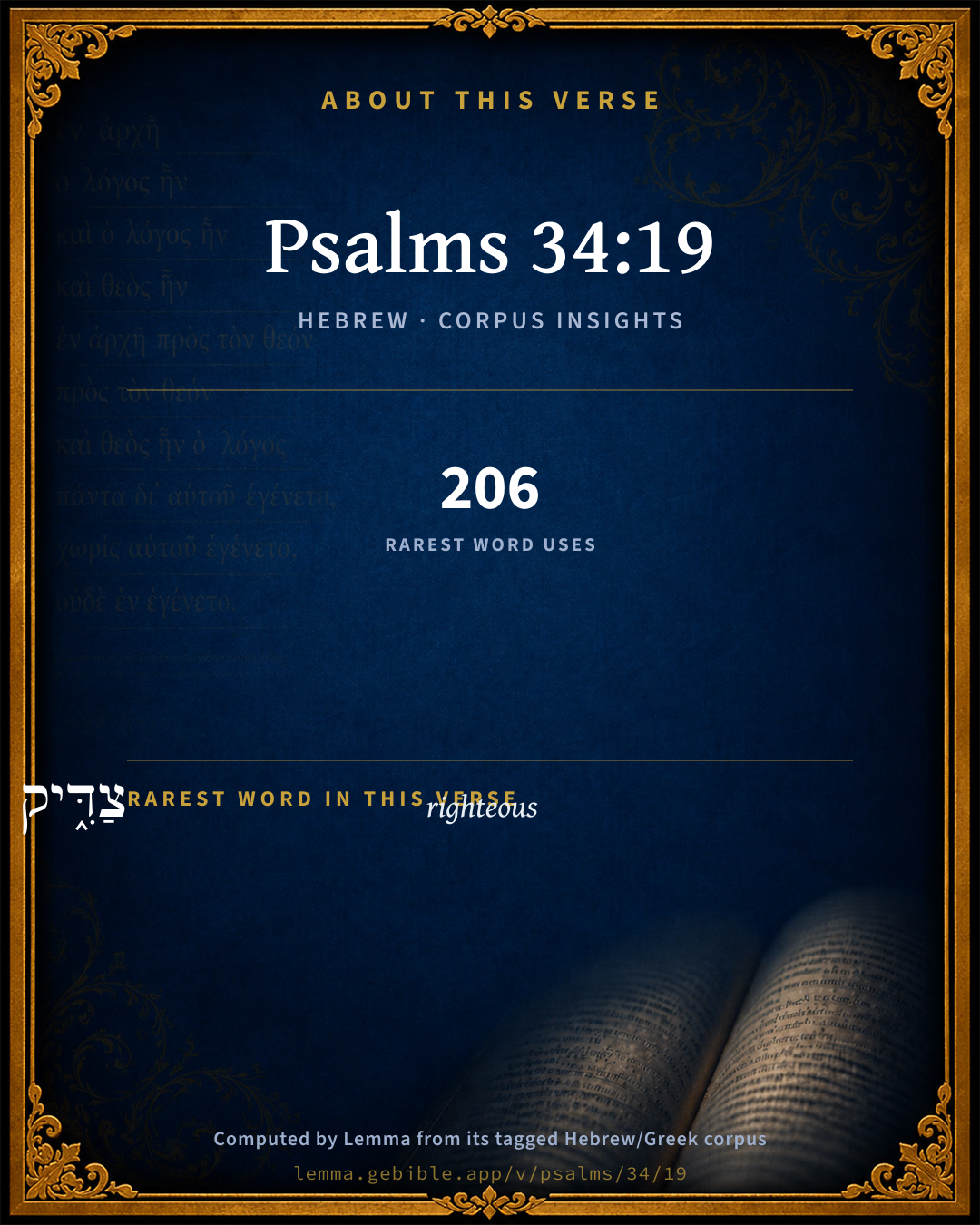
Psalms 34:19

Hebrew (Westminster Leningrad Codex) Psalms 34:19 appears in the Hebrew Old Testament. The text above is from the Westminster Leningrad Codex. Each word links to its Strong’s number, a concise gloss, and parsing drawn from the Open Scriptures Hebrew Bible morphology. Click any word for its full Brown-Driver-Briggs (BDB) entry.
Download image
Cite this verse

Psalms 34:19 (World English Bible). Public Domain. Lemma interlinear Bible study tool, https://lemma.gebible.app/v/psalms/34/19.

Show BibTeX & RIS
BibTeX
RIS
English Translation
Many are the afflictions of the righteous, But Yahweh delivers him out of them all.
World English Bible · Public Domain
Download a study sheet

One document with this verse’s original text, its word-by-word gloss line, the meaning frame, cross-references with their text, attributed commentary, and full source and license credits — printable, and it pastes into notes with its structure intact.

This verse Autodidact and up

Study sheet (.html) Plain text (.txt)

A passage Seminary Student

Up to 50 verses in one chapter. A passage sheet keeps up to 6 commentary sources and 12 cross-references per verse, in the order this page ranks them, and says so on the sheet whenever that leaves anything out. Ask for a single verse and you get the Autodidact verse sheet above.

Everything on this page stays free to read, with no account — the sheet is a download of what is already on screen, not access to it.

Want to remove ads? Support Godless Engineer
Compare translations 3

The same verse in 3 English versions, stacked beneath the original-language interlinear above. Click any original word for its lexicon entry.

Each is an independent rendering of the whole verse — the interlinear is not word-aligned to these translations.

Highlighted words mark where these versions differ — a whole-verse word diff, not a word-by-word alignment.

  • World English Bible Public Domain
    Many are the afflictions of the righteous, But Yahweh delivers him out of them all.
  • King James Version Public Domain
    Many are the afflictions of the righteous: but the LORD delivereth him out of them all.
  • unfoldingWord Literal Text CC BY-SA 4.0
    Many the evils of the righteous, but Yahweh delivers him from all of them.

unfoldingWord Literal Text — © unfoldingWord, licensed CC BY-SA 4.0. Word-aligned USFM3 via Door43 (git.door43.org/unfoldingWord/en_ult).

Versions to compare (up to 4)

3 of 4 selected

Show all 18 translations

Every available English version of this verse, each an independent rendering of the whole verse.

  • World English Bible Public Domain
    Many are the afflictions of the righteous, But Yahweh delivers him out of them all.
  • Berean Standard Bible Public Domain
    Many are the afflictions of the righteous, but the LORD delivers him from them all.
  • Majority Standard Bible Public Domain
    Many are the afflictions of the righteous, but the LORD delivers him from them all.
  • King James Version Public Domain
    Many are the afflictions of the righteous: but the LORD delivereth him out of them all.
  • American Standard Version (1901) Public Domain
    Many are the afflictions of the righteous; But Jehovah delivereth him out of them all.
  • Revised Version (1885) Public Domain
    Many are the afflictions of the righteous: but the LORD delivereth him out of them all.
  • Geneva Bible (1599) Public Domain
    Great are the troubles of the righteous: but the Lord deliuereth him out of them all.
  • Douay-Rheims (1899) Public Domain
    The Lord is nigh unto them that are of a contrite heart: and he will save the humble of spirit.
  • Young's Literal Translation Public Domain
    Many `are' the evils of the righteous, Out of them all doth Jehovah deliver him.
  • Literal Standard Version CC BY-SA 4.0
    Many [are] the afflictions of the righteous, || YHWH delivers him out of them all.
  • Unlocked Literal Bible CC BY-SA 4.0
    Many are the troubles of the righteous, but Yahweh delivers them out of them all.
  • unfoldingWord Literal Text CC BY-SA 4.0
    Many the evils of the righteous, but Yahweh delivers him from all of them.
  • Darby Bible Public Domain
    Many are the adversities of the righteous, but Jehovah delivereth him out of them all:
  • World Messianic Bible Public Domain
    Many are the afflictions of the righteous, but the LORD delivers him out of them all.
  • Webster's Bible Public Domain
    \\34:18\\The LORD is nigh to them that are of a broken heart; and saveth such as are of a contrite spirit.
  • Free Bible Version CC BY-SA 4.0
    Those who do right have many problems, but the Lord solves all of them.
  • Bible in Basic English Public Domain
    Great are the troubles of the upright: but the Lord takes him safely out of them all.
  • JPS Tanakh (1917) Public Domain
    (34-20) Many are the ills of the righteous, but the LORD delivereth him out of them all.

Literal Standard Version (2020), Covenant Press — licensed CC BY-SA 4.0. Text via the HelloAO Bible API (eBible.org). Unlocked Literal Bible (unfoldingWord) — licensed CC BY-SA 4.0. Text via the HelloAO Bible API (eBible.org). unfoldingWord Literal Text — © unfoldingWord, licensed CC BY-SA 4.0. Word-aligned USFM3 via Door43 (git.door43.org/unfoldingWord/en_ult). Free Bible Version, Dr. Jonathan Gallagher — licensed CC BY-SA 4.0. Text via the HelloAO Bible API (eBible.org).

Word by word

More ways to search: Search by grammar → Find every occurrence → Compare this word →

Practice this passage: Drill this verse → Learn its vocabulary →

About this verse

These counts appear in no published source. They are computed here, from the morphology-tagged text and Lemma’s own curated glosses. What Lemma adds →

6
words
6
distinct lemmas
Wisdom
section

Grammatical profile

  • 1 verb
  • 3 nouns
  • 2 adjectives

Verb forms

  • יַצִּילֶ֥נּוּ Hiphil · Imperfect

Hebrew & Septuagint length

In English translation the verse runs 15 words from the Hebrew and 16 from the Septuagint (LXX English) — closely comparable.

A rough comparison of the two English renderings, which tokenize alike — not a word-level alignment.

Word counts can differ between the Hebrew and the Greek without any difference in meaning — e.g. the Hebrew direct-object marker אֵת has no separate Greek word, and Greek often adds the article ὁ.

Cross-references

19

Topical passages linked to Psalms 34:19 in the Treasury of Scripture Knowledge — connected by theme and wording, ordered by reader-vote popularity; previews shown in the World English Bible.

  • Psalms 34:17 The righteous cry, and Yahweh hears, And delivers them out of all their troubles.
  • 1 Peter 4:12–13 Beloved, don't be astonished at the fiery trial which has come upon you, to test you, as though a strange thing happened to you.
  • Psalms 34:6 This poor man cried, and Yahweh heard him, And saved him out of all his troubles.
  • 2 Corinthians 4:17 For our light affliction, which is for the moment, works for us more and more exceedingly an eternal weight of glory;
  • John 16:33 I have told you these things, that in me you may have peace. In the world you have oppression; but cheer up! I have overcome the world."
  • Psalms 34:4 I sought Yahweh, and he answered me, And delivered me from all my fears.
  • 2 Timothy 3:11–12 persecutions, and sufferings: those things that happened to me at Antioch, Iconium, and Lystra. I endured those persecutions. Out of them all the Lord delivered me.
  • Job 5:19 He will deliver you in six troubles; Yes, in seven there shall no evil touch you.
  • Proverbs 24:16 For a righteous man falls seven times, and rises up again; But the wicked are overthrown by calamity.
  • 2 Corinthians 4:7–12 But we have this treasure in clay vessels, that the exceeding greatness of the power may be of God, and not from ourselves.
  • Psalms 71:20 You, who have shown us many and bitter troubles, You will let me live. You will bring us up again from the depths of the earth.
  • Hebrews 11:33–38 who, through faith subdued kingdoms, worked out righteousness, obtained promises, stopped the mouths of lions,
  • 1 Thessalonians 3:3–4 that no one be moved by these afflictions. For you know that we are appointed to this task.
  • Acts 14:22 confirming the souls of the disciples, exhorting them to continue in the faith, and that through many afflictions we must enter into the Kingdom of God.
  • Job 42:12 So Yahweh blessed the latter end of Job more than his beginning. He had fourteen thousand sheep, six thousand camels, one thousand yoke of oxen, and a thousand female donkeys.
  • Revelation 7:14–17 I told him, "My lord, you know." He said to me, "These are those who came out of the great tribulation. They washed their robes, and made them white in the Lamb's blood.
  • 2 Corinthians 11:23–27 Are they servants of Christ? (I speak as one beside himself) I am more so; in labors more abundantly, in prisons more abundantly, in stripes above measure, in deaths often.
  • James 5:10–11 Take, brothers, for an example of suffering and of patience, the prophets who spoke in the name of the Lord.
  • Job 30:9–31 "Now I have become their song. Yes, I am a byword to them.

Cross-references courtesy of OpenBible.info (CC BY 4.0).

Hebrew and Greek witnesses Masoretic Hebrew ↔ Greek Septuagint

The same verse in the two great witnesses to the Old Testament, shown verse-for-verse.

You’re reading Greek Psalm 33 (Hebrew Psalm 34). The Septuagint counts the superscription, so verse numbers can differ from the Hebrew — chapter-level alignment, not verse-by-verse. Numbering follows Rahlfs.

These are two independent witnesses, not word-aligned to each other, and the Septuagint is shown in lemma (dictionary) form.

Hebrew Psalms 34:19 Masoretic · Westminster Leningrad Codex

רַ֭בּוֹת רָע֣וֹת צַדִּ֑יק וּ֝מִכֻּלָּ֗ם יַצִּילֶ֥נּוּ יְהוָֽה

Many are the afflictions of the righteous, But Yahweh delivers him out of them all.

World English Bible · Public Domain

Greek LXX Greek Psalm 33:19 Septuagint · lemma form

ἐγγύς κύριος ὁ συντρίβω ὁ καρδία καί ὁ ταπεινός ὁ πνεῦμα σώζω

Many are the afflictions of the righteous: but out of them all Lord will deliver them.

LXX2012 (modern English Septuagint) · Public Domain

Hebrew: Westminster Leningrad Codex (CC BY 4.0). Greek: Septuagint (public domain); English from LXX2012 (modern English Septuagint) (Public Domain). How the Septuagint differs from the Hebrew →

Commentary

Notes on Psalms 34:19 from classic Christian and Jewish commentators (each source and its license shown beneath its notes). The classic Christian expositions comment on the surrounding passage and are grouped to its opening verse, so a note may address several verses; the Jewish commentaries on the Tanakh (Rashi and others) are per-verse, so they appear only where the commentator wrote on this verse.

Lemma curates 59 commentaries, every one of them public domain or Creative Commons licensed, each selected and text-cleaned for this edition rather than reprinted as found. About our sources →

Trapp's Complete Commentary

John Trapp

Psa 34:19 Many [are] the afflictions of the righteous: but the LORD delivereth him out of them all.

Ver. 19. Many are the troubles, &c.] Dei sunt nuntii, these are God’s messengers, saith Kimchi, and they seldom come single. See Jas 1:2. {See Trapp on "Jas 1:2"} Sent they are also to the wicked, Psa 32:10, but on another errand, and for another end. The righteous, per augusta ad augustum, per spinas ad rosas, per motum ad quietem, per procellas ad portum, per crucem ad caelum contendunt, through many tribulations they enter into God’s kingdom. Not so the wicked; their crosses are but a typical hell.

But the Lord delivereth him out of them all] No country hath more venomous creatures, none more antidotes, than Egypt; so godliness hath many troubles, and as many helps against trouble.

John Trapp, A Commentary or Exposition upon All the Books of the Old and New Testament (1647–1656) — public domain. Text from a community e-Sword module.

The Biblical Illustrator

Joseph S. Exell

Psa_34:19-20

Many are the afflictions of the righteous: but the Lord delivereth them out of them all.

The trial of the righteous

The sum of this verse is as if he should say, Let the righteous look for more troubles than others, and likewise let them hope for greater comforts than others; for when they are well, they shall be eclipsed again, to show that their light was but borrowed; and when they are eclipsed, their light shall return, to show their difference from them whom God hateth, which fall from plague to plague, as they run from sin to sin.

I. what makes our troubles so hard to bear is our lack of patience, how great is our need of this grace! A sound spirit, saith Solomon, will bear his infirmity, but a wounded spirit what can sustain? (Pro_18:14). Therefore as the lid is made to open and shut, to save the eye, so patience is set to keep the soul, and save the heart; whole, to cheer the body again. Therefore if you mark, when you can go by an offence, and take a little wrong and suffer trouble quietly, you have a kind of peace and joy in your heart, as if you have gotten a victory, and the more your patience is, still the less your pain is. For as a light burden, borne at the arms end, weigheth heavier by much, than a burden of treble weight, if it be borne upon the shoulders, which are made to bear; so if a man set impatience to bear his cross, which is not fit to bear, it will grumble, and murmur, and let the burden fall upon his head, like a broken staff, which promiseth to help him over the water, and leaveth him in the ditch. But if you pug it to patience, and set her to bear it, which is appointed to bear, she is like the hearty spies that came from Canaan, and said, It is nothing to overcome them (Jos_2:1-24.). Among the strange cures of patience, David may report of his experience what this plaster hath done for him; for, being a figure of Christ, he was always hedged about with the Cross, which proved his patience like a touchstone every day. As Christ was contemned of his countrymen, so David was contemned of his brethren (1Sa_26:2); as Christ fled to Egypt, so David fled unto Gath; as Christ received food of women, so David received food of Abigail (Luk_8:2); as Herod persecuted Christ, so Saul persecuted David. Thus, by his own foot, David measured the condition of the righteous, and saith, Many are the troubles of the righteous; and then, by his own cure, he showeth how they should be healed, saying, The Lord will deliver him out of all. If ye mark, the Spirit hath directed David to those two things which make us take our troubles grievously: one, because we do not look for them before they come. Therefore, as Christ told Peter before he suffered, to strengthen him when he suffered (Joh_21:18); so the Holy Ghost doth run upon the cross to keep us in expectation of troubles, that we might prepare faith, and patience, and constancy for them, as Noah prepared an ark for the flood.

II. The second thing which makes us to start so at the cross is, because we are like the prophets servant, which did see his foes, but not his friends (2Ki_6:1-33.); so we see our sore, but not our salve, Comfort seems afar off, like Abraham in the heavens (Luk_16:1-31.), as though it would never come so low. Therefore we go about to deliver ourselves, as it is said, Psa_2:1-12., Let us break his bands, as though we could deliver ourselves. But hold your peace, saith Moses, the Lord shall fight for you (Exo_14:14). So David comes in like a pacifier, and saith, Vex not yourselves, for the Lord will deliver you. Bear both these sentences in mind, that you must go through a sea of troubles, and that then you shall come to the haven of rest, and no affliction shall take you before you be armed for it, or you be without your remedy: Many are the troubles of the righteous, but the Lord delivereth him out of all. Here be the two hands of God, like a wound and a plaster, one casteth down, and the other raiseth up. It is good for a man to know his troubles before they come, because afflictions are lightened in the expectation (Act_9:16; Mat_16:24; Joh_2:10). This is the manner of Gods proceedings to send good after evil, as He made light after darkness (Gen_1:3). The knife of correction must prune and lop off mens rotten twigs before they can bring forth fruit.

III. yet our troubles are but troubles. When God doth visit the wicked, His punishments are called plagues and destructions; the plagues of Egypt, the curse of Cain, the destruction of Sodom. But when He doth visit the righteous, His punishments are called corrections, and chastisements, and rods, which proceed from a Father, not to destroy us, but to try us, and purge us, and instruct us. And as Jacob was blessed and halted both at one time, so a man may be blessed and afflicted both together. Afflictions do not hinder our happiness, but our happiness cometh by affliction, as Jacobs blessing came with halting (Gen_32:1-32.), and as peace is procured by war. (Henry Smith.)

The good man under afflictions

I. afflictions often befall the best of men; some, that are common to them with the rest of mankind, and others, that are peculiar to persons of this character. The righteous man, as well as others, may be deserted by his friend, and abused by his enemies. Death may deprive him of those dear to him, and swell his heart with sorrow. His virtue will not secure him from infamy and contempt, from losses and disappointments in his worldly affairs; from poverty, and the thousand hardships that attend it, from bad health and painful distempers. Then, besides his own private afflictions, the good man, through the tenderness of his heart, feels the calamities of his fellow-creatures, and shares in the manifold evils he sees them suffer. Righteousness or virtue sometimes draws upon itself the hatred of bad men, with all the evils they are able to inflict. Eminent worth, which outshines others, and makes them appear despicable and mean, provokes their envy, the most bitter and deadly of human passions. Besides, integrity may lead a man to oppose the wicked in their unjust and mischievous designs; wherefore these will join themselves to such as envy him, and increase the number of his enemies.

II. why the righteous are afflicted. If God lays affliction upon the righteous, it is not because He has no distinguishing regard for them; but because their sufferings may answer many valuable purposes both to others and themselves.

1. I say, others may reap various advantages by observing the sufferings of good men. By such events God may intend to admonish us, that prosperity is not the best of blessings, nor adversity the worst of evils; since He frequently dispenses the one, and denies the other to His own children. The suffering of the righteous may also be of service to the world; as by this means their virtues are more clearly displayed, and recommended with greater force to the imitation of mankind.

2. Their afflictions often produce great advantages to the sufferers themselves. Among these, I am not afraid to mention the glory they derive from hence. Suffering virtue at least may surely be allowed to comfort itself with the foresight of that veneration, which is wrongfully withheld from it when living; but which posterity will pay with interest to its surviving memory. ,Nor is it a small advantage, that by means of their sufferings the righteous may attain a comfortable assurance of their own constancy. Sometimes also adversity is profitable to good men, as it helps to cure them of their remaining imperfections.

III. the righteous mans supports under afflictions.

1. The native strength of his virtue, which enables him to break their forte by opposing to them a firm and constant mind.

2. Religion also lends him a powerful aid. (John Holland.)

The Biblical Illustrator, edited by Joseph S. Exell (c. 1880s–1900s) — public domain. Text from a community e-Sword module.

Joseph Benson's Commentary

Psa 34:19-20. Many are the afflictions of the righteous — In the world they may have tribulation, and their afflictions and troubles may be many, (for they must not promise themselves such prosperity as will exempt them from the trial of their faith and patience;) but the Lord delivereth him out of them all — That is, in due time, when it will be best for them to be so delivered. And in this they ought to think themselves happy, that God will both support them under their trials, and will also put an end to them when he hath sufficiently proved them thereby. He keepeth all his bones — Not only his soul, but his body, and all the parts and members thereof; not one of them is broken — God will not suffer any real mischief to befall him; though he may be often afflicted, yet he shall not be destroyed. But these words, though they may be understood of righteous men in general, of whom they are true in a metaphorical sense; yet have a further meaning in them, being designed by the Spirit of God to signify a great mystery, namely, that none of Christ’s bones should be broken when he was put to death, contrary to the usual custom of treating those who were crucified, whose legs were wont to be broken, in order to put them sooner out of their pain. See Joh 19:32; Joh 19:36. Dr. Kennicott’s translation of this and the preceding verse renders the application of them to Christ perfectly natural and easy, and is well worth the reader’s attention. It is thus, Many are the afflictions of the Just One; but from them all Jehovah delivereth him: Jehovah keepeth all his bones; not one of them shall be broken. This translation the Hebrew will well bear.

Joseph Benson's Commentary on the Old and New Testaments (1811–1818) — public domain. Text from a community e-Sword module.

J. A. Alexander on Psalms

Joseph Addison Alexander

20. (Psa 34:19). Many evils (befall) the righteous, and from them all will Jehovah deliver him. The preceding promise might have seemed to imply exemption from all suffering; but this can only be enjoyed in connection with exemption from all sin. While sin continues to exist, sorrow must coexist with it, even in the case of true believers or the righteous, who are never described in this book as absolutely sinless. See above, Psa 19:13 (12), Psa 25:7. While the sufferings of the righteous shew them to be sinners, their deliverance illustrates the divine compassion. The relation of the clauses would in our idiom require a but instead of the simple copulative, which the Hebrew writers commonly employ in such connection.

Joseph Addison Alexander, The Psalms Translated and Explained (1850) — public domain. Text from a community e-Sword module.

Tyndale Open Study Notes

Tyndale Open Resources

34:19-22 The godly might suffer, but the Lord will reward them in the end. Similarly, the wicked might prosper for a time, but ultimately they will perish (1:6; 34:15-16).

Tyndale Open Study Notes — © Tyndale Open Resources, licensed CC BY-SA 4.0. Text via the HelloAO Bible API.

Adam Clarke's Commentary

Verse 19. Many are the afflictions of the righteous] No commander would do justice to a brave and skilful soldier, by refusing him opportunities to put his skill and bravery to proof by combating with the adversary; or by preventing him from taking the post of danger when necessity required it. The righteous are God's soldiers. He suffers them to be tried, and sometimes to enter into the hottest of the battle and in their victory the power and influence of the grace of God is shown, as well as their faithfulness.

Delivereth him out of them all.] He may well combat heartily, who knows that if he fight in the Lord, he shall necessarily be the conqueror.

Adam Clarke's Commentary on the Bible (1810–1826) — public domain. Text from a community e-Sword/MySword module.

John Calvin's Commentaries

19. Many are the afflictions of the righteous. The Psalmist here anticipates the thought which often arises in the mind, “How can it be that God has a care about the righteous, who are continually harassed with so many calamities and trials? for what purpose does the protection of God serve, unless those who are peaceably inclined enjoy peace and repose? and what is more unreasonable, than that those who cause trouble to no one should themselves be tormented and afflicted in all variety of ways?” That, therefore, the temptations by which we are continually assailed may not shake our belief in the providence of God, we ought to remember this lesson of instruction, that although God governs the righteous, and provides for their safety, they are yet subject and exposed to many miseries, that, being tested by such trials, they may give evidence of their invincible constancy, and experience so much the more that God is their deliverer. If they were exempted from every kind of trial, their faith would languish, they would cease to call upon God, and their piety would remain hidden and unknown. It is, therefore, necessary that they should be exercised with various trials, and especially for this end, that they may acknowledge that they have been wonderfully preserved by God amidst numberless deaths. If this should seldom happen, it might appear to be fortuitous, or the result of chance; but when innumerable and interminable evils come upon them in succession, the grace of God cannot be unknown, when he always stretches forth his hand to them. David, therefore, admonishes the faithful never to lose their courage, whatever evils may threaten them; since God, who can as easily deliver them a thousand times as once from death, will never disappoint their expectation. What he adds concerning their bones, seems not a little to illustrate the truth of this doctrine, and to teach us that those who are protected by God shall be free from all danger. He therefore declares, that God will take care that not one of their bones shall be broken; in which sense Christ also says, that

“the very hairs of our head are all numbered,” (Luke 12:7.)

John Calvin's Commentaries (1540-1563) — public domain. Text from the Calvin Translation Society English edition (1840s-50s) via the Christian Classics Ethereal Library (ccel.org). Calvin's coverage is partial (roughly two-thirds of the Bible); uncommented books and verses are honest gaps, never fabricated. The 19th-century editor's footnotes and remarks are omitted so the notes are faithfully Calvin's own voice.

The Cambridge Bible for Schools and Colleges

gen. ed. J. J. S. Perowne

19. No exemption from evils is promised to the righteous man, but out of them all the Lord rescues him (Psa_34:4; Psa_34:17).

The Cambridge Bible for Schools and Colleges (gen. ed. J. J. S. Perowne; Cambridge University Press, 1878–1918) — public domain. Text from a community e-Sword module.

John Gill's Exposition

Many are the afflictions of the righteous,.... This may be understood of some one particular righteous person, since the singular number is here made use of; whereas the plural is always used before, when the righteous are made mention of; and the Lord Jesus Christ may be designed, who is eminently and emphatically "the righteous"; he is righteous both as God and man, and as Mediator, in the discharge of every branch of his office; and his afflictions were many, which he endured from men, from devils, and from God himself: many were the afflictions of his body, which he bore when buffeted, scourged, and crucified; and many were the afflictions of his soul, when he bore the sins of his people, endured the wrath of God for them, and was forsaken by him; though none of these were for any sins of his own, but for the sins of others; and out of them all the Lord delivered him at last, and set him at his own right hand; or this may be understood of everyone of the righteous; who, though they are justified from sin, and are saved from wrath, yet have many afflictions; which are "evils" in themselves, as the word (m) may be rendered, and are very troublesome and distressing; and these are great and grievous for quality, and many and abundant for quantity; though no more than it is the will of God should be, and not one too many;

but the Lord delivereth him out of them all; as Christ was, and all his people will be; if not in this life, by giving respites and intervals, as he sometimes does; yet hereafter, when the righteous are completely delivered out of all their trials and exercises, so as that they shall never return more upon them. The word translated "afflictions", as it signifies "evils", may be safely interpreted of moral evils, as well as of evils of afflictions: it is the same word that is used for moral evil in Psa 34:21; and then the sense is, that many are the sins committed by righteous persons; for there are none without sin, in many things they all offend; yet they shall not perish by them, but they shall be delivered from them; as, from the dominion of them by the power of grace, and from the guilt of them by the blood of Christ, and from condemnation for them through his righteousness; so hereafter from the very being of them, and all molestation and disturbance by them.

(m) "mala", Pagninus, Montanus, Musculus, Cocceius, Gejerus, Michaelis; so Ainsworth.

John Gill's Exposition of the Whole Bible (1746–1763) — public domain (CC PDM 1.0). Text via the HelloAO Bible API.

Albert Barnes' Notes on the Bible

Many are the afflictions of the righteous - This is not intended to affirm that the afflictions of the righteous are more numerous or more severe than the afflictions of other men, but that they are subjected to much suffering, and to many trials. Religion does not exempt them from suffering, but it sustains them in it; it does not deliver them from all trials in this life, but it supports them in their trials, which it teaches them to consider as a preparation for the life to come. There are, indeed, sorrows which are special to the righteous, or which come upon them in virtue of their religion, as the trials of persecution; but there are sorrows, also, that are special to the wicked - such as are the effects of intemperance, dishonesty, crime. The latter are more numerous by far than the former; so that it is still true that the wicked suffer more than the righteous in this life.

But the Lord delivereth him out of them all - See the notes at Psa 34:17.

Albert Barnes' Notes on the Bible (1834–1885) — public domain. Text from a community e-Sword/MySword module.

The Treasury of David

Charles H. Spurgeon

Ver. 19. Many are the afflictions of the righteous. Thus are they made like Jesus their covenant Head. Scripture does not flatter us like the story books with the idea that goodness will secure us from trouble; on the contrary, we are again and again warned to expect tribulation while we are in this body. Our afflictions come from all points of the compass, and are as many and as tormenting as the mosquitoes of the tropics. It is the earthly portion of the elect to find thorns and briars growing in their pathway, yea, to lie down among them, finding their rest broken and disturbed by sorrow. BUT, blessed but, how it takes the sting out of the previous sentence! But the Lord delivereth him out of them all. Through troops of ills Jehovah shall lead his redeemed scatheless and triumphant. There is an end to the believer's affliction, and a joyful end too. None of his trials can hurt so much as a hair of his head, neither can the furnace hold him for a moment after the Lord bids him come forth of it. Hard would be the lot of the righteous if this promise, like a bundle of camphire, were not bound up in it, but this sweetens all. The same Lord who sends the afflictions will also recall them when his design is accomplished, but he will never allow the fiercest of them to rend and devour his beloved.

Ver. 19. Many are the afflictions of the righteous, etc. Be our troubles many in number, strange in nature, heavy in measure; yet God's mercies are more numerous, his wisdom more wondrous, his power more miraculous; he will deliver us out of all. Thomas Adams.

Ver. 19. Many are the afflictions of the righteous, etc. When David did behold his trouble, like the host of the Aramites 2Ki 6:16, he looked back unto God like Elisha, and spied one with him stronger than all against him. Therefore, respecting his afflictions he crieth, Many are the troubles of the righteous; respecting the promise he says, The Lord delivereth him out of all. Thus, by his own foot, David measures the condition of the righteous, and saith, Many are the troubles of the righteous; and then, by his own cure, he showeth how they should be healed, saying, The Lord will deliver him out of them all....The lawyer can deliver his client but from strife, the physician can deliver his patient but from sickness, the master can deliver his servant but from bondage, but the Lord delivereth us from all. As when Moses came to deliver the Israelites, he would not leave a hoof behind him, so when the Lord cometh to deliver the righteous he will not leave a trouble behind him. He who saith, "I put away all thine iniquities, " will also say, "I put away all thine infirmities." Henry Smith.

Ver. 19. Black and white, or bane and antidote.

Special people, special trials, special deliverances, special faith as a duty.

Psalms 34:20*

Charles H. Spurgeon's The Treasury of David (1869–1885) — public domain. Psalms only. Text from a community e-Sword/MySword module.

The Pulpit Commentary

Many are the afflictions of the righteous. (comp. Job_36:8-10 Act_14:22 1Co_15:19 2Ti_3:12 Heb_11:33-38 Heb_12:5-10, etc.) The righteous suffer afflictions because they are so imperfectly righteous. They need purging, purifying, chastening, to rid them of the dross and defilement of sin which still clings to them, and from which they are never wholly freed while they continue in the flesh. "We must through mush tribulation enter into the kingdom of God". (Act_14:22) We must, like the Captain of our salvation, be "made perfect through suffering". (Heb_2:10) But the Lord delivereth him out of them all. When they have done their appointed work of purging, purifying, instructing, improving, or whatever else their work may be, God removes the afflictions with which he has visited us or allowed us to be visited, ultimately, when he takes us to himself, mercifully delivering us "out of them all."

The Pulpit Commentary (1880–1919), ed. H.D.M. Spence-Jones & Joseph S. Exell — public domain. Text from a community e-Sword module.

Lesson kit

Teaching starters — assembled from the data on this page, not authored interpretation. Every prompt links to the verse data it draws on. Edit before teaching.

Psalms, in the Wisdom, opens this verse with 6 words (6 distinct Hebrew lemmas). Its most distinctive word is tsaddîyq (“righteous”). A historical commentator’s framing appears above. Read the whole chapter for the surrounding context.

Discussion questions

  1. What does “righteous” (tsaddîyq) contribute to the verse as a whole?
  2. How does Psalms 34:17, which shares this passage’s theme, read alongside this verse?
  3. These translations render this verse differently; the difference is in the English rendering, not the original. What questions does that raise?
  4. «יַצִּילֶ֥נּוּ» is a Hiphil Imperfect verb. How does that grammatical form shape the action described?
  5. Compare how Trapp's Complete Commentary and The Biblical Illustrator read this verse. Where do they agree or differ?

Things to notice

Reading settings

Reading text

Shown beneath each verse's original-language words.

Old Testament
Old Testament edition

Read the OT as the Masoretic Hebrew (MT) or the Greek Septuagint (LXX).

English shown for the Greek Septuagint (in the Hebrew ↔ Greek comparison).

Comparing translations? Open the Compare panel on any verse page to stack up to four side by side.