
Psalms 34:4

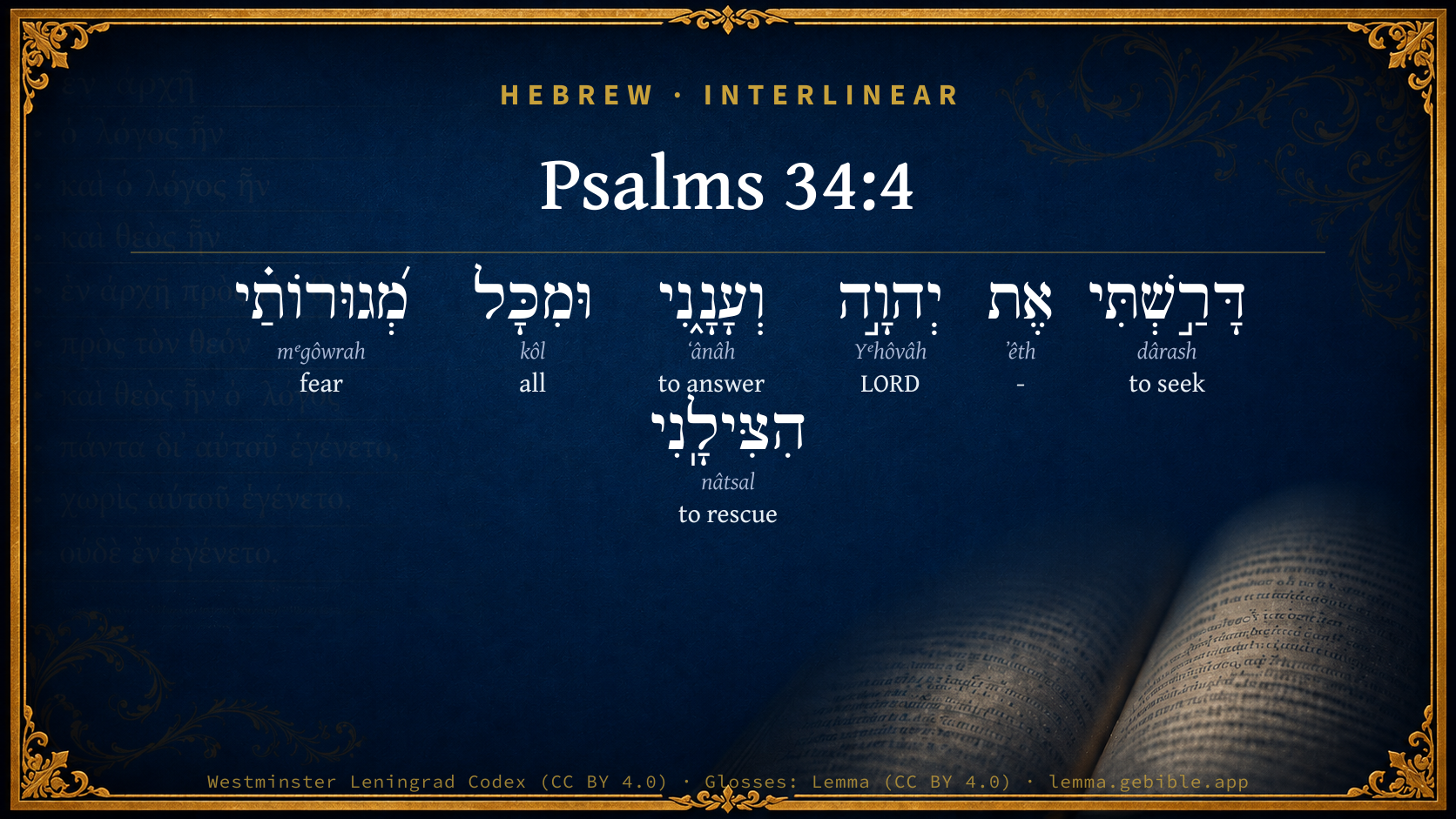
Hebrew (Westminster Leningrad Codex) Psalms 34:4 appears in the Hebrew Old Testament. The text above is from the Westminster Leningrad Codex. Each word links to its Strong’s number, a concise gloss, and parsing drawn from the Open Scriptures Hebrew Bible morphology. Click any word for its full Brown-Driver-Briggs (BDB) entry.
Download image
Cite this verse

Psalms 34:4 (World English Bible). Public Domain. Lemma interlinear Bible study tool, https://lemma.gebible.app/v/psalms/34/4.

Show BibTeX & RIS
BibTeX
RIS
English Translation
I sought Yahweh, and he answered me, And delivered me from all my fears.
World English Bible · Public Domain
Highlights
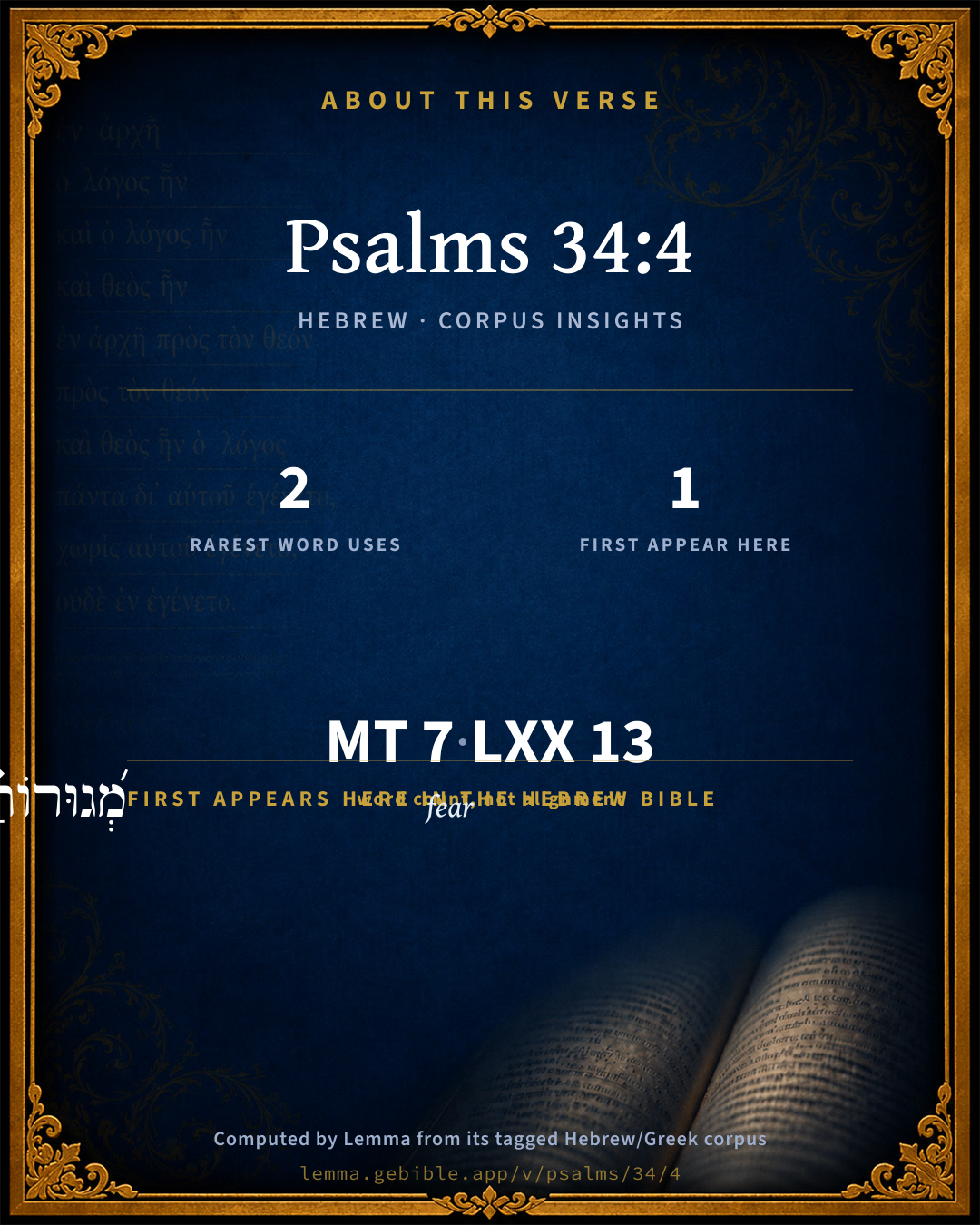
  • 1 first appearance in the Hebrew Bible
Full analysis ↓
Download a study sheet

One document with this verse’s original text, its word-by-word gloss line, the meaning frame, cross-references with their text, attributed commentary, and full source and license credits — printable, and it pastes into notes with its structure intact.

This verse Autodidact and up

Study sheet (.html) Plain text (.txt)

A passage Seminary Student

Up to 50 verses in one chapter. A passage sheet keeps up to 6 commentary sources and 12 cross-references per verse, in the order this page ranks them, and says so on the sheet whenever that leaves anything out. Ask for a single verse and you get the Autodidact verse sheet above.

Everything on this page stays free to read, with no account — the sheet is a download of what is already on screen, not access to it.

Want to remove ads? Support Godless Engineer
Compare translations 3

The same verse in 3 English versions, stacked beneath the original-language interlinear above. Click any original word for its lexicon entry.

Each is an independent rendering of the whole verse — the interlinear is not word-aligned to these translations.

Highlighted words mark where these versions differ — a whole-verse word diff, not a word-by-word alignment.

  • World English Bible Public Domain
    I sought Yahweh, and he answered me, And delivered me from all my fears.
  • King James Version Public Domain
    I sought the LORD, and he heard me, and delivered me from all my fears.
  • unfoldingWord Literal Text CC BY-SA 4.0
    I sought Yahweh, and he answered me, and from all of my fears he delivered me.

unfoldingWord Literal Text — © unfoldingWord, licensed CC BY-SA 4.0. Word-aligned USFM3 via Door43 (git.door43.org/unfoldingWord/en_ult).

Versions to compare (up to 4)

3 of 4 selected

Show all 18 translations

Every available English version of this verse, each an independent rendering of the whole verse.

  • World English Bible Public Domain
    I sought Yahweh, and he answered me, And delivered me from all my fears.
  • Berean Standard Bible Public Domain
    I sought the LORD, and He answered me; He delivered me from all my fears.
  • Majority Standard Bible Public Domain
    I sought the LORD, and He answered me; He delivered me from all my fears.
  • King James Version Public Domain
    I sought the LORD, and he heard me, and delivered me from all my fears.
  • American Standard Version (1901) Public Domain
    I sought Jehovah, and he answered me, And delivered me from all my fears.
  • Revised Version (1885) Public Domain
    I sought the LORD, and he answered me, and delivered me from all my fears.
  • Geneva Bible (1599) Public Domain
    I sought the Lord, and he heard me: yea, he deliuered me out of all my feare.
  • Douay-Rheims (1899) Public Domain
    O magnify the Lord with me; and let us extol his name together.
  • Young's Literal Translation Public Domain
    I sought Jehovah, and He answered me, And from all my fears did deliver me.
  • Literal Standard Version CC BY-SA 4.0
    I sought YHWH, and He answered me, || And delivered me from all my fears.
  • Unlocked Literal Bible CC BY-SA 4.0
    I sought Yahweh and he answered me, and he gave me victory over all my fears.
  • unfoldingWord Literal Text CC BY-SA 4.0
    I sought Yahweh, and he answered me, and from all of my fears he delivered me.
  • Darby Bible Public Domain
    I sought Jehovah, and he answered me, and delivered me from all my fears.
  • World Messianic Bible Public Domain
    I sought the LORD, and he answered me, and delivered me from all my fears.
  • Webster's Bible Public Domain
    \\34:3\\O magnify the LORD with me, and let us exalt his name together.
  • Free Bible Version CC BY-SA 4.0
    I asked the Lord for help, and he answered me. He set me free from all my fears.
  • Bible in Basic English Public Domain
    I was searching for the Lord, and he gave ear to my voice, and made me free from all my fears.
  • JPS Tanakh (1917) Public Domain
    (34-5) I sought the LORD, and He answered me, and delivered me from all my fears.

Literal Standard Version (2020), Covenant Press — licensed CC BY-SA 4.0. Text via the HelloAO Bible API (eBible.org). Unlocked Literal Bible (unfoldingWord) — licensed CC BY-SA 4.0. Text via the HelloAO Bible API (eBible.org). unfoldingWord Literal Text — © unfoldingWord, licensed CC BY-SA 4.0. Word-aligned USFM3 via Door43 (git.door43.org/unfoldingWord/en_ult). Free Bible Version, Dr. Jonathan Gallagher — licensed CC BY-SA 4.0. Text via the HelloAO Bible API (eBible.org).

Word by word

More ways to search: Search by grammar → Find every occurrence → Compare this word →

Practice this passage: Drill this verse → Learn its vocabulary →

About this verse

These counts appear in no published source. They are computed here, from the morphology-tagged text and Lemma’s own curated glosses. What Lemma adds →

7
words
7
distinct lemmas
Wisdom
section

Notable vocabulary

The rarest word here is מְ֝גוּרוֹתַ֗י fear H4034 — appearing just 2 times in the whole Hebrew Bible.

First appearance in Scripture

This word makes its first canonical appearance in the Hebrew Bible here:

  • מְ֝גוּרוֹתַ֗י fear H4034

Shared distinctive vocabulary

מְ֝גוּרוֹתַ֗י fear H4034 occurs in 2 verses of the Hebrew Bible. Also found in:

Grammatical profile

  • 3 verbs
  • 3 nouns
  • 1 particle

Verb forms

  • דָּרַ֣שְׁתִּי Qal · Perfect
  • וְעָנָ֑נִי Qal · Perfect
  • הִצִּילָֽנִי Hiphil · Perfect

Hebrew & Septuagint length

In English translation the verse runs 14 words from the Hebrew and 17 from the Septuagint (LXX English) — closely comparable.

A rough comparison of the two English renderings, which tokenize alike — not a word-level alignment.

Word counts can differ between the Hebrew and the Greek without any difference in meaning — e.g. the Hebrew direct-object marker אֵת has no separate Greek word, and Greek often adds the article ὁ.

In the original languages it is 7 Hebrew tokens and 13 Greek tokens — but the two are counted differently (Hebrew bundles its prefixes and suffixes into one token; the Greek is in lemma form), so that isn’t a like-for-like length.

Cross-references

18

Topical passages linked to Psalms 34:4 in the Treasury of Scripture Knowledge — connected by theme and wording, ordered by reader-vote popularity; previews shown in the World English Bible.

  • Psalms 18:6 In my distress I called on Yahweh, And cried to my God. He heard my voice out of his temple, My cry before him came into his ears.
  • Matthew 7:7 "Ask, and it will be given you. Seek, and you will find. Knock, and it will be opened for you.
  • Psalms 116:1–6 I love Yahweh, because he listens to my voice, And my cries for mercy.
  • Psalms 56:3 When I am afraid, I will put my trust in you.
  • 2 Timothy 1:7 For God didn't give us a spirit of fear, but of power, love, and self-control.
  • Isaiah 12:2 Behold, God is my salvation. I will trust, and will not be afraid; for Yah, Yahweh, is my strength and song; and he has become my salvation."
  • Jonah 2:2 He said, "I called because of my affliction to Yahweh. He answered me. Out of the belly of Sheol I cried. You heard my voice.
  • Psalms 31:22 As for me, I said in my haste, "I am cut off from before your eyes." Nevertheless you heard the voice of my petitions when I cried to you.
  • Hebrews 5:7 He, in the days of his flesh, having offered up prayers and petitions with strong crying and tears to him who was able to save him from death, and having been heard for his godly fear,
  • Psalms 27:1–2 Yahweh is my light and my salvation. Whom shall I fear? Yahweh is the strength of my life. Of whom shall I be afraid?
  • Luke 11:9 "I tell you, keep asking, and it will be given you. Keep seeking, and you will find. Keep knocking, and it will be opened to you.
  • Psalms 22:24 For he has not despised nor abhorred the affliction of the afflicted, Neither has he hidden his face from him; But when he cried to him, he heard.
  • 2 Corinthians 12:8–9 Concerning this thing, I begged the Lord three times that it might depart from me.
  • Psalms 46:2 Therefore we won't be afraid, though the earth changes, Though the mountains are shaken into the heart of the seas;
  • 2 Chronicles 15:2 and he went out to meet Asa, and said to him, Hear you me, Asa, and all Judah and Benjamin: Yahweh is with you, while you are with him; and if you seek him, he will be found of you; but if you forsake him, he will forsake you.
  • Psalms 77:1–2 My cry goes to God! Indeed, I cry to God for help, And for him to listen to me.
  • 2 Corinthians 7:5–6 For even when we had come into Macedonia, our flesh had no relief, but we were afflicted on every side. Fightings were outside. Fear was inside.
  • 1 Samuel 27:1 David said in his heart, I shall now perish one day by the hand of Saul: there is nothing better for me than that I should escape into the land of the Philistines; and Saul will despair of me, to seek me any more in all the borders of Israel: so shall I escape out of his hand.

Cross-references courtesy of OpenBible.info (CC BY 4.0).

Hebrew and Greek witnesses Masoretic Hebrew ↔ Greek Septuagint

The same verse in the two great witnesses to the Old Testament, shown verse-for-verse.

You’re reading Greek Psalm 33 (Hebrew Psalm 34). The Septuagint counts the superscription, so verse numbers can differ from the Hebrew — chapter-level alignment, not verse-by-verse. Numbering follows Rahlfs.

These are two independent witnesses, not word-aligned to each other, and the Septuagint is shown in lemma (dictionary) form.

Hebrew Psalms 34:4 Masoretic · Westminster Leningrad Codex

דָּרַ֣שְׁתִּי אֶת יְהוָ֣ה וְעָנָ֑נִי וּמִכָּל מְ֝גוּרוֹתַ֗י הִצִּילָֽנִי

I sought Yahweh, and he answered me, And delivered me from all my fears.

World English Bible · Public Domain

Greek LXX Greek Psalm 33:4 Septuagint · lemma form

μεγαλύνω ὁ κύριος σύν ἐγώ καί ὑψόω ὁ ὄνομα αὐτός ἐπί ὁ αὐτός

I sought the Lord diligently, and he listened to me, and delivered me from all my sojournings.

LXX2012 (modern English Septuagint) · Public Domain

On this verse, Adam Clarke's Commentary discusses the Septuagint’s reading. Read the note in Commentary ↓

Hebrew: Westminster Leningrad Codex (CC BY 4.0). Greek: Septuagint (public domain); English from LXX2012 (modern English Septuagint) (Public Domain). How the Septuagint differs from the Hebrew →

Commentary

Notes on Psalms 34:4 from classic Christian and Jewish commentators (each source and its license shown beneath its notes). The classic Christian expositions comment on the surrounding passage and are grouped to its opening verse, so a note may address several verses; the Jewish commentaries on the Tanakh (Rashi and others) are per-verse, so they appear only where the commentator wrote on this verse.

Lemma curates 59 commentaries, every one of them public domain or Creative Commons licensed, each selected and text-cleaned for this edition rather than reprinted as found. About our sources →

Trapp's Complete Commentary

John Trapp

Psa 34:4 I sought the LORD, and he heard me, and delivered me from all my fears.

Ver. 4. I sought the Lord] Even when I was in the enemies’ hands, and playing my pranks as a mad man among them; I prayed secretly and inwardly, I sent up some ejaculations, as Neh 2:4, and was heard, though unworthy.

And delivered me out of all my fears] Which were not a few, 1Sa 21:13, besides his inward terrors upon his unwarrantable practices to save his life. Sense fights sore against faith, when it is upon its own dunghill (in a sensible danger I mean), to the great disturbance of the conscience afterwards. George Marsh, afterwards a martyr in Queen Mary’s days, being examined before the Earl of Derby, kept himself close in the sacrament of the altar, as they called it. But afterward, thus he writeth to a friend; I departed much more troubled in my spirit than before; because I had not with more boldness confessed Christ, but in such sort as mine adversaries thereby thought they should prevail against me; whereat I was much grieved; for hitherto I went about, as much as in me lay, to rid myself out of their hands, if by any means, without openly denying Christ and his word, that could be done (Acts and Mon. fol. 1419). Thus he; but no rest he had in his mind till he had better declared himself, though to the loss of his life. A man had better offend all the world, than his own conscience. David, not without much ado, recovered his peace, for which he here heartily blesseth God.

John Trapp, A Commentary or Exposition upon All the Books of the Old and New Testament (1647–1656) — public domain. Text from a community e-Sword module.

The Biblical Illustrator

Joseph S. Exell

Psa_34:4

I sought the Lord, and He heard me.

The reasonableness of prayer

I. what the head, left to itself, thinks about prayer. The head, discerning only the externality of it, sees man, the creature, venturing to go into the presence of Jehovah the Creator, and ask to have just what he may wish for. That is prayer as many seem to apprehend it. And the apprehension is so limited, and so imperfect, we cannot wonder it should occasion difficulty. Half the trouble is gone when we have worthily stated what prayer is. It is the act of acknowledged dependence. To connect every thought with the thought of God. To look on everything as His work and appointment. To submit every wish, thought, and resolve, to Him. That is prayer. And if that be the essence and life of prayer, and we can lay firm hold of it, then we are lifted into a serene region of calm, above the tempest that rages over such things as the possibilities of answer, and the relation of prayer to law. What does the head say about prayer? It says--

1. Prayer is not unreasonable. Admit that there is a God on whom we are all dependent, and every one will be found willing to acknowledge that no act is more proper and reasonable than that in which we seek Divine favour and blessing. The Theist, who prides himself on the guidance of reason, speaks eloquently of prayer.

2. The head is fully willing to recognize the fact that, in all ages, and in all climes, men have been moved by the impulse to prayer. Everywhere man has felt the presence of One higher than himself, and has turned yearning eyes toward Him.

3. The head finds no serious objection to urge against the abstract statement that God can hear and answer prayer. If He be God indeed, and if He did create us, reason can find no ground for denying that, in His Divine arrangements, God may consider the feelings and wishes of His creatures, as well as their positive needs. The matter of prayer may be presented so that our minds cannot but find serious objections and difficulties. Sometimes it seems to be expected that by prayer we may change the order of the outward universe. We have even seen statements which assume that prayer is the means by which our wish determines Gods will. Against either of these representations the head properly stumbles.

II. what the head, guided by the heart, thinks about prayer. The text is a heart-inspired utterance. The heart-guided head says--

1. If God be a Father He must be a prayer-hearer. If He does not, He cannot be true to His name. Fatherhood pledges fatherly interest. If is the most simple and necessary thing that we, as children, should pray. It is the essential of His relation to us that God our Father should hear.

2. If God has promised, He surely knows how to perform.

3. The heart--guided head learns to set prayer in its proper limitations.

4. And, listening to all the objections urged against prayer, it quietly but firmly replies, You cannot argue me out of the facts and experiences of my life. This I know, I sought the Lord, and He heard me; and I shall go on praying, for I have proved the power of prayer. It is enough. We believe in the power of prayer. We see the glory of a praying life. (R. Tuck, B. A.)

The Biblical Illustrator, edited by Joseph S. Exell (c. 1880s–1900s) — public domain. Text from a community e-Sword module.

Joseph Benson's Commentary

Psa 34:4-6. I sought the Lord, and he heard me — David now proceeds to give reasons why God should be praised and glorified; he himself and others had found by experience, that he was a God hearing and answering prayer. He first mentions his own case. God had heard and answered him, and delivered him from all his fears — Not only from the death he feared, but from the disquietude he was put into by the fear of it. “This,” says Chandler, “exactly answers to the history, which informs us, that when David heard what the servants of Achish said concerning him, he laid up these words in his heart, and was greatly afraid, 1Sa 21:13. Undoubtedly he thought himself in extreme danger, but instead of removing their suspicions, and his own fears, by offering to join with the Philistines against his country, he rather chose to counterfeit madness, and trust Providence with the success of it, than secure his safety by base and dishonourable compliances.” But it may be said, David was a great and eminent man; and we cannot expect to be favoured as he was: Have any others ever experienced the like benefit by prayer? Yes, many besides him. For, They looked unto him — Namely, the humble, or they that feared him; they sought and expected help from the Lord, and were lightened — Comforted and encouraged. The meaning of the passage, Chandler thinks, is, that the humble looked to God for the psalmist’s protection and received that light, that is, that comfort and joy, from him upon David’s return to safety, which diffused itself through their whole hearts; so that their faces were not ashamed, or, as יחפרו, jechparu, signifies, “were not put to the blush for shame,” by being disappointed as to their hope on his account. But we may, with the ancient interpreters, read these and the foregoing words imperatively, as an exhortation to others; thus, Look unto him — That is, with an eye of faith and prayer, and be ye enlightened — Take comfort in the expectation of mercy from him. If it be said, “Perhaps these also were persons of great eminence, like David himself, and upon that account were highly favoured, or their numbers made them considerable;” the psalmist replies, This poor man cried, and the Lord heard him — A single person, mean and inconsiderable, whom no man looked upon with any respect, or looked after with any concern; yet he was as welcome to the throne of grace as David, or any of his worthies: the Lord heard him, took cognizance of his case, and of his prayers, and saved him out of all his troubles, for God will regard the prayer of the destitute, Psa 102:17; Isa 57:15.

Joseph Benson's Commentary on the Old and New Testaments (1811–1818) — public domain. Text from a community e-Sword module.

J. A. Alexander on Psalms

Joseph Addison Alexander

5. (Psa 34:4). I sought Jehovah, and he answered me, and from all my fears delivered me. He here begins to assign a reason why he and others should praise God. He had delivered him from all his fears by removing the occasions of them. The same plural form occurs Isa 66:4.

Joseph Addison Alexander, The Psalms Translated and Explained (1850) — public domain. Text from a community e-Sword module.

Geneva Bible (1599)

Geneva Bible translators

Which I conceived for the danger wherein I was.

Geneva Bible (1599) marginal notes — public domain. Text via Bolls.life.

Jamieson, Fausset & Brown

Robert Jamieson, A. R. Fausset & David Brown

delivered . . . fears--as well as actual evil (Psa 64:1).

Jamieson, Fausset & Brown — Commentary Critical and Explanatory on the Whole Bible (1871) — public domain (CC PDM 1.0). Text via the HelloAO Bible API.

Adam Clarke's Commentary

Verse 4. I sought the Lord] This is the reason and cause of his gratitude. I sought the Lord, and he heard me, and delivered me out of all my fears. This answers to the history; for when David heard what the servants of Achish said concerning him, "he laid up the words in his heart, and was greatly afraid," 1Sa 21:13. To save him, God caused the epileptic fit to seize him; and, in consequence, he was dismissed by Achish, as one whose defection from his master, and union with the Philistines, could be of no use, and thus David's life and honour were preserved. The reader will see that I proceed on the ground laid down by the Septuagint. See before, Ps 34:1.

Adam Clarke's Commentary on the Bible (1810–1826) — public domain. Text from a community e-Sword/MySword module.

John Calvin's Commentaries

4. I sought Jehovah, and he answered me. The Psalmist here explains more plainly and more fully what he had said concerning joy. In the first place, he tells us that his prayers had been heard. This he applies to all the godly, that, encouraged by a testimony so precious, they might stir themselves up to prayer. What is implied in seeking God is evident from the following clause. In some places it is to be understood in a different sense, namely, to bend the mind in earnest application to the service of God, and to have all its thoughts directed to him. Here it simply means to have recourse to him for help; for it immediately follows that God answered him; and he is properly said to answer prayer and supplication. By his fears the Psalmist means, taking the effect for the cause, the dangers which sorely disquieted his mind; yet doubtless he confesses that he had been terrified and agitated by fears. He did not look upon his dangers with a calm and untroubled mind, as if he viewed them at a distance and from some elevated position, but being grievously tormented with innumerable cares, he might justly speak of his fears and terrors. Nay more, by the use of the plural number, he shows that he had been greatly terrified not only in one way, but that he had been distracted by a variety of troubles. On the one hand, he saw a cruel death awaiting him; while on the other, his mind may have been filled with fear, lest Achish should send him to Saul for his gratification, as the ungodly are wont to make sport to themselves of the children of God. And since he had already been detected and betrayed once, he might well conclude, even if he should escape, that the hired assassins of Saul would lay wait for him on all sides. The hatred too which Achish had conceived against him, both for the death of Goliath and the destruction of his own army, might give rise to many fears; especially considering that his enemy might instantly wreak his vengeance upon him, and that he had good reason to think that his cruelty was such as would not be appeased by subjecting him to some mild form of death. “Et qu’il avoit bien occasion de penser que la cruaute d’iceluy ne se pourroit pas appaiser a le faire mourir de quelque legere mort.” — Fr.

John Calvin's Commentaries (1540-1563) — public domain. Text from the Calvin Translation Society English edition (1840s-50s) via the Christian Classics Ethereal Library (ccel.org). Calvin's coverage is partial (roughly two-thirds of the Bible); uncommented books and verses are honest gaps, never fabricated. The 19th-century editor's footnotes and remarks are omitted so the notes are faithfully Calvin's own voice.

The Cambridge Bible for Schools and Colleges

gen. ed. J. J. S. Perowne

4. When I sought Jehovah (with earnest devotion, see note on Psa_24:6), he answered me, and rescued me from all my terrors (Psa_31:13).

The Cambridge Bible for Schools and Colleges (gen. ed. J. J. S. Perowne; Cambridge University Press, 1878–1918) — public domain. Text from a community e-Sword module.

John Gill's Exposition

I sought the Lord, and he heard me,.... Not that he sought the Lord publicly in his house and ordinances, for he was now at Gath; but privately by prayer and supplication; and that not vocally, but mentally; for he was in the midst of the servants of the king of Gath; yet earnestly, diligently, and with his whole heart, being in great distress; when it was right to seek the Lord, and which showed him to be a good man; and the Lord heard and answered even his silent groans, which could not be uttered;

and delivered me from all my fear; of being seized on by Achish, king of Gath, and of losing his life for killing Goliath: and many are the fears of God's people, both from within and from without, by reason of sin, Satan, and the world; but the Lord saves them out of the hands of all their enemies, grants them his presence, and shows them their interest in himself, which, scatters all their fears.

John Gill's Exposition of the Whole Bible (1746–1763) — public domain (CC PDM 1.0). Text via the HelloAO Bible API.

Albert Barnes' Notes on the Bible

I sought the Lord, and he heard me - That is, on the occasion referred to in the psalm, when he was exposed to the persecutions of Saul, and when he sought refuge in the country of Abimelech or Achish: 1Sa 21:1-15. The idea is, that at that time he did not confide in his own wisdom, or trust to any devices of his own, but that he sought the protection and guidance of God, alike when he fled to Gath, and when he fled from Gath.

And delivered me from all my fears - From all that he apprehended from Saul, and again from all that he dreaded when he found that Abimelech would not harbor him, but drove him from him.

Albert Barnes' Notes on the Bible (1834–1885) — public domain. Text from a community e-Sword/MySword module.

The Treasury of David

Charles H. Spurgeon

Ver. 4. I sought the Lord, and he heard me. It must have been in a very confused manner that David prayed, and there must have been much of self sufficiency in his prayer, or he would not have resorted to methods of such dubious morality as pretending to be mad and behaving as a lunatic; yet his poor limping prayer had an acceptance and brought him succour: the more reason for then celebrating the abounding mercy of the Lord. We may seek God even when we have sinned. If sin could blockade the mercyseat it would be all over with us, but the mercy is that there are gifts even for the rebellious, and an advocate for men who sin. And delivered me from all my fears. God makes a perfect work of it. He clears away both our fears and their causes, all of them without exception. Glory be to his name, prayer sweeps the field, slays all the enemies and even buries their bones. Note the egoism of this verse and of those preceding it; we need not blush to speak of ourselves when in so doing we honestly aim at glorifying God, and not at exalting ourselves. Some are foolishly squeamish upon this point, but they should remember that when modesty robs God it is most immodest.

Ver. 4. I sought the Lord, and he heard me. God expects to hear from you before you can expect to hear from him. If you restrain prayer, it is no wonder the mercy promised is retained. Meditation is like the lawyer's studying the case in order to his pleading at the bar; when, therefore, thou hast viewed the promise, and affected thy heart with the riches of it, then fly thee to the throne of grace, and spread it before the Lord. William Gurnall.

Ver. 4. He delivered me from all my fears. To have delivered me from all my troubles had been a great favour, but a far greater to deliver me from all my fears; for where that would but have freed me from present evil, this secures me from evil to come; that now I enjoy not only tranquillity, but security, a privilege only of the godly. The wicked may be free from trouble, but can they be free from fear? No; God knows, though they be not in trouble like other men, yet they live in more fear than other men. Guiltiness of mind, or mind of the world, never suffers them to be secure: though they be free sometimes from the fit of an ague, yet they are never without a grudging; and (if I may use the expression of poets) though they feel not always the whip of Tysiphone, yet they feel always her terrors; and, seeing the Lord hath done this for me, hath delivered me from all my fears, have I not cause, just cause, to magnify him, and exalt his name? Sir Richard Baker.

Ver. 4. Confessions of a ransomed soul. Simple, honouring to God, exclude merit, and encourage others to seek also.

Ver. 4. Four stages, "fears, ""sought, ""heard, ""delivered."

Psalms 34:5*

Charles H. Spurgeon's The Treasury of David (1869–1885) — public domain. Psalms only. Text from a community e-Sword/MySword module.

Whedon's Commentary on the Bible

Daniel D. Whedon

4. I sought… he heard… and delivered me—Here is a brief analysis of the psalmist’s theme of praise, or boasting, and the reasons for his earnestness as well. Identified by the courtiers of Achish, charged of being the most powerful enemy of the Philistines, and being now in their hands, he had no resort but prayer, no help but in God; and He heard him and brought him forth in safety.

Daniel D. Whedon (gen. ed.), Commentary on the Old and New Testaments (1874–1909) — public domain. Text from a community e-Sword module.

The Pulpit Commentary

I sought the Lord, and he heard me. To "seek the Lord" is not merely to trust in him, but to fly to him, and make our requests of him in our troubles. David apparently speaks of some special occasion on which he "sought the Lord," and some special request which he made of him, but does not tell us what the occasion or request was. We may presume that it was in some way connected with his "escape to the cave Adullam". (1Sa_22:1) And delivered me from all my fears; literally, frown all the things which I feared. (comp. Isa_66:4)

The Pulpit Commentary (1880–1919), ed. H.D.M. Spence-Jones & Joseph S. Exell — public domain. Text from a community e-Sword module.

Keil & Delitzsch

C. F. Keil & F. Delitzsch

(Heb.: 34:5-7) The poet now gives the reason for this praise by setting forth the deliverance he has experienced. He longed for God and took pains to find Him (such is the meaning of דּרשׁ in distinction from בּקּשׁ), and this striving, which took the form of prayer, did not remain without some actual answer (ענה is used of the being heard and the fulfilment as an answer to the petition of the praying one). The perfects, as also in Psa 34:6, Psa 34:7, describe facts, one of which did not take place without the other; whereas ויּענני would give them the relation of antecedent and consequent. In Psa 34:6, his own personal experience is generalised into an experimental truth, expressed in the historical form: they look unto Him and brighten up, i.e., whosoever looketh unto Him (הבּיט אל of a look of intense yearning, eager for salvation, as in Num 21:9; Zac 12:10) brightens up. It is impracticable to make the ענוים from Psa 34:3 the subject; it is an act and the experience that immediately accompanies it, that is expressed with an universal subject and in gnomical perfects. The verb נהר, here as in Isa 60:5, has the signification to shine, glitter (whence נהרה, light). Theodoret renders it: Ὁ μετὰ πίστεως τῷ θεῷ προσιὼν φωτὸς ἀκτῖνας δέχεται νοεροῦ, the gracious countenance of God is reflected on their faces; to the actus directus of fides supplex succeeds the actus reflexus of fides triumphans. It never comes to pass that their countenances must be covered with shame on account of disappointed hope: this shall not and cannot be, as the sympathetic force of אל implies. In all the three dialects חפר (חפר) has the signification of being ashamed and sacred; according to Gesenius and F׬rst (root פר) it proceeds from the primary signification of reddening, blushing; in reality, however, since it is to be combined, not with Arab. hmr, but with chmr (cf. Arab. kfr, כפר, Arab. gfr, gmr), it proceeds from the primary signification of covering, hiding, veiling (Arabic chafira, tachaffara, used of a woman, cf. chamara, to be ashamed, to blush, to be modest, used of both sexes), so that consequently the shame-covered countenance is contrasted with that which has a bright, bold, and free look. In Psa 34:7, this general truth is again individualised. By זה עני (like זה סיני in Psa 68:9) David points to himself. From the great peril in which he was placed at the court of the Philistines, from which God has rescued him, he turns his thoughts with gratitude and praise to all the deliverances which lie in the past.

Keil & Delitzsch — Biblical Commentary on the Old Testament (1861–1891) — public domain (CC PDM 1.0). Text via the HelloAO Bible API. (Old Testament only.)

unfoldingWord translationNotes

Door43 World Missions Community

I sought Yahweh

Here "sought Yahweh" means David was asking Yahweh for help. AT: "I prayed to Yahweh" or "I asked Yahweh for help" (See: Metaphor)

Those who look to him

Here "look to" represents seeking help from him. AT: "Those who look at him for help" or "those who expect help only from him" (See: Metaphor)

are radiant

This idiom refers to their appearance as being joyful. AT: "are joyful" (See: Idiom)

their faces are not ashamed

Here "their faces" refers to the people who look to Yahweh. It can also be stated in positive form. AT: "they are not ashamed" or "they are proud" (See: Synecdoche and Litotes)

This oppressed man

David describes himself as an oppressed man. AT: "I was oppressed and" (See: First, Second, or Third Person)

Yahweh heard him

Here "heard" means that Yahweh helped him. AT: "Yahweh heard me" or "Yahweh helped him" (See: Idiom)

translationWords

fear

face

shame

oppress

cry

save

trouble

unfoldingWord translationNotes — © Distant Shores Media and the Door43 World Missions Community, licensed CC BY-SA 4.0. Source: git.door43.org/Door43/en_tn.

Lesson kit

Teaching starters — assembled from the data on this page, not authored interpretation. Every prompt links to the verse data it draws on. Edit before teaching.

Psalms, in the Wisdom, opens this verse with 7 words (7 distinct Hebrew lemmas). Its most distinctive word is mᵉgôwrah (“fear”). A historical commentator’s framing appears above. Read the whole chapter for the surrounding context.

Discussion questions

  1. How does “fear” (mᵉgôwrah) shape what this verse is saying?
  2. This is the first place “fear” appears in Scripture (first appears here). What does its debut here establish?
  3. How does Proverbs 10:24, which shares the word «fear», read alongside this verse?
  4. These translations render this verse differently. What is at stake in choosing one wording over another?
  5. «דָּרַ֣שְׁתִּי» is a Qal Perfect verb. How does that grammatical form shape the action described?
  6. Compare how Trapp's Complete Commentary and The Biblical Illustrator read this verse. Where do they agree or differ?

Things to notice

Reading settings

Reading text

Shown beneath each verse's original-language words.

Old Testament
Old Testament edition

Read the OT as the Masoretic Hebrew (MT) or the Greek Septuagint (LXX).

English shown for the Greek Septuagint (in the Hebrew ↔ Greek comparison).

Comparing translations? Open the Compare panel on any verse page to stack up to four side by side.