Jeremiah 20:13

Hebrew (Westminster Leningrad Codex) Jeremiah 20:13 appears in the Hebrew Old Testament. The text above is from the Westminster Leningrad Codex. Each word links to its Strong’s number, a concise gloss, and parsing drawn from the Open Scriptures Hebrew Bible morphology. Click any word for its full Brown-Driver-Briggs (BDB) entry.
Download image
Cite this verse

Jeremiah 20:13 (World English Bible). Public Domain. Lemma interlinear Bible study tool, https://lemma.gebible.app/v/jeremiah/20/13.

Show BibTeX & RIS
BibTeX
RIS
English Translation
Sing to Yahweh, praise you Yahweh; for he has delivered the soul of the needy from the hand of evil-doers.
World English Bible · Public Domain
Download a study sheet

One document with this verse’s original text, its word-by-word gloss line, the meaning frame, cross-references with their text, attributed commentary, and full source and license credits — printable, and it pastes into notes with its structure intact.

This verse Autodidact and up

Study sheet (.html) Plain text (.txt)

A passage Seminary Student

Up to 50 verses in one chapter. A passage sheet keeps up to 6 commentary sources and 12 cross-references per verse, in the order this page ranks them, and says so on the sheet whenever that leaves anything out. Ask for a single verse and you get the Autodidact verse sheet above.

Everything on this page stays free to read, with no account — the sheet is a download of what is already on screen, not access to it.

Want to remove ads? Support Godless Engineer
Compare translations 3

The same verse in 3 English versions, stacked beneath the original-language interlinear above. Click any original word for its lexicon entry.

Each is an independent rendering of the whole verse — the interlinear is not word-aligned to these translations.

Highlighted words mark where these versions differ — a whole-verse word diff, not a word-by-word alignment.

  • World English Bible Public Domain
    Sing to Yahweh, praise you Yahweh; for he has delivered the soul of the needy from the hand of evil-doers.
  • King James Version Public Domain
    Sing unto the LORD, praise ye the LORD: for he hath delivered the soul of the poor from the hand of evildoers.
  • unfoldingWord Literal Text CC BY-SA 4.0
    Sing to Yahweh! Praise Yahweh! For he has rescued the life of the needy one from the hand of evildoers.

unfoldingWord Literal Text — © unfoldingWord, licensed CC BY-SA 4.0. Word-aligned USFM3 via Door43 (git.door43.org/unfoldingWord/en_ult).

Versions to compare (up to 4)

3 of 4 selected

Show all 18 translations

Every available English version of this verse, each an independent rendering of the whole verse.

  • World English Bible Public Domain
    Sing to Yahweh, praise you Yahweh; for he has delivered the soul of the needy from the hand of evil-doers.
  • Berean Standard Bible Public Domain
    Sing to the LORD! Praise the LORD! For He rescues the life of the needy from the hands of evildoers.
  • Majority Standard Bible Public Domain
    Sing to the LORD! Praise the LORD! For He rescues the life of the needy from the hands of evildoers.
  • King James Version Public Domain
    Sing unto the LORD, praise ye the LORD: for he hath delivered the soul of the poor from the hand of evildoers.
  • American Standard Version (1901) Public Domain
    Sing unto Jehovah, praise ye Jehovah; for he hath delivered the soul of the needy from the hand of evil-doers.
  • Revised Version (1885) Public Domain
    Sing unto the LORD, praise ye the LORD: for he hath delivered the soul of the needy from the hand of evil-doers.
  • Geneva Bible (1599) Public Domain
    Sing vnto the Lord, praise ye the Lord: for he hath deliuered the soule of the poore from the hande of the wicked.
  • Douay-Rheims (1899) Public Domain
    Sing ye to the Lord, praise the Lord: because he hath delivered the soul of the poor out of the hand of the wicked.
  • Young's Literal Translation Public Domain
    Sing ye to Jehovah, praise Jehovah, For He hath delivered the soul of the needy From the hand of evil doers.
  • Literal Standard Version CC BY-SA 4.0
    Sing to YHWH, praise YHWH, || For He has delivered the soul of the needy || From the hand of evildoers.
  • Unlocked Literal Bible CC BY-SA 4.0
    Sing to Yahweh! Praise Yahweh! For he has rescued the lives of those who are oppressed from the hand of evildoers.
  • unfoldingWord Literal Text CC BY-SA 4.0
    Sing to Yahweh! Praise Yahweh! For he has rescued the life of the needy one from the hand of evildoers.
  • Darby Bible Public Domain
    Sing ye unto Jehovah, praise Jehovah, for he hath delivered the soul of the needy from the hand of evildoers.
  • World Messianic Bible Public Domain
    Sing to the LORD! Praise the LORD, for he has delivered the soul of the needy from the hand of evildoers.
  • Webster's Bible Public Domain
    Sing to the LORD, praise ye the LORD: for he hath delivered the soul of the poor from the hand of evil-doers.
  • Free Bible Version CC BY-SA 4.0
    Sing to the Lord! Praise the Lord! For he saves the poor from the power of the wicked.
  • Bible in Basic English Public Domain
    Make melody to the Lord, give praise to the Lord: for he has made the soul of the poor man free from the hands of the evil-doers.
  • JPS Tanakh (1917) Public Domain
    Sing unto the LORD, praise ye the LORD; for He hath delivered the soul of the needy from the hand of evil-doers.

Literal Standard Version (2020), Covenant Press — licensed CC BY-SA 4.0. Text via the HelloAO Bible API (eBible.org). Unlocked Literal Bible (unfoldingWord) — licensed CC BY-SA 4.0. Text via the HelloAO Bible API (eBible.org). unfoldingWord Literal Text — © unfoldingWord, licensed CC BY-SA 4.0. Word-aligned USFM3 via Door43 (git.door43.org/unfoldingWord/en_ult). Free Bible Version, Dr. Jonathan Gallagher — licensed CC BY-SA 4.0. Text via the HelloAO Bible API (eBible.org).

Word by word

More ways to search: Search by grammar → Find every occurrence → Compare this word →

Practice this passage: Drill this verse → Learn its vocabulary →

אֶבְי֖וֹן
ʼebyôwn
H34
“needy”
Adjective, Adjective, Masculine, Singular, Absolute
Part of Speech
Adjective
Type
Adjective
Gender
Masculine
Number
Singular
State
Absolute
Full BDB Definition

Origin: from H14 , in the sense of want (especially in feeling)

TWOT: 3a

in want, needy, chiefly poor, needy person - subject to oppression and abuse - needing help, deliverance from trouble, especially as delivered by God - general reference to lowest class
  1. שִׁ֚ירוּ shîyr H7891 “sing” Verb, Qal, Imperative, 2nd Person, Masculine, Plural
  2. לַֽיהוָ֔ה Yᵉhôvâh H3068 “to/for · LORD” Preposition + Noun, Proper
  3. הַֽלְל֖וּ hâlal H1984 “praise” Verb, Piel, Imperative, 2nd Person, Masculine, Plural
  4. אֶת ʼêth H853 “-” Particle, Direct Object
  5. יְהוָ֑ה Yᵉhôvâh H3068 “LORD” Noun, Proper
  6. כִּ֥י kîy H3588 “that” Conjunction
  7. הִצִּ֛יל nâtsal H5337 “to rescue” Verb, Hiphil, Perfect, 3rd Person, Masculine, Singular
  8. אֶת ʼêth H853 “-” Particle, Direct Object
  9. נֶ֥פֶשׁ nephesh H5315 “soul of” Noun, Common, Both, Singular, Construct
  10. מִיַּ֥ד yâd H3027 “from · hand of” Preposition + Noun, Common, Both, Singular, Construct
  11. מְרֵעִֽים râʻaʻ H7489 “doing evil” Verb, Hiphil, Participle Active, Masculine, Plural, Absolute

About this verse

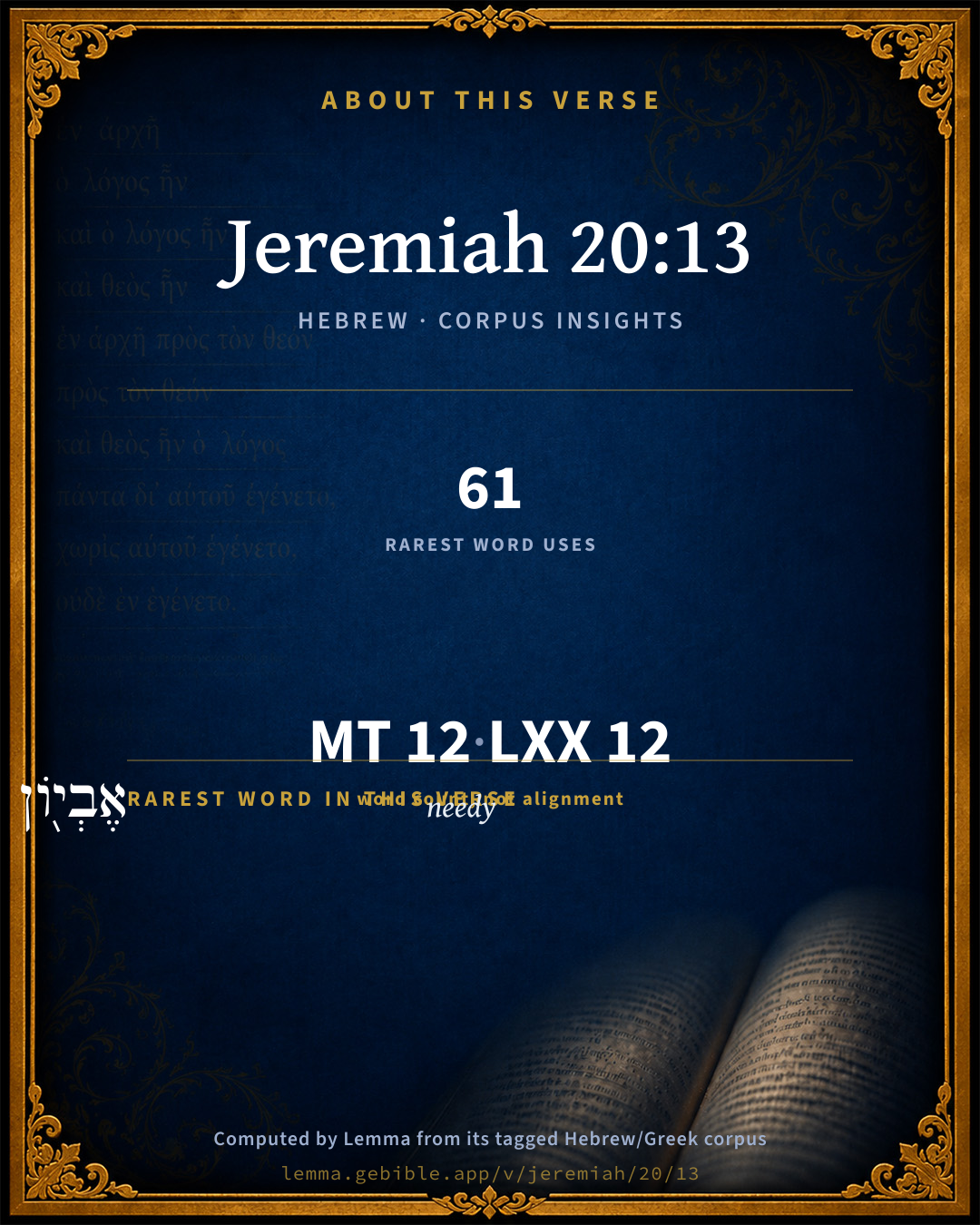
These counts appear in no published source. They are computed here, from the morphology-tagged text and Lemma’s own curated glosses. What Lemma adds →

12
words
10
distinct lemmas
Prophets
section

Grammatical profile

  • 4 verbs
  • 4 nouns
  • 1 adjective
  • 1 conjunction
  • 2 particles

Verb forms

  • שִׁ֚ירוּ Qal · Imperative
  • הַֽלְל֖וּ Piel · Imperative
  • הִצִּ֛יל Hiphil · Perfect
  • מְרֵעִֽים Hiphil · Participle Active

Repetition

A word recurs within this verse — often emphatic in Hebrew:

  • לַֽיהוָ֔ה LORD H3068 ×2

Hebrew & Septuagint length

In the original languages it is 12 Hebrew tokens and 12 Greek tokens — but the two are counted differently (Hebrew bundles its prefixes and suffixes into one token; the Greek is in lemma form), so that isn’t a like-for-like length.

Cross-references

7

Topical passages linked to Jeremiah 20:13 in the Treasury of Scripture Knowledge — connected by theme and wording, ordered by reader-vote popularity; previews shown in the World English Bible.

  • Isaiah 25:4 For you have been a stronghold to the poor, a stronghold to the needy in his distress, a refuge from the storm, a shade from the heat, when the blast of the awesome ones is as a storm against the wall.
  • Psalms 69:33 For Yahweh hears the needy, And doesn't despise his captive people.
  • Psalms 35:9–11 My soul shall be joyful in Yahweh. It shall rejoice in his salvation.
  • Psalms 34:6 This poor man cried, and Yahweh heard him, And saved him out of all his troubles.
  • Psalms 72:4 He will judge the poor of the people. He will save the children of the needy, And will break the oppressor in pieces.
  • Psalms 109:30–31 I will give great thanks to Yahweh with my mouth. Yes, I will praise him among the multitude.
  • James 2:5–6 Listen, my beloved brothers. Didn't God choose those who are poor in this world to be rich in faith, and heirs of the Kingdom which he promised to those who love him?

Cross-references courtesy of OpenBible.info (CC BY 4.0).

Hebrew and Greek witnesses Masoretic Hebrew ↔ Greek Septuagint

The same verse in the two great witnesses to the Old Testament, shown verse-for-verse.

These are two independent witnesses, not word-aligned to each other, and the Septuagint is shown in lemma (dictionary) form.

Hebrew Jeremiah 20:13 Masoretic · Westminster Leningrad Codex

שִׁ֚ירוּ לַֽיהוָ֔ה הַֽלְל֖וּ אֶת יְהוָ֑ה כִּ֥י הִצִּ֛יל אֶת נֶ֥פֶשׁ אֶבְי֖וֹן מִיַּ֥ד מְרֵעִֽים

Sing to Yahweh, praise you Yahweh; for he has delivered the soul of the needy from the hand of evil-doers.

World English Bible · Public Domain

Greek LXX Structure differs

In the Septuagint, Jeremiah is about an eighth shorter than the Hebrew and arranges its material differently — the Oracles Against the Nations (Hebrew chapters 46–51) appear in the middle of the Greek book, after 25:13. Because the chapter and verse boundaries do not line up, a verse-for-verse comparison with the Hebrew is not shown.

A verse-for-verse comparison isn’t shown here because the chapters and verses don’t line up. Switch to the LXX edition with the MT / LXX toggle above to read the Greek directly.

Hebrew: Westminster Leningrad Codex (CC BY 4.0). Greek: Septuagint (public domain); English from a public-domain English Septuagint. How the Septuagint differs from the Hebrew →

Targum (Aramaic paraphrase)

1

The Targum is the ancient Jewish Aramaic paraphrase of the Hebrew Scriptures — an interpretive translation, not the Hebrew text itself. Onkelos (literal) and Pseudo-Jonathan (expansive) render the Torah, and Jonathan the Prophets. Coverage is partial: where no permissively-licensed English translation exists for a verse, only the Aramaic is shown. This is verse-level text, not a word-by-word alignment to the Hebrew.

  1. Targum Jonathan Prophets (Joshua–Malachi)
    שַׁבָּחוּ קֳדָם יְיָ אוֹדוּ קֳדָם יְיָ אֲרֵי שֵׁיזֵיב יַת נְפַשׁ מִסְכֵּן מִיַד מַבְאֲשִׁין:

    (no public-domain English translation for this verse)

    Targum Jonathan — Aramaic: “Mikraot Gedolot” (public domain). English: “Sefaria Community Translation” (CC0 1.0 (public-domain dedication)); “London "Chaldee Paraphrase," 1871” (public domain). Text via Sefaria.

Commentary

Notes on Jeremiah 20:13 from classic Christian and Jewish commentators (each source and its license shown beneath its notes). The classic Christian expositions comment on the surrounding passage and are grouped to its opening verse, so a note may address several verses; the Jewish commentaries on the Tanakh (Rashi and others) are per-verse, so they appear only where the commentator wrote on this verse.

Lemma curates 59 commentaries, every one of them public domain or Creative Commons licensed, each selected and text-cleaned for this edition rather than reprinted as found. About our sources →

Trapp's Complete Commentary

John Trapp

Jer 20:13 Sing unto the LORD, praise ye the LORD: for he hath delivered the soul of the poor from the hand of evildoers.

Ver. 13. Sing unto the Lord, praise ye the Lord.] Nota hic alternantis animi motus aestusque. Here the Spirit triumpheth over the flesh; as in the next verses, the flesh again gets the wind and hill of the Spirit. Every good man is a divided man.

For he hath delivered the soul of the poor,] i.e., Of poor me. {as Psa 34:4}

John Trapp, A Commentary or Exposition upon All the Books of the Old and New Testament (1647–1656) — public domain. Text from a community e-Sword module.

Tyndale Open Study Notes

Tyndale Open Resources

20:13 Suddenly, relief and joy came to Jeremiah’s soul; he recalled that even when he was poor and needy, the Lord had rescued him from his oppressors.

Tyndale Open Study Notes — © Tyndale Open Resources, licensed CC BY-SA 4.0. Text via the HelloAO Bible API.

Jamieson, Fausset & Brown

Robert Jamieson, A. R. Fausset & David Brown

delivered . . . soul--This deliverance took place when Zedekiah succeeded Jeconiah.

Jamieson, Fausset & Brown — Commentary Critical and Explanatory on the Whole Bible (1871) — public domain (CC PDM 1.0). Text via the HelloAO Bible API.

Adam Clarke's Commentary

Verse 13. Sing unto the Lord] He was so completely delivered from all fear, that although he remained in the same circumstances, yet he exults in the Divine protection, and does not fear the face of any adversary.

Adam Clarke's Commentary on the Bible (1810–1826) — public domain. Text from a community e-Sword/MySword module.

John Calvin's Commentaries

Here the Prophet breaks out into an open expression of joy, and not only gives thanks himself to God, that he had been freed from the intrigues and violence of the wicked, but he also summons others, and encourages them to sing praises to God; as though he had said, that his deliverance was such a favor, that not only he should be thankful to God for it, but that all should join to celebrate it, according to what is said by Paul in 2 Corinthians 1:11, that thanks might be given by many to God. The Prophet no doubt had experienced God’s help, yea, that help which he had before so highly extolled. As, then, he had really found that God was victorious, and that his safety had been defended against all the ungodly by God’s invincible power, he in full confidence expressed his thanks, and wished all God’s servants to join with him.

Whenever, then, we are reduced into straits, and seem to be, as it were, rejected by God himself, let us still wait patiently until he may be pleased to free us from the hand of the wicked; without misery and distress preceding, we should never sufficiently acknowledge the power of God in preserving us. Thus Jeremiah confesses that he was for a time miserable and oppressed, but that he was at length delivered, even when the ungodly and wicked thought themselves victorious. Now follows an outcry, which seems to be of a very different character, —

John Calvin's Commentaries (1540-1563) — public domain. Text from the Calvin Translation Society English edition (1840s-50s) via the Christian Classics Ethereal Library (ccel.org). Calvin's coverage is partial (roughly two-thirds of the Bible); uncommented books and verses are honest gaps, never fabricated. The 19th-century editor's footnotes and remarks are omitted so the notes are faithfully Calvin's own voice.

Ellicott's Commentary for English Readers

(13) Sing unto the Lord . . .—It was as though heaviness had endured for a night, and joy had come in the morning. As with so many of the Psalms (Psa_22:22 is, perhaps, the most striking parallel), what began in a cry De profundis ends in a Hallelujah.

A Bible Commentary for English Readers, edited by Charles John Ellicott (1878–1897) — public domain. Text from a community e-Sword module.

The Cambridge Bible for Schools and Colleges

gen. ed. J. J. S. Perowne

13. This exclamation of praise may be compared with those which break out from time to time in the course, or at the conclusion, of many even among the most mournful and despondent of the Psalms, e.g. Psa_35:9-10; Psa_35:28.

The Cambridge Bible for Schools and Colleges (gen. ed. J. J. S. Perowne; Cambridge University Press, 1878–1918) — public domain. Text from a community e-Sword module.

John Gill's Exposition

Sing unto the Lord, praise ye the Lord,.... The prophet, from prayer, proceeds to praise; and from expressions of faith and confidence in the Lord, having committed his cause to him, being assured of success, rises up to a holy triumph and joy; and calls upon his soul, and upon others, to join with him in praising, and singing praises to the Lord: this is said, as Kimchi observes, with respect to the saints in Jerusalem; for there were some good people doubtless there at this time, a remnant according to the election of grace; who had a regard for the prophet, and wished well to him, and were ready to join with him in acts of devotion, prayer, or praise;

for he hath delivered the soul of the poor from the hand of evil doers; or, "the life of the poor"; meaning himself, a poor destitute person, few or none to stand by him but the Lord, who had delivered him out of the hand of Pashur and his accomplices; and out of the hand of those that watched for his halting; and out of the hands of all his persecutors: or this may respect not past deliverances, but what was to come; which the prophet had such a believing view of, that he calls upon himself and others to praise God for beforehand.

John Gill's Exposition of the Whole Bible (1746–1763) — public domain (CC PDM 1.0). Text via the HelloAO Bible API.

Haydock's Catholic Bible Commentary

Sing. God having shewn that his prayer should be heard, he gives thanks, (Calmet) and thus shews that what he is going to say proceeds not from impatience. (Theodoret)

George Leo Haydock (1774–1849), Haydock's Catholic Family Bible and Commentary, 1859 edition — public domain. Excludes Psalms (Douay-Rheims chapter numbering differs from Protestant) and Deuterocanonical books (Catholic canon only).

Matthew Poole's English Annotations

The prophet here riseth higher, from prayer to praise: it is not certain whether this was a rejoicing of faith or of sense; a thanksgiving to God upon his deliverance out of the hand of Pashur, or some other enemies, or a rejoicing in the sure belief that God would deliver his life out of the hands of these wicked men. If we take it in the latter sense, it teacheth us our duty, to give God the honour of all our deliverances from the hands of wicked men. If in the former sense, it showeth us the power of faith, which being the substance of things not seen, and evidence of things but hoped for, showeth us things to come as if already present, and teacheth us to rejoice in the hope of those things of which we have no present possession.

Matthew Poole's English Annotations on the Holy Bible (1683–1685) — public domain. Text from a community e-Sword/MySword module.

The Pulpit Commentary

In the confidence of faith Jeremiah sees himself already delivered. He writes in the style of the psalmists, who constantly pass from the language of prayer to that of fruition.

Thanksgiving for future blessings.

I WE MAY BE THANKFUL FOR BLESSINGS NOT YET RECEIVED. Jeremiah closes his prayer with praise. No sooner has he asked for God"s help than he feels so assured of receiving it that he anticipates it in imagination, and breaks forth into grateful song as though he were already enjoying it. This is a proof of genuine faith. Faith makes the absent seem near and the future appear present. (Heb_11:1) It influences our whole being the imagination among other faculties so that it enables us to conceive the good thing trusted for so vividly and so confidently that the thought of it affects the mind just as strongly as if we saw the object with our eyes and grasped it in our hands. Such an effect is a test of the earnestness and faith of prayer. Some people could not be more surprised than by receiving the exact answer to their prayers.

II THE FULL DELIVERANCE FROM ALL HARM IS A FUTURE BLESSING FOR WHICH WE MAY BE GRATEFUL.

1. It is a future blessing. Jeremiah was not delivered immediately. His life was beset with danger to the end. After the time to which our text refers, he met with worse troubles than any that had hitherto befallen him. The Christian must not expect a sudden and perfect escape from all distress and temptation the moment he prays to God for help. Perfect deliverance can only come with the conquest of the last enemy, death. "Now is our salvation our perfect deliverancenearer than when we first believed", (Rom_13:11) but it is not yet enjoyed.

2. It is, nevertheless, a blessing for which we may be truly thankful at once. For it is positively assured to the Christian. The heir of a great inheritance may rejoice in his prospects, though for the present he is in want. But earthly pleasures of hope are checked by fears of possible disappointment. The buds may be nipped by frost; the promising young man may break down before achieving any great work. Nevertheless God is too powerful, as well as too faithful, to fail in fulfilling his promises. Therefore we should anticipate the praises of heaven on earth, sing the songs of Zion in the strange land, and enjoy the vision of the celestial city from Beulah heights though valleys of humiliation and waters of death may lie between.

III IT IS A GOOD THING TO EXPRESS OUR GRATITUDE FOR FUTURE BLESSINGS.

1. All gratitude should find utterance in praise. The grateful heart should rouse the singing voice. Of all feelings thankfulness should be the last to be mute. We may pray for mercy in secret communion with God; we should utter praise as a public testimony to others and as an uncontrollable gladness that must relieve itself in song.

2. The utterance of praise for future blessings is an assurance of our faith. It will react upon us and strengthen faith. It will be a solace for the dark hours that may yet intervene before the enjoyment of the anticipated good.

The Pulpit Commentary (1880–1919), ed. H.D.M. Spence-Jones & Joseph S. Exell — public domain. Text from a community e-Sword module.

Lesson kit

Teaching starters — assembled from the data on this page, not authored interpretation. Every prompt links to the verse data it draws on. Edit before teaching.

Jeremiah, in the Prophets, opens this verse with 12 words (10 distinct Hebrew lemmas). Its most distinctive word is ʼebyôwn (“needy”). A historical commentator’s framing appears above. Read the whole chapter for the surrounding context.

Discussion questions

  1. The word ʼebyôwn carries the sense “needy.” How does it shape the verse?
  2. How does Isaiah 25:4, which shares this passage’s theme, read alongside this verse?
  3. What does the repetition of “LORD” (2× in this one verse) do in this verse?
  4. The translations on this page render this verse differently — a whole-verse word diff, not a word-by-word alignment. What might account for the different wordings?
  5. «שִׁ֚ירוּ» is a Qal Imperative verb. How does that grammatical form shape the action described?
  6. Compare how Trapp's Complete Commentary and Tyndale Open Study Notes read this verse. Where do they agree or differ?

Things to notice

Reading settings

Reading text

Shown beneath each verse's original-language words.

Old Testament
Old Testament edition

Read the OT as the Masoretic Hebrew (MT) or the Greek Septuagint (LXX).

English shown for the Greek Septuagint (in the Hebrew ↔ Greek comparison).

Comparing translations? Open the Compare panel on any verse page to stack up to four side by side.