Joshua 9:26

Hebrew (Westminster Leningrad Codex) Joshua 9:26 appears in the Hebrew Old Testament. The text above is from the Westminster Leningrad Codex. Each word links to its Strong’s number, a concise gloss, and parsing drawn from the Open Scriptures Hebrew Bible morphology. Click any word for its full Brown-Driver-Briggs (BDB) entry.
Download image
Cite this verse

Joshua 9:26 (World English Bible). Public Domain. Lemma interlinear Bible study tool, https://lemma.gebible.app/v/joshua/9/26.

Show BibTeX & RIS
BibTeX
RIS
English Translation
So did he to them, and delivered them out of the hand of the children of Israel, that they didn't kill them.
World English Bible · Public Domain
Download a study sheet

One document with this verse’s original text, its word-by-word gloss line, the meaning frame, cross-references with their text, attributed commentary, and full source and license credits — printable, and it pastes into notes with its structure intact.

This verse Autodidact and up

Study sheet (.html) Plain text (.txt)

A passage Seminary Student

Up to 50 verses in one chapter. A passage sheet keeps up to 6 commentary sources and 12 cross-references per verse, in the order this page ranks them, and says so on the sheet whenever that leaves anything out. Ask for a single verse and you get the Autodidact verse sheet above.

Everything on this page stays free to read, with no account — the sheet is a download of what is already on screen, not access to it.

Want to remove ads? Support Godless Engineer
Compare translations 3

The same verse in 3 English versions, stacked beneath the original-language interlinear above. Click any original word for its lexicon entry.

Each is an independent rendering of the whole verse — the interlinear is not word-aligned to these translations.

Highlighted words mark where these versions differ — a whole-verse word diff, not a word-by-word alignment.

  • World English Bible Public Domain
    So did he to them, and delivered them out of the hand of the children of Israel, that they didn't kill them.
  • King James Version Public Domain
    And so did he unto them, and delivered them out of the hand of the children of Israel, that they slew them not.
  • unfoldingWord Literal Text CC BY-SA 4.0
    And he did thus to them. And he delivered them from the hand of the sons of Israel, and they did not slay them.

unfoldingWord Literal Text — © unfoldingWord, licensed CC BY-SA 4.0. Word-aligned USFM3 via Door43 (git.door43.org/unfoldingWord/en_ult).

Versions to compare (up to 4)

3 of 4 selected

Show all 18 translations

Every available English version of this verse, each an independent rendering of the whole verse.

  • World English Bible Public Domain
    So did he to them, and delivered them out of the hand of the children of Israel, that they didn't kill them.
  • Berean Standard Bible Public Domain
    So Joshua did this and delivered them from the hands of the Israelites, and they did not kill the Gibeonites.
  • Majority Standard Bible Public Domain
    So Joshua did this and delivered them from the hands of the Israelites, and they did not kill the Gibeonites.
  • King James Version Public Domain
    And so did he unto them, and delivered them out of the hand of the children of Israel, that they slew them not.
  • American Standard Version (1901) Public Domain
    And so did he unto them, and delivered them out of the hand of the children of Israel, that they slew them not.
  • Revised Version (1885) Public Domain
    And so did he unto them, and delivered them out of the hand of the children of Israel, that they slew them not.
  • Geneva Bible (1599) Public Domain
    Euen so did he vnto them, and deliuered them out of the hand of the children of Israel, that they slewe them not.
  • Douay-Rheims (1899) Public Domain
    So Josue did as he had said, and delivered them from the hand of the children of Israel, that they should not be slain.
  • Young's Literal Translation Public Domain
    And he doth to them so, and delivereth them from the hand of the sons of Israel, and they have not slain them;
  • Literal Standard Version CC BY-SA 4.0
    And he does to them so, and delivers them from the hand of the sons of Israel, and they have not slain them;
  • Unlocked Literal Bible CC BY-SA 4.0
    So Joshua did this for them: He delivered them out of the control of the people of Israel, so that the Israelites did not kill them.
  • unfoldingWord Literal Text CC BY-SA 4.0
    And he did thus to them. And he delivered them from the hand of the sons of Israel, and they did not slay them.
  • Darby Bible Public Domain
    And he did so to them, and delivered them out of the hand of the children of Israel, and they did not slay them.
  • World Messianic Bible Public Domain
    He did so to them, and delivered them out of the hand of the children of Israel, so that they didn’t kill them.
  • Webster's Bible Public Domain
    And so did he to them, and delivered them out of the hand of the children of Israel, that they slew them not.
  • Free Bible Version CC BY-SA 4.0
    Joshua did as he had said. He saved them from the Israelites, so that they did not kill them.
  • Bible in Basic English Public Domain
    So he kept them safe from the children of Israel, and did not let them be put to death.
  • JPS Tanakh (1917) Public Domain
    And so did he unto them, and delivered them out of the hand of the children of Israel, that they slew them not.

Literal Standard Version (2020), Covenant Press — licensed CC BY-SA 4.0. Text via the HelloAO Bible API (eBible.org). Unlocked Literal Bible (unfoldingWord) — licensed CC BY-SA 4.0. Text via the HelloAO Bible API (eBible.org). unfoldingWord Literal Text — © unfoldingWord, licensed CC BY-SA 4.0. Word-aligned USFM3 via Door43 (git.door43.org/unfoldingWord/en_ult). Free Bible Version, Dr. Jonathan Gallagher — licensed CC BY-SA 4.0. Text via the HelloAO Bible API (eBible.org).

Word by word

More ways to search: Search by grammar → Find every occurrence → Compare this word →

Practice this passage: Drill this verse → Learn its vocabulary →

הֲרָגֽוּם
hârag
H2026
“to kill · them”
Verb, Qal, Perfect, 3rd Person, Common, Plural + Suffix, Personal, 3rd Person, Masculine, Plural
Part of Speech
Verb
Stem
Qal
Form
Perfect
Person
3rd Person
Gender
Common
Number
Plural
Full BDB Definition

Origin: a primitive root

TWOT: 514

to kill, slay, murder, destroy, murderer, slayer, out of hand - (Qal) - to kill, slay - to destroy, ruin - (Niphal) to be killed - (Pual) to be killed, be slain
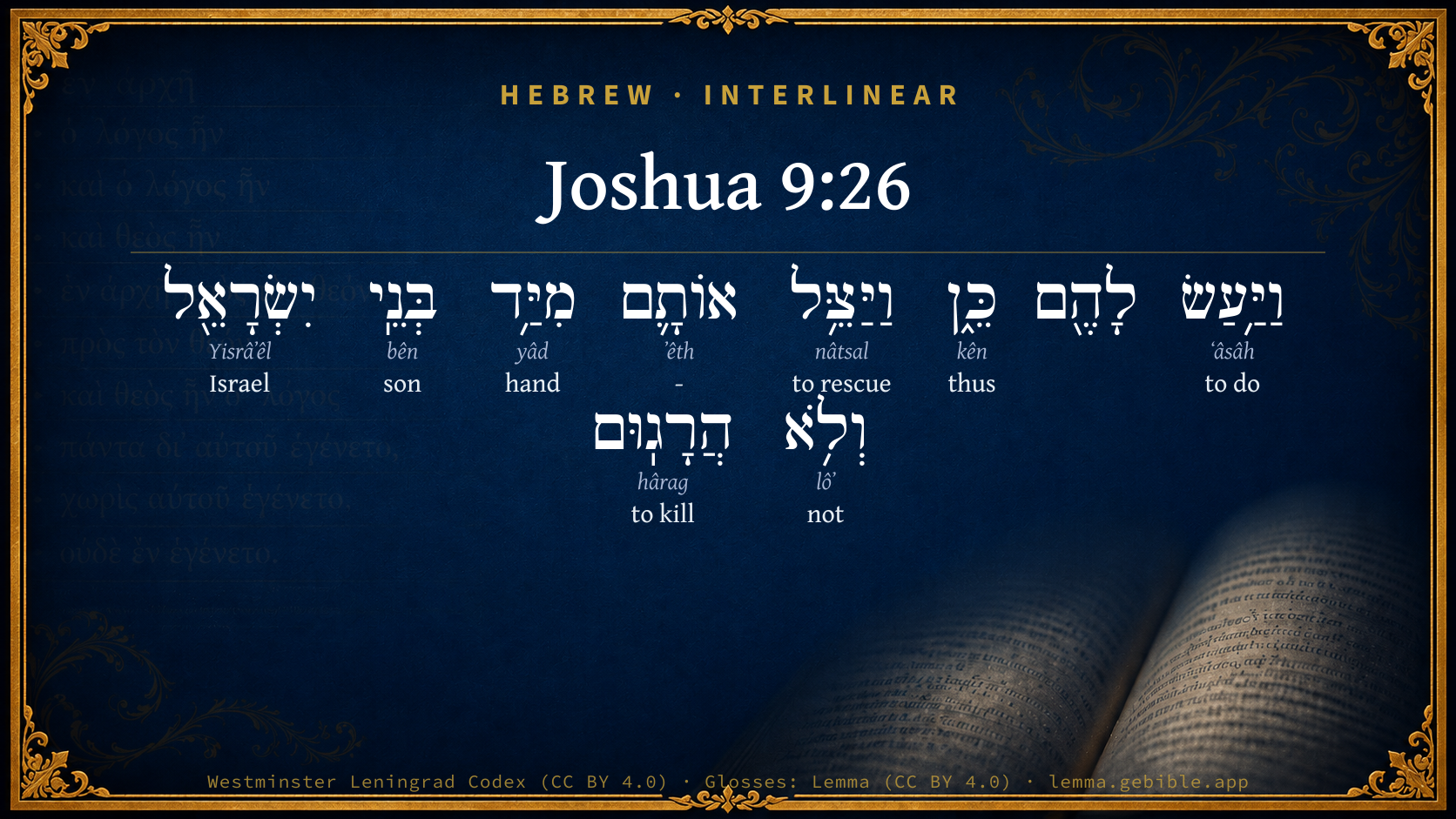
  1. וַיַּ֥עַשׂ ʻâsâh H6213 “and · to do” Conjunction + Verb, Qal, Sequential Imperfect, 3rd Person, Masculine, Singular
  2. כֵּ֑ן kên H3651 “thus” Particle, Demonstrative
  3. וַיַּצֵּ֥ל nâtsal H5337 “and · to rescue” Conjunction + Verb, Hiphil, Sequential Imperfect, 3rd Person, Masculine, Singular
  4. אוֹתָ֛ם ʼêth H853 “- · them” Particle, Direct Object + Suffix, Personal, 3rd Person, Masculine, Plural
  5. מִיַּ֥ד yâd H3027 “from · hand of” Preposition + Noun, Common, Both, Singular, Construct
  6. בְּנֵֽי bên H1121 “sons of” Noun, Common, Masculine, Plural, Construct
  7. יִשְׂרָאֵ֖ל Yisrâʼêl H3478 “Israel” Noun, Proper
  8. וְלֹ֥א lôʼ H3808 “and · not” Conjunction + Particle, Negative

About this verse

These counts appear in no published source. They are computed here, from the morphology-tagged text and Lemma’s own curated glosses. What Lemma adds →

10
words
9
distinct lemmas
Historical
section

Grammatical profile

  • 3 verbs
  • 3 nouns
  • 1 preposition
  • 3 particles

Verb forms

  • וַיַּ֥עַשׂ Qal · Sequential Imperfect
  • וַיַּצֵּ֥ל Hiphil · Sequential Imperfect
  • הֲרָגֽוּם Qal · Perfect

Hebrew & Septuagint length

In English translation the verse runs 22 words from the Hebrew and 28 from the Septuagint (LXX English) — closely comparable.

A rough comparison of the two English renderings, which tokenize alike — not a word-level alignment.

Word counts can differ between the Hebrew and the Greek without any difference in meaning — e.g. the Hebrew direct-object marker אֵת has no separate Greek word, and Greek often adds the article ὁ.

Hebrew and Greek witnesses Masoretic Hebrew ↔ Greek Septuagint

The same verse in the two great witnesses to the Old Testament, shown verse-for-verse.

These are two independent witnesses, not word-aligned to each other, and the Septuagint is shown in lemma (dictionary) form.

Hebrew Joshua 9:26 Masoretic · Westminster Leningrad Codex

וַיַּ֥עַשׂ לָהֶ֖ם כֵּ֑ן וַיַּצֵּ֥ל אוֹתָ֛ם מִיַּ֥ד בְּנֵֽי יִשְׂרָאֵ֖ל וְלֹ֥א הֲרָגֽוּם

So did he to them, and delivered them out of the hand of the children of Israel, that they didn't kill them.

World English Bible · Public Domain

Greek LXX Joshua 9:26 Septuagint · lemma form

καί ποιέω αὐτός οὕτως καί ἐκαἱρέω αὐτός ἰησοῦς ἐν ὁ ἡμέρα ἐκεῖνος ἐκ χείρ υἱός ἰσραήλ καί οὐ ἀνααἱρέω αὐτός

And they did so to them; and Joshua rescued them in that day out of the hands of the children of Israel, and they did not kill them.

LXX2012 (modern English Septuagint) · Public Domain

Hebrew: Westminster Leningrad Codex (CC BY 4.0). Greek: Septuagint (public domain); English from LXX2012 (modern English Septuagint) (Public Domain). How the Septuagint differs from the Hebrew →

Targum (Aramaic paraphrase)

1

The Targum is the ancient Jewish Aramaic paraphrase of the Hebrew Scriptures — an interpretive translation, not the Hebrew text itself. Onkelos (literal) and Pseudo-Jonathan (expansive) render the Torah, and Jonathan the Prophets. Coverage is partial: where no permissively-licensed English translation exists for a verse, only the Aramaic is shown. This is verse-level text, not a word-by-word alignment to the Hebrew.

  1. Targum Jonathan Prophets (Joshua–Malachi)
    וַעֲבַד לְהוֹן כֵן וְשֵׁזִיב יַתְהוֹן מִיַד בְּנֵי יִשְׂרָאֵל וְלָא קַטְלוּנוּן:

    (no public-domain English translation for this verse)

    Targum Jonathan — Aramaic: “Mikraot Gedolot” (public domain). English: “Sefaria Community Translation” (CC0 1.0 (public-domain dedication)); “London "Chaldee Paraphrase," 1871” (public domain). Text via Sefaria.

Commentary

Notes on Joshua 9:26 from classic Christian and Jewish commentators (each source and its license shown beneath its notes). The classic Christian expositions comment on the surrounding passage and are grouped to its opening verse, so a note may address several verses; the Jewish commentaries on the Tanakh (Rashi and others) are per-verse, so they appear only where the commentator wrote on this verse.

Lemma curates 59 commentaries, every one of them public domain or Creative Commons licensed, each selected and text-cleaned for this edition rather than reprinted as found. About our sources →

Trapp's Complete Commentary

John Trapp

Jos 9:26 And so did he unto them, and delivered them out of the hand of the children of Israel, that they slew them not.

Ver. 26. And delivered them out of the hands of the children of Israel.] Whose fingers even itched, as they say, after the pillage of those great cities: but Joshua staved them off.

John Trapp, A Commentary or Exposition upon All the Books of the Old and New Testament (1647–1656) — public domain. Text from a community e-Sword module.

Tyndale Open Study Notes

Tyndale Open Resources

9:26-27 This summary closes the account of Joshua’s second and last major mistake in leadership. • to this day: See study note on 4:9.

Tyndale Open Study Notes — © Tyndale Open Resources, licensed CC BY-SA 4.0. Text via the HelloAO Bible API.

Geneva Bible (1599)

Geneva Bible translators

Who were minded to put them to death for fear of God’s wrath.

Geneva Bible (1599) marginal notes — public domain. Text via Bolls.life.

Adam Clarke's Commentary

Verse 26. And so did he unto them] That is, he acted according to justice and mercy: he delivered them out of the hands of the people, so that they slew them not - here was mercy; and he made them hewers of wood and drawers of water for the congregation, and to the altar of God - here was justice. Thus Joshua did nothing but what was good and right, not only in his own eyes, but also in the eyes of the Lord.

How long the Gibeonites were preserved as a distinct people after this, we know not. That they existed in the time of David, is evident from the circumstance mentioned on Jos 9:19. They are not mentioned after the captivity; and it is probable that they were nearly annihilated by the persecution raised up against them by Saul. Some suppose that the Gibeonites existed under the appellation of Nethinim; but of this there is no decisive proof; the Nethinim were probably slaves of a different race.

ON what we meet with in this chapter, we may make the following observations.

1. The Gibeonites told lies, in order to save their lives. No expediency can justify this, nor are we called to attempt it. The Gibeonites were heathens, and we can expect nothing better from them. See Clarke on Jos 2:24.

2. They did not profit by their falsity: had they come in fairly, sought peace, and renounced their idolatry, they would have had life on honourable terms. As it was, they barely escaped with their lives, and were utterly deprived of their political liberty. Even the good that is sought by unlawful means has God's curse on it.

3. We need not be solicitous for the character of the Gibeonites here; they are neither our models, nor believers in the true God, and therefore pure religion is not concerned in their prevarication and falsity.

4. We see here of what solemn importance an oath was considered among the people of God; they swore to their own hurt, and changed not. When once they had bound themselves to their Maker, they did not believe that any changing circumstances could justify a departure from so awful an obligation. Thus, reader, shouldst thou fear a lie, and tremble at an oath.

Adam Clarke's Commentary on the Bible (1810–1826) — public domain. Text from a community e-Sword/MySword module.

The Cambridge Bible for Schools and Colleges

gen. ed. J. J. S. Perowne

26. delivered them out of the hand of the children of Israel] who would have certainly been glad to destroy them.

The Cambridge Bible for Schools and Colleges (gen. ed. J. J. S. Perowne; Cambridge University Press, 1878–1918) — public domain. Text from a community e-Sword module.

John Gill's Exposition

And so did he unto them,.... What was good and right, he showed them favour, and did them justice:

and delivered them out of the hand of the children of Israel, that they slew them not; who were so incensed against them for imposing on them in the manner they did, that they were ready many of them to draw their swords and slay them; and would have done it, had it not been for the interposition of Joshua, and the orders he gave to the contrary.

John Gill's Exposition of the Whole Bible (1746–1763) — public domain (CC PDM 1.0). Text via the HelloAO Bible API.

Matthew Poole's English Annotations

So as was said Jos 9:23, and so as here follows.

Matthew Poole's English Annotations on the Holy Bible (1683–1685) — public domain. Text from a community e-Sword/MySword module.

Whedon's Commentary on the Bible

Daniel D. Whedon

26. And delivered them — The people were clamorous for their blood. Joshua shows his great courage and fidelity to his convictions by resisting the pressure of the outraged and excited populace, who in mobocratic madness would have swept away a weaker ruler.

Daniel D. Whedon (gen. ed.), Commentary on the Old and New Testaments (1874–1909) — public domain. Text from a community e-Sword module.

The Pulpit Commentary

That they slew them not. See ver. 18, which attributes the preservation of the Gibeonites to the action of the heads of tribes. Perhaps this should be rendered, and they slew them not.

The Pulpit Commentary (1880–1919), ed. H.D.M. Spence-Jones & Joseph S. Exell — public domain. Text from a community e-Sword module.

Keil & Delitzsch

C. F. Keil & F. Delitzsch

"And so did he unto them, and delivered them out of the hand of the children of Israel, that they slew them not. He made them hewers of wood and drawers of water for the congregation, and indeed for the altar of the Lord," (assigning them) "to the place which God would choose," viz., for the altar. אלהמּקום (to the place) is grammatically dependent upon ויּתּנם (he "gave them"). It by no means follows, however, that Joshua sent them there at that very time, but simply that he sentenced them to service at the altar in the place which would be chosen for the sanctuary. From the words "unto this day," it no doubt follows, on the one hand, that the account was written after the fact had taken place; but, on the other hand, it also follows from the future יבחר (should, or shall choose), that it was written before the place was definitely fixed, and therefore before the building of Solomon's temple.

Keil & Delitzsch — Biblical Commentary on the Old Testament (1861–1891) — public domain (CC PDM 1.0). Text via the HelloAO Bible API. (Old Testament only.)

unfoldingWord translationNotes

Door43 World Missions Community

for them

The word "them" here refers to the Gibeonites.

to this day

"even up to now." This means that the people had continued to do these things even up to the day that the writer was living.

translationWords

Joshua

Israel

Gibeon

altar

Yahweh

unfoldingWord translationNotes — © Distant Shores Media and the Door43 World Missions Community, licensed CC BY-SA 4.0. Source: git.door43.org/Door43/en_tn.

Lesson kit

Teaching starters — assembled from the data on this page, not authored interpretation. Every prompt links to the verse data it draws on. Edit before teaching.

Joshua, in the Historical, opens this verse with 10 words (9 distinct Hebrew lemmas). Its most distinctive word is hârag (“to kill”). A historical commentator’s framing appears above. Read the whole chapter for the surrounding context.

Discussion questions

  1. The word hârag carries the sense “to kill.” How does it shape the verse?
  2. These translations render this verse differently; the difference is in the English rendering, not the original. What questions does that raise?
  3. «וַיַּ֥עַשׂ» is a Qal Sequential Imperfect verb. How does that grammatical form shape the action described?
  4. Compare how Trapp's Complete Commentary and Tyndale Open Study Notes read this verse. Where do they agree or differ?

Things to notice

Reading settings

Reading text

Shown beneath each verse's original-language words.

Old Testament
Old Testament edition

Read the OT as the Masoretic Hebrew (MT) or the Greek Septuagint (LXX).

English shown for the Greek Septuagint (in the Hebrew ↔ Greek comparison).

Comparing translations? Open the Compare panel on any verse page to stack up to four side by side.