
Isaiah 36:18

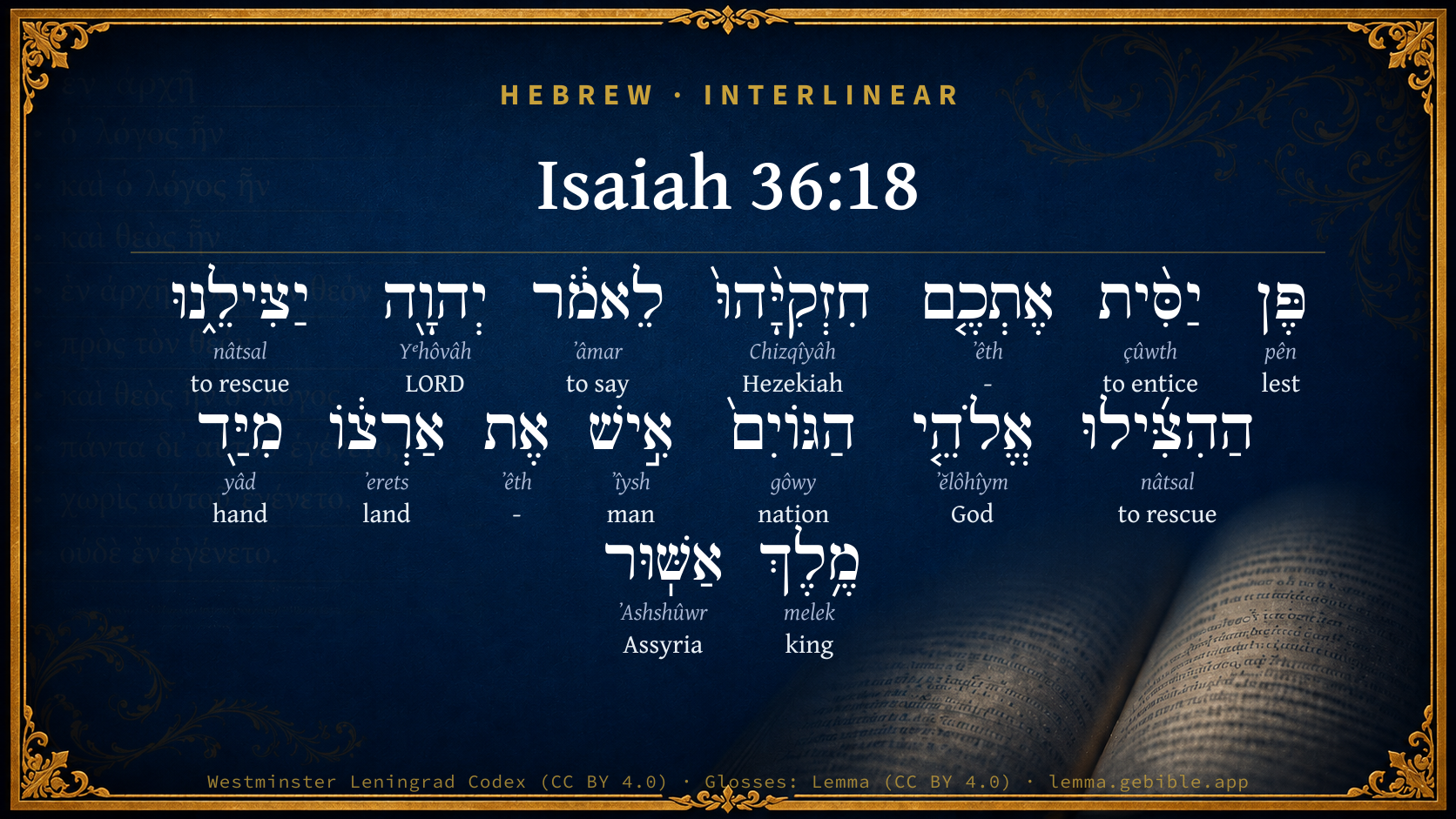
Hebrew (Westminster Leningrad Codex) Isaiah 36:18 appears in the Hebrew Old Testament. The text above is from the Westminster Leningrad Codex. Each word links to its Strong’s number, a concise gloss, and parsing drawn from the Open Scriptures Hebrew Bible morphology. Click any word for its full Brown-Driver-Briggs (BDB) entry.
Download image
Cite this verse

Isaiah 36:18 (World English Bible). Public Domain. Lemma interlinear Bible study tool, https://lemma.gebible.app/v/isaiah/36/18.

Show BibTeX & RIS
BibTeX
RIS
English Translation
Beware lest Hezekiah persuade you, saying, Yahweh will deliver us. Has any of the gods of the nations delivered his land out of the hand of the king of Assyria?
World English Bible · Public Domain
Download a study sheet

One document with this verse’s original text, its word-by-word gloss line, the meaning frame, cross-references with their text, attributed commentary, and full source and license credits — printable, and it pastes into notes with its structure intact.

This verse Autodidact and up

Study sheet (.html) Plain text (.txt)

A passage Seminary Student

Up to 50 verses in one chapter. A passage sheet keeps up to 6 commentary sources and 12 cross-references per verse, in the order this page ranks them, and says so on the sheet whenever that leaves anything out. Ask for a single verse and you get the Autodidact verse sheet above.

Everything on this page stays free to read, with no account — the sheet is a download of what is already on screen, not access to it.

Want to remove ads? Support Godless Engineer
Compare translations 3

The same verse in 3 English versions, stacked beneath the original-language interlinear above. Click any original word for its lexicon entry.

Each is an independent rendering of the whole verse — the interlinear is not word-aligned to these translations.

Highlighted words mark where these versions differ — a whole-verse word diff, not a word-by-word alignment.

  • World English Bible Public Domain
    Beware lest Hezekiah persuade you, saying, Yahweh will deliver us. Has any of the gods of the nations delivered his land out of the hand of the king of Assyria?
  • King James Version Public Domain
    Beware lest Hezekiah persuade you, saying, the LORD will deliver us. Hath any of the gods of the nations delivered his land out of the hand of the king of Assyria?
  • unfoldingWord Literal Text CC BY-SA 4.0
    lest Hezekiah mislead you, saying, “Yahweh will deliver us.” Did the gods of the nations deliver, a man, his land, from the hand of the king of Assyria?

unfoldingWord Literal Text — © unfoldingWord, licensed CC BY-SA 4.0. Word-aligned USFM3 via Door43 (git.door43.org/unfoldingWord/en_ult).

Versions to compare (up to 4)

3 of 4 selected

Show all 18 translations

Every available English version of this verse, each an independent rendering of the whole verse.

  • World English Bible Public Domain
    Beware lest Hezekiah persuade you, saying, Yahweh will deliver us. Has any of the gods of the nations delivered his land out of the hand of the king of Assyria?
  • Berean Standard Bible Public Domain
    Do not let Hezekiah mislead you when he says, ‘The LORD will deliver us.’ Has the god of any nation ever delivered his land from the hand of the king of Assyria?
  • Majority Standard Bible Public Domain
    Do not let Hezekiah mislead you when he says, ‘The LORD will deliver us.’ Has the god of any nation ever delivered his land from the hand of the king of Assyria?
  • King James Version Public Domain
    Beware lest Hezekiah persuade you, saying, the LORD will deliver us. Hath any of the gods of the nations delivered his land out of the hand of the king of Assyria?
  • American Standard Version (1901) Public Domain
    Beware lest Hezekiah persuade you, saying, Jehovah will deliver us. Hath any of the gods of the nations delivered his land out of the hand of the king of Assyria?
  • Revised Version (1885) Public Domain
    Beware lest Hezekiah persuade you, saying, The LORD will deliver us. Hath any of the gods of the nations delivered his land out of the hand of the king of Assyria?
  • Geneva Bible (1599) Public Domain
    Least Hezekiah deceiue you, saying, The Lord wil deliuer vs. Hath any of the gods of the nations deliuered his land out of the hand of the King of Asshur?
  • Douay-Rheims (1899) Public Domain
    Neither let Ezechias trouble you, saying: The Lord will deliver us. Have any of the gods of the nations delivered their land out of the hand of the king of the Assyrians?
  • Young's Literal Translation Public Domain
    lest Hezekiah doth persuade you, saying, Jehovah doth deliver us. `Have the gods of the nations delivered each his land out of the hand of the king of Asshur?
  • Literal Standard Version CC BY-SA 4.0
    lest Hezekiah persuades you, saying, YHWH delivers us. Have the gods of the nations each delivered his land out of the hand of the king of Asshur?
  • Unlocked Literal Bible CC BY-SA 4.0
    Do not let Hezekiah mislead you, saying, 'Yahweh will rescue us.' Has any of the gods of the peoples rescued them from the hand of the king of Assyria?
  • unfoldingWord Literal Text CC BY-SA 4.0
    lest Hezekiah mislead you, saying, “Yahweh will deliver us.” Did the gods of the nations deliver, a man, his land, from the hand of the king of Assyria?
  • Darby Bible Public Domain
    Let not Hezekiah persuade you, saying, Jehovah will deliver us. Has any of the gods of the nations delivered his land out of the hand of the king of Assyria?
  • World Messianic Bible Public Domain
    Beware lest Hezekiah persuade you, saying, “The LORD will deliver us.” Have any of the gods of the nations delivered their lands from the hand of the king of Assyria?
  • Webster's Bible Public Domain
    Beware lest Hezekiah persuade you, saying, The LORD will deliver us. Hath any of the gods of the nations delivered his land out of the hand of the king of Assyria?
  • Free Bible Version CC BY-SA 4.0
    But don't let Hezekiah trick you when he says, ‘The Lord will deliver us.’ Have any of the gods of any nation ever saved their land from the power of the king of Assyria?
  • Bible in Basic English Public Domain
    Give no attention to Hezekiah when he says to you, The Lord will keep us safe. Has any one of the gods of the nations kept his land from falling into the hands of the king of Assyria?
  • JPS Tanakh (1917) Public Domain
    Beware lest Hezekiah persuade you, saying: The LORD will deliver us. Hath any of the gods of the nations delivered his land out of the hand of the king of Assyria?

Literal Standard Version (2020), Covenant Press — licensed CC BY-SA 4.0. Text via the HelloAO Bible API (eBible.org). Unlocked Literal Bible (unfoldingWord) — licensed CC BY-SA 4.0. Text via the HelloAO Bible API (eBible.org). unfoldingWord Literal Text — © unfoldingWord, licensed CC BY-SA 4.0. Word-aligned USFM3 via Door43 (git.door43.org/unfoldingWord/en_ult). Free Bible Version, Dr. Jonathan Gallagher — licensed CC BY-SA 4.0. Text via the HelloAO Bible API (eBible.org).

Word by word

More ways to search: Search by grammar → Find every occurrence → Compare this word →

Practice this passage: Drill this verse → Learn its vocabulary →

יַסִּ֨ית
çûwth
H5496
“to entice”
Verb, Hiphil, Imperfect, 3rd Person, Masculine, Singular
Part of Speech
Verb
Stem
Hiphil
Form
Imperfect
Person
3rd Person
Gender
Masculine
Number
Singular
Full BDB Definition

Origin: perhaps denominative from H7898

TWOT: 1481

to incite, allure, instigate, entice - (Hiphil) - to incite (to a request) - to allure, lure - to instigate (bad sense)
  1. פֶּן pên H6435 “lest” Conjunction
  2. אֶתְכֶ֤ם ʼêth H853 “- · you” Particle, Direct Object + Suffix, Personal, 2nd Person, Masculine, Plural
  3. חִזְקִיָּ֨הוּ֙ Chizqîyâh H2396 “Hezekiah” Noun, Proper
  4. לֵאמֹ֔ר ʼâmar H559 “to say” Preposition + Verb, Qal, Infinitive Construct
  5. יְהוָ֖ה Yᵉhôvâh H3068 “LORD” Noun, Proper
  6. יַצִּילֵ֑נוּ nâtsal H5337 “to rescue · us” Verb, Hiphil, Imperfect, 3rd Person, Masculine, Singular + Suffix, Personal, 1st Person, Common, Plural
  7. הַהִצִּ֜ילוּ nâtsal H5337 “to rescue” Particle, Interrogative + Verb, Hiphil, Perfect, 3rd Person, Common, Plural
  8. אֱלֹהֵ֤י ʼĕlôhîym H430 “God(s) of” Noun, Common, Masculine, Plural, Construct
  9. הַגּוֹיִם֙ gôwy H1471 “the · nations” Particle, Definite Article + Noun, Common, Masculine, Plural, Absolute
  10. אִ֣ישׁ ʼîysh H376 “man” Noun, Common, Masculine, Singular, Absolute
  11. אֶת ʼêth H853 “-” Particle, Direct Object
  12. אַרְצ֔וֹ ʼerets H776 “land · his” Noun, Common, Both, Singular, Construct + Suffix, Personal, 3rd Person, Masculine, Singular
  13. מִיַּ֖ד yâd H3027 “from · hand of” Preposition + Noun, Common, Both, Singular, Construct
  14. מֶ֥לֶךְ melek H4428 “king of” Noun, Common, Masculine, Singular, Construct
  15. אַשּֽׁוּר ʼAshshûwr H804 “Assyria” Noun, Proper

About this verse

These counts appear in no published source. They are computed here, from the morphology-tagged text and Lemma’s own curated glosses. What Lemma adds →

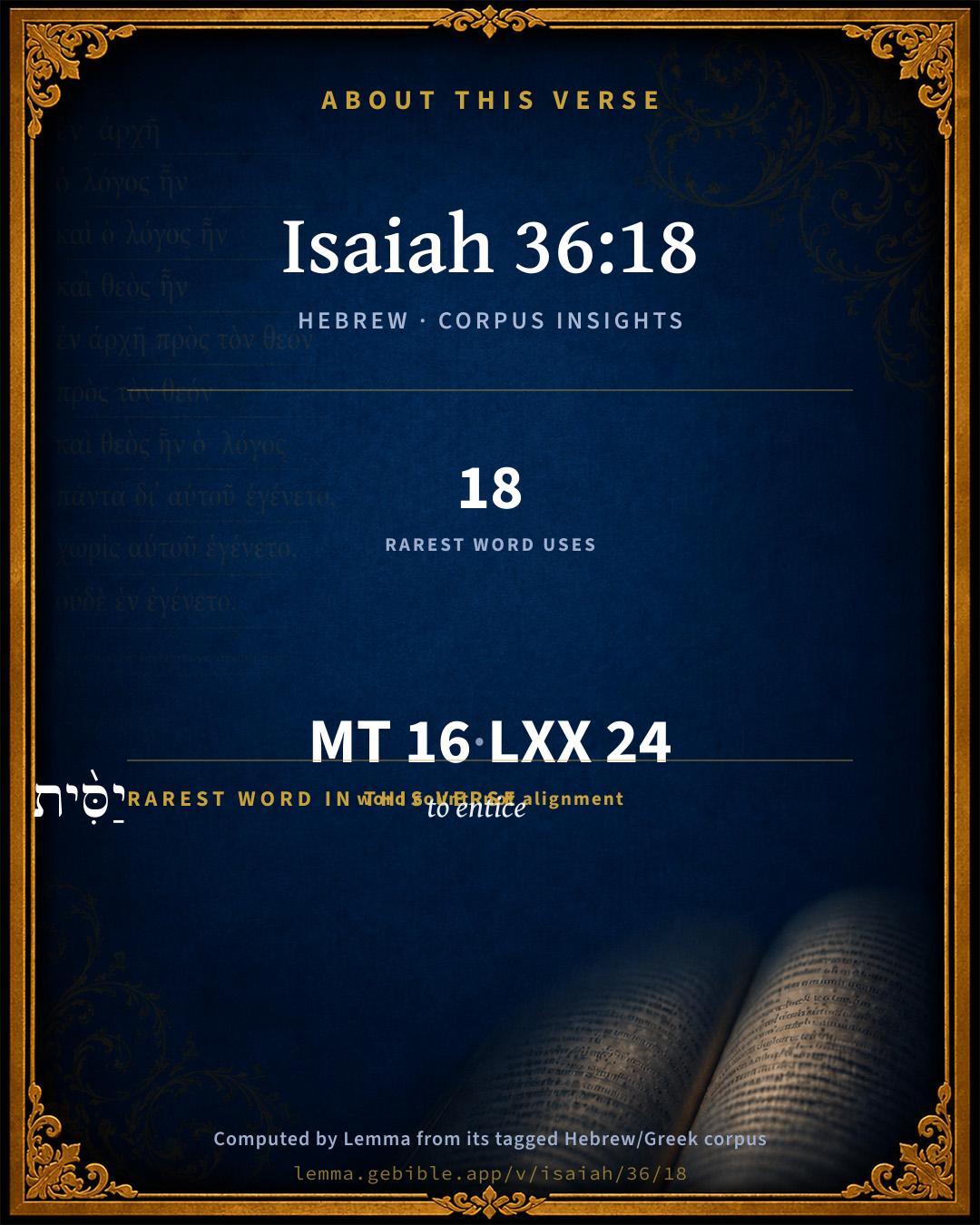
16
words
14
distinct lemmas
Prophets
section

Notable vocabulary

The rarest word here is יַסִּ֨ית to entice H5496 — appearing just 18 times in the whole Hebrew Bible.

Shared distinctive vocabulary

יַסִּ֨ית to entice H5496 occurs in 18 verses of the Hebrew Bible. Also found in:

Grammatical profile

  • 4 verbs
  • 9 nouns
  • 1 conjunction
  • 2 particles

Verb forms

  • יַסִּ֨ית Hiphil · Imperfect
  • לֵאמֹ֔ר Qal · Infinitive Construct
  • יַצִּילֵ֑נוּ Hiphil · Imperfect
  • הַהִצִּ֜ילוּ Hiphil · Perfect

Repetition

A word recurs within this verse — often emphatic in Hebrew:

  • יַצִּילֵ֑נוּ to rescue H5337 ×2

Hebrew & Septuagint length

In English translation the verse runs 30 words from the Hebrew and 32 from the Septuagint (LXX English) — closely comparable.

A rough comparison of the two English renderings, which tokenize alike — not a word-level alignment.

Word counts can differ between the Hebrew and the Greek without any difference in meaning — e.g. the Hebrew direct-object marker אֵת has no separate Greek word, and Greek often adds the article ὁ.

In the original languages it is 16 Hebrew tokens and 24 Greek tokens — but the two are counted differently (Hebrew bundles its prefixes and suffixes into one token; the Greek is in lemma form), so that isn’t a like-for-like length.

Cross-references

19

Topical passages linked to Isaiah 36:18 in the Treasury of Scripture Knowledge — connected by theme and wording, ordered by reader-vote popularity; previews shown in the World English Bible.

  • Isaiah 36:15 neither let Hezekiah make you trust in Yahweh, saying, Yahweh will surely deliver us; this city shall not be given into the hand of the king of Assyria.
  • Isaiah 37:17–18 Turn your ear, Yahweh, and hear; open your eyes, Yahweh, and behold; and hear all the words of Sennacherib, who has sent to defy the living God.
  • 2 Kings 18:33–35 Has any of the gods of the nations ever delivered his land out of the hand of the king of Assyria?
  • 2 Kings 19:12–13 Have the gods of the nations delivered them, which my fathers have destroyed, Gozan, and Haran, and Rezeph, and the children of Eden that were in Telassar?
  • 2 Kings 19:17–18 Of a truth, Yahweh, the kings of Assyria have laid waste the nations and their lands,
  • 2 Chronicles 32:13–17 Don't you know what I and my fathers have done to all the peoples of the lands? Were the gods of the nations of the lands in any wise able to deliver their land out of my hand?
  • Psalms 12:4 Who have said, "With our tongue we will prevail. Our lips are our own. Who is lord over us?"
  • Psalms 92:5–7 How great are your works, Yahweh! Your thoughts are very deep.
  • Psalms 115:2–8 Why should the nations say, "Where is their God, now?"
  • Psalms 135:5–6 For I know that Yahweh is great, That our Lord is above all gods.
  • Psalms 135:15–18 The idols of the nations are silver and gold, The work of men's hands.
  • Isaiah 36:7 But if you tell me, We trust in Yahweh our God: isn't that he, whose high places and whose altars Hezekiah has taken away, and has said to Judah and to Jerusalem, You shall worship before this altar?
  • Isaiah 36:10 Am I now come up without Yahweh against this land to destroy it? Yahweh said to me, Go up against this land, and destroy it.
  • Isaiah 37:10 Thus shall you speak to Hezekiah king of Judah, saying, Don't let your God in whom you trust deceive you, saying, Jerusalem shall not be given into the hand of the king of Assyria.
  • Isaiah 37:12–13 Have the gods of the nations delivered them, which my fathers have destroyed, Gozan, and Haran, and Rezeph, and the children of Eden who were in Telassar?
  • Jeremiah 10:10–12 But Yahweh is the true God; he is the living God, and an everlasting King: at his wrath the earth trembles, and the nations are not able to abide his indignation.
  • Daniel 3:15 Now if you are ready whenever you hear the sound of the horn, flute, zither, lyre, harp, pipe, and all kinds of music to you fall down and worship the image which I have made, [well]: but if you don't worship, you shall be cast the same hour into the midst of a burning fiery furnace; and who is that god that shall deliver you out of my hands?
  • Habakkuk 2:19–20 Woe to him who says to the wood, 'Awake!' or to the mute stone, 'Arise!' Shall this teach? Behold, it is overlaid with gold and silver, and there is no breath at all in the midst of it.
  • Jeremiah 10:3–5 For the customs of the peoples are vanity; for one cuts a tree out of the forest, the work of the hands of the workman with the axe.

Cross-references courtesy of OpenBible.info (CC BY 4.0).

Hebrew and Greek witnesses Masoretic Hebrew ↔ Greek Septuagint

The same verse in the two great witnesses to the Old Testament, shown verse-for-verse.

These are two independent witnesses, not word-aligned to each other, and the Septuagint is shown in lemma (dictionary) form.

Hebrew Isaiah 36:18 Masoretic · Westminster Leningrad Codex

פֶּן יַסִּ֨ית אֶתְכֶ֤ם חִזְקִיָּ֨הוּ֙ לֵאמֹ֔ר יְהוָ֖ה יַצִּילֵ֑נוּ הַהִצִּ֜ילוּ אֱלֹהֵ֤י הַגּוֹיִם֙ אִ֣ישׁ אֶת אַרְצ֔וֹ מִיַּ֖ד מֶ֥לֶךְ אַשּֽׁוּר

Beware lest Hezekiah persuade you, saying, Yahweh will deliver us. Has any of the gods of the nations delivered his land out of the hand of the king of Assyria?

World English Bible · Public Domain

Greek LXX Isaiah 36:18 Septuagint · lemma form

μή σύ ἀπατάω εζεκιας λέγω ὁ θεός σύ ῥύομαι σύ μή ῥύομαι ὁ θεός ὁ ἔθνος ἕκαστος ὁ ἑαυτοῦ χώρα ἐκ χείρ βασιλεύς ἀσσύριος

Let not Ezekias deceive you, saying, God will deliver you. Have the gods of the nations delivered each one his own land out of the hand of the king of the Assyrians?

LXX2012 (modern English Septuagint) · Public Domain

Hebrew: Westminster Leningrad Codex (CC BY 4.0). Greek: Septuagint (public domain); English from LXX2012 (modern English Septuagint) (Public Domain). How the Septuagint differs from the Hebrew →

Targum (Aramaic paraphrase)

1

The Targum is the ancient Jewish Aramaic paraphrase of the Hebrew Scriptures — an interpretive translation, not the Hebrew text itself. Onkelos (literal) and Pseudo-Jonathan (expansive) render the Torah, and Jonathan the Prophets. Coverage is partial: where no permissively-licensed English translation exists for a verse, only the Aramaic is shown. This is verse-level text, not a word-by-word alignment to the Hebrew.

  1. Targum Jonathan Prophets (Joshua–Malachi)
    דִלְמָא יַטְעֵי יַתְכוֹן חִזְקִיָה לְמֵימָר יְיָ יְשֵׁזְבָנָנָא הֲשֵׁיזְבָא דַחֲלַת עַמְמַיָא גְבַר יַת אַרְעֵהּ מִיַד מַלְכָּא דְאַתּוּר:

    Beware lest Hezekiah cause you to err, saying, The Lord shall deliver us. Hath any of the gods of the nations delivered his land from the hand of the king of Assyria?

    Targum Jonathan — Aramaic: “Mikraot Gedolot” (public domain). English: “Sefaria Community Translation” (CC0 1.0 (public-domain dedication)); “London "Chaldee Paraphrase," 1871” (public domain). Text via Sefaria.

Commentary

Notes on Isaiah 36:18 from classic Christian and Jewish commentators (each source and its license shown beneath its notes). The classic Christian expositions comment on the surrounding passage and are grouped to its opening verse, so a note may address several verses; the Jewish commentaries on the Tanakh (Rashi and others) are per-verse, so they appear only where the commentator wrote on this verse.

Lemma curates 59 commentaries, every one of them public domain or Creative Commons licensed, each selected and text-cleaned for this edition rather than reprinted as found. About our sources →

Ellicott's Commentary for English Readers

(18) Hath any of the gods of the nations . . .—The Rabshakeh speaks in the natural language of polytheism. The Jehovah of Israel was one of gods many and lords many, a simple national deity; but Asshur and Ishtar, the gods of Assyria, were supreme above them all (Records of the Past, i. 25, 33).

A Bible Commentary for English Readers, edited by Charles John Ellicott (1878–1897) — public domain. Text from a community e-Sword module.

The Cambridge Bible for Schools and Colleges

gen. ed. J. J. S. Perowne

18–20. The long record of Assyrian conquest shews the folly of Hezekiah’s trust in Divine power. Cf. ch. Isa_10:9-11.

persuade] Rather, beguile.

The Cambridge Bible for Schools and Colleges (gen. ed. J. J. S. Perowne; Cambridge University Press, 1878–1918) — public domain. Text from a community e-Sword module.

John Gill's Exposition

Beware lest Hezekiah persuade you,.... To trust in the Lord, stand up in your own defence and not listen to these proposals; or, lest he "deceive you" (m); with vain words; whom he would represent not only as not being their lawful king, and therefore never gives him that title, but also as a deceiver and impostor, of whom they should be cautious, and guard against:

saying, the Lord will deliver us; and therefore need not fear the boasts and threats, the force and fury, of the enemy:

hath any of the gods of the nations delivered his land; over whom he presided, and to whom the people of it were devotees:

out of the hand of the king of Assyria? this reasoning would have had some weight in it had the Lord God of Israel been like the gods of the nations, but he is not; he is the Former and Maker of all things, and sits in the heavens, and does whatsoever he pleases in heaven and in earth; and therefore, though they could not deliver their nations that worshipped them, it did not follow that the God of Israel could not deliver Hezekiah and his people.

(m) "ne forte decipiat vos", Calvin, Vatablus; "ne seducat vos", Junius & Tremellius, Piscator.

John Gill's Exposition of the Whole Bible (1746–1763) — public domain (CC PDM 1.0). Text via the HelloAO Bible API.

Albert Barnes' Notes on the Bible

Hath any of the gods of the nations ... - This is said to show them the impossibility, as he supposed, of being delivered from the arm of the king of Assyria. He had conquered all before him, and not even the gods of the nations had been able to rescue the lands where they were worshipped from the hands of the victorious invader. He inferred, therefore, that Yahweh, the God of Palestine, could not save their land.

Albert Barnes' Notes on the Bible (1834–1885) — public domain. Text from a community e-Sword/MySword module.

The Pulpit Commentary

Beware lest Hezekiah persuade you; rather, seduce you. (Deu_13:6 1Ki_21:25) Sennacherib claims to be entitled to the people"s allegiance, and represents Hezekiah as a rebel, who seeks to draw them away from their duty. Hath any of the gods of the nations delivered his land? The successes of the Assyrians, and the religious character of their wars, justified this boast. The pervading idea of the inscriptions is that wars arc undertaken for the glory of the Assyrian deities, particularly of Asshur, for the chastisement of his enemies, and with the object of establishing in each country, as it is brought under subjection, the laws and worship of Asshur (see "Ancient Monarchies," vol. 2. pp. 322-324 and 531). The nations fight under the protection of their own gods, and thus each war is a struggle between the Assyrian deities and those of the nation with which they arc contending. Hitherto, undoubtedly, Assyria had met with almost uniform success. (see Isa_10:5-14)

Insult offered to our God.

It is an insult to class Jehovah with the idol-gods created by heathen imaginations and presented in heathen symbolic figures. Jehovah is like none else; he is God alone. The impertinence of this Rabshakeb is seen in that he sets Jehovah among the petty and inferior gods of small nations, and assumes that Asshur and Ishtar, the gods of Assyria, were supreme above them all. Cheyne says, "The Assyrian is inconsistent. In his first speech he had stated himself to be the obedient instrument of Jehovah. Here he represents the wars of the Assyrians as inspired by a religious hostility to all the gods of the nations." The point which may be illustrated is What should be our attitude in the presence of such insults? For they are offered now. The scoffer still lives. The sceptic still flings over God the dark shadow of his doubtings. Literature, too, often thinly veils its insults.

We should variously meet the occasions, adapting our response to the nature of the insult and the character of him who offers it. Three forms of response may be considered.

I CALM INDIFFERENCE. Very many of the bravely uttered scepticisms of our time are only designed to draw attention to those who utter them. They are in the nature of personal advertisements. Leave them alone. They are nothing; we must take care not to swell them into something by directing attention to them. Sometimes these insults are petty and nagging, but continuous. Again, indifference is the best treatment. Those who have faith in God make grave mistakes when they too vigorously defend God against the arrows of mere children. To noisy antagonism we may calmly say, "It doesn"t matter.

II NOBLE TESTIMONY. There is a time to speak. When insults have grown to such power that the faith of the young, or the work of grace in the world, is imperilled, we must speak out. The Christian apologist has his time and his sphere, especially when a kind of mania of unbelief seems to seize upon a people. Illustrate from the three Hebrew youths; the apostles before the Sanhedrini; Paul before Agrippa; Luther at the Diet of Worms, etc. Firm testimony of our personal convictions will often silence the scoffer.

III ACTIVE VINDICATION. By reasonable judgments on those who offer the insult. Blasphemy ought to he a crime. By withdrawal from association with those who thus walk disorderly. The man who has no reverence for God has no basis of character which makes friendship with him safe. And by using all available means for clearing the outraged name, and upholding the imperilled honour of him who is our "All and in all. R.T.

The Pulpit Commentary (1880–1919), ed. H.D.M. Spence-Jones & Joseph S. Exell — public domain. Text from a community e-Sword module.

J. A. Alexander on Isaiah

Joseph Addison Alexander

“Let not (or beware lest) Hezekiah seduce you, saying, Jehovah will deliver us. Have the gods of the nations delivered every one his land out of the hand of the king of Assyria?” The Assyrian here, with characteristic recklessness, forsakes his previous position, that he was but acting as Jehovah’s instrument, and sets himself in disdainful opposition to Jehovah Himself.

Joseph Addison Alexander, The Prophecies of Isaiah (1846–1847; New York: Scribner, 1870–1878) — public domain. Text from a community e-Sword module.

unfoldingWord translationNotes

Door43 World Missions Community

General Information:

The chief commander continues speaking the king of Assyria's message to the people of Judah. (See: Isaiah 36:16)

Has any of the gods of the peoples rescued them from ... Assyria?

The chief commander uses this question to ridicule the people of Judah. This question may be written as a statement. AT: "None of the gods of the peoples rescued them from ... Assyria." (See: Rhetorical Question)

the hand of the king

The king's control is referred to as his "hand." AT: "the control of the king" (See: Metonymy)

Where are the gods of Hamath and Arpad? Where are the gods of Sepharvaim? Have they rescued Samaria from my power?

The chief commander uses these questions to ridicule the people of Judah. These questions may be combined and written as a statement. AT: "The gods of Hamath, Arpad, Sepharvaim, and Samaria did not rescue their people from my power." (See: Rhetorical Question)

Hamath ... Arpad

Translate the names of these cities the same as you did in Isaiah 10:09. (See: How to Translate Names)

Sepharvaim

This is the name of a city. (See: How to Translate Names)

is there any god who has rescued ... as if Yahweh could save Jerusalem from my power?

The chief commander uses this question to ridicule the people of Judah. This question may be written as a statement. AT: "there is no god who has rescued ... and Yahweh will not save you in Jerusalem from my power." (See: Rhetorical Question)

his land

This refers to the people who live in the land. AT: "his people" (See: Metonymy)

translationWords

Hezekiah

Yahweh

false god

people group

power

king

Assyria

Samaria

Jerusalem

unfoldingWord translationNotes — © Distant Shores Media and the Door43 World Missions Community, licensed CC BY-SA 4.0. Source: git.door43.org/Door43/en_tn.

Lesson kit

Teaching starters — assembled from the data on this page, not authored interpretation. Every prompt links to the verse data it draws on. Edit before teaching.

Isaiah, in the Prophets, opens this verse with 16 words (14 distinct Hebrew lemmas). Its most distinctive word is çûwth (“to entice”). A historical commentator’s framing appears above. Read the whole chapter for the surrounding context.

Discussion questions

  1. The word çûwth carries the sense “to entice.” How does it shape the verse?
  2. How does Deuteronomy 13:6, which shares the word «to entice», read alongside this verse?
  3. What does the repetition of “to rescue” (2× in this one verse) do in this verse?
  4. These translations render this verse differently; the difference is in the English rendering, not the original. What questions does that raise?
  5. «יַסִּ֨ית» is a Hiphil Imperfect verb. How does that grammatical form shape the action described?
  6. Compare how Ellicott's Commentary for English Readers and The Cambridge Bible for Schools and Colleges read this verse. Where do they agree or differ?

Things to notice

Reading settings

Reading text

Shown beneath each verse's original-language words.

Old Testament
Old Testament edition

Read the OT as the Masoretic Hebrew (MT) or the Greek Septuagint (LXX).

English shown for the Greek Septuagint (in the Hebrew ↔ Greek comparison).

Comparing translations? Open the Compare panel on any verse page to stack up to four side by side.