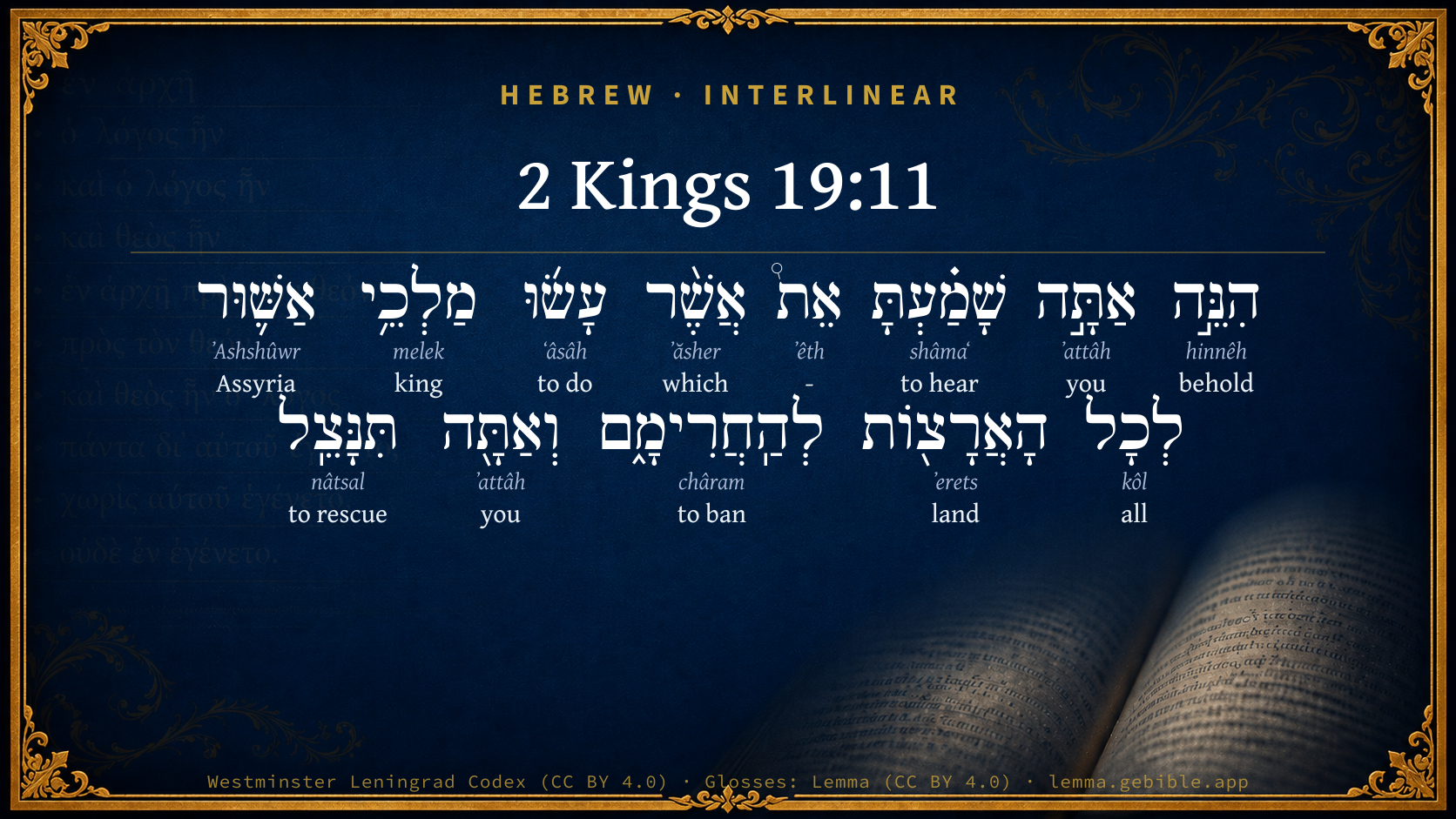
2 Kings 19:11

Hebrew (Westminster Leningrad Codex) 2 Kings 19:11 appears in the Hebrew Old Testament. The text above is from the Westminster Leningrad Codex. Each word links to its Strong’s number, a concise gloss, and parsing drawn from the Open Scriptures Hebrew Bible morphology. Click any word for its full Brown-Driver-Briggs (BDB) entry.
Download image
Cite this verse

2 Kings 19:11 (World English Bible). Public Domain. Lemma interlinear Bible study tool, https://lemma.gebible.app/v/2-kings/19/11.

Show BibTeX & RIS
BibTeX
RIS
English Translation
Behold, you have heard what the kings of Assyria have done to all lands, by destroying them utterly: and shall you be delivered?
World English Bible · Public Domain
Download a study sheet

One document with this verse’s original text, its word-by-word gloss line, the meaning frame, cross-references with their text, attributed commentary, and full source and license credits — printable, and it pastes into notes with its structure intact.

This verse Autodidact and up

Study sheet (.html) Plain text (.txt)

A passage Seminary Student

Up to 50 verses in one chapter. A passage sheet keeps up to 6 commentary sources and 12 cross-references per verse, in the order this page ranks them, and says so on the sheet whenever that leaves anything out. Ask for a single verse and you get the Autodidact verse sheet above.

Everything on this page stays free to read, with no account — the sheet is a download of what is already on screen, not access to it.

Want to remove ads? Support Godless Engineer
Compare translations 3

The same verse in 3 English versions, stacked beneath the original-language interlinear above. Click any original word for its lexicon entry.

Each is an independent rendering of the whole verse — the interlinear is not word-aligned to these translations.

Highlighted words mark where these versions differ — a whole-verse word diff, not a word-by-word alignment.

  • World English Bible Public Domain
    Behold, you have heard what the kings of Assyria have done to all lands, by destroying them utterly: and shall you be delivered?
  • King James Version Public Domain
    Behold, thou hast heard what the kings of Assyria have done to all lands, by destroying them utterly: and shalt thou be delivered?
  • unfoldingWord Literal Text CC BY-SA 4.0
    Behold, you, you have heard what the kings of Assyria have done to all of the lands by destroying them. So you, will you be delivered?

unfoldingWord Literal Text — © unfoldingWord, licensed CC BY-SA 4.0. Word-aligned USFM3 via Door43 (git.door43.org/unfoldingWord/en_ult).

Versions to compare (up to 4)

3 of 4 selected

Show all 18 translations

Every available English version of this verse, each an independent rendering of the whole verse.

  • World English Bible Public Domain
    Behold, you have heard what the kings of Assyria have done to all lands, by destroying them utterly: and shall you be delivered?
  • Berean Standard Bible Public Domain
    Surely you have heard what the kings of Assyria have done to all the other countries, devoting them to destruction. Will you then be spared?
  • Majority Standard Bible Public Domain
    Surely you have heard what the kings of Assyria have done to all the other countries, devoting them to destruction. Will you then be spared?
  • King James Version Public Domain
    Behold, thou hast heard what the kings of Assyria have done to all lands, by destroying them utterly: and shalt thou be delivered?
  • American Standard Version (1901) Public Domain
    Behold, thou hast heard what the kings of Assyria have done to all lands, by destroying them utterly: and shalt thou be delivered?
  • Revised Version (1885) Public Domain
    Behold, thou hast heard what the kings of Assyria have done to all lands, by destroying them utterly: and shalt thou be delivered?
  • Geneva Bible (1599) Public Domain
    Beholde, thou hast heard what the Kings of Asshur haue done to all landes, how they haue destroyed them: and shalt thou be deliuered?
  • Douay-Rheims (1899) Public Domain
    Behold thou hast heard what the kings of the Assyrians have done to all countries, how they have laid them waste: and canst thou alone be delivered?
  • Young's Literal Translation Public Domain
    Lo, thou hast heard that which the kings of Asshur have done to all the lands -- to devote them; and thou art delivered!
  • Literal Standard Version CC BY-SA 4.0
    Behold, you have heard that which the kings of Asshur have done to all the lands—to devote them; and are you delivered?
  • Unlocked Literal Bible CC BY-SA 4.0
    See, you have heard what the kings of Assyria have done to all lands by destroying them completely. So will you be rescued?
  • unfoldingWord Literal Text CC BY-SA 4.0
    Behold, you, you have heard what the kings of Assyria have done to all of the lands by destroying them. So you, will you be delivered?
  • Darby Bible Public Domain
    Behold, thou hast heard what the kings of Assyria have done to all countries, destroying them utterly; and shalt thou be delivered?
  • World Messianic Bible Public Domain
    Behold, you have heard what the kings of Assyria have done to all lands, by destroying them utterly. Will you be delivered?
  • Webster's Bible Public Domain
    Behold, thou hast heard what the kings of Assyria have done to all lands, by destroying them utterly: and shalt thou be delivered?
  • Free Bible Version CC BY-SA 4.0
    Look! You've heard what the kings of Assyria have done to all the countries they've invaded — they destroyed them completely! Do you really think you'll be saved?
  • Bible in Basic English Public Domain
    No doubt the story has come to your ears of what the kings of Assyria have done to all lands, putting them to the curse; and will you be kept safe?
  • JPS Tanakh (1917) Public Domain
    Behold, thou hast heard what the kings of Assyria have done to all lands, by destroying them utterly; and shalt thou be delivered?

Literal Standard Version (2020), Covenant Press — licensed CC BY-SA 4.0. Text via the HelloAO Bible API (eBible.org). Unlocked Literal Bible (unfoldingWord) — licensed CC BY-SA 4.0. Text via the HelloAO Bible API (eBible.org). unfoldingWord Literal Text — © unfoldingWord, licensed CC BY-SA 4.0. Word-aligned USFM3 via Door43 (git.door43.org/unfoldingWord/en_ult). Free Bible Version, Dr. Jonathan Gallagher — licensed CC BY-SA 4.0. Text via the HelloAO Bible API (eBible.org).

Word by word

More ways to search: Search by grammar → Find every occurrence → Compare this word →

Practice this passage: Drill this verse → Learn its vocabulary →

לְהַֽחֲרִימָ֑ם
châram
H2763
“to ban · them”
Preposition + Verb, Hiphil, Infinitive Construct + Suffix, Personal, 3rd Person, Masculine, Plural
Part of Speech
Preposition + Verb
Stem
Hiphil
Form
Infinitive Construct
Full BDB Definition

Origin: a primitive root

TWOT: 744 , 745

to ban, devote, destroy utterly, completely destroy, dedicate for destruction, exterminate - (Hiphil) - to prohibit (for common use), ban - to consecrate, devote, dedicate for destruction - to exterminate, completely destroy - (Hophal) - to be put under the ban, be devoted to destruction - to be devoted, be forfeited - to be completely destroyed - to split, slit, mutilate (a part of the body) - (Qal) to mutilate - (Hiphil) to divide
  1. הִנֵּ֣ה hinnêh H2009 “behold” Particle, Demonstrative
  2. אַתָּ֣ה ʼattâh H859 “you” Pronoun, Personal, 2nd Person, Masculine, Singular
  3. שָׁמַ֗עְתָּ shâmaʻ H8085 “to hear” Verb, Qal, Perfect, 2nd Person, Masculine, Singular
  4. אֵת֩ ʼêth H853 “-” Particle, Direct Object
  5. אֲשֶׁ֨ר ʼăsher H834 “which” Particle, Relative
  6. עָשׂ֜וּ ʻâsâh H6213 “to do” Verb, Qal, Perfect, 3rd Person, Common, Plural
  7. מַלְכֵ֥י melek H4428 “kings of” Noun, Common, Masculine, Plural, Construct
  8. אַשּׁ֛וּר ʼAshshûwr H804 “Assyria” Noun, Proper
  9. לְכָל kôl H3605 “to/for · all of” Preposition + Noun, Common, Masculine, Singular, Construct
  10. הָאֲרָצ֖וֹת ʼerets H776 “the · lands” Particle, Definite Article + Noun, Common, Both, Plural, Absolute
  11. וְאַתָּ֖ה ʼattâh H859 “and · you” Conjunction + Pronoun, Personal, 2nd Person, Masculine, Singular
  12. תִּנָּצֵֽל nâtsal H5337 “to rescue” Verb, Niphal, Imperfect, 2nd Person, Masculine, Singular

About this verse

These counts appear in no published source. They are computed here, from the morphology-tagged text and Lemma’s own curated glosses. What Lemma adds →

13
words
12
distinct lemmas
Historical
section

Shared distinctive vocabulary

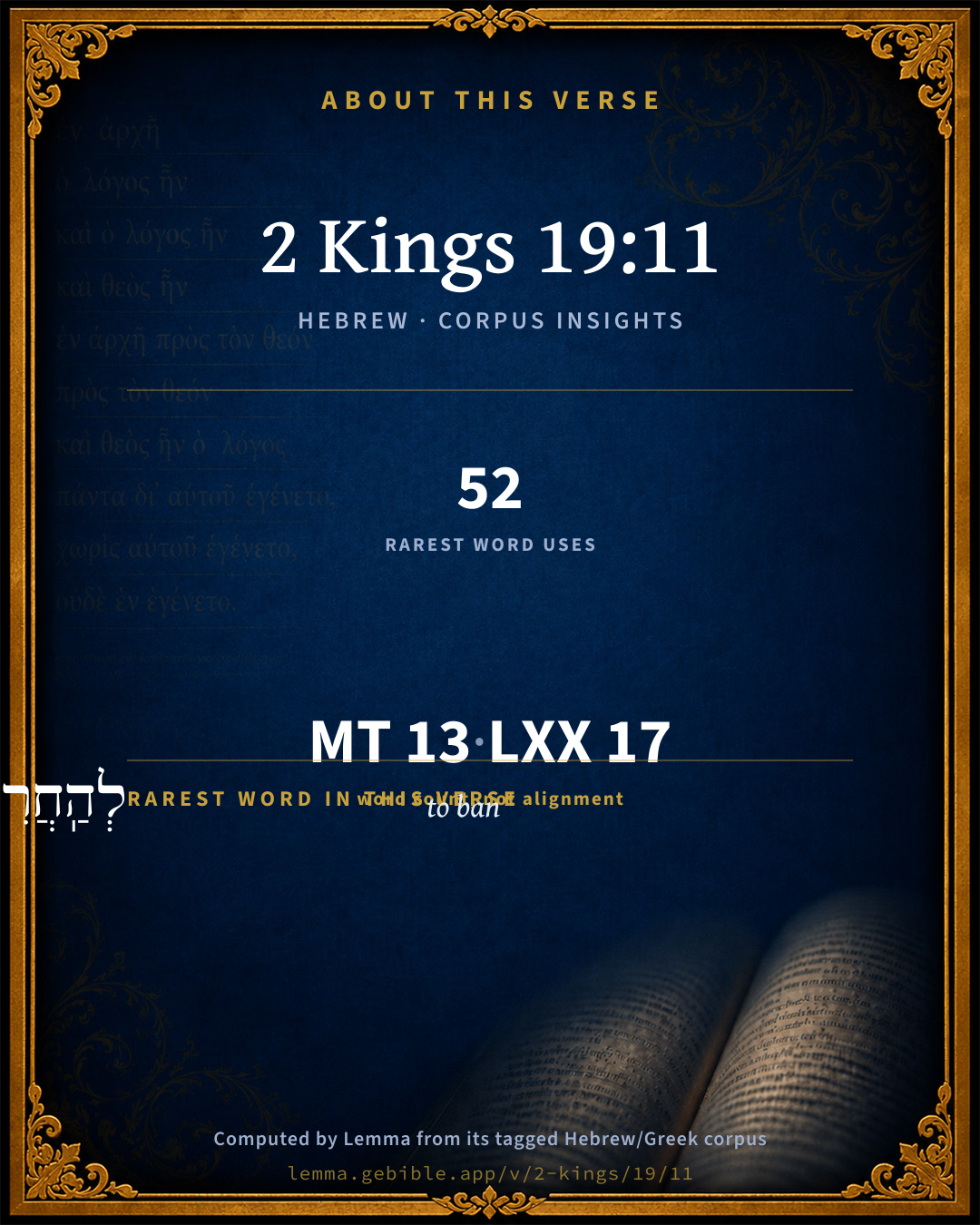
לְהַֽחֲרִימָ֑ם to ban H2763 occurs in 48 verses of the Hebrew Bible. Also found in:

Grammatical profile

  • 4 verbs
  • 4 nouns
  • 2 pronouns
  • 3 particles

Verb forms

  • שָׁמַ֗עְתָּ Qal · Perfect
  • עָשׂ֜וּ Qal · Perfect
  • לְהַֽחֲרִימָ֑ם Hiphil · Infinitive Construct
  • תִּנָּצֵֽל Niphal · Imperfect

Repetition

A word recurs within this verse — often emphatic in Hebrew:

  • אַתָּ֣ה you H859 ×2

Hebrew & Septuagint length

In English translation the verse runs 23 words from the Hebrew and 26 from the Septuagint (LXX English) — closely comparable.

A rough comparison of the two English renderings, which tokenize alike — not a word-level alignment.

Word counts can differ between the Hebrew and the Greek without any difference in meaning — e.g. the Hebrew direct-object marker אֵת has no separate Greek word, and Greek often adds the article ὁ.

In the original languages it is 13 Hebrew tokens and 17 Greek tokens — but the two are counted differently (Hebrew bundles its prefixes and suffixes into one token; the Greek is in lemma form), so that isn’t a like-for-like length.

Cross-references

4

Topical passages linked to 2 Kings 19:11 in the Treasury of Scripture Knowledge — connected by theme and wording, ordered by reader-vote popularity; previews shown in the World English Bible.

  • 2 Kings 17:5–11 Then the king of Assyria came up throughout all the land, and went up to Samaria, and besieged it three years.
  • 2 Kings 19:17–18 Of a truth, Yahweh, the kings of Assyria have laid waste the nations and their lands,
  • 2 Chronicles 32:13–14 Don't you know what I and my fathers have done to all the peoples of the lands? Were the gods of the nations of the lands in any wise able to deliver their land out of my hand?
  • Isaiah 10:8–11 For he says, Aren't my princes all of them kings?

Cross-references courtesy of OpenBible.info (CC BY 4.0).

Hebrew and Greek witnesses Masoretic Hebrew ↔ Greek Septuagint

The same verse in the two great witnesses to the Old Testament, shown verse-for-verse.

These are two independent witnesses, not word-aligned to each other, and the Septuagint is shown in lemma (dictionary) form.

Hebrew 2 Kings 19:11 Masoretic · Westminster Leningrad Codex

הִנֵּ֣ה אַתָּ֣ה שָׁמַ֗עְתָּ אֵת֩ אֲשֶׁ֨ר עָשׂ֜וּ מַלְכֵ֥י אַשּׁ֛וּר לְכָל הָאֲרָצ֖וֹת לְהַֽחֲרִימָ֑ם וְאַתָּ֖ה תִּנָּצֵֽל

Behold, you have heard what the kings of Assyria have done to all lands, by destroying them utterly: and shall you be delivered?

World English Bible · Public Domain

Greek LXX 2 Kings 19:11 Septuagint · lemma form

ἰδού σύ ἀκούω πᾶς ὅσος ποιέω βασιλεύς ἀσσύριος πᾶς ὁ γῆ ὁ ἀναθεματίζω αὐτός καί σύ ῥύομαι

Behold, you have heard all that the kings of the Assyrians have done in all the lands, to waste them utterly: and shall you be delivered?

LXX2012 (modern English Septuagint) · Public Domain

On this verse, The Cambridge Bible for Schools and Colleges discusses the Septuagint’s reading. Read the note in Commentary ↓

Hebrew: Westminster Leningrad Codex (CC BY 4.0). Greek: Septuagint (public domain); English from LXX2012 (modern English Septuagint) (Public Domain). How the Septuagint differs from the Hebrew →

Targum (Aramaic paraphrase)

1

The Targum is the ancient Jewish Aramaic paraphrase of the Hebrew Scriptures — an interpretive translation, not the Hebrew text itself. Onkelos (literal) and Pseudo-Jonathan (expansive) render the Torah, and Jonathan the Prophets. Coverage is partial: where no permissively-licensed English translation exists for a verse, only the Aramaic is shown. This is verse-level text, not a word-by-word alignment to the Hebrew.

  1. Targum Jonathan Prophets (Joshua–Malachi)
    הָא אַתְּ שְׁמַעְתָּא יַת דַעֲבַדוּ מַלְכֵי דְאַתּוּר לְכָל מְדִינָתָא לְגַמָרוּתְהוֹן וְאַתְּ מְדַמֵי לְאִשְׁתֵּיזָבָא:

    (no public-domain English translation for this verse)

    Targum Jonathan — Aramaic: “Mikraot Gedolot” (public domain). English: “Sefaria Community Translation” (CC0 1.0 (public-domain dedication)); “London "Chaldee Paraphrase," 1871” (public domain). Text via Sefaria.

Commentary

Notes on 2 Kings 19:11 from classic Christian and Jewish commentators (each source and its license shown beneath its notes). The classic Christian expositions comment on the surrounding passage and are grouped to its opening verse, so a note may address several verses; the Jewish commentaries on the Tanakh (Rashi and others) are per-verse, so they appear only where the commentator wrote on this verse.

Lemma curates 59 commentaries, every one of them public domain or Creative Commons licensed, each selected and text-cleaned for this edition rather than reprinted as found. About our sources →

Trapp's Complete Commentary

John Trapp

2Ki 19:11 Behold, thou hast heard what the kings of Assyria have done to all lands, by destroying them utterly: and shalt thou be delivered?

Ver. 11. Behold, thau hast heard.] See 2Ki 18:33-35.

To all lands, by destroying them utterly.] Not all, nor utterly neither; but the tongue, that little member, boasteth great things. {Jas 3:5} He talketh here like some Pyrgopolynices or Therapontigonoplatagidorias in Plautus. {a}

{a} In Curcul.

John Trapp, A Commentary or Exposition upon All the Books of the Old and New Testament (1647–1656) — public domain. Text from a community e-Sword module.

Ellicott's Commentary for English Readers

(11) All lands, by destroying them utterly.—All the countries, by putting them under the ban, i.e., solemnly devoting all that lived in them to extermination.

A Bible Commentary for English Readers, edited by Charles John Ellicott (1878–1897) — public domain. Text from a community e-Sword module.

The Cambridge Bible for Schools and Colleges

gen. ed. J. J. S. Perowne

11. by destroying them utterly] The verb implies ‘dooming’, ‘devoting as if to a curse’. Hence the LXX. represents it by ἀναθεματίσαι.

The Cambridge Bible for Schools and Colleges (gen. ed. J. J. S. Perowne; Cambridge University Press, 1878–1918) — public domain. Text from a community e-Sword module.

Albert Barnes' Notes on the Bible

All lands - This boast is in strict accordance with the general tenor of the Assyrian inscriptions. Hyperbole is the general language of the East; but in this instance it was not so extreme as in some others. The Assyrians under Sargon and Sennacherib had enjoyed an uninterrupted series of military successes: they had succeeded in establishing their pre-eminence from the Median desert to the banks of the Nile, and from the shores of Lake Van to those of the Persian Gulf.

Albert Barnes' Notes on the Bible (1834–1885) — public domain. Text from a community e-Sword/MySword module.

Matthew Poole's English Annotations

No, certainly, never expect it: such questions oft imply a denial, as Gen 18:17.

Matthew Poole's English Annotations on the Holy Bible (1683–1685) — public domain. Text from a community e-Sword/MySword module.

The Pulpit Commentary

Behold, thou hast heard what the kings of Assyria have done to all lands, by destroying them utterly. (see the comment on 2Ki_18:33) The fact was indisputable (secret. 17). The question remained Would this triumphant career of success necessarily continue?

And shalt thou be delivered? A perfect induction is impossible in practical matters. Anything short of a perfect induction is short of a proof.

The Pulpit Commentary (1880–1919), ed. H.D.M. Spence-Jones & Joseph S. Exell — public domain. Text from a community e-Sword module.

Lesson kit

Teaching starters — assembled from the data on this page, not authored interpretation. Every prompt links to the verse data it draws on. Edit before teaching.

2 Kings, in the Historical, opens this verse with 13 words (12 distinct Hebrew lemmas). Its most distinctive word is châram (“to ban”). A historical commentator’s framing appears above. Read the whole chapter for the surrounding context.

Discussion questions

  1. The word châram carries the sense “to ban.” How does it shape the verse?
  2. Exodus 22:20 shares the word «to ban» with this verse. How do the two illuminate each other?
  3. “you” occurs 2× in this one verse. What is the effect of the repetition?
  4. These translations render this verse differently. What is at stake in choosing one wording over another?
  5. The verb «שָׁמַ֗עְתָּ» is Qal Perfect. How does its form color the action?
  6. Reading how Trapp's Complete Commentary and Ellicott's Commentary for English Readers read this verse, where do the two commentators agree and where do they part?

Things to notice

Reading settings

Reading text

Shown beneath each verse's original-language words.

Old Testament
Old Testament edition

Read the OT as the Masoretic Hebrew (MT) or the Greek Septuagint (LXX).

English shown for the Greek Septuagint (in the Hebrew ↔ Greek comparison).

Comparing translations? Open the Compare panel on any verse page to stack up to four side by side.