
Psalms 119:43

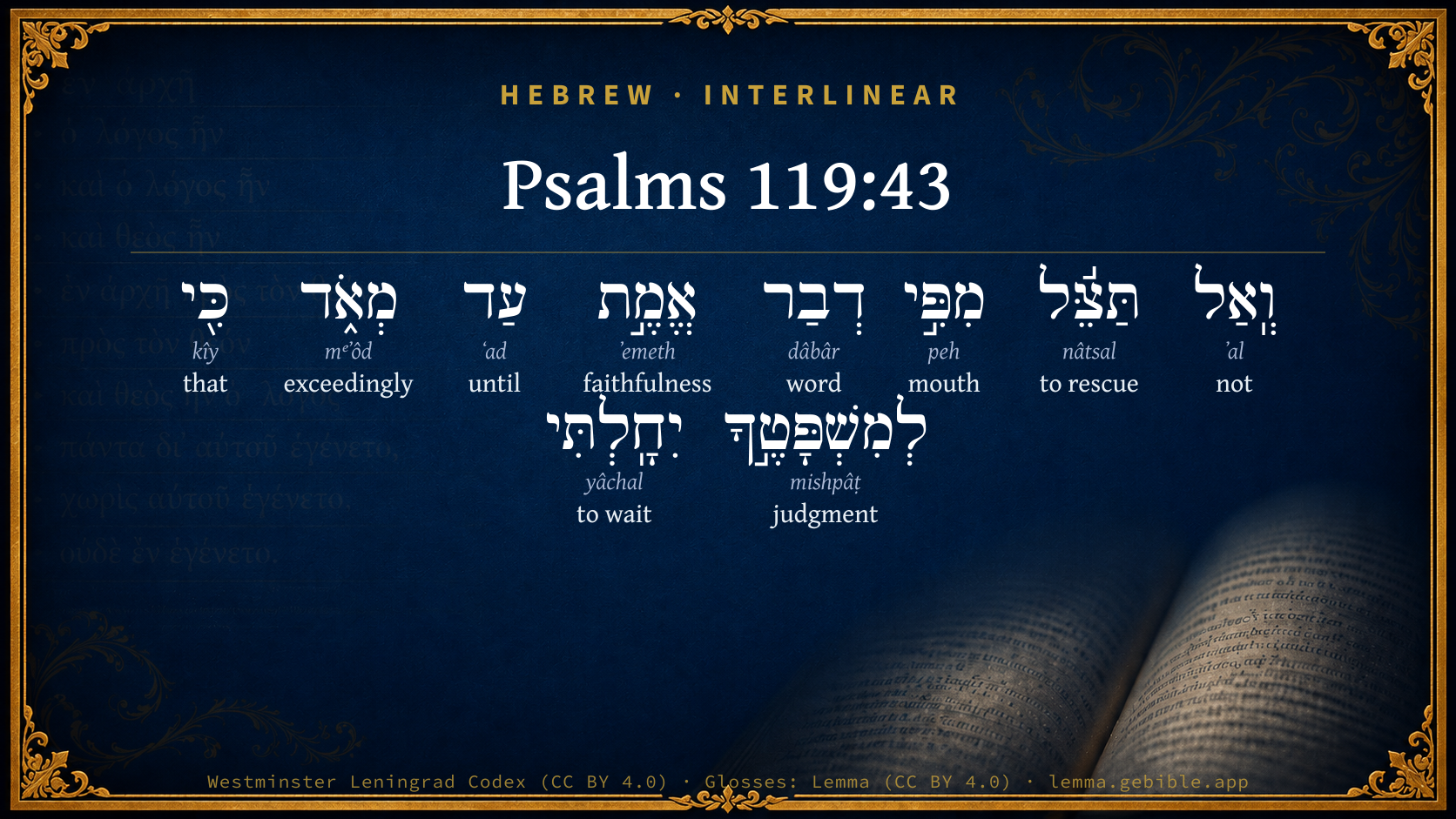
Hebrew (Westminster Leningrad Codex) Psalms 119:43 appears in the Hebrew Old Testament. The text above is from the Westminster Leningrad Codex. Each word links to its Strong’s number, a concise gloss, and parsing drawn from the Open Scriptures Hebrew Bible morphology. Click any word for its full Brown-Driver-Briggs (BDB) entry.
Download image
Cite this verse

Psalms 119:43 (World English Bible). Public Domain. Lemma interlinear Bible study tool, https://lemma.gebible.app/v/psalms/119/43.

Show BibTeX & RIS
BibTeX
RIS
English Translation
Don't snatch the word of truth out of my mouth, For I put my hope in your ordinances.
World English Bible · Public Domain
Download a study sheet

One document with this verse’s original text, its word-by-word gloss line, the meaning frame, cross-references with their text, attributed commentary, and full source and license credits — printable, and it pastes into notes with its structure intact.

This verse Autodidact and up

Study sheet (.html) Plain text (.txt)

A passage Seminary Student

Up to 50 verses in one chapter. A passage sheet keeps up to 6 commentary sources and 12 cross-references per verse, in the order this page ranks them, and says so on the sheet whenever that leaves anything out. Ask for a single verse and you get the Autodidact verse sheet above.

Everything on this page stays free to read, with no account — the sheet is a download of what is already on screen, not access to it.

Want to remove ads? Support Godless Engineer
Compare translations 3

The same verse in 3 English versions, stacked beneath the original-language interlinear above. Click any original word for its lexicon entry.

Each is an independent rendering of the whole verse — the interlinear is not word-aligned to these translations.

Highlighted words mark where these versions differ — a whole-verse word diff, not a word-by-word alignment.

  • World English Bible Public Domain
    Don't snatch the word of truth out of my mouth, For I put my hope in your ordinances.
  • King James Version Public Domain
    And take not the word of truth utterly out of my mouth; for I have hoped in thy judgments.
  • unfoldingWord Literal Text CC BY-SA 4.0
    So do not utterly snatch the word of truth from my mouth, for I wait for your judgments.

unfoldingWord Literal Text — © unfoldingWord, licensed CC BY-SA 4.0. Word-aligned USFM3 via Door43 (git.door43.org/unfoldingWord/en_ult).

Versions to compare (up to 4)

3 of 4 selected

Show all 17 translations

Every available English version of this verse, each an independent rendering of the whole verse.

  • World English Bible Public Domain
    Don't snatch the word of truth out of my mouth, For I put my hope in your ordinances.
  • Berean Standard Bible Public Domain
    Never take Your word of truth from my mouth, for I hope in Your judgments.
  • Majority Standard Bible Public Domain
    Never take Your word of truth from my mouth, for I hope in Your judgments.
  • King James Version Public Domain
    And take not the word of truth utterly out of my mouth; for I have hoped in thy judgments.
  • American Standard Version (1901) Public Domain
    And take not the word of truth utterly out of my mouth; For I have hoped in thine ordinances.
  • Revised Version (1885) Public Domain
    And take not the word of truth utterly out of my mouth; for I have hoped in thy judgments.
  • Geneva Bible (1599) Public Domain
    And take not the woorde of trueth vtterly out of my mouth: for I waite for thy iudgements.
  • Young's Literal Translation Public Domain
    And Thou takest not utterly away From my mouth the word of truth, Because for Thy judgment I have hoped.
  • Literal Standard Version CC BY-SA 4.0
    And You do not utterly take away || The word of truth from my mouth, || Because I have hoped for Your judgment.
  • Unlocked Literal Bible CC BY-SA 4.0
    Do not take the word of truth from my mouth, for my hope is in your righteous decrees.
  • unfoldingWord Literal Text CC BY-SA 4.0
    So do not utterly snatch the word of truth from my mouth, for I wait for your judgments.
  • Darby Bible Public Domain
    And take not the word of truth utterly out of my mouth; because I have hoped in thy judgments.
  • World Messianic Bible Public Domain
    Don’t snatch the word of truth out of my mouth, for I put my hope in your ordinances.
  • Webster's Bible Public Domain
    And take not the word of truth utterly out of my mouth; for I have hoped in thy judgments.
  • Free Bible Version CC BY-SA 4.0
    Don't ever prevent me from being able to speak your words of truth, for I place my complete confidence in your just judgments.
  • Bible in Basic English Public Domain
    Take not your true word quite out of my mouth; for I have put my hope in your decisions.
  • JPS Tanakh (1917) Public Domain
    And take not the word of truth utterly out of my mouth; for I hope in Thine ordinances;

Literal Standard Version (2020), Covenant Press — licensed CC BY-SA 4.0. Text via the HelloAO Bible API (eBible.org). Unlocked Literal Bible (unfoldingWord) — licensed CC BY-SA 4.0. Text via the HelloAO Bible API (eBible.org). unfoldingWord Literal Text — © unfoldingWord, licensed CC BY-SA 4.0. Word-aligned USFM3 via Door43 (git.door43.org/unfoldingWord/en_ult). Free Bible Version, Dr. Jonathan Gallagher — licensed CC BY-SA 4.0. Text via the HelloAO Bible API (eBible.org).

Word by word

More ways to search: Search by grammar → Find every occurrence → Compare this word →

Practice this passage: Drill this verse → Learn its vocabulary →

יִחָֽלְתִּי
yâchal
H3176
“to wait”
Verb, Piel, Perfect, 1st Person, Common, Singular
Part of Speech
Verb
Stem
Piel
Form
Perfect
Person
1st Person
Gender
Common
Number
Singular
Full BDB Definition

Origin: a primitive root

TWOT: 859

to wait, hope, expect - (Niphal) to wait - (Piel) - to wait, await, tarry - to wait for, hope for - (Hiphil) to wait, tarry, wait for, hope for
  1. וְֽאַל ʼal H408 “and · not” Conjunction + Particle, Negative
  2. תַּצֵּ֬ל nâtsal H5337 “to rescue” Verb, Hiphil, Jussive, 2nd Person, Masculine, Singular
  3. מִפִּ֣י peh H6310 “from · mouth · my” Preposition + Noun, Common, Masculine, Singular, Construct + Suffix, Personal, 1st Person, Common, Singular
  4. דְבַר dâbâr H1697 “word of” Noun, Common, Masculine, Singular, Construct
  5. אֱמֶ֣ת ʼemeth H571 “faithfulness” Noun, Common, Feminine, Singular, Absolute
  6. עַד ʻad H5704 “until” Preposition
  7. מְאֹ֑ד mᵉʼôd H3966 “exceedingly” Adverb
  8. כִּ֖י kîy H3588 “that” Conjunction
  9. לְמִשְׁפָּטֶ֣ךָ mishpâṭ H4941 “to/for · judgment · your” Preposition + Noun, Common, Masculine, Singular, Construct + Suffix, Personal, 2nd Person, Masculine, Singular

About this verse

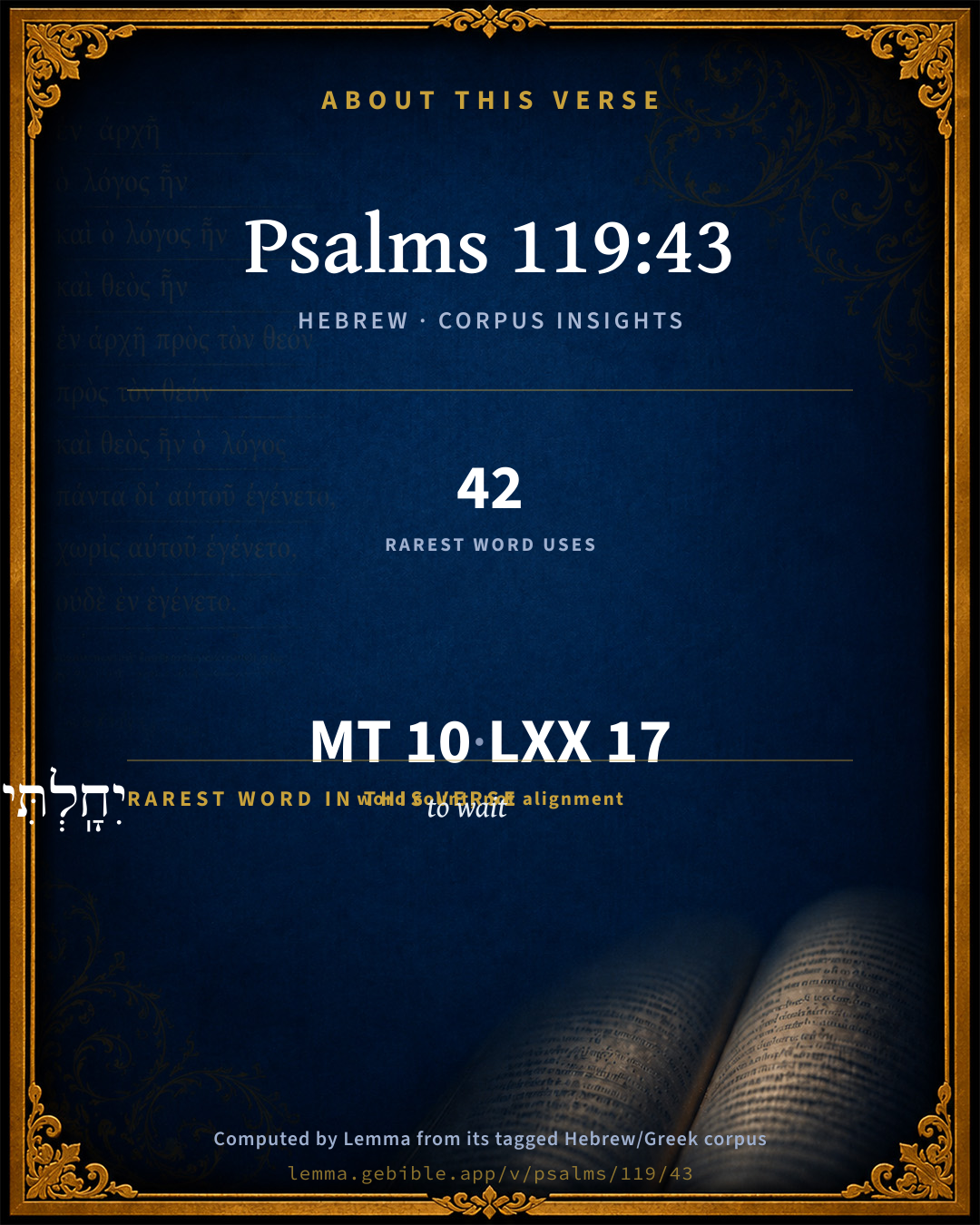
These counts appear in no published source. They are computed here, from the morphology-tagged text and Lemma’s own curated glosses. What Lemma adds →

10
words
10
distinct lemmas
Wisdom
section

Shared distinctive vocabulary

יִחָֽלְתִּי to wait H3176 occurs in 41 verses of the Hebrew Bible. Also found in:

Grammatical profile

  • 2 verbs
  • 4 nouns
  • 1 preposition
  • 1 conjunction
  • 1 adverb
  • 1 particle

Verb forms

  • תַּצֵּ֬ל Hiphil · Jussive
  • יִחָֽלְתִּי Piel · Perfect

Hebrew & Septuagint length

In English translation the verse runs 18 words from the Hebrew and 30 from the Septuagint (LXX English) — closely comparable.

A rough comparison of the two English renderings, which tokenize alike — not a word-level alignment.

Word counts can differ between the Hebrew and the Greek without any difference in meaning — e.g. the Hebrew direct-object marker אֵת has no separate Greek word, and Greek often adds the article ὁ.

In the original languages it is 10 Hebrew tokens and 17 Greek tokens — but the two are counted differently (Hebrew bundles its prefixes and suffixes into one token; the Greek is in lemma form), so that isn’t a like-for-like length.

Cross-references

15

Topical passages linked to Psalms 119:43 in the Treasury of Scripture Knowledge — connected by theme and wording, ordered by reader-vote popularity; previews shown in the World English Bible.

  • Psalms 9:4 For you have maintained my just cause. You sit on the throne judging righteously.
  • Ephesians 1:13 in whom you also, having heard the word of the truth, the Gospel of your salvation,--in whom, having also believed, you were sealed with the Holy Spirit of promise,
  • 1 Peter 2:23 Who, when he was cursed, didn't curse back. When he suffered, didn't threaten, but committed himself to him who judges righteously;
  • Psalms 71:17–18 God, you have taught me from my youth. Until now, I have declared your wondrous works.
  • Psalms 119:13 With my lips, I have declared all the ordinances of your mouth.
  • Psalms 119:175 Let my soul live, that I may praise you. Let your ordinances help me.
  • Psalms 50:16 But to the wicked God says, "What right do you have to declare my statutes, That you have taken my covenant on your lips,
  • Psalms 119:52 I remember your ordinances of old, Yahweh, And have comforted myself.
  • James 1:18 Of his own will he brought us forth by the word of truth, that we should be a kind of first fruits of his creatures.
  • Psalms 7:6–9 Arise, Yahweh, in your anger. Lift up yourself against the rage of my adversaries. Awake for me. You have commanded judgment.
  • Psalms 9:16 Yahweh has made himself known. He has executed judgment. The wicked is snared by the work of his own hands. Meditation. Selah.
  • Psalms 43:1 Vindicate me, God, and plead my cause against an ungodly nation. Oh, deliver me from deceitful and wicked men.
  • Psalms 51:14–15 Deliver me from bloodguiltiness, O God, the God of my salvation. My tongue shall sing aloud of your righteousness.
  • Psalms 119:120 My flesh trembles for fear of you. I am afraid of your judgments.
  • Isaiah 59:21 As for me, this is my covenant with them, says Yahweh: my Spirit who is on you, and my words which I have put in your mouth, shall not depart out of your mouth, nor out of the mouth of your seed, nor out of the mouth of your seed's seed, says Yahweh, from henceforth and forever.

Cross-references courtesy of OpenBible.info (CC BY 4.0).

Hebrew and Greek witnesses Masoretic Hebrew ↔ Greek Septuagint

The same verse in the two great witnesses to the Old Testament, shown verse-for-verse.

You’re reading Greek Psalm 118 (Hebrew Psalm 119). The Septuagint counts the superscription, so verse numbers can differ from the Hebrew — chapter-level alignment, not verse-by-verse. Numbering follows Rahlfs.

These are two independent witnesses, not word-aligned to each other, and the Septuagint is shown in lemma (dictionary) form.

Hebrew Psalms 119:43 Masoretic · Westminster Leningrad Codex

וְֽאַל תַּצֵּ֬ל מִפִּ֣י דְבַר אֱמֶ֣ת עַד מְאֹ֑ד כִּ֖י לְמִשְׁפָּטֶ֣ךָ יִחָֽלְתִּי

Don't snatch the word of truth out of my mouth, For I put my hope in your ordinances.

World English Bible · Public Domain

Greek LXX Greek Psalm 118:43 Septuagint · lemma form

καί μή περιἔρχομαι ἐκ ὁ στόμα ἐγώ λόγος ἀλήθεια ἕως σφόδρα ὅτι ἐπί ὁ κρίμα σύ ἐπιἐλπίζω

And take not the word of truth utterly out of my mouth; for I have hoped in your judgments. So shall I keep your law continually, for ever and ever.

LXX2012 (modern English Septuagint) · Public Domain

Hebrew: Westminster Leningrad Codex (CC BY 4.0). Greek: Septuagint (public domain); English from LXX2012 (modern English Septuagint) (Public Domain). How the Septuagint differs from the Hebrew →

Commentary

Notes on Psalms 119:43 from classic Christian and Jewish commentators (each source and its license shown beneath its notes). The classic Christian expositions comment on the surrounding passage and are grouped to its opening verse, so a note may address several verses; the Jewish commentaries on the Tanakh (Rashi and others) are per-verse, so they appear only where the commentator wrote on this verse.

Lemma curates 59 commentaries, every one of them public domain or Creative Commons licensed, each selected and text-cleaned for this edition rather than reprinted as found. About our sources →

Trapp's Complete Commentary

John Trapp

Psa 119:43 And take not the word of truth utterly out of my mouth; for I have hoped in thy judgments.

Ver. 43. And take not the word of truth utterly] Give me free utterance, "that in nothing I be ashamed; but that with all boldness, as always, so now also Christ may be magnified in my body," &c., Php 1:20. Despoil me not of my courage in a good cause, let not Satan rob me of that jewel: Ne auferas, id est ut spolium, ut Exo 12:36 (Aben Ezra). I have read of a nobleman, who when he came into jeering company of great ones, would begin and own himself one of those they called Puritans, and so anticipated them.

John Trapp, A Commentary or Exposition upon All the Books of the Old and New Testament (1647–1656) — public domain. Text from a community e-Sword module.

J. A. Alexander on Psalms

Joseph Addison Alexander

43. (Psa 119:43) And take not out of my mouth (this) word of truth utterly, for in thy judgments do I hope. Deprive me not of this conclusive answer to my enemies, by withholding that providential vindication of my character and practical attestation of thy favour towards me, which I confidently look for. The first verb is used in its primary sense (Gen 32:12), from which comes the usual but secondary one of snatching out of danger, extricating, saving. For the literal meaning of the Hebrew phrase translated utterly, see above, on Psa 119:8. The last phrase in the verse means, for thy judgments I have waited, i.e. confidently looked for their appearance.

Joseph Addison Alexander, The Psalms Translated and Explained (1850) — public domain. Text from a community e-Sword module.

Matthew Henry's Commentary

Here is, 1. David's humble petition for the tongue of the learned, that he might know how to speak a word in season for the glory of God: Take not the word of truth utterly out of my mouth. He means, "Lord, let the word of truth be always in my mouth; let me have the wisdom and courage which are necessary to enable me both to use my knowledge for the instruction of others, and, like the good householder, to bring out of my treasury things new and old, and to make profession of my faith whenever I am called to it." We have need to pray to God that we may never be afraid or ashamed to own his truths and ways, nor deny him before men. David found that he was sometimes at a loss, that the word of truth was not so ready to him as it should have been, but he prays, "Lord, let it not be taken utterly from me; let my always have so much of it at hand as will be necessary to the due discharge of my duty." 2. His humble profession of the heart of the upright, without which the tongue of the learned, however it may be serviceable to others, will stand us in no stead. (1.) David professes his confidence in God: "Lord, make me ready and mighty in the scriptures, for I have hoped in those judgments of thy mouth, and, if they be not at hand, my support and defence have departed from me." (2.) He professes his resolution to adhere to his duty in the strength of God's grace: "So shall I keep thy law continually. If I have thy word not only in my heart, but in my mouth, I shall do all I should do, stand complete in thy whole will." Thus shall the man of God be perfect, thoroughly furnished for every good word and work, Ti2 3:17; Col 3:16. Observe how he resolves to keep God's law, [1.] Continually, without trifling. God must be served in a constant course of obedience every day, and all the day long. [2.] For ever and ever, without backsliding. We must never be weary of well-doing. If we serve him to the end of our time on earth, we shall be serving him in heaven to the endless ages of eternity; so shall we keep his law for ever and ever. Or thus: "Lord, let me have the word of truth in my mouth, that I may commit that sacred deposit to the rising generation (Ti2 2:2) and by them it may be transmitted to succeeding ages; so shall thy law be kept for ever and ever," that is, from one generation to another, according to that promise (Isa 59:21), My word in thy mouth shall not depart out of the mouth of thy seed, nor thy seed's seed.

Matthew Henry's Commentary on the Whole Bible (1708–1710) — public domain (CC PDM 1.0). Text via the HelloAO Bible API.

Adam Clarke's Commentary

Verse 43. Take not the word of truth] Grant that the assurances which thy prophets have given to the people of approaching deliverance may not fall to the ground; let it appear that they have spoken thy mind, and that thou hast fulfilled their word.

Adam Clarke's Commentary on the Bible (1810–1826) — public domain. Text from a community e-Sword/MySword module.

John Calvin's Commentaries

43. Take not the word of truth too long out of my mouth It may be asked, why he demands rather to have his tongue filled with, than his heart fortified by, the word of truth; inasmuch as the latter takes the precedence, both in point of order and of excellence. What will it profit us to be fluent and eloquent in speech, if our hearts are destitute of faith? On the other hand, wherever there is firm faith, there to speech will flow ultroneously. My reply is, that David was not so concerned about outward confession as not to give the preference to the faith of the heart; but considering that he is making his address to God, there is nothing strange in his making mention only of the former, under which, however, he includes also the latter. “Lord, support not only my heart by faith, lest I be overwhelmed with temptation, but grant me also freedom of speech, that I may fearlessly sound forth thy praises among men.” We observe, when he asks to be endued with boldness of speech, that he begins with the heart.

It may be farther inquired here, why he says too long, just as if he were not afraid of being deprived of the word of truth for a short time. Such a supposition were most absurd, seeing we must watch every moment lest we be overtaken by the enemy, when we are unarmed and powerless. The solution of this difficulty must be drawn from our own experience; for in this, the infirmity of our flesh, it is almost impossible but that, occasionally, even the stoutest heart will quail under the violent assaults of Satan. And although their faith fails not, yet it shakes, and they do not find such presence of mind, as that there is constantly a uniform train of speech, and a prompt reply to the derision’s of the ungodly; but, on the contrary, they rather begin to stagger and quake for a short time. Conscious of this weakness, which is perceptible in all mankind, he accommodates his prayer in the following manner: “Though I am not always prepared with that boldness of speech which is desirable, suffer me not to continue long silent.” By this language the prophet tacitly admits, that he had not been so steadfast and bold as was requisite, but that he was, as it were, struck speechless by reason of fear. Whence we may learn, that the faculty of speaking freely is no more in our power than are the affections. of the heart. As far, then, as God directs our tongues, they are prepared for ready utterance; but no sooner does he withdraw the spirit of magnanimity, than not only our hearts faint, or rather fail, but also our tongues become mute. The cause of this is subjoined in these words, for I have waited for thy judgments for so he literally expresses himself. From which we conclude, that judgments refer not merely to the precepts of the law, but also to the promises, which constitute the true foundation of our confidence. Some render it, I was afraid of thy. judgments, deriving the word here employed from the root חול chul; which translation I am unable to say whether it be suitable or not. But of this I am certain, that to understand judgments as equivalent to punishments, is quite foreign to the design of the prophet.

John Calvin's Commentaries (1540-1563) — public domain. Text from the Calvin Translation Society English edition (1840s-50s) via the Christian Classics Ethereal Library (ccel.org). Calvin's coverage is partial (roughly two-thirds of the Bible); uncommented books and verses are honest gaps, never fabricated. The 19th-century editor's footnotes and remarks are omitted so the notes are faithfully Calvin's own voice.

The Cambridge Bible for Schools and Colleges

gen. ed. J. J. S. Perowne

43. This verse is to be taken in connexion with Psa_119:41-42. ‘And so let me not be deprived of power to bear witness to the truth before my persecutors, as I should be if I had no practical experience of Thy goodness, for I have waited with hope for Thy judgements’; here as usually, not judicial acts, but principles of right, which he expects to see realised in life.

The Cambridge Bible for Schools and Colleges (gen. ed. J. J. S. Perowne; Cambridge University Press, 1878–1918) — public domain. Text from a community e-Sword module.

John Gill's Exposition

And I will walk at liberty,.... Not in licentious way, but in Gospel liberty, under the influence of the free spirit; where is liberty, in the exercise of grace and discharge of duty. Or, "I will walk at large" (g); or, "in a broad way", as Aben Ezra and Kimchi supply it: not in the broad road that leads to destruction, but in the law of God, which is exceeding broad, Psa 119:96; as the Targum,

"in the breadth of the law.''

So a man walks when he walks in all the commandments and ordinances of the Lord: and who also may be said to walk at large when delivered out of straits and difficulties; when he is brought into a large place, and his steps are enlarged under him; and having his heart enlarged with the love of God, and fear of him, and with spiritual joy, and having every grace in exercise, he not only walks in, but runs the way of God's commandments; see Psa 119:32; and See Gill on Psa 118:5;

for I seek thy precepts; out of love and affection to them, to know more of them, the mind and will of God in them, and to practise them.

(g) "in latitudine", Pagninus, Montanus, Tigurine version, &c.

John Gill's Exposition of the Whole Bible (1746–1763) — public domain (CC PDM 1.0). Text via the HelloAO Bible API.

Albert Barnes' Notes on the Bible

And take not the word of truth utterly out of my mouth - Do not take it entirely or altogether from me. Let me not be utterly hopeless; let me be at no time without some evidence that thy word dwells in me with sustaining and sanctifying power. The prayer seems to have been offered when the mind was troubled and in doubt, and when it seemed as if all hope and all trust in the truth of God would vanish. The words rendered “utterly” mean “to very much;” that is, altogether or entirely. Let it not be done until the extreme shall be reached.

For I have hoped in thy judgments - I do trust in thy word, and it is my only trust. If that is gone, all is gone. As long as I can hold on to that, even in the slightest degree, I am safe. When all else fails, if that has not utterly failed me, I shall be secure.

Albert Barnes' Notes on the Bible (1834–1885) — public domain. Text from a community e-Sword/MySword module.

Matthew Poole's English Annotations

Do not deal so with me, that I shall be altogether ashamed to mention thy word, which I have so often affirmed to be a word of truth and infallible certainty, of which I have often made my boast.

In thy judgments; either in thy word and promises, or in thy judicial administrations and government of the world, which as it is matter of terror to the wicked, so it is matter of comfort and hope to me.

Matthew Poole's English Annotations on the Holy Bible (1683–1685) — public domain. Text from a community e-Sword/MySword module.

The Treasury of David

Charles H. Spurgeon

Ver. 43. Take not the word of truth, etc. It is well known that men do, when persecution threatens, either altogether deny the truth, or weakly and lukewarmly confess it; but lest this should happen to him, David therefore prays here, O Lord, take not the word of truth utterly out of my mouth, i.e., make me, with an intrepid spirit, always to confess the avowed truth boldly and manfully. In the Hebrew text it is dak de, "very, ""very much, "or, as Augustine renders it, "wholly and altogether"; and he thinks that David prayed for this, that, if through human weakness it should happen to him to fall, and at some time or other not steadfastly to confess the word, yet that God would not allow him to continue in that sit, , but again restore and establish him; and he illustrates this by the example of Peter. Further, David adds the reason which has impelled him thus to pray: Because I have for, and even with great desire, as the Hebrew verb lhy signifies, "thy judgments, " with which in the last day thou wilt openly pass sentence on heretics, fanatics, and all tyrants. Solomon Gesner.

Ver. 43. Take not the word of truth utterly out of my mouth. The word is taken out of the mouth, when it is said to the sinner, Wherefore dost thou declare thy statutes? And eloquence itself becomes dumb if the conscience be evil. The birds of heaven come and take the word out of thy mouth, even as they took the seed of the word from off the rock lest it should bring forth fruit. Ambrose.

Ver. 43. The word is also taken out of our mouth when in strong temptations all things, as it were, fail, neither can we discover where we may make a stand: Ps 69:2. Martin Geier.

Ver. 43. Take not the word of truth utterly out of my mouth. Sometimes we are afraid to speak for the Saviour, lest we should incur the charge of hypocrisy. At other times we are ashamed to speak, from the absence of that only constraining principle "the love of Christ." And thus "the word of truth is taken out of our mouths." Often have we wanted a word to speak for the relief of the Lord's tempted people, and have not been able to find it; so that the recollection of precious lost opportunities may well give utterance to the prayer "Take not the word of truth utterly out of my mouth." Not only do not take it out of my heart; but let it be ready in my mouth for a confession of my Master. Some of us know the painful trial of the indulgence of worldly habits and conversation, when a want of liberty of spirit has hindered us from standing up boldly for our God. We may perhaps allege the plea of bashfulness or judicious caution in excuse for silence; which however, in many instances, we must regard as a self deceptive covering for the real cause of restraint the want of apprehension of the mercy of God to the soul. Charles Bridges.

Ver. 43. Take not the word of truth utterly out of my mouth. Oh, what service can a dumb body do in Christ's house! Oh, I think the word of God is imprisoned also! Oh, I am a dry tree! Alas, I can neither plant nor water! Oh, if my Lord would make but dung of me, to fatten and make fertile his own corn ridges in Mount Zion! Oh, if I might but speak to three or four herd boys of my worthy Master, I would be satisfied to be the meanest and most obscure of all the pastors in this land, and to live in any place, in any of Christ's basest out houses! But he saith, "Sirrah, I will not send you; I have no errands for you there away." My desire to serve him is sick of jealousy, lest he be unwilling to employ me... I am very well every way, all praise to him in whose books I must stand for ever as his debtor! Only my silence pains me. I had one joy out of heaven, next to Christ my Lord, and that was to preach him to thiss faithless generation; and they have taken that from me. It was to me as the poor man's one eye, and they have put out that eye. Samuel Rutherford.

Ver. 43. For I have hoped in thy judgments, the word Mmpvm, judgment, signifieth either the law, or the execution of the sentence thereof.

1. The law or whole word of God; so that, "I have hoped in thy judgments, "is no more, but in thy word do I hope; as it is, "I wait for the Lord, my soul doth wait, and in his word do I hope" (Ps 130:5).

2. Answerable execution of the law, when the promise or threatening is fulfilled. (1) When the promise is fulfilled: that is judgment in a sense when God accomplishes what he has promised for our salvation and deliverance. Thus God is said to judge his people, when he righteth and sayeth them according to his word: "O Lord, thou hast seen my wrong: judge thou my cause" (La 3:59). (2) But the more usual notion of judgment is the execution of the threatening on wicked men; which being a benefit to God's faithful servants, and done in their favour, David might well be said to hope for it. Their "judgment" is our obtaining the promise. Thomas Manton.

Ver. 43-44. Lord, let me have the word of truth in "my mouth" that I may commit that sacred depositum to the rising generation (2Ti 2:22), and by them it may be transmitted to succeeding ages; so shall "thy law" be kept "for ever and ever, "i.e., from one generation to another, according to that promise (Isa 59:21): "My words in thy mouth shall not depart out of the mouth of thy seed, nor out of the mouth of thy seed's seed." Matthew Henry.

Ver. 43. How the true preacher could be silenced, and his plea that he may not be so.

Psalms 119:44*

Charles H. Spurgeon's The Treasury of David (1869–1885) — public domain. Psalms only. Text from a community e-Sword/MySword module.

The Pulpit Commentary

And take not the word of truth utterly out of my mouth. "The word of truth" here is the "well-grounded answer" that the psalmist looks to make to those who reproach him (Hengstenberg). (See the preceding verse.) If God does not grant him "mercy and salvation" (ver. 41), this answer will be "taken out of his mouth." For I have hoped in thy judgments. I have trusted in thy vindication of my character, and in thy judgments upon my foes.

The Pulpit Commentary (1880–1919), ed. H.D.M. Spence-Jones & Joseph S. Exell — public domain. Text from a community e-Sword module.

John Wesley's Explanatory Notes

Take not - Do not deal so with me, that I shall be ashamed to mention thy word. Judgments - In thy word.

John Wesley, Explanatory Notes Upon the Whole Bible (1754–1765) — public domain. Text via the GEBible commentary corpus.

unfoldingWord translationNotes

Door43 World Missions Community

Do not take the word of truth from my mouth

Here the writer is represented by his "mouth." Possible meanings are 1) "never prevent me from speaking the message about the truth" or 2) "never prevent me from speaking the true message."

I will observe

"I will obey"

translationWords

word

true

righteous

decree

eternity

unfoldingWord translationNotes — © Distant Shores Media and the Door43 World Missions Community, licensed CC BY-SA 4.0. Source: git.door43.org/Door43/en_tn.

Rashi

Rabbi Shlomo Yitzchaki (Rashi)

And do not take...from my mouth a word of truth Heb. תצל. Do not separate from my mouth a word of truth, as (Gen. 31:9): “And God separated (ויצל) your father’s property and gave it to me.” I found this.

utterly...a word of truth in all my instructions [regarding ritual law] and in all my legal decisions, that I should not stumble over them.

Rashi on the Tanakh — English translations: “The Judaica Press complete Tanach with Rashi, translated by A. J. Rosenberg” (CC BY 4.0); “Pentateuch with Rashi's commentary by M. Rosenbaum and A.M. Silbermann, 1929-1934” (public domain); “The Metsudah Tanach series, Lakewood, N.J” (CC BY 4.0); and “The Book of Joshua, Metsudah Publications, 1997” (CC BY 4.0). Text via Sefaria.

Lesson kit

Teaching starters — assembled from the data on this page, not authored interpretation. Every prompt links to the verse data it draws on. Edit before teaching.

Psalms, in the Wisdom, opens this verse with 10 words (10 distinct Hebrew lemmas). Its most distinctive word is yâchal (“to wait”). A historical commentator’s framing appears above. Read the whole chapter for the surrounding context.

Discussion questions

  1. How does “to wait” (yâchal) shape what this verse is saying?
  2. Genesis 8:12 shares the word «to wait» with this verse. How do the two illuminate each other?
  3. These translations render this verse differently. What is at stake in choosing one wording over another?
  4. The verb «תַּצֵּ֬ל» is Hiphil Jussive. How does its form color the action?
  5. Reading how Trapp's Complete Commentary and J. A. Alexander on Psalms read this verse, where do the two commentators agree and where do they part?

Things to notice

Reading settings

Reading text

Shown beneath each verse's original-language words.

Old Testament
Old Testament edition

Read the OT as the Masoretic Hebrew (MT) or the Greek Septuagint (LXX).

English shown for the Greek Septuagint (in the Hebrew ↔ Greek comparison).

Comparing translations? Open the Compare panel on any verse page to stack up to four side by side.