
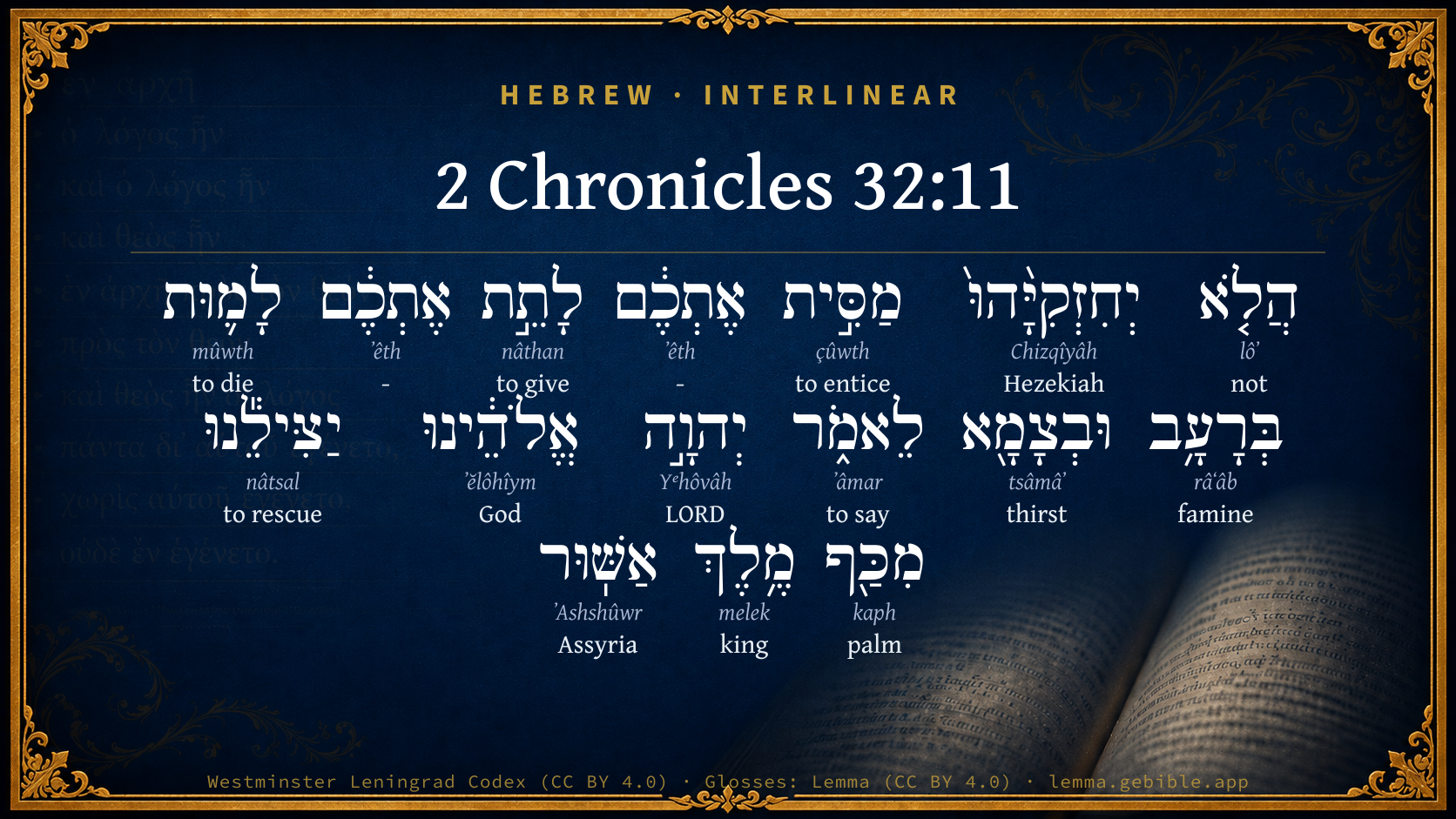
2 Chronicles 32:11

Hebrew (Westminster Leningrad Codex) 2 Chronicles 32:11 appears in the Hebrew Old Testament. The text above is from the Westminster Leningrad Codex. Each word links to its Strong’s number, a concise gloss, and parsing drawn from the Open Scriptures Hebrew Bible morphology. Click any word for its full Brown-Driver-Briggs (BDB) entry.
Download image
Cite this verse

2 Chronicles 32:11 (World English Bible). Public Domain. Lemma interlinear Bible study tool, https://lemma.gebible.app/v/2-chronicles/32/11.

Show BibTeX & RIS
BibTeX
RIS
English Translation
Does not Hezekiah persuade you, to give you over to die by famine and by thirst, saying, Yahweh our God will deliver us out of the hand of the king of Assyria?
World English Bible · Public Domain
Download a study sheet

One document with this verse’s original text, its word-by-word gloss line, the meaning frame, cross-references with their text, attributed commentary, and full source and license credits — printable, and it pastes into notes with its structure intact.

This verse Autodidact and up

Study sheet (.html) Plain text (.txt)

A passage Seminary Student

Up to 50 verses in one chapter. A passage sheet keeps up to 6 commentary sources and 12 cross-references per verse, in the order this page ranks them, and says so on the sheet whenever that leaves anything out. Ask for a single verse and you get the Autodidact verse sheet above.

Everything on this page stays free to read, with no account — the sheet is a download of what is already on screen, not access to it.

Want to remove ads? Support Godless Engineer
Compare translations 3

The same verse in 3 English versions, stacked beneath the original-language interlinear above. Click any original word for its lexicon entry.

Each is an independent rendering of the whole verse — the interlinear is not word-aligned to these translations.

Highlighted words mark where these versions differ — a whole-verse word diff, not a word-by-word alignment.

  • World English Bible Public Domain
    Does not Hezekiah persuade you, to give you over to die by famine and by thirst, saying, Yahweh our God will deliver us out of the hand of the king of Assyria?
  • King James Version Public Domain
    Doth not Hezekiah persuade you to give over yourselves to die by famine and by thirst, saying, The LORD our God shall deliver us out of the hand of the king of Assyria?
  • unfoldingWord Literal Text CC BY-SA 4.0
    Is not Hezekiah misleading you all, to give you all to die by famine and by thirst, saying, ‘Yahweh our God will deliver us from the palm of the king of Assyria’?

unfoldingWord Literal Text — © unfoldingWord, licensed CC BY-SA 4.0. Word-aligned USFM3 via Door43 (git.door43.org/unfoldingWord/en_ult).

Versions to compare (up to 4)

3 of 4 selected

Show all 18 translations

Every available English version of this verse, each an independent rendering of the whole verse.

  • World English Bible Public Domain
    Does not Hezekiah persuade you, to give you over to die by famine and by thirst, saying, Yahweh our God will deliver us out of the hand of the king of Assyria?
  • Berean Standard Bible Public Domain
    Is not Hezekiah misleading you to give you over to death by famine and thirst when he says, ‘The LORD our God will deliver us from the hand of the king of Assyria?’
  • Majority Standard Bible Public Domain
    Is not Hezekiah misleading you to give you over to death by famine and thirst when he says, ‘The LORD our God will deliver us from the hand of the king of Assyria?’
  • King James Version Public Domain
    Doth not Hezekiah persuade you to give over yourselves to die by famine and by thirst, saying, The LORD our God shall deliver us out of the hand of the king of Assyria?
  • American Standard Version (1901) Public Domain
    Doth not Hezekiah persuade you, to give you over to die by famine and by thirst, saying, Jehovah our God will deliver us out of the hand of the king of Assyria?
  • Revised Version (1885) Public Domain
    Doth not Hezekiah persuade you, to give you over to die by famine and by thirst, saying, The LORD our God shall deliver us out of the hand of the king of Assyria?
  • Geneva Bible (1599) Public Domain
    Doeth not Hezekiah entice you to giue ouer your selues vnto death by famine and by thirst, saying, The Lord our God shall deliuer vs out of the hande of the King of Asshur?
  • Douay-Rheims (1899) Public Domain
    Doth not Ezechias deceive you, to give you up to die by hunger and thirst, affirming that the Lord your God shall deliver you from the hand of the king of the Assyrians?
  • Young's Literal Translation Public Domain
    `Is not Hezekiah persuading you, to give you up to die by famine, and by thirst, saying, Jehovah our God doth deliver us from the hand of the king of Asshur?
  • Literal Standard Version CC BY-SA 4.0
    Is Hezekiah not persuading you to give you up to die by famine and by thirst, saying, Our God YHWH delivers us from the hand of the king of Asshur?
  • Unlocked Literal Bible CC BY-SA 4.0
    Is not Hezekiah misleading you, that he may give you over to die by famine and by thirst, when he tells you, 'Yahweh our God will rescue us from the hand of the king of Assyria'?
  • unfoldingWord Literal Text CC BY-SA 4.0
    Is not Hezekiah misleading you all, to give you all to die by famine and by thirst, saying, ‘Yahweh our God will deliver us from the palm of the king of Assyria’?
  • Darby Bible Public Domain
    Does not Hezekiah persuade you, to give yourselves over to die by famine and by thirst, saying, Jehovah our God will deliver us out of the hand of the king of Assyria?
  • World Messianic Bible Public Domain
    Doesn’t Hezekiah persuade you to give you over to die by famine and by thirst, saying, ‘The LORD our God will deliver us out of the hand of the king of Assyria’?
  • Webster's Bible Public Domain
    Doth not Hezekiah persuade you to give over yourselves to die by famine and by thirst, saying, The LORD our God will deliver us out of the hand of the king of Assyria?
  • Free Bible Version CC BY-SA 4.0
    Can't you see that in reality Hezekiah is telling you to die from starvation and thirst when he tells you, ‘The Lord our God will save us from the king of Assyria’?
  • Bible in Basic English Public Domain
    Is it not Hezekiah who has got you to do it, causing your death from need of food and water, by saying, The Lord our God will give us salvation out of the hands of the king of Assyria?
  • JPS Tanakh (1917) Public Domain
    Doth not Hezekiah persuade you, to give you over to die by famine and by thirst, saying: The LORD our God will deliver us out of the hand of the king of Assyria?

Literal Standard Version (2020), Covenant Press — licensed CC BY-SA 4.0. Text via the HelloAO Bible API (eBible.org). Unlocked Literal Bible (unfoldingWord) — licensed CC BY-SA 4.0. Text via the HelloAO Bible API (eBible.org). unfoldingWord Literal Text — © unfoldingWord, licensed CC BY-SA 4.0. Word-aligned USFM3 via Door43 (git.door43.org/unfoldingWord/en_ult). Free Bible Version, Dr. Jonathan Gallagher — licensed CC BY-SA 4.0. Text via the HelloAO Bible API (eBible.org).

Word by word

More ways to search: Search by grammar → Find every occurrence → Compare this word →

Practice this passage: Drill this verse → Learn its vocabulary →

וּבְצָמָ֖א
tsâmâʼ
H6772
“and · in/at · thirst”
Conjunction + Preposition + Noun, Common, Masculine, Singular, Absolute
Part of Speech
Conjunction + Preposition + Noun
Type
Common
Gender
Masculine
Number
Singular
State
Absolute
Full BDB Definition

Origin: from H6770

TWOT: 1926a

thirst
  1. הֲלֹ֤א lôʼ H3808 “not” Particle, Interrogative + Particle, Negative
  2. יְחִזְקִיָּ֨הוּ֙ Chizqîyâh H2396 “Hezekiah” Noun, Proper
  3. מַסִּ֣ית çûwth H5496 “enticing” Verb, Hiphil, Participle Active, Masculine, Singular, Absolute
  4. אֶתְכֶ֔ם ʼêth H853 “- · you” Particle, Direct Object + Suffix, Personal, 2nd Person, Masculine, Plural
  5. לָתֵ֣ת nâthan H5414 “to give” Preposition + Verb, Qal, Infinitive Construct
  6. אֶתְכֶ֔ם ʼêth H853 “- · you” Particle, Direct Object + Suffix, Personal, 2nd Person, Masculine, Plural
  7. לָמ֛וּת mûwth H4191 “to die” Preposition + Verb, Qal, Infinitive Construct
  8. בְּרָעָ֥ב râʻâb H7458 “in/at · famine” Preposition + Noun, Common, Masculine, Singular, Absolute
  9. לֵאמֹ֑ר ʼâmar H559 “to say” Preposition + Verb, Qal, Infinitive Construct
  10. יְהוָ֣ה Yᵉhôvâh H3068 “LORD” Noun, Proper
  11. אֱלֹהֵ֔ינוּ ʼĕlôhîym H430 “God(s) · our” Noun, Common, Masculine, Plural, Construct + Suffix, Personal, 1st Person, Common, Plural
  12. יַצִּילֵ֕נוּ nâtsal H5337 “to rescue · us” Verb, Hiphil, Imperfect, 3rd Person, Masculine, Singular + Suffix, Personal, 1st Person, Common, Plural
  13. מִכַּ֖ף kaph H3709 “from · palm of” Preposition + Noun, Common, Feminine, Singular, Construct
  14. מֶ֥לֶךְ melek H4428 “king of” Noun, Common, Masculine, Singular, Construct
  15. אַשּֽׁוּר ʼAshshûwr H804 “Assyria” Noun, Proper

About this verse

These counts appear in no published source. They are computed here, from the morphology-tagged text and Lemma’s own curated glosses. What Lemma adds →

16
words
15
distinct lemmas
Historical
section

Notable vocabulary

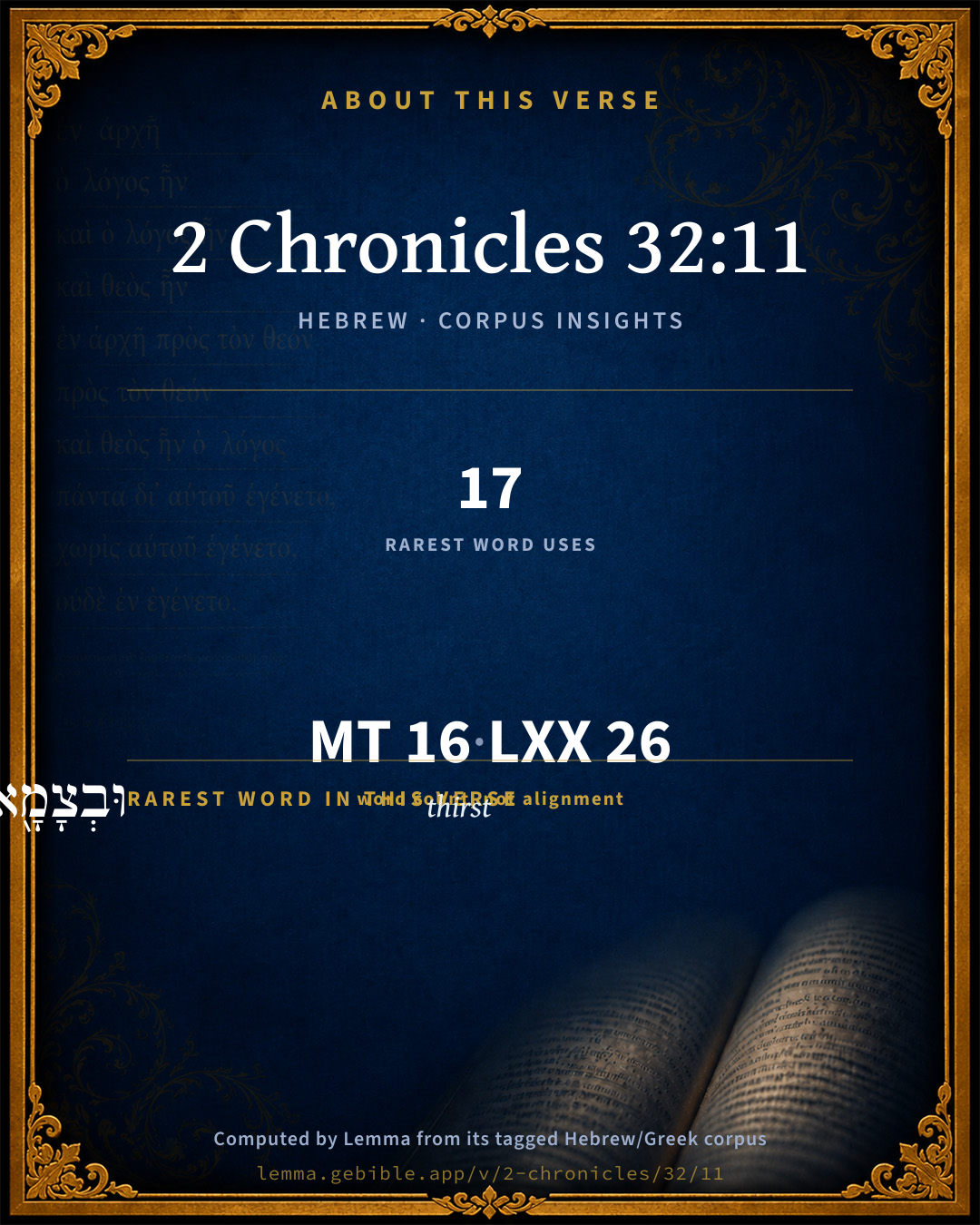
The rarest word here is וּבְצָמָ֖א thirst H6772 — appearing just 17 times in the whole Hebrew Bible.

Shared distinctive vocabulary

וּבְצָמָ֖א thirst H6772 occurs in 17 verses of the Hebrew Bible. Also found in:

Grammatical profile

  • 5 verbs
  • 8 nouns
  • 3 particles

Verb forms

  • מַסִּ֣ית Hiphil · Participle Active
  • לָתֵ֣ת Qal · Infinitive Construct
  • לָמ֛וּת Qal · Infinitive Construct
  • לֵאמֹ֑ר Qal · Infinitive Construct
  • יַצִּילֵ֕נוּ Hiphil · Imperfect

Hebrew & Septuagint length

In English translation the verse runs 32 words from the Hebrew and 31 from the Septuagint (LXX English) — closely comparable.

A rough comparison of the two English renderings, which tokenize alike — not a word-level alignment.

Word counts can differ between the Hebrew and the Greek without any difference in meaning — e.g. the Hebrew direct-object marker אֵת has no separate Greek word, and Greek often adds the article ὁ.

In the original languages it is 16 Hebrew tokens and 26 Greek tokens — but the two are counted differently (Hebrew bundles its prefixes and suffixes into one token; the Greek is in lemma form), so that isn’t a like-for-like length.

Cross-references

12

Topical passages linked to 2 Chronicles 32:11 in the Treasury of Scripture Knowledge — connected by theme and wording, ordered by reader-vote popularity; previews shown in the World English Bible.

  • 2 Kings 18:27 But Rabshakeh said to them, Has my master sent me to your master, and to you, to speak these words? Hasn't he sent me to the men who sit on the wall, to eat their own dung, and to drink their own water with you?
  • 2 Kings 18:30 neither let Hezekiah make you trust in Yahweh, saying, Yahweh will surely deliver us, and this city shall not be given into the hand of the king of Assyria.
  • 2 Kings 19:10 Thus shall you speak to Hezekiah king of Judah, saying, Don't let your God in whom you trust deceive you, saying, Jerusalem shall not be given into the hand of the king of Assyria.
  • 2 Chronicles 32:15 Now therefore don't let Hezekiah deceive you, nor persuade you after this manner, neither believe you him; for no god of any nation or kingdom was able to deliver his people out of my hand, and out of the hand of my fathers: how much less shall your God deliver you out of my hand?
  • Psalms 3:2 Many there are who say of my soul, "There is no help for him in God." Selah.
  • Psalms 11:1–3 In Yahweh, I take refuge. How can you say to my soul, "Flee as a bird to your mountain!"
  • Psalms 22:8 "He trusts in Yahweh; Let him deliver him; Let him rescue him, since he delights in him."
  • Psalms 42:10 As with a sword in my bones, my adversaries reproach me, While they continually ask me, "Where is your God?"
  • Psalms 71:11 Saying, "God has forsaken him. Pursue and take him, for no one will rescue him."
  • Isaiah 36:12 But Rabshakeh said, Has my master sent me to your master, and to you, to speak these words? [has he] not [sent me] to the men who sit on the wall, to eat their own dung, and to drink their own water with you?
  • Isaiah 36:18 Beware lest Hezekiah persuade you, saying, Yahweh will deliver us. Has any of the gods of the nations delivered his land out of the hand of the king of Assyria?
  • Matthew 27:43 He trusts in God. Let God deliver him now, if he wants him; for he said, 'I am the Son of God.'"

Cross-references courtesy of OpenBible.info (CC BY 4.0).

Hebrew and Greek witnesses Masoretic Hebrew ↔ Greek Septuagint

The same verse in the two great witnesses to the Old Testament, shown verse-for-verse.

These are two independent witnesses, not word-aligned to each other, and the Septuagint is shown in lemma (dictionary) form.

Hebrew 2 Chronicles 32:11 Masoretic · Westminster Leningrad Codex

הֲלֹ֤א יְחִזְקִיָּ֨הוּ֙ מַסִּ֣ית אֶתְכֶ֔ם לָתֵ֣ת אֶתְכֶ֔ם לָמ֛וּת בְּרָעָ֥ב וּבְצָמָ֖א לֵאמֹ֑ר יְהוָ֣ה אֱלֹהֵ֔ינוּ יַצִּילֵ֕נוּ מִכַּ֖ף מֶ֥לֶךְ אַשּֽׁוּר

Does not Hezekiah persuade you, to give you over to die by famine and by thirst, saying, Yahweh our God will deliver us out of the hand of the king of Assyria?

World English Bible · Public Domain

Greek LXX 2 Chronicles 32:11 Septuagint · lemma form

οὐ εζεκιας ἀπατάω σύ ὁ παραδίδωμι σύ εἰς θάνατος καί εἰς λιμός καί εἰς δίψα λέγω κύριος ὁ θεός ἐγώ σώζω ἐγώ ἐκ χείρ βασιλεύς ασσουρ

Does not Ezekias deceive you, to deliver you to death and famine and thirst, saying, The Lord our God will deliver us out of the hand of the king of Assyria?

LXX2012 (modern English Septuagint) · Public Domain

Hebrew: Westminster Leningrad Codex (CC BY 4.0). Greek: Septuagint (public domain); English from LXX2012 (modern English Septuagint) (Public Domain). How the Septuagint differs from the Hebrew →

Commentary

Notes on 2 Chronicles 32:11 from classic Christian and Jewish commentators (each source and its license shown beneath its notes). The classic Christian expositions comment on the surrounding passage and are grouped to its opening verse, so a note may address several verses; the Jewish commentaries on the Tanakh (Rashi and others) are per-verse, so they appear only where the commentator wrote on this verse.

Lemma curates 59 commentaries, every one of them public domain or Creative Commons licensed, each selected and text-cleaned for this edition rather than reprinted as found. About our sources →

Trapp's Complete Commentary

John Trapp

2Ch 32:11 Doth not Hezekiah persuade you to give over yourselves to die by famine and by thirst, saying, The LORD our God shall deliver us out of the hand of the king of Assyria?

Ver. 11. Doth not Hezekiah persuade (or deceive) you?] See on 2Ki 18:29-30.

John Trapp, A Commentary or Exposition upon All the Books of the Old and New Testament (1647–1656) — public domain. Text from a community e-Sword module.

Joseph Benson's Commentary

2Ch 32:11-12. To give over yourselves to die by famine, &c. — It appears by this he did not intend to storm the city, but to keep them pent up till they were starved. Hath not Hezekiah taken away his high places, &c. — He speaks thus through his ignorance of the divine law, which enjoined them to worship only at Jerusalem.

Joseph Benson's Commentary on the Old and New Testaments (1811–1818) — public domain. Text from a community e-Sword module.

Ellicott's Commentary for English Readers

(11) Doth not Hezekiah persuade you.—Is not Hezekiah inciting you (2Ki_18:32; 1Ch_21:1). The, verb recurs in 2Ch_32:15.

To give over yourselves . . . by thirst.—In order to deliver you to dying . . . by thirst. A softening down of the coarse expression recorded in 2Ki_18:27. Esarhaddon in the record of his Egyptian campaign uses similar language: “siege-works against him I constructed, and food and water, the life of their souls, I cut off.”

A Bible Commentary for English Readers, edited by Charles John Ellicott (1878–1897) — public domain. Text from a community e-Sword module.

The Cambridge Bible for Schools and Colleges

gen. ed. J. J. S. Perowne

11. persuade] Or “entice”; cp. 1Ch_21:1 (“provoked” for the same Heb. word).

to give over yourselves] R.V. to give you over.

The Cambridge Bible for Schools and Colleges (gen. ed. J. J. S. Perowne; Cambridge University Press, 1878–1918) — public domain. Text from a community e-Sword module.

John Gill's Exposition

Hath not the same Hezekiah taken away his high places,.... For the sense of this and the three following verses, see the notes on Isa 36:17; see Gill on Isa 36:18, Isa 36:19, Isa 36:20

2 Chronicles 32:16

ch2 32:16

ch2 32:16

ch2 32:16And his servants spake yet more against the Lord God, and against his servant Hezekiah. Than what is here recorded, as may be read in Kg2 18:1, and Isa 36:1.

John Gill's Exposition of the Whole Bible (1746–1763) — public domain (CC PDM 1.0). Text via the HelloAO Bible API.

The Pulpit Commentary

The policy of Sennacherib, in the direct attempt to undermine Hezekiah by appealing straight to his people, instead of to himself or his ministers of state, is yet more pronounced in expression, as seen in 2Ki_18:26, 2Ki_18:27.

The Pulpit Commentary (1880–1919), ed. H.D.M. Spence-Jones & Joseph S. Exell — public domain. Text from a community e-Sword module.

unfoldingWord translationNotes

Door43 World Missions Community

Is not Hezekiah misleading you ... king of Assyria'?

Sennacherib uses a rhetorical question to cause the people of Jerusalem to think about their situation. It can be translated as a statement. AT: "Hezekiah is misleading you ... king of Assyria.'" (See: Rhetorical Question)

that he may give you over to die by famine and by thirst

"so that you will die from lack of food and water"

from the hand of the king of Assyria

Here "hand" represents power or control. AT: "from the power of the king of Assyria" or "from the king of Assyria" (See: Metonymy)

Has not this same Hezekiah taken away ... sacrifices'?

Sennacherib uses a rhetorical question to cause the people of Jerusalem to think about their situation. It can be translated as a statement. AT: "This is the same Hezekiah who has taken away ... sacrifices.'" or "Hezekiah has taken away ... sacrifices.'"

commanded Judah and Jerusalem

Here "Judah" and "Jerusalem" represent the people who live there. AT: "commanded the people of Judah and Jerusalem" (See: Metonymy)

translationWords

die

famine

hand

altar

command

worship

sacrifice

unfoldingWord translationNotes — © Distant Shores Media and the Door43 World Missions Community, licensed CC BY-SA 4.0. Source: git.door43.org/Door43/en_tn.

Lesson kit

Teaching starters — assembled from the data on this page, not authored interpretation. Every prompt links to the verse data it draws on. Edit before teaching.

2 Chronicles, in the Historical, opens this verse with 16 words (15 distinct Hebrew lemmas). Its most distinctive word is tsâmâʼ (“thirst”). A historical commentator’s framing appears above. Read the whole chapter for the surrounding context.

Discussion questions

  1. What does “thirst” (tsâmâʼ) contribute to the verse as a whole?
  2. How does Exodus 17:3, which shares the word «thirst», read alongside this verse?
  3. The translations on this page render this verse differently — a whole-verse word diff, not a word-by-word alignment. What might account for the different wordings?
  4. «מַסִּ֣ית» is a Hiphil Participle Active verb. How does that grammatical form shape the action described?
  5. Compare how Trapp's Complete Commentary and Joseph Benson's Commentary read this verse. Where do they agree or differ?

Things to notice

Reading settings

Reading text

Shown beneath each verse's original-language words.

Old Testament
Old Testament edition

Read the OT as the Masoretic Hebrew (MT) or the Greek Septuagint (LXX).

English shown for the Greek Septuagint (in the Hebrew ↔ Greek comparison).

Comparing translations? Open the Compare panel on any verse page to stack up to four side by side.