Hosea 2:10

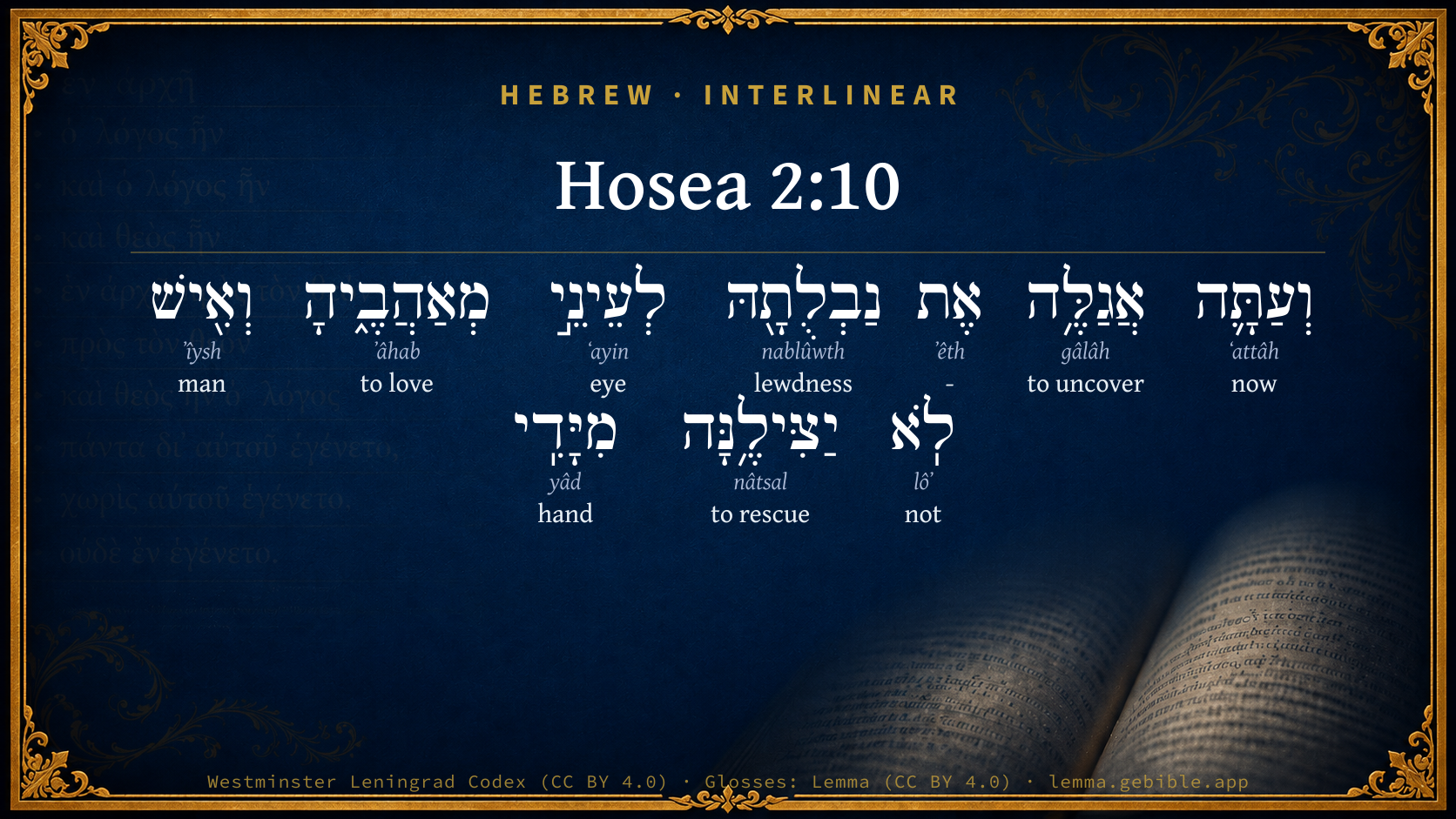
Hebrew (Westminster Leningrad Codex) Hosea 2:10 appears in the Hebrew Old Testament. The text above is from the Westminster Leningrad Codex. Each word links to its Strong’s number, a concise gloss, and parsing drawn from the Open Scriptures Hebrew Bible morphology. Click any word for its full Brown-Driver-Briggs (BDB) entry.
Download image
Cite this verse

Hosea 2:10 (World English Bible). Public Domain. Lemma interlinear Bible study tool, https://lemma.gebible.app/v/hosea/2/10.

Show BibTeX & RIS
BibTeX
RIS
English Translation
Now I will uncover her lewdness in the sight of her lovers, And no one will deliver her out of my hand.
World English Bible · Public Domain
Highlights
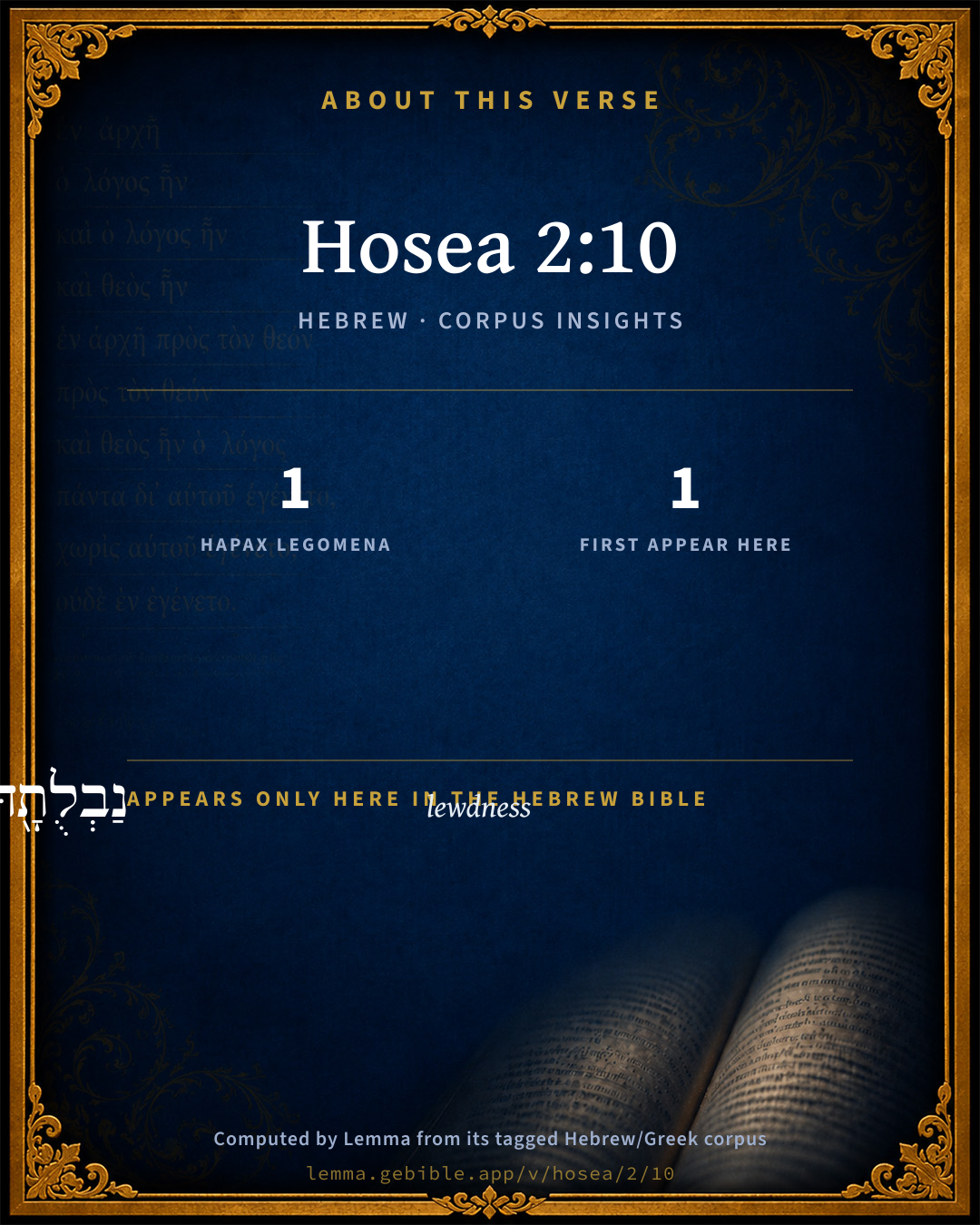
  • 1 hapax legomenon — only here in the Hebrew Bible
  • 1 first appearance in the Hebrew Bible
Full analysis ↓
Download a study sheet

One document with this verse’s original text, its word-by-word gloss line, the meaning frame, cross-references with their text, attributed commentary, and full source and license credits — printable, and it pastes into notes with its structure intact.

This verse Autodidact and up

Study sheet (.html) Plain text (.txt)

A passage Seminary Student

Up to 50 verses in one chapter. A passage sheet keeps up to 6 commentary sources and 12 cross-references per verse, in the order this page ranks them, and says so on the sheet whenever that leaves anything out. Ask for a single verse and you get the Autodidact verse sheet above.

Everything on this page stays free to read, with no account — the sheet is a download of what is already on screen, not access to it.

Want to remove ads? Support Godless Engineer
Compare translations 3

The same verse in 3 English versions, stacked beneath the original-language interlinear above. Click any original word for its lexicon entry.

Each is an independent rendering of the whole verse — the interlinear is not word-aligned to these translations.

Highlighted words mark where these versions differ — a whole-verse word diff, not a word-by-word alignment.

  • World English Bible Public Domain
    Now I will uncover her lewdness in the sight of her lovers, And no one will deliver her out of my hand.
  • King James Version Public Domain
    And now will I discover her lewdness in the sight of her lovers, and none shall deliver her out of mine hand.
  • unfoldingWord Literal Text CC BY-SA 4.0
    And now I will uncover her lewdness to the eyes of her lovers, and no man will deliver her from my hand.

unfoldingWord Literal Text — © unfoldingWord, licensed CC BY-SA 4.0. Word-aligned USFM3 via Door43 (git.door43.org/unfoldingWord/en_ult).

Versions to compare (up to 4)

3 of 4 selected

Show all 18 translations

Every available English version of this verse, each an independent rendering of the whole verse.

  • World English Bible Public Domain
    Now I will uncover her lewdness in the sight of her lovers, And no one will deliver her out of my hand.
  • Berean Standard Bible Public Domain
    And then I will expose her lewdness in the sight of her lovers, and no one will deliver her out of My hands.
  • Majority Standard Bible Public Domain
    And then I will expose her lewdness in the sight of her lovers, and no one will deliver her out of My hands.
  • King James Version Public Domain
    And now will I discover her lewdness in the sight of her lovers, and none shall deliver her out of mine hand.
  • American Standard Version (1901) Public Domain
    And now will I uncover her lewdness in the sight of her lovers, and none shall deliver her out of my hand.
  • Revised Version (1885) Public Domain
    And now will I discover her lewdness in the sight of her lovers, and none shall deliver her out of mine hand.
  • Geneva Bible (1599) Public Domain
    And now will I discouer her lewdnes in the sight of her louers, and no man shall deliuer her out of mine hand.
  • Douay-Rheims (1899) Public Domain
    And now I will lay open her folly in the eyes of her lovers: and no man shall deliver her out of my hand:
  • Young's Literal Translation Public Domain
    And now do I reveal her dishonour before the eyes of her lovers, And none doth deliver her out of My hand.
  • Literal Standard Version CC BY-SA 4.0
    And now I reveal her dishonor before the eyes of her lovers, || And none deliver her out of My hand.
  • Unlocked Literal Bible CC BY-SA 4.0
    Then I will strip her naked in the sight of her lovers, and no one will rescue her out of my hand.
  • unfoldingWord Literal Text CC BY-SA 4.0
    And now I will uncover her lewdness to the eyes of her lovers, and no man will deliver her from my hand.
  • Darby Bible Public Domain
    And now will I discover her impiety in the sight of her lovers, and none shall deliver her out of my hand.
  • World Messianic Bible Public Domain
    Now I will uncover her lewdness in the sight of her lovers, and no one will deliver her out of my hand.
  • Webster's Bible Public Domain
    And now will I disclose her lewdness in the sight of her lovers, and none shall deliver her out of my hand.
  • Free Bible Version CC BY-SA 4.0
    I will strip her naked while her lovers watch; no one will be able to rescue her from me.
  • Bible in Basic English Public Domain
    And now I will make her shame clear before the eyes of her lovers, and no one will take her out of my hand.
  • JPS Tanakh (1917) Public Domain
    (2-12) And now will I uncover her shame in the sight of her lovers, and none shall deliver her out of My hand.

Literal Standard Version (2020), Covenant Press — licensed CC BY-SA 4.0. Text via the HelloAO Bible API (eBible.org). Unlocked Literal Bible (unfoldingWord) — licensed CC BY-SA 4.0. Text via the HelloAO Bible API (eBible.org). unfoldingWord Literal Text — © unfoldingWord, licensed CC BY-SA 4.0. Word-aligned USFM3 via Door43 (git.door43.org/unfoldingWord/en_ult). Free Bible Version, Dr. Jonathan Gallagher — licensed CC BY-SA 4.0. Text via the HelloAO Bible API (eBible.org).

Word by word

More ways to search: Search by grammar → Find every occurrence → Compare this word →

Practice this passage: Drill this verse → Learn its vocabulary →

נַבְלֻתָ֖הּ
nablûwth
H5040
“lewdness · her”
Noun, Common, Feminine, Singular, Construct + Suffix, Personal, 3rd Person, Feminine, Singular
Part of Speech
Noun
Type
Common
Gender
Feminine
Number
Singular
State
Construct
Full BDB Definition

Origin: from H5036

TWOT: 1285c

immodesty, shamelessness, lewdness, pudenda (of female)
  1. וְעַתָּ֛ה ʻattâh H6258 “and · now” Conjunction + Adverb
  2. אֲגַלֶּ֥ה gâlâh H1540 “to uncover” Verb, Piel, Imperfect, 1st Person, Common, Singular
  3. אֶת ʼêth H853 “-” Particle, Direct Object
  4. לְעֵינֵ֣י ʻayin H5869 “to/for · eyes of” Preposition + Noun, Common, Both, Dual, Construct
  5. מְאַהֲבֶ֑יהָ ʼâhab H157 “loving · her” Verb, Piel, Participle Active, Masculine, Plural, Construct + Suffix, Personal, 3rd Person, Feminine, Singular
  6. וְאִ֖ישׁ ʼîysh H376 “and · man” Conjunction + Noun, Common, Masculine, Singular, Absolute
  7. לֹֽא lôʼ H3808 “not” Particle, Negative
  8. יַצִּילֶ֥נָּה nâtsal H5337 “to rescue · her” Verb, Hiphil, Imperfect, 3rd Person, Masculine, Singular + Suffix, Personal, 3rd Person, Feminine, Singular
  9. מִיָּדִֽי yâd H3027 “from · hand · my” Preposition + Noun, Common, Both, Singular, Construct + Suffix, Personal, 1st Person, Common, Singular

About this verse

These counts appear in no published source. They are computed here, from the morphology-tagged text and Lemma’s own curated glosses. What Lemma adds →

10
words
10
distinct lemmas
Prophets
section

Notable vocabulary

1 hapax legomenon — a word that appears only here in the entire Hebrew Bible:

  • נַבְלֻתָ֖הּ lewdness H5040

First appearance in Scripture

This word makes its first canonical appearance in the Hebrew Bible here:

  • נַבְלֻתָ֖הּ lewdness H5040

Grammatical profile

  • 3 verbs
  • 4 nouns
  • 1 adverb
  • 2 particles

Verb forms

  • אֲגַלֶּ֥ה Piel · Imperfect
  • מְאַהֲבֶ֑יהָ Piel · Participle Active
  • יַצִּילֶ֥נָּה Hiphil · Imperfect

Hebrew & Septuagint length

In English translation the verse runs 22 words from the Hebrew and 23 from the Septuagint (LXX English) — closely comparable.

A rough comparison of the two English renderings, which tokenize alike — not a word-level alignment.

Word counts can differ between the Hebrew and the Greek without any difference in meaning — e.g. the Hebrew direct-object marker אֵת has no separate Greek word, and Greek often adds the article ὁ.

Cross-references

13

Topical passages linked to Hosea 2:10 in the Treasury of Scripture Knowledge — connected by theme and wording, ordered by reader-vote popularity; previews shown in the World English Bible.

  • Ezekiel 23:29 and they shall deal with you in hatred, and shall take away all your labor, and shall leave you naked and bare; and the nakedness of your prostitution shall be uncovered, both your lewdness and your prostitution.
  • Luke 12:2–3 But there is nothing covered up, that will not be revealed, nor hidden, that will not be known.
  • Psalms 50:22 "Now consider this, you who forget God, Lest I tear you into pieces, and there be none to deliver.
  • Proverbs 11:21 Most assuredly, the evil man will not be unpunished, But the seed of the righteous will be delivered.
  • Isaiah 3:17 Therefore the Lord brings sores on the crown of the head of the women of Zion, And Yahweh will make their scalps bald."
  • Jeremiah 13:22 If you say in your heart, Why are these things come on me? for the greatness of your iniquity are your skirts uncovered, and your heels suffer violence.
  • Jeremiah 13:26 Therefore will I also uncover your skirts on your face, and your shame shall appear.
  • Ezekiel 16:36–37 Thus says the Lord Yahweh, Because your filthiness was poured out, and your nakedness uncovered through your prostitution with your lovers; and because of all the idols of your abominations, and for the blood of your children, that you gave to them;
  • Hosea 2:3 Lest I strip her naked, And make her bare as in the day that she was born, And make her like a wilderness, And set her like a dry land, And kill her with thirst.
  • Hosea 5:13–14 When Ephraim saw his sickness, And Judah his wound, Then Ephraim went to Assyria, And sent to king Jareb: But he is not able to heal you, Neither will he cure you of your wound.
  • Hosea 13:7–8 Therefore am I to them like a lion; Like a leopard I will lurk by the path.
  • Micah 5:8 The remnant of Jacob will be among the nations, In the midst of many peoples, Like a lion among the animals of the forest, Like a young lion among the flocks of sheep; Who, if he goes through, treads down and tears in pieces, And there is no one to deliver.
  • 1 Corinthians 4:5 Therefore judge nothing before the time, until the Lord comes, who will both bring to light the hidden things of darkness, and reveal the counsels of the hearts. Then each man will get his praise from God.

Cross-references courtesy of OpenBible.info (CC BY 4.0).

Hebrew and Greek witnesses Masoretic Hebrew ↔ Greek Septuagint

The same verse in the two great witnesses to the Old Testament, shown verse-for-verse.

These are two independent witnesses, not word-aligned to each other, and the Septuagint is shown in lemma (dictionary) form.

Hebrew Hosea 2:10 Masoretic · Westminster Leningrad Codex

וְעַתָּ֛ה אֲגַלֶּ֥ה אֶת נַבְלֻתָ֖הּ לְעֵינֵ֣י מְאַהֲבֶ֑יהָ וְאִ֖ישׁ לֹֽא יַצִּילֶ֥נָּה מִיָּדִֽי

Now I will uncover her lewdness in the sight of her lovers, And no one will deliver her out of my hand.

World English Bible · Public Domain

Greek LXX Hosea 2:10 Septuagint · lemma form

καί αὐτός οὐ γιγνώσκω ὅτι ἐγώ δίδωμι αὐτός ὁ σῖτος καί ὁ οἶνος καί ὁ ἔλαιον καί ἀργύριον πληθύνω αὐτός αὐτός δέ ἀργυροῦς καί χρυσοῦς ποιέω ὁ βααλ

And now I will expose her uncleanness before her lovers, and no one shall by any means deliver her out of my hand.

LXX2012 (modern English Septuagint) · Public Domain

On this verse, The Pulpit Commentary discusses the Septuagint’s reading. Read the note in Commentary ↓

Hebrew: Westminster Leningrad Codex (CC BY 4.0). Greek: Septuagint (public domain); English from LXX2012 (modern English Septuagint) (Public Domain). How the Septuagint differs from the Hebrew →

Targum (Aramaic paraphrase)

1

The Targum is the ancient Jewish Aramaic paraphrase of the Hebrew Scriptures — an interpretive translation, not the Hebrew text itself. Onkelos (literal) and Pseudo-Jonathan (expansive) render the Torah, and Jonathan the Prophets. Coverage is partial: where no permissively-licensed English translation exists for a verse, only the Aramaic is shown. This is verse-level text, not a word-by-word alignment to the Hebrew.

  1. Targum Jonathan Prophets (Joshua–Malachi)
    וְאִינוּן לָא יָדְעִין אֲרֵי אֲנָא בָּרְכֵית לְהוֹן עִבּוּרָא וְחַמְרָא וּמִשְׁחָא וְכַסְפָּא אַסְגֵיתִי לְהוֹן וְדַהֲבָא מִנֵיהּ עֲבָדוּ לְטַעֲוָתָא:

    (no public-domain English translation for this verse)

    Targum Jonathan — Aramaic: “Mikraot Gedolot” (public domain). English: “Sefaria Community Translation” (CC0 1.0 (public-domain dedication)); “London "Chaldee Paraphrase," 1871” (public domain). Text via Sefaria.

Commentary

Notes on Hosea 2:10 from classic Christian and Jewish commentators (each source and its license shown beneath its notes). The classic Christian expositions comment on the surrounding passage and are grouped to its opening verse, so a note may address several verses; the Jewish commentaries on the Tanakh (Rashi and others) are per-verse, so they appear only where the commentator wrote on this verse.

Lemma curates 59 commentaries, every one of them public domain or Creative Commons licensed, each selected and text-cleaned for this edition rather than reprinted as found. About our sources →

Trapp's Complete Commentary

John Trapp

Hos 2:10 And now will I discover her lewdness in the sight of her lovers, and none shall deliver her out of mine hand.

Ver. 10. And now will I discover her lewdness] Or her filthiness, baseness, foolishness, saplessness; perhaps the same with her nakedness, Hos 2:9. {See Trapp on "Hos 2:9"} How shameless the heathen idolaters were, the worshippers of Priapus especially (which Jerome and Isidore say was the same with Baalpeor, and made Maacha, the mother of Asa, guilty of that villany), with their infamous Nos, pudore pulso, stamus sub Iove coleis apertis, &c., is notoriously known; how they ran about naked in their Lupercalia, Bacchanalia, and other beastly solemnities. God threateneth to make her naked here in another manner, to her utter disgrace and ignominy ( Chaldeus reddit ignominiam, ut quam velatam desiderabant, apertam contemnant. Jerome). He had threatened her before with poverty, now with scorn and contempt: these go seldom asunder; but when self-procured they are very grievous. See Deu 28:15-68. Fornicators are fools, Jer 29:23 Gen 34:7, Shechem committed folly in Israel, and is therefore called a lad or a child {Gen 34:19, Neque distulit puer} for his witlessness, as being carried not by right reason, but blind affection. So Amnon was for this as one of the fools in Israel, 2Sa 13:12, a Nabal, a Nebulo, one that falls below the dignity of a man, below the stirrup of reason, flagitious and profligate.

Spiritual fornicators are all this and more. They hunt after lying vanities, and so forsake their own mercies, Jon 2:8, being singularly foolish (as the word here used importeth) and miserable by their own election. The indignity and iniquity of their practice, see Jer 2:9-13. Satan deals by them as he did by Adam when he gave him an apple for Paradise; and set him to the tree of knowledge that he might not taste the tree of life. And like unto them (saith a Lapide here) is every wicked person who by Satan’s persuasion preferreth the creature before the Creator, earth before heaven, the devil before God, hell before heaven, sin before sanctity, evil before good. These are lewd persons of sordid and servile dispositions, homines ad servitutem parati (as Tiberius said of the Romans), men of an under-spirit, as those, 1Ch 4:23. Hedge rogues Mr Dyke calleth them.

In the sight of her lovers] That her whom they have so desired while she was veiled they may deride when laid open. There can nothing befall a woman more grievous than to be stripped naked, but especially before her sweethearts: Lam 1:8, "All that honoured her despise her, because they have seen her nakedness: yea, she sigheth and turneth backward." It is the paint or the dress many times that makes the lewd woman lovely. Think the same of idolatry: how pompous is it, and theatrical! but God will detect it, and make it ridiculous every day more and more. Erasmus was very instrumental this way, and did prejudice Popery by his witty jeering as much as Luther did by his stomaching and inveighing, saith Capito. Though it cannot be denied but that pruriginosa istorum hominum scabies asperiori strigili fricanda fuerat, the scabby hides of those popelings called for a sharper currycomb, as another learned man phraseth it (Amama. Anibarb. Praefat.).

And none shall deliver her out of my hand] Not her idols, not her confederates. "An idol is nothing in the world," 1Co 8:4, and all nations set by God are as a drop of a bucket, or dust of a balance: they can no more stand before him than a glass bottle can before a cannon shot. It was bootless, therefore, for this adulteress to hope for help from her lovers when God once took her in hand. He would give her her due, ipsis spectantibus et stantibus instar stipitum, while they looked on and stood like so many stocks, not daring to stir for her rescue and relief. See for this, Rev 18:10. {See Trapp on "Rev 18:10"}

John Trapp, A Commentary or Exposition upon All the Books of the Old and New Testament (1647–1656) — public domain. Text from a community e-Sword module.

The Biblical Illustrator

Joseph S. Exell

Hos_2:10-12

None shall deliver her out of My hand.

The Lords sentence

I. Taking away things necessary to life, Learn--

1. However the Lord communicate of His bounty with the children of men, yet He still retains the dominion of all the creatures in His own hand, that He may dispose of them at His pleasure.

2. Mens abuse of prosperity, especially to uphold a false religion, doth justly forefault their right thereunto before God, and doth provoke Him to take away abused mercies.

3. As Gods former bounty will not secure pros perity to the abusers of it, so He will take it away when it promises fairest, as when it is come to the harvest.

4. As outward mercies are given for the supply of necessities, and not for fostering of luxury, so it is a special cause of Gods stroke that men do so far miscarry, because of that, without which they would be so vile. These things were given to cover her nakedness, and she would be vile without them. Yet she abused them, and therefore God will take them away.

II. Making her vileness appear to her lovers. Learn--

1. How right soever sinners may appear to themselves or others in their prosperity, yet God will, by judgments, make it appear how lewd and vile their way hath been.

2. God is so strong a party as when He contends with sinners, all their confidences in idolatry, false worship, or confederates, will fail them, and not be able to help them.

3. Idolatry, and abuse of prosperity to uphold it, doth ripen a visible Church for very speedy destruction.

III. Cutting short mirth and worship. Learn--

1. Sin and mirth will not last long together, but were there never so much of mirth, sin will cut it all short.

2. God will not be mocked with external performances of solemn worship to Him, when they join gross idolatry with them.

IV. Destruction even of the sources of blessing. Not only their fruits, but the trees they grew upon. Learn--

1. Spiritual judgments and deprivation of ordinances will have but little weight with wicked men, unless some other rod be sent with them.

2. Such is the desperate stupidity and obstinacy of declining sinners, as no cutting off of present enjoyments will affect them, unless their future expectations be cut off likewise.

3. As God doth not cut off enjoyments from sinners, but when they do abuse them, so we should take heed of Gods quarrel under calamities, and especially the abuse of prosperity, in not acknowledging God, but strengthening ourselves in an ill way, because of it. (George Hutcheson.)

Gods punishments are just

Whenever God deals severely with men, He visits their sins, and inflicts a just punishment. For though men may consider themselves to be chastised by the Lord, they yet do not thoroughly search and examine themselves as they ought. Hence the prophet repeats what we have before met with, and that is, that this chastisement would be just. At the same time, he shows us as by the finger what chiefly displeased God in the Israelites, which was, that religion was corrupted by them: for there is nothing more necessary to be known, than that in order men may ever habituate themselves to worship God in a pure manner, this should be testified to them, that all superstitions are such an abomination to God that He cannot bear them. (John Calvin.)

The Biblical Illustrator, edited by Joseph S. Exell (c. 1880s–1900s) — public domain. Text from a community e-Sword module.

Joseph Benson's Commentary

Hos 2:10-11. And now will I discover her lewdness, &c. — The folly and wickedness of her idolatries shall appear by the punishments which I will inflict upon her, which shall be so remarkable that they shall be taken notice of by the idolatrous nations round about her, which have pretended a friendship for her, and promised her great assistance and prosperity if she would worship the same gods that they worshipped; but neither they nor any of their false gods shall save her from the calamities I will bring upon her. And I will cause all her mirth to cease — The mirth and jollity of Israel were greatly damped when Tiglath-pileser took Ijon and other cities, and subdued Gilead and Galilee, and all the land of Naphtali, and carried the people away captive to Assyria, which he did but a few years after this prophecy was uttered. And surely all their joy must have ceased about ten or twelve years after, when Samaria was taken, and Hosea and all Israel made captives. Her feast-days, her new-moons, &c. — Though apostate Israel was fallen to idolatry, and had renounced the true worship of God, yet by this verse it appears they retained many of the rites and ceremonies that were used in Judah, or else they set up others like them. But God here threatens, that in their captivity they should have no opportunity to celebrate them.

Joseph Benson's Commentary on the Old and New Testaments (1811–1818) — public domain. Text from a community e-Sword module.

Whedon's Commentary on the Bible

Daniel D. Whedon

10. By withholding the crops at the time when the people might expect them Jehovah will show that it is he, and he alone, who controls the forces of nature, and not the Baalim (Hos_2:5); the latter will be absolutely helpless.

Lewdness — R.V. margin, “shame”; carries further in figurative language the announcement of Hos_2:9. With the flax and wool, intended for covering, gone, the woman — here Israel — will stand exposed naked.

In the sight of her lovers — The thought is not that, seeing her thus, they will begin to abhor and despise her, but rather that, though it is done in their very presence, they will be unable to help her (compare Isa_1:7). The Baalim never have done anything, and their helplessness will become self-evident when Jehovah strikes the blow. No one can rescue Israel. If this were the only reference in Hosea to the worship of other gods one might be led to think that Hosea believed in their existence though he considered them less powerful than Jehovah; but compare Hos_4:5; Hos_14:3.

THE BUILDING OF THE TEMPLE WILL ASSURE NEW BLESSINGS FROM GOD, Hos_2:10-19.

This also is a message of encouragement and promise, which reaches its culmination in the last sentence, “From this day will I bless you.” Again nothing is said concerning the occasion of the prophecy, but its contents enable us to determine it. The words were apparently called forth by new questionings of the people. It would seem that they came to resent the severe accusations made in the first address. Were they not bringing offerings to Jehovah? As a result they came to question the truth of the statements that the calamities which they suffered were the consequence of their neglectfulness, and that the rebuilding of the temple would assure them the restoration of the divine favor. To silence the questionings the prophet propounds to the priests two questions concerning the power of infection possessed by clean and unclean things. The priests reply that the unclean is more contagious than the clean (11-13). This reply the prophet applies to the case in hand. True, the people were offering sacrifices, but, says he, they are insufficient to overcome the unclean in their life and conduct; on the contrary, the unclean conduct makes even their offerings an abomination in the sight of Jehovah (14). He discusses once more the relation of the calamities to their neglectfulness and asserts that they are a direct result of the latter. The address closes with a promise that from now on the divine favor will again rest upon them (15-19).

Hos_2:10 is similar to Hag_1:1; Hag_2:1.

Four and twentieth day of the ninth month — Just three months after the building operations commenced (see on Hos_2:18). The ninth month is called Chisleu (Zec_7:1) and covers the latter part of November and first part of December.

Daniel D. Whedon (gen. ed.), Commentary on the Old and New Testaments (1874–1909) — public domain. Text from a community e-Sword module.

The Preacher's Complete Homiletical Commentary

Joseph S. Exell (gen. ed.)

CRITICAL NOTES.—

Hos_2:10. Discover her lewdness] Lit. uncover her shame. Sin decked out in gaudy colours, and covered with showy masks, shall be stripped and exposed to public shame. None can avert the threatened punishment.

HOMILETICS

THE EXPOSURE OF FOLLY.—Hos_2:10

Warning follows warning, but amid judgment and corruption Israel forgets God and gives up herself to mirth and idolatry. Pleasures allure men astray. But sin and mirth will be separated, and those who refuse Divine mercy will feel Divine justice.

Notice:—

I. Folly decked in gaudy colours. “Lewdness” means folly; for sin is real folly, as holiness is essential wisdom. Foolishness is the natural tendency, the mighty propensity to evil; bound up in the heart, incorporated in the thoughts, and manifest in the life of the sinner. But the folly of sin is often veiled in darkness, decked in ornament and trickery, to attract and deceive. It dazzles by its glitter and ensnares by its mask. The outside is attractive, but the inside is deceptive. There is no substance, no enjoyment in sin; all is shadow and emptiness. Men think themselves wise in their folly, and are praised for their worldly policy (Psa_49:18). They call themselves happy, when applauded by others and blessed with temporal prosperity. But fame and success, wealth and worldly possessions, are impotent in the tomb. The dying worldling “shall carry nothing away: his glory shall not descend after him.” The pleasures of sin and the pride of life are only rainbow colours to the bubble, giving it tint, but no substance and reality. There is no utility, no rest, no gain in sin. It is not a casual step from the path of wisdom, but the regular and usual course of folly. Essential folly, folly in the grain, folly in its nature, folly in its dress, and folly in its end. “Nought but itself could be its parallel.” It has the fascination and the fangs of a serpent. “It biteth like a serpent, and stingeth like an adder.” It deceives and destroys. In whatever guise folly presents itself, gross and repellent, subtle and seductive, it must be shunned. “Abstain from all appearance of evil,” or as some, “from everything that not only is evil, but that looks like evil.”

II. Folly exposed to public shame. “Now will I discover her lewdness in the sight of her lovers.” Darkness and secresy are no hiding-place to God. His eyes penetrate every place, and his hand can reach every person. Secret sins shall be discovered and their perpetrators exposed. The mask shall be torn away, and sin in its nature and consequences shall appear offensive, lewd, “exceeding sinful.” Men may deny the fact and excuse the fault of sin; may cover crime with lies, and self-righteousness with professional virtues; but a God of truth will bring “to light the hidden things of darkness.” Virtues are hidden and oppressed; wickedness rules; and every day cries out for redress and retribution. Evil-doers shun the light and love darkness. They never will, never did, appreciate the light of holiness and rectitude. It reveals their folly and kindles remorse in their bosom. As foul birds of night, they hide themselves from its beams. The wicked cover their sins from themselves and others. They banish serious thoughts from their minds, stifle convictions, and put on a cheerful appearance. But “he that covereth his sins shall not prosper.” An offended God, who summoned Adam from his hiding-place, will call and condemn the sinner. In public, “in the sight of her lovers,” before men on earth and angels in eternity, they will be put to shame and confusion of face. The darkest deeds are “set in the light of God’s countenance,” and will “be proclaimed upon the house-tops.” “There is no darkness, nor shadow of death, where the workers of iniquity may hide themselves.”

III. Folly bereft of every defence. “None shall deliver her out of mine hand.” When God begins to work, who shall let or hinder him? Men say, “It was an oversight,” “I could not help it,” therefore forget it. They plead ignorance, custom, temptation, infirmity, necessity, and fatalism even, to excuse or palliate their guilt. This will never succeed. It was hopeless for Israel to trust to their idols and alliances. The strongest army, the most popular idol, are nothing before God. “All nations before him are as nothing; and they are counted to him less than nothing and vanity.” The allurements of vice will deceive. Reliance on temporal prosperity, outward formality, and religious ceremony will be in vain. It is only faith in Christ, not confidence in men, that can deliver us. The wicked “strengtheneth himself in his wickedness” (Psa_52:7); but he can neither outwit nor overcome his Judge. Given to wickedness, the sinner and the false professor shall find that “none shall deliver.” “The wicked is driven away in his wickedness” (Pro_14:32); “neither shall wickedness deliver those that are given to it” (Ecc_8:8).

ILLUSTRATIONS TO CHAPTER 2

Hos_2:10-11. Mirth. Mirth is a vain and unprofitable passion, not fit for a wise man’s entertainment [Bp. Hall].

Often when in the full enjoyment of all that this world could bestow, my conscience told me, that in the true sense of the word I was not a Christian. I laughed. I sang. I was apparently gay and happy. But the thought would steal across me,—what madness is all this! to continue easy in a state, in which a sudden call out of the world would consign me to everlasting misery, and that when eternal happiness is within my grasp [Wilberforce]. Mirth at a funeral is scarce more indecent or unnatural than a perpetual flight of gaiety and burst of exultation in a world like this; a world which may seem a paradise to fools, but is an hospital with the wise [Dr Young].

Forgetfulness of God, Hos_2:13. Such is the character of all engrossing passion, such is the source of sin to which the soul gives way, in avarice, ambition, worldliness, sensual sin, godless science. The soul at last does not rebel against God; it forgets him. It is taken up with other things, with itself, with the subjects of its thoughts, the objects of its affections, and it has no time for God, because it has no love for him [Pusey].

The gradations of sin.

1. Neglecting God. Neglect of his word, house, and service.

2. Forgetting God. Forgetting his love, goodness, and claims.

3. Departing from God. Departing into danger, error, and punishment.

Forgetfulness of God—a sign of carelessness—a mark of ingratitude and contempt—springs from unbelief and disobedience to God’s command (Deu_4:9; Deu_8:14).

Idolatry in the Church—the top-stone, the height of all crime—hated by God, and pursued by the sinner. Professed believers are too slow after God, but sinners hasten after their lovers. Let their zeal rebuke our tardiness; their punishment turn our steps to God and duty

The two masters.

1. Jehovah forgotten, Baal loved and worshipped.

2. The sacred days of Jehovah turned into festive days of Baal.

3. The gifts of Jehovah devoted to the service and support of Baal. “No man can serve two masters,” &c. Which are you serving? “Choose you this day,” &c.

The Preacher's Complete Homiletical Commentary (gen. ed. Joseph S. Exell; Funk & Wagnalls, c. 1892) — public domain (pre-1929). A full-Bible homiletical/sermon-outline anthology covering 65 of 66 books (2 John is absent from the source module). Text from a community e-Sword module.

Geneva Bible (1599)

Geneva Bible translators

That is, all her service, ceremonies and inventions whereby she worshipped her idols.

Geneva Bible (1599) marginal notes — public domain. Text via Bolls.life.

Jamieson, Fausset & Brown

Robert Jamieson, A. R. Fausset & David Brown

lewdness--rather, "the shame of her nakedness"; laying aside the figure, "I will expose her in her state, bereft of every necessary, before her lovers," that is, the idols (personified, as if they could see), who, nevertheless, can give her no help. "Discover" is appropriate to stripping off the self-flatteries of her hypocrisy.

Jamieson, Fausset & Brown — Commentary Critical and Explanatory on the Whole Bible (1871) — public domain (CC PDM 1.0). Text via the HelloAO Bible API.

Adam Clarke's Commentary

Verse 10. In the sight of her lovers] Her idols, and her faithful or faithless allies.

Adam Clarke's Commentary on the Bible (1810–1826) — public domain. Text from a community e-Sword/MySword module.

John Calvin's Commentaries

He pursues the same subject; and the Prophet explains at large, and even divides what he had briefly said before, into many clauses or particulars. He says firsts I will uncover her baseness. How was this done? By God, when he took away the coverings by which the Israelites kept themselves hid: for, as we have said hypocrites felicitate themselves on account of God’s gifts, and thus hide themselves as thieves do in caverns; and they think that they can mock God with impunity; for, through the fatness of their eyes, as it is said in Psalm 73:7, they have but a very dim sight. Now then God declares, that the filthiness of the people would be made to appear, when he deprived them of those gifts with which he had for a time enriched them.

Now, he says, will I uncover her baseness before the eyes of her lovers By this sentence he intimates a change, of which the people were not apprehensive; for, as long as the wicked feel not the strokes, they laugh at all threatening. Hence God, that he might rouse them from such an indifference, says, Now will I uncover her before the eyes of her lovers. The Prophet, no doubt, speaks of false gods, and of all those devices by which the Israelites corrupted the pure worship of God: for I cannot be persuaded to explain this either of the Assyrians or of the Egyptians. I indeed know, as I mentioned briefly yesterday, that the treaties into which the Jews, as well as the Israelites, entered with idolaters, were the tenter-hooks of Satan: this I allow; but at the same time, I look on what the Prophet especially treats of; for he directly inveighs here against absurd and vicious modes of worship. What then does he mean by saying, that God will uncover the baseness of the people before their lovers? He alludes to shameless women, who dare, by terror, to check their husbands, that they may not exercise their own right. “What! do you treat me ill? there is one who will resent this conduct.” Even when husbands indignantly bear their own reproach, they often attempt not to assert their own right, because they see that fear is in the way. But God says, “Nothing will hinder me from chastising thee as thou deserves (for he addresses the people under the character of a wife;) before thy lovers then will I uncover thy baseness.”

And no man shall rescue thee from my hand. The word man is put here for idols; for it is a word of general import among the Hebrews. Sometimes when brute animals are spoken of, this word, man, is used; and it is also applied to the fragments of a carcass. For when Moses describes the sacrifice made by Abraham, ‘Man,’ he says, ‘was laid to his fellow;’ that is, Abraham joined together the different parts of the sacrifice, as we say in French, Il n’y a piece God then speaks here of idols: No one, he says, shall rescue them from my hand. We now comprehend the meaning of the Prophet.

We must, at the same time, see what he had in view. The Israelites indeed thought, that as long as their corrupt modes of worship prevailed, they were safe and secure: it seemed impossible to them that any adversity should happen to them while idolatry continued. As, then, they imagined their false gods to be to them like an invincible rampart, “Thy idols,” he says, “shall remain, and yet thou shalt fall: for I will before thy lovers uncover thy baseness, and not one of them shall deliver thee from my hand.”

John Calvin's Commentaries (1540-1563) — public domain. Text from the Calvin Translation Society English edition (1840s-50s) via the Christian Classics Ethereal Library (ccel.org). Calvin's coverage is partial (roughly two-thirds of the Bible); uncommented books and verses are honest gaps, never fabricated. The 19th-century editor's footnotes and remarks are omitted so the notes are faithfully Calvin's own voice.

The Cambridge Bible for Schools and Colleges

gen. ed. J. J. S. Perowne

10. in the sight of her lovers] Note here that the prophet seems to admit the real existence of the Baalim. Seems, but only seems; for in Hos_4:12 he describes the popular oracles as ‘stocks,’ and in Hos_14:3 he describes it as folly to say ‘to the work of our hands, Ye are our gods,’ Hosea’s language here is probably poetically free, just as in Psa_96:4 a psalmist declares that Jehovah is ‘to be feared above all gods’ (’elôhîm), though he adds in Hos_2:5 that ‘all the gods of the nations are but ’elîhîm ‘nothings’ or ‘not-gods.’ The later prophets are more emphatically monotheistic (see Introduction, part v., and comp. on Hos_1:10).

The Cambridge Bible for Schools and Colleges (gen. ed. J. J. S. Perowne; Cambridge University Press, 1878–1918) — public domain. Text from a community e-Sword module.

John Gill's Exposition

And I will destroy her vines and her fig trees,.... Which are mentioned for the rest, being the most fruitful and beneficial: this was done when Judea was invaded, overrun and wasted, by the Roman army; and when many were cut down, as Josephus observes, to build forts, and cast up mounts against Jerusalem; so that, he, says (l), the appearance of the earth was miserable, for what before was adorned with trees and gardens, looked now like a wilderness:

whereof she hath said, these are my rewards that my lovers have given me; alluding to the hire of harlots, given them by their gallants; these she ascribed, as she did before her bread, water, wool, flax; and oil, Hos 2:5, not to God, the author and giver of them, but to the people her lovers, as the Targum; or to her idols, or to her beloved tenets, and doing according to them; and which is here mentioned as a reason of the divine resentment, and why he destroyed these fruitful trees:

and I will make them a forest, and the beasts of the field shall eat them; make the vines and fig trees like forest trees, barren and unfruitful; the fruitful land of Judea should be turned into a forest, or become like a desert or wilderness, and all the fruits of it should be eaten up by wild beasts; by their enemies, compared to the beasts of the field, particularly the Romans, the fourth beast; see Isa 56:9.

(l) De Bello Jud. l. 6. c. 1. sect. 1.

John Gill's Exposition of the Whole Bible (1746–1763) — public domain (CC PDM 1.0). Text via the HelloAO Bible API.

Albert Barnes' Notes on the Bible

Her lewdness - The word originally means “folly,” and so “foulness.” For sin is the only real folly, as holiness is the only true wisdom. But the folly of sin is veiled amid outward prosperity, and people think themselves, and are thought, wise and honorable and in good repute, and are centers of attraction and leaders of society, so long as they prosper; as it is said, “so long as thou doest well unto thyself, men will speak of thee” Psa 49:18. But as soon as God withdraws those outward gifts, the mask drops off, and people, being no longer dazzled, despise the sinner, while they go on to hug the sin. God says, “I will discover,” as just before He had said, that His gifts had been given to “cover her.” He would then lay her bare outwardly and inwardly; her folly, foulness, wickedness, and her outward shame; and that, “in the sight of her lovers,” i. e. of those whom she had chosen instead of God, her idols, the heavenly bodies, the false gods, and real devils. Satan must jeer at the wretched folly of the souls whom he deceives.

And none shall deliver her out of My hand - Neither rebel spirits nor rebel people. The evil spirits would prolong the prosperity of the wicked, that so they might sin the more deeply, and might not repent, (which they see people to do amid God’s chastisements,) and so might incur the deeper danmation.

Albert Barnes' Notes on the Bible (1834–1885) — public domain. Text from a community e-Sword/MySword module.

Haydock's Catholic Bible Commentary

Folly, or shame, Genesis xxxiv. 7., and Judges xix. 23.

George Leo Haydock (1774–1849), Haydock's Catholic Family Bible and Commentary, 1859 edition — public domain. Excludes Psalms (Douay-Rheims chapter numbering differs from Protestant) and Deuterocanonical books (Catholic canon only).

Matthew Poole's English Annotations

And now, when I make a seizure, and strip her of all that is mine, I will expose her, or else I shortly will do so, ere long.

Her lewdness; the folly and wickedness of her idolatrous worship; and perhaps the corporal lewdnesses which idolaters seldom were free from may be here intended.

In the sight of her lovers; among whom most will loathe her and hoot at her, some secretly despise her; if any shall attempt to help at this dead lift, it shall be to no purpose.

None shall deliver her out of mine hand; they who would deliver her are few and weak, unable to rescue her from the infamy I adjudge her to. In short, as she hath like a strumpet shamelessly sinned, so like a strumpet she shall be shamefully, with greatest infamy, punished; and I, saith the Lord, will see it done.

Matthew Poole's English Annotations on the Holy Bible (1683–1685) — public domain. Text from a community e-Sword/MySword module.

The Pulpit Commentary

And now will I discover her lewdness in the sight of her lovers, and none shall deliver her out of mine hand. Deprivation is followed by disgrace, dispossession by dishonor. The figure of a faithless female being continued, the calamities of Israel are pictured in the extreme deplorableness of her condition. The word navluth does not elsewhere occur, but its meaning is not difficult to ascertain. It denotes literally, "slackness," "laxness," or a withered state, from navel, to be withered, and may be translated either "her shame" or "her turpitude." The LXX has akayarsian , while Jerome renders it stultitiam. Thus she is exposed to the derision and disgust of her former admirers and paramours; while deliverance is out of the question. Her lovers are the idols, or, according to Kimchi," Egypt and Assyria, which cannot deliver her." She who once was the object of delight is become the object of disdain and contempt; nor is there any of her quondam lovers desirous of or able to deliver her out of the hand of him who administers the justly deserved punishment.

Vers. 10-13. Retribution.

Israel"s punishment, while retributive, was reformatory. It is equally true that, while reformatory, it was retributive. It repaid Israel for her sins. It vindicated righteousness. All earthly punishments have this double character. The following principles come to light in the passage:

I SIN ENDS IN THE FULL REVELATION OF ITS HIDEOUSNESS. (Ver. 10) At first its true nature is concealed. It comes with fair appearances; it decks itself in festal garments (ver. 13); it makes large promises. Only at a later period is the mask stripped off, and it appears in its full hideousness. Such a day of revelation will come for every sinner. He will find himself put to shame even in the eyes of those whom he sought to serve. How loathsome even the body can become when sin has wrought its work in it (the drunkard, the harlot)! How much more the soul! Every rag of deceptive appearance will yet be stripped off, and the foul, abhorrent spectacle of depravity exposed to the whole universe.

II SIN ENDS IN THE DYING OUT OF JOY. "I will also cause all her mirth to cease" (ver. 11). This is literally true, even in the present life. After a time, sin ceases to yield the pleasures which at first were found in it. The very capacity for joy dies out. The debauchee, the fortune-hunter, the slaves of fashion, the victims of ambition, know this well.

III SIN ENDS IN THE WITHDRAWAL OF ABUSED PRIVILEGES. (Ver. 11) The feast days, new moons, sabbaths, and other festivals, which Israel had turned into days of unholy carnival, would be taken from her. They were given her for different ends, and she had abused them. We cannot hope to reject God and yet retain unimpaired our religious liberties, opportunities, and blessings; e.g. our sabbaths. These will vanish with our regard for the Giver of them.

IV SIN ENDS IN THE REMOVAL OF NATURAL BLESSINGS. (Ver. 12) Failing in the due acknowledgment of God in the reception of them, we may look for the withdrawal of these also.

V SIN ENDS IN POIGNANT MEMORIES OF AN EVIL PAST. "The days of Baalim, wherein she burned incense to them, and she decked herself," etc. (ver. 13). The memory of past follies is no small part of the sinner"s misery. "Son, remember". J.O. (Luk_16:25)

The Pulpit Commentary (1880–1919), ed. H.D.M. Spence-Jones & Joseph S. Exell — public domain. Text from a community e-Sword module.

John Wesley's Explanatory Notes

Her lewdness - Folly and wickedness.

John Wesley, Explanatory Notes Upon the Whole Bible (1754–1765) — public domain. Text via the GEBible commentary corpus.

Keil & Delitzsch

C. F. Keil & F. Delitzsch

"And now will I uncover her shame before her lovers, and no one shall tear her out of my hand." The ἅπ. λεγ. נבלוּה, lit., a withered state, from נבל, to be withered or faded, probably denotes, as Hengstenberg says, corpus multa stupra passum, and is rendered freely in the lxx by ἀκαθαρσία. "Before the eyes of the lovers," i.e., not so that they shall be obliged to look at it, without being able to avoid it, but so that the woman shall become even to them an object of abhorrence, from which they will turn away (comp. Nah 3:5; Jer 13:26). In this concrete form the general truth is expressed, that "whoever forsakes God for the world, will be put to shame by God before the world itself; and that all the more, the nearer it stood to Him before" (Hengstenberg). By the addition of the words "no one," etc., all hope is cut off that the threatened punishment can be averted (cf. Hos 5:14).

This punishment is more minutely defined in Hos 2:11-13, in which the figurative drapery is thrown into the background by the actual fact. Hos 2:11. "And I make all her joy keep holiday (i.e., cease), her feast, and her new moon, and her sabbath, and all her festive time." The feast days and festive times were days of joy, in which Israel was to rejoice before the Lord its God. To bring into prominence this character of the feasts, כּל־משׂושׂהּ, "all her joy," is placed first, and the different festivals are mentioned afterwards. Châg stands for the three principal festivals of the year, the Passover, Pentecost, and the feast of Tabernacles, which had the character of châg, i.e., of feasts of joy par excellence, as being days of commemoration of the great acts of mercy which the Lord performed on behalf of His people. Then came the day of the new moon every month, and the Sabbath every week. Finally, these feasts are all summed up in כּל־מועדהּ; for מועד, מועדים is the general expression for all festive seasons and festive days (Lev 23:2, Lev 23:4). As a parallel, so far as the facts are concerned, comp. Amo 8:10; Jer 7:34, and Lam 1:4; Lam 5:15.

Keil & Delitzsch — Biblical Commentary on the Old Testament (1861–1891) — public domain (CC PDM 1.0). Text via the HelloAO Bible API. (Old Testament only.)

unfoldingWord translationNotes

Door43 World Missions Community

General Information:

Yahweh is speaking to Hosea.

Then I will strip her naked in the sight of her lovers

This means God will humiliate the people of Israel in front of the other nations nearby. See how you translated this in Hosea 2:3. (See: Metaphor)

no one will rescue her out of my hand

No one will try to help Israel. Here "hand" refers to God's power to punish. (See: Metonymy)

translationWords

lover

hand

feast

new moon

Sabbath

appoint

festival

unfoldingWord translationNotes — © Distant Shores Media and the Door43 World Missions Community, licensed CC BY-SA 4.0. Source: git.door43.org/Door43/en_tn.

Rashi

Rabbi Shlomo Yitzchaki (Rashi)

But she did not know She did not lay it to her heart, but showed herself as unknowing.

and I gave her much silver and gold but they made it for Baal.

Rashi on the Tanakh — English translations: “The Judaica Press complete Tanach with Rashi, translated by A. J. Rosenberg” (CC BY 4.0); “Pentateuch with Rashi's commentary by M. Rosenbaum and A.M. Silbermann, 1929-1934” (public domain); “The Metsudah Tanach series, Lakewood, N.J” (CC BY 4.0); and “The Book of Joshua, Metsudah Publications, 1997” (CC BY 4.0). Text via Sefaria.

Lesson kit

Teaching starters — assembled from the data on this page, not authored interpretation. Every prompt links to the verse data it draws on. Edit before teaching.

Hosea, in the Prophets, opens this verse with 10 words (10 distinct Hebrew lemmas). Its most distinctive word is nablûwth (“lewdness”). A historical commentator’s framing appears above. Read the whole chapter for the surrounding context.

Discussion questions

  1. The word nablûwth carries the sense “lewdness.” How does it shape the verse?
  2. 1 word here appears nowhere else in the Hebrew Bible. Why might the author reach for such rare wording?
  3. This is the first place “lewdness” appears in Scripture (first appears here). What does its debut here establish?
  4. How does Ezekiel 23:29, which shares this passage’s theme, read alongside this verse?
  5. These translations render this verse differently; the difference is in the English rendering, not the original. What questions does that raise?
  6. «אֲגַלֶּ֥ה» is a Piel Imperfect verb. How does that grammatical form shape the action described?
  7. Compare how Trapp's Complete Commentary and The Biblical Illustrator read this verse. Where do they agree or differ?

Things to notice

  • 1 word in this verse appears nowhere else in the Hebrew Bible.
  • 1 word makes its first canonical appearance in Scripture here.
  • These translations choose different wording for 10 words in this verse.
  • 10 distinct Hebrew lemmas span 10 words in this verse.

Reading settings

Reading text

Shown beneath each verse's original-language words.

Old Testament
Old Testament edition

Read the OT as the Masoretic Hebrew (MT) or the Greek Septuagint (LXX).

English shown for the Greek Septuagint (in the Hebrew ↔ Greek comparison).

Comparing translations? Open the Compare panel on any verse page to stack up to four side by side.