
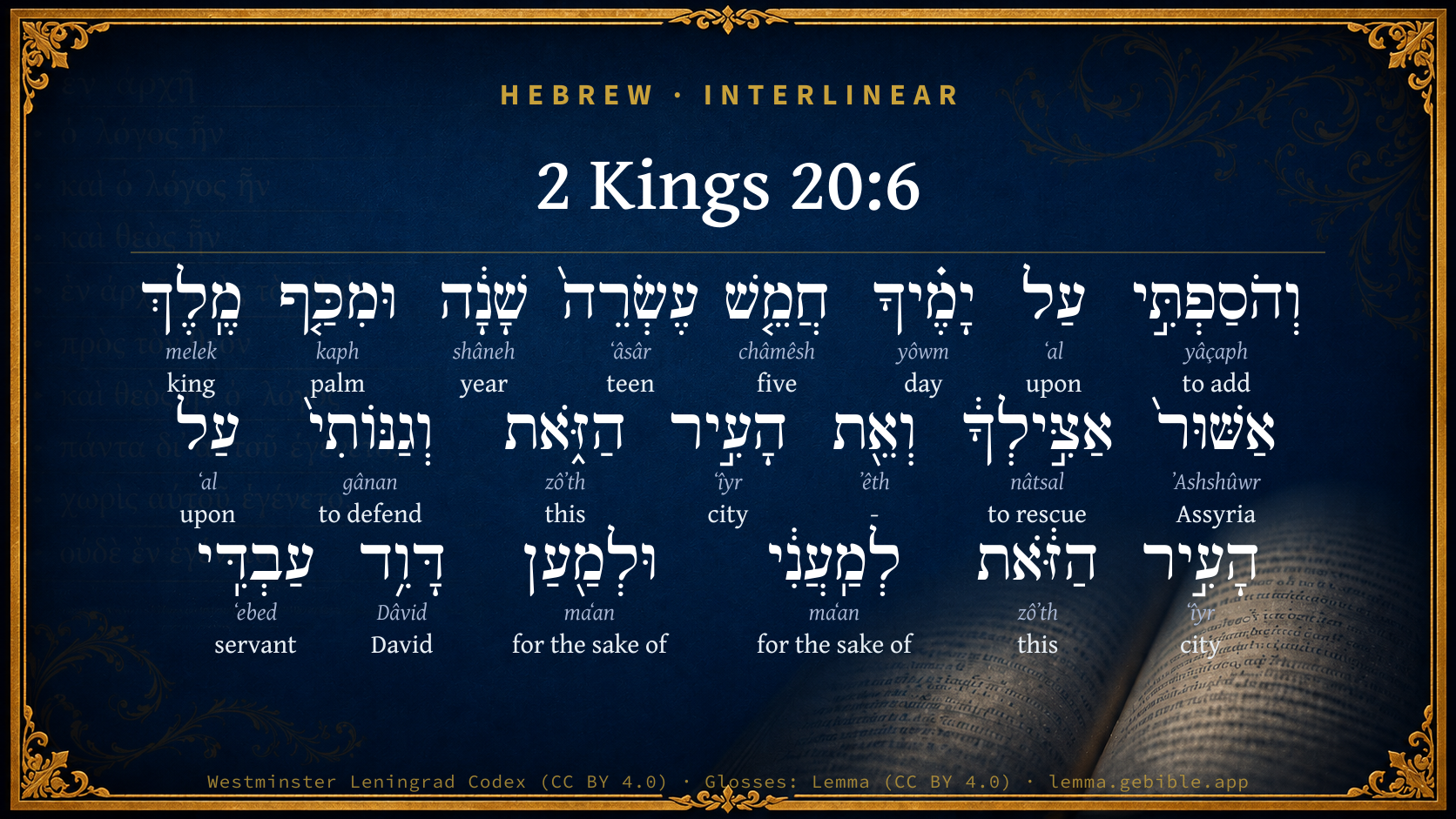
2 Kings 20:6

Hebrew (Westminster Leningrad Codex) 2 Kings 20:6 appears in the Hebrew Old Testament. The text above is from the Westminster Leningrad Codex. Each word links to its Strong’s number, a concise gloss, and parsing drawn from the Open Scriptures Hebrew Bible morphology. Click any word for its full Brown-Driver-Briggs (BDB) entry.
Download image
Cite this verse

2 Kings 20:6 (World English Bible). Public Domain. Lemma interlinear Bible study tool, https://lemma.gebible.app/v/2-kings/20/6.

Show BibTeX & RIS
BibTeX
RIS
English Translation
I will add to your days fifteen years; and I will deliver you and this city out of the hand of the king of Assyria; and I will defend this city for my own sake, and for my servant David's sake.
World English Bible · Public Domain
Download a study sheet

One document with this verse’s original text, its word-by-word gloss line, the meaning frame, cross-references with their text, attributed commentary, and full source and license credits — printable, and it pastes into notes with its structure intact.

This verse Autodidact and up

Study sheet (.html) Plain text (.txt)

A passage Seminary Student

Up to 50 verses in one chapter. A passage sheet keeps up to 6 commentary sources and 12 cross-references per verse, in the order this page ranks them, and says so on the sheet whenever that leaves anything out. Ask for a single verse and you get the Autodidact verse sheet above.

Everything on this page stays free to read, with no account — the sheet is a download of what is already on screen, not access to it.

Want to remove ads? Support Godless Engineer
Compare translations 3

The same verse in 3 English versions, stacked beneath the original-language interlinear above. Click any original word for its lexicon entry.

Each is an independent rendering of the whole verse — the interlinear is not word-aligned to these translations.

Highlighted words mark where these versions differ — a whole-verse word diff, not a word-by-word alignment.

  • World English Bible Public Domain
    I will add to your days fifteen years; and I will deliver you and this city out of the hand of the king of Assyria; and I will defend this city for my own sake, and for my servant David's sake.
  • King James Version Public Domain
    And I will add unto thy days fifteen years; and I will deliver thee and this city out of the hand of the king of Assyria; and I will defend this city for mine own sake, and for my servant David's sake.
  • unfoldingWord Literal Text CC BY-SA 4.0
    And I will add 15 years to your days, and I will deliver you and this city from the palm of the king of Assyria. And I will cover over this city for my sake and for the sake of David my servant.”’”

unfoldingWord Literal Text — © unfoldingWord, licensed CC BY-SA 4.0. Word-aligned USFM3 via Door43 (git.door43.org/unfoldingWord/en_ult).

Versions to compare (up to 4)

3 of 4 selected

Show all 18 translations

Every available English version of this verse, each an independent rendering of the whole verse.

  • World English Bible Public Domain
    I will add to your days fifteen years; and I will deliver you and this city out of the hand of the king of Assyria; and I will defend this city for my own sake, and for my servant David's sake.
  • Berean Standard Bible Public Domain
    I will add fifteen years to your life. And I will deliver you and this city from the hand of the king of Assyria. I will defend this city for My sake and for the sake of My servant David.’”
  • Majority Standard Bible Public Domain
    I will add fifteen years to your life. And I will deliver you and this city from the hand of the king of Assyria. I will defend this city for My sake and for the sake of My servant David.’”
  • King James Version Public Domain
    And I will add unto thy days fifteen years; and I will deliver thee and this city out of the hand of the king of Assyria; and I will defend this city for mine own sake, and for my servant David's sake.
  • American Standard Version (1901) Public Domain
    And I will add unto thy days fifteen years; and I will deliver thee and this city out of the hand of the king of Assyria; and I will defend this city for mine own sake, and for my servant David's sake.
  • Revised Version (1885) Public Domain
    And I will add unto thy days fifteen years; and I will deliver thee and this city out of the hand of the king of Assyria; and I will defend this city for mine own sake, and for my servant David’s sake.
  • Geneva Bible (1599) Public Domain
    And I wil adde vnto thy dayes fiftene yere, and wil deliuer thee and this citie out of the hand of the King of Asshur, and will defende this citie for mine owne sake, and for Dauid my seruats sake.
  • Douay-Rheims (1899) Public Domain
    And I will add to thy days fifteen years: and I will deliver thee and this city out of the hand of the king of the Assyrians, and I will protect this city for my own sake, and for David my servant's sake.
  • Young's Literal Translation Public Domain
    and I have added to thy days fifteen years, and out of the hand of the king of Asshur I deliver thee and this city, and have covered over this city for Mine own sake, and for the sake of David My servant.'
  • Literal Standard Version CC BY-SA 4.0
    and I have added fifteen years to your days, and I deliver you and this city out of the hand of the king of Asshur, and have covered over this city for My own sake, and for the sake of My servant David.”
  • Unlocked Literal Bible CC BY-SA 4.0
    I will add fifteen years to your life, and I will rescue you and this city from the hand of the king of Assyria, and I will defend this city for my own sake and for my servant David's sake.”'”
  • unfoldingWord Literal Text CC BY-SA 4.0
    And I will add 15 years to your days, and I will deliver you and this city from the palm of the king of Assyria. And I will cover over this city for my sake and for the sake of David my servant.”’”
  • Darby Bible Public Domain
    and I will add to thy days fifteen years; and I will deliver thee and this city out of the hand of the king of Assyria, and I will defend this city for mine own sake, and for my servant David's sake.
  • World Messianic Bible Public Domain
    I will add to your days fifteen years. I will deliver you and this city out of the hand of the king of Assyria. I will defend this city for my own sake, and for my servant David’s sake.”’”
  • Webster's Bible Public Domain
    And I will add to thy days fifteen years; and I will deliver thee and this city out of the hand of the king of Assyria; and I will defend this city for my own sake, and for my servant David's sake.
  • Free Bible Version CC BY-SA 4.0
    I will add fifteen years to your life. I will save you and this city from the king of Assyria. I will defend this city for my sake and for the sake of my servant David.”
  • Bible in Basic English Public Domain
    I will give you fifteen more years of life; and I will keep you and this town safe from the hands of the king of Assyria; I will keep this town safe, for my honour, and for the honour of my servant David.
  • JPS Tanakh (1917) Public Domain
    And I will add unto thy days fifteen years; and I will deliver thee and this city out of the hand of the king of Assyria; and I will defend this city for Mine own sake, and for My servant David's sake.'

Literal Standard Version (2020), Covenant Press — licensed CC BY-SA 4.0. Text via the HelloAO Bible API (eBible.org). Unlocked Literal Bible (unfoldingWord) — licensed CC BY-SA 4.0. Text via the HelloAO Bible API (eBible.org). unfoldingWord Literal Text — © unfoldingWord, licensed CC BY-SA 4.0. Word-aligned USFM3 via Door43 (git.door43.org/unfoldingWord/en_ult). Free Bible Version, Dr. Jonathan Gallagher — licensed CC BY-SA 4.0. Text via the HelloAO Bible API (eBible.org).

Word by word

More ways to search: Search by grammar → Find every occurrence → Compare this word →

Practice this passage: Drill this verse → Learn its vocabulary →

וְגַנּוֹתִי֙
gânan
H1598
“and · to defend”
Conjunction + Verb, Qal, Sequential Perfect, 1st Person, Common, Singular
Part of Speech
Conjunction + Verb
Stem
Qal
Form
Sequential Perfect
Person
1st Person
Gender
Common
Number
Singular
Full BDB Definition

Origin: a primitive root

TWOT: 367

to defend, cover, surround - (Qal) to defend - (Hiphil) to defend
  1. וְהֹסַפְתִּ֣י yâçaph H3254 “and · to add” Conjunction + Verb, Hiphil, Sequential Perfect, 1st Person, Common, Singular
  2. עַל ʻal H5921 “upon” Preposition
  3. יָמֶ֗יךָ yôwm H3117 “days · your” Noun, Common, Masculine, Plural, Construct + Suffix, Personal, 2nd Person, Masculine, Singular
  4. חֲמֵ֤שׁ châmêsh H2568 “five” Adjective, Cardinal number, Feminine, Singular, Absolute
  5. עֶשְׂרֵה֙ ʻâsâr H6240 “teen” Adjective, Cardinal number, Feminine, Singular, Absolute
  6. שָׁנָ֔ה shâneh H8141 “year” Noun, Common, Feminine, Singular, Absolute
  7. וּמִכַּ֤ף kaph H3709 “and · from · palm of” Conjunction + Preposition + Noun, Common, Feminine, Singular, Construct
  8. מֶֽלֶךְ melek H4428 “king of” Noun, Common, Masculine, Singular, Construct
  9. אַשּׁוּר֙ ʼAshshûwr H804 “Assyria” Noun, Proper
  10. אַצִּ֣ילְךָ֔ nâtsal H5337 “to rescue · you” Verb, Hiphil, Imperfect, 1st Person, Common, Singular + Suffix, Personal, 2nd Person, Masculine, Singular
  11. וְאֵ֖ת ʼêth H853 “and · -” Conjunction + Particle, Direct Object
  12. הָעִ֣יר ʻîyr H5892 “the · city” Particle, Definite Article + Noun, Common, Feminine, Singular, Absolute
  13. הַזֹּ֑את zôʼth H2063 “the · this” Particle, Definite Article + Pronoun, Demonstrative, Feminine, Singular
  14. עַל ʻal H5921 “upon” Preposition
  15. הָעִ֣יר ʻîyr H5892 “the · city” Particle, Definite Article + Noun, Common, Feminine, Singular, Absolute
  16. הַזֹּ֔את zôʼth H2063 “the · this” Particle, Definite Article + Pronoun, Demonstrative, Feminine, Singular
  17. לְמַֽעֲנִ֔י maʻan H4616 “for the sake of · me” Preposition + Suffix, Personal, 1st Person, Common, Singular
  18. וּלְמַ֖עַן maʻan H4616 “and · for the sake of” Conjunction + Preposition
  19. דָּוִ֥ד Dâvid H1732 “David” Noun, Proper
  20. עַבְדִּֽי ʻebed H5650 “servant · my” Noun, Common, Masculine, Singular, Construct + Suffix, Personal, 1st Person, Common, Singular

About this verse

These counts appear in no published source. They are computed here, from the morphology-tagged text and Lemma’s own curated glosses. What Lemma adds →

21
words
17
distinct lemmas
Historical
section

Notable vocabulary

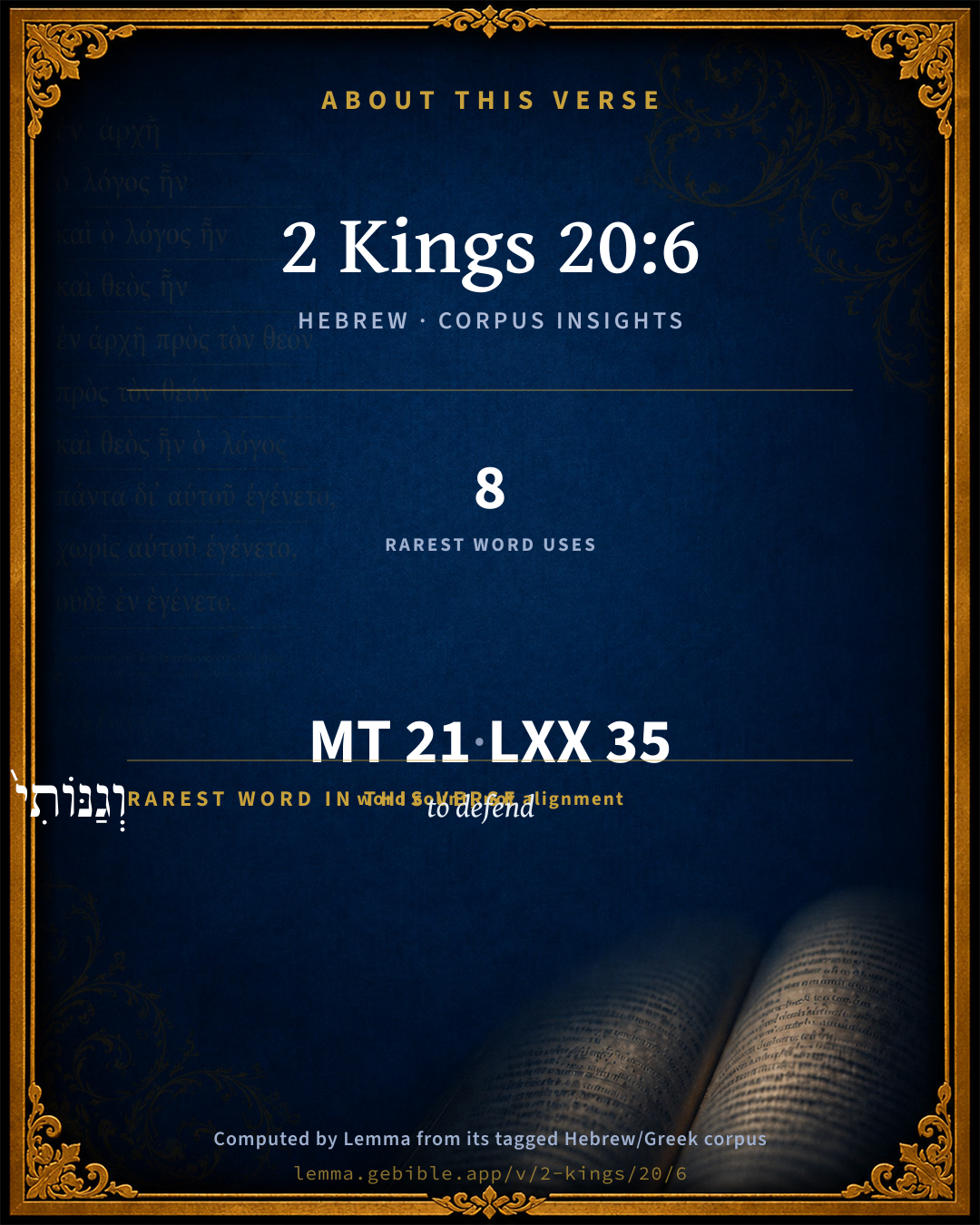
The rarest word here is וְגַנּוֹתִי֙ to defend H1598 — appearing just 8 times in the whole Hebrew Bible.

Shared distinctive vocabulary

וְגַנּוֹתִי֙ to defend H1598 occurs in 7 verses of the Hebrew Bible. Also found in:

Grammatical profile

  • 3 verbs
  • 9 nouns
  • 2 adjectives
  • 2 pronouns
  • 4 prepositions
  • 1 particle

Verb forms

  • וְהֹסַפְתִּ֣י Hiphil · Sequential Perfect
  • אַצִּ֣ילְךָ֔ Hiphil · Imperfect
  • וְגַנּוֹתִי֙ Qal · Sequential Perfect

Repetition

Words recur within this verse — often emphatic in Hebrew:

  • עַל upon H5921 ×2
  • הָעִ֣יר city H5892 ×2
  • לְמַֽעֲנִ֔י for the sake of H4616 ×2
  • הַזֹּ֑את this H2063 ×2

Hebrew & Septuagint length

In English translation the verse runs 41 words from the Hebrew and 43 from the Septuagint (LXX English) — closely comparable.

A rough comparison of the two English renderings, which tokenize alike — not a word-level alignment.

Word counts can differ between the Hebrew and the Greek without any difference in meaning — e.g. the Hebrew direct-object marker אֵת has no separate Greek word, and Greek often adds the article ὁ.

In the original languages it is 21 Hebrew tokens and 35 Greek tokens — but the two are counted differently (Hebrew bundles its prefixes and suffixes into one token; the Greek is in lemma form), so that isn’t a like-for-like length.

Cross-references

5

Topical passages linked to 2 Kings 20:6 in the Treasury of Scripture Knowledge — connected by theme and wording, ordered by reader-vote popularity; previews shown in the World English Bible.

  • 2 Kings 19:34 For I will defend this city to save it, for my own sake, and for my servant David's sake.
  • Isaiah 10:24 Therefore thus says the Lord, Yahweh of Hosts, my people who dwell in Zion, don't be afraid of the Assyrian, though he strike you with the rod, and lift up his staff against you, after the manner of Egypt.
  • Acts 27:24 saying, 'Don't be afraid, Paul. You must stand before Caesar. Behold, God has granted you all those who sail with you.'
  • 2 Chronicles 32:22 Thus Yahweh saved Hezekiah and the inhabitants of Jerusalem from the hand of Sennacherib the king of Assyria, and from the hand of all [others], and guided them on every side.
  • Psalms 116:15 Precious in the sight of Yahweh is the death of his saints.

Cross-references courtesy of OpenBible.info (CC BY 4.0).

Hebrew and Greek witnesses Masoretic Hebrew ↔ Greek Septuagint

The same verse in the two great witnesses to the Old Testament, shown verse-for-verse.

These are two independent witnesses, not word-aligned to each other, and the Septuagint is shown in lemma (dictionary) form.

Hebrew 2 Kings 20:6 Masoretic · Westminster Leningrad Codex

וְהֹסַפְתִּ֣י עַל יָמֶ֗יךָ חֲמֵ֤שׁ עֶשְׂרֵה֙ שָׁנָ֔ה וּמִכַּ֤ף מֶֽלֶךְ אַשּׁוּר֙ אַצִּ֣ילְךָ֔ וְאֵ֖ת הָעִ֣יר הַזֹּ֑את וְגַנּוֹתִי֙ עַל הָעִ֣יר הַזֹּ֔את לְמַֽעֲנִ֔י וּלְמַ֖עַן דָּוִ֥ד עַבְדִּֽי

I will add to your days fifteen years; and I will deliver you and this city out of the hand of the king of Assyria; and I will defend this city for my own sake, and for my servant David's sake.

World English Bible · Public Domain

Greek LXX 2 Kings 20:6 Septuagint · lemma form

καί προςτίθημι ἐπί ὁ ἡμέρα σύ πέντε καί δέκα ἔτος καί ἐκ χείρ βασιλεύς ἀσσύριος σώζω σύ καί ὁ πόλις οὗτος καί ὑπερἀσπίζω ὑπέρ ὁ πόλις οὗτος διά ἐγώ καί διά δαυίδ ὁ δοῦλος ἐγώ

And I will add to your days fifteen years; and I will deliver you and this city out of the hand of the king of the Assyrians, and I will defend this city for my own sake, and for my servant's David sake.

LXX2012 (modern English Septuagint) · Public Domain

Hebrew: Westminster Leningrad Codex (CC BY 4.0). Greek: Septuagint (public domain); English from LXX2012 (modern English Septuagint) (Public Domain). How the Septuagint differs from the Hebrew →

Targum (Aramaic paraphrase)

1

The Targum is the ancient Jewish Aramaic paraphrase of the Hebrew Scriptures — an interpretive translation, not the Hebrew text itself. Onkelos (literal) and Pseudo-Jonathan (expansive) render the Torah, and Jonathan the Prophets. Coverage is partial: where no permissively-licensed English translation exists for a verse, only the Aramaic is shown. This is verse-level text, not a word-by-word alignment to the Hebrew.

  1. Targum Jonathan Prophets (Joshua–Malachi)
    וְאוֹסִיף עַל יוֹמָךְ חֲמֵשׁ עַסְרֵי שְׁנִין וּמִיַד מַלְכָּא דְאַתּוּר אֲשֵׁיזְבִינָךְ וְיַת קַרְתָּא הָדָא וְאָגֵין עַל קַרְתָּא הָדָא בְּדִיל מֵימְרִי וּבְדִיל דָוִד עַבְדִי:

    (no public-domain English translation for this verse)

    Targum Jonathan — Aramaic: “Mikraot Gedolot” (public domain). English: “Sefaria Community Translation” (CC0 1.0 (public-domain dedication)); “London "Chaldee Paraphrase," 1871” (public domain). Text via Sefaria.

Commentary

Notes on 2 Kings 20:6 from classic Christian and Jewish commentators (each source and its license shown beneath its notes). The classic Christian expositions comment on the surrounding passage and are grouped to its opening verse, so a note may address several verses; the Jewish commentaries on the Tanakh (Rashi and others) are per-verse, so they appear only where the commentator wrote on this verse.

Lemma curates 59 commentaries, every one of them public domain or Creative Commons licensed, each selected and text-cleaned for this edition rather than reprinted as found. About our sources →

Trapp's Complete Commentary

John Trapp

2Ki 20:6 And I will add unto thy days fifteen years; and I will deliver thee and this city out of the hand of the king of Assyria; and I will defend this city for mine own sake, and for my servant David’s sake.

Ver. 6. And I will add unto thy days fifteen years.] Thus God’s grant to Hezekiah’s prayer was not more speedy than bountiful. We are wont to reckon seven years for the life of a man, and now, behold, more than two lives hath God added to the age of Hezekiah. This also he did for him, notwithstanding those flaws in his prayer, those distrustful I said’s, {Isa 38:10-11, &c.} and albeit he foresaw that Hezekiah would "not render again according to the benefit done unto him." {2Ch 32:25}

And I will deliver thee and this city.] Thus God is better to his people than their prayers; he doth for them "exceeding abundantly above all that they ask or think." {Eph 3:20} Piscator here hence concludeth that Hezekiah began to be sick presently after the promise made of sending away the Assyrian out of the land. {2Ki 19:32}

And for my servant David’s sake,] i.e., For my promise’s sake made to David. See on 2Ki 20:5.

John Trapp, A Commentary or Exposition upon All the Books of the Old and New Testament (1647–1656) — public domain. Text from a community e-Sword module.

Albert Barnes' Notes on the Bible

The king of Assyria in 714 and 713 B.C. was Sargon (B.C. 721-705). If then the Biblical and Assyrian chronologies which agree exactly in the year of the taking of Samaria (721 B.C.), are to be depended on, the king of Assyria here must have been Sargon. It may be conjectured that he had taken offence at something in the conduct of Hezekiah, and have threatened Jerusalem about this time (compare Isa 20:6). There is, however, no evidence of actual hostilities between Judaea and Assyria in Sargon’s reign.

Albert Barnes' Notes on the Bible (1834–1885) — public domain. Text from a community e-Sword/MySword module.

Joseph Benson's Commentary

2Ki 20:6. I will add to thy days fifteen years — Beyond what thou dost now expect, and beyond the time thou wouldst live if I left thee to the force of thy disease. We have not an instance of any other who was told beforehand just how long he should live. God has wisely kept us at uncertainties, that we may be always ready.

Joseph Benson's Commentary on the Old and New Testaments (1811–1818) — public domain. Text from a community e-Sword module.

Tyndale Open Study Notes

Tyndale Open Resources

20:6 When God added more years to Hezekiah’s life, he also promised to defend Jerusalem. When Hezekiah reacted to Sennacherib’s later invasion (19:14-19) by seeking counsel from Isaiah (19:2), he was following an established precedent. • for my own honor and for . . . David: God reminded Hezekiah of this promise during Sennacherib’s invasion (19:34).

Tyndale Open Study Notes — © Tyndale Open Resources, licensed CC BY-SA 4.0. Text via the HelloAO Bible API.

Adam Clarke's Commentary

Verse 6. I will add unto thy days fifteen years] This is the first and only man who was ever informed of the term of his life. And was this a privilege! Surely no. If Hezekiah was attached to life, as he appears to have been, how must his mind be affected to mark the sinking years! He knew he was to die at the end of fifteen years; and how must he feel at the end of every year, when he saw that so much was cut off from life? He must necessarily feel a thousand deaths in fearing one. I believe there would be nothing wanting to complete the misery of men, except the place of torment, were they informed of the precise time in which their lives must terminate. God, in his abundant mercy, has hidden this from their eyes.

Adam Clarke's Commentary on the Bible (1810–1826) — public domain. Text from a community e-Sword/MySword module.

Ellicott's Commentary for English Readers

(6) I will add unto thy days fifteen years.—In the Jewish reckoning fourteen years and a fraction of a year would count as fifteen years. With this very definite prediction comp. Isa_7:8; Isa_23:15; Jer_25:11-12.

And I will deliver thee . . .—So that the Assyrians had not yet retired from the West. For the rest of the verse see 2Ki_19:34.

A Bible Commentary for English Readers, edited by Charles John Ellicott (1878–1897) — public domain. Text from a community e-Sword module.

The Cambridge Bible for Schools and Colleges

gen. ed. J. J. S. Perowne

6. fifteen years] See above on verse 1.

I will deliver thee and this city out of the hand of the king of Assyria] Some stress has been laid on these words as though they necessarily implied that Jerusalem was still besieged. The preposition rendered ‘out of’ is literally ‘from’, and if that be borne in mind there is no reason why the words should not refer to the continued protection which Hezekiah and his city enjoyed afterwards when Sennacherib had been driven away.

for mine own sake, and for my servant David’s sake] These words, which occur before in 2Ki_19:34, are not found in Isaiah 38.

The Cambridge Bible for Schools and Colleges (gen. ed. J. J. S. Perowne; Cambridge University Press, 1878–1918) — public domain. Text from a community e-Sword module.

John Gill's Exposition

And Isaiah said, take a lump of figs,.... Not moist figs, but a cake of dried figs, as the word used signifies, and so the less likely to have any effect in curing the boil:

and they took, and laid it on the boil, and he recovered; made a plaster of it, and laid it on the ulcer, and it was healed. Physicians observe (u), that as such like inflammations consist in a painful extension of the fibres by the hinderance of the circulation of the blood, through the extreme little arteries, which may be mitigated, or dissipated, or ripened, by such things as are emollient and loosening, so consequently by figs; and, in a time of pestilence, figs beaten together with butter and treacle have been applied to plague of boils with great success; yet these figs being only a cake of dry figs, and, the boil not only malignant, but deadly, and the cure so suddenly performed, show that this was done not in a natural, but in a supernatural way, though means were directed to be made use of.

(u) Scheuchzer. Physic. Sacr. vol. 3. p. 620. Vid. Levin. Lemnii Herb. Bibl. Explicat. c. 19. p. 60.

John Gill's Exposition of the Whole Bible (1746–1763) — public domain (CC PDM 1.0). Text via the HelloAO Bible API.

Haydock's Catholic Bible Commentary

Assyrians. It is commonly supposed that this alludes to Sennacherib. But it might refer to his son, who was sending an army, Isaias xx. 1. We ought not to alter the scriptural order of the transactions, without cogent reasons.

George Leo Haydock (1774–1849), Haydock's Catholic Family Bible and Commentary, 1859 edition — public domain. Excludes Psalms (Douay-Rheims chapter numbering differs from Protestant) and Deuterocanonical books (Catholic canon only).

Matthew Poole's English Annotations

Fifteen years beyond what thou dost expect, and beyond what thou wouldst do if I should leave thee to the force of thy disease.

Out of the hand of the king of Assyria; this is added, either, first, Because he might otherwise fear the Assyrian’s return to this city, from which he was so shamefully repulsed. Or, secondly, Because this sickness happened before that great slaughter, 2Ki 19:35; of which See Poole "2Ki 20:1".

For mine own sake; to vindicate my glory against that insolent blasphemer.

Matthew Poole's English Annotations on the Holy Bible (1683–1685) — public domain. Text from a community e-Sword/MySword module.

Whedon's Commentary on the Bible

Daniel D. Whedon

6. I will add unto thy days fifteen years — A remarkable announcement, and of doubtful worth to Hezekiah. These additional years would not yet make him an old man, and most of them would be too apt to be spent in carnal security. And they produced an heir whose life and reign were a calamity to the kingdom.

Out of the hand of the king of Assyria — This clearly indicates that these events occurred at the time of the Assyrian invasion. See note on 2Ki_20:12.

Daniel D. Whedon (gen. ed.), Commentary on the Old and New Testaments (1874–1909) — public domain. Text from a community e-Sword module.

The Pulpit Commentary

And I win add unto thy days fifteen years. God "does exceeding abundantly more than we either ask or think". (Eph_3:20) Hezekiah had asked for nothing more than immediate escape from death. God grants him fifteen additional years of life, i.e. more than doubles the length of his reign. And I will deliver thee and this city out of the hand of the King of Assyria. If Hezekiah"s illness took place in B.C. 713, and Jerusalem was then in danger of being attacked by theAssyrians, the king who threatened the attack must have been Sargon. Sargon made an expedition into Palestine in B.C. 720, another in B.C. 713, and a third in B.C. 711. In none of them does he seem to have invaded Judaea; but in the third he counts the Jews among his enemies ("Eponym Canon," p. 130, line 32). Hezekiah, who had revolted from him, (2Ki_18:7) may well have felt alarm both in B.C. 713 and 711. And I will defend this city for mine own sake, and for my servant David"s sake (2Ki_19:34) The promise given in B.C. 713 in respect of Sargon was repeated in B.C. 699(?) with respect to Sennacherib in almost the same words.

The Pulpit Commentary (1880–1919), ed. H.D.M. Spence-Jones & Joseph S. Exell — public domain. Text from a community e-Sword module.

John Wesley's Explanatory Notes

Fifteen years - We have not an instance of any other, who was told before-hand just how long, he should live. God has wisely kept us at uncertainties, that we may be always ready.

John Wesley, Explanatory Notes Upon the Whole Bible (1754–1765) — public domain. Text via the GEBible commentary corpus.

unfoldingWord translationNotes

Door43 World Missions Community

General Information:

The message from Yahweh to King Hezekiah through the prophet Isaiah continues.

fifteen years

15 years (See: Numbers)

from the hand of the king of Assyria

"Hand" is metonymy for power, authority and control. AT: "from the control of the king of Assyria" (See: Metonymy)

lump of figs

"paste made of boiled figs"

They did so and put it on his boil

"Hezekiah's servants did this and put the paste on Hezekiah's sore"

translationWords

power

king

Assyria

servant

fig

unfoldingWord translationNotes — © Distant Shores Media and the Door43 World Missions Community, licensed CC BY-SA 4.0. Source: git.door43.org/Door43/en_tn.

Rashi

Rabbi Shlomo Yitzchaki (Rashi)

And I will save you from the hand of the king of Ashur. We learn that he became ill before Sancheiriv's downfall.

Rashi on the Tanakh — English translations: “The Judaica Press complete Tanach with Rashi, translated by A. J. Rosenberg” (CC BY 4.0); “Pentateuch with Rashi's commentary by M. Rosenbaum and A.M. Silbermann, 1929-1934” (public domain); “The Metsudah Tanach series, Lakewood, N.J” (CC BY 4.0); and “The Book of Joshua, Metsudah Publications, 1997” (CC BY 4.0). Text via Sefaria.

Lesson kit

Teaching starters — assembled from the data on this page, not authored interpretation. Every prompt links to the verse data it draws on. Edit before teaching.

2 Kings, in the Historical, opens this verse with 21 words (17 distinct Hebrew lemmas). Its most distinctive word is gânan (“to defend”). A historical commentator’s framing appears above. Read the whole chapter for the surrounding context.

Discussion questions

  1. How does “to defend” (gânan) shape what this verse is saying?
  2. 2 Kings 19:34 shares the word «to defend» with this verse. How do the two illuminate each other?
  3. “upon” occurs 2× in this one verse. What is the effect of the repetition?
  4. These translations render this verse differently. What is at stake in choosing one wording over another?
  5. The verb «וְהֹסַפְתִּ֣י» is Hiphil Sequential Perfect. How does its form color the action?
  6. Reading how Trapp's Complete Commentary and Albert Barnes' Notes on the Bible read this verse, where do the two commentators agree and where do they part?

Things to notice

Reading settings

Reading text

Shown beneath each verse's original-language words.

Old Testament
Old Testament edition

Read the OT as the Masoretic Hebrew (MT) or the Greek Septuagint (LXX).

English shown for the Greek Septuagint (in the Hebrew ↔ Greek comparison).

Comparing translations? Open the Compare panel on any verse page to stack up to four side by side.