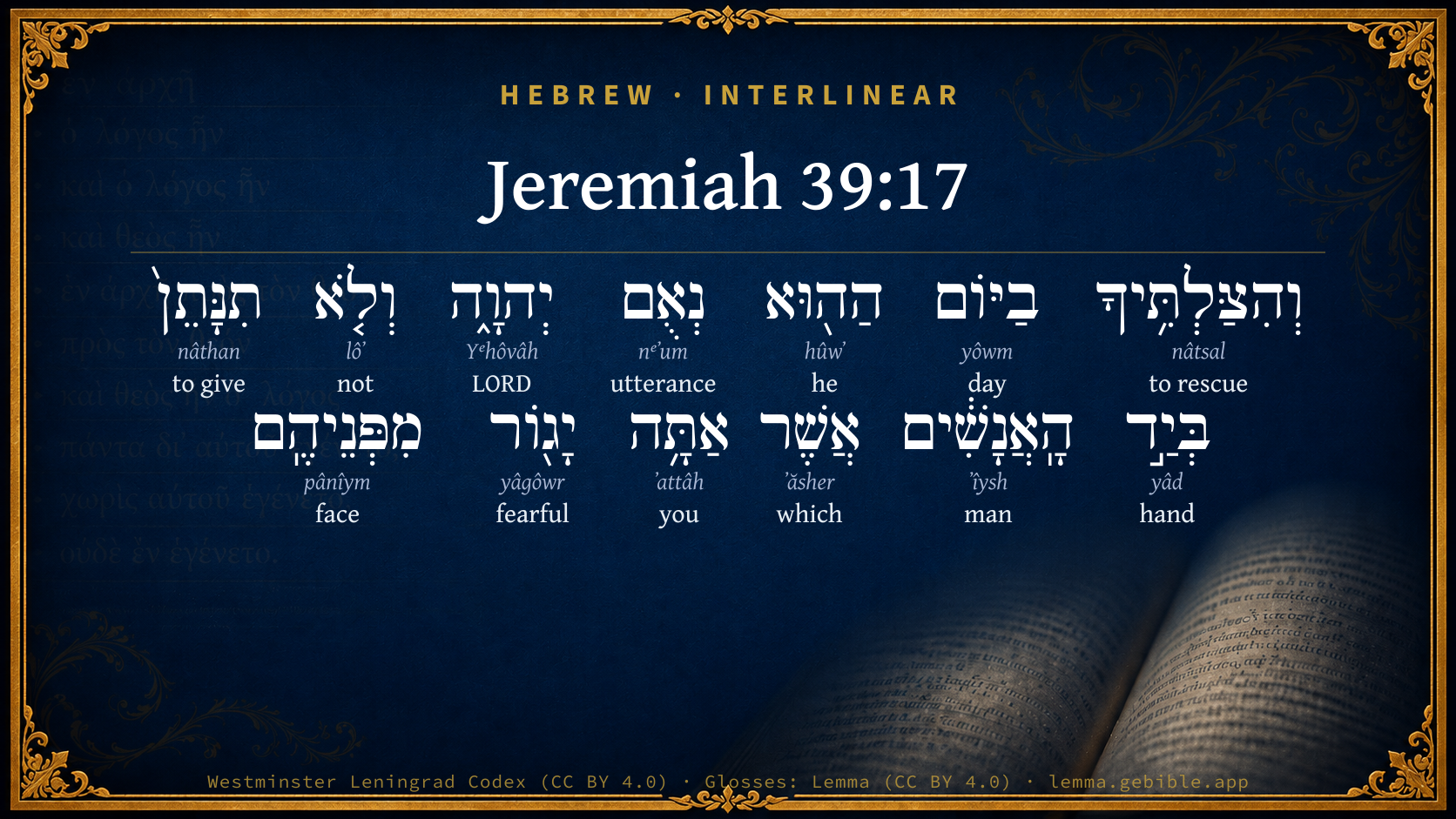
Jeremiah 39:17

Hebrew (Westminster Leningrad Codex) Jeremiah 39:17 appears in the Hebrew Old Testament. The text above is from the Westminster Leningrad Codex. Each word links to its Strong’s number, a concise gloss, and parsing drawn from the Open Scriptures Hebrew Bible morphology. Click any word for its full Brown-Driver-Briggs (BDB) entry.
Download image
Cite this verse

Jeremiah 39:17 (World English Bible). Public Domain. Lemma interlinear Bible study tool, https://lemma.gebible.app/v/jeremiah/39/17.

Show BibTeX & RIS
BibTeX
RIS
English Translation
But I will deliver you in that day, says Yahweh; and you shall not be given into the hand of the men of whom you are afraid.
World English Bible · Public Domain
Download a study sheet

One document with this verse’s original text, its word-by-word gloss line, the meaning frame, cross-references with their text, attributed commentary, and full source and license credits — printable, and it pastes into notes with its structure intact.

This verse Autodidact and up

Study sheet (.html) Plain text (.txt)

A passage Seminary Student

Up to 50 verses in one chapter. A passage sheet keeps up to 6 commentary sources and 12 cross-references per verse, in the order this page ranks them, and says so on the sheet whenever that leaves anything out. Ask for a single verse and you get the Autodidact verse sheet above.

Everything on this page stays free to read, with no account — the sheet is a download of what is already on screen, not access to it.

Want to remove ads? Support Godless Engineer
Compare translations 3

The same verse in 3 English versions, stacked beneath the original-language interlinear above. Click any original word for its lexicon entry.

Each is an independent rendering of the whole verse — the interlinear is not word-aligned to these translations.

Highlighted words mark where these versions differ — a whole-verse word diff, not a word-by-word alignment.

  • World English Bible Public Domain
    But I will deliver you in that day, says Yahweh; and you shall not be given into the hand of the men of whom you are afraid.
  • King James Version Public Domain
    But I will deliver thee in that day, saith the LORD: and thou shalt not be given into the hand of the men of whom thou art afraid.
  • unfoldingWord Literal Text CC BY-SA 4.0
    But I will rescue you on that day—this is Yahweh’s declaration—and you will not be given into the hand of the men whom you fear.

unfoldingWord Literal Text — © unfoldingWord, licensed CC BY-SA 4.0. Word-aligned USFM3 via Door43 (git.door43.org/unfoldingWord/en_ult).

Versions to compare (up to 4)

3 of 4 selected

Show all 18 translations

Every available English version of this verse, each an independent rendering of the whole verse.

  • World English Bible Public Domain
    But I will deliver you in that day, says Yahweh; and you shall not be given into the hand of the men of whom you are afraid.
  • Berean Standard Bible Public Domain
    But I will deliver you on that day, declares the LORD, and you will not be delivered into the hands of the men whom you fear.
  • Majority Standard Bible Public Domain
    But I will deliver you on that day, declares the LORD, and you will not be delivered into the hands of the men whom you fear.
  • King James Version Public Domain
    But I will deliver thee in that day, saith the LORD: and thou shalt not be given into the hand of the men of whom thou art afraid.
  • American Standard Version (1901) Public Domain
    But I will deliver thee in that day, saith Jehovah; and thou shalt not be given into the hand of the men of whom thou art afraid.
  • Revised Version (1885) Public Domain
    But I will deliver thee in that day, saith the LORD: and thou shalt not be given into the hand of the men of whom thou art afraid.
  • Geneva Bible (1599) Public Domain
    But I wil deliuer thee in that day, saith the Lord, and thou shalt not be giuen into the hand of the men whome thou fearest.
  • Douay-Rheims (1899) Public Domain
    And I will deliver thee in that day, saith the Lord: and thou shalt not be given into the hands of the men whom thou fearest:
  • Young's Literal Translation Public Domain
    And I have delivered thee in that day -- an affirmation of Jehovah -- and thou art not given into the hand of the men of whose face thou art afraid,
  • Literal Standard Version CC BY-SA 4.0
    And I have delivered you in that day—a declaration of YHWH—and you are not given into the hand of the men of whose face you are afraid,
  • Unlocked Literal Bible CC BY-SA 4.0
    But I will rescue you on that day—this is Yahweh's declaration—and you will not be given into the hand of the men whom you fear.
  • unfoldingWord Literal Text CC BY-SA 4.0
    But I will rescue you on that day—this is Yahweh’s declaration—and you will not be given into the hand of the men whom you fear.
  • Darby Bible Public Domain
    And I will deliver thee in that day, saith Jehovah; and thou shalt not be given into the hand of the men of whom thou art afraid;
  • World Messianic Bible Public Domain
    But I will deliver you in that day,” says the LORD; “and you will not be given into the hand of the men of whom you are afraid.
  • Webster's Bible Public Domain
    But I will deliver thee in that day, saith the LORD: and thou shalt not be given into the hand of the men of whom thou art afraid.
  • Free Bible Version CC BY-SA 4.0
    But when that day comes I'm going to save you, declares the Lord. You won't be handed over to the people you're afraid of.
  • Bible in Basic English Public Domain
    But I will keep you safe on that day, says the Lord: you will not be given into the hands of the men you are fearing.
  • JPS Tanakh (1917) Public Domain
    But I will deliver thee in that day, saith the LORD; and thou shalt not be given into the hand of the men of whom thou art afraid.

Literal Standard Version (2020), Covenant Press — licensed CC BY-SA 4.0. Text via the HelloAO Bible API (eBible.org). Unlocked Literal Bible (unfoldingWord) — licensed CC BY-SA 4.0. Text via the HelloAO Bible API (eBible.org). unfoldingWord Literal Text — © unfoldingWord, licensed CC BY-SA 4.0. Word-aligned USFM3 via Door43 (git.door43.org/unfoldingWord/en_ult). Free Bible Version, Dr. Jonathan Gallagher — licensed CC BY-SA 4.0. Text via the HelloAO Bible API (eBible.org).

Word by word

More ways to search: Search by grammar → Find every occurrence → Compare this word →

Practice this passage: Drill this verse → Learn its vocabulary →

יָג֖וֹר
yâgôwr
H3016
“fearful”
Adjective, Adjective, Masculine, Singular, Absolute
Part of Speech
Adjective
Type
Adjective
Gender
Masculine
Number
Singular
State
Absolute
Full BDB Definition

Origin: from H3025

TWOT: 843a

(Qal) fearful, fearing
  1. וְהִצַּלְתִּ֥יךָ nâtsal H5337 “and · to rescue · you” Conjunction + Verb, Hiphil, Sequential Perfect, 1st Person, Common, Singular + Suffix, Personal, 2nd Person, Masculine, Singular
  2. בַיּוֹם yôwm H3117 “in/at the · day” Preposition, Determined + Noun, Common, Masculine, Singular, Absolute
  3. הַה֖וּא hûwʼ H1931 “the · he” Particle, Definite Article + Pronoun, Personal, 3rd Person, Masculine, Singular
  4. נְאֻם nᵉʼum H5002 “utterance of” Noun, Common, Masculine, Singular, Construct
  5. יְהוָ֑ה Yᵉhôvâh H3068 “LORD” Noun, Proper
  6. וְלֹ֤א lôʼ H3808 “and · not” Conjunction + Particle, Negative
  7. תִנָּתֵן֙ nâthan H5414 “to give” Verb, Niphal, Imperfect, 2nd Person, Masculine, Singular
  8. בְּיַ֣ד yâd H3027 “in/at · hand of” Preposition + Noun, Common, Both, Singular, Construct
  9. הָֽאֲנָשִׁ֔ים ʼîysh H376 “the · men” Particle, Definite Article + Noun, Common, Masculine, Plural, Absolute
  10. אֲשֶׁר ʼăsher H834 “which” Particle, Relative
  11. אַתָּ֥ה ʼattâh H859 “you” Pronoun, Personal, 2nd Person, Masculine, Singular
  12. מִפְּנֵיהֶֽם pânîym H6440 “from · face(s) · their” Preposition + Noun, Common, Both, Plural, Construct + Suffix, Personal, 3rd Person, Masculine, Plural

About this verse

These counts appear in no published source. They are computed here, from the morphology-tagged text and Lemma’s own curated glosses. What Lemma adds →

13
words
13
distinct lemmas
Prophets
section

Notable vocabulary

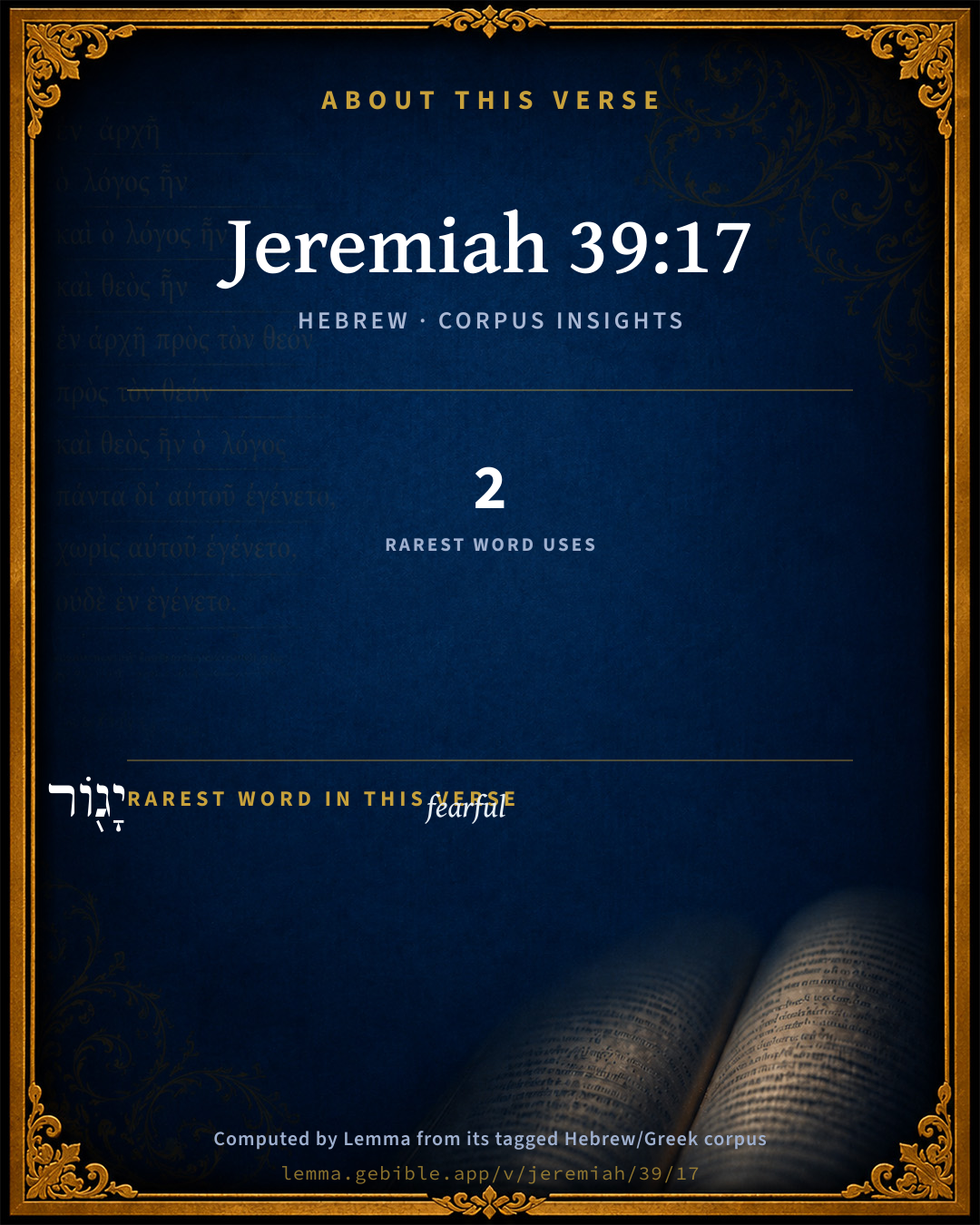
The rarest word here is יָג֖וֹר fearful H3016 — appearing just 2 times in the whole Hebrew Bible.

Shared distinctive vocabulary

יָג֖וֹר fearful H3016 occurs in 2 verses of the Hebrew Bible. Also found in:

Grammatical profile

  • 2 verbs
  • 6 nouns
  • 1 adjective
  • 2 pronouns
  • 2 particles

Verb forms

  • וְהִצַּלְתִּ֥יךָ Hiphil · Sequential Perfect
  • תִנָּתֵן֙ Niphal · Imperfect

Cross-references

13

Topical passages linked to Jeremiah 39:17 in the Treasury of Scripture Knowledge — connected by theme and wording, ordered by reader-vote popularity; previews shown in the World English Bible.

  • Psalms 41:1–2 Blessed is he who considers the poor: Yahweh will deliver him in the day of evil.
  • Psalms 50:15 Call on me in the day of trouble. I will deliver you, and you will honor me."
  • Psalms 91:14–15 "Because he has set his love on me, therefore I will deliver him. I will set him on high, because he has known my name.
  • 2 Samuel 24:14 David said to Gad, I am in a great strait: let us fall now into the hand of Yahweh; for his mercies are great; and let me not fall into the hand of man.
  • Jeremiah 1:19 They shall fight against you; but they shall not prevail against you: for I am with you, says Yahweh, to deliver you.
  • Genesis 15:1 After these things the word of Yahweh came to Abram in a vision, saying, "Don't be afraid, Abram. I am your shield, your exceedingly great reward."
  • Jeremiah 38:9 My lord the king, these men have done evil in all that they have done to Jeremiah the prophet, whom they have cast into the dungeon; and he is likely to die in the place where he is, because of the famine; for there is no more bread in the city.
  • Job 5:19–21 He will deliver you in six troubles; Yes, in seven there shall no evil touch you.
  • 2 Timothy 1:16–18 May the Lord grant mercy to the house of Onesiphorus, for he often refreshed me, and was not ashamed of my chain,
  • Jeremiah 38:1 Shephatiah the son of Mattan, and Gedaliah the son of Pashhur, and Jucal the son of Shelemiah, and Pashhur the son of Malchijah, heard the words that Jeremiah spoke to all the people, saying,
  • Daniel 6:16 Then the king commanded, and they brought Daniel, and cast him into the den of lions. [Now] the king spoke and said to Daniel, Your God whom you serve continually, he will deliver you.
  • Matthew 10:40–42 He who receives you receives me, and he who receives me receives him who sent me.
  • Matthew 25:40 "The King will answer them, 'Most assuredly I tell you, inasmuch as you did it to one of the least of these my brothers, you did it to me.'

Cross-references courtesy of OpenBible.info (CC BY 4.0).

Hebrew and Greek witnesses Masoretic Hebrew ↔ Greek Septuagint

The same verse in the two great witnesses to the Old Testament, shown verse-for-verse.

These are two independent witnesses, not word-aligned to each other, and the Septuagint is shown in lemma (dictionary) form.

Hebrew Jeremiah 39:17 Masoretic · Westminster Leningrad Codex

וְהִצַּלְתִּ֥יךָ בַיּוֹם הַה֖וּא נְאֻם יְהוָ֑ה וְלֹ֤א תִנָּתֵן֙ בְּיַ֣ד הָֽאֲנָשִׁ֔ים אֲשֶׁר אַתָּ֥ה יָג֖וֹר מִפְּנֵיהֶֽם

But I will deliver you in that day, says Yahweh; and you shall not be given into the hand of the men of whom you are afraid.

World English Bible · Public Domain

Greek LXX Structure differs

In the Septuagint, Jeremiah is about an eighth shorter than the Hebrew and arranges its material differently — the Oracles Against the Nations (Hebrew chapters 46–51) appear in the middle of the Greek book, after 25:13. Because the chapter and verse boundaries do not line up, a verse-for-verse comparison with the Hebrew is not shown.

A verse-for-verse comparison isn’t shown here because the chapters and verses don’t line up. Switch to the LXX edition with the MT / LXX toggle above to read the Greek directly.

Hebrew: Westminster Leningrad Codex (CC BY 4.0). Greek: Septuagint (public domain); English from a public-domain English Septuagint. How the Septuagint differs from the Hebrew →

Targum (Aramaic paraphrase)

1

The Targum is the ancient Jewish Aramaic paraphrase of the Hebrew Scriptures — an interpretive translation, not the Hebrew text itself. Onkelos (literal) and Pseudo-Jonathan (expansive) render the Torah, and Jonathan the Prophets. Coverage is partial: where no permissively-licensed English translation exists for a verse, only the Aramaic is shown. This is verse-level text, not a word-by-word alignment to the Hebrew.

  1. Targum Jonathan Prophets (Joshua–Malachi)
    וְאַשֵׁיזְבִינָךְ בְּיוֹמָא הַהוּא אֲמַר יְיָ וְלָא תִתְמְסַר בְּיַד גַבְרַיָא דְאַתְּ דָחֵיל מִן קֳדָמֵיהוֹן:

    (no public-domain English translation for this verse)

    Targum Jonathan — Aramaic: “Mikraot Gedolot” (public domain). English: “Sefaria Community Translation” (CC0 1.0 (public-domain dedication)); “London "Chaldee Paraphrase," 1871” (public domain). Text via Sefaria.

Commentary

Notes on Jeremiah 39:17 from classic Christian and Jewish commentators (each source and its license shown beneath its notes). The classic Christian expositions comment on the surrounding passage and are grouped to its opening verse, so a note may address several verses; the Jewish commentaries on the Tanakh (Rashi and others) are per-verse, so they appear only where the commentator wrote on this verse.

Lemma curates 59 commentaries, every one of them public domain or Creative Commons licensed, each selected and text-cleaned for this edition rather than reprinted as found. About our sources →

Trapp's Complete Commentary

John Trapp

Jer 39:17 But I will deliver thee in that day, saith the LORD: and thou shalt not be given into the hand of the men of whom thou [art] afraid.

Ver. 17. But I will deliver thee in that day.] From the sword, the famine, and the pestilence. "A thousand shall fall at thy side, and ten thousand at thy right hand, but it shall not come nigh thee; only with thine eyes shalt thou behold and see the reward of the wicked"; {Psa 91:7-8} and that the Lord is sure, though slow, tarditatem supplicii gravitate compensans. {a}

And thou shalt not be delivered into the hands of those men.] Zedekiah’s courtiers, who do bear thee an aching tooth for thy kindness to my prophet, and have vowed revenge.

{a} Val. Max.

John Trapp, A Commentary or Exposition upon All the Books of the Old and New Testament (1647–1656) — public domain. Text from a community e-Sword module.

Jamieson, Fausset & Brown

Robert Jamieson, A. R. Fausset & David Brown

the men of whom thou art afraid-- (Jer 38:1, Jer 38:4-6). The courtiers and princes hostile to thee for having delivered Jeremiah shall have no power to hurt. Heretofore intrepid, he was now afraid; this prophecy was therefore the more welcome to him.

Jamieson, Fausset & Brown — Commentary Critical and Explanatory on the Whole Bible (1871) — public domain (CC PDM 1.0). Text via the HelloAO Bible API.

John Calvin's Commentaries

He then adds, But I will deliver thee in that day, and thou shalt not be given up into the hand of the men whose face thou fearest Here God promises that Ebedmelech would be saved through a special privilege; and the Prophet shews that this prophecy had not been without reason announced. For though Ebedmelech had, with an intrepid mind, undertaken the cause of Jeremiah, and boldly and perseveringly fronted all reproaches, he yet was not divested of all the feelings of nature, but he had his fears, especially when he saw the cause of fear set before him. Hence the Prophet says, that he feared the face of enemies: and this might, at the same time, avail to rouse him to receive with more alacrity, the promise offered to him; for we know that the blessings of God are, in a manner, deemed of no value by us, when we do not know how necessary to us they are. The prophecies and the promises, by which God comforts us and animates us to patience, are for the most part viewed as of no worth, until God really shews to us how miserable we must be, except he thus succors us. Then the Prophet wished to remind Ebedmelech of this, when he said that he feared. Thou fearest, he says. For if Ebedmelech had no fear, he might have disregarded this prophecy as being superfluous. But being reminded of his fear and anxiety, he became more ready to receive what God promised to him.

John Calvin's Commentaries (1540-1563) — public domain. Text from the Calvin Translation Society English edition (1840s-50s) via the Christian Classics Ethereal Library (ccel.org). Calvin's coverage is partial (roughly two-thirds of the Bible); uncommented books and verses are honest gaps, never fabricated. The 19th-century editor's footnotes and remarks are omitted so the notes are faithfully Calvin's own voice.

The Cambridge Bible for Schools and Colleges

gen. ed. J. J. S. Perowne

17. the men of whom thou art afraid] meaning perhaps the princes, who were hostile to Jeremiah and so would punish Ebed-melech for helping him out of the dungeon, or, as Jer_39:18 suggests, the victorious army, in which case cp. Jer_22:25.

The Cambridge Bible for Schools and Colleges (gen. ed. J. J. S. Perowne; Cambridge University Press, 1878–1918) — public domain. Text from a community e-Sword module.

John Gill's Exposition

But I will deliver thee in that day, saith the Lord,.... As from the famine and pestilence, so from the sword of the Chaldeans, and from all the evil that shall come upon the city in the day of its destruction:

and thou shalt not be given into the hand of the man of whom thou art afraid; for though he was a bold and intrepid man, as appears by his charging the princes and prime ministers of state with having done evil to the prophet, and that in the presence of the king; yet at times he was not without his fears, which is the case of the best of men; and whereas he knew the courtiers owed him a grudge, for the freedom he took with their characters before the king, and for his friendship to Jeremiah, he might fear they would seek to do him a mischief, and contrive his ruin, in some way or another; but here he is assured he should not be given into their hands; or rather, as Jarchi, into the hands of the Chaldeans; for, as he believed in the Lord and his prophet, so he knew that all that was predicted would certainly come to pass; and that the city, with the king, his nobles, and the inhabitants of it, would fall into the hands of the Chaldeans; he might tremble at the righteous judgments of God, and fear that he himself would become a prey unto them; but here he is assured of the contrary.

John Gill's Exposition of the Whole Bible (1746–1763) — public domain (CC PDM 1.0). Text via the HelloAO Bible API.

Albert Barnes' Notes on the Bible

Of whom thou art afraid - The Chaldaeans. Ebed-melech apparently looked forward with much alarm to the b oodshed sure to take place at the storming of the city.

Albert Barnes' Notes on the Bible (1834–1885) — public domain. Text from a community e-Sword/MySword module.

Matthew Poole's English Annotations

But promiseth Ebed-melech he should be delivered in that evil day; and, whether he feared the Chaldeans, that he should lose his life by them when they should break up the city, or the princes, whom he had angered by complaining to the king of their hard usage of the prophet, he should come into none of their power.

Matthew Poole's English Annotations on the Holy Bible (1683–1685) — public domain. Text from a community e-Sword/MySword module.

Whedon's Commentary on the Bible

Daniel D. Whedon

17. The men of whom thou art afraid — The Chaldeans. But some think the courtiers and princes, against whom Ebed-melech had set himself in delivering Jeremiah.

Daniel D. Whedon (gen. ed.), Commentary on the Old and New Testaments (1874–1909) — public domain. Text from a community e-Sword module.

unfoldingWord translationNotes

Door43 World Missions Community

General Information:

Yahweh continues speaking to Jeremiah.

that day

This refers to the day the Babylonians break through the walls of Jerusalem to destroy the city.

this is Yahweh's declaration

Yahweh speaks of himself by name to express the certainty of what he is declaring. See how you translated this in Jeremiah 1:8. AT: "this is what Yahweh has declared" or "this is what I, Yahweh, have declared" (See: First, Second, or Third Person)

you will not be given into the hand of the men whom you fear

Here "hand" refers to power or control. This can be translated in active form. AT: "the men you fear will not harm you" or "I will not allow anyone to put you under the control of the people whom you fear" (See: Metonymy and Active or Passive)

You will not fall by the sword

The sword is a metonym for dying in war. AT: "No one will kill you with their sword" or "You will not die in war" (See: Euphemism and Metonymy)

with your life

"alive"

translationWords

declare

hand

sword

life

trust

unfoldingWord translationNotes — © Distant Shores Media and the Door43 World Missions Community, licensed CC BY-SA 4.0. Source: git.door43.org/Door43/en_tn.

Rashi

Rabbi Shlomo Yitzchaki (Rashi)

into the hand[s] of the men into the hand[s] of the Chaldeans.

Rashi on the Tanakh — English translations: “The Judaica Press complete Tanach with Rashi, translated by A. J. Rosenberg” (CC BY 4.0); “Pentateuch with Rashi's commentary by M. Rosenbaum and A.M. Silbermann, 1929-1934” (public domain); “The Metsudah Tanach series, Lakewood, N.J” (CC BY 4.0); and “The Book of Joshua, Metsudah Publications, 1997” (CC BY 4.0). Text via Sefaria.

Lesson kit

Teaching starters — assembled from the data on this page, not authored interpretation. Every prompt links to the verse data it draws on. Edit before teaching.

Jeremiah, in the Prophets, opens this verse with 13 words (13 distinct Hebrew lemmas). Its most distinctive word is yâgôwr (“fearful”). A historical commentator’s framing appears above. Read the whole chapter for the surrounding context.

Discussion questions

  1. The word yâgôwr carries the sense “fearful.” How does it shape the verse?
  2. How does Jeremiah 22:25, which shares the word «fearful», read alongside this verse?
  3. The translations on this page render this verse differently — a whole-verse word diff, not a word-by-word alignment. What might account for the different wordings?
  4. «וְהִצַּלְתִּ֥יךָ» is a Hiphil Sequential Perfect verb. How does that grammatical form shape the action described?
  5. Compare how Trapp's Complete Commentary and Jamieson, Fausset & Brown read this verse. Where do they agree or differ?

Things to notice

Reading settings

Reading text

Shown beneath each verse's original-language words.

Old Testament
Old Testament edition

Read the OT as the Masoretic Hebrew (MT) or the Greek Septuagint (LXX).

English shown for the Greek Septuagint (in the Hebrew ↔ Greek comparison).

Comparing translations? Open the Compare panel on any verse page to stack up to four side by side.