Proverbs 6:3

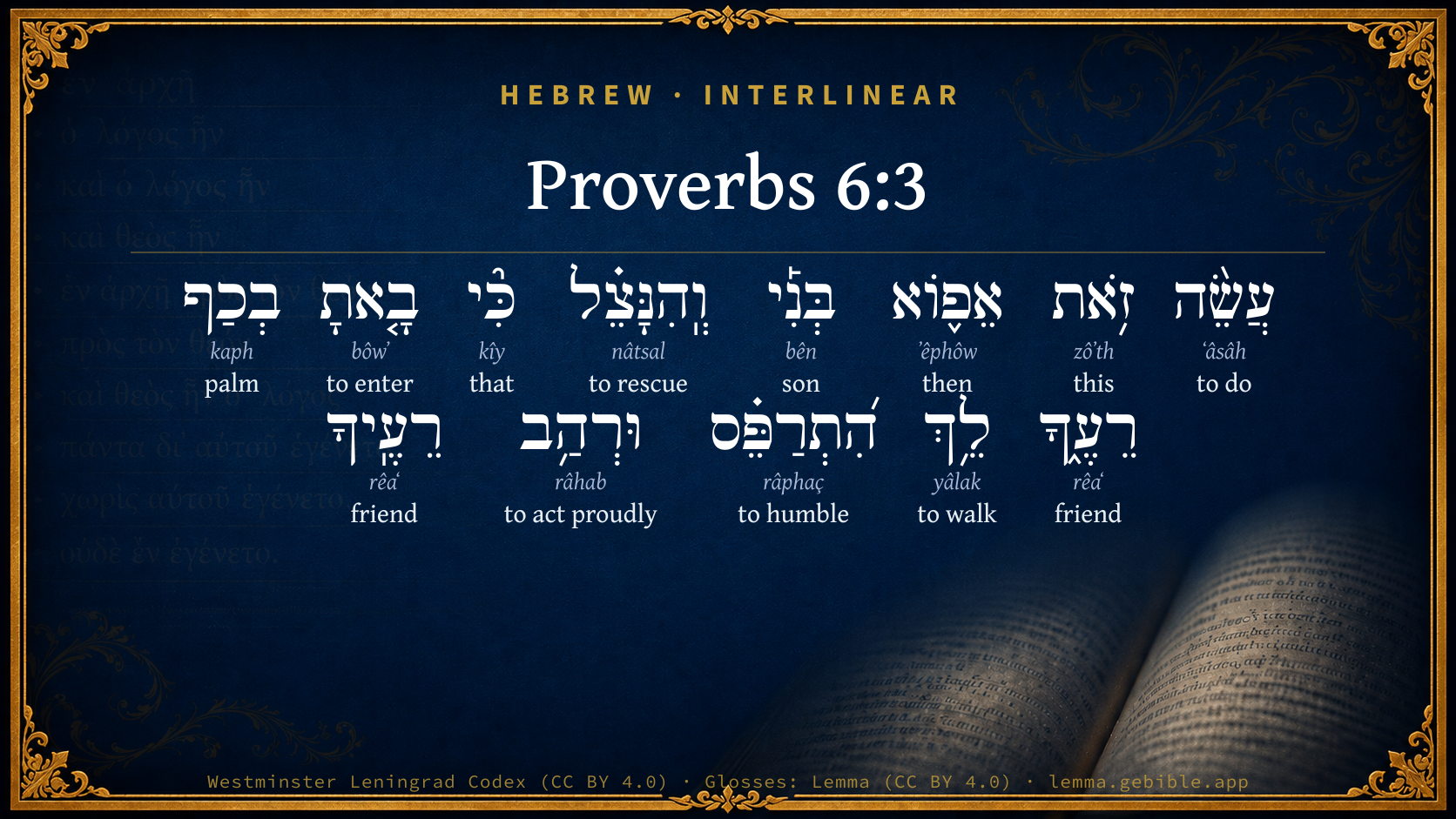
Hebrew (Westminster Leningrad Codex) Proverbs 6:3 appears in the Hebrew Old Testament. The text above is from the Westminster Leningrad Codex. Each word links to its Strong’s number, a concise gloss, and parsing drawn from the Open Scriptures Hebrew Bible morphology. Click any word for its full Brown-Driver-Briggs (BDB) entry.
Download image
Cite this verse

Proverbs 6:3 (World English Bible). Public Domain. Lemma interlinear Bible study tool, https://lemma.gebible.app/v/proverbs/6/3.

Show BibTeX & RIS
BibTeX
RIS
English Translation
Do this now, my son, and deliver yourself, Seeing you have come into the hand of your neighbor. Go, humble yourself. Press your plea with your neighbor.
World English Bible · Public Domain
Download a study sheet

One document with this verse’s original text, its word-by-word gloss line, the meaning frame, cross-references with their text, attributed commentary, and full source and license credits — printable, and it pastes into notes with its structure intact.

This verse Autodidact and up

Study sheet (.html) Plain text (.txt)

A passage Seminary Student

Up to 50 verses in one chapter. A passage sheet keeps up to 6 commentary sources and 12 cross-references per verse, in the order this page ranks them, and says so on the sheet whenever that leaves anything out. Ask for a single verse and you get the Autodidact verse sheet above.

Everything on this page stays free to read, with no account — the sheet is a download of what is already on screen, not access to it.

Want to remove ads? Support Godless Engineer
Compare translations 3

The same verse in 3 English versions, stacked beneath the original-language interlinear above. Click any original word for its lexicon entry.

Each is an independent rendering of the whole verse — the interlinear is not word-aligned to these translations.

Highlighted words mark where these versions differ — a whole-verse word diff, not a word-by-word alignment.

  • World English Bible Public Domain
    Do this now, my son, and deliver yourself, Seeing you have come into the hand of your neighbor. Go, humble yourself. Press your plea with your neighbor.
  • King James Version Public Domain
    Do this now, my son, and deliver thyself, when thou art come into the hand of thy friend; go, humble thyself, and make sure thy friend.
  • unfoldingWord Literal Text CC BY-SA 4.0
    then do this, my son, and rescue yourself: Since you have come into the palm of your neighbor, go, humble yourself, and press your neighbor.

unfoldingWord Literal Text — © unfoldingWord, licensed CC BY-SA 4.0. Word-aligned USFM3 via Door43 (git.door43.org/unfoldingWord/en_ult).

Versions to compare (up to 4)

3 of 4 selected

Show all 18 translations

Every available English version of this verse, each an independent rendering of the whole verse.

  • World English Bible Public Domain
    Do this now, my son, and deliver yourself, Seeing you have come into the hand of your neighbor. Go, humble yourself. Press your plea with your neighbor.
  • Berean Standard Bible Public Domain
    then do this, my son, to free yourself, for you have fallen into your neighbor’s hands: Go, humble yourself, and press your plea with your neighbor.
  • Majority Standard Bible Public Domain
    then do this, my son, to free yourself, for you have fallen into your neighbor’s hands: Go, humble yourself, and press your plea with your neighbor.
  • King James Version Public Domain
    Do this now, my son, and deliver thyself, when thou art come into the hand of thy friend; go, humble thyself, and make sure thy friend.
  • American Standard Version (1901) Public Domain
    Do this now, my son, and deliver thyself, Seeing thou art come into the hand of thy neighbor: Go, humble thyself, and importune thy neighbor;
  • Revised Version (1885) Public Domain
    Do this now, my son, and deliver thyself, seeing thou art come into the hand of thy neighbour; go, humble thyself, and importune thy neighbour.
  • Geneva Bible (1599) Public Domain
    Doe this nowe, my sonne, and deliuer thy selfe: seeing thou art come into the hande of thy neighbour, goe, and humble thy selfe, and sollicite thy friends.
  • Douay-Rheims (1899) Public Domain
    Do therefore, my son, what I say, and deliver thyself: because thou art fallen into the hand of thy neighbour. Run about, make haste, stir up thy friend:
  • Young's Literal Translation Public Domain
    Do this now, my son, and be delivered, For thou hast come into the hand of thy friend. Go, trample on thyself, and strengthen thy friend,
  • Literal Standard Version CC BY-SA 4.0
    Do this now, my son, and be delivered, || For you have come into the hand of your friend. Go, trample on yourself, and strengthen your friend,
  • Unlocked Literal Bible CC BY-SA 4.0
    When you are caught by your words, my son, do this and save yourself, since you have fallen into the hand of your neighbor; go and humble yourself and make your case before your neighbor.
  • unfoldingWord Literal Text CC BY-SA 4.0
    then do this, my son, and rescue yourself: Since you have come into the palm of your neighbor, go, humble yourself, and press your neighbor.
  • Darby Bible Public Domain
    Do this now, my son, and deliver thyself, since thou hast come into the hand of thy friend: go, humble thyself, and be urgent with thy friend.
  • World Messianic Bible Public Domain
    Do this now, my son, and deliver yourself, since you have come into the hand of your neighbor. Go, humble yourself. Press your plea with your neighbor.
  • Webster's Bible Public Domain
    Do this now, my son, and deliver thyself, when thou art come into the hand of thy friend; go, humble thyself, and make sure thy friend.
  • Free Bible Version CC BY-SA 4.0
    So this is what you have to do. You need to get out of it, because you've put yourself in that person's power. Go to your neighbor in all humility and ask him to release you from the commitment.
  • Bible in Basic English Public Domain
    Do this, my son, and make yourself free, because you have come into the power of your neighbour; go without waiting, and make a strong request to your neighbour.
  • JPS Tanakh (1917) Public Domain
    Do this now, my son, and deliver thyself, seeing thou art come into the hand of thy neighbour; go, humble thyself, and urge thy neighbour.

Literal Standard Version (2020), Covenant Press — licensed CC BY-SA 4.0. Text via the HelloAO Bible API (eBible.org). Unlocked Literal Bible (unfoldingWord) — licensed CC BY-SA 4.0. Text via the HelloAO Bible API (eBible.org). unfoldingWord Literal Text — © unfoldingWord, licensed CC BY-SA 4.0. Word-aligned USFM3 via Door43 (git.door43.org/unfoldingWord/en_ult). Free Bible Version, Dr. Jonathan Gallagher — licensed CC BY-SA 4.0. Text via the HelloAO Bible API (eBible.org).

Word by word

More ways to search: Search by grammar → Find every occurrence → Compare this word →

Practice this passage: Drill this verse → Learn its vocabulary →

הִ֝תְרַפֵּ֗ס
râphaç
H7511
“humble”
Verb, Hithpael, Imperative, 2nd Person, Masculine, Singular
Part of Speech
Verb
Stem
Hithpael
Form
Imperative
Person
2nd Person
Gender
Masculine
Number
Singular
Full BDB Definition

Origin: a primitive root

TWOT: 2199

(Hithpael) - to stamp oneself down, humble oneself - stamping or tramping down (participle)
  1. עֲשֵׂ֨ה ʻâsâh H6213 “do” Verb, Qal, Imperative, 2nd Person, Masculine, Singular
  2. זֹ֥את zôʼth H2063 “this” Pronoun, Demonstrative, Feminine, Singular
  3. אֵפ֪וֹא ʼêphôw H645 “then” Adverb
  4. בְּנִ֡י bên H1121 “son · my” Noun, Common, Masculine, Singular, Construct + Suffix, Personal, 1st Person, Common, Singular
  5. וְֽהִנָּצֵ֗ל nâtsal H5337 “and · rescue” Conjunction + Verb, Niphal, Imperative, 2nd Person, Masculine, Singular
  6. כִּ֘י kîy H3588 “that” Conjunction
  7. בָ֤אתָ bôwʼ H935 “to enter” Verb, Qal, Perfect, 2nd Person, Masculine, Singular
  8. בְכַף kaph H3709 “in/at · palm of” Preposition + Noun, Common, Feminine, Singular, Construct
  9. רֵעֶ֑ךָ rêaʻ H7453 “friend · your” Noun, Common, Masculine, Singular, Construct + Suffix, Personal, 2nd Person, Masculine, Singular
  10. לֵ֥ךְ yâlak H3212 “walk” Verb, Qal, Imperative, 2nd Person, Masculine, Singular
  11. וּרְהַ֥ב râhab H7292 “and · act proudly” Conjunction + Verb, Qal, Imperative, 2nd Person, Masculine, Singular
  12. רֵעֶֽיךָ rêaʻ H7453 “friends · your” Noun, Common, Masculine, Plural, Construct + Suffix, Personal, 2nd Person, Masculine, Singular

About this verse

These counts appear in no published source. They are computed here, from the morphology-tagged text and Lemma’s own curated glosses. What Lemma adds →

13
words
12
distinct lemmas
Wisdom
section

Notable vocabulary

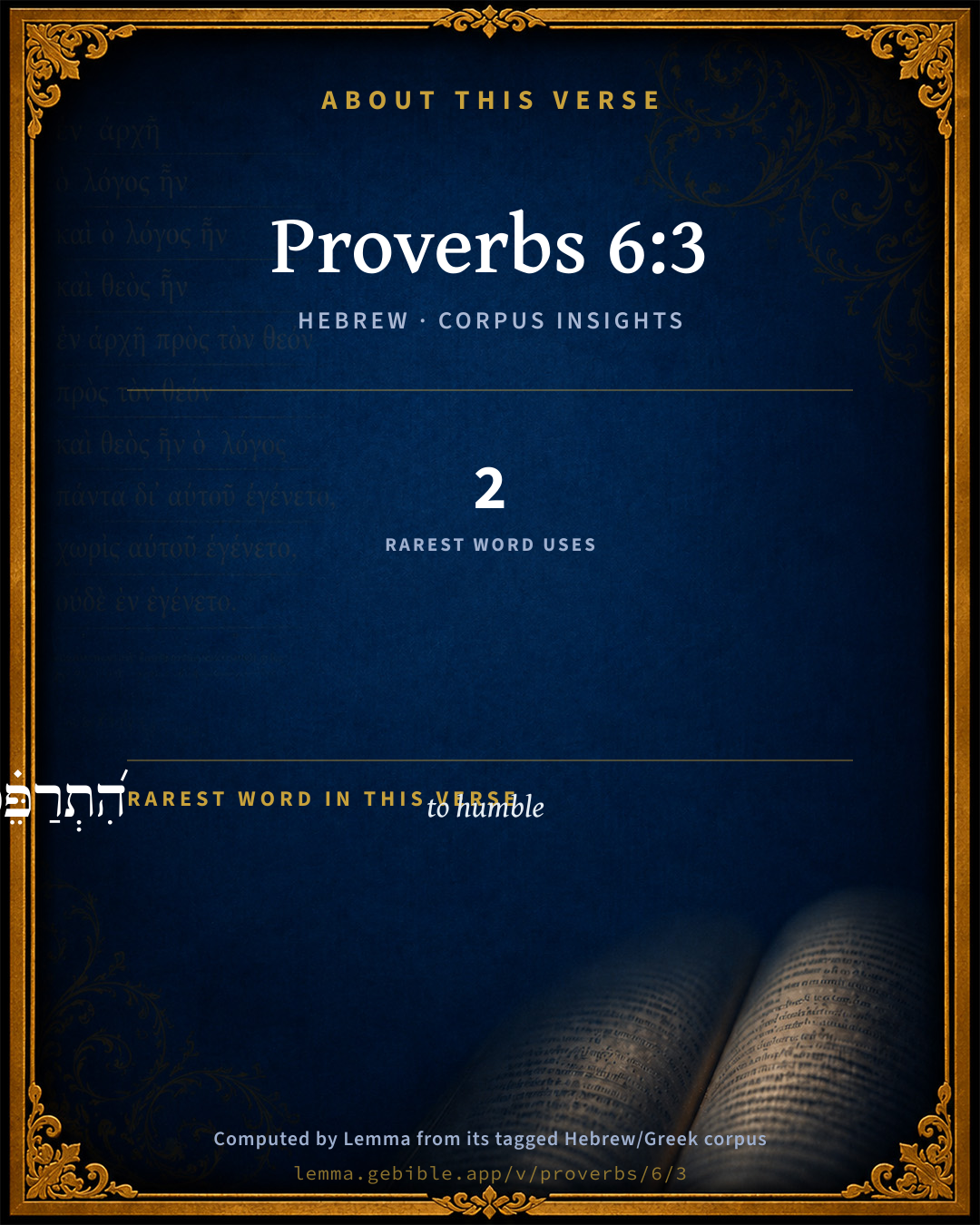
The rarest word here is הִ֝תְרַפֵּ֗ס to humble H7511 — appearing just 2 times in the whole Hebrew Bible.

Shared distinctive vocabulary

הִ֝תְרַפֵּ֗ס to humble H7511 occurs in 2 verses of the Hebrew Bible. Also found in:

Grammatical profile

  • 6 verbs
  • 4 nouns
  • 1 pronoun
  • 1 conjunction
  • 1 adverb

Verb forms

  • עֲשֵׂ֨ה Qal · Imperative
  • וְֽהִנָּצֵ֗ל Niphal · Imperative
  • בָ֤אתָ Qal · Perfect
  • לֵ֥ךְ Qal · Imperative
  • הִ֝תְרַפֵּ֗ס Hithpael · Imperative
  • וּרְהַ֥ב Qal · Imperative

Repetition

A word recurs within this verse — often emphatic in Hebrew:

  • רֵעֶ֑ךָ friend H7453 ×2

Hebrew & Septuagint length

In English translation the verse runs 27 words from the Hebrew and 38 from the Septuagint (LXX English) — the Septuagint runs noticeably longer here. See the side-by-side →

A rough comparison of the two English renderings, which tokenize alike — not a word-level alignment.

Word counts can differ between the Hebrew and the Greek without any difference in meaning — e.g. the Hebrew direct-object marker אֵת has no separate Greek word, and Greek often adds the article ὁ.

Cross-references

6

Topical passages linked to Proverbs 6:3 in the Treasury of Scripture Knowledge — connected by theme and wording, ordered by reader-vote popularity; previews shown in the World English Bible.

  • James 4:10 Humble yourselves in the sight of the Lord, and he will exalt you.
  • 2 Samuel 24:14 David said to Gad, I am in a great strait: let us fall now into the hand of Yahweh; for his mercies are great; and let me not fall into the hand of man.
  • Psalms 31:8 You have not shut me up into the hand of the enemy. You have set my feet in a large place.
  • Exodus 10:3 Moses and Aaron went in to Pharaoh, and said to him, "This is what Yahweh, the God of the Hebrews, says: 'How long will you refuse to humble yourself before me? Let my people go, that they may serve me.
  • 2 Chronicles 12:5 Now Shemaiah the prophet came to Rehoboam, and to the princes of Judah, who were gathered together to Jerusalem because of Shishak, and said to them, Thus says Yahweh, You have forsaken me, therefore have I also left you in the hand of Shishak.
  • 2 Chronicles 36:12 and he did that which was evil in the sight of Yahweh his God; he didn't humble himself before Jeremiah the prophet [speaking] from the mouth of Yahweh.

Cross-references courtesy of OpenBible.info (CC BY 4.0).

Hebrew and Greek witnesses Masoretic Hebrew ↔ Greek Septuagint

The same verse in the two great witnesses to the Old Testament, shown verse-for-verse.

Here the Septuagint runs noticeably longer than the Hebrew — LXX2012 (modern English Septuagint) 38 words vs World English Bible 27. A rough length comparison of the two English translations, not a word-level alignment — read both below.

These are two independent witnesses, not word-aligned to each other, and the Septuagint is shown in lemma (dictionary) form.

Hebrew Proverbs 6:3 Masoretic · Westminster Leningrad Codex

עֲשֵׂ֨ה זֹ֥את אֵפ֪וֹא בְּנִ֡י וְֽהִנָּצֵ֗ל כִּ֘י בָ֤אתָ בְכַף רֵעֶ֑ךָ לֵ֥ךְ הִ֝תְרַפֵּ֗ס וּרְהַ֥ב רֵעֶֽיךָ

Do this now, my son, and deliver yourself, Seeing you have come into the hand of your neighbor. Go, humble yourself. Press your plea with your neighbor.

World English Bible · Public Domain

Greek LXX Proverbs 6:3 Septuagint · lemma form

ποιέω υἱός ὅς ἐγώ σύ ἐντέλλομαι καί σώζω ἥκω γάρ εἰς χείρ κακός διά σός φίλος εἶμι μή ἐκλύω παραὀξύνω δέ καί ὁ φίλος σύ ὅς ἐνἐγγυάω

My son, do what I command you, and deliver yourself; for on your friend's account you are come into the power of evil men: faint not, but stir up even your friend for whom you are become surety.

LXX2012 (modern English Septuagint) · Public Domain

On this verse, The Cambridge Bible for Schools and Colleges discusses the Septuagint’s reading. Read the note in Commentary ↓

Hebrew: Westminster Leningrad Codex (CC BY 4.0). Greek: Septuagint (public domain); English from LXX2012 (modern English Septuagint) (Public Domain). How the Septuagint differs from the Hebrew →

Commentary

Notes on Proverbs 6:3 from classic Christian and Jewish commentators (each source and its license shown beneath its notes). The classic Christian expositions comment on the surrounding passage and are grouped to its opening verse, so a note may address several verses; the Jewish commentaries on the Tanakh (Rashi and others) are per-verse, so they appear only where the commentator wrote on this verse.

Lemma curates 59 commentaries, every one of them public domain or Creative Commons licensed, each selected and text-cleaned for this edition rather than reprinted as found. About our sources →

Trapp's Complete Commentary

John Trapp

Pro 6:3 Do this now, my son, and deliver thyself, when thou art come into the hand of thy friend; go, humble thyself, and make sure thy friend.

Ver. 3. When thou art come into the hand.] For "the borrower is servant to the lender," {Pro 22:7} and Facile ex amico inimicum facies cui promissa non reddes, saith Jerome. {a} A friend will soon become a foe, if unfriendly and unfaithfully dealt with. Not keeping time makes a jar in payments - and so in friendship too - as well as in music.

Go, humble thyself.] Crave favour and further time of the creditor. Say, Doubt not of your debt, only forbear a while. Cast thyserf at his feet, as to be trodden - so the Hebrew word here signifieth. {Eze 32:2; Eze 34:18} Stick not at any submission, so thou mayest gain time, and get off, and not be forced to run into the usurer’s books, that Amalek, or licking people, which, as cormorants, fall upon the borrowers, and, like cur dogs, suck your blood only with licking, and in the end kill you, and crush you, rob you, and ravish you. {Psa 10:8-10}

And make sure thy friend.] For whom thou standest engaged; call upon him to save thee harmless. For as Alphius, the usurer, sometimes said of his clients, Optima nomina non appellando mala fieri; { b} even good debtors will prove slack paymasters if they be let alone, if not now and then called upon. Some read the words thus: Multiply thy friends, or solicit them, viz., to intercede for thee to the creditor, and to keep thee out of this brake.

{a} Jerome, Ad Celantiam.

{b} Horat. Epod. Colum. de re rust, lib. i. cap. 7.

John Trapp, A Commentary or Exposition upon All the Books of the Old and New Testament (1647–1656) — public domain. Text from a community e-Sword module.

Joseph Benson's Commentary

Pro 6:3-5. Do this now, my son — Immediately follow the counsel which I now give thee, and deliver thyself — Use thy utmost endeavours to be discharged; when, or since, thou art come into the hand — That is, into the power; of thy friend — Of the debtor, for whom, as being thy friend, thou didst become surety, whereby thou art in his power, by his neglect or unfaithfulness, to expose thee to the payment of the debt. Go, humble thyself — Hebrew, התרפס, throw thyself down at his feet, or offer thyself to be trodden upon. As thou hast put thyself in his power, and made thyself his servant, bear the fruits of thy own folly, and humbly and earnestly implore him as readily to grant thy request as thou wast forward to comply with his, and forthwith to satisfy the debt, or give thee security against the creditor. Make sure of thy friend — Cease not to urge and importune him by thyself, and by thy friends, till thou hast prevailed with him. The Seventy translate this verse,” Do, my son, the things which I command thee, and deliver thyself: for thou art come into the hands of evil men upon thy friend’s account: go, therefore, be not careless or remiss, but earnest and importunate with thy friend to get thyself discharged.” Give not sleep to thine eyes, &c. — Namely, until thou hast taken care for the discharge of this obligation. Be not secure, nor negligent, nor dilatory in this matter. Deliver thyself as a roe, &c. — With all possible expedition, as a roe runs swiftly away.

Joseph Benson's Commentary on the Old and New Testaments (1811–1818) — public domain. Text from a community e-Sword module.

Tyndale Open Study Notes

Tyndale Open Resources

6:3-5 save yourself: The danger of ruin is so great that escaping the situation is almost a matter of life and death, as highlighted by the images of animals caught in a trap.

Tyndale Open Study Notes — © Tyndale Open Resources, licensed CC BY-SA 4.0. Text via the HelloAO Bible API.

Jamieson, Fausset & Brown

Robert Jamieson, A. R. Fausset & David Brown

come . . . friend--in his power.

humble . . . sure thy friend--urge as a suppliant; that is, induce the friend to provide otherwise for his debt, or secure the surety.

Jamieson, Fausset & Brown — Commentary Critical and Explanatory on the Whole Bible (1871) — public domain (CC PDM 1.0). Text via the HelloAO Bible API.

Adam Clarke's Commentary

Verse 3. Do this - deliver thyself] Continue to press him for whom thou art become surety, to pay his creditor; give him no rest till he do it, else thou mayest fully expect to be left to pay the debt.

Adam Clarke's Commentary on the Bible (1810–1826) — public domain. Text from a community e-Sword/MySword module.

Ellicott's Commentary for English Readers

(3) When thou art come . . .—Rather, for thou hast come under the power of thy friend; thou hast made thy freedom and property dependent on him for whom thou hast become surety.

Humble thyself.—Literally, let thyself be trampled on, humbly sue.

Make sure.—Rather, assail impetuously, importune.

A Bible Commentary for English Readers, edited by Charles John Ellicott (1878–1897) — public domain. Text from a community e-Sword module.

The Cambridge Bible for Schools and Colleges

gen. ed. J. J. S. Perowne

3. when] Rather, for, or, seeing that, R.V.

humble thyself] Lit. offer thyself to be trampled upon; prostrate thyself. Others render, stir thyself, R.V. marg.; ἴσθι μὴ ἐκλυόμενος, LXX., festina, Vulg.

make sure] Rather, be urgent upon, importune, R.V.; παρόξυνε, LXX.; suscita, Vulg.

The Cambridge Bible for Schools and Colleges (gen. ed. J. J. S. Perowne; Cambridge University Press, 1878–1918) — public domain. Text from a community e-Sword module.

John Gill's Exposition

Do this now, my son, and deliver thyself,.... Take the following advice, as the best that can be given in such circumstances, in order to be freed from such an obligation, or to be safe and easy under it;

when thou art come into the hand of thy friend; or,

"because or seeing thou art fallen into the hand of thy friend,''

as the Targum; or

"though thou art,'' &c.

as Aben Ezra; which may be understood either of the creditor to whom a man is bound, or of the debtor for whom he is bound, or of both; for a surety is in the hands or power of both: he is in the hands of the creditor, who may demand payment of the debt of him; and he is in the hands of the debtor, who, if a careless or crafty and deceitful man, may leave him to the payment of it. The Septuagint and Arabic versions are,

"for thou art come into the hands of evil men for thy friend;''

and the Syriac version,

"seeing for thy friend thou art fallen into the hands of thine enemy;''

and therefore must make the best of it thou canst, and in the following way:

go, humble thyself; that is, to the creditor, prostrate thyself before him; lie down upon the ground to be trodden on, as the word (d) signifies; fall down on thine knees, and entreat him to discharge thee from the bond, or give longer time for payment, if up; for thou art in his hands, and there is no carrying it with a high hand or a haughty spirit to him; humility, and not haughtiness, is most likely to be serviceable in such a case;

and make sure thy friend; for whom thou art become a surety, as the Syriac and Arabic versions add; solicit him, as the former of these versions render it; stimulate him, as the Septuagint; stir him up, urge him to pay off the debt quickly, and discharge the bond, or give thee security and indemnity from it. Or, "magnify thy friend" (e); that is, to the creditor; speak of him as a very able and responsible man, and as an honest and faithful one, that will pay in due time. Some render it "magnify", and speak well of the debtor to thy friend, which may please and appease him: or, "multiply thy friends" (f); get as many as thou canst to intercede for thee, and get thee discharged from the obligation by some means or another; to this purpose Jarchi.

(d) "praebe conculcandum te", Montanus, Vatablus, Michaelis. (e) "evehe proximum tuum", Tigurine version; "magnifica", so some in Vatablus. (f) "Multiplica amicos tuos", so some in Bayne.

John Gill's Exposition of the Whole Bible (1746–1763) — public domain (CC PDM 1.0). Text via the HelloAO Bible API.

Albert Barnes' Notes on the Bible

Better, “Do this now, O my son, and free thyself when thou hast come into thy friend’s house; go, how thyself down (perhaps “stamp with thy foot,” or “hasten”), press hotly upon thy friend. By persuasion, and if need be, by threats, get back the bond which thou hast been entrapped into signing:” The “friend” is, as before, the companion, not the creditor.

Albert Barnes' Notes on the Bible (1834–1885) — public domain. Text from a community e-Sword/MySword module.

Haydock's Catholic Bible Commentary

Make. Hebrew, "humble thyself, and made sure thy friend," (Protestant) entreating (Haydock) and forcing him to pay his debts. The Fathers apply this to pastors, who have undertaken to direct others. Their soul is at stake. (St. Gregory) (Calmet)

George Leo Haydock (1774–1849), Haydock's Catholic Family Bible and Commentary, 1859 edition — public domain. Excludes Psalms (Douay-Rheims chapter numbering differs from Protestant) and Deuterocanonical books (Catholic canon only).

Matthew Poole's English Annotations

Into the hand; into the power.

Of thy friend; either,

1. Of the creditor, who possibly may be also thy friend; yet take the following course with him, and much more if he be a stranger. Or,

2. Of the debtor, for whom, as being thy friend, thou didst become surety; whereby thou art not only in the creditor’s power to exact payment, but also in the debtor’s power, by his neglect or unfaithfulness, to expose thee to the payment of the debt. And this may seem best to agree both with Pro 6:1, where friend is taken in that sense, and is distinguished from the creditor, who is called a stranger, and with the words here following; for this humbling of himself was not likely to have much power with a stranger and a griping usurer; but it might probably prevail with his friend, either to take effectual care to pay the debt, or at least to discharge him from the obligation, or to secure him against it some other way.

Humble thyself, Heb. offer thyself to be trodden upon, or throw thyself down at his feet. As thou hast made thyself his servant, bear the fruits of thine own folly, and humbly and earnestly implore his patience and clemency.

And make sure thy friend; or, and prevail with thy friend; strive to win him by thine incessant and earnest solicitations. Or, honour or magnify thy friend, which is fitly and properly opposed to, and indeed is in some good measure done by, the humbling a man’s self before him.

Matthew Poole's English Annotations on the Holy Bible (1683–1685) — public domain. Text from a community e-Sword/MySword module.

Whedon's Commentary on the Bible

Daniel D. Whedon

3. Humble thyself — Or, bestir thyself, and beseech him for whom thou art surety to release thee, or give ample security against the risks encountered. This is supposed to be the general meaning of the passage. Like many other passages of the book, it is to be understood with the appropriate qualifications which common sense suggests. We cannot imagine that the wise man here instructs his pupil to never, in any case, become security for a friend. This may sometimes be an act of justice, of humanity, or of charity, and often involves little risk. With the above qualifications, the warning is one of prudence. A man can scarcely be too careful to avoid risks of this nature. Many a well-doing man and his family have thus been ruined. A wise man will not rashly put his name on another man’s paper; and a good and just man will not ask his friend to run a great risk to accommodate him. In all cases of any risk, the endorser or surety should be made acquainted with the true state of the case. It is dishonest for one man to accept the endorsement or joint liability of another while concealing from him the danger of the transaction.

Daniel D. Whedon (gen. ed.), Commentary on the Old and New Testaments (1874–1909) — public domain. Text from a community e-Sword module.

The Pulpit Commentary

In this verse advice is tendered as to what is to be done under the circumstances of this entanglement. The surety is to take immediate steps to be set free. The urgency of the advice is to be explained by the serious consequences which would follow in the event of the debtor not satisfying the creditor in due time. The surety became liable to the penalties inflicted by the Hebrew law of debt. His property could be distrained. His bed and his garment could be taken from him, (Pro_22:27 and Pro_20:16) and he was liable as well as his family to be reduced to the condition of servitude. So we find the son of Sirach saying, "Suretyship hath undone many of good estate, and shaken them as a wave of the sea: mighty men hath it driven from their houses, so that they wandered among strange nations". (Ecc 29:18; cf. 2Ki_4:1 Neh_5:3-5 Mat_18:25) Compare the dictum of Thales, the Greek philosopher, Eggua para d ata , "Give surety, and ruin is near;" and that of Chilo (Pliny, "Nat. Hist.," 6:32), "Sponsioni non deest jactura is not wanting to a surety." The same idea is conveyed in the modern German proverb, "Burgen soll man wurgen a surety" Do this now; or, therefore. The particle epho is intensive, and emphasizes the command, and in this sense is of frequent occurrence. (Job_17:15 Gen_27:32 Gen_43:11 2Ki_10:10, etc.) It appears to be equivalent to the Latin quod dico. So the Vulgate, "Do therefore what I say;" similarly the LXX renders, "Do, my son, what I bid thee (a egw soi entellomai )." It carries with it the sense of instant and prompt action.

And deliver thyself, when thou art come into the hand of thy friend; i.e. set thyself free when thou findest thou art actually at the mercy of thy friend for whom thou hast become surety. The ki (yKi) is not hypothetical, but actual; it is not "if" you are, but "when" or because you actually are in his power. The Vulgate and LXX render yKi respectively by quia and gar . Go, humble thyself; i.e. present thyself as a suppliant, prostrate thyself, offer thyself to be trodden upon (Michaelis), or humble thyself like to the threshold which is trampled and trode upon (Rashi). or humble thyself under the soles of his feet (Aben Ezra). The expression implies the spirit of entire submission, in which the surety is to approach his friend in order to be released from his responsibility. The Hebrew verb hith"rappes has, however, been rendered differently. Radically raphas signifies "to tread or trample with the feet," and this has been taken to express haste, or the bestirring of one"s self. So the Vulgate reads festina, "hasten;" and the LXX isyi mh ekluomenov , i.e. "be not remiss." But the hithp, clearly determines in favour of the reflexive rendering; comp. Psa_68:30, "Till every one submit himself with pieces of silver the only other passage where raphas occurs. And make sure thy friend (Hebrew, rhav reeyka); rather, importune thy friend, be urgent with him, press upon him to fulfil his engagement. The verb rahav is properly "to be fierce," "to rage," and hence with the accusative, as here, "to assail with impetuosity." In Isa_3:5 it is used with B (b), and signifies to act fiercely against any one. The meaning of the passage is that if abject submission or persuasion does not avail, then sterner measures are to be resorted to gain the desired end.

The Pulpit Commentary (1880–1919), ed. H.D.M. Spence-Jones & Joseph S. Exell — public domain. Text from a community e-Sword module.

John Wesley's Explanatory Notes

Hand - Into the power. Friend - Of the debtor, for whom, as being thy friend, thou didst become surety; whereby thou art in his power, by his neglect or unfaithfulness, to expose thee to the payment of the debt. Make sure - Or, and prevail with thy friend, strive to win him by thine incessant and earnest solicitations.

John Wesley, Explanatory Notes Upon the Whole Bible (1754–1765) — public domain. Text via the GEBible commentary corpus.

unfoldingWord translationNotes

Door43 World Missions Community

save yourself

"protect yourself" or "help yourself out of these problems"

you have fallen into the hand of your neighbor

This is a figure of speech using the term "hand" to mean "harm." AT: "your neighbor can bring harm to you if he wants to" or "your neighbor has power over you" (See: Idiom)

neighbor

"friend"

translationWords

neighbor

humble

beg

unfoldingWord translationNotes — © Distant Shores Media and the Door43 World Missions Community, licensed CC BY-SA 4.0. Source: git.door43.org/Door43/en_tn.

Rashi

Rabbi Shlomo Yitzchaki (Rashi)

go, humble yourself Heb. התרפס [a combination of two words, התר פס], open the palm of your hand for him to pay him his money.

and give your fellow superiority Heb. ורהב. And if he has no money with you, only that you were trapped with the sayings of your mouth by speaking harshly to him, bring many friends to him to beg him to forgive you.

Another explanation: [1] My son, if you stood surety for your Friend After you stood surety for the Holy One, blessed be He, Who is your “friend,” as it is written (Song 5:16): “This is my beloved and this is my friend”; you undertook at Sinai and in the plains of Moab with a curse and with an oath to observe His commandments.

have given your hand to a stranger You have repented and turned from His ways and clung to the disbelievers to go in their ways.

[2] you have been trapped by the sayings of your mouth You have given your hand to cling to strangers.

[3] Do this, then, my son, and be saved Since you have come into the palm of your Friend at Sinai and you have accepted His Godliness over you,

go, humble yourself Heb. התרפס. Humble yourself before Him like a threshold, which is trodden (נרפסת) and stepped on.

and increase your friends Bring many friends who will pray for you before Him. In this manner it is expounded on in Midrash Psalms.

Rashi on the Tanakh — English translations: “The Judaica Press complete Tanach with Rashi, translated by A. J. Rosenberg” (CC BY 4.0); “Pentateuch with Rashi's commentary by M. Rosenbaum and A.M. Silbermann, 1929-1934” (public domain); “The Metsudah Tanach series, Lakewood, N.J” (CC BY 4.0); and “The Book of Joshua, Metsudah Publications, 1997” (CC BY 4.0). Text via Sefaria.

Lesson kit

Teaching starters — assembled from the data on this page, not authored interpretation. Every prompt links to the verse data it draws on. Edit before teaching.

Proverbs, in the Wisdom, opens this verse with 13 words (12 distinct Hebrew lemmas). Its most distinctive word is râphaç (“to humble”). The Greek Septuagint runs longer here. A historical commentator’s framing appears above. Read the whole chapter for the surrounding context.

Discussion questions

  1. How does “to humble” (râphaç) shape what this verse is saying?
  2. Psalms 68:30 shares the word «to humble» with this verse. How do the two illuminate each other?
  3. “friend” occurs 2× in this one verse. What is the effect of the repetition?
  4. Compared with the Hebrew, the Septuagint runs longer here. What questions does that raise?
  5. These translations render this verse differently. What is at stake in choosing one wording over another?
  6. The verb «עֲשֵׂ֨ה» is Qal Imperative. How does its form color the action?
  7. Reading how Trapp's Complete Commentary and Joseph Benson's Commentary read this verse, where do the two commentators agree and where do they part?

Things to notice

Reading settings

Reading text

Shown beneath each verse's original-language words.

Old Testament
Old Testament edition

Read the OT as the Masoretic Hebrew (MT) or the Greek Septuagint (LXX).

English shown for the Greek Septuagint (in the Hebrew ↔ Greek comparison).

Comparing translations? Open the Compare panel on any verse page to stack up to four side by side.