Psalms 35:10

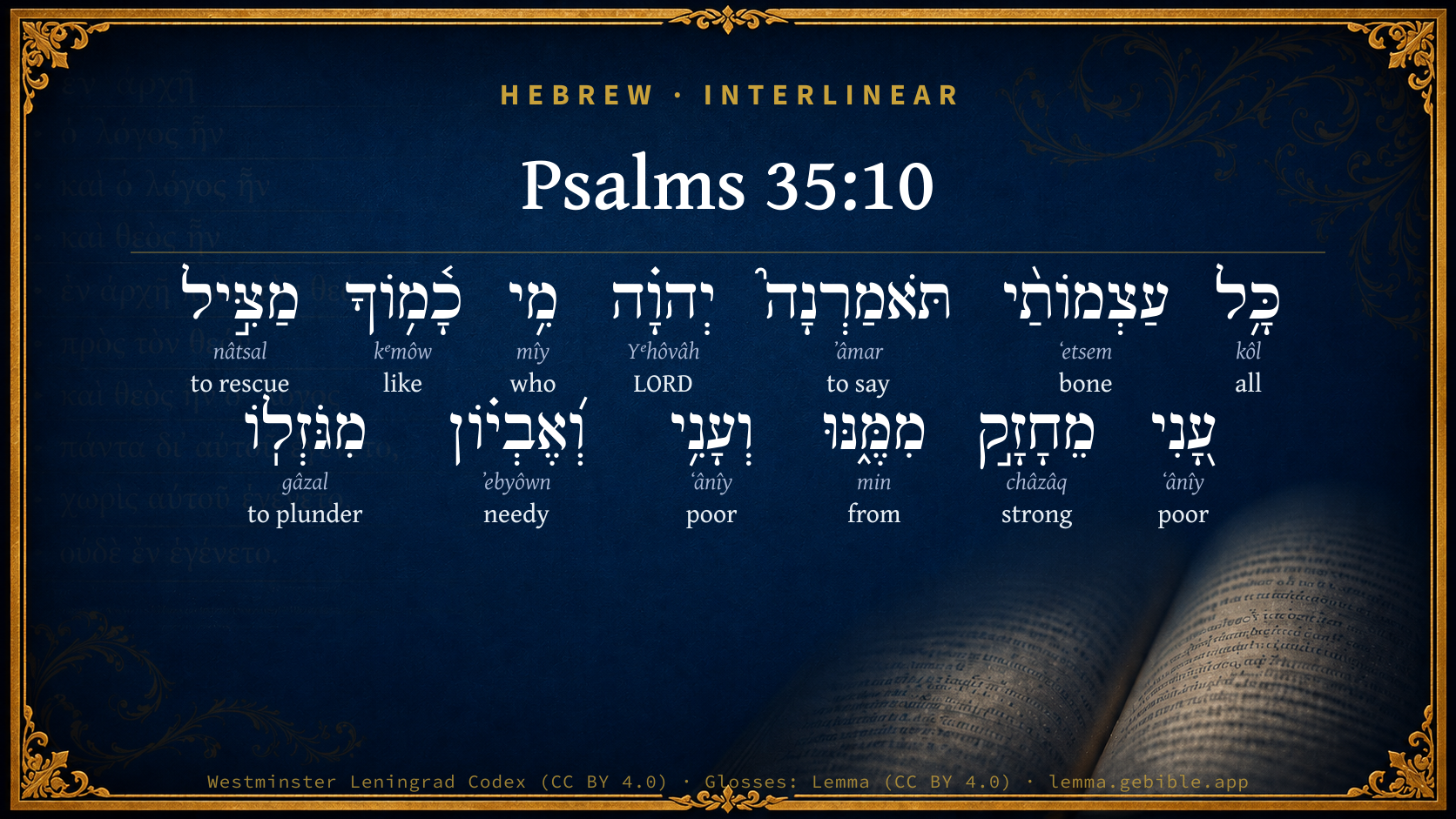
Hebrew (Westminster Leningrad Codex) Psalms 35:10 appears in the Hebrew Old Testament. The text above is from the Westminster Leningrad Codex. Each word links to its Strong’s number, a concise gloss, and parsing drawn from the Open Scriptures Hebrew Bible morphology. Click any word for its full Brown-Driver-Briggs (BDB) entry.
Download image
Cite this verse

Psalms 35:10 (World English Bible). Public Domain. Lemma interlinear Bible study tool, https://lemma.gebible.app/v/psalms/35/10.

Show BibTeX & RIS
BibTeX
RIS
English Translation
All my bones shall say, "Yahweh, who is like you, Who delivers the poor from him who is too strong for him, Yes, the poor and the needy from him who robs him?"
World English Bible · Public Domain
Download a study sheet

One document with this verse’s original text, its word-by-word gloss line, the meaning frame, cross-references with their text, attributed commentary, and full source and license credits — printable, and it pastes into notes with its structure intact.

This verse Autodidact and up

Study sheet (.html) Plain text (.txt)

A passage Seminary Student

Up to 50 verses in one chapter. A passage sheet keeps up to 6 commentary sources and 12 cross-references per verse, in the order this page ranks them, and says so on the sheet whenever that leaves anything out. Ask for a single verse and you get the Autodidact verse sheet above.

Everything on this page stays free to read, with no account — the sheet is a download of what is already on screen, not access to it.

Want to remove ads? Support Godless Engineer
Compare translations 3

The same verse in 3 English versions, stacked beneath the original-language interlinear above. Click any original word for its lexicon entry.

Each is an independent rendering of the whole verse — the interlinear is not word-aligned to these translations.

Highlighted words mark where these versions differ — a whole-verse word diff, not a word-by-word alignment.

  • World English Bible Public Domain
    All my bones shall say, "Yahweh, who is like you, Who delivers the poor from him who is too strong for him, Yes, the poor and the needy from him who robs him?"
  • King James Version Public Domain
    All my bones shall say, LORD, who is like unto thee, which deliverest the poor from him that is too strong for him, yea, the poor and the needy from him that spoileth him?
  • unfoldingWord Literal Text CC BY-SA 4.0
    All my bones will say, “Yahweh, who is like you, rescuing the oppressed from those stronger than them and the oppressed and needy from those robbing them?”

unfoldingWord Literal Text — © unfoldingWord, licensed CC BY-SA 4.0. Word-aligned USFM3 via Door43 (git.door43.org/unfoldingWord/en_ult).

Versions to compare (up to 4)

3 of 4 selected

Show all 18 translations

Every available English version of this verse, each an independent rendering of the whole verse.

  • World English Bible Public Domain
    All my bones shall say, "Yahweh, who is like you, Who delivers the poor from him who is too strong for him, Yes, the poor and the needy from him who robs him?"
  • Berean Standard Bible Public Domain
    All my bones will exclaim, “Who is like You, O LORD, who delivers the afflicted from the aggressor, the poor and needy from the robber?”
  • Majority Standard Bible Public Domain
    All my bones will exclaim, “Who is like You, O LORD, who delivers the afflicted from the aggressor, the poor and needy from the robber?”
  • King James Version Public Domain
    All my bones shall say, LORD, who is like unto thee, which deliverest the poor from him that is too strong for him, yea, the poor and the needy from him that spoileth him?
  • American Standard Version (1901) Public Domain
    All my bones shall say, Jehovah, who is like unto thee, Who deliverest the poor from him that is too strong for him, Yea, the poor and the needy from him that robbeth him?
  • Revised Version (1885) Public Domain
    All my bones shall say, LORD, who is like unto thee, which deliverest the poor from him that is too strong for him, yea, the poor and the needy from him that spoileth him?
  • Geneva Bible (1599) Public Domain
    All my bones shall say, Lord, who is like vnto thee, which deliuerest the poore from him, that is too strong for him! yea, the poore and him that is in miserie, from him that spoyleth him!
  • Douay-Rheims (1899) Public Domain
    All my bones shall say: Lord, who is like to thee? Who deliverest the poor from the hand of them that are stronger than he; the needy and the poor from them that strip him.
  • Young's Literal Translation Public Domain
    All my bones say, `Jehovah, who is like Thee, Delivering the poor from the stronger than he, And the poor and needy from his plunderer.'
  • Literal Standard Version CC BY-SA 4.0
    All my bones say, “YHWH, who is like You, || Delivering the poor from the [one] stronger than he, || And the poor and needy from his plunderer.”
  • Unlocked Literal Bible CC BY-SA 4.0
    All my bones will say, “Yahweh, who is like you, who rescues the oppressed from those who are too strong for them and the poor and needy from those who try to rob them?”
  • unfoldingWord Literal Text CC BY-SA 4.0
    All my bones will say, “Yahweh, who is like you, rescuing the oppressed from those stronger than them and the oppressed and needy from those robbing them?”
  • Darby Bible Public Domain
    All my bones shall say, Jehovah, who is like unto thee, who deliverest the afflicted from one stronger than he, yea, the afflicted and the needy from him that spoileth him!
  • World Messianic Bible Public Domain
    All my bones shall say, “LORD, who is like you, who delivers the poor from him who is too strong for him; yes, the poor and the needy from him who robs him?”
  • Webster's Bible Public Domain
    All my bones shall say, LORD, who is like thee, who deliverest the poor from him that is too strong for him, even the poor and the needy from him that spoileth him?
  • Free Bible Version CC BY-SA 4.0
    Every part of me will say, Who can compare to you, Lord? You rescue the weak from the strong; the poor and needy from robbers.
  • Bible in Basic English Public Domain
    All my bones will say, Lord, who is like you? The saviour of the poor man from the hands of the strong, of him who is poor and in need from him who takes his goods.
  • JPS Tanakh (1917) Public Domain
    All my bones shall say: 'LORD, who is like unto Thee, who deliverest the poor from him that is too strong for him, yea, the poor and the needy from him that spoileth him?'

Literal Standard Version (2020), Covenant Press — licensed CC BY-SA 4.0. Text via the HelloAO Bible API (eBible.org). Unlocked Literal Bible (unfoldingWord) — licensed CC BY-SA 4.0. Text via the HelloAO Bible API (eBible.org). unfoldingWord Literal Text — © unfoldingWord, licensed CC BY-SA 4.0. Word-aligned USFM3 via Door43 (git.door43.org/unfoldingWord/en_ult). Free Bible Version, Dr. Jonathan Gallagher — licensed CC BY-SA 4.0. Text via the HelloAO Bible API (eBible.org).

Word by word

More ways to search: Search by grammar → Find every occurrence → Compare this word →

Practice this passage: Drill this verse → Learn its vocabulary →

מִגֹּזְלֽוֹ
gâzal
H1497
“from · plundering · him”
Preposition + Verb, Qal, Participle Active, Masculine, Singular, Construct + Suffix, Personal, 3rd Person, Masculine, Singular
Part of Speech
Preposition + Verb
Stem
Qal
Form
Participle Active
Gender
Masculine
Number
Singular
State
Construct
Full BDB Definition

Origin: a primitive root

TWOT: 337

to tear away, seize, plunder, tear off, pull off, rob, take away by force - (Qal) - to tear away, rob - to seize, plunder (with acc cognate) - (Niphal) - to be robbed - to be taken away
  1. כָּ֥ל kôl H3605 “all of” Noun, Common, Masculine, Singular, Construct
  2. עַצְמוֹתַ֨י ʻetsem H6106 “bones · my” Noun, Common, Feminine, Plural, Construct + Suffix, Personal, 1st Person, Common, Singular
  3. תֹּאמַרְנָה֮ ʼâmar H559 “to say” Verb, Qal, Imperfect, 3rd Person, Feminine, Plural
  4. יְהוָ֗ה Yᵉhôvâh H3068 “LORD” Noun, Proper
  5. מִ֥י mîy H4310 “who” Particle, Interrogative
  6. כָ֫מ֥וֹךָ kᵉmôw H3644 “like · you” Preposition + Suffix, Personal, 2nd Person, Masculine, Singular
  7. מַצִּ֣יל nâtsal H5337 “rescuing” Verb, Hiphil, Participle Active, Masculine, Singular, Absolute
  8. עָ֭נִי ʻânîy H6041 “poor” Adjective, Adjective, Masculine, Singular, Absolute
  9. מֵחָזָ֣ק châzâq H2389 “from · strong” Preposition + Adjective, Adjective, Masculine, Singular, Absolute
  10. מִמֶּ֑נּוּ min H4480 “from · us” Preposition + Suffix, Personal, 1st Person, Common, Plural
  11. וְעָנִ֥י ʻânîy H6041 “and · poor” Conjunction + Adjective, Adjective, Masculine, Singular, Absolute
  12. וְ֝אֶבְי֗וֹן ʼebyôwn H34 “and · needy” Conjunction + Adjective, Adjective, Masculine, Singular, Absolute

About this verse

These counts appear in no published source. They are computed here, from the morphology-tagged text and Lemma’s own curated glosses. What Lemma adds →

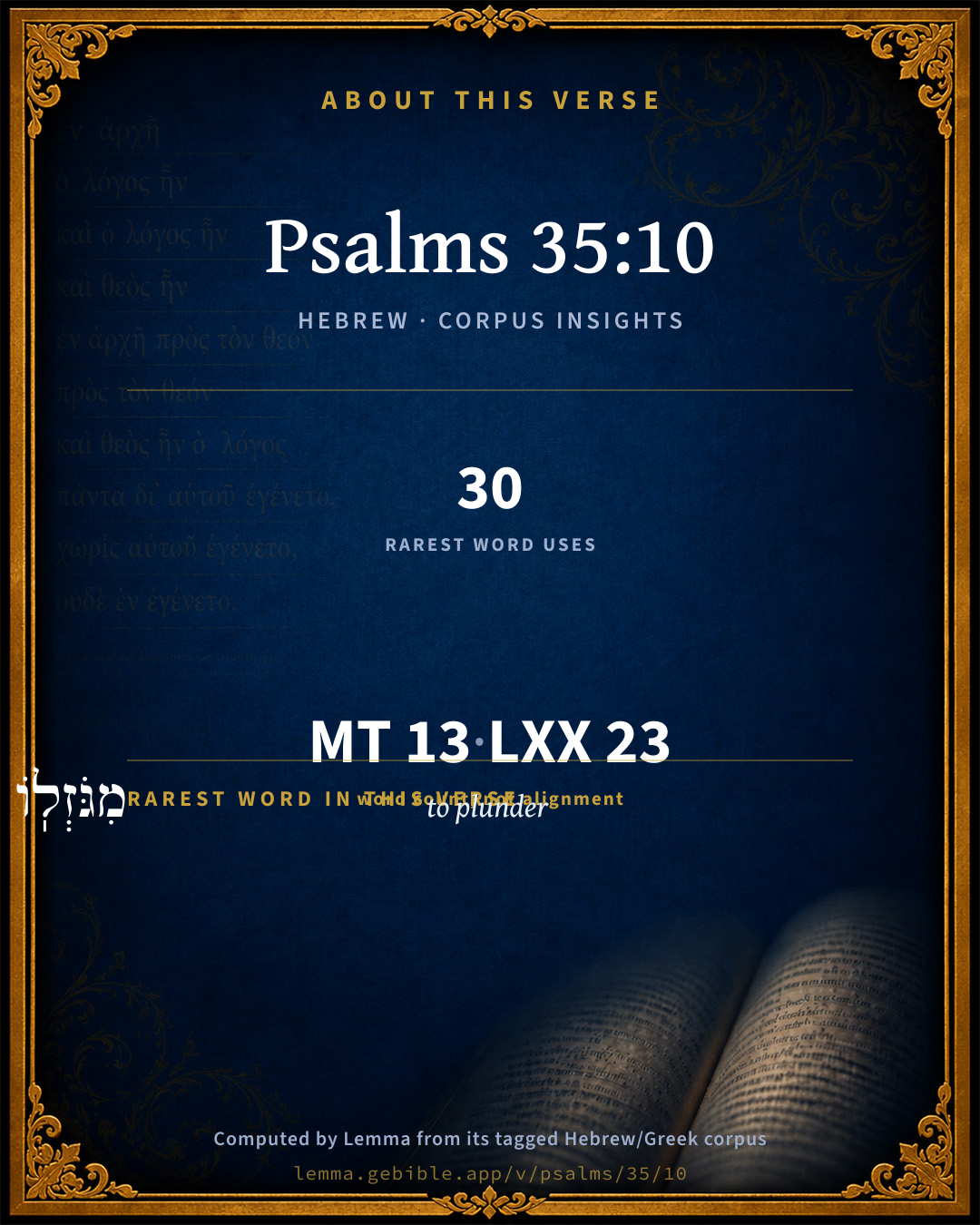
13
words
12
distinct lemmas
Wisdom
section

Shared distinctive vocabulary

מִגֹּזְלֽוֹ to plunder H1497 occurs in 30 verses of the Hebrew Bible. Also found in:

Grammatical profile

  • 3 verbs
  • 3 nouns
  • 4 adjectives
  • 2 prepositions
  • 1 particle

Verb forms

  • תֹּאמַרְנָה֮ Qal · Imperfect
  • מַצִּ֣יל Hiphil · Participle Active
  • מִגֹּזְלֽוֹ Qal · Participle Active

Repetition

A word recurs within this verse — often emphatic in Hebrew:

  • עָ֭נִי poor H6041 ×2

Hebrew & Septuagint length

In English translation the verse runs 33 words from the Hebrew and 37 from the Septuagint (LXX English) — closely comparable.

A rough comparison of the two English renderings, which tokenize alike — not a word-level alignment.

Word counts can differ between the Hebrew and the Greek without any difference in meaning — e.g. the Hebrew direct-object marker אֵת has no separate Greek word, and Greek often adds the article ὁ.

In the original languages it is 13 Hebrew tokens and 23 Greek tokens — but the two are counted differently (Hebrew bundles its prefixes and suffixes into one token; the Greek is in lemma form), so that isn’t a like-for-like length.

Cross-references

25

Topical passages linked to Psalms 35:10 in the Treasury of Scripture Knowledge — connected by theme and wording, ordered by reader-vote popularity; previews shown in the World English Bible.

  • Exodus 15:11 Who is like you, Yahweh, among the gods? Who is like you, glorious in holiness, Fearful in praises, doing wonders?
  • Psalms 109:31 For he will stand at the right hand of the needy, To save him from those who judge his soul.
  • Psalms 140:12 I know that Yahweh will maintain the cause of the afflicted, And justice for the needy.
  • Psalms 51:8 Let me hear joy and gladness, That the bones which you have broken may rejoice.
  • Psalms 71:19 Your righteousness also, God, reaches to the heavens; You have done great things. God, who is like you?
  • Psalms 86:8 There is no one like you among the gods, Lord, Nor any deeds like your deeds.
  • Psalms 18:17 He delivered me from my strong enemy, From those who hated me; for they were too mighty for me.
  • Psalms 10:14 But you do see trouble and grief; You consider it to take it into your hand. You help the victim and the fatherless.
  • Psalms 22:14 I am poured out like water. All my bones are out of joint. My heart is like wax; It is melted within me.
  • Psalms 32:3 When I kept silence, my bones wasted away through my groaning all day long.
  • Psalms 34:20 He protects all of his bones. Not one of them is broken.
  • Psalms 38:3 There is no soundness in my flesh because of your indignation, Neither is there any health in my bones because of my sin.
  • Job 5:15–16 But he saves from the sword of their mouth, Even the needy from the hand of the mighty.
  • Job 33:19–25 He is chastened also with pain on his bed, With continual strife in his bones;
  • Psalms 22:24 For he has not despised nor abhorred the affliction of the afflicted, Neither has he hidden his face from him; But when he cried to him, he heard.
  • Psalms 34:6 This poor man cried, and Yahweh heard him, And saved him out of all his troubles.
  • Psalms 37:14 The wicked have drawn out the sword, and have bent their bow, To cast down the poor and needy, To kill those who are upright in the way.
  • Psalms 69:33 For Yahweh hears the needy, And doesn't despise his captive people.
  • Psalms 89:6–8 For who in the skies can be compared to Yahweh? Who among the sons of the heavenly beings is like Yahweh,
  • Psalms 102:3 For my days consume away like smoke. My bones are burned as a firebrand.
  • Proverbs 22:22–23 Don't exploit the poor, because he is poor; And don't crush the needy in court;
  • Isaiah 40:18 To whom then will you liken God? or what likeness will you compare to him?
  • Isaiah 40:25 To whom then will you liken me, that I should be equal [to him]? says the Holy One.
  • Psalms 102:17–20 He has responded to the prayer of the destitute, And has not despised their prayer.
  • Jeremiah 10:7 Who should not fear you, King of the nations? for to you does it appertain; because among all the wise men of the nations, and in all their royal estate, there is none like you.

Cross-references courtesy of OpenBible.info (CC BY 4.0).

Hebrew and Greek witnesses Masoretic Hebrew ↔ Greek Septuagint

The same verse in the two great witnesses to the Old Testament, shown verse-for-verse.

You’re reading Greek Psalm 34 (Hebrew Psalm 35). The Septuagint counts the superscription, so verse numbers can differ from the Hebrew — chapter-level alignment, not verse-by-verse. Numbering follows Rahlfs.

These are two independent witnesses, not word-aligned to each other, and the Septuagint is shown in lemma (dictionary) form.

Hebrew Psalms 35:10 Masoretic · Westminster Leningrad Codex

כָּ֥ל עַצְמוֹתַ֨י תֹּאמַרְנָה֮ יְהוָ֗ה מִ֥י כָ֫מ֥וֹךָ מַצִּ֣יל עָ֭נִי מֵחָזָ֣ק מִמֶּ֑נּוּ וְעָנִ֥י וְ֝אֶבְי֗וֹן מִגֹּזְלֽוֹ

All my bones shall say, "Yahweh, who is like you, Who delivers the poor from him who is too strong for him, Yes, the poor and the needy from him who robs him?"

World English Bible · Public Domain

Greek LXX Greek Psalm 34:10 Septuagint · lemma form

πᾶς ὁ ὀστέον ἐγώ εἶπον κύριος τίς ὅμοιος σύ ῥύομαι πτωχός ἐκ χείρ στερεός αὐτός καί πτωχός καί πένης ἀπό ὁ διαἁρπάζω αὐτός

All my bones shall say, O Lord, who is like to you? delivering the poor out of the hand of them that are stronger than he, yes, the poor and needy one from them that spoil him.

LXX2012 (modern English Septuagint) · Public Domain

Hebrew: Westminster Leningrad Codex (CC BY 4.0). Greek: Septuagint (public domain); English from LXX2012 (modern English Septuagint) (Public Domain). How the Septuagint differs from the Hebrew →

Commentary

Notes on Psalms 35:10 from classic Christian and Jewish commentators (each source and its license shown beneath its notes). The classic Christian expositions comment on the surrounding passage and are grouped to its opening verse, so a note may address several verses; the Jewish commentaries on the Tanakh (Rashi and others) are per-verse, so they appear only where the commentator wrote on this verse.

Lemma curates 59 commentaries, every one of them public domain or Creative Commons licensed, each selected and text-cleaned for this edition rather than reprinted as found. About our sources →

Trapp's Complete Commentary

John Trapp

Psa 35:10 All my bones shall say, LORD, who [is] like unto thee, which deliverest the poor from him that is too strong for him, yea, the poor and the needy from him that spoileth him?

Ver. 10. All my bones shall say, Lord, who is like unto thee?] Not my soul only, but my body also shall join in this joyful acclamation; yea, my bones shall say, &c., that is, whatsoever strength and vigour is in me, it shall be spent in celebrating thy praises. Or, although I have nothing left me but skin and bones, so poor am I grown, yet I will not be wanting to the work.

John Trapp, A Commentary or Exposition upon All the Books of the Old and New Testament (1647–1656) — public domain. Text from a community e-Sword module.

J. A. Alexander on Psalms

Joseph Addison Alexander

10. (Psa 35:10) All my bones shall say, Jehovah, who is like thee, delivering the sufferer from (one) stronger than himself, and the sufferer and the needy from his spoiler? The bones, the frame, the person, are here put for the whole man. See above, on Psa 32:3. The interrogative form implies negation. "There is no such saviour besides God." The apparent tautology may be relieved in English by translating even the sufferer, etc. But such repetitions are entirely congenial to the Hebrew idiom. With the second clause compare Jer 31:11, and with the third Psa 10:2.

Joseph Addison Alexander, The Psalms Translated and Explained (1850) — public domain. Text from a community e-Sword module.

Tyndale Open Study Notes

Tyndale Open Resources

35:10 Nothing in the universe can compare with the Lord (see 86:8; 89:6, 8; Isa 40:18, 25).

Tyndale Open Study Notes — © Tyndale Open Resources, licensed CC BY-SA 4.0. Text via the HelloAO Bible API.

Geneva Bible (1599)

Geneva Bible translators

He attributeth his deliverance only to God, praising him therefore both in soul and body.

Geneva Bible (1599) marginal notes — public domain. Text via Bolls.life.

Jamieson, Fausset & Brown

Robert Jamieson, A. R. Fausset & David Brown

All my bones--every part.

him that spoileth him--(Compare Psa 10:2).

Jamieson, Fausset & Brown — Commentary Critical and Explanatory on the Whole Bible (1871) — public domain (CC PDM 1.0). Text via the HelloAO Bible API.

Adam Clarke's Commentary

Verse 10. All my bones shall say] My life being preserved, all the members of my body shall magnify thy saving mercy.

Deliverest the poor] This is a general maxim: God is peculiarly mindful of the poor. Where secular advantages are withheld, there is the more need for spiritual help. God considers this, and his kind providence works accordingly.

Adam Clarke's Commentary on the Bible (1810–1826) — public domain. Text from a community e-Sword/MySword module.

John Calvin's Commentaries

10. O Jehovah! who is like thee? Here he explains more fully the nature of his joy in the salvation of God of which he had spoken, showing that it consisted in his ascribing entirely to God the deliverance which he had obtained. Men, in general, praise God in such a manner that he scarcely obtains the tenth part of his due. But David, distinguishing him from all others, distinctly declares that the whole glory of his deliverance is due to him alone. And, certainly, we then only yield to God what belongs to him, when, investing him with his own power, we rest all our hopes on him. For what purpose does it serve, loudly to celebrate the name of God with our mouths, if we tear in pieces his power and goodness at our pleasure? David, therefore, in the true spirit of godliness, extols the greatness of God by this high encomium, that he is the guardian and defender of the poor, and rescues the needy and afflicted from the hand of those who oppress them; as if he had said, It is God’s peculiar duty to succor the miserable. By these words we are taught to cling to the hope of better things in adversity; for the power and resources of our enemies, however great they may be, is no reason why we should lose our confidence, since God declares to us from heaven that he reigns expressly for the purpose of resisting the strong and powerful. If the children of this world, who employ their power in injuring and oppressing the weak, had the least degree of sound understanding, it would certainly serve to restrain their audacity, and prevent them proceeding farther in provoking the wrath of God.

John Calvin's Commentaries (1540-1563) — public domain. Text from the Calvin Translation Society English edition (1840s-50s) via the Christian Classics Ethereal Library (ccel.org). Calvin's coverage is partial (roughly two-thirds of the Bible); uncommented books and verses are honest gaps, never fabricated. The 19th-century editor's footnotes and remarks are omitted so the notes are faithfully Calvin's own voice.

Ellicott's Commentary for English Readers

(10) All my bones.—As we say, “all the fibres of my body.” (Comp. Psa_6:2; Psa_34:20.)

The poor . . . the poor.—Better, the sufferer . . . the sufferer.

A Bible Commentary for English Readers, edited by Charles John Ellicott (1878–1897) — public domain. Text from a community e-Sword module.

The Cambridge Bible for Schools and Colleges

gen. ed. J. J. S. Perowne

10. All my bones] The bodily frame feels the thrill of joy as it feels the pain of sorrow. Cp. Psa_51:8; and see note on Psa_6:2.

who is like unto thee] Incomparable for power and goodness. Cp. Exo_15:2; Mic_7:18.

the poor] The afflicted, often coupled with the needy (Psa_37:14; Psa_40:17; Psa_86:1; &c.)

The Cambridge Bible for Schools and Colleges (gen. ed. J. J. S. Perowne; Cambridge University Press, 1878–1918) — public domain. Text from a community e-Sword module.

John Gill's Exposition

All my bones shall say,.... So, in a figurative sense, vexation and disquietude are ascribed to the bones, Psa 6:2; and sometimes joy and gladness, Psa 51:8. His soul is said to rejoice in Psa 35:9; and here his bones are said to show forth the praises of the Lord; and both together design the whole man, as heart and flesh in Psa 84:2; and the bones being the strength of the body may denote his saying what follows, with all his might, and with all his strength, and with the utmost fervency of spirit:

Lord, who is like unto thee; on account of the perfections of his nature, which appear in the salvation and deliverance of his people: there is none like unto him for his wisdom, holiness, power, grace, and mercy; for his foreknowledge, wisdom, and counsel, in forming the scheme of salvation; for his holiness and justice, which are glorified by it; for his might and power in effecting it; and for his grace, mercy, goodness, and faithfulness shown in keeping covenant with his people, in pardoning and passing by their iniquity and transgression, and in condescending to take notice of his poor and needy, to deliver them, as follows; see Psa 113:5;

which deliverest the poor from him that is too strong for him: yea,

the poor and the needy from him that spoileth him? in which words the psalmist doubtless respects himself and his own case, who was poor and afflicted, and stood in need of help when he was persecuted by Saul, who was his enemy, too strong for him, and who sought to spoil and ruin him, but the Lord delivered him out of his hands; see Psa 18:17. They agree with the case of all the Lord's poor and needy, who are so not only in a temporal sense, as they commonly be; and in such sense as all mankind are, though everyone is not sensible of his spiritual poverty through sin; having neither food nor raiment, nor anything to procure them with, and yet think themselves rich and increased with goods; but in the best sense, being poor in spirit and rich in faith; these have enemies stronger than they. Sin is sometimes represented as a person, their antagonist that fights against them, wars with them, prevails over them sometimes, and carries them captive: sin is too strong for a man without the grace of God; nay, it was too strong for Adam in innocence, and spoiled him of the image of God, stripped him of his righteousness, and marred all the glory and honour in which he was; and it is too strong for a man that has the grace of God, when left to himself: but the Lord delivers his people from it; they; are redeemed from it, and saved from punishment for it by the blood of Christ; and they are freed from the power and dominion of it, by the Spirit and grace of Christ at conversion, and at death they are delivered from the being of it. Satan is the strong man armed, and is more than a match for the poor and needy; but Christ the mighty God is stronger than he, and has ransomed them out of the hands of him that was stronger than they; and the prey, or they that were made a spoil by him, are taken out of the hands of the mighty, and the lawful captive is delivered: they are, indeed, assaulted by his temptations, in which he would be too many for them, but that they are strengthened against him by the Lord, and are enabled to withstand him; who, in the issue, flees from them; nor can he do as he pleases with them, nor reassume his power over them he once had, nor lead them captive at his will as he once did: God is on their side, Christ is their patron and defender, that pleads their cause against him; the Spirit that is within them is greater than he that is in the world; angels are all around them, and in a little while these poor and needy will be in heaven, and out of his reach, and so of every oppressor and persecutor; now they are the weak things of this world, and their enemies are the mighty ones, and too strong for them, who spoil them of their good name and character, and sometimes of their goods and property; but the Lord does and will deliver them out of their hands, and enter them into rest, where the wicked cease from troubling.

John Gill's Exposition of the Whole Bible (1746–1763) — public domain (CC PDM 1.0). Text via the HelloAO Bible API.

Albert Barnes' Notes on the Bible

All my bones shall say - A similar expression occurs in Psa 51:8 : “That the bones which thou hast broken may rejoice.” The “bones” are here put for the frame; the whole man. See the notes at Psa 32:3. The idea is, that he had been crushed and overborne with trouble and danger, so that his very frame - that which sustained him - had given way. He says now that if God would interpose in the manner which he prays for, he would be relieved of the insupportable burden, and his whole nature would rejoice.

Who is like unto thee - Who can bring deliverance like God. Compare the notes at Isa 40:18. “Which deliverest the poor,” etc. Who rescues the poor from the hand of the mighty. That is,

(a) Who is there that would interpose as God does in behalf of the poor and the downtrodden?

(b) Who is there that could save them as He does? In His power, and in His willingness to aid, there is no one like God. The word rendered poor here rather means one who is afflicted, or crushed by trial.

Yea, the poor and the needy - The word here rendered poor is the same as that which occurs in the former member of the sentence. The word rendered “needy” is that which is commonly used to denote the poor in the usual sense of the term - one who is in need. The reference is to David, who was afflicted by persecution, and at the same thee was in want of the comforts of life.

From him that spoileth him - From him that would plunder and rob him.

Albert Barnes' Notes on the Bible (1834–1885) — public domain. Text from a community e-Sword/MySword module.

Matthew Poole's English Annotations

All my bones, i.e. my whole body, by a synecdoche, as Psa 34:20, as well as my soul, mentioned Psa 35:9. I will glorify thee, both with my soul and with my body.

Shall say: speech is ascribed to the bones figuratively, as elsewhere they are said to fear and to rejoice, Psa 6:2; 51:8, and as the loins are said to bless, Job 31:20. If they could speak, they would express thy praises, because having been dried up with sorrow, they are now refreshed by thy mercy.

Matthew Poole's English Annotations on the Holy Bible (1683–1685) — public domain. Text from a community e-Sword/MySword module.

The Treasury of David

Charles H. Spurgeon

Ver. 10. As the tongue were not enough to bless God with, David makes every limb vocal--All my bones shall say, Lord, who is like unto thee? His whole anatomy he would make resonant with gratitude. Those bones which were to have been broken by my enemies shall now praise God; every one of them shall bring its tribute, ascribing unrivalled excellence to Jehovah the Saviour of his people. Even if worn to skin and bone, yet my very skeleton shall magnify the Lord, which deliverest the poor from him that is too strong for him, yea, the poor and the needy from him that spoileth him. God is the champion, the true knight errant of all oppressed ones. Where there is so much condescension, justice, kindness, power, and compassion, the loftiest songs should be rendered. Come, dear reader, have you not been delivered from sin, Satan, and death, and will not you bless the Redeemer? You were poor and weak, but in due time Christ sought you, and set you free. O magnify the Lord today, and speak well of his name.

Ver. 10. All my bones, etc. These words contain the most vivid description of the highest delight which by the whole soul and body should be experienced and openly manifested. He mentions his soul Ps 35:9 and all his bones as about to take part in the joy, to indicate that he most heartily and with his whole body was about to rejoice, and that the joy which he would manifest would not be of an ordinary character, but of the highest order, so that each several bone should sing forth the praises of God. Herman Venema, 1697-1787.

Ver. 10. All my bones. In the Scriptures emotions are generally ascribed to the viscera, the bones are usually regarded as passive; in this place and Ps 51:8, and in these two places only, exulting joy is attributed to the bones. Ordinary experience shows us that the intestines have sympathy with our passionate excitements, but we have no consciousness of the bones becoming sympathetically sensitive. The expression therefore is highly poetical, and indicates that they joy intended would be far beyond ordinary and common delight; it would be so profound that even the most callous part of the human frame would partake of it. Doubtless the poetry has a basis of truth in it, for though we may not perceive it, there is most assuredly a true and real sympathy with our mental states in every particle of bone and muscle, as well as in those tender organs which are more apparently affected. C. H. S. Thoughts suggested by a passage in "Biblical Psychology, " by Franz Delitzsch.

Ver. 10. All my bones. That is, whatsoever strength and vigour is in me shall be spent in celebrating thy praises. Or, although I have nothing left me but skin and bones so poor am I grown, yet I will not be wanting to the work. John Trapp.

Ver. 10. My bones are riving through my skin, and yet all my bones are praising him. "I said, I am cast out of thy sight, but I will look again towards thy holy temple." Thomas Halyburton. 1674-1711.

Ver. 10. A matchless God, and his matchless grace--these are the themes. An experienced heart, thoroughly quickened--this is the songster; and from this cometh matchless music.

The music of a shattered harp.

Psalms 35:11*

Charles H. Spurgeon's The Treasury of David (1869–1885) — public domain. Psalms only. Text from a community e-Sword/MySword module.

The Pulpit Commentary

All my bones shall say, Lord, who is like unto thee? The "bones" here represent, not the frame only, as in Psa_34:20, but the entire nature. David promises that his whole nature shall bear witness to God"s mercy and goodness, proclaiming that there is "none like unto him" in these respects, none other that can deliver from danger as he can and does. As Hengstenberg observes, "He seeks to make the Lord grant the desired help by promising that the help afforded would yield a rich harvest of praise and thanksgiving." Which deliverest the poor from him that is too strong for him, yea, the poor and the needy from him that spoileth him? (comp. Psa_86:1, where David again calls himself "poor and needy;" i.e. in want of help and peace and comfort; not absolutely without means, or he would not offer any temptation to the spoiler)

The Pulpit Commentary (1880–1919), ed. H.D.M. Spence-Jones & Joseph S. Exell — public domain. Text from a community e-Sword module.

John Wesley's Explanatory Notes

My bones - My whole body, as well as my soul.

John Wesley, Explanatory Notes Upon the Whole Bible (1754–1765) — public domain. Text via the GEBible commentary corpus.

Rashi

Rabbi Shlomo Yitzchaki (Rashi)

All my bones will praise You for everything, for now...

Rashi on the Tanakh — English translations: “The Judaica Press complete Tanach with Rashi, translated by A. J. Rosenberg” (CC BY 4.0); “Pentateuch with Rashi's commentary by M. Rosenbaum and A.M. Silbermann, 1929-1934” (public domain); “The Metsudah Tanach series, Lakewood, N.J” (CC BY 4.0); and “The Book of Joshua, Metsudah Publications, 1997” (CC BY 4.0). Text via Sefaria.

Lesson kit

Teaching starters — assembled from the data on this page, not authored interpretation. Every prompt links to the verse data it draws on. Edit before teaching.

Psalms, in the Wisdom, opens this verse with 13 words (12 distinct Hebrew lemmas). Its most distinctive word is gâzal (“to plunder”). A historical commentator’s framing appears above. Read the whole chapter for the surrounding context.

Discussion questions

  1. What does “to plunder” (gâzal) contribute to the verse as a whole?
  2. How does Genesis 21:25, which shares the word «to plunder», read alongside this verse?
  3. What does the repetition of “poor” (2× in this one verse) do in this verse?
  4. These translations render this verse differently. What is at stake in choosing one wording over another?
  5. «תֹּאמַרְנָה֮» is a Qal Imperfect verb. How does that grammatical form shape the action described?
  6. Compare how Trapp's Complete Commentary and J. A. Alexander on Psalms read this verse. Where do they agree or differ?

Things to notice

Reading settings

Reading text

Shown beneath each verse's original-language words.

Old Testament
Old Testament edition

Read the OT as the Masoretic Hebrew (MT) or the Greek Septuagint (LXX).

English shown for the Greek Septuagint (in the Hebrew ↔ Greek comparison).

Comparing translations? Open the Compare panel on any verse page to stack up to four side by side.