
Isaiah 36:15

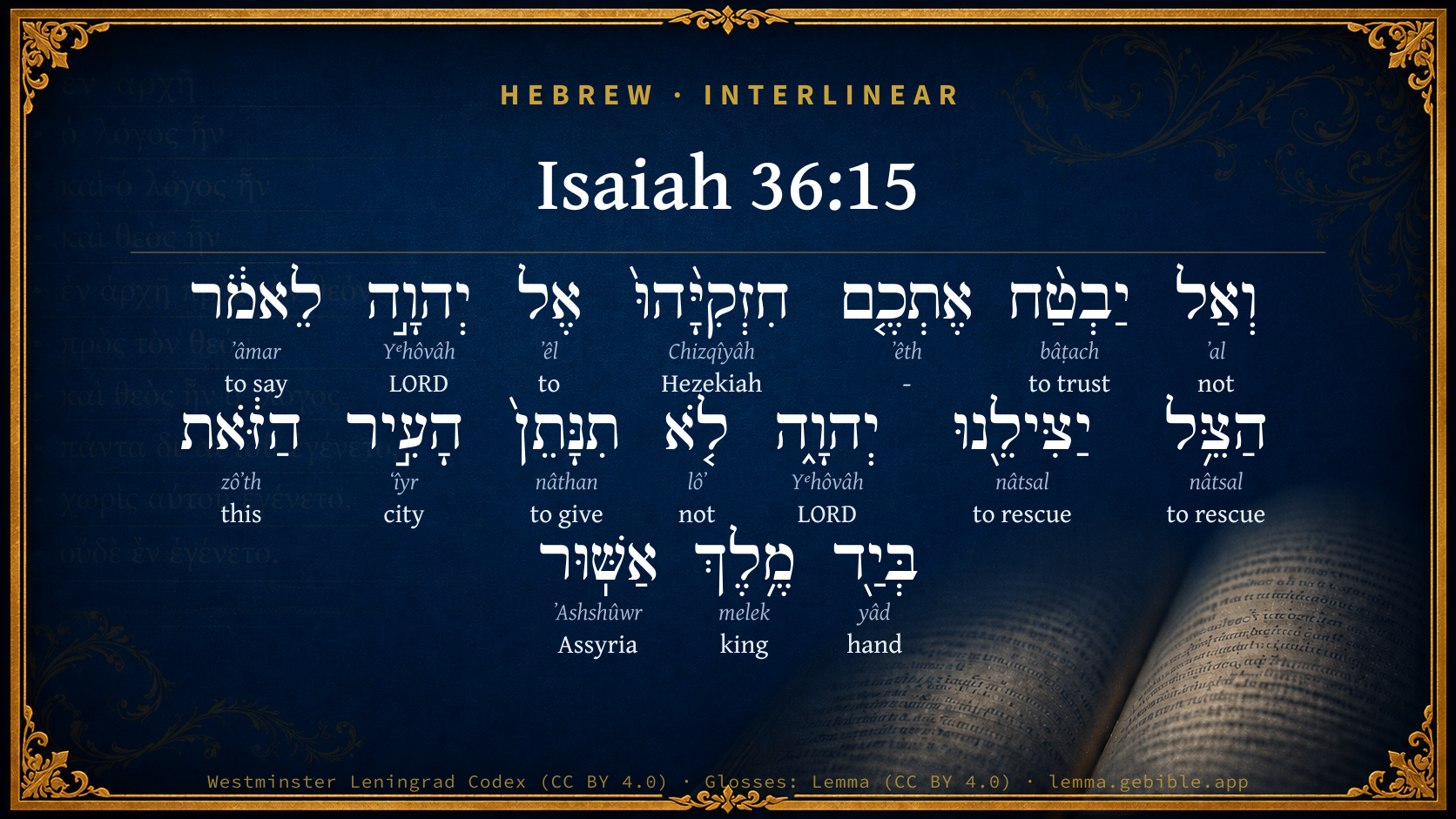
Hebrew (Westminster Leningrad Codex) Isaiah 36:15 appears in the Hebrew Old Testament. The text above is from the Westminster Leningrad Codex. Each word links to its Strong’s number, a concise gloss, and parsing drawn from the Open Scriptures Hebrew Bible morphology. Click any word for its full Brown-Driver-Briggs (BDB) entry.
Download image
Cite this verse

Isaiah 36:15 (World English Bible). Public Domain. Lemma interlinear Bible study tool, https://lemma.gebible.app/v/isaiah/36/15.

Show BibTeX & RIS
BibTeX
RIS
English Translation
neither let Hezekiah make you trust in Yahweh, saying, Yahweh will surely deliver us; this city shall not be given into the hand of the king of Assyria.
World English Bible · Public Domain
Download a study sheet

One document with this verse’s original text, its word-by-word gloss line, the meaning frame, cross-references with their text, attributed commentary, and full source and license credits — printable, and it pastes into notes with its structure intact.

This verse Autodidact and up

Study sheet (.html) Plain text (.txt)

A passage Seminary Student

Up to 50 verses in one chapter. A passage sheet keeps up to 6 commentary sources and 12 cross-references per verse, in the order this page ranks them, and says so on the sheet whenever that leaves anything out. Ask for a single verse and you get the Autodidact verse sheet above.

Everything on this page stays free to read, with no account — the sheet is a download of what is already on screen, not access to it.

Want to remove ads? Support Godless Engineer
Compare translations 3

The same verse in 3 English versions, stacked beneath the original-language interlinear above. Click any original word for its lexicon entry.

Each is an independent rendering of the whole verse — the interlinear is not word-aligned to these translations.

Highlighted words mark where these versions differ — a whole-verse word diff, not a word-by-word alignment.

  • World English Bible Public Domain
    neither let Hezekiah make you trust in Yahweh, saying, Yahweh will surely deliver us; this city shall not be given into the hand of the king of Assyria.
  • King James Version Public Domain
    Neither let Hezekiah make you trust in the LORD, saying, The LORD will surely deliver us: this city shall not be delivered into the hand of the king of Assyria.
  • unfoldingWord Literal Text CC BY-SA 4.0
    And do not let Hezekiah make you trust in Yahweh, saying, “Delivering, Yahweh will deliver us. This city will not be given into the hand of the king of Assyria.”’

unfoldingWord Literal Text — © unfoldingWord, licensed CC BY-SA 4.0. Word-aligned USFM3 via Door43 (git.door43.org/unfoldingWord/en_ult).

Versions to compare (up to 4)

3 of 4 selected

Show all 18 translations

Every available English version of this verse, each an independent rendering of the whole verse.

  • World English Bible Public Domain
    neither let Hezekiah make you trust in Yahweh, saying, Yahweh will surely deliver us; this city shall not be given into the hand of the king of Assyria.
  • Berean Standard Bible Public Domain
    Do not let Hezekiah persuade you to trust in the LORD when he says, ‘The LORD will surely deliver us; this city will not be given into the hand of the king of Assyria.’
  • Majority Standard Bible Public Domain
    Do not let Hezekiah persuade you to trust in the LORD when he says, ‘The LORD will surely deliver us; this city will not be given into the hand of the king of Assyria.’
  • King James Version Public Domain
    Neither let Hezekiah make you trust in the LORD, saying, The LORD will surely deliver us: this city shall not be delivered into the hand of the king of Assyria.
  • American Standard Version (1901) Public Domain
    neither let Hezekiah make you trust in Jehovah, saying, Jehovah will surely deliver us; this city shall not be given into the hand of the king of Assyria.
  • Revised Version (1885) Public Domain
    neither let Hezekiah make you trust in the LORD, saying, The LORD will surely deliver us; this city shall not be given into the hand of the king of Assyria.
  • Geneva Bible (1599) Public Domain
    Neither let Hezekiah make you to trust in the Lord, saying, The Lord will surely deliuer vs: this citie shall not be giuen ouer into the hand of the King of Asshur.
  • Douay-Rheims (1899) Public Domain
    And let not Ezechias make you trust in the Lord, saying: The Lord will surely deliver us, and this city shall not be given into the hands of the king of the Assyrians.
  • Young's Literal Translation Public Domain
    and let not Hezekiah make you trust unto Jehovah, saying, Jehovah doth certainly deliver us, this city is not given into the hand of the king of Asshur.
  • Literal Standard Version CC BY-SA 4.0
    and do not let Hezekiah make you trust to YHWH, saying, YHWH certainly delivers us, this city is not given into the hand of the king of Asshur.
  • Unlocked Literal Bible CC BY-SA 4.0
    Do not let Hezekiah make you trust in Yahweh, saying, “Yahweh will surely rescue us; this city will not be given into the hand of the king of Assyria.”'
  • unfoldingWord Literal Text CC BY-SA 4.0
    And do not let Hezekiah make you trust in Yahweh, saying, “Delivering, Yahweh will deliver us. This city will not be given into the hand of the king of Assyria.”’
  • Darby Bible Public Domain
    Neither let Hezekiah make you rely upon Jehovah, saying, Jehovah will certainly deliver us; this city shall not be given into the hand of the king of Assyria.
  • World Messianic Bible Public Domain
    Don’t let Hezekiah make you trust in the LORD, saying, “The LORD will surely deliver us. This city won’t be given into the hand of the king of Assyria.”’
  • Webster's Bible Public Domain
    Neither let Hezekiah make you trust in the LORD, saying, the LORD will surely deliver us: this city shall not be delivered into the hand of the king of Assyria.
  • Free Bible Version CC BY-SA 4.0
    Don't believe Hezekiah when he tells you to trust in the Lord, saying, ‘I'm certain the Lord will save us. This city will never fall into the hands of the king of Assyria.’
  • Bible in Basic English Public Domain
    And do not let Hezekiah make you put your faith in the Lord, saying, The Lord will certainly keep us safe, and this town will not be given into the hands of the king of Assyria.
  • JPS Tanakh (1917) Public Domain
    neither let Hezekiah make you trust in the LORD, saying: The LORD will surely deliver us; this city shall not be given into the hand of the king of Assyria.

Literal Standard Version (2020), Covenant Press — licensed CC BY-SA 4.0. Text via the HelloAO Bible API (eBible.org). Unlocked Literal Bible (unfoldingWord) — licensed CC BY-SA 4.0. Text via the HelloAO Bible API (eBible.org). unfoldingWord Literal Text — © unfoldingWord, licensed CC BY-SA 4.0. Word-aligned USFM3 via Door43 (git.door43.org/unfoldingWord/en_ult). Free Bible Version, Dr. Jonathan Gallagher — licensed CC BY-SA 4.0. Text via the HelloAO Bible API (eBible.org).

Word by word

More ways to search: Search by grammar → Find every occurrence → Compare this word →

Practice this passage: Drill this verse → Learn its vocabulary →

יַבְטַ֨ח
bâṭach
H982
“to trust”
Verb, Hiphil, Jussive, 3rd Person, Masculine, Singular
Part of Speech
Verb
Stem
Hiphil
Form
Jussive
Person
3rd Person
Gender
Masculine
Number
Singular
Full BDB Definition

Origin: a primitive root

TWOT: 233

to trust - (Qal) - to trust, trust in - to have confidence, be confident - to be bold - to be secure - (Hiphil) - to cause to trust, make secure - (TWOT) to feel safe, be careless
  1. וְאַל ʼal H408 “and · not” Conjunction + Particle, Negative
  2. אֶתְכֶ֤ם ʼêth H853 “- · you” Particle, Direct Object + Suffix, Personal, 2nd Person, Masculine, Plural
  3. חִזְקִיָּ֨הוּ֙ Chizqîyâh H2396 “Hezekiah” Noun, Proper
  4. אֶל ʼêl H413 “to” Preposition
  5. יְהוָ֣ה Yᵉhôvâh H3068 “LORD” Noun, Proper
  6. לֵאמֹ֔ר ʼâmar H559 “to say” Preposition + Verb, Qal, Infinitive Construct
  7. הַצֵּ֥ל nâtsal H5337 “to rescue” Verb, Hiphil, Infinitive Absolute
  8. יַצִּילֵ֖נוּ nâtsal H5337 “to rescue · us” Verb, Hiphil, Imperfect, 3rd Person, Masculine, Singular + Suffix, Personal, 1st Person, Common, Plural
  9. יְהוָ֑ה Yᵉhôvâh H3068 “LORD” Noun, Proper
  10. לֹ֤א lôʼ H3808 “not” Particle, Negative
  11. תִנָּתֵן֙ nâthan H5414 “to give” Verb, Niphal, Imperfect, 3rd Person, Feminine, Singular
  12. הָעִ֣יר ʻîyr H5892 “the · city” Particle, Definite Article + Noun, Common, Feminine, Singular, Absolute
  13. הַזֹּ֔את zôʼth H2063 “the · this” Particle, Definite Article + Pronoun, Demonstrative, Feminine, Singular
  14. בְּיַ֖ד yâd H3027 “in/at · hand of” Preposition + Noun, Common, Both, Singular, Construct
  15. מֶ֥לֶךְ melek H4428 “king of” Noun, Common, Masculine, Singular, Construct
  16. אַשּֽׁוּר ʼAshshûwr H804 “Assyria” Noun, Proper

About this verse

These counts appear in no published source. They are computed here, from the morphology-tagged text and Lemma’s own curated glosses. What Lemma adds →

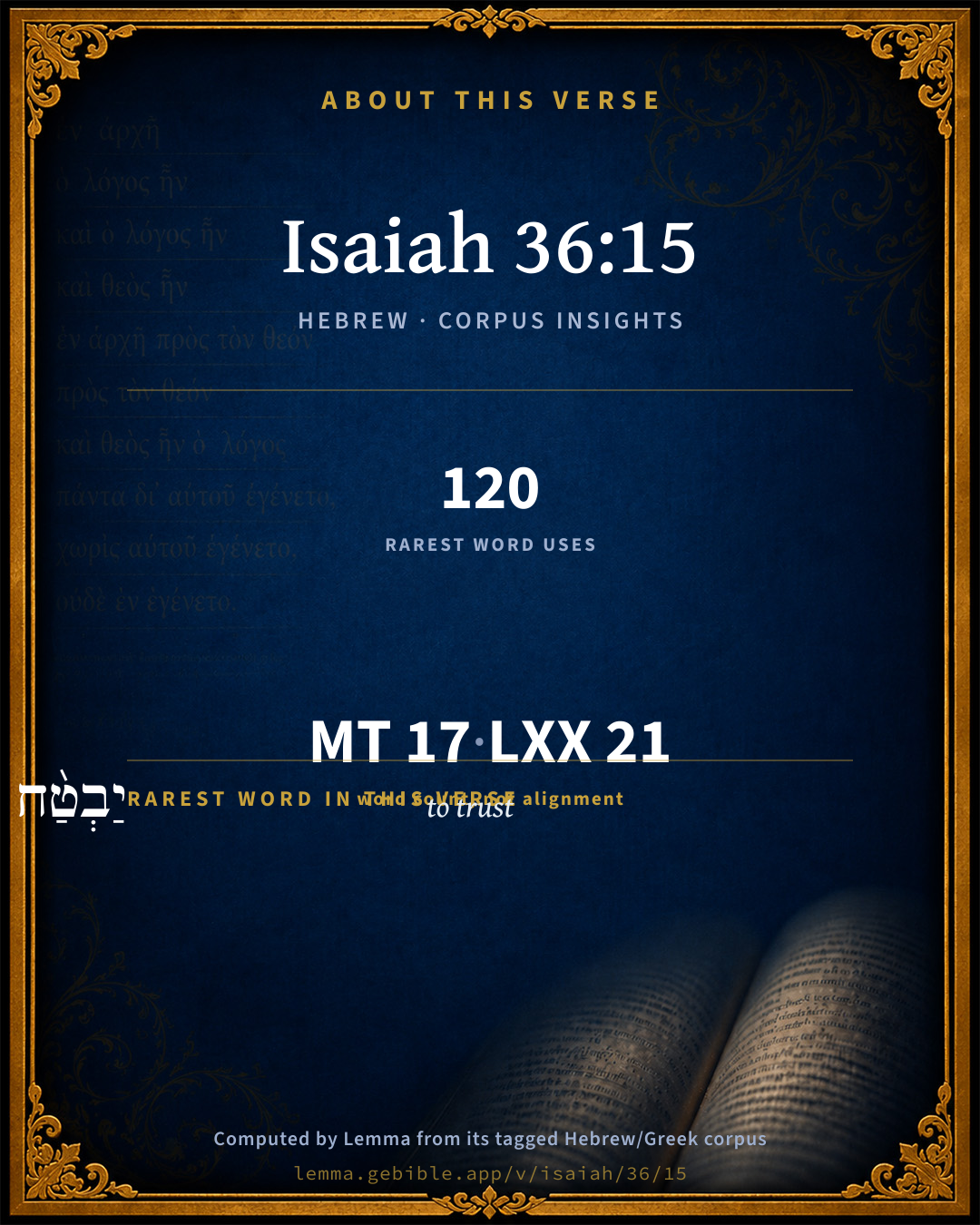
17
words
15
distinct lemmas
Prophets
section

Grammatical profile

  • 5 verbs
  • 7 nouns
  • 1 pronoun
  • 1 preposition
  • 3 particles

Verb forms

  • יַבְטַ֨ח Hiphil · Jussive
  • לֵאמֹ֔ר Qal · Infinitive Construct
  • הַצֵּ֥ל Hiphil · Infinitive Absolute
  • יַצִּילֵ֖נוּ Hiphil · Imperfect
  • תִנָּתֵן֙ Niphal · Imperfect

Repetition

Words recur within this verse — often emphatic in Hebrew:

  • יְהוָ֣ה LORD H3068 ×2
  • הַצֵּ֥ל to rescue H5337 ×2

Hebrew & Septuagint length

In English translation the verse runs 28 words from the Hebrew and 30 from the Septuagint (LXX English) — closely comparable.

A rough comparison of the two English renderings, which tokenize alike — not a word-level alignment.

Word counts can differ between the Hebrew and the Greek without any difference in meaning — e.g. the Hebrew direct-object marker אֵת has no separate Greek word, and Greek often adds the article ὁ.

In the original languages it is 17 Hebrew tokens and 21 Greek tokens — but the two are counted differently (Hebrew bundles its prefixes and suffixes into one token; the Greek is in lemma form), so that isn’t a like-for-like length.

Cross-references

7

Topical passages linked to Isaiah 36:15 in the Treasury of Scripture Knowledge — connected by theme and wording, ordered by reader-vote popularity; previews shown in the World English Bible.

  • Psalms 4:2 You sons of men, how long shall my glory be turned into dishonor? Will you love vanity, and seek after falsehood? Selah.
  • Psalms 22:7–8 All those who see me mock me. They insult me with their lips. They shake their heads, saying,
  • Psalms 71:9–11 Don't reject me in my old age. Don't forsake me when my strength fails.
  • Isaiah 36:7 But if you tell me, We trust in Yahweh our God: isn't that he, whose high places and whose altars Hezekiah has taken away, and has said to Judah and to Jerusalem, You shall worship before this altar?
  • Isaiah 37:10 Thus shall you speak to Hezekiah king of Judah, saying, Don't let your God in whom you trust deceive you, saying, Jerusalem shall not be given into the hand of the king of Assyria.
  • Isaiah 37:23–24 Whom have you defied and blasphemed? and against whom have you exalted your voice and lifted up your eyes on high? [even] against the Holy One of Israel.
  • Matthew 27:43 He trusts in God. Let God deliver him now, if he wants him; for he said, 'I am the Son of God.'"

Cross-references courtesy of OpenBible.info (CC BY 4.0).

Hebrew and Greek witnesses Masoretic Hebrew ↔ Greek Septuagint

The same verse in the two great witnesses to the Old Testament, shown verse-for-verse.

These are two independent witnesses, not word-aligned to each other, and the Septuagint is shown in lemma (dictionary) form.

Hebrew Isaiah 36:15 Masoretic · Westminster Leningrad Codex

וְאַל יַבְטַ֨ח אֶתְכֶ֤ם חִזְקִיָּ֨הוּ֙ אֶל יְהוָ֣ה לֵאמֹ֔ר הַצֵּ֥ל יַצִּילֵ֖נוּ יְהוָ֑ה לֹ֤א תִנָּתֵן֙ הָעִ֣יר הַזֹּ֔את בְּיַ֖ד מֶ֥לֶךְ אַשּֽׁוּר

neither let Hezekiah make you trust in Yahweh, saying, Yahweh will surely deliver us; this city shall not be given into the hand of the king of Assyria.

World English Bible · Public Domain

Greek LXX Isaiah 36:15 Septuagint · lemma form

καί μή λέγω σύ εζεκιας ὅτι ῥύομαι σύ ὁ θεός καί οὐ μή παραδίδωμι ὁ πόλις οὗτος ἐν χείρ βασιλεύς ἀσσύριος

And let not Ezekias say to you, That God will deliver you, and this city will not at all be delivered into the hand of the king of the Assyrians.

LXX2012 (modern English Septuagint) · Public Domain

Hebrew: Westminster Leningrad Codex (CC BY 4.0). Greek: Septuagint (public domain); English from LXX2012 (modern English Septuagint) (Public Domain). How the Septuagint differs from the Hebrew →

Targum (Aramaic paraphrase)

1

The Targum is the ancient Jewish Aramaic paraphrase of the Hebrew Scriptures — an interpretive translation, not the Hebrew text itself. Onkelos (literal) and Pseudo-Jonathan (expansive) render the Torah, and Jonathan the Prophets. Coverage is partial: where no permissively-licensed English translation exists for a verse, only the Aramaic is shown. This is verse-level text, not a word-by-word alignment to the Hebrew.

  1. Targum Jonathan Prophets (Joshua–Malachi)
    וְלָא יַרְחִיץ יַתְכוֹן חִזְקִיָה עַל מֵימְרָא דַייָ לְמֵימָר שֵׁיזָבָא יְשֵׁזְבָנָנָא יְיָ לָא תִּתְמְסַר קַרְתָּא הָדָא בְּיַד מַלְכָּא דְאַתּוּר:

    Neither let Hezekiah make you trust in the WORD of the Lord, saying, The Lord will surely deliver us: this city shall not be delivered into the hand of the king of Assyria.

    Targum Jonathan — Aramaic: “Mikraot Gedolot” (public domain). English: “Sefaria Community Translation” (CC0 1.0 (public-domain dedication)); “London "Chaldee Paraphrase," 1871” (public domain). Text via Sefaria.

Commentary

Notes on Isaiah 36:15 from classic Christian and Jewish commentators (each source and its license shown beneath its notes). The classic Christian expositions comment on the surrounding passage and are grouped to its opening verse, so a note may address several verses; the Jewish commentaries on the Tanakh (Rashi and others) are per-verse, so they appear only where the commentator wrote on this verse.

Lemma curates 59 commentaries, every one of them public domain or Creative Commons licensed, each selected and text-cleaned for this edition rather than reprinted as found. About our sources →

Tyndale Open Study Notes

Tyndale Open Resources

36:15 Hezekiah demonstrated a strong faith in the Lord, unlike Ahaz (ch 7). Hezekiah’s faith would bring rescue, whereas Ahaz’s lack of faith brought him trouble (see 7:9).

Tyndale Open Study Notes — © Tyndale Open Resources, licensed CC BY-SA 4.0. Text via the HelloAO Bible API.

Jamieson, Fausset & Brown

Robert Jamieson, A. R. Fausset & David Brown

The foes of God's people cannot succeed against them, unless they can shake their trust in Him (compare Isa 36:10).

Jamieson, Fausset & Brown — Commentary Critical and Explanatory on the Whole Bible (1871) — public domain (CC PDM 1.0). Text via the HelloAO Bible API.

Adam Clarke's Commentary

Verse 15. This city shall not be delivered] ולא velo, AND this city. Ten of Kennicott's MSS., and nine of De Rossi's, with one (ancient) of my own, add the conjunction.

Adam Clarke's Commentary on the Bible (1810–1826) — public domain. Text from a community e-Sword/MySword module.

Ellicott's Commentary for English Readers

(15, 16) Neither let Hezekiah make you trust in the Lord . . .—Rabshakeh had apparently heard from spies or deserters of Hezekiah’s speech to his people (2Ch_32:7-8). In contrast with what he derides as trust in a God who was against those who trusted Him, he offers tangible material advantages They have only to leave the besieged city, and to go to the Assyrian camp, and they will be allowed provisionally to occupy their own houses and till their own fields, and, instead of dying of thirst, shall have each man the waters of his own cistern; and then, not without a latent sarcasm, worse than the vœ victis which is the normal utterance of conquerors, he offers the doom of exile as if it were a change for the better, and not the worse, as though the conquered had no love of country as such, no reverence for the sepulchres of their fathers, no yearning for the Temple of their God. The taunt and the promise may, perhaps, be connected with Sennacherib’s boast that he had improved the water-supply of the cities of his empire (Records of the Past, i. 32, 9:23, 26, 28).

A Bible Commentary for English Readers, edited by Charles John Ellicott (1878–1897) — public domain. Text from a community e-Sword module.

The Cambridge Bible for Schools and Colleges

gen. ed. J. J. S. Perowne

15. The Lord will surely deliver us] Cf. ch. Isa_37:35.

The Cambridge Bible for Schools and Colleges (gen. ed. J. J. S. Perowne; Cambridge University Press, 1878–1918) — public domain. Text from a community e-Sword module.

John Gill's Exposition

Neither let Hezekiah make you trust in the Lord,.... Hezekiah trusted in the Lord himself, and he endeavoured, both by his own example, and by arguments, to persuade his people to do so likewise; of this Rabshakeh was sensible, and was more afraid of this than of any thing else, and, therefore laboured this point more than any other; see Ch2 32:6;

saying, the Lord will surely deliver us, this city shall not be delivered into the hand of the king of Assyria: which he might say with the greatest confidence, since the Lord had promised to defend it, Isa 31:5 and especially if his sickness, and recovery out of it, and promises then made to him, were before this, as some think; since it is expressly promised by the Lord, that he would deliver him and the city out of the hand of the king of Assyria, Isa 38:6.

John Gill's Exposition of the Whole Bible (1746–1763) — public domain (CC PDM 1.0). Text via the HelloAO Bible API.

Albert Barnes' Notes on the Bible

Make you trust in the Lord - Rabshakeh knew that Hezekiah was professedly devoted to Yahweh, and that he would endeavor to induce the people to trust in him. The Jews had now no other refuge but God, and as long as they put their confidence there, even Rabshakeh knew that it was hazardous to attempt to take and destroy their city. It was his policy, therefore, first to endeavor to undermine their reliance on God, before he could have any hope of success. The enemies of God’s people cannot succeed in their designs against them until they can unsettle their confidence in Him.

Albert Barnes' Notes on the Bible (1834–1885) — public domain. Text from a community e-Sword/MySword module.

The Pulpit Commentary

Neither let Hezekiah make you trust in Jehovah. There is nothing improbable in Rabshakeh"s having thus spoken. Isaiah had long been encouraging Hezekiah to resist Sennacherib by promises of Divine aid. (Isa_30:31 Isa_31:4-9) Hezekiah would naturally repeat these premises to the people, and could not give their effect in simpler words than by saying, "Jehovah will surely deliver us: this city shall not be delivered into the hand of the King of Assyria." Spies and deserters would naturally tell the Assyrian envoys what he had said.

The Pulpit Commentary (1880–1919), ed. H.D.M. Spence-Jones & Joseph S. Exell — public domain. Text from a community e-Sword module.

J. A. Alexander on Isaiah

Joseph Addison Alexander

“And let not Hezekiah make you trust in Jehovah, saying, Jehovah will certainly save us, this city shall not be given up into the hand of the king of Assyria.” The idea of certain deliverance is expressed by the idiomatic combination of the future and infinitive.

Joseph Addison Alexander, The Prophecies of Isaiah (1846–1847; New York: Scribner, 1870–1878) — public domain. Text from a community e-Sword module.

Lesson kit

Teaching starters — assembled from the data on this page, not authored interpretation. Every prompt links to the verse data it draws on. Edit before teaching.

Isaiah, in the Prophets, opens this verse with 17 words (15 distinct Hebrew lemmas). Its most distinctive word is bâṭach (“to trust”). A historical commentator’s framing appears above. Read the whole chapter for the surrounding context.

Discussion questions

  1. How does “to trust” (bâṭach) shape what this verse is saying?
  2. Psalms 4:2 shares this passage’s theme. How do the two illuminate each other?
  3. “LORD” occurs 2× in this one verse. What is the effect of the repetition?
  4. The translations on this page render this verse differently — a whole-verse word diff, not a word-by-word alignment. What might account for the different wordings?
  5. The verb «יַבְטַ֨ח» is Hiphil Jussive. How does its form color the action?
  6. Reading how Tyndale Open Study Notes and Jamieson, Fausset & Brown read this verse, where do the two commentators agree and where do they part?

Things to notice

Reading settings

Reading text

Shown beneath each verse's original-language words.

Old Testament
Old Testament edition

Read the OT as the Masoretic Hebrew (MT) or the Greek Septuagint (LXX).

English shown for the Greek Septuagint (in the Hebrew ↔ Greek comparison).

Comparing translations? Open the Compare panel on any verse page to stack up to four side by side.