
Jeremiah 7:10

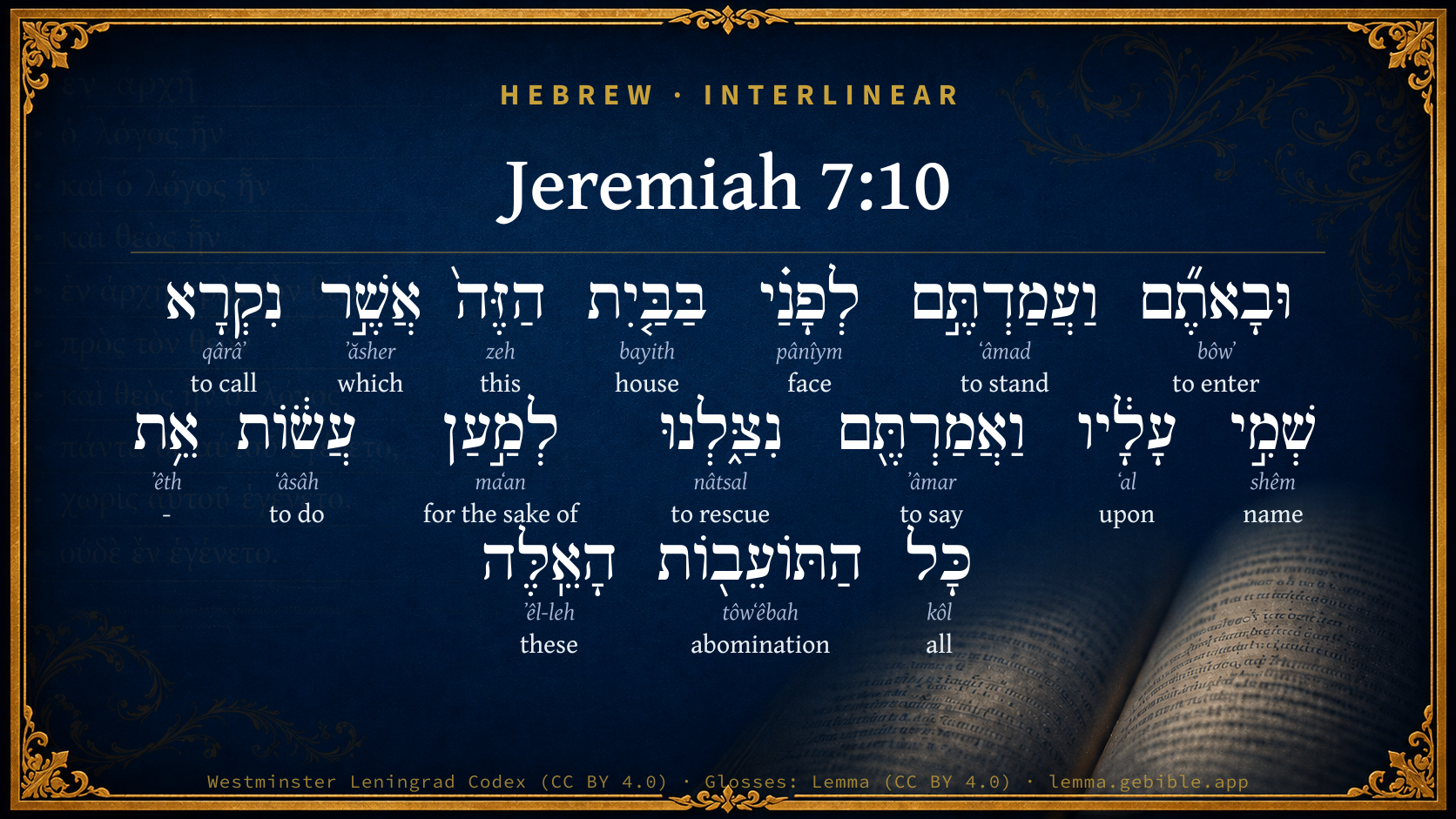
Hebrew (Westminster Leningrad Codex) Jeremiah 7:10 appears in the Hebrew Old Testament. The text above is from the Westminster Leningrad Codex. Each word links to its Strong’s number, a concise gloss, and parsing drawn from the Open Scriptures Hebrew Bible morphology. Click any word for its full Brown-Driver-Briggs (BDB) entry.
Download image
Cite this verse

Jeremiah 7:10 (World English Bible). Public Domain. Lemma interlinear Bible study tool, https://lemma.gebible.app/v/jeremiah/7/10.

Show BibTeX & RIS
BibTeX
RIS
English Translation
and come and stand before me in this house, which is called by my name, and say, We are delivered; that you may do all these abominations?
World English Bible · Public Domain
Download a study sheet

One document with this verse’s original text, its word-by-word gloss line, the meaning frame, cross-references with their text, attributed commentary, and full source and license credits — printable, and it pastes into notes with its structure intact.

This verse Autodidact and up

Study sheet (.html) Plain text (.txt)

A passage Seminary Student

Up to 50 verses in one chapter. A passage sheet keeps up to 6 commentary sources and 12 cross-references per verse, in the order this page ranks them, and says so on the sheet whenever that leaves anything out. Ask for a single verse and you get the Autodidact verse sheet above.

Everything on this page stays free to read, with no account — the sheet is a download of what is already on screen, not access to it.

Want to remove ads? Support Godless Engineer
Compare translations 3

The same verse in 3 English versions, stacked beneath the original-language interlinear above. Click any original word for its lexicon entry.

Each is an independent rendering of the whole verse — the interlinear is not word-aligned to these translations.

Highlighted words mark where these versions differ — a whole-verse word diff, not a word-by-word alignment.

  • World English Bible Public Domain
    and come and stand before me in this house, which is called by my name, and say, We are delivered; that you may do all these abominations?
  • King James Version Public Domain
    And come and stand before me in this house, which is called by my name, and say, We are delivered to do all these abominations?
  • unfoldingWord Literal Text CC BY-SA 4.0
    and then come and stand before my face in this house which is called by my name and say, “We are delivered,” in order to do all of these abominations?

unfoldingWord Literal Text — © unfoldingWord, licensed CC BY-SA 4.0. Word-aligned USFM3 via Door43 (git.door43.org/unfoldingWord/en_ult).

Versions to compare (up to 4)

3 of 4 selected

Show all 18 translations

Every available English version of this verse, each an independent rendering of the whole verse.

  • World English Bible Public Domain
    and come and stand before me in this house, which is called by my name, and say, We are delivered; that you may do all these abominations?
  • Berean Standard Bible Public Domain
    and then come and stand before Me in this house, which bears My Name, and say, ‘We are delivered, so we can continue with all these abominations’?
  • Majority Standard Bible Public Domain
    and then come and stand before Me in this house, which bears My Name, and say, ‘We are delivered, so we can continue with all these abominations’?
  • King James Version Public Domain
    And come and stand before me in this house, which is called by my name, and say, We are delivered to do all these abominations?
  • American Standard Version (1901) Public Domain
    and come and stand before me in this house, which is called by my name, and say, We are delivered; that ye may do all these abominations?
  • Revised Version (1885) Public Domain
    and come and stand before me in this house, which is called by my name, and say, We are delivered; that ye may do all these abominations.
  • Geneva Bible (1599) Public Domain
    And come and stande before mee in this House, whereupon my Name is called, and saye, We are deliuered, though we haue done all these abominations?
  • Douay-Rheims (1899) Public Domain
    And you have come, and stood before me in this house, in which my name is called upon, and have said: We are delivered, because we have done all these abominations.
  • Young's Literal Translation Public Domain
    And ye have come in and stood before Me, In this house on which My name is called, And have said, `We have been delivered,' In order to do all these abominations.
  • Literal Standard Version CC BY-SA 4.0
    And you have come in and stood before Me, || In this house on which My Name is called, || And have said, We have been delivered, || In order to do all these abominations.
  • Unlocked Literal Bible CC BY-SA 4.0
    Then do you come and stand before me in this house that is called by my name and say, “We are saved,” so you can do all of these abominations?
  • unfoldingWord Literal Text CC BY-SA 4.0
    and then come and stand before my face in this house which is called by my name and say, “We are delivered,” in order to do all of these abominations?
  • Darby Bible Public Domain
    then ye come and stand before me, in this house which is called by my name, and say, We are delivered, -- in order to do all these abominations!
  • World Messianic Bible Public Domain
    then come and stand before me in this house, which is called by my name, and say, ‘We are delivered,’ that you may do all these abominations?
  • Webster's Bible Public Domain
    And come and stand before me in this house, which is called by my name, and say, We are delivered to do all these abominations?
  • Free Bible Version CC BY-SA 4.0
    and then come and stand before me in my own Temple and say, “We're safe, so we can continue doing all these offensive things”?
  • Bible in Basic English Public Domain
    And come and take your place before me in this house, which is named by my name, and say, We have been made safe; so that you may do all these disgusting things?
  • JPS Tanakh (1917) Public Domain
    and come and stand before Me in this house, whereupon My name is called, and say: 'We are delivered', that ye may do all these abominations?

Literal Standard Version (2020), Covenant Press — licensed CC BY-SA 4.0. Text via the HelloAO Bible API (eBible.org). Unlocked Literal Bible (unfoldingWord) — licensed CC BY-SA 4.0. Text via the HelloAO Bible API (eBible.org). unfoldingWord Literal Text — © unfoldingWord, licensed CC BY-SA 4.0. Word-aligned USFM3 via Door43 (git.door43.org/unfoldingWord/en_ult). Free Bible Version, Dr. Jonathan Gallagher — licensed CC BY-SA 4.0. Text via the HelloAO Bible API (eBible.org).

Word by word

More ways to search: Search by grammar → Find every occurrence → Compare this word →

Practice this passage: Drill this verse → Learn its vocabulary →

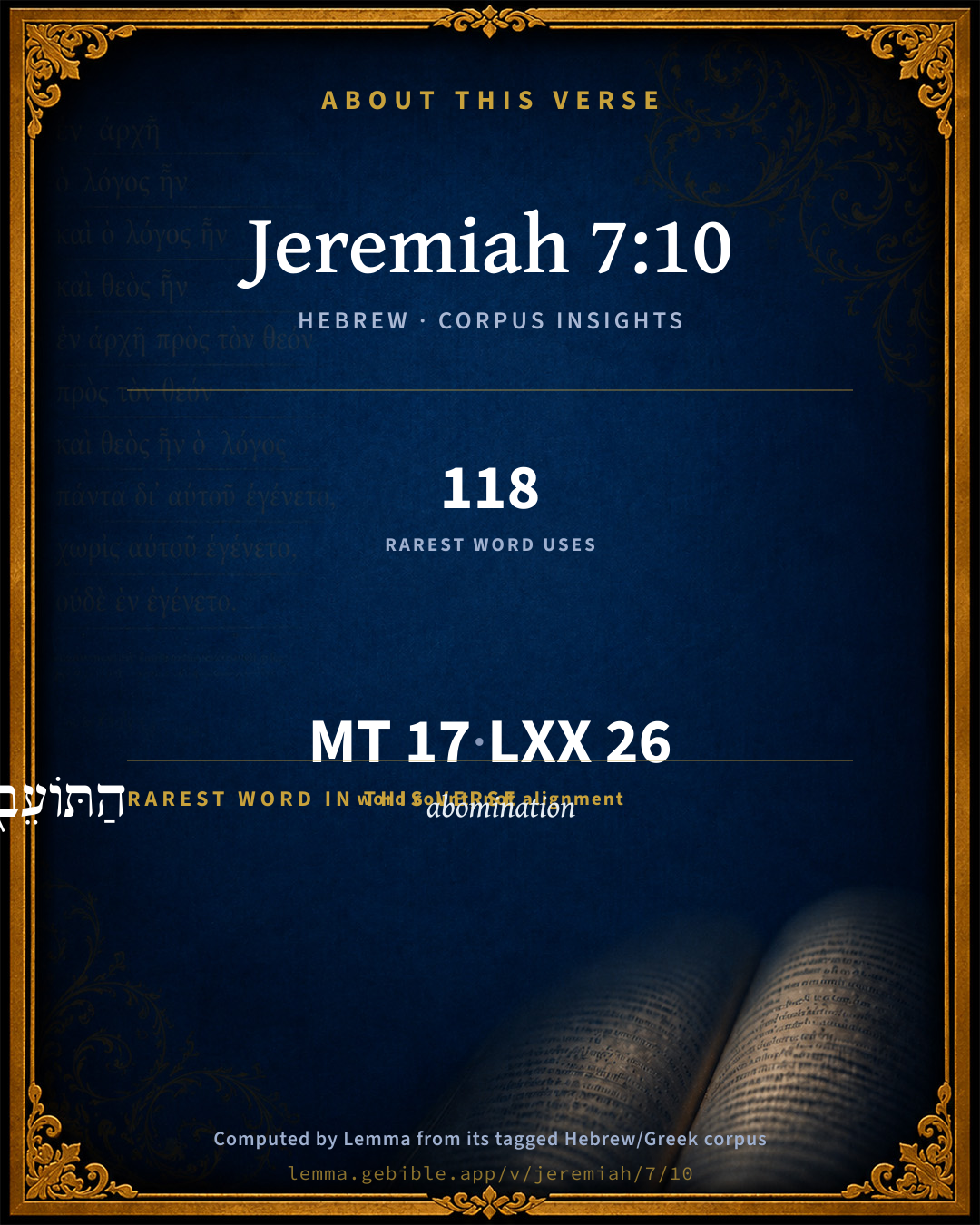
הַתּוֹעֵב֖וֹת
tôwʻêbah
H8441
“the · abominations”
Particle, Definite Article + Noun, Common, Feminine, Plural, Absolute
Part of Speech
Particle + Noun
Type
Common
Gender
Feminine
Number
Plural
State
Absolute
Full BDB Definition

Origin: act part of H8581

TWOT: 2530a

a disgusting thing, abomination, abominable - in ritual sense (of unclean food, idols, mixed marriages) - in ethical sense (of wickedness etc)
  1. וּבָאתֶ֞ם bôwʼ H935 “and · to enter” Conjunction + Verb, Qal, Sequential Perfect, 2nd Person, Masculine, Plural
  2. וַעֲמַדְתֶּ֣ם ʻâmad H5975 “and · to stand” Conjunction + Verb, Qal, Sequential Perfect, 2nd Person, Masculine, Plural
  3. לְפָנַ֗י pânîym H6440 “to/for · face(s) · my” Preposition + Noun, Common, Both, Plural, Construct + Suffix, Personal, 1st Person, Common, Singular
  4. בַּבַּ֤יִת bayith H1004 “in/at the · house” Preposition, Determined + Noun, Common, Masculine, Singular, Absolute
  5. הַזֶּה֙ zeh H2088 “the · this” Particle, Definite Article + Pronoun, Demonstrative, Masculine, Singular
  6. אֲשֶׁ֣ר ʼăsher H834 “which” Particle, Relative
  7. נִקְרָא qârâʼ H7121 “to call” Verb, Niphal, Perfect, 3rd Person, Masculine, Singular
  8. שְׁמִ֣י shêm H8034 “name · my” Noun, Common, Masculine, Singular, Construct + Suffix, Personal, 1st Person, Common, Singular
  9. עָלָ֔יו ʻal H5921 “upon · him” Preposition + Suffix, Personal, 3rd Person, Masculine, Singular
  10. וַאֲמַרְתֶּ֖ם ʼâmar H559 “and · to say” Conjunction + Verb, Qal, Sequential Perfect, 2nd Person, Masculine, Plural
  11. נִצַּ֑לְנוּ nâtsal H5337 “to rescue” Verb, Niphal, Perfect, 1st Person, Common, Plural
  12. לְמַ֣עַן maʻan H4616 “for the sake of” Preposition
  13. עֲשׂ֔וֹת ʻâsâh H6213 “to do” Verb, Qal, Infinitive Construct
  14. אֵ֥ת ʼêth H853 “-” Particle, Direct Object
  15. כָּל kôl H3605 “all of” Noun, Common, Masculine, Singular, Construct
  16. הָאֵֽלֶּה ʼêl-leh H428 “the · these” Particle, Definite Article + Pronoun, Demonstrative, Common, Plural

About this verse

These counts appear in no published source. They are computed here, from the morphology-tagged text and Lemma’s own curated glosses. What Lemma adds →

17
words
17
distinct lemmas
Prophets
section

Grammatical profile

  • 6 verbs
  • 5 nouns
  • 2 pronouns
  • 2 prepositions
  • 2 particles

Verb forms

  • וּבָאתֶ֞ם Qal · Sequential Perfect
  • וַעֲמַדְתֶּ֣ם Qal · Sequential Perfect
  • נִקְרָא Niphal · Perfect
  • וַאֲמַרְתֶּ֖ם Qal · Sequential Perfect
  • נִצַּ֑לְנוּ Niphal · Perfect
  • עֲשׂ֔וֹת Qal · Infinitive Construct

Hebrew & Septuagint length

In the original languages it is 17 Hebrew tokens and 26 Greek tokens — but the two are counted differently (Hebrew bundles its prefixes and suffixes into one token; the Greek is in lemma form), so that isn’t a like-for-like length.

Cross-references

22

Topical passages linked to Jeremiah 7:10 in the Treasury of Scripture Knowledge — connected by theme and wording, ordered by reader-vote popularity; previews shown in the World English Bible.

  • Jeremiah 32:34 But they set their abominations in the house which is called by my name, to defile it.
  • Ezekiel 23:37 For they have committed adultery, and blood is in their hands; and with their idols have they committed adultery; and they have also caused their sons, whom they bore to me, to pass through [the fire] to them to be devoured.
  • Ezekiel 23:39 For when they had slain their children to their idols, then they came the same day into my sanctuary to profane it; and, behold, thus have they done in the midst of my house.
  • Jeremiah 7:11 Is this house, which is called by my name, become a den of robbers in your eyes? Behold, I, even I, have seen it, says Yahweh.
  • Jeremiah 7:14 therefore will I do to the house which is called by my name, in which you trust, and to the place which I gave to you and to your fathers, as I did to Shiloh.
  • Jeremiah 7:30 For the children of Judah have done that which is evil in my sight, says Yahweh: they have set their abominations in the house which is called by my name, to defile it.
  • Jeremiah 34:15 You were now turned, and had done that which is right in my eyes, in proclaiming liberty every man to his neighbor; and you had made a covenant before me in the house which is called by my name:
  • 2 Kings 21:4 He built altars in the house of Yahweh, of which Yahweh said, In Jerusalem will I put my name.
  • 2 Chronicles 33:4 He built altars in the house of Yahweh, of which Yahweh said, In Jerusalem shall my name be forever.
  • 2 Chronicles 33:7 He set the engraved image of the idol, which he had made, in the house of God, of which God said to David and to Solomon his son, In this house, and in Jerusalem, which I have chosen out of all the tribes of Israel, will I put my name forever:
  • Proverbs 7:14–15 "Sacrifices of peace-offerings are with me. This day I have paid my vows.
  • Isaiah 1:10–15 Hear the word of Yahweh, you rulers of Sodom! Listen to the law of our God, you people of Gomorrah!
  • Isaiah 48:2 (for they call themselves of the holy city, and stay themselves on the God of Israel; Yahweh of Hosts is his name):
  • Isaiah 58:2–4 Yet they seek me daily, and delight to know my ways: as a nation that did righteousness, and didn't forsake the ordinance of their God, they ask of me righteous judgments; they delight to draw near to God.
  • Ezekiel 20:39 As for you, house of Israel, thus says the Lord Yahweh: Go you, serve everyone his idols, and hereafter also, if you will not listen to me; but my holy name shall you no more profane with your gifts, and with your idols.
  • Ezekiel 23:29 and they shall deal with you in hatred, and shall take away all your labor, and shall leave you naked and bare; and the nakedness of your prostitution shall be uncovered, both your lewdness and your prostitution.
  • Matthew 23:13 "Woe to you, scribes and Pharisees, hypocrites! For you devour widows' houses, and as a pretense you make long prayers. Therefore you will receive greater condemnation.
  • John 13:18 I don't speak concerning all of you. I know whom I have chosen. But that the Scripture may be fulfilled, 'He who eats bread with me has lifted up his heel against me.'
  • John 13:26–27 Jesus therefore answered, "It is he to whom I will give this piece of bread when I have dipped it." So when he had dipped the piece of bread, he gave it to Judas, the son of Simon Iscariot.
  • John 18:28 They led Jesus therefore from Caiaphas into the Praetorium. It was early, and they themselves didn't enter into the Praetorium, that they might not be defiled, but might eat the Passover.
  • Proverbs 15:8 The sacrifice made by the wicked is an abomination to Yahweh, But the prayer of the upright is his delight.
  • Ezekiel 33:31 They come to you as the people comes, and they sit before you as my people, and they hear your words, but don't do them; for with their mouth they show much love, but their heart goes after their gain.

Cross-references courtesy of OpenBible.info (CC BY 4.0).

Hebrew and Greek witnesses Masoretic Hebrew ↔ Greek Septuagint

The same verse in the two great witnesses to the Old Testament, shown verse-for-verse.

These are two independent witnesses, not word-aligned to each other, and the Septuagint is shown in lemma (dictionary) form.

Hebrew Jeremiah 7:10 Masoretic · Westminster Leningrad Codex

וּבָאתֶ֞ם וַעֲמַדְתֶּ֣ם לְפָנַ֗י בַּבַּ֤יִת הַזֶּה֙ אֲשֶׁ֣ר נִקְרָא שְׁמִ֣י עָלָ֔יו וַאֲמַרְתֶּ֖ם נִצַּ֑לְנוּ לְמַ֣עַן עֲשׂ֔וֹת אֵ֥ת כָּל הַתּוֹעֵב֖וֹת הָאֵֽלֶּה

and come and stand before me in this house, which is called by my name, and say, We are delivered; that you may do all these abominations?

World English Bible · Public Domain

Greek LXX Structure differs

In the Septuagint, Jeremiah is about an eighth shorter than the Hebrew and arranges its material differently — the Oracles Against the Nations (Hebrew chapters 46–51) appear in the middle of the Greek book, after 25:13. Because the chapter and verse boundaries do not line up, a verse-for-verse comparison with the Hebrew is not shown.

A verse-for-verse comparison isn’t shown here because the chapters and verses don’t line up. Switch to the LXX edition with the MT / LXX toggle above to read the Greek directly.

On this verse, Matthew Poole's English Annotations discusses the Septuagint’s reading. Read the note in Commentary ↓

Hebrew: Westminster Leningrad Codex (CC BY 4.0). Greek: Septuagint (public domain); English from a public-domain English Septuagint. How the Septuagint differs from the Hebrew →

Targum (Aramaic paraphrase)

1

The Targum is the ancient Jewish Aramaic paraphrase of the Hebrew Scriptures — an interpretive translation, not the Hebrew text itself. Onkelos (literal) and Pseudo-Jonathan (expansive) render the Torah, and Jonathan the Prophets. Coverage is partial: where no permissively-licensed English translation exists for a verse, only the Aramaic is shown. This is verse-level text, not a word-by-word alignment to the Hebrew.

  1. Targum Jonathan Prophets (Joshua–Malachi)
    וְאָתָן אַתּוּן וְקַיְימִין קֳדָמַי בְּבֵיתָא הָדֵין דְאִתְקְרֵי שְׁמִי עֲלוֹהִי וְאָמְרִין אַתּוּן שֵׁיזֵיבְנָא בְּדִיל לְמֶעְבַּד יַת כָּל תּוֹעֲבָתָא הָאִלֵין:

    (no public-domain English translation for this verse)

    Targum Jonathan — Aramaic: “Mikraot Gedolot” (public domain). English: “Sefaria Community Translation” (CC0 1.0 (public-domain dedication)); “London "Chaldee Paraphrase," 1871” (public domain). Text via Sefaria.

Commentary

Notes on Jeremiah 7:10 from classic Christian and Jewish commentators (each source and its license shown beneath its notes). The classic Christian expositions comment on the surrounding passage and are grouped to its opening verse, so a note may address several verses; the Jewish commentaries on the Tanakh (Rashi and others) are per-verse, so they appear only where the commentator wrote on this verse.

Lemma curates 59 commentaries, every one of them public domain or Creative Commons licensed, each selected and text-cleaned for this edition rather than reprinted as found. About our sources →

Trapp's Complete Commentary

John Trapp

Jer 7:10 And come and stand before me in this house, which is called by my name, and say, We are delivered to do all these abominations?

Ver. 10. And come and stand before me in this house.] This was worse than to do as the Circassiaus, a kind of mongrel Christians of the Greek Church of this day, who, as they baptize not their children till the eighth year, so they enter not into the Church, the gentlemen especially, till the sixtieth year, but hear divine service standing without the temple - that is to say, till through age they grow unable to continue their rapines and robberies, to which sin that nation is exceedingly addicted. {a}

And say, We are delivered,] i.e., Licensed. Hoc idem dicunt qui cogitationes inter peccata non numerant, saith Oecolampadius.

{a} Breerwood’s Enquiry.

John Trapp, A Commentary or Exposition upon All the Books of the Old and New Testament (1647–1656) — public domain. Text from a community e-Sword module.

Jamieson, Fausset & Brown

Robert Jamieson, A. R. Fausset & David Brown

And come--And yet come (Eze 23:39).

We are delivered--namely, from all impending calamities. In spite of the prophet's threats, we have nothing to fear; we have offered our sacrifices, and therefore Jehovah will "deliver" us.

to do all these abominations--namely, those enumerated (Jer 7:9). These words are not to be connected with "we are delivered," but thus: "Is it with this design that ye come and stand before Me in this house," in order that having offered your worthless sacrifices ye may be taken into My favor and so do all these abominations (Jer 7:9) with impunity? [MAURER].

Jamieson, Fausset & Brown — Commentary Critical and Explanatory on the Whole Bible (1871) — public domain (CC PDM 1.0). Text via the HelloAO Bible API.

John Calvin's Commentaries

The Prophet now adds, Ye come, that is, after ye have allowed yourselves to steal, and to murder, and to commit adultery, and to corrupt the whole worship of God, — at last, Ye come and stand before me in this temple. God proceeds with the same subject; for it was not only his purpose in this place to condemn the Jews as murderers, and thieves, and adulterers, but he proceeds farther, even to shew their shameless effrontery in coming with an unblushing front and entering the Temple, as though they were the true worshippers of God. “What do you mean, “he says, “by this? Ye bring with you murders, and thefts, and adulteries, and abominable filth; ye are contaminated with the most disgraceful things: by and bye ye enter the Temple, and think that you are at liberty to do anything.” Similar is the language we find in the first chapter of Isaiah, verses 12 and 15 (Isaiah 1:12, 15): God complains there that they trod the pavement of his Temple, and brought hands polluted with blood. So also in this place, Ye come, he says, intimating his detestation, and ye stand before me in this Temple Though God was not inclosed in that Temple, yet we know that the Ark of the Covenant was the symbol of his presence. Hence, we often meet in the law with this expression, “Ye shall stand before me.” Here then, God shews that it was a detestable and monstrous thing, that the Jews dared to rush into his presence, when polluted and contaminated with so many vices.

And he adds, In this house, on which is called my name, that is, which has been dedicated to me; for to call God’s name on the Temple, means nothing else, but that the Temple was consecrated to him, so that he was there worshipped. When God is truly worshipped, they who seek him find that he himself is present by his grace and power. As then God had commanded the Temple to be built for him, that he might there be worshipped, he says his name was there called, that is, according to its first and sacred appointment. Absurdly indeed did the Jews call on his name, for there was in them no religion, no piety: but according to God’s institution, his name was called upon in the Temple, as he had consecrated it to himself. Hence God reminds them of the first institution, which was holy and ought to have continued inviolable: “Know ye not, that this place has been chosen by me, that my name might be there invoked? Ye stand before me in the holy place, and ye stand polluted; and though polluted, not with one kind of vices, but my whole law has been violated by you, and my Tables despised, ye yet stand!” We hence see the design of the Prophet: for he condemns the effrontery and frowardness of the Jews, because they thus dared to rush into God’s presence in all their pollutions.

And ye say, he adds, that is, while standing in the Temple; ye say, O, we are freed to do all these abominations; that is, “Ye think that the Temple is a covert for you to hide all your vices; and so ye think, that you have escaped from my hand, as though no account is any more to be made of your sins, my Temple being regarded by you as an asylum, under whose shade ye take shelter.” It is indeed certain, that the Jews did not thus speak; for had they been asked whether their life was abominable, they would have denied it to be so. He speaks of the fact itself, and he speaks in the person of God, and according to his command. He therefore condemns hypocrites for thinking themselves freed, because they came to the Temple, and for thinking that all those abominations which he had mentioned, their impiety towards God and their injustice towards their neighbors, would be unpunished.

John Calvin's Commentaries (1540-1563) — public domain. Text from the Calvin Translation Society English edition (1840s-50s) via the Christian Classics Ethereal Library (ccel.org). Calvin's coverage is partial (roughly two-thirds of the Bible); uncommented books and verses are honest gaps, never fabricated. The 19th-century editor's footnotes and remarks are omitted so the notes are faithfully Calvin's own voice.

Ellicott's Commentary for English Readers

(10) And come and stand.—Better, and then have ye come, and stood before me.

We are delivered.—Taking the word as it stands (a different punctuation adopted by some commentators and versions gives Deliver us, as though reproducing, with indignant scorn, the very prayer of the people), the sense seems to be this. The people tried to combine the worship of Baal and Jehovah, and passed from the one temple to the other. They went away from the fast or feast in the house of the Lord with the feeling that they were “saved,” or “delivered.” They had gone through their religious duties, and might claim their reward. The prophet seems to repeat their words in a tone of irony, They were “delivered,” not from their abominations, but as if set free to do them.

A Bible Commentary for English Readers, edited by Charles John Ellicott (1878–1897) — public domain. Text from a community e-Sword module.

The Cambridge Bible for Schools and Colleges

gen. ed. J. J. S. Perowne

10. called by my name] in token of ownership. Cp. Jer_14:9, Jer_25:29, Jer_32:34. See other references for the phrase in Dr.’s note.

We are delivered] We are guaranteed impunity by the discharge of this religious formality. It is best with R.V. to limit the people’s supposed utterance to these three words, and to make the clause that follows to be the prophet’s indignant and sarcastic retort.

The Cambridge Bible for Schools and Colleges (gen. ed. J. J. S. Perowne; Cambridge University Press, 1878–1918) — public domain. Text from a community e-Sword module.

John Gill's Exposition

And come and stand before me in this house,.... In the temple; this they did after they had been guilty of such immoralities and idolatry; thinking by their appearance there, and their performance of a few ceremonies, and offering of some sacrifices, that all were atoned for: or this denotes their impudence, that, after the commission of such notorious crimes, they should have the front to come into the house of God, and stand before him, as if they had never departed from him, and were his people, and the true worshippers of him:

which is called by my name; the temple of God, the house of God, the sanctuary of the Lord; and where his name was also called upon, being a house of prayer; or where prayer was made to the Lord:

and say, we are delivered; from the punishment of the above sins, by coming into the temple, and standing before the Lord in it; by calling on his name, and offering sacrifices, though with impure hearts and hands, and in a hypocritical way

to do all these abominations; before mentioned; theft, murder, adultery, perjury, and idolatry. The sense is, either we are delivered and freed from punishment, that we may do these things with impunity; this is the use we make of, and the inference we draw from, our deliverance from evil: or we are delivered, though we commit these abominations, and therefore in them: or, seeing we are delivered, therefore do we these things; not that they really said these words, but this was the language of their actions. The Syriac version is, "deliver us, while we commit all these sins".

John Gill's Exposition of the Whole Bible (1746–1763) — public domain (CC PDM 1.0). Text via the HelloAO Bible API.

Albert Barnes' Notes on the Bible

We are delivered - Jeremiah accuses them of trusting in the ceremonial of the temple instead of leading holy lives. “You break,” he says, “the Ten Commandments, and then you go to the Temple; and when the service is over you say, We are delivered. We have atoned for our past actions, and may start afresh with easy minds upon a new course of wickedness.”

Albert Barnes' Notes on the Bible (1834–1885) — public domain. Text from a community e-Sword/MySword module.

Haydock's Catholic Bible Commentary

Because. Hebrew also, "although," (Sa; Grotius) "to perform," (Chaldean; Montanus) or "by doing." God must surely approve of our conduct, since we are unmolested. (St. Thomas Aquinas; Lyranus) --- But the Vulgate seems preferable, and the people attribute their success to idols, chap. xliv. 17., and 2 Paralipomenon xxviii. 23.

George Leo Haydock (1774–1849), Haydock's Catholic Family Bible and Commentary, 1859 edition — public domain. Excludes Psalms (Douay-Rheims chapter numbering differs from Protestant) and Deuterocanonical books (Catholic canon only).

Matthew Poole's English Annotations

And come and stand before me in this house; in the temple; either as if they had done no such thing, like the whore, that wipes her mouth, and saith she hath done no wickedness, Pro 30:20, noting their deep hypocrisy; or else that barely this would expiate for all their abominations, as if they could make God amends for their sins by their duties; and their posture of standing notes their service, 1Ki 10:8; Pro 22:29.

Which is called by my name; that is acknowledged to bc my house, and bears my name, dedicated to me.

We are delivered to do all these abominations; that is, after they had appeared before God with their sacrifices, either they thought themselves safe from all danger, and freed from God’s judgments, Mal 3:15; or rather privileged to return to all those wickednesses again, hereby noting their impudence. See Isa 1:12, &c. LXX. read it, we have abstained from all these abominations, as if these were the lying words in which they trusted.

Matthew Poole's English Annotations on the Holy Bible (1683–1685) — public domain. Text from a community e-Sword/MySword module.

The Pulpit Commentary

And come, etc.; rather, and then ye come, etc. We are delivered to do, etc.; rather, we have escaped, in order to do, etc. To make the concluding words of the verse a part of the speech seems hardly fair to the Jews, who would certainly not proclaim that they had made their escape from the threatened judgment with the object of prosecuting abominable acts. Such a view, moreover, greatly weakens the force of the emphatic "We have escaped." "In order to do," etc., are the words of the prophet, who thus lays bare the secret intentions of these formal worshippers.

The Pulpit Commentary (1880–1919), ed. H.D.M. Spence-Jones & Joseph S. Exell — public domain. Text from a community e-Sword module.

John Wesley's Explanatory Notes

Delivered - After they had appeared before God with their sacrifices, they thought they were privileged to return to all those wickednesses.

John Wesley, Explanatory Notes Upon the Whole Bible (1754–1765) — public domain. Text via the GEBible commentary corpus.

Lesson kit

Teaching starters — assembled from the data on this page, not authored interpretation. Every prompt links to the verse data it draws on. Edit before teaching.

Jeremiah, in the Prophets, opens this verse with 17 words (17 distinct Hebrew lemmas). Its most distinctive word is tôwʻêbah (“abomination”). A historical commentator’s framing appears above. Read the whole chapter for the surrounding context.

Discussion questions

  1. What does “abomination” (tôwʻêbah) contribute to the verse as a whole?
  2. How does Jeremiah 32:34, which shares this passage’s theme, read alongside this verse?
  3. These translations render this verse differently; the difference is in the English rendering, not the original. What questions does that raise?
  4. «וּבָאתֶ֞ם» is a Qal Sequential Perfect verb. How does that grammatical form shape the action described?
  5. Compare how Trapp's Complete Commentary and Jamieson, Fausset & Brown read this verse. Where do they agree or differ?

Things to notice

Reading settings

Reading text

Shown beneath each verse's original-language words.

Old Testament
Old Testament edition

Read the OT as the Masoretic Hebrew (MT) or the Greek Septuagint (LXX).

English shown for the Greek Septuagint (in the Hebrew ↔ Greek comparison).

Comparing translations? Open the Compare panel on any verse page to stack up to four side by side.