
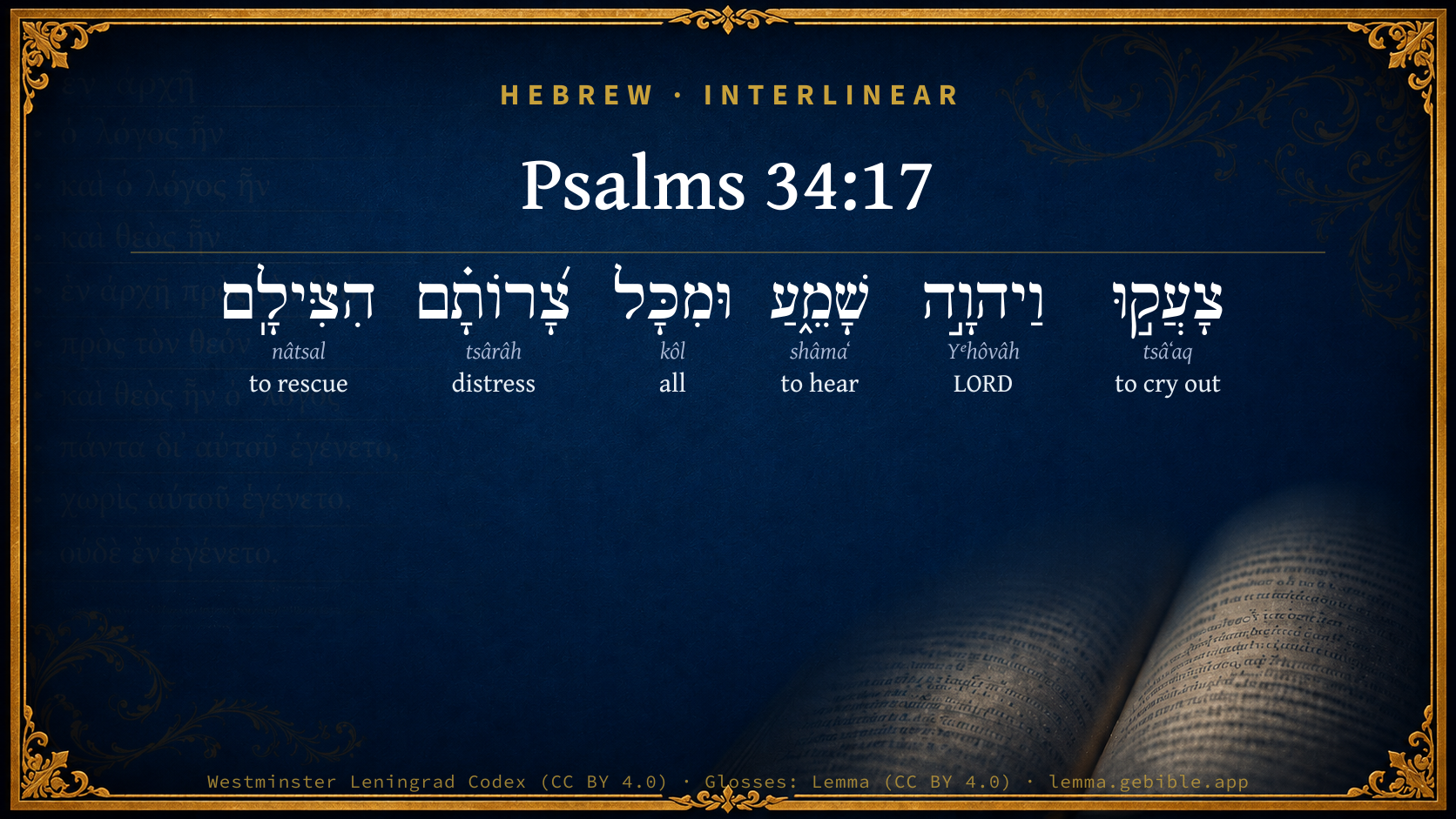
Psalms 34:17

Hebrew (Westminster Leningrad Codex) Psalms 34:17 appears in the Hebrew Old Testament. The text above is from the Westminster Leningrad Codex. Each word links to its Strong’s number, a concise gloss, and parsing drawn from the Open Scriptures Hebrew Bible morphology. Click any word for its full Brown-Driver-Briggs (BDB) entry.
Download image
Cite this verse

Psalms 34:17 (World English Bible). Public Domain. Lemma interlinear Bible study tool, https://lemma.gebible.app/v/psalms/34/17.

Show BibTeX & RIS
BibTeX
RIS
English Translation
The righteous cry, and Yahweh hears, And delivers them out of all their troubles.
World English Bible · Public Domain
Download a study sheet

One document with this verse’s original text, its word-by-word gloss line, the meaning frame, cross-references with their text, attributed commentary, and full source and license credits — printable, and it pastes into notes with its structure intact.

This verse Autodidact and up

Study sheet (.html) Plain text (.txt)

A passage Seminary Student

Up to 50 verses in one chapter. A passage sheet keeps up to 6 commentary sources and 12 cross-references per verse, in the order this page ranks them, and says so on the sheet whenever that leaves anything out. Ask for a single verse and you get the Autodidact verse sheet above.

Everything on this page stays free to read, with no account — the sheet is a download of what is already on screen, not access to it.

Want to remove ads? Support Godless Engineer
Compare translations 3

The same verse in 3 English versions, stacked beneath the original-language interlinear above. Click any original word for its lexicon entry.

Each is an independent rendering of the whole verse — the interlinear is not word-aligned to these translations.

Highlighted words mark where these versions differ — a whole-verse word diff, not a word-by-word alignment.

  • World English Bible Public Domain
    The righteous cry, and Yahweh hears, And delivers them out of all their troubles.
  • King James Version Public Domain
    The righteous cry, and the LORD heareth, and delivereth them out of all their troubles.
  • unfoldingWord Literal Text CC BY-SA 4.0
    They cry out, and Yahweh hears, and from all of their troubles he delivers them.

unfoldingWord Literal Text — © unfoldingWord, licensed CC BY-SA 4.0. Word-aligned USFM3 via Door43 (git.door43.org/unfoldingWord/en_ult).

Versions to compare (up to 4)

3 of 4 selected

Show all 18 translations

Every available English version of this verse, each an independent rendering of the whole verse.

  • World English Bible Public Domain
    The righteous cry, and Yahweh hears, And delivers them out of all their troubles.
  • Berean Standard Bible Public Domain
    The righteous cry out, and the LORD hears; He delivers them from all their troubles.
  • Majority Standard Bible Public Domain
    The righteous cry out, and the LORD hears; He delivers them from all their troubles.
  • King James Version Public Domain
    The righteous cry, and the LORD heareth, and delivereth them out of all their troubles.
  • American Standard Version (1901) Public Domain
    `The righteous' cried, and Jehovah heard, And delivered them out of all their troubles.
  • Revised Version (1885) Public Domain
    The righteous cried, and the LORD heard, and delivered them out of all their troubles.
  • Geneva Bible (1599) Public Domain
    The righteous crie, and the Lord heareth them, and deliuereth them out of all their troubles.
  • Douay-Rheims (1899) Public Domain
    But the countenance of the Lord is against them that do evil things: to cut off the remembrance of them from the earth.
  • Young's Literal Translation Public Domain
    They cried, and Jehovah heard, And from all their distresses delivered them.
  • Literal Standard Version CC BY-SA 4.0
    They cried, and YHWH heard, || And delivered them from all their distresses.
  • Unlocked Literal Bible CC BY-SA 4.0
    The righteous cry out and Yahweh hears and he rescues them from all their troubles.
  • unfoldingWord Literal Text CC BY-SA 4.0
    They cry out, and Yahweh hears, and from all of their troubles he delivers them.
  • Darby Bible Public Domain
    [The righteous] cry, and Jehovah heareth, and delivereth them out of all their troubles.
  • World Messianic Bible Public Domain
    The righteous cry, and the LORD hears, and delivers them out of all their troubles.
  • Webster's Bible Public Domain
    \\34:16\\The face of the LORD is against them that do evil, to cut off the remembrance of them from the earth.
  • Free Bible Version CC BY-SA 4.0
    But when his people call out for help, he hears them and rescues them from all their troubles.
  • Bible in Basic English Public Domain
    The cry of the upright comes before the Lord, and he takes them out of all their troubles.
  • JPS Tanakh (1917) Public Domain
    (34-18) They cried, and the LORD heard, and delivered them out of all their troubles.

Literal Standard Version (2020), Covenant Press — licensed CC BY-SA 4.0. Text via the HelloAO Bible API (eBible.org). Unlocked Literal Bible (unfoldingWord) — licensed CC BY-SA 4.0. Text via the HelloAO Bible API (eBible.org). unfoldingWord Literal Text — © unfoldingWord, licensed CC BY-SA 4.0. Word-aligned USFM3 via Door43 (git.door43.org/unfoldingWord/en_ult). Free Bible Version, Dr. Jonathan Gallagher — licensed CC BY-SA 4.0. Text via the HelloAO Bible API (eBible.org).

Word by word

More ways to search: Search by grammar → Find every occurrence → Compare this word →

Practice this passage: Drill this verse → Learn its vocabulary →

About this verse

These counts appear in no published source. They are computed here, from the morphology-tagged text and Lemma’s own curated glosses. What Lemma adds →

6
words
6
distinct lemmas
Wisdom
section

Shared distinctive vocabulary

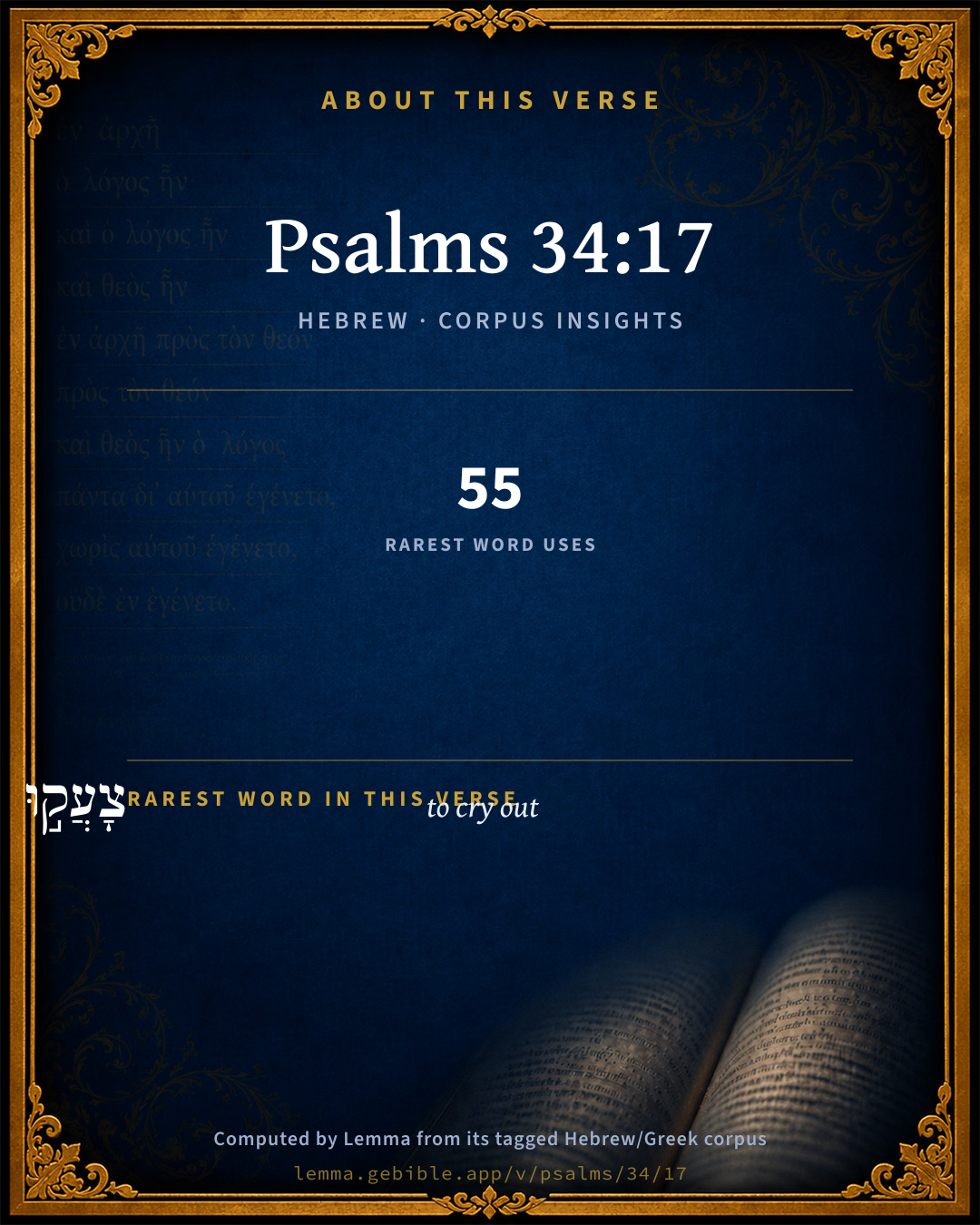
צָעֲק֣וּ to cry out H6817 occurs in 53 verses of the Hebrew Bible. Also found in:

Grammatical profile

  • 3 verbs
  • 3 nouns

Verb forms

  • צָעֲק֣וּ Qal · Perfect
  • שָׁמֵ֑עַ Qal · Perfect
  • הִצִּילָֽם Hiphil · Perfect

Hebrew & Septuagint length

In English translation the verse runs 14 words from the Hebrew and 8 from the Septuagint (LXX English) — closely comparable.

A rough comparison of the two English renderings, which tokenize alike — not a word-level alignment.

Word counts can differ between the Hebrew and the Greek without any difference in meaning — e.g. the Hebrew direct-object marker אֵת has no separate Greek word, and Greek often adds the article ὁ.

Cross-references

9

Topical passages linked to Psalms 34:17 in the Treasury of Scripture Knowledge — connected by theme and wording, ordered by reader-vote popularity; previews shown in the World English Bible.

  • Psalms 145:18–20 Yahweh is near to all those who call on him, To all who call on him in truth.
  • Isaiah 65:24 It shall happen that, before they call, I will answer; and while they are yet speaking, I will hear.
  • Psalms 34:19 Many are the afflictions of the righteous, But Yahweh delivers him out of them all.
  • Psalms 34:6 This poor man cried, and Yahweh heard him, And saved him out of all his troubles.
  • Psalms 91:15 He will call on me, and I will answer him. I will be with him in trouble. I will deliver him, and honor him.
  • Psalms 34:15 Yahweh's eyes are toward the righteous. His ears listen to their cry.
  • Acts 12:5–11 Peter therefore was kept in the prison, but constant prayer was made by the assembly to God for him.
  • 2 Chronicles 32:24 In those days Hezekiah was sick even to death: and he prayed to Yahweh; and he spoke to him, and gave him a sign.
  • 2 Chronicles 32:20–21 Hezekiah the king, and Isaiah the prophet the son of Amoz, prayed because of this, and cried to heaven.

Cross-references courtesy of OpenBible.info (CC BY 4.0).

Hebrew and Greek witnesses Masoretic Hebrew ↔ Greek Septuagint

The same verse in the two great witnesses to the Old Testament, shown verse-for-verse.

You’re reading Greek Psalm 33 (Hebrew Psalm 34). The Septuagint counts the superscription, so verse numbers can differ from the Hebrew — chapter-level alignment, not verse-by-verse. Numbering follows Rahlfs.

These are two independent witnesses, not word-aligned to each other, and the Septuagint is shown in lemma (dictionary) form.

Hebrew Psalms 34:17 Masoretic · Westminster Leningrad Codex

צָעֲק֣וּ וַיהוָ֣ה שָׁמֵ֑עַ וּמִכָּל צָ֝רוֹתָ֗ם הִצִּילָֽם

The righteous cry, and Yahweh hears, And delivers them out of all their troubles.

World English Bible · Public Domain

Greek LXX Greek Psalm 33:17 Septuagint · lemma form

πρόσωπον δέ κύριος ἐπί ποιέω κακός ὁ ἐκὀλεθρεύω ἐκ γῆ ὁ μνημόσυνον αὐτός

and delivered them out of all their afflictions.

LXX2012 (modern English Septuagint) · Public Domain

On this verse, The Cambridge Bible for Schools and Colleges discusses the Septuagint’s reading. Read the note in Commentary ↓

Hebrew: Westminster Leningrad Codex (CC BY 4.0). Greek: Septuagint (public domain); English from LXX2012 (modern English Septuagint) (Public Domain). How the Septuagint differs from the Hebrew →

Commentary

Notes on Psalms 34:17 from classic Christian and Jewish commentators (each source and its license shown beneath its notes). The classic Christian expositions comment on the surrounding passage and are grouped to its opening verse, so a note may address several verses; the Jewish commentaries on the Tanakh (Rashi and others) are per-verse, so they appear only where the commentator wrote on this verse.

Lemma curates 59 commentaries, every one of them public domain or Creative Commons licensed, each selected and text-cleaned for this edition rather than reprinted as found. About our sources →

The Cambridge Bible for Schools and Colleges

gen. ed. J. J. S. Perowne

17. They cried, and Jehovah heard;

And rescued them out of all their distresses.

We may understand a subject from the verb, they who cried cried, as in Psa_34:5, i.e., when any cried: or with LXX and Vulg. supply the righteous. (Had the LXX this reading, or did they merely insert the word from Psa_34:15?) It is however possible that Psa_34:15-16 should be transposed, and then the righteous in Psa_34:15 supplies the natural subject to Psa_34:17. This transposition deserts the present order of the letters of the alphabet, but is justified by Lamentations 2, 3, 4, and Proverbs 31 according to the LXX, where Pç precedes Ayin.

The Cambridge Bible for Schools and Colleges (gen. ed. J. J. S. Perowne; Cambridge University Press, 1878–1918) — public domain. Text from a community e-Sword module.

Trapp's Complete Commentary

John Trapp

Psa 34:17 [The righteous] cry, and the LORD heareth, and delivereth them out of all their troubles.

Ver. 17. The righteous cry, &c.] This is often inculcated for our better assurance; because we are apt to doubt if delayed. See Psa 34:6.

John Trapp, A Commentary or Exposition upon All the Books of the Old and New Testament (1647–1656) — public domain. Text from a community e-Sword module.

J. A. Alexander on Psalms

Joseph Addison Alexander

18. (Psa 34:17). They cried and Jehovah heard, and fromt all their distresses delivered them. This may at first sight seem to have respect to the evil-doers of the preceding verse, who are then represented as obtaining relief from deserved judgments by humble prayer to God. But as the wicked are, in this whole passage, mentioned only incidentally, and as a kind of foil or contrast to the righteous, it seems better on the whole, to make the first verb here indefinite, men cry for help, but with special reference to the righteous of Psa 34:16 (15). God watches over the righteous to protect them—as he does over the wicked to destroy them—and whenever they cry to him for help, he saves them. This parenthetical construction of Psa 34:17 (16) is the more admissible because it contains no finite verb, whereas Psa 34:18 (17) contains three.

Joseph Addison Alexander, The Psalms Translated and Explained (1850) — public domain. Text from a community e-Sword module.

Jamieson, Fausset & Brown

Robert Jamieson, A. R. Fausset & David Brown

Humble penitents are objects of God's special tender regard (Psa 51:19; Isa 57:15).

Jamieson, Fausset & Brown — Commentary Critical and Explanatory on the Whole Bible (1871) — public domain (CC PDM 1.0). Text via the HelloAO Bible API.

Adam Clarke's Commentary

Verse 17. The righteous cry] There is no word in the present Hebrew text for righteous; but all the versions preserve it. I suppose it was lost through its similitude to the word צעקו tsaaku, they cry צעקו צדיקים tsaaku tsaddikim, the righteous cry.

Adam Clarke's Commentary on the Bible (1810–1826) — public domain. Text from a community e-Sword/MySword module.

John Calvin's Commentaries

17. They It is wicked men who are spoken of in the immediately preceding verse; but they here evidently refers not to them, but to the righteous, mentioned in the fifteenth verse; and, accordingly, in all the ancient versions, and in our English Bible, the words the righteous are supplied. It is supposed by those who make this supplement, that the word צדיקים, tsaddikim, has been lost out of the text. But if we read the 16th verse as a parenthesis, it will not be necessary to make any supplement, and the words may be read exactly as they are in the Hebrew, They cried.

John Calvin's Commentaries (1540-1563) — public domain. Text from the Calvin Translation Society English edition (1840s-50s) via the Christian Classics Ethereal Library (ccel.org). Calvin's coverage is partial (roughly two-thirds of the Bible); uncommented books and verses are honest gaps, never fabricated. The 19th-century editor's footnotes and remarks are omitted so the notes are faithfully Calvin's own voice.

John Gill's Exposition

The righteous cry,.... The word "righteous" is not in the original text, but is rightly supplied in our version, as it is in the Targum, and by Jarchi; and so Kimchi and Ben Melech observe, that these words are not to be connected with Psa 34:16, but with Psa 34:15; and they are indeed an amplification of the last clause of it; and the cry of the righteous is meant, to which the ears of the Lord are open; though Aben Ezra thinks that these words are to be understood of them that do evil, and of their cry to the Lord, when they turn from their evil ways; but the former sense is best;

and the Lord heareth, and delivereth them out of all their troubles; their inward troubles, through the workings of corruption in their hearts; through the violent assaults of Satan, the blasphemous thoughts he injects into them, and his solicitations of them to sin; and through divine desertions, and their outward troubles; through afflictions of body, losses of estate and friends, and the reproaches and persecutions of men; out of all these the Lord sooner or later delivers his people who cry unto him.

John Gill's Exposition of the Whole Bible (1746–1763) — public domain (CC PDM 1.0). Text via the HelloAO Bible API.

Albert Barnes' Notes on the Bible

The righteous cry, and the Lord heareth - That is, one of the advantages or benefits of being righteous is the privilege of crying unto God, or of calling on his name, with the assurance that he will hear and deliver us. No one has ever yet fully appreciated the “privilege” of being permitted to call upon God; the privilege of prayer. There is no blessing conferred upon man in his present state superior to this; and no one can fully understand the force of the argument derived from this in favor of the service of God. What a world would this be - how sad, how helpless, how wretched - if there were no God to whom the guilty, the suffering, and the sorrowful might come; if God were a Being who never heard prayer at all; if he were a capricious Being who might or might not hear prayer; if He were a Being governed by fitful emotions, who would now hear the righteous, and then the wicked, and then neither, and who dispensed His favors in answer to prayer by no certain rule!

And delivereth them out of all their troubles -

(1) He often delivers them from trouble in this life in answer to prayer.

(2) he will deliver them literally from all trouble in the life to come.

The promise is not indeed, that they shall be delivered from all trouble on earth, but the idea is that God is able to rescue them from trouble here; that He often does it in answer to prayer; and that there will be, in the case of every righteous person, a sure and complete deliverance from all trouble hereafter. Compare the notes at Psa 34:6 : see Psa 34:19.

Albert Barnes' Notes on the Bible (1834–1885) — public domain. Text from a community e-Sword/MySword module.

Matthew Poole's English Annotations

Heb. They cry, to wit, the righteous, as is manifest both from the nature of the thing, and from Psa 34:15, where they are so called, and with which this verse is to be continued, the 16th verse coming in by way of parenthesis, as is very usual in many places of Scripture.

Matthew Poole's English Annotations on the Holy Bible (1683–1685) — public domain. Text from a community e-Sword/MySword module.

The Treasury of David

Charles H. Spurgeon

Ver. 17. The righteous cry. Like Israel in Egypt, they cry out under the heavy yoke of oppression, both of sin, temptation, care, and grief. And the Lord heareth; he is like the night watchman, who no sooner hears the alarm bell than he flies to relieve those who need him. And delivereth them out of all their troubles. No net of trouble can so hold us that the Lord cannot free us. Our afflictions may be numerous and complicated, but prayer can set us free from them all, for the Lord will show himself strong on our behalf.

Ver. 17. Afflictions and their threefold blessing.

1. They make us pray.

2. They bring us the Lord's hearing ear.

3. They afford room for joyful experience of deliverance.

Psalms 34:18*

Charles H. Spurgeon's The Treasury of David (1869–1885) — public domain. Psalms only. Text from a community e-Sword/MySword module.

The Pulpit Commentary

The righteous cry, and the Lord heareth; literally, they cry, and the Lord heareth. "Cry," which by the ordinary rules of grammar should have for its subject the "evil-doers" of the preceding verse, must, it is obvious from the context, refer to the "righteous" of ver. 15, who are the predominant subject of the entire passage( vers. 15-22). And delivereth them out of all their troubles. (comp. ver. 19 and Psa_54:7)

The Pulpit Commentary (1880–1919), ed. H.D.M. Spence-Jones & Joseph S. Exell — public domain. Text from a community e-Sword module.

Rashi

Rabbi Shlomo Yitzchaki (Rashi)

The face of the Lord His angry face, les ires in Old French, ire, as (in Lev. 20:5): “And I will direct My face, etc.” So did Menachem (p. 143) associate it.

Rashi on the Tanakh — English translations: “The Judaica Press complete Tanach with Rashi, translated by A. J. Rosenberg” (CC BY 4.0); “Pentateuch with Rashi's commentary by M. Rosenbaum and A.M. Silbermann, 1929-1934” (public domain); “The Metsudah Tanach series, Lakewood, N.J” (CC BY 4.0); and “The Book of Joshua, Metsudah Publications, 1997” (CC BY 4.0). Text via Sefaria.

Lesson kit

Teaching starters — assembled from the data on this page, not authored interpretation. Every prompt links to the verse data it draws on. Edit before teaching.

Psalms, in the Wisdom, opens this verse with 6 words (6 distinct Hebrew lemmas). Its most distinctive word is tsâʻaq (“to cry out”). A historical commentator’s framing appears above. Read the whole chapter for the surrounding context.

Discussion questions

  1. What does “to cry out” (tsâʻaq) contribute to the verse as a whole?
  2. How does Genesis 4:10, which shares the word «to cry out», read alongside this verse?
  3. The translations on this page render this verse differently — a whole-verse word diff, not a word-by-word alignment. What might account for the different wordings?
  4. «צָעֲק֣וּ» is a Qal Perfect verb. How does that grammatical form shape the action described?
  5. Compare how The Cambridge Bible for Schools and Colleges and Trapp's Complete Commentary read this verse. Where do they agree or differ?

Things to notice

Reading settings

Reading text

Shown beneath each verse's original-language words.

Old Testament
Old Testament edition

Read the OT as the Masoretic Hebrew (MT) or the Greek Septuagint (LXX).

English shown for the Greek Septuagint (in the Hebrew ↔ Greek comparison).

Comparing translations? Open the Compare panel on any verse page to stack up to four side by side.