
Isaiah 20:6

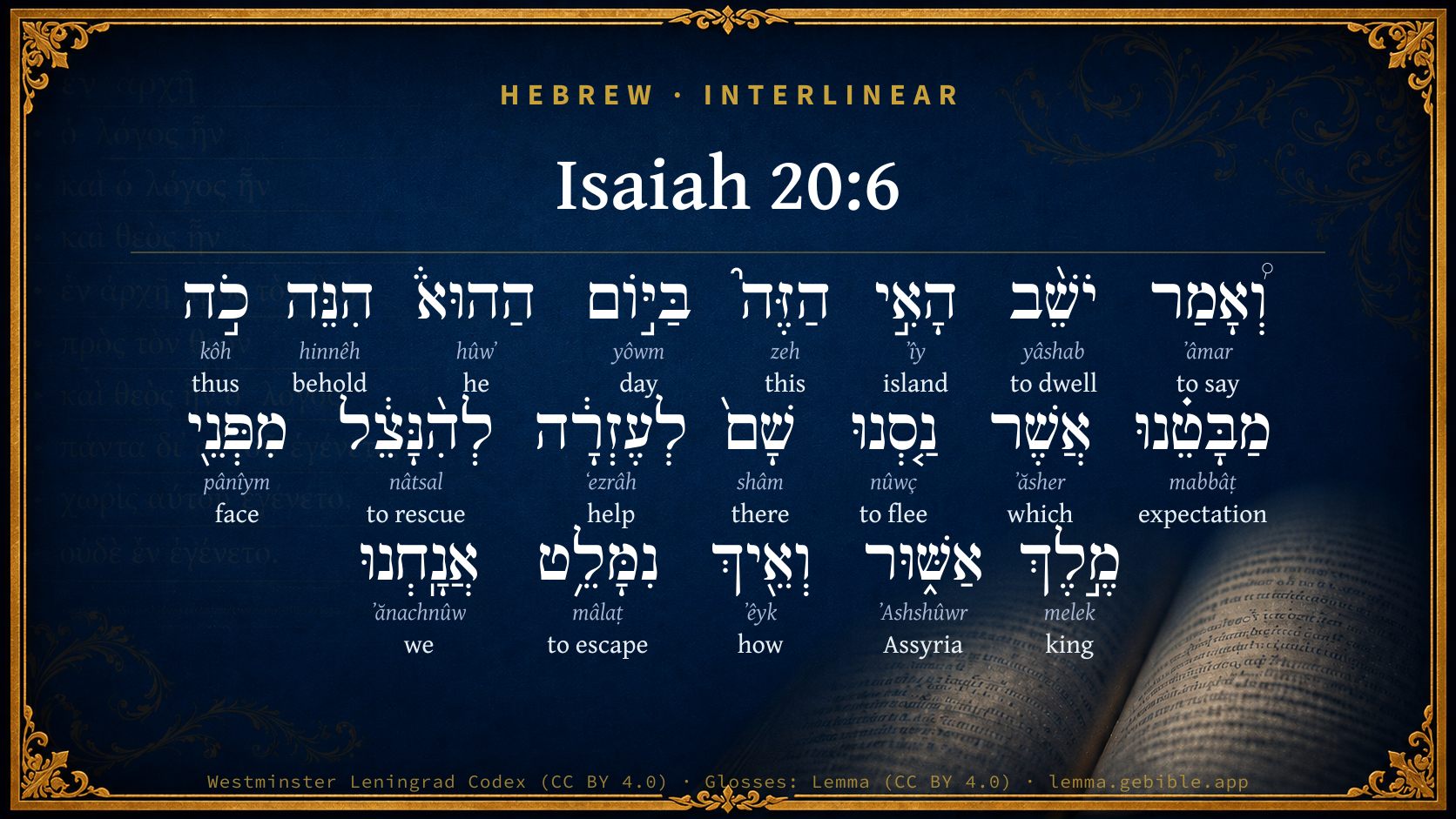
Hebrew (Westminster Leningrad Codex) Isaiah 20:6 appears in the Hebrew Old Testament. The text above is from the Westminster Leningrad Codex. Each word links to its Strong’s number, a concise gloss, and parsing drawn from the Open Scriptures Hebrew Bible morphology. Click any word for its full Brown-Driver-Briggs (BDB) entry.
Download image
Cite this verse

Isaiah 20:6 (World English Bible). Public Domain. Lemma interlinear Bible study tool, https://lemma.gebible.app/v/isaiah/20/6.

Show BibTeX & RIS
BibTeX
RIS
English Translation
The inhabitant of this coast-land shall say in that day, Behold, such is our expectation, where we fled for help to be delivered from the king of Assyria: and we, how shall we escape?
World English Bible · Public Domain
Download a study sheet

One document with this verse’s original text, its word-by-word gloss line, the meaning frame, cross-references with their text, attributed commentary, and full source and license credits — printable, and it pastes into notes with its structure intact.

This verse Autodidact and up

Study sheet (.html) Plain text (.txt)

A passage Seminary Student

Up to 50 verses in one chapter. A passage sheet keeps up to 6 commentary sources and 12 cross-references per verse, in the order this page ranks them, and says so on the sheet whenever that leaves anything out. Ask for a single verse and you get the Autodidact verse sheet above.

Everything on this page stays free to read, with no account — the sheet is a download of what is already on screen, not access to it.

Want to remove ads? Support Godless Engineer
Compare translations 3

The same verse in 3 English versions, stacked beneath the original-language interlinear above. Click any original word for its lexicon entry.

Each is an independent rendering of the whole verse — the interlinear is not word-aligned to these translations.

Highlighted words mark where these versions differ — a whole-verse word diff, not a word-by-word alignment.

  • World English Bible Public Domain
    The inhabitant of this coast-land shall say in that day, Behold, such is our expectation, where we fled for help to be delivered from the king of Assyria: and we, how shall we escape?
  • King James Version Public Domain
    And the inhabitant of this isle shall say in that day, Behold, such is our expectation, whither we flee for help to be delivered from the king of Assyria: and how shall we escape?
  • unfoldingWord Literal Text CC BY-SA 4.0
    And the dweller of this coastland will say in that day, ‘Behold, this our hope, where we fled there for help, to be delivered from the face of the king of Assyria! And we, how will we escape?’”

unfoldingWord Literal Text — © unfoldingWord, licensed CC BY-SA 4.0. Word-aligned USFM3 via Door43 (git.door43.org/unfoldingWord/en_ult).

Versions to compare (up to 4)

3 of 4 selected

Show all 18 translations

Every available English version of this verse, each an independent rendering of the whole verse.

  • World English Bible Public Domain
    The inhabitant of this coast-land shall say in that day, Behold, such is our expectation, where we fled for help to be delivered from the king of Assyria: and we, how shall we escape?
  • Berean Standard Bible Public Domain
    And on that day the dwellers of this coastland will say, ‘See what has happened to our source of hope, those to whom we fled for help and deliverance from the king of Assyria! How then can we escape?’”
  • Majority Standard Bible Public Domain
    And on that day the dwellers of this coastland will say, ‘See what has happened to our source of hope, those to whom we fled for help and deliverance from the king of Assyria! How then can we escape?’”
  • King James Version Public Domain
    And the inhabitant of this isle shall say in that day, Behold, such is our expectation, whither we flee for help to be delivered from the king of Assyria: and how shall we escape?
  • American Standard Version (1901) Public Domain
    And the inhabitant of this coast-land shall say in that day, Behold, such is our expectation, whither we fled for help to be delivered from the king of Assyria: and we, how shall we escape?
  • Revised Version (1885) Public Domain
    And the inhabitant of this coastland shall say in that day, Behold, such is our expectation, whither we fled for help to be delivered from the king of Assyria: and we, how shall we escape?
  • Geneva Bible (1599) Public Domain
    Then shall the inhabitant of this yle say in that day, Behold, such is our expectation, whither we fledde for helpe to be deliuered from the King of Asshur, and howe shall we be deliuered?
  • Douay-Rheims (1899) Public Domain
    And the inhabitants of this isle shall say in that day: Lo this was our hope, to whom we fled for help, to deliver up from the face of the king of the Assyrians: and how shall we be able to escape?
  • Young's Literal Translation Public Domain
    and the inhabitant of this isle hath said in that day -- Lo, thus `is' our trust, Whither we have fled for help, To be delivered from the king of Asshur, And how do we escape -- we?'
  • Literal Standard Version CC BY-SA 4.0
    and the inhabitant of this island has said in that day—Behold, thus [is] our trust, || To where we have fled for help, || To be delivered from the king of Asshur, || And how do we escape—we?”
  • Unlocked Literal Bible CC BY-SA 4.0
    The inhabitants of these coasts will say on that day, 'Indeed, this was our source of hope, where we fled for help to be rescued from the king of Assyria, and now, how can we escape?'”
  • unfoldingWord Literal Text CC BY-SA 4.0
    And the dweller of this coastland will say in that day, ‘Behold, this our hope, where we fled there for help, to be delivered from the face of the king of Assyria! And we, how will we escape?’”
  • Darby Bible Public Domain
    And the inhabitants of this coast shall say in that day, Behold, such is our confidence, whither we fled for help to be delivered from the king of Assyria; and how shall we escape?
  • World Messianic Bible Public Domain
    The inhabitants of this coast land will say in that day, ‘Behold, this is our expectation, where we fled for help to be delivered from the king of Assyria. And we, how will we escape?’”
  • Webster's Bible Public Domain
    And the inhabitant of this isle shall say in that day, Behold, such is our expectation, whither we flee for help to be delivered from the king of Assyria: and how shall we escape?
  • Free Bible Version CC BY-SA 4.0
    At that time the people living in the coastal lands will say, ‘Look what has happened to those we were depending on! We ran to them for help to save us from the king of Assyria. We don't stand a chance!’”
  • Bible in Basic English Public Domain
    And those living by the sea will say in that day, See the fate of our hope to whom we went for help and salvation from the king of Assyria: what hope have we then of salvation?
  • JPS Tanakh (1917) Public Domain
    And the inhabitant of this coast-land shall say in that day: Behold, such is our expectation, whither we fled for help to be delivered from the king of Assyria; and how shall we escape?'

Literal Standard Version (2020), Covenant Press — licensed CC BY-SA 4.0. Text via the HelloAO Bible API (eBible.org). Unlocked Literal Bible (unfoldingWord) — licensed CC BY-SA 4.0. Text via the HelloAO Bible API (eBible.org). unfoldingWord Literal Text — © unfoldingWord, licensed CC BY-SA 4.0. Word-aligned USFM3 via Door43 (git.door43.org/unfoldingWord/en_ult). Free Bible Version, Dr. Jonathan Gallagher — licensed CC BY-SA 4.0. Text via the HelloAO Bible API (eBible.org).

Word by word

More ways to search: Search by grammar → Find every occurrence → Compare this word →

Practice this passage: Drill this verse → Learn its vocabulary →

מַבָּטֵ֗נוּ
mabbâṭ
H4007
“expectation · our”
Noun, Common, Masculine, Singular, Construct + Suffix, Personal, 1st Person, Common, Plural
Part of Speech
Noun
Type
Common
Gender
Masculine
Number
Singular
State
Construct
Full BDB Definition

Origin: from H5027

TWOT: 1282a

expectation, object of hope or confidence
  1. וְ֠אָמַר ʼâmar H559 “and · to say” Conjunction + Verb, Qal, Sequential Perfect, 3rd Person, Masculine, Singular
  2. יֹשֵׁ֨ב yâshab H3427 “dwelling” Verb, Qal, Participle Active, Masculine, Singular, Absolute
  3. הָאִ֣י ʼîy H339 “the · island” Particle, Definite Article + Noun, Common, Masculine, Singular, Absolute
  4. הַזֶּה֮ zeh H2088 “the · this” Particle, Definite Article + Pronoun, Demonstrative, Masculine, Singular
  5. בַּיּ֣וֹם yôwm H3117 “in/at the · day” Preposition, Determined + Noun, Common, Masculine, Singular, Absolute
  6. הַהוּא֒ hûwʼ H1931 “the · he” Particle, Definite Article + Pronoun, Personal, 3rd Person, Masculine, Singular
  7. הִנֵּה hinnêh H2009 “behold” Particle, Demonstrative
  8. כֹ֣ה kôh H3541 “thus” Adverb
  9. אֲשֶׁר ʼăsher H834 “which” Particle, Relative
  10. נַ֤סְנוּ nûwç H5127 “to flee” Verb, Qal, Perfect, 1st Person, Common, Plural
  11. שָׁם֙ shâm H8033 “there” Adverb
  12. לְעֶזְרָ֔ה ʻezrâh H5833 “to/for · help” Preposition + Noun, Common, Feminine, Singular, Absolute
  13. לְהִ֨נָּצֵ֔ל nâtsal H5337 “to rescue” Preposition + Verb, Niphal, Infinitive Construct
  14. מִפְּנֵ֖י pânîym H6440 “from · face(s) of” Preposition + Noun, Common, Both, Plural, Construct
  15. מֶ֣לֶךְ melek H4428 “king of” Noun, Common, Masculine, Singular, Construct
  16. אַשּׁ֑וּר ʼAshshûwr H804 “Assyria” Noun, Proper
  17. וְאֵ֖יךְ ʼêyk H349 “and · how” Conjunction + Particle, Interrogative
  18. נִמָּלֵ֥ט mâlaṭ H4422 “to escape” Verb, Niphal, Imperfect, 1st Person, Common, Plural
  19. אֲנָֽחְנוּ ʼănachnûw H587 “we” Pronoun, Personal, 1st Person, Common, Plural

About this verse

These counts appear in no published source. They are computed here, from the morphology-tagged text and Lemma’s own curated glosses. What Lemma adds →

20
words
20
distinct lemmas
Prophets
section

Notable vocabulary

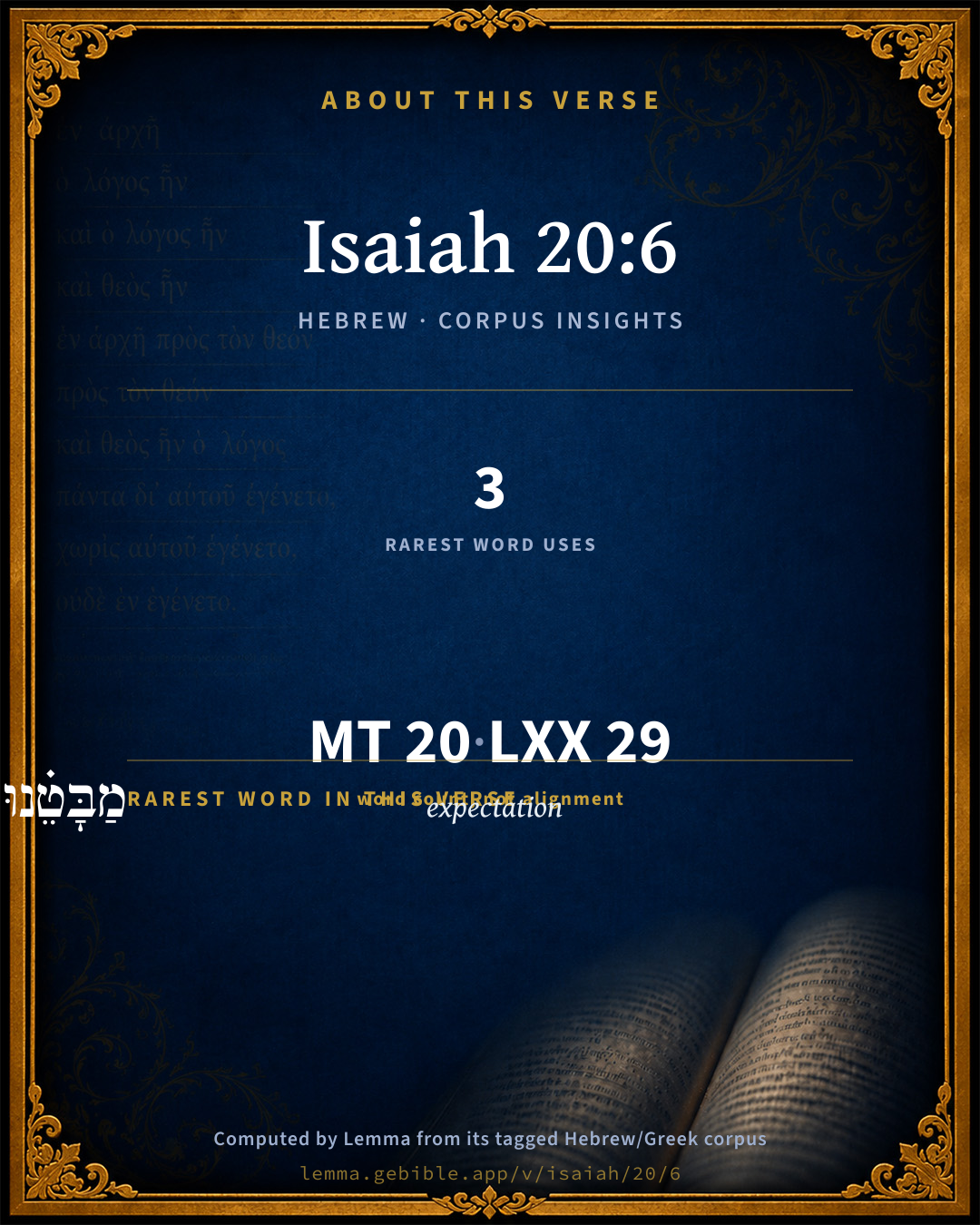
The rarest word here is מַבָּטֵ֗נוּ expectation H4007 — appearing just 3 times in the whole Hebrew Bible.

Shared distinctive vocabulary

מַבָּטֵ֗נוּ expectation H4007 occurs in 3 verses of the Hebrew Bible. Also found in:

Grammatical profile

  • 5 verbs
  • 7 nouns
  • 3 pronouns
  • 2 adverbs
  • 3 particles

Verb forms

  • וְ֠אָמַר Qal · Sequential Perfect
  • יֹשֵׁ֨ב Qal · Participle Active
  • נַ֤סְנוּ Qal · Perfect
  • לְהִ֨נָּצֵ֔ל Niphal · Infinitive Construct
  • נִמָּלֵ֥ט Niphal · Imperfect

Hebrew & Septuagint length

In English translation the verse runs 34 words from the Hebrew and 38 from the Septuagint (LXX English) — closely comparable.

A rough comparison of the two English renderings, which tokenize alike — not a word-level alignment.

Word counts can differ between the Hebrew and the Greek without any difference in meaning — e.g. the Hebrew direct-object marker אֵת has no separate Greek word, and Greek often adds the article ὁ.

In the original languages it is 20 Hebrew tokens and 29 Greek tokens — but the two are counted differently (Hebrew bundles its prefixes and suffixes into one token; the Greek is in lemma form), so that isn’t a like-for-like length.

Cross-references

12

Topical passages linked to Isaiah 20:6 in the Treasury of Scripture Knowledge — connected by theme and wording, ordered by reader-vote popularity; previews shown in the World English Bible.

  • Matthew 23:33 You serpents, you offspring of vipers, how will you escape the judgment of Gehenna?
  • 1 Thessalonians 5:3 For when they are saying, "Peace and safety," then sudden destruction will come on them, like birth pains on a pregnant woman; and they will in no way escape.
  • Hebrews 2:3 how will we escape if we neglect so great a salvation-- which at the first having been spoken through the Lord, was confirmed to us by those who heard;
  • Job 6:20 They were distressed because they were confident; They came there, and were confounded.
  • Job 22:30 He will even deliver him who is not innocent; Yes, he shall be delivered through the cleanness of your hands."
  • Isaiah 10:3 What will you do in the day of visitation, and in the desolation which shall come from far? to whom will you flee for help? and where will you leave your glory?
  • Isaiah 28:17 I will make justice the line, and righteousness the plummet; and the hail shall sweep away the refuge of lies, and the waters shall overflow the hiding-place.
  • Isaiah 30:1–7 Woe to the rebellious children, says Yahweh, who take counsel, but not of me; and who make a league, but not of my Spirit, that they may add sin to sin,
  • Isaiah 30:15–16 For thus said the Lord Yahweh, the Holy One of Israel, In returning and rest shall you be saved; in quietness and in confidence shall be your strength. You would not:
  • Isaiah 31:1–3 Woe to those who go down to Egypt for help, and rely on horses, and trust in chariots because they are many, and in horsemen because they are very strong, but they don't look to the Holy One of Israel, neither seek Yahweh!
  • Jeremiah 30:15–17 Why cry you for your hurt? your pain is incurable: for the greatness of your iniquity, because your sins were increased, I have done these things to you.
  • Jeremiah 47:4 because of the day that comes to destroy all the Philistines, to cut off from Tyre and Sidon every helper who remains: for Yahweh will destroy the Philistines, the remnant of the isle of Caphtor.

Cross-references courtesy of OpenBible.info (CC BY 4.0).

Hebrew and Greek witnesses Masoretic Hebrew ↔ Greek Septuagint

The same verse in the two great witnesses to the Old Testament, shown verse-for-verse.

These are two independent witnesses, not word-aligned to each other, and the Septuagint is shown in lemma (dictionary) form.

Hebrew Isaiah 20:6 Masoretic · Westminster Leningrad Codex

וְ֠אָמַר יֹשֵׁ֨ב הָאִ֣י הַזֶּה֮ בַּיּ֣וֹם הַהוּא֒ הִנֵּה כֹ֣ה מַבָּטֵ֗נוּ אֲשֶׁר נַ֤סְנוּ שָׁם֙ לְעֶזְרָ֔ה לְהִ֨נָּצֵ֔ל מִפְּנֵ֖י מֶ֣לֶךְ אַשּׁ֑וּר וְאֵ֖יךְ נִמָּלֵ֥ט אֲנָֽחְנוּ

The inhabitant of this coast-land shall say in that day, Behold, such is our expectation, where we fled for help to be delivered from the king of Assyria: and we, how shall we escape?

World English Bible · Public Domain

Greek LXX Isaiah 20:6 Septuagint · lemma form

καί εἶπον ὁ καταοἰκέω ἐν ὁ νήσος οὗτος ἰδού ἐγώ εἰμί πείθω ὁ φεύγω εἰς αὐτός εἰς βοήθεια ὅς οὐ δύναμαι σώζω ἀπό βασιλεύς ἀσσύριος καί πῶς ἐγώ σώζω

And they that dwell in this island shall say in that day, Behold, we trusted to flee to them for help, who could not save themselves from the king of the Assyrians: and how shall we be saved?

LXX2012 (modern English Septuagint) · Public Domain

Hebrew: Westminster Leningrad Codex (CC BY 4.0). Greek: Septuagint (public domain); English from LXX2012 (modern English Septuagint) (Public Domain). How the Septuagint differs from the Hebrew →

Targum (Aramaic paraphrase)

1

The Targum is the ancient Jewish Aramaic paraphrase of the Hebrew Scriptures — an interpretive translation, not the Hebrew text itself. Onkelos (literal) and Pseudo-Jonathan (expansive) render the Torah, and Jonathan the Prophets. Coverage is partial: where no permissively-licensed English translation exists for a verse, only the Aramaic is shown. This is verse-level text, not a word-by-word alignment to the Hebrew.

  1. Targum Jonathan Prophets (Joshua–Malachi)
    וְיֵמַר יָתֵיב נִסָא הָדֵין בְּעִדָנָא הַהִיא הַכְדֵין הֲוָה בֵית רוּחֲצָנָא דַהֲוֵינָא סְבִירִין לְמֶעְרוֹק לְתַמָן לְסָעִיד לְאִשְׁתֵּיזְבָא מִן קֳדָם מַלְכָּא דְאַתּוּר עַד כְּדוּן נַפְשֵׁהוֹן לָא שֵׁזִיבוּ וְאֵיכְדֵין נִשְׁתֵּזִיב אֲנָחְנָא:

    At that time the inhabitant of this island shall say: Such is become the place of our trust, to which we were hoping to flee for help to be delivered from before the king of Assyria, if hitherto they could not deliver themselves, how shall we be delivered?

    Targum Jonathan — Aramaic: “Mikraot Gedolot” (public domain). English: “Sefaria Community Translation” (CC0 1.0 (public-domain dedication)); “London "Chaldee Paraphrase," 1871” (public domain). Text via Sefaria.

Commentary

Notes on Isaiah 20:6 from classic Christian and Jewish commentators (each source and its license shown beneath its notes). The classic Christian expositions comment on the surrounding passage and are grouped to its opening verse, so a note may address several verses; the Jewish commentaries on the Tanakh (Rashi and others) are per-verse, so they appear only where the commentator wrote on this verse.

Lemma curates 59 commentaries, every one of them public domain or Creative Commons licensed, each selected and text-cleaned for this edition rather than reprinted as found. About our sources →

Trapp's Complete Commentary

John Trapp

Isa 20:6 And the inhabitant of this isle shall say in that day, Behold, such [is] our expectation, whither we flee for help to be delivered from the king of Assyria: and how shall we escape?

Ver. 6. And the inhabitant of this isle shall say, &c.] Judea, though part of the continent, is here called an isle or island, whereas it was indeed an inland; (1.) Because it was bounded on the west with the Midland Sea, and on the east with the lake of Gennesaret; (2.) Because it was beset with many enemies, and beaten upon by the waves of wars from all parts, but especially from Egypt and Babylon, which is called a sea; {Isa 21:1; Isa 8:8} (3.) Because begirt with God’s favour, power, and protection, which was greater security to it than the sea is to Venice {a} (which yet is media insuperabilis unda), or than wooden walls can be to any island.

Behold, such is our expectation, &c.] Here is their shame, and well it might be, for if Hezekiah relied not upon the Egyptian for help against the Assyrian, yet the people did, as Rabshakeh also could tell. {2Ki 18:24}

And how shall we escape?] Here is their fear. {Isa 20:5} How much more shall wicked men say thus at the last day?

{a} Venice is environed with her embracing Neptune, to whom she marrieth herself with yearly nuptials, casting a ring into the sea.

John Trapp, A Commentary or Exposition upon All the Books of the Old and New Testament (1647–1656) — public domain. Text from a community e-Sword module.

Geneva Bible (1599)

Geneva Bible translators

Meaning, Judea, which was compassed about with their enemies, as an isle with waters.

Geneva Bible (1599) marginal notes — public domain. Text via Bolls.life.

Jamieson, Fausset & Brown

Robert Jamieson, A. R. Fausset & David Brown

isle--that is, coast on the Mediterranean--Philistia, perhaps Phœnicia (compare Isa 23:2; Isa 11:11; Isa 13:22; Psa 72:10).

we--emphatical; if Egypt, in which we trusted, was overcome, how shall we, a small weak state, escape?

He does not narrate the event, but graphically supposes himself a watchman in Babylon, beholding the events as they pass.

Next: Isaiah Chapter 21

Jamieson, Fausset & Brown — Commentary Critical and Explanatory on the Whole Bible (1871) — public domain (CC PDM 1.0). Text via the HelloAO Bible API.

Ellicott's Commentary for English Readers

(6) The inhabitant of this isle . . .—Better, as elsewhere, coast-land. Here it probably refers to the whole coast of Philistia, which had been foremost in the revolt, and Phœnicia, Tyre also having joined in it (Annals of Sargon in Lenormant’s Anc. Hist., i. 396). Cyprus, the conquest of which Sargon records (Records of the Past, vii. 51), may also be included. The whole sea-board population would find out too late that they could not resist Assyria even with the help of Egypt and Ethiopia.

A Bible Commentary for English Readers, edited by Charles John Ellicott (1878–1897) — public domain. Text from a community e-Sword module.

The Cambridge Bible for Schools and Colleges

gen. ed. J. J. S. Perowne

6. this isle] strictly: this coastland (as R.V.). The expression is most accurately descriptive of the Philistine country; but must include Judah. Isaiah did not go three years naked and barefoot for the sake of the Philistines. It no doubt embraces the territory of all the states concerned in the conspiracy—“this region.”

expectation here and Isa_20:5 is “object of expectation.” we has a position of great emphasis in the original.

The Cambridge Bible for Schools and Colleges (gen. ed. J. J. S. Perowne; Cambridge University Press, 1878–1918) — public domain. Text from a community e-Sword module.

John Gill's Exposition

And the inhabitants of this isle shall say, in that day,.... Not of Ashdod, Isa 20:1 or the isle of Caphtor, Jer 47:4 but the land of Israel, as both Jarchi and Kimchi interpret it; so called, because it bordered on the sea, as such countries are sometimes called isles; see Jer 25:22. Ben Melech interprets it of Jerusalem, and observes that the word signifies a place or country, whether it has a river or sea encompassing it, or not; besides, the land of Canaan had the Mediterranean sea on one side of it, and the sea of Galilee and Tiberias on the other, and was moreover separated from all other countries by the power, providence, and presence of God:

behold, such is our expectation, whither we flee for help, to be delivered from the king of Assyria; signifying that it was vain and foolish, and they had acted a very weak, as well as a wicked part, in having recourse to the Egyptians and Ethiopians to help them against the Assyrians, as it plainly appeared by both nations now being conquered by them:

and how shall we escape? seeing they had not, who were more powerful than they were; and how could they think that they could save them, who could not save themselves? and so the Targum,

"if they have not delivered their souls (themselves), how shall we be delivered?''

Next: Isaiah Chapter 21

John Gill's Exposition of the Whole Bible (1746–1763) — public domain (CC PDM 1.0). Text via the HelloAO Bible API.

Albert Barnes' Notes on the Bible

And the inhabitant - The dwellers generally.

Of this isle - The word אי 'iy “isle” is used here in the sense of “coast, or maritime” country, and is evidently applied to Palestine, or the land of Canaan, which is a narrow coast lying on the Mediterranean. That the word is often used in this sense, and may be applied to a maritime country, see the notes at Isa 13:22; Isa 41:1. The connection here requires us to understand it of Palestine.

Shall say ... - Shall condemn their own folly in trusting in Egypt, and seeking deliverance there.

And how shall we escape? - They shall be alarmed for their own safety, for the very nation on which they had relied had been made captive. And when the “stronger” had been subdued, how could the feeble and dependent escape a similar overthrow and captivity? All this was designed to show them the folly of trusting in the aid of another nation, and to lead them to put confidence in the God of their fathers.

Albert Barnes' Notes on the Bible (1834–1885) — public domain. Text from a community e-Sword/MySword module.

Matthew Poole's English Annotations

Of this isle; of this land, in which the prophet was, and to whose inhabitants these words were uttered. For the title of isles or islands in Scripture is frequently given not only to lands encompassed with the sea, but also to such countries as lay upon the sea-coasts, as Psa 72:10; Eze 26:15,18, as Palestine or Canaan did, yea, to such countries as are remote or separated from that place in or of which the words are spoken, as Est 10:1; Isa 24:15; 42:4,10, &c, as Canaan was from Egypt, or at least from Ethiopia. Add to this, that Canaan had some resemblance with an isle, either because it was almost encompassed with the Midland Sea on one side, and with the Dead Sea, and the Sea of Galilee or Tiberius and Jordan on the other side; or because, as isles are separated from other lands by the sea, so this land and people were seoarated from all the rest of the world by God’s special providence, and presence, and worship.

Such is our expectation; so vain is our hope placed upon such a people as are unable to deliver themselves, and much more to deliver us.

Whither we flee for help; to whom we now and usually trust; for this was the common disease of the people of Israel, although Hezekiah was in a good measure free from it, as we read, 2Ki 18:5.

How shall we escape? either by their help, who cannot defend themselves; or by our own strength, seeing they who were much more potent than we are could not escape.

Matthew Poole's English Annotations on the Holy Bible (1683–1685) — public domain. Text from a community e-Sword/MySword module.

Whedon's Commentary on the Bible

Daniel D. Whedon

6. Of this isle — This coastland from Gaza to Phenicia, and northward, how insignificant this compared with the thousand miles up the Nile covered by the great powers of Egypt and Ethiopia combined, on which Judah depended for help. Judah can now see her land all open as a foraging highway region for the conquering Assyrians, who are only too ready to take revenge for her alliance with the conquered countries. Well may the people cry out, How shall we escape? “We?” “We know the barbarities of war. We know the retributions laid on conquered dependants.” Nevertheless, during these direful wars, Jehovah did in considerable measure interfere for Jerusalem, on account of the theocratic fidelity of pious Hezekiah. See chapter 37.

Daniel D. Whedon (gen. ed.), Commentary on the Old and New Testaments (1874–1909) — public domain. Text from a community e-Sword module.

The Pulpit Commentary

The inhabitant of this isle; rather, of this coast (Knobel, Hitzig, Kay); i.e. of Palestine generally, which was a mere strip of coast compared with Egypt and Ethiopia. Sargon speaks of all the four powers who at this time "sought to Egypt," as "dwelling beside the sea" (G. Smith, "Eponym Canon," p. 130). Such is our expectation; rather, so hath it gone with our expectation; i.e. , with Egypt and Ethiopia.

A grove question with many applications.

"How shall we escape?" Egypt being reduced, no defense remained for Israel against the overwhelming power of Assyria. "This was the cry of despair at Jerusalem. But in such despair was her only hope. The destruction of Egypt and Ethiopia by the arms of Sennacherib weaned her from looking any longer to earthly powers for help, and raised her eyes to heaven" (Bishop Wordsworth). The expression, or exclamation, may be

I APPLIED TO PERSONAL TROUBLES. Oftentimes in life we are brought to extremities; we know not what to do, nor which way to take. In our difficulties, hedged in on every side, we cry out, "How shall we escape?" The Israelites cried thus when the Red Sea rolled before them, a wall of mountains barred the path, and an enraged foe hurried upon them from behind. The secret of peace and deliverance is, "Trust in the Lord, who maketh ways in the seas, and paths in the great waters.

II APPLIED TO THE POWER OF SIN. When it has become the enslavement of fixed habit. Compare St. Paul"s exclamation, "O wretched man that I am! who shall deliver me from the body of this death?" And see his triumphant answer, "I thank God through Jesus Christ our Lord.

III APPLIED TO THE PENALTIES OF SINNING. The "fearful looking for of judgment and fiery indignation, which shall consume the adversaries." The utter despair of escape is pictured in Scripture by the people crying to the very rocks to cover and hide them from the wrath of God and of the Lamb.

IV APPLIED TO OUR PRESENT OPPORTUNITIES OF SALVATION. The writer of the Epistle to the Hebrews finds expression for this: (Heb_2:2, Heb_2:3) "If the word spoken by angels was steadfast, and every transgression and disobedience received a just recompense of reward; how shall we escape, if we neglect so great salvation?" This grave question this great cry may be the cry of hopeful self-humiliation and distrust; and then to it God will be sure to respond. But it may be the cry of hopeless despair, the conviction that the day of grace is passed, that it is "too late;" and then God"s response must be holding aloof, and letting the overwhelming judgments come, if even thus at last the true humiliations may be wrought. R.T.

The Pulpit Commentary (1880–1919), ed. H.D.M. Spence-Jones & Joseph S. Exell — public domain. Text from a community e-Sword module.

John Wesley's Explanatory Notes

Of the country - Of this land, in which the prophet was, and to whose inhabitants, these words were uttered. Such - So vain is our hope placed upon such a people as are unable to deliver themselves.

John Wesley, Explanatory Notes Upon the Whole Bible (1754–1765) — public domain. Text via the GEBible commentary corpus.

J. A. Alexander on Isaiah

Joseph Addison Alexander

“And the inhabitant of this isle (or coast) shall say in that day, Behold, thus (or such) is our expectation, whither we fled for help, to be delivered from the presence of the king of Assyria. And how shall we (ourselves) escape?” The disappointment described in the foregoing verse is now expressed by those who felt it. The argument is one a fortiori. If the protectors were subdued, what must become of the protected? The pronoun in the last clause is emphatic, as it usually is when not essential to the sense. The Hebrew word for island has no exact equivalent in English. Three distinct shades or gradations of meaning seem to be clearly marked in usage. The first is that of land as opposed to water; the second that of coast as opposed to inland; the third that of island as opposed to mainland. The last, although commonly expressed in most translations, is perhaps the least frequent of the three. The word here denotes the south-eastern shore of the Mediterranean, called this coast, in order to distinguish it from that coast, viz. Ethiopia and Egypt, which had just before been mentioned. As to the extent of country meant to be included, nothing of course can be determined from the word itself, which is designedly indefinite. Thus or such is our expectation, (i.e., this is the end of it, you see what has become of it, you see the fate of that to which we looked for help); how then can we ourselves be delivered or escape? See a similar expression 2Ki 10:4.

Joseph Addison Alexander, The Prophecies of Isaiah (1846–1847; New York: Scribner, 1870–1878) — public domain. Text from a community e-Sword module.

Rashi

Rabbi Shlomo Yitzchaki (Rashi)

the inhabitants of this isle The land of Israel, who relied on Pharoah for aid.

isle like the islands of the sea.

Rashi on the Tanakh — English translations: “The Judaica Press complete Tanach with Rashi, translated by A. J. Rosenberg” (CC BY 4.0); “Pentateuch with Rashi's commentary by M. Rosenbaum and A.M. Silbermann, 1929-1934” (public domain); “The Metsudah Tanach series, Lakewood, N.J” (CC BY 4.0); and “The Book of Joshua, Metsudah Publications, 1997” (CC BY 4.0). Text via Sefaria.

Ibn Ezra

Rabbi Abraham ibn Ezra

The inhabitant of this isle. The Israelites, who live in these islands near Egypt, will say,

This has happened to those to whom we fled, etc.

Ibn Ezra on the Tanakh — English translations: “Sefaria Community Translation” (CC0 1.0 (public-domain dedication)); “Yalkut, Sifsei Chachomim Chumash, Metsudah Publications, 2009” (CC BY 4.0); and “Commentary of Ibn Ezra on Isaiah - trans. by M. Friedlander, 1873” (public domain). Text via Sefaria.

Lesson kit

Teaching starters — assembled from the data on this page, not authored interpretation. Every prompt links to the verse data it draws on. Edit before teaching.

Isaiah, in the Prophets, opens this verse with 20 words (20 distinct Hebrew lemmas). Its most distinctive word is mabbâṭ (“expectation”). A historical commentator’s framing appears above. Read the whole chapter for the surrounding context.

Discussion questions

  1. What does “expectation” (mabbâṭ) contribute to the verse as a whole?
  2. How does Isaiah 20:5, which shares the word «expectation», read alongside this verse?
  3. These translations render this verse differently. What is at stake in choosing one wording over another?
  4. «וְ֠אָמַר» is a Qal Sequential Perfect verb. How does that grammatical form shape the action described?
  5. Compare how Trapp's Complete Commentary and Geneva Bible (1599) read this verse. Where do they agree or differ?

Things to notice

Reading settings

Reading text

Shown beneath each verse's original-language words.

Old Testament
Old Testament edition

Read the OT as the Masoretic Hebrew (MT) or the Greek Septuagint (LXX).

English shown for the Greek Septuagint (in the Hebrew ↔ Greek comparison).

Comparing translations? Open the Compare panel on any verse page to stack up to four side by side.