
Job 5:19

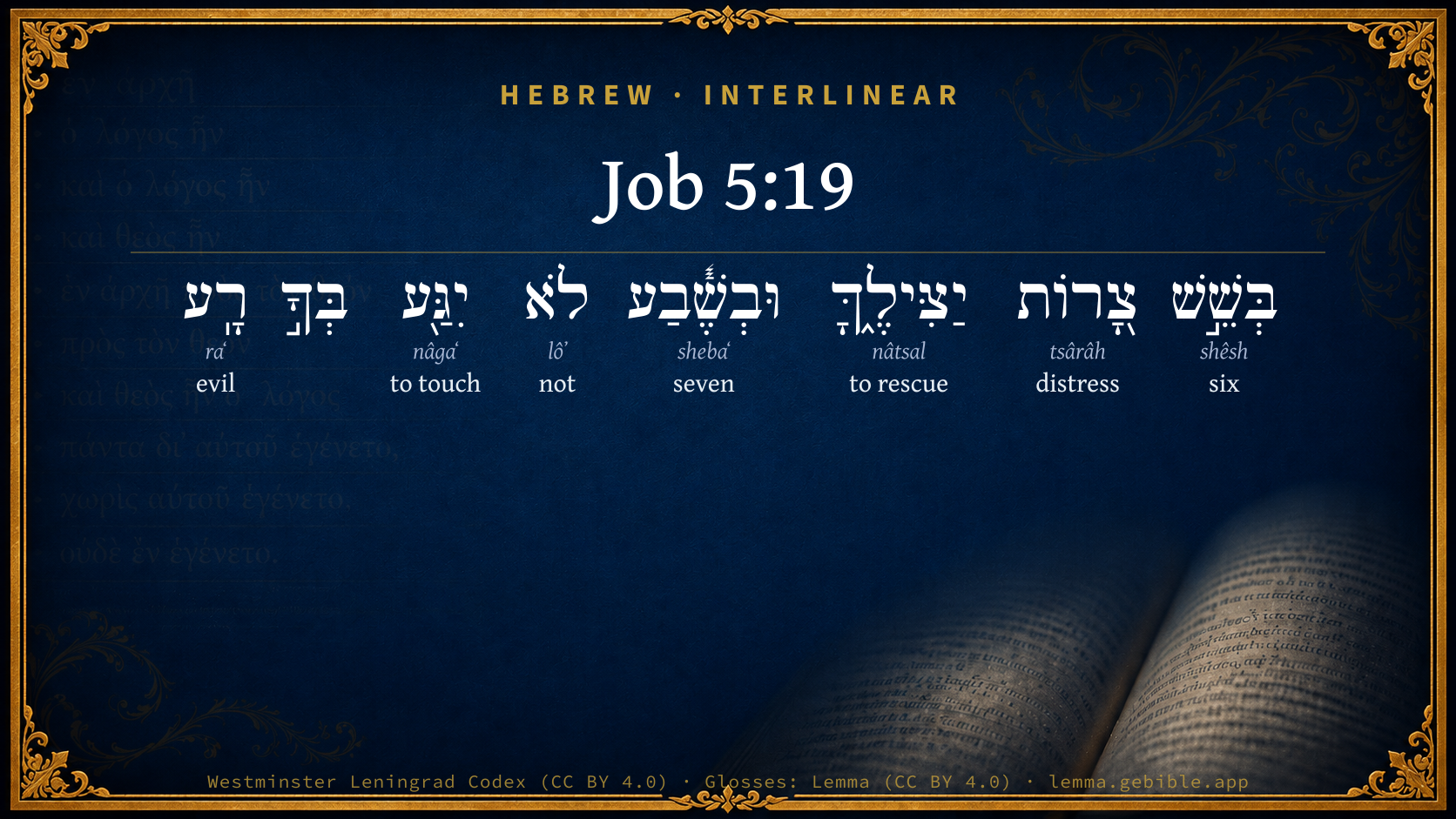
Hebrew (Westminster Leningrad Codex) Job 5:19 appears in the Hebrew Old Testament. The text above is from the Westminster Leningrad Codex. Each word links to its Strong’s number, a concise gloss, and parsing drawn from the Open Scriptures Hebrew Bible morphology. Click any word for its full Brown-Driver-Briggs (BDB) entry.
Download image
Cite this verse

Job 5:19 (World English Bible). Public Domain. Lemma interlinear Bible study tool, https://lemma.gebible.app/v/job/5/19.

Show BibTeX & RIS
BibTeX
RIS
English Translation
He will deliver you in six troubles; Yes, in seven there shall no evil touch you.
World English Bible · Public Domain
Download a study sheet

One document with this verse’s original text, its word-by-word gloss line, the meaning frame, cross-references with their text, attributed commentary, and full source and license credits — printable, and it pastes into notes with its structure intact.

This verse Autodidact and up

Study sheet (.html) Plain text (.txt)

A passage Seminary Student

Up to 50 verses in one chapter. A passage sheet keeps up to 6 commentary sources and 12 cross-references per verse, in the order this page ranks them, and says so on the sheet whenever that leaves anything out. Ask for a single verse and you get the Autodidact verse sheet above.

Everything on this page stays free to read, with no account — the sheet is a download of what is already on screen, not access to it.

Want to remove ads? Support Godless Engineer
Compare translations 3

The same verse in 3 English versions, stacked beneath the original-language interlinear above. Click any original word for its lexicon entry.

Each is an independent rendering of the whole verse — the interlinear is not word-aligned to these translations.

Highlighted words mark where these versions differ — a whole-verse word diff, not a word-by-word alignment.

  • World English Bible Public Domain
    He will deliver you in six troubles; Yes, in seven there shall no evil touch you.
  • King James Version Public Domain
    He shall deliver thee in six troubles: yea, in seven there shall no evil touch thee.
  • unfoldingWord Literal Text CC BY-SA 4.0
    In six troubles he will rescue you, and in seven, harm will not touch you.

unfoldingWord Literal Text — © unfoldingWord, licensed CC BY-SA 4.0. Word-aligned USFM3 via Door43 (git.door43.org/unfoldingWord/en_ult).

Versions to compare (up to 4)

3 of 4 selected

Show all 18 translations

Every available English version of this verse, each an independent rendering of the whole verse.

  • World English Bible Public Domain
    He will deliver you in six troubles; Yes, in seven there shall no evil touch you.
  • Berean Standard Bible Public Domain
    He will rescue you from six calamities; no harm will touch you in seven.
  • Majority Standard Bible Public Domain
    He will rescue you from six calamities; no harm will touch you in seven.
  • King James Version Public Domain
    He shall deliver thee in six troubles: yea, in seven there shall no evil touch thee.
  • American Standard Version (1901) Public Domain
    He will deliver thee in six troubles; Yea, in seven there shall no evil touch thee.
  • Revised Version (1885) Public Domain
    He shall deliver thee in six troubles; yea, in seven there shall no evil touch thee.
  • Geneva Bible (1599) Public Domain
    He shall deliuer thee in sixe troubles, and in the seuenth the euill shall not touch thee.
  • Douay-Rheims (1899) Public Domain
    In six troubles he shall deliver thee, and in the seventh, evil shall not touch thee.
  • Young's Literal Translation Public Domain
    In six distresses He delivereth thee, And in seven evil striketh not on thee.
  • Literal Standard Version CC BY-SA 4.0
    In six distresses He delivers you, || And in seven evil does not strike on you.
  • Unlocked Literal Bible CC BY-SA 4.0
    He will rescue you out of six troubles; indeed, in seven troubles, no evil will touch you.
  • unfoldingWord Literal Text CC BY-SA 4.0
    In six troubles he will rescue you, and in seven, harm will not touch you.
  • Darby Bible Public Domain
    He will deliver thee in six troubles, and in seven there shall no evil touch thee.
  • World Messianic Bible Public Domain
    He will deliver you in six troubles; yes, in seven no evil will touch you.
  • Webster's Bible Public Domain
    He will deliver thee in six troubles: yea, in seven there shall no evil touch thee.
  • Free Bible Version CC BY-SA 4.0
    He will save you from many disasters; a multitude of evils will not affect you.
  • Bible in Basic English Public Domain
    He will keep you safe from six troubles, and in seven no evil will come near you.
  • JPS Tanakh (1917) Public Domain
    He will deliver thee in six troubles; yea, in seven there shall no evil touch thee.

Literal Standard Version (2020), Covenant Press — licensed CC BY-SA 4.0. Text via the HelloAO Bible API (eBible.org). Unlocked Literal Bible (unfoldingWord) — licensed CC BY-SA 4.0. Text via the HelloAO Bible API (eBible.org). unfoldingWord Literal Text — © unfoldingWord, licensed CC BY-SA 4.0. Word-aligned USFM3 via Door43 (git.door43.org/unfoldingWord/en_ult). Free Bible Version, Dr. Jonathan Gallagher — licensed CC BY-SA 4.0. Text via the HelloAO Bible API (eBible.org).

Word by word

More ways to search: Search by grammar → Find every occurrence → Compare this word →

Practice this passage: Drill this verse → Learn its vocabulary →

About this verse

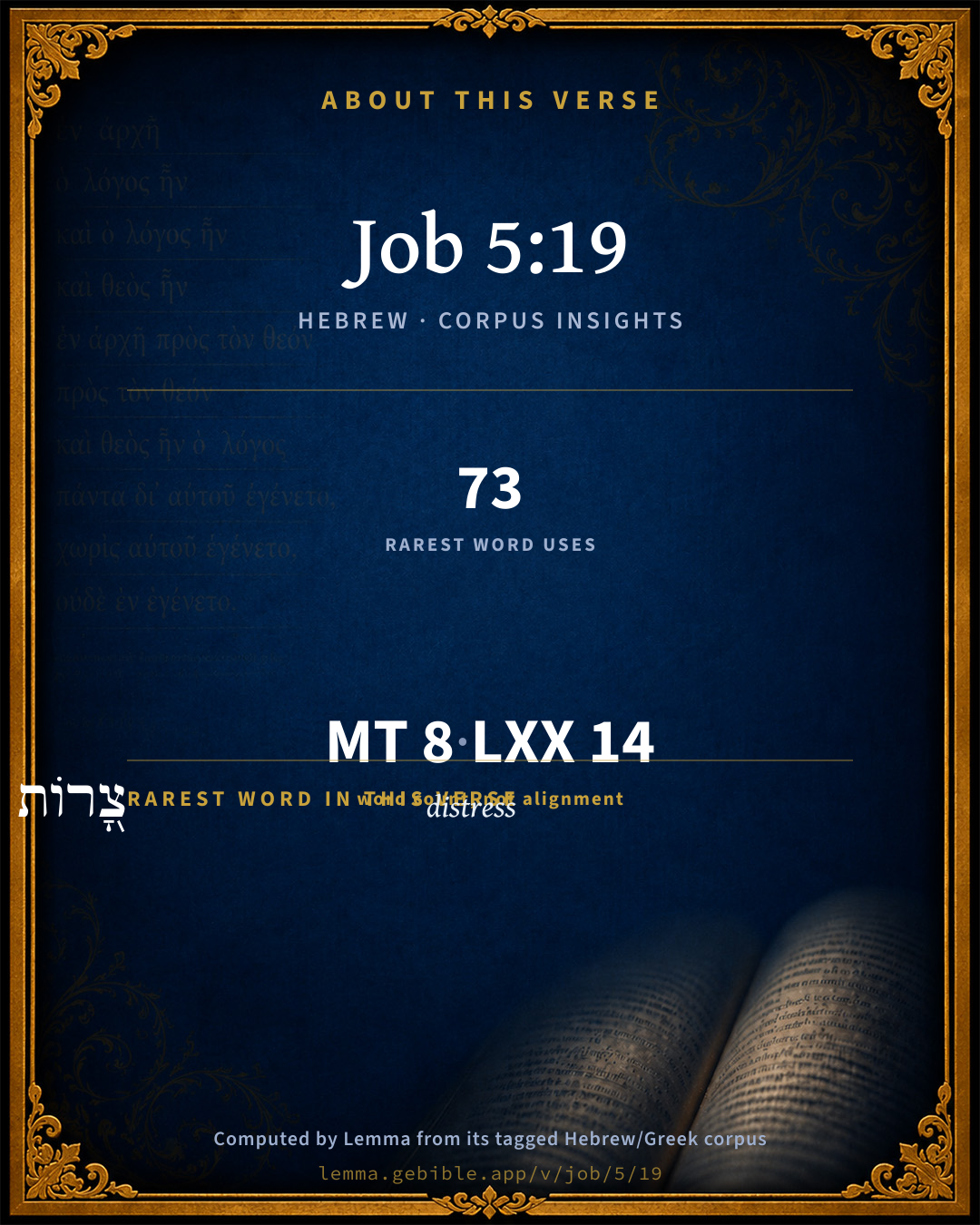
These counts appear in no published source. They are computed here, from the morphology-tagged text and Lemma’s own curated glosses. What Lemma adds →

8
words
7
distinct lemmas
Wisdom
section

Grammatical profile

  • 2 verbs
  • 1 noun
  • 3 adjectives
  • 1 preposition
  • 1 particle

Verb forms

  • יַצִּילֶ֑ךָּ Hiphil · Imperfect
  • יִגַּ֖ע Qal · Imperfect

Hebrew & Septuagint length

In English translation the verse runs 16 words from the Hebrew and 18 from the Septuagint (LXX English) — closely comparable.

A rough comparison of the two English renderings, which tokenize alike — not a word-level alignment.

Word counts can differ between the Hebrew and the Greek without any difference in meaning — e.g. the Hebrew direct-object marker אֵת has no separate Greek word, and Greek often adds the article ὁ.

In the original languages it is 8 Hebrew tokens and 14 Greek tokens — but the two are counted differently (Hebrew bundles its prefixes and suffixes into one token; the Greek is in lemma form), so that isn’t a like-for-like length.

Cross-references

6

Topical passages linked to Job 5:19 in the Treasury of Scripture Knowledge — connected by theme and wording, ordered by reader-vote popularity; previews shown in the World English Bible.

  • Psalms 34:19 Many are the afflictions of the righteous, But Yahweh delivers him out of them all.
  • 1 Corinthians 10:13 No temptation has taken you except what is common to man. God is faithful, who will not allow you to be tempted above what you are able, but will with the temptation also make the way of escape, that you may be able to endure it.
  • Psalms 91:3–10 For he will deliver you from the snare of the fowler, And from the deadly pestilence.
  • Proverbs 24:16 For a righteous man falls seven times, and rises up again; But the wicked are overthrown by calamity.
  • 2 Peter 2:9 the Lord knows how to deliver the godly out of temptation and to keep the unrighteous under punishment for the day of judgment;
  • 2 Corinthians 1:8 For we don't desire to have you uninformed, brothers, concerning our affliction which happened to us in Asia, that we were weighed down exceedingly, beyond our power, so much that we despaired even of life.

Cross-references courtesy of OpenBible.info (CC BY 4.0).

Hebrew and Greek witnesses Masoretic Hebrew ↔ Greek Septuagint

The same verse in the two great witnesses to the Old Testament, shown verse-for-verse.

These are two independent witnesses, not word-aligned to each other, and the Septuagint is shown in lemma (dictionary) form.

Hebrew Job 5:19 Masoretic · Westminster Leningrad Codex

בְּשֵׁ֣שׁ צָ֭רוֹת יַצִּילֶ֑ךָּ וּבְשֶׁ֓בַע לֹא יִגַּ֖ע בְּךָ֣ רָֽע

He will deliver you in six troubles; Yes, in seven there shall no evil touch you.

World English Bible · Public Domain

Greek LXX Job 5:19 Septuagint · lemma form

ἑξάκις ἐκ ἀνάγκη σύ ἐκαἱρέω ἐν δέ ὁ ἕβδομος οὐ μή ἅπτομαι σύ κακός

Six time he shall deliver you out of distresses: and in the seventh harm shall not touch you.

LXX2012 (modern English Septuagint) · Public Domain

Hebrew: Westminster Leningrad Codex (CC BY 4.0). Greek: Septuagint (public domain); English from LXX2012 (modern English Septuagint) (Public Domain). How the Septuagint differs from the Hebrew →

Commentary

Notes on Job 5:19 from classic Christian and Jewish commentators (each source and its license shown beneath its notes). The classic Christian expositions comment on the surrounding passage and are grouped to its opening verse, so a note may address several verses; the Jewish commentaries on the Tanakh (Rashi and others) are per-verse, so they appear only where the commentator wrote on this verse.

Lemma curates 59 commentaries, every one of them public domain or Creative Commons licensed, each selected and text-cleaned for this edition rather than reprinted as found. About our sources →

Trapp's Complete Commentary

John Trapp

Job 5:19 He shall deliver thee in six troubles: yea, in seven there shall no evil touch thee.

Ver. 19. He shall deliver thee] Heb. Snatch thee away, or pull thee out, as a brand out of the fire, or as a prey out of the teeth of a wild beast. Thus God snatched Lot out of Sodom, David out of many waters, Paul out of the mouth of the lion, Jonah out of the belly of hell, &c. As birds flying, so will I defend Jerusalem, Isa 31:5. A metaphor from the eagle and other birds, which when they fly highest set a watchful eye upon the nest, to rescue their young ones in case of danger.

In six troubles] Or straits, such as enemies or other evils put men to. Israel at the Red Sea, for instance, where they were sorely distressed, encircled with troubles, neither was there any way of escape, unless they could have gone up to heaven, which because they could not, heaven came down to them and delivered them.

Yea, in seven] A certain number for an uncertain. Boundless deliverances will God grant to his people, even as oft as they shall need deliverance; enemies oft plough upon their backs, and God as often cuts their traces, Psa 129:3-4. As Cato was two and thirty times accused, and two and thirty times cleared and absolved; so shall it be with the saints; and this not only at the end of the world, as Gregory and others interpret this text (as if by six and seven allusion were made to God’s creating the world in six days, and resting on the seventh; and so must his servants labour here under afflictions, and rest in heaven), but in this life present, where many are the troubles of the righteous (millions, some render it), but the Lord delivereth them out of all, Psa 34:19; yea, in them all, as this text hath it, by his supporting grace, and those divine comforts, which, as blown bladders, bear them aloft all waters.

There shall no evil touch thee] sc. Tactu qualitativo, with a deadly touch. God chargeth afflictions as David did his captains concerning Absalom, Handle the young man gently for my sake. Touch not mine anointed, &c. Either touch them not at all, or not to hurt them. Troubles may touch the saints, but evils must not, 1Co 10:14.

John Trapp, A Commentary or Exposition upon All the Books of the Old and New Testament (1647–1656) — public domain. Text from a community e-Sword module.

Tyndale Open Study Notes

Tyndale Open Resources

5:19-26 six disasters . . . even in the seventh: This wisdom formula reflects a sense of completeness (cp. Prov 30:15-31). • This list reflects Mosaic covenant blessings and curses (Lev 26; Deut 28). Eliphaz thought that people in right relationship with God would be free from famine (Job 5:20, 22; see Lev 26:4-5, 10; Deut 28:4-6, 8, 11-12), war (i.e., death, Job 5:20) and the destruction it causes (5:21, 22; see Lev 26:6-8; Deut 28:7, 48), and slander. They will even be at peace with wild animals (Job 5:23; see Lev 26:6) and the stones of the field. This peace might indicate fertile rather than stony fields (2 Kgs 3:19, 25; Matt 13:5), or it might symbolize wider harmony with the natural world (see Ps 91:11-12).

Tyndale Open Study Notes — © Tyndale Open Resources, licensed CC BY-SA 4.0. Text via the HelloAO Bible API.

Geneva Bible (1599)

Geneva Bible translators

He will send trouble after trouble that his children may not for one time, but continually trust in him: but they shall have a comfortable issue, even in the greatest and the last, which is here called the seventh.

Geneva Bible (1599) marginal notes — public domain. Text via Bolls.life.

Jamieson, Fausset & Brown

Robert Jamieson, A. R. Fausset & David Brown

in six . . . yea, in seven-- (Pro 6:16; Amo 1:3). The Hebrew idiom fixes on a certain number (here "six"), in order to call attention as to a thing of importance; then increases the force by adding, with a "yea, nay seven," the next higher number; here "seven," the sacred and perfect number. In all possible troubles; not merely in the precise number "seven."

Jamieson, Fausset & Brown — Commentary Critical and Explanatory on the Whole Bible (1871) — public domain (CC PDM 1.0). Text via the HelloAO Bible API.

Adam Clarke's Commentary

Verse 19. He shall deliver thee in six troubles] The numbers six and seven are put here for many. Though a number of troubles should come upon thee all at once, and there should be no hope, humanly speaking, yet God would rid thee out of them all; for he saves as well from many as from few. We may also understand the words, He who hath been thy deliverer in past troubles, will not deny his help in those which are to come.

Adam Clarke's Commentary on the Bible (1810–1826) — public domain. Text from a community e-Sword/MySword module.

Ellicott's Commentary for English Readers

(19) In six troubles.—The special form of speech here used is characteristic mainly of the Proverbs (see Job_6:16; Job_30:15; Job_30:18; Job_30:21). Since evil was emphatically touching Job, the actual irony of these words must have been bitter indeed.

A Bible Commentary for English Readers, edited by Charles John Ellicott (1878–1897) — public domain. Text from a community e-Sword module.

The Cambridge Bible for Schools and Colleges

gen. ed. J. J. S. Perowne

19. “Six” and “seven” are round numbers meaning “many” or “all,” like “three” and “four” and other numbers, elsewhere, cf. Pro_6:16; see Amo_1:3 seq., Mic_5:5. Eliphaz assumes that God’s afflictions will have their due effect on Job, he will turn unto the Lord, whose hands will “make him whole,” and the care and protection specified in this and the following verses shall mark his restored life.

The Cambridge Bible for Schools and Colleges (gen. ed. J. J. S. Perowne; Cambridge University Press, 1878–1918) — public domain. Text from a community e-Sword module.

John Gill's Exposition

He shall deliver thee in six troubles,.... Behaving as before directed; seeking unto God, committing his cause and case to him, and leaving it with him; and not despising the chastening of the Lord, but receiving and bearing it with reverence, patience, and submission: and then the sense is, that God would deliver out of whatsoever troubles he was or should be in, though they were ever so many; a certain number being put for an uncertain one, Psa 34:19,

yea, seven there shall no evil touch thee; which is a number expressive of multitude and of perfection, and so may denote the multitude and fulness of afflictions: the tribulations of God's people are many, through which they pass to heaven, and there is a measure of them to be filled up; and when they are come to the height, and the measure is fully up, then the Lord puts a stop to them, and delivers out of all their troubles; and in the midst of them all, so preserves them, that "no evil" shall so much as "touch" them; not the evil of punishment; for, though those troubles and afflictions that attend them are evil things, in a natural or civil sense, they are disagreeable and distressing, yet they are not the effect of vindictive justice; there is not a drop wrath and vengeance in them; and though they do come upon them and unto them, upon their persons and families; yet not so as to do any real hurt, or as to destroy them; see Psa 91:10; some think that seven particular troubles are meant, hereafter mentioned, as Jarchi; as famine, war, an evil tongue, destruction, dearness of provision, the beasts of the earth, and the stones of the field.

John Gill's Exposition of the Whole Bible (1746–1763) — public domain (CC PDM 1.0). Text via the HelloAO Bible API.

Albert Barnes' Notes on the Bible

He shall deliver thee in six troubles - Six is used here to denote an indefinite number, meaning that he would support in many troubles. This mode of speech is not uncommon among the Hebrews, where one number is mentioned, so that an extreme number may be immediately added. The method is, to mention a number within the limit, and then to add one more, meaning that in all instances the thing referred to would occur. The limit here is seven, with the Hebrews a complete and perfect number; and the idea is, that in any succession of troubles, however numerous, God was able to deliver. Similar expressions not unfrequently occur. Thus, in Amo 1:3, Amo 1:6,Amo 1:9, Amo 1:11, Amo 1:13; Amo 2:1, Amo 2:4,Amo 2:6 :

Thus saith the Lord:

For three transgressions of Damascus, and for four,

I will not turn away the punishment thereof.

Thus saith the Lord:

For three transgressions of Gaza, and for four,

I will not turn away, the punishment thereof.

Thus saith the Lord:

For three transgressions of Tyrus, and for four,

I will not turn away the punishment thereof.

Thus in Pro 30:15 :

There are three things that are never satisfied,

Yea, four things say not, It is enough.

There be three things that are too wonderful for me,

Yea, four which I know not. Pro 30:18.

For three things the earth is disquieted,

And for four which it cannot bear.” Pro 30:21.

There be three things that go well,

Yea, four are comely in going:

A lion which is strongest among beasts,

And turneth not away for any;

A grey-hound;

An he-goat also;

And a king, against whom there is no rising up.” Pro 30:29-31.

Compare Homer, Iliad vi. 174:

Εννήμαρ ξείνισσε καὶ ἐννέα βοῦς ἱέρευσεν

Ennēmar ceinisse kai ennea bous hiereusen.

An enumeration, in regard to number similar to the one before us, occurs in Pro 6:16 :

These six things doth the Lord hate;

Yea, seven are an abomination to him.

There shall no evil touch thee - That is, permanently; for he could not mean that he would not be subjected to calamity at all, since by the very supposition he was a sufferer. But the sense is, that God would save from those calamities.

Albert Barnes' Notes on the Bible (1834–1885) — public domain. Text from a community e-Sword/MySword module.

Haydock's Catholic Bible Commentary

In six, mentioned below; (Menochius) or in many, indefinitely. (Calmet) --- Both during the six days of (Menochius) life, and at death, God’s grace delivers us. (St. Gregory) (Worthington)

George Leo Haydock (1774–1849), Haydock's Catholic Family Bible and Commentary, 1859 edition — public domain. Excludes Psalms (Douay-Rheims chapter numbering differs from Protestant) and Deuterocanonical books (Catholic canon only).

Matthew Poole's English Annotations

He shall deliver thee, to wit, if thou seekest to him by prayer and repentance.

Six, i.e. manifold or repeated; as six is used for many, Pro 6:16.

There shall no evil touch thee, to wit, so as to undo or destroy thee, as touching is used, Jos 9:19; Heb 11:28; 1Jo 5:18. See also Gen 26:11,29; 2Sa 14:10; Psa 105:15; Zec 2:8. Thou shalt have a good issue out of all thy troubles, though they are both great and many.

Matthew Poole's English Annotations on the Holy Bible (1683–1685) — public domain. Text from a community e-Sword/MySword module.

Whedon's Commentary on the Bible

Daniel D. Whedon

19. Six troubles — The speaker first incidentally suggests six, but as seven is the number expressive of completeness, he adds “in seven troubles;” that is, in all troubles, God will protect us against evil. He goes on to specify a few, say five, troubles, although Cocceius and Schultens conceive that seven are enumerated. Davidson sees a fine gradation in the ills, and observes that they are coupled together in pairs: — First pair: Public national calamity — famine and sword, (20.) Second pair: Personal private wrong from the powerful or malevolent — calumny, violence, (21.) Third pair: Personal private misfortune — hunger, (want from failure,) beasts of the field, (ravages on private property,) (22, 23.) “The number seven was esteemed a holy number also among other peoples, as the Persians, Hindus, and the ancient Germans.” — WINER, Rwb. This wondrous word “SEVEN,” according to Cicero, contains the mystery of all things, and tends, as Hippocrates, the ancient philosopher, said, through its occult virtues to the evolution of all things. The identity of the Hebrew word with שׁבע, “to swear,” “take an oath,” as if men swore by this word seven, shows that from very ancient times it has been associated with a sacred idea.

Daniel D. Whedon (gen. ed.), Commentary on the Old and New Testaments (1874–1909) — public domain. Text from a community e-Sword module.

The Pulpit Commentary

He shall deliver thee in six troubles: yea, in seven. (comp. Amo_1:3, Amo_1:6, Amo_1:9, Amo_1:11, Amo_1:13, "For three transgressions... and for four An idiomatic way of expressing an indefinite number. There shall no evil touch thee; i.e. no real evil, nothing calculated to do thee real hurt. All affliction is "for the present grievous;" but if it "afterward yieldeth the peaceable fruit of righteousness unto them that are exercised thereby", (Heb_12:11) it does not do us harm, but good.

The Pulpit Commentary (1880–1919), ed. H.D.M. Spence-Jones & Joseph S. Exell — public domain. Text from a community e-Sword module.

John Wesley's Explanatory Notes

Deliver - If thou seekest to him by prayer and repentance. Here he applies himself to Job directly. Six - Manifold and repeated. Touch - So as to destroy thee. Thou shalt have a good issue out of all thy troubles, though they are both great and many.

John Wesley, Explanatory Notes Upon the Whole Bible (1754–1765) — public domain. Text via the GEBible commentary corpus.

Rashi

Rabbi Shlomo Yitzchaki (Rashi)

In six troubles When they come to the world, he will save you through the pains with which you wee tormented, and also with the seventh one, which when it comes will not touch you.

Rashi on the Tanakh — English translations: “The Judaica Press complete Tanach with Rashi, translated by A. J. Rosenberg” (CC BY 4.0); “Pentateuch with Rashi's commentary by M. Rosenbaum and A.M. Silbermann, 1929-1934” (public domain); “The Metsudah Tanach series, Lakewood, N.J” (CC BY 4.0); and “The Book of Joshua, Metsudah Publications, 1997” (CC BY 4.0). Text via Sefaria.

Lesson kit

Teaching starters — assembled from the data on this page, not authored interpretation. Every prompt links to the verse data it draws on. Edit before teaching.

Job, in the Wisdom, opens this verse with 8 words (7 distinct Hebrew lemmas). Its most distinctive word is tsârâh (“distress”). A historical commentator’s framing appears above. Read the whole chapter for the surrounding context.

Discussion questions

  1. The word tsârâh carries the sense “distress.” How does it shape the verse?
  2. Psalms 34:19 shares this passage’s theme. How do the two illuminate each other?
  3. These translations render this verse differently. What is at stake in choosing one wording over another?
  4. The verb «יַצִּילֶ֑ךָּ» is Hiphil Imperfect. How does its form color the action?
  5. Reading how Trapp's Complete Commentary and Tyndale Open Study Notes read this verse, where do the two commentators agree and where do they part?

Things to notice

Reading settings

Reading text

Shown beneath each verse's original-language words.

Old Testament
Old Testament edition

Read the OT as the Masoretic Hebrew (MT) or the Greek Septuagint (LXX).

English shown for the Greek Septuagint (in the Hebrew ↔ Greek comparison).

Comparing translations? Open the Compare panel on any verse page to stack up to four side by side.