Psalms 144:7

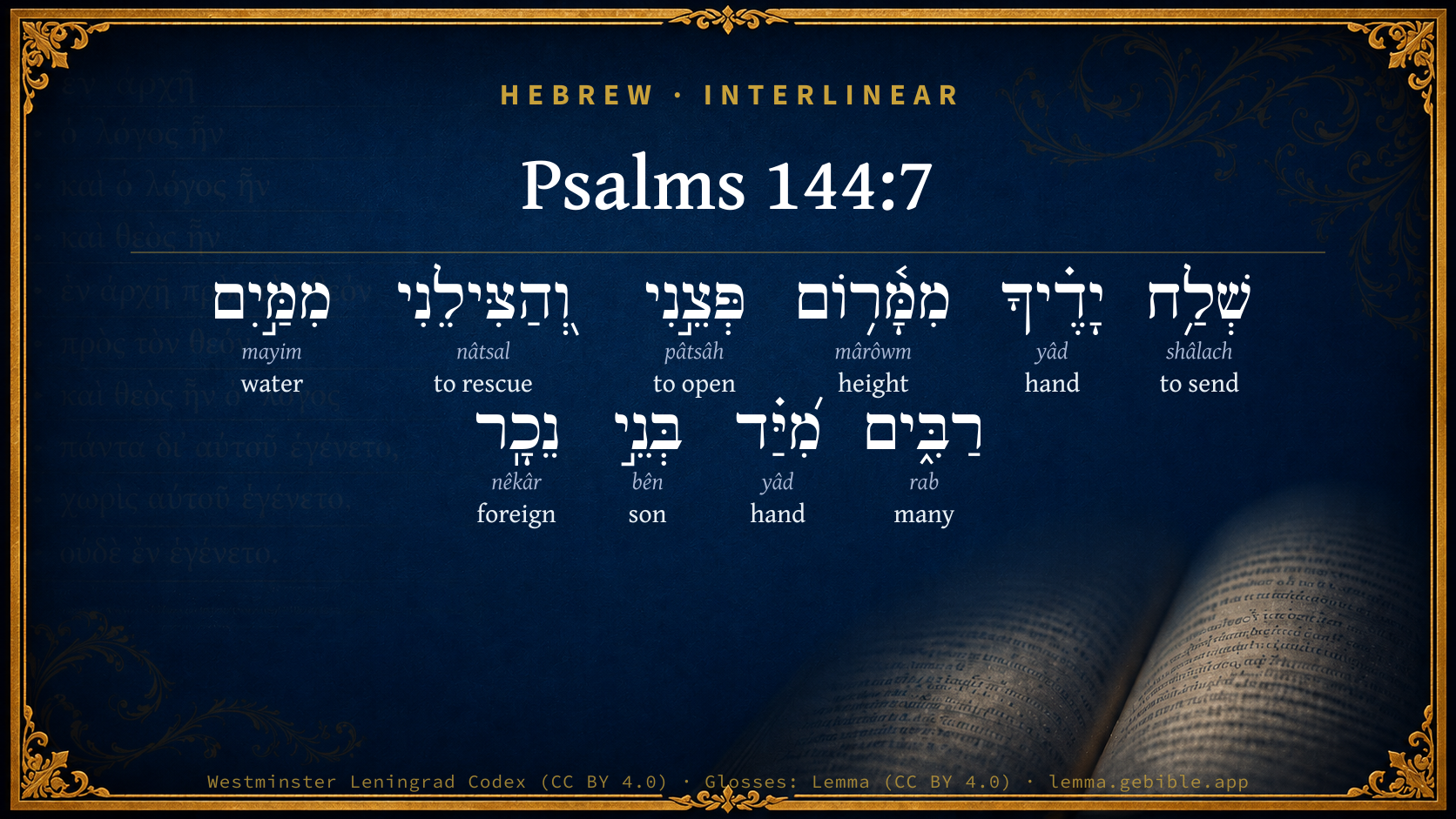
Hebrew (Westminster Leningrad Codex) Psalms 144:7 appears in the Hebrew Old Testament. The text above is from the Westminster Leningrad Codex. Each word links to its Strong’s number, a concise gloss, and parsing drawn from the Open Scriptures Hebrew Bible morphology. Click any word for its full Brown-Driver-Briggs (BDB) entry.
Download image
Cite this verse

Psalms 144:7 (World English Bible). Public Domain. Lemma interlinear Bible study tool, https://lemma.gebible.app/v/psalms/144/7.

Show BibTeX & RIS
BibTeX
RIS
English Translation
Stretch out your hand from above, Rescue me, and deliver me out of great waters, Out of the hands of foreigners;
World English Bible · Public Domain
Download a study sheet

One document with this verse’s original text, its word-by-word gloss line, the meaning frame, cross-references with their text, attributed commentary, and full source and license credits — printable, and it pastes into notes with its structure intact.

This verse Autodidact and up

Study sheet (.html) Plain text (.txt)

A passage Seminary Student

Up to 50 verses in one chapter. A passage sheet keeps up to 6 commentary sources and 12 cross-references per verse, in the order this page ranks them, and says so on the sheet whenever that leaves anything out. Ask for a single verse and you get the Autodidact verse sheet above.

Everything on this page stays free to read, with no account — the sheet is a download of what is already on screen, not access to it.

Want to remove ads? Support Godless Engineer
Compare translations 3

The same verse in 3 English versions, stacked beneath the original-language interlinear above. Click any original word for its lexicon entry.

Each is an independent rendering of the whole verse — the interlinear is not word-aligned to these translations.

Highlighted words mark where these versions differ — a whole-verse word diff, not a word-by-word alignment.

  • World English Bible Public Domain
    Stretch out your hand from above, Rescue me, and deliver me out of great waters, Out of the hands of foreigners;
  • King James Version Public Domain
    Send thine hand from above; rid me, and deliver me out of great waters, from the hand of strange children;
  • unfoldingWord Literal Text CC BY-SA 4.0
    Send your hands from above; break me free and deliver me from many waters, from the hand of sons of a foreigner,

unfoldingWord Literal Text — © unfoldingWord, licensed CC BY-SA 4.0. Word-aligned USFM3 via Door43 (git.door43.org/unfoldingWord/en_ult).

Versions to compare (up to 4)

3 of 4 selected

Show all 18 translations

Every available English version of this verse, each an independent rendering of the whole verse.

  • World English Bible Public Domain
    Stretch out your hand from above, Rescue me, and deliver me out of great waters, Out of the hands of foreigners;
  • Berean Standard Bible Public Domain
    Reach down from on high; set me free and rescue me from the deep waters, from the grasp of foreigners,
  • Majority Standard Bible Public Domain
    Reach down from on high; set me free and rescue me from the deep waters, from the grasp of foreigners,
  • King James Version Public Domain
    Send thine hand from above; rid me, and deliver me out of great waters, from the hand of strange children;
  • American Standard Version (1901) Public Domain
    Stretch forth thy hand from above; Rescue me, and deliver me out of great waters, Out of the hand of aliens;
  • Revised Version (1885) Public Domain
    Stretch forth thine hand from above; rescue me, and deliver me out of great waters, out of the hand of strangers;
  • Geneva Bible (1599) Public Domain
    Send thine hand from aboue: deliuer me, and take me out of the great waters, and from the hand of strangers,
  • Douay-Rheims (1899) Public Domain
    Hear me speedily, O Lord: my spirit hath fainted away. Turn not away thy face from me, lest I be like unto them that go down into the pit.
  • Young's Literal Translation Public Domain
    Send forth Thy hand from on high, Free me, and deliver me from many waters, From the hand of sons of a stranger,
  • Literal Standard Version CC BY-SA 4.0
    Send forth Your hand from on high, || Free me, and deliver me from many waters, || From the hand of sons of a stranger,
  • Unlocked Literal Bible CC BY-SA 4.0
    Reach out your hand from above; rescue me out of many waters, from the hand of foreigners.
  • unfoldingWord Literal Text CC BY-SA 4.0
    Send your hands from above; break me free and deliver me from many waters, from the hand of sons of a foreigner,
  • Darby Bible Public Domain
    Stretch out thy hands from above; rescue me, and deliver me out of great waters, from the hand of aliens,
  • World Messianic Bible Public Domain
    Stretch out your hand from above, rescue me, and deliver me out of great waters, out of the hands of foreigners,
  • Webster's Bible Public Domain
    Send thy hand from above; rid me, and deliver me out of great waters, from the hand of strange children;
  • Free Bible Version CC BY-SA 4.0
    Stretch down your hand from heaven and set me free. Rescue me from raging waters, from the oppression of foreign enemies.
  • Bible in Basic English Public Domain
    Put out your hand from on high; make me free, take me safely out of the great waters, and out of the hands of strange men;
  • JPS Tanakh (1917) Public Domain
    Stretch forth Thy hands from on high; rescue me, and deliver me out of many waters, out of the hand of strangers;

Literal Standard Version (2020), Covenant Press — licensed CC BY-SA 4.0. Text via the HelloAO Bible API (eBible.org). Unlocked Literal Bible (unfoldingWord) — licensed CC BY-SA 4.0. Text via the HelloAO Bible API (eBible.org). unfoldingWord Literal Text — © unfoldingWord, licensed CC BY-SA 4.0. Word-aligned USFM3 via Door43 (git.door43.org/unfoldingWord/en_ult). Free Bible Version, Dr. Jonathan Gallagher — licensed CC BY-SA 4.0. Text via the HelloAO Bible API (eBible.org).

Word by word

More ways to search: Search by grammar → Find every occurrence → Compare this word →

Practice this passage: Drill this verse → Learn its vocabulary →

פְּצֵ֣נִי
pâtsâh
H6475
“open · me”
Verb, Qal, Imperative, 2nd Person, Masculine, Singular + Suffix, Personal, 1st Person, Common, Singular
Part of Speech
Verb
Stem
Qal
Form
Imperative
Person
2nd Person
Gender
Masculine
Number
Singular
Full BDB Definition

Origin: a primitive root

TWOT: 1795

to part, open, separate, set free - (Qal) - to open (mouth), utter - to snatch away, set free
  1. שְׁלַ֥ח shâlach H7971 “send” Verb, Qal, Imperative, 2nd Person, Masculine, Singular
  2. יָדֶ֗יךָ yâd H3027 “hands · your” Noun, Common, Both, Dual, Construct + Suffix, Personal, 2nd Person, Masculine, Singular
  3. מִמָּ֫ר֥וֹם mârôwm H4791 “from · height” Preposition + Noun, Common, Masculine, Singular, Absolute
  4. וְ֭הַצִּילֵנִי nâtsal H5337 “and · rescue · me” Conjunction + Verb, Hiphil, Imperative, 2nd Person, Masculine, Singular + Suffix, Personal, 1st Person, Common, Singular
  5. מִמַּ֣יִם mayim H4325 “from · water(s)” Preposition + Noun, Common, Masculine, Plural, Absolute
  6. רַבִּ֑ים rab H7227 “many” Adjective, Adjective, Masculine, Plural, Absolute
  7. מִ֝יַּ֗ד yâd H3027 “from · hand of” Preposition + Noun, Common, Both, Singular, Construct
  8. בְּנֵ֣י bên H1121 “sons of” Noun, Common, Masculine, Plural, Construct
  9. נֵכָֽר nêkâr H5236 “foreign” Noun, Common, Masculine, Singular, Absolute

About this verse

These counts appear in no published source. They are computed here, from the morphology-tagged text and Lemma’s own curated glosses. What Lemma adds →

10
words
9
distinct lemmas
Wisdom
section

Notable vocabulary

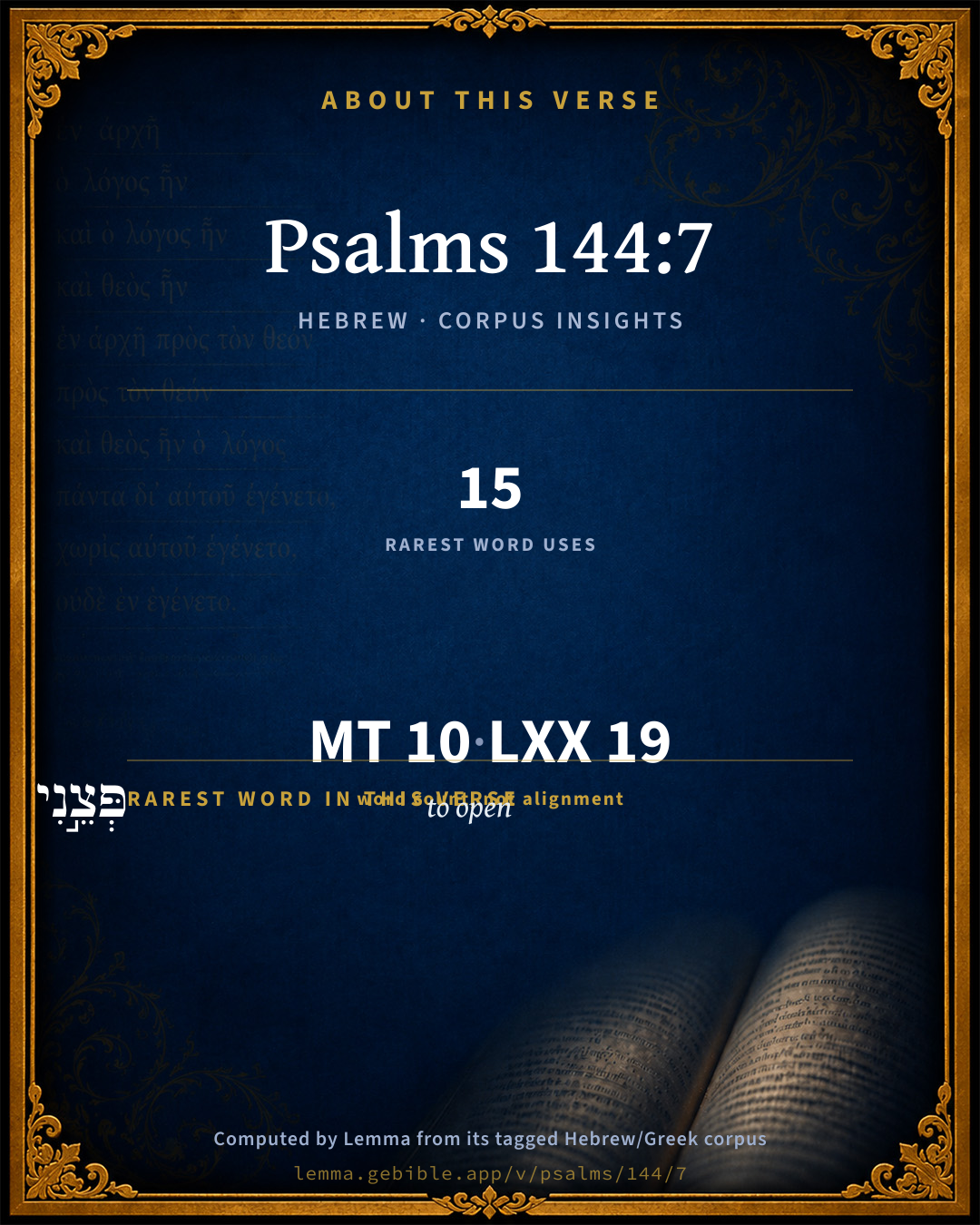
The rarest word here is פְּצֵ֣נִי to open H6475 — appearing just 15 times in the whole Hebrew Bible.

Shared distinctive vocabulary

פְּצֵ֣נִי to open H6475 occurs in 15 verses of the Hebrew Bible. Also found in:

Grammatical profile

  • 3 verbs
  • 6 nouns
  • 1 adjective

Verb forms

  • שְׁלַ֥ח Qal · Imperative
  • פְּצֵ֣נִי Qal · Imperative
  • וְ֭הַצִּילֵנִי Hiphil · Imperative

Repetition

A word recurs within this verse — often emphatic in Hebrew:

  • יָדֶ֗יךָ hand H3027 ×2

Hebrew & Septuagint length

In English translation the verse runs 21 words from the Hebrew and 23 from the Septuagint (LXX English) — closely comparable.

A rough comparison of the two English renderings, which tokenize alike — not a word-level alignment.

Word counts can differ between the Hebrew and the Greek without any difference in meaning — e.g. the Hebrew direct-object marker אֵת has no separate Greek word, and Greek often adds the article ὁ.

In the original languages it is 10 Hebrew tokens and 19 Greek tokens — but the two are counted differently (Hebrew bundles its prefixes and suffixes into one token; the Greek is in lemma form), so that isn’t a like-for-like length.

Cross-references

13

Topical passages linked to Psalms 144:7 in the Treasury of Scripture Knowledge — connected by theme and wording, ordered by reader-vote popularity; previews shown in the World English Bible.

  • Psalms 18:16 He sent from on high. He took me. He drew me out of many waters.
  • Psalms 69:1–2 Save me, God, For the waters have come up to my neck!
  • Psalms 54:3 For strangers have risen up against me. Violent men have sought after my soul. They haven't set God before them. Selah.
  • Revelation 17:15 He said to me, "The waters which you saw, where the prostitute sits, are peoples, multitudes, nations, and languages.
  • 2 Samuel 22:17 He sent from on high, he took me; He drew me out of many waters;
  • Psalms 18:44 As soon as they hear of me they shall obey me. The foreigners shall submit themselves to me.
  • Psalms 93:3–4 The floods have lifted up, Yahweh, The floods have lifted up their voice. The floods lift up their waves.
  • Matthew 27:43 He trusts in God. Let God deliver him now, if he wants him; for he said, 'I am the Son of God.'"
  • Revelation 12:15–16 The serpent spewed water out of his mouth after the woman like a river, that he might cause her to be carried away by the stream.
  • Nehemiah 9:2 The seed of Israel separated themselves from all foreigners, and stood and confessed their sins, and the iniquities of their fathers.
  • Psalms 69:14–15 Deliver me out of the mire, and don't let me sink. Let me be delivered from those who hate me, and out of the deep waters.
  • Psalms 144:11 Rescue me, and deliver me out of the hands of foreigners, Whose mouths speak deceit, Whose right hand is a right hand of falsehood.
  • Malachi 2:11 Judah has dealt treacherously, and an abomination is committed in Israel and in Jerusalem; for Judah has profaned the holiness of Yahweh which he loves, and has married the daughter of a foreign god.

Cross-references courtesy of OpenBible.info (CC BY 4.0).

Hebrew and Greek witnesses Masoretic Hebrew ↔ Greek Septuagint

The same verse in the two great witnesses to the Old Testament, shown verse-for-verse.

You’re reading Greek Psalm 143 (Hebrew Psalm 144). The Septuagint counts the superscription, so verse numbers can differ from the Hebrew — chapter-level alignment, not verse-by-verse. Numbering follows Rahlfs.

These are two independent witnesses, not word-aligned to each other, and the Septuagint is shown in lemma (dictionary) form.

Hebrew Psalms 144:7 Masoretic · Westminster Leningrad Codex

שְׁלַ֥ח יָדֶ֗יךָ מִמָּ֫ר֥וֹם פְּצֵ֣נִי וְ֭הַצִּילֵנִי מִמַּ֣יִם רַבִּ֑ים מִ֝יַּ֗ד בְּנֵ֣י נֵכָֽר

Stretch out your hand from above, Rescue me, and deliver me out of great waters, Out of the hands of foreigners;

World English Bible · Public Domain

Greek LXX Greek Psalm 143:7 Septuagint · lemma form

ἐκ ἀποστέλλω ὁ χείρ σύ ἐκ ὕψος ἐκαἱρέω ἐγώ καί ῥύομαι ἐγώ ἐκ ὕδωρ πολύς ἐκ χείρ υἱός ἀλλότριος

Send forth your hand from on high; rescue me, and deliver me out of great waters, out of the hand of strange children;

LXX2012 (modern English Septuagint) · Public Domain

Hebrew: Westminster Leningrad Codex (CC BY 4.0). Greek: Septuagint (public domain); English from LXX2012 (modern English Septuagint) (Public Domain). How the Septuagint differs from the Hebrew →

Commentary

Notes on Psalms 144:7 from classic Christian and Jewish commentators (each source and its license shown beneath its notes). The classic Christian expositions comment on the surrounding passage and are grouped to its opening verse, so a note may address several verses; the Jewish commentaries on the Tanakh (Rashi and others) are per-verse, so they appear only where the commentator wrote on this verse.

Lemma curates 59 commentaries, every one of them public domain or Creative Commons licensed, each selected and text-cleaned for this edition rather than reprinted as found. About our sources →

Trapp's Complete Commentary

John Trapp

Psa 144:7 Send thine hand from above; rid me, and deliver me out of great waters, from the hand of strange children;

Ver. 7. Send thine hand from above] Heb. hands, both hands, all thy whole power; for I need it.

John Trapp, A Commentary or Exposition upon All the Books of the Old and New Testament (1647–1656) — public domain. Text from a community e-Sword module.

The Treasury of David

Charles H. Spurgeon

Ver. 7. Send thine hand from above. Let thy long and strong arm be stretched out till thine hand seizes my foes, and delivers me from them.

Rid me, and deliver me out of great waters. Make a Moses of me, one drawn out of the waters. My foes pour in upon me like torrents, they threaten to overwhelm me; save me from their force and fury; take them from me, and me from them.

From the hand of strange children. From foreigners of every race; men strange to me and thee, who therefore must work evil to me, and rebellion against thyself. Those against whom he pleaded were out of covenant with God; they were Philistines and Edomites; or else they were men of his own nation of black heart and traitorous spirit, who were real strangers, though they bore the name of Israel. Oh to be rid of those infidel, blaspheming beings who pollute society with their false teachings and hard speeches! Oh to be delivered from slanderous tongues, deceptive lips, and false hearts! No wonder these words are repeated, for they are the frequent cry of many a tried child of God; "Rid me, and deliver me." The devil's children are strange to us: we can never agree with them, and they will never understand us: they are aliens to us, and we are despised by them. O Lord, deliver us from the evil one, and from all who are of his race.

Ver. 7. Send thine hand from above. Hebrew, hands, both hands, all thy whole power, for I need it. John Trapp.

Ver. 7. Rid me, and deliver me. Away, you who theorize about suffering, and can do no more than descant upon it, away! for in the time of weeping we cannot endure your reasonings. If you have no means of delivering us, if you have nothing but sententious phrases to offer, put your hands on your mouths; enwrap yourselves in silence! It is enough to suffer; but to suffer and listen to you is more than we can bear. If Job's mouth was nigh unto blasphemy, the blame is yours, ye miserable comforters, who talked instead of weeping. If I must suffer, then I pray for suffering without fine talk! E. De Pressense.

Ver. 7. Rid me, and deliver me...from the hand of strange children. We must remember that as the Grecians (conceiting themselves the best bred people in the world) called all other nations "barbarians"; so the people of Israel, the stock of Abraham (being God's peculiar covenant people), called all other nations "aliens" or "strangers"; and because they were hated and maligned by all other nations, therefore they called all professed strangers enemies; so the word is used (Isa 1:7), "Your land strangers shall devour"; that is, enemies shall invade and prevail over you. "Deliver me out of the hand of strange children", or out of the hand of strangers; that is, out of the hand of mine enemies. The Latin word alienus is often put for hostis, and the Roman orator (Cicero) telleth us that "he who is now called a stranger was called an enemy by our ancestors." The reason was because strangers proved unkind to, yea, turned enemies against those that entertained them. Joseph Caryl.

Ver. 7. Strange children. He calls them strangers, not in respect of generic origin, but character and disposition. John Calvin.

Ver. 7. The strange children, now the enemies of David, shall be either won to willing subjection, or else shall be crushed under the triumphant Messiah (Ps 2:1-12). The Spirit by David spake things the deep significance of which reached further than even he understood (1Pe 1:11-12). Andrew Robert Fausset.

Ver. 7-8, 11. Repetitions, not vain. Repetitions in prayer are vain when they result from form, thoughtlessness, or superstition; but not, e.g.,

1. When they are the utterance of genuine fervour.

2. When the danger prayed against is imminent.

3. When the fear which prompts the prayer is urgent.

4. When the repetition is prompted by a new motive, Ps 144:7-8; by God's condescension, Ps 144:3, 11; by God's former deliverance, Ps 144:10; and by the results which will flow from the answer, Ps 144:12-14. C.A.D.

Psalms 144:8*

Charles H. Spurgeon's The Treasury of David (1869–1885) — public domain. Psalms only. Text from a community e-Sword/MySword module.

J. A. Alexander on Psalms

Joseph Addison Alexander

7. (Psa 144:7) Send thy hands from on high; rid me and free me from (the) many waters, from the hand of aliens. With the first clause compare Psa 18:16. For hand we have here the plural hands, and for the two verbs there used two substantially equivalent, the first of which has the sense here given to it only in this place and the cognate languages,. and is therefore well represented by the less usual English word rid. With the last clause, compare Psa 18:44-45, where the phrase sons of strangeness (or of foreign parts) has been explained already.

Joseph Addison Alexander, The Psalms Translated and Explained (1850) — public domain. Text from a community e-Sword module.

Geneva Bible (1599)

Geneva Bible translators

That is, deliver me from the tumults of them that should be my people, but are corrupt in their judgment and enterprises, as though they were strangers.

Geneva Bible (1599) marginal notes — public domain. Text via Bolls.life.

Adam Clarke's Commentary

Verse 7. Deliver me out of great waters] See Clarke on Ps 18:16.

Adam Clarke's Commentary on the Bible (1810–1826) — public domain. Text from a community e-Sword/MySword module.

John Calvin's Commentaries

7. Send thy hand, etc. In one word we are now made to see what was meant by the figures formerly used — that in the absence of all earthly help, God would put forth his hand from above, the greatness of the exigency making extraordinary help necessary. Accordingly he compares his enemies to great and deep waters. He calls them strangers, not in respect of generic origin, but character and disposition. It were a mistake to refer the term to the uncircumcision, for David rather animadverts upon degenerate Jews who gloried in the flesh; and shortly afterwards he hints that he had to do with internal foes rather than a foreign enemy, who would openly assault him with violence and arms. By the right hand of falsehood some understand rash attempts, which David hoped would be frustrated. Others limit the phrase to the solemn ceremony of taking an oath, as if he said they were perjured; “In taking an oath the right hand was lifted up. The enemies of David profaned their oaths by violating the covenants into which they entered, and breaking their solemn engagements.” — Walford.

“The meaning is, the hands with which they confirm their treaties of peace and leagues of friendship are immediately lifted up against the lives and liberties of their allies.” — Warner.

John Calvin's Commentaries (1540-1563) — public domain. Text from the Calvin Translation Society English edition (1840s-50s) via the Christian Classics Ethereal Library (ccel.org). Calvin's coverage is partial (roughly two-thirds of the Bible); uncommented books and verses are honest gaps, never fabricated. The 19th-century editor's footnotes and remarks are omitted so the notes are faithfully Calvin's own voice.

Ellicott's Commentary for English Readers

(7) Rid.—The Hebrew verb means “to tear asunder,” and is used of the gaping of the mouth (Psa_22:13). The meaning here is got from the cognate Arabic, and Syriac

Strange children.—Literally, sons of the stranger.

A Bible Commentary for English Readers, edited by Charles John Ellicott (1878–1897) — public domain. Text from a community e-Sword module.

The Cambridge Bible for Schools and Colleges

gen. ed. J. J. S. Perowne

7. Stretch forth thine hands from on high:

Rescue me, and deliver me out of many waters, out of the hand of strangers.

From Psa_18:16; Psa_18:45, description being again changed to prayer. For hands some MSS and all Ancient Versions read hand. The word rendered rescue is a word used in this sense only here and in Psa_144:10-11 in the O.T., but common in Aramaic. It is an indication of the late date of the Psalm. Great or many waters are a figure for overwhelming dangers, here particularly the attacks of foreign enemies, or possibly the tyranny of foreign rulers.

The Cambridge Bible for Schools and Colleges (gen. ed. J. J. S. Perowne; Cambridge University Press, 1878–1918) — public domain. Text from a community e-Sword module.

John Gill's Exposition

Send thine hand from above,.... From the high heavens, as the Targum; that is, exert and display thy power in my deliverance, and in the destruction of my enemies; as follows:

rid me, and deliver me out of great waters; out of great afflictions, which, for quantity and quality, are like many waters, overflowing and overwhelming; see Isa 43:2; or out of the hands of enemies, many, mighty, and strong, whom he compares to waters; as Aben Ezra, Kimchi, and Ben Melech observe: and so the Targum,

"deliver me from the multitudes or armies, that are like to many waters;''

see Rev 17:1. It may be applied to the sorrows and sufferings of Christ, the antitype of David, with which he was overwhelmed; to the billows of divine wrath which went over him; to the floods of ungodly men that encompassed him; and to the whole posse of devils, Satan, and his principalities and powers, that attacked him; see Psa 18:4;

from the hand of strange children; which explains what is meant by "great waters": wicked men chiefly; either Gentiles, the children of a people of a strange nation, and of a strange language, and of strange sentiments of religion, and that worship a strange god: such as the Edomites, Moabites, Philistines, &c. who were aliens from the commonwealth of Israel, and strangers to the covenants of promise: or else the Israelites, who were degenerated from their ancestors, such of David's subjects that rebelled against him; so the Ziphims are called strangers that rose up against him, Psa 54:3; and such were the enemies of Christ, both the Romans, who were Heathens and aliens; and the people of the Jews, his own countrymen, who were a generation of vipers; see Act 4:27; such as Juvenal calls (l) "filii morum", who inherited the vices of their fathers.

(l) Satyr. 14. v. 52.

John Gill's Exposition of the Whole Bible (1746–1763) — public domain (CC PDM 1.0). Text via the HelloAO Bible API.

Albert Barnes' Notes on the Bible

Send thine hand from above - Margin, as in Hebrew, “hands.” See the notes at Psa 18:16 : “He sent from above.”

Rid me, and deliver me out of great waters - Thus Psa 18:16 : “He took me, he drew me out of many waters.” As God had done it once, there was ground for the prayer that he would do it yet again.

From the hand of strange children - Strangers: strangers to thee; strangers to thy people, foreigners. See Psa 54:3 : “For strangers are risen up against me.” The language would properly imply that at the time referred to in the psalm he was engaged in a warfare with foreign enemies. Who they were, we have no means now of ascertaining.

Albert Barnes' Notes on the Bible (1834–1885) — public domain. Text from a community e-Sword/MySword module.

Matthew Poole's English Annotations

Either of the heathen nations, which envy and hate me; or of the rebellious Israelites, who, though they profess themselves to be the Lord’s people, yet in truth and for their carriage to me are like the barbarous heathens.

Matthew Poole's English Annotations on the Holy Bible (1683–1685) — public domain. Text from a community e-Sword/MySword module.

Whedon's Commentary on the Bible

Daniel D. Whedon

7-9. Strange children—That is, “unnatural, rebellious children.” David, in utter violation of Hebrew law, married Maachah, daughter of Talmai, a heathen ruler north east of Palestine. Her children, Absalom and Tamar, of remarkable beauty, were a source of serious trouble to David. Absalom’s mouth spoke vanity, and his right hand was a right hand of falsehood. David, as a father, mourned, but as a ruler, welcomed, his death, and for the relief it brought, he sang a new song unto God.

Daniel D. Whedon (gen. ed.), Commentary on the Old and New Testaments (1874–1909) — public domain. Text from a community e-Sword module.

The Pulpit Commentary

Send thine hand from above; literally, reach out thy hands from on high. Rid me; rather, rescue me. And deliver me out of great waters. "Great waters," or "deep waters," is a common metaphor in the Psalms for serious peril. David"s peril at this time was from the hand of strange children; literally, sons of strangers; i.e. foreign foes.

Vers. 7, 8. The known God and the unknown foe.

"Stretch forth thine hand from above; rescue me out of the hand of strangers." This is but saying, "I do not know those who trouble me, but I do know thee.

I ALL AROUND US IS THE UNKNOWN.

1. There is so little that we can understand. Spite of all the attainments of science, the "known" today bears no comparison at all to the "unknown." The philosopher has but scooped up in his shell a little of the water of the great ocean of truth. The mute a man knows, the more he feels how little he knows. We need not be philosophers, and argue that man never does know more than phenomena, the accidents of things; it is enough to see that, concerning almost everything, a child can ask questions which the wisest man cannot answer.

2. There is so much that never comes into the field of human thought at all. For we have no right to say that the laws which we apprehend as controlling the movements of nature are the only laws that control them. We are constantly baffled by intimations of the working of laws of which we know nothing at all.

3. And the human experience through which we have to pass is hopelessly unknown to us. Known to no man are his coming positions, relations, friends, or foes. Every day every man has to say to himself, "I have not gone this way heretofore." It just has to be accepted as the fact for every life, "We are of yesterday, and know nothing.

II UP ABOVE US IS THE KNOWN. In a recent exhibition there was a very touching picture of an old farm-laborer, dressed in his smock-frock, and with a lined, wearied face that told of a long life of troubles, but over the seams and lines seemed to spread a soul-smile as, looking away through the clouds, he said, "Up beyond is the blue sky." It may be thus with every man. For the mind there is no rest; there is nothing but a fretful worrying with the surrounding unknown. But for the soul there is rest. It does not look around; it looks up, and knows God knows as love can know, knows as trust can know. And that is the only satisfying knowledge. A man can only be an agnostic till his soul finds God; then he knows as souls only can know. R.T.

The Pulpit Commentary (1880–1919), ed. H.D.M. Spence-Jones & Joseph S. Exell — public domain. Text from a community e-Sword module.

John Wesley's Explanatory Notes

Strange children - Either of the Heathen nations: or of the rebellious Israelites.

John Wesley, Explanatory Notes Upon the Whole Bible (1754–1765) — public domain. Text via the GEBible commentary corpus.

unfoldingWord translationNotes

Door43 World Missions Community

Reach out your hand from above; rescue me out of many waters

David speaks as if God were on land above a flood and had physical hands with which he could pull David out of a flood. The flood is a metaphor for the troubles caused by the "foreigners." AT: "You who are able to act, help me overcome my troubles" (See: Metaphor)

from the hand of foreigners

Here "hand" refers to power. AT: "from the power of foreigners" (See: Metonymy)

Their mouths speak lies

Here the word "mouths" represent the people who speak. AT: "They speak lies" (See: Synecdoche)

their right hand is falsehood

Possible meanings are 1) David speaks of the custom of raising the right hand to swear that what one is about to say in court is true, "they lie even when they swear to tell the truth," or 2) the "right hand" is a metaphor for power, "everything they have gotten, they have gotten by telling lies." (See: Metaphor)

translationWords

hand

water

alien

right hand

unfoldingWord translationNotes — © Distant Shores Media and the Door43 World Missions Community, licensed CC BY-SA 4.0. Source: git.door43.org/Door43/en_tn.

Rashi

Rabbi Shlomo Yitzchaki (Rashi)

deliver me פצני, take me out. That is an expression of saving, and so is (verse 10): “Who delivers (הפוצה) David His servant.” (I found.)

Rashi on the Tanakh — English translations: “The Judaica Press complete Tanach with Rashi, translated by A. J. Rosenberg” (CC BY 4.0); “Pentateuch with Rashi's commentary by M. Rosenbaum and A.M. Silbermann, 1929-1934” (public domain); “The Metsudah Tanach series, Lakewood, N.J” (CC BY 4.0); and “The Book of Joshua, Metsudah Publications, 1997” (CC BY 4.0). Text via Sefaria.

Lesson kit

Teaching starters — assembled from the data on this page, not authored interpretation. Every prompt links to the verse data it draws on. Edit before teaching.

Psalms, in the Wisdom, opens this verse with 10 words (9 distinct Hebrew lemmas). Its most distinctive word is pâtsâh (“to open”). A historical commentator’s framing appears above. Read the whole chapter for the surrounding context.

Discussion questions

  1. The word pâtsâh carries the sense “to open.” How does it shape the verse?
  2. Genesis 4:11 shares the word «to open» with this verse. How do the two illuminate each other?
  3. “hand” occurs 2× in this one verse. What is the effect of the repetition?
  4. These translations render this verse differently; the difference is in the English rendering, not the original. What questions does that raise?
  5. The verb «שְׁלַ֥ח» is Qal Imperative. How does its form color the action?
  6. Reading how Trapp's Complete Commentary and The Treasury of David read this verse, where do the two commentators agree and where do they part?

Things to notice

Reading settings

Reading text

Shown beneath each verse's original-language words.

Old Testament
Old Testament edition

Read the OT as the Masoretic Hebrew (MT) or the Greek Septuagint (LXX).

English shown for the Greek Septuagint (in the Hebrew ↔ Greek comparison).

Comparing translations? Open the Compare panel on any verse page to stack up to four side by side.