
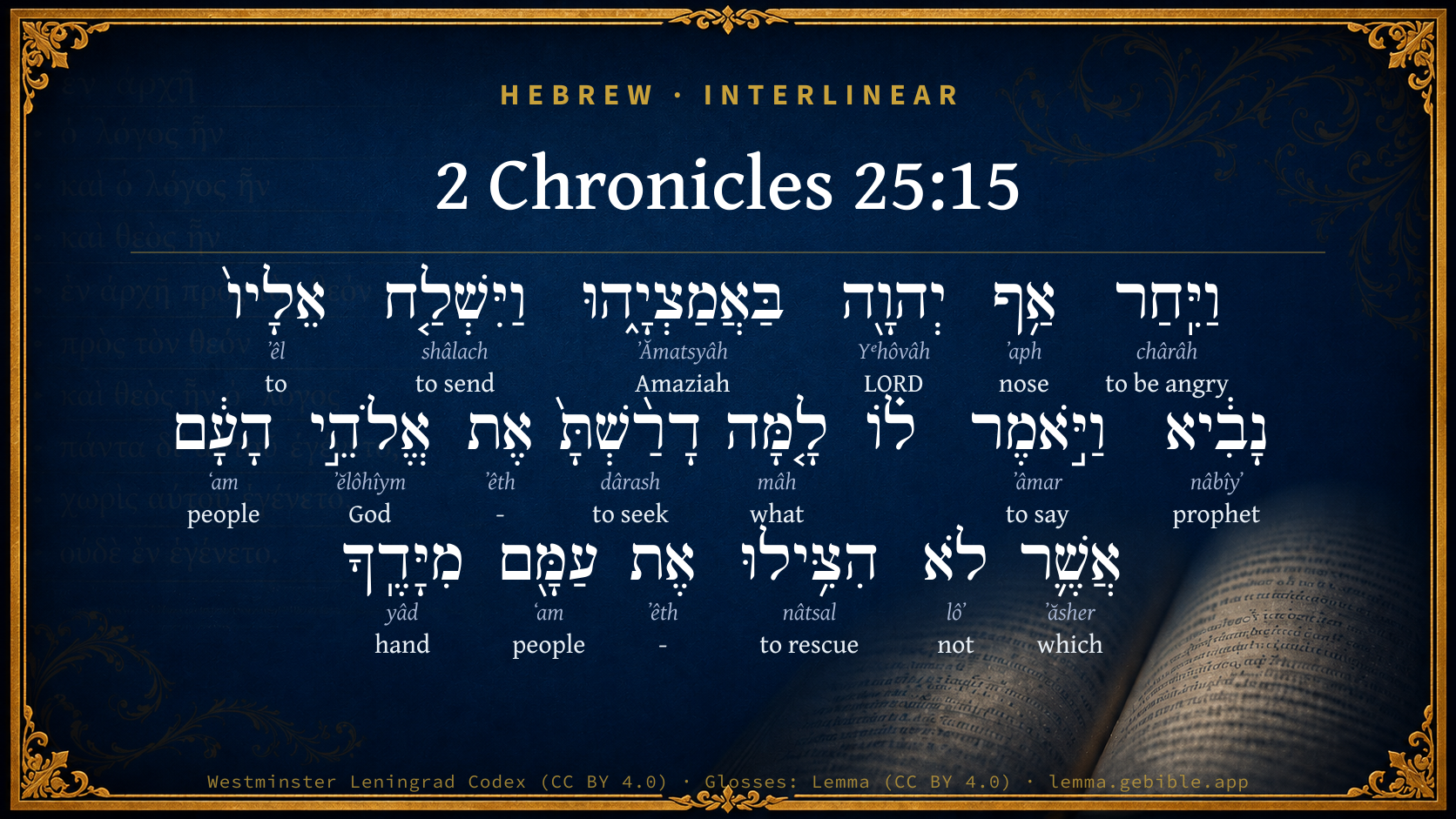
2 Chronicles 25:15

Hebrew (Westminster Leningrad Codex) 2 Chronicles 25:15 appears in the Hebrew Old Testament. The text above is from the Westminster Leningrad Codex. Each word links to its Strong’s number, a concise gloss, and parsing drawn from the Open Scriptures Hebrew Bible morphology. Click any word for its full Brown-Driver-Briggs (BDB) entry.
Download image
Cite this verse

2 Chronicles 25:15 (World English Bible). Public Domain. Lemma interlinear Bible study tool, https://lemma.gebible.app/v/2-chronicles/25/15.

Show BibTeX & RIS
BibTeX
RIS
English Translation
Therefore the anger of Yahweh was kindled against Amaziah, and he sent to him a prophet, who said to him, Why have you sought after the gods of the people, which have not delivered their own people out of your hand?
World English Bible · Public Domain
Download a study sheet

One document with this verse’s original text, its word-by-word gloss line, the meaning frame, cross-references with their text, attributed commentary, and full source and license credits — printable, and it pastes into notes with its structure intact.

This verse Autodidact and up

Study sheet (.html) Plain text (.txt)

A passage Seminary Student

Up to 50 verses in one chapter. A passage sheet keeps up to 6 commentary sources and 12 cross-references per verse, in the order this page ranks them, and says so on the sheet whenever that leaves anything out. Ask for a single verse and you get the Autodidact verse sheet above.

Everything on this page stays free to read, with no account — the sheet is a download of what is already on screen, not access to it.

Want to remove ads? Support Godless Engineer
Compare translations 3

The same verse in 3 English versions, stacked beneath the original-language interlinear above. Click any original word for its lexicon entry.

Each is an independent rendering of the whole verse — the interlinear is not word-aligned to these translations.

Highlighted words mark where these versions differ — a whole-verse word diff, not a word-by-word alignment.

  • World English Bible Public Domain
    Therefore the anger of Yahweh was kindled against Amaziah, and he sent to him a prophet, who said to him, Why have you sought after the gods of the people, which have not delivered their own people out of your hand?
  • King James Version Public Domain
    Wherefore the anger of the LORD was kindled against Amaziah, and he sent unto him a prophet, which said unto him, Why hast thou sought after the gods of the people, which could not deliver their own people out of thine hand?
  • unfoldingWord Literal Text CC BY-SA 4.0
    And the anger of Yahweh burned against Amaziah. And he sent to him a prophet, and he said to him, “Why do you seek the gods of the people who did not deliver their people from your hand?”

unfoldingWord Literal Text — © unfoldingWord, licensed CC BY-SA 4.0. Word-aligned USFM3 via Door43 (git.door43.org/unfoldingWord/en_ult).

Versions to compare (up to 4)

3 of 4 selected

Show all 18 translations

Every available English version of this verse, each an independent rendering of the whole verse.

  • World English Bible Public Domain
    Therefore the anger of Yahweh was kindled against Amaziah, and he sent to him a prophet, who said to him, Why have you sought after the gods of the people, which have not delivered their own people out of your hand?
  • Berean Standard Bible Public Domain
    Therefore the anger of the LORD burned against Amaziah, and He sent him a prophet, who said, “Why have you sought this people’s gods, which could not deliver them from your hand?”
  • Majority Standard Bible Public Domain
    Therefore the anger of the LORD burned against Amaziah, and He sent him a prophet, who said, “Why have you sought this people’s gods, which could not deliver them from your hand?”
  • King James Version Public Domain
    Wherefore the anger of the LORD was kindled against Amaziah, and he sent unto him a prophet, which said unto him, Why hast thou sought after the gods of the people, which could not deliver their own people out of thine hand?
  • American Standard Version (1901) Public Domain
    Wherefore the anger of Jehovah was kindled against Amaziah, and he sent unto him a prophet, who said unto him, Why hast thou sought after the gods of the people, which have not delivered their own people out of thy hand?
  • Revised Version (1885) Public Domain
    Wherefore the anger of the LORD was kindled against Amaziah, and he sent unto him a prophet, which said unto him, Why hast thou sought after the gods of the people, which have not delivered their own people out of thine hand?
  • Geneva Bible (1599) Public Domain
    Wherefore the Lord was wroth with Amaziah, and sent vnto him a Prophet, which sayd vnto him, Why hast thou sought the gods of the people, which were not able to deliuer their owne people out of thine hand?
  • Douay-Rheims (1899) Public Domain
    Wherefore the Lord being angry against Amasias, sent a prophet to him, to say to him: Why hast thou adored gods that have not delivered their own people out of thy hand?
  • Young's Literal Translation Public Domain
    And the anger of Jehovah burneth against Amaziah, and He sendeth unto him a prophet, and he saith unto him, `Why hast thou sought the gods of the people that have not delivered their people out of thy hand?'
  • Literal Standard Version CC BY-SA 4.0
    And the anger of YHWH burns against Amaziah, and He sends a prophet to him, and he says to him, “Why have you sought the gods of the people that have not delivered their people out of your hand?”
  • Unlocked Literal Bible CC BY-SA 4.0
    So Yahweh's anger was kindled against Amaziah. He sent a prophet to him, who said, “Why have you sought after the gods of a people who did not even save their own people from your hand?”
  • unfoldingWord Literal Text CC BY-SA 4.0
    And the anger of Yahweh burned against Amaziah. And he sent to him a prophet, and he said to him, “Why do you seek the gods of the people who did not deliver their people from your hand?”
  • Darby Bible Public Domain
    And the anger of Jehovah was kindled against Amaziah, and he sent to him a prophet, who said to him, Why dost thou seek after the gods of a people who have not delivered their own people out of thy hand?
  • World Messianic Bible Public Domain
    Therefore the LORD’s anger burned against Amaziah, and he sent to him a prophet who said to him, “Why have you sought after the gods of the people, which have not delivered their own people out of your hand?”
  • Webster's Bible Public Domain
    Wherefore the anger of the LORD was kindled against Amaziah, and he sent to him a prophet, who said to him, Why hast thou sought after the gods of the people, which could not deliver their own people out of thy hand?
  • Free Bible Version CC BY-SA 4.0
    The Lord became angry with Amaziah and he sent a prophet to him, who said to him, “Why would you worship the gods of a people who couldn't even save their own people from you?”
  • Bible in Basic English Public Domain
    And so the wrath of the Lord was moved against Amaziah, and he sent a prophet to him, who said, Why have you gone after the gods of the people who have not given their people salvation from your hands?
  • JPS Tanakh (1917) Public Domain
    Wherefore the anger of the LORD was kindled against Amaziah, and He sent unto him a prophet, who said unto him: 'Why hast thou sought after the gods of the people, which have not delivered their own people out of thy hand?'

Literal Standard Version (2020), Covenant Press — licensed CC BY-SA 4.0. Text via the HelloAO Bible API (eBible.org). Unlocked Literal Bible (unfoldingWord) — licensed CC BY-SA 4.0. Text via the HelloAO Bible API (eBible.org). unfoldingWord Literal Text — © unfoldingWord, licensed CC BY-SA 4.0. Word-aligned USFM3 via Door43 (git.door43.org/unfoldingWord/en_ult). Free Bible Version, Dr. Jonathan Gallagher — licensed CC BY-SA 4.0. Text via the HelloAO Bible API (eBible.org).

Word by word

More ways to search: Search by grammar → Find every occurrence → Compare this word →

Practice this passage: Drill this verse → Learn its vocabulary →

בַּאֲמַצְיָ֑הוּ
ʼĂmatsyâh
H558
“in/at · Amaziah”
Preposition + Noun, Proper
Part of Speech
Preposition + Noun
Type
Proper
Full BDB Definition

Origin: from H553 and H3050

TWOT: None

Amaziah = "Jehovah is mighty" - a king of Judah, son Joash, father of Azariah - a priest of Bethel under Jeroboam II - father of Joshah, of the tribe of Simeon - a Levite tabernacle singer in David's day
  1. וַיִּֽחַר chârâh H2734 “and · to be angry” Conjunction + Verb, Qal, Sequential Imperfect, 3rd Person, Masculine, Singular
  2. אַ֥ף ʼaph H639 “nose” Particle, Accusative
  3. יְהוָ֖ה Yᵉhôvâh H3068 “LORD” Noun, Proper
  4. וַיִּשְׁלַ֤ח shâlach H7971 “and · to send” Conjunction + Verb, Qal, Sequential Imperfect, 3rd Person, Masculine, Singular
  5. אֵלָיו֙ ʼêl H413 “to · him” Preposition + Suffix, Personal, 3rd Person, Masculine, Singular
  6. נָבִ֔יא nâbîyʼ H5030 “prophet” Noun, Common, Masculine, Singular, Absolute
  7. וַיֹּ֣אמֶר ʼâmar H559 “and · to say” Conjunction + Verb, Qal, Sequential Imperfect, 3rd Person, Masculine, Singular
  8. לָ֤מָּה mâh H4100 “to/for · what” Preposition + Particle, Interrogative
  9. דָרַ֨שְׁתָּ֙ dârash H1875 “to seek” Verb, Qal, Perfect, 2nd Person, Masculine, Singular
  10. אֶת ʼêth H853 “-” Particle, Direct Object
  11. אֱלֹהֵ֣י ʼĕlôhîym H430 “God(s) of” Noun, Common, Masculine, Plural, Construct
  12. הָעָ֔ם ʻam H5971 “the · people” Particle, Definite Article + Noun, Common, Masculine, Singular, Absolute
  13. אֲשֶׁ֛ר ʼăsher H834 “which” Particle, Relative
  14. לֹא lôʼ H3808 “not” Particle, Negative
  15. הִצִּ֥ילוּ nâtsal H5337 “to rescue” Verb, Hiphil, Perfect, 3rd Person, Common, Plural
  16. אֶת ʼêth H853 “-” Particle, Direct Object
  17. עַמָּ֖ם ʻam H5971 “people · their” Noun, Common, Masculine, Singular, Construct + Suffix, Personal, 3rd Person, Masculine, Plural
  18. מִיָּדֶֽךָ yâd H3027 “from · hand · your” Preposition + Noun, Common, Both, Singular, Construct + Suffix, Personal, 2nd Person, Masculine, Singular

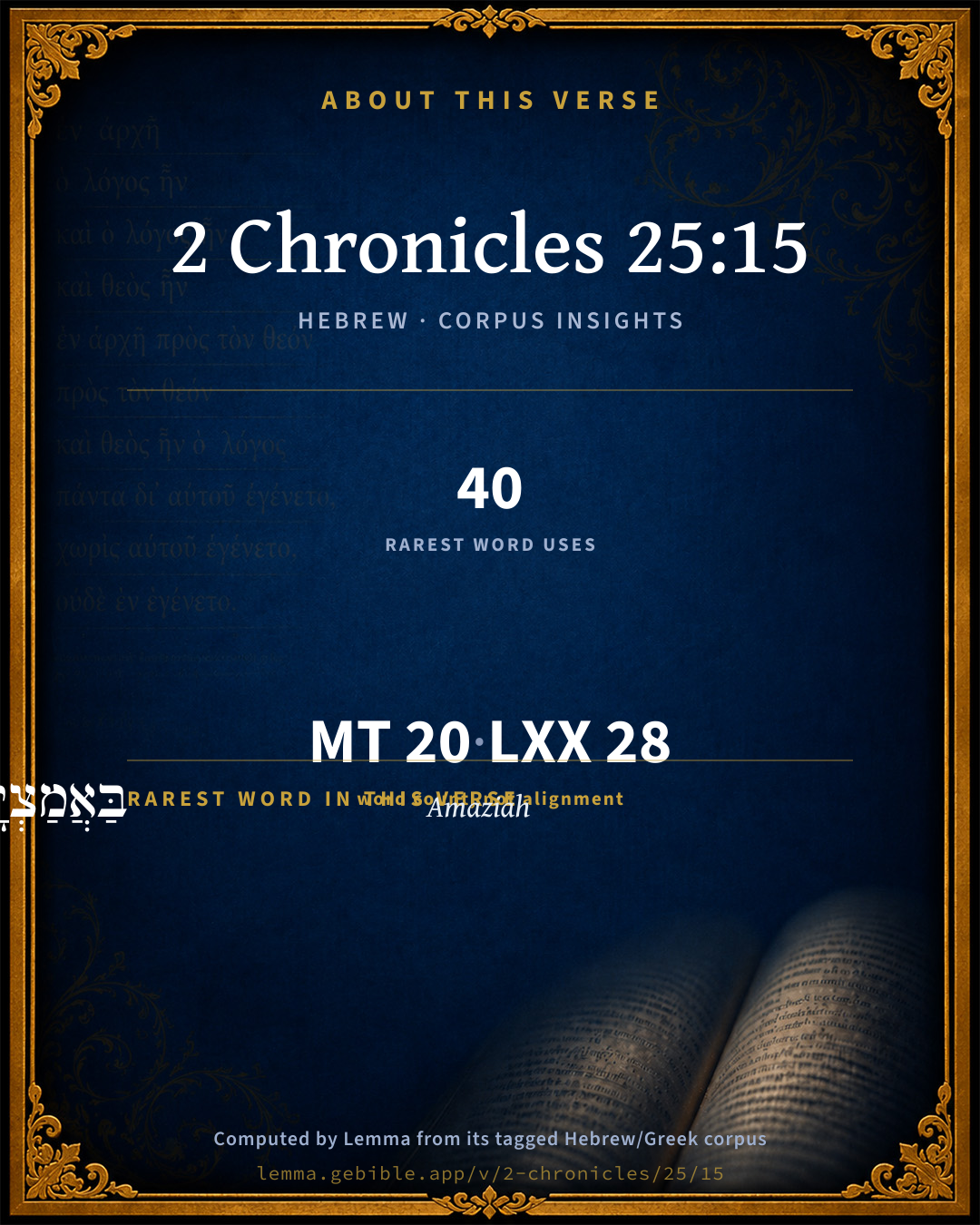
About this verse

These counts appear in no published source. They are computed here, from the morphology-tagged text and Lemma’s own curated glosses. What Lemma adds →

20
words
17
distinct lemmas
Historical
section

Shared distinctive vocabulary

בַּאֲמַצְיָ֑הוּ Amaziah H558 occurs in 39 verses of the Hebrew Bible. Also found in:

Grammatical profile

  • 5 verbs
  • 7 nouns
  • 2 prepositions
  • 6 particles

Verb forms

  • וַיִּֽחַר Qal · Sequential Imperfect
  • וַיִּשְׁלַ֤ח Qal · Sequential Imperfect
  • וַיֹּ֣אמֶר Qal · Sequential Imperfect
  • דָרַ֨שְׁתָּ֙ Qal · Perfect
  • הִצִּ֥ילוּ Hiphil · Perfect

Repetition

A word recurs within this verse — often emphatic in Hebrew:

  • הָעָ֔ם people H5971 ×2

Hebrew & Septuagint length

In English translation the verse runs 41 words from the Hebrew and 40 from the Septuagint (LXX English) — closely comparable.

A rough comparison of the two English renderings, which tokenize alike — not a word-level alignment.

Word counts can differ between the Hebrew and the Greek without any difference in meaning — e.g. the Hebrew direct-object marker אֵת has no separate Greek word, and Greek often adds the article ὁ.

In the original languages it is 20 Hebrew tokens and 28 Greek tokens — but the two are counted differently (Hebrew bundles its prefixes and suffixes into one token; the Greek is in lemma form), so that isn’t a like-for-like length.

Cross-references

16

Topical passages linked to 2 Chronicles 25:15 in the Treasury of Scripture Knowledge — connected by theme and wording, ordered by reader-vote popularity; previews shown in the World English Bible.

  • Psalms 96:5 For all the gods of the peoples are idols, But Yahweh made the heavens.
  • 2 Chronicles 25:11–12 Amaziah took courage, and led forth his people, and went to the Valley of Salt, and struck of the children of Seir ten thousand.
  • Judges 2:2 and you shall make no covenant with the inhabitants of this land; you shall break down their altars. But you have not listened to my voice: why have you done this?
  • 2 Samuel 12:1–6 Yahweh sent Nathan to David. He came to him, and said to him, "There were two men in one city; the one rich, and the other poor.
  • 2 Chronicles 16:7–9 At that time Hanani the seer came to Asa king of Judah, and said to him, Because you have relied on the king of Syria, and have not relied on Yahweh your God, therefore is the host of the king of Syria escaped out of your hand.
  • 2 Chronicles 19:2 Jehu the son of Hanani the seer went out to meet him, and said to king Jehoshaphat, Should you help the wicked, and love those who hate Yahweh? for this thing wrath is on you from before Yahweh.
  • 2 Chronicles 20:37 Then Eliezer the son of Dodavahu of Mareshah prophesied against Jehoshaphat, saying, Because you have joined yourself with Ahaziah, Yahweh has destroyed your works. The ships were broken, so that they were not able to go to Tarshish.
  • 2 Chronicles 24:20 The Spirit of God came on Zechariah the son of Jehoiada the priest; and he stood above the people, and said to them, Thus says God, Why disobey you the commandments of Yahweh, so that you can't prosper? because you have forsaken Yahweh, he has also forsaken you.
  • 2 Chronicles 25:7 But there came a man of God to him, saying, O king, don't let the army of Israel go with you; for Yahweh is not with Israel, [to wit], with all the children of Ephraim.
  • Psalms 115:4–8 Their idols are silver and gold, The work of men's hands.
  • Isaiah 44:9–10 Those who fashion an engraved image are all of them vanity; and the things that they delight in shall not profit; and their own witnesses don't see, nor know: that they may be disappointed.
  • Isaiah 46:1–2 Bel bows down, Nebo stoops; their idols are on the animals, and on the cattle: the things that you carried about are made a load, a burden to the weary [animal].
  • Jeremiah 2:5 thus says Yahweh, What unrighteousness have your fathers found in me, that they have gone far from me, and have walked after vanity, and are become vain?
  • Jeremiah 10:7 Who should not fear you, King of the nations? for to you does it appertain; because among all the wise men of the nations, and in all their royal estate, there is none like you.
  • 1 Corinthians 8:4 Therefore concerning the eating of things sacrificed to idols, we know that no idol is anything in the world, and that there is no other God but one.
  • 1 Corinthians 10:20 But I say that the things which the Gentiles sacrifice, they sacrifice to demons, and not to God, and I don't desire that you would have communion with demons.

Cross-references courtesy of OpenBible.info (CC BY 4.0).

Hebrew and Greek witnesses Masoretic Hebrew ↔ Greek Septuagint

The same verse in the two great witnesses to the Old Testament, shown verse-for-verse.

These are two independent witnesses, not word-aligned to each other, and the Septuagint is shown in lemma (dictionary) form.

Hebrew 2 Chronicles 25:15 Masoretic · Westminster Leningrad Codex

וַיִּֽחַר אַ֥ף יְהוָ֖ה בַּאֲמַצְיָ֑הוּ וַיִּשְׁלַ֤ח אֵלָיו֙ נָבִ֔יא וַיֹּ֣אמֶר ל֗וֹ לָ֤מָּה דָרַ֨שְׁתָּ֙ אֶת אֱלֹהֵ֣י הָעָ֔ם אֲשֶׁ֛ר לֹא הִצִּ֥ילוּ אֶת עַמָּ֖ם מִיָּדֶֽךָ

Therefore the anger of Yahweh was kindled against Amaziah, and he sent to him a prophet, who said to him, Why have you sought after the gods of the people, which have not delivered their own people out of your hand?

World English Bible · Public Domain

Greek LXX 2 Chronicles 25:15 Septuagint · lemma form

καί γίγνομαι ὀργή κύριος ἐπί αμασιαν καί ἀποστέλλω αὐτός προφήτης καί εἶπον αὐτός τίς ζητέω ὁ θεός ὁ λαός ὅς οὐ ἐκαἱρέω ὁ λαός αὐτός ἐκ χείρ σύ

And the anger of the Lord came upon Amasias, and he sent him a prophet, and he said to him, Why have you sought the gods of the people, which have not rescued their own people out of your hand?

LXX2012 (modern English Septuagint) · Public Domain

Hebrew: Westminster Leningrad Codex (CC BY 4.0). Greek: Septuagint (public domain); English from LXX2012 (modern English Septuagint) (Public Domain). How the Septuagint differs from the Hebrew →

Commentary

Notes on 2 Chronicles 25:15 from classic Christian and Jewish commentators (each source and its license shown beneath its notes). The classic Christian expositions comment on the surrounding passage and are grouped to its opening verse, so a note may address several verses; the Jewish commentaries on the Tanakh (Rashi and others) are per-verse, so they appear only where the commentator wrote on this verse.

Lemma curates 59 commentaries, every one of them public domain or Creative Commons licensed, each selected and text-cleaned for this edition rather than reprinted as found. About our sources →

Trapp's Complete Commentary

John Trapp

2Ch 25:15 Wherefore the anger of the LORD was kindled against Amaziah, and he sent unto him a prophet, which said unto him, Why hast thou sought after the gods of the people, which could not deliver their own people out of thine hand?

Ver. 15. And he sent unto him a prophet.] When he might have sent him to hell with a thunderbolt; as the patientest man upon earth would have done likely, had he been in God’s place and power.

Why hast thou sought after the gods?] It may be that the Edomites had hid their tutelary gods, and that Amaziah sought them out. The word signifieth a diligent, narrow search.

John Trapp, A Commentary or Exposition upon All the Books of the Old and New Testament (1647–1656) — public domain. Text from a community e-Sword module.

Joseph Benson's Commentary

2Ch 25:15. The anger of the Lord was kindled against Amaziah — And well it might; yet, before he sent to destroy him, he sent to convince and reclaim him, and thus prevent his destruction. He sent to him a prophet, who reasoned with him very fairly and mildly, saying, Why hast thou sought after the gods which could not deliver their own people? — Is this reasonable? Is it acting like a wise man? If men would but duly consider the inability of all those things to help them, which they have recourse to when they forsake God, they would not be such enemies to themselves.

Joseph Benson's Commentary on the Old and New Testaments (1811–1818) — public domain. Text from a community e-Sword module.

Geneva Bible (1599)

Geneva Bible translators

He proveth that whatsoever cannot save himself nor his worshippers, is no God but an idol.

Geneva Bible (1599) marginal notes — public domain. Text via Bolls.life.

Ellicott's Commentary for English Readers

(15) Could not deliver.—Delivered not. (Comp. the boast of Sennacherib concerning the gods who had failed before him: 2Ki_18:33-35.) The king’s object may have been to win their favour, and so retain his hold on what was regarded as their peculiar territory. One of these gods might be Hadad (comp. 1Ch_1:46; 1Ch_1:50; 2Ki_5:18; 2Ki_6:24); another might have been Kôsh. (Comp. the Edomite royal names Qa-us-ma-la-ka, i.e., Kosmalak, “Kosh is king,” and Qa-us-gab-ri, i.e., Kosgabri, “Kosh is my warrior;” names which are like the Hebrew Elimelech and Gabriel respectively.) The Hebrew proper name, Kish, may be the same as Kôsh. Lastly, the name of a king of Edom mentioned by Sennacherib, Mâlik-rammu, i.e., “Moloch is exalted,” indicates that Moloch also was worshipped in Edom.

A Bible Commentary for English Readers, edited by Charles John Ellicott (1878–1897) — public domain. Text from a community e-Sword module.

The Cambridge Bible for Schools and Colleges

gen. ed. J. J. S. Perowne

15. which could not deliver] R.V. which have not delivered.

The Cambridge Bible for Schools and Colleges (gen. ed. J. J. S. Perowne; Cambridge University Press, 1878–1918) — public domain. Text from a community e-Sword module.

John Gill's Exposition

And it came to pass, as he talked with him, that the king said unto him, art thou made of the king's council?.... He was not indeed one of his privy council, made so by him, but he was appointed a counsellor to him by the Lord, the King of kings, to expostulate with him about his idolatry, and to advise him to relinquish it, to whose counsel he ought to have hearkened:

forbear, why shouldest thou be smitten? bidding him hold his peace, and threatening him, that if he did not, he must expect to be smitten; that is, with death, as Zechariah the prophet was by the order of his father:

then the prophet forbore; left off speaking, only added this at parting:

and said, I know that God hath determined to destroy thee; being given up to hardness of heart, so as to pay no regard to the Lord and his prophets, which was a sure presage of destruction:

because thou hast done this; committed such idolatry, and persisted in it:

and hast not hearkened to my counsel; to reform from it.

John Gill's Exposition of the Whole Bible (1746–1763) — public domain (CC PDM 1.0). Text via the HelloAO Bible API.

Matthew Poole's English Annotations

Therefore thou art not only ungrateful and impious, but also ridiculously foolish, in offending that God whose power and goodness thou hast now found, and in worshipping such gods of whose impotency thou hast had late experience.

Matthew Poole's English Annotations on the Holy Bible (1683–1685) — public domain. Text from a community e-Sword/MySword module.

The Pulpit Commentary

He sent unto him a prophet. We are again not told whom. The tone of the prophet, and the words given us as his in the latter half of ver. 16, would lead us to think it was the same "man of God;" but we cannot assert it, and had it been the same, it would more probably have transpired. The history now often reminds us of 2Ch_24:16.

The folly of irreligion.

The remonstrance addressed by the prophet of the Lord to Amaziah was well grounded; his argument was conclusive. We arc simply astonished at

I THE INFATUATION OF IDOLATRY. What insensate folly of the King of Judah to turn from the service of Jehovah, who had just granted him a signal proof of his power and his goodness, to the service and the worship of the gods of the very people he had defeated (ver. 14)! Well might he be reproached for conduct so culpable and so irrational. Any one who was conversant with the history of the Hebrew people, even up to this time, might have known that faithfulness to Jehovah was accompanied by victory and prosperity, and that, contrariwise, idolatry was attended with misery and disaster. And yet, such was "the deceitfulness of sin," we find king and courtier, priest and people, lapsing into disobedience and iniquity. We are not now under the temptation which proved too strong for Amaziah, but we may make a mistake as serious and as senseless as he made.

II THE FOLLY OF IRRELIGION, AND ESPECIALLY OF SPIRITUAL UNFAITHFULNESS. For what is it that we see?

1. A large number of men and women honouring various false gods; it is some form of temporal success; it may be physical enjoyment, or it may be

2. the possession of wealth, or it may be social position, or it may be political power, or it may be professional distinction.

3. These votaries are not blessed by the deities they are serving; for these"powers" are weakness itself; they "cannot. deliver their own people," their own adherents. They do not deliver them from failure, from disappointment, from heartache, from misery. They do not gladden the heart and brighten and beautify the life of those who are seeking and serving them. Even those who have reached the heights they set themselves to climb, who have grasped the goal towards which they ran, have confessed, again and again, that they have not found rest unto their soul, but rather disquietude, craving, envy a sense of dreariness and defeat. Why, then, should we add our souls to the number of the unblessed, of the deceived and the betrayed? Why, indeed, should we who have tasted of better things be so indescribably foolish as to abandon "our Rock" for "their rock"? (Deu_32:31) Why should we seek after the "gods that cannot deliver their own people"? And this folly is the greater when we take into our account

III THE PROVED WISDOM OF PIETY. For has it not been abundantly confirmed that "godliness has the promise of the life that now is, as well as of that which is to come"? Do not we who have followed Christ know, and can we not testify, that to be his true disciple, his faithful servant this is to be:

1. Gladdened with all joy.

2. Comforted in all sorrow.

3. Enlarged in all obscurity and lowliness of sphere.

4. Engaged in the best and noblest of all works the work of humanelevation.

5. Sustained by the most exalted hope the hope of everlasting life in hisown royal presence. C.

The Pulpit Commentary (1880–1919), ed. H.D.M. Spence-Jones & Joseph S. Exell — public domain. Text from a community e-Sword module.

Lesson kit

Teaching starters — assembled from the data on this page, not authored interpretation. Every prompt links to the verse data it draws on. Edit before teaching.

2 Chronicles, in the Historical, opens this verse with 20 words (17 distinct Hebrew lemmas). Its most distinctive word is ʼĂmatsyâh (“Amaziah”). A historical commentator’s framing appears above. Read the whole chapter for the surrounding context.

Discussion questions

  1. The word ʼĂmatsyâh carries the sense “Amaziah.” How does it shape the verse?
  2. How does 2 Kings 12:21, which shares the word «Amaziah», read alongside this verse?
  3. What does the repetition of “people” (2× in this one verse) do in this verse?
  4. These translations render this verse differently. What is at stake in choosing one wording over another?
  5. «וַיִּֽחַר» is a Qal Sequential Imperfect verb. How does that grammatical form shape the action described?
  6. Compare how Trapp's Complete Commentary and Joseph Benson's Commentary read this verse. Where do they agree or differ?

Things to notice

Reading settings

Reading text

Shown beneath each verse's original-language words.

Old Testament
Old Testament edition

Read the OT as the Masoretic Hebrew (MT) or the Greek Septuagint (LXX).

English shown for the Greek Septuagint (in the Hebrew ↔ Greek comparison).

Comparing translations? Open the Compare panel on any verse page to stack up to four side by side.