Isaiah 5:29

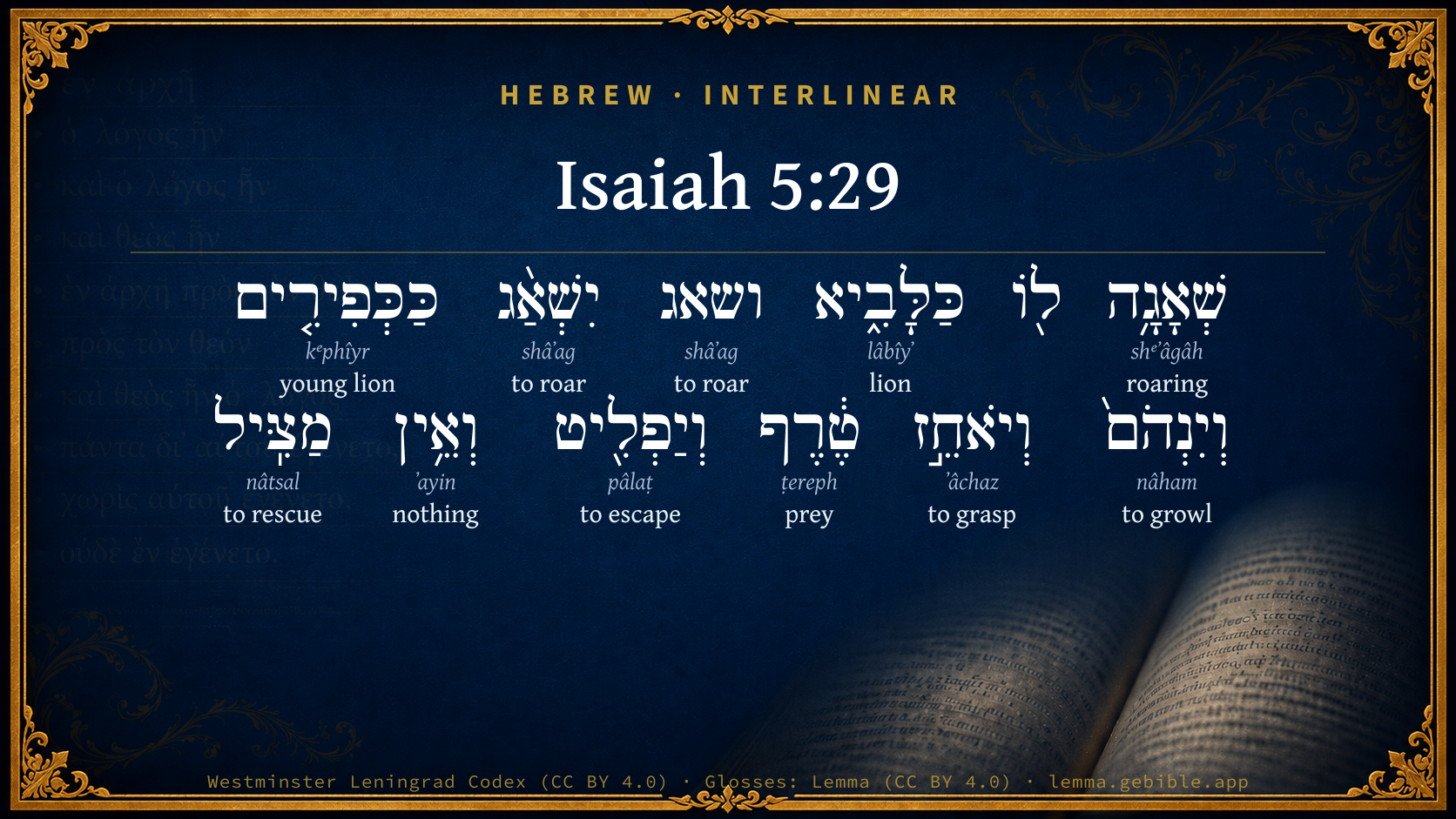
Hebrew (Westminster Leningrad Codex) Isaiah 5:29 appears in the Hebrew Old Testament. The text above is from the Westminster Leningrad Codex. Each word links to its Strong’s number, a concise gloss, and parsing drawn from the Open Scriptures Hebrew Bible morphology. Click any word for its full Brown-Driver-Briggs (BDB) entry.
Download image
Cite this verse

Isaiah 5:29 (World English Bible). Public Domain. Lemma interlinear Bible study tool, https://lemma.gebible.app/v/isaiah/5/29.

Show BibTeX & RIS
BibTeX
RIS
English Translation
Their roaring will be like a lioness. They will roar like young lions. Yes, they shall roar, And seize their prey and carry it off, And there will be no one to deliver.
World English Bible · Public Domain
Download a study sheet

One document with this verse’s original text, its word-by-word gloss line, the meaning frame, cross-references with their text, attributed commentary, and full source and license credits — printable, and it pastes into notes with its structure intact.

This verse Autodidact and up

Study sheet (.html) Plain text (.txt)

A passage Seminary Student

Up to 50 verses in one chapter. A passage sheet keeps up to 6 commentary sources and 12 cross-references per verse, in the order this page ranks them, and says so on the sheet whenever that leaves anything out. Ask for a single verse and you get the Autodidact verse sheet above.

Everything on this page stays free to read, with no account — the sheet is a download of what is already on screen, not access to it.

Want to remove ads? Support Godless Engineer
Compare translations 3

The same verse in 3 English versions, stacked beneath the original-language interlinear above. Click any original word for its lexicon entry.

Each is an independent rendering of the whole verse — the interlinear is not word-aligned to these translations.

Highlighted words mark where these versions differ — a whole-verse word diff, not a word-by-word alignment.

  • World English Bible Public Domain
    Their roaring will be like a lioness. They will roar like young lions. Yes, they shall roar, And seize their prey and carry it off, And there will be no one to deliver.
  • King James Version Public Domain
    Their roaring shall be like a lion, they shall roar like young lions: yea, they shall roar, and lay hold of the prey, and shall carry it away safe, and none shall deliver it.
  • unfoldingWord Literal Text CC BY-SA 4.0
    A roaring to it like a lioness; and it roars like young lions. And it growls, and it seizes the prey and carries away, and there is none delivering.

unfoldingWord Literal Text — © unfoldingWord, licensed CC BY-SA 4.0. Word-aligned USFM3 via Door43 (git.door43.org/unfoldingWord/en_ult).

Versions to compare (up to 4)

3 of 4 selected

Show all 18 translations

Every available English version of this verse, each an independent rendering of the whole verse.

  • World English Bible Public Domain
    Their roaring will be like a lioness. They will roar like young lions. Yes, they shall roar, And seize their prey and carry it off, And there will be no one to deliver.
  • Berean Standard Bible Public Domain
    Their roaring is like that of a lion; they roar like young lions. They growl and seize their prey; they carry it away from deliverance.
  • Majority Standard Bible Public Domain
    Their roaring is like that of a lion; they roar like young lions. They growl and seize their prey; they carry it away, and no one can rescue it.
  • King James Version Public Domain
    Their roaring shall be like a lion, they shall roar like young lions: yea, they shall roar, and lay hold of the prey, and shall carry it away safe, and none shall deliver it.
  • American Standard Version (1901) Public Domain
    their roaring shall be like a lioness, they shall roar like young lions; yea, they shall roar, and lay hold of the prey, and carry it away safe, and there shall be none to deliver.
  • Revised Version (1885) Public Domain
    their roaring shall be like a lion, they shall roar like young lions: yea, they shall roar, and lay hold of the prey, and carry it away safe, and there shall be none to deliver.
  • Geneva Bible (1599) Public Domain
    His roaring shalbe like a lyon, and he shall roare like lyons whelpes: they shall roare, and lay holde of the praye: they shall take it away, and none shall deliuer it.
  • Douay-Rheims (1899) Public Domain
    Their roaring like that of a lion, they shall roar like young lions: yea they shall roar, and take hold of the prey, and they shall keep fast hold of it, and there shall be none to deliver it.
  • Young's Literal Translation Public Domain
    Its roaring `is' like a lioness, It roareth like young lions, And it howleth, and seizeth prey, And carrieth away safely, and there is none delivering.
  • Literal Standard Version CC BY-SA 4.0
    Its roaring [is] like a lioness, || It roars like young lions, || And it howls, and seizes prey, || And carries away safely, and there is none delivering.
  • Unlocked Literal Bible CC BY-SA 4.0
    Their roaring will be like a lion; they will roar like young lions. They will growl and seize the prey and drag it away, with none to rescue.
  • unfoldingWord Literal Text CC BY-SA 4.0
    A roaring to it like a lioness; and it roars like young lions. And it growls, and it seizes the prey and carries away, and there is none delivering.
  • Darby Bible Public Domain
    Their roaring is like a lioness, they roar as the young lions; yea, they growl, and snatch the prey, and carry it away safe, and there is none to deliver;
  • World Messianic Bible Public Domain
    Their roaring will be like a lioness. They will roar like young lions. Yes, they shall roar, and seize their prey and carry it off, and there will be no one to deliver.
  • Webster's Bible Public Domain
    Their roaring shall be like a lion, they shall roar like young lions: yes, they shall roar, and lay hold of the prey, and shall carry it away safe, and none shall deliver it.
  • Free Bible Version CC BY-SA 4.0
    They roar like lions, like young lions. They growl, and pounce on their prey. They drag it off so it can't be rescued.
  • Bible in Basic English Public Domain
    The sound of their armies will be like the voice of a lion, and their war-cry like the noise of young lions: with loud cries they will come down on their food and will take it away safely, and there will be no one to take it out of their hands.
  • JPS Tanakh (1917) Public Domain
    Their roaring shall be like a lion, they shall roar like young lions, yea, they shall roar, and lay hold of the prey, and carry it away safe, and there shall be none to deliver.

Literal Standard Version (2020), Covenant Press — licensed CC BY-SA 4.0. Text via the HelloAO Bible API (eBible.org). Unlocked Literal Bible (unfoldingWord) — licensed CC BY-SA 4.0. Text via the HelloAO Bible API (eBible.org). unfoldingWord Literal Text — © unfoldingWord, licensed CC BY-SA 4.0. Word-aligned USFM3 via Door43 (git.door43.org/unfoldingWord/en_ult). Free Bible Version, Dr. Jonathan Gallagher — licensed CC BY-SA 4.0. Text via the HelloAO Bible API (eBible.org).

Word by word

More ways to search: Search by grammar → Find every occurrence → Compare this word →

Practice this passage: Drill this verse → Learn its vocabulary →

וְיִנְהֹם֙
nâham
H5098
“and · to growl”
Conjunction + Verb, Qal, Imperfect, 3rd Person, Masculine, Singular
Part of Speech
Conjunction + Verb
Stem
Qal
Form
Imperfect
Person
3rd Person
Gender
Masculine
Number
Singular
Full BDB Definition

Origin: a primitive root

TWOT: 1313

to growl, groan - (Qal) - to growl (of lion) - to groan (of sufferer)
  1. שְׁאָגָ֥ה shᵉʼâgâh H7581 “roaring” Noun, Common, Feminine, Singular, Absolute
  2. כַּלָּבִ֑יא lâbîyʼ H3833 “like/as the · lion” Preposition, Determined + Noun, Common, Both, Singular, Absolute
  3. ושאג shâʼag H7580 “and · to roar” Conjunction + Verb, Qal, Sequential Perfect, 3rd Person, Masculine, Singular
  4. יִשְׁאַ֨ג shâʼag H7580 “to roar” Verb, Qal, Imperfect, 3rd Person, Masculine, Singular
  5. כַּכְּפִירִ֤ים kᵉphîyr H3715 “like/as the · young lions” Preposition, Determined + Noun, Common, Masculine, Plural, Absolute
  6. וְיֹאחֵ֣ז ʼâchaz H270 “and · to grasp” Conjunction + Verb, Qal, Imperfect, 3rd Person, Masculine, Singular
  7. טֶ֔רֶף ṭereph H2964 “prey” Noun, Common, Masculine, Singular, Absolute
  8. וְיַפְלִ֖יט pâlaṭ H6403 “and · to escape” Conjunction + Verb, Hiphil, Imperfect, 3rd Person, Masculine, Singular
  9. וְאֵ֥ין ʼayin H369 “and · nothing” Conjunction + Particle, Negative
  10. מַצִּֽיל nâtsal H5337 “rescuing” Verb, Hiphil, Participle Active, Masculine, Singular, Absolute

About this verse

These counts appear in no published source. They are computed here, from the morphology-tagged text and Lemma’s own curated glosses. What Lemma adds →

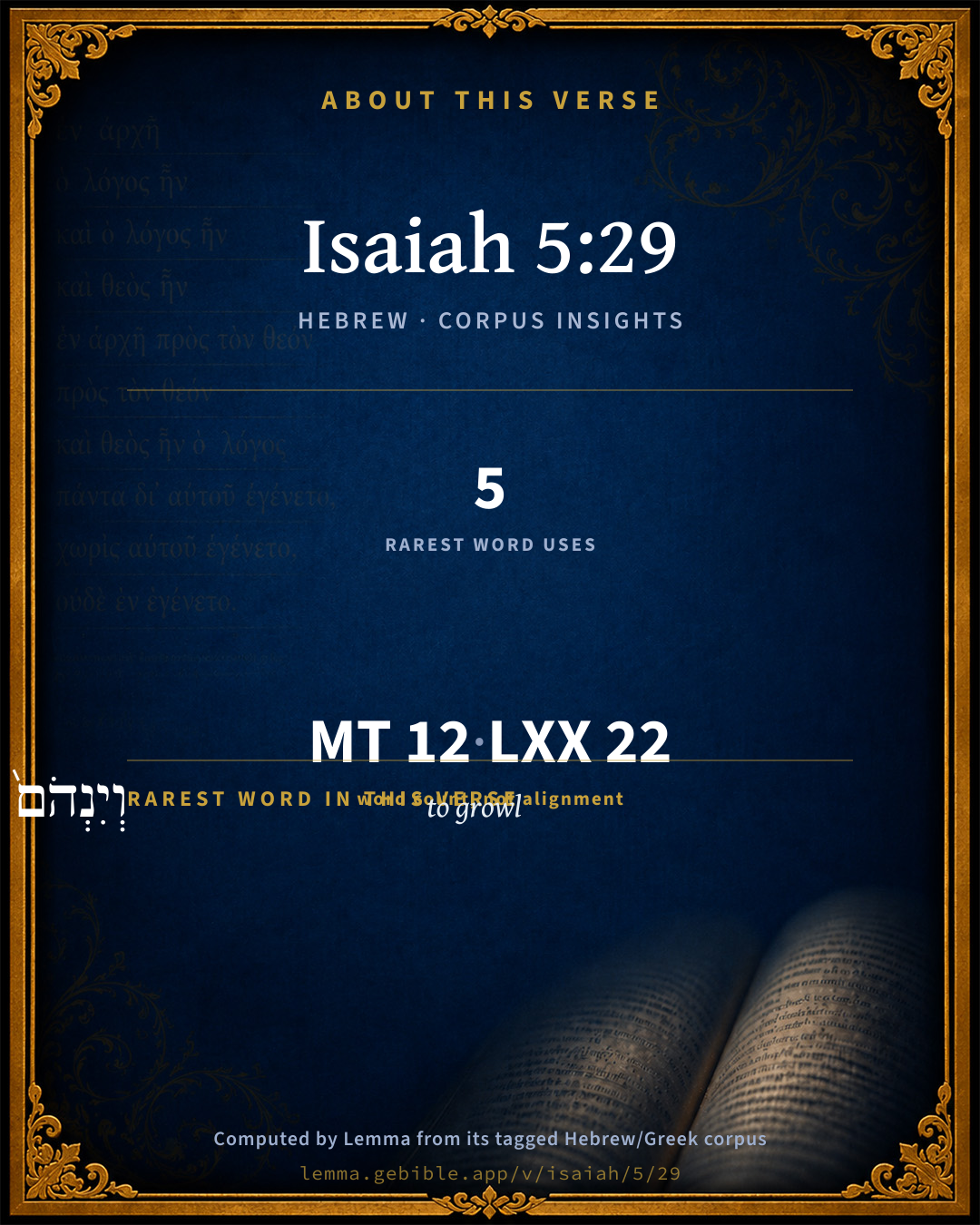
12
words
10
distinct lemmas
Prophets
section

Notable vocabulary

The rarest word here is וְיִנְהֹם֙ to growl H5098 — appearing just 5 times in the whole Hebrew Bible.

Shared distinctive vocabulary

וְיִנְהֹם֙ to growl H5098 occurs in 5 verses of the Hebrew Bible. Also found in:

Grammatical profile

  • 6 verbs
  • 4 nouns
  • 1 preposition
  • 1 particle

Verb forms

  • ושאג Qal · Sequential Perfect
  • יִשְׁאַ֨ג Qal · Imperfect
  • וְיִנְהֹם֙ Qal · Imperfect
  • וְיֹאחֵ֣ז Qal · Imperfect
  • וְיַפְלִ֖יט Hiphil · Imperfect
  • מַצִּֽיל Hiphil · Participle Active

Repetition

A word recurs within this verse — often emphatic in Hebrew:

  • ושאג to roar H7580 ×2

Hebrew & Septuagint length

In English translation the verse runs 33 words from the Hebrew and 35 from the Septuagint (LXX English) — closely comparable.

A rough comparison of the two English renderings, which tokenize alike — not a word-level alignment.

Word counts can differ between the Hebrew and the Greek without any difference in meaning — e.g. the Hebrew direct-object marker אֵת has no separate Greek word, and Greek often adds the article ὁ.

In the original languages it is 12 Hebrew tokens and 22 Greek tokens — but the two are counted differently (Hebrew bundles its prefixes and suffixes into one token; the Greek is in lemma form), so that isn’t a like-for-like length.

Cross-references

16

Topical passages linked to Isaiah 5:29 in the Treasury of Scripture Knowledge — connected by theme and wording, ordered by reader-vote popularity; previews shown in the World English Bible.

  • Isaiah 42:22 But this is a people robbed and plundered; they are all of them snared in holes, and they are hid in prison-houses: they are for a prey, and none delivers; for a spoil, and none says, Restore.
  • Isaiah 49:24–25 Shall the prey be taken from the mighty, or the lawful captives be delivered?
  • Micah 5:8 The remnant of Jacob will be among the nations, In the midst of many peoples, Like a lion among the animals of the forest, Like a young lion among the flocks of sheep; Who, if he goes through, treads down and tears in pieces, And there is no one to deliver.
  • Zechariah 11:3 A voice of the wailing of the shepherds! For their glory is destroyed: a voice of the roaring of young lions! For the pride of the Jordan is ruined.
  • Genesis 49:9 Judah is a lion's cub. From the prey, my son, you have gone up. He stooped down, he crouched as a lion, As a lioness. Who will rouse him up?
  • Numbers 24:9 He couched, he lay down as a lion, As a lioness; who shall rouse him up? Blessed be everyone who blesses you, Cursed be everyone who curses you.
  • Psalms 50:22 "Now consider this, you who forget God, Lest I tear you into pieces, and there be none to deliver.
  • Isaiah 10:6 I will send him against a profane nation, and against the people of my wrath will I give him a charge, to take the spoil, and to take the prey, and to tread them down like the mire of the streets.
  • Isaiah 31:4 For thus says Yahweh to me, As the lion and the young lion growling over his prey, if a multitude of shepherds are called forth against him, will not be dismayed at their voice, nor abase himself for the noise of them: so will Yahweh of Hosts come down to fight on Mount Zion, and on the hill of it.
  • Jeremiah 4:7 A lion is gone up from his thicket, and a destroyer of nations; he is on his way, he is gone forth from his place, to make your land desolate, that your cities be laid waste, without inhabitant.
  • Jeremiah 49:19 Behold, he shall come up like a lion from the pride of the Jordan against the strong habitation: for I will suddenly make them run away from it; and whoever is chosen, him will I appoint over it: for who is like me? and who will appoint me a time? and who is the shepherd who will stand before me?
  • Jeremiah 50:17 Israel is a hunted sheep; the lions have driven him away: first, the king of Assyria devoured him; and now at last Nebuchadrezzar king of Babylon has broken his bones.
  • Jeremiah 51:38 They shall roar together like young lions; they shall growl as lions' cubs.
  • Hosea 11:10 They will walk after Yahweh, Who will roar like a lion; For he will roar, and the children will come trembling from the west.
  • Amos 3:8 The lion has roared. Who will not fear? The Lord Yahweh has spoken. Who can but prophesy?
  • Zephaniah 3:3 Her princes in the midst of her are roaring lions. Her judges are evening wolves. They leave nothing until the next day.

Cross-references courtesy of OpenBible.info (CC BY 4.0).

Hebrew and Greek witnesses Masoretic Hebrew ↔ Greek Septuagint

The same verse in the two great witnesses to the Old Testament, shown verse-for-verse.

These are two independent witnesses, not word-aligned to each other, and the Septuagint is shown in lemma (dictionary) form.

Hebrew Isaiah 5:29 Masoretic · Westminster Leningrad Codex

שְׁאָגָ֥ה ל֖וֹ כַּלָּבִ֑יא ושאג יִשְׁאַ֨ג כַּכְּפִירִ֤ים וְיִנְהֹם֙ וְיֹאחֵ֣ז טֶ֔רֶף וְיַפְלִ֖יט וְאֵ֥ין מַצִּֽיל

Their roaring will be like a lioness. They will roar like young lions. Yes, they shall roar, And seize their prey and carry it off, And there will be no one to deliver.

World English Bible · Public Domain

Greek LXX Isaiah 5:29 Septuagint · lemma form

ὁρμάω ὡς λέων καί παραἵστημι ὡς σκύμνος λέων καί ἐπιλαμβάνω καί βοάω ὡς θηρίον καί ἐκβάλλω καί οὐ εἰμί ὁ ῥύομαι αὐτός

They rage as lions, and draw near as a lion's whelps: and he shall seize, and roar as a wild beast, and he shall cast them forth, and there shall be none to deliver them.

LXX2012 (modern English Septuagint) · Public Domain

Hebrew: Westminster Leningrad Codex (CC BY 4.0). Greek: Septuagint (public domain); English from LXX2012 (modern English Septuagint) (Public Domain). How the Septuagint differs from the Hebrew →

Targum (Aramaic paraphrase)

1

The Targum is the ancient Jewish Aramaic paraphrase of the Hebrew Scriptures — an interpretive translation, not the Hebrew text itself. Onkelos (literal) and Pseudo-Jonathan (expansive) render the Torah, and Jonathan the Prophets. Coverage is partial: where no permissively-licensed English translation exists for a verse, only the Aramaic is shown. This is verse-level text, not a word-by-word alignment to the Hebrew.

  1. Targum Jonathan Prophets (Joshua–Malachi)
    נִיהוֹמֵי לֵיהּ כַּאַרְיָא וְיִנְהוֹם כְּבַר אַרְיְוָן וְיַכְלֵי וְיֵחוֹד בִּזָא וִישֵׁיזֵיב וְלֵית דְמַצִיל:

    His roaring shall be like a lion, and he shall roar like a young lion, yea, he shall roar, and lay hold of the prey, and shall carry it away safe, and none shall deliver it.

    Targum Jonathan — Aramaic: “Mikraot Gedolot” (public domain). English: “Sefaria Community Translation” (CC0 1.0 (public-domain dedication)); “London "Chaldee Paraphrase," 1871” (public domain). Text via Sefaria.

Commentary

Notes on Isaiah 5:29 from classic Christian and Jewish commentators (each source and its license shown beneath its notes). The classic Christian expositions comment on the surrounding passage and are grouped to its opening verse, so a note may address several verses; the Jewish commentaries on the Tanakh (Rashi and others) are per-verse, so they appear only where the commentator wrote on this verse.

Lemma curates 59 commentaries, every one of them public domain or Creative Commons licensed, each selected and text-cleaned for this edition rather than reprinted as found. About our sources →

Trapp's Complete Commentary

John Trapp

Isa 5:29 Their roaring [shall be] like a lion, they shall roar like young lions: yea, they shall roar, and lay hold of the prey, and shall carry [it] away safe, and none shall deliver [it].

Ver. 29. Their roaring shall be like a lion.] At whose terrible roar the beasts of the field are said to stand as amazed.

They shall lay hold on the prey.] Not of wealth only, but of persons, and shall hold their own when they have gotten them.

John Trapp, A Commentary or Exposition upon All the Books of the Old and New Testament (1647–1656) — public domain. Text from a community e-Sword module.

Geneva Bible (1599)

Geneva Bible translators

Whereby is declared the cruelty of the enemy.

Geneva Bible (1599) marginal notes — public domain. Text via Bolls.life.

Jamieson, Fausset & Brown

Robert Jamieson, A. R. Fausset & David Brown

roaring--their battle cry.

Jamieson, Fausset & Brown — Commentary Critical and Explanatory on the Whole Bible (1871) — public domain (CC PDM 1.0). Text via the HelloAO Bible API.

The Cambridge Bible for Schools and Colleges

gen. ed. J. J. S. Perowne

29. Their roaring …] Or, he has a roar like that of a lioness, he roars like young lions and growls seizing the prey, &c. Two words are here used of the lion’s roar, the first is perhaps that uttered as he searches for prey, the second the low growl with which he springs on his victim.

The Cambridge Bible for Schools and Colleges (gen. ed. J. J. S. Perowne; Cambridge University Press, 1878–1918) — public domain. Text from a community e-Sword module.

John Gill's Exposition

Their roaring shall be like a lion,.... When engaged in war, just seizing on their prey. The phrase denotes their fierceness and cruelty, and the horror they should inject into the hearts of their enemies:

they shall roar like young lions; that are hungry, and almost famished, and in sight of their prey; see Job 4:10,

yea, they shall roar, and lay hold of the prey; seize it with great noise and greediness:

and shall carry it away safe; into their own den, the country from whence they come:

and none shall deliver it; this shows that respect is had; not to the Babylonish captivity, from whence there was a deliverance in a few years; but the Roman captivity, from thence there is no deliverance as yet to this day.

John Gill's Exposition of the Whole Bible (1746–1763) — public domain (CC PDM 1.0). Text via the HelloAO Bible API.

Albert Barnes' Notes on the Bible

Their roaring ... - Their battle cry, or their shout as they enter into an engagement. Such a “shout,” or cry, was common at the commencement of a battle. War was very much a personal conflict; and they expected to accomplish much by making it as frightful and terrible as possible. A shout served not only to excite their own spirits, but to produce an impression of their numbers and courage, and to send dismay into the opposite ranks. Such “shouts” are almost always mentioned by Homer, and by other writers, in their accounts of battles. They are often mentioned, also, in the Old Testament; Exo 32:18; Jos 6:10, Jos 6:16, Jos 6:20; Jer 50:15; 1Sa 17:20, 1Sa 17:52; 2Ch 13:15; Job 39:25.

Like a lion - This comparison is common in the Bible; Jer 51:38; Hos 11:10; Amo 3:4; compare Num 23:24.

Like young lions - This variation of the expression, from the lion to the young lion, is very common. It is the Hebrew form of poetry, where the second member expresses little more than the first. Here the description is that of a lion, or more probably a “lioness” and her whelps, all ravenous, and all uniting in roaring for prey. The idea is, that the army that would come up would be greedy of plunder; they would rush on to rapine in a frightful manner.

Albert Barnes' Notes on the Bible (1834–1885) — public domain. Text from a community e-Sword/MySword module.

Haydock's Catholic Bible Commentary

Lion. Nabuchodonosor is compared to one, ver. 26., and Jeremias iv. 7.

George Leo Haydock (1774–1849), Haydock's Catholic Family Bible and Commentary, 1859 edition — public domain. Excludes Psalms (Douay-Rheims chapter numbering differs from Protestant) and Deuterocanonical books (Catholic canon only).

Matthew Poole's English Annotations

They shall roar like young lions; which signifies both their cruelty, and their greediness and eagerness to catch and devour the prey.

None; neither the Jews themselves, nor the Egyptians, to whose help they will trust, nor any of their confederates.

Matthew Poole's English Annotations on the Holy Bible (1683–1685) — public domain. Text from a community e-Sword/MySword module.

The Pulpit Commentary

Their roaring shall be like a lion; rather, like a lioness, which the Hebrews appear to have regarded as fiercer than a lion. (see Gen_44:9 Num_24:9 Hab_2:11) The Assyrian armies probably advanced to the combat with loud shouts and yells. (see Jer_2:15) Yea, they shall roar; rather, growl. The word is different from the one used previously, and may express the "deep growl" with which the lion springs upon his prey (see Dr. Kay"s note, ad loc.). Shall carry it away safe. Sennacherib says in one of his inscriptions, that he carried off to Nineveh 200, 150 captives on his first expedition against Jerusalem (Oppert, "Inscriptions des Sargonides," pp. 45, 46).

The Pulpit Commentary (1880–1919), ed. H.D.M. Spence-Jones & Joseph S. Exell — public domain. Text from a community e-Sword module.

John Wesley's Explanatory Notes

Roar - Which signifies both their cruelty, and their eagerness to devour the prey.

John Wesley, Explanatory Notes Upon the Whole Bible (1754–1765) — public domain. Text via the GEBible commentary corpus.

Keil & Delitzsch

C. F. Keil & F. Delitzsch

"Roaring issues from it as from the lioness: it roars like lions, and utters a low murmur; seizes the prey, carries it off, and no one rescues." The futures, with the preceding לו שׁאגה which is equivalent to a future, hold each feature in the description fast, as if for prolonged contemplation. The lion roars when eager for prey; and such is now the war-cry of the bloodthirsty enemy, which the prophet compares to the roaring of a lion or of young lions (Cephirim) in the fulness of their strength. (The lion is described by its poetic name, לביא; this does not exactly apply to the lioness, which would rather be designated by the term לביּה.) The roar is succeeded by a low growl (nâham, fremere), when a lion is preparing to fall upon its prey.

(Note: In Arabic, en-nehem is used to signify greediness (see Ali's Proverbs, No. 16).)

And so the prophet hears a low and ominous murmur in the army, which is now ready for battle. But he also sees immediately afterwards how the enemy seizes its booty and carries it irrecoverably away: literally, "how he causes it to escape," i.e., not "lets it slip in cruel sport," as Luzzatto interprets it, but carries it to a place of safety (Mic 6:14). The prey referred to is Judah. It also adds to the gloomy and mysterious character of the prophecy, that the prophet never mentions Judah. In the following v. also (Isa 5:30) the object is still suppressed, as if the prophet could not let it pass his lips.

Keil & Delitzsch — Biblical Commentary on the Old Testament (1861–1891) — public domain (CC PDM 1.0). Text via the HelloAO Bible API. (Old Testament only.)

J. A. Alexander on Isaiah

Joseph Addison Alexander

By a sudden transition, the enemy are here represented as lions, roaring, growling, seizing their prey, and carrying it off without resistance; a lively picture, especially to an oriental reader, of the boldness, fierceness, quickness, and success of the attack here threatened. “He has a roar like the lioness, and he shall roar like the young lions, and shall growl, and seize the prey, and secure it, none delivering (i.e., and none can rescue it).”

Joseph Addison Alexander, The Prophecies of Isaiah (1846–1847; New York: Scribner, 1870–1878) — public domain. Text from a community e-Sword module.

unfoldingWord translationNotes

Door43 World Missions Community

General Information:

Isaiah continues to describe the army that will attack Judah. (See: Isaiah 05:26)

Their roaring will be like a lion; they will roar like young lions

Both of these phrases mean basically the same thing. Isaiah compares the enemy army to a lion to imply how the sound of their attack will cause the people of Judah to be very afraid. AT: "When their army shouts in battle they will sound like a roaring lion" (See: Parallelism and Simile)

young lions

A young age is a metonym for strength. AT: "the strongest lions" (See: Metonymy)

They will growl and seize the prey

Isaiah compares the enemy killing the people of Judah to a lion killing a weaker animal. Possible meanings are 1) lions make a sound not as loud as a roar just before they strike, or 2) the writer is using two words to mean the same thing. (See: Metaphor and Doublet)

prey

animals that another animal wants to catch and kill

with none to rescue

"and no one will be able to save them"

will roar ... sea roars

These are the same word translated "growl" in verse 29. Use your language's word for the sound of waves in a storm or heavy rain or some other frightening natural sound.

even the light will be made dark by the clouds

Here darkness represents suffering and disaster. This metaphor can be stated in active form. AT: "the dark clouds will completely block the light of the sun" (See: Metaphor and Active or Passive)

translationWords

day of the Lord

darkness

light

unfoldingWord translationNotes — © Distant Shores Media and the Door43 World Missions Community, licensed CC BY-SA 4.0. Source: git.door43.org/Door43/en_tn.

Rashi

Rabbi Shlomo Yitzchaki (Rashi)

He has a roar like a lion His fear will be upon you like a lion.

and he will retrieve He will save it from all those who try to save it. יַפְלִיט is esmoucer in O.F. [to seize].

Rashi on the Tanakh — English translations: “The Judaica Press complete Tanach with Rashi, translated by A. J. Rosenberg” (CC BY 4.0); “Pentateuch with Rashi's commentary by M. Rosenbaum and A.M. Silbermann, 1929-1934” (public domain); “The Metsudah Tanach series, Lakewood, N.J” (CC BY 4.0); and “The Book of Joshua, Metsudah Publications, 1997” (CC BY 4.0). Text via Sefaria.

Ibn Ezra

Rabbi Abraham ibn Ezra

וינהום And he shall roar. Irregular form; because regularly the guttural letter widens the vowel, and causes the form of the future to be like,יִפְעַל the second radical of the verb פעל being a guttural; in the conjugation tables, however, no notice is taken of this property, else we should not have in the paradigm the standard form of the future ויפליט

יִפְצוֹל And he lets escape. He lets escape the prey, as I think, in order to see whether there is any one to deliver it.

Ibn Ezra on the Tanakh — English translations: “Sefaria Community Translation” (CC0 1.0 (public-domain dedication)); “Yalkut, Sifsei Chachomim Chumash, Metsudah Publications, 2009” (CC BY 4.0); and “Commentary of Ibn Ezra on Isaiah - trans. by M. Friedlander, 1873” (public domain). Text via Sefaria.

Lesson kit

Teaching starters — assembled from the data on this page, not authored interpretation. Every prompt links to the verse data it draws on. Edit before teaching.

Isaiah, in the Prophets, opens this verse with 12 words (10 distinct Hebrew lemmas). Its most distinctive word is nâham (“to growl”). A historical commentator’s framing appears above. Read the whole chapter for the surrounding context.

Discussion questions

  1. What does “to growl” (nâham) contribute to the verse as a whole?
  2. How does Proverbs 5:11, which shares the word «to growl», read alongside this verse?
  3. What does the repetition of “to roar” (2× in this one verse) do in this verse?
  4. These translations render this verse differently. What is at stake in choosing one wording over another?
  5. «ושאג» is a Qal Sequential Perfect verb. How does that grammatical form shape the action described?
  6. Compare how Trapp's Complete Commentary and Geneva Bible (1599) read this verse. Where do they agree or differ?

Things to notice

Reading settings

Reading text

Shown beneath each verse's original-language words.

Old Testament
Old Testament edition

Read the OT as the Masoretic Hebrew (MT) or the Greek Septuagint (LXX).

English shown for the Greek Septuagint (in the Hebrew ↔ Greek comparison).

Comparing translations? Open the Compare panel on any verse page to stack up to four side by side.