2 Kings 18:34

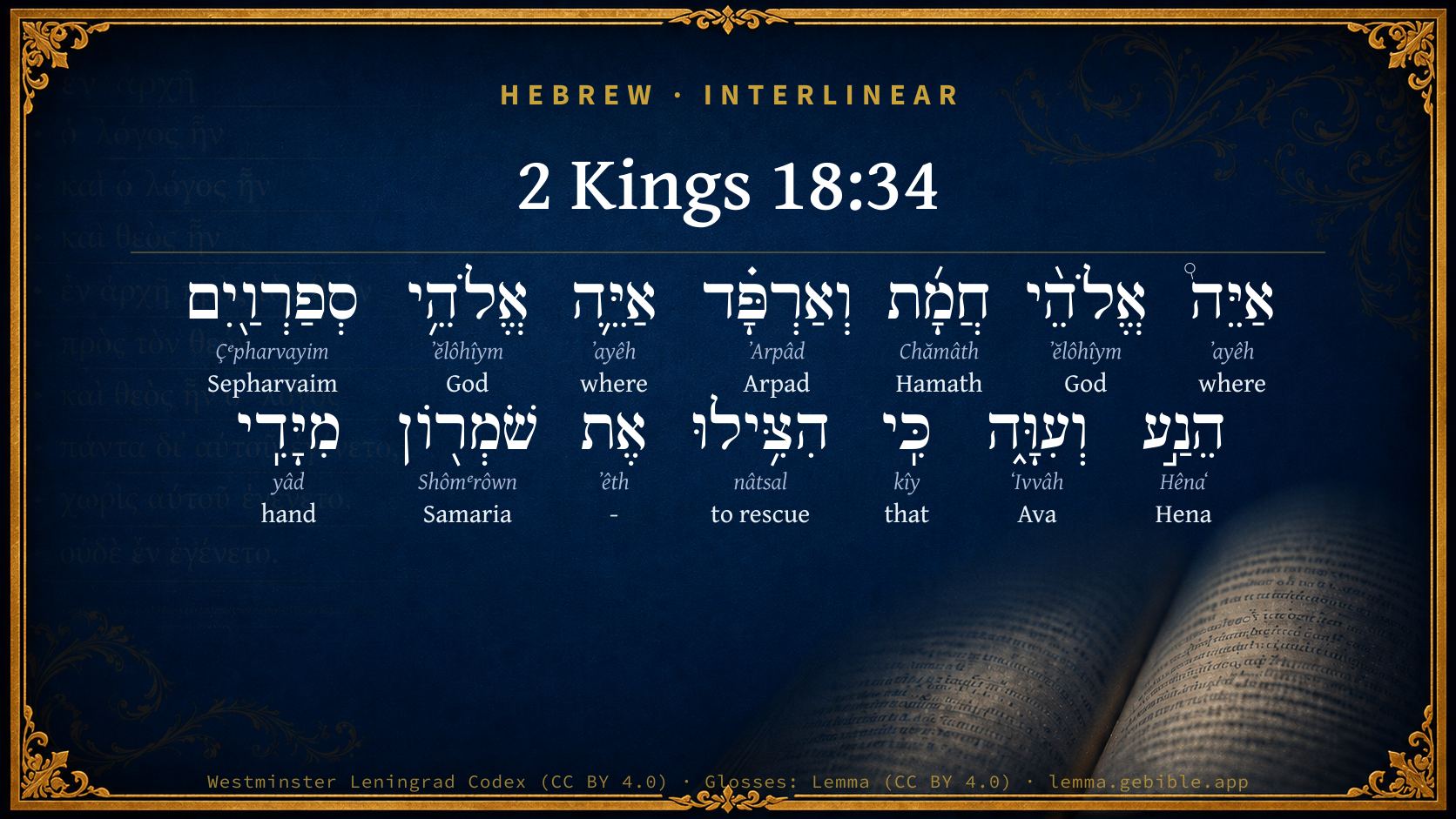
Hebrew (Westminster Leningrad Codex) 2 Kings 18:34 appears in the Hebrew Old Testament. The text above is from the Westminster Leningrad Codex. Each word links to its Strong’s number, a concise gloss, and parsing drawn from the Open Scriptures Hebrew Bible morphology. Click any word for its full Brown-Driver-Briggs (BDB) entry.
Download image
Cite this verse

2 Kings 18:34 (World English Bible). Public Domain. Lemma interlinear Bible study tool, https://lemma.gebible.app/v/2-kings/18/34.

Show BibTeX & RIS
BibTeX
RIS
English Translation
Where are the gods of Hamath, and of Arpad? where are the gods of Sepharvaim, of Hena, and Ivvah? have they delivered Samaria out of my hand?
World English Bible · Public Domain
Highlights
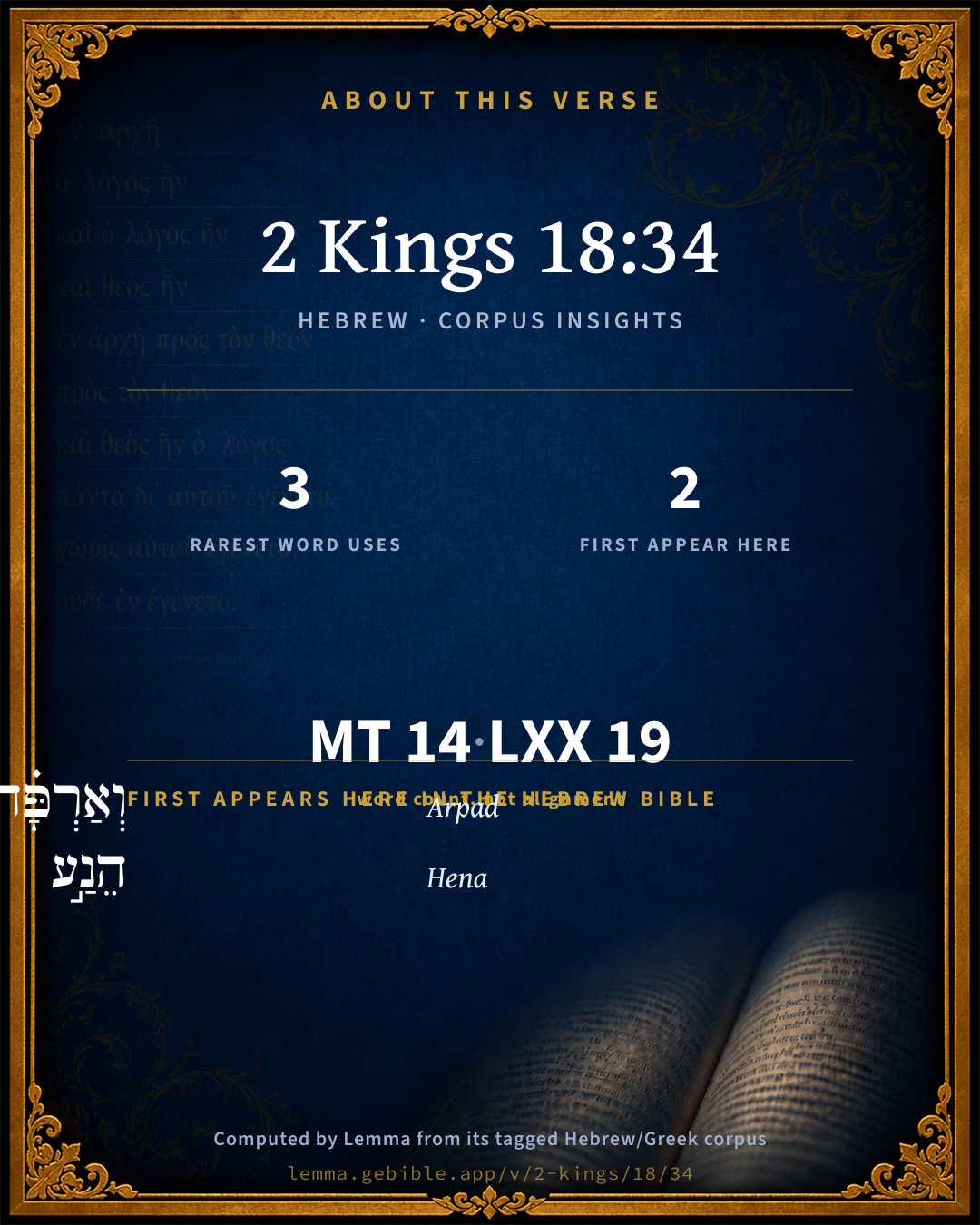
  • 2 first appearances in the Hebrew Bible
Full analysis ↓
Download a study sheet

One document with this verse’s original text, its word-by-word gloss line, the meaning frame, cross-references with their text, attributed commentary, and full source and license credits — printable, and it pastes into notes with its structure intact.

This verse Autodidact and up

Study sheet (.html) Plain text (.txt)

A passage Seminary Student

Up to 50 verses in one chapter. A passage sheet keeps up to 6 commentary sources and 12 cross-references per verse, in the order this page ranks them, and says so on the sheet whenever that leaves anything out. Ask for a single verse and you get the Autodidact verse sheet above.

Everything on this page stays free to read, with no account — the sheet is a download of what is already on screen, not access to it.

Want to remove ads? Support Godless Engineer
Compare translations 3

The same verse in 3 English versions, stacked beneath the original-language interlinear above. Click any original word for its lexicon entry.

Each is an independent rendering of the whole verse — the interlinear is not word-aligned to these translations.

Highlighted words mark where these versions differ — a whole-verse word diff, not a word-by-word alignment.

  • World English Bible Public Domain
    Where are the gods of Hamath, and of Arpad? where are the gods of Sepharvaim, of Hena, and Ivvah? have they delivered Samaria out of my hand?
  • King James Version Public Domain
    Where are the gods of Hamath, and of Arpad? where are the gods of Sepharvaim, Hena, and Ivah? have they delivered Samaria out of mine hand?
  • unfoldingWord Literal Text CC BY-SA 4.0
    Where the gods of Hamath and Arpad? Where the gods of Sepharvaim, Hena, and Ivvah? Indeed, did they deliver Samaria from my hand?

unfoldingWord Literal Text — © unfoldingWord, licensed CC BY-SA 4.0. Word-aligned USFM3 via Door43 (git.door43.org/unfoldingWord/en_ult).

Versions to compare (up to 4)

3 of 4 selected

Show all 18 translations

Every available English version of this verse, each an independent rendering of the whole verse.

  • World English Bible Public Domain
    Where are the gods of Hamath, and of Arpad? where are the gods of Sepharvaim, of Hena, and Ivvah? have they delivered Samaria out of my hand?
  • Berean Standard Bible Public Domain
    Where are the gods of Hamath and Arpad? Where are the gods of Sepharvaim, Hena, and Ivvah? Have they delivered Samaria from my hand?
  • Majority Standard Bible Public Domain
    Where are the gods of Hamath and Arpad? Where are the gods of Sepharvaim, Hena, and Ivvah? Have they delivered Samaria from my hand?
  • King James Version Public Domain
    Where are the gods of Hamath, and of Arpad? where are the gods of Sepharvaim, Hena, and Ivah? have they delivered Samaria out of mine hand?
  • American Standard Version (1901) Public Domain
    Where are the gods of Hamath, and of Arpad? where are the gods of Sepharvaim, of Hena, and Ivvah? have they delivered Samaria out of my hand?
  • Revised Version (1885) Public Domain
    Where are the gods of Hamath, and of Arpad? where are the gods of Sepharvaim, of Hena, and Ivvah? have they delivered Samaria out of my hand?
  • Geneva Bible (1599) Public Domain
    Where is the god of Hamah, and of Arpad? where is the god of Sepharuaim, Hena and Iuah? how haue they deliuered Samaria out of mine hand?
  • Douay-Rheims (1899) Public Domain
    Where is the god of Emath, end of Arphad? where is the god of Sepharvaim, of Ana, and of Ava? have they delivered Samaria out of my hand?
  • Young's Literal Translation Public Domain
    Where `are' the gods of Hamath and Arpad? where the gods of Sepharvaim, Hena, and Ivvah, that they have delivered Samaria out of my hand?
  • Literal Standard Version CC BY-SA 4.0
    Where [are] the gods of Hamath and Arpad? Where [are] the gods of Sepharvaim, Hena, and Ivvah, that they have delivered Samaria out of my hand?
  • Unlocked Literal Bible CC BY-SA 4.0
    Where are the gods of Hamath and Arpad? Where are the gods of Sepharvaim, Hena, and Ivvah? Have they rescued Samaria out of my hand?
  • unfoldingWord Literal Text CC BY-SA 4.0
    Where the gods of Hamath and Arpad? Where the gods of Sepharvaim, Hena, and Ivvah? Indeed, did they deliver Samaria from my hand?
  • Darby Bible Public Domain
    Where are the gods of Hamath and of Arpad? Where are the gods of Sepharvaim, Hena, and Ivvah? and have they delivered Samaria out of my hand?
  • World Messianic Bible Public Domain
    Where are the gods of Hamath and of Arpad? Where are the gods of Sepharvaim, of Hena, and Ivvah? Have they delivered Samaria out of my hand?
  • Webster's Bible Public Domain
    Where are the gods of Hamath, and of Arpad? where are the gods of Sepharvaim, Hena, and Ivah? have they delivered Samaria out of my hand?
  • Free Bible Version CC BY-SA 4.0
    Where were the gods of Hamath and Arpad? Where were the gods of Sepharvaim, Hena, and Ivvah? Were they able to save Samaria from me?
  • Bible in Basic English Public Domain
    Where are the gods of Hamath and of Arpad? where are the gods of Sepharvaim, of Hena and Ivvah? have they kept Samaria out of my hands?
  • JPS Tanakh (1917) Public Domain
    Where are the gods of Hamath, and of Arpad? where are the gods of Sepharvaim, of Hena, and Ivvah? have they delivered Samaria out of my hand?

Literal Standard Version (2020), Covenant Press — licensed CC BY-SA 4.0. Text via the HelloAO Bible API (eBible.org). Unlocked Literal Bible (unfoldingWord) — licensed CC BY-SA 4.0. Text via the HelloAO Bible API (eBible.org). unfoldingWord Literal Text — © unfoldingWord, licensed CC BY-SA 4.0. Word-aligned USFM3 via Door43 (git.door43.org/unfoldingWord/en_ult). Free Bible Version, Dr. Jonathan Gallagher — licensed CC BY-SA 4.0. Text via the HelloAO Bible API (eBible.org).

Word by word

More ways to search: Search by grammar → Find every occurrence → Compare this word →

Practice this passage: Drill this verse → Learn its vocabulary →

הֵנַ֣ע
Hênaʻ
H2012
“Hena”
Noun, Proper
Part of Speech
Noun
Type
Proper
Full BDB Definition

Origin: probably of foreign derivation

TWOT: None

Hena = "troubling" - a city in Mesopotamia which the Assyrian kings reduced shortly before the time of Sennacherib; site unknown
  1. אַיֵּה֩ ʼayêh H346 “where” Particle, Interrogative
  2. אֱלֹהֵ֨י ʼĕlôhîym H430 “God(s) of” Noun, Common, Masculine, Plural, Construct
  3. חֲמָ֜ת Chămâth H2574 “Hamath” Noun, Proper
  4. וְאַרְפָּ֗ד ʼArpâd H774 “and · Arpad” Conjunction + Noun, Proper
  5. אַיֵּ֛ה ʼayêh H346 “where” Particle, Interrogative
  6. אֱלֹהֵ֥י ʼĕlôhîym H430 “God(s) of” Noun, Common, Masculine, Plural, Construct
  7. סְפַרְוַ֖יִם Çᵉpharvayim H5617 “Sepharvaim” Noun, Proper
  8. וְעִוָּ֑ה ʻIvvâh H5755 “and · Ava” Conjunction + Noun, Proper
  9. כִּֽי kîy H3588 “that” Conjunction
  10. הִצִּ֥ילוּ nâtsal H5337 “to rescue” Verb, Hiphil, Perfect, 3rd Person, Common, Plural
  11. אֶת ʼêth H853 “-” Particle, Direct Object
  12. שֹׁמְר֖וֹן Shômᵉrôwn H8111 “Samaria” Noun, Proper
  13. מִיָּדִֽי yâd H3027 “from · hand · my” Preposition + Noun, Common, Both, Singular, Construct + Suffix, Personal, 1st Person, Common, Singular

About this verse

These counts appear in no published source. They are computed here, from the morphology-tagged text and Lemma’s own curated glosses. What Lemma adds →

14
words
12
distinct lemmas
Historical
section

Notable vocabulary

The rarest word here is הֵנַ֣ע Hena H2012 — appearing just 3 times in the whole Hebrew Bible.

First appearance in Scripture

These words make their first canonical appearance in the Hebrew Bible here:

  • וְאַרְפָּ֗ד Arpad H774
  • הֵנַ֣ע Hena H2012

Shared distinctive vocabulary

הֵנַ֣ע Hena H2012 occurs in 3 verses of the Hebrew Bible. Also found in:

Grammatical profile

  • 1 verb
  • 9 nouns
  • 1 conjunction
  • 3 particles

Verb forms

  • הִצִּ֥ילוּ Hiphil · Perfect

Repetition

Words recur within this verse — often emphatic in Hebrew:

  • אַיֵּה֩ where H346 ×2
  • אֱלֹהֵ֨י God H430 ×2

Hebrew & Septuagint length

In English translation the verse runs 27 words from the Hebrew and 27 from the Septuagint (LXX English) — the same length.

A rough comparison of the two English renderings, which tokenize alike — not a word-level alignment.

Word counts can differ between the Hebrew and the Greek without any difference in meaning — e.g. the Hebrew direct-object marker אֵת has no separate Greek word, and Greek often adds the article ὁ.

In the original languages it is 14 Hebrew tokens and 19 Greek tokens — but the two are counted differently (Hebrew bundles its prefixes and suffixes into one token; the Greek is in lemma form), so that isn’t a like-for-like length.

Cross-references

10

Topical passages linked to 2 Kings 18:34 in the Treasury of Scripture Knowledge — connected by theme and wording, ordered by reader-vote popularity; previews shown in the World English Bible.

  • Isaiah 10:9 Isn't Calno as Carchemish? Isn't Hamath as Arpad? Isn't Samaria as Damascus?
  • Numbers 13:21 So they went up, and spied out the land from the wilderness of Zin to Rehob, to the entrance of Hamath.
  • 2 Samuel 8:9 When Toi king of Hamath heard that David had struck all the host of Hadadezer,
  • 2 Kings 17:6 In the ninth year of Hoshea the king of Assyria took Samaria, and carried Israel away to Assyria, and placed them in Halah, and on the Habor, the river of Gozan, and in the cities of the Medes.
  • 2 Kings 17:23–33 until Yahweh removed Israel out of his sight, as he spoke by all his servants the prophets. So Israel was carried away out of their own land to Assyria to this day.
  • 2 Kings 19:12–13 Have the gods of the nations delivered them, which my fathers have destroyed, Gozan, and Haran, and Rezeph, and the children of Eden that were in Telassar?
  • Isaiah 36:18–19 Beware lest Hezekiah persuade you, saying, Yahweh will deliver us. Has any of the gods of the nations delivered his land out of the hand of the king of Assyria?
  • Isaiah 37:11–12 Behold, you have heard what the kings of Assyria have done to all lands, by destroying them utterly: and shall you be delivered?
  • Isaiah 37:18–19 Of a truth, Yahweh, the kings of Assyria have laid waste all the countries, and their land,
  • Jeremiah 49:23 Of Damascus. Hamath is confounded, and Arpad; for they have heard evil news, they are melted away: there is sorrow on the sea; it can't be quiet.

Cross-references courtesy of OpenBible.info (CC BY 4.0).

Hebrew and Greek witnesses Masoretic Hebrew ↔ Greek Septuagint

The same verse in the two great witnesses to the Old Testament, shown verse-for-verse.

These are two independent witnesses, not word-aligned to each other, and the Septuagint is shown in lemma (dictionary) form.

Hebrew 2 Kings 18:34 Masoretic · Westminster Leningrad Codex

אַיֵּה֩ אֱלֹהֵ֨י חֲמָ֜ת וְאַרְפָּ֗ד אַיֵּ֛ה אֱלֹהֵ֥י סְפַרְוַ֖יִם הֵנַ֣ע וְעִוָּ֑ה כִּֽי הִצִּ֥ילוּ אֶת שֹׁמְר֖וֹן מִיָּדִֽי

Where are the gods of Hamath, and of Arpad? where are the gods of Sepharvaim, of Hena, and Ivvah? have they delivered Samaria out of my hand?

World English Bible · Public Domain

Greek LXX 2 Kings 18:34 Septuagint · lemma form

ποῦ εἰμί ὁ θεός αιμαθ καί αρφαδ ποῦ εἰμί ὁ θεός σεπφαρουαιν καί ὅτι ἐκαἱρέω σαμαρεία ἐκ χείρ ἐγώ

Where is the god of Haemath, and of Arphad? where is the god of Seppharvaim, Ana, and Aba? for have they delivered Samaria out of my hand?

LXX2012 (modern English Septuagint) · Public Domain

On this verse, Ellicott's Commentary for English Readers discusses the Septuagint’s reading. Read the note in Commentary ↓

Hebrew: Westminster Leningrad Codex (CC BY 4.0). Greek: Septuagint (public domain); English from LXX2012 (modern English Septuagint) (Public Domain). How the Septuagint differs from the Hebrew →

Targum (Aramaic paraphrase)

1

The Targum is the ancient Jewish Aramaic paraphrase of the Hebrew Scriptures — an interpretive translation, not the Hebrew text itself. Onkelos (literal) and Pseudo-Jonathan (expansive) render the Torah, and Jonathan the Prophets. Coverage is partial: where no permissively-licensed English translation exists for a verse, only the Aramaic is shown. This is verse-level text, not a word-by-word alignment to the Hebrew.

  1. Targum Jonathan Prophets (Joshua–Malachi)
    אָן דַחֲלַת חֲמַת וְאַרְפַּד וְאָן דַחֲלַת סְפַרְוַיִם הֲלָא טַלְטִילוּנוּן וְאַגְלִיאוּנוּן אֲרֵי שֵׁיזְבוּ יַת שֹׁמְרוֹן מִן יְדָי:

    (no public-domain English translation for this verse)

    Targum Jonathan — Aramaic: “Mikraot Gedolot” (public domain). English: “Sefaria Community Translation” (CC0 1.0 (public-domain dedication)); “London "Chaldee Paraphrase," 1871” (public domain). Text via Sefaria.

Commentary

Notes on 2 Kings 18:34 from classic Christian and Jewish commentators (each source and its license shown beneath its notes). The classic Christian expositions comment on the surrounding passage and are grouped to its opening verse, so a note may address several verses; the Jewish commentaries on the Tanakh (Rashi and others) are per-verse, so they appear only where the commentator wrote on this verse.

Lemma curates 59 commentaries, every one of them public domain or Creative Commons licensed, each selected and text-cleaned for this edition rather than reprinted as found. About our sources →

Trapp's Complete Commentary

John Trapp

2Ki 18:34 Where [are] the gods of Hamath, and of Arpad? where [are] the gods of Sepharvaim, Hena, and Ivah? have they delivered Samaria out of mine hand?

Ver. 34. Where are the gods?] Os ferreum! This is a most insolent insultation, and might well become an Aiax flagellifer, who knew no god but his own weapons.

Have they delivered?] i.e., Have the gods of Samaria?

John Trapp, A Commentary or Exposition upon All the Books of the Old and New Testament (1647–1656) — public domain. Text from a community e-Sword module.

Joseph Benson's Commentary

2Ki 18:34-35. Where are the gods of Hamath and of Arpad? — These were cities or countries which the kings of Assyria had conquered, as were the other places here mentioned. And therefore Rab-shakeh argued that the gods of Assyria were more powerful than the gods of any other nation. Who are they, among all the gods of the countries, &c. — He desires them to produce an instance of one god that had been able to save his country, when his master invaded it. And by this he endeavours to persuade them, that it would be their wisdom to deliver up their city to him, insomuch as their God would not be able to preserve it, unless he could do more than any other god had done; which he concluded was unlikely.

Joseph Benson's Commentary on the Old and New Testaments (1811–1818) — public domain. Text from a community e-Sword module.

Adam Clarke's Commentary

Verse 34. Where are the gods of Hamath] Sennacherib is greater than any of the gods of the nations. The Assyrians have already overthrown the gods of Hamath, Arpad, Hena, and Ivah; therefore, Jehovah shall be like one of them, and shall not be able to deliver Jerusalem out of the hand of my master.

The impudent blasphemy of this speech is without parallel. Hezekiah treated it as he ought: it was not properly against him, but against the LORD; therefore he refers the matter to Jehovah himself, who punishes this blasphemy in the most signal manner.

Adam Clarke's Commentary on the Bible (1810–1826) — public domain. Text from a community e-Sword/MySword module.

Ellicott's Commentary for English Readers

(34) Where are the gods of Hamath, and of Arpad?—Sargon, Sennacherib’s father, had reduced these two cities. The reference to “my fathers” in 2Ki_19:12, and the use of the general term, “the king of Assyria” (2Ki_18:33), are against Schrader’s supposition that the historian has confused the campaigns of Sargon with those of Sennacherib. (Comp. 2Ki_17:24; 2Ki_17:30.) Sargon has recorded that Ya-u-bi-h-di, king of the Hamathites, induced Arpad, Simyra, Damascus, and Samaria to join his revolt against Assyria. The confederacy was defeated at Qarqar, and Yahubihdi taken and flayed alive (B.C. 720).

Arpad.—Tell-Erfâd, about ten miles north of Aleppo. The question, “Where are the gods?” &c, may imply that they had been annihilated along with their temples and statues. (Comp. Job_14:10.) Sometimes, indeed, the Assyrians carried off the idols of conquered nations, but this need not have been an invariable practice, and Isa_10:11 seems to imply that they were sometimes destroyed, as was likely to be the case when a city was taken by storm, and committed to the flames.

Sepharvaim.—See on 2Ki_17:24. This city revolted with Babylon against Sargon at the beginning of his reign. No account of its fall has been preserved.

Hena, and Ivah.—These names do not occur in Isaiah, and are wholly unknown. The words look like two Hebrew verbs (“He hath caused to wander, and overturned”), as at present vocalised; and the Targum translates them as a question: “Have they not made them wander, and carried them away?” Hoffmann thinks the two words are really one (the niphal participle of ‘av’av), and should be rendered as an epithet of Sepharvaim, “the utterly perverted;” a nickname given it by the Assyrians, because of its follyin revolting again after its former subjugation. But the mention of Ava and the Avites (2Ki_17:24; 2Ki_17:31) is in favour of the same proper name here, and the LXX., Syriac, Arabic, and Vulg. agree with this. (The Syriac reads Avva, as in chap. 7:24.)

Have they delivered Samaria . . .?—Rather, How much less have they (i.e., its gods) delivered Samaria out of mine hand! So Ewald, Gram., § 256. The Syriac, Vulg., and Arabic render as the Authorised Version. Perhaps the original reading was not kȋ; but hakî: “Is it the case that they have delivered?” &c. (Job_6:22).

Out of mine hand?—Sennacherib speaks as if he were one with his father, a circumstance which lends some support to the suggestion of Schrader, that the successive Assyrian invasions were not kept quite distinct in the Hebrew tradition. If so, the year 714 B.C. , assigned as the date of the present expedition (2Ki_18:13), may really be that of an earlier expedition under Sargon, who, in fact, invaded the West in 720, 715, and 711 (or 709) B.C.

A Bible Commentary for English Readers, edited by Charles John Ellicott (1878–1897) — public domain. Text from a community e-Sword module.

The Cambridge Bible for Schools and Colleges

gen. ed. J. J. S. Perowne

34. gods of Hamath, and of Arpad] Of Hamath, see above on 2Ki_17:24. Arpad is always spoken of in connexion with Hamath, but the site of the place has not been determined, nor any trace of the name found except in the Bible (2Ki_19:13; Jer_49:23; Isa_10:9; Isa_36:19; Isa_37:13). In the two last-named places A.V. writes the word Arphad, and the same spelling is found 2Es_9:26 as a various reading for Ardath. From the passage in Jeremiah above quoted it is manifest that like Hamath, it belonged to Damascus, for it is included in the prophecy concerning that city. The chief god of Damascus was Rimmon.

the gods of Sepharvaim] See above, on 2Ki_17:31.

Hena] The LXX. represents the name by Ἀνὰ. From the combination of the gods of Sepharvaim with those of the other two places here mentioned, we should gather that the worship in all three was the same. This gives support to the conjecture which identifies Hena with Ana, a city not far from Sepharvaim. Other opinions favour the identification of the place with Anat, an island in the Euphrates, near its union with the Khabour. This also would be not very remote from Sepharvaim.

and Ivah] R.V. Ivvah. This place is supposed to be the same with Ava (R.V. Avvah) in 2Ki_17:24 above, where see note. If it be identified, as has been suggested, with Ahava, all the three places lie close together. ‘Hena’ and ‘Ivah’ are omitted from the parallel passage in Isaiah.

have they delivered Samaria] Among the gods of the countries, the gods of Samaria have been in Rab-shakeh’s thoughts though he has not expressly spoken of them. But here, as if he had done so, he asks: Have they delivered Samaria?

The Cambridge Bible for Schools and Colleges (gen. ed. J. J. S. Perowne; Cambridge University Press, 1878–1918) — public domain. Text from a community e-Sword module.

Albert Barnes' Notes on the Bible

Arpad was situated somewhere in southern Syria; but it is impossible to fix its exact position. Sargon mentions it in an inscription as joining with Hamath in an act of rebellion, which he chastised. It was probably the capture and destruction of these two cities on this occasion which caused them to be mentioned together here (and in 2Ki 19:13, and again in Isa 10:9). Sennacherib adduces late examples of the inability of the nations’ gods to protect their cities. On the other cities mentioned in this verse, see 2Ki 17:24 notes.

Albert Barnes' Notes on the Bible (1834–1885) — public domain. Text from a community e-Sword/MySword module.

Haydock's Catholic Bible Commentary

CHAPTER XVIII.

Emath, Emesa. --- Arphad, or Arad, an island and city on the continent, (Calmet) near Tyre. --- Of Ana, &c. , "of," is not expressed in the Vulgate, (Haydock) and it may be explained as if Ana and Ava were idols of Sepharvaim. (Menochius) --- But they are commonly supposed to be cities. (Haydock) --- Ana is probably a city (Du Hamel) built on both sides of the Euphrates, four days’ journey from Bagdat. Isaias does not specify these cities in the parallel passage, but they are found in the letter addressed to Ezechias, Isaias xxxvii. 13. --- Samaria, or the inhabitants who had come from distant parts, and had perhaps revolted. We do not however find the Sennacherib had conquered them, nor does the pretend that all these conquests were made by himself. (Calmet) --- He gives part of the honour to his ancestors, chap. xix. 12., and 2 Paralipomenon xxxii. 13. But he asserts that all the gods of the respective countries of Samaria, &c., had yielded to his superior force. (Haydock) --- Strange infatuation in a man who looked upon the idols as gods! They are in effect nothing, 1 Corinthians viii. 4. But as their votaries were of a different persuasion, ought they not to have acted and spoken consistently? Yet Suetonius (Caius, c. 5.) informs us, that "on the day when Germanicus died, the temples were stoned, the altars of the gods overturned, the domestic lares thrown out by some into the open air;" all to express their grief and indignation at the gods, for not preserving his life. (Haydock)

George Leo Haydock (1774–1849), Haydock's Catholic Family Bible and Commentary, 1859 edition — public domain. Excludes Psalms (Douay-Rheims chapter numbering differs from Protestant) and Deuterocanonical books (Catholic canon only).

Matthew Poole's English Annotations

Hamath and Arpad; of which see Jer 49:23.

Sepharvaim; of which see 2Ki 17:21.

Hena and Ivah; the names, either,

1. Of idol gods. But why should only these two be named, and not the gods of the other places here mentioned? Or rather,

2. Of cities or countries, as is manifest from 2Ki 19:13, where those words are repeated among other places, whose kings are there mentioned, and where they are rendered, of Hena and Ivah, as they should be here also, the words in the Hebrew being the very same.

Have they delivered Samaria? i.e.

1. Either the gods here mentioned, which, together with other idols, were worshipped in Samaria. Or,

2. Their gods; which is easily understood from the foregoing words.

Matthew Poole's English Annotations on the Holy Bible (1683–1685) — public domain. Text from a community e-Sword/MySword module.

Whedon's Commentary on the Bible

Daniel D. Whedon

34. On Hamath, Sepharvaim, and Ivah, see notes on 2Ki_17:24. From the frequent association of Arpad with Hamath (2Ki_19:13; Isa_10:9; Isa_36:19; Isa_37:13; Jer_49:23) it is probable that it was not far from that city, and is, perhaps, identical with Arfad in Northern Syria. The site of Hena has not been identified with certainty. It is usually supposed to have been in Mesopotamia. Some find it in a town on the Euphrates called Anah, and the Assyrian inscriptions mention a town called Anat, on an island in the Euphrates.

Daniel D. Whedon (gen. ed.), Commentary on the Old and New Testaments (1874–1909) — public domain. Text from a community e-Sword module.

The Pulpit Commentary

Where are the gods of Hamath, and of Arpad? Hamath and Arpad had been recently conquered (about B.C. 720) by Sargon (see the "Epouym Canon," pp. 126-128). Of the latter city but little is known, net even its site. We find it generally connected with Damascus (Jer_49:23; "Eponym Canon," pp. 68, 126) and Hamath, (2Ki_19:13; Isa_10:9 Isa_36:19 Isa_37:13; Jer_49:23; "Eponym Canon," p. 126) and may conjecture that it lay between them, either in Coele-Syria or in the Anti-Libanus. (On Hamath, see the commentary upon 2Ki_14:25; and for its special god, Ashima, see that on 2Ki_17:30) Where are the gods of Sepharvaim, Hens, and Ivah? . (On the cities and gods of Sepharvaim and Ivah (or Ava), see the comment on 2Ki_17:24, 2Ki_17:31) "Hena," mentioned always with Sepharvaim and Ivah (2Ki_19:13; Isa_38:13) is probably Allah on the Euphrates, about seventy miles above Hit (Ivah). Nothing is known of its gods. Probably Sepharvaim, Hena, and Ivah had rebelled in conjunction, and been reconquered at no distant date. Sargon mentions in his annals that he besieged and took Sepharvaim (Sippara) in his twelfth year (B.C. 710). Have they delivered Samaria out of mine hand? There is probably some compression of the original narrative here. The meaning is, "Have they delivered their several cities, or has the god of Samaria delivered his city out of my hand?" No god had hitherto delivered any city which the Assyrians had attacked.

The Pulpit Commentary (1880–1919), ed. H.D.M. Spence-Jones & Joseph S. Exell — public domain. Text from a community e-Sword module.

Rashi

Rabbi Shlomo Yitzchaki (Rashi)

He exiled them and twisted them. The King of Ashur, destroyed them and exiled them.

Did they save Shomron. And the inhabitants of Shomron worshiped the gods of the Aromeans, who were their neighbors.

Rashi on the Tanakh — English translations: “The Judaica Press complete Tanach with Rashi, translated by A. J. Rosenberg” (CC BY 4.0); “Pentateuch with Rashi's commentary by M. Rosenbaum and A.M. Silbermann, 1929-1934” (public domain); “The Metsudah Tanach series, Lakewood, N.J” (CC BY 4.0); and “The Book of Joshua, Metsudah Publications, 1997” (CC BY 4.0). Text via Sefaria.

Lesson kit

Teaching starters — assembled from the data on this page, not authored interpretation. Every prompt links to the verse data it draws on. Edit before teaching.

2 Kings, in the Historical, opens this verse with 14 words (12 distinct Hebrew lemmas). Its most distinctive word is Hênaʻ (“Hena”). A historical commentator’s framing appears above. Read the whole chapter for the surrounding context.

Discussion questions

  1. The word Hênaʻ carries the sense “Hena.” How does it shape the verse?
  2. 2 words here appear for the first time in Scripture. What is being introduced at this debut?
  3. 2 Kings 19:13 shares the word «Hena» with this verse. How do the two illuminate each other?
  4. “where” occurs 2× in this one verse. What is the effect of the repetition?
  5. These translations render this verse differently. What is at stake in choosing one wording over another?
  6. The verb «הִצִּ֥ילוּ» is Hiphil Perfect. How does its form color the action?
  7. Reading how Trapp's Complete Commentary and Joseph Benson's Commentary read this verse, where do the two commentators agree and where do they part?

Things to notice

Reading settings

Reading text

Shown beneath each verse's original-language words.

Old Testament
Old Testament edition

Read the OT as the Masoretic Hebrew (MT) or the Greek Septuagint (LXX).

English shown for the Greek Septuagint (in the Hebrew ↔ Greek comparison).

Comparing translations? Open the Compare panel on any verse page to stack up to four side by side.